Early Cities and States
Begin
14 pages · ~28 min
Early Cities and States
Explore the emergence of early cities and states, analyzing their development and structure for history students and enthusiasts.
What you’ll learn
- 01The Rise of Early Cities and StatesWelcome. Today we're going to explore one of the most profound transformations in human history: the rise of the first cities and states. Our story begins about six thousand years ago, when people started moving from kinship-based villages, where everyone knew everyone else, into large, anonymous, and often deeply unequal urban centers. This shift raises some fascinating questions. What exactly turns a big village into a city? And what transforms a community organized by family ties into a state ruled by laws and armies? Archaeologists and historians don't just accept simple answers to these questions. They piece together evidence from artifacts, building foundations, ancient writing, and even the layout of streets to understand how this change unfolded. To do that, we'll travel across the globe, from Mesopotamia and Egypt to the Indus Valley, China, Mesoamerica, and the Andes. We'll compare different regions and consider multiple explanations for why this happened. Let's begin with the background and the world before cities.link.springer.comassets.cambridge.organnualreviews.org+21 min
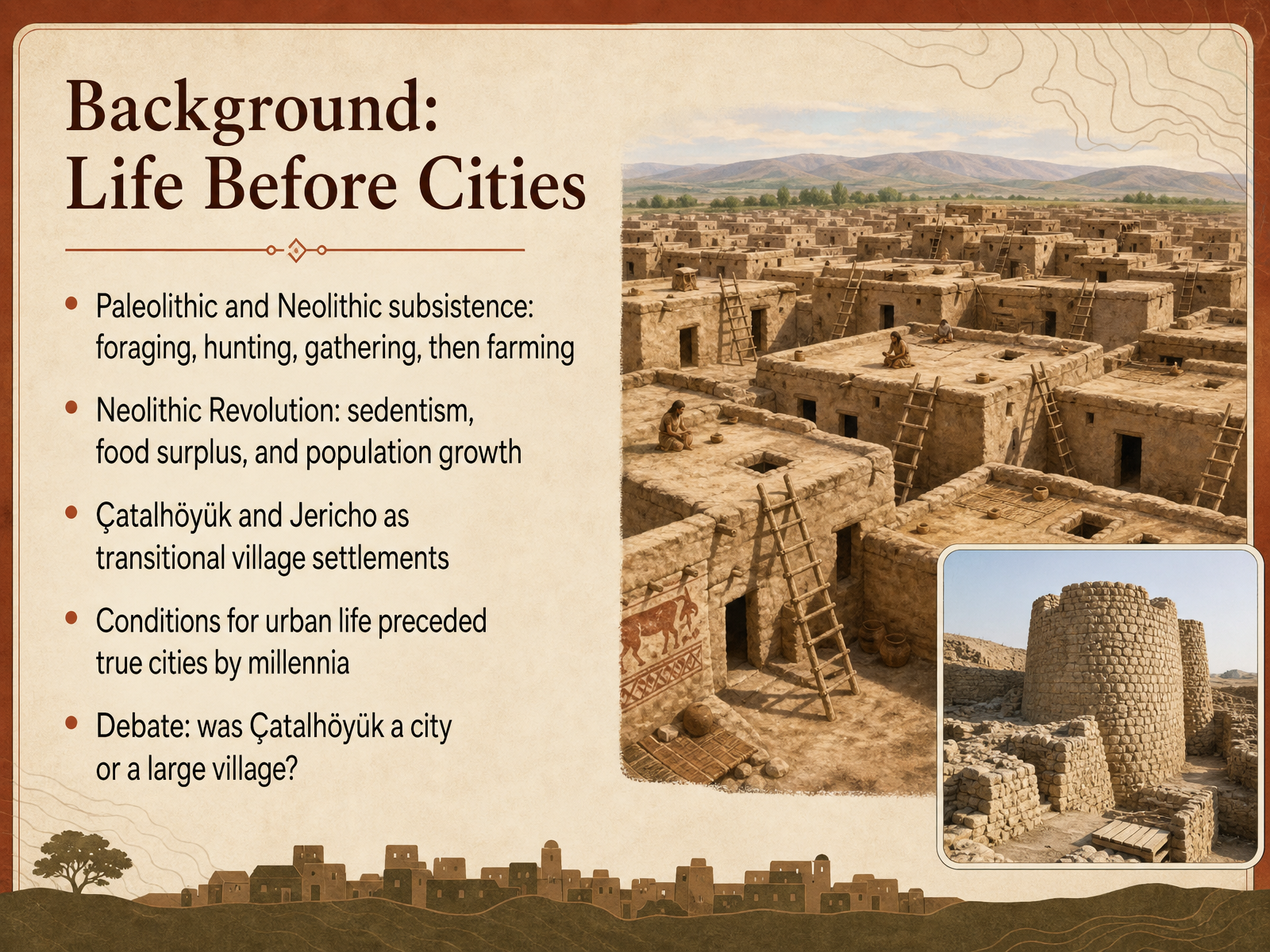
- 02Background: Life Before CitiesNow, let's step back to a time before cities and states existed. For most of human history, people lived by foraging, hunting, and gathering. That changed gradually with what we call the Neolithic Revolution, when communities began to settle down, grow crops, and raise animals. Settling in one place allowed food surpluses to build up, and populations began to grow. Sites like Çatalhöyük in central Turkey and Jericho in the Levant give us a glimpse of these transitional village settlements. Çatalhöyük, for example, was home to several thousand people at its peak, with houses packed closely together and entered through the roof. But here is the important point: these conditions for urban life developed thousands of years before what most archaeologists would call true cities. In fact, there is still lively debate about whether Çatalhöyük was a city or simply a very large village. It lacked clear central authority, major social inequality, and specialized labor on a large scale. So, it helps us see the foundations being laid, even while the idea of the city itself was still taking shape. Next, we will move into some core concepts that help define what makes a city and a state.
 annualreviews.orgwhc.unesco.orgcatalhoyuk.ku.edu.tr+22 min
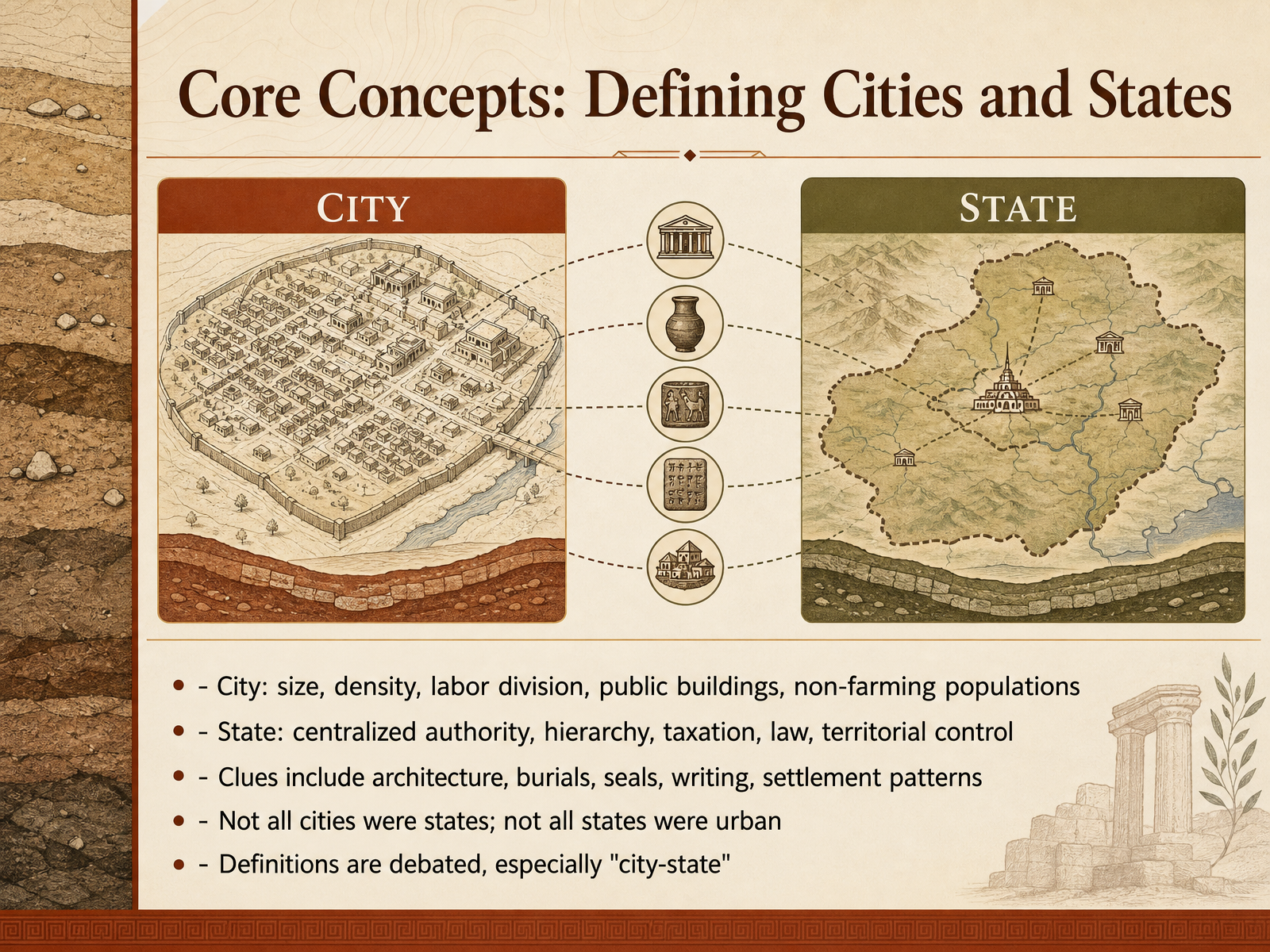
 - 03Core Concepts: Defining Cities and StatesBefore we look at particular places, we should get comfortable with two central terms: cities and states. For a city, archaeologists generally look for a combination of features. These include larger and denser settlement than the surrounding countryside, a division of labor with many people who do not farm, public buildings, and signs of social differentiation. A state, by contrast, is a form of political organization. It involves centralized authority, hierarchy, taxation, law, and control over a defined territory. So a city is, in essence, a kind of place, while a state is a kind of power structure. Archaeologists infer both from material clues, such as monumental architecture, burial differences, seals, writing, and settlement patterns. This distinction matters, because cities and states did not always go together. Some cities existed without full state organization, and some early states were not strongly urban. Scholars also continue to debate labels like city-state, which is useful but slippery. The important point is that these are analytical tools for comparison, not checklists that every ancient society must satisfy. Next, we will turn to the major theories that try to explain why cities and states emerged at all.
 faculty.washington.eduliverpooluniversitypress.co.ukbritannica.com+22 min
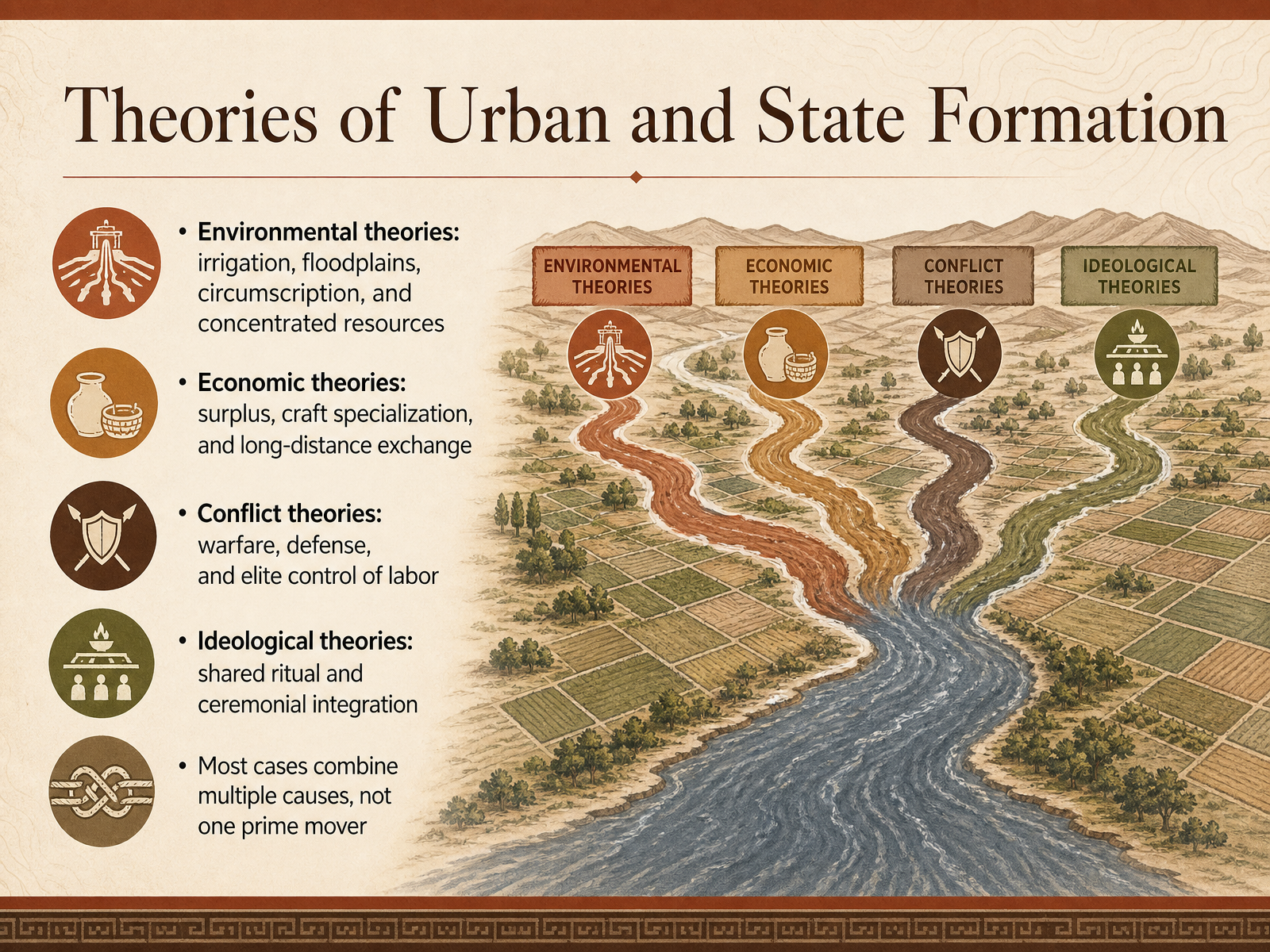
 - 04Theories of Urban and State FormationHow did clusters of villages become cities and states? Scholars have proposed several kinds of answers, and they tend to group into four broad families of explanation. First, environmental theories focus on landscapes that concentrate resources, such as river floodplains, irrigation systems, or areas hemmed in by mountains or deserts. The idea is that certain environments encouraged larger cooperative projects and made it harder for people to simply leave. Second, economic theories point to growing surpluses, craft specialization, and long-distance exchange, which created new wealth and new needs for coordination. Third, conflict theories emphasize warfare, defense, and the ability of emerging elites to organize labor and control rivals. Fourth, ideological theories highlight shared ritual and ceremonial integration, where common beliefs and public ceremonies helped bind larger communities together. In practice, archaeologists now generally agree that no single cause explains every early city or state. Most cases combined several of these forces. Climate, trade, ritual, and competition usually worked together, though their mix varied from place to place. That integrated view will be especially useful as we look next at how researchers actually study these early urban societies.
 pmc.ncbi.nlm.nih.govcambridge.orgpmc.ncbi.nlm.nih.gov+22 min
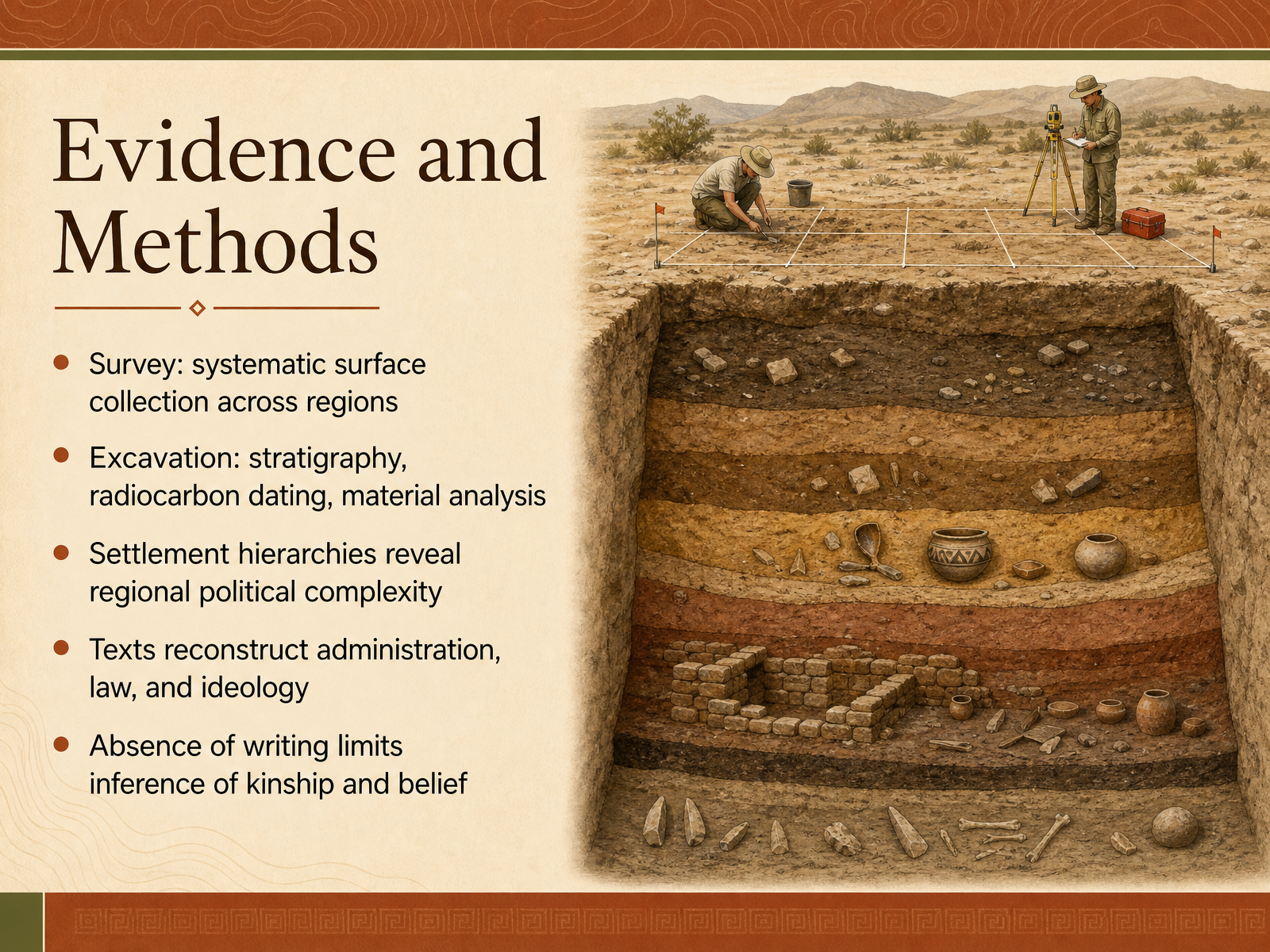
 - 05Evidence and MethodsSo how do we actually know what life was like in these early cities and states? Let's look at the methods and evidence. One major tool is regional survey, where archaeologists systematically walk across the landscape and collect material from the surface. This helps them map settlement sizes and distributions across whole regions. When those settlement patterns show clear differences in scale, like a large urban center surrounded by smaller towns and villages, that hierarchy suggests growing political complexity. Excavation then adds depth. By carefully digging through layers, or stratigraphy, and using techniques like radiocarbon dating, researchers can establish chronology and analyze the materials people used every day. Where writing exists, texts become another window, offering clues about administration, law, and official ideology. But we also have to be careful. In places without written records, it is much harder to reconstruct kinship systems or religious beliefs. The evidence we have shapes the questions we can answer. Next, we turn to a famous case study: Mesopotamia and the first cities.
 journals.uchicago.edu1 min
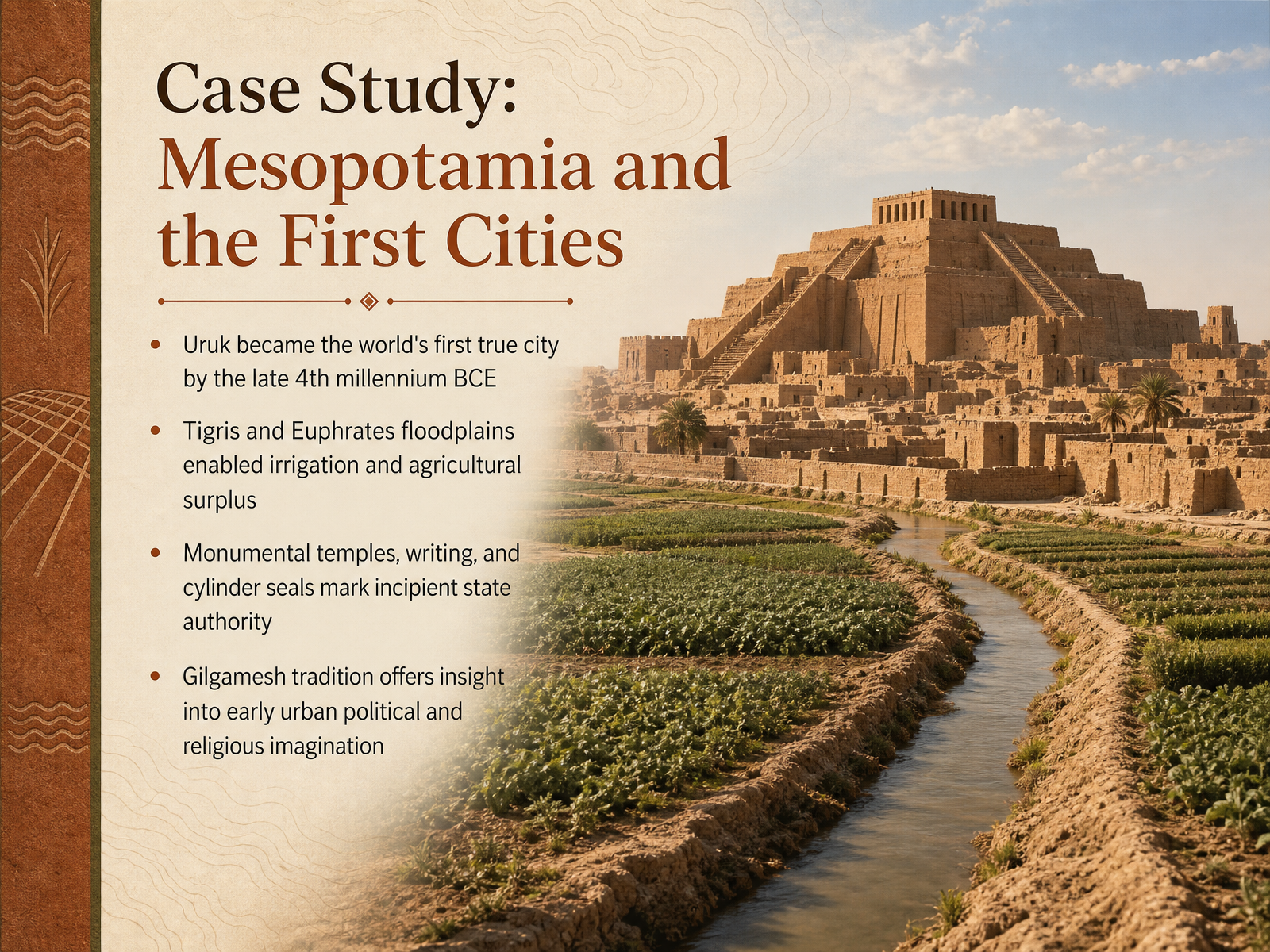
 - 06Case Study: Mesopotamia and the First CitiesLet us turn now to Mesopotamia, where we find one of the most compelling examples of early urban life: Uruk. By the late fourth millennium BCE, Uruk had grown into what many scholars consider the world's first true city. Its rise was made possible by the Tigris and Euphrates floodplains, where irrigation allowed communities to produce a reliable agricultural surplus. That surplus supported people who were not farmers, including priests, craftspeople, and administrators. At Uruk we also see monumental temples, the earliest known writing, and cylinder seals used to mark ownership and authority. These are all signs of an emerging state structure. The later stories of Gilgamesh, remembered as a king of Uruk, give us a glimpse into how early city dwellers imagined power, friendship, and the divine. Even though the epic is legendary, it reflects the real concerns of an urban society still learning how to govern itself. This Mesopotamian case helps us see cities not just as places, but as new kinds of communities. Next, we will compare this pattern with Egypt, the Indus, and China.
 link.springer.comassets.cambridge.organnualreviews.org+22 min
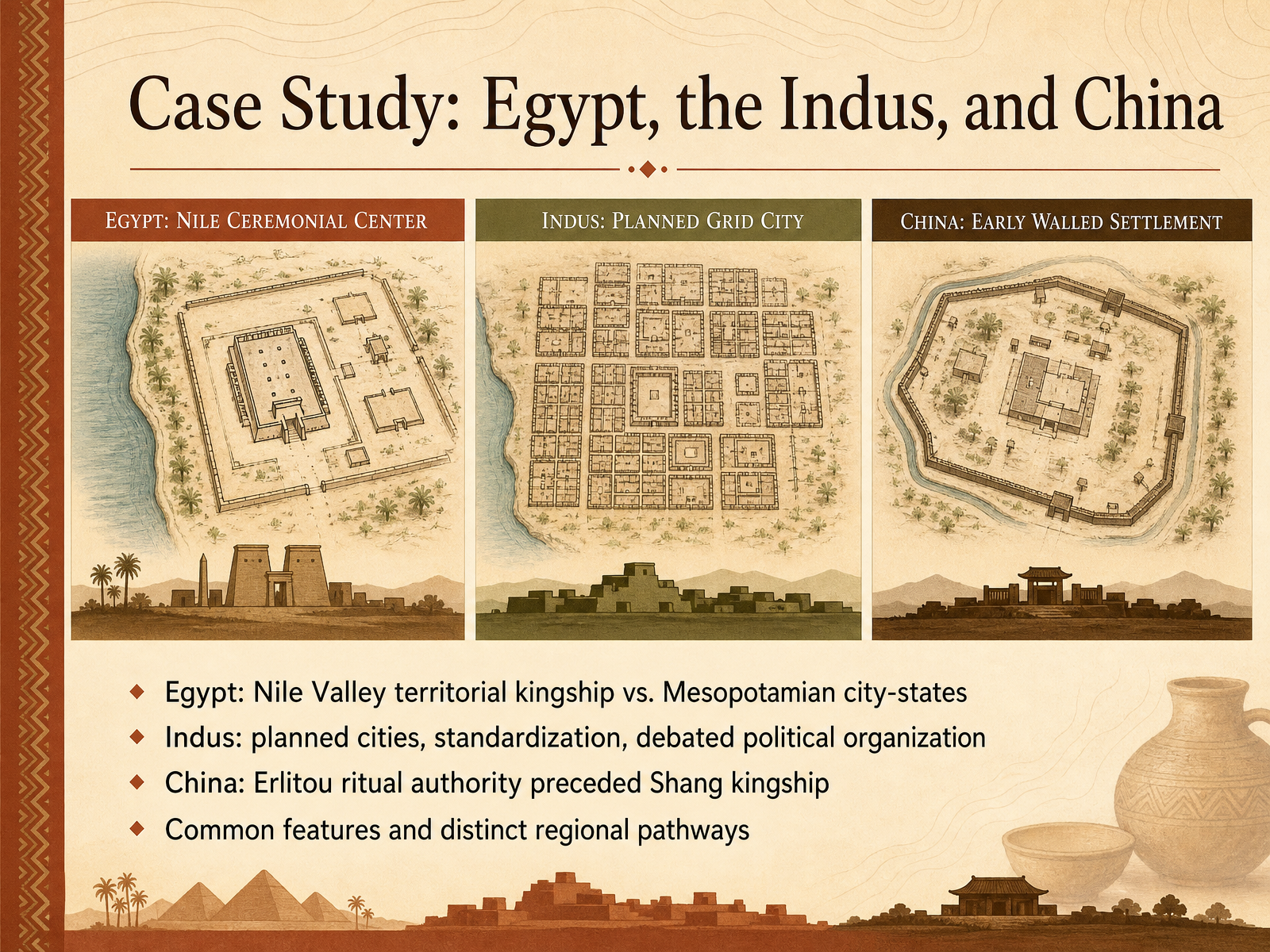
 - 07Case Study: Egypt, the Indus, and ChinaWhen we compare Egypt, the Indus Valley, and China, the big lesson is that early states did not follow one single script. Egypt took a territorial path. Power was tied to the Nile landscape and to kingship over a unified land, which is very different from the city state model we saw in Mesopotamia. The Indus civilization offers a striking contrast. We see planned cities, standardized bricks, and clear attention to urban order. Yet archaeologists still debate how political authority actually worked there, because we have not found the same clear royal symbols we see in Egypt or Mesopotamia. China gives us another pathway. At Erlitou, ritual authority and shared religious practices helped create a new political order before the better known Shang kings consolidated their rule. So as we look across these three cases, we find common threads, like growing social complexity and urban centers, but also distinct regional experiments in living together at a larger scale. That idea of distinct pathways will carry us naturally into our next case study, Mesoamerica and the Andes.
 link.springer.comassets.cambridge.organnualreviews.org+22 min
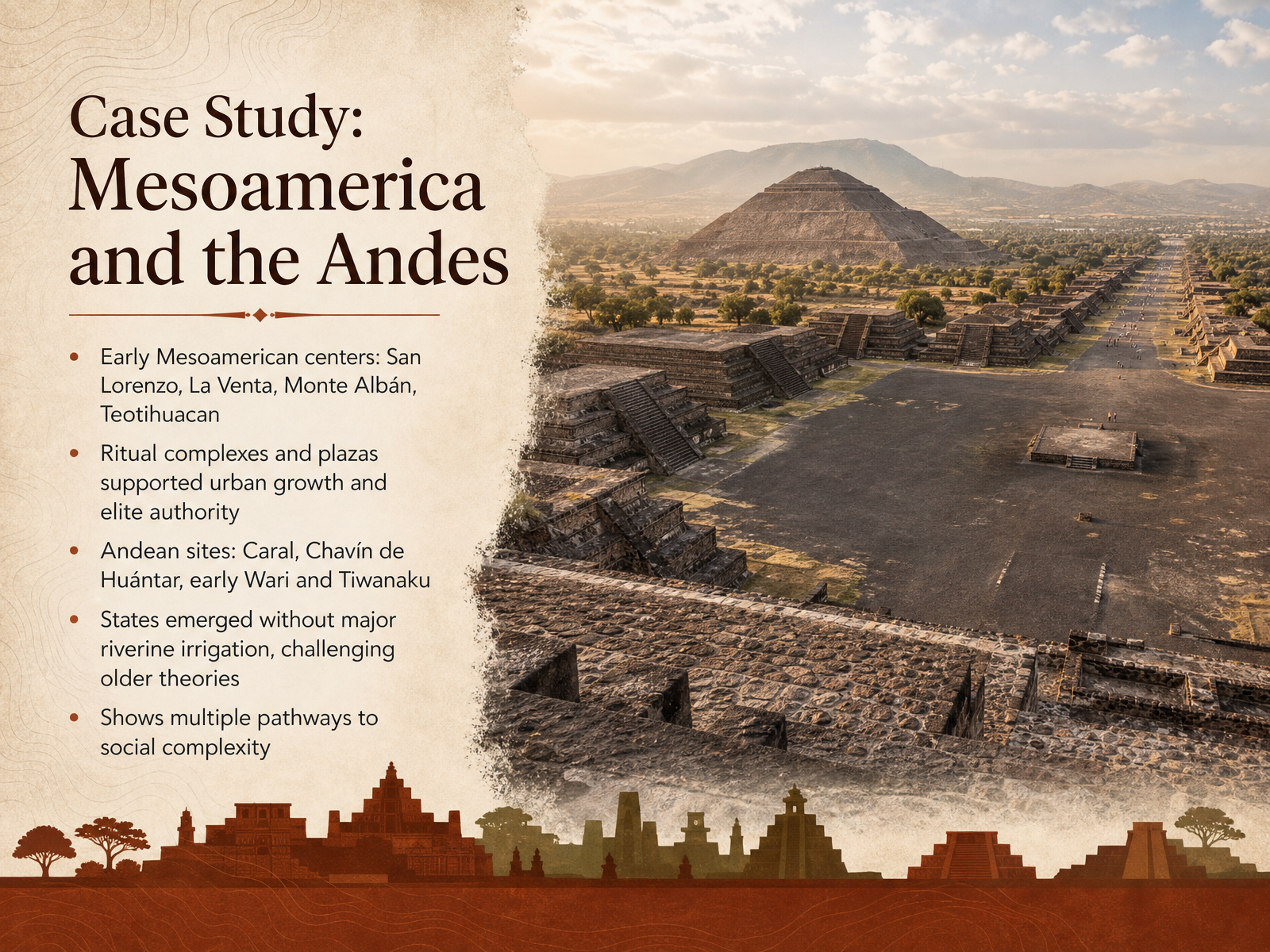
 - 08Case Study: Mesoamerica and the AndesNow let's look across the Americas, where early cities and states took their own distinct paths. In Mesoamerica, centers like San Lorenzo, La Venta, Monte Albán, and Teotihuacan grew around ritual complexes and large plazas. These public spaces did more than host ceremonies. They helped concentrate people, coordinate labor, and reinforce the authority of emerging elites. In the Andes, sites like Caral and Chavín de Huántar show a similarly early move toward monumentality and urban life, followed later by Wari and Tiwanaku. What makes these cases especially important is that complex societies emerged without the kind of large riverine irrigation systems once thought necessary for state formation. Older theories often tied early states closely to centralized water management, but here we see alternative foundations, including ritual, trade, and regional competition. This reminds us that social complexity rarely follows a single formula. Different environments and histories could produce cities and states through multiple pathways. With that in mind, let's turn to the next slide and consider the consequences of cities and states.
 pmc.ncbi.nlm.nih.govcambridge.orgpmc.ncbi.nlm.nih.gov+22 min
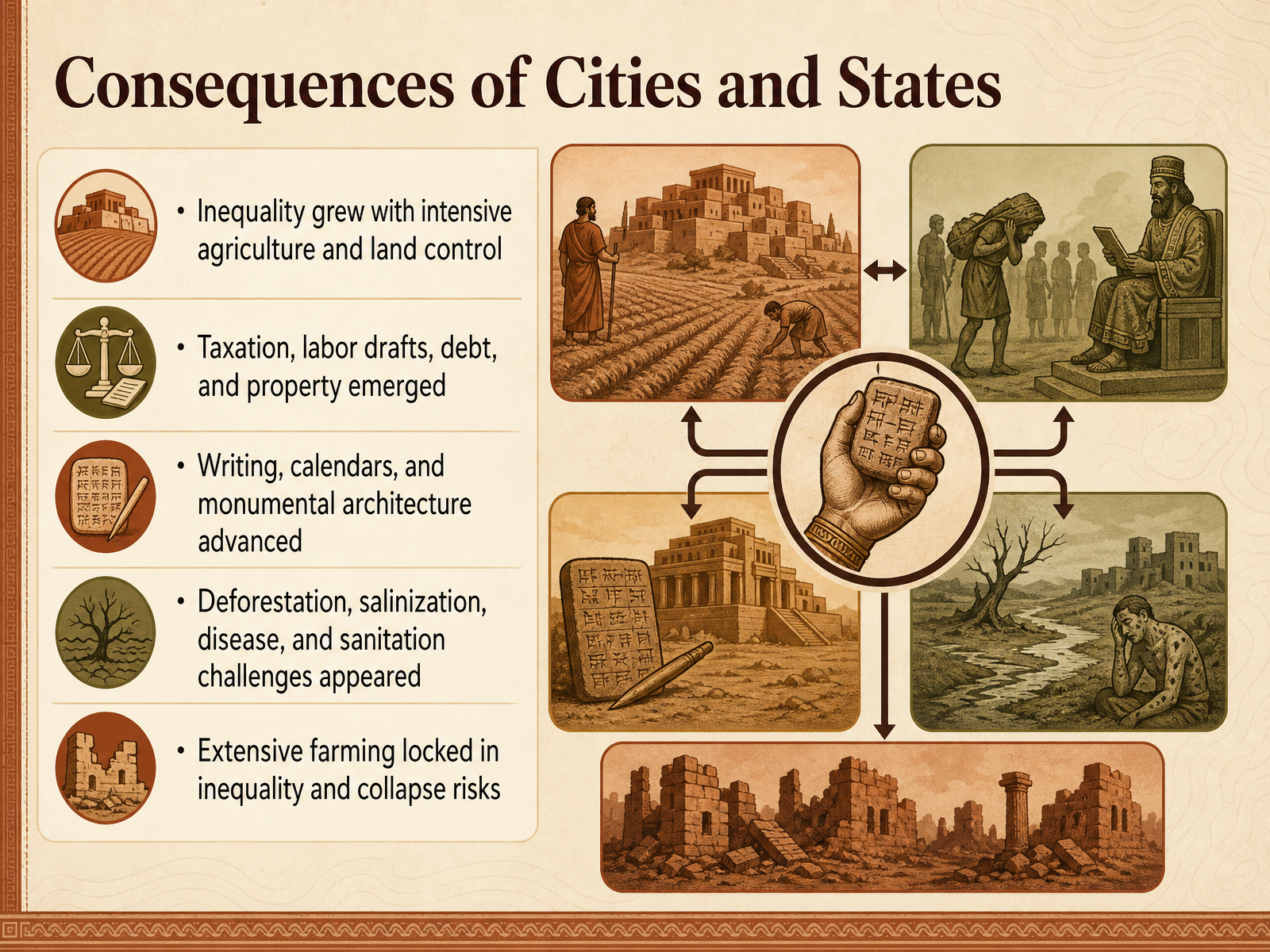
 - 09Consequences of Cities and StatesNow we come to the consequences of early cities and states, which were both creative and troubling. As agriculture intensified and land became controlled, social inequality grew. Archaeologists see this pattern clearly: where land could be owned and passed down, wealth concentrated in fewer hands. Alongside this, new systems appeared. Taxation, labor drafts, debt, and formal property rights became part of everyday life. At the same time, cities drove remarkable advances. Writing, calendars, and monumental architecture all flourished, reshaping how people recorded, organized, and expressed their world. But there were environmental costs. Deforestation, soil salinization, disease, and sanitation challenges followed dense urban living. Perhaps most important, extensive farming could lock societies into inequality and make collapse more likely. Once a community depended on large-scale land control, moving away from that system was extremely difficult. So the very structures that enabled early states also carried long-term vulnerabilities. Next, we will examine debates about cities, states, and collapse.
 1 min
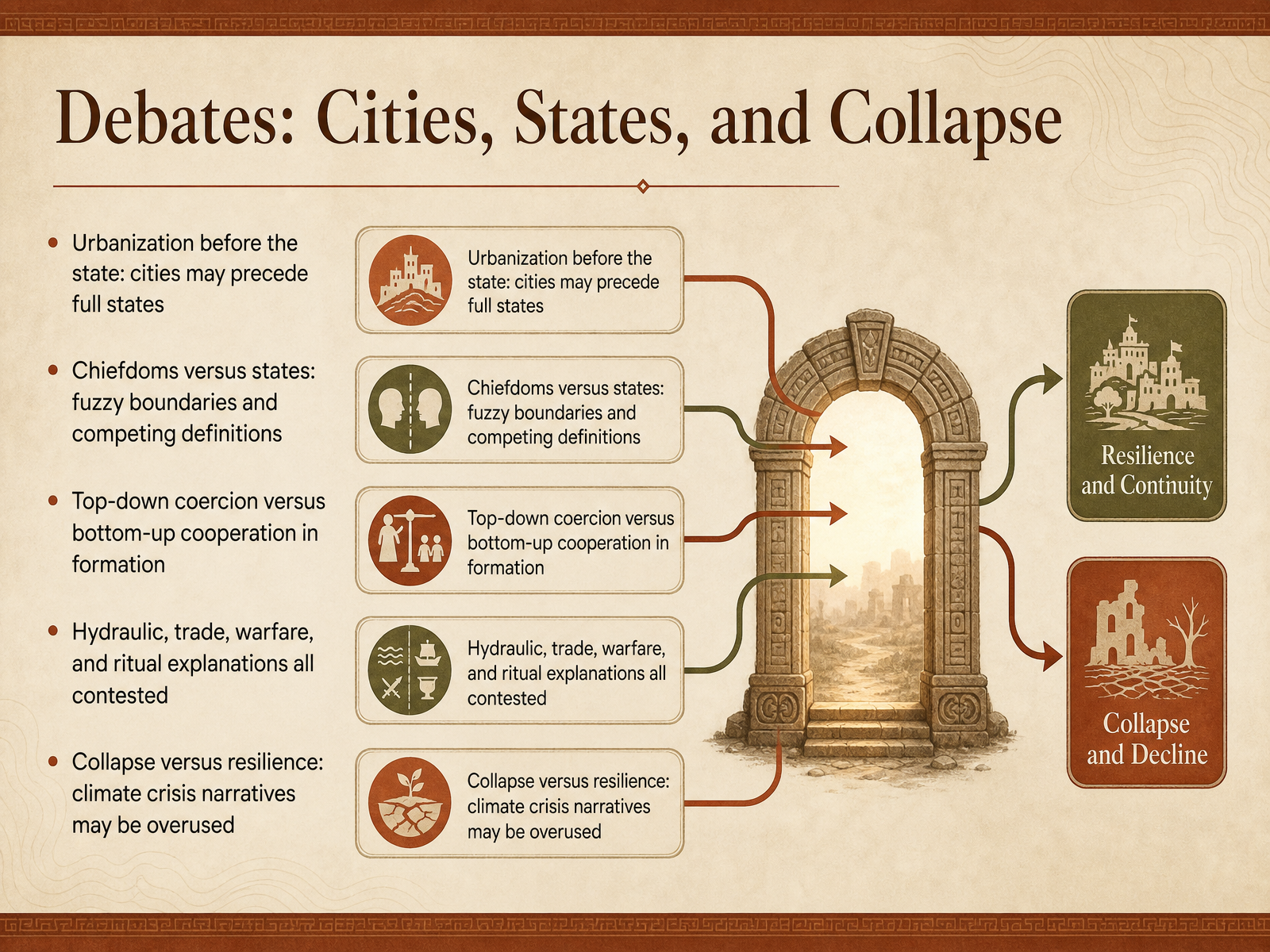
1 min - 10Debates: Cities, States, and CollapseNow let's step back and look at the bigger debates, because these questions are far from settled. One important issue is timing. Some settlements grew large and city-like before anything we would confidently call a state appeared. That complicates the old assumption that cities and states always emerged together. Scholars also disagree about where chiefdoms end and states begin, since the boundaries between these categories are often fuzzy and depend on definitions. Another lively conversation contrasts top-down coercion with bottom-up cooperation. Did elites force people into new arrangements, or did communities cooperate because they saw shared benefits? The classic explanations are all contested too. Water management, long-distance trade, warfare, and ritual each have supporters, but none works everywhere. And when we talk about collapse, climate stories are popular, yet archaeologists increasingly emphasize resilience. Many societies adapted and transformed rather than simply falling apart. In the next slide, we will tackle some common misconceptions about early cities and states.
 pmc.ncbi.nlm.nih.govcambridge.orgpmc.ncbi.nlm.nih.gov+21 min
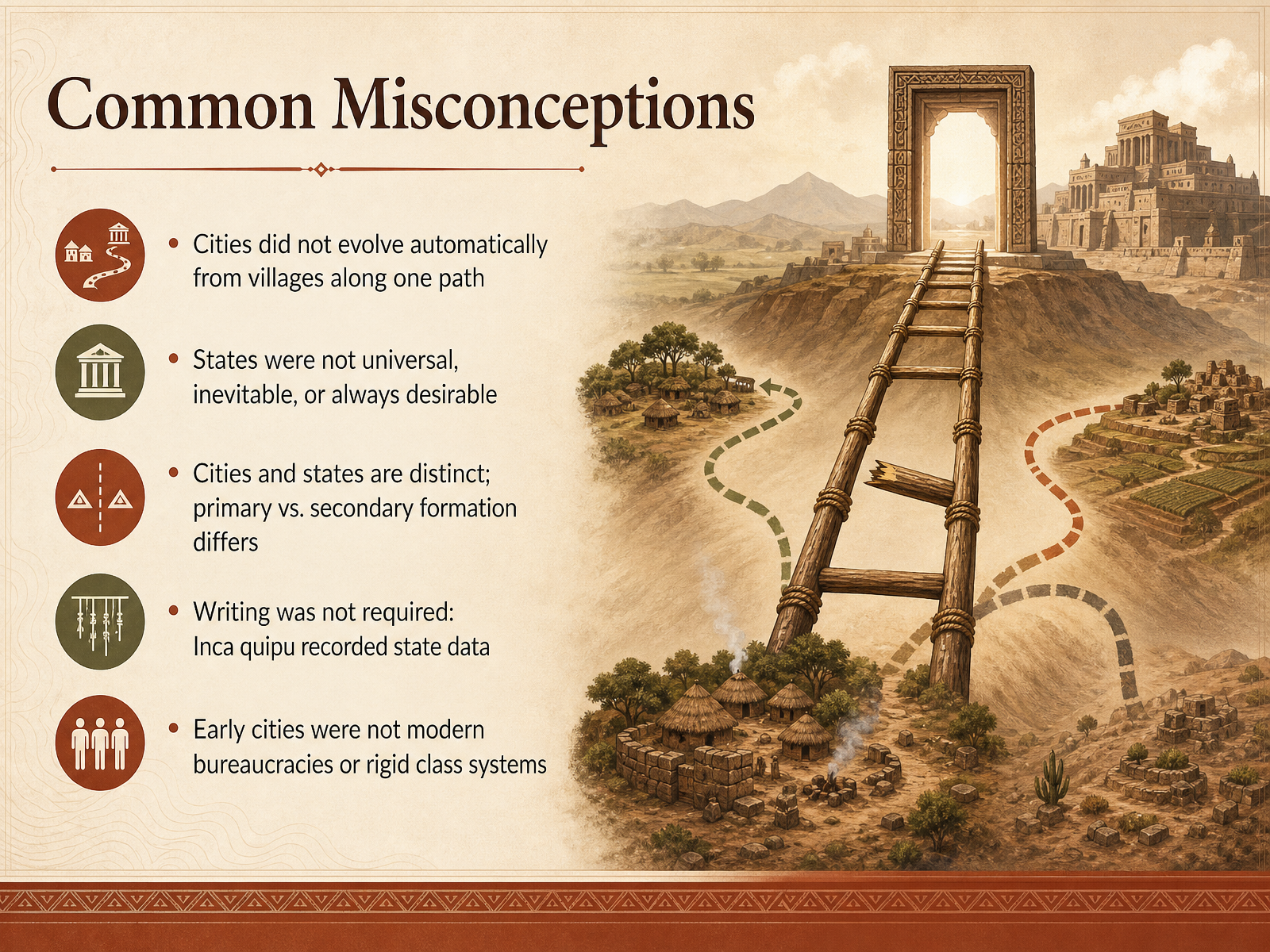
 - 11Common MisconceptionsLet’s pause and correct a few common misconceptions. First, cities did not simply evolve from villages along one fixed path. Different regions took different routes, and some societies stayed rural for centuries. Second, states were not universal or inevitable. Many people lived for thousands of years without them. Third, cities and states are not the same thing. A city is a dense settlement, while a state is a political structure. Primary and secondary formation also differ, since some states developed independently while others emerged under outside influence. Another misconception is that writing was required for state organization. The Inca managed complex imperial records with quipu, a system of knotted cords. Finally, early cities were not modern bureaucracies, and they were not always rigid class systems. Many early urban communities mixed planning with flexible, household-based social ties. Keeping these distinctions in mind will help students ask better questions about ancient societies. Next, let’s turn to teaching strategies for the classroom.
 faculty.washington.eduliverpooluniversitypress.co.ukbritannica.com+21 min
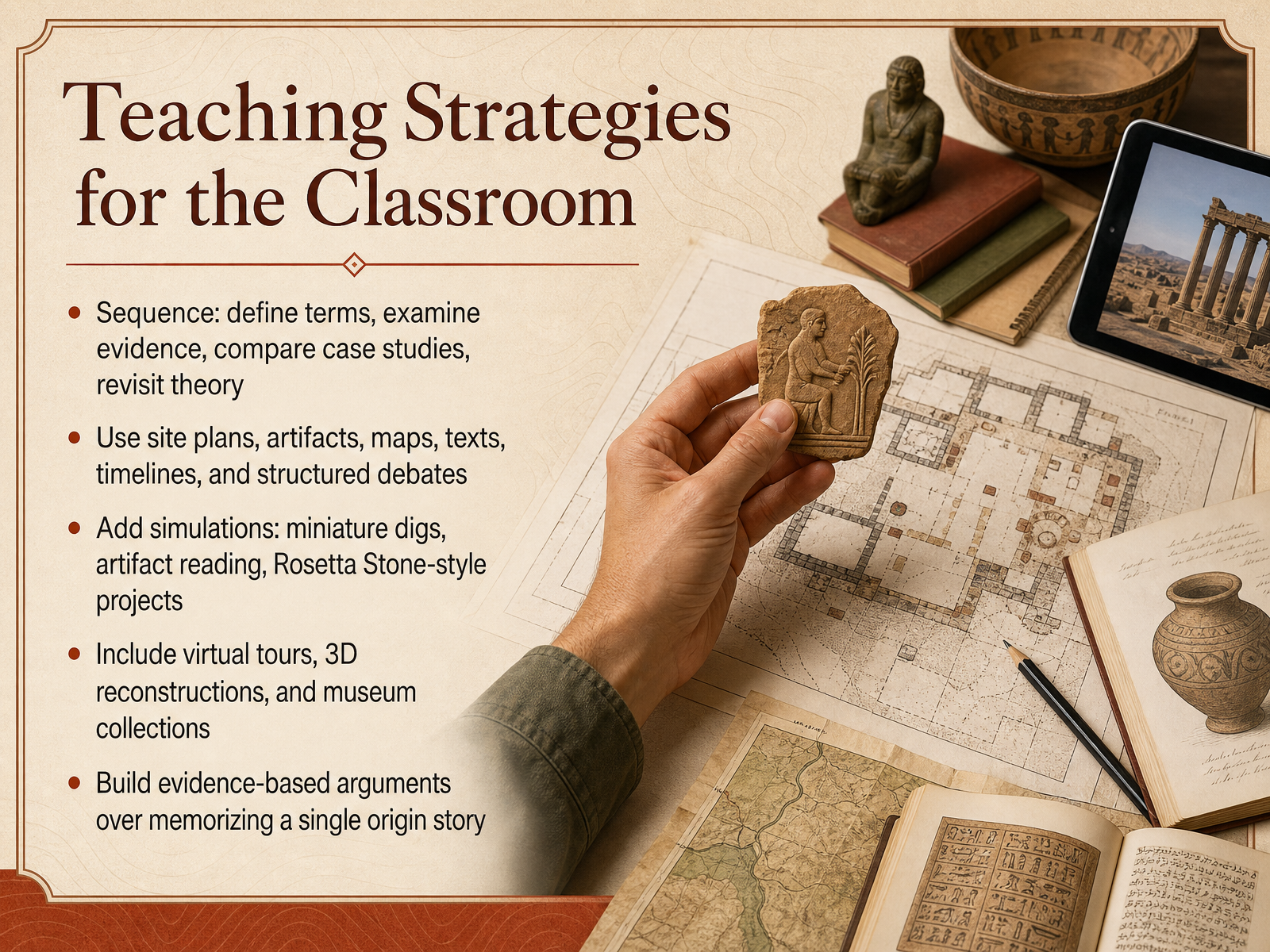
 - 12Teaching Strategies for the ClassroomLet's turn now to how we can bring these methods into the classroom. A strong teaching sequence often starts by defining terms, then examining physical evidence, comparing case studies, and finally revisiting the big theories. Use site plans, artifacts, maps, texts, and timelines to anchor discussion. Structured debates help students weigh competing explanations. Hands-on simulations, like miniature digs or artifact reading exercises, make abstract concepts tangible. Projects inspired by the Rosetta Stone let students experience how scripts are deciphered. Digital resources also open doors, including virtual tours, 3D reconstructions, and online museum collections. The goal is not to memorize one single origin story, but to build evidence-based arguments about how early cities and states emerged. This approach turns students into active interpreters of the past. Next, we will synthesize these themes and consider key takeaways for deeper study.
 journals.uchicago.edu1 min
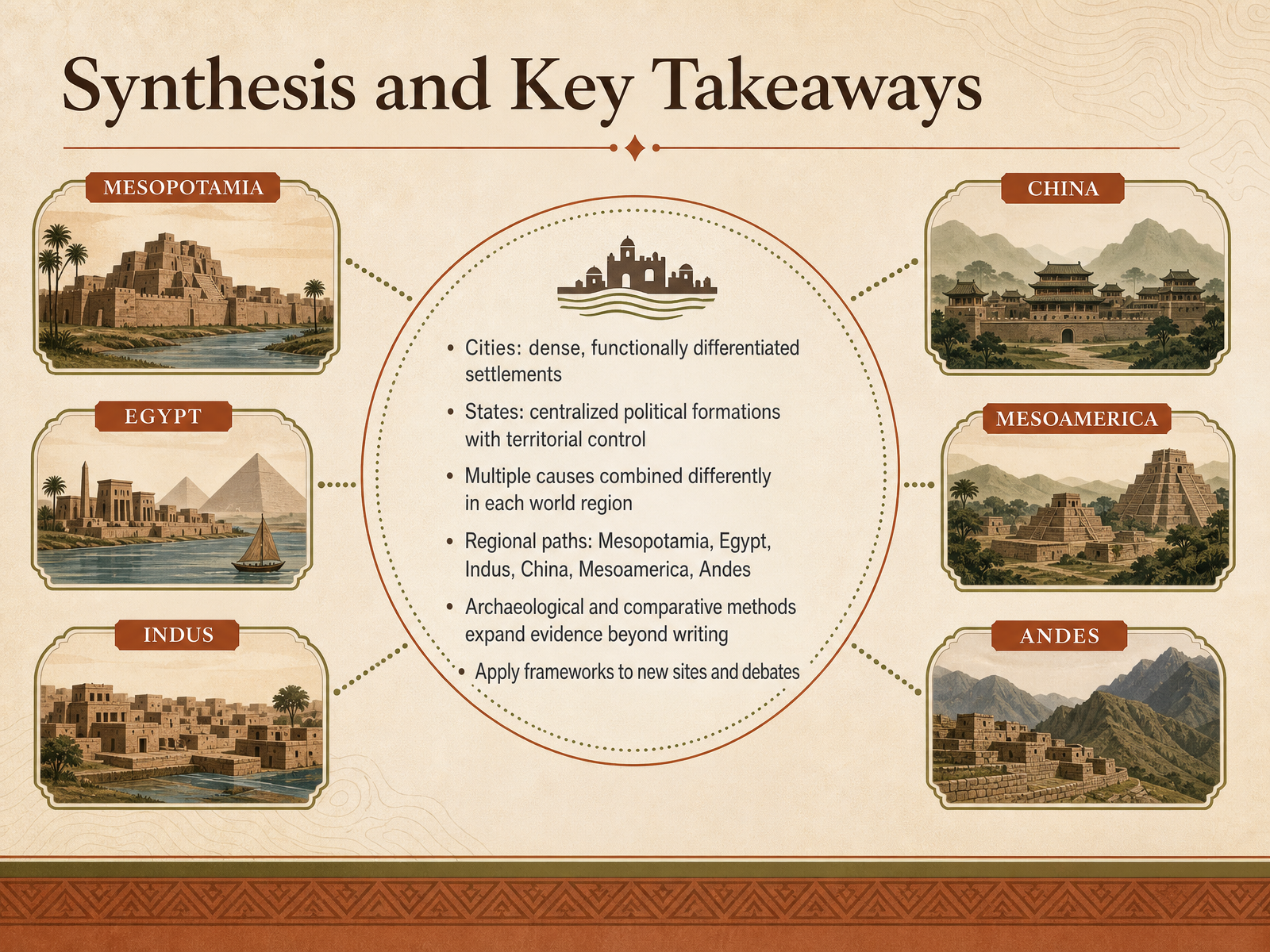
 - 13Synthesis and Key TakeawaysLet’s bring the main threads together. Throughout this course, we’ve seen that cities are best understood as dense settlements where people take on very different kinds of work, from craft production to administration. States, by contrast, are political formations, defined by centralized authority and control over a defined territory. A key takeaway is that these categories don’t always fit together neatly. A city can exist without a state, and some early states were not especially urban. We also saw that there is no single cause that explains every case. Irrigation, trade, warfare, and ritual each played different roles, and they combined in unique ways in Mesopotamia, Egypt, the Indus Valley, China, Mesoamerica, and the Andes. Our methods matter just as much as our theories. Archaeology and comparison let us recognize states and cities even where there are no written records. As you encounter new sites or debates, try applying these definitions and frameworks with that same critical eye. Up next, we’ll move to discussion prompts and next steps.
 faculty.washington.eduliverpooluniversitypress.co.ukbritannica.com+22 min
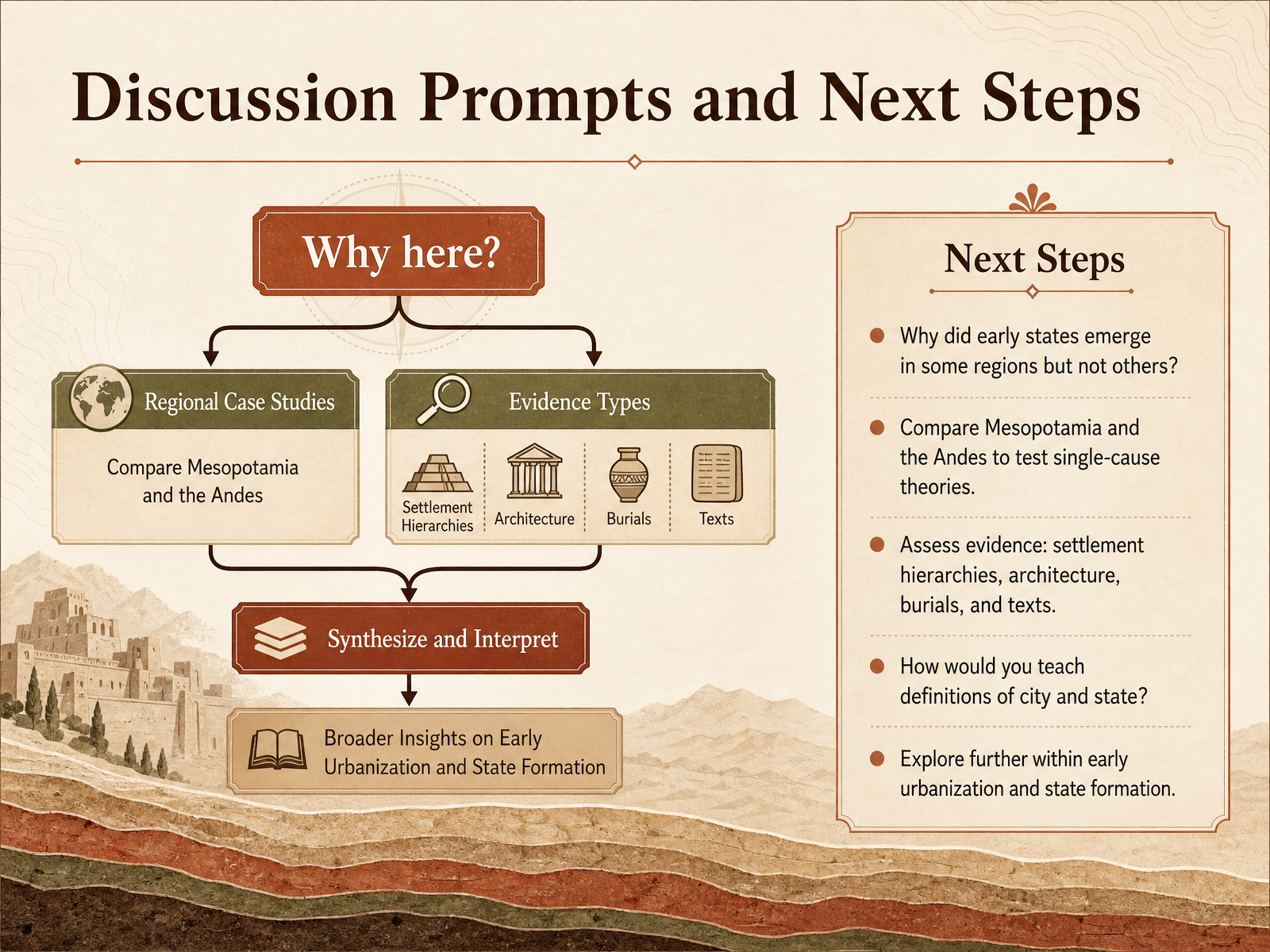
 - 14Discussion Prompts and Next StepsLet's close by turning these questions back on ourselves. As you consider why early states emerged in some regions but not others, hold Mesopotamia and the Andes side by side. Seeing how different environments, histories, and choices led to similar social outcomes is one of the best tests against any single-cause theory. As you compare, return often to the evidence. Settlement hierarchies, architecture, burials, and texts each preserve different decisions and pressures, and they rarely tell the same simple story. One useful exercise, especially for educators, is to ask how you would teach the definitions of city and state. What examples would you choose, and what evidence would you expect students to weigh? I encourage you to carry this reflective habit into further reading on early urbanization and state formation. Thank you for exploring these complex societies with me. The past rewards the questions we keep asking.
 pmc.ncbi.nlm.nih.govcambridge.orgpmc.ncbi.nlm.nih.gov+22 min
Take the deck with you
Download this course as a file — free, no sign-up needed.
- PDF handoutEvery slide page, ready to print or share.15 pages · 6.3 MBDownload
- Narrated PowerPointThe deck that presents itself — every slide carries the digital human's narration video.15 pages · 19.6 MBDownload
- PowerPoint slidesThe full deck as a .pptx — open it in PowerPoint, Keynote, or Google Slides.15 pages · 6.3 MBDownload
Free to use in your own training — please keep the PersonWise credit page at the end.
Have your own deck? Turn it into a course
Sources consulted
Web sources consulted while building this course.
- Cities, states, and trust networks: chapter 1 of Cities and States in World History | Theory and Society | Springer Nature Link — link.springer.com
- Understanding Early Civilizations — assets.cambridge.org
- Origins and Development of Urbanism: Archaeological Perspectives | Annual Reviews — annualreviews.org
- Definitions and Comparisons in Urban Archaeology — brepolsonline.net
- The Archaeology of Ancient Civlizations — eolss.net
- Çatalhöyük in the Context of the Middle Eastern Neolithic | Annual Reviews — annualreviews.org
- Neolithic Site of Çatalhöyük — whc.unesco.org
- The Rise and Fall of a Neolithic Town | Çatalhöyük Research Project — catalhoyuk.ku.edu.tr
- Diversity and Complexity in Early Farming Communities of Southwest Asia: New Insights into the Economic and Environmental Basis of Neolithic Çatalhöyük — journals.uchicago.edu
- Mobility and kinship in the world's first village societies — pubmed.ncbi.nlm.nih.gov
- The Urban Revolution Author(s): V. Gordon Childe Source: The Town Planning Review, Vol. 21, No. 1 (Apr., 1950), pp. 3-17 Accessed: 19/09/2011 14:46 — faculty.washington.edu
- V. Gordon Childe and the Urban Revolution: a historical ... — liverpooluniversitypress.co.uk
- Urban revolution | Definition, V. Gordon Childe, Theory ... — britannica.com
- Urbanization, State Formation, and Cooperation: A Reappraisal — dash.harvard.edu
- The hydraulic lift of early states societies — pmc.ncbi.nlm.nih.gov
- Trade and Early State Formation in the Northern Titicaca Basin, Peru — cambridge.org
- War and early state formation in the northern Titicaca Basin, Peru — pmc.ncbi.nlm.nih.gov
- [PDF] Developmental Aspects of Hydraulic Society - Columbia University — columbia.edu
- Process and Agency in Early State Formation — cambridge.org
- Rediscovering the Heartland of Cities Early Southern Mesopotamian States in Their Setting through New Field Research — journals.uchicago.edu