Begin
14 pages · ~28 min
Sleep Brand Strategy: Eight Sleep vs Oura vs Casper
Compare Eight Sleep, Oura, and Casper brand strategies, including key differences, tradeoffs, and use cases, to help trainees evaluate positioning choices in sleep-tech markets.
A digital instructor presents all 14 pages. Hold “Ask” at any point and ask out loud — the answer comes from this course. No sign-up needed.
What you’ll learn
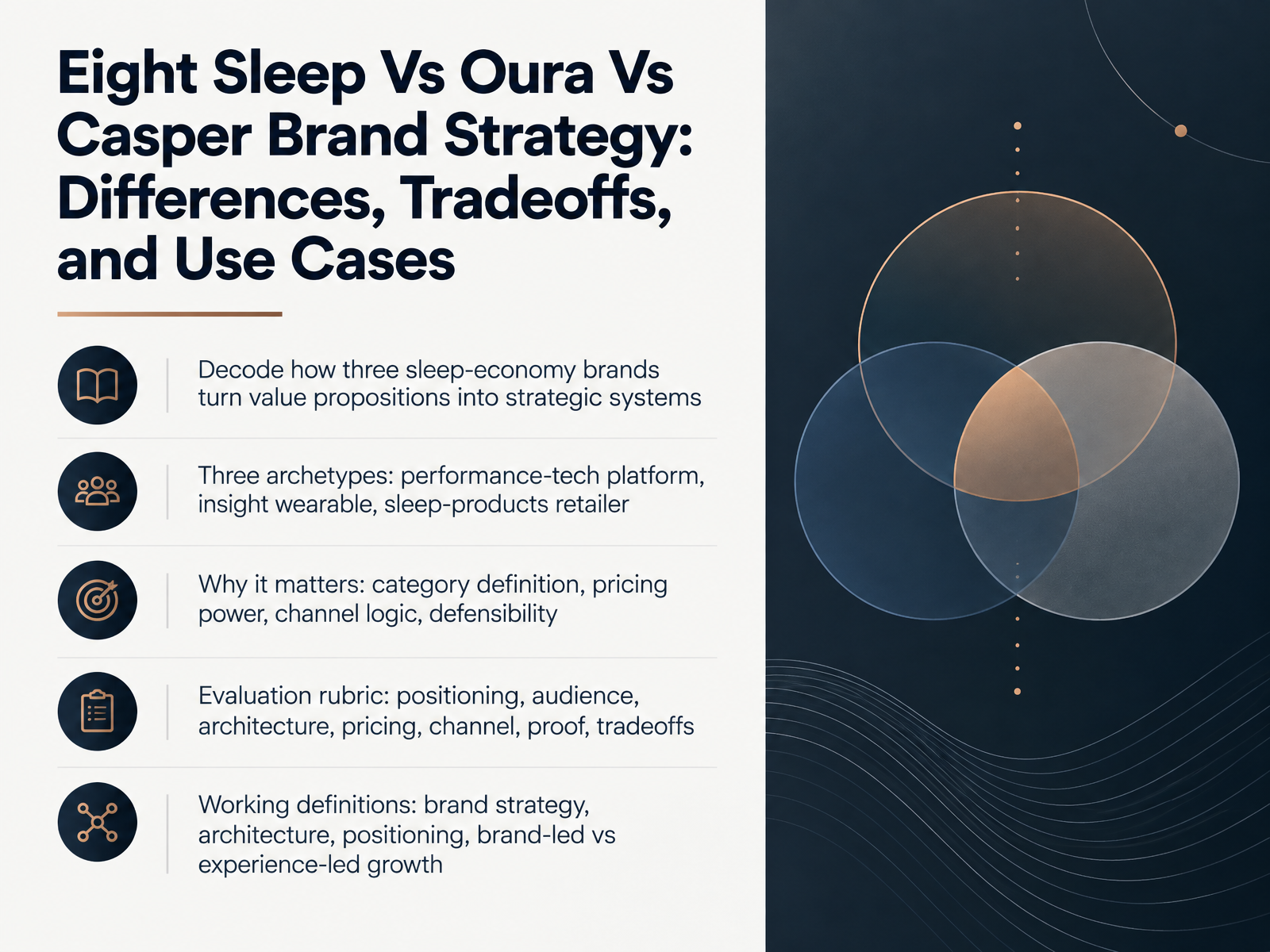
- 01Eight Sleep Vs Oura Vs Casper Brand Strategy: Differences, Tradeoffs, and Use CasesWelcome. Today we work through a comparison that practitioners keep asking about: Eight Sleep, Oura, and Casper. Same sleep economy, three different strategic systems. Our goal is not to crown a winner. It's to decode how each brand converts a value proposition into choices you can copy, borrow, or avoid. We'll treat them as three archetypes: the performance-tech platform, the insight wearable, and the sleep-products retailer. Why it matters: category definition, pricing power, channel logic, and defensibility. Our rubric runs seven questions: positioning, audience, architecture, pricing, channel, proof, and tradeoffs. And we'll lock down working definitions first, so we're precise about brand strategy, architecture, positioning, and the difference between brand-led and experience-led growth. Practical lens throughout: what decision does each tradeoff inform? Let's start with the context that produced these paths.tangkaren.substack.comfemtechinsider.comtechcrunch.com+22 min
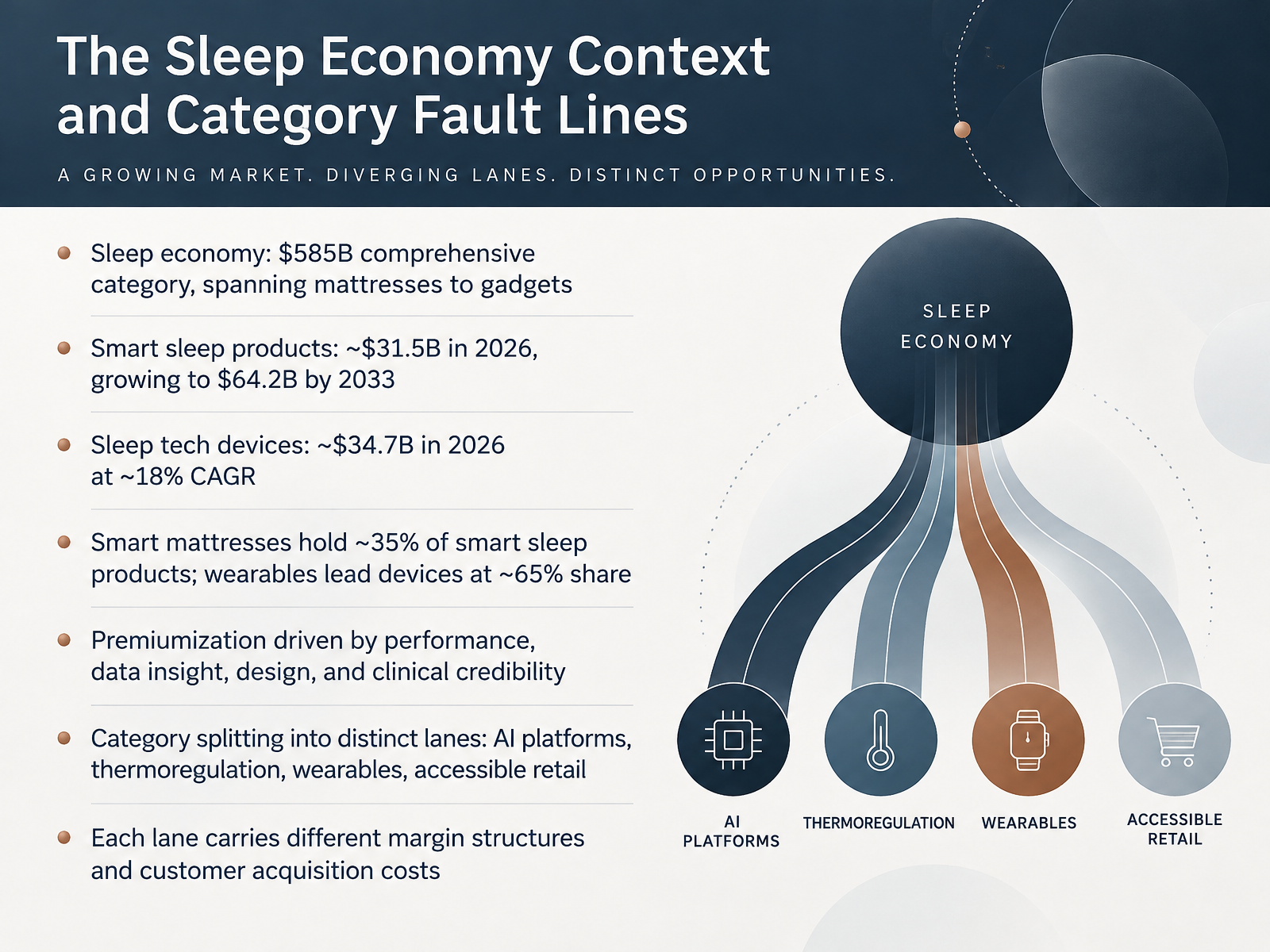
- 02The Sleep Economy Context and Category Fault LinesBefore we compare brands, we need the map they compete on. The sleep economy is a five hundred eighty five billion dollar category. It covers mattresses, accessories, gadgets, and devices. But the strategic money is in sleep tech. Devices sit near thirty five billion in twenty twenty six, growing at roughly eighteen percent a year. Smart sleep products reach thirty two billion, heading toward sixty four billion by twenty thirty three. Now the fault lines. Smart mattresses hold about thirty five percent of smart sleep products. Wearables lead devices at roughly sixty five percent share. Premiumization is driven by performance, data insight, design, and clinical credibility. And the category is splitting into distinct lanes. AI platforms, thermoregulation, wearables, and accessible retail. Each lane carries a different margin structure and customer acquisition cost. That matters more than any single product claim. Next, we look at Eight Sleep and its performance tech positioning.
 persistencemarketresearch.comglobalwellnessinstitute.orgthebusinessresearchcompany.com+22 min
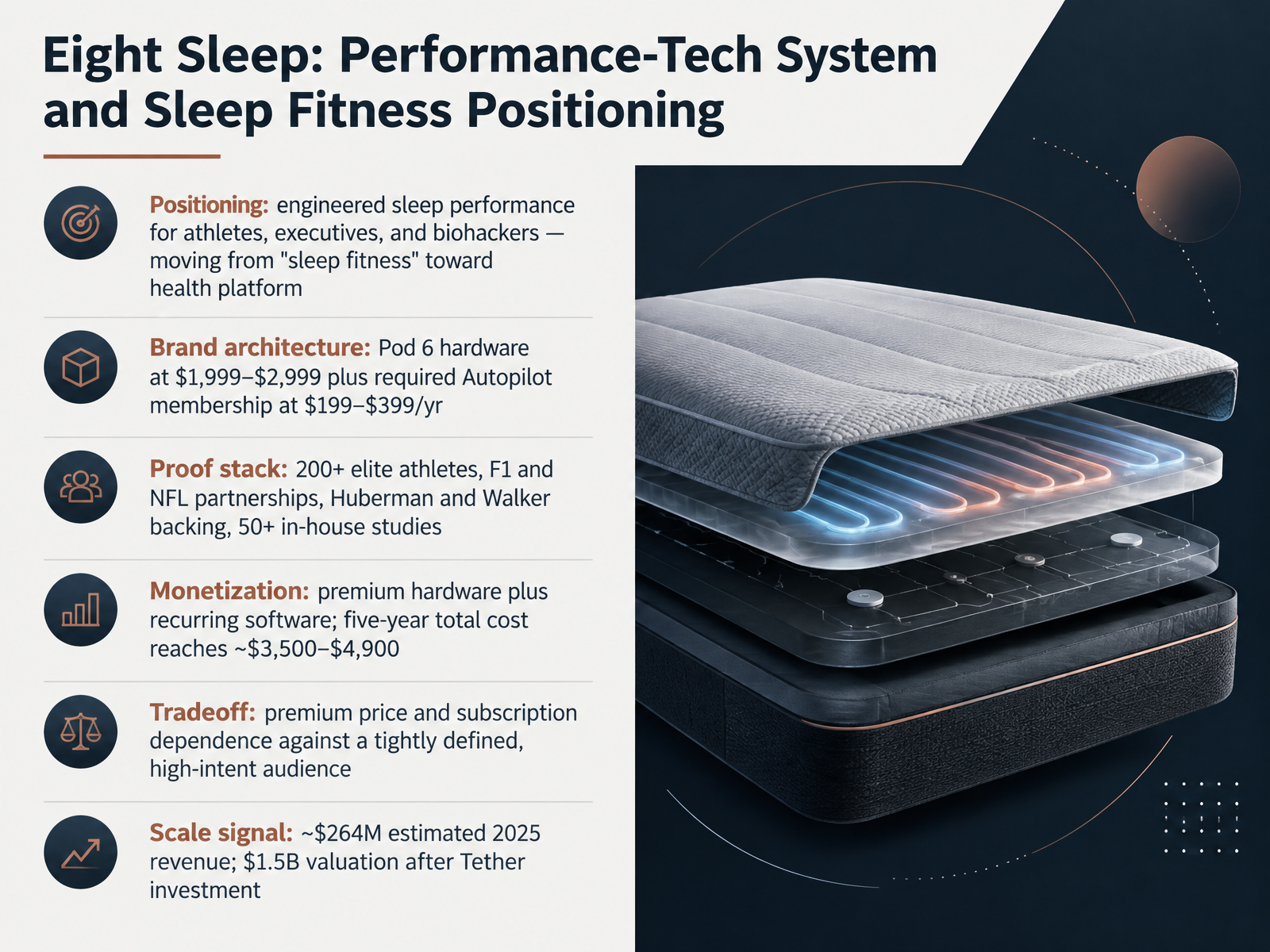
- 03Eight Sleep: Performance-Tech System and Sleep Fitness PositioningNow let's look at Eight Sleep, which sits at the performance-tech end of this category. Eight Sleep positions the Pod as engineered sleep performance, aimed at athletes, executives, and biohackers, and it is now stretching that story from sleep fitness toward a broader health platform. Notice the brand architecture. The Pod hardware runs about two thousand to three thousand dollars, and the Autopilot membership is required in year one at one hundred ninety-nine to three hundred ninety-nine dollars annually. The proof stack is dense. Over two hundred elite athletes, Formula One and NFL partnerships, endorsements from Andrew Huberman and Matthew Walker, and more than fifty in-house studies. But monetization creates the tradeoff. Over five years, total cost reaches roughly thirty-five hundred to forty-nine hundred dollars. That buys a tightly defined, high-intent audience, and it also introduces subscription dependence. Scale signals are real, with estimated twenty twenty-five revenue near two hundred sixty-four million dollars and a one point five billion dollar valuation. Next, Oura: Insight-Led Wearable, Ecosystem, and Trust Strategy.
 fortune.comeightsleep.comeightsleep.com+22 min
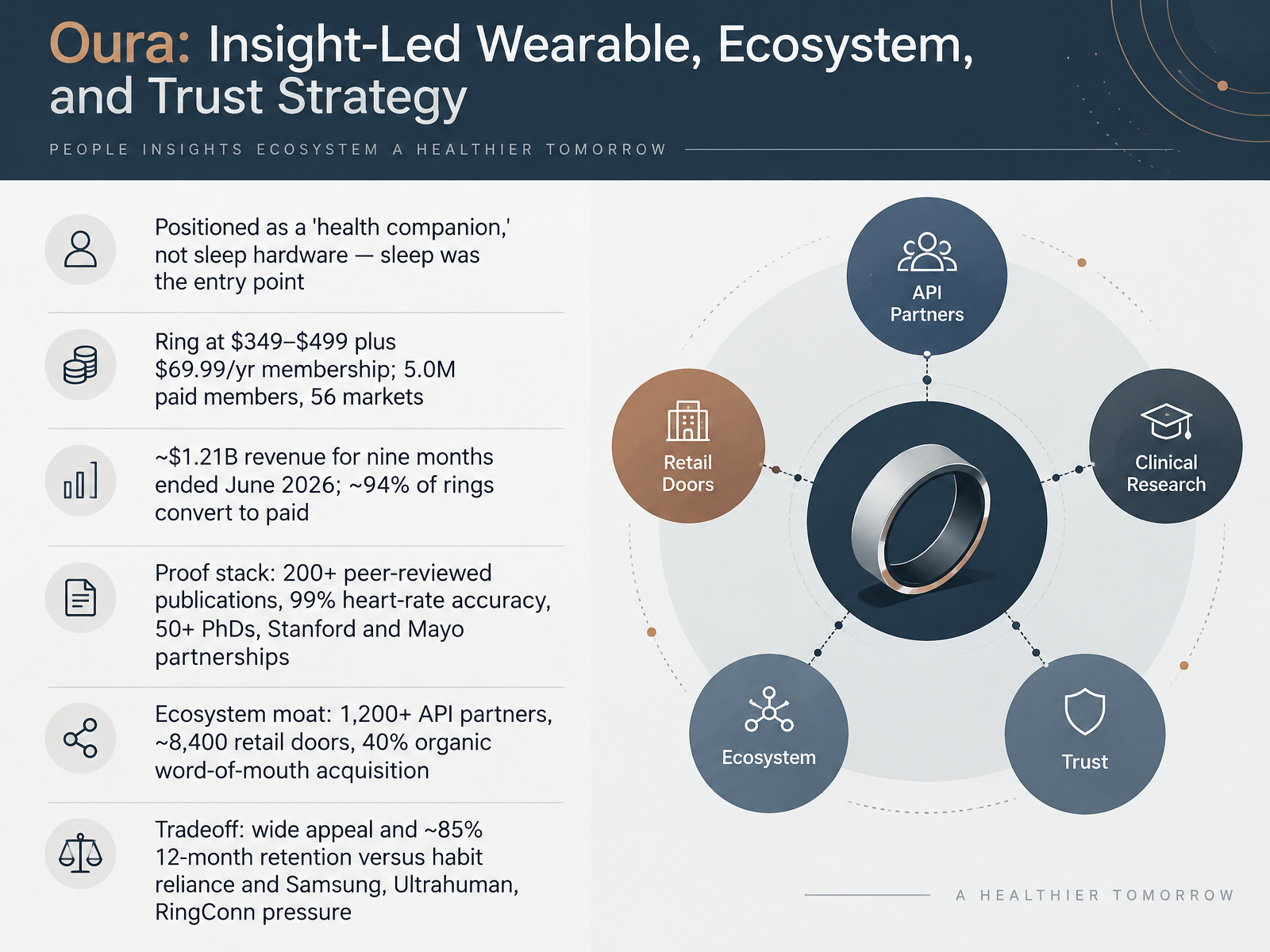
- 04Oura: Insight-Led Wearable, Ecosystem, and Trust StrategyNow let's look at Oura, a clear example of an insight-led wearable strategy. Oura's positioning is a health companion, not sleep hardware. Sleep was the entry point that built the habit. The ring runs three hundred forty nine to four hundred ninety nine dollars, plus sixty nine ninety nine a year for membership. That reached five million paid members across fifty six markets and one point two one billion dollars in revenue for nine months ended June twenty twenty six, with about ninety four percent of rings converting to paid. The proof stack carries the trust: over two hundred peer-reviewed publications, ninety nine percent heart-rate accuracy, fifty plus PhDs, and Stanford and Mayo partnerships. The ecosystem moat is equally deliberate: twelve hundred plus API partners, roughly eighty four hundred retail doors, and forty percent organic word of mouth. The tradeoff is habit reliance. Wide appeal and eighty five percent twelve-month retention come with pressure from Samsung, Ultrahuman, and RingConn. Next, we turn to Casper: Retail-Origin Brand, Product Breadth, and Turnaround Pressures.
 jpmorgan.comouraring.comfortuneindia.com+22 min
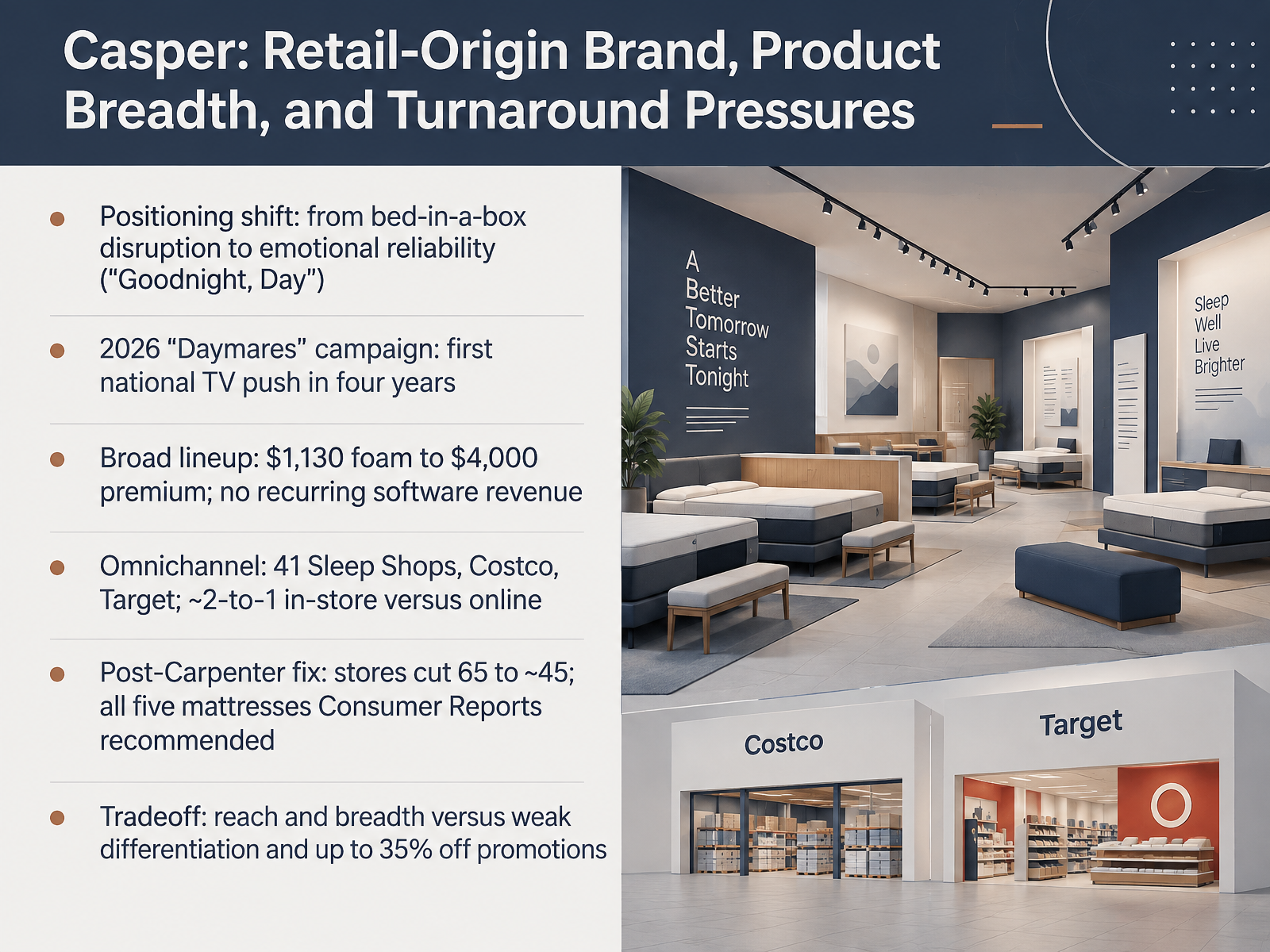
- 05Casper: Retail-Origin Brand, Product Breadth, and Turnaround PressuresNow let's look at Casper, the retail-origin brand, where breadth creates both reach and risk. Casper ran its first national TV push in four years, the Daymares campaign, with the tagline Goodnight, Day. That is a deliberate repositioning from bed-in-a-box disruption toward emotional reliability. The lineup runs from eleven hundred thirty dollars foam up to a four thousand dollar premium mattress, with no recurring software revenue. Distribution is omnichannel: forty-one Sleep Shops, plus Costco and Target, at roughly a two-to-one in-store versus online split. After the Carpenter acquisition, stores were cut from sixty-five to about forty-five, and all five mattresses earned Consumer Reports recommendations. The tradeoff is clear. Reach and breadth come with weak differentiation and promotions up to thirty-five percent off, which pressures premium positioning. Decide whether you are buying distribution or a distinct reason to exist. That tension is what we compare across brands next, in Cross-Brand Comparison: Positioning, Architecture, Monetization, Channel.
 tangkaren.substack.comfemtechinsider.comtechcrunch.com+22 min
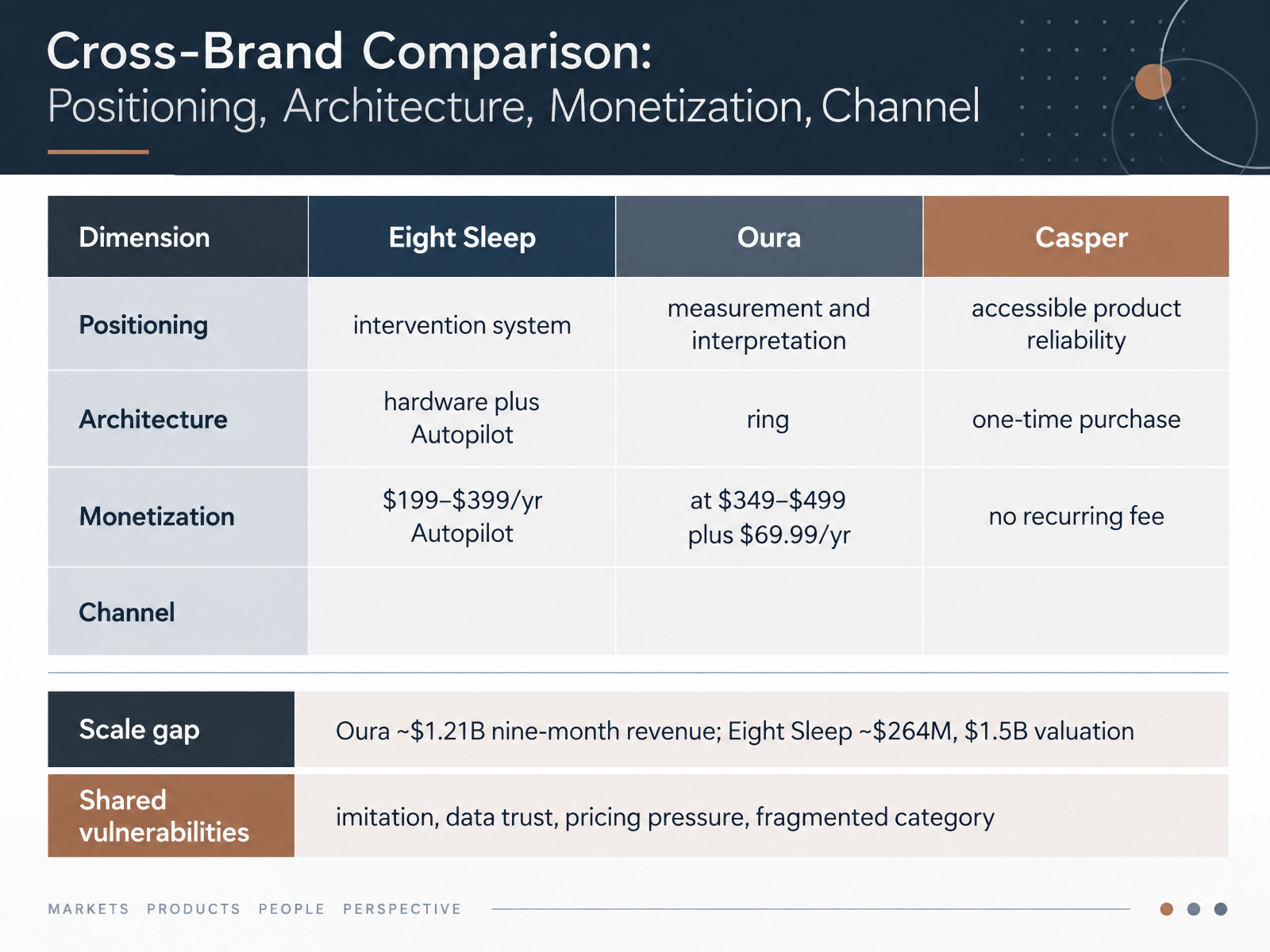
- 06Cross-Brand Comparison: Positioning, Architecture, Monetization, ChannelNow let's put the three brands side by side on four dimensions: positioning, architecture, monetization, and channel. Eight Sleep positions as an intervention system. You buy hardware, then pay one hundred ninety nine to three hundred ninety nine dollars a year for Autopilot. Oura positions as measurement and interpretation. The ring runs three hundred forty nine to four hundred ninety nine dollars, plus sixty nine dollars and ninety nine cents a year. Casper positions as accessible product reliability. One purchase, no recurring fee. Note the scale gap. Oura reported about one point two one billion dollars in nine month revenue. Eight Sleep sits near two hundred sixty four million, at a one point five billion dollar valuation. Different sizes, same structural problems: imitation, data trust, pricing pressure, and a fragmented category. The decision for you is which model your category can sustain. Move on to tradeoffs and trade surfaces: what each brand gains and gives up.
 tangkaren.substack.comfemtechinsider.comtechcrunch.com+22 min
- 07Tradeoffs and Trade Surfaces: What Each Brand Gains and Gives UpNow let's put the tradeoffs on the table, because every brand choice here has a cost attached.
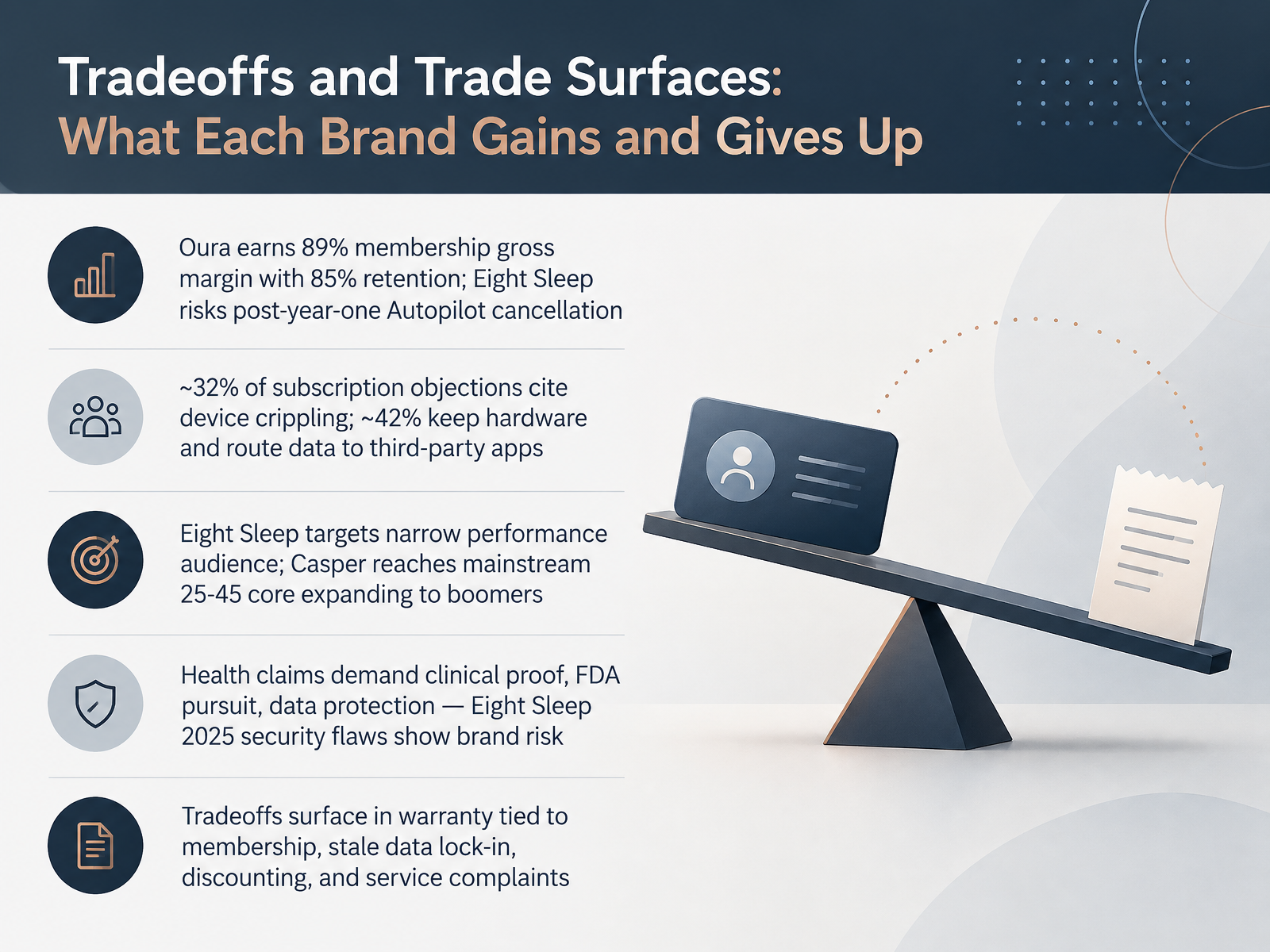
Start with subscriptions. Oura runs an eighty-nine percent membership gross margin with roughly eighty-five percent retention. Eight Sleep carries a different risk: customers cancel Autopilot after year one. About thirty-two percent of subscription objections cite device crippling, and about forty-two percent keep the hardware and route data to third-party apps.
Reach differs too. Eight Sleep targets a narrow performance audience. Casper serves a mainstream twenty-five to forty-five core and expands toward boomers.
Health claims raise the bar. They demand clinical proof, FDA pursuit, and data protection. Eight Sleep's twenty twenty-five security flaws show the brand risk.
Finally, tradeoffs surface in warranty tied to membership, stale data lock-in, discounting, and service complaints. Map each one before you commit.
Next, we match these strategies to real consumer scenarios.
 2 min
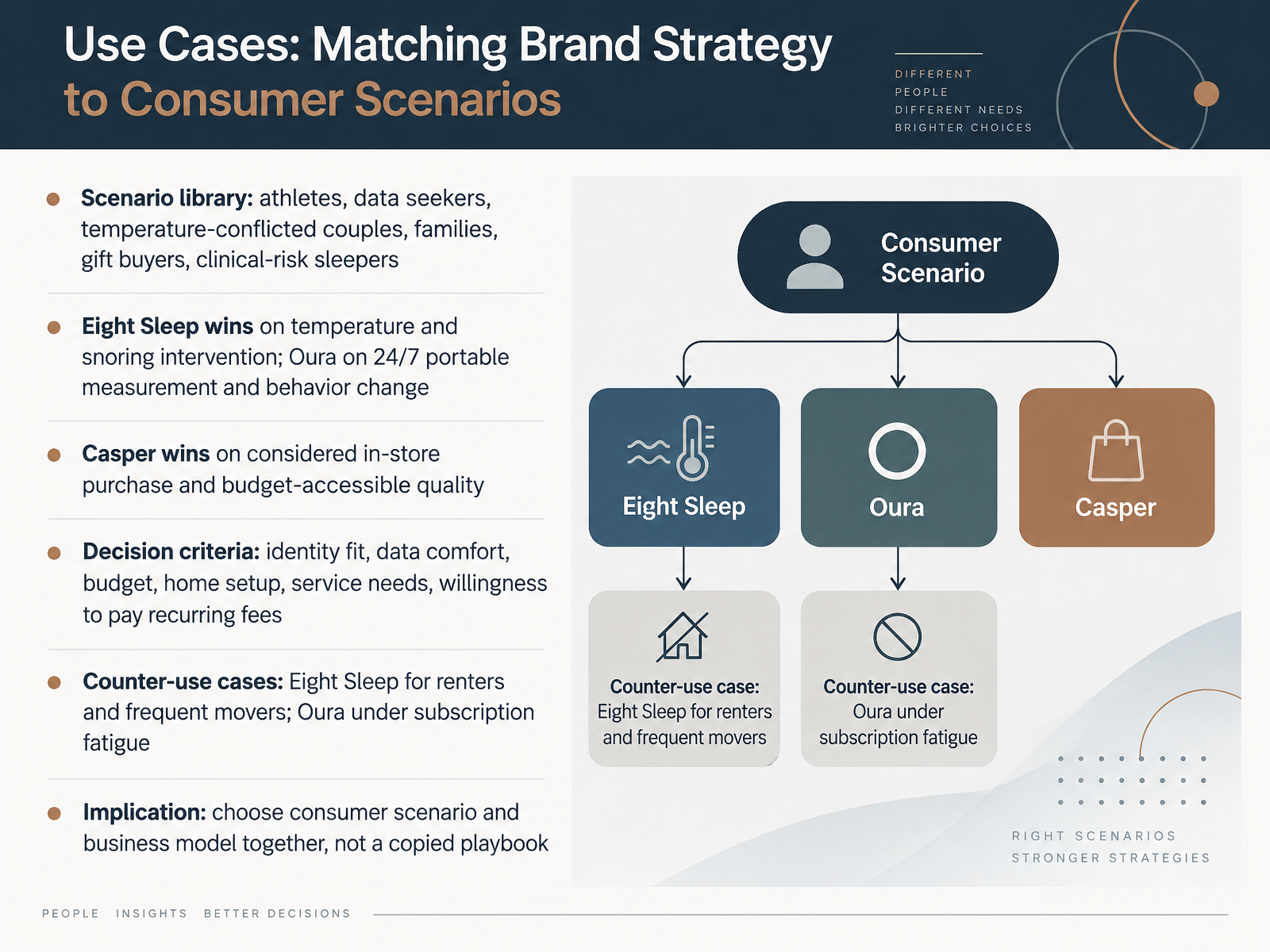
- 08Use Cases: Matching Brand Strategy to Consumer ScenariosLet's move from strategy to scenarios. Build a scenario library, then match the brand to it. Eight Sleep wins on temperature and snoring intervention. Oura wins on portable, around-the-clock measurement and behavior change. Casper wins on the considered in-store purchase and accessible quality. Screen each scenario against six criteria: identity fit, data comfort, budget, home setup, service needs, and willingness to pay a recurring fee. Counter-use cases matter just as much. Eight Sleep is a poor fit for renters and frequent movers. Oura struggles under subscription fatigue. Here's the implication. Choose the consumer scenario and the business model together. Do not copy a playbook. Next, we'll move into strategic takeaways for brand strategy development.
 tangkaren.substack.comfemtechinsider.comtechcrunch.com+21 min
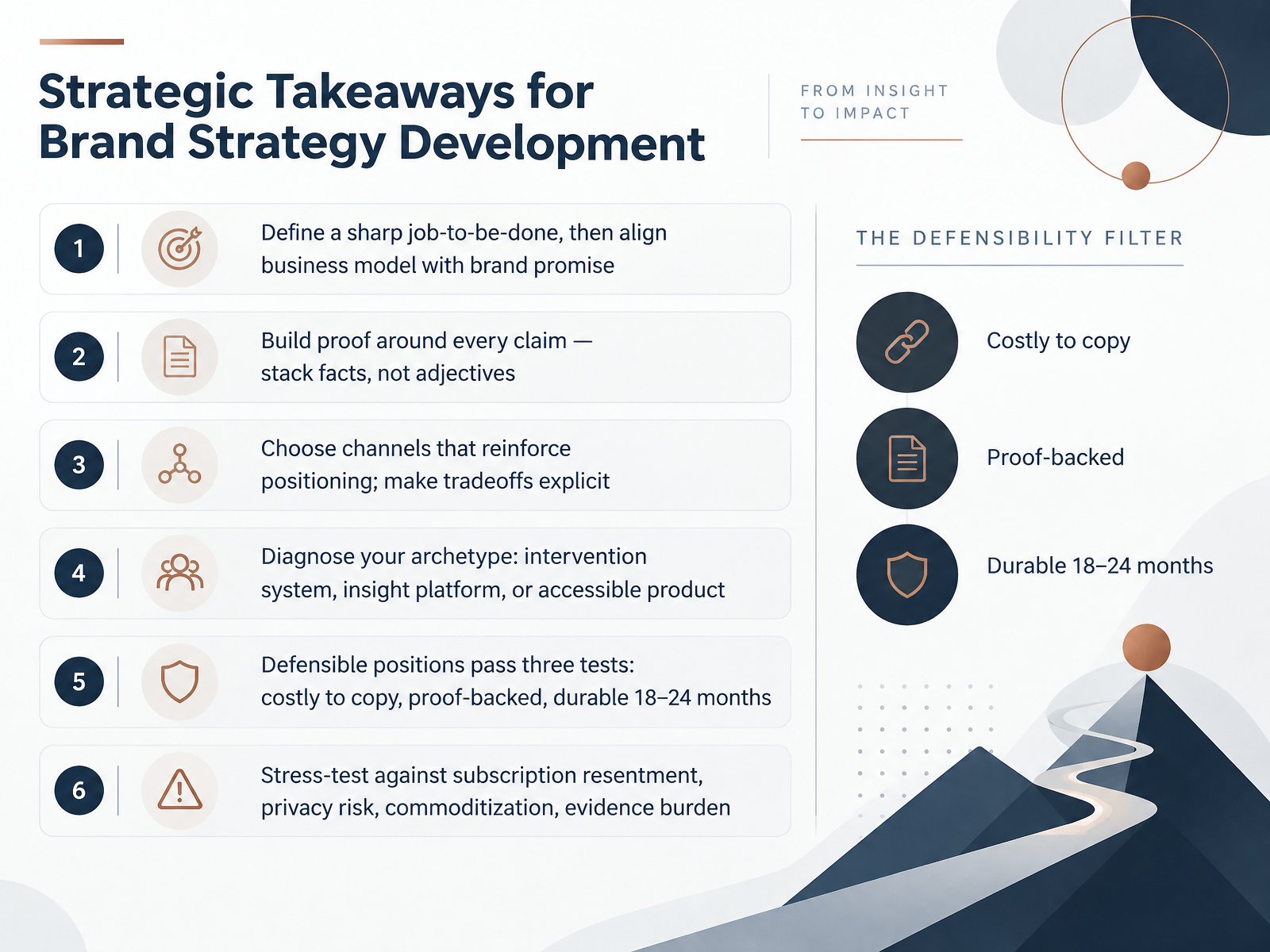
- 09Strategic Takeaways for Brand Strategy DevelopmentLet's pull the comparison into six takeaways you can act on. First, define a sharp job to be done, then align the business model with the brand promise. Eight Sleep sells an intervention, Oura sells insight, Casper sold accessibility. Second, build proof around every claim. Stack facts, not adjectives. Third, choose channels that reinforce positioning, and make tradeoffs explicit. Casper's direct-to-consumer route cut out the middle layer but carried the full cost of awareness and service. Fourth, diagnose your archetype before you draft anything. Fifth, a defensible position passes three tests. It is costly to copy, proof-backed, and durable for eighteen to twenty-four months. Sixth, stress-test against the real risks, subscription resentment, privacy exposure, commoditization, and evidence burden. The pattern to keep: every strength carries a condition, so write the condition down next to the claim. Now let's apply this framework to a live brand decision. Workshop: Applying the Comparison Framework to a Brand Decision.
 tangkaren.substack.com2 min
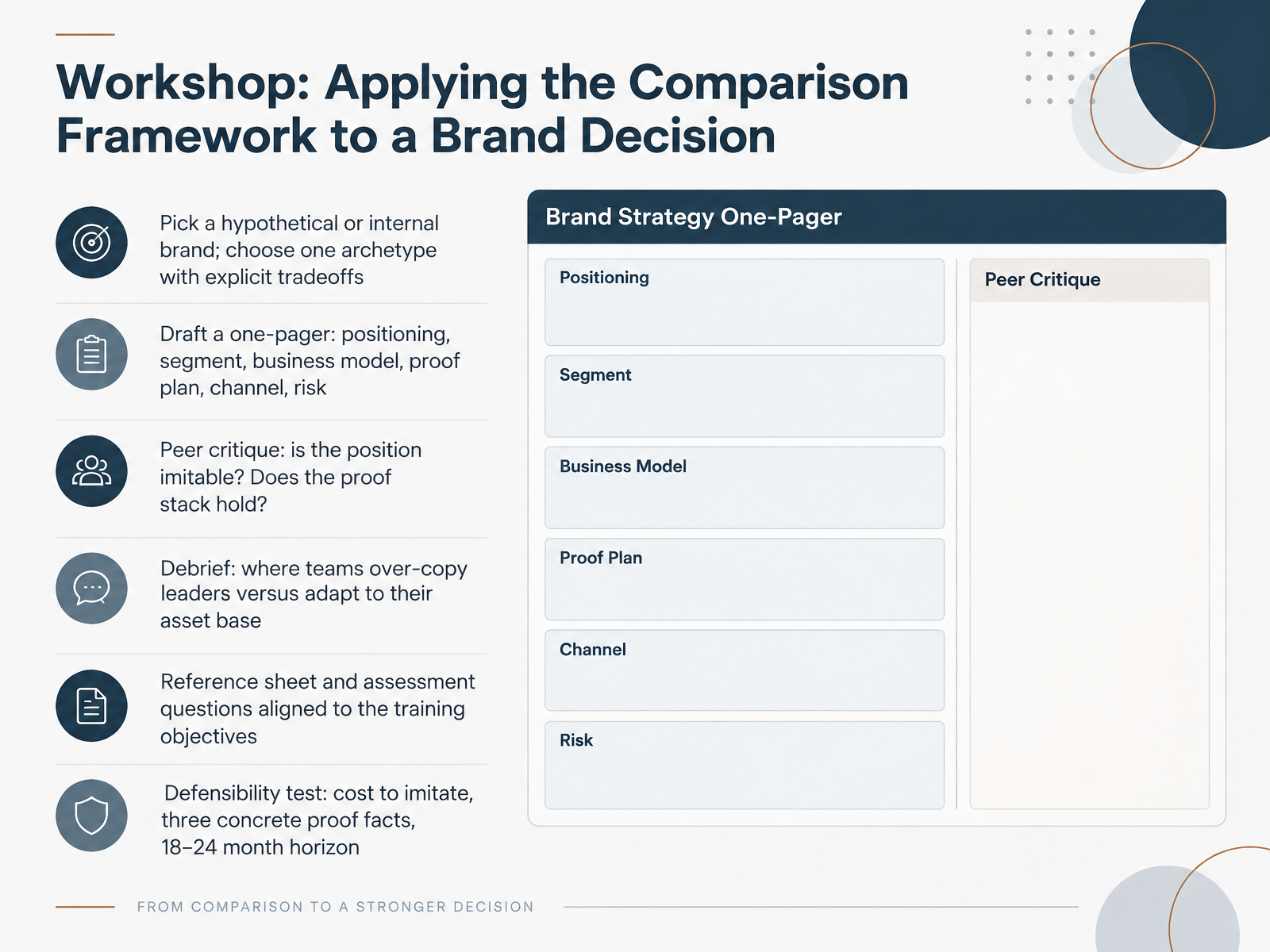
- 10Workshop: Applying the Comparison Framework to a Brand DecisionNow let's put the comparison framework to work. Pick a hypothetical or internal brand, and choose one archetype with explicit tradeoffs. Draft a one-pager covering positioning, segment, business model, proof plan, channel, and risk. Then run peer critique on two questions. Is the position imitable? Does the proof stack hold? Debrief on where teams over-copy the leader instead of adapting to their own asset base. Apply the defensibility test. First, cost to imitate. If a competitor can neutralize you by changing homepage copy, you have a message, not a position. Second, three concrete proof facts. A number, a patent, a distribution exclusive. Third, an eighteen to twenty-four month horizon. Use the reference sheet and assessment questions aligned to the training objectives. The takeaway: write the tradeoff down, then test whether it survives contact with a competitor. Next, Brand Equity, Pricing Power, and the Risk of Commoditization.
 tangkaren.substack.com2 min
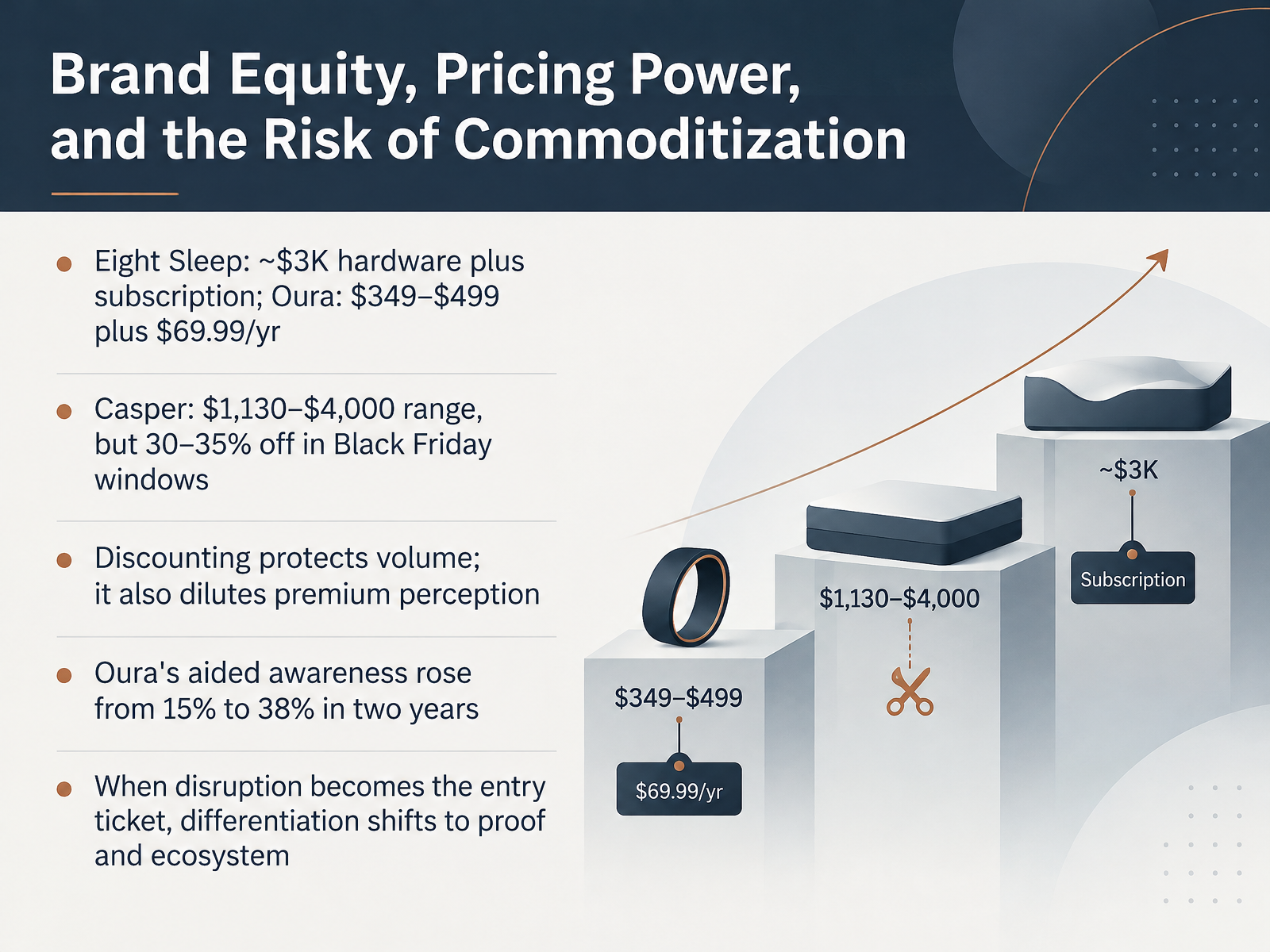
- 11Brand Equity, Pricing Power, and the Risk of CommoditizationNow let's look at brand equity, and where pricing power actually comes from. Eight Sleep charges roughly three thousand dollars for hardware, plus a subscription. Oura sits at three hundred forty nine to four hundred ninety nine dollars, plus sixty nine ninety nine a year. Casper ranges from about eleven hundred thirty to four thousand dollars, but runs thirty to thirty five percent off in Black Friday windows. Discounting protects volume. It also dilutes premium perception. Oura shows the other path. Aided awareness rose from fifteen percent to thirty eight percent in two years, built on ecosystem and proof. The lesson for strategy: when disruption becomes the entry ticket, differentiation shifts to proof and ecosystem. Now let's move to data trust, privacy, and the evidence burden.
 1 min
- 12Data Trust, Privacy, and the Evidence BurdenLet's turn to data trust, privacy, and the evidence burden.
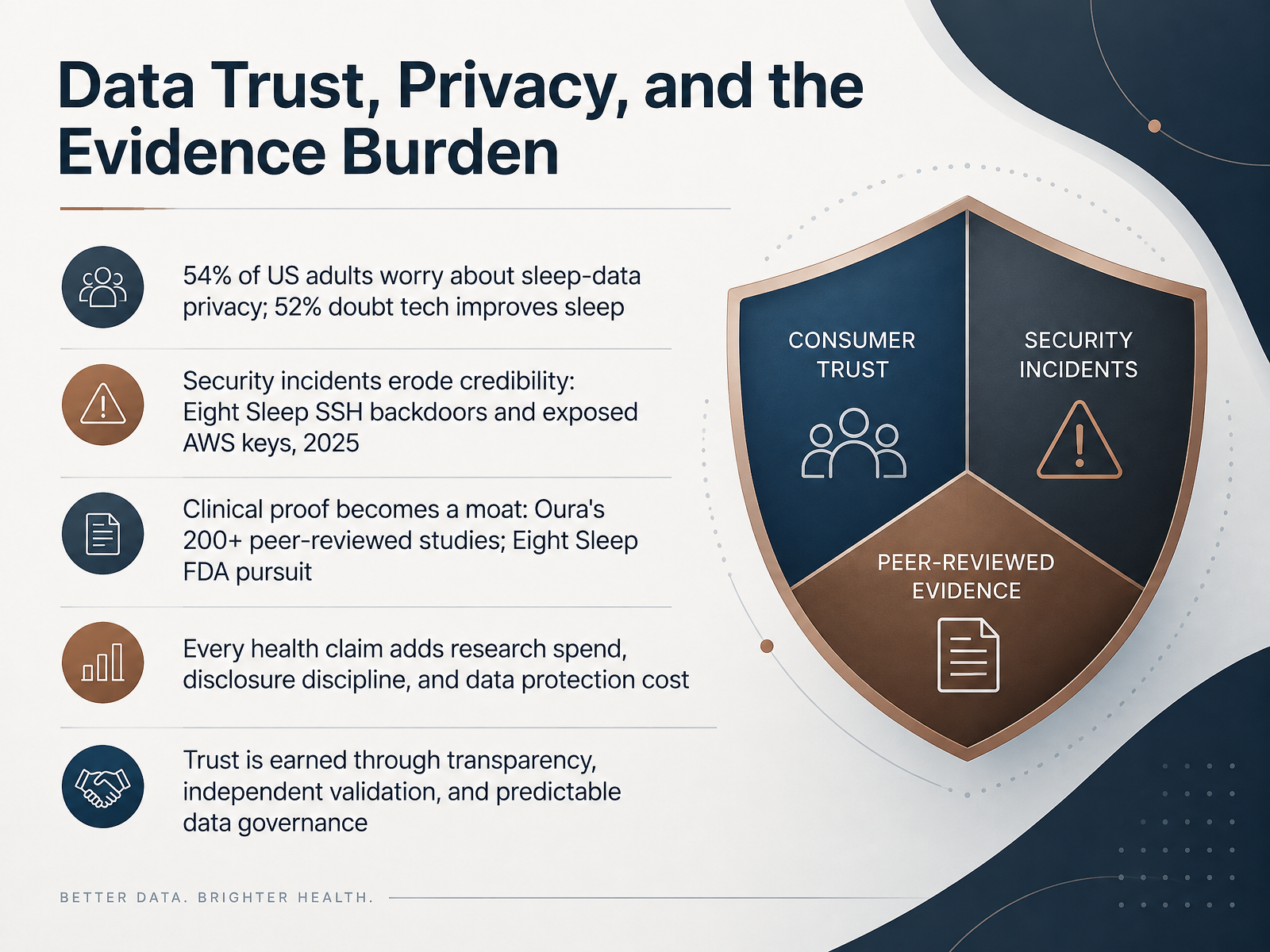
The demand signal is clear. Fifty-four percent of U.S. adults worry about sleep-data privacy. And fifty-two percent doubt tech improves sleep. Trust is a prerequisite, not a nice-to-have.
Incidents erode credibility fast. Eight Sleep's SSH backdoors and exposed AWS keys in twenty twenty-five gave practitioners a visible lesson in security debt.
Clinical proof, by contrast, becomes a moat. Oura points to over two hundred peer-reviewed studies. Eight Sleep is pursuing FDA clearance. Both paths buy credibility, and both carry cost.
Every health claim adds research spend, disclosure discipline, and data protection cost. So treat transparency and independent validation as line items, not messaging. Trust is earned through transparency, independent validation, and predictable data governance.
That brings us to audience definition and segment strategy, and who each brand serves.
 jpmorgan.comouraring.comfortuneindia.com+21 min
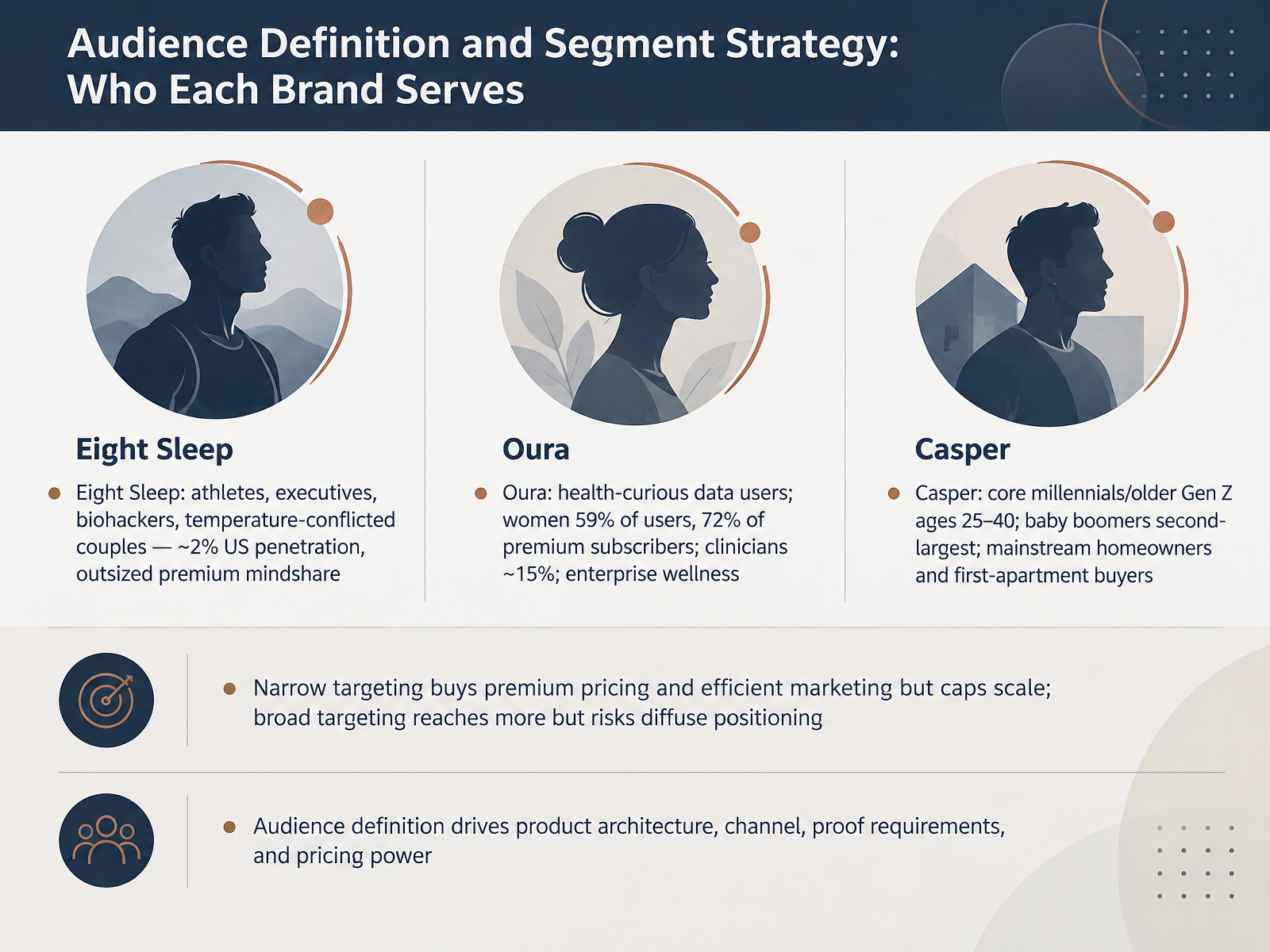
- 13Audience Definition and Segment Strategy: Who Each Brand ServesNow let's look at who each brand actually serves, because audience definition is where strategy becomes concrete. Eight Sleep targets athletes, executives, biohackers, and temperature-conflicted couples. Its penetration is roughly two percent in the United States, yet its premium mindshare is outsized. Oura serves health-curious data users. Women are fifty-nine percent of its users and seventy-two percent of premium subscribers, with clinicians around fifteen percent and a growing enterprise wellness channel. Casper goes broad. Its core is millennials and older Gen Z, ages twenty-five to forty, with baby boomers as the second-largest group, plus mainstream homeowners and first-apartment buyers. Here's the tradeoff. Narrow targeting buys premium pricing and efficient marketing, but it caps scale. Broad targeting reaches more people, but risks diffuse positioning. Audience definition then drives product architecture, channel, proof requirements, and pricing power. So define the audience first, not last. Next, we turn to channel and ecosystem strategy, and the routes to market that reinforce position.
 tangkaren.substack.comfemtechinsider.comtechcrunch.com+22 min
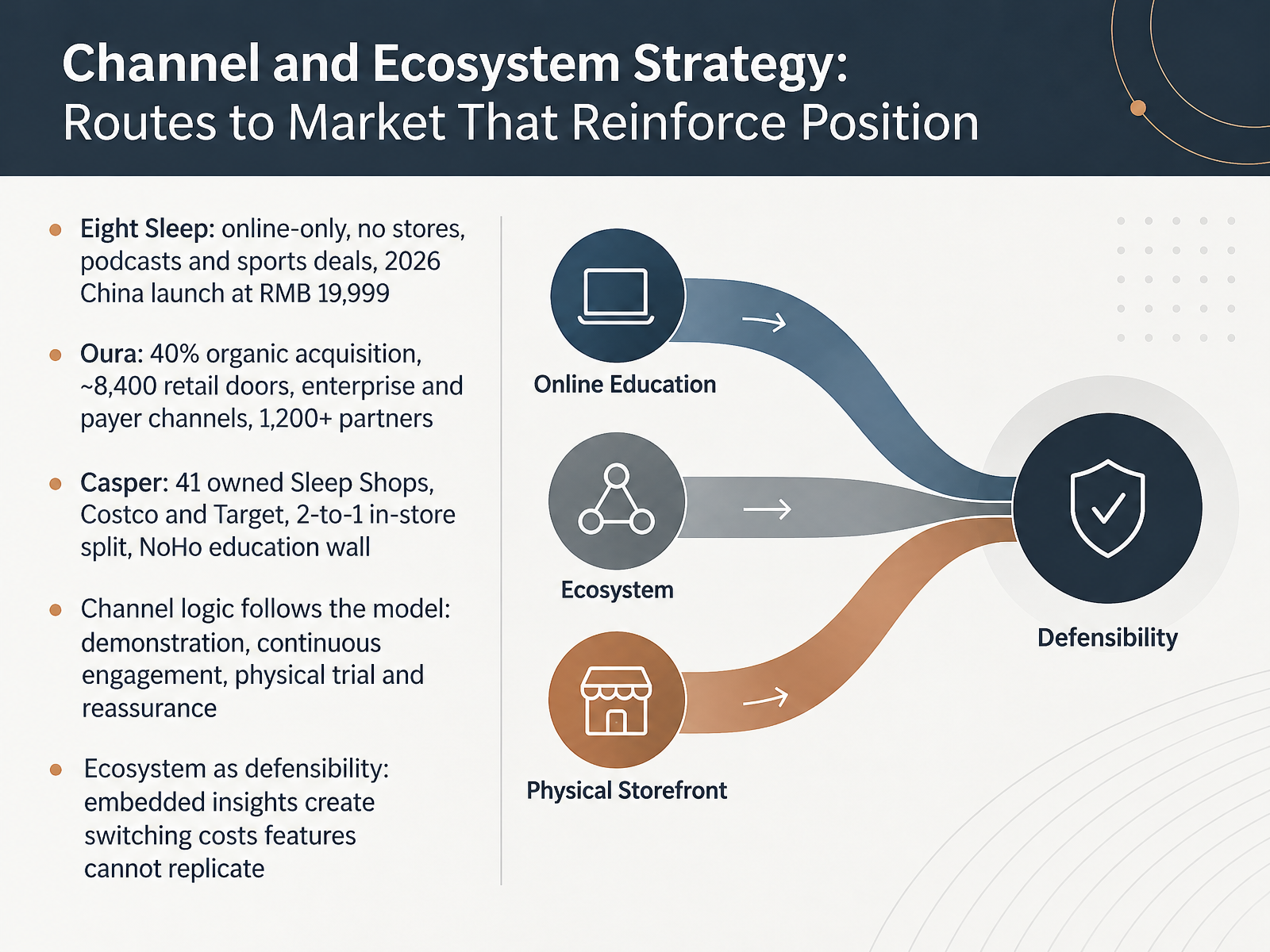
- 14Channel and Ecosystem Strategy: Routes to Market That Reinforce PositionLet's close by connecting channel choice to brand position. Each of these brands routes to market in a way that reinforces its model. Eight Sleep sells online only, with no stores, and builds demand through podcasts and sports partnerships. It launches in China in 2026 at nineteen thousand nine hundred ninety-nine yuan. Oura grows through product-led acquisition, with about forty percent of members arriving organically, roughly eight thousand four hundred retail doors, enterprise and payer channels, and more than twelve hundred partners. Casper runs forty-one owned Sleep Shops alongside Costco, Target, and regional retailers, at about a two-to-one in-store versus online split. Its NoHo store adds an education wall to support trial. The pattern is simple. The channel follows the model. Demonstration for Eight Sleep. Continuous engagement for Oura. Physical trial and reassurance for Casper. And the ecosystem is the real defensibility, because embedded insights create switching costs that features alone cannot replicate. To wrap up, treat channel and ecosystem as strategic choices, not logistics. Match them to the position you are building, then commit. Thank you for working through this with me. Keep testing these tradeoffs against real brand decisions, and you will sharpen your strategy judgment quickly.
 fortune.comeightsleep.comeightsleep.com+22 min
Take the deck with you
Download this course as a file — free, no sign-up needed.
- PDF handoutEvery slide page, ready to print or share.15 pages · 3.5 MBDownload
- Narrated PowerPointThe deck that presents itself — every slide carries the digital human's narration video.15 pages · 14.3 MBDownload
- PowerPoint slidesThe full deck as a .pptx — open it in PowerPoint, Keynote, or Google Slides.15 pages · 3.4 MBDownload
Free to use in your own training — please keep the PersonWise credit page at the end.
Have your own deck? Turn it into a course
Sources consulted
Web sources consulted while building this course.
- 睡眠經濟|從 Casper 到 Eight Sleep,一張床的兩種生意 — tangkaren.substack.com
- Sleep Is Having Its Women's Health Moment - Femtech Insider — femtechinsider.com
- Eight Sleep CEO says his startup is more than a mattress company | TechCrunch — techcrunch.com
- The Sleep Tech Market in 2026: Why Sleep Data Is the Most Valuable Metric in Consumer Health | Sahha — sahha.ai
- The Consumer Sleep Industrial Complex — sleepdocs.substack.com
- Smart Sleep Products Market Size & Future Growth, 2033 — persistencemarketresearch.com
- Sleep Initiative Trends for 2026 - Global Wellness Institute — globalwellnessinstitute.org
- Smart Mattress Market Size, Share, Growth Report 2026-2030 — thebusinessresearchcompany.com
- Wearable Sleep Trackers Market Size, Drivers Report 2026-2030 — thebusinessresearchcompany.com
- The Sleep Market: Exploring Trends in Tracking Devices, Accessories, and Tourism | CO- by US Chamber of Commerce — uschamber.com
- The $3,000 mattress cover company that billionaires love wants to become a healthcare company | Fortune — fortune.com
- Eight Sleep Pod 6 | Smart Bed Cooling & Heating System — eightsleep.com
- Eight Sleep Pod 6 | Intelligent Bed Cooling & Heating — eightsleep.com
- Eight Sleep x Paceline — eightsleep.com
- Eight Sleep Expands Sports Recovery Presence Through Seahawks Partnership - TipRanks.com — tipranks.com
- printmgr file — jpmorgan.com
- Advancing Human Health with Oura: Bridging Everyday Life and Clinical Care - The Pulse Blog — ouraring.com
- Oura enters India with a premium health pitch, even as smart ring market shrinks — fortuneindia.com
- ŌURA Brings Menopause Impact Scale into Clinical Care through Expanding Partner Network - The Pulse Blog — ouraring.com
- Oura expands clinical research with obesity treatment study — fiercehealthcare.com