Begin
14 pages · ~28 min
Ethics in Customer Education
This training equips customer education professionals to apply ethical principles and responsible practices in their programs, ensuring fair, transparent, and trustworthy learner experiences.
A digital instructor presents all 14 pages. Hold “Ask” at any point and ask out loud — the answer comes from this course. No sign-up needed.
What you’ll learn
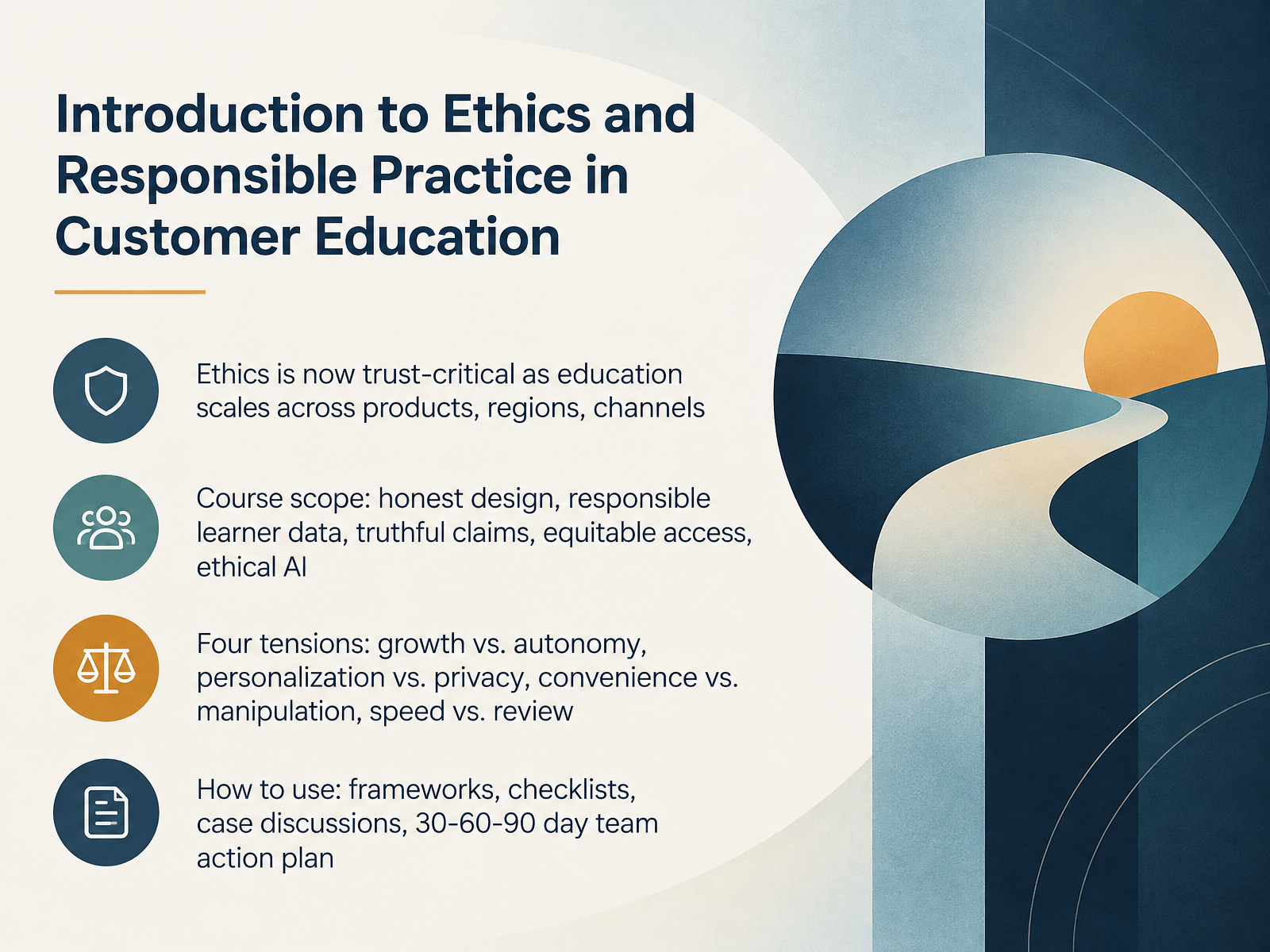
- 01Introduction to Ethics and Responsible Practice in Customer EducationWelcome. This course is about ethics and responsible practice in customer education. Our goal is simple but demanding: to help you build and defend trustworthy learning at scale. Ethics has become trust critical because education now reaches across products, regions, and channels, and every scaling decision carries real trade offs. In practice, honest design means a course claiming to teach a feature does not overstate results, and learner analytics are collected for stated purposes, not quietly repurposed. We will focus on five areas: honest design, responsible learner data, truthful claims, equitable access, and ethical AI. We will also work through four tensions. Growth versus autonomy, personalization versus privacy, convenience versus manipulation, and speed versus review. These tensions are where good teams often feel the deadline pressure, and where responsible practice has to be defined in the moment, not avoided. Here is how we will use our time. You will get frameworks, checklists, and case discussions, then build a thirty, sixty, ninety day action plan for your team. Keep one question in mind as we go. If a customer saw exactly how we designed this, would they still trust us? Let's move into the background, and how customer education became a trust critical function.apdcat.catcppa.ca.govflsenate.gov+22 min
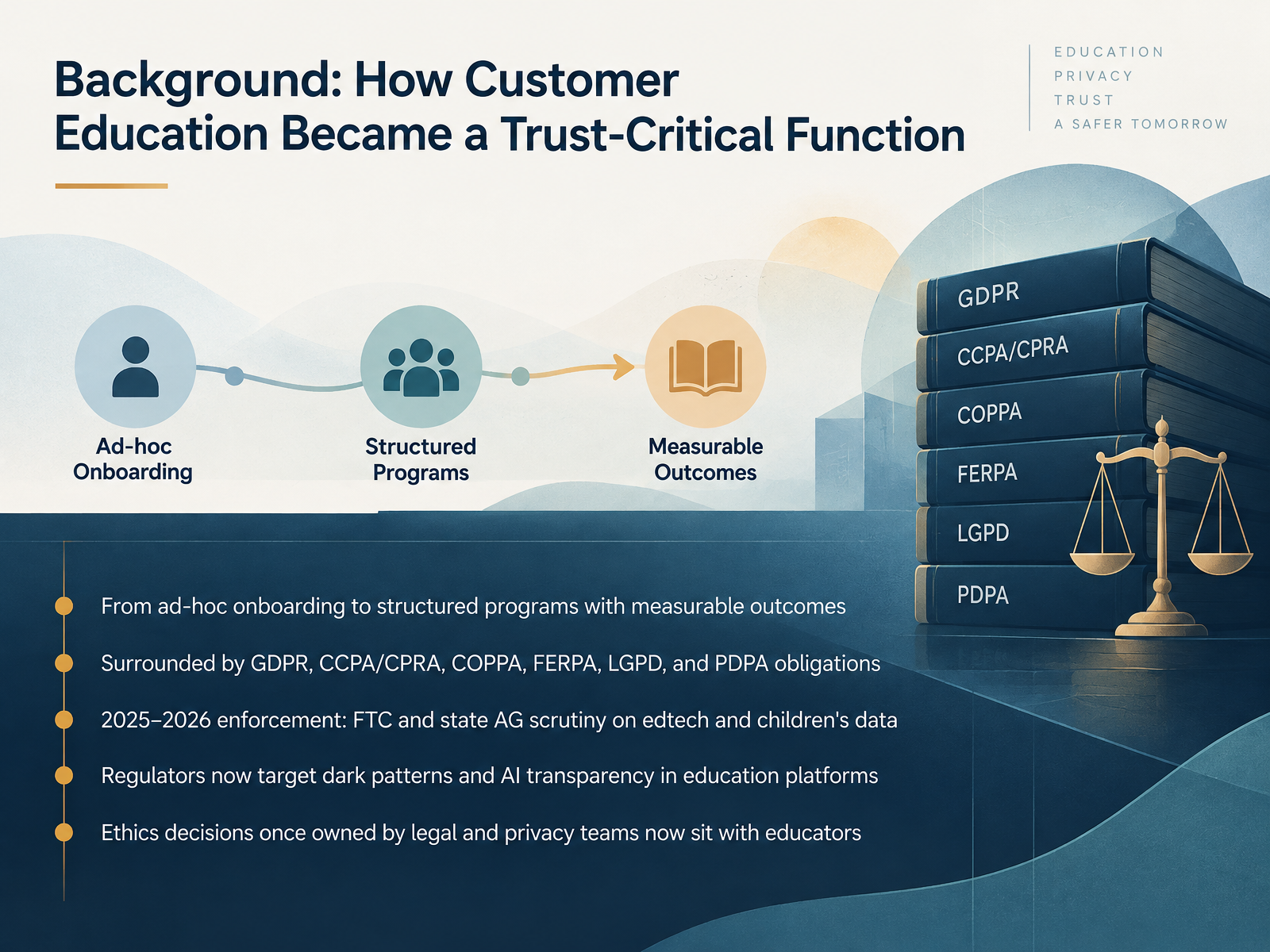
- 02Background: How Customer Education Became a Trust-Critical FunctionLet's look at how customer education became a trust-critical function. The shift happened fast. Ad-hoc onboarding turned into structured programs with measurable outcomes, and that meant more learner data moving through more systems. Now layer on the regulatory environment. GDPR, CCPA and CPRA, COPPA, FERPA, LGPD, and Singapore's PDPA all apply depending on where your learners sit and how old they are. Enforcement matched that complexity. Through 2025 and 2026, the FTC and state attorneys general sharpened scrutiny on edtech and children's data, with state AGs often the more aggressive layer. Regulators also started naming design itself, targeting dark patterns in enrollment flows and demanding transparency around AI in learning platforms. Here is the practical consequence for us. Decisions that once sat entirely with legal and privacy teams now land on educators. If you choose a retention window, configure a default, or approve an AI feature, you are making an ethics call. What responsible practice looks like: route those decisions deliberately, document your reasoning, and confirm consent covers the actual use. That foundation sets up our next topic, Core Ethical Principles for Learning Content.
 apdcat.catcppa.ca.govflsenate.gov+22 min
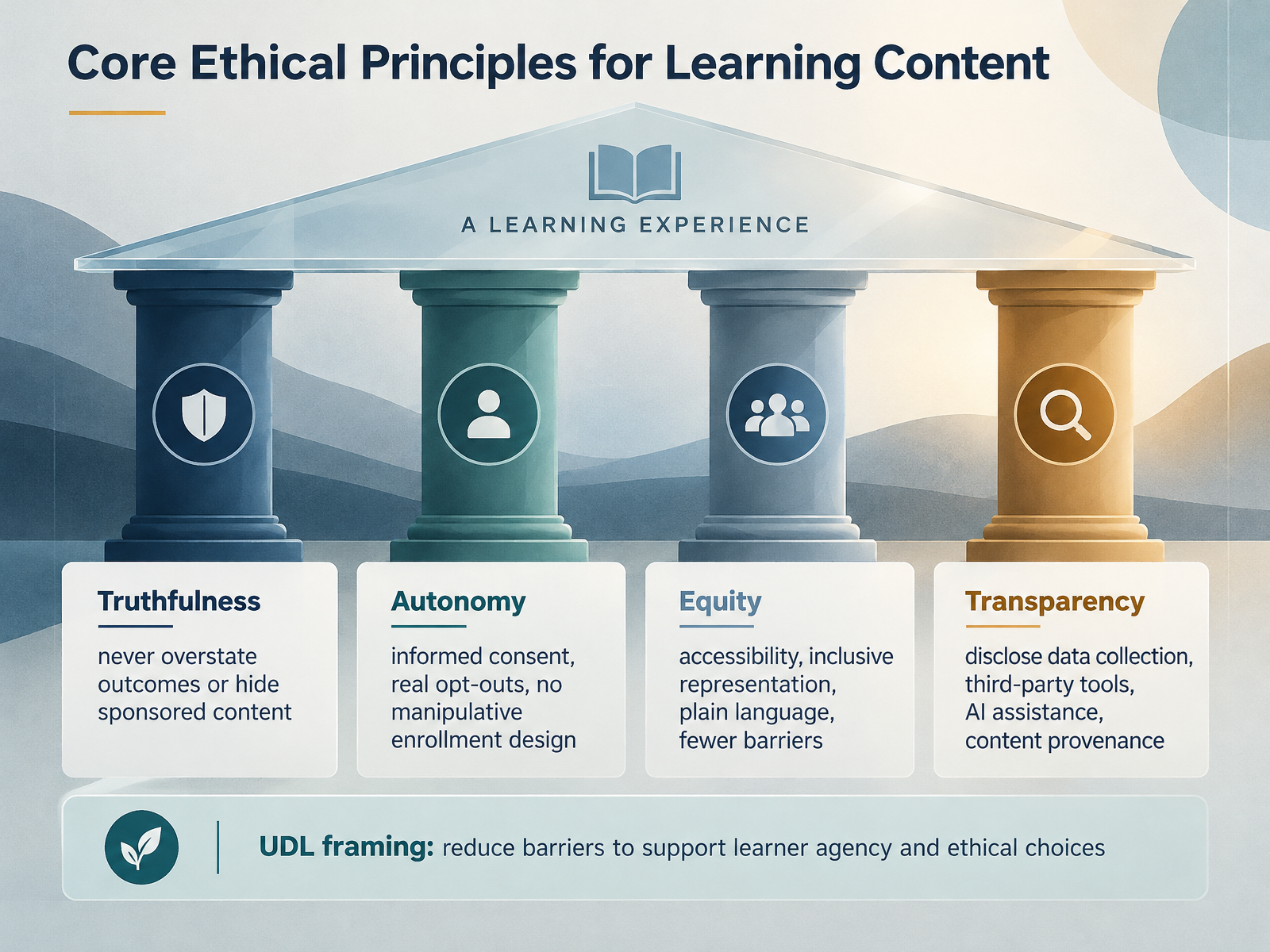
- 03Core Ethical Principles for Learning ContentLet's ground this in five principles you'll use every day. First, truthfulness: never overstate outcomes, and never hide sponsored content. If a vendor funds a course, say so in the course, not just the contract. Second, autonomy: informed consent, real opt-outs, and no manipulative enrollment design. A pre-checked renewal box is not consent. Third, equity: accessibility, inclusive representation, plain language, and fewer barriers. One caption file serves more learners than you think. Fourth, transparency: disclose data collection, third-party tools, AI assistance, and content provenance. Yes, deadlines are tight, but a one-line disclosure at intake costs minutes, not days. Fifth, UDL framing: reducing barriers builds learner agency, so ethical choices are supported by design rather than policed. Treat these as design constraints, not a checklist. That leads us to the regulatory landscape you actually need to know.
 doi.orgdl.acm.orgepale.ec.europa.eu+22 min
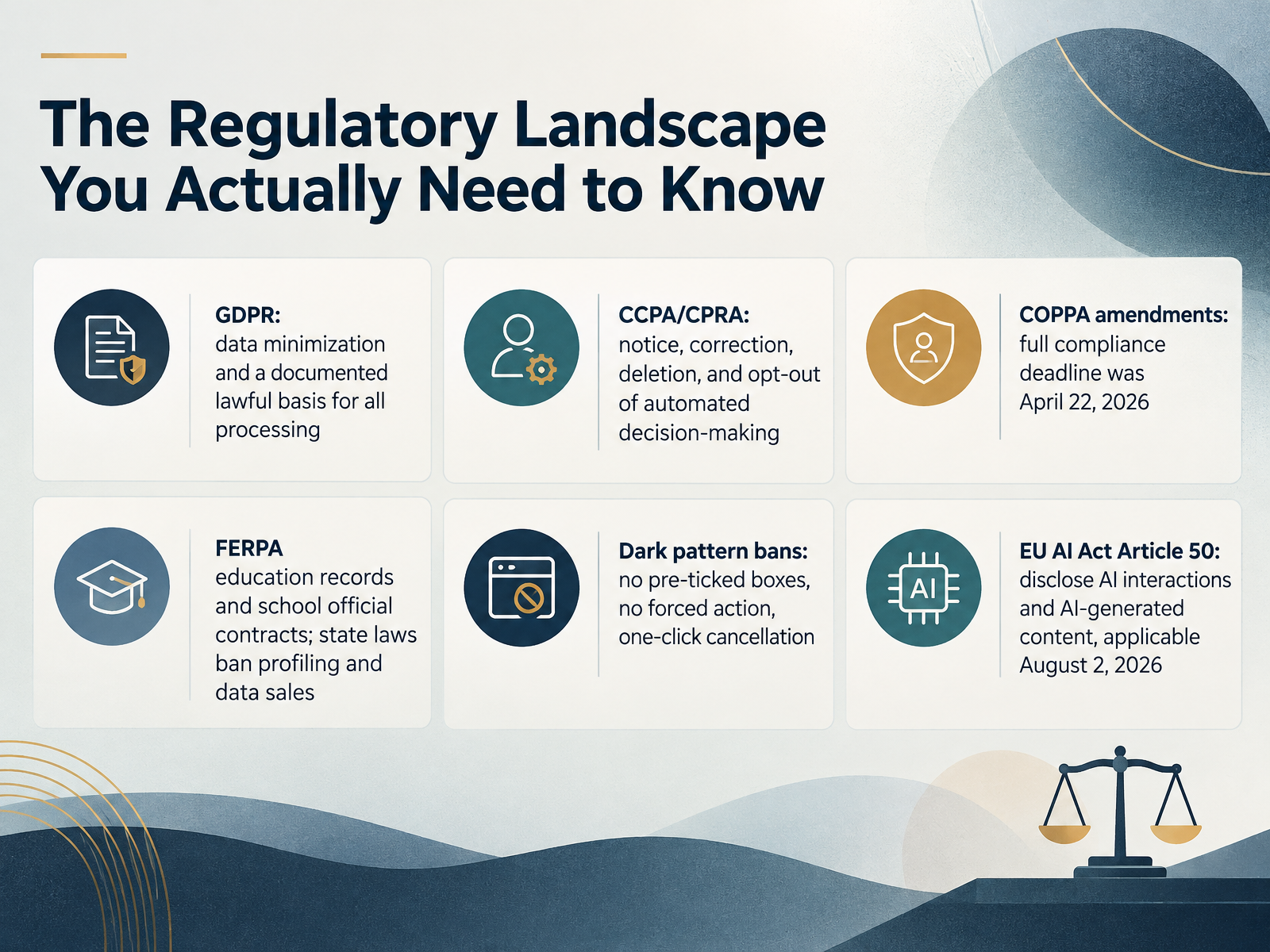
- 04The Regulatory Landscape You Actually Need to KnowLet's move into the regulatory landscape you actually need to know. This is a crowded field, so focus on six anchors. GDPR requires data minimization and a documented lawful basis for every processing activity. Under CCPA and CPRA, learners get notice, correction, deletion, and opt-out of automated decision-making. COPPA amendments had a full compliance deadline of April twenty-second, twenty twenty-six, and the FTC treats it as a hard date, not a grace period. FERPA covers education records and school official contracts, while state laws ban profiling and data sales. Dark pattern bans now rule out pre-ticked boxes, forced action, and complicated cancellation. And EU AI Act Article fifty requires disclosure of AI interactions and AI-generated content starting August second, twenty twenty-six. A practical example: if your chatbot tutors a thirteen-year-old, COPPA, FERPA, and Article fifty can all apply at once. Map each rule to a specific workflow before your next content or product release. Next, we look at Responsible Use of Learner Data.
 apdcat.catcppa.ca.govflsenate.gov+22 min
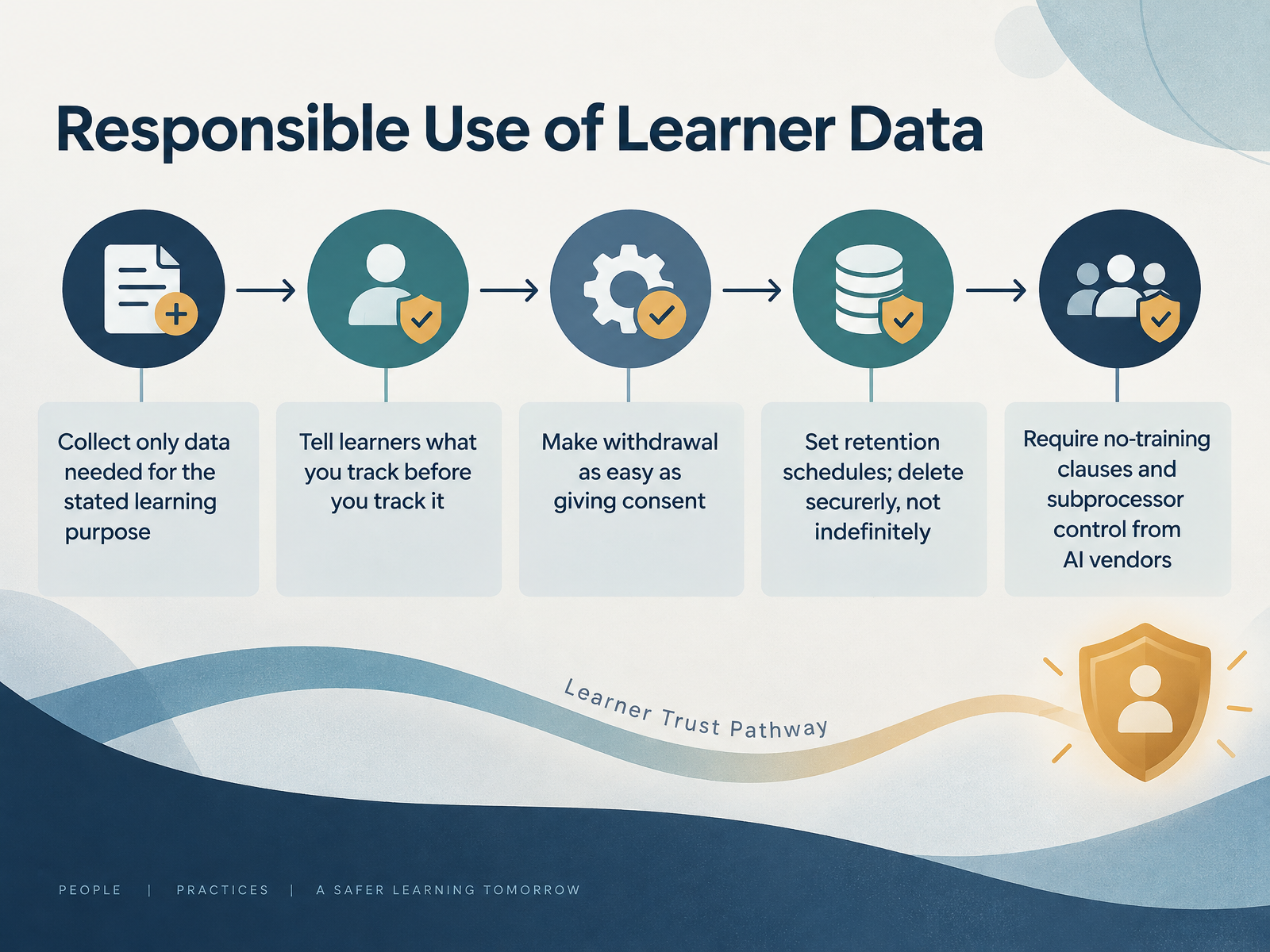
- 05Responsible Use of Learner DataNext, let's talk about responsible use of learner data. The core discipline is straightforward. Collect only what the stated learning purpose requires, and tell learners what you track before you track it. In practice, that means a progress dashboard for a certification program should disclose which clickstream and assessment signals feed it, not bury that in a vendor privacy policy. Then make withdrawal as easy as giving consent. If a learner opts into analytics with one click, opting out should also take one click, and you should act on it promptly. Set retention schedules and delete securely rather than keeping data indefinitely just because it might be useful. Finally, push on AI vendors: require contractual no-training clauses and control over subprocessors, so your learners' conversations never become someone else's training data. That last term matters most, because data absorbed into model weights cannot be recalled. Practical takeaway: document purpose, notice, withdrawal, retention, and vendor terms before you pilot. Coming up next, avoiding dark patterns in enrollment, upsells, and certification.
 gov.ukgov.ukguidance.submit-learner-data.service.gov.uk+22 min
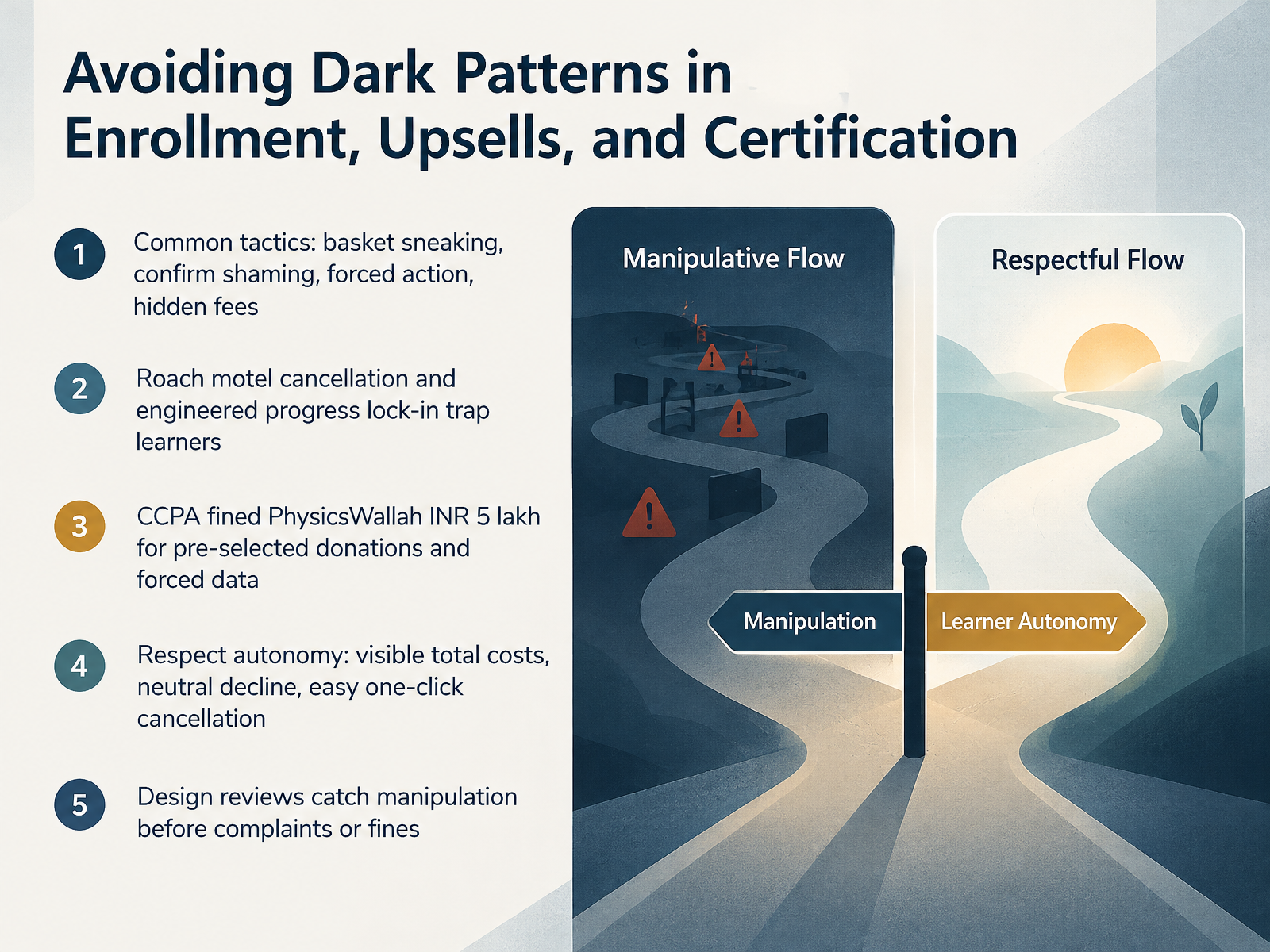
- 06Avoiding Dark Patterns in Enrollment, Upsells, and CertificationNow let's talk about dark patterns in enrollment, upsells, and certification. These are interface choices that push learners toward decisions they would not freely make. The common tactics are basket sneaking, confirm shaming, forced action, and hidden fees. Two more are especially destructive in education. A roach motel cancellation makes signing up frictionless and leaving a maze. Engineered progress lock-in makes a streak or rank feel too costly to abandon, so learners keep paying to protect an investment rather than to learn. We have a clear regulatory signal. India's Central Consumer Protection Authority fined PhysicsWallah five lakh rupees for a pre-selected donation at checkout and for forcing mobile numbers and email addresses before access to courses billed as free. The content was identical across accounts, so the data collection served no learning purpose. If your deadline pressure is real, here is what responsible practice looks like in that moment. Show the full cost before payment. Keep decline neutral and easy to find. Make cancellation one click. And run a design review against a dark pattern checklist before complaints or fines force the fix. Our next topic is Designing Honest and Inclusive Learning Experiences.
 doi.orgforbes.comdoi.org+22 min
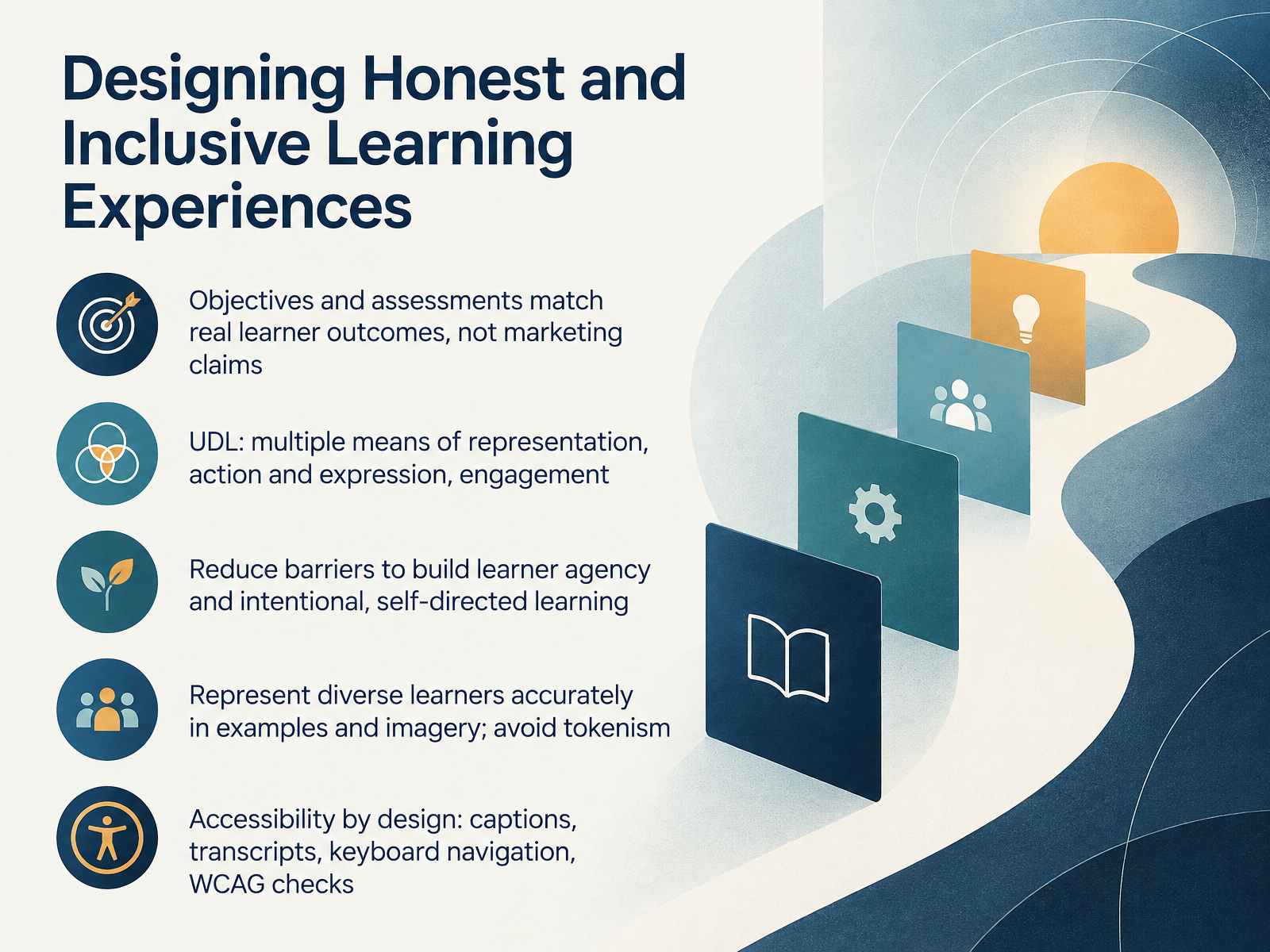
- 07Designing Honest and Inclusive Learning ExperiencesLet us look at how we design honest and inclusive learning experiences. Start with your promises. Your objectives and assessments should match real learner outcomes, not marketing claims. If sales copy says a course makes someone proficient, your assessments need to prove that. Next, apply Universal Design for Learning's three principles: multiple means of representation, action and expression, and engagement. The goal is to reduce barriers and build learner agency, so people become intentional and self-directed. For example, offer a written, audio, and visual version of the same lesson, and let learners demonstrate mastery through a presentation, an infographic, or a written response against one shared rubric. When you represent diverse learners in examples and imagery, do it accurately and avoid tokenism. One real person in a real role beats a decorative stock photo. And build accessibility in from the start with captions, transcripts, keyboard navigation, and regular WCAG checks. Rushing accessibility at the end costs more and fails more often. Design honestly, design inclusively, and learners get both fairness and better outcomes. That leads directly into our next topic: the ethical use of AI in customer education.
 doi.orgdl.acm.orgepale.ec.europa.eu+22 min
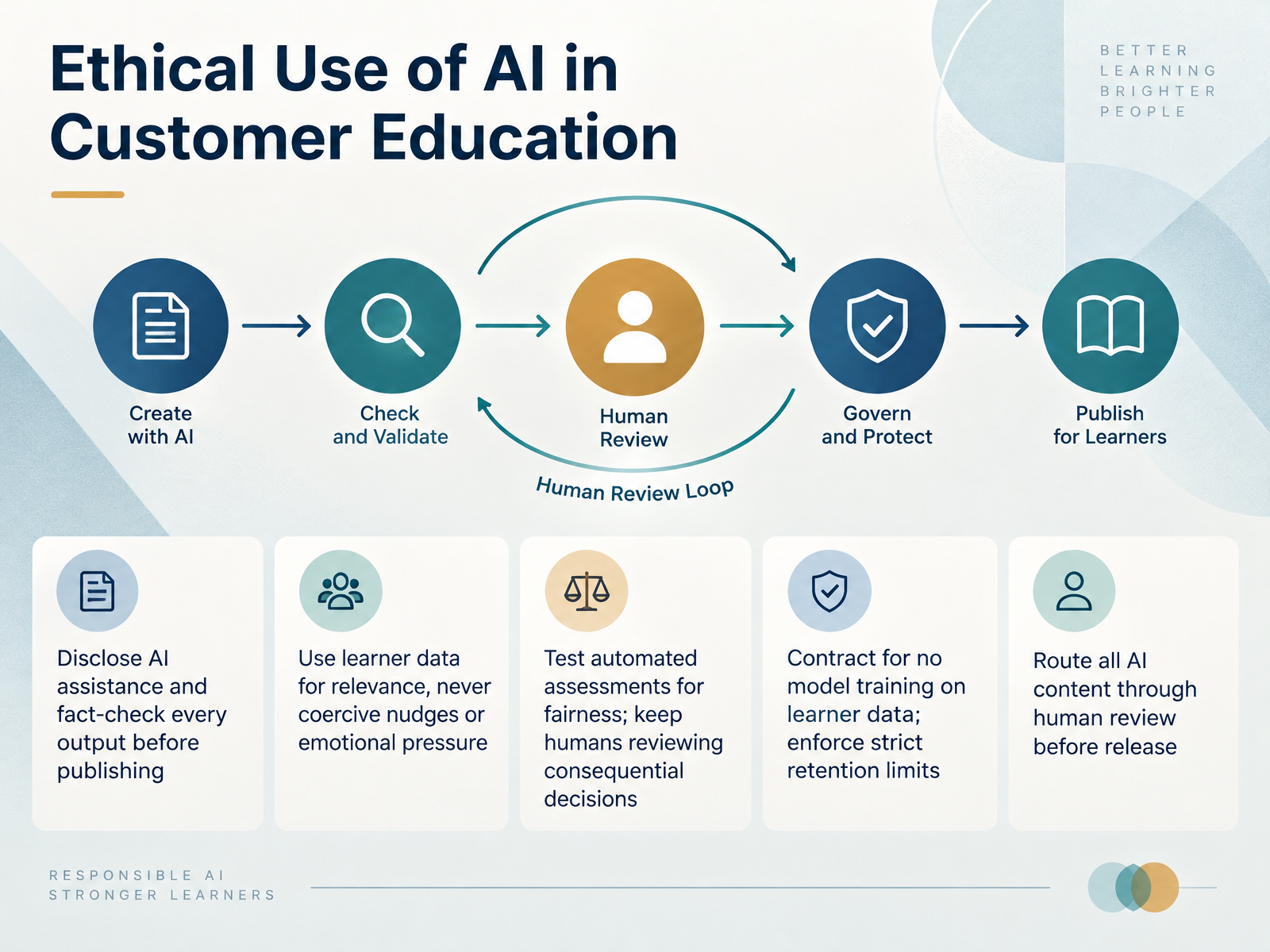
- 08Ethical Use of AI in Customer EducationNow let's look at the ethical use of AI in customer education. Disclose AI assistance, and fact-check every output before publishing. A generated quiz explanation can sound confident and still be wrong. Use learner data to personalize relevance, never for coercive nudges or emotional pressure. Test automated assessments for fairness, and keep humans reviewing consequential decisions. In contracts, require no model training on learner data, with strict retention limits, binding subprocessors too. Route all AI content through human review before release. The practical takeaway: AI can draft, but accountable people decide what reaches learners. Next, we examine a certification program with inflated completion claims.
 doi.orgdl.acm.orgepale.ec.europa.eu+21 min
- 09Case Study: A Certification Program with Inflated Completion ClaimsLet's walk through a case that plays out often in customer education. A certification program markets near-universal certification, while internal data shows completion far lower. That gap invites consumer protection scrutiny and erodes learner trust. So who owns the accuracy of outcome claims, and what evidence is required? Here is a concrete example. Your marketing page says ninety percent of learners get certified. The learning platform shows forty percent. Two numbers, one promise, and no one clearly assigned to reconcile them. The fix is not just a softer headline. It is a claims substantiation workflow. Before any outcome number goes public, someone validates it against platform data and documents the method. Then you report outcomes in plain language, such as completion rate or pass rate, with the timeframe stated. Finally, audit published statistics periodically and correct past overstatements openly. That correction protects learners and your credibility. Next, we look at a case study on learner tracking that exceeded stated consent.
 2 min
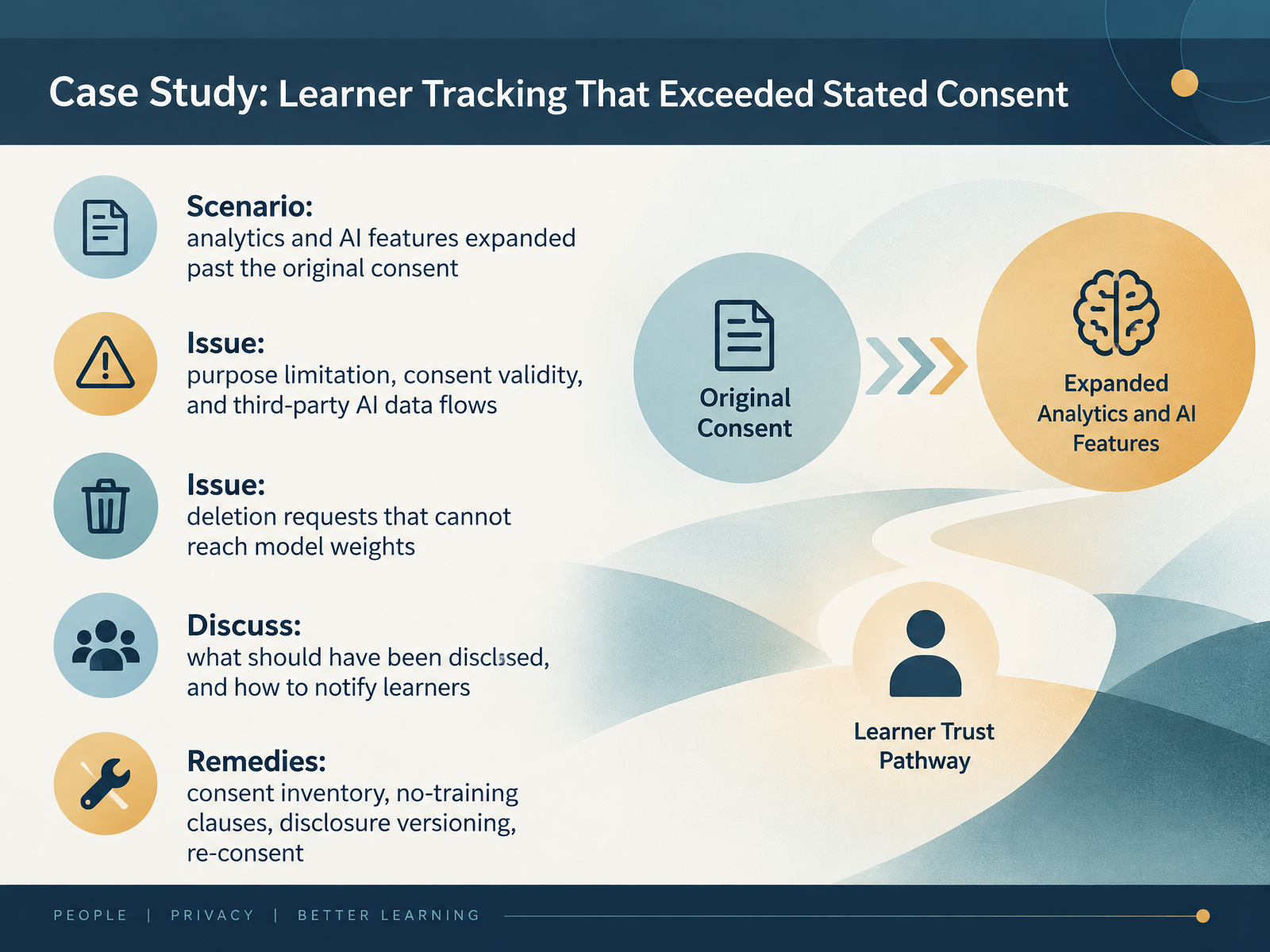
- 10Case Study: Learner Tracking That Exceeded Stated ConsentLet's walk through a case that many of you have seen in some form. A learning platform added analytics, then AI features, and those uses quietly expanded past the consent learners originally gave. That is where purpose limitation breaks. Consent is tied to a specific purpose, and when we reuse that data for something new, the original consent no longer covers it. The harder issue is third-party AI. If prompts or transcripts flow to a vendor's model, you have a data flow you may not have disclosed, and deletion requests cannot reach model weights. So a learner asking to be erased may be told yes while their data persists in a trained model. No one has a clean technical fix for that, which is why it has to be a contract term. So what should have been disclosed, and how do you tell learners now? First, before adoption, you should have disclosed the new purposes and the third parties clearly and in plain language. Then when the problem surfaces, you notify proactively with a short notice, explain what changed, link to detail, and offer a clear path to object or withdraw without penalizing them. Practically, build a consent inventory so you know what each learner actually agreed to. Put no-training and zero-retention clauses in vendor contracts that bind subprocessors, version your disclosures, and re-consent when purposes change. Treat disclosure as an operational gate in every release, not a one-time document. Next, we look at a related risk. Case Study: AI-Generated Course Content with Undisclosed Bias.
 gov.ukgov.ukguidance.submit-learner-data.service.gov.uk+22 min
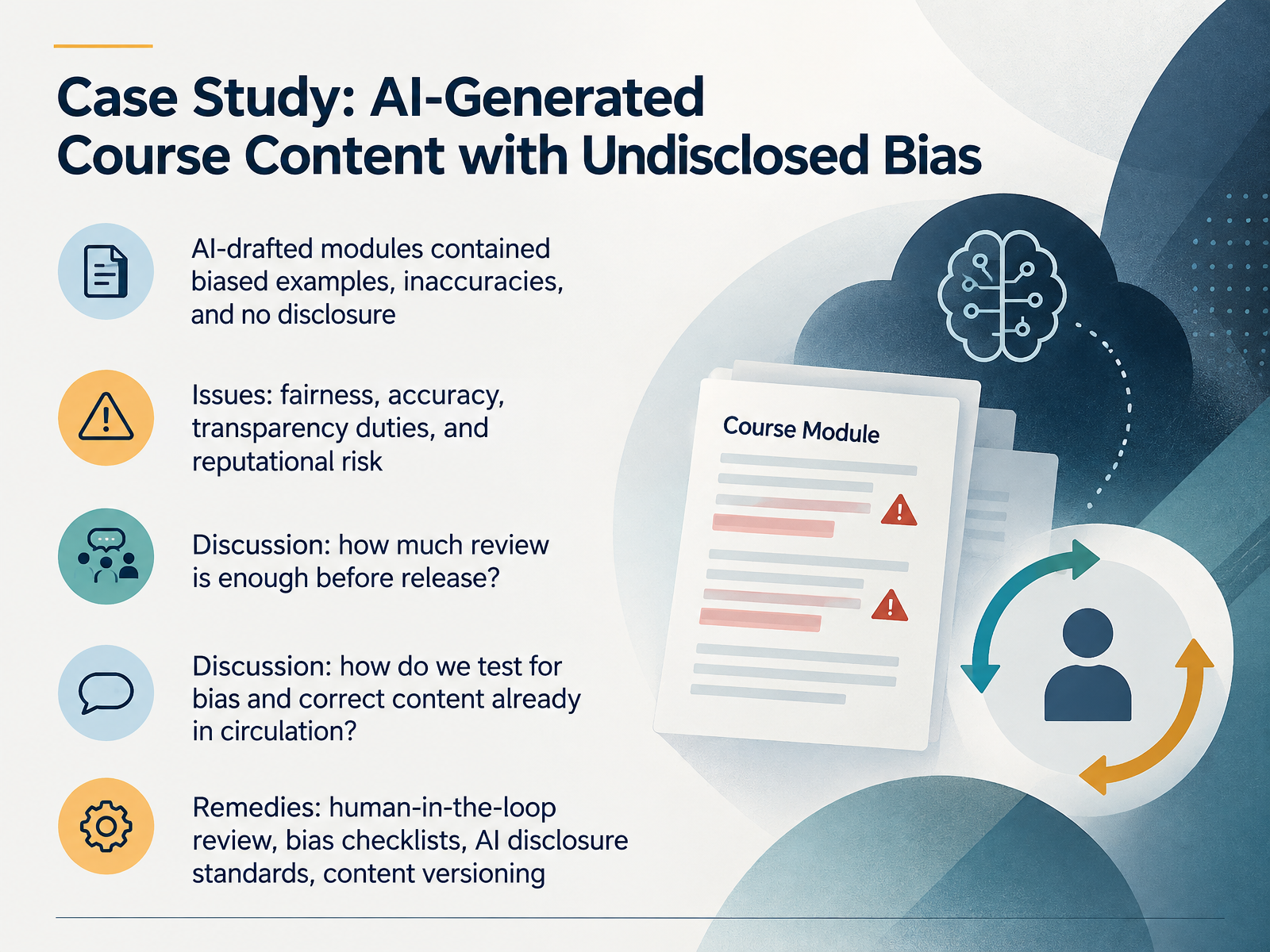
- 11Case Study: AI-Generated Course Content with Undisclosed BiasLet's look at a case study on AI-generated course content with undisclosed bias. Here's the scenario. A team drafts modules with a generative tool, and the output contains biased examples, factual inaccuracies, and no disclosure that AI was involved. That surfaces four distinct duties: fairness, accuracy, transparency, and reputation. Picture a customer-facing certification module that names only one professional demographic in every scenario. Learners notice. So does the client. Now, the discussion questions. How much review is enough before release? And how do you test for bias or correct content already in circulation? First, define a review standard tied to risk, not to the calendar. High-stakes modules get expert review and a bias checklist before publishing. Second, disclosure should be explicit and layered, stating where and how AI was used. Third, apply versioning so you can pull or correct a module and prove what changed. Human-in-the-loop review isn't a formality here. It's the control that catches bias before your learners do. Next, we move from cases to practice, embedding ethics into daily work through checklists, decision trees, and ownership.
 doi.orgdl.acm.orgepale.ec.europa.eu+22 min
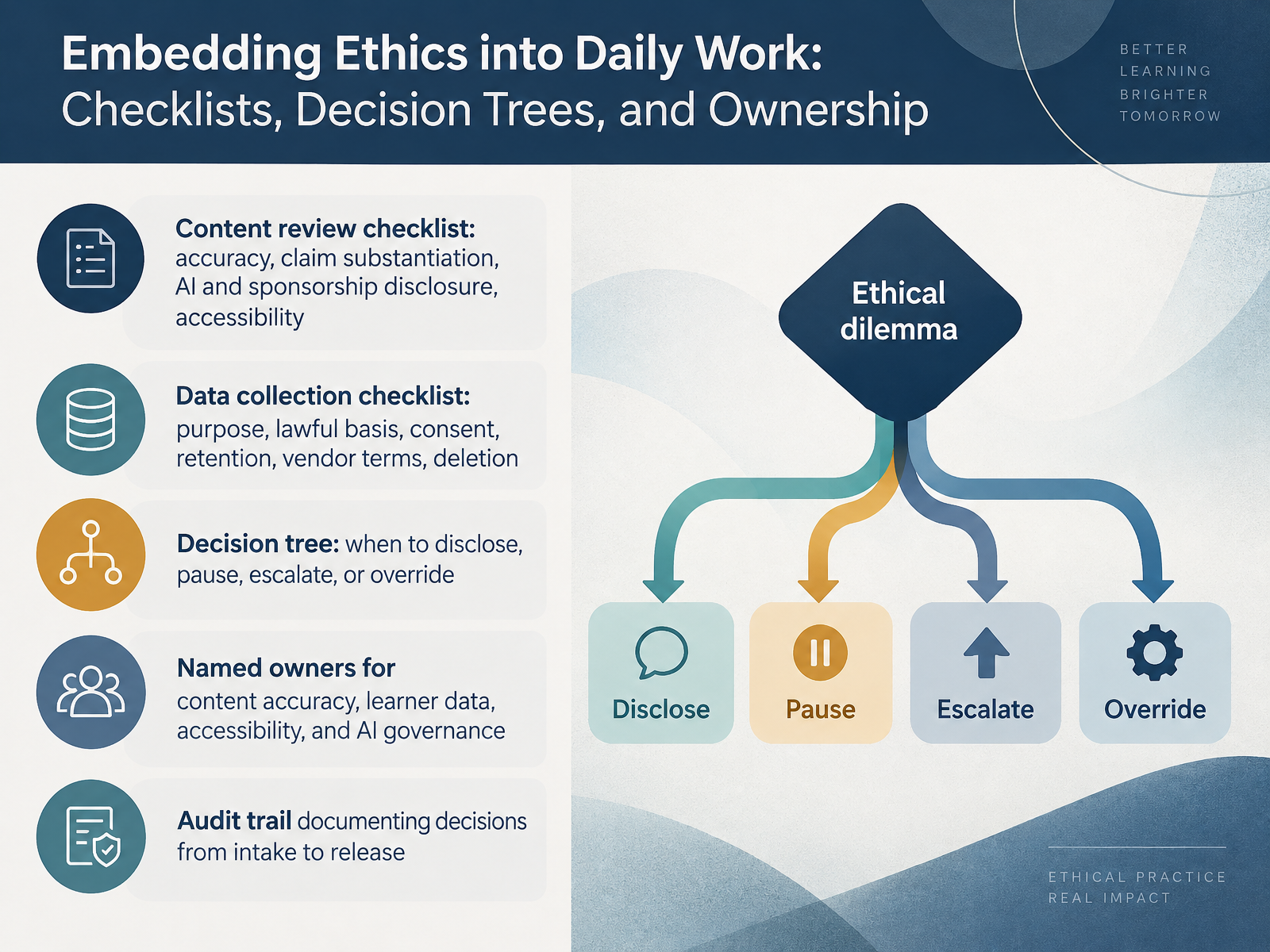
- 12Embedding Ethics into Daily Work: Checklists, Decision Trees, and OwnershipLet's turn to embedding ethics into daily work. Principles only matter if they show up in the process, so build two checklists. The content review checklist covers accuracy, claim substantiation, AI and sponsorship disclosure, and accessibility. The data collection checklist covers purpose, lawful basis, consent, retention, vendor terms, and deletion. Then add a decision tree that answers four questions: when do we disclose, when do we pause, when do we escalate, and when do we override? A customer asks you to ship a course today. The pressure is real. Responsible practice means running the checklist first, not after launch. Name owners for content accuracy, learner data, accessibility, and AI governance, so accountability has a face. Finally, keep an audit trail from intake to release, showing what you decided and why. That trail is your evidence when a client, auditor, or regulator asks. Next, we look at measuring ethical practice and continuous improvement.
 2 min
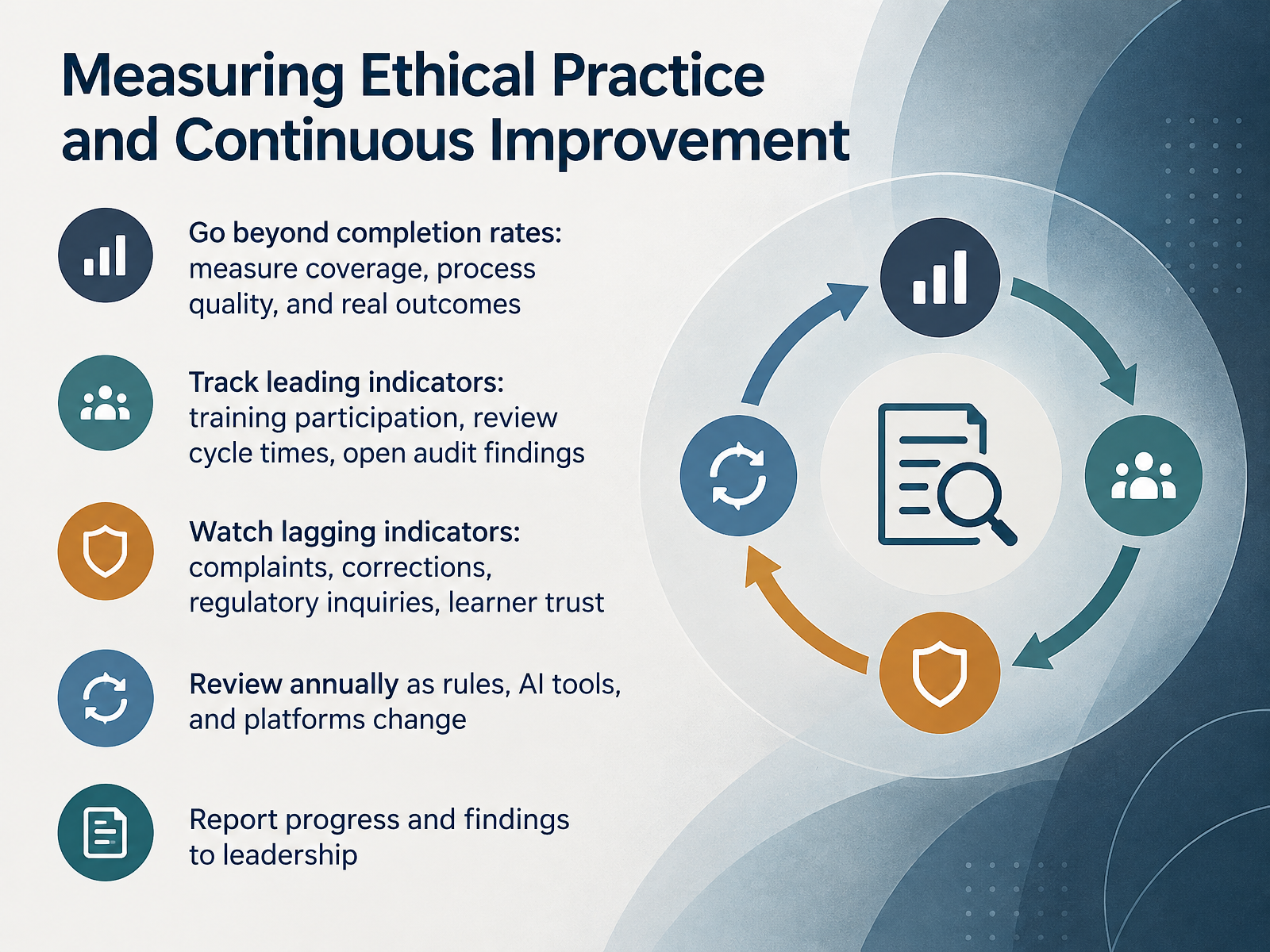
- 13Measuring Ethical Practice and Continuous ImprovementLet's talk about how you know your ethical practice is actually improving. Completion rates alone won't tell you that. So go deeper. Measure coverage, the quality of your review process, and real outcomes. Track leading indicators like training participation, review cycle times, and open audit findings. Those tell you where you're likely to fail before you do. Then watch lagging indicators: complaints, corrections, regulatory inquiries, and learner trust. Those show you what already went wrong. One practical example. Say your completion rate is nearly one hundred percent, but your review cycle time keeps climbing and audit findings sit open. That gap is your real signal. You don't need heavy tooling to start. A shared spreadsheet updated monthly is enough. Review everything annually, because rules, AI tools, and platforms change fast. And report your progress and findings to leadership. Make the findings lead to a decision, not just a slide. Next, we'll turn this into action.
 2 min
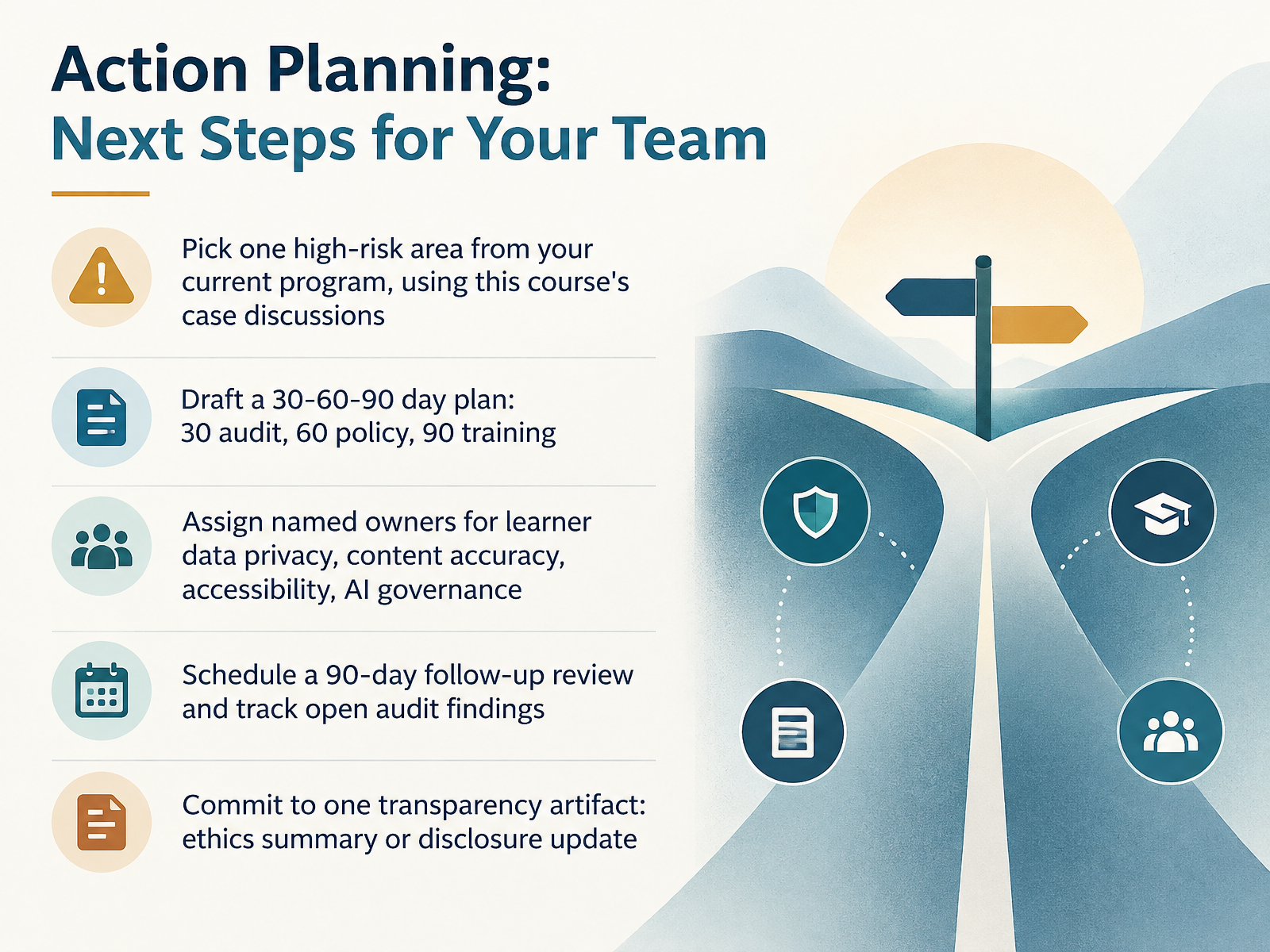
- 14Action Planning: Next Steps for Your TeamLet's close with action. Pick one high-risk area from your current program. Use the case discussions from this course to choose it. Maybe it's learner data consent, or content accuracy across a reused module. Then draft a thirty, sixty, ninety day plan. Thirty days to audit, sixty to write policy, ninety to train. Next, name owners. Assign a real person for learner data privacy, content accuracy, accessibility, and AI governance. Unnamed ownership is how gaps survive. Schedule a ninety-day follow-up review and track your open audit findings until they close. Finally, commit to one transparency artifact, either an ethics summary or a disclosure update. That keeps your program accountable to learners and clients. Small, specific, and owned, that's what makes responsible practice stick. Thank you for staying engaged throughout the course. Now take that first step this week, and keep building trust one decision at a time.
 2 min
Take the deck with you
Download this course as a file — free, no sign-up needed.
- PDF handoutEvery slide page, ready to print or share.15 pages · 3.9 MBDownload
- Narrated PowerPointThe deck that presents itself — every slide carries the digital human's narration video.15 pages · 15.9 MBDownload
- PowerPoint slidesThe full deck as a .pptx — open it in PowerPoint, Keynote, or Google Slides.15 pages · 3.9 MBDownload
Free to use in your own training — please keep the PersonWise credit page at the end.
Have your own deck? Turn it into a course
Sources consulted
Web sources consulted while building this course.
- Data Protection Authorities publish a ten-point manifesto of basic principles for the contracting and use of digital educational platforms — apdcat.cat
- CCPA - Effective January 1, 2026 — cppa.ca.gov
- Chapter 1006 Section 1494 - 2026 Florida Statutes - The Florida Senate — flsenate.gov
- 7 Things to Know Before 2026 CCPA Updates Take Effect — cppa.ca.gov
- PRIVACY POLICY — cdn.ashurstperkinscoie.com
- A Framework for Ethical Online Course Development with Universal Design for Learning — doi.org
- Guidelines for Designing AI Technologies to Support Adult ... — dl.acm.org
- AI Technologies for Adult Learning: Meeting Andragogical Needs Thro... — epale.ec.europa.eu
- Application of Learning Engineering Design Principles for Ethical and Inclusive Adaptive Instructional Systems | Adaptive Instructional Systems — dl.acm.org
- AI Ethics Rubric for L&D – 10 Dimensions of Consideration — paradoxlearning.com
- Data protection in schools - Guidance - GOV.UK — gov.uk
- Issuing privacy notices: guidance for schools and local authorities - GOV.UK — gov.uk
- ILR Privacy Notice 2026 to 2027 version 1: January 2026 — guidance.submit-learner-data.service.gov.uk
- Privacy information: key stage 4 and 5 and adult education - GOV.UK — gov.uk
- FERPA | Protecting Student Privacy - Department of Education — studentprivacy.ed.gov
- Deceptive Pattern Analysis in Education Technology: Examining Manipulative and Ethical Design Practices in EdTech Platforms — doi.org
- Dark Patterns In EdTech: The Hidden Cost Of Easy Enrollment — forbes.com
- Exploring the Use of Dark Patterns in University Websites: Ethical Implications and Impacts on Student Decision-Making — doi.org
- Misleading Dark Patterns On Digital Platform: Consent Engineered Through Guilt — legal500.com
- HOLDING CORPORATIONS ACCOUNTABLE FOR EXPLOITING ONLINE EDUCATION — protectborrowers.org