Everyday English Conversation Skills
Begin
14 pages · ~28 min
Everyday English Conversation Skills
This training helps learners build practical English conversation skills for daily interactions, improving confidence and fluency in real-life situations.
What you’ll learn
- 01English Conversation for Everyday SituationsHello, and welcome! I'm so glad you're here. This course is all about English conversation for everyday situations. Whether you're just starting out, you're a teacher looking for fresh ideas, or you're creating your own language content, this is the right place. So, what will we do together? We'll move from common situations to the exact phrases people use. We'll practice listening, and we'll explore how to teach these skills. Our goal is simple: to help you speak with fluency, confidence, and natural ease in your daily life. Think about ordering a coffee, asking for directions, or making small talk. These are the moments we'll master. Before we dive in, just remember to breathe, relax, and be patient with yourself. Speaking a new language is a journey. In our next section, we'll look at the core situations and contexts you'll encounter most often. Let's get started!tryclue.appblog.rosettastone.comiwantspeakenglish.com+21 min
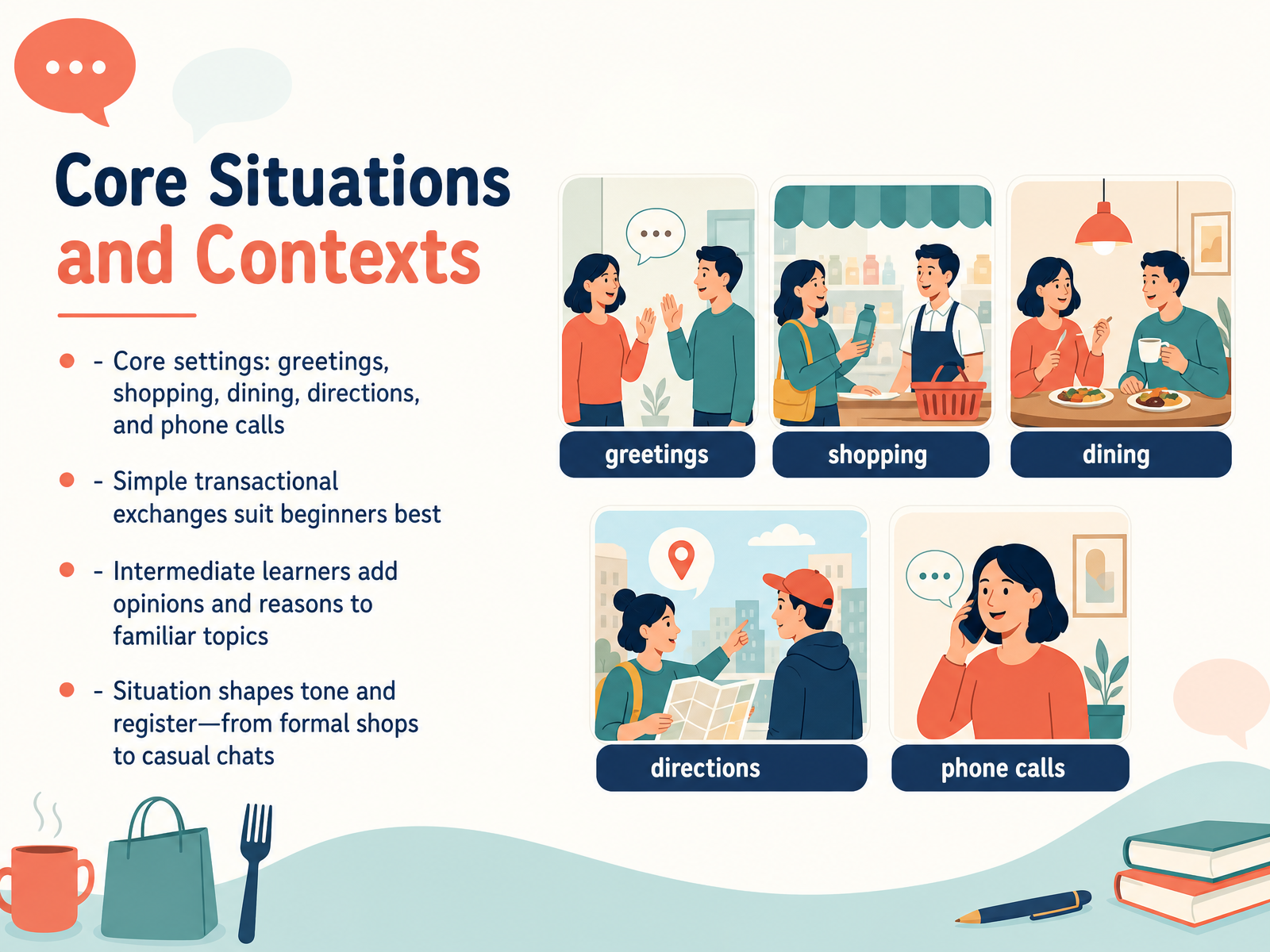
- 02Core Situations and ContextsLet’s look at the situations you’ll actually meet in daily life. The core ones are greetings, shopping, dining, asking for directions, and phone calls. For beginners, simple transactional exchanges work best. That means short, clear conversations where you get what you need. For example, ordering a coffee or asking the price of something. As you reach the intermediate level, you can start adding your opinions and reasons to familiar topics. So instead of just saying 'I like this,' you might say 'I like this because it’s faster.' Remember, the situation also shapes the tone. A conversation in a formal shop is different from a casual chat with a friend. You’ll use different words and a different level of politeness. So as we go through these situations, think about who you’re talking to and where you are. Next, we’ll explore useful phrases and sentence patterns for each of these moments.
 tryclue.appblog.rosettastone.comiwantspeakenglish.com+21 min
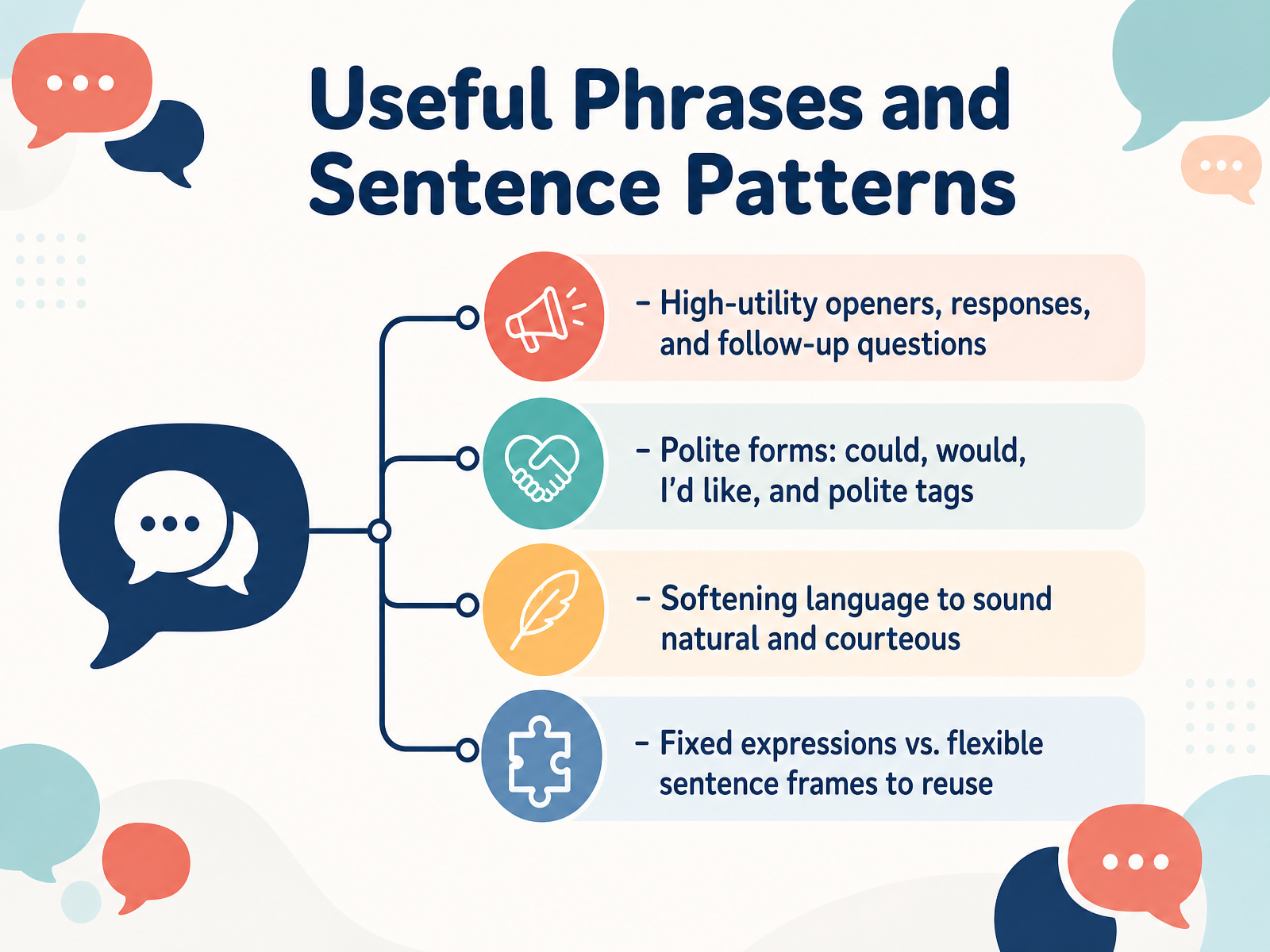
 - 03Useful Phrases and Sentence PatternsNow let's look at the building blocks you'll use again and again. Think of these as your conversation toolkit. First, high-utility openers and responses. Simple phrases like 'Nice to meet you' or 'Sounds good to me' work in many situations. Then we have polite forms. Words like 'could' and 'would' make requests softer. Instead of 'Give me the menu,' try 'Could I see the menu, please?' And 'I'd like' is a friendly way to order. Next, softening language helps you sound courteous and natural. Saying 'I'm not sure, but I think...' is gentler than a strong statement. Finally, notice the difference between fixed expressions and flexible frames. A fixed phrase like 'How's it going?' is ready to use. But a frame like 'I need...' lets you fill in the blank: 'I need help,' 'I need a break.' Practice these chunks as one piece, not word by word. They will come out faster and smoother over time. Coming up next, we will see how to start and keep a conversation going.
 practiceme.appbasicenglishspeaking.comrefinedenglishacademy.com+22 min
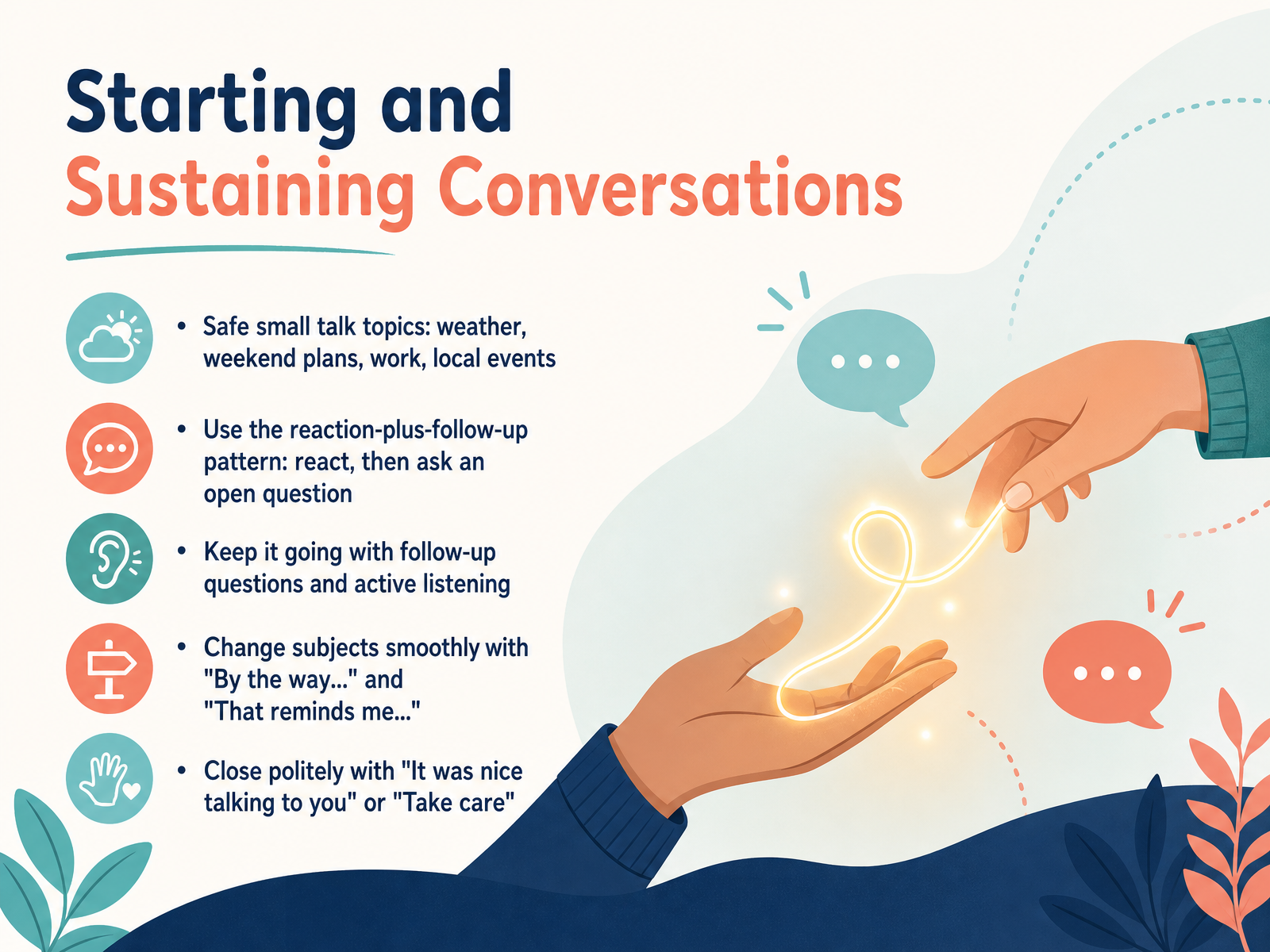
 - 04Starting and Sustaining ConversationsSo, how do we keep a conversation going once it has started? It begins with safe topics. Think about the weather, weekend plans, work, or local events. These are shared experiences. Now, here is a simple pattern to use: react, then ask a follow-up question. For example, if someone says they had a busy week, you can say, That sounds tiring, what kept you so busy? This shows you are listening and invites them to share more. To switch topics smoothly, use phrases like, By the way, or, That reminds me. And when it is time to leave, close politely with It was nice talking to you, or simply, Take care. These small tools keep the conversation flowing naturally. Next, we will look at the rhythm of listening and turn-taking.
 practiceme.appbasicenglishspeaking.comrefinedenglishacademy.com+21 min
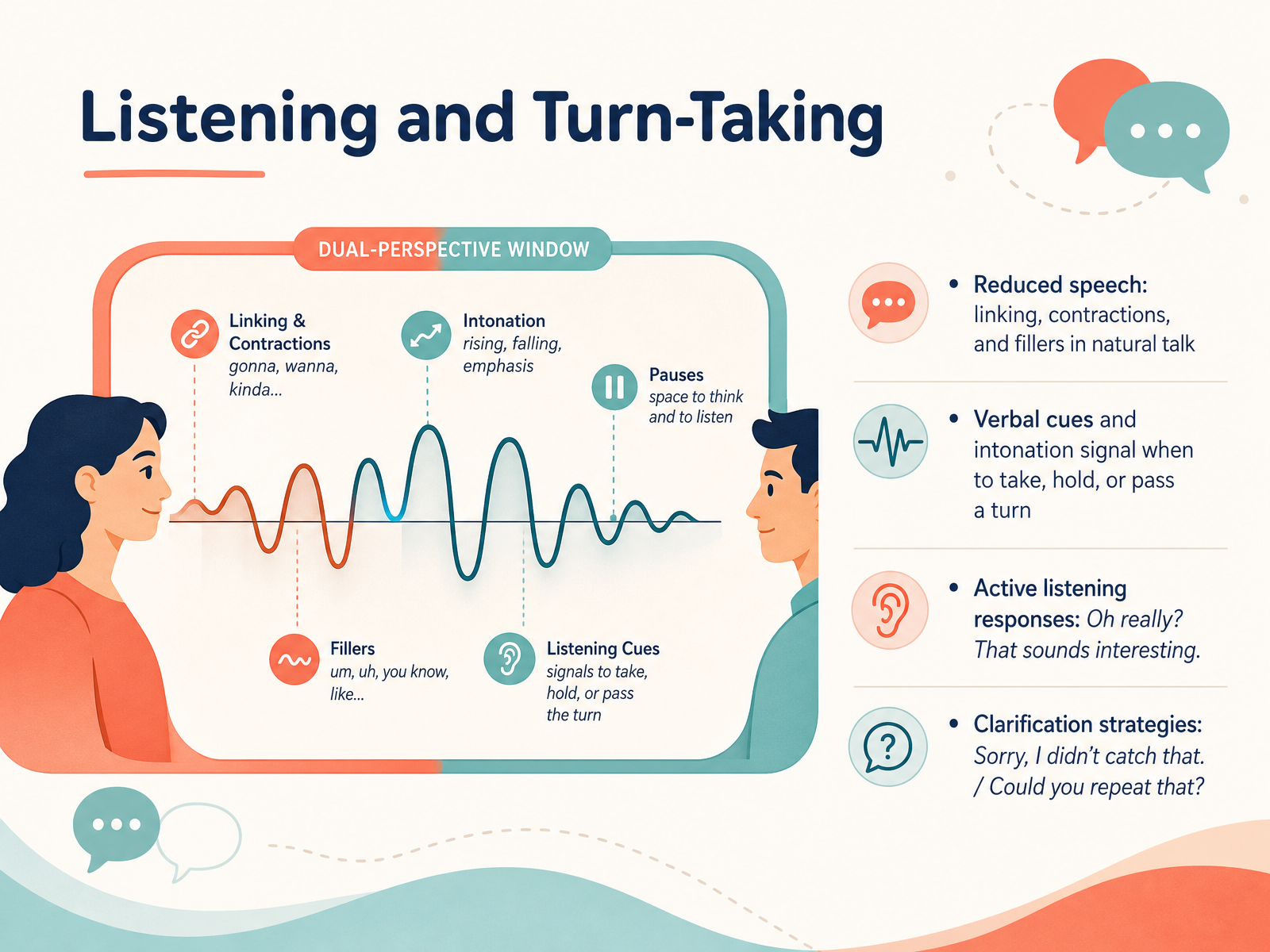
 - 05Listening and Turn-TakingLet's look at how we really listen and take turns in English conversation. Natural speech often sounds different from written English. Words link together, like 'gonna' or 'wanna'. Contractions like 'I'm' or 'that's' are everywhere. And we use fillers like 'um' and 'you know' while we think. These are all normal. Now, how do we know when to speak? It's all about cues. Rising intonation at the end of a sentence often means the speaker is inviting you to respond. A falling tone might mean they're finishing their thought. And phrases like 'What do you think?' or 'Anyway...' are clear signals it's your turn. When someone is talking, show you're listening with short responses. Say 'Oh really?' or 'That sounds interesting.' These keep the conversation flowing. And if you miss something, don't be shy. Say 'Sorry, I didn't catch that' or 'Could you repeat that?' These simple phrases are your lifeline in real conversations. Remember, listening is active, not passive. Next, we'll talk about building your confidence and fluency.
 usingenglish.comteachingenglish.org.ukmacmillanenglish.com+21 min
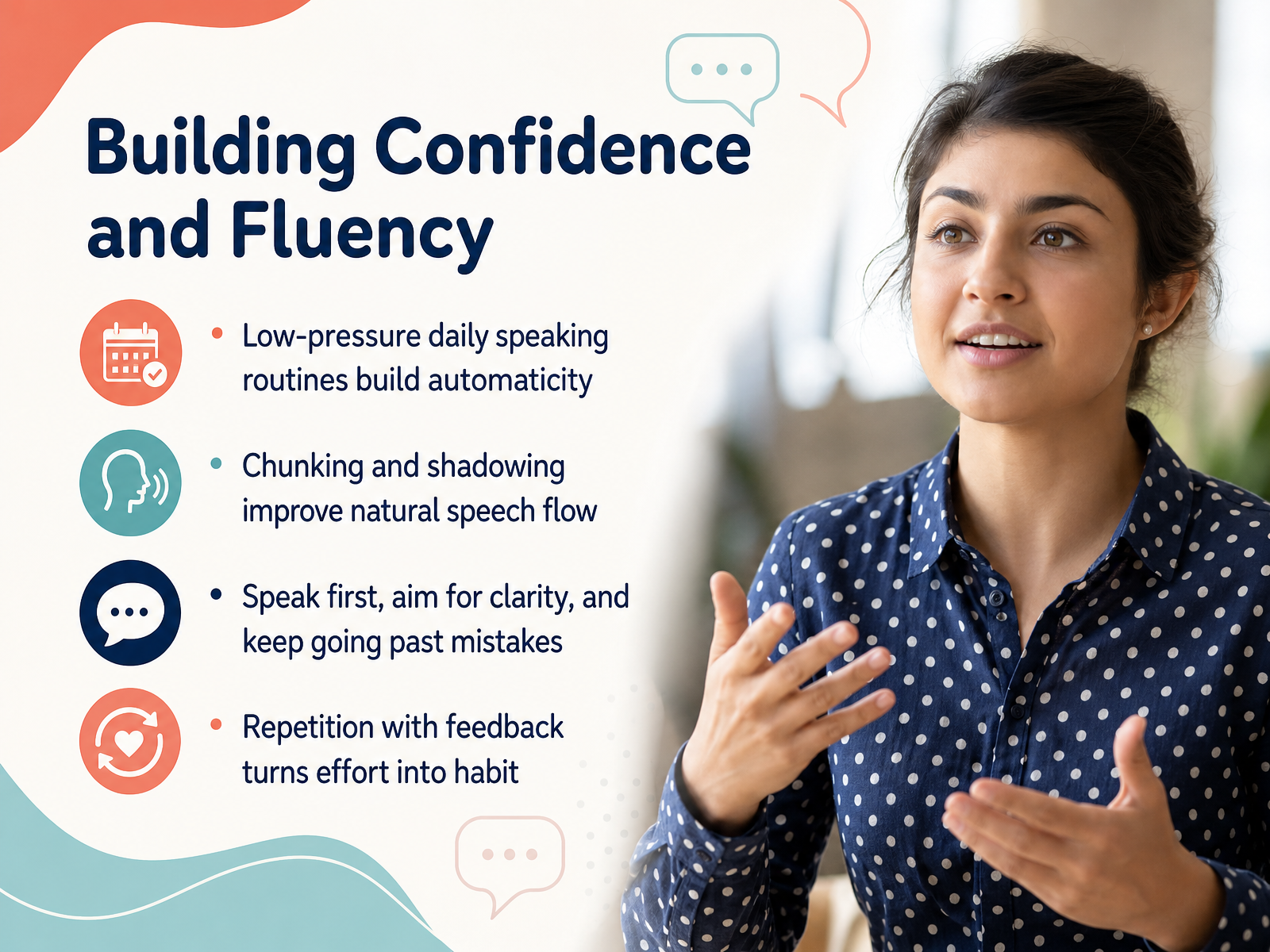
 - 06Building Confidence and FluencyLet's think about confidence for a moment. It isn't something you wait for. It's something you build. Daily practice is the foundation. Even five minutes of talking to yourself about your day makes a difference. The goal is automaticity, which means the words just come out without you overthinking. Chunking helps with that. Learn phrases as whole units, like "I'd like to..." or "What do you think about...?" And shadowing works too. Listen to a short clip of a native speaker and repeat it right away, matching their rhythm and tone. It feels odd at first, but it trains your mouth to move naturally. When you speak, aim for clarity, not perfection. If you stumble, keep going. Mistakes are part of the process. What matters is that you carry the conversation forward. Then, repeat. Use the same phrases in new situations. Each time, it becomes a little more habitual. With repetition and feedback, effort turns into habit, and that is where real confidence lives. Next, we'll look at how to teach these everyday conversations to others.
 marcusenglishinstitute.comlearnenglish.britishcouncil.orgpracticeme.app+21 min
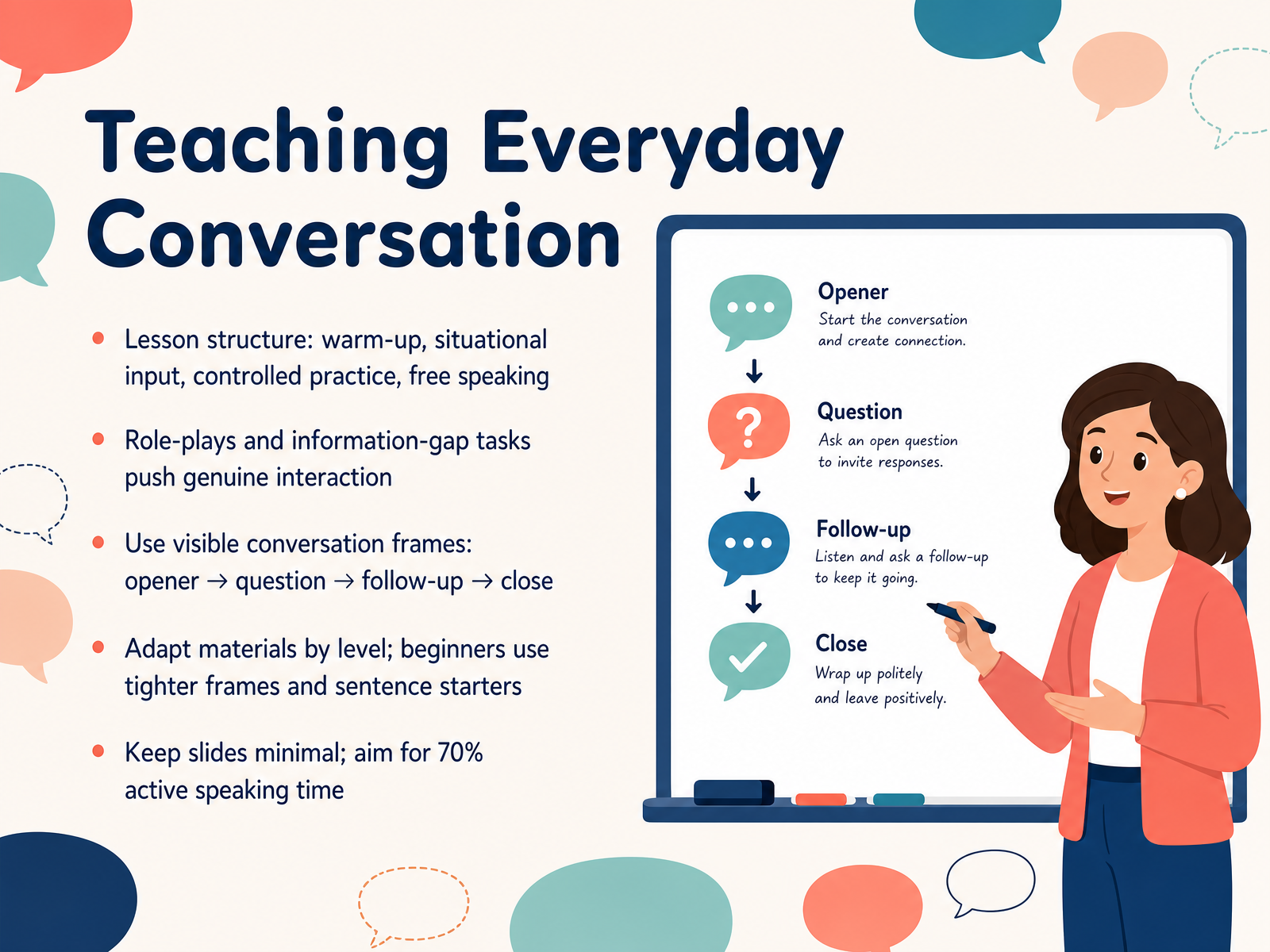
 - 07Teaching Everyday ConversationNow, let’s talk about teaching everyday conversation. A good lesson follows a simple structure. Start with a warm-up. Then introduce the situation. Follow that with controlled practice, and finish with free speaking. This keeps the class balanced and gives learners a clear path. Role-plays and information-gap tasks are powerful tools. They push real interaction. When learners need information they don’t have, they must ask questions and respond naturally. Many learners also benefit from a visible conversation frame. Show them a simple flow: opener, question, follow-up, close. This gives them a roadmap. They can see where the conversation begins and how to end it politely. Adapt your materials to the learners’ level. Beginners need tighter frames and sentence starters. More advanced learners can handle open-ended tasks with less support. And remember, your slides should be minimal. The goal is speaking time. Aim for about seventy percent of class time spent with learners actually talking. Keep it simple, keep it active, and let the conversation happen.
 2 min
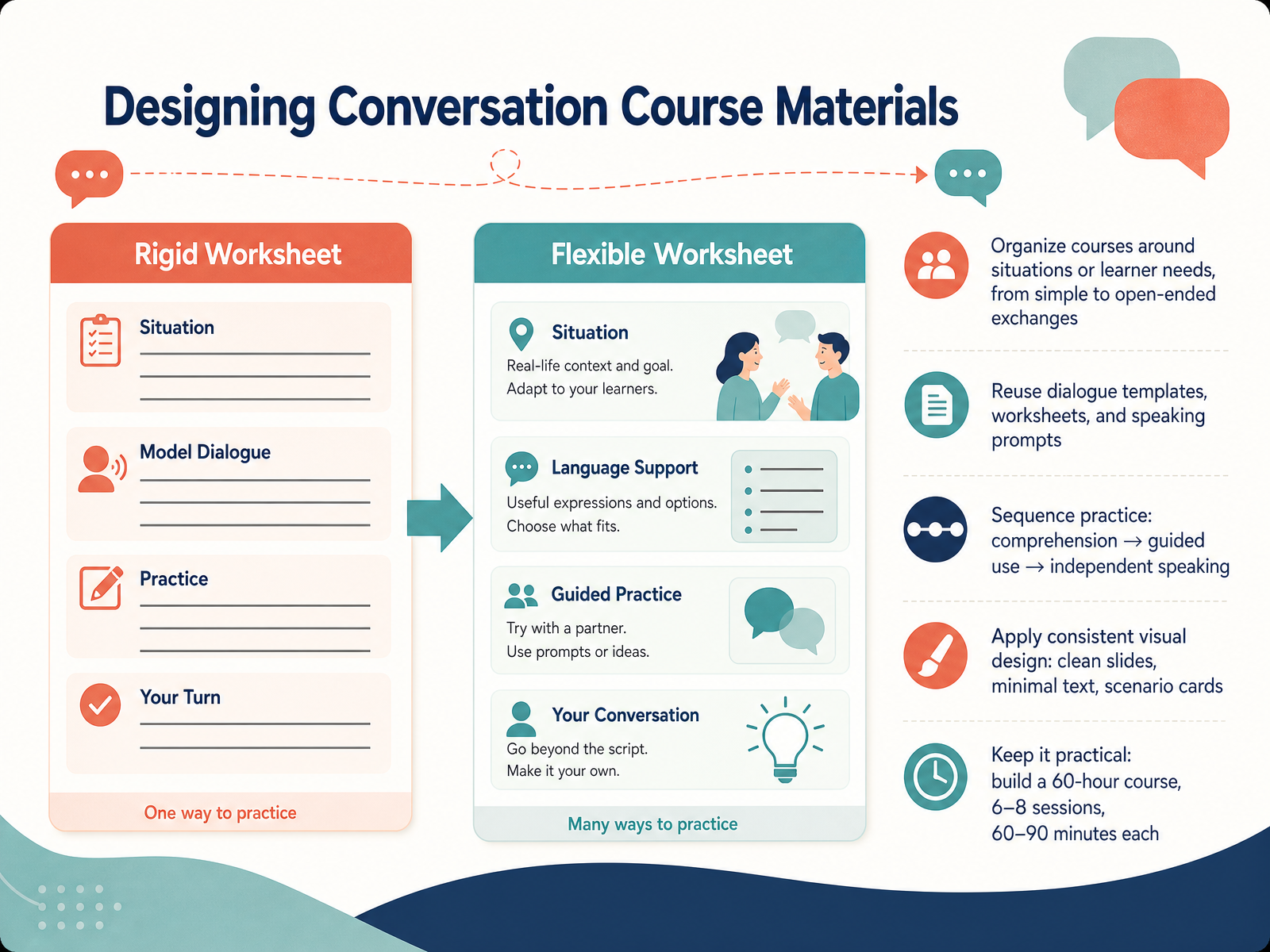
2 min - 08Designing Conversation Course MaterialsNow let's talk about building your course materials. Start by organizing lessons around real situations your learners care about. Think of ordering food or making small talk. Begin simple, then move toward open-ended conversations. Reuse things like dialogue templates, worksheets, and speaking prompts. This saves you time and keeps your lessons consistent. Sequence each practice in three clear steps. First, comprehension, where students listen and understand. Second, guided use, where they practice with support. And third, independent speaking, where they talk freely. Keep your visual design clean and simple. Use slides with minimal text and scenario cards that show a situation in just a few sentences. Remember, the goal is talking, not reading. For a practical course, build around sixty hours. That usually means six to eight sessions of sixty to ninety minutes each. This gives learners enough time to build confidence without losing momentum. Next, we'll look at how to assess speaking progress effectively.
 2 min
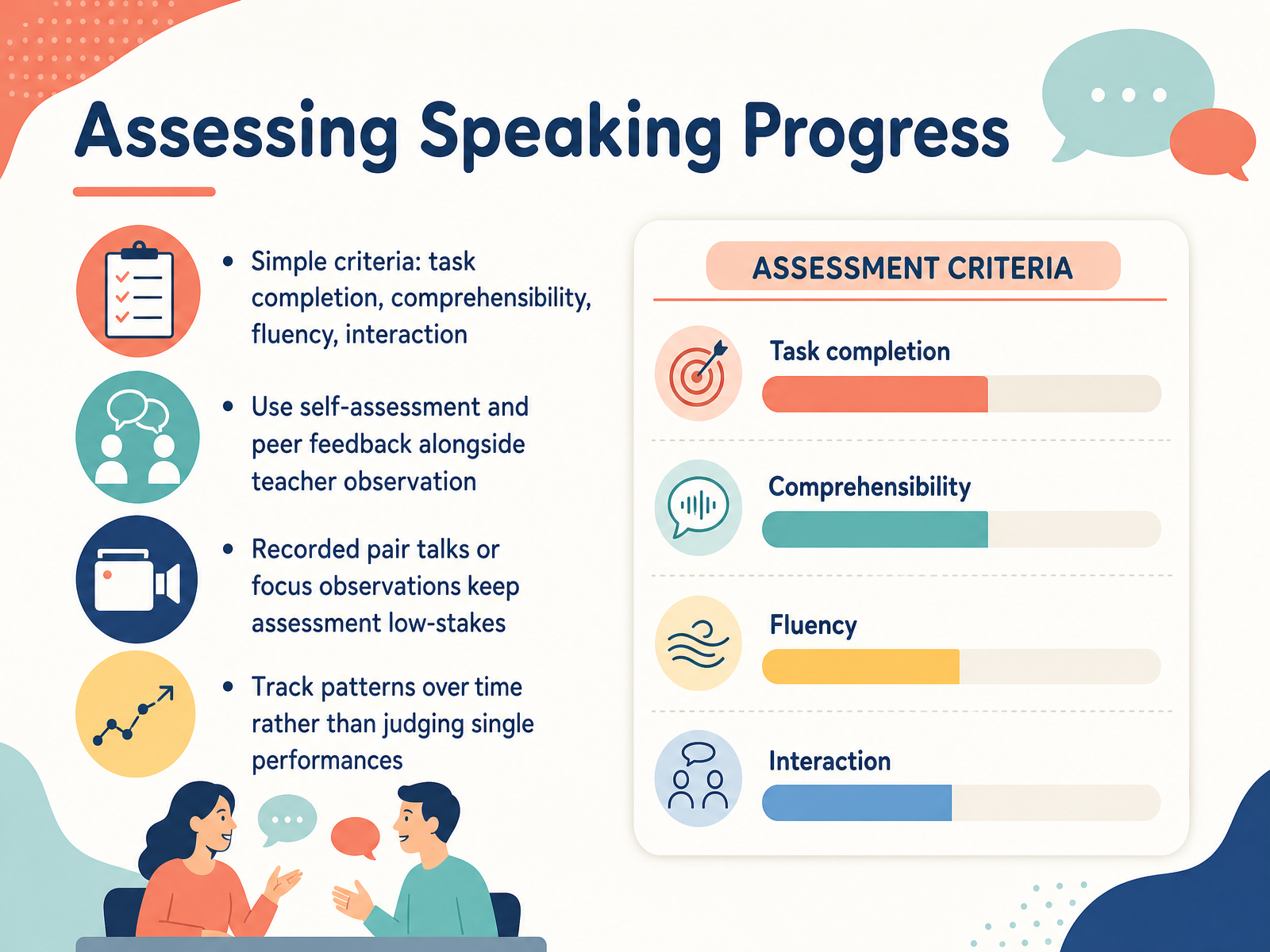
2 min - 09Assessing Speaking ProgressNow, let's talk about how we can assess speaking progress in a way that feels supportive, not stressful. Keep it simple. Focus on four things: did the learner complete the task, was their speech understandable, did it flow at a natural pace, and how well did they interact with their partner? You don't need a formal test. You can use self-assessment, where learners rate their own performance, and peer feedback, where partners share what went well. Recording short pair talks or doing quick focused observations keeps things low-stakes. The key is to look for patterns over time. A single nervous moment isn't the full picture. What matters is the trend. Are they pausing less? Are they adding more details? Are they asking better questions? Over weeks, those small wins tell the real story. So pick one or two criteria to focus on each week. Track them quietly. Celebrate improvement. That's how speaking confidence grows. Up next, we'll look at common speaking problems and how to solve them. Let's get started.
 1 min
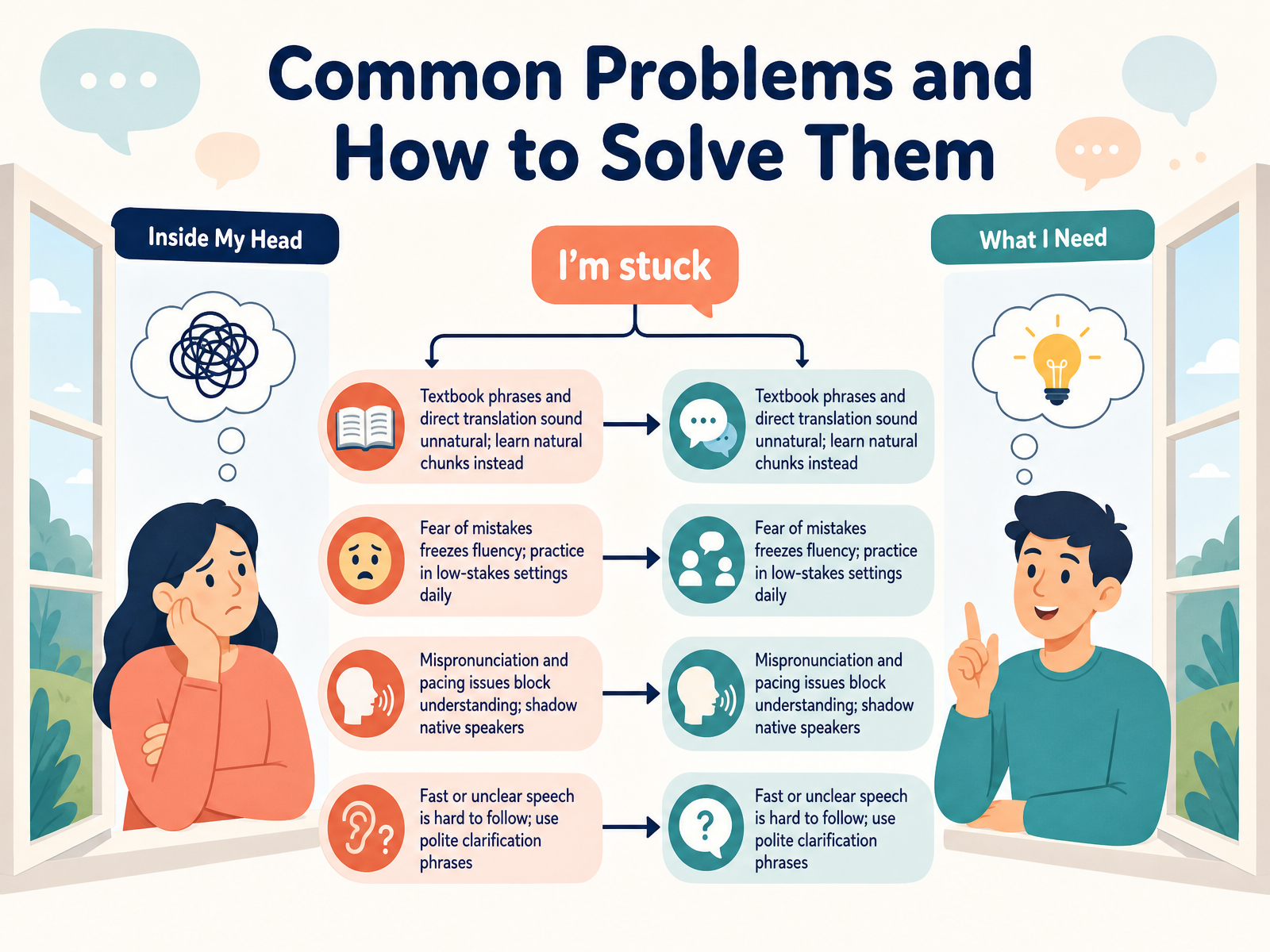
1 min - 10Common Problems and How to Solve ThemLet's talk about the common problems learners face in conversation, and how to solve them. First, textbook phrases often sound unnatural. Instead of translating word for word, learn natural chunks, like 'I'm afraid I can't make it.' Next, fear of mistakes can freeze your fluency. The best fix is daily practice in low-stakes settings, even if it is just talking to yourself. Mispronunciation and pacing can block understanding, so try shadowing native speakers. Repeat their words, and match their rhythm. Finally, when others speak too fast or unclearly, use polite clarification phrases. Say things like 'Sorry, could you say that again?' or 'Do you mean that...?' These small tools keep the conversation moving. And we will keep moving too, into Leveling Everyday Conversation.
 usingenglish.comteachingenglish.org.ukmacmillanenglish.com+21 min
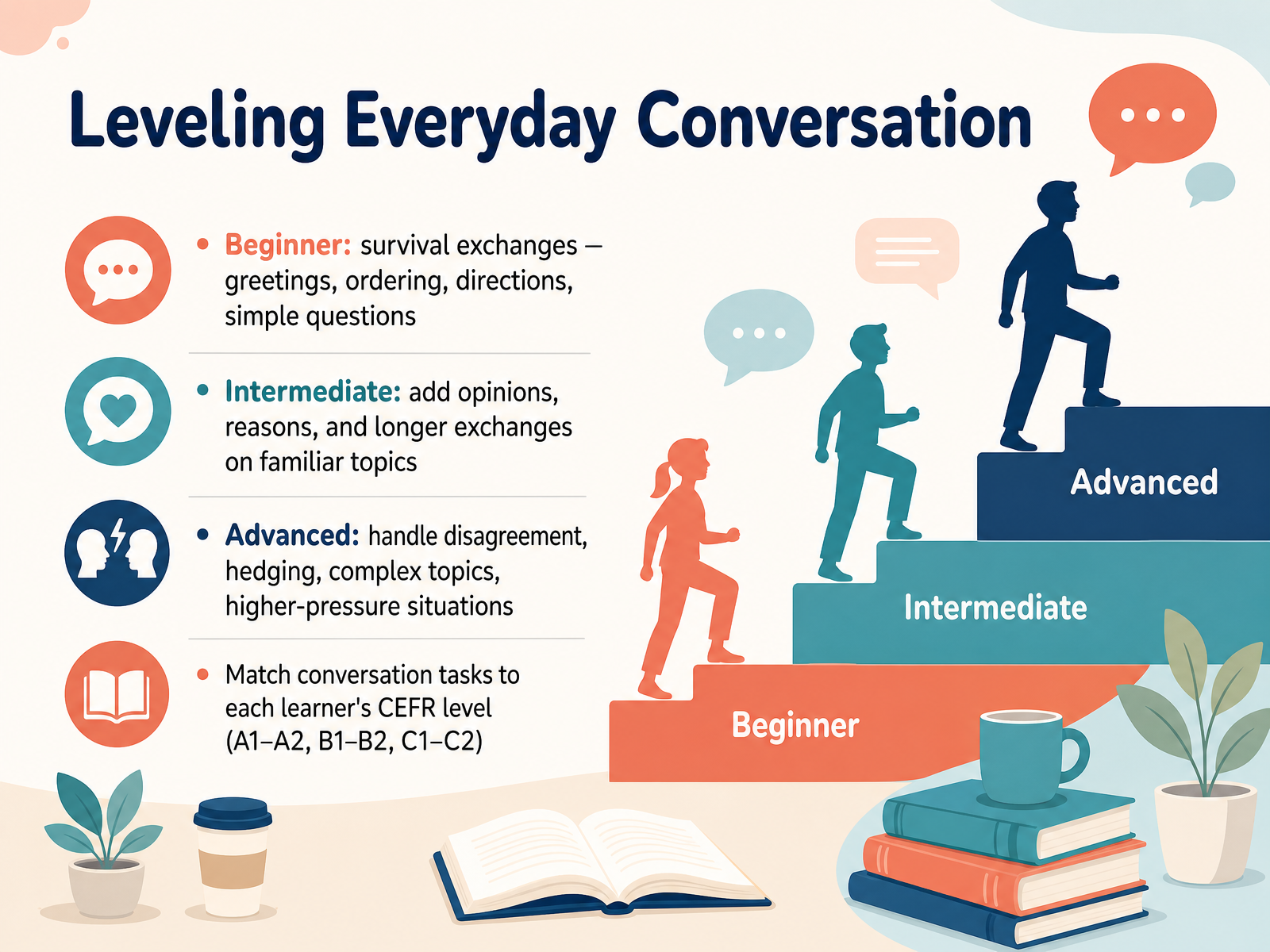
 - 11Leveling Everyday ConversationNow let’s think about how to match conversations to the right level. At the beginner stage, learners focus on survival exchanges — greetings, ordering food, asking for directions, and simple questions. These are short, clear, and practical. For example, ordering a coffee or asking where the restroom is. As learners move to intermediate, they start adding opinions, reasons, and longer exchanges about familiar topics. They can explain why they prefer one movie over another, or describe their weekend in detail. At the advanced level, learners handle disagreement, hedging, and complex topics. They can navigate higher-pressure situations like negotiating at work or discussing social issues. The key is to match each conversation task to the learner’s CEFR level. Beginners work at A1 to A2, intermediates at B1 to B2, and advanced learners at C1 to C2. By matching tasks to the right level, you keep learners challenged but not overwhelmed. Next, we’ll look at how to make conversation feel natural.
 avatalks.comblog.rosettastone.compracticeme.app+21 min
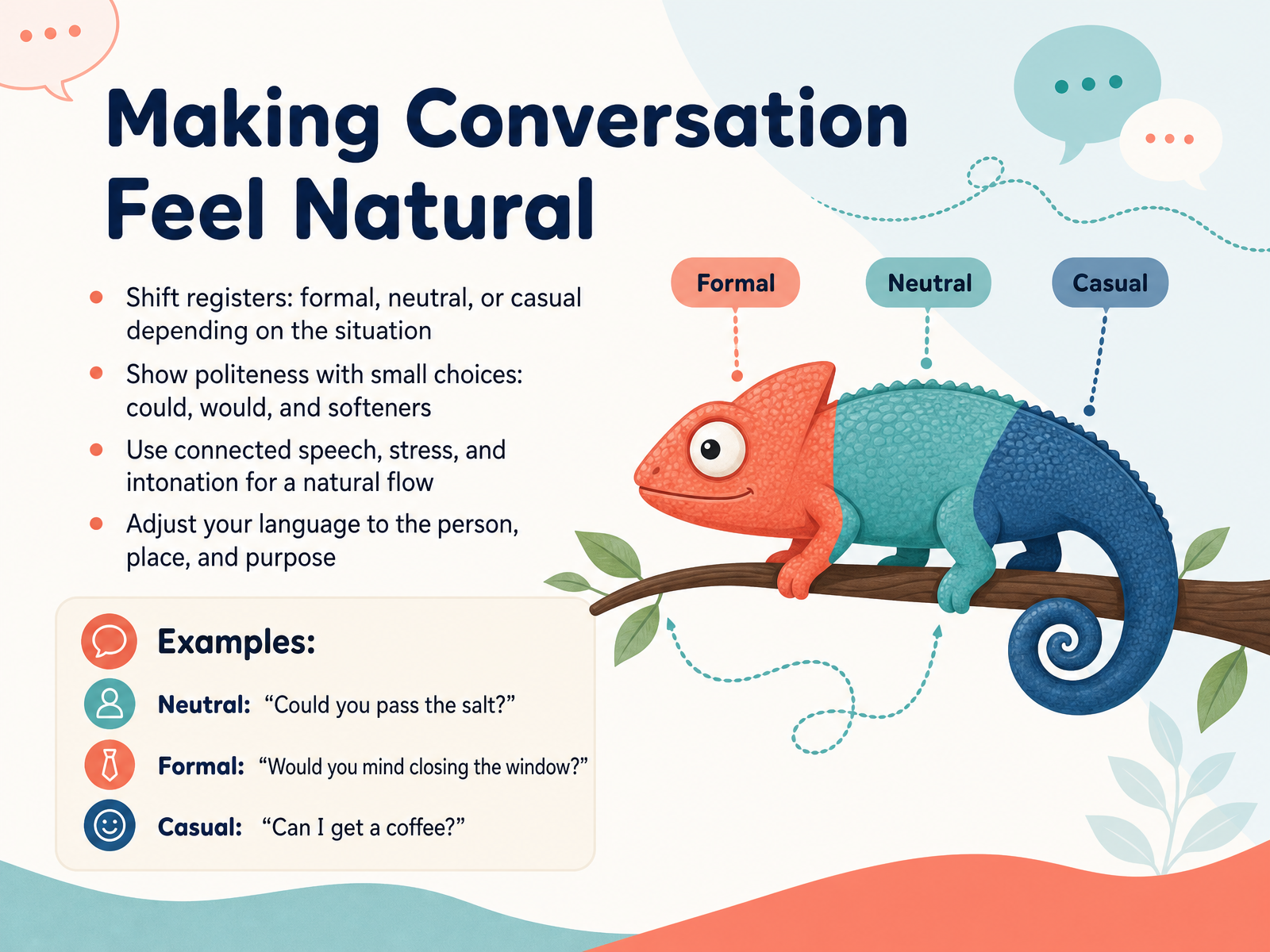
 - 12Making Conversation Feel NaturalNow, let's talk about making conversation feel natural. It's not just about the words you choose, but how you say them. First, think about the situation. Are you with friends? Use casual language. Are you in a formal meeting? Switch to formal. Neutral language is your safe default, and it works almost anywhere. Politeness comes through small choices. Instead of saying, can you, try, could you. It's softer and more polite. A phrase like, would you mind, is even more formal. And softeners, like, just or, a little, help ease the tone. For example, could you pass the salt? That's neutral. Would you mind closing the window? That's formal. And, can I get a coffee? That's casual. Also, listen to the rhythm. Native speakers link words together, stress key words, and use intonation to show feeling. This makes speech flow naturally. So, adjust your language to the person, place, and purpose. That's the key. Now, let's look at a practice plan to put all this into action.
 practiceme.appbasicenglishspeaking.comrefinedenglishacademy.com+21 min
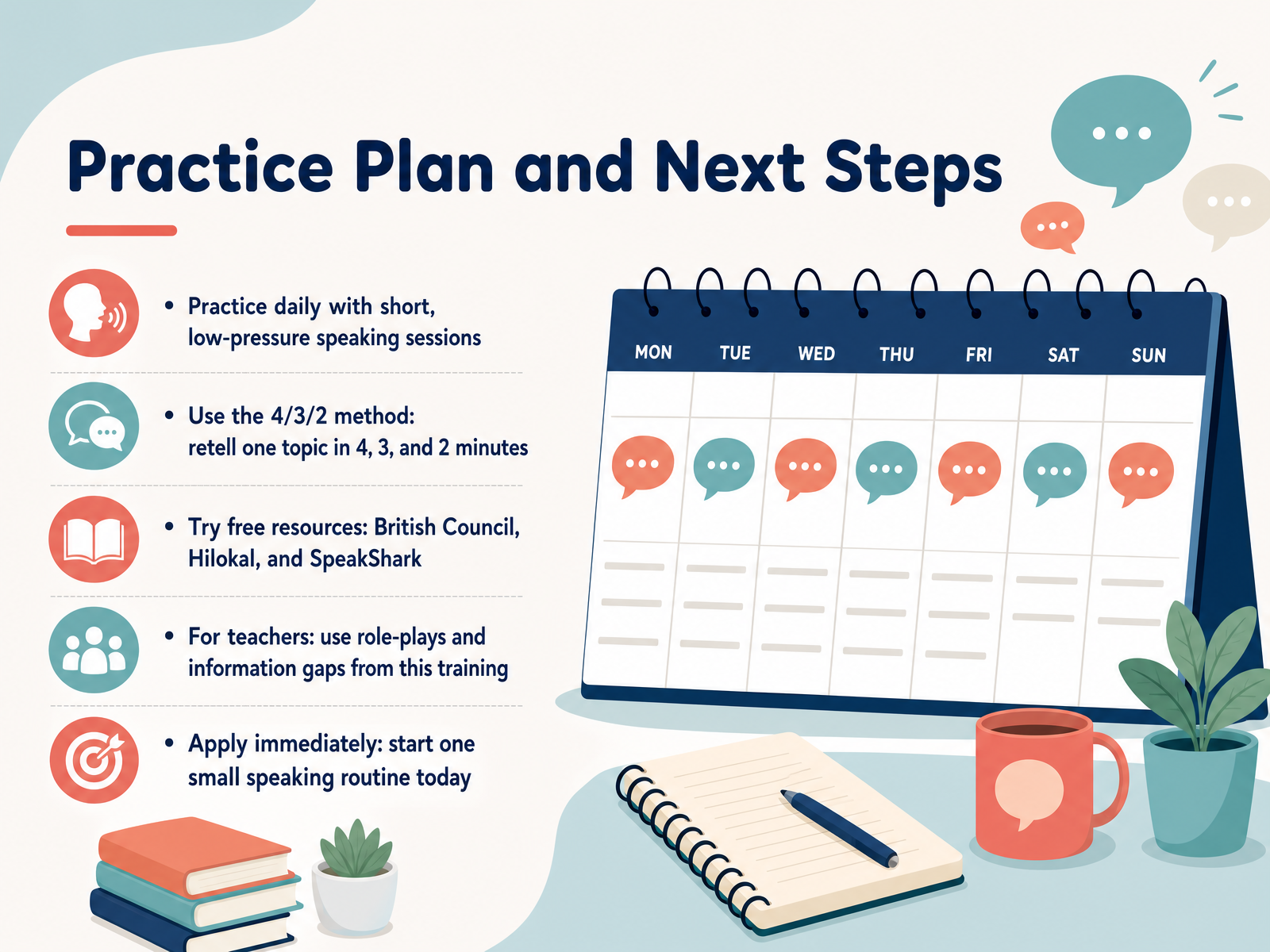
 - 13Practice Plan and Next StepsSo now, let's turn all these ideas into a simple plan you can start today. The first rule is simple: practice a little every day. Even five minutes is enough. Short, low-pressure sessions build a strong habit much faster than one long session a week. Second, try the 4, 3, 2 method. Pick a topic, like your weekend, and talk about it for four minutes. Then retell the same story in three minutes. Then do it again in just two minutes. This repetition sharpens your fluency and reduces hesitation. Next, check out free resources like the British Council, Hilokal, and SpeakShark. These give you structured lessons and real speaking practice. For teachers, bring role-plays and information gaps from this training into your classrooms. They are engaging and effective. Finally, do not wait. Choose one small speaking routine and start it today. That one small step is the best next move.
 marcusenglishinstitute.comlearnenglish.britishcouncil.orgpracticeme.app+22 min
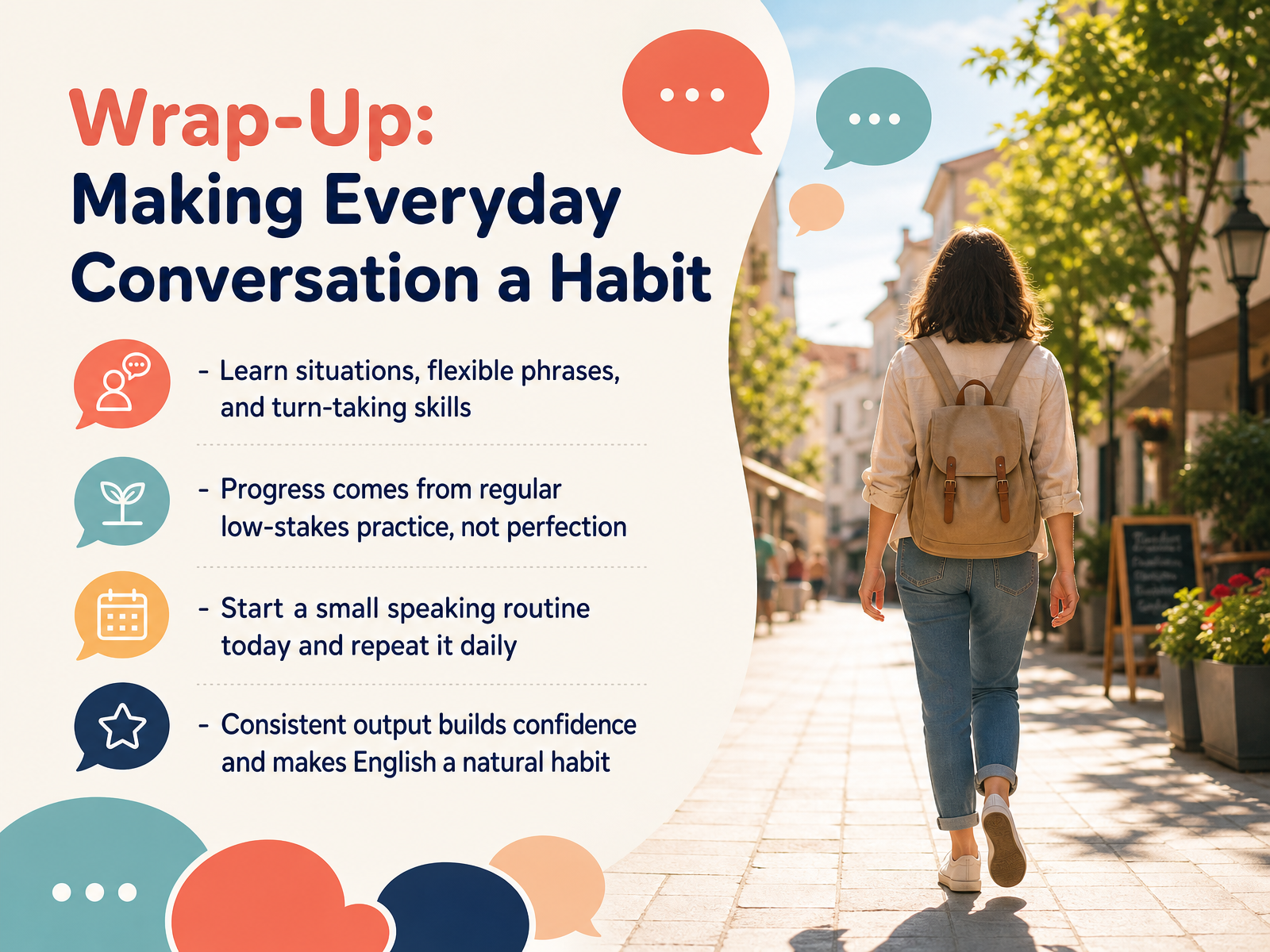
 - 14Wrap-Up: Making Everyday Conversation a HabitWe've reached the final lesson, and I want to say this: progress in English comes from regular, low-stakes practice—not from being perfect. It's the small daily steps that build real confidence. So, think about what you've learned. You now have phrases for real situations, you know how to take turns in a conversation, and you have the tools to keep going even when you feel stuck. All of that is powerful. Here's my challenge for you: start a tiny speaking routine today. Maybe it's just five minutes of talking to yourself, describing your room, or repeating a useful sentence. Do it every day. Consistency beats intensity. When you speak a little every day, English stops feeling like a performance and starts feeling natural. You'll hesitate less, and your brain will get faster at finding the right words. Thank you for learning with me. I'm so proud of the work you've done. Now, close this lesson, and go have your first everyday conversation—you're truly ready. Keep practicing, and enjoy the journey.
 marcusenglishinstitute.comlearnenglish.britishcouncil.orgpracticeme.app+22 min
Take the deck with you
Download this course as a file — free, no sign-up needed.
- PDF handoutEvery slide page, ready to print or share.15 pages · 3.4 MBDownload
- Narrated PowerPointThe deck that presents itself — every slide carries the digital human's narration video.15 pages · 12.5 MBDownload
- PowerPoint slidesThe full deck as a .pptx — open it in PowerPoint, Keynote, or Google Slides.15 pages · 3.3 MBDownload
Free to use in your own training — please keep the PersonWise credit page at the end.
Have your own deck? Turn it into a course
Sources consulted
Web sources consulted while building this course.
- English Phrases for Everyday Situations: What to Actually Say in… — tryclue.app
- Essential English Conversation Practice for All Levels (with Audio and Scripts) - Rosetta Stone — blog.rosettastone.com
- Daily English Conversations: Real-Life Dialogues for ESL Learners — iwantspeakenglish.com
- English Conversation Dialogues for Everyday Situations | Avatalks Blog — avatalks.com
- Dialogs for Everyday Use — americanenglish.state.gov
- 100 Common English Phrases for Conversation | Practice Me — practiceme.app
- 100 Common English Phrases and Sentence Patterns ... — basicenglishspeaking.com
- Common English Sentence Patterns: 12 Easy Structures for Daily Conversation — refinedenglishacademy.com
- 200+ Simple English Sentences for Everyday Conversation | FluentU — fluentu.com
- 100 Daily Use English Sentences for Speaking Practice — speakshark.com
- How to teach turn taking - UsingEnglish.com — usingenglish.com
- Socialising 4: Active listening | TeachingEnglish | British Council — teachingenglish.org.uk
- Developing real conversation skills - Macmillan English — macmillanenglish.com
- Teaching ESL Speaking Through Cultural Turn-Taking Awareness — teachenglishinkorea.org
- Keeping a Conversation Going in English: Phrases | Simmonds — englisch-lehrer.com
- Speak English Well as an Adult: 7 Proven Methods (2026) — marcusenglishinstitute.com
- How to improve your English speaking — learnenglish.britishcouncil.org
- English Speaking Confidence: The Complete Checklist | Practice Me — practiceme.app
- Gain Confidence Speaking English: A Practical Guide | Verse — verse.academy
- Speaking English with Confidence: How to Overcome the Fear and Build Real Fluency — nona.academy