Empires: Expansion, Rule, and Resistance
Begin
14 pages · ~28 min
Empires: Expansion, Rule, and Resistance
Explore how empires expanded, governed diverse peoples, and faced resistance, for learners seeking a concise introduction to imperial history and its lasting impact.
What you’ll learn
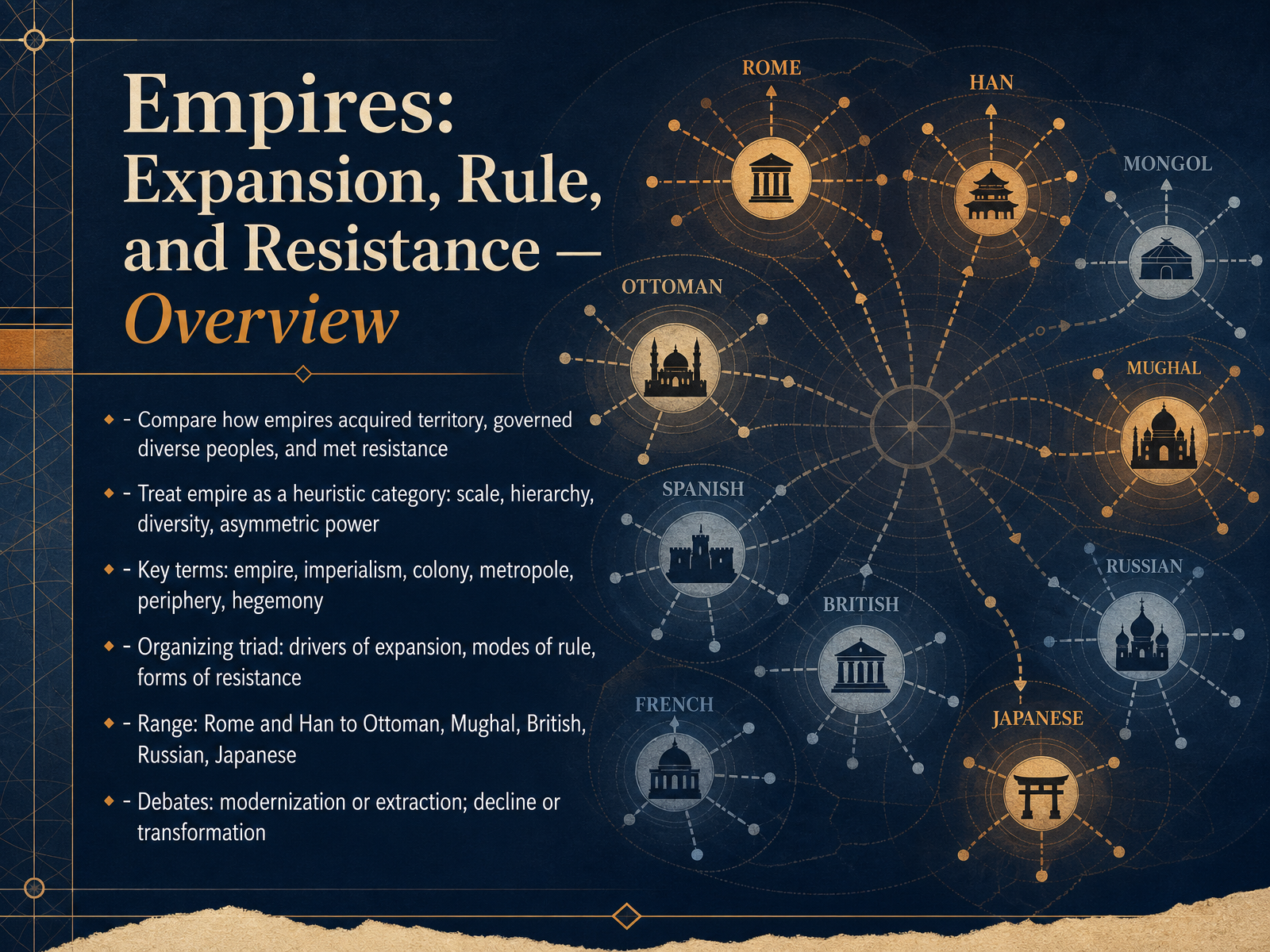
- 01Empires: Expansion, Rule, and Resistance — OverviewWelcome. This course asks a deceptively simple question: how did empires expand, govern, and face resistance? We will treat empire as a heuristic category, a flexible tool for comparison rather than a rigid label, defined by scale, hierarchy, diversity, and asymmetric power. Notice the key terms as they appear. Empire names a ruling polity, the metropole, holding subordinate colonies or peripheries. Imperialism is the practice or ideology of that domination. Hegemony describes rule by consented influence rather than open force. Our organizing triad is straightforward: drivers of expansion, modes of rule, and forms of resistance. Consider one example of each: Rome and Han China, Ottoman and Mughal states, British, Russian, and Japanese empires. Across these cases, we weigh two debates. Did empire modernize the regions it ruled, or chiefly extract their wealth? And when empires end, is that decline, or transformation into new political forms? Keep both questions in view. In the next slide, we define empire more formally through concepts, typologies, and periodization.cambridge.orgdoi.orgcambridge.org+21 min
- 02Defining Empire: Concepts, Typologies, and PeriodizationLet's begin by asking what we actually mean when we call a polity an empire.
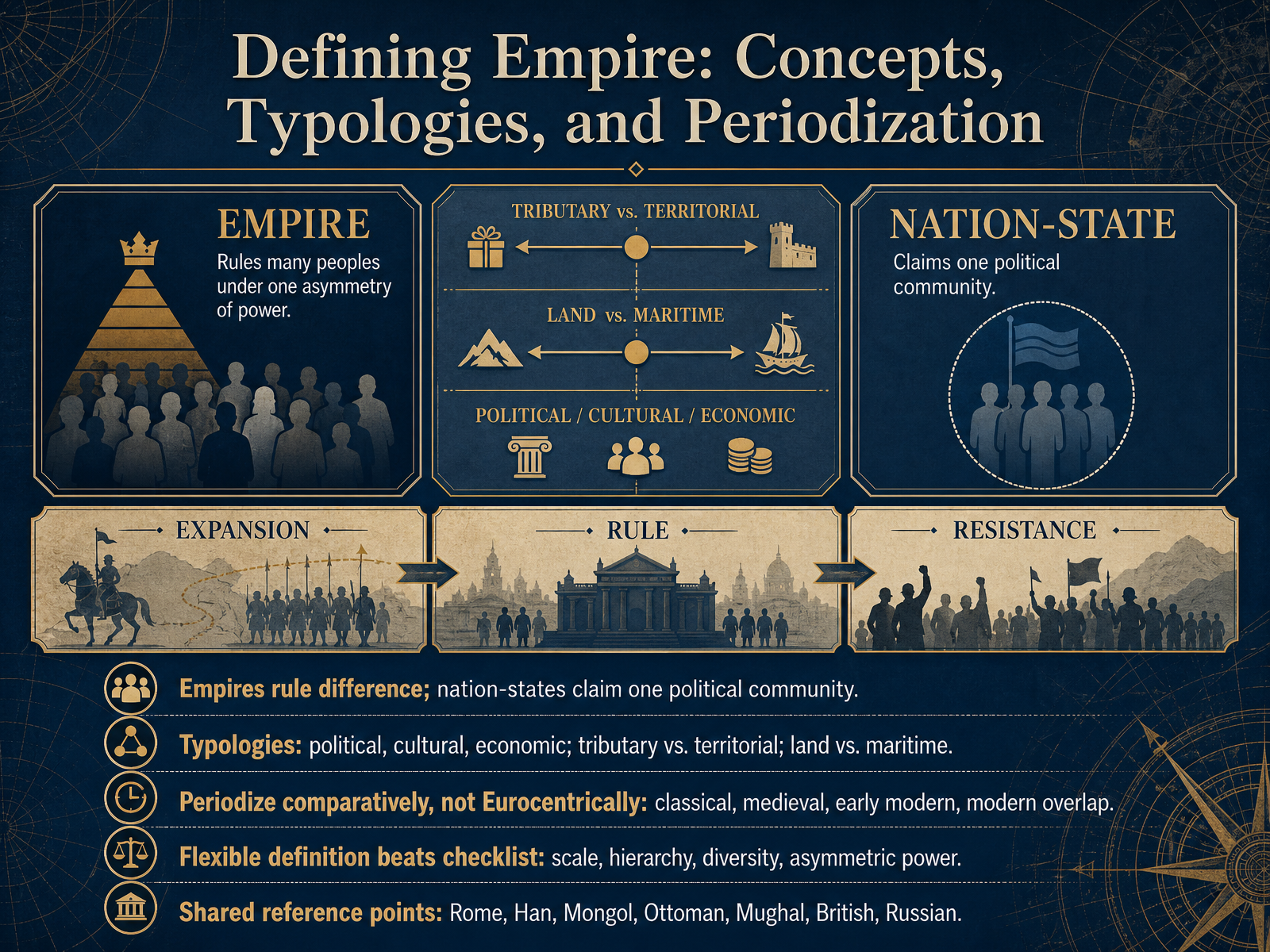
The core distinction is this: empires rule difference, while nation-states claim a single political community. Empires govern populations they never fully assimilate, and that management of difference shapes everything that follows.
Typologies help us compare. We can separate political, cultural, and economic forms of imperiality, depending on whether domination, conversion, or exploitation drives incorporation. We can distinguish tributary empires, which extract goods and labor indirectly, from territorial empires, which administer land directly. And we can contrast land empires with maritime ones, whose power often rests on ports and sea lanes rather than contiguous frontiers.
Periodization matters too. Rather than imposing a single European timeline, notice that classical, medieval, and early modern phases overlap and unfold at different tempos across regions. A flexible definition beats any checklist. Look instead for scale, hierarchy, diversity, and asymmetric power.
Keep shared reference points in mind as we go: Rome, Han China, the Mongols, the Ottomans, the Mughals, the British, and the Russians. Each lets us test our concepts against evidence.
Next, we turn to what actually drove imperial expansion: drivers of expansion, trade, faith, and security.
 cambridge.orgdoi.orgcambridge.org+22 min
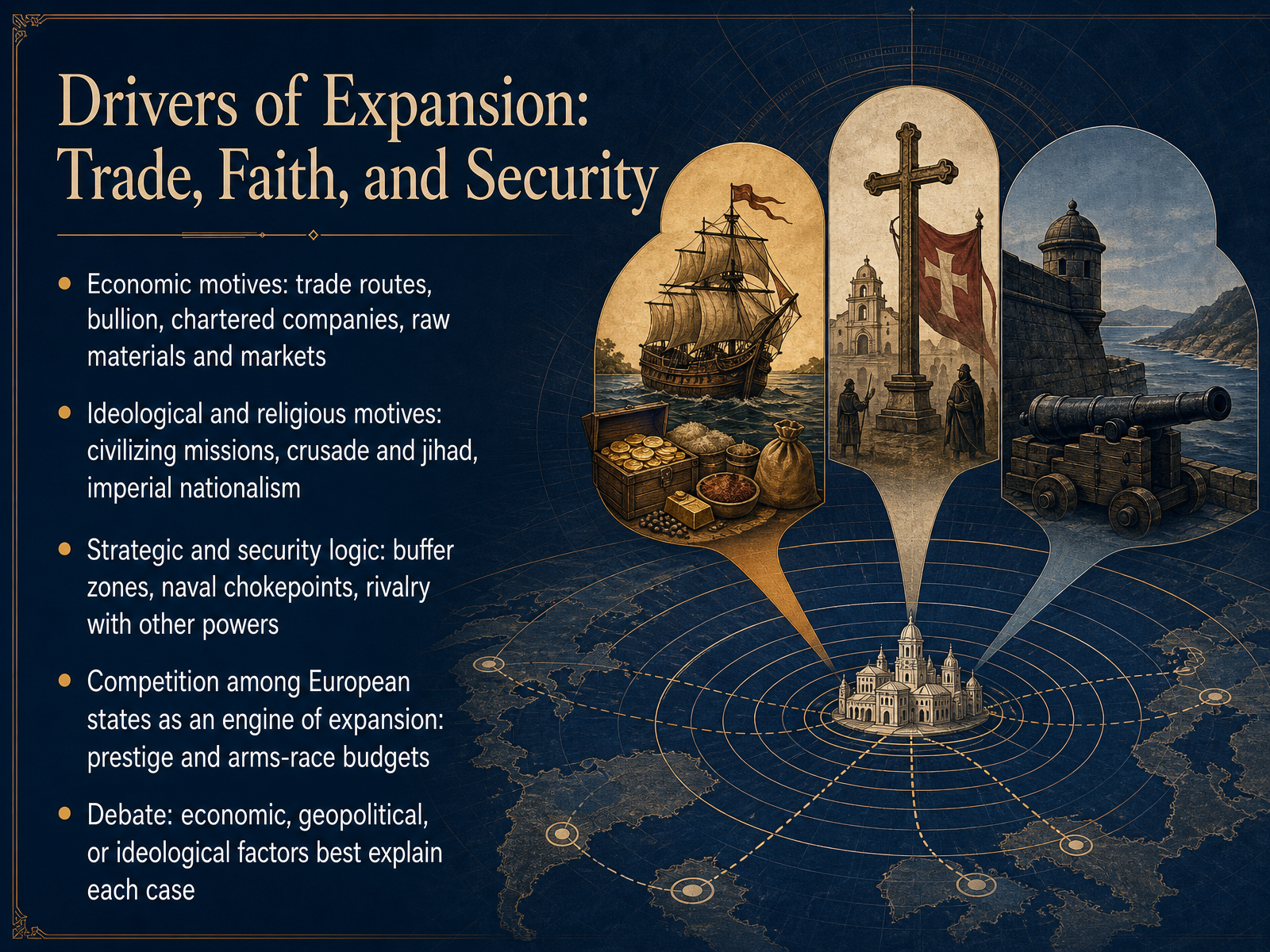
 - 03Drivers of Expansion: Trade, Faith, and SecurityHaving outlined the shape of empires, let us turn to what actually drove them outward. Notice that expansion rarely rested on a single cause. Historians usually group the drivers into three overlapping categories. First, economic motives: the pursuit of trade routes, bullion, chartered companies, raw materials, and captive markets. Consider how a chartered company like the Dutch East India Company combined commerce with state-backed force. Second, ideological and religious motives: civilizing missions, crusade and jihad, and imperial nationalism all gave expansion moral and spiritual justification. Third, strategic and security logic: buffer zones, naval chokepoints, and rivalry with other powers. Britain's concern for the sea route to India shaped its holdings from Egypt to Singapore. Running through all three is competition among European states, where prestige and arms-race budgets made overseas territory a measure of power. The key debate, then, is this: for any given case, do economic, geopolitical, or ideological factors best explain it? Weigh the evidence for each empire rather than assuming one answer fits all. Next, we examine the means that made expansion possible: technology, logistics, and violence.
 link.springer.combristoluniversitypressdigital.comcambridge.org+22 min
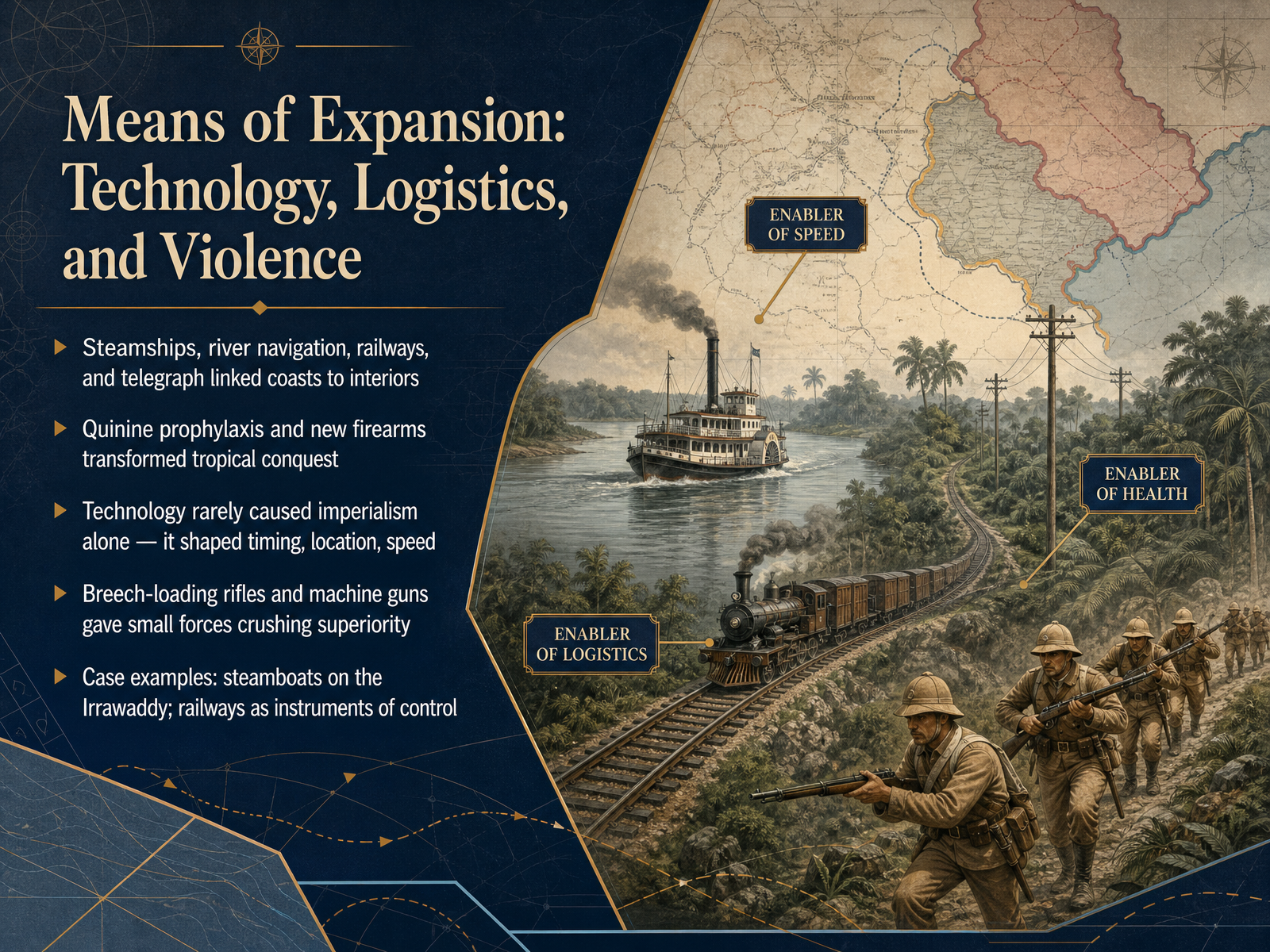
 - 04Means of Expansion: Technology, Logistics, and ViolenceLet us turn now to the means of expansion, and notice how technology, logistics, and violence worked together. Steamships, river navigation, railways, and the telegraph linked coasts to interiors, moving troops, goods, and messages far faster than before. Quinine prophylaxis against malaria, along with new firearms, transformed conquest in tropical regions. Yet technology rarely caused imperialism alone. As the historian Daniel Headrick argues, it shaped timing, location, and speed, acting as a means rather than the motive. Breech-loading rifles and machine guns gave small forces crushing superiority over larger armies. Consider two cases. Steamboats carried British forces up the Irrawaddy River to conquer Burma. And railways, built ostensibly for trade, doubled as instruments of control, moving soldiers quickly to suppress resistance. So the takeaway is this: tools of transport, medicine, and war made expansion possible and rapid, but they answered motives that were already there. Next, we examine how empires actually governed what they seized, in Modes of Rule: Direct, Indirect, and Hybrid Governance.
 link.springer.combristoluniversitypressdigital.comcambridge.org+22 min
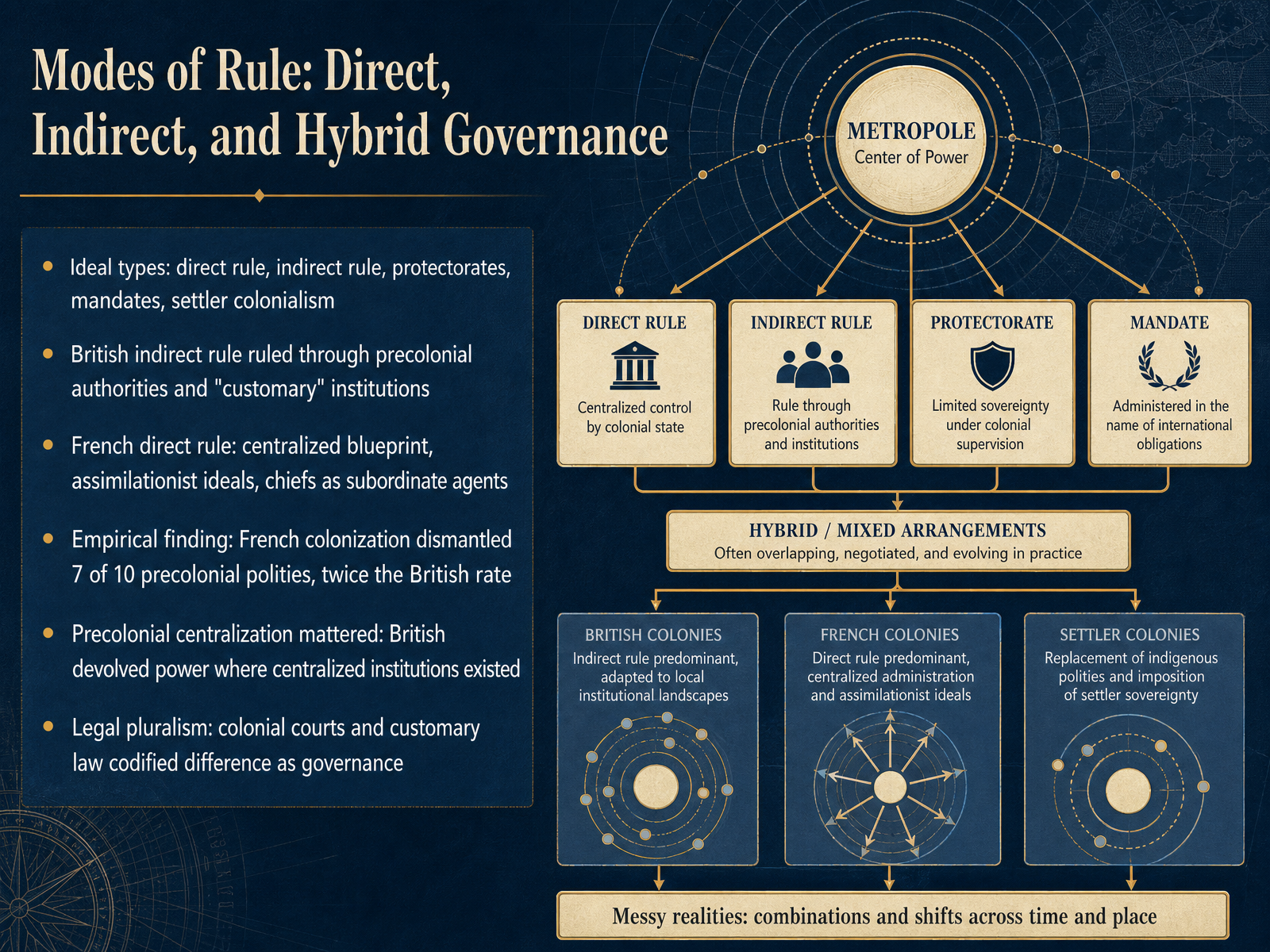
 - 05Modes of Rule: Direct, Indirect, and Hybrid GovernanceNow consider how empires actually governed what they claimed. We often describe rule through ideal types: direct rule, indirect rule, protectorates, mandates, and settler colonialism. These are analytical models, not neat boxes. British indirect rule governed through precolonial authorities and so-called customary institutions. French direct rule followed a centralized blueprint shaped by assimilationist ideals, casting chiefs as subordinate agents of the colonial state. The evidence is striking. French colonization dismantled the lines of succession of seven of ten precolonial polities, roughly twice the British rate. Precolonial centralization mattered: where centralized institutions existed, the British devolved more power; the French did not. Notice, too, legal pluralism, where colonial courts and customary law codified difference as a technique of governance. Let us turn next to the infrastructure of control: census, maps, tax, and schooling.
 ideas.repec.orgcambridge.orgora.ox.ac.uk+21 min
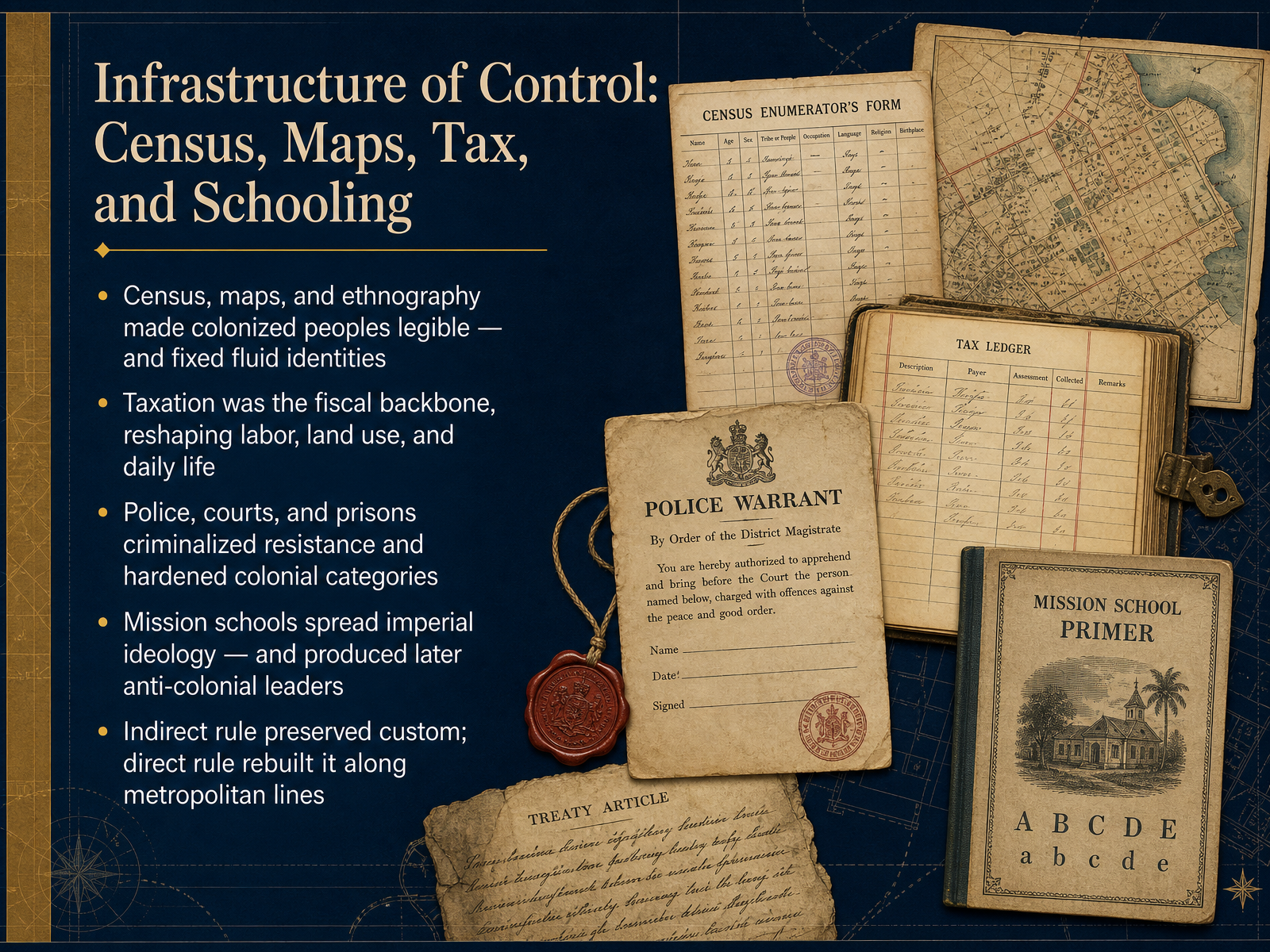
 - 06Infrastructure of Control: Census, Maps, Tax, and SchoolingLet's turn now to the infrastructure of control. Empires ruled not only with soldiers, but with paperwork. Consider the census, the map, and the ethnographic survey. Together they made colonized peoples legible to the state, counted and classified. Yet in fixing fluid identities, they often hardened categories that had once been flexible. Taxation was the fiscal backbone of empire. It reshaped labor, land use, and daily life, sometimes forcing people into wage work or cash crops just to pay. Police, courts, and prisons criminalized resistance, and in doing so, they further hardened colonial categories. Mission schools spread imperial ideology, but notice the irony: they also produced many later anti-colonial leaders. Finally, compare systems of rule. Indirect rule preserved custom through existing authorities, while direct rule rebuilt institutions along metropolitan lines. Keep that contrast in mind as we move to extraction and the imperial economy.
 ideas.repec.orgcambridge.orgora.ox.ac.uk+22 min
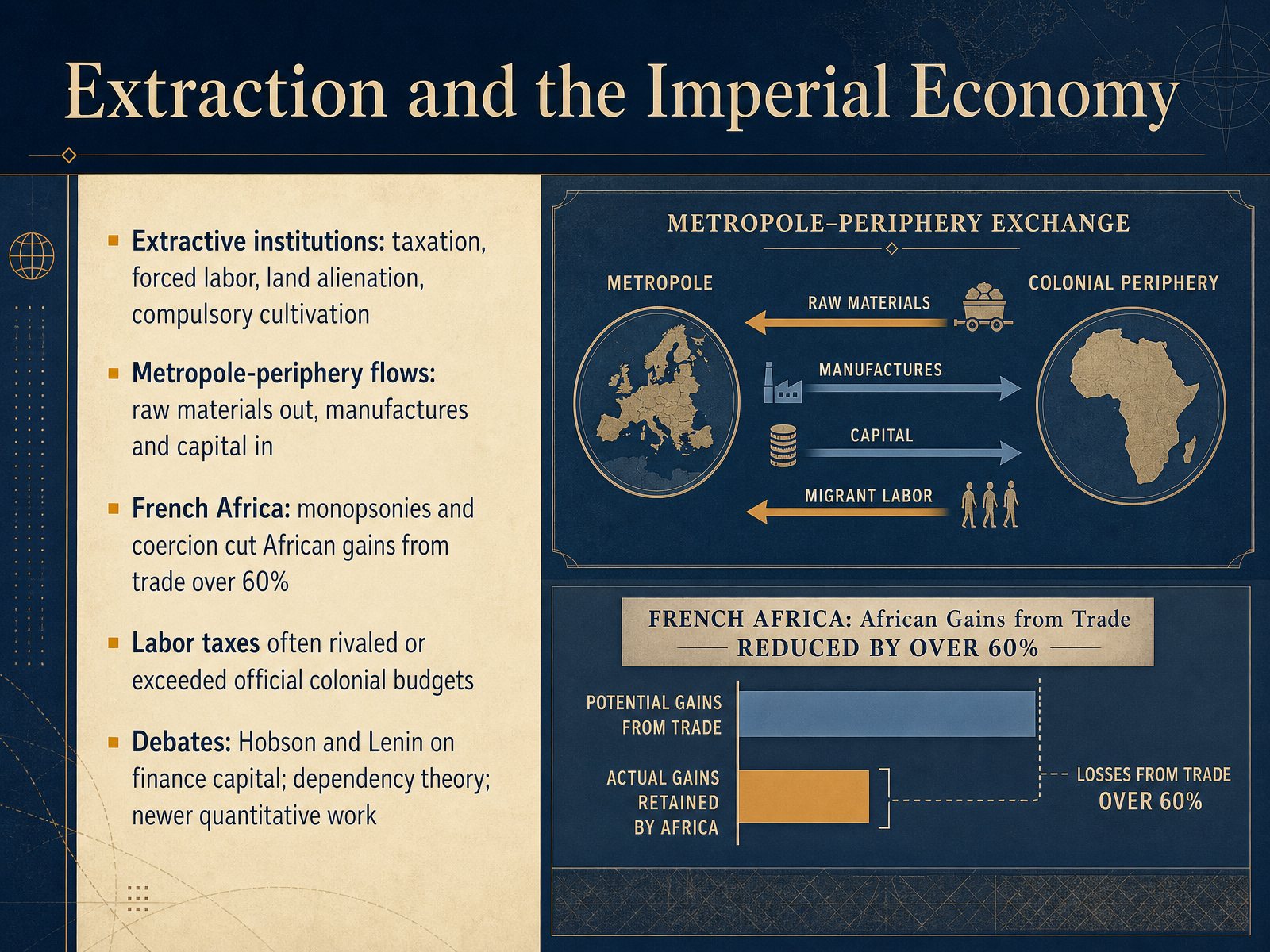
 - 07Extraction and the Imperial EconomyLet's turn now to extraction and the imperial economy. Extractive institutions were the arrangements that moved income and wealth from colonized populations to colonizers. Notice their concrete forms: taxation, forced labor, land alienation, and compulsory cultivation. Consider how the flows worked. Raw materials moved from periphery to metropole, while manufactures and capital moved the other way. In French Africa, the evidence is striking. Trade monopsonies, where a single buyer sets the price, combined with coercive labor, cut African gains from trade by over sixty percent. Labor taxes were especially significant. In many places, their value rivaled or even exceeded official colonial budgets. Historians continue to debate these mechanisms. Hobson and Lenin linked expansion to finance capital. Dependency theory emphasized structural inequality. Newer quantitative work measures extraction directly through prices and wages. The takeaway is this: extraction was not incidental to empire. It was organized, measurable, and consequential. Next, we examine culture, knowledge, and imperial ideology.
 doi.orgcambridge.orgcambridge.org+22 min
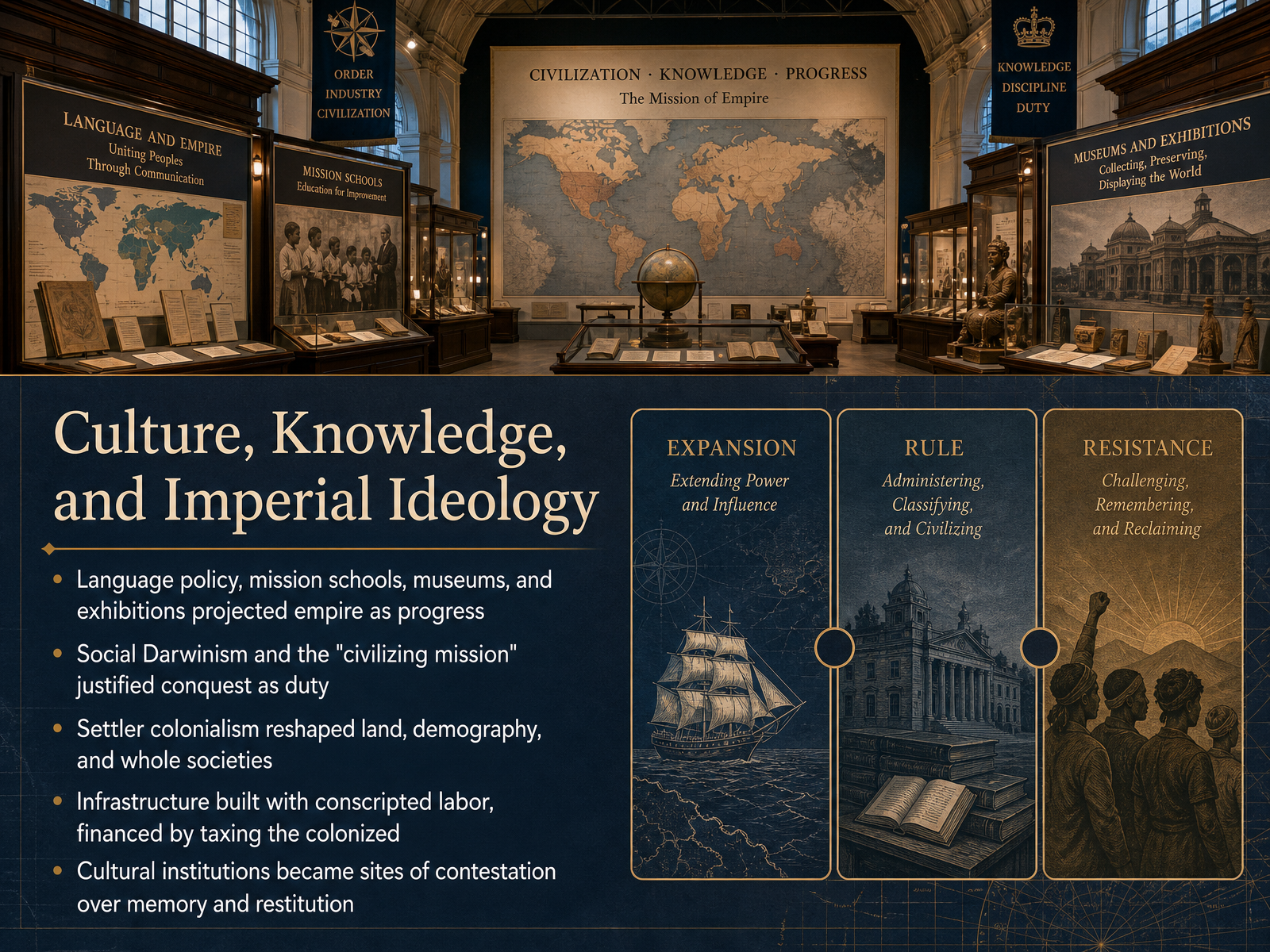
 - 08Culture, Knowledge, and Imperial IdeologyNext, consider how empires governed not only through force, but through culture and knowledge. Language policy, mission schools, museums, and exhibitions projected empire as progress. Social Darwinism and the civilizing mission framed conquest as a duty rather than a seizure of land and labor. Notice what followed. Settler colonialism reshaped land, demography, and entire societies, often permanently. Infrastructure, meanwhile, was built with conscripted labor and financed by taxing the colonized. A railway or road could look like development while functioning as extraction. That is why cultural institutions became sites of contestation over memory and restitution. Ask who wrote the story, who benefited, and who was silenced. With those questions in mind, let us turn to Resistance and Rebellion: A Typology.
 doi.orgcambridge.orgcambridge.org+22 min
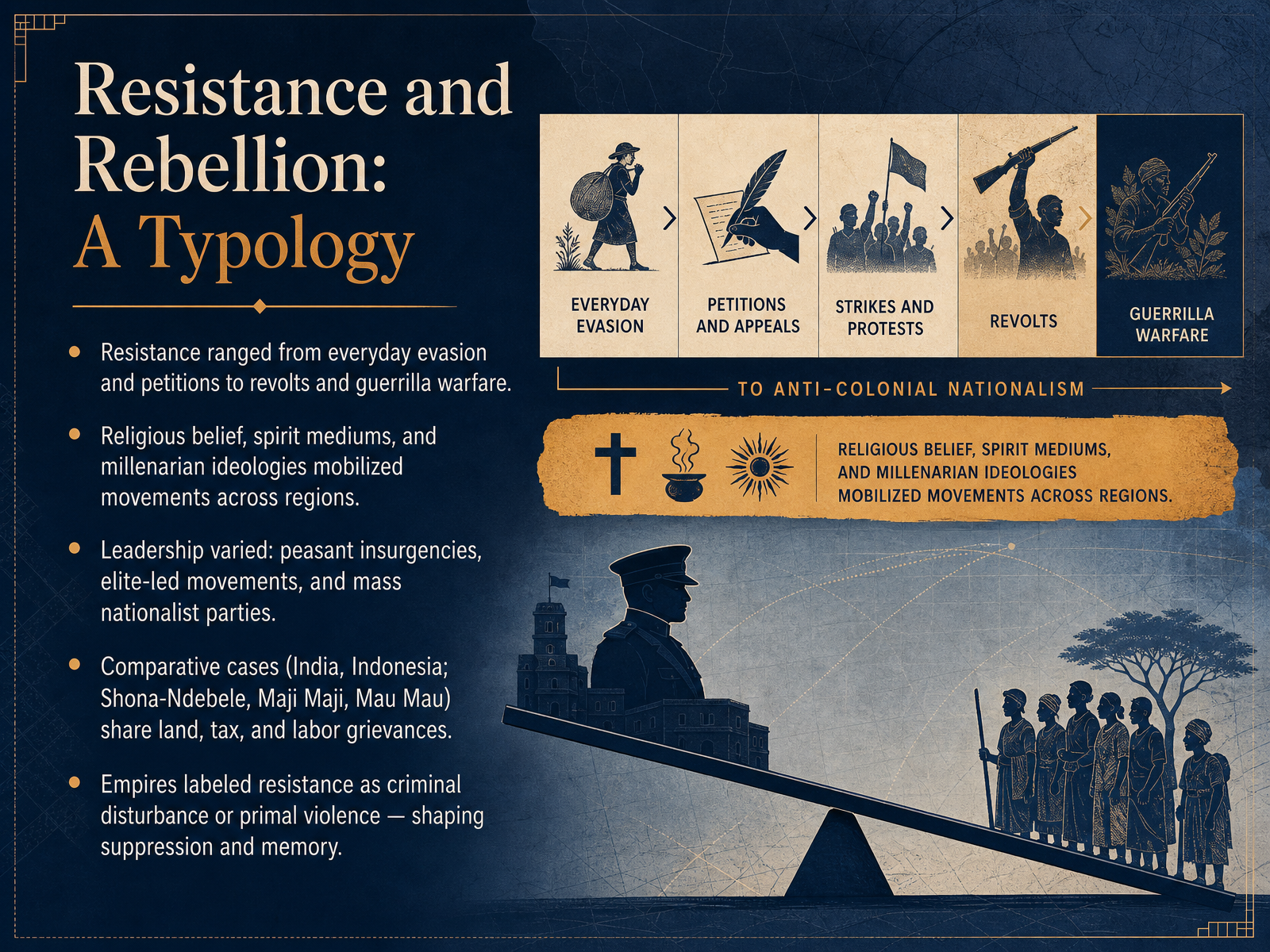
 - 09Resistance and Rebellion: A TypologyNow let us turn to resistance and rebellion, and organize the many forms they took. Resistance ranged widely. It included everyday evasion, such as avoiding taxes or labor drafts, and formal petitions, but also armed revolts and guerrilla warfare. Notice that religious belief often mobilized movements. Spirit mediums, for example among the Shona and Ndebele, and millenarian ideas, as in the Maji Maji rising, gave protest purpose and unity. Leadership varied too: peasant insurgencies, elite-led movements, and mass nationalist parties each drew on different resources. Compare cases across regions and periods. In India, Indonesia, and across Africa, land alienation, taxation, and forced labor recur as shared grievances. Empires typically labeled resistance as criminal disturbance or primal violence, a framing that shaped both suppression and later memory. Next, we examine specific cases in detail.
 1 min
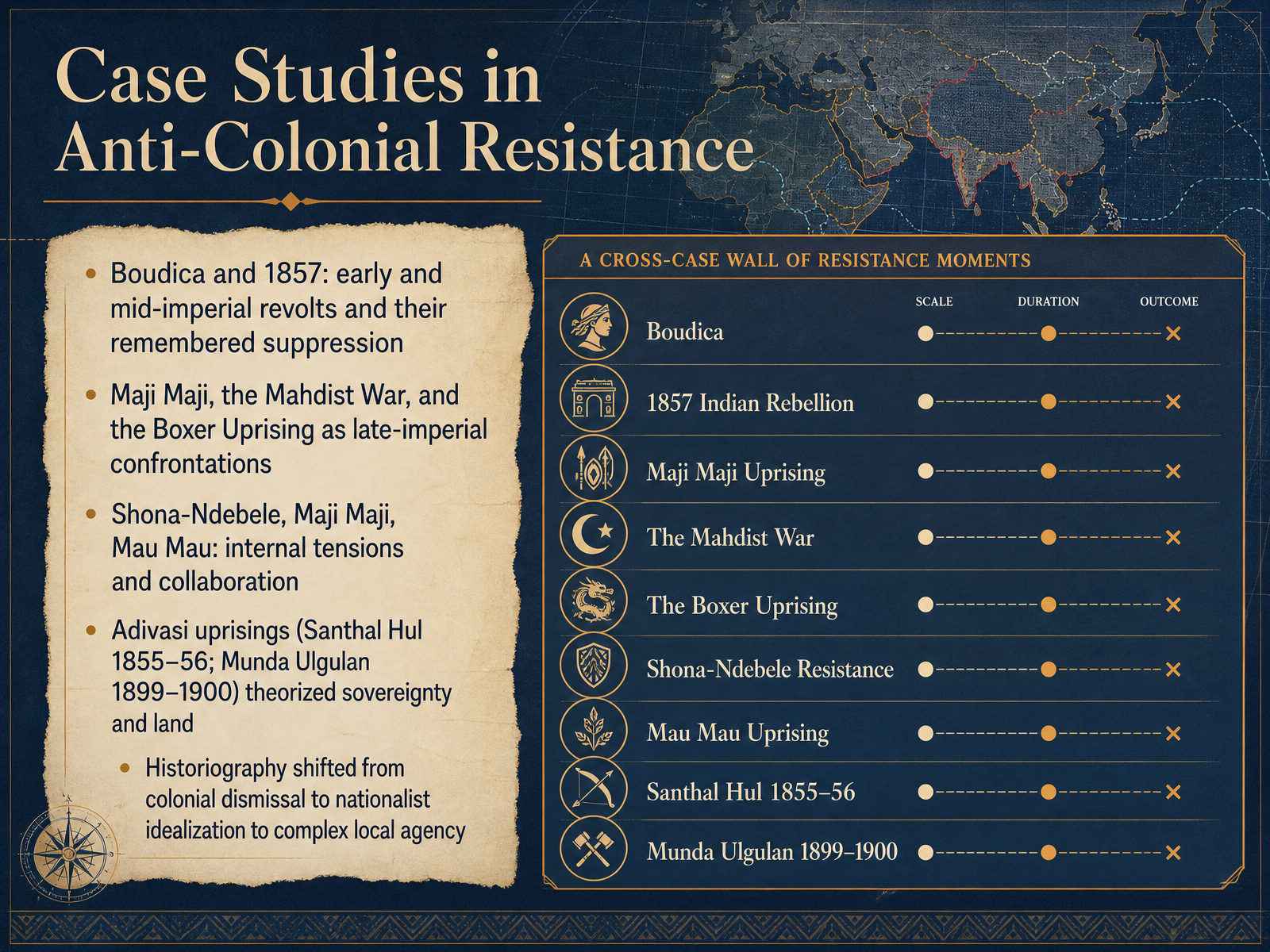
1 min - 10Case Studies in Anti-Colonial ResistanceLet us turn to case studies in anti-colonial resistance. Notice the range. Boudica's revolt in Britain and the Indian uprising of 1857 were suppressed and remembered in very different ways. Later confrontations, such as Maji Maji, the Mahdist War, and the Boxer Uprising, tested empires already stretched by industrial and global competition. Now consider Shona-Ndebele, Maji Maji, and Mau Mau together. Each reveals internal tensions and collaboration, not simple unity against a single enemy. The Adivasi uprisings matter here too. The Santhal Hul of 1855 and 1856, and the Munda Ulgulan of 1899 to 1900, theorized sovereignty and land rights in explicit terms. Finally, watch the historiography shift. Colonial accounts dismissed these movements as criminal or irrational. Nationalist narratives idealized them. Contemporary scholarship recovers complex local agency, negotiation, and competing interests. That shift changes how we read resistance itself. Next, we take a wider view with Paths to Independence: Decolonization in Global Perspective.
 2 min
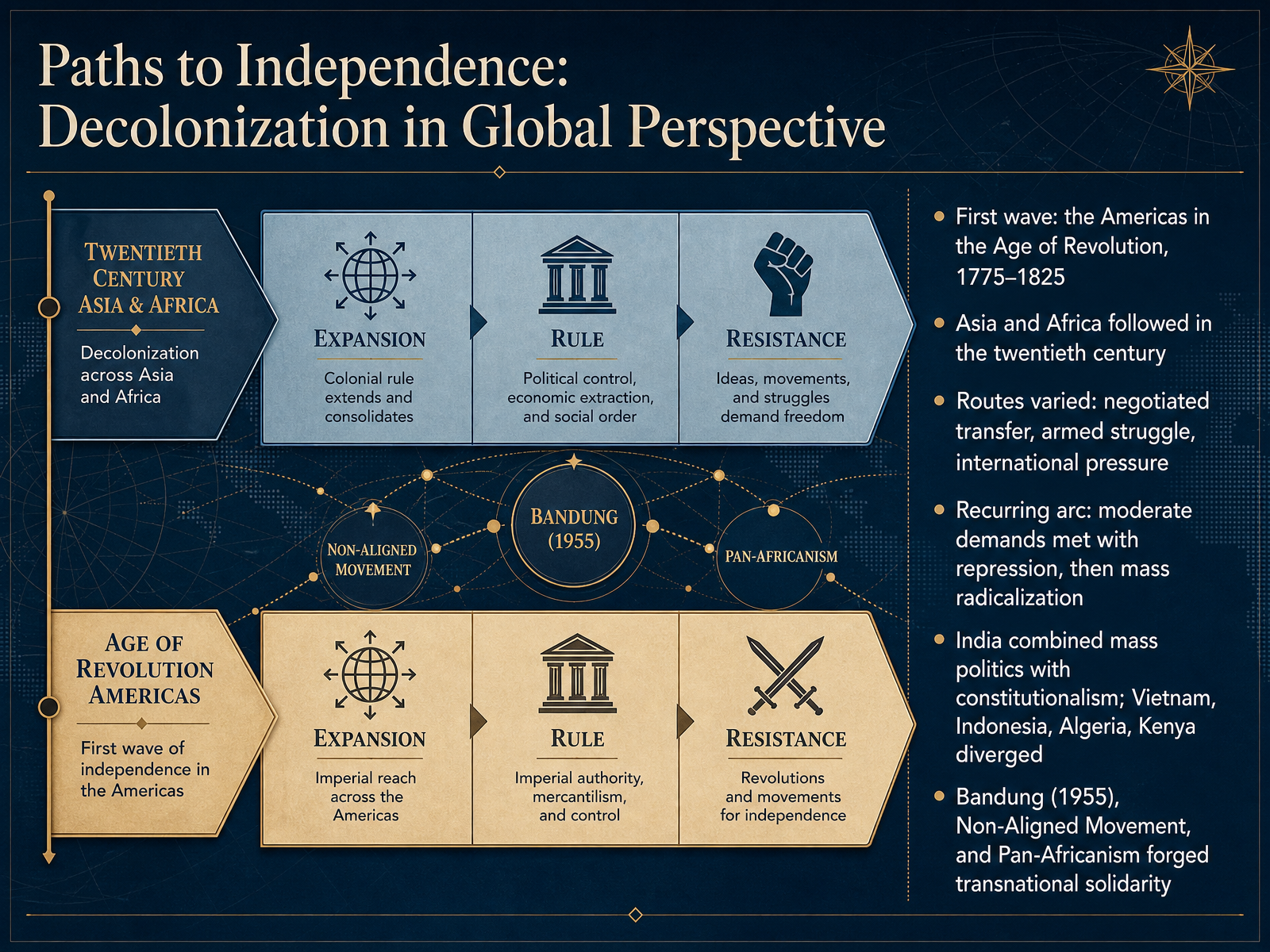
2 min - 11Paths to Independence: Decolonization in Global PerspectiveNow let's turn to paths to independence, viewing decolonization from a global perspective. Notice that independence came in two broad waves. The first unfolded in the Americas during the Age of Revolution, roughly seventeen seventy-five to eighteen twenty-five, when the Thirteen Colonies, Haiti, and Spanish America broke with Europe. Asia and Africa followed in the twentieth century. Consider that the routes varied widely. Some transfers were negotiated, as in India and Nigeria. Others required armed struggle, as in Vietnam, Indonesia, Algeria, and Kenya. International pressure also mattered, especially after the Second World War. A recurring arc appears across regions. Moderate demands for reform were met with indifference or repression, and that pushed movements toward mass radicalization. India combined mass politics with constitutionalism. Vietnam, Indonesia, Algeria, and Kenya diverged. Finally, Bandung in nineteen fifty-five, the Non-Aligned Movement, and Pan-Africanism forged transnational solidarity among newly independent states. Next, we examine the legacies: borders, institutions, and unresolved inequalities.
 2 min
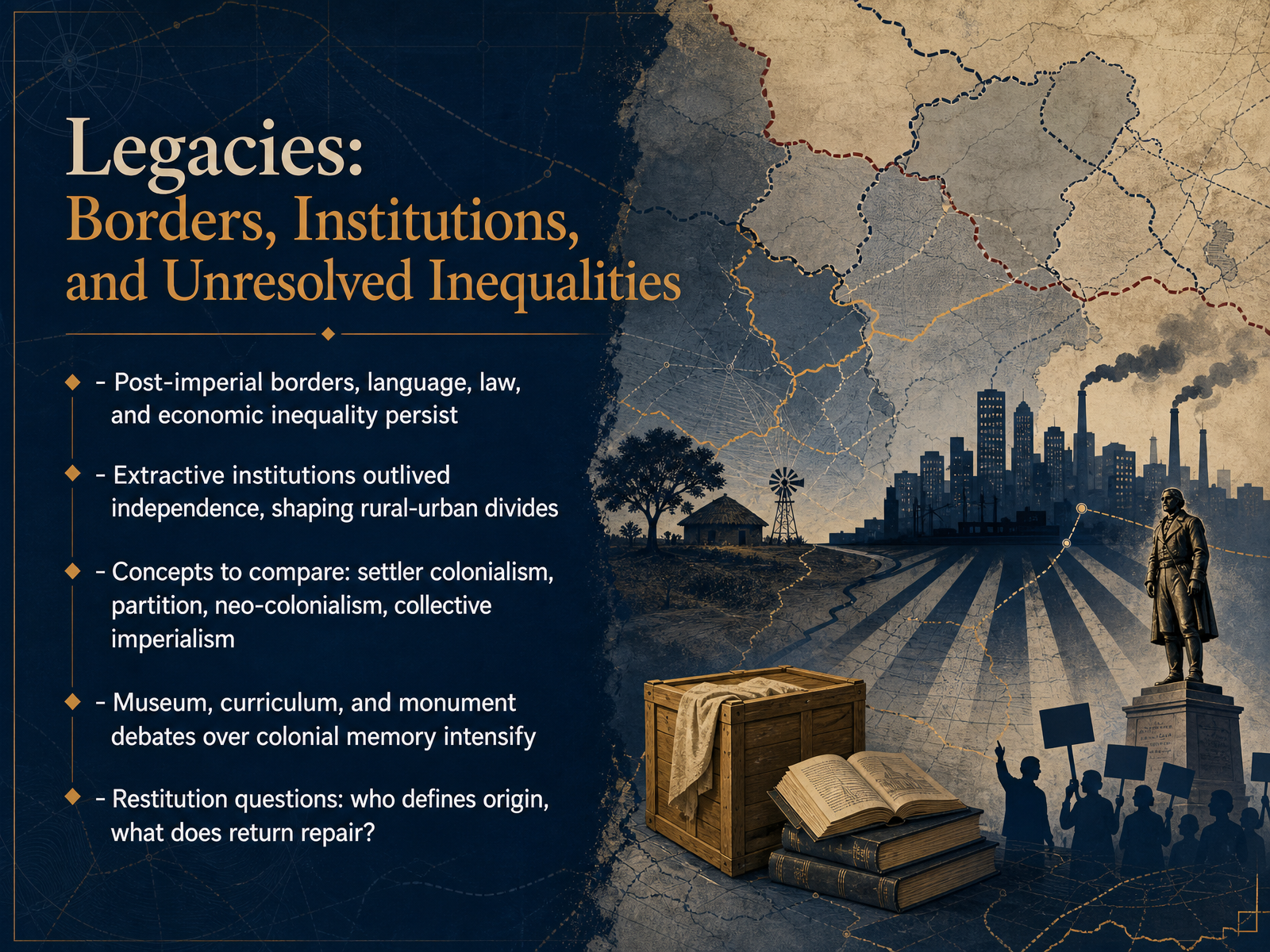
2 min - 12Legacies: Borders, Institutions, and Unresolved InequalitiesLet us turn now to legacies. Empires may end, but the borders, legal systems, languages, and economic hierarchies they created often endure for generations. Notice how post-imperial borders rarely align with pre-colonial communities, and how extractive institutions, designed to move resources outward, frequently outlived independence and deepened rural-urban divides. Four concepts help you compare these patterns: settler colonialism, partition, neo-colonialism, and collective imperialism. Consider the restitution debate as a concrete case. As scholars such as Mbembe argue, returning an object is not simply a transfer of property; it can be an act of disenclosure that challenges ongoing colonial power. Yet the process is contested. Who defines a site of origin when borders have shifted? What does return actually repair, and who decides? Museums, curricula, and monuments now sit at the center of these arguments over memory and inequality. Take the Benin Bronzes or the Cham sculptures returned to Cambodia, each case shows how modern politics shapes what counts as justice. So keep this question in view: legacies are not only inherited, they are actively negotiated. That sets up our next topic, Teaching Empires: Frameworks, Sources, and Controversy.
 2 min
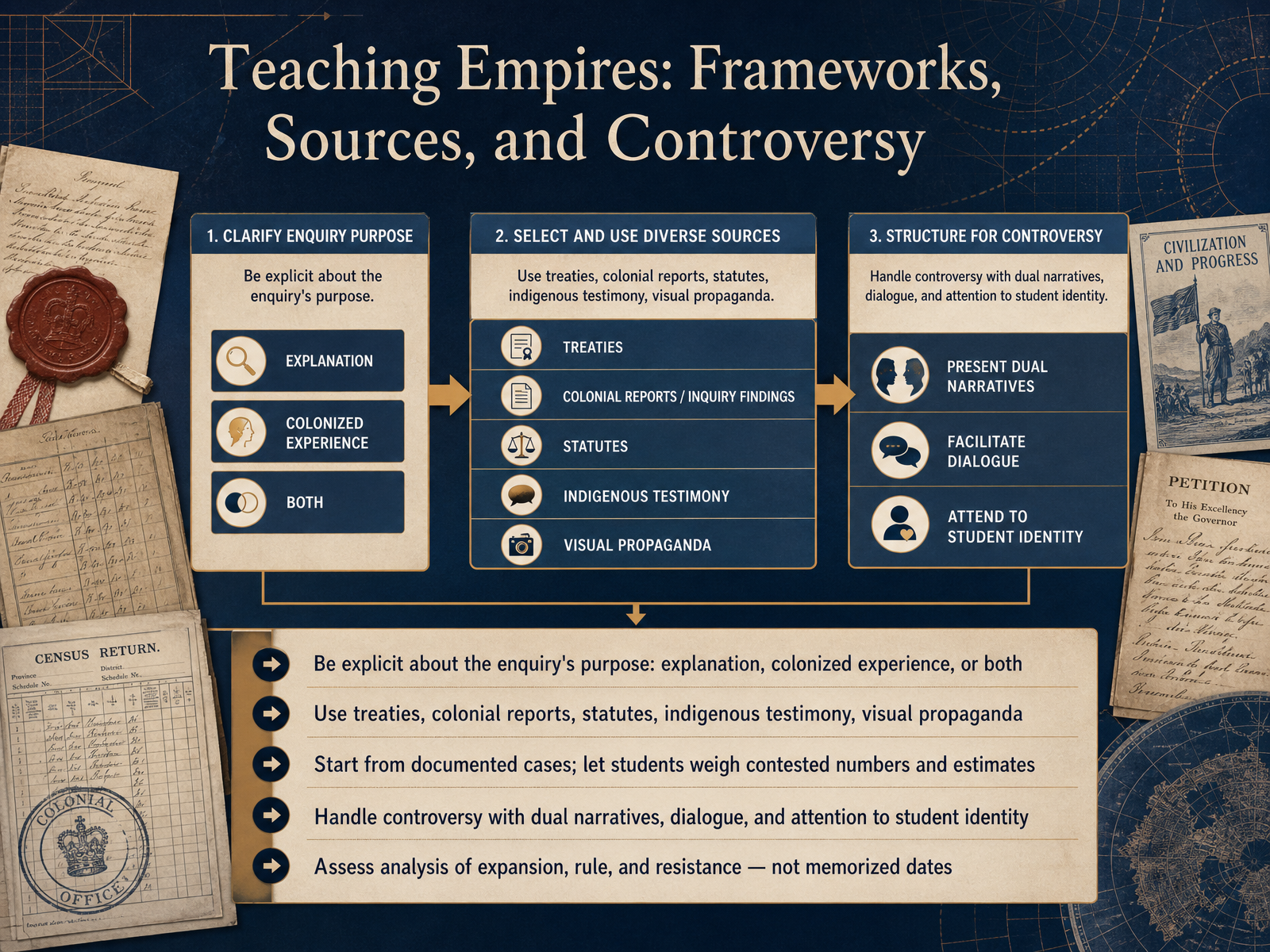
2 min - 13Teaching Empires: Frameworks, Sources, and ControversyNow, let's turn to how we actually teach this material. Start by being explicit about your enquiry's purpose. Are you explaining imperial expansion, examining colonized experience, or both? Consider how that choice shapes everything that follows. Then, build your source base deliberately. Pair treaties and colonial reports with statutes, indigenous testimony, and visual propaganda. Notice how these sources do different kinds of work. Begin from documented cases, and let students weigh contested numbers and estimates rather than accepting a single figure. When controversy arises, use dual narratives, dialogue, and attention to student identity. Finally, assess students' analysis of expansion, rule, and resistance, not memorized dates. This framework carries directly into Assessment and Classroom Application.
 1 min
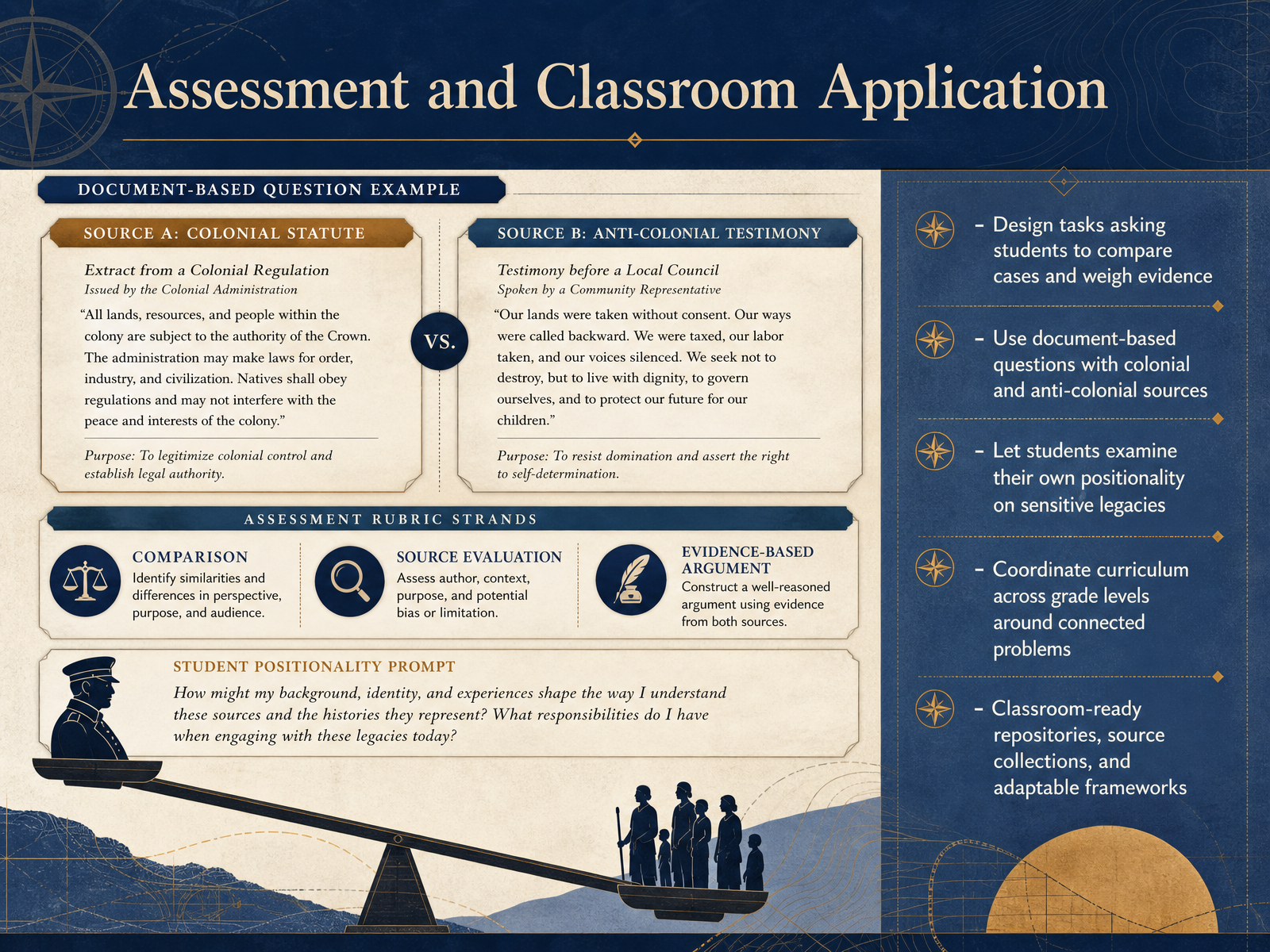
1 min - 14Assessment and Classroom ApplicationAs we close, let's turn from analysis to application. Design tasks that ask students to compare cases directly and weigh evidence rather than absorb conclusions. Build document-based questions using both colonial and anti-colonial sources, because reading a governor's report beside an anti-colonial petition teaches critical reading in a way no textbook summary can. Notice, too, that the evidence itself must be interrogated, not trusted at face value.
Invite students to examine their own positionality on sensitive legacies, thoughtfully and without pressure to confess. Coordinate curriculum across grade levels, so connected problems build coherently from one year to the next. And lean on the classroom-ready repositories, source collections, and adaptable frameworks we've explored.
Thank you for your engagement throughout this course. You now have models, evidence, and methods. Take them into your classroom, and help your students think historically and honestly.
 2 min
2 min
Take the deck with you
Download this course as a file — free, no sign-up needed.
- PDF handoutEvery slide page, ready to print or share.15 pages · 6.3 MBDownload
- Narrated PowerPointThe deck that presents itself — every slide carries the digital human's narration video.15 pages · 17.1 MBDownload
- PowerPoint slidesThe full deck as a .pptx — open it in PowerPoint, Keynote, or Google Slides.15 pages · 6.3 MBDownload
Free to use in your own training — please keep the PersonWise credit page at the end.
Have your own deck? Turn it into a course
Sources consulted
Web sources consulted while building this course.
- The Comparative Study of Empires * — cambridge.org
- Typology of the Empire: General and Special Types — doi.org
- The Limits of Universal Rule Eurasian Empires Compared — cambridge.org
- Introduction — yuri-pines-sinology.com
- A World-Historical Model for Understanding 3 Forms of Empire: Ancient Political, Medieval Cultural, and Modern Economic Forms - OKCIR: Omar Khayyam Center for Integrative Research — okcir.com
- A Model of Two Styles of Imperialism | Springer Nature Link — link.springer.com
- 2: Origins of Colonialism: Is There One Story? in: The Economic History of Colonialism — bristoluniversitypressdigital.com
- Capital, Containment, and Competition: The Dynamics of British Imperialism, 1730–1939 — cambridge.org
- The Tools of Imperialism: Technology and the Expansion of European Colonial Empires in the Nineteenth Century — kth.se
- Rivalry and Empire: How Competition among European States Shaped Imperialism — janvogler.net
- Continuity or Change? (In)direct Rule in British and French Colonial Africa — ideas.repec.org
- Indirect Rule—French and British Style — cambridge.org
- Continuity or Change? — ora.ox.ac.uk
- The Mechanisms of Direct and Indirect Rule: Colonialism and Economic Development in Africa — ideas.repec.org
- Continuity or Change? (In)direct Rule in British and French Colonial Africa | Carl Müller-Crepon — carlmueller-crepon.org
- Extractive Institutions in Colonial Africa — doi.org
- Financing the African Colonial State: The Revenue Imperative and Forced Labor | The Journal of Economic History | Cambridge Core — cambridge.org
- Raising revenue in the British empire, 1870–1940: how ‘extractive’ were colonial taxes? * — cambridge.org
- Endogenous Colonial Institutions Lessons from Fiscal Capacity Building in British and French Africa, 1880-1940 — aehnetwork.org
- https://thesis.library.caltech.edu/8384/1/TadeiFederico2014Thesis.pdf — thesis.library.caltech.edu