Begin
8 pages · ~16 min
Getting Started with Generative AI
Introductory training on generative AI fundamentals, designed for beginners to understand core concepts, capabilities, and practical applications.
A digital instructor presents all 8 pages. Hold “Ask” at any point and ask out loud — the answer comes from this course. No sign-up needed.
What you’ll learn
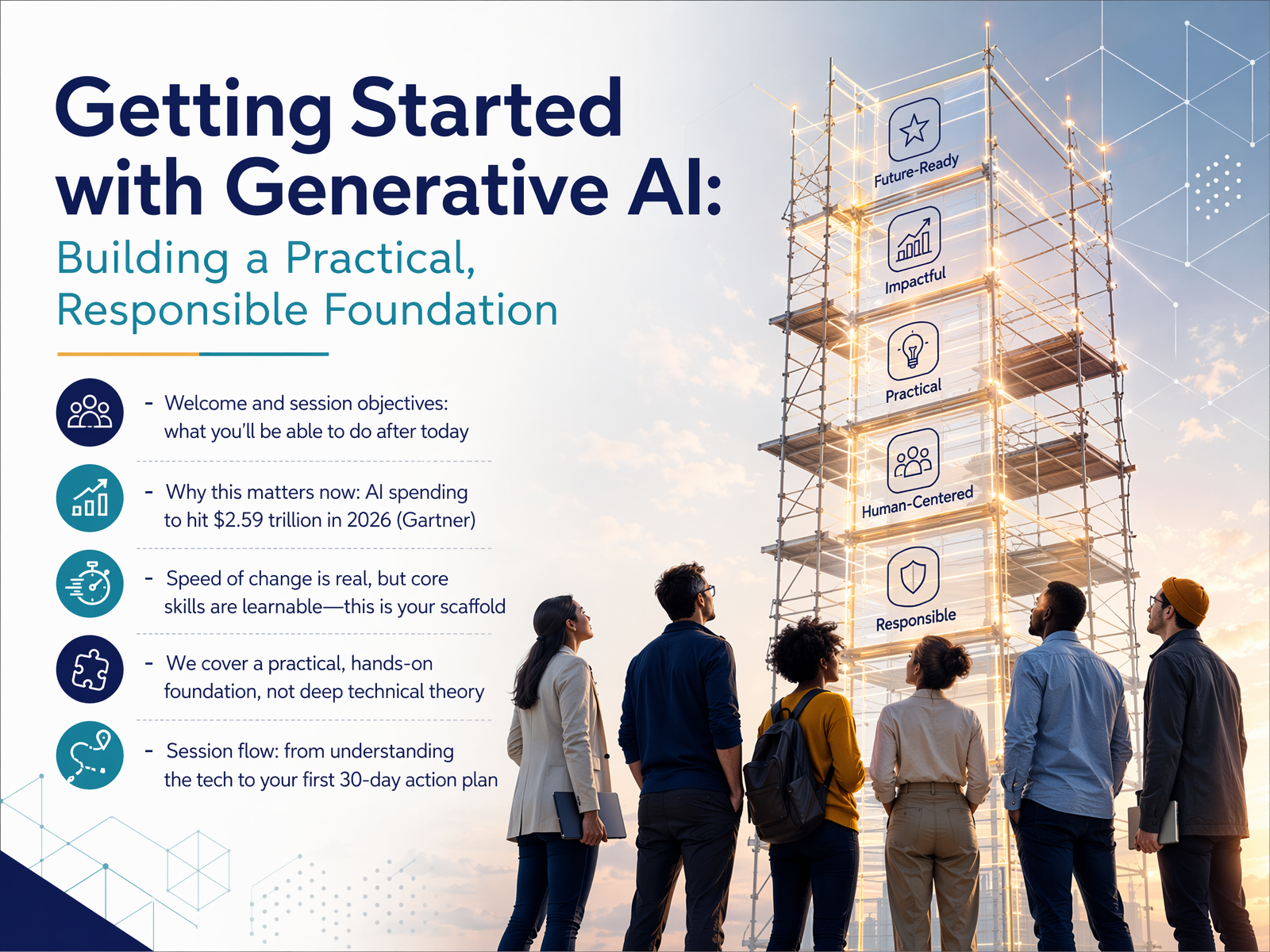
- 01Getting Started with Generative AI: Building a Practical, Responsible FoundationWelcome. This course gives you a practical, responsible foundation in generative AI. By the end, you will understand what these systems do, where they are useful, where they can fail, and how to begin practicing with appropriate safeguards. Generative AI is becoming part of everyday creative and knowledge work, but the durable skill is not memorizing a particular tool. It is learning how to frame a task, evaluate an output, protect sensitive information, and keep human judgment in the loop. We will focus on those transferable habits rather than deep technical theory or short-lived product features. We will start with a clear mental model, practice a prompt-evaluate-refine loop, examine common failure modes, and finish with a realistic first-month plan.deloitte.comgspublishing.compwc.com+22 min
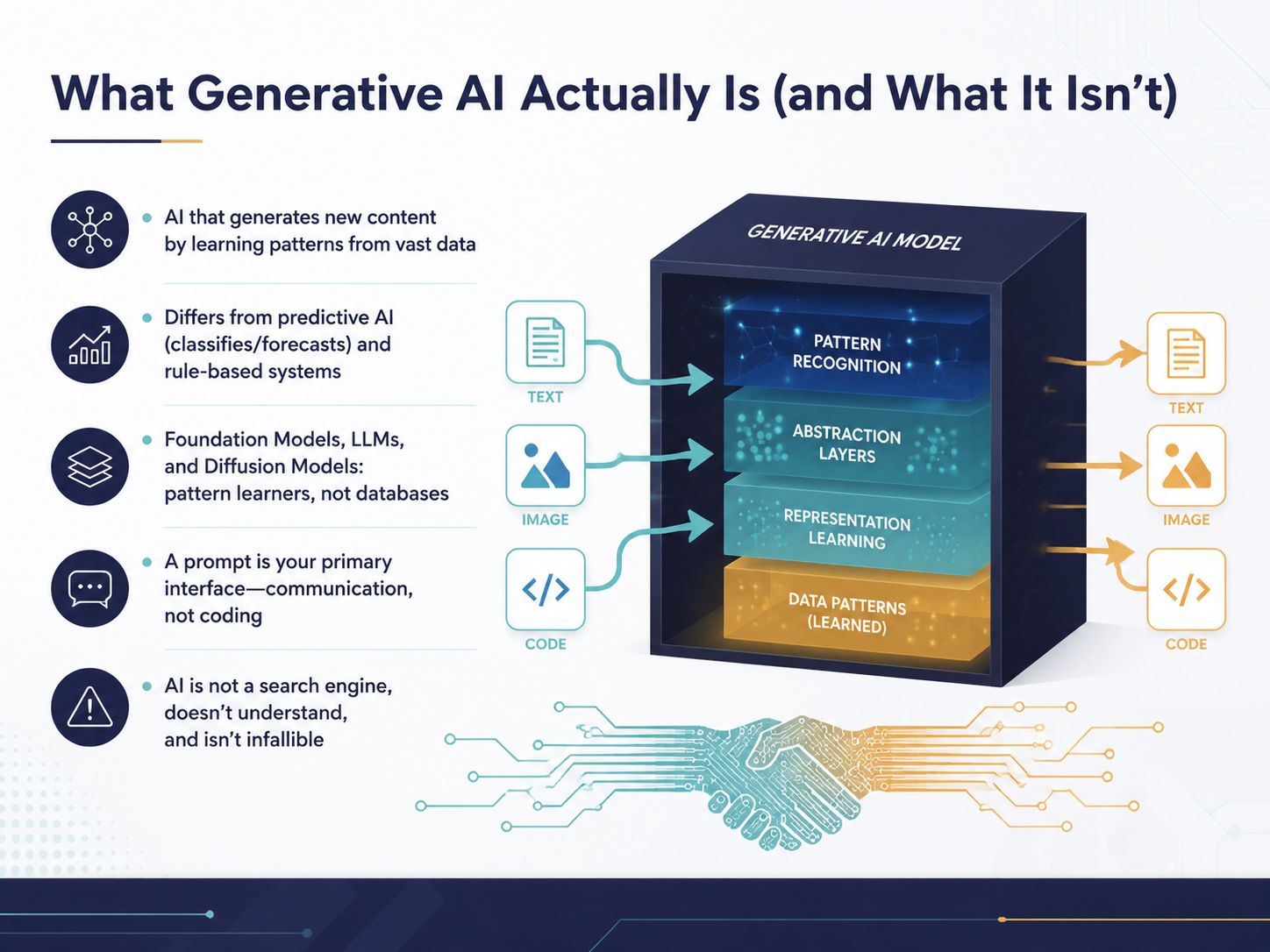
- 02What Generative AI Actually Is (and What It Isn't)Now, let's get clear on what generative AI actually is, and just as importantly, what it isn't. At its core, this is an AI that creates new content by learning patterns from a massive amount of data. Think of it as a pattern learner, not a database. This is different from predictive AI, which forecasts numbers, or older rule-based systems that follow a fixed script. The technology behind the chat tools you've heard about are called Foundation Models, Large Language Models, or Diffusion Models. When you use one, your primary interface is a prompt. That's just a natural language instruction. It's communication, not coding. But here's a critical point that often surprises people: an AI is not a search engine. It doesn't look up facts, and it doesn't truly understand concepts. It predicts the most plausible next word. Because of this, it is not infallible. It can confidently produce false information, which we call a hallucination, like inventing a fake case study or a citation that never existed. So, your role is to be a skilled editor and fact-checker, not just a recipient of the output. This leads us perfectly into the most important skill you'll build: a continuous cycle of improving your results. Let's explore that core loop of prompt, evaluate, and iterate.
 ai-tldr.devtowardsdatascience.comperplexityaimagazine.com+22 min
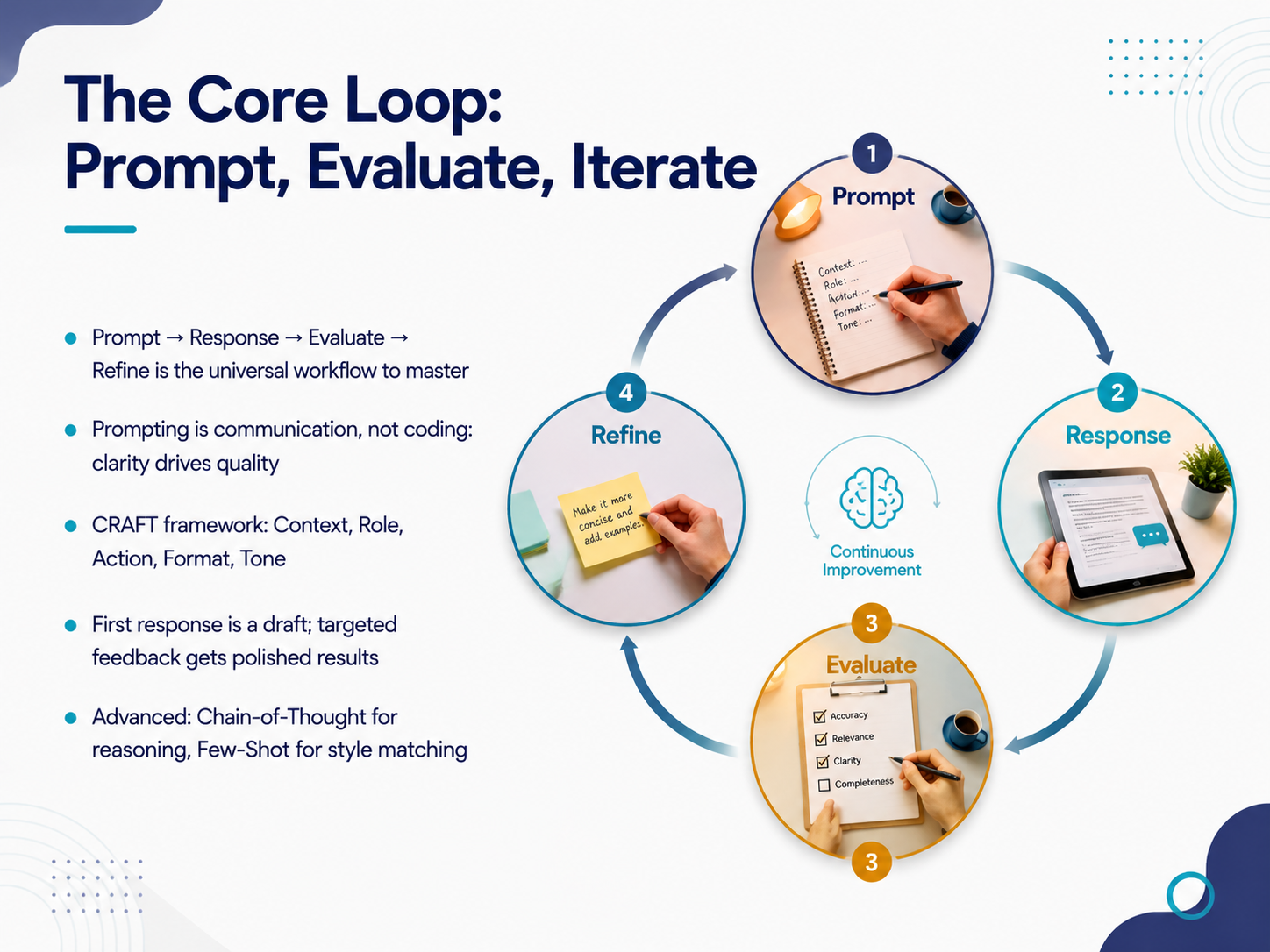
 - 03The Core Loop: Prompt, Evaluate, IterateA reliable way to work with generative AI is a simple loop: prompt, review the response, evaluate it against your goal, and refine your instruction. Treat the first response as a draft. Clear communication matters more than special wording. Give the system enough context, state the task, name important constraints, describe the desired format, and identify the audience. Then inspect what came back. Is it complete? Is it accurate? Does it follow the constraints? For a complex task, ask the model to state assumptions, propose a checklist, or pause at intermediate steps so you can verify the direction. Examples can also help when you need a consistent structure or tone. The goal is not to discover one perfect prompt. It is to build a repeatable editing process in which human judgment remains responsible for the final result.
 prompt-architects.commefai.comaipromptarchitect.co.uk+22 min
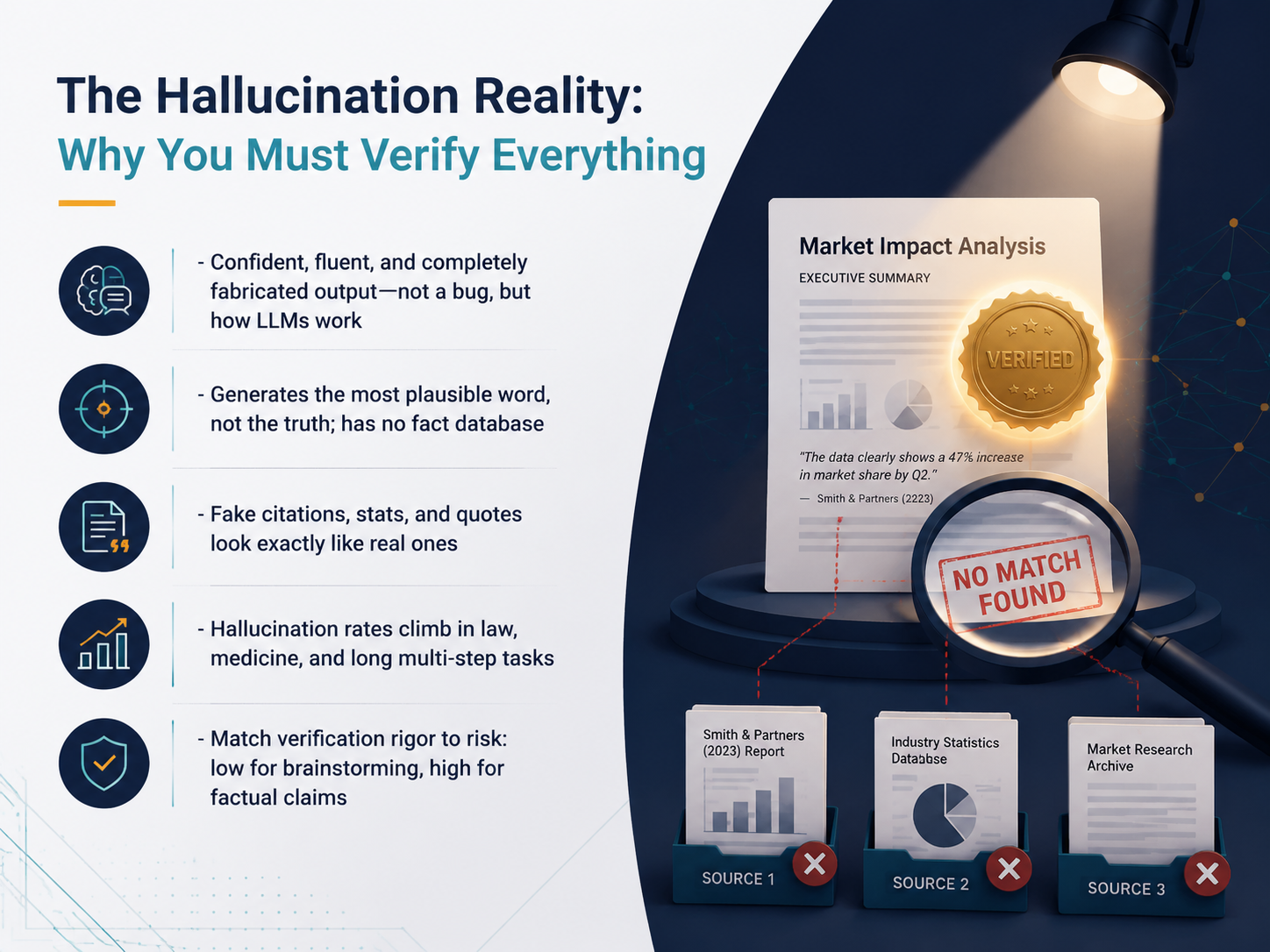
 - 04The Hallucination Reality: Why You Must Verify EverythingGenerative AI can produce an answer that sounds polished and confident while still being wrong. A language model generates plausible continuations; it does not guarantee that a statement is true. That means citations, statistics, quotations, dates, and names should be checked against reliable sources before you use them. The same rule applies when a task depends on specialized knowledge or several linked steps. Match your verification effort to the possible consequence of an error. Brainstorming labels for a private draft is low risk. Publishing a factual explanation, making a business decision, or giving guidance in a regulated field requires much stronger review and, when appropriate, a qualified human expert. Fluency is not evidence. Verification is part of the workflow.
 ai-tldr.devtowardsdatascience.comperplexityaimagazine.com+22 min
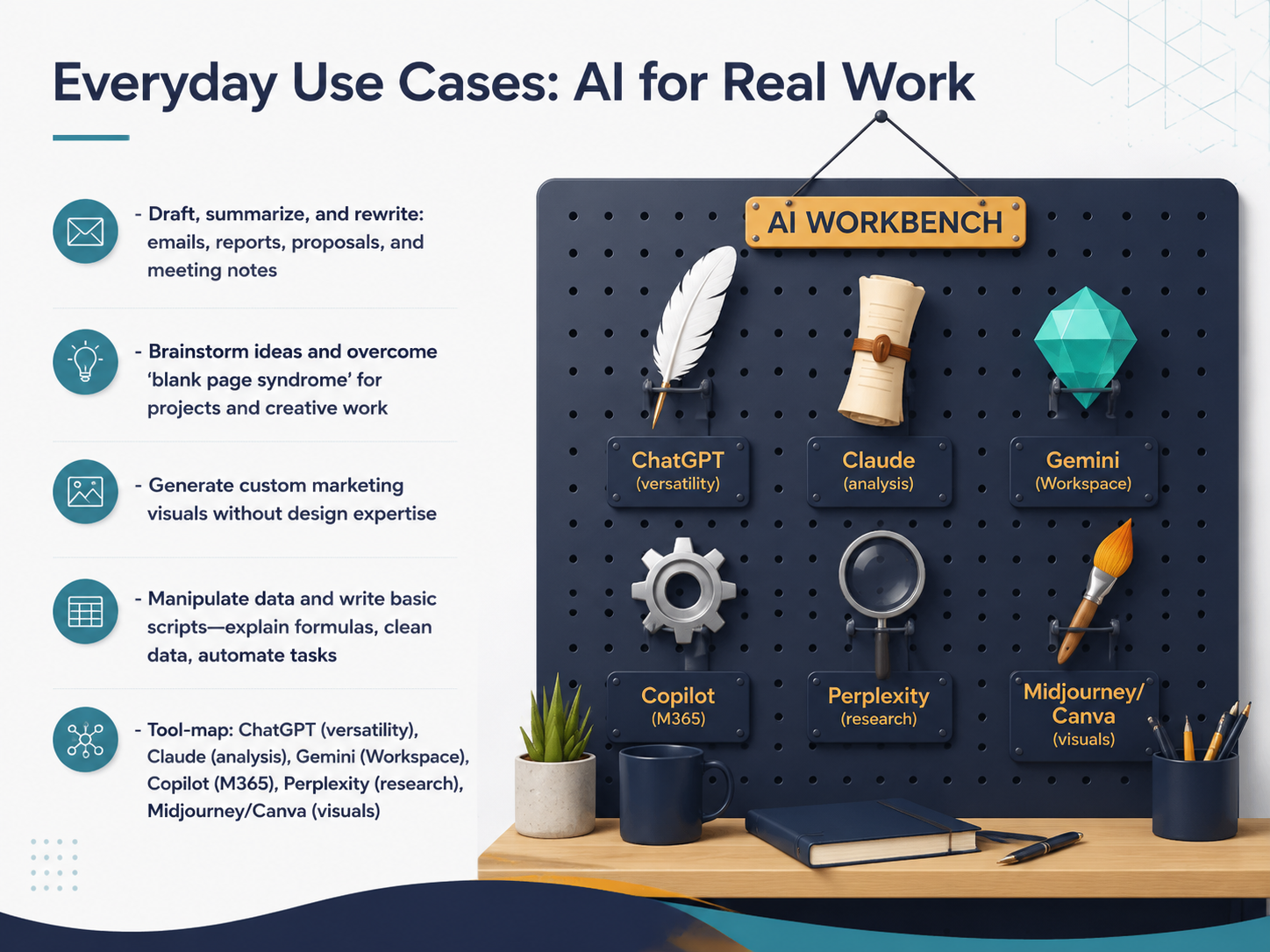
 - 05Everyday Use Cases: AI for Real WorkGenerative AI can help with many ordinary tasks when the risk is appropriate and the result is reviewed. You might draft an email, summarize material you are allowed to share, compare several ways to structure a report, or brainstorm alternatives when you are facing a blank page. It can also turn approved source material into an outline or a set of visual concepts. For technical work, it may explain a formula, transform sample data, or draft a small script that you then test. Choose a tool based on the task rather than brand familiarity. Check its privacy terms, whether it can ground answers in sources, what file types it supports, and how you will review the output. Start with work that is reversible and low risk.
 pctechmag.comzapier.comalmcorp.com+22 min
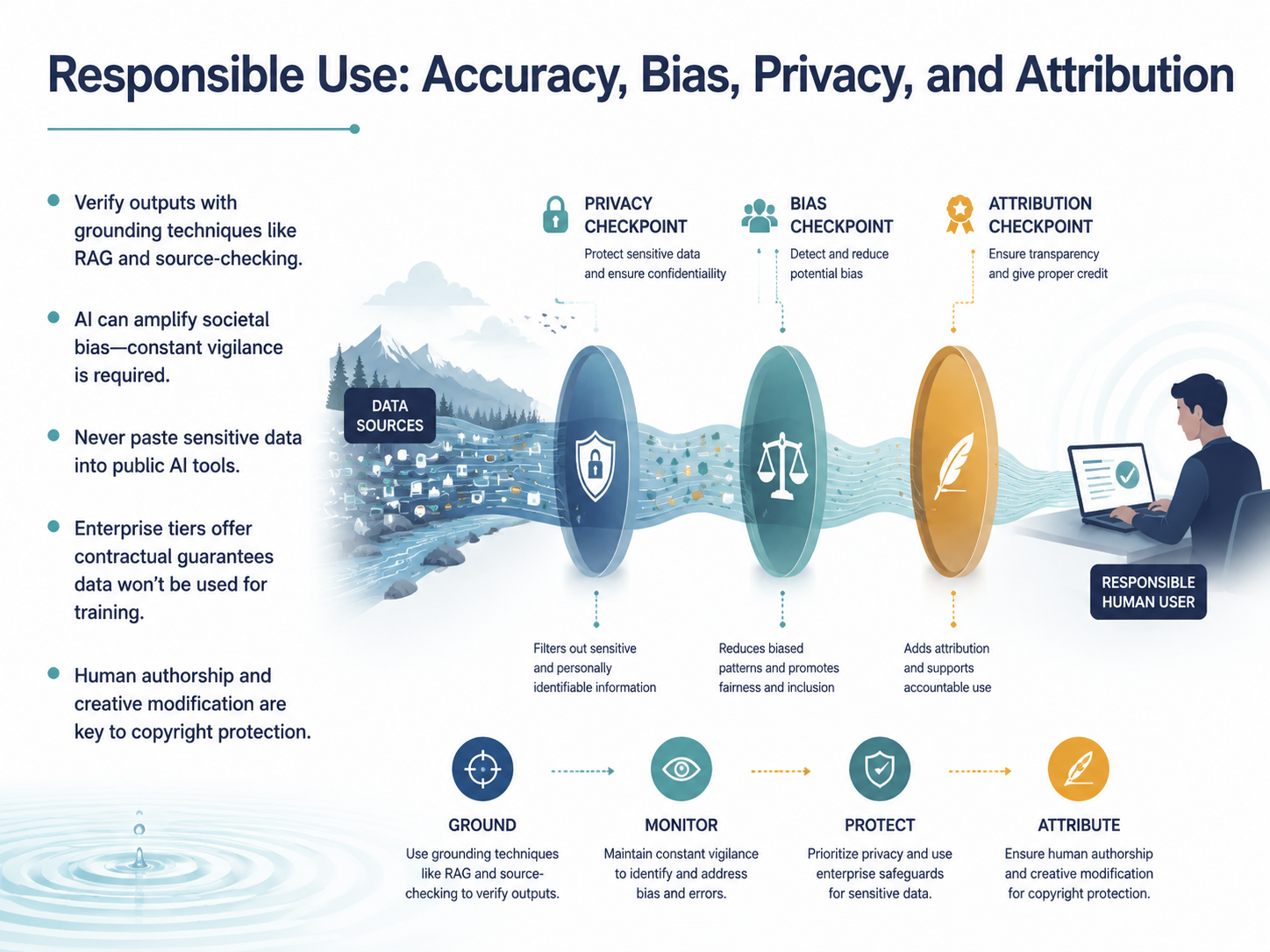
 - 06Responsible Use: Accuracy, Bias, Privacy, and AttributionResponsible use begins with accuracy, fairness, privacy, and transparency. Verify factual claims against reliable sources instead of treating an AI answer as evidence. Look for bias, missing perspectives, and uneven performance across languages or groups. Protect information as carefully as you would with any external service: do not enter confidential, personal, or proprietary data unless you are authorized and the tool's terms and settings are appropriate. Product settings and policies differ, so review the current documentation rather than assuming one rule applies everywhere. Finally, keep meaningful human review in the process and disclose AI assistance when your organization, publisher, teacher, or audience expects it. These habits support a human-centered approach in which AI assists judgment rather than replacing responsibility.
 ai-tldr.devtowardsdatascience.comperplexityaimagazine.com+22 min
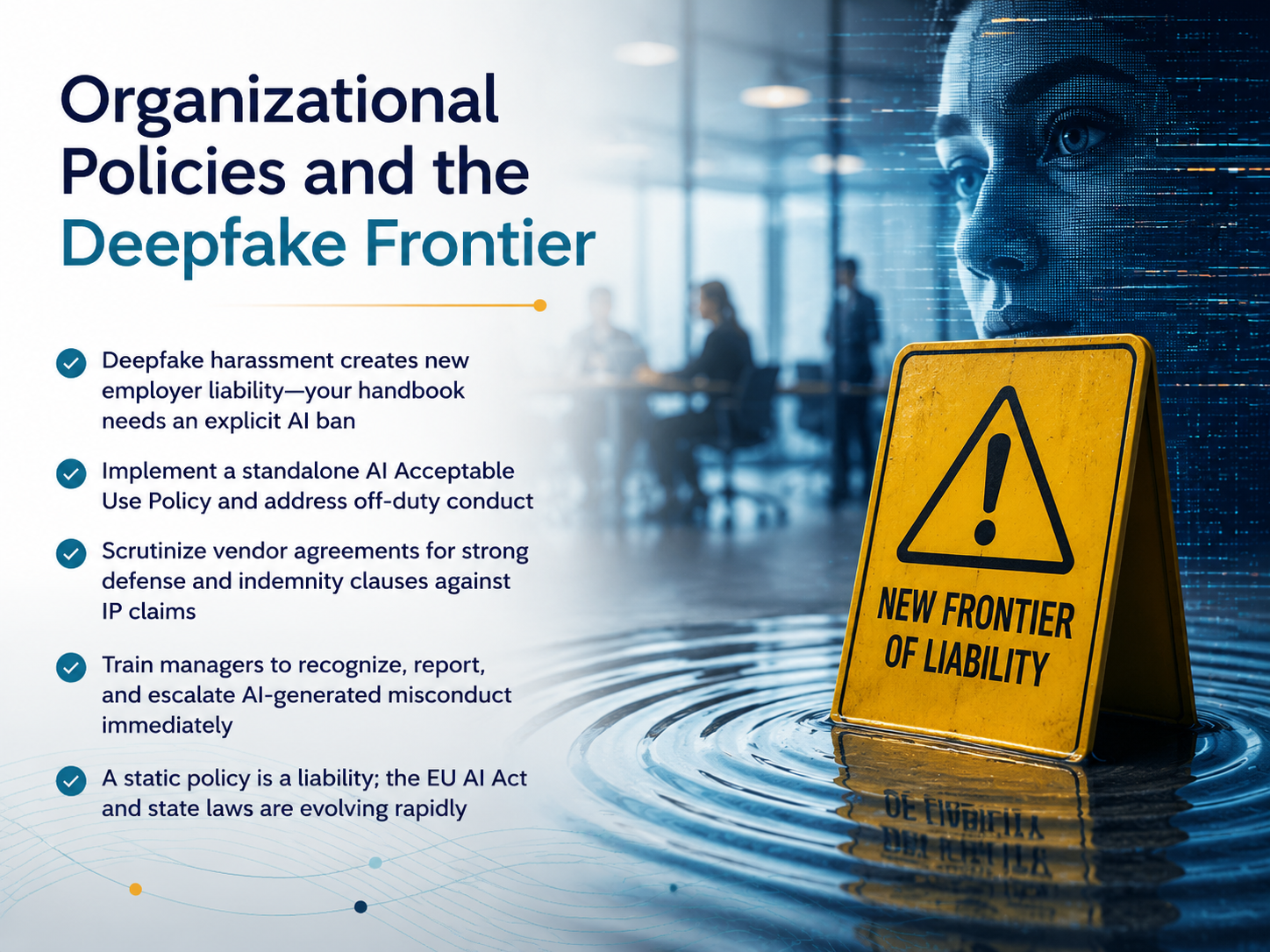
 - 07Organizational Policies and the Deepfake FrontierOrganizations need practical guardrails, not just enthusiasm or fear. An acceptable-use policy can describe approved tasks, prohibited data, review responsibilities, and escalation paths. Synthetic media deserves particular care because realistic audio, images, or video can mislead people when their origin is unclear. Label or disclose it when the context requires transparency, and provide a clear way to report harmful or deceptive content. Before adopting a tool, review its current privacy, security, rights, retention, and support terms with the appropriate internal owners. Training should help people recognize uncertainty and know when to stop and ask for help. Guidance should be reviewed as tools and organizational needs change. This is operational awareness, not legal advice; requirements vary by jurisdiction and context.
 2 min
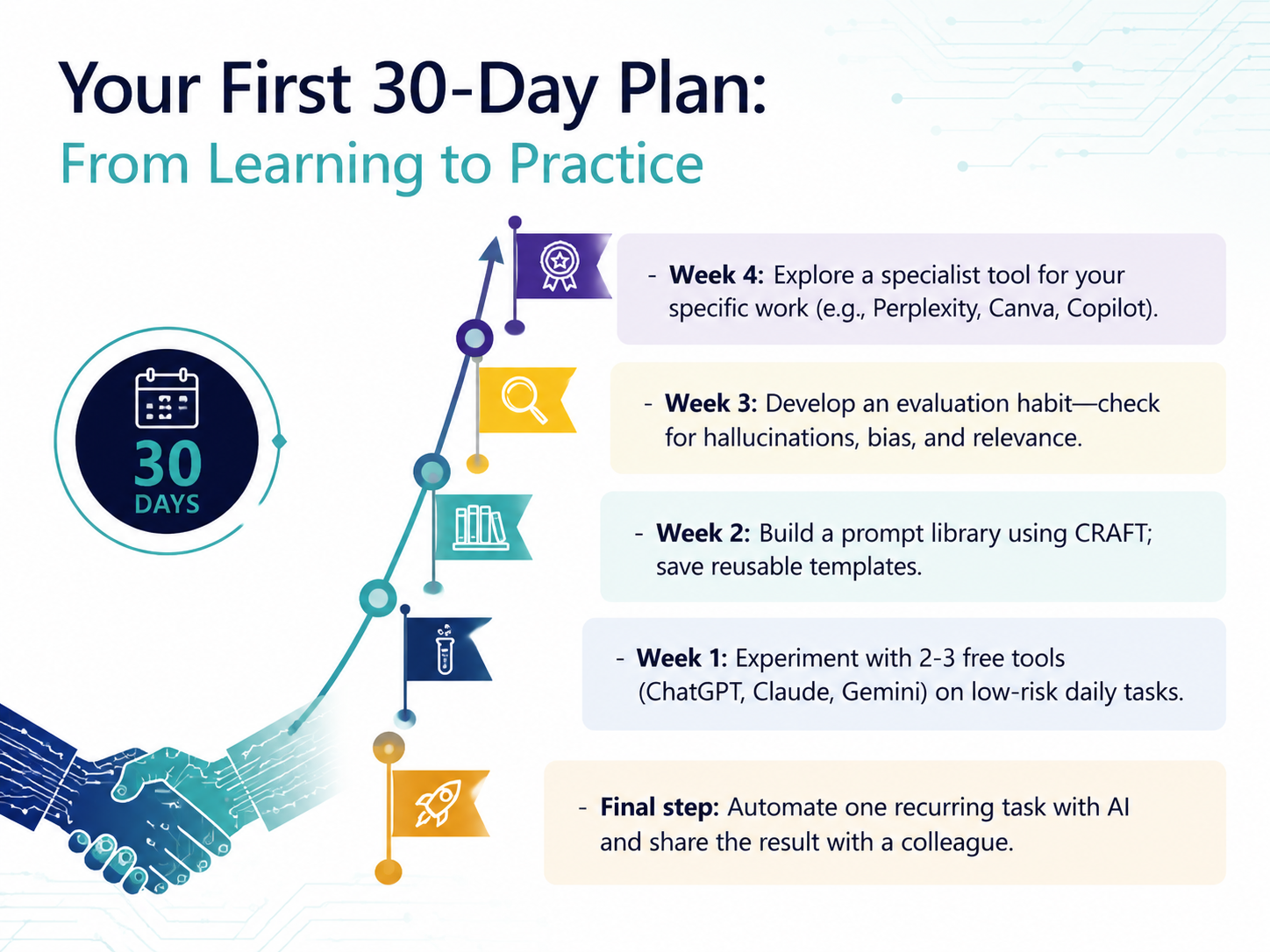
2 min - 08Your First 30-Day Plan: From Learning to PracticeTurn your first month into a careful practice plan. In week one, choose one approved tool and use it only for low-risk, reversible tasks. Notice what information helps it produce a useful draft. In week two, save a small prompt library for tasks you repeat, including context, constraints, audience, and format. In week three, build an evaluation habit: check factual claims, question assumptions, look for bias or missing perspectives, and compare the result with your real goal. In week four, test one specialist workflow using approved sample data, then review the outcome before using it in real work. Finish by documenting what worked, what failed, what information must stay private, and where human review belongs. The aim is not maximum automation. It is a responsible process you can explain, repeat, and improve.
 prompt-architects.commefai.comaipromptarchitect.co.uk+22 min
Take the deck with you
Download this course as a file — free, no sign-up needed.
- PDF handoutEvery slide page, ready to print or share.9 pages · 2.1 MBDownload
- Narrated PowerPointThe deck that presents itself — every slide carries the digital human's narration video.9 pages · 7.7 MBDownload
- PowerPoint slidesThe full deck as a .pptx — open it in PowerPoint, Keynote, or Google Slides.9 pages · 2.0 MBDownload
Free to use in your own training — please keep the PersonWise credit page at the end.
Have your own deck? Turn it into a course
Sources consulted
Web sources consulted while building this course.
- The State of AI in the Enterprise - 2026 AI report | Deloitte US — deloitte.com
- April 2026: Adoption Rises to 19.8% — gspublishing.com
- 2026 AI Business Predictions: PwC — pwc.com
- Gartner Forecasts Worldwide AI Spending to Grow 47% in 2026 | Morningstar — morningstar.com
- Generative AI Market Size, Share, Value Report [2026-2034] — fortunebusinessinsights.com
- Why Do LLMs Hallucinate? Causes and Fixes | AI/TLDR — ai-tldr.dev
- That Is Embarrassing: Why Frontier AI Still Makes Things Up, and What to Do About It | Towards Data Science — towardsdatascience.com
- AI Hallucinations Explained: Risks in 2026 — perplexityaimagazine.com
- It's 2026. Why Are LLMs Still Hallucinating? - Duke University Libraries Blogs — blogs.library.duke.edu
- Accuracy paradox: Addressing epistemic, manipulative, and societal risks of hallucination in AI governance - ScienceDirect — sciencedirect.com
- What Is Prompt Engineering? A 2026 Beginner's Guide (with Examples) | Prompt Architects — prompt-architects.com
- Prompt Engineering in 2026: The Complete Beginner's Guide to Getting Better AI Outputs Every Time - MEFAI — mefai.com
- Prompt Engineering for Beginners: Start Here (2026 Guide) — aipromptarchitect.co.uk
- Prompt Engineering for Beginners: A Practical Guide to Better AI Prompts » AIML Insights — aimlinsights.com
- Prompt Engineering Best Practices: Tutorial & Examples | LaunchDarkly — launchdarkly.com
- The Best Generative AI Programs for Working Professionals in 2026, Ranked by What Actually Matters - PC Tech Magazine — pctechmag.com
- The 21 best generative AI tools in 2026 | Zapier — zapier.com
- Top Generative AI Tools in 2026: 12 Best Platforms Ranked — almcorp.com
- Generative AI Models Compared: 9 Top Tools (2026) — albato.com
- Best Generative AI Platforms in 2026: Tools Compared • SQ Magazine — sqmagazine.co.uk