Introduction to Robotics
Begin
16 pages · ~32 min
Introduction to Robotics
This training provides a foundational overview of robotics concepts, designed for beginners to understand key components and principles of robotic systems.
What you’ll learn
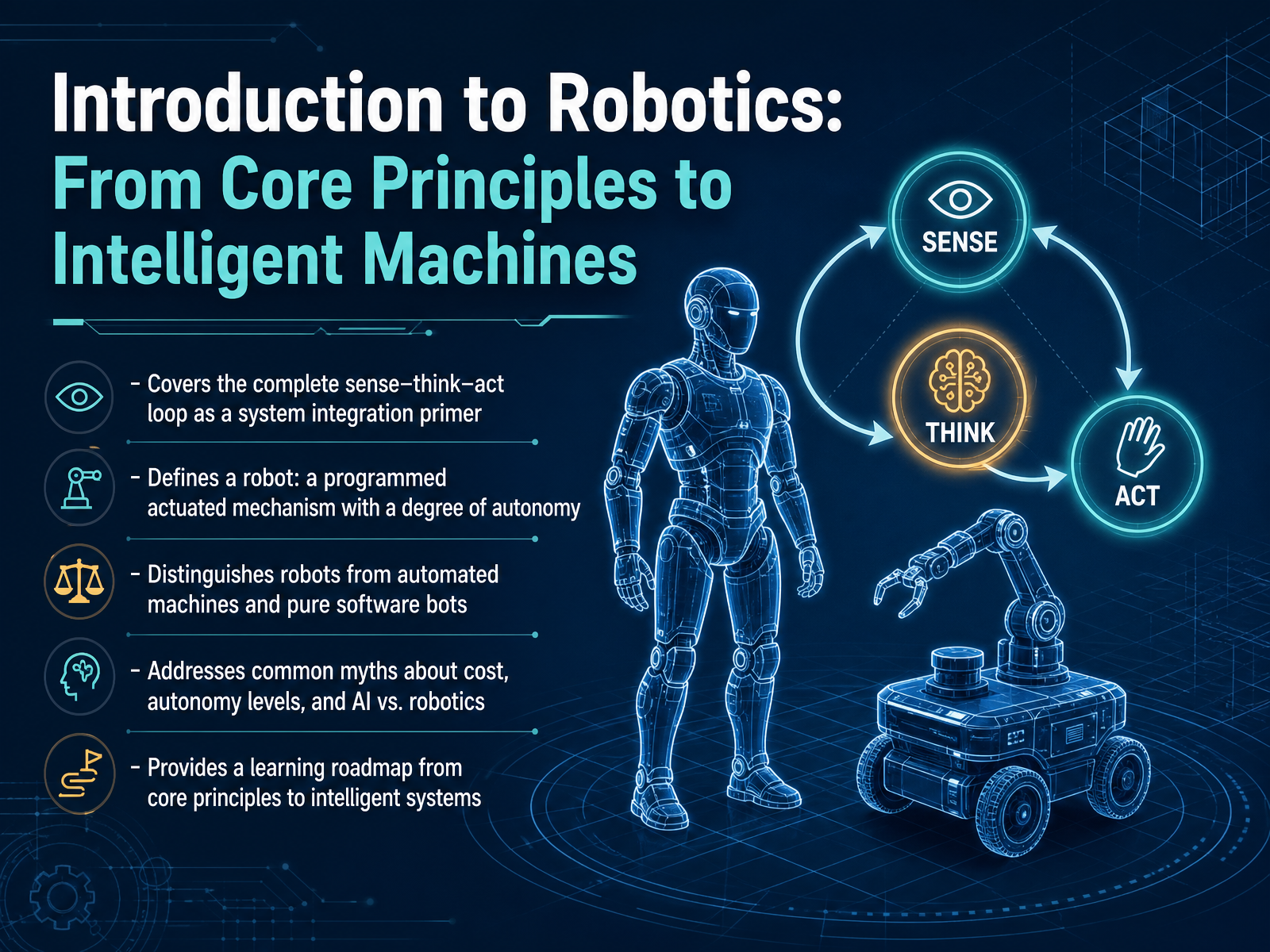
- 01Introduction to Robotics: From Core Principles to Intelligent MachinesWelcome to Introduction to Robotics. In this course, we'll work together to understand how robots go from core principles to intelligent machines. Our goal is simple: to see how sensing, decision-making, action, and feedback work together as one complete loop. We'll start with a clear, international definition. According to the ISO 8373 standard, a robot is a programmed, actuated mechanism with a degree of autonomy that moves, manipulates, or positions itself. This separates a true robot from a purely automated machine or a software bot. We'll also clear up a few common myths along the way. For example, you don't need an advanced degree or a huge budget to start; curiosity and a willingness to experiment are what really matter. By the time we finish the roadmap, you'll see why a robot is much more than just hardware and code—it's an integrated system. Next, we'll move to our first deep dive: What Makes a Machine a Robot? Core Definition and Boundaries.iso.orgiso.orgifr.org+22 min
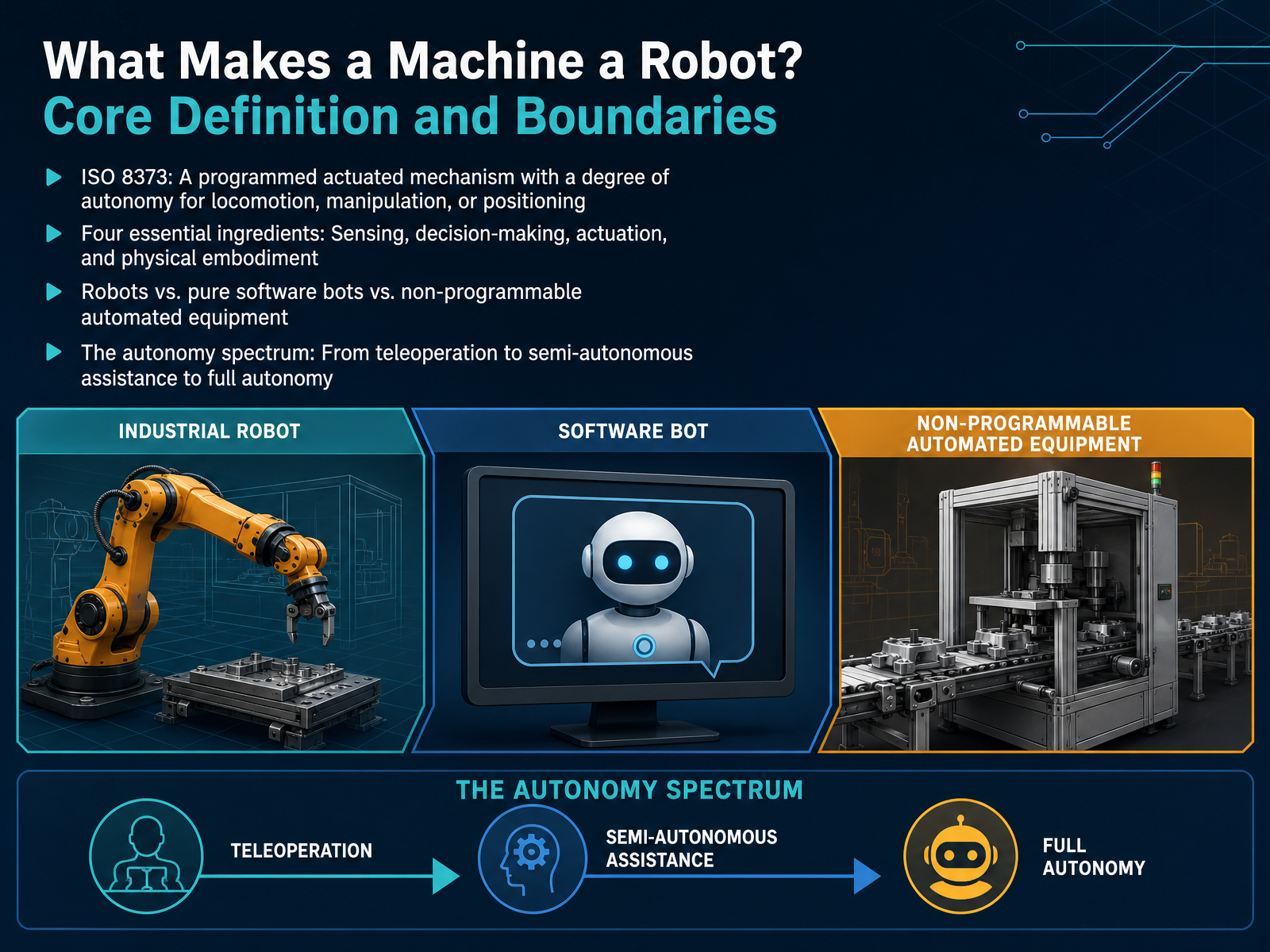
- 02What Makes a Machine a Robot? Core Definition and BoundariesLet’s sharpen our definition with an international standard: ISO 8373. It describes a robot as a programmed actuated mechanism with a degree of autonomy that moves, manipulates, or positions itself. Think of it as a rulebook that separates true robots from fixed machines and software alone. Four ingredients must be present. First, sensing: collecting data from the world through cameras, microphones, or contact sensors. Second, decision-making: processing that data with a control system to choose an action. Third, actuation: turning a decision into physical movement using motors or other drives. And fourth, physical embodiment: a real body that interacts with its surroundings. This recipe helps you spot the differences. A chatbot has sensing and decision-making but no moving body, so it is a software bot, not a robot. A non-programmable automated lift may move, but without autonomy it sits outside the definition. Autonomy itself lives on a spectrum. At one end you have teleoperation, where a human directly controls every motion. In the middle sits semi-autonomous assistance, where the robot handles parts of a task while a person guides high-level choices. Further along, you reach full autonomy, with the system performing tasks based on its own sensing and state without human intervention. Next, we will explore how these pieces connect in a closed loop, in 'The Sense–Think–Act Cycle: The Universal Robot Blueprint.'
 iso.orgiso.orgifr.org+22 min
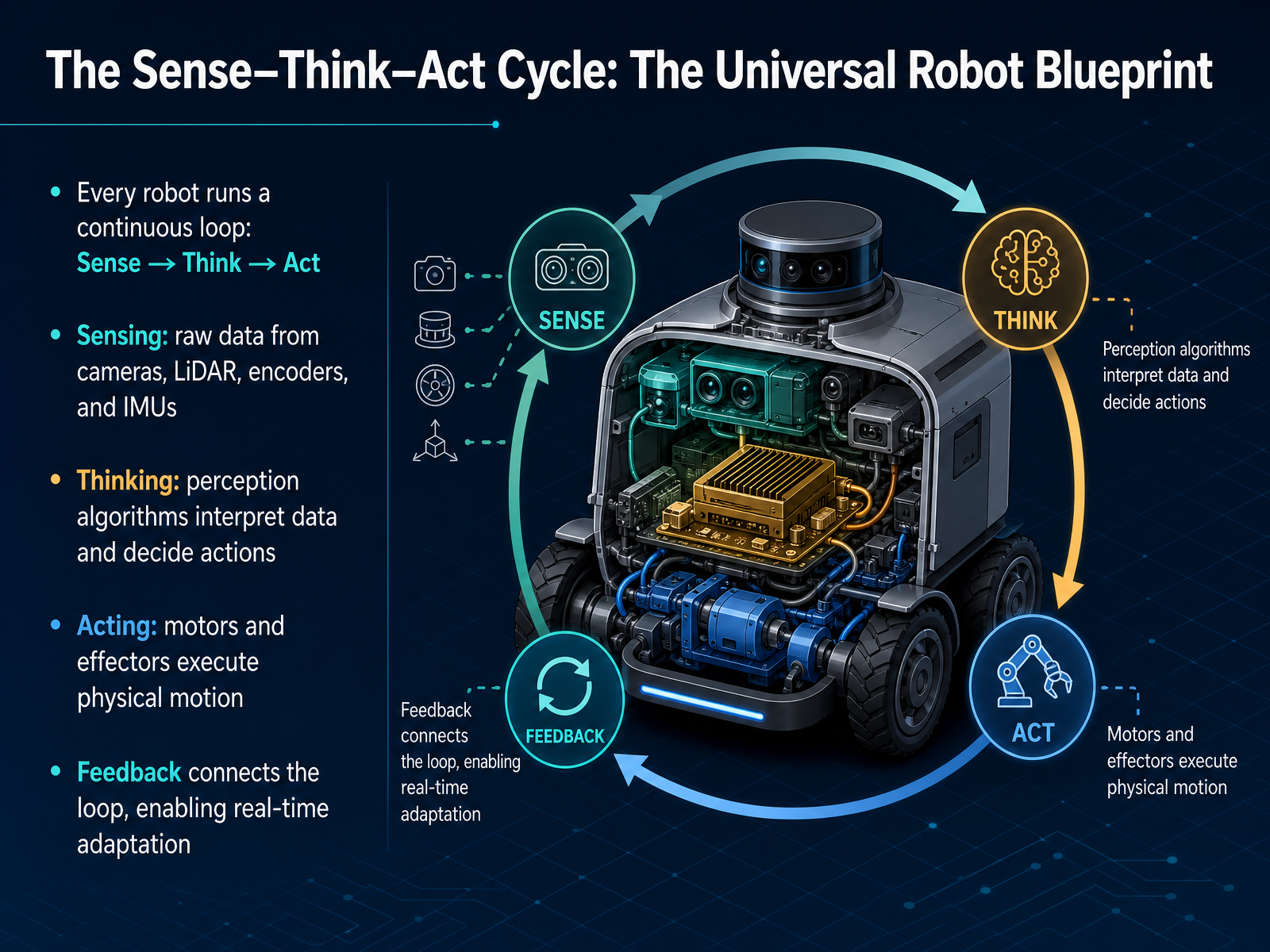
 - 03The Sense–Think–Act Cycle: The Universal Robot BlueprintNow, let's look at the blueprint that every robot follows. We call it the sense-think-act cycle, and it is a continuous loop. First, the robot senses. It pulls in raw data from its eyes and ears, like cameras, laser-based LiDAR, joint encoders, and motion sensors. Next, it thinks. Perception algorithms run through that data, build a picture of the world, and decide what to do. Then, it acts. Motors and other effectors carry out the physical movement. But here is the critical connector. Feedback links the acting back to the sensing, so the robot can adjust in real time. If a gripper meets unexpected resistance, the feedback loop instantly tells the arm to ease up. This sense-think-act cycle with feedback is the universal engine behind every robot, from a warehouse loader to a surgical assistant. Next, we will go deeper into the first step and explore sensing: how robots perceive their world and themselves.
 mordorintelligence.comlidarseek.comindexbox.io+22 min
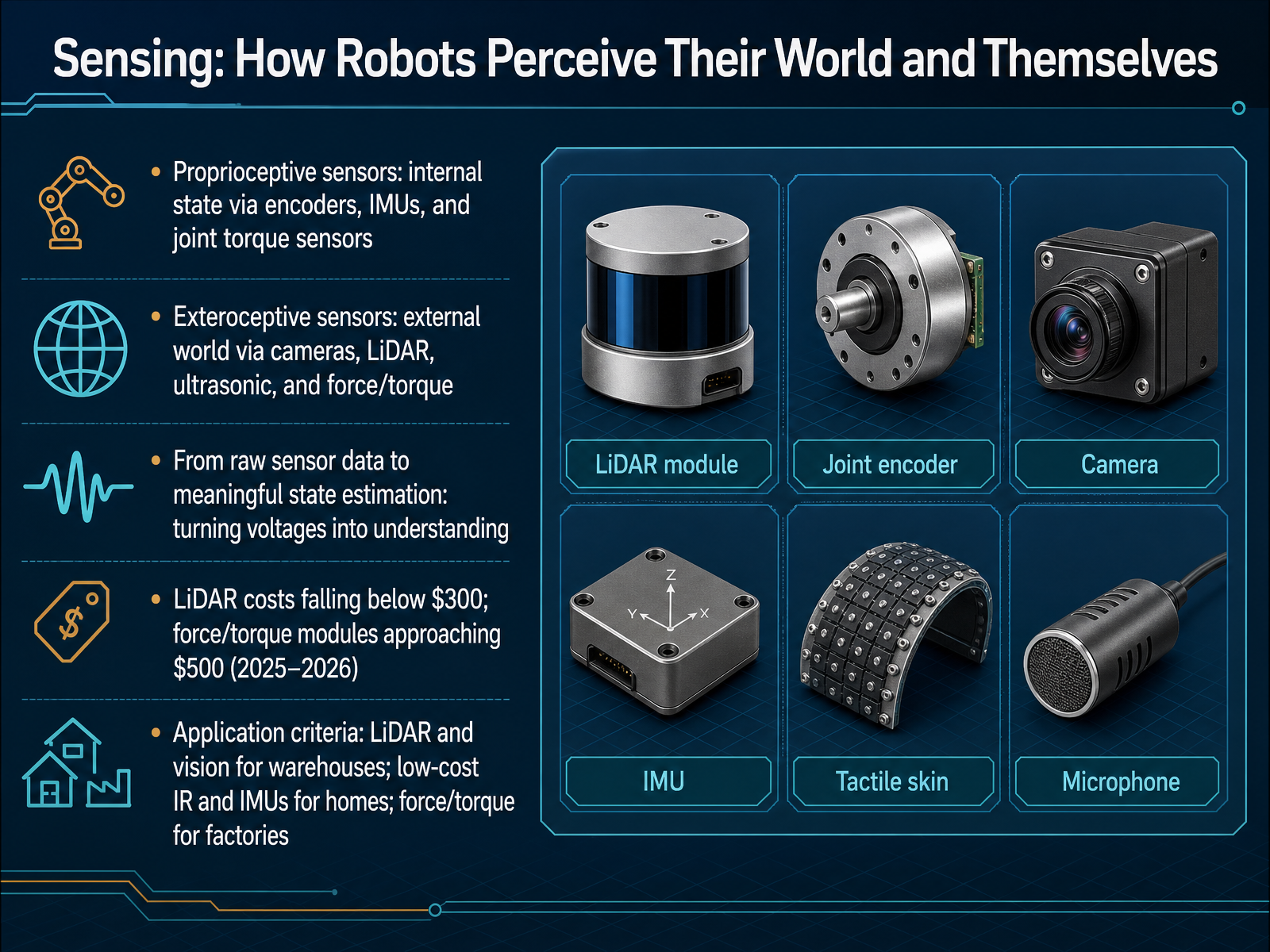
 - 04Sensing: How Robots Perceive Their World and ThemselvesNow, let's look at sensing—how a robot perceives its world and itself. Think of sensing as the robot's entire input system, split into two groups. First, internal or proprioceptive sensors. These measure the robot's own body: encoders track joint angles, IMUs measure motion and tilt, and joint torque sensors feel the force in its limbs. Second, external or exteroceptive sensors. These face outward. Cameras capture visual detail, LiDAR builds a 3D point cloud of the space, ultrasonic sensors detect nearby obstacles, and force or torque sensors gauge contact with outside objects. All of this raw data—voltages and signals—is useless by itself. The robot must run estimation algorithms to turn that stream into a meaningful understanding, like knowing where it is and what it's touching. Cost is making these sensors much more accessible. By 2025 to 2026, LiDAR modules have fallen below three hundred dollars, and basic force or torque modules are approaching five hundred dollars. The choice of sensor depends entirely on the job. Warehouses lean heavily on LiDAR and vision for navigation. Home robots keep costs down with low-cost infrared sensors and inertial measurement units. Factories, where precise handling matters, invest in force and torque sensing. All of this rich sensor data flows straight into the next stage: perception and decision-making, the robot's brain.
 mordorintelligence.comlidarseek.comindexbox.io+22 min
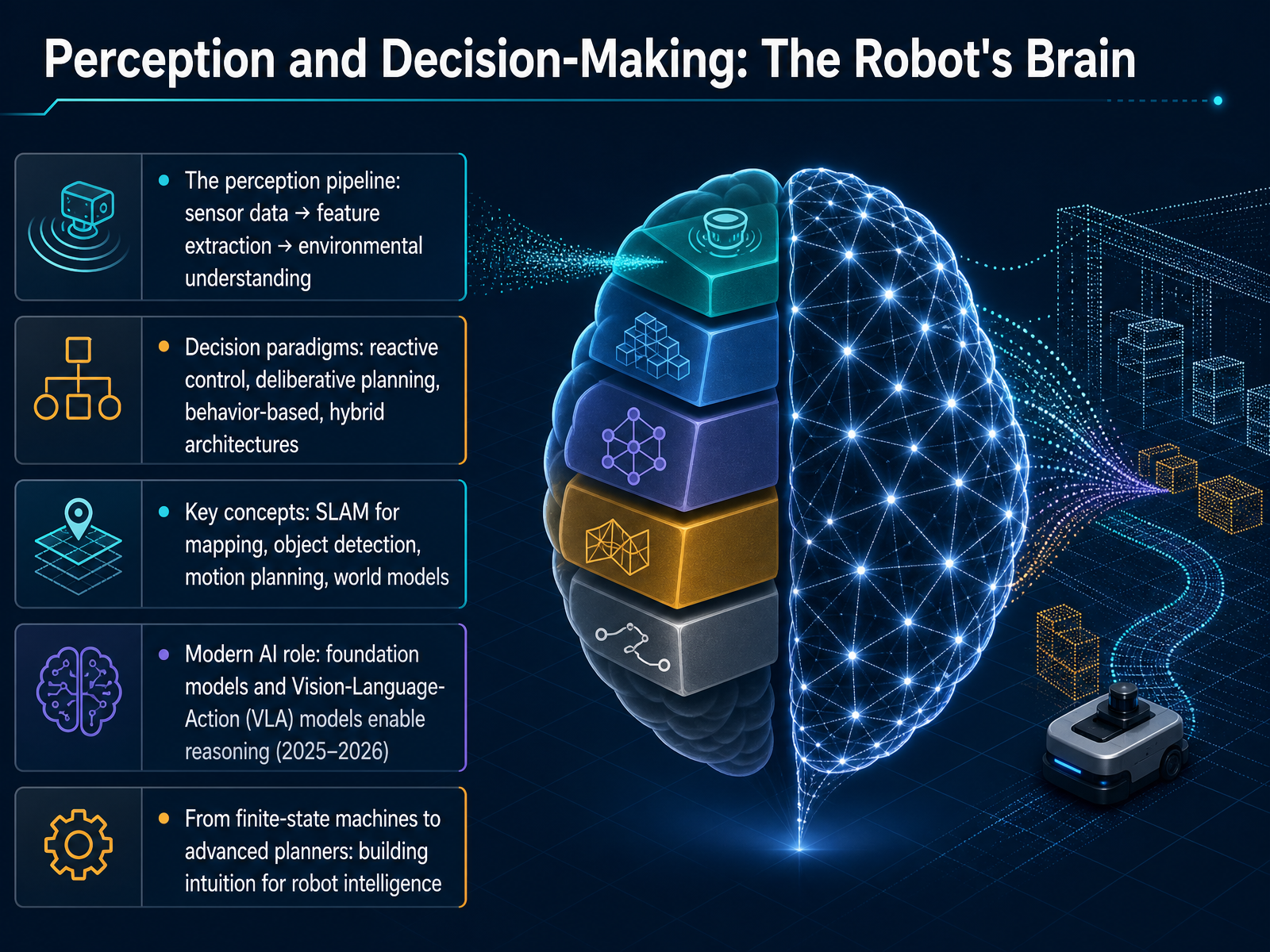
 - 05Perception and Decision-Making: The Robot's BrainLet's look closely at how a robot builds understanding and decides what to do. We call this the perception pipeline. It starts with raw sensor data, like camera images or depth readings. The system extracts key features, edges, colors, or shapes, and uses them to form environmental understanding, a working picture of where things are and what they are. Once the robot sees its world, it has to choose an action. There are a few common decision paradigms. Reactive control means responding directly to sensor input, like stopping when something is too close. Deliberative planning involves looking ahead, searching through possible sequences to reach a goal. Many robots use behavior-based or hybrid approaches, blending fast reactions with deeper planning. Two important abilities sit underneath all of this. One is SLAM, simultaneous localization and mapping, which lets the robot build a map while tracking its own position. Object detection finds specific items, and motion planning computes safe, efficient paths. Together, these form a kind of world model. A major shift has come from modern AI, especially between 2025 and 2026. Foundation models and Vision-Language-Action models, often called VLA models, give robots the ability to reason. Instead of just matching patterns, a robot can connect what it sees to language and then to physical actions, handling tasks it was never explicitly trained for. So, from simple state machines to advanced planners, the brain of the robot is growing more flexible and more capable every year. Now that we understand perception and decision-making, let's move to the next piece. Our next slide covers actuation: turning decisions into physical motion.
 arxiv.orgarxiv.orgarxiv.org+22 min
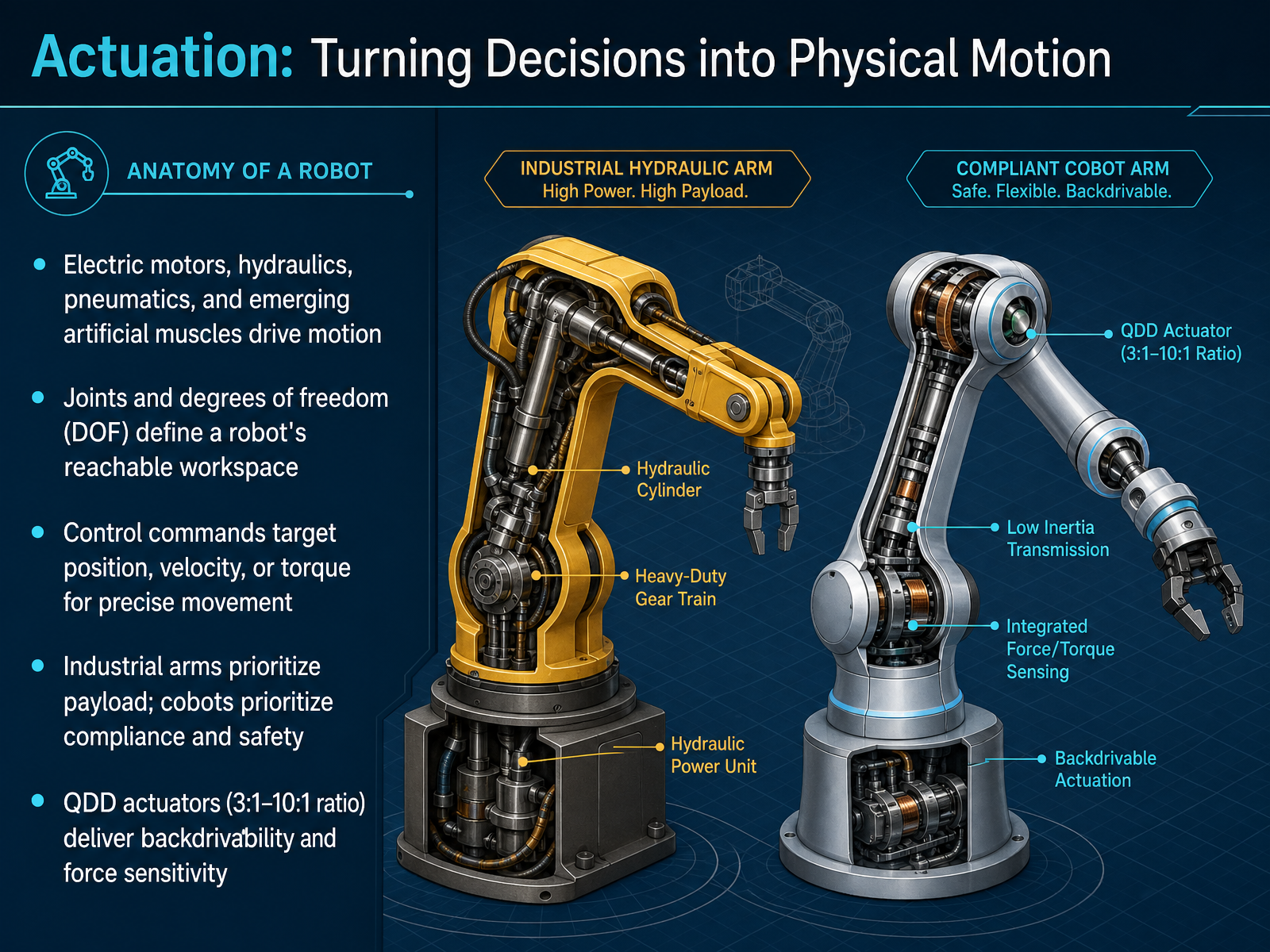
 - 06Actuation: Turning Decisions into Physical MotionNow let's see how a robot's decisions become physical motion. This step is called actuation. Think of it as the robot's muscles. The most common muscles are electric motors, but some robots use hydraulics or pneumatics for heavy lifting, and researchers are even developing artificial muscles. A robot's motion is defined by its joints and something called degrees of freedom, or DOF. Each independent direction a joint can move is one degree of freedom, and together they define the space the robot can reach. To control this motion precisely, we send commands that target the position, the velocity, or the torque of a joint. The priority changes with the job. A large industrial arm needs high payload capacity to lift heavy parts. In contrast, a collaborative robot, or cobot, working next to a person prioritizes compliance and safety, giving way if it bumps into something. This safe interaction is often achieved with quasi-direct drive actuators, which we call QDD actuators. They use a low gear ratio, typically between three-to-one and ten-to-one. This design provides excellent backdrivability, meaning you can physically move the robot's arm, and it gives the robot a fine sense of touch through force sensitivity. Let's close this loop in the system next.
 doi.orggithub.comrobotwale.com+22 min
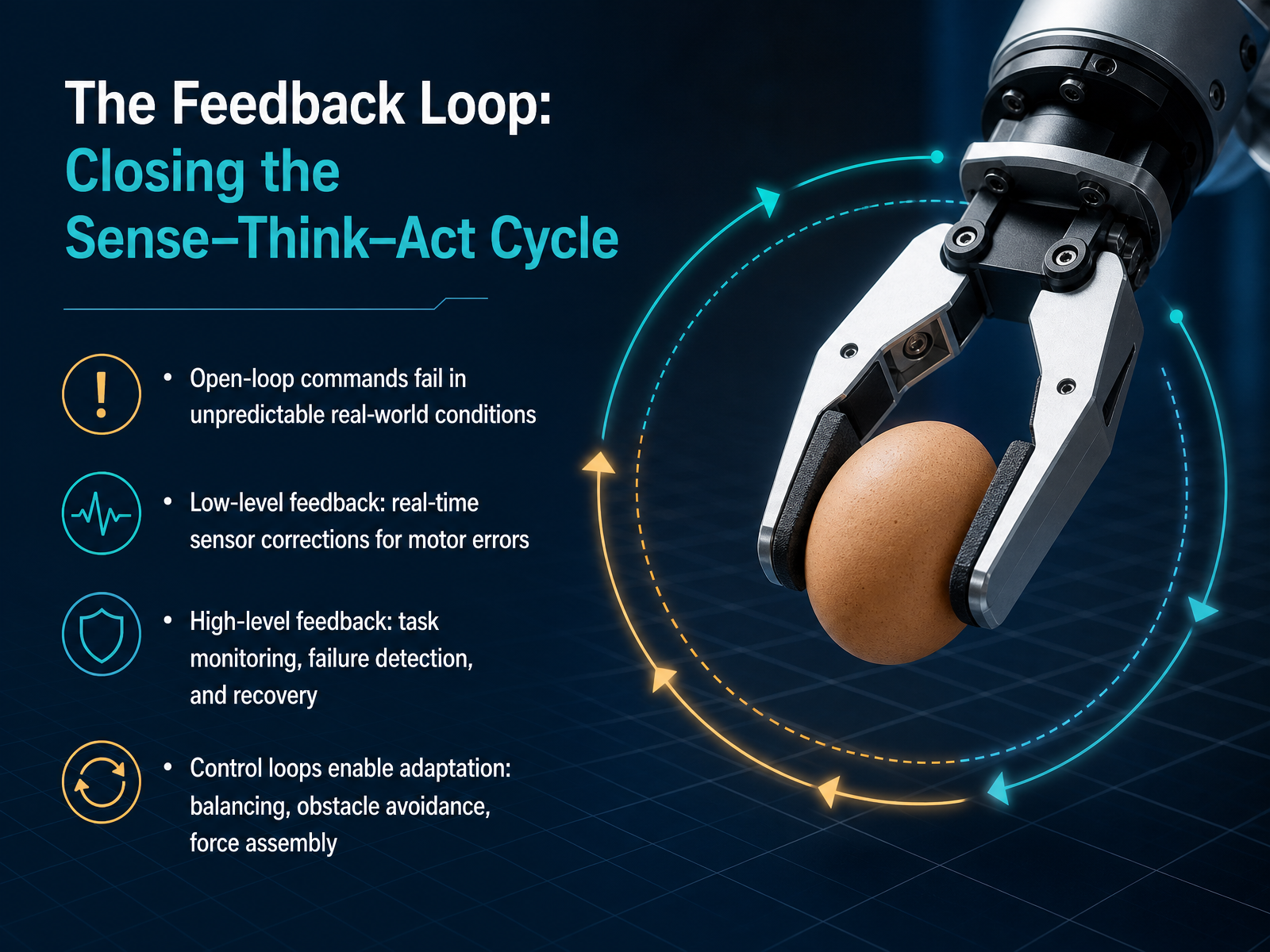
 - 07The Feedback Loop: Closing the Sense–Think–Act CycleNow, let's close the loop. We've seen sensing, thinking, and acting as separate steps. But in the real world, a robot can't just execute a single open-loop command and hope for the best. Imagine trying to walk across an icy patch with your eyes closed—that's what an open-loop command feels like. Feedback is what gives the robot its eyes and its sense of balance. We can break this feedback into two levels. Low-level feedback is the body's instant reaction. A motor feels unexpected resistance and the controller immediately adjusts its power to compensate, thousands of times per second. High-level feedback is more like a supervisor. It monitors the overall task. If a robot is supposed to place a part but its hand is empty, high-level feedback detects that failure and triggers a recovery plan. Together, these create a control loop that enables true adaptation, like a humanoid balancing on one leg, or a robotic arm precisely assembling a delicate connector. This cycle of continuous correction is what turns a rigid machine into a flexible, intelligent system. Next, let's see how these pieces connect by looking at a robot's system architecture, where we integrate sensing, planning, and control into one functioning whole.
 2 min
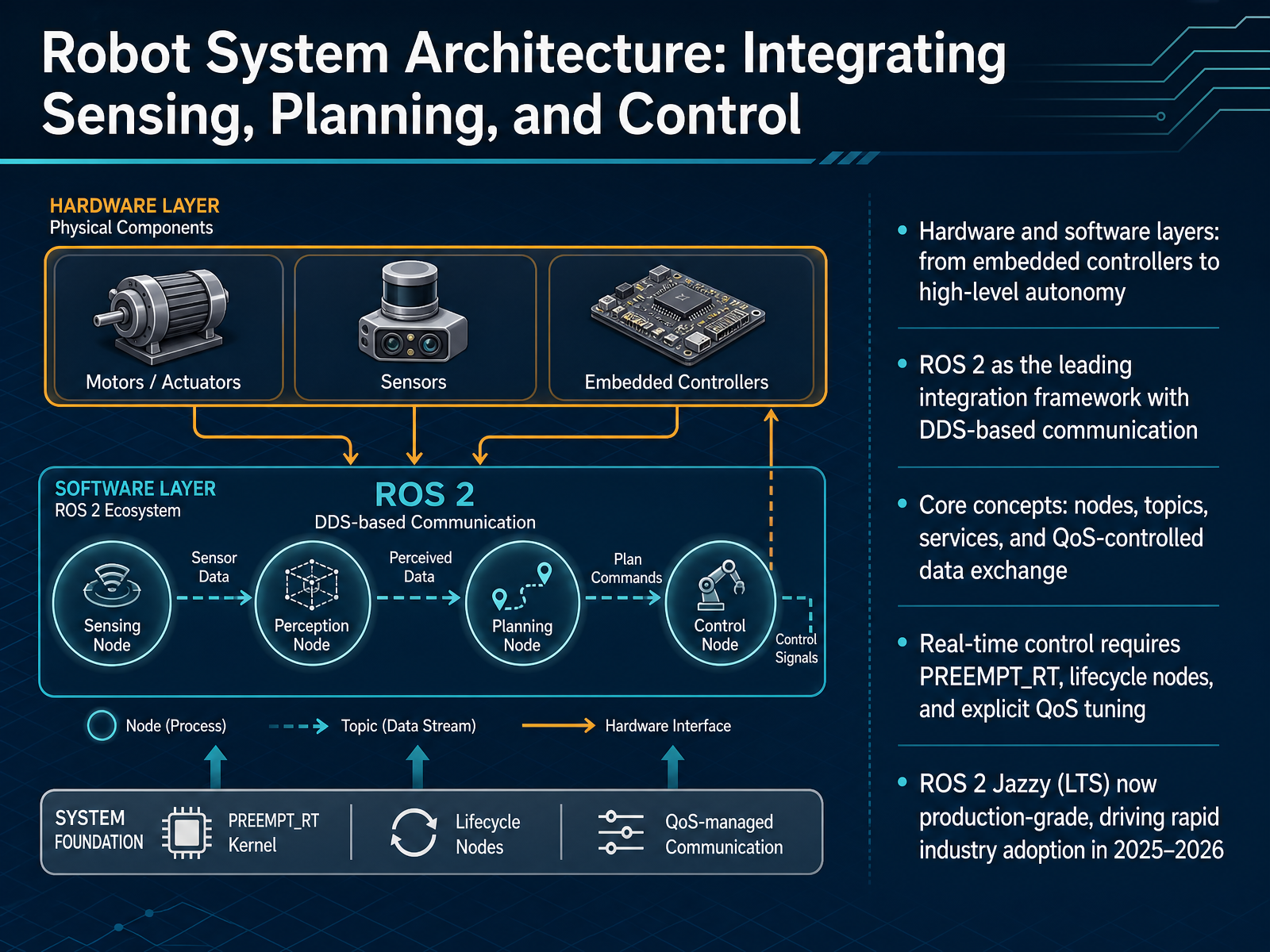
2 min - 08Robot System Architecture: Integrating Sensing, Planning, and ControlNow we bring those individual components together into a complete architecture. Think of it as two main layers working in concert. At the bottom, we have the hardware and low-level software—the embedded controllers that interface directly with sensors and motors. On top of that, we have the high-level autonomy layer that does the planning and decision-making. And connecting it all is ROS 2, the Robot Operating System version two, which has become the leading framework for integration. It uses a communication standard called DDS—think of it like a high-speed, decentralized postal service for software. This lets us build systems around a few core concepts: 'nodes', which are individual pieces of code; 'topics', which are the data streams between them; and 'services', for specific request-response actions. For any of this to work in a real industrial setting, we often need 'real-time' control. That means the robot must respond with guaranteed timing. This requires a special operating system configuration called PREEMPT underscore RT, sophisticated 'lifecycle nodes' that start up in a controlled sequence, and careful tuning of the data delivery, known as quality of service. The latest long-term support version is called Jazzy, and it is now production-grade, which is why we're seeing a rapid increase in industry adoption right now. This robust architecture directly supports our next topic: 'Degrees of Autonomy and the 'Collaborative Application' Concept'.
 2 min
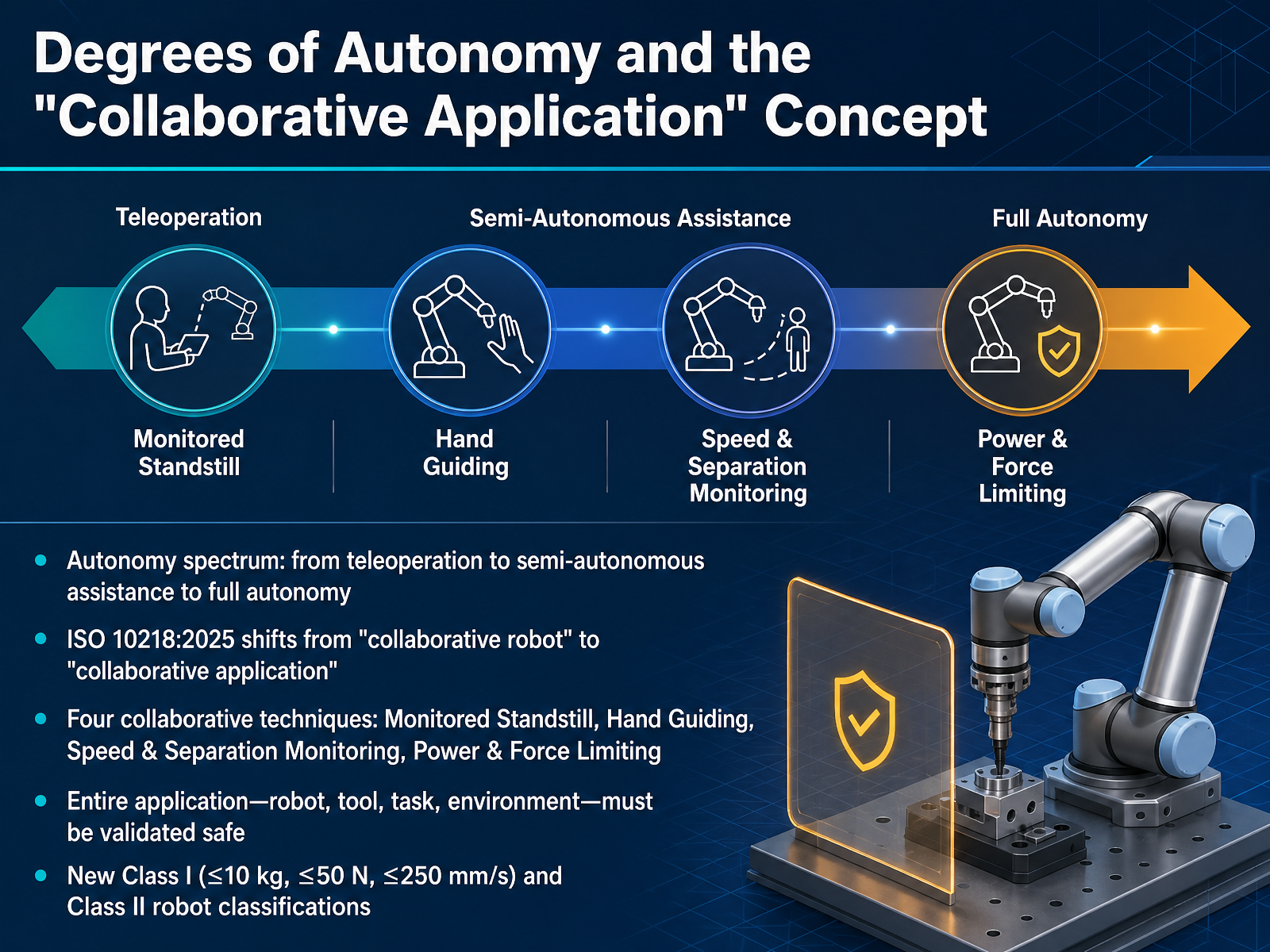
2 min - 09Degrees of Autonomy and the "Collaborative Application" ConceptNow let’s talk about degrees of autonomy and why the industry is shifting to the concept of a collaborative application. Think of autonomy as a spectrum. On one end you have teleoperation, where a person directly controls every move. In the middle you find semi-autonomous assistance, and on the far end you reach full autonomy. The 2025 update to ISO 10218 marks a big change in how we talk about safety. It no longer uses the term collaborative robot. Instead, it focuses on the collaborative application. This means safety isn’t a label on the hardware. It’s a property of the entire system, including the robot, its tool, the task, and the environment working together as a whole. The standard preserves four safety techniques for these applications. You will see safety-rated monitored stop, now often called monitored standstill, hand guiding, speed and separation monitoring, and power and force limiting. For an application to be validated as safe, the entire setup must be tested together. Finally, the standard introduces two robot classes to help integrators choose the right controls. Class one covers smaller, slower robots; think ten kilograms or less, under fifty newtons of force, and under two hundred fifty millimeters per second. Class two covers anything exceeding those limits. Now that we understand the collaboration framework, let’s look at real-world applications in manufacturing and logistics.
 2 min
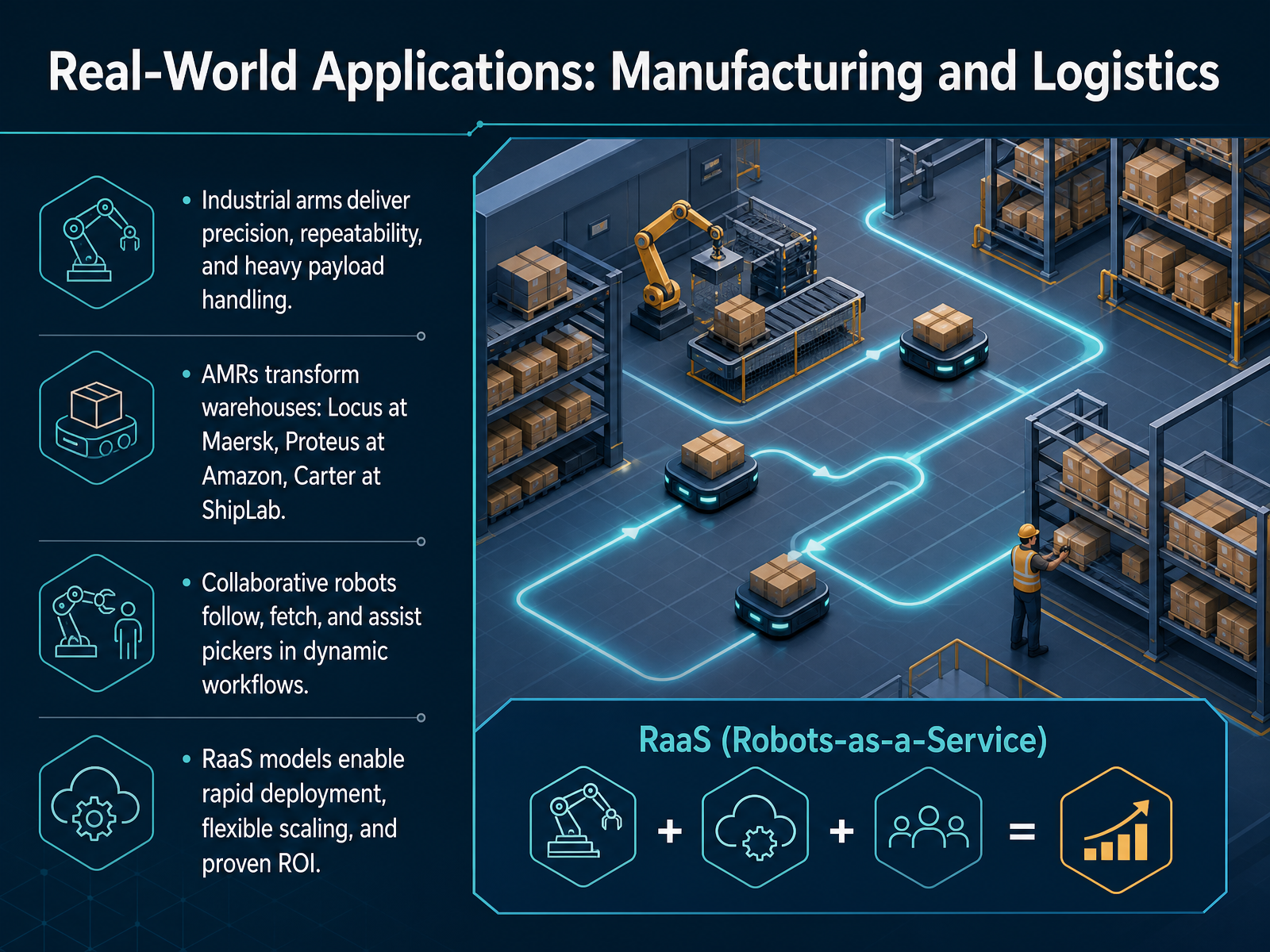
2 min - 10Real-World Applications: Manufacturing and LogisticsNow let's see how these concepts come together in manufacturing and logistics. Industrial robotic arms bring extreme precision and repeatability to assembly lines, and they can safely handle heavy payloads that would be impossible for a person to manage alone. Beyond fixed arms, autonomous mobile robots, or AMRs, are transforming warehouses. For example, Locus Robotics deployed a fleet at Maersk to support Flying Tiger's ecommerce orders, while Amazon's next-generation Proteus robot can now take natural language commands from workers. Another example is Robust.ai's Carter robot, which follows a crawl, walk, run deployment model at ShipLab, letting the team validate performance at each stage before scaling up. These collaborative robots follow, fetch, and assist pickers in dynamic workflows, reducing walking time and letting people focus on higher-value tasks. Many of these systems are available through robotics-as-a-service, or RaaS, models. This means companies can deploy robots quickly, scale up or down with seasonal demand, and reach a proven return on investment without massive upfront capital. Next, we'll explore real-world applications across service, field, and medical robotics.
 2 min
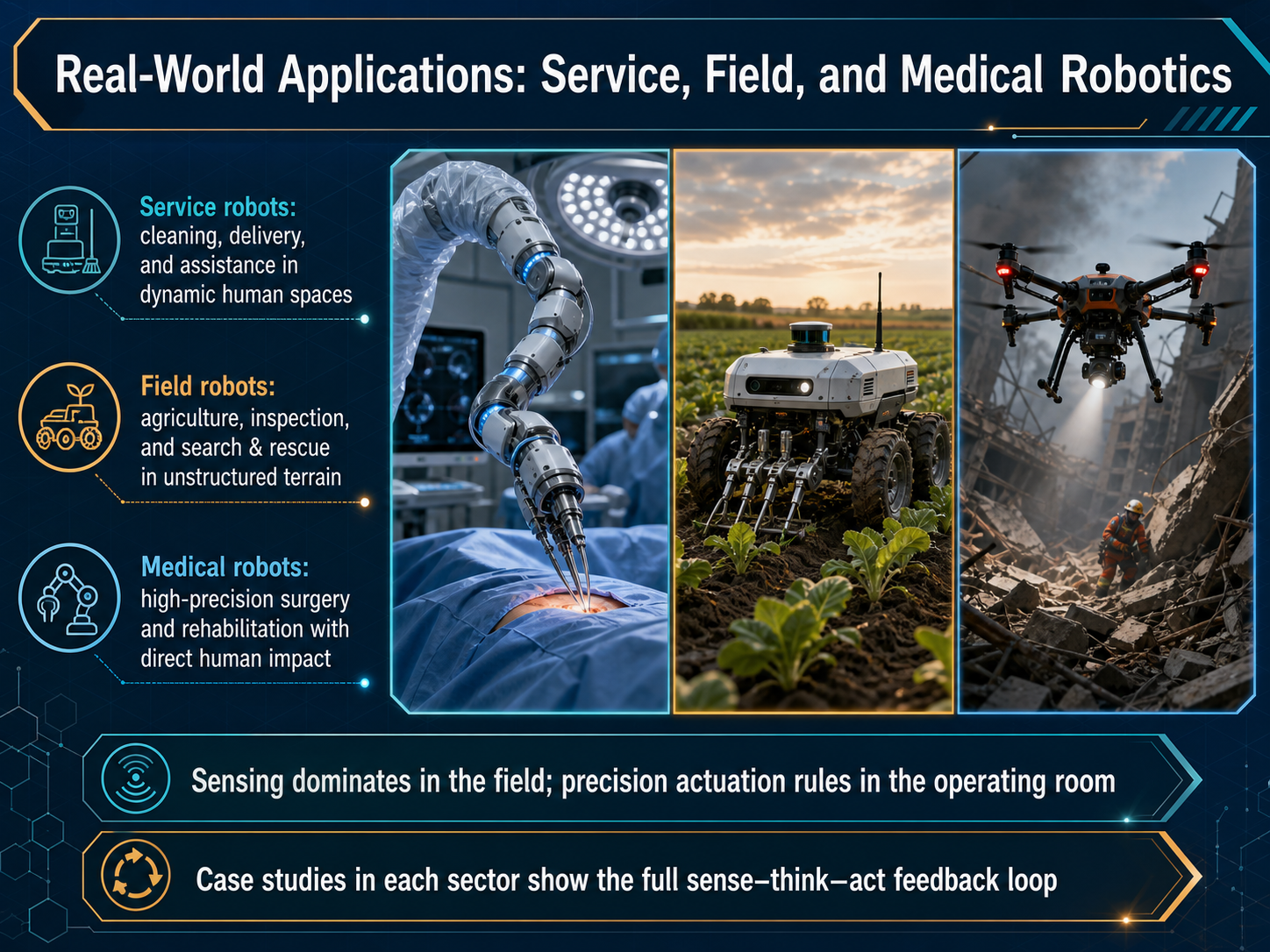
2 min - 11Real-World Applications: Service, Field, and Medical RoboticsNow let’s see how the sense–think–act loop plays out in real systems. Service robots work in busy environments like homes, offices, and hospitals. They sense people and obstacles, decide on safe paths, and move to clean or deliver items. Field robots face very different challenges. On farms, in disaster zones, or inspecting pipelines, they rely heavily on sensing to handle rough terrain, mud, and changing light. The thinking part focuses on navigating without clear maps, and the acting part stays robust even when conditions are unpredictable. Medical robots push precision and safety to the extreme. In surgery, sub-millimeter motions are driven by high-fidelity sensors and strict decision logic, because the execution directly affects human tissue. In rehabilitation, the robot senses a patient’s force and adapts its support in real time. Across all these examples, sensing dominates in the field, while precision actuation rules in the operating room. And every successful machine, whether on a farm or in a surgery suite, closes the same loop: sense, think, act, and feed back. Next, we’ll look at the hard parts—what happens when sensing fails, when decisions are uncertain, and why safety is so difficult to guarantee.
 2 min
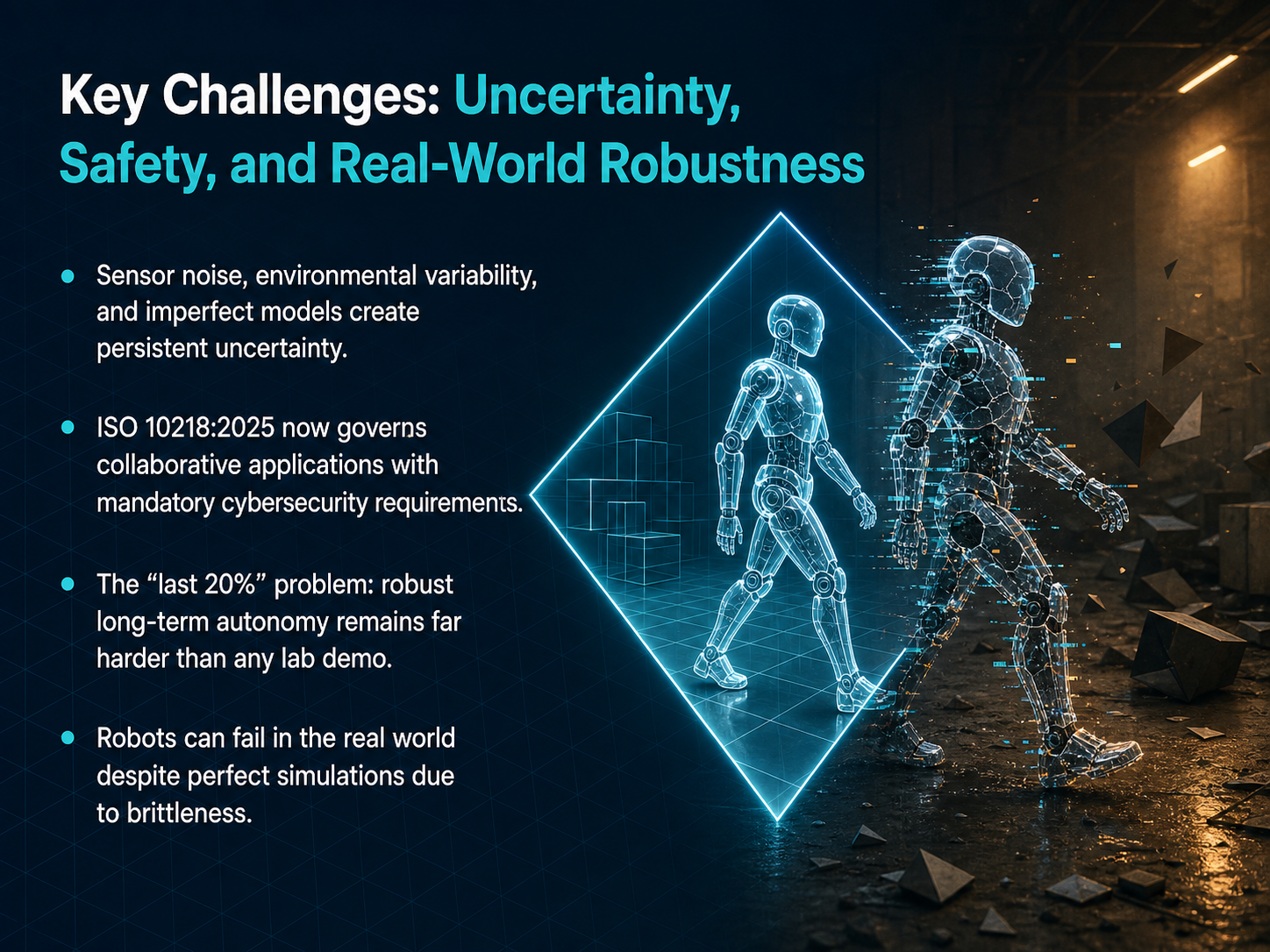
2 min - 12Key Challenges: Uncertainty, Safety, and Real-World RobustnessNow, let’s talk about the hardest parts of real-world robotics. It’s not the flashy demo; it’s the messiness of a factory floor. The first challenge is uncertainty. Sensors can be noisy, lighting changes, and a robot’s internal model is never perfect. A robot is constantly guessing, and that creates risk. The second challenge is safety, tightly connected to new rules. In 2025, the global safety standard ISO 10218 was updated. For the first time, it includes mandatory cybersecurity requirements for collaborative applications. This means safety isn’t just about physical guards anymore; it’s about protecting the software too. Finally, there’s what we call the 'last twenty percent' problem. Getting a robot to work perfectly in a lab is one thing. But building a system that runs reliably for months in the real world—handling every edge case without human rescue—is ten times harder. Many robots fail in the field not because the code is wrong, but because the environment is unpredictable. This brittleness is the core obstacle to long-term autonomy. Next, we’ll explore how a new wave of technology—vision-language-action models and foundation models—aims to solve exactly these problems.
 2 min
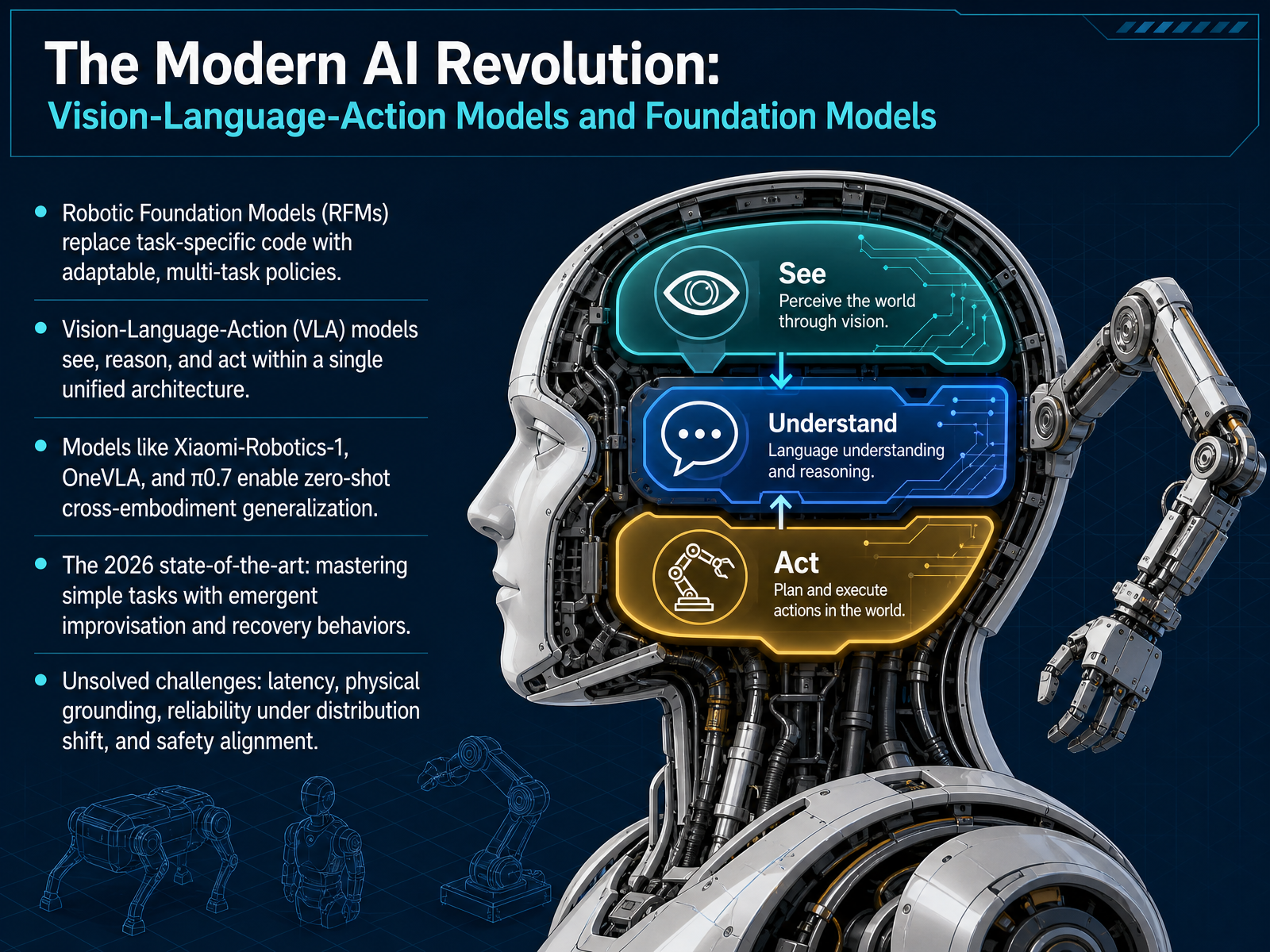
2 min - 13The Modern AI Revolution: Vision-Language-Action Models and Foundation ModelsLet’s move into the modern AI revolution reshaping robotics: vision-language-action models and foundation models. Instead of writing task-specific code for every new job, robotic foundation models learn adaptable, multi-task policies that work across different scenarios. The most advanced approach today is the vision-language-action, or VLA model. These systems see, reason, and act within a single unified architecture. Think of it as moving from separate perception and planning modules to one integrated brain. Leading examples like Xiaomi-Robotics-One, OneVLA, and Pi zero point seven now support zero-shot cross-embodiment generalization—a model trained on one robot can transfer its skills to a completely different body without extra training. By 2026, the state of the art reached mastery of simple physical tasks. We’re seeing emergent improvisation and recovery behaviors: a robot that can shake a bag to settle its contents, or catch a falling object without explicit programming. Still, unsolved challenges remain. Latency limits real-time responsiveness. Physical grounding can break when environments shift. Reliability drops under distribution change. And safety alignment is an open concern—how do we ensure emergent actions never cause harm? Next, we’ll look at the data and simulation flywheel that makes this learning at scale possible.
 arxiv.orgarxiv.orgarxiv.org+22 min
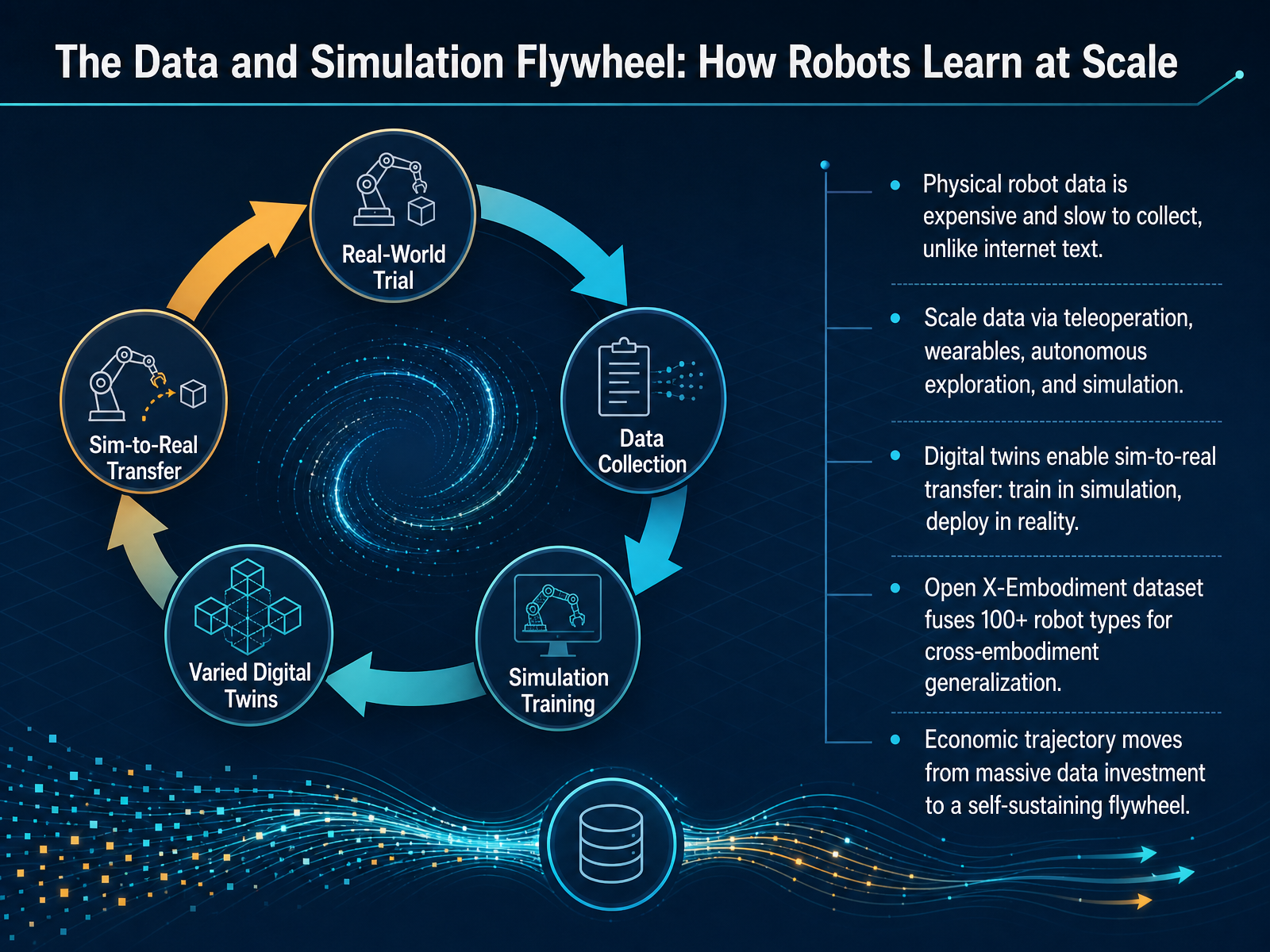
 - 14The Data and Simulation Flywheel: How Robots Learn at ScaleSo far we have explored the closed loop of sense, decide, and act. Now we need to ask: where does all the training data come from? Regular internet text is cheap and plentiful. For robots, collecting physical data is expensive, slow, and sometimes dangerous. This slide looks at the data and simulation flywheel that lets robots learn at scale. Think of it in four layers. First, we scale collection. Instead of one robot trying everything, we use teleoperation, wearable devices, autonomous exploration, and rich simulated worlds. Second, we build digital twins. These are high-fidelity virtual copies of real environments. A robot can practice thousands of times in simulation, then transfer the policy to the real world. That is sim-to-real transfer. Third, we share knowledge across bodies. The Open X-Embodiment dataset already fuses over one hundred robot types. This proves that a model can generalize across different arms, hands, and mobile bases. Finally, the economic flywheel. Early on, we invest heavily in data. Once a capable foundation model exists, it starts generating better data itself. Deployment improves the model, which improves deployment. Over time, this becomes a self-sustaining loop. Keep this flywheel in mind. It sets the stage for how the whole field scales in the next few years.
 2 min
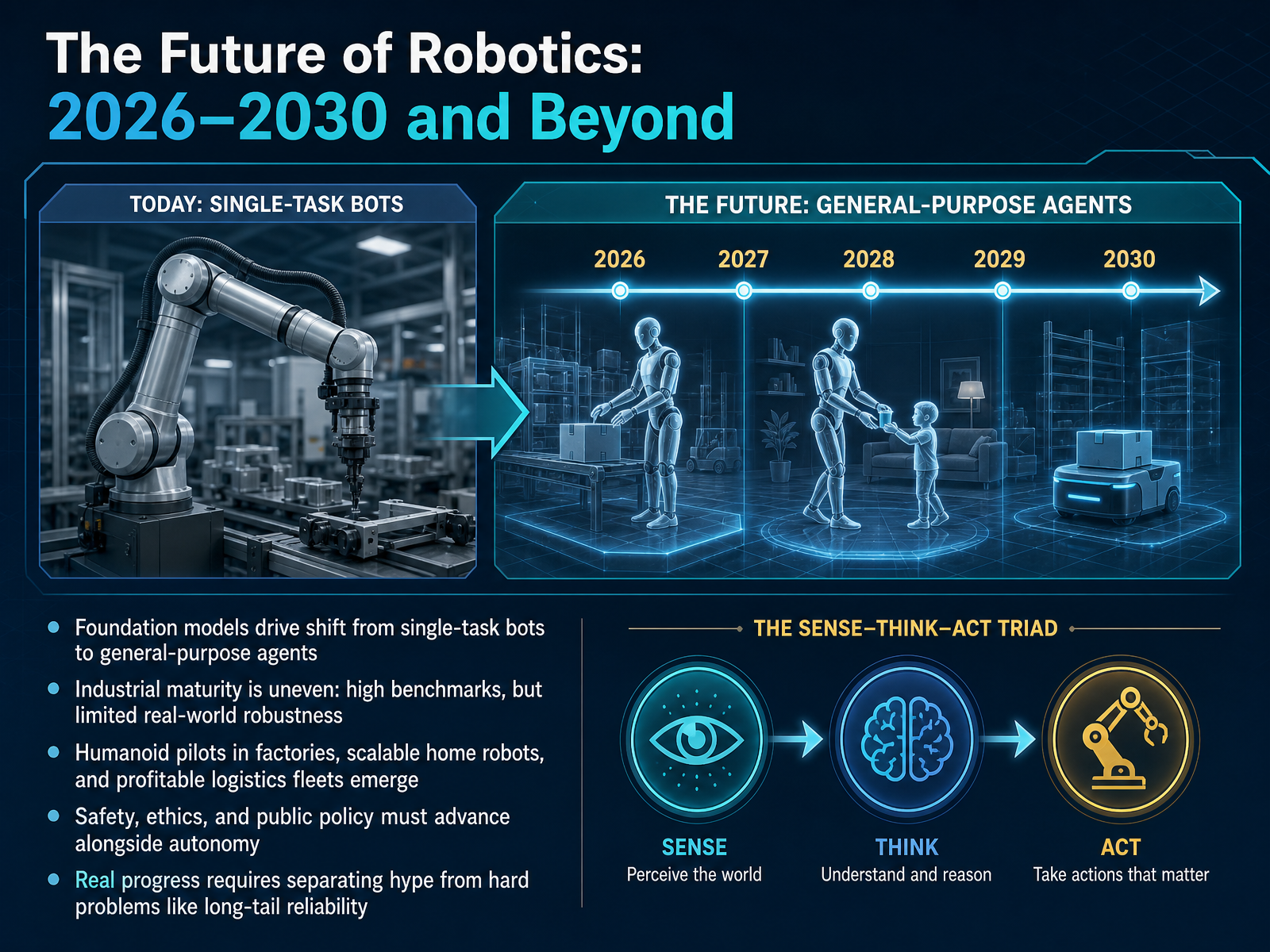
2 min - 15The Future of Robotics: 2026–2030 and BeyondLet’s look ahead to the near horizon, from 2026 to 2030 and beyond. The big story is a shift in how robots are built. Instead of training one model per task, we’re moving toward foundation models: large, general-purpose systems that can handle many different jobs in many different settings. This promise is real, but industrial maturity is still uneven. Some robots hit impressive benchmarks in the lab, yet stumble when faced with the messy, unstructured conditions of a real factory floor. That’s why we’re seeing humanoid pilots cautiously step into factories, and why scalable home robots and profitable logistics fleets are just starting to emerge. As this happens, safety, ethics, and public policy must keep pace with increasing autonomy. A robot that can improvise is exciting, but we need guardrails to ensure those improvisations are safe and aligned with what people actually want. The key takeaway is this: real progress means separating the hype from the genuinely hard problems, especially long-tail reliability—handling all the rare edge cases that don’t appear in training data but matter deeply in the real world. Now, let’s bring everything together in your learning roadmap: Next Steps in Robotics.
 2 min
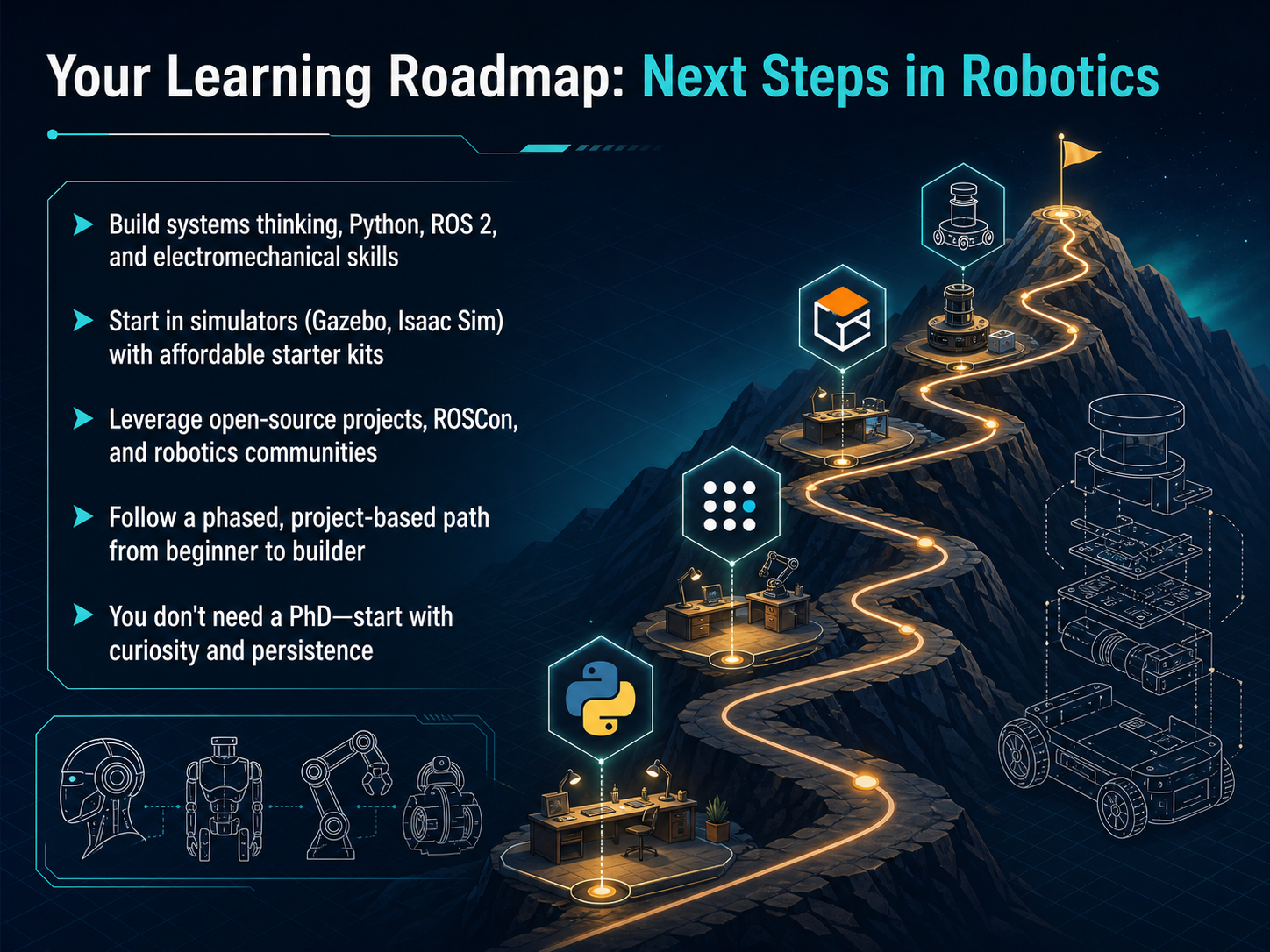
2 min - 16Your Learning Roadmap: Next Steps in RoboticsSo where do you go from here? Let's map out your next steps in robotics. First, build a strong foundation. Focus on systems thinking, coding in Python, learning the Robot Operating System version two, and getting comfortable with basic electronics and motors. A great way to start is inside a simulator like Gazebo or Isaac Sim. Pair that practice with an affordable starter kit to bring your code into the physical world. You don't have to figure this out alone. Dive into open-source projects, attend events like ROSCon, and join online robotics communities. The best path is a phased, project-based one. You might start by making an LED blink, then move to a wheeled robot, and later add a camera and sensors. And here is the most important takeaway. You do not need a PhD to be a roboticist. You need curiosity, and you need persistence. That combination is what turns a beginner into a builder. Thank you for joining this introduction. Your journey in robotics starts right now, and I cannot wait to see what you create.
 2 min
2 min
Take the deck with you
Download this course as a file — free, no sign-up needed.
- PDF handoutEvery slide page, ready to print or share.17 pages · 5.5 MBDownload
- Narrated PowerPointThe deck that presents itself — every slide carries the digital human's narration video.17 pages · 21.2 MBDownload
- PowerPoint slidesThe full deck as a .pptx — open it in PowerPoint, Keynote, or Google Slides.17 pages · 5.4 MBDownload
Free to use in your own training — please keep the PersonWise credit page at the end.
Have your own deck? Turn it into a course
Sources consulted
Web sources consulted while building this course.
- ISO/DIS 8373 - Robotics — Vocabulary — iso.org
- ISO 8373:2021 - Robotics — Vocabulary — iso.org
- Robot definitions at ISO — ifr.org
- Robotics – Vocabulary — singaporestandardseshop.sg
- Singapore Standards — singaporestandardseshop.sg
- Robotic Sensors Market Size, Share | Growth Report Forecast 2026-2031 — mordorintelligence.com
- LiDAR Price vs Performance in 2026: A Deep Technical and Commercial Analysis for Autonomous Driving, Robotics, and Industrial Applications — lidarseek.com
- Robotic Sensors Market in the United States | Report - IndexBox - Prices, Size, Forecast, and Companies — indexbox.io
- The Sub-RMB-1500 Inflection: 2026 Deep Research Report on China LiDAR Industry Market Size and Competitive Landscape — Tianxia Gongchang Research — faxiangongchang.com
- Lidar Sensor Modules Market in the World | Report - IndexBox - Prices, Size, Forecast, and Companies — indexbox.io
- Xiaomi-Robotics-1: Scaling Vision-Language-Action ... — arxiv.org
- Exploratory, Communicative, and Deployable: Vision-Driven Embodied Agents for Open-World Mobile Manipulation — arxiv.org
- https://arxiv.org/pdf/2602.08537 — arxiv.org
- InternRobotics/REAL — github.com
- SG-VLA: Learning Spatially-Grounded Vision-Language-Action Models for Mobile Manipulation | alphaXiv — alphaxiv.org
- A Light-Weight Quasi-Direct Drive Collaborative Robot Arm — doi.org
- JeongSeoJin/quasi-direct-drive-actuator — github.com
- The Backdrivable Joint Revolution: A Technical Audit of Quasi-Direct Drive Motors in Humanoid Robotics - RobotWale — robotwale.com
- Robot Actuator Development: Complete Engineering Toolchain — zanerobotics.substack.com
- [1904.03815] Quasi-Direct Drive for Low-Cost Compliant Robotic Manipulation — ar5iv.labs.arxiv.org