Begin
14 pages · ~28 min
Responsible AI Key Principles
Learn key principles of responsible AI, including types, patterns, and real-world examples, to build ethical and trustworthy AI systems.
A digital instructor presents all 14 pages. Hold “Ask” at any point and ask out loud — the answer comes from this course. No sign-up needed.
What you’ll learn
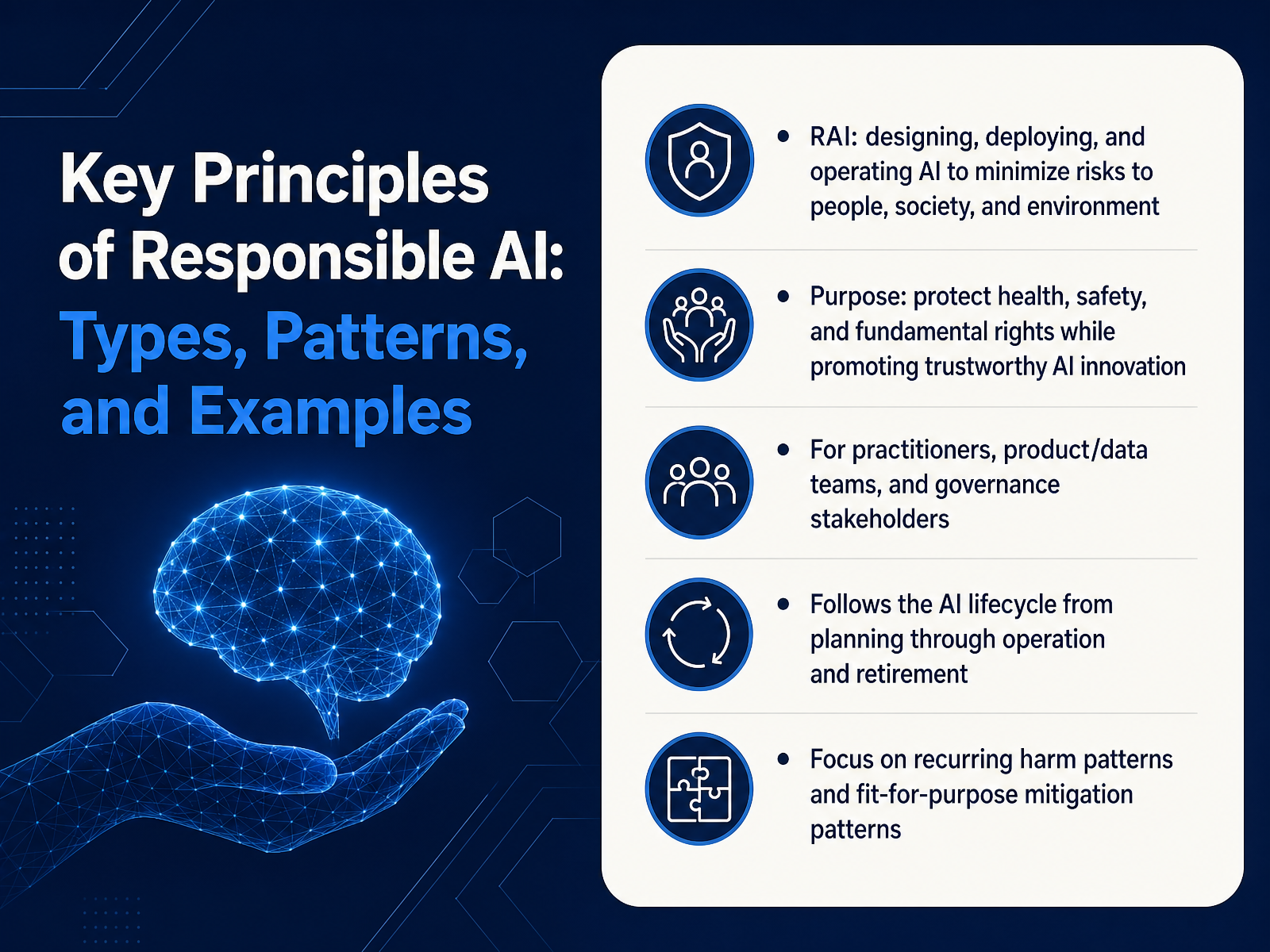
- 01Key Principles of Responsible AI: Types, Patterns, and ExamplesWelcome. In this course, we take a practitioner's view of responsible AI. That means moving beyond definitions and into the patterns you can actually apply when building, reviewing, or governing a system. We define responsible AI as designing, deploying, and operating systems to minimize risk to people, society, and the environment. The goal is not to slow innovation. The goal is to protect health, safety, and fundamental rights while building AI that earns trust. This material is built for practitioners, product and data teams, and governance stakeholders. We follow the full AI lifecycle, from planning and data work through deployment, operation, and retirement. Instead of abstract principles, we focus on recurring harm patterns, such as biased outputs or missing human oversight, and on fit-for-purpose mitigation patterns. That means you can take what you learn here and map it directly to your own model reviews, risk assessments, and control decisions. Before we go deeper, let's look at why this has become a business and regulatory priority in the next slide, Why Responsible AI Matters Now.eur-lex.europa.euhai.stanford.eduoecd.org+21 min
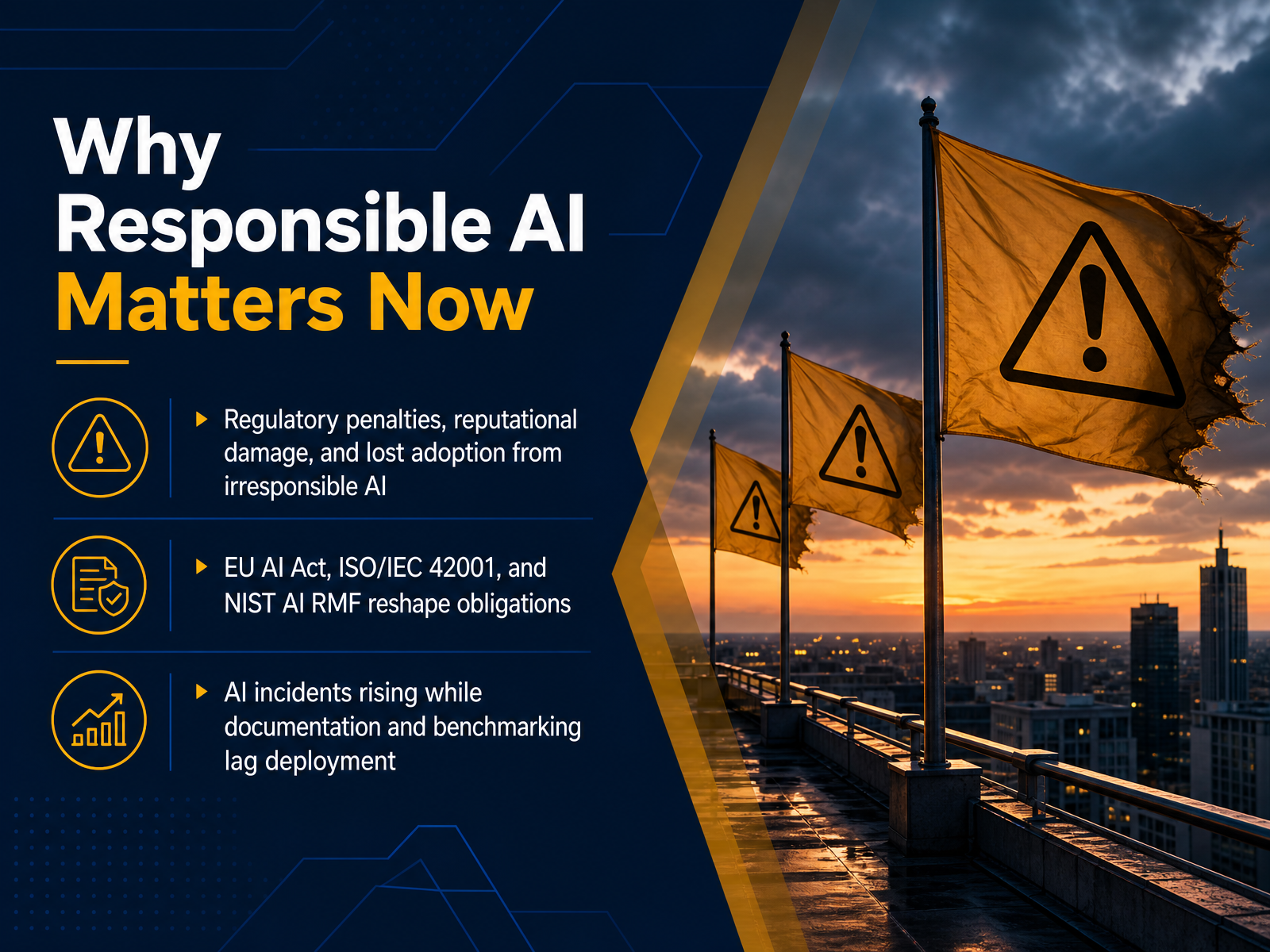
- 02Why Responsible AI Matters NowLet's look at why responsible AI has shifted from a values discussion to a hard operational requirement. Three forces are converging right now. First, the cost of failure is rising. Regulatory penalties now reach seven percent of global annual turnover under the EU AI Act, and that's before factoring in reputational damage or lost customer adoption. Second, the obligations themselves are becoming more concrete. The EU AI Act, ISO IEC 42001, and the NIST AI Risk Management Framework are no longer abstract references. They define specific duties around risk management, documentation, logging, and human oversight. Third, and most critically, the gap between deployment speed and governance readiness is widening. AI incidents are increasing, but documentation, benchmarking, and continuous monitoring still lag behind what's already in production. That mismatch is where avoidable risk accumulates. So the question is not whether your team should engage with responsible AI. It's how quickly you can translate these obligations into operational practice. That's exactly what we'll cover next, starting with the core principles of responsible AI.
 oecd.orgfuturium.ec.europa.eueur-lex.europa.eu+21 min
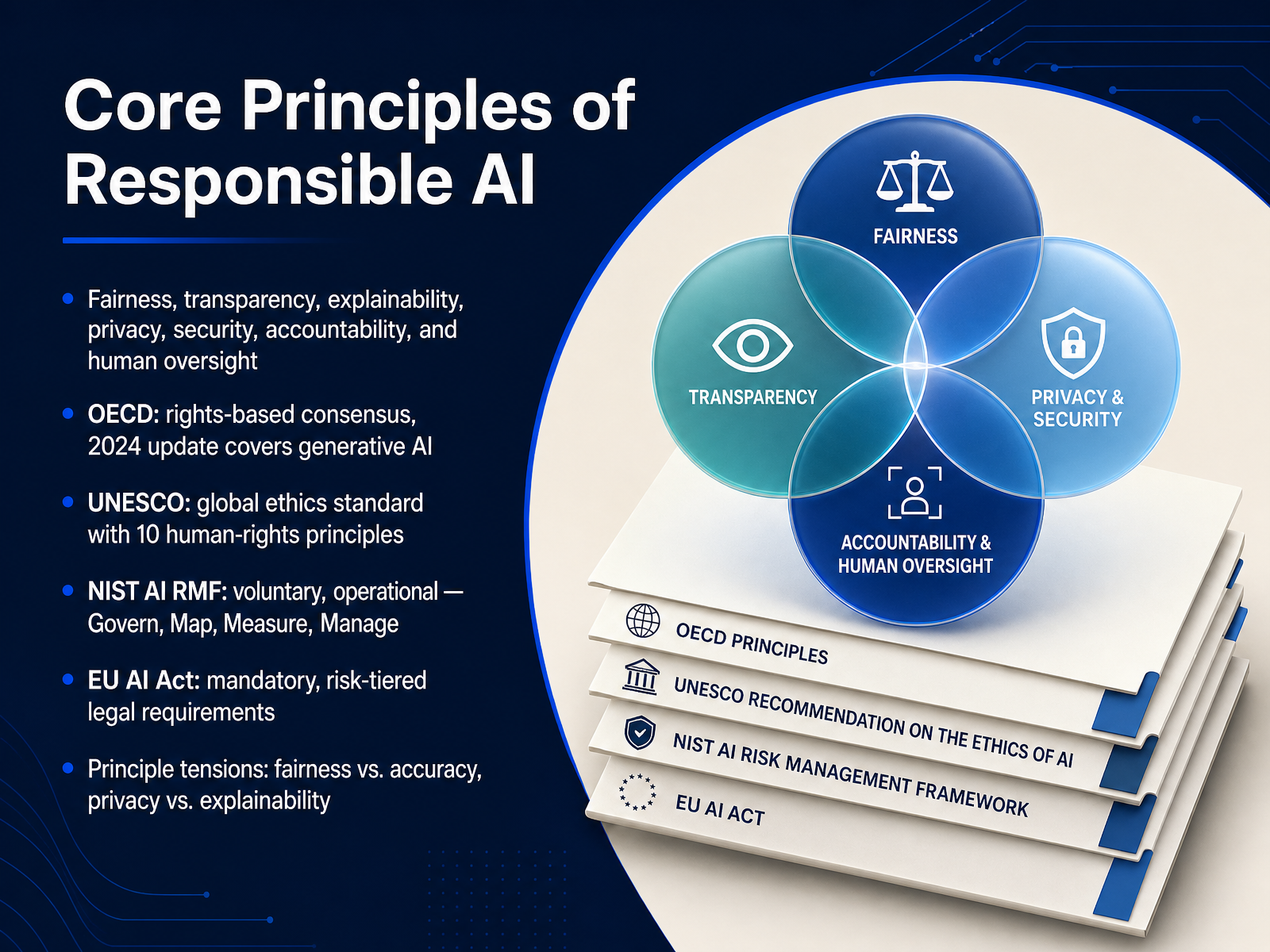
 - 03Core Principles of Responsible AIThe core principles begin with the familiar set, fairness, transparency, explainability, privacy, security, accountability, and human oversight. Think of these as the shared vocabulary. Now the real work is turning them into operations. OECD gives us a rights-based consensus. The twenty twenty four update extends that language to generative AI. UNESCO offers a global ethics standard built on ten human rights principles. The NIST AI Risk Management Framework is voluntary and operational. Its four functions are Govern, Map, Measure, and Manage. The EU AI Act is different. It is mandatory, with risk tiered legal requirements. You must classify each system and meet the controls for that tier. Finally, expect tensions. Fairness may trade off against accuracy. Privacy can conflict with explainability. Define and document those tradeoffs early. This is not about avoiding tension, it is about governing it. Next, we will look at types of responsible AI issues across the lifecycle.
 link.springer.compublishing.emanresearch.orglexology.com+22 min
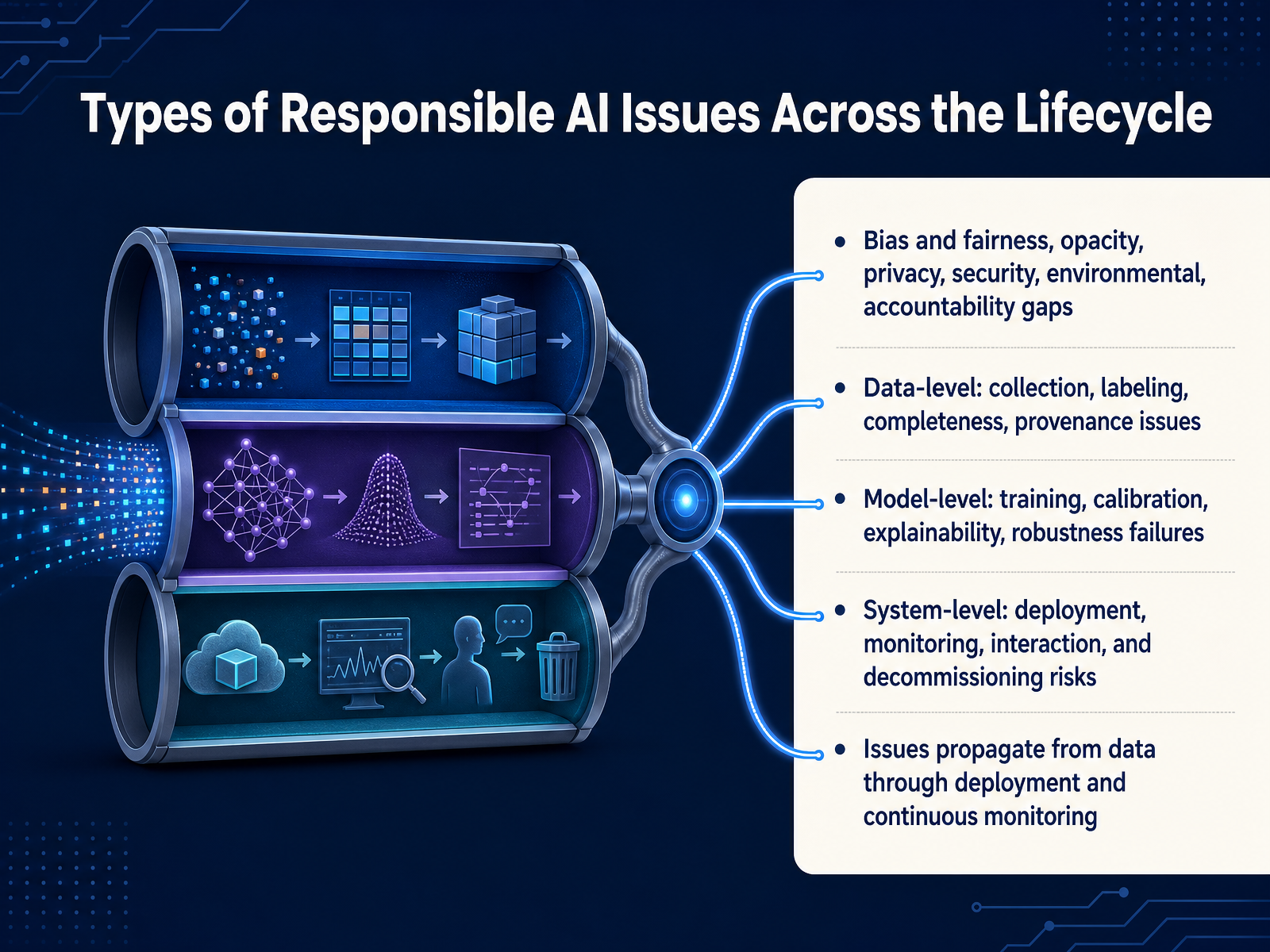
 - 04Types of Responsible AI Issues Across the LifecycleNow let's look at where responsible AI issues actually appear across the system lifecycle. We can group them into data-level, model-level, and system-level risk categories. At the data level, watch for collection bias, labeling errors, incomplete records, and missing provenance. These issues silently poison everything downstream. At the model level, focus on training instability, poor calibration, weak explainability, and robustness failures under distribution shift. At the system level, examine deployment mismatches, monitoring gaps, interaction failures, and decommissioning risks. The key insight is propagation. A labeling gap in training data becomes a calibration failure in the model, which becomes a harmful output in production. So define your risk checks at each layer, test before promotion, and document where each issue was first introduced. That is the only reliable way to trace harm back to its root cause. Next, we will examine the common patterns of responsible AI harm that emerge from these lifecycle issues.
 nvlpubs.nist.govedps.europa.euoecd.org+21 min
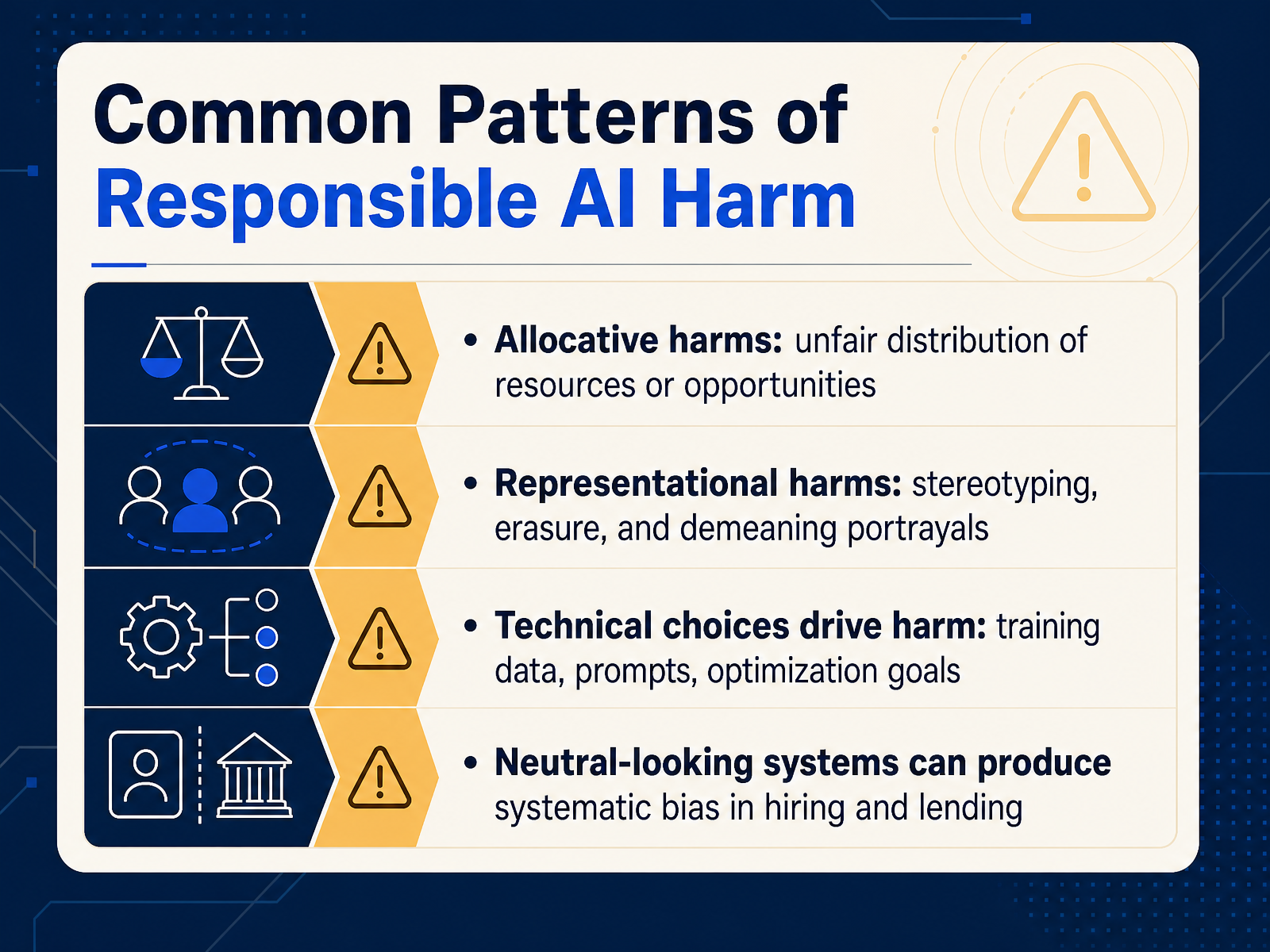
 - 05Common Patterns of Responsible AI HarmNow let's translate those principles into the harm patterns you will actually encounter in the field. We can group these harms into two broad categories. Allocative harms happen when a system unfairly distributes resources or opportunities. Think about a screening model that systematically downranks qualified candidates from a specific background, or a lending model that denies credit along demographic lines. Representational harms are different. These involve stereotyping, erasure, or demeaning portrayals of social groups. For example, a language model might default to one-dimensional narratives about certain nationalities, or a translation system might consistently assign male pronouns to doctors and female pronouns to nurses. Pay close attention to where these harms originate. They are not accidents. They stem from concrete technical choices, such as which training data you select, how you write your system prompts, and what you set as your optimization goal. Even a system that looks neutral on the surface can produce systematic bias in hiring and lending. So your job is to identify the underlying pattern before deploying. That means auditing for both allocation and representation, and tracing them back to the technical decisions that created them. Let's build on this by looking at the design patterns that actually prevent these harms.
 donets.orgeprints.illc.uva.nl2 min
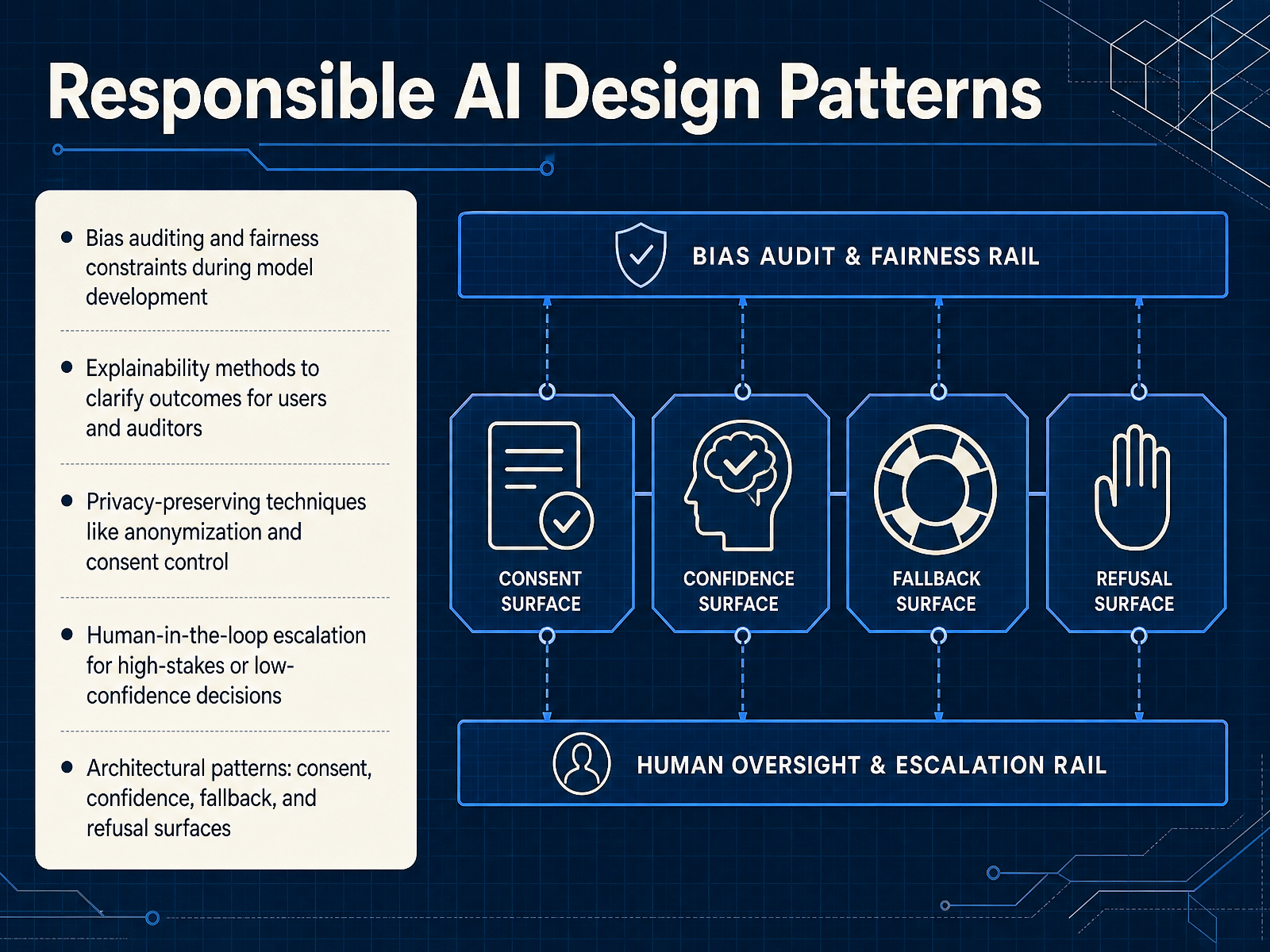
 - 06Responsible AI Design PatternsLet’s turn those principles into concrete design patterns you can implement. Start with bias auditing during development. Define fairness constraints early, test across groups, and monitor for drift after deployment. Next, build explanation surfaces for both users and auditors. A decision trace should show what data and factors drove the output, not just a technical plot. Make explanations actionable, so a user can correct an error or contest a result. For privacy, apply anonymization and pseudonymization before data leaves your system. Document consent flows and minimize retention. Then design human escalation as a first-class capability, not a failure fallback. Define clear criteria like low confidence, high stakes, or regulatory requirement. Your review interface should show the input, the model output, and the reasoning trace. Finally, treat architectural surfaces as a pattern language. Consent surfaces tell users what data is used and why. Confidence surfaces expose uncertainty when it matters. Fallback and refusal surfaces handle cases where the model should not answer. A system that never refuses either has no policy or is violating one. These patterns reinforce each other. Consented data underwrites everything else, confidence feeds escalation, and explanation is required at both refusal and low-confidence review. Next, we’ll see how these patterns work in real deployments across hiring, credit, healthcare, and public services.
 2 min
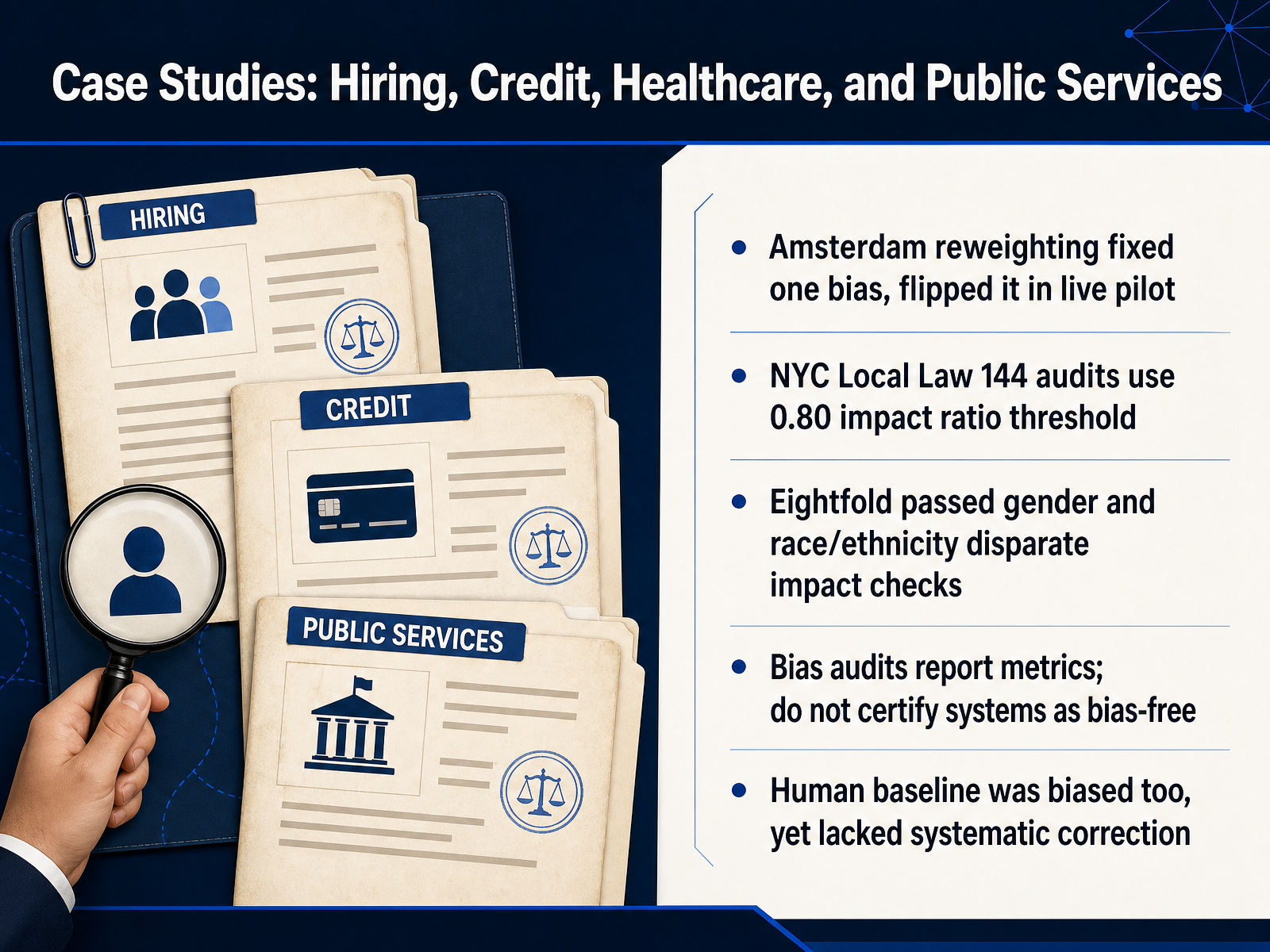
2 min - 07Case Studies: Hiring, Credit, Healthcare, and Public ServicesLet's ground these principles in real deployments. Amsterdam's welfare screening offers a critical lesson. The team used training-data reweighting to correct initial bias against migrants and men. It worked in testing. But in the live pilot, the bias inverted, now disproportionately flagging Dutch applicants and women. One fix did not create a fair system. In New York City, Local Law 144 audits apply a clear metric: an impact ratio of point eighty. Eightfold's independent audit showed all gender and race or ethnicity groups passed above that threshold. Yet these audits report metrics. They do not certify a system as bias-free. A crucial comparison came from Amsterdam's own analysis. Human caseworkers were also biased, but their bias lacked any systematic correction loop. The responsible AI standard is higher, and that is the point. Next, we will move from case studies to operationalizing responsible AI across the lifecycle.
 1 min
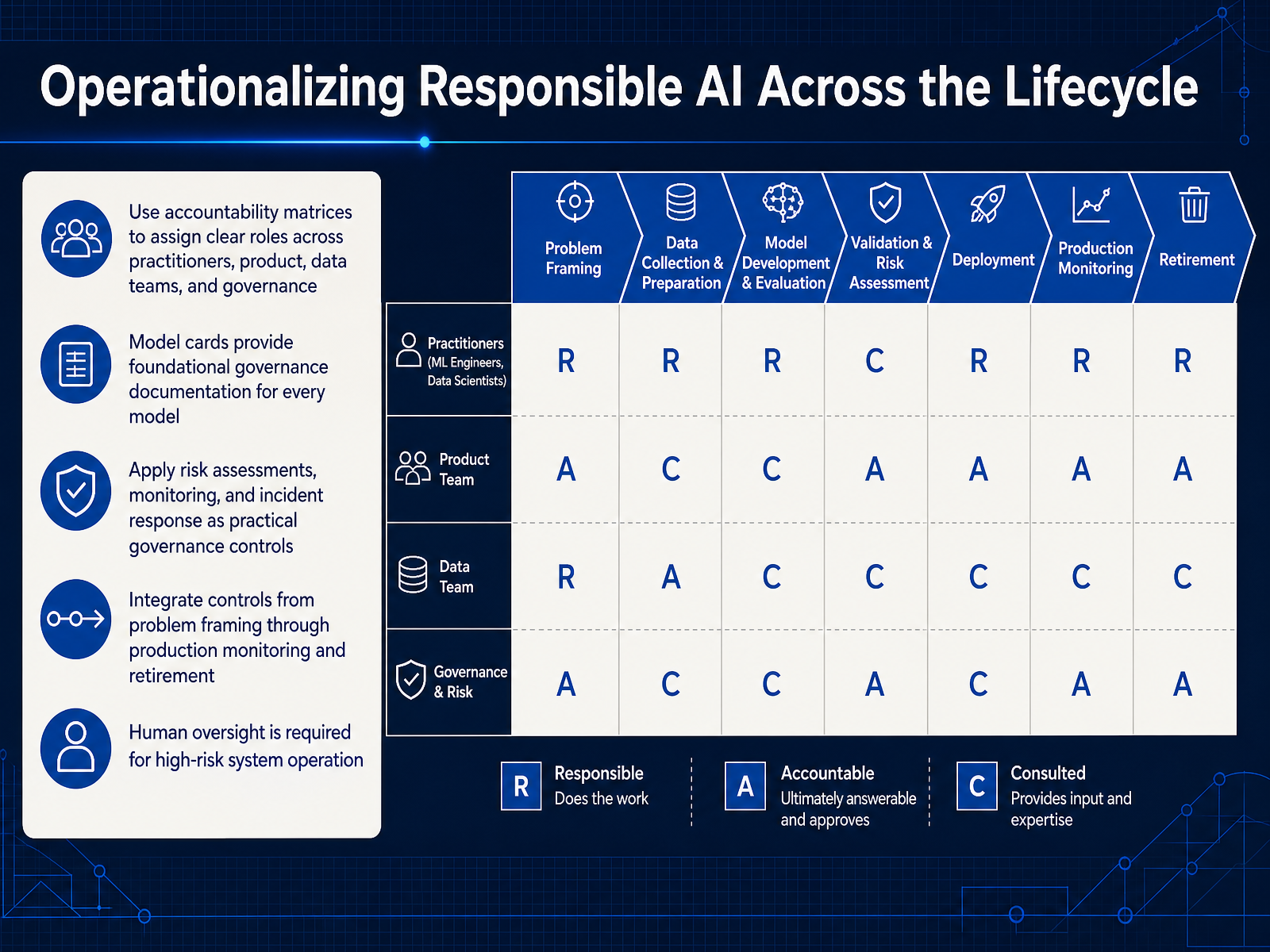
1 min - 08Operationalizing Responsible AI Across the LifecycleMoving from definitions to practice, this slide addresses how to operationalize responsible AI across the entire life cycle. Start by defining accountability. Use matrices to assign clear roles for practitioners, product teams, data owners, and governance stakeholders. Without named owners, oversight stalls. Next, document every model with a model card. Model cards serve as the foundational governance artifact, capturing purpose, data sources, performance thresholds, known limitations, risk tier, and approval history. They create the audit trail that downstream oversight depends on. Then, apply practical governance controls. Conduct risk assessments before deployment, establish continuous monitoring for drift, and maintain a formal incident response plan. Integrate these controls from problem framing through production monitoring and eventual retirement. Silent decommissioning without documentation is not governance. Finally, require human oversight for high-risk system operation. Automated checks support governance, but a human must remain accountable for consequential decisions. In short, move from principles to executable structure: assign owners, document artifacts, monitor performance, and plan for incidents. Up next, we will examine metrics, assessment, and the trade-offs involved.
 oecd.org1 min
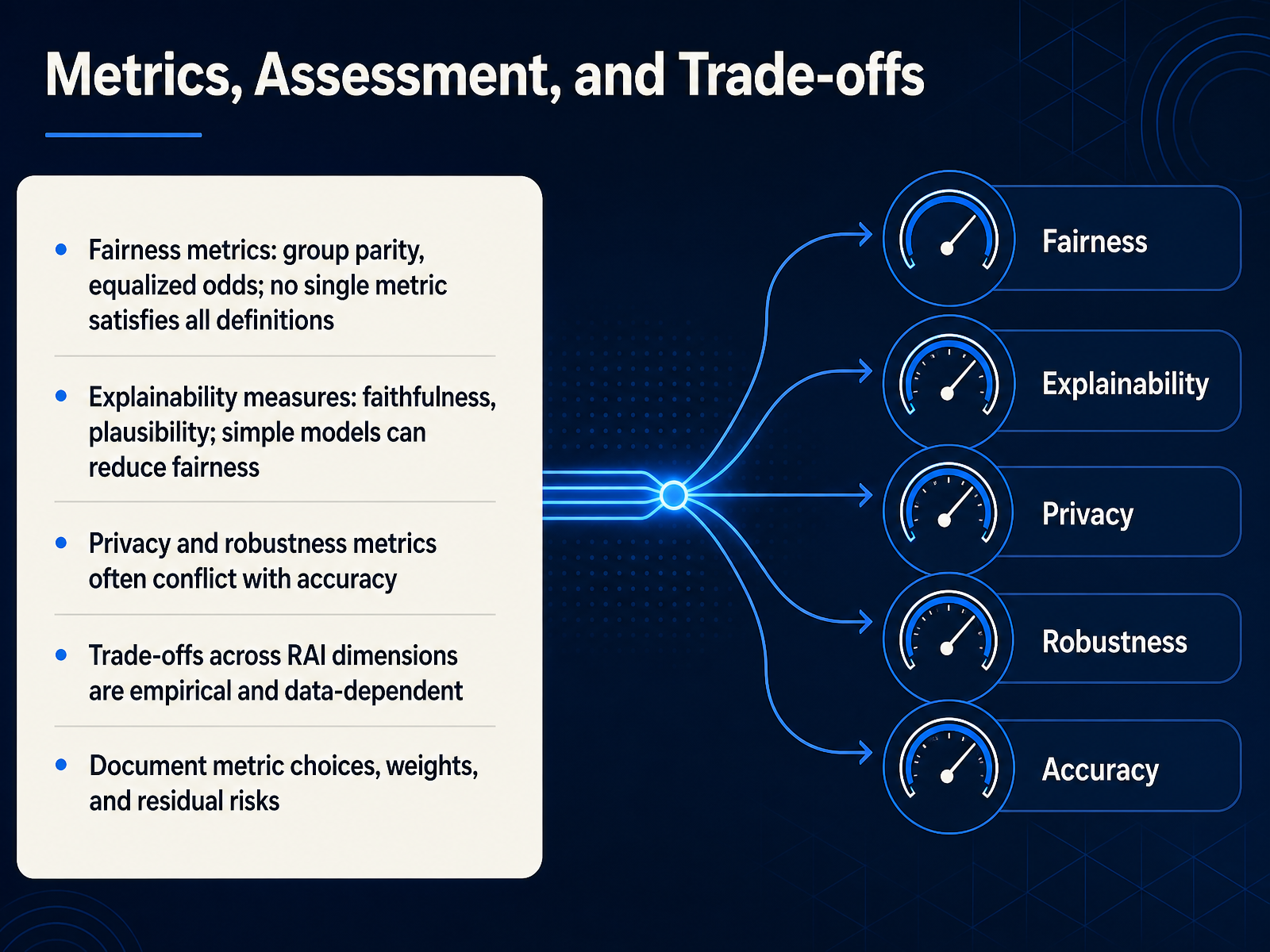
 - 09Metrics, Assessment, and Trade-offsLet's turn to the practical work of measuring what we claim to build. When we talk about fairness, there is no single metric that settles the question. Group parity and equalized odds encode different definitions of what fairness means, and they can point in opposite directions on the same model. That is not a flaw in your measurement stack. It is a signal that fairness is plural. Pick the metric that matches your policy objective, then hold yourself to it. Explainability has the same character. Faithfulness asks whether an explanation tracks what the model actually computes. Plausibility asks whether a human finds that explanation convincing. Those are different questions. And be careful here. Simplifying a model to make it easier to explain can accidentally reduce fairness, especially when the simplification merges subgroups that should remain distinct. The same pattern shows up with privacy and robustness. Stronger privacy protections often cost accuracy. Stronger adversarial robustness can reduce transparency. These trade-offs are not theoretical. They are empirical and they shift with your data and your deployment context. So treat them as design decisions. Document the metrics you chose, the weights you assigned, and the residual risks you accepted. That record is what makes the trade-off defensible.
 1 min
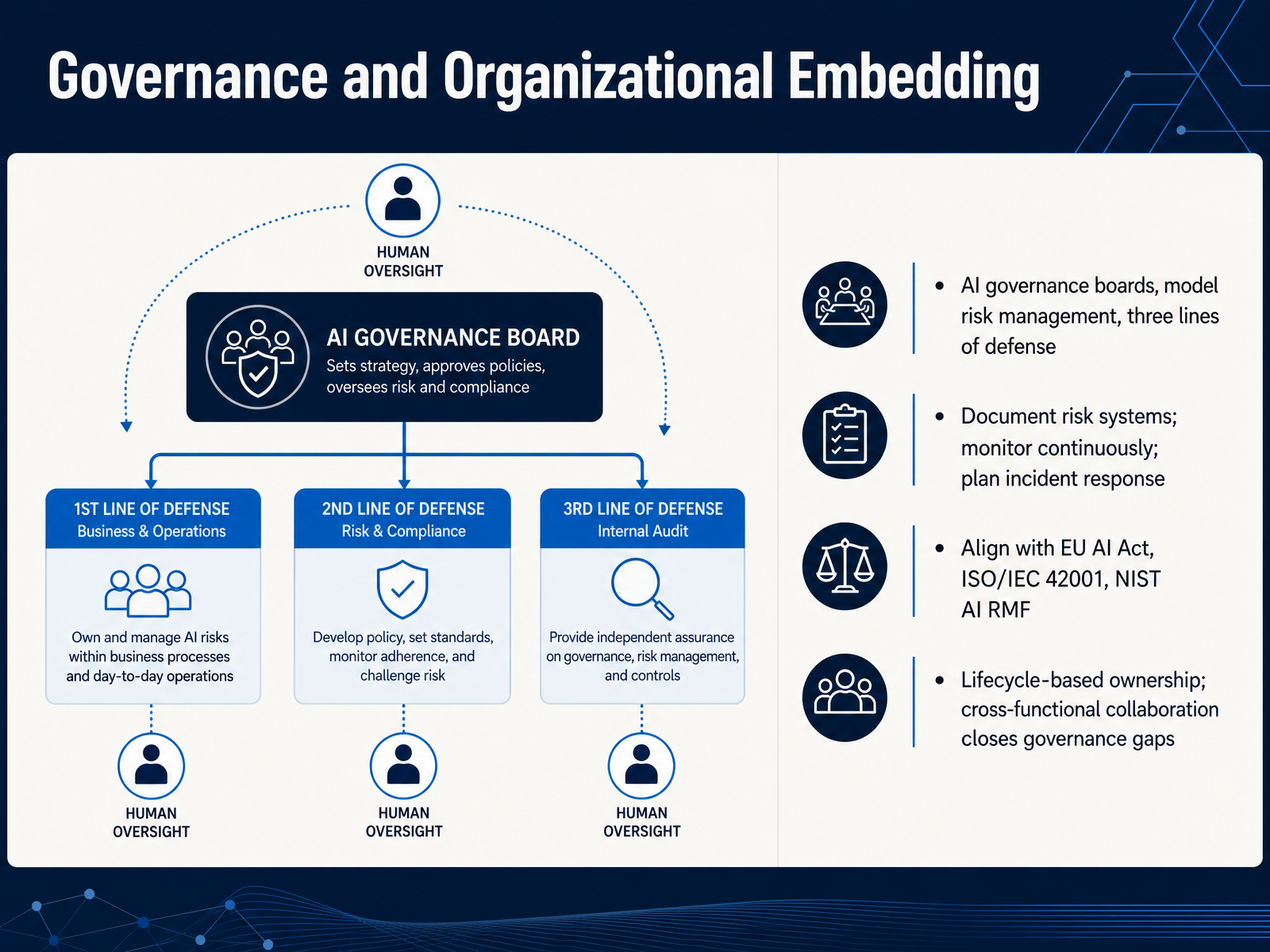
1 min - 10Governance and Organizational EmbeddingGovernance only works when it is embedded into how your organization already operates. That means moving from policy documents to actual structures. Most mature programs rely on three layers. First, an AI governance board sets risk appetite and resolves cross-functional disputes. Second, model risk management applies existing model validation disciplines to AI systems. And third, the three lines of defense clarify who owns the risk. Business and data teams manage daily risks. Compliance and risk functions provide challenge and oversight. Internal audit gives independent assurance. Now operationalize these structures. Document each system's risk tier, intended use, and known limitations. Monitor performance continuously. Drift below approved thresholds should trigger a documented decision, not just another retraining ticket. And every team needs a rehearsed incident response plan. Align your evidence package with recognized standards. The EU AI Act requires high-risk systems to maintain continuous risk management and logging. ISO IEC forty-two zero zero one provides a certifiable management system. And the NIST AI RMF offers a voluntary but widely referenced map of govern, map, measure, and manage functions. The key is lifecycle-based ownership. A model is governed from intake and documentation through deployment, monitoring, and formal retirement. Cross-functional collaboration is what closes the gaps between engineering, legal, and risk. When ownership is clear at every phase, governance becomes part of the build, not a gate at the end. Next, we turn to a practical checklist to evaluate and improve your existing AI systems.
 oecd.org2 min
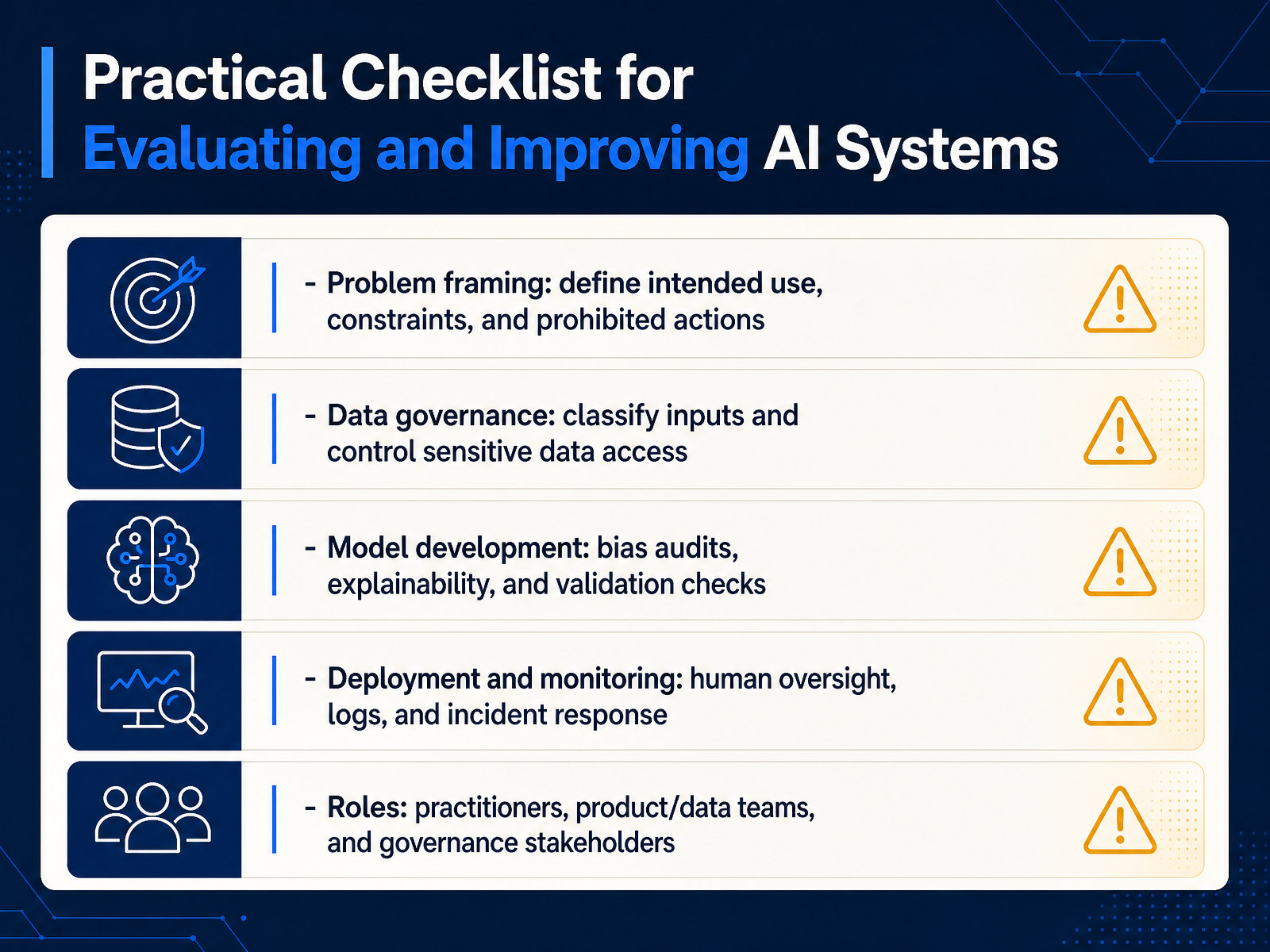
 - 11Practical Checklist for Evaluating and Improving AI SystemsLet's turn this into a working checklist you can apply immediately. Start with problem framing. Define the intended use, explicit constraints, and prohibited actions before building anything. Next, move to data governance. Classify your inputs and restrict sensitive data access at the permission level, not just in policy documents. In model development, run bias audits, validate explainability, and enforce structured validation checks. Then, deployment and monitoring. That means documented human oversight, continuous logging, and a tested incident response procedure, not one you write after something fails. Across all of this, ownership matters. Practitioners execute the checks. Product and data teams own the workflows. Governance stakeholders set thresholds and review evidence. Treat this as an operational baseline, not a one-time exercise. Next, let's map these responsibilities to organizational roles and next steps.
 2 min
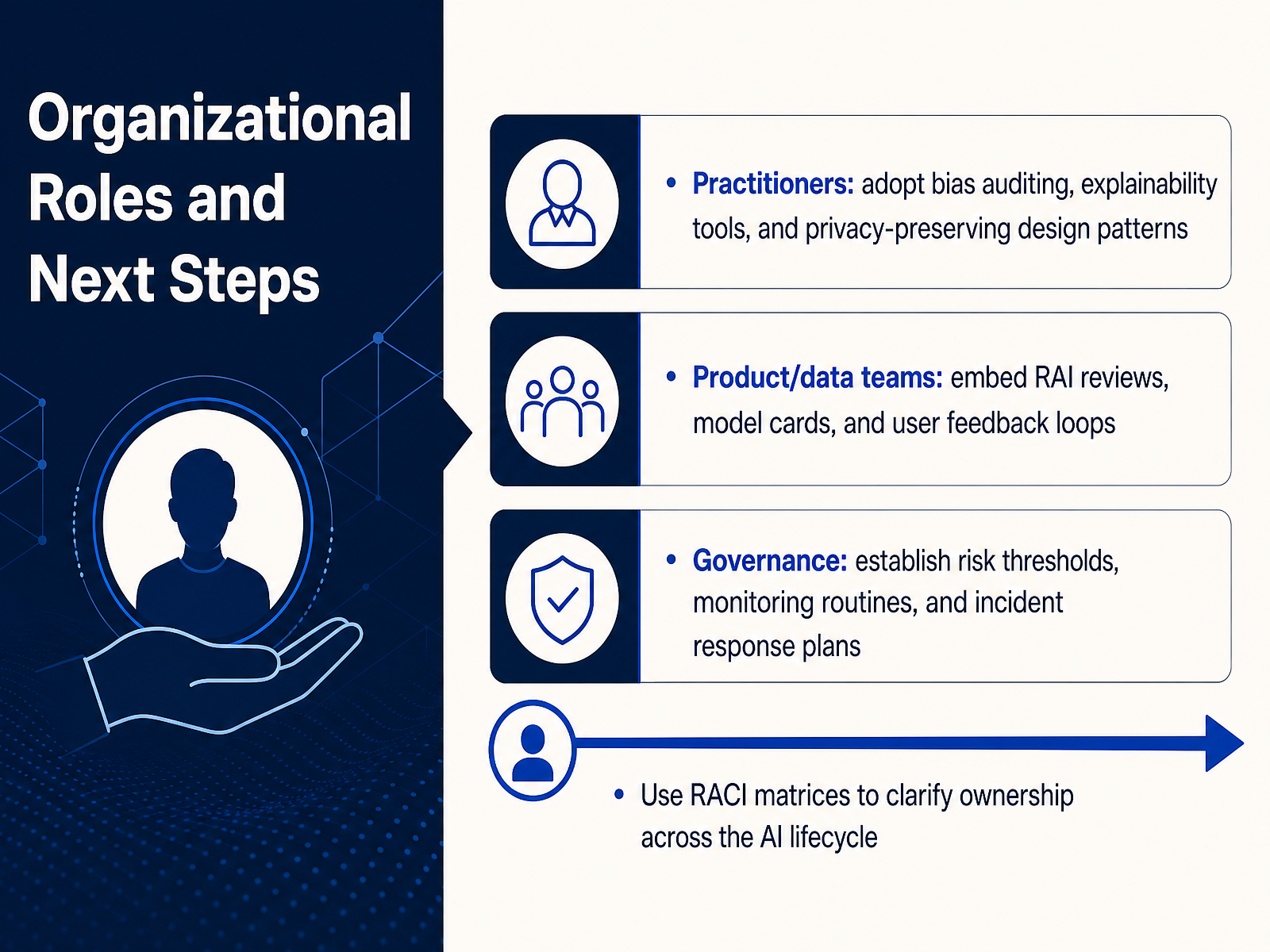
2 min - 12Organizational Roles and Next StepsLet's turn this into concrete ownership. Practitioners should adopt bias auditing, explainability tools, and privacy-preserving design patterns as part of their standard workflow. Product and data teams need to embed responsible AI reviews, model cards, and user feedback loops directly into the development cycle. Governance stakeholders must establish clear risk thresholds, ongoing monitoring routines, and tested incident response plans. Use a RACI matrix to clarify who is responsible, accountable, consulted, and informed across the AI lifecycle. This eliminates ambiguity about who owns what, especially where handoffs occur between data, modeling, and deployment teams. Document these assignments as living artifacts, not one-time exercises, so ownership stays clear as systems evolve. Next, we'll explore continuing your responsible AI journey.
 oecd.org1 min
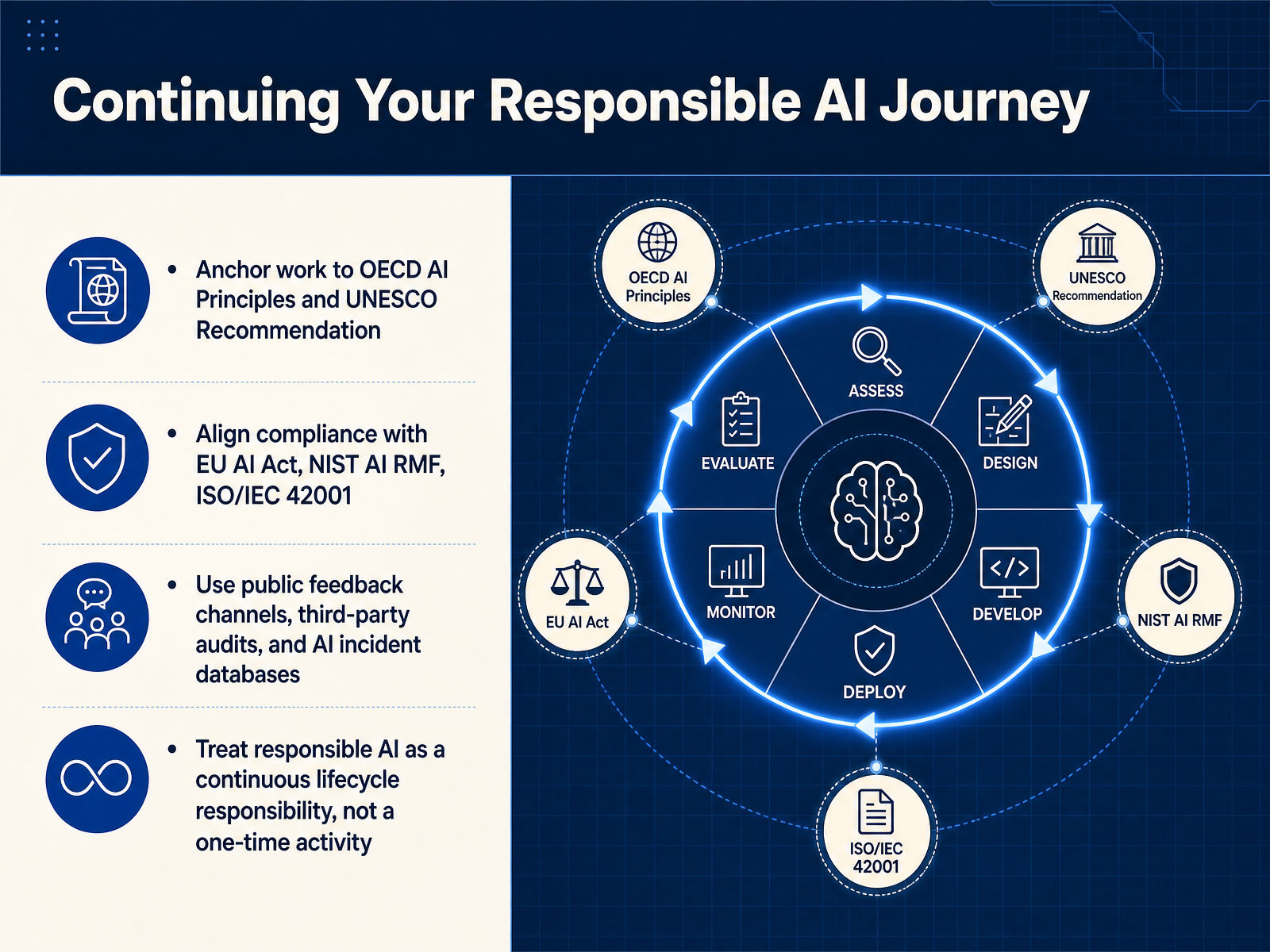
 - 13Continuing Your Responsible AI JourneyLet's turn to the practical work of adding structure to your responsible AI program. First, anchor your approach to established global principles, specifically the OECD AI Principles and the UNESCO Recommendation on AI Ethics. These give you a values-based foundation that predates and informs current regulations. Next, align your compliance work with the major operational frameworks. Consider the EU AI Act for market access, the NIST AI Risk Management Framework for practical controls, and ISO IEC 42001 for a certifiable management system. These are not interchangeable; map each to your specific obligations. Build external feedback loops. Open public comment channels, commission third-party audits, and monitor AI incident databases. Incidents there are your best early warning system for failure modes you have not yet modeled internally. Finally, treat all of this as a continuous lifecycle responsibility. Model risk shifts after deployment, data drifts, and new attack techniques emerge. Responsible AI is not a one-time certification checkbox; it is an operating cadence. With that foundation in place, let's finish by reviewing our summary and key takeaways.
 eur-lex.europa.euhai.stanford.eduoecd.org+21 min
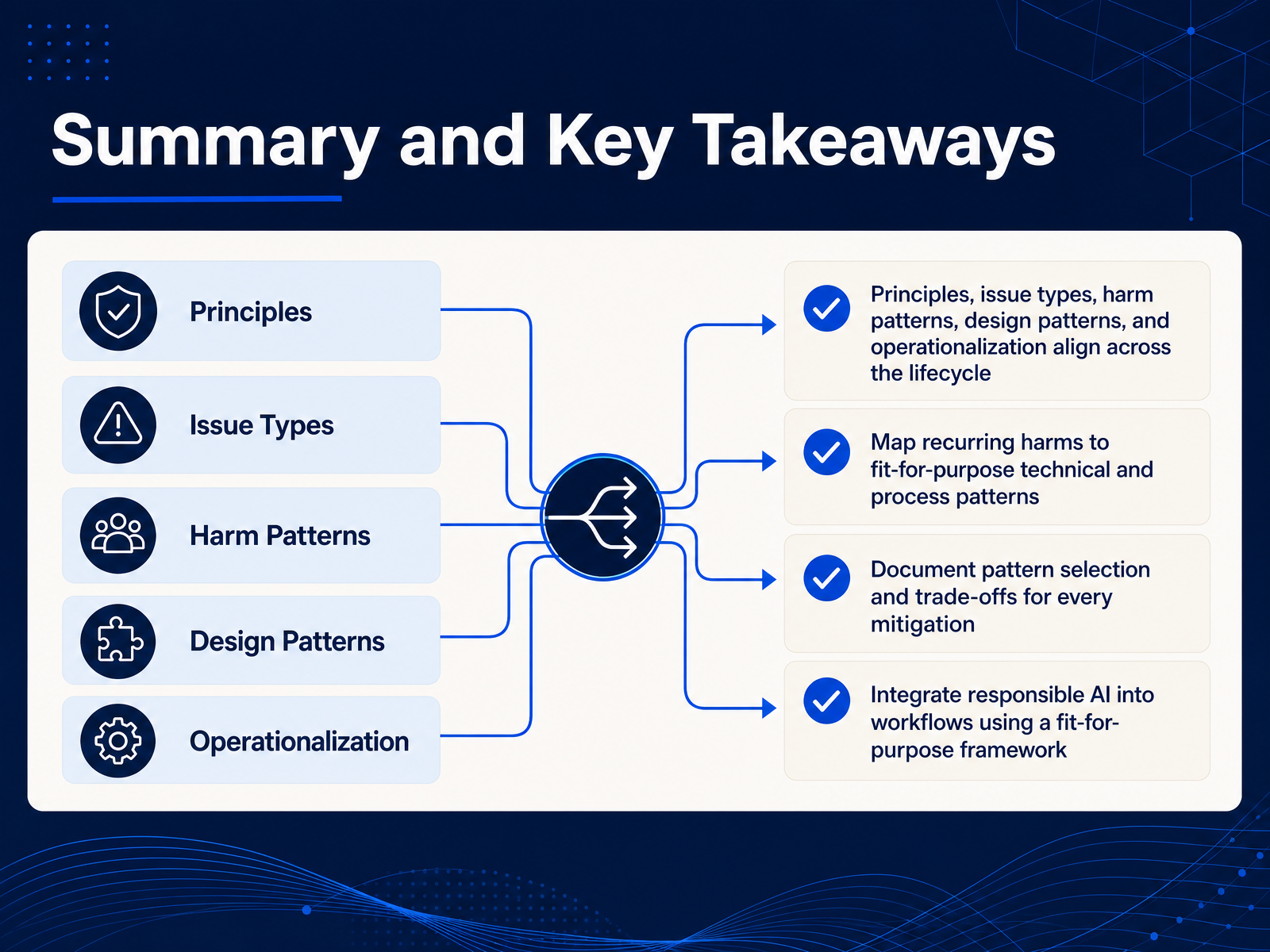
 - 14Summary and Key TakeawaysLet's bring this together. The core idea is alignment. Principles, issue types, harm patterns, and design patterns map across the full AI lifecycle. What you identify in a risk assessment should connect directly to a technical or process control. When you see a recurring harm, do not improvise. Use a fit-for-purpose pattern. That might mean pairing a bias-mitigation technique with a human review checkpoint, or adding documentation requirements alongside a model card. Then, document your choices. Record which pattern you selected, why, and what trade-offs you accepted. This gives reviewers and future teams the rationale they need. Finally, integrate responsible AI into daily workflows. Use a framework like the NIST AI Risk Management Framework or ISO 42001 as your operating model, not a checklist. The goal is to make these practices routine, measurable, and adaptable across teams. Thank you for joining this session. Use these patterns on your next project.
 nvlpubs.nist.govedps.europa.euoecd.org+21 min
Take the deck with you
Download this course as a file — free, no sign-up needed.
- PDF handoutEvery slide page, ready to print or share.15 pages · 3.9 MBDownload
- Narrated PowerPointThe deck that presents itself — every slide carries the digital human's narration video.15 pages · 16.7 MBDownload
- PowerPoint slidesThe full deck as a .pptx — open it in PowerPoint, Keynote, or Google Slides.15 pages · 3.8 MBDownload
Free to use in your own training — please keep the PersonWise credit page at the end.
Have your own deck? Turn it into a course
Sources consulted
Web sources consulted while building this course.
- Consolidated TEXT: 32024R1689 — EN — 27.07.2026 — eur-lex.europa.eu
- Responsible AI | The 2026 AI Index Report | Stanford HAI — hai.stanford.edu
- OECD Due Diligence Guidance for Responsible AI (EN) — oecd.org
- AI principles - OECD — oecd.org
- A Systematic Review of Responsible Artificial Intelligence Principles and Practice — mdpi.com
- Implementation Guidance for the EU AI Act — futurium.ec.europa.eu
- Regulation - EU - 2024/1689 - EN - EUR-Lex — eur-lex.europa.eu
- AI Act | Shaping Europe's digital future - European Union — digital-strategy.ec.europa.eu
- 2ND EDITION — global-index.ai
- The anatomy of AI policies: a systematic comparative analysis of AI policies across the globe | AI and Ethics | Springer Nature Link — link.springer.com
- Global AI Governance in Comparison: Ethics, Regulation, and Accountability Across OECD, UNESCO, EU, and US Frameworks — publishing.emanresearch.org
- Quick view: Global AI governance frameworks – a comparative view (Global) - Lexology Pro — lexology.com
- Compare AI risk management frameworks from NIST and beyond | TechTarget — techtarget.com
- AI ethics frameworks compared: EU AI Act, OECD, UNESCO, NIST and more | ethics.ai — ethics.ai
- Artificial Intelligence Risk Management Framework (AI RMF 1.0) — nvlpubs.nist.gov
- Guidance for Risk Management of Artificial Intelligence systems — edps.europa.eu
- AI RMF Core - AIRC — airc.nist.gov
- AI lifecycle risk management: ISO/IEC 42001:2023 for AI governance | AWS Security Blog — aws.amazon.com
- Nikolay Donets | Allocational and Representational Harms - AI Risk — donets.org
- Taking a — eprints.illc.uva.nl