Teaching Kids Critical Thinking Skills
Begin
14 pages · ~28 min
Teaching Kids Critical Thinking Skills
This training helps parents and educators teach children critical thinking through a practical workflow, building skills to evaluate information and reason effectively.
What you’ll learn
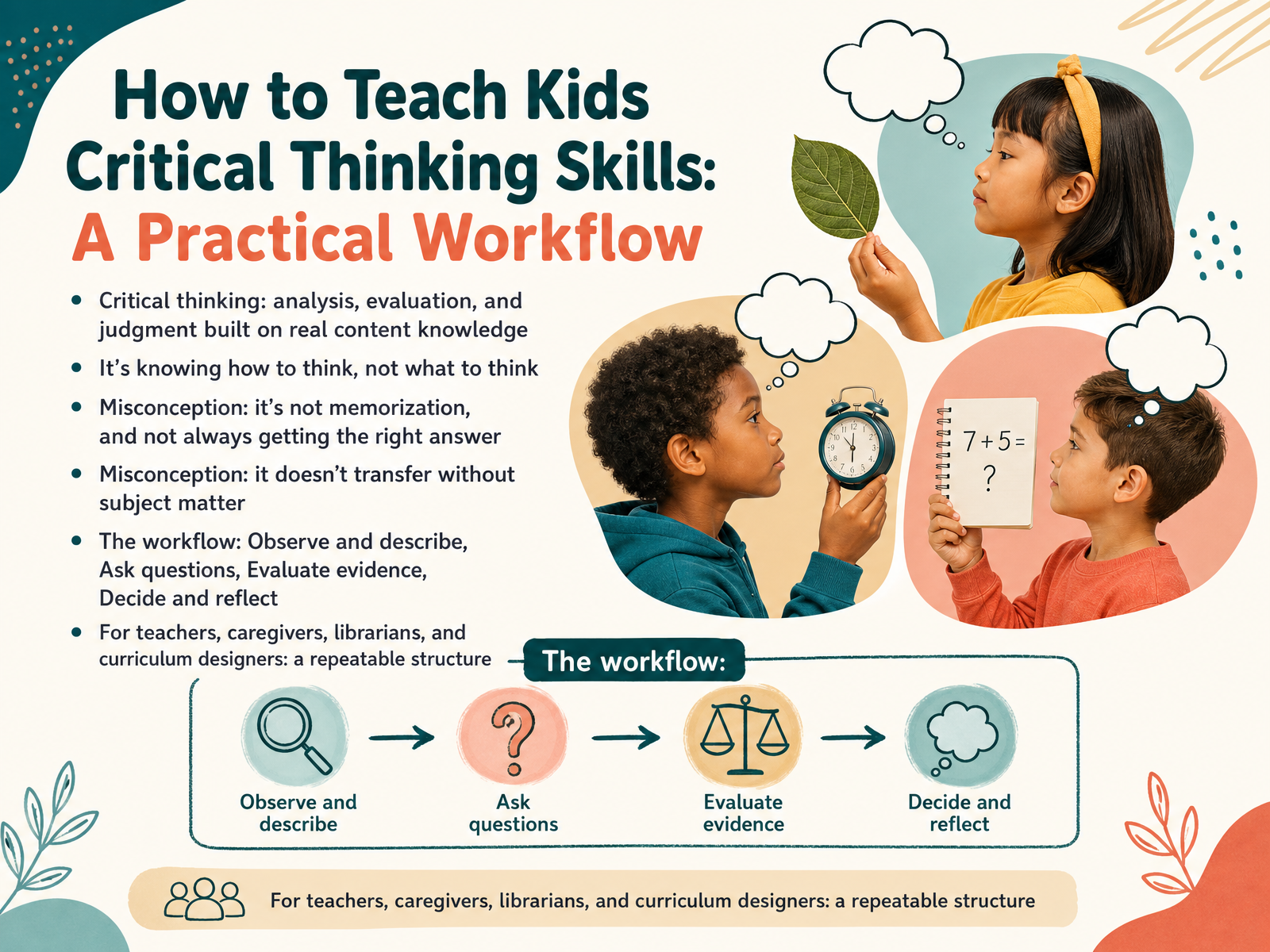
- 01How to Teach Kids Critical Thinking Skills: A Practical WorkflowWelcome. I am glad you are here. This course is for teachers, caregivers, librarians, and curriculum designers, and it is built around one practical goal. You will leave with a repeatable workflow for teaching kids how to think, not just what to think. Let's start with what critical thinking really is. It is analysis, evaluation, and judgment, but it grows out of real content knowledge. A child needs something worth thinking about. So here are two common misconceptions to set aside. First, critical thinking is not memorization, and it is not always getting the right answer. It is about how a learner reaches a judgment. Second, it does not transfer automatically across subjects. You and the learners in your care need to practice it inside the material you are studying, whether that is a science unit, a picture book, or a news article. Throughout this course, we will use one four step workflow. Observe and describe, ask questions, evaluate evidence, and decide and reflect. Think of it as a structure you can return to again and again. Next, let's look at why kids struggle with critical thinking.scholastic.comcriticalthinking.orgnationalgeographic.com+22 min
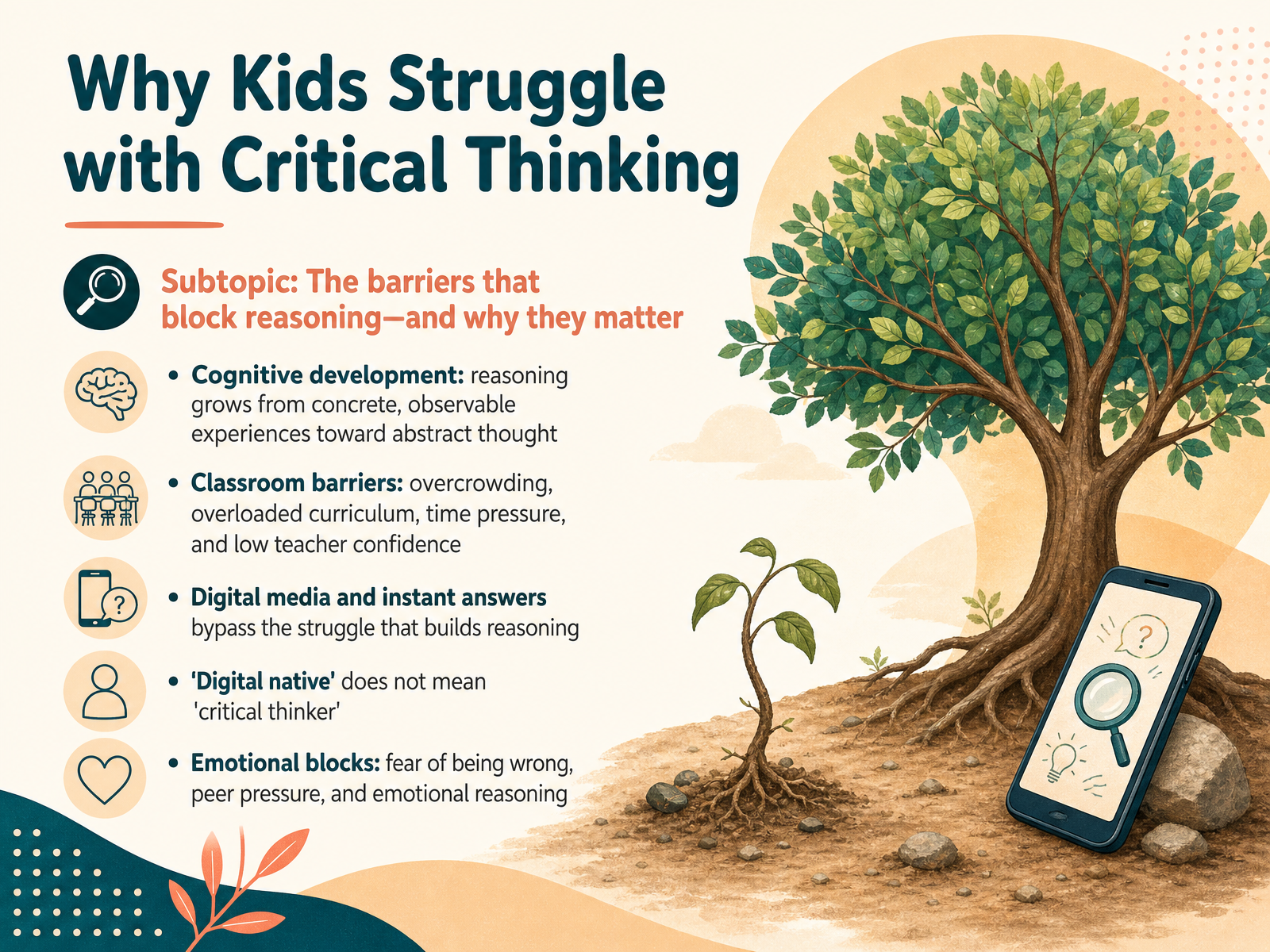
- 02Why Kids Struggle with Critical ThinkingLet's talk about why critical thinking is hard for kids in the first place. Understanding these barriers changes how you coach them. First, development. Reasoning grows from concrete, observable experiences toward abstract thought. So ask, what did you see happen? before asking, what do you think caused it? Second, classroom realities: overcrowding, an overloaded curriculum, time pressure, and low teacher confidence all crowd out deeper thinking. Third, digital media and instant answers bypass the struggle that actually builds reasoning. Remember, digital native does not mean critical thinker. Finally, emotional blocks. Fear of being wrong, peer pressure, and emotional reasoning can shut down inquiry. So respond to a wrong answer with curiosity, not correction. Name these barriers, and you and the learners in your care can start working around them. This brings us to The Four-Phase Foundation.
 sajce.co.zadoi.orglink.springer.com+21 min
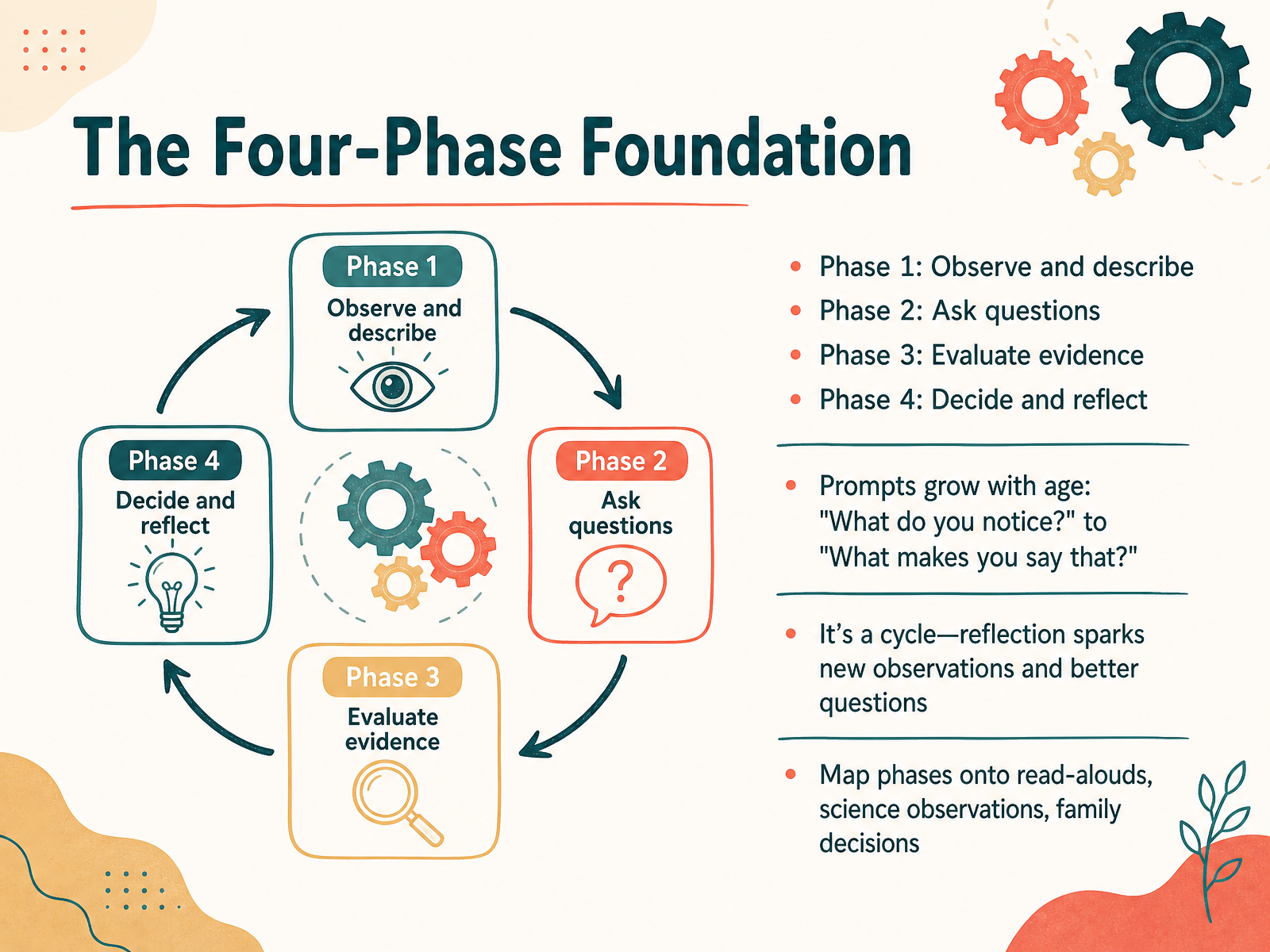
 - 03The Four-Phase FoundationLet's look at the foundation that holds all of this together: four phases. Phase one is observe and describe. Ask, what do you notice? Phase two is ask questions. Prompt learners to wonder aloud. Phase three is evaluate evidence. Ask, what makes you say that? And phase four is decide and reflect. Then the cycle begins again. Reflection sparks new observations and better questions. You can map these phases onto almost anything: a read-aloud, a science observation, even a family decision about bedtime. The prompts grow with age, but the sequence stays steady. So keep it simple. Notice, question, weigh the evidence, decide, and reflect. That rhythm builds thinking habits for life.
 edutopia.orgthinkingclassroom.orggraduateprogram.org+21 min
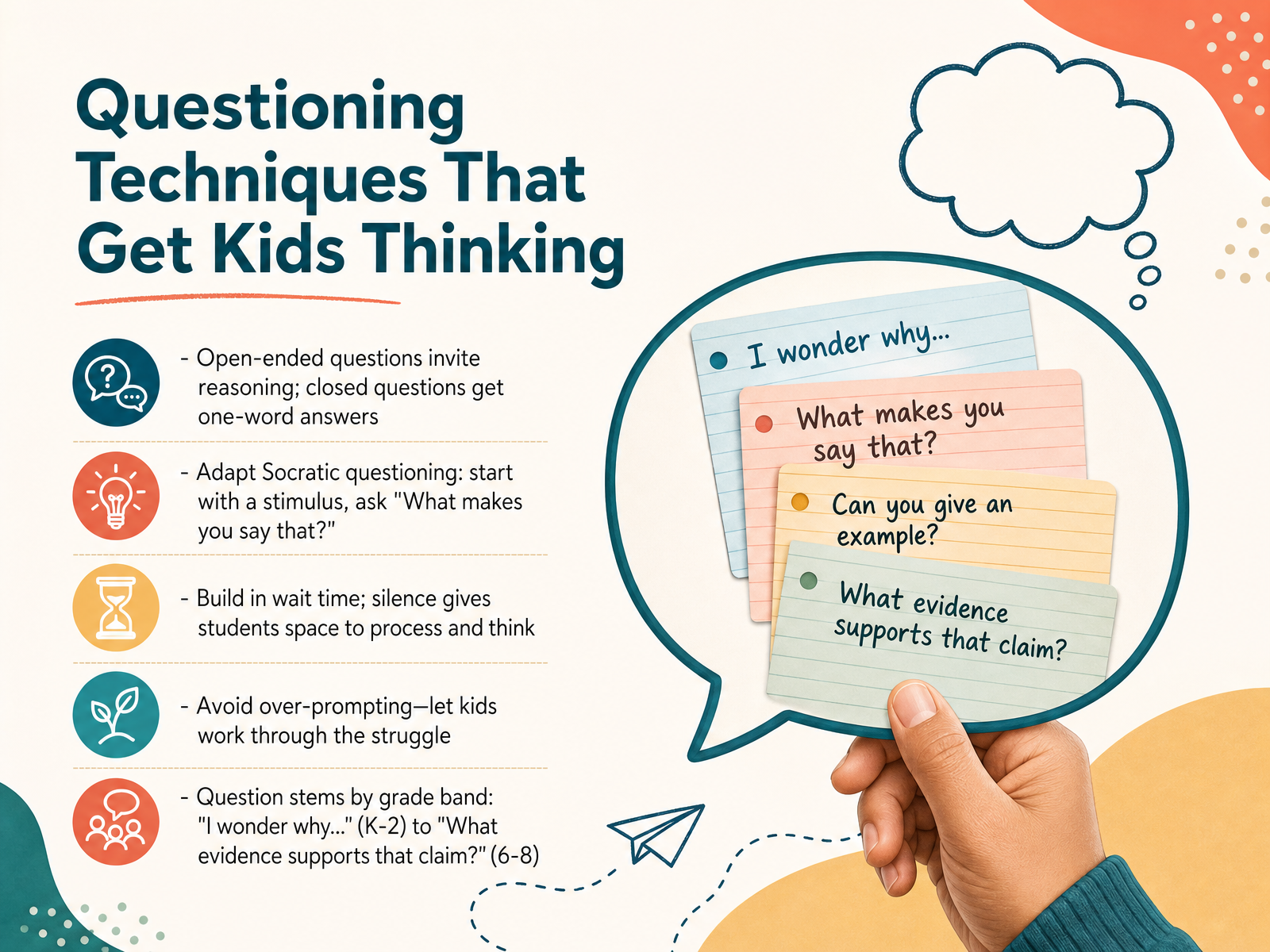
 - 04Questioning Techniques That Get Kids ThinkingLet's turn to the questions themselves, because the words you choose shape how deeply kids think. Open-ended questions invite reasoning. Closed questions get you one-word answers. So instead of asking, did you like the story, try, what makes you say the character acted that way? That's the heart of adapting Socratic questioning. Start with a stimulus, a picture, a short text, even a toy, then ask, what makes you say that? Next, build in wait time. Silence is not a problem. It gives students space to process, so count a few seconds before you speak again. And avoid over-prompting. Let kids work through the struggle, even when it feels slow. Here are stems by grade band. In kindergarten through second grade, try, I wonder why. For grades six through eight, ask, what evidence supports that claim? Teaching Evidence and Reasoning.
 dwwlibrary.wested.orglink.springer.combigideas4littlescholars.com+22 min
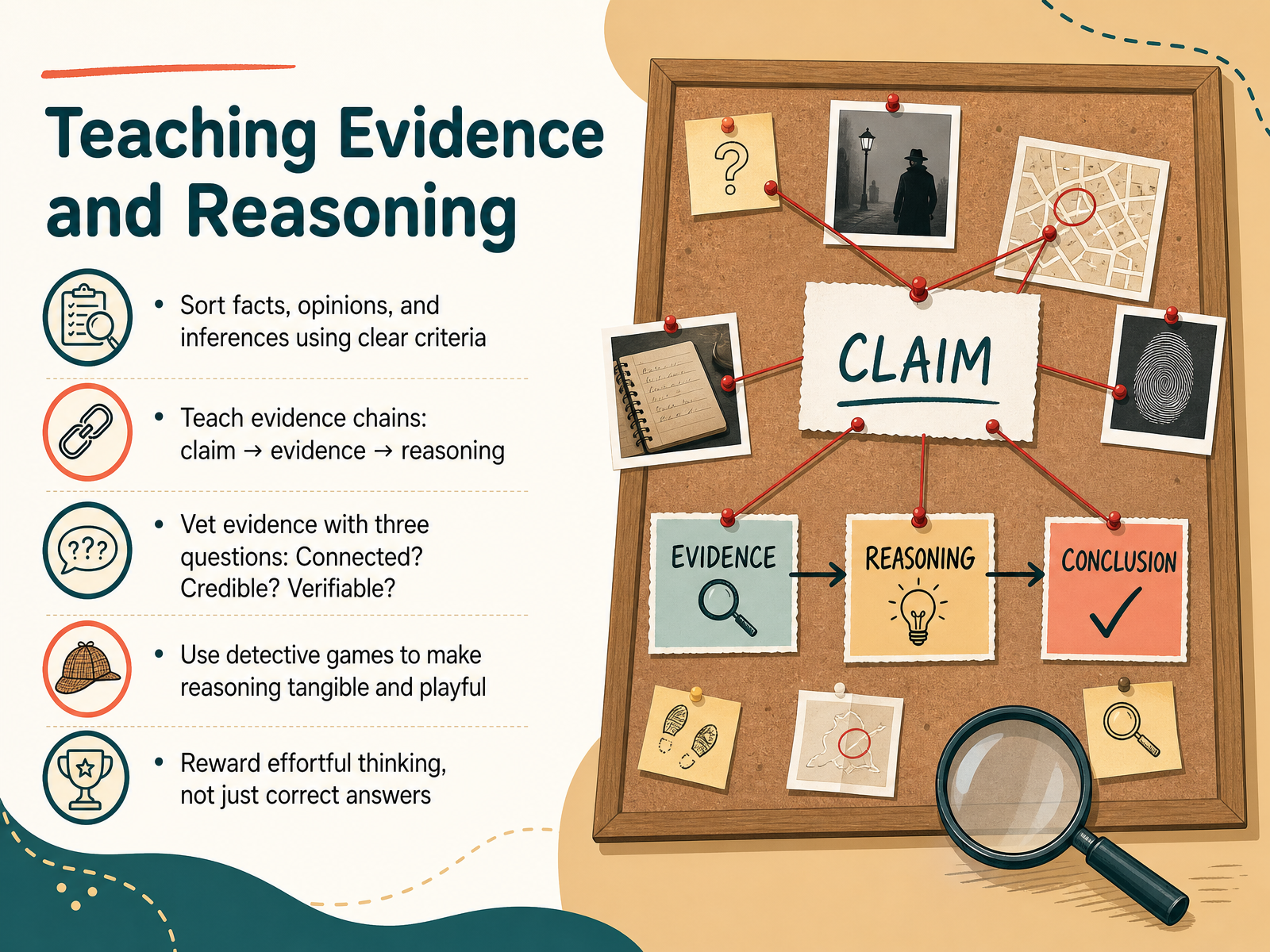
 - 05Teaching Evidence and ReasoningLet's talk about how to teach evidence and reasoning. Start with sorting. Ask learners to sort statements into facts, opinions, and inferences using clear criteria you post and reuse. Next, build evidence chains out loud. State the claim, name the evidence, then explain the reasoning that connects them. To vet evidence, use three questions. Is it connected to the claim? Is the source credible? Can it be verified elsewhere? Try a detective game to make this tangible. Give a mystery and let learners gather clues and defend which evidence is strongest. And reward effortful thinking, not just correct answers. Praise the reasoning, even when the conclusion is wrong. That is how you and the learners in your care build real critical thinking habits. Now, let's carry these skills into everyday subjects.
 lawrencehallofscience.orgscholastic.comcriticalthinking.org+21 min
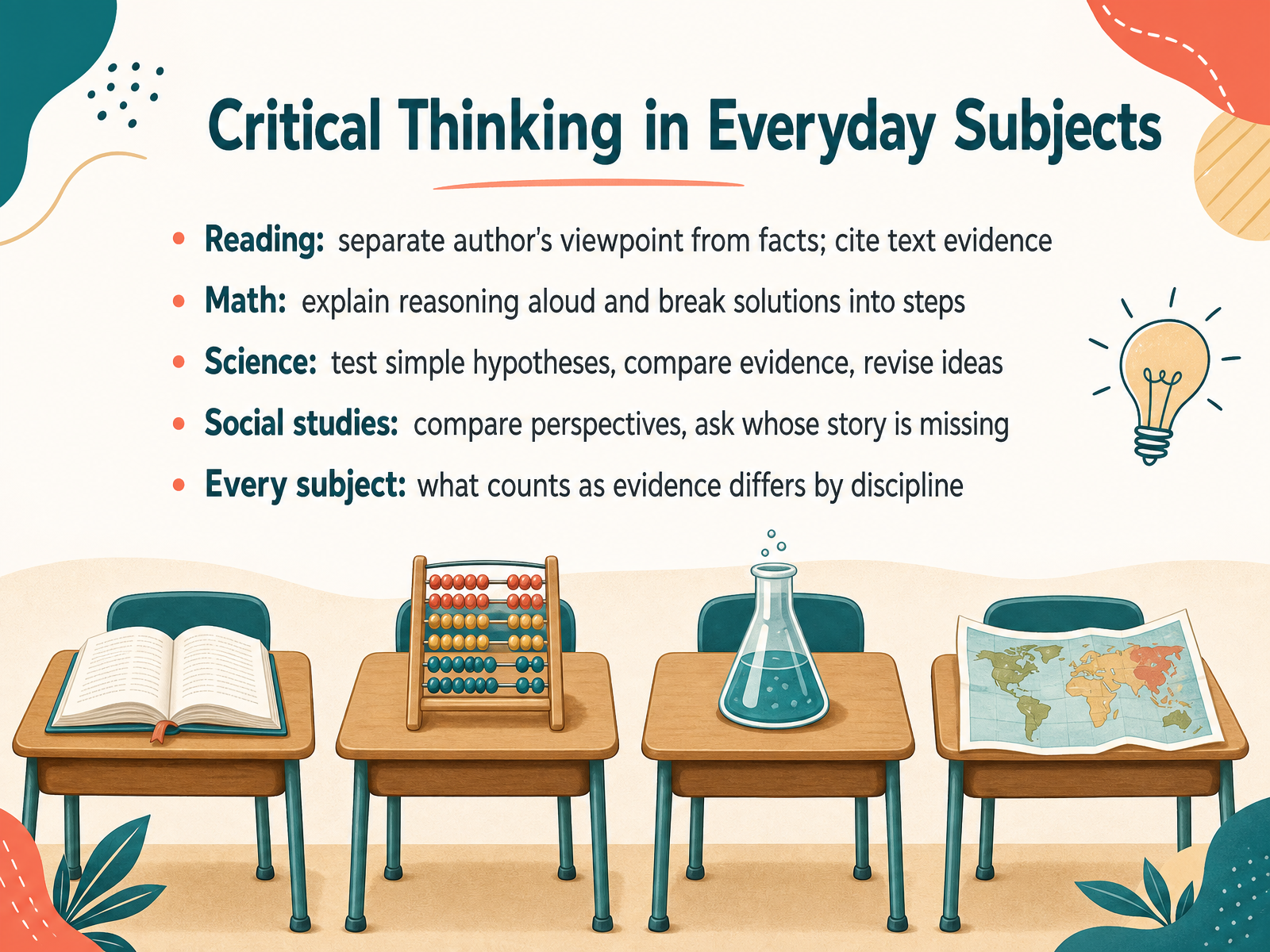
 - 06Critical Thinking in Everyday SubjectsNow let's see what critical thinking looks like inside everyday subjects. In reading, help learners separate the author's viewpoint from the facts, and ask them to point to the exact words in the text that support their thinking. In math, invite students to explain their reasoning aloud and break a solution into steps, so the process becomes visible, not just the answer. In science, keep it simple. Ask children to test a small hypothesis, compare evidence, and revise their idea when new information appears. In social studies, compare perspectives, then ask, whose story is missing here? And remember, every subject has its own rules for evidence. What counts as proof in a math explanation differs from what counts in an English essay. So ask yourself, in this lesson, what does good evidence look like? Next, let's explore scaffolding the workflow by age.
 edutopia.orgthinkingclassroom.orggraduateprogram.org+21 min
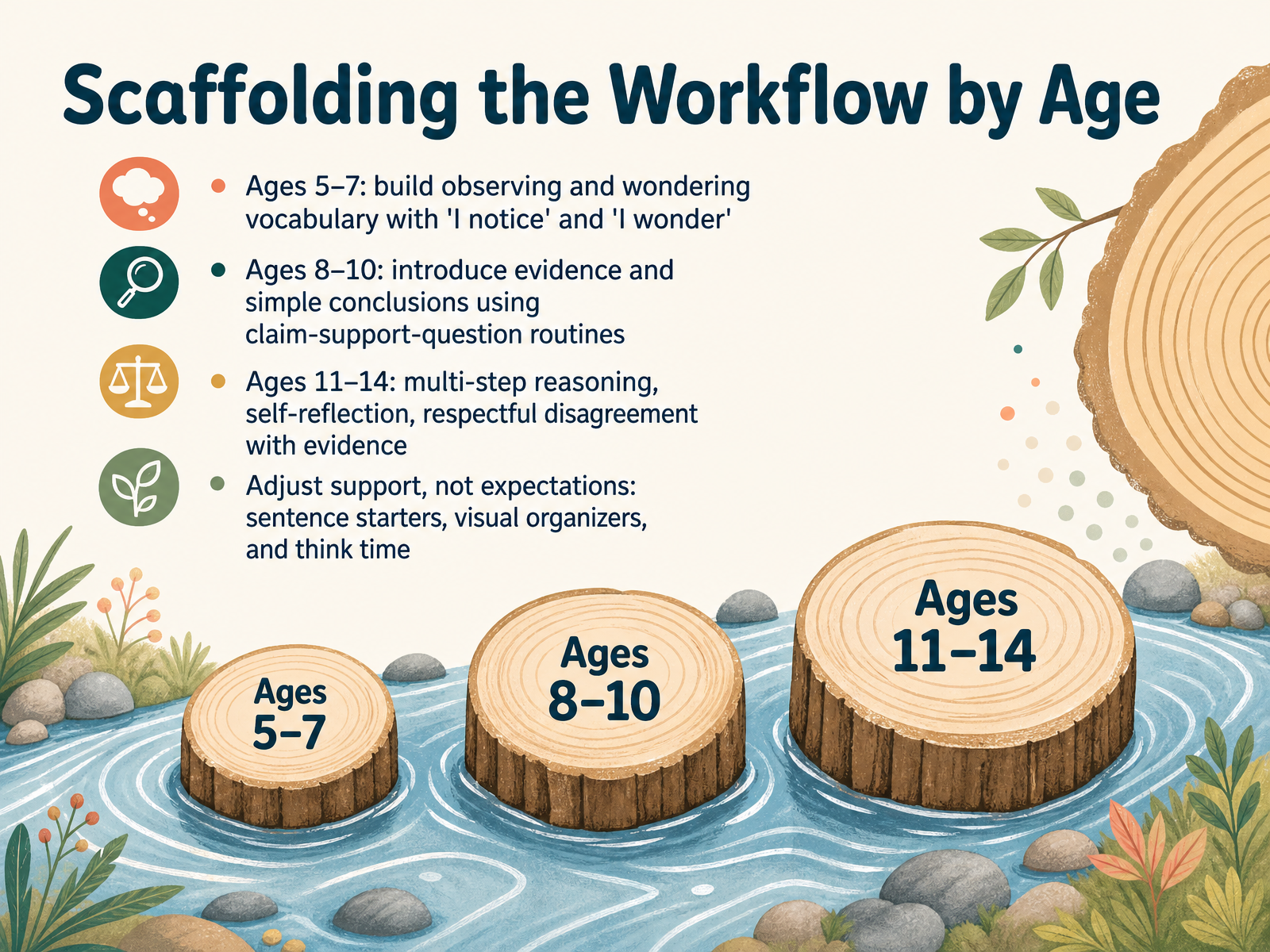
 - 07Scaffolding the Workflow by AgeNow let's think about how to scaffold this workflow by age. The goal stays constant; the support changes. With ages five to seven, build observing and wondering vocabulary. Try the routine 'I notice, I wonder.' Present a leaf, and ask, what do you notice? Then, what do you wonder? For ages eight to ten, introduce evidence and simple conclusions. Use claim, support, question. A student says, I claim the plant needs light, because it leaned toward the window, so I question whether it needs water too. With ages eleven to fourteen, stretch into multi-step reasoning, self-reflection, and respectful disagreement with evidence. Ask, what evidence would change your mind? And here is the anchor: adjust support, not expectations. Sentence starters, visual organizers, and think time give access without lowering the bar. Remember, critical thinking is possible at all ages. Building a Reusable Activity Bank.
 thinkingclassroom.orgedutopia.orgdwwlibrary.wested.org+21 min
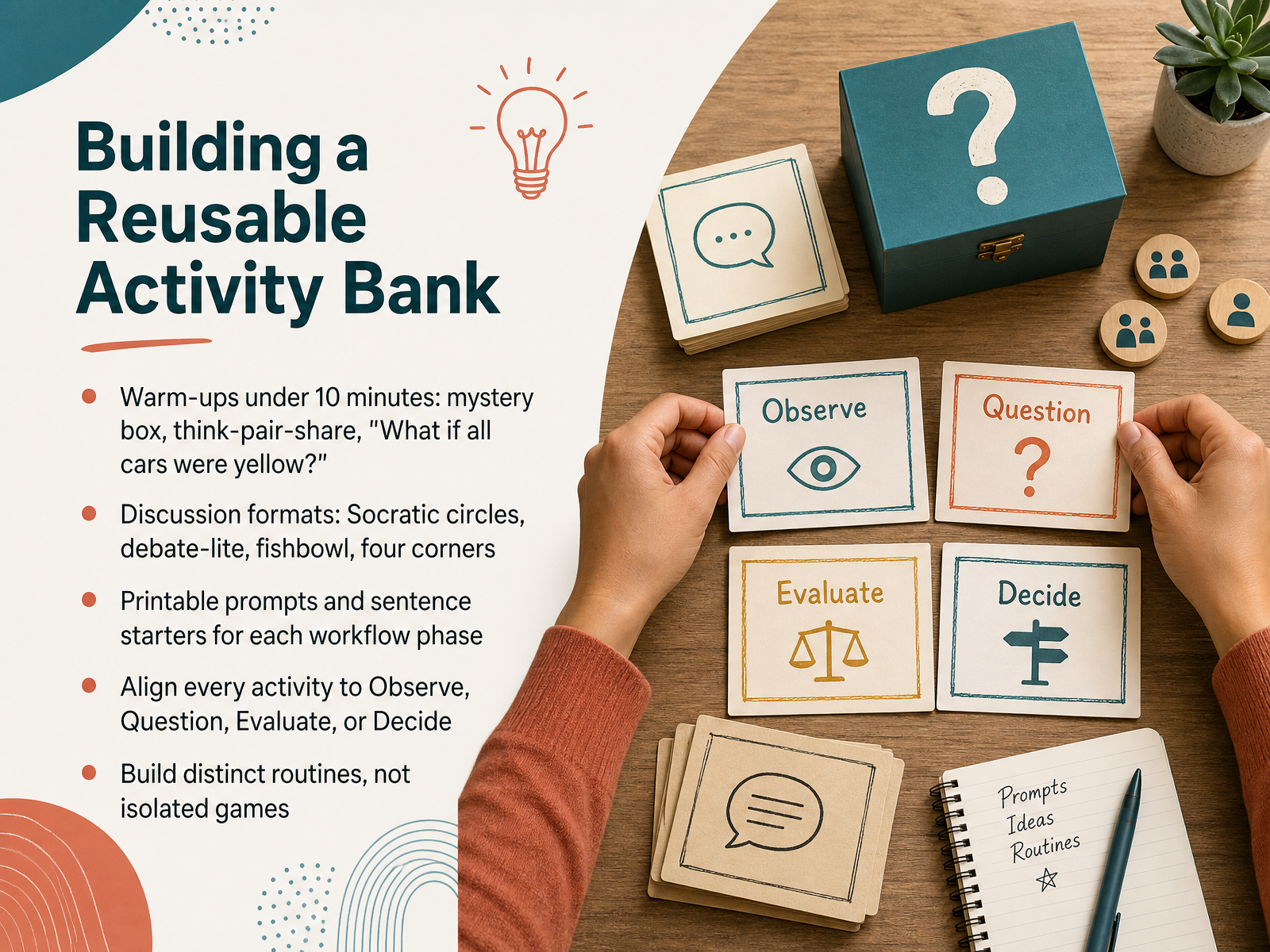
 - 08Building a Reusable Activity BankLet's talk about building a reusable activity bank, so you're not reinventing critical thinking lessons every week. Start small. Warm-ups under ten minutes work beautifully: a mystery box, a quick think-pair-share, or the playful question, what if all cars were yellow? That one always gets giggles, then real reasoning. Next, rotate discussion formats: Socratic circles, debate-lite, fishbowl, and four corners. Keep printable prompts and sentence starters ready for each phase, so learners always know how to begin. Here is the key move: align every activity to Observe, Question, Evaluate, or Decide. That way, each game has a clear thinking purpose, not just fun. Build distinct routines, not isolated games. Soon your bank becomes a dependable toolkit you and the learners in your care can trust. Next, we look at assessing critical thinking without standardized tests.
 dwwlibrary.wested.orglink.springer.combigideas4littlescholars.com+21 min
 - 09Assessing Critical Thinking Without Standardized TestsSo how do you assess critical thinking without relying on standardized tests? Start with observation. Keep a simple checklist and track things like clarifying questions, revised ideas, and use of evidence. Next, use short rubrics. Focus on clarity, evidence, and how well a learner responds to a counterargument. Then add self-reflection prompts. Ask, what strategy did I use, and what changed my mind? Over time, collect work samples and discussion notes in portfolios. These show growth far better than a single score. Above all, keep assessment formative. Feedback should guide your next instructional move, not label a child. And write rubrics in student language. That way, kids can assess their own reasoning. Let's look at your implementation plan and common pitfalls next.
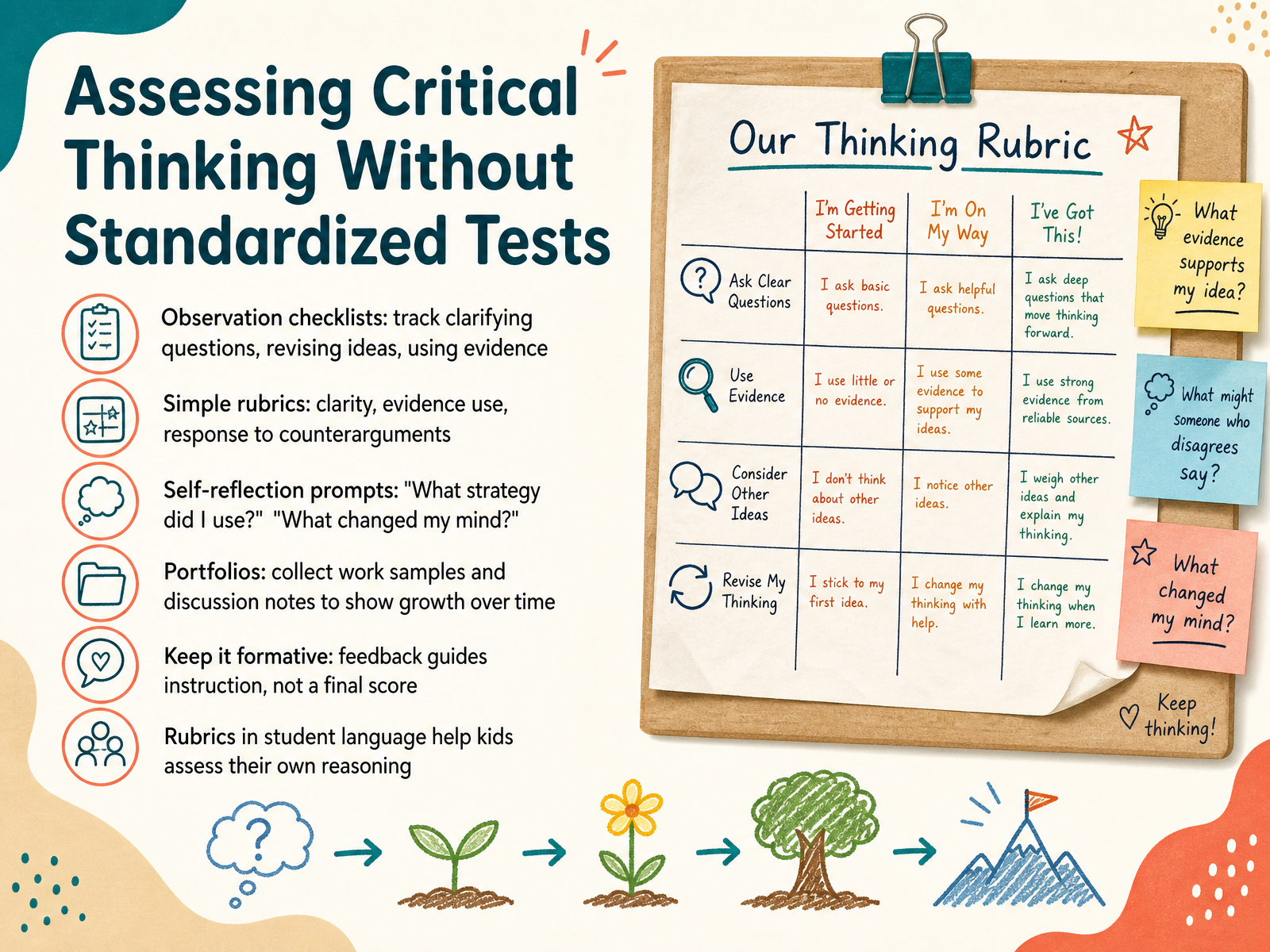 edutopia.orgthinkingclassroom.orggraduateprogram.org+21 min
 - 10Implementation Plan and Common PitfallsNow let's put this into practice with an implementation plan and the pitfalls to watch for. Start with a ten day plan. Introduce the workflow, model each phase yourself, then apply it in just one subject. Keep the scope small so you and the learners in your care can build confidence. As you teach, watch for three common pitfalls. First, over prompting and rushing. Leave real wait time after you ask a question. A child staring at a puzzle for ten seconds is not stuck. Second, praising only correct answers. Notice effortful reasoning instead. Try saying, you looked at the pattern and tried a new strategy. Third, treating critical thinking as a standalone lesson. Research shows thinking is intertwined with content, so embed it in what you already teach. Then grow through professional learning communities, teacher and librarian partnerships, and curated lessons. Pick one subject and one phase this week, and give learners the quiet space to think. Next, we will look at adapting for different learning environments.
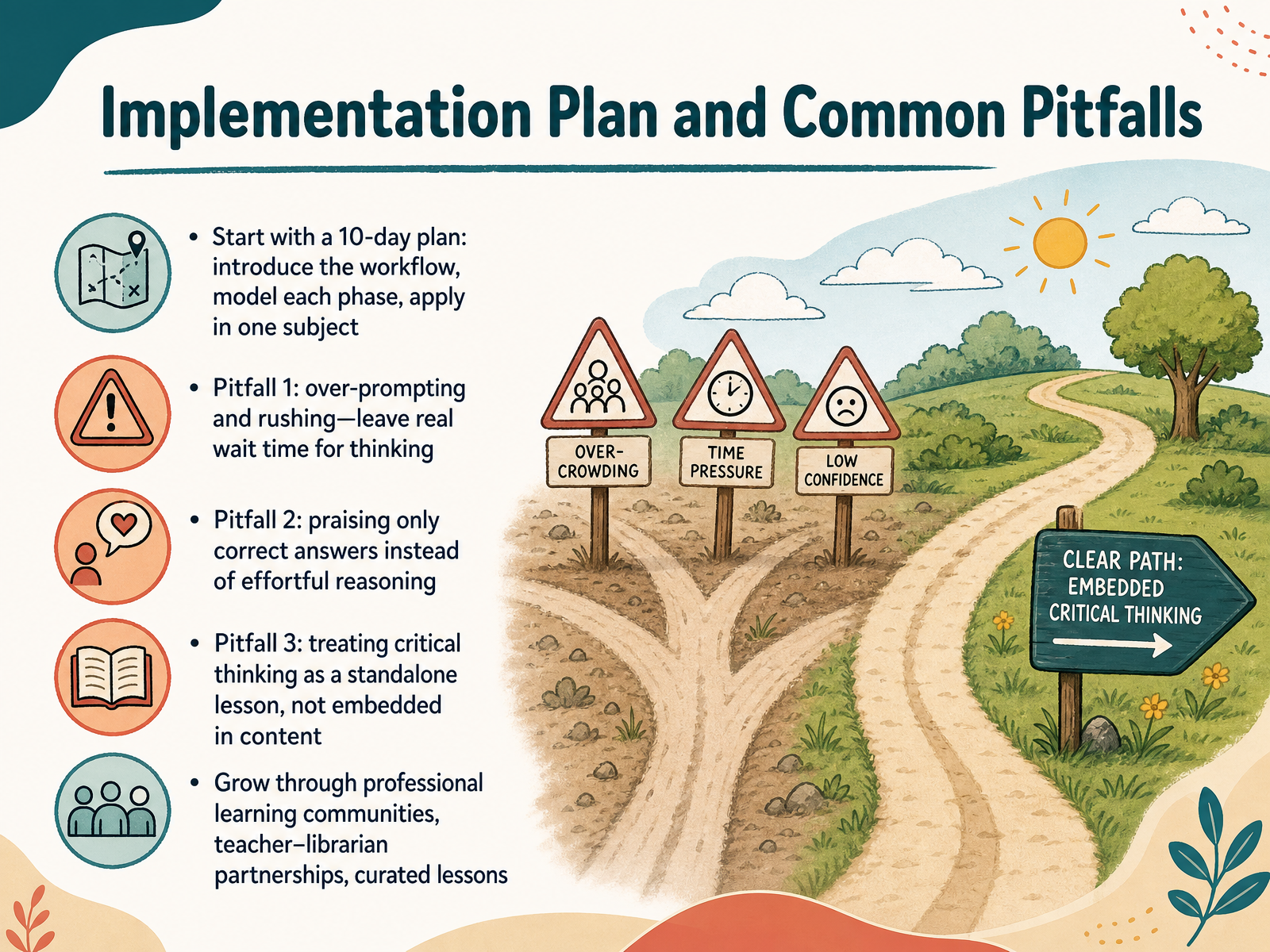 nationalgeographic.comsajce.co.zadoi.org+22 min
 - 11Adapting for Different Learning EnvironmentsNow let's talk about adapting the same workflow for different learning environments. The prompts stay the same. The setting changes. In a classroom, weave discussion routines into subject blocks. Pause during a math lesson and ask, what evidence supports that step? Use quick formative check-ins while students work. In a library, pair read-alouds with questioning protocols and source evaluation. After a story, ask, what makes this fact trustworthy? At home, model thinking aloud. Answer why questions, and welcome disagreement. Try saying, I changed my mind because of this new detail. In curriculum design, embed reasoning checks with explicit prompts and rubrics, so expectations stay visible for every learner. Same workflow, different settings. Keep prompts and evidence expectations posted where you and the learners in your care can see them. Start with one setting this week. Which environment will you adapt first? Next, we look at fostering a thinking culture.
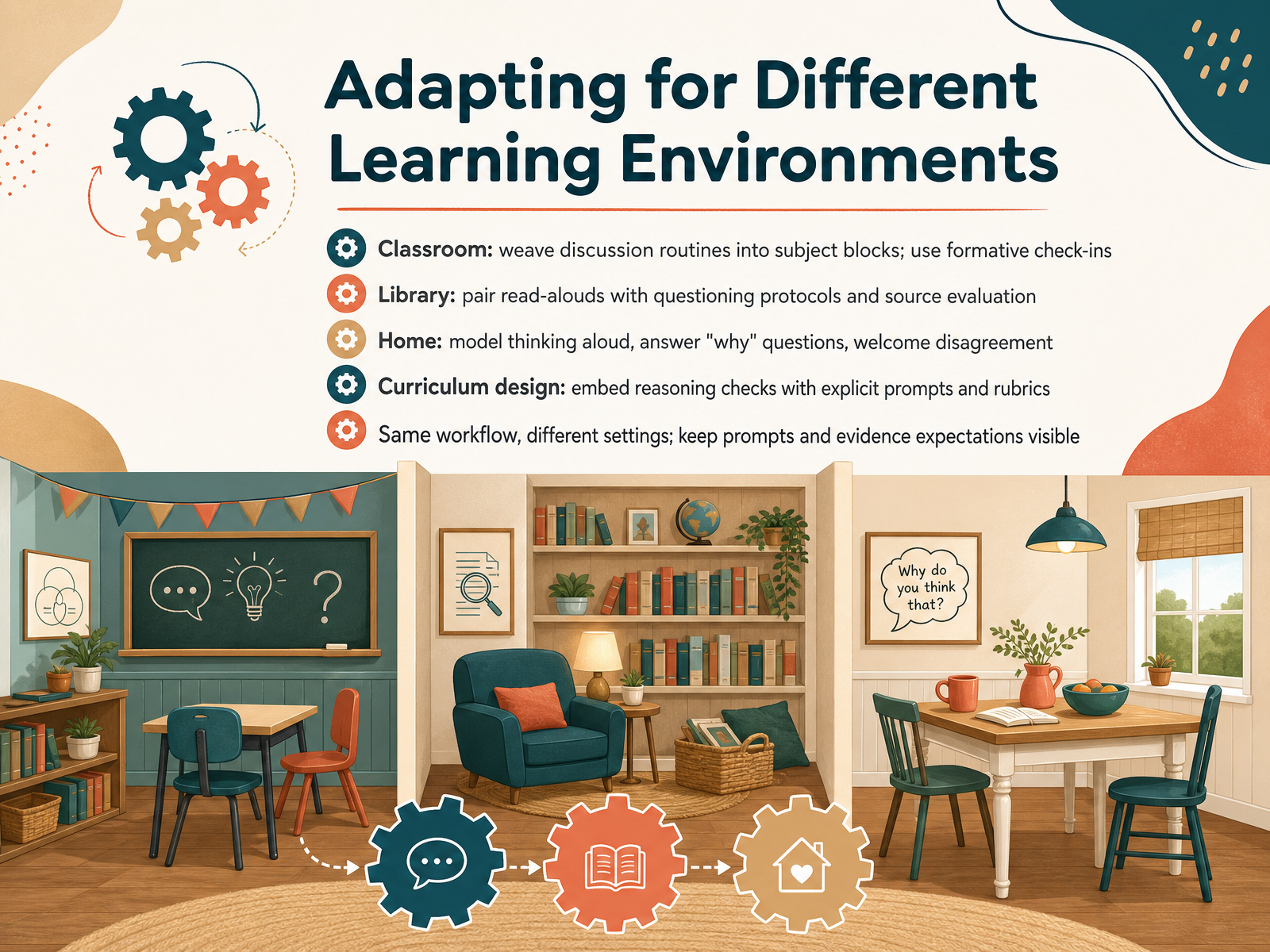 edutopia.orgthinkingclassroom.orgscholastic.com+22 min
 - 12Fostering a Thinking CultureLet's talk about the culture you build around thinking. Because culture, not curriculum, decides whether kids actually take intellectual risks. First, normalize mistakes. Keep a failure wall where learners post an error and what it taught them. One fourth grade teacher did this and watched fearful students finally put pen to paper. Second, praise the thinking, not just the correct answer. Say, tell me how you got there, instead of, you're so smart. Third, treat questions as welcome, even uncomfortable ones. When a child questions your reasoning, that is not talking back. It is practice. Fourth, require evidence and reasoning, while respecting diverse perspectives. Ask, what makes you say that? Then let the learner explain. Try one shift this week. Swap one piece of praise for a question about process. Now let's look at resources and next steps.
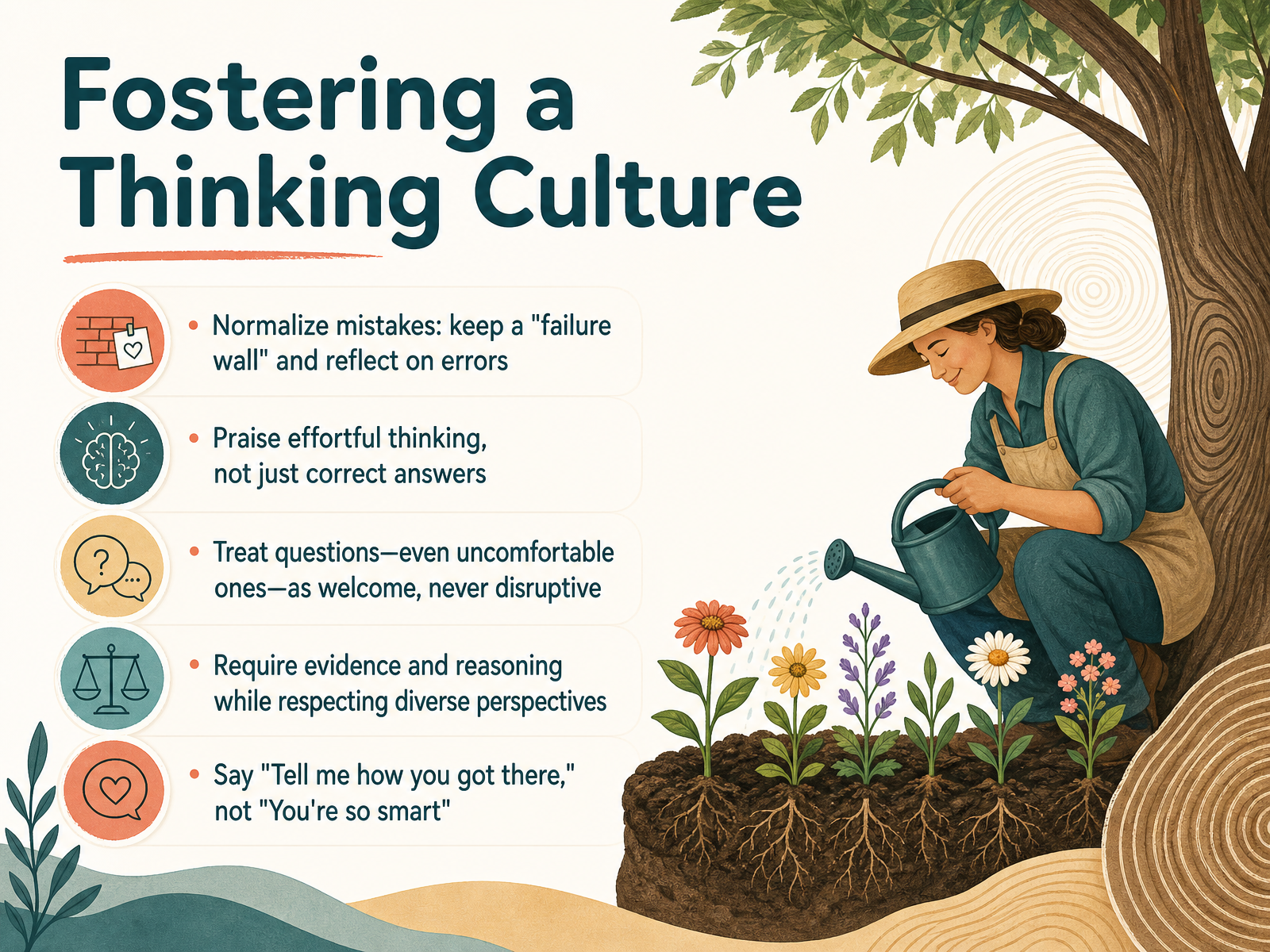 nationalgeographic.comedutopia.orgthinkingclassroom.org+21 min
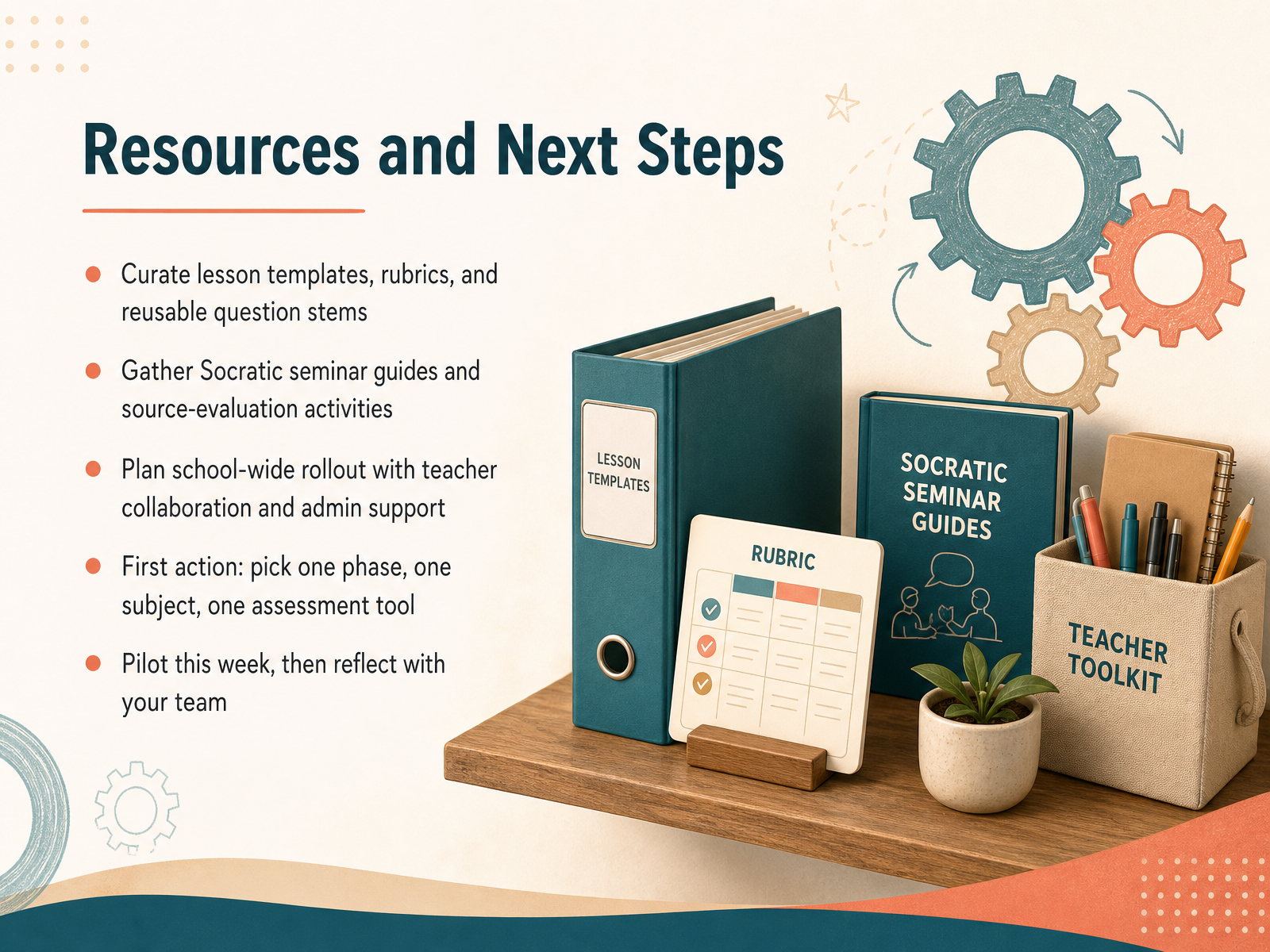
 - 13Resources and Next StepsNow, let's talk about resources and next steps. First, curate your materials. Collect lesson templates, rubrics, and reusable question stems so you are not reinventing the wheel each week. Rubrics built for critical thinking, like those from PBLWorks or your state's Portrait of a Graduate, give you and your students a shared language for reasoning and evidence. Next, gather Socratic seminar guides and source-evaluation activities. For example, a simple fact-versus-fiction chart works beautifully in early grades, while a news detective task fits upper elementary. Then, plan your school-wide rollout. Invite teacher collaboration and admin support early, so the work is shared, not solo. Here is your first action. Pick one phase, one subject, and one assessment tool. Pilot it this week with the learners in your care. Then reflect with your team. What worked? What needs adjusting? Small, steady steps build lasting practice. Let's bring it all together in our final segment, Summary and Action Planning.
 edutopia.orgthinkingclassroom.orgdwwlibrary.wested.org+21 min
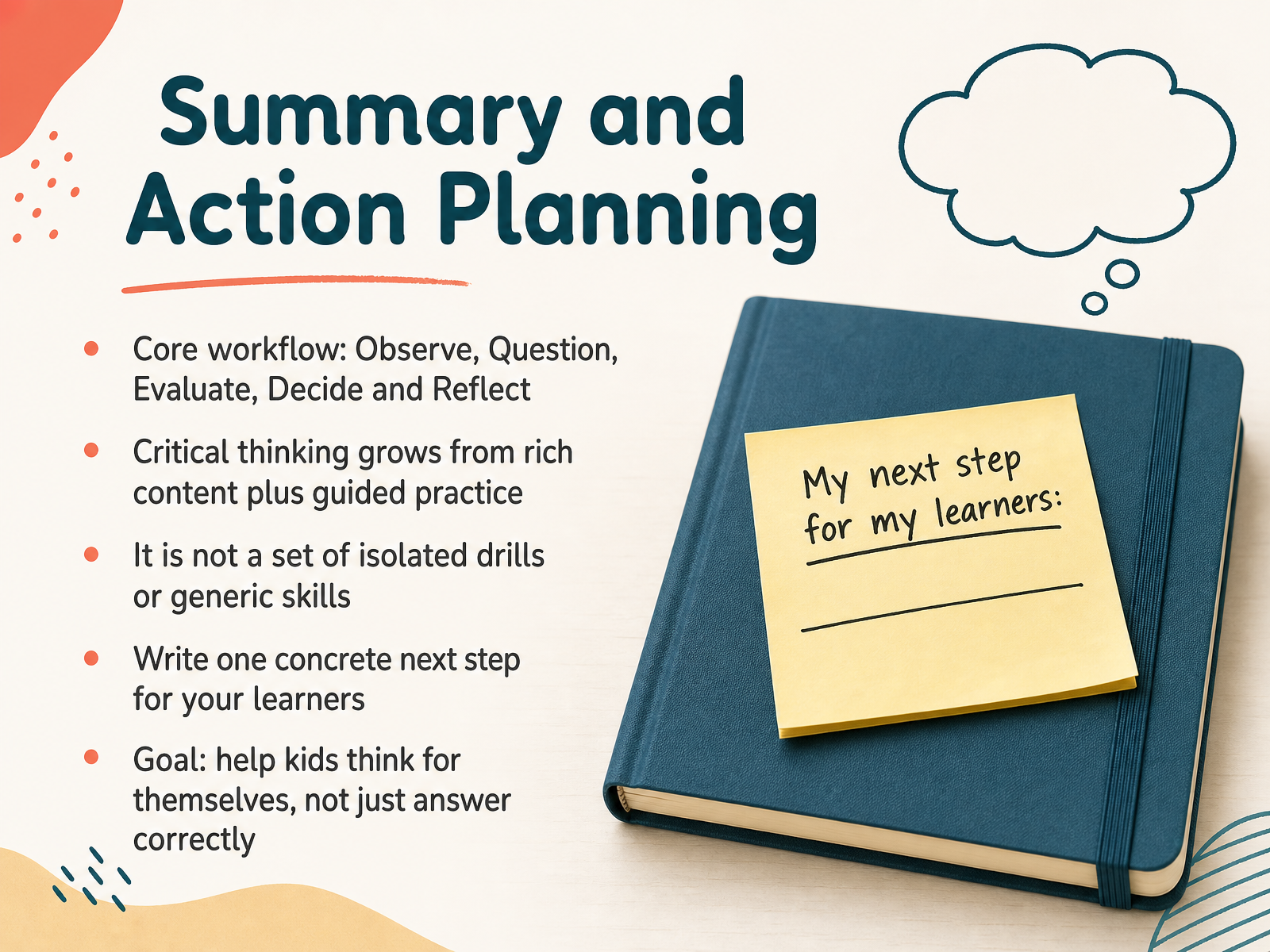
 - 14Summary and Action PlanningLet's bring it all together. As you plan ahead, hold onto the core workflow: Observe, Question, Evaluate, Decide, and Reflect. Critical thinking grows from rich content plus guided practice. It is not a set of isolated drills, and it is not a generic skill you can teach in a vacuum. So here is your next step. Write one concrete action for the learners in your care. For example, in your next read aloud, pause and ask, what makes you say that? Then let the silence sit, and let them reason. Remember your goal: help kids think for themselves, not just answer correctly. You have the framework, you have the content, and you have the skill to guide them. Thank you for the thoughtful work you do every day. Now go plan that one step, and keep going.
 edutopia.orgthinkingclassroom.orggraduateprogram.org+21 min
Take the deck with you
Download this course as a file — free, no sign-up needed.
- PDF handoutEvery slide page, ready to print or share.15 pages · 4.9 MBDownload
- Narrated PowerPointThe deck that presents itself — every slide carries the digital human's narration video.15 pages · 23.9 MBDownload
- PowerPoint slidesThe full deck as a .pptx — open it in PowerPoint, Keynote, or Google Slides.15 pages · 4.8 MBDownload
Free to use in your own training — please keep the PersonWise credit page at the end.
Have your own deck? Turn it into a course
Sources consulted
Web sources consulted while building this course.
- Think About It: Critical Thinking — scholastic.com
- Defining Critical Thinking — criticalthinking.org
- How to raise your children to be critical thinkers | National Geographic — nationalgeographic.com
- Critical Thinking for Children — criticalthinking.org
- Critical Thinking - Minnesota Children's ... — mcm.org
- Challenges related to teaching critical thinking in the ... — sajce.co.za
- Explicit and reflective teaching for the development of Critical Thinking skills and Nature of Science and Technology understandings in Primary Education — doi.org
- The Use of Questioning Strategies in the Development of Critical Thinking Skills in Children: A Qualitative Study of the Socratic Method | Early Childhood Education Journal | Springer Nature Link — link.springer.com
- An Evaluative Review of Barriers to Critical Thinking in ... - PMC — pmc.ncbi.nlm.nih.gov
- Effects of a design-based research approach on fourth-grade students’ critical thinking, problem-solving skills, computational thinking, and creativity self-efficacy | International Journal of Technology and Design Education | Springer Nature Link — link.springer.com
- A Critical Thinking Framework for Elementary Students — edutopia.org
- A FRAMEWORK FOR CRITICAL THINKING ACROSS THE CURRICULUM — thinkingclassroom.org
- Teaching Critical Thinking in the Elementary Classroom — graduateprogram.org
- Critical Thinking in Elementary Education: Useful Strategies — apu.apus.edu
- A Routine to Develop Inferencing Skills in Primary School Children — doi.org
- Questioning in a Socratic Seminar - The Doing What Works Library — dwwlibrary.wested.org
- CONVERSATIONS with CLASS ~ Introducing Socratic Dialogue to Younger Scholars - Big Ideas for Little Scholars — bigideas4littlescholars.com
- Socratic Seminar and Shared Inquiry – Robert Seth Price — eggplant.org
- Socratic Method for Kids: Enhancing Critical Thinking Through Inquiry - LearningMole — learningmole.com
- Evaluating Evidence — lawrencehallofscience.org