Begin
14 pages · ~28 min
Data Science Case Studies: Patterns & Tradeoffs
This training explores real-world data science case studies to help practitioners recognize recurring patterns and make informed tradeoffs in their projects.
A digital instructor presents all 14 pages. Hold “Ask” at any point and ask out loud — the answer comes from this course. No sign-up needed.
What you’ll learn
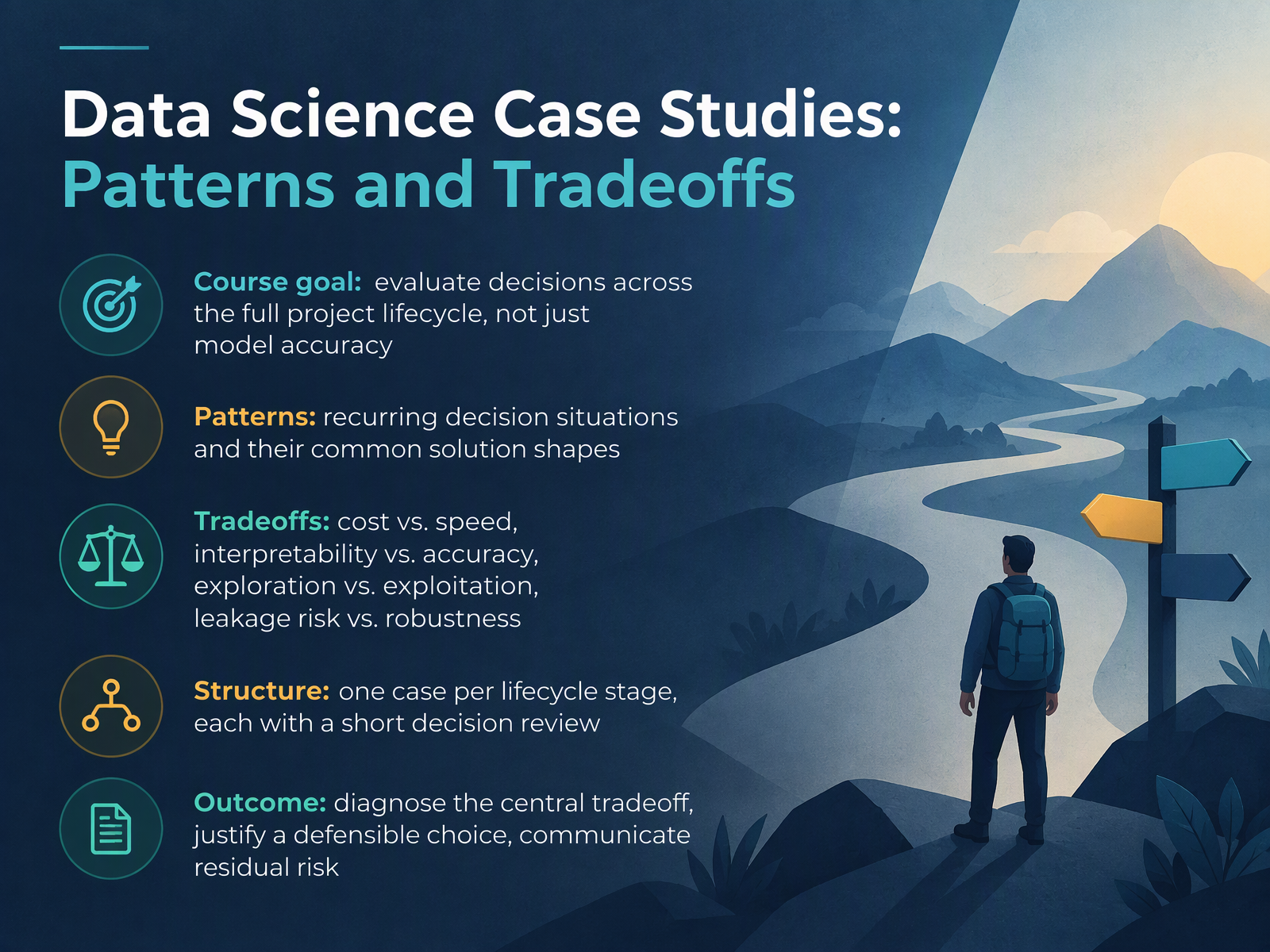
- 01Data Science Case Studies: Patterns and TradeoffsWelcome. I'm glad you're here. This course is about judging decisions across a full data project, not just model accuracy. We'll look at patterns, which are recurring decision situations and the solution shapes that tend to work. And we'll name the tradeoff behind each choice, for example cost versus speed, or interpretability versus accuracy. We'll also cover exploration versus exploitation, and leakage risk versus robustness. Leakage means information reaching the model that it wouldn't have at prediction time. The structure is simple. One case per lifecycle stage, each ending with a short decision review. The Team Data Science Process and similar frameworks give us shared stages to anchor those cases. By the end, you'll be able to diagnose the central tradeoff, justify a defensible choice, and communicate residual risk. That's the risk left after your mitigation. Next, we'll look at why cases beat checklists.learn.microsoft.comdocs.databricks.comdomino.ai+22 min
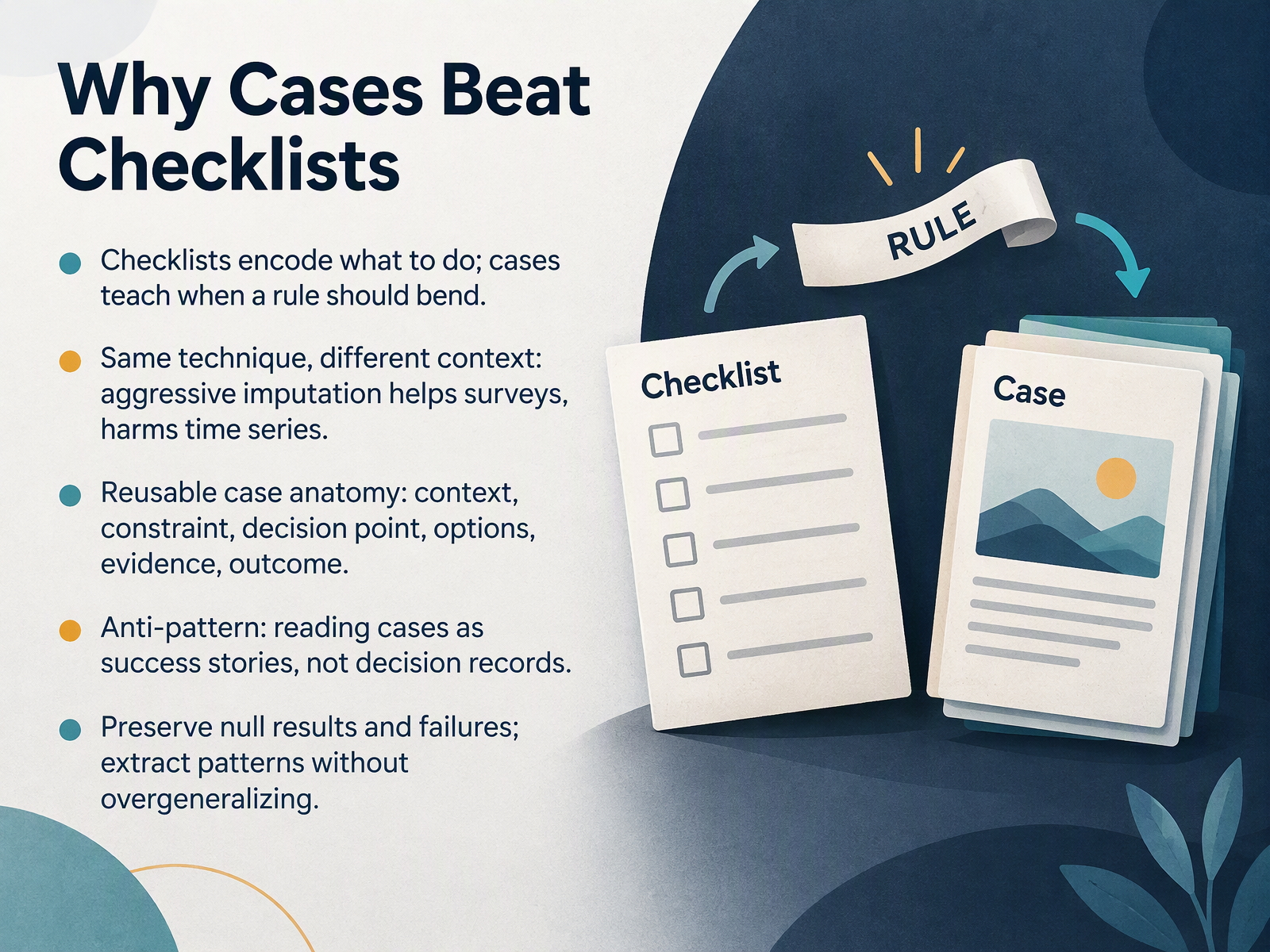
- 02Why Cases Beat ChecklistsSo why do cases beat checklists? A checklist tells you what to do. A case teaches you when a rule should bend. Consider imputation, which means filling in missing values. Aggressive imputation helps survey data, but it can harm time series, because it invents a trend that wasn't there. Same technique, different context. Good cases share a reusable anatomy: context, constraint, decision point, options, evidence, and outcome. One anti-pattern to avoid is reading cases as success stories instead of decision records. So preserve null results and failures too. Extract the pattern, but don't overgeneralize it. Next, we'll lay this out on The Lifecycle Decision Map.
 learn.microsoft.comdocs.databricks.comdomino.ai+21 min
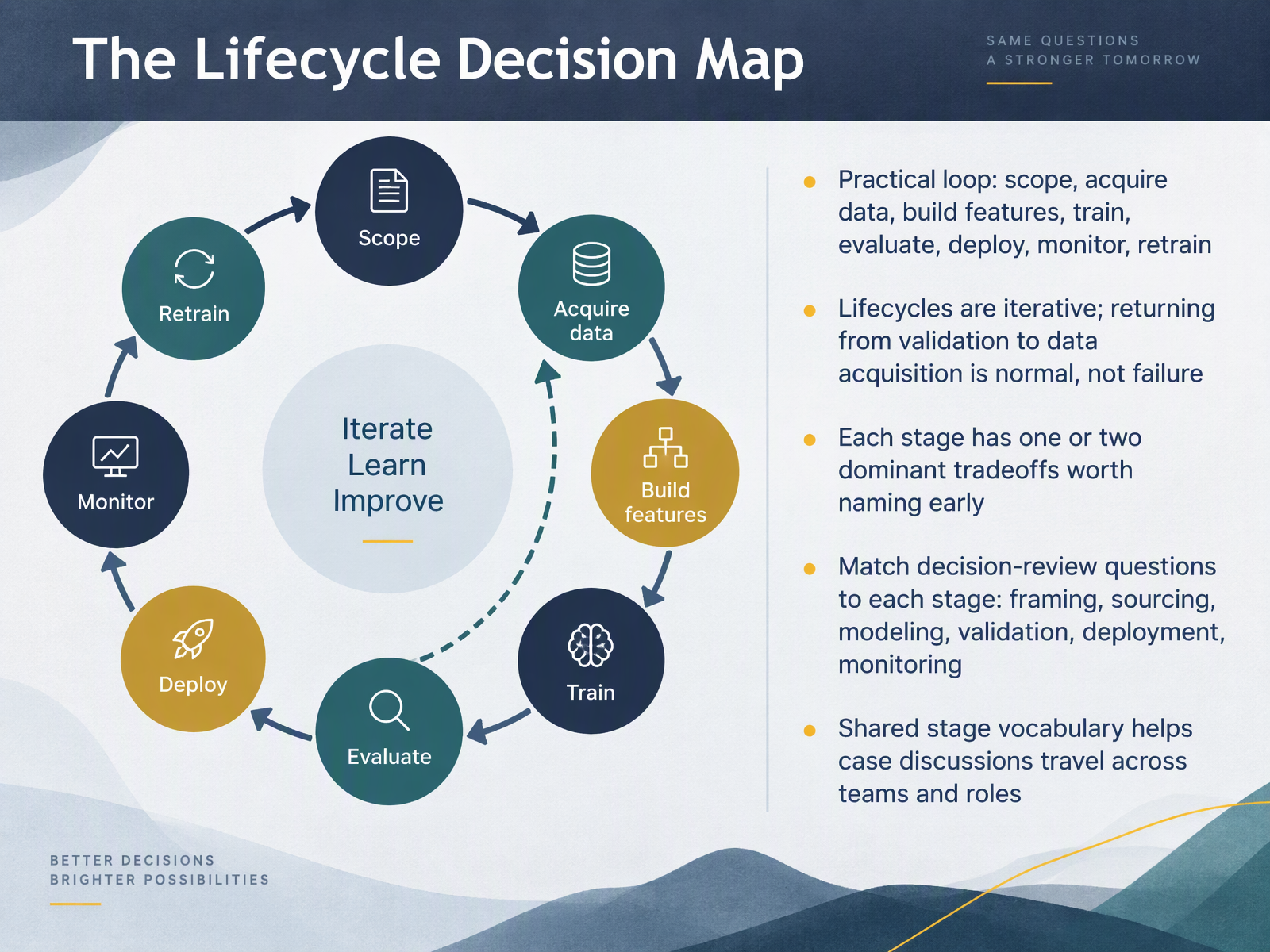
- 03The Lifecycle Decision MapLet's look at the lifecycle decision map. The practical loop runs from scope, to acquiring data, building features, training, evaluating, deploying, monitoring, and retraining. One thing to internalize early: these lifecycles are iterative. Going from validation back to data acquisition is normal, not failure. Each stage carries one or two dominant tradeoffs, and naming them early keeps the team honest. For example, at scoping you trade breadth of use case against speed to a first result. At data acquisition, you trade sample size against labeling cost and privacy constraints. Match your review questions to the stage: framing questions at scope, sourcing questions during acquisition, modeling and validation questions later, then deployment and monitoring questions near release. And a shared stage vocabulary lets case discussions travel across teams and roles. When everyone names the same stage, the tradeoff becomes easier to debate. Next, we turn to framing the problem and the metric.
 learn.microsoft.comdocs.databricks.comdomino.ai+22 min
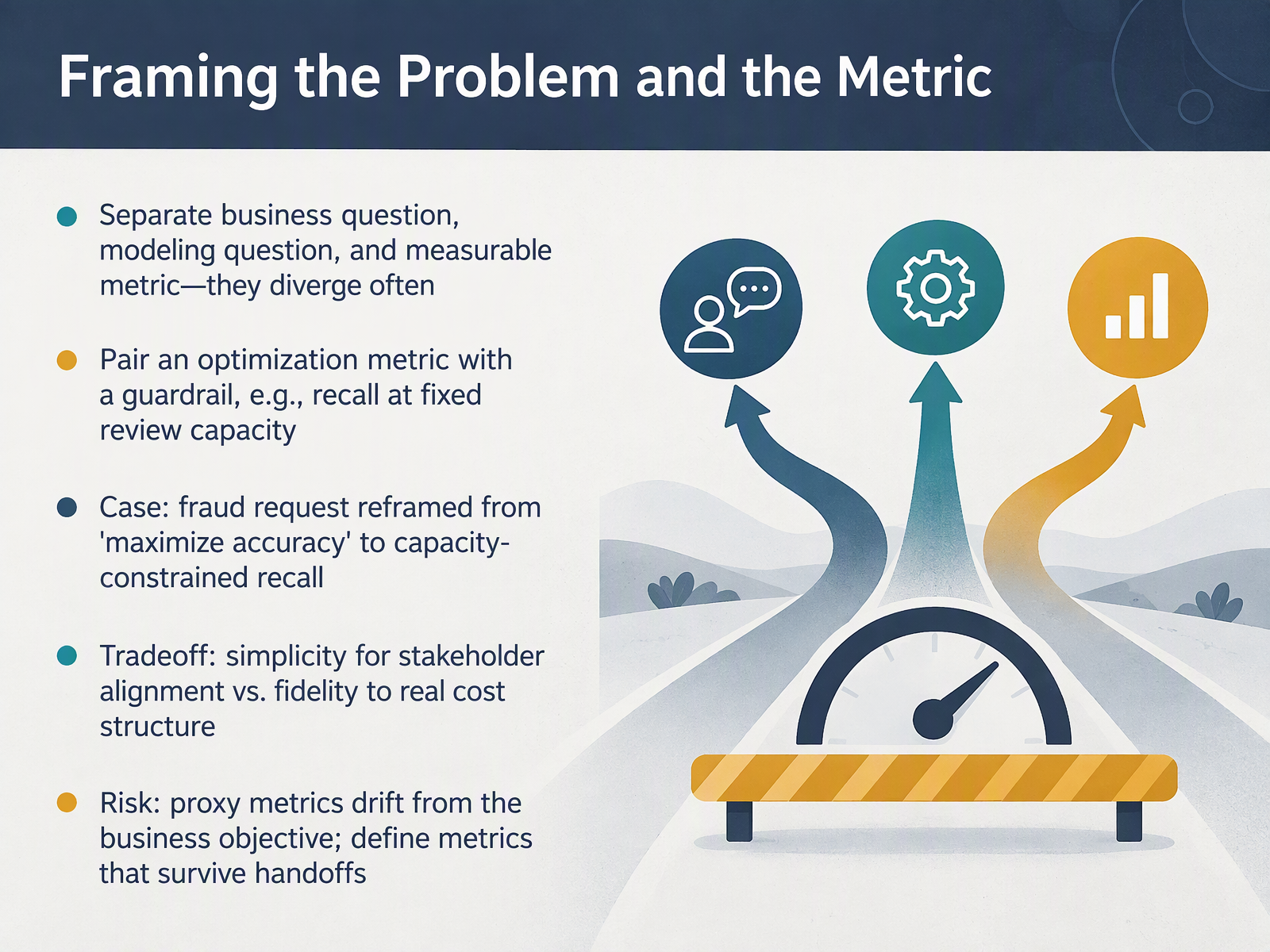
- 04Framing the Problem and the MetricLet's look at how to frame the problem and choose the metric. Start by separating three things: the business question, the modeling question, and the measurable metric. They often diverge, and naming each one keeps the team honest. Next, pair an optimization metric with a guardrail. For example, maximize recall at a fixed review capacity, so detection improves without overwhelming the reviewers. Consider a fraud request originally framed as maximize accuracy. Reframed as capacity-constrained recall, it matches the real workflow. The tradeoff is simplicity for stakeholder alignment versus fidelity to the real cost structure. The risk is that a proxy metric drifts from the business objective, so define metrics that survive handoffs. Next, we move to Data Sourcing and Leakage.
 arxiv.orgdoi.orgicaps23.icaps-conference.org+21 min
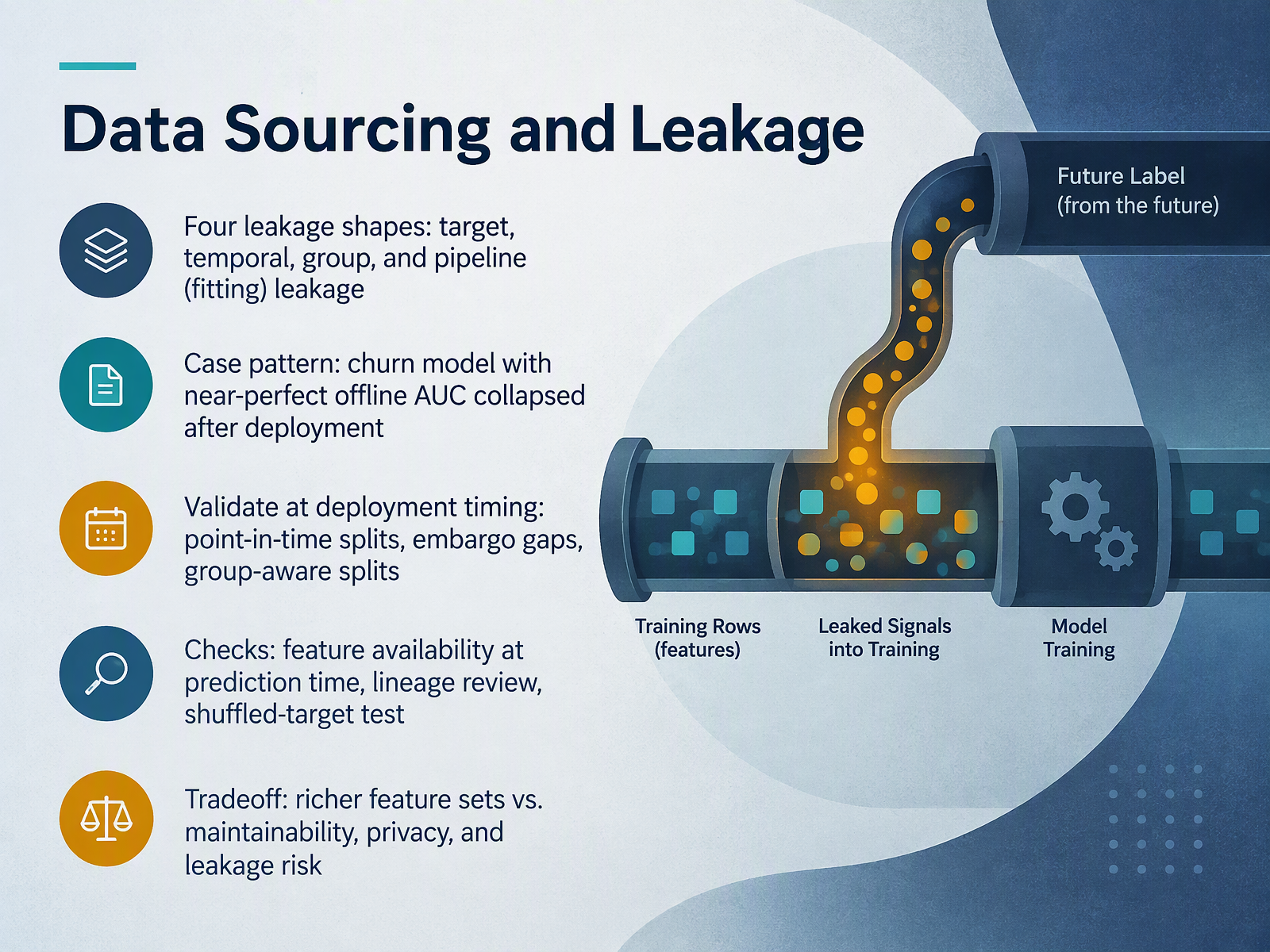
- 05Data Sourcing and LeakageNext, let's look at data sourcing and leakage. Leakage means your model sees information that will not exist when it makes a real prediction. There are four common shapes. Target leakage is when a feature secretly encodes the answer. Temporal leakage is when future data slips into training. Group leakage is when related rows appear in both training and test. Pipeline leakage is when you fit a scaler or selector on all the data before splitting. A classic case is a churn model with near-perfect offline AUC that collapsed after deployment. The fix is validation that matches deployment timing. Use point-in-time splits, embargo gaps, and group-aware splits. Run three checks. Confirm each feature is available at prediction time, review data lineage, and run a shuffled-target test. The tradeoff is real. Richer feature sets can add predictive power, but they also raise risk and reduce maintainability and privacy. Now, let's move on to interpretability versus accuracy.
 temporalcv.readthedocs.iorefontelearning.comeinarolafsson.github.io+22 min
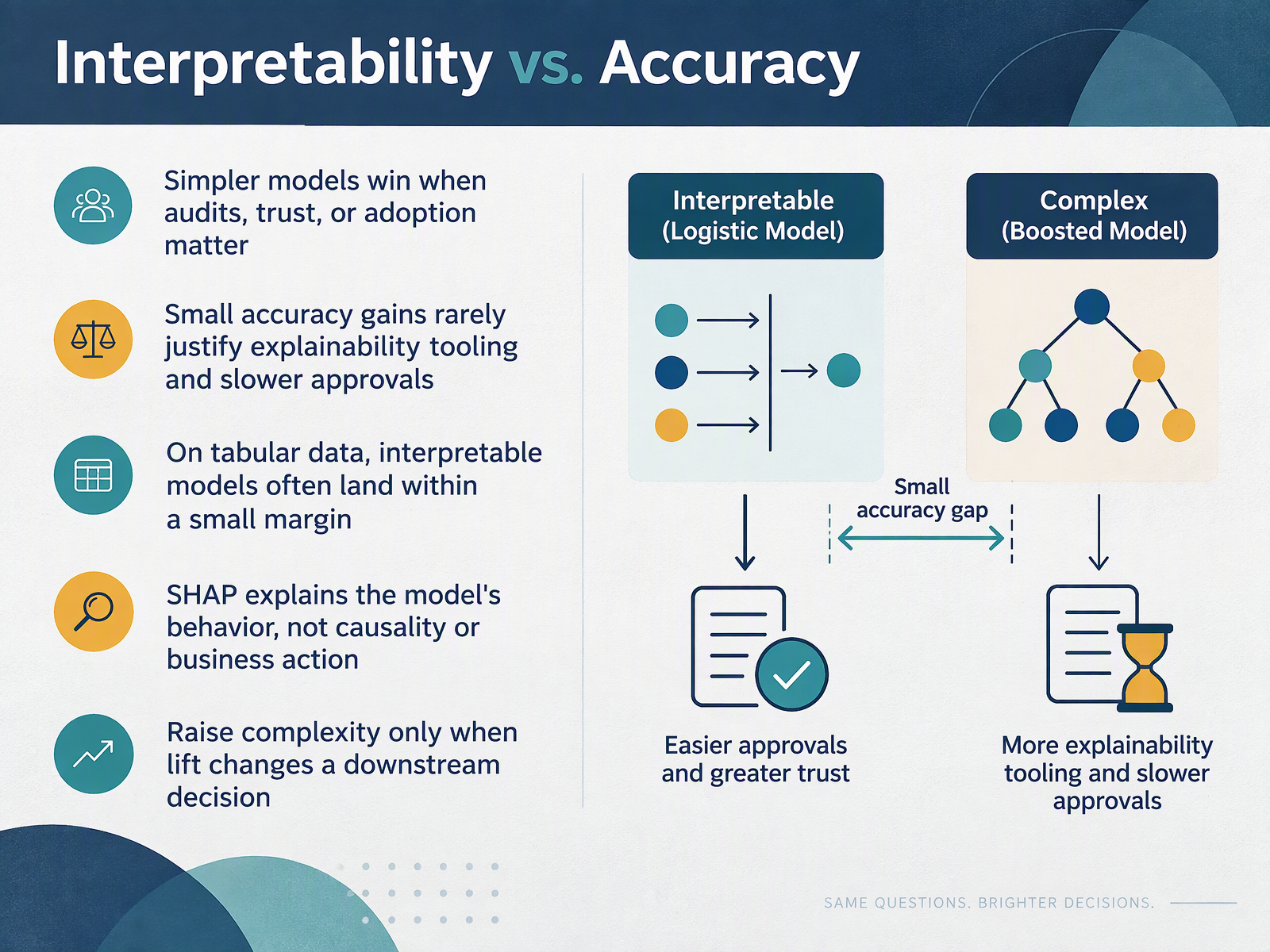
- 06Interpretability vs. AccuracyOur next pattern is the tradeoff between interpretability and accuracy. Interpretability means a person can read the model directly and see why it made a prediction. Simpler models win when audits, trust, or adoption matter. A small accuracy gain rarely justifies explainability tooling and slower approvals. On tabular data, interpretable models often land within a small margin of complex ones. And SHAP explains the model's behavior, not causality or business action. So raise complexity only when the lift changes a downstream decision. That is the pattern. Now let's look at Validation, Backtesting, and Errors That Lied.
 pmc.ncbi.nlm.nih.govdl.acm.orgpmc.ncbi.nlm.nih.gov+21 min
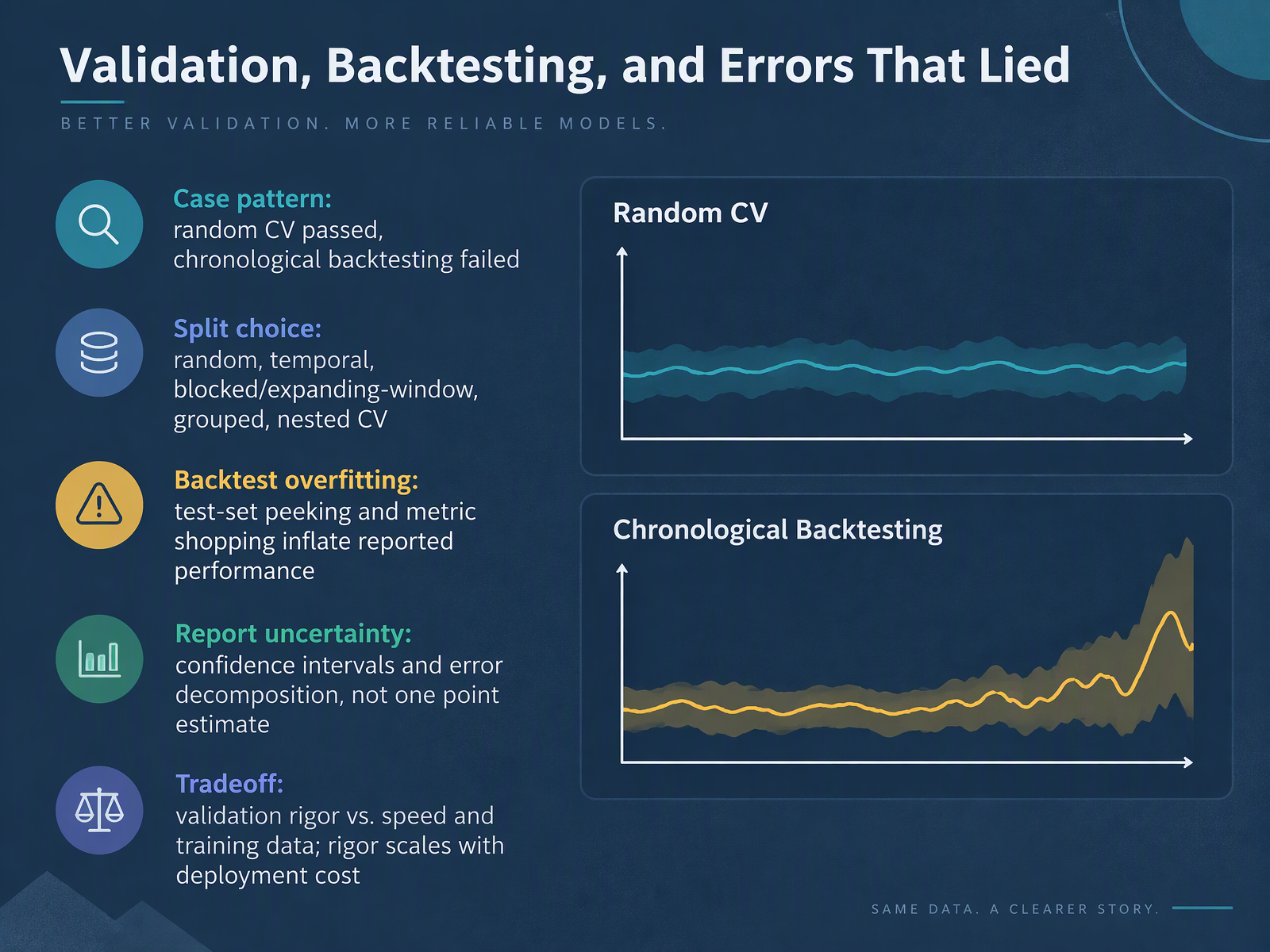
- 07Validation, Backtesting, and Errors That LiedLet's look at a pattern many teams learn the hard way. Random cross-validation passes, but chronological backtesting fails. Cross-validation means holding data out to estimate performance. When rows in time are correlated, a random split lets the model peek at the future, so the estimate looks optimistic. The split choice matters. Random splits suit independent rows. Temporal splits keep training before testing. Blocked or expanding-window splits add a gap to reduce carryover. Grouped splits keep related records together, and nested cross-validation separates tuning from evaluation. Watch for backtest overfitting. Test-set peeking and metric shopping inflate reported performance. Instead of one point estimate, report confidence intervals and decompose errors by segment. The tradeoff is validation rigor versus speed and available training data. Rigor should scale with deployment cost. Next, we move to deployment patterns: shadow, canary, rollback.
 temporalcv.readthedocs.iorefontelearning.comeinarolafsson.github.io+22 min
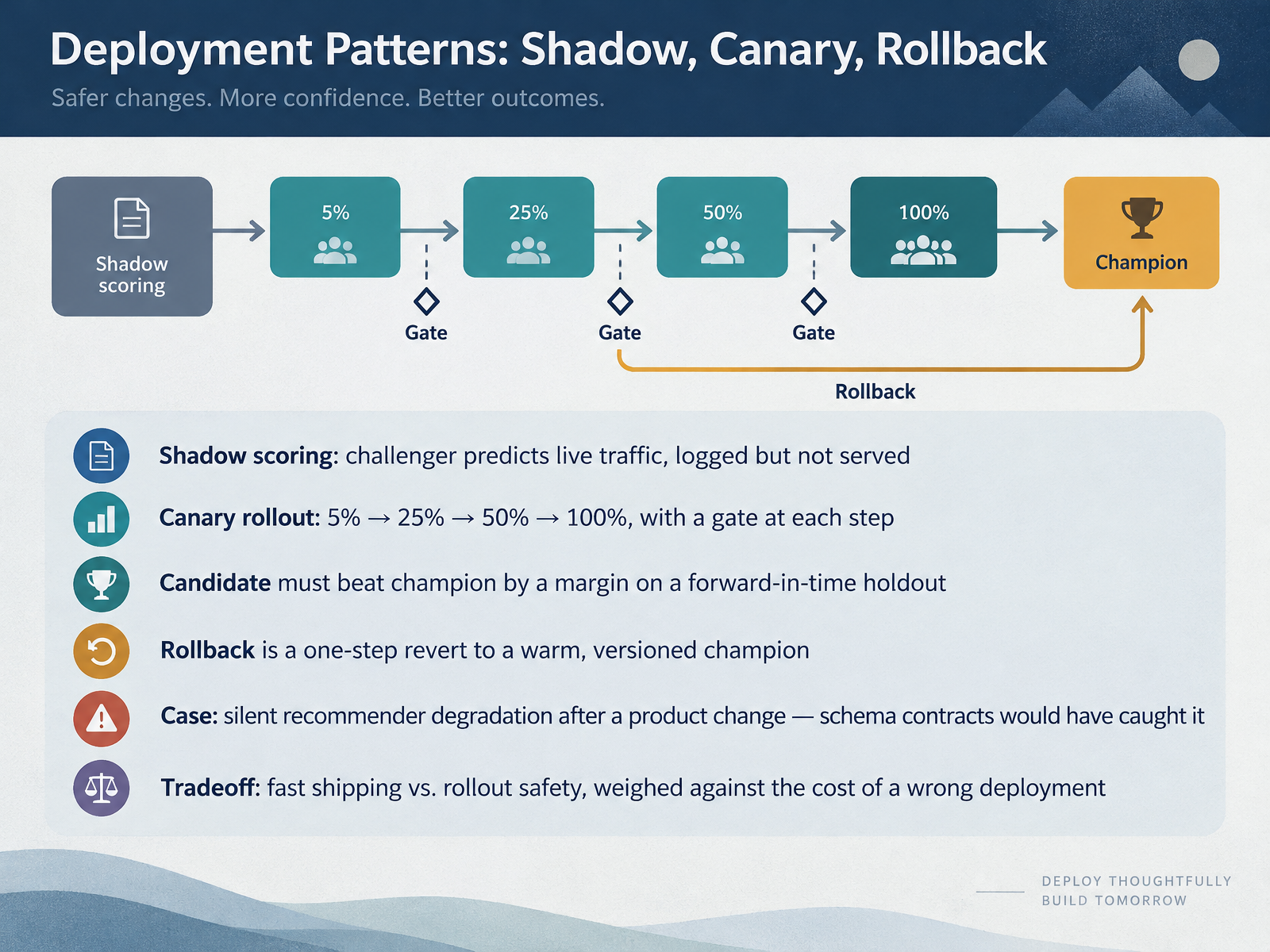
- 08Deployment Patterns: Shadow, Canary, RollbackNext, let's look at deployment patterns. Shadow scoring runs a challenger model on live traffic, but only logs its predictions without serving them. That lets you compare before anyone is affected. Canary rollout goes gradually: five percent, then twenty five, fifty, and one hundred percent, with a gate at each step. Before any rollout, the candidate must beat the champion by a margin on a forward-in-time holdout. A holdout means data the model never saw during training. Rollback should be a one-step revert to a warm, versioned champion, so you can recover in seconds. One case: a recommender degraded silently after a product change. Schema contracts would have caught it, because a contract checks that incoming data matches expected fields. The tradeoff is fast shipping versus rollout safety, weighed against the cost of a wrong deployment. Coming up next, monitoring and retraining tradeoffs.
 2 min
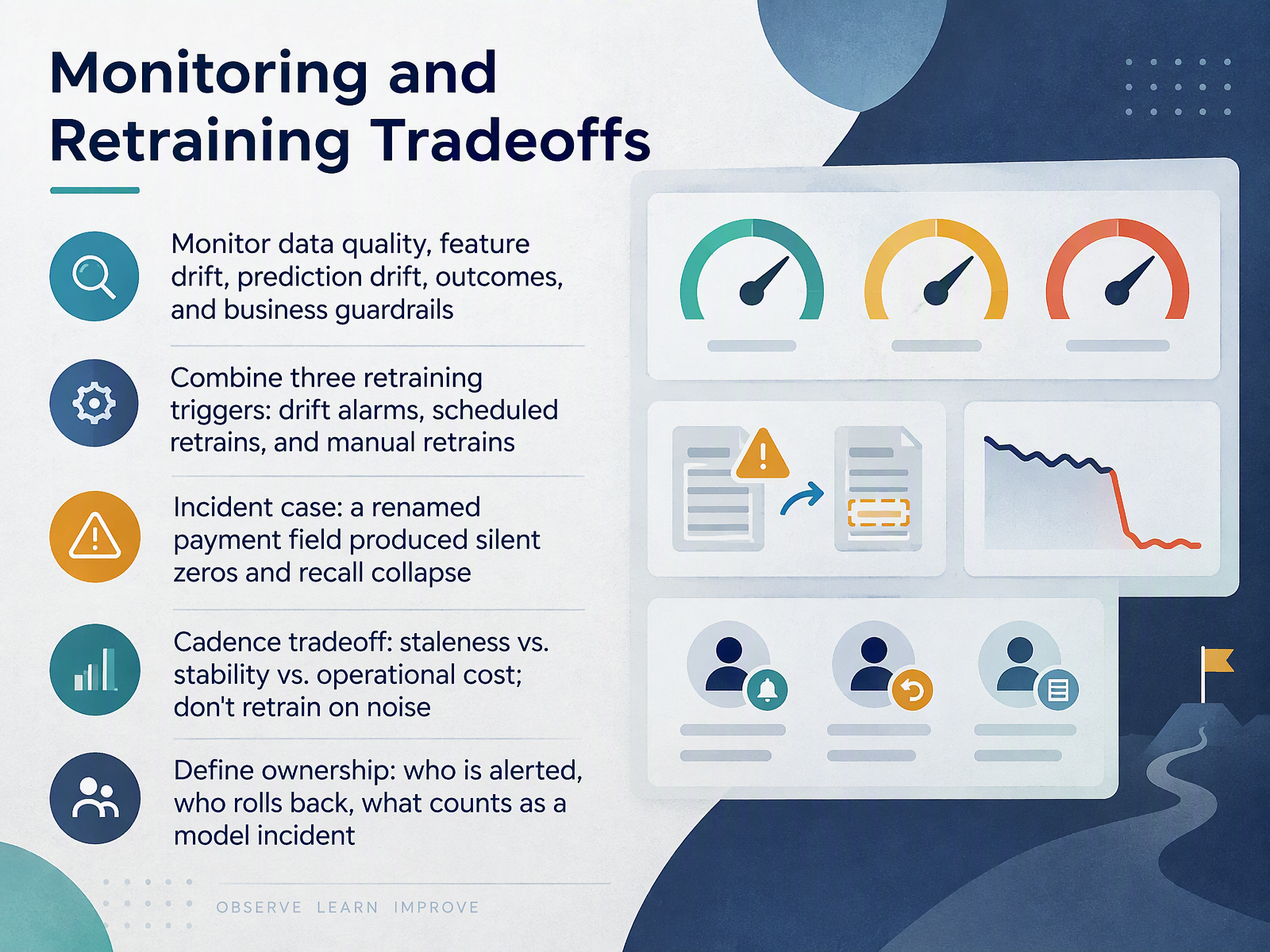
- 09Monitoring and Retraining TradeoffsNow let's talk about monitoring and retraining tradeoffs. Monitor five things: data quality, feature drift, prediction drift, outcomes, and business guardrails. Feature drift means the input distributions shifted. Prediction drift means your scores changed shape. Combine three retraining triggers: drift alarms, scheduled retrains, and manual retrains. Threshold-only triggering misses slow drift, and schedule-only is wasteful and laggy. Consider a real incident. An upstream pipeline renamed a payment field, and serving silently produced zeros. Recall collapsed before anyone noticed. That is why schema checks matter. Now the cadence tradeoff: staleness versus stability versus operational cost. Retraining on noise makes results worse, not better. Finally, define ownership. Who gets alerted, who rolls back, and what counts as a model incident. If no one owns the rollback, the model stays broken. Next, we move to fairness, privacy, and risk.
 2 min
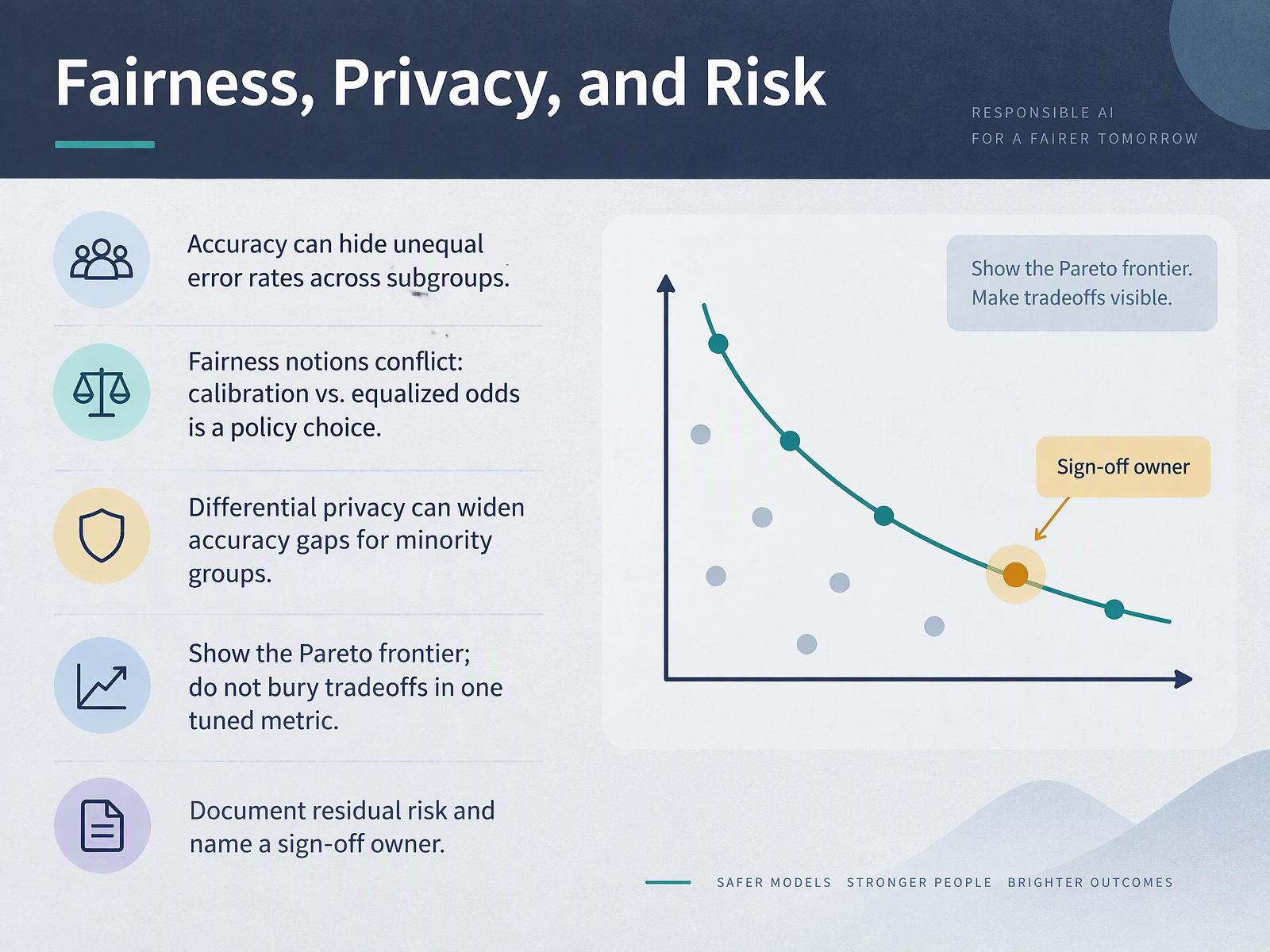
- 10Fairness, Privacy, and RiskNext, let's look at fairness, privacy, and risk. For fairness, start with a simple check. Overall accuracy can hide unequal error rates across subgroups. A model may look strong on average while failing one group more often. Fairness definitions also conflict. For example, subgroup calibration and equalized odds cannot both hold except in trivial cases. Choosing between them is a policy decision, not a technical default. On privacy, differential privacy adds noise to protect individuals. That noise can widen accuracy gaps for minority groups, especially with long-tailed data. So show the Pareto frontier instead of burying these tradeoffs in one tuned metric. A Pareto frontier maps options where improving one objective costs another, so decision makers can see the cost of each operating point. Finally, document residual risk and name a sign-off owner. That makes the accepted tradeoff explicit and accountable. Coming up next, Communicating Decisions and Residual Risk.
 2 min
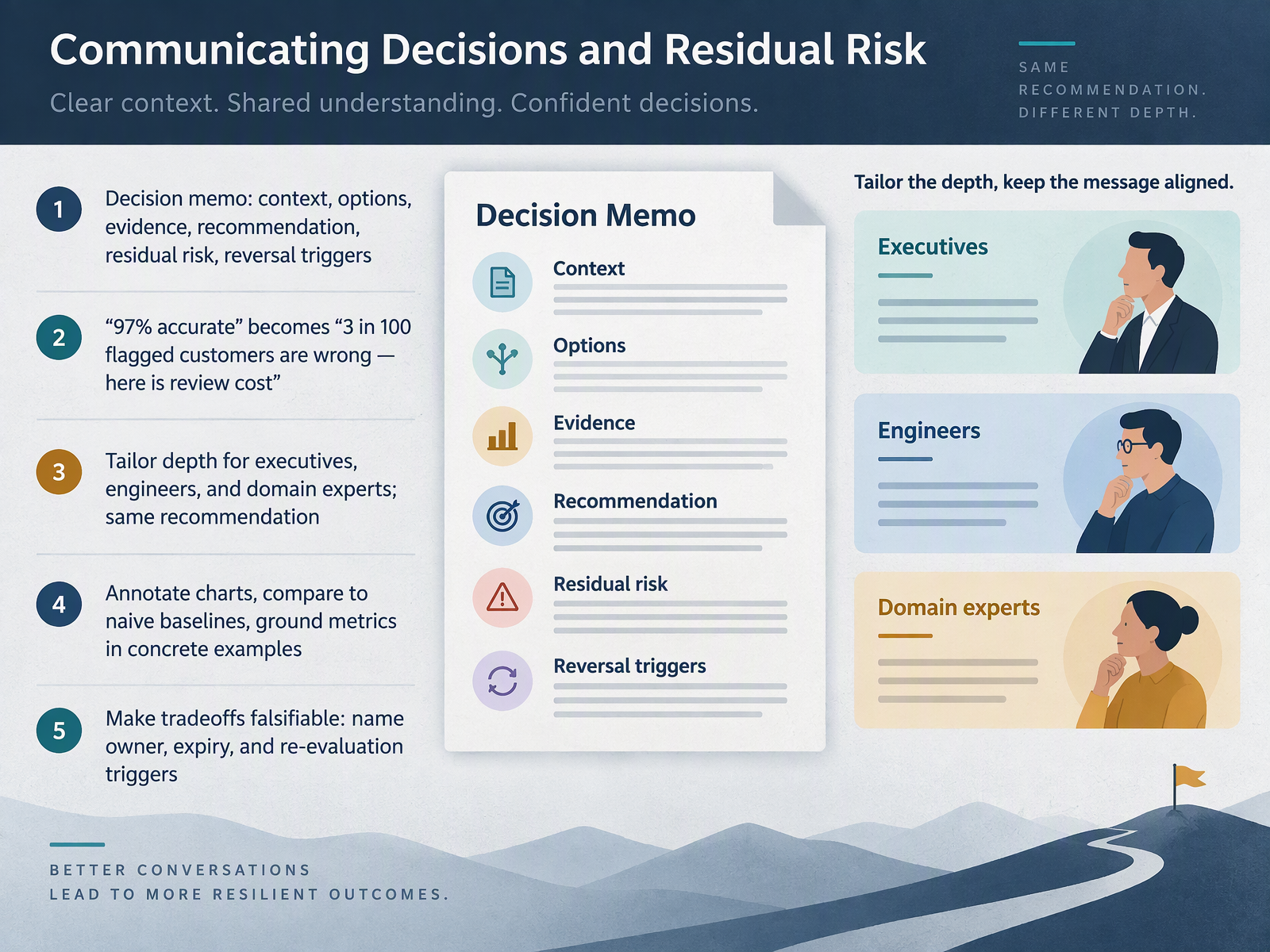
- 11Communicating Decisions and Residual RiskLet's look at how we communicate decisions and the risk that remains. A decision memo captures context, options, evidence, recommendation, residual risk, and reversal triggers. Residual risk means the error that stays after mitigation. Translate metrics into plain terms. "Ninety-seven percent accurate" becomes "three in one hundred flagged customers are wrong, and here is the review cost." Tailor depth for executives, engineers, and domain experts, but keep the same recommendation. Annotate charts, compare against a naive baseline, and ground metrics in concrete examples. Make tradeoffs falsifiable by naming an owner, an expiry date, and re-evaluation triggers. Next, we move into Case Clinic: Frame, Split, and Measure.
 1 min
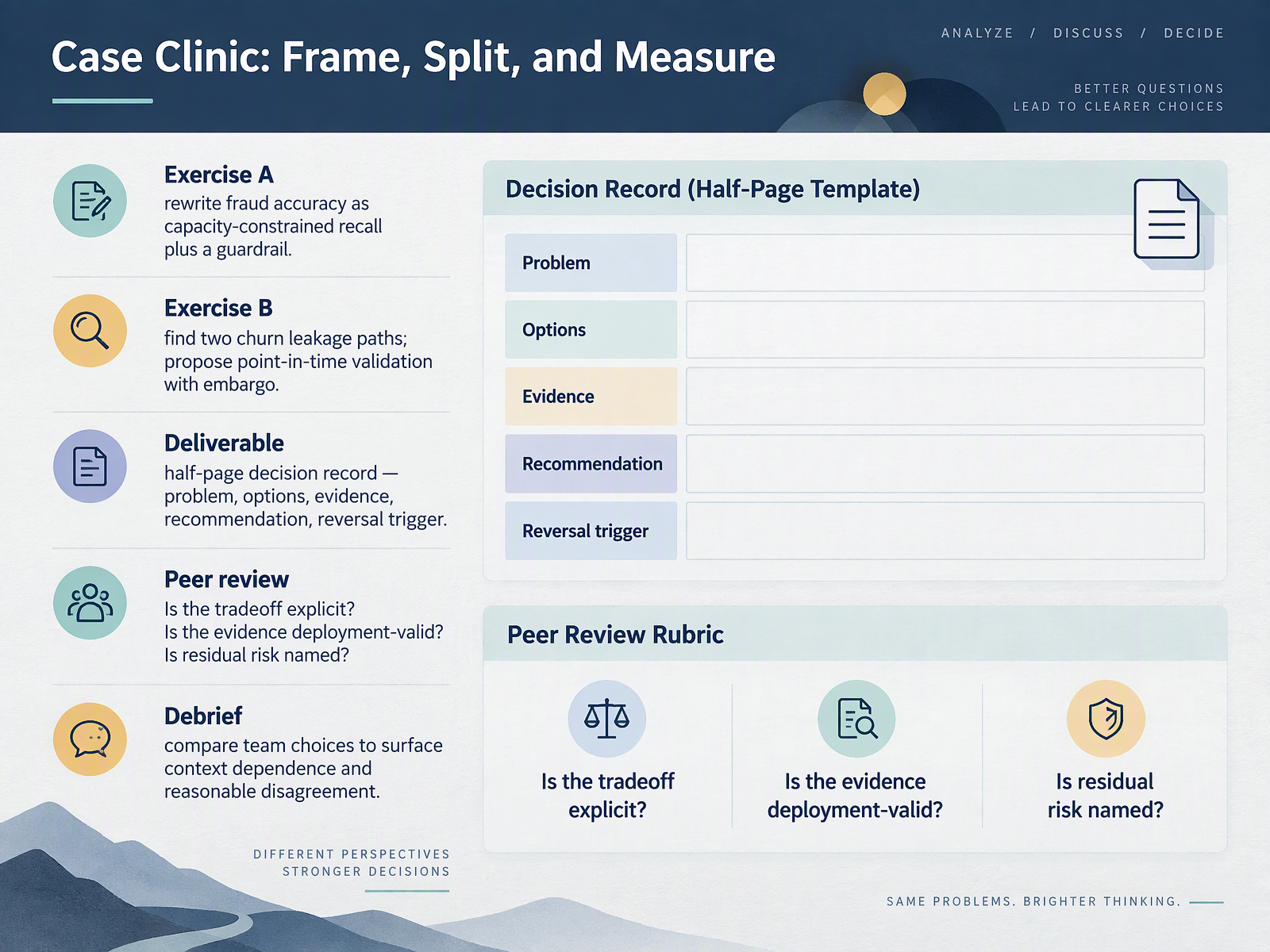
- 12Case Clinic: Frame, Split, and MeasureNow let's put these ideas into practice with a case clinic. You'll work in teams on two framing exercises. In Exercise A, rewrite fraud accuracy as capacity-constrained recall plus a guardrail. In plain terms, accuracy hides the cost of false positives and false negatives. So you tie detection to the number of cases your review team can actually inspect, and add a guardrail on false positives. In Exercise B, find two churn leakage paths, then test a point-in-time validation with an embargo. Leakage means using information that would not exist at prediction time. An embargo is a gap between training and test periods, so features built after a label cannot slip in. Each team writes a half-page decision record. It covers the problem, the options, the evidence, and your recommendation. Finish with a reversal trigger, which names what evidence would make you change course. Then peer review with three questions. Is the tradeoff explicit? Is the evidence deployment-valid? And is residual risk named? In the debrief, compare team choices to surface how context changes the right answer, and why reasonable people disagree. Next, we will move into the workshop and defend a tradeoff.
 arxiv.orgdoi.orgicaps23.icaps-conference.org+22 min
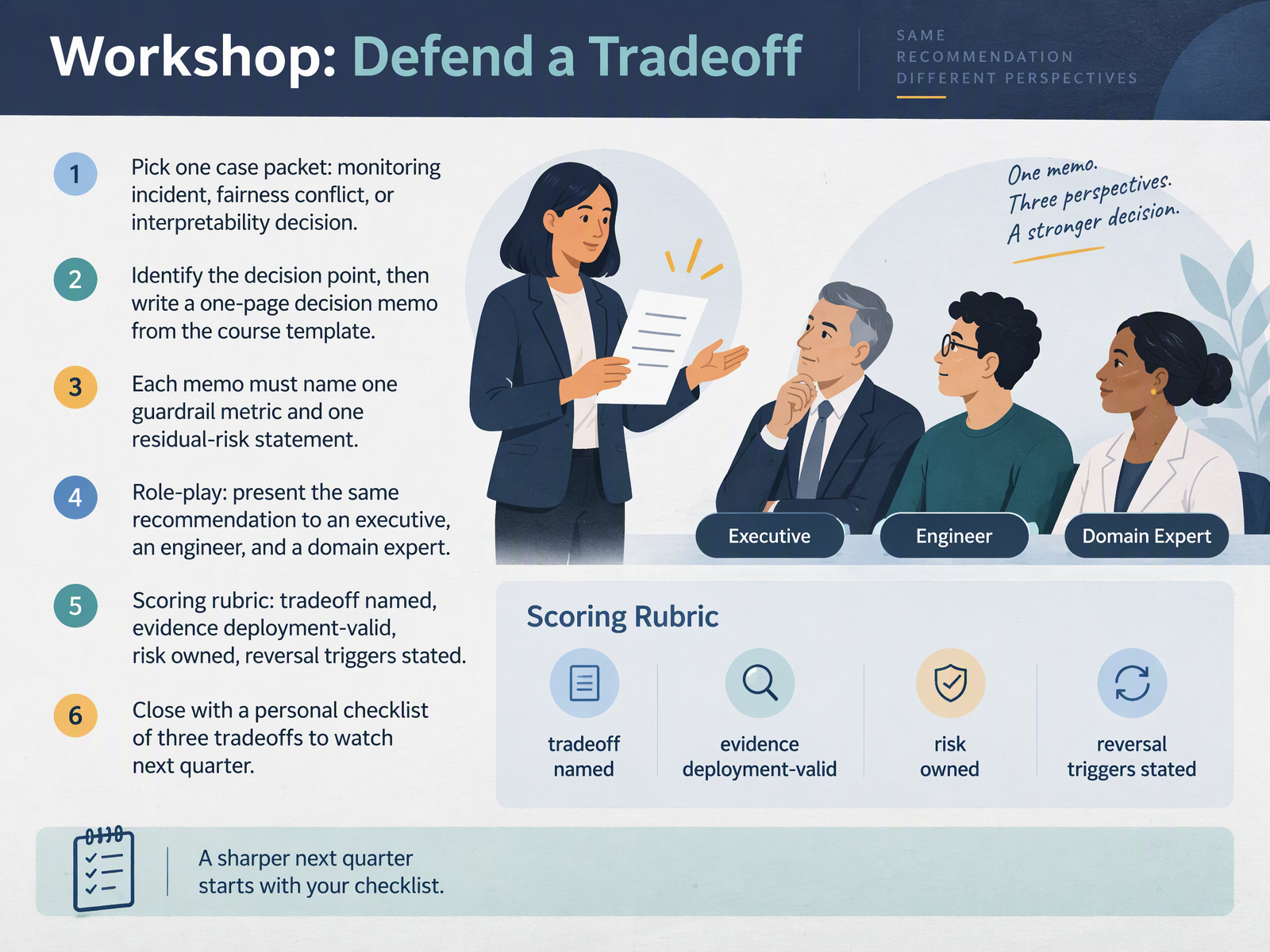
- 13Workshop: Defend a TradeoffNow it's your turn to practice. This workshop asks you to defend a tradeoff out loud. Start by picking one case packet: a monitoring incident, a fairness conflict, or an interpretability decision. Identify the decision point, then write a one-page decision memo using the course template. Each memo must name one guardrail metric, a measure that catches harm before it spreads, and one residual-risk statement, meaning the risk you accept and still own. Then role-play the same recommendation three ways: to an executive, an engineer, and a domain expert. Your scoring rubric checks four things: the tradeoff is named, the evidence is valid for deployment, the risk is owned, and reversal triggers are stated. Reversal triggers are the conditions that would make you change course. Close by writing a personal checklist of three tradeoffs to watch next quarter. That checklist is the part you carry forward. Next, we move to Takeaways and Your Decision Checklist.
 2 min
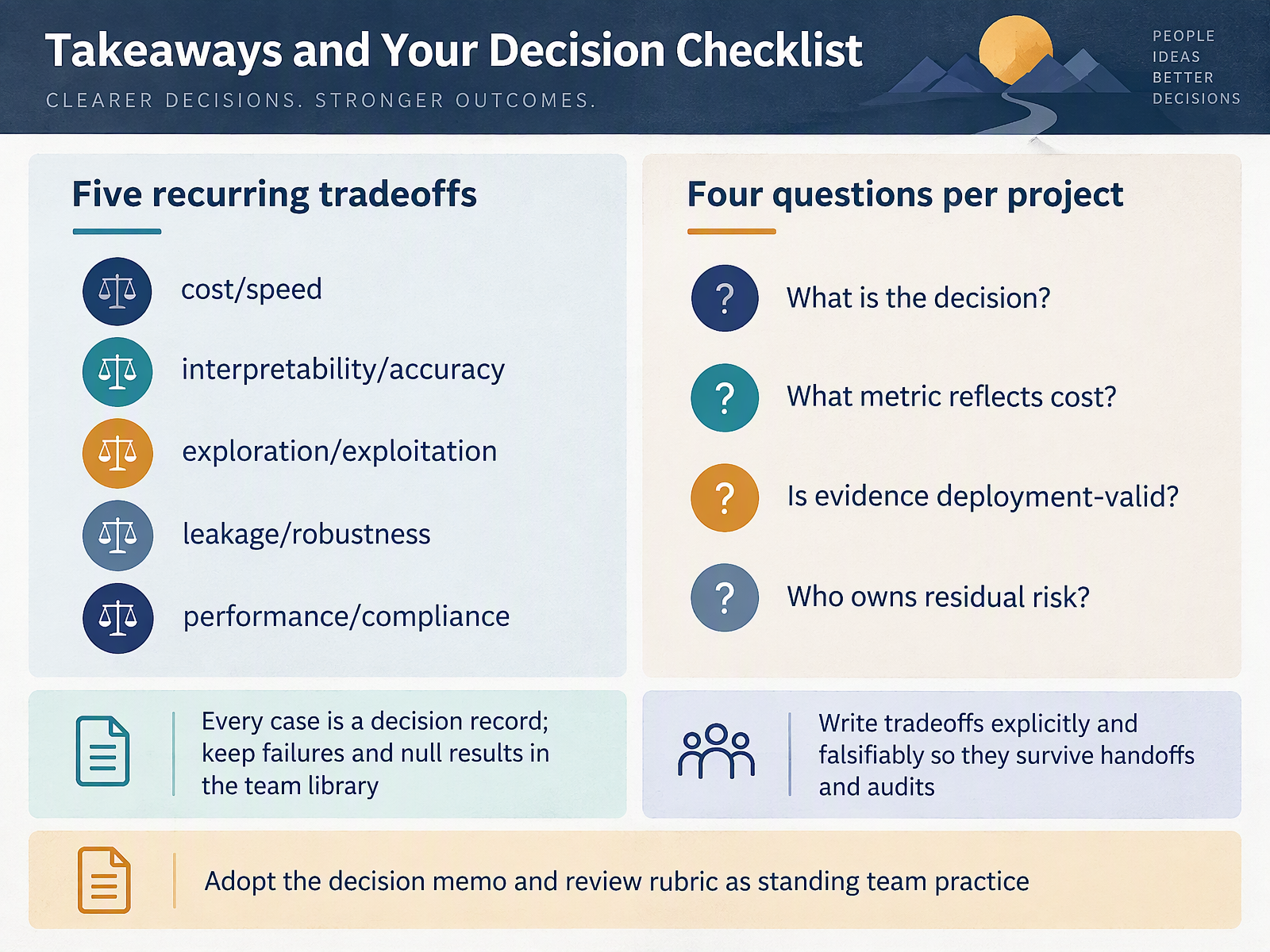
- 14Takeaways and Your Decision ChecklistLet's close by making these tradeoffs a habit. Five recurring tradeoffs show up across projects: cost versus speed, interpretability versus accuracy, exploration versus exploitation, leakage versus robustness, and performance versus compliance. None of these is wrong on its own. Each one changes what your project optimizes and who carries the cost. Before any project, ask four questions. What decision does this model change? What metric reflects the real cost? Is the evidence valid for deployment conditions? And who owns the residual risk? Treat every case and every decision as a decision record. Keep failures and null results in your team library, so colleagues don't repeat the work. Write tradeoffs explicitly and falsifiably, so they survive handoffs and audits. Adopt the decision memo and review rubric as standing practice. Thank you for learning with me. You now have a checklist you can use on your very next project. Keep asking those four questions, and you'll make better choices.
 learn.microsoft.comdocs.databricks.comdomino.ai+22 min
Take the deck with you
Download this course as a file — free, no sign-up needed.
- PDF handoutEvery slide page, ready to print or share.15 pages · 4.0 MBDownload
- Narrated PowerPointThe deck that presents itself — every slide carries the digital human's narration video.15 pages · 15.3 MBDownload
- PowerPoint slidesThe full deck as a .pptx — open it in PowerPoint, Keynote, or Google Slides.15 pages · 4.0 MBDownload
Free to use in your own training — please keep the PersonWise credit page at the end.
Have your own deck? Turn it into a course
Sources consulted
Web sources consulted while building this course.
- What is the Team Data Science Process? — learn.microsoft.com
- Machine learning lifecycle | Databricks on AWS — docs.databricks.com
- Data science project management | Domino Data Lab — domino.ai
- Data Science Project Development Approach | The GitLab Handbook — handbook.gitlab.com
- Docs/lifecycle-detail.md — github.com
- Tradeoffs in Streaming Binary Classification under Limited Inspection Resources — arxiv.org
- Cost-Sensitive Top- K Review for Capacity-Constrained Fraud Screening — doi.org
- Value Detection Rate: A Performance Metric for Payments Fraud Detection — icaps23.icaps-conference.org
- Introducing Cscore, a Cost-Aware Alternative for Model Assessment — arxiv.org
- https://arxiv.org/pdf/2005.02488 — arxiv.org
- Tutorial: Leakage Detection with Validation Gates ¶ — temporalcv.readthedocs.io
- Point-in-Time ML Validation: Stop Future Data Leakage — refontelearning.com
- Train/test leakage audit - spaCR 1.5.1.0 documentation — einarolafsson.github.io
- timefence v0.9.1 — pypi.org
- leakprobe v0.1.0 — pypi.org
- Stop Explaining Black Box Machine Learning Models for High Stakes Decisions and Use Interpretable Models Instead - PMC — pmc.ncbi.nlm.nih.gov
- It's Just Not That Simple: An Empirical Study of the Accuracy-Explainability Trade-off in Machine Learning for Public Policy — dl.acm.org
- Can a Transparent Machine Learning Algorithm Predict Better than Its Black Box Counterparts? A Benchmarking Study Using 110 Data Sets - PMC — pmc.ncbi.nlm.nih.gov
- Interpretable Companions for Black-Box Models — proceedings.mlr.press
- Reframing the Accuracy/Interpretability Trade-Off in Machine Learning — borisbabic.com