Risk Register Fundamentals
Begin
12 pages · ~24 min
Risk Register Fundamentals
Learn to identify, assess, and document project risks by creating a comprehensive risk register to proactively manage threats and opportunities.
What you’ll learn
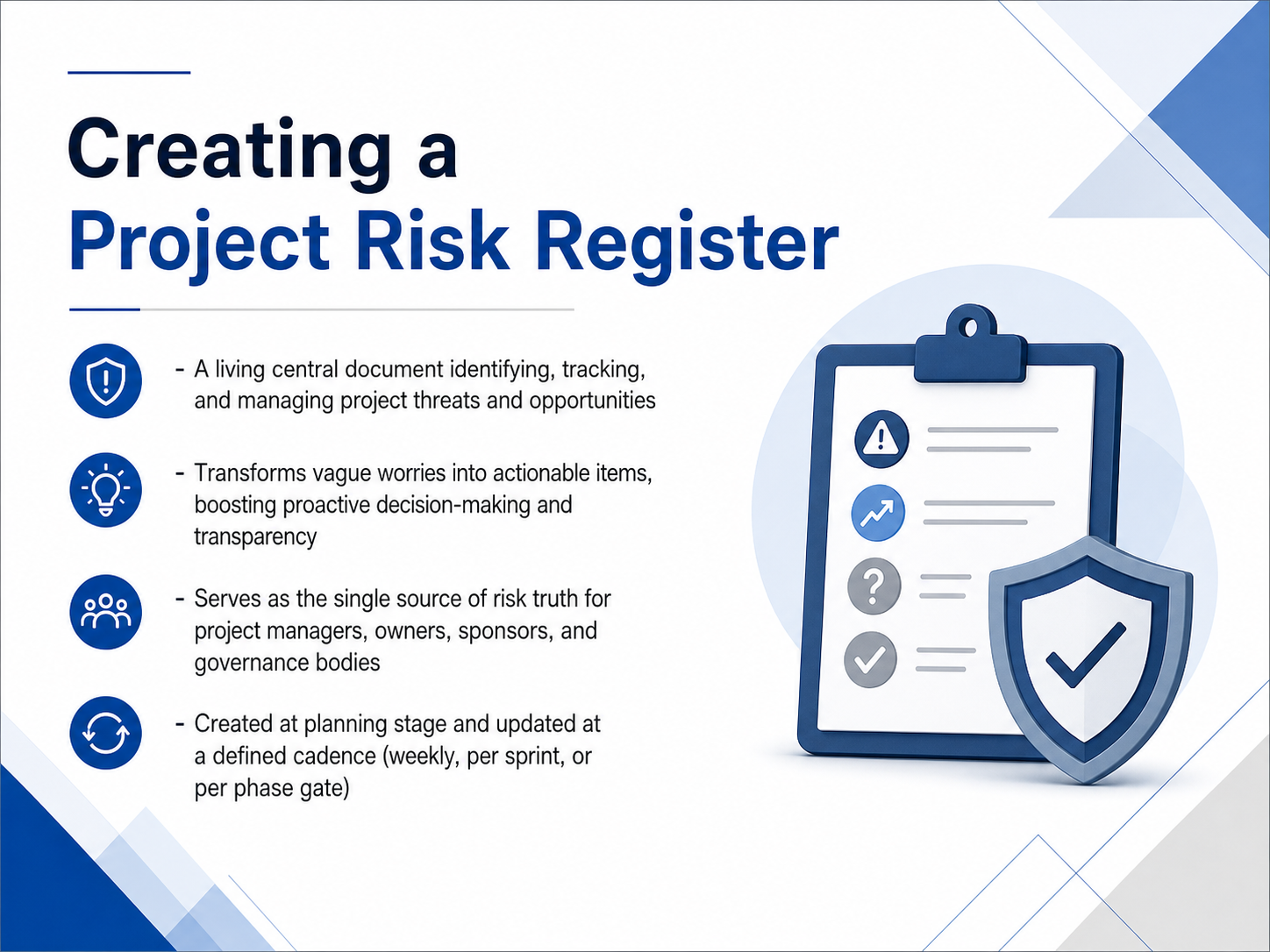
- 01Creating a Project Risk RegisterWelcome. In this session, we are going to build one of the most practical tools in project management: the project risk register. Our goal is straightforward. We will take those vague worries that circle around a project and transform them into structured, actionable items that can be reviewed and assigned. Think of the risk register as a living, central document. It is the single source of truth that identifies, tracks, and manages both threats and opportunities. You create it during the planning stage, but it does not sit on a shelf. You will update it at a defined cadence, whether that is weekly, per sprint, or at each phase gate. This process boosts proactive decision-making and provides full transparency for you, your sponsors, and any governance body. Let's start by clarifying a fundamental distinction we touched on. Next up: Risk, Issue, or Assumption? Core Concepts.atlassian.comasana.comwrike.com+21 min
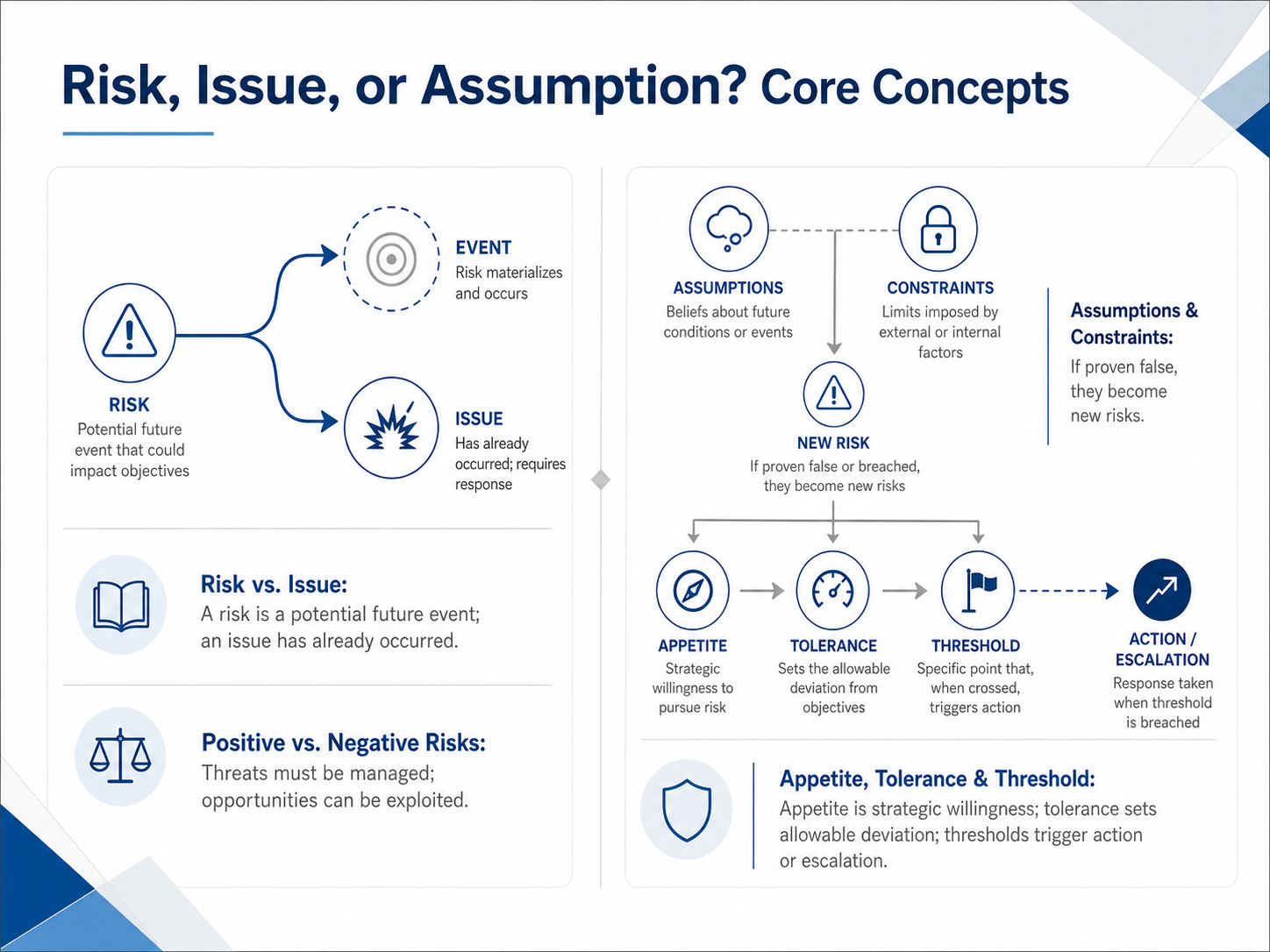
- 02Risk, Issue, or Assumption? Core ConceptsNow let's clarify the core concepts for your risk register. First, the difference between a risk and an issue. A risk is a potential future event that may impact your project. An issue has already occurred and needs immediate resolution. Next, consider positive and negative risks. Negative risks are threats that must be managed. Positive risks are opportunities you can exploit for project benefit. Also, watch your assumptions and constraints. If an assumption proves false, it immediately becomes a new risk to document. Finally, there's a hierarchy for measuring acceptable risk. At the top, risk appetite is the strategic willingness to take on uncertainty. Risk tolerance then defines the allowable deviation from the plan, like a ten percent cost overrun. The most granular level is the risk threshold, which is the specific trigger point that forces action or escalation, such as needing sponsor approval when a risk value exceeds fifty thousand dollars. These thresholds are what make your register actionable. Now, let's apply this to the anatomy of a risk register.
 44riskpm.comcontrolhorizon.ioadaptivegrc.com+22 min
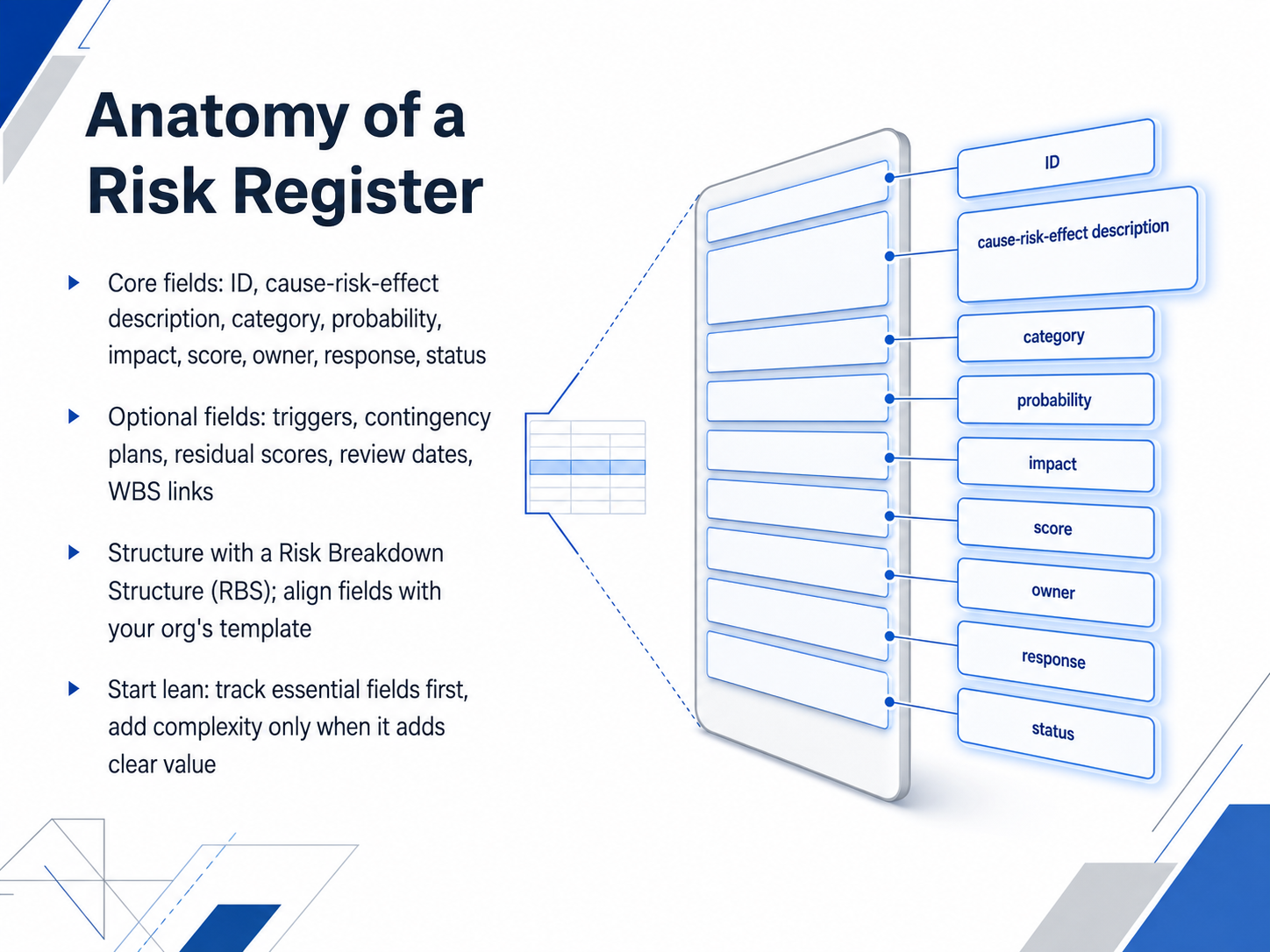
 - 03Anatomy of a Risk RegisterLet's look at the anatomy of a working risk register. A solid register turns vague worries into searchable, sortable, and assignable data. Your core fields should include a unique ID, a cause-risk-effect description, a category like technical or schedule, and probability and impact scores. Multiply those two scores to get a risk score that prioritizes what needs attention. Then assign an owner, define a response strategy, and track the status. Optional fields like triggers, contingency plans, and residual scores can come later. Start lean with the essential fields first. Add complexity only when the team agrees it adds clear value. A five-column register kept current is far better than an abandoned twelve-column spreadsheet. In the next slide, we'll practice writing actionable risk descriptions that give owners real traction.
 strategize.cloudasana.comsikhanaseekho.com+22 min
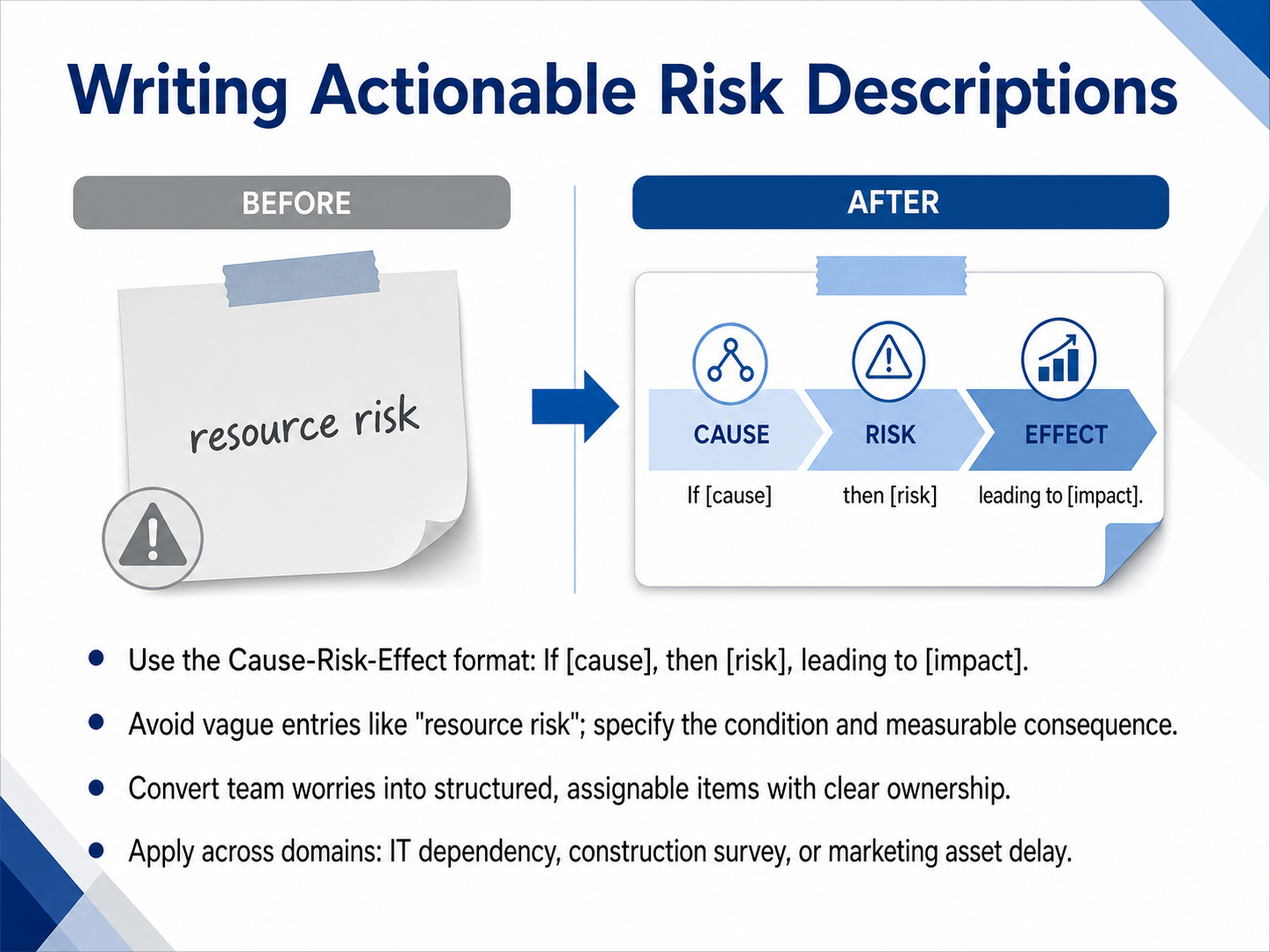
 - 04Writing Actionable Risk DescriptionsNow let's turn a team worry into an entry you can actually assign and track. The most reliable format is Cause-Risk-Effect. Think of it as a simple sentence: If this condition happens, then this risk occurs, leading to this measurable impact. For example, instead of writing vague labels like "resource risk," specify the condition. You might write: If the lead engineer is pulled onto the legacy system firefight, then the new release critical path loses its only senior developer, leading to a minimum two-week schedule slip. This format forces precision. It transforms a general anxiety, like a marketing team saying "what if our asset is late?" into a structured item with clear ownership. The description now tells everyone exactly what condition to watch for and what consequence will trigger escalation. This disciplined approach works across every domain, whether you are handling an I T dependency, a construction survey finding, or a delayed marketing asset. The output is always the same: an assignable risk item that leaves no room for ambiguity.
 strategize.cloudasana.comsikhanaseekho.com+22 min
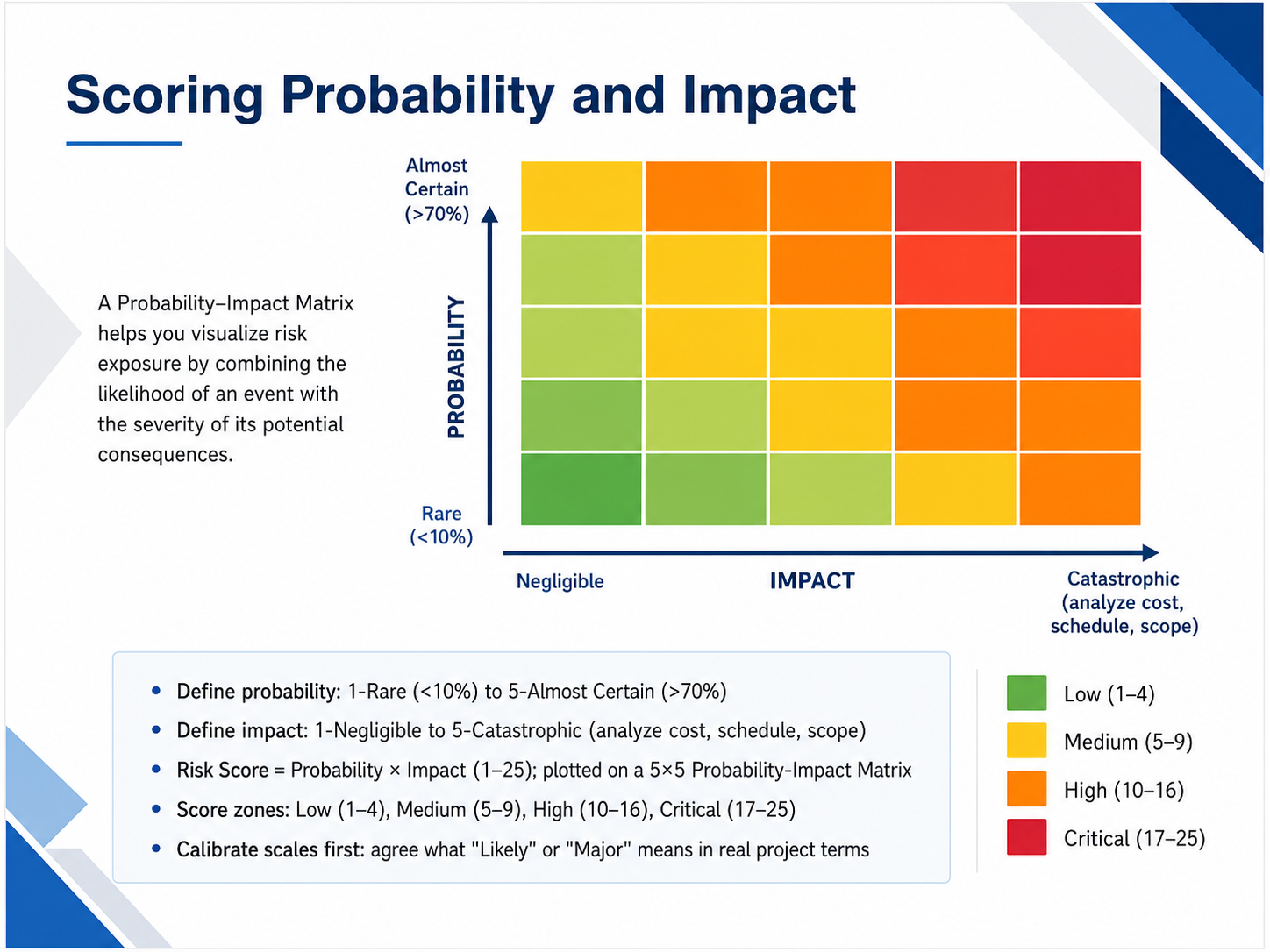
 - 05Scoring Probability and ImpactBefore we assign any scores, we need to agree on what the numbers actually mean in terms of our project. First, we define probability on a five-point scale. A score of one means Rare, with less than a ten percent chance of occurring. Five means Almost Certain, with over a seventy percent chance. We then define impact using the same five-point scale, from Negligible to Catastrophic, analyzing the effect on cost, schedule, and scope. Once our scales are calibrated, we calculate the Risk Score by multiplying probability by impact. This gives us a value ranging from one to twenty-five. We plot this score on a five-by-five matrix and classify it into color-coded zones. Scores one through four are Low, five to nine are Medium, ten to sixteen are High, and seventeen to twenty-five are Critical. This matrix turns our judgment into a ranked, actionable priority list. Now that we have our scores, let’s assign clear ownership to ensure every high-priority risk has someone accountable.
 projectmanagementformula.commonday.comresources.rework.com+22 min
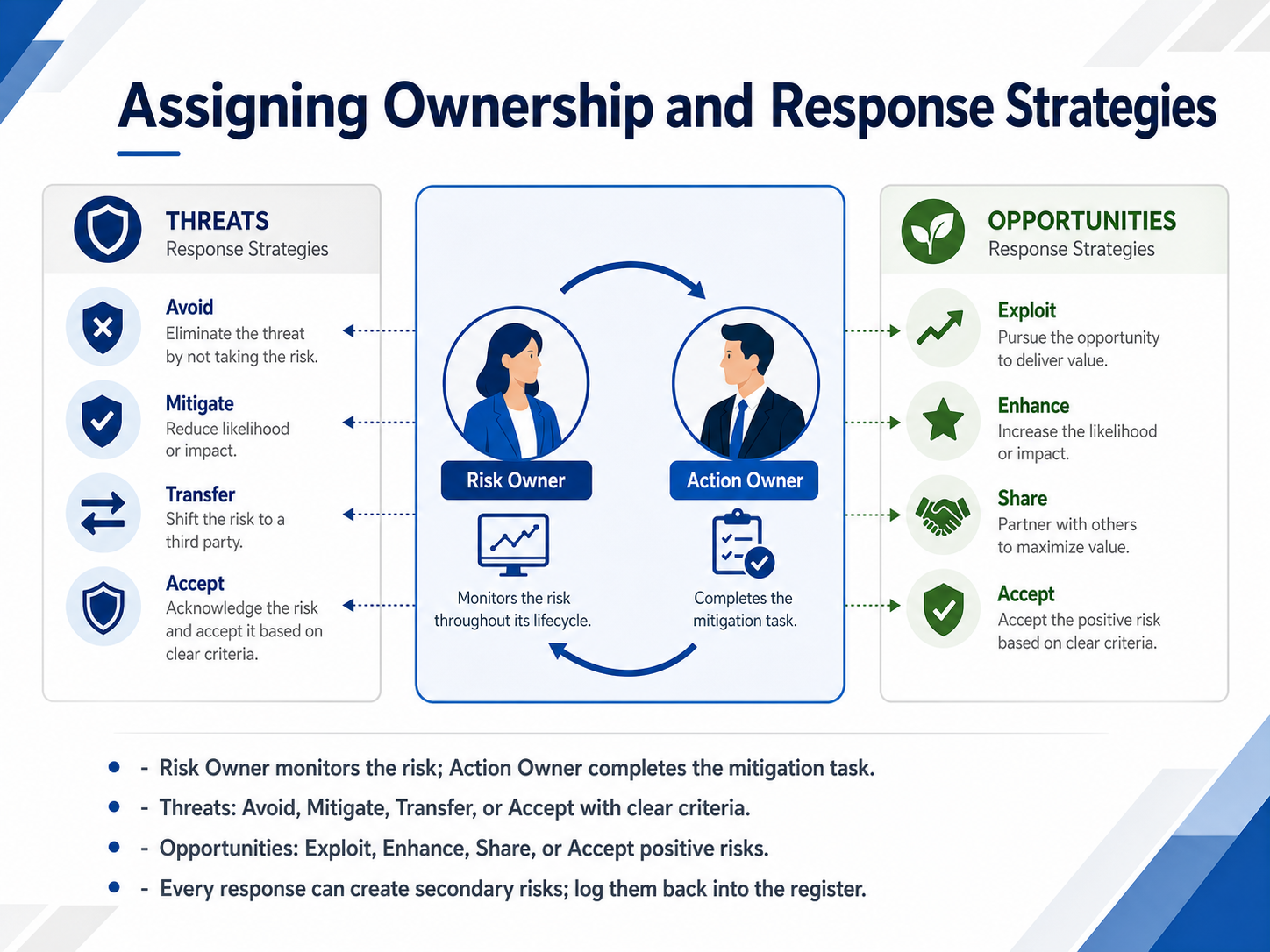
 - 06Assigning Ownership and Response StrategiesLet's talk about how a risk moves from a line item to someone's actual responsibility. Every risk needs two owners: a Risk Owner and an Action Owner. The Risk Owner keeps an eye on the risk, watching for triggers and monitoring whether the probability or impact changes. The Action Owner is the person who actually executes the mitigation tasks when the time comes. Splitting these roles keeps oversight separate from execution and prevents things from falling through the cracks. Next, we need to choose the right response strategy. For threats, you have four options. You can avoid the risk entirely by changing the plan, mitigate it to reduce its probability or impact, transfer it to a third party like an insurer, or accept it with clear criteria and management approval. For positive risks, what we call opportunities, we flip the script. You can exploit them to make sure they happen, enhance their probability, share ownership with a partner, or accept them too. One critical rule: every response you choose can create secondary risks. If you transfer a risk to a vendor, you've just created a vendor reliability risk. If you accept a risk, you create a monitoring burden. Every new risk gets logged right back into the register as its own entry, with its own owners and scores. That's what keeps your register complete and honest. Now, let's look at how this whole document gets woven into your regular project routines.
 atlassian.comasana.comwrike.com+22 min
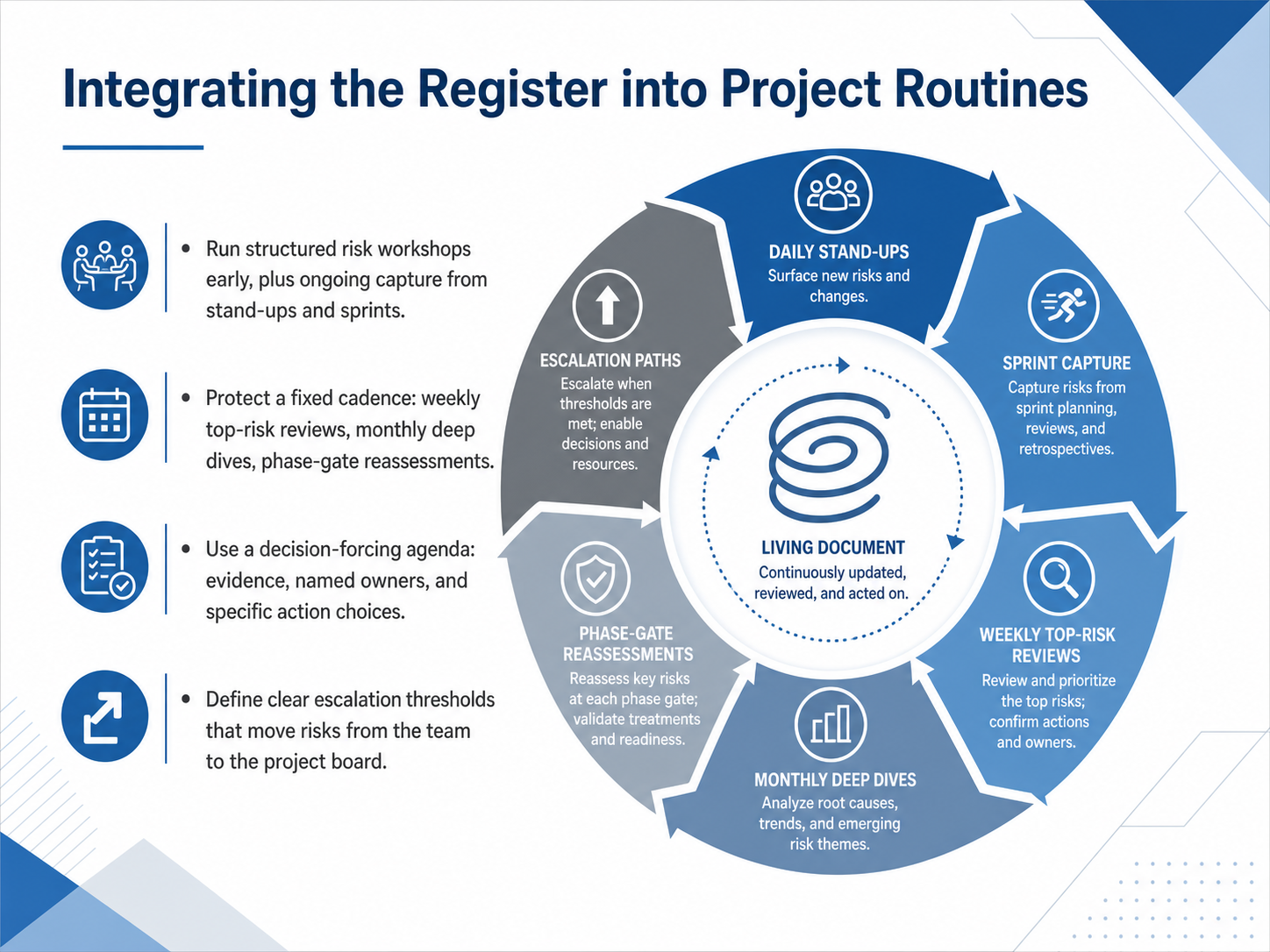
 - 07Integrating the Register into Project RoutinesNow let's make the risk register a living part of how you run the project. Integration into your routines is where most registers either deliver real value or become empty paperwork. Start by running structured risk workshops early, and then keep the capture going continuously from your stand-ups and sprint reviews. Protect a fixed cadence on the calendar. Block a short weekly window for top-risk reviews with named owners. Add a monthly deep dive where you challenge exposure changes and control effectiveness. And at every phase gate, hold a formal reassessment before committing to the next stage. Inside those meetings, use a decision-forcing agenda. Every item should present evidence that can change a choice, name the specific owner, and surface the action decision required. Do not let the conversation drift into status reporting. Finally, define clear escalation thresholds upfront. When a risk exceeds the team's authority or a critical control is weak, it must move structurally to the project board, not stay buried in a verbal handoff. This turns your register from a static list into a decision engine. Next, we put these principles straight into practice in our simulation: Building a Register Step by Step.
 andrezaaraujo.com2 min
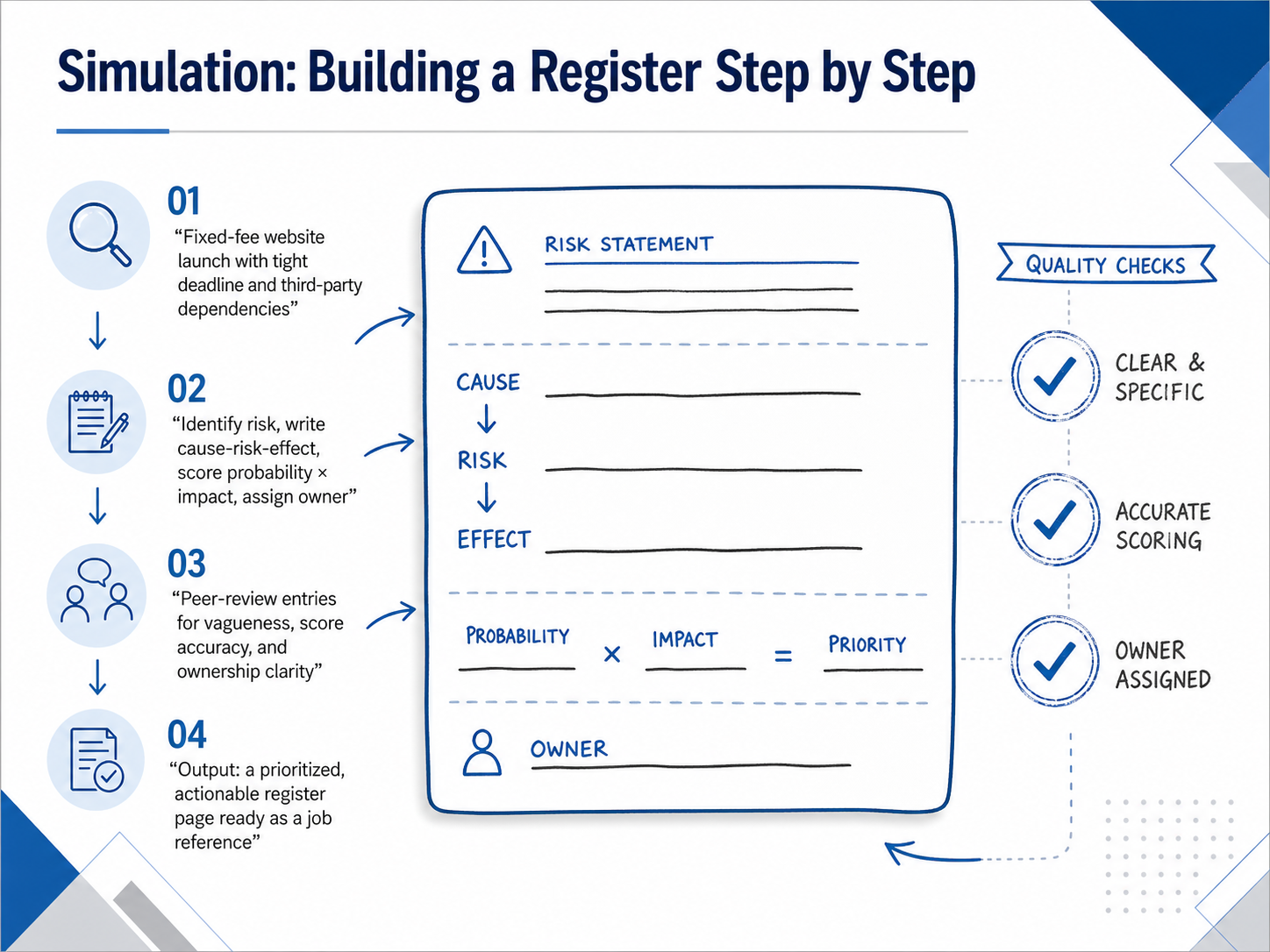
 - 08Simulation: Building a Register Step by StepLet's put the entire process into practice with a simulation based on a fixed-fee website launch. The project has a tight deadline and several third-party dependencies, which makes it a perfect risk management case study. You'll start by identifying a risk, then write it out as a clear cause-risk-effect statement. Next, you'll score its probability and impact, multiply them together to get a risk score, and assign a single owner who is accountable for monitoring it. After you've drafted your entries, you'll peer-review each other's work. You'll look for vague descriptions, check if the scores are justified, and confirm that every risk has a clearly named owner. The output is a prioritized, actionable register page that you can keep and use as a job reference. This isn't just theory. You're building a real document that turns uncertain threats into tracked, manageable items. Next, we'll move into spotting and correcting the most common mistakes people make when filling in a risk register.
 strategize.cloudasana.comsikhanaseekho.com+22 min
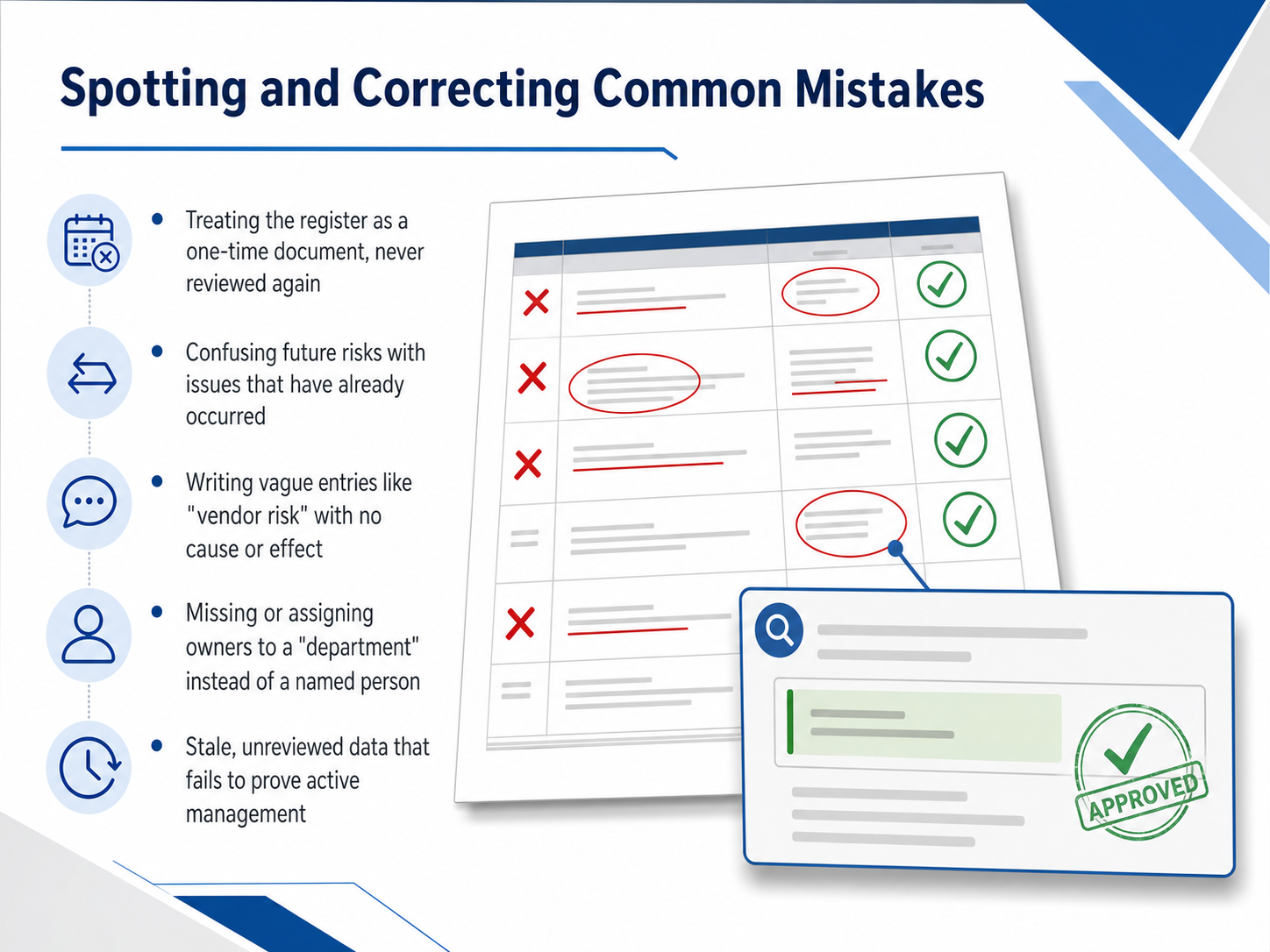
 - 09Spotting and Correcting Common MistakesLet's look at the five mistakes that quietly turn a risk register into a useless file. First, treating the register as a one-time document you create and never open again. A register that hasn't been reviewed in months shows the auditor that risk management is not active. Second, mixing up future risks with issues that have already happened. A vendor delay that occurred last week is an issue, not a risk. The register is for what might happen next. Third, writing vague entries like just the word vendor risk. Without a clear cause and a clear impact, no one can assign an owner or build a real response. Fourth, assigning risk ownership to a department instead of a named person. When a risk is owned by a group, it is owned by no one. You need a specific accountable individual. And fifth, letting data go stale. Outdated scores and unreviewed entries cannot prove active management. A living register is your best defense during an audit. Let's take that foundation and turn it into actionable intelligence.
 1 min
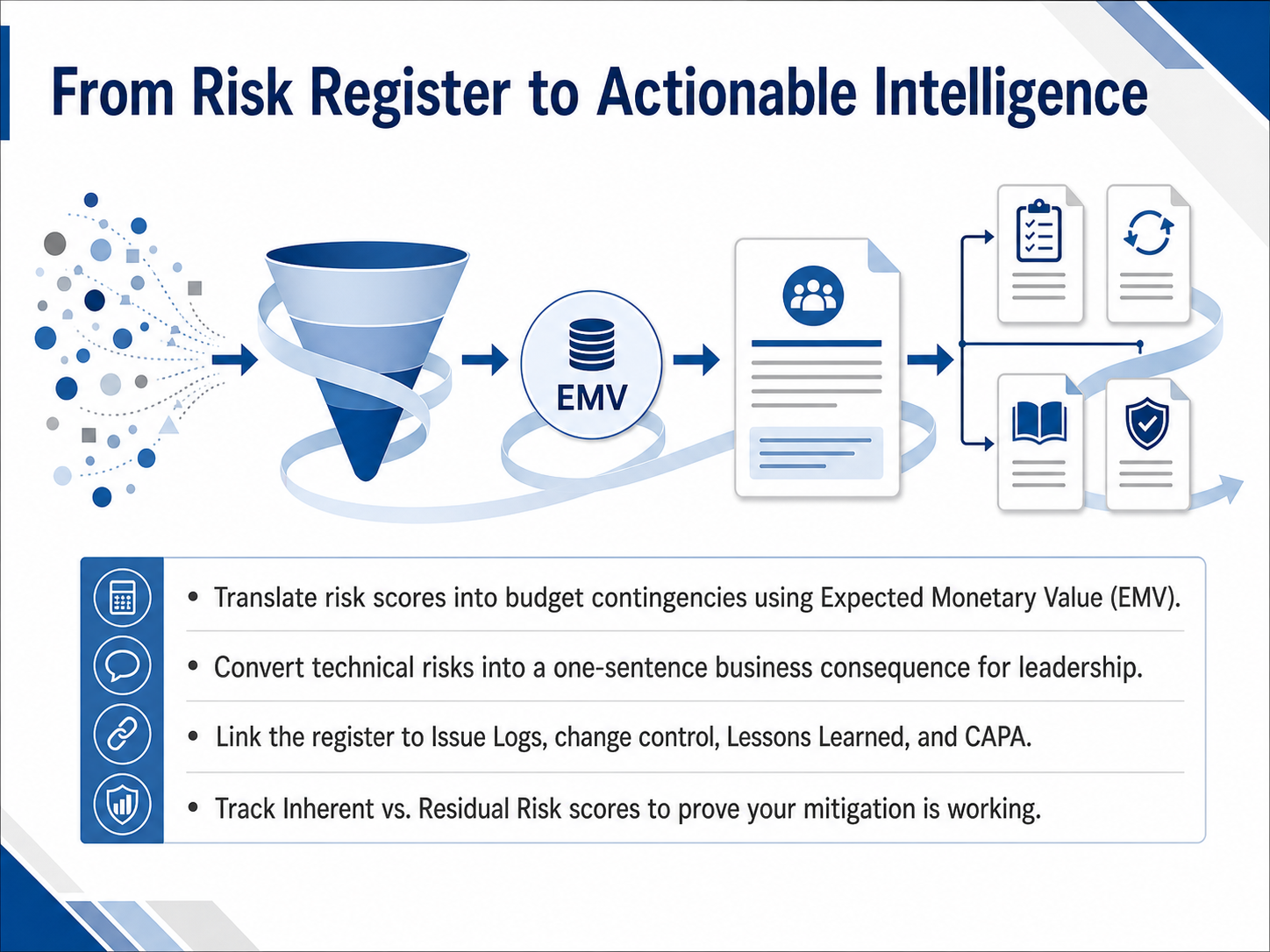
1 min - 10From Risk Register to Actionable IntelligenceNow let's turn our risk register into actionable intelligence for your leadership team. First, translate your risk scores into budget contingencies using Expected Monetary Value. Multiply the probability percentage by the estimated cost impact for each risk. The sum of these values gives you a defensible number for your contingency reserve request, directly linking the register to financial planning. Next, convert technical risks into business consequences in one sentence. Instead of saying 'inadequate patch management,' state the real impact: 'unpatched systems could expose us to a regulatory fine and a week of operational downtime.' This translation ensures leadership understands what is at stake. Then, maintain strong connections between your register and other governance tools. Link risks to issue logs, change control records, lessons learned, and corrective and preventive action plans. This creates a traceable chain that auditors can follow from identification to resolution. Finally, track both inherent and residual risk scores. The inherent score shows the exposure before any action, and the residual score proves whether your mitigation is actually reducing the threat. A shrinking gap between the two is your evidence that risk management is working. Coming up next, we'll examine common risk register pitfalls across different frameworks.
 projectmanagementformula.commonday.comresources.rework.com+22 min
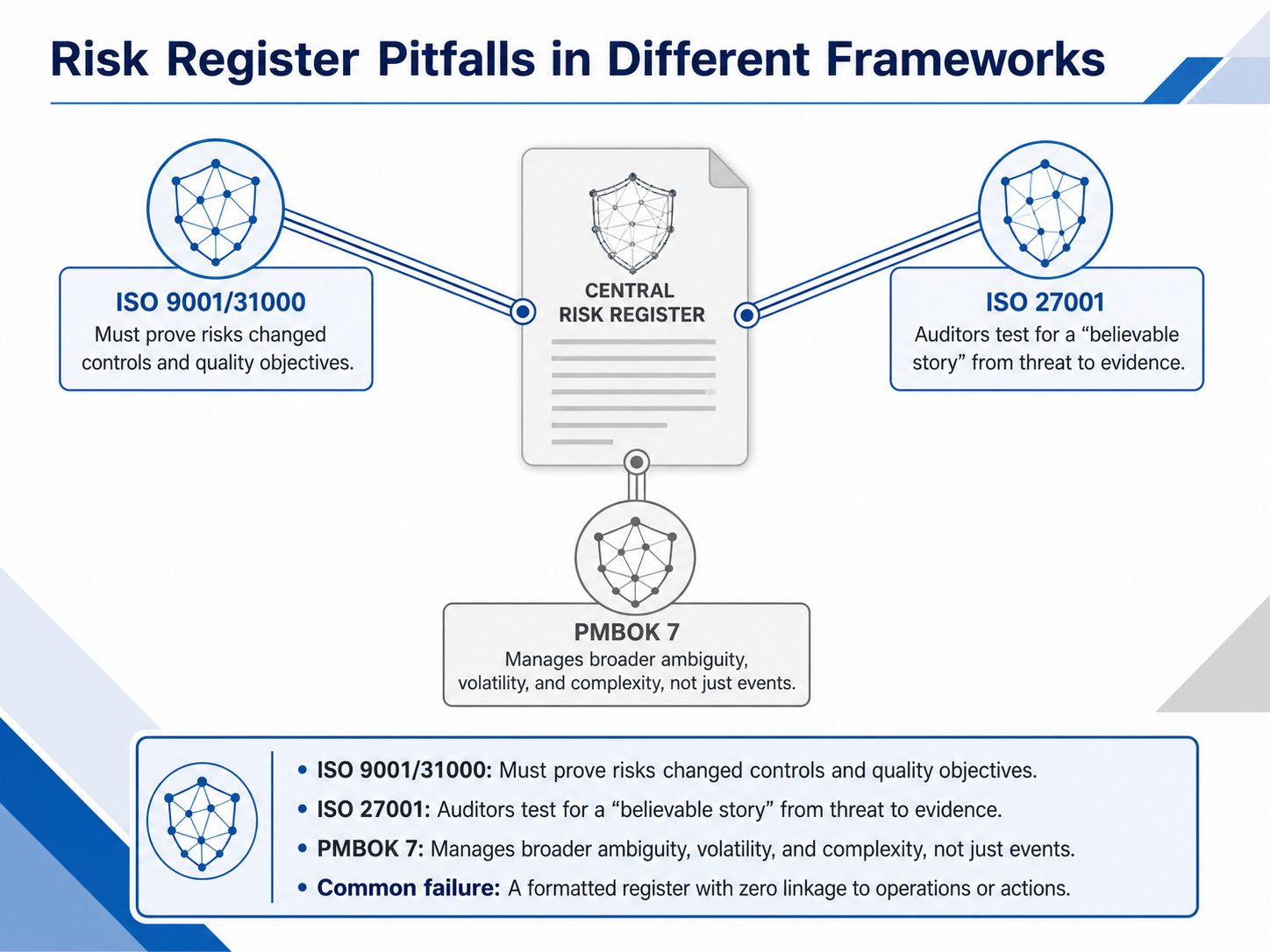
 - 11Risk Register Pitfalls in Different FrameworksLet’s look at how different frameworks expose risk register pitfalls. Under I S O 9001 or 31000, you must prove that identified risks actually changed your controls and quality objectives. Without that traceability, the register is just a document artifact. Under I S O 27001, auditors test for a believable story that connects a specific threat all the way through to treatment evidence. Vague entries or missing owners break that chain. P M B O K Seven takes an even broader view. It manages ambiguity, volatility, and complexity, not just discrete events. A register limited to named risks may miss the real uncertainty shaping your project. Across all frameworks, the most common failure is a formatted register with zero linkage to operations or actions. If an entry never changed a work instruction, a test plan, or a quality objective, it failed. Coming up next, we will lock in the key takeaways and walk through your first risk register build.
 2 min
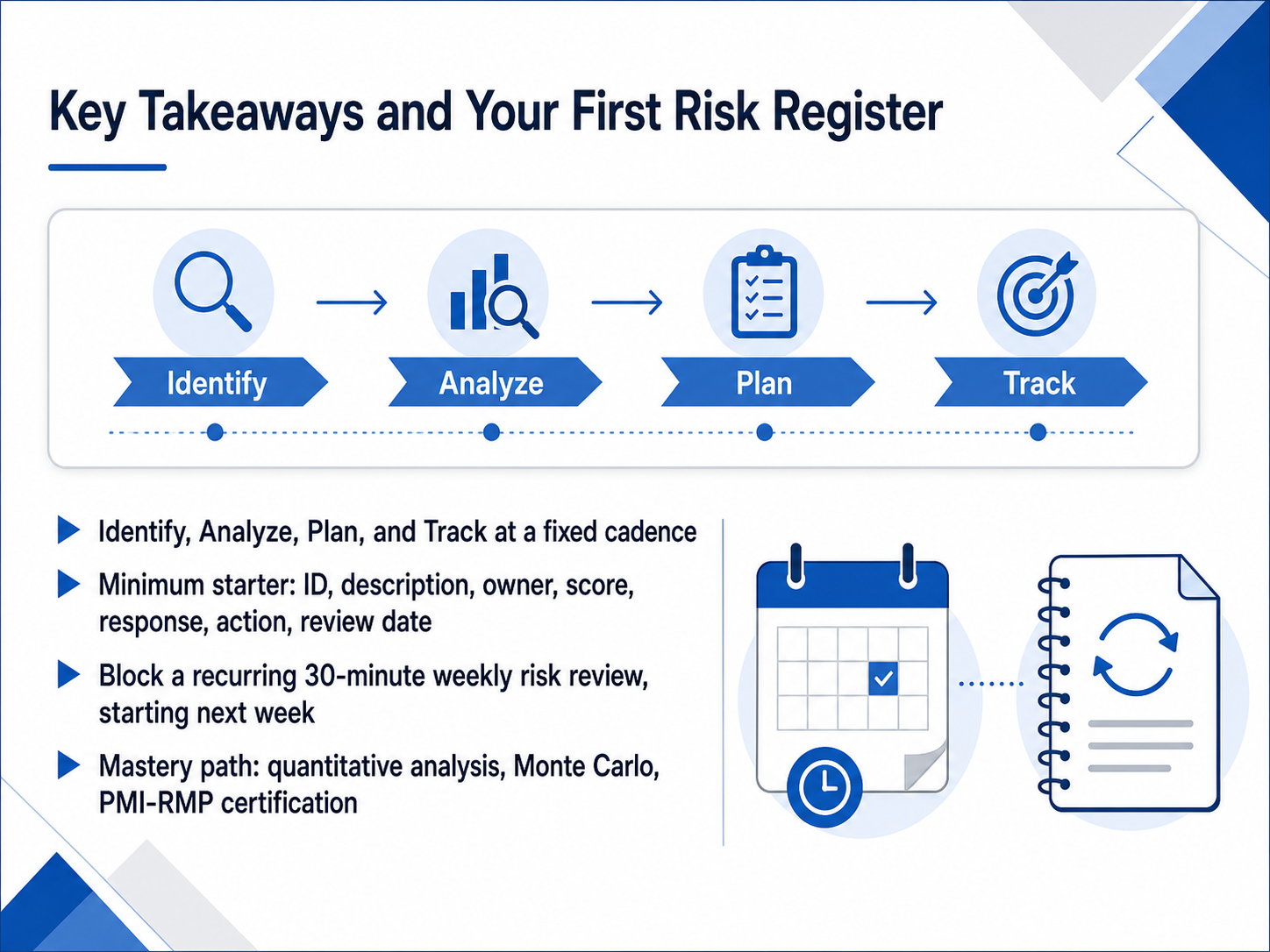
2 min - 12Key Takeaways and Your First Risk RegisterLet's bring it all together with the key takeaways. You've built the muscle memory today: Identify, Analyze, Plan, and Track at a fixed, non-negotiable cadence. To get your first register running tomorrow, start with the absolute minimum columns: risk ID, a clear description, an owner, a probability-times-impact score, your planned response, the next concrete action, and a review date. Don't wait. Block a recurring thirty-minute weekly risk review starting next week, and protect that time slot fiercely. When you're ready for the mastery path, take it deeper with quantitative analysis and Monte Carlo simulations, or even pursue your PMI-RMP certification. You now have everything you need to turn vague concerns into structured, actionable risk items. Thank you for your focus, and I look forward to seeing your risk registers in action.
 atlassian.comasana.comwrike.com+21 min
Take the deck with you
Download this course as a file — free, no sign-up needed.
- PDF handoutEvery slide page, ready to print or share.13 pages · 2.7 MBDownload
- Narrated PowerPointThe deck that presents itself — every slide carries the digital human's narration video.13 pages · 10.8 MBDownload
- PowerPoint slidesThe full deck as a .pptx — open it in PowerPoint, Keynote, or Google Slides.13 pages · 2.6 MBDownload
Free to use in your own training — please keep the PersonWise credit page at the end.
Have your own deck? Turn it into a course
Sources consulted
Web sources consulted while building this course.
- What is a Risk Register? [+How to Create One] | The Workstream — atlassian.com
- Risk Register: How to Create One (Template + Example) [2026] • Asana — asana.com
- https://www.wrike.com/blog/what-is-a-risk-register-project-management/ — wrike.com
- Risk registers: a brief guide — pmworldjournal.com
- A Guide to Risk Registers: Benefits and Examples | TechTarget — techtarget.com
- Risk Appetite vs Risk Tolerance vs Risk Threshold for PMP® - Forty-Four Risk PM — 44riskpm.com
- Risk Appetite vs Risk Tolerance vs Risk Threshold: What's the Difference? — Control Horizon — controlhorizon.io
- Risk Appetite vs Risk Tolerance: Differences, Examples and KRIs — adaptivegrc.com
- Risk Appetite vs Risk Tolerance: Examples & Guide — simplilearn.com
- Risk Appetite vs Risk Tolerance vs Risk Thresholds - Risk Management — complianceforge.com
- Risk Register Template With Scoring Guide — strategize.cloud
- Free Risk Register Template — Excel, Sheets & PDF - Sikhana Seekho — sikhanaseekho.com
- Risk Register Sample – Project Management Formula — projectmanagementformula.com
- Free Risk Register Template (CSV + Example) | Scrumbuiss — scrumbuiss.com
- Risk Probability and Impact Matrix - Project Management FormulaProject Management Formula — projectmanagementformula.com
- Risk Matrix Guide: Definition, Examples, and How to Use It — monday.com
- "Risk Matrix: How to Score Probability and Impact (Template)" — resources.rework.com
- Understanding Project and Program Risk Scoring — primavera.oraclecloud.com
- How To Calculate Risk Scores For Project Risk Analysis — riskpublishing.com
- How to Build a Leadership Risk Review Agenda in 10 Days | Andreza Araujo — andrezaaraujo.com