Begin
14 pages · ~28 min
Critical Thinking Fundamentals
Develop essential critical thinking skills to analyze problems, evaluate evidence, and make sound decisions in professional settings.
A digital instructor presents all 14 pages. Hold “Ask” at any point and ask out loud — the answer comes from this course. No sign-up needed.
What you’ll learn
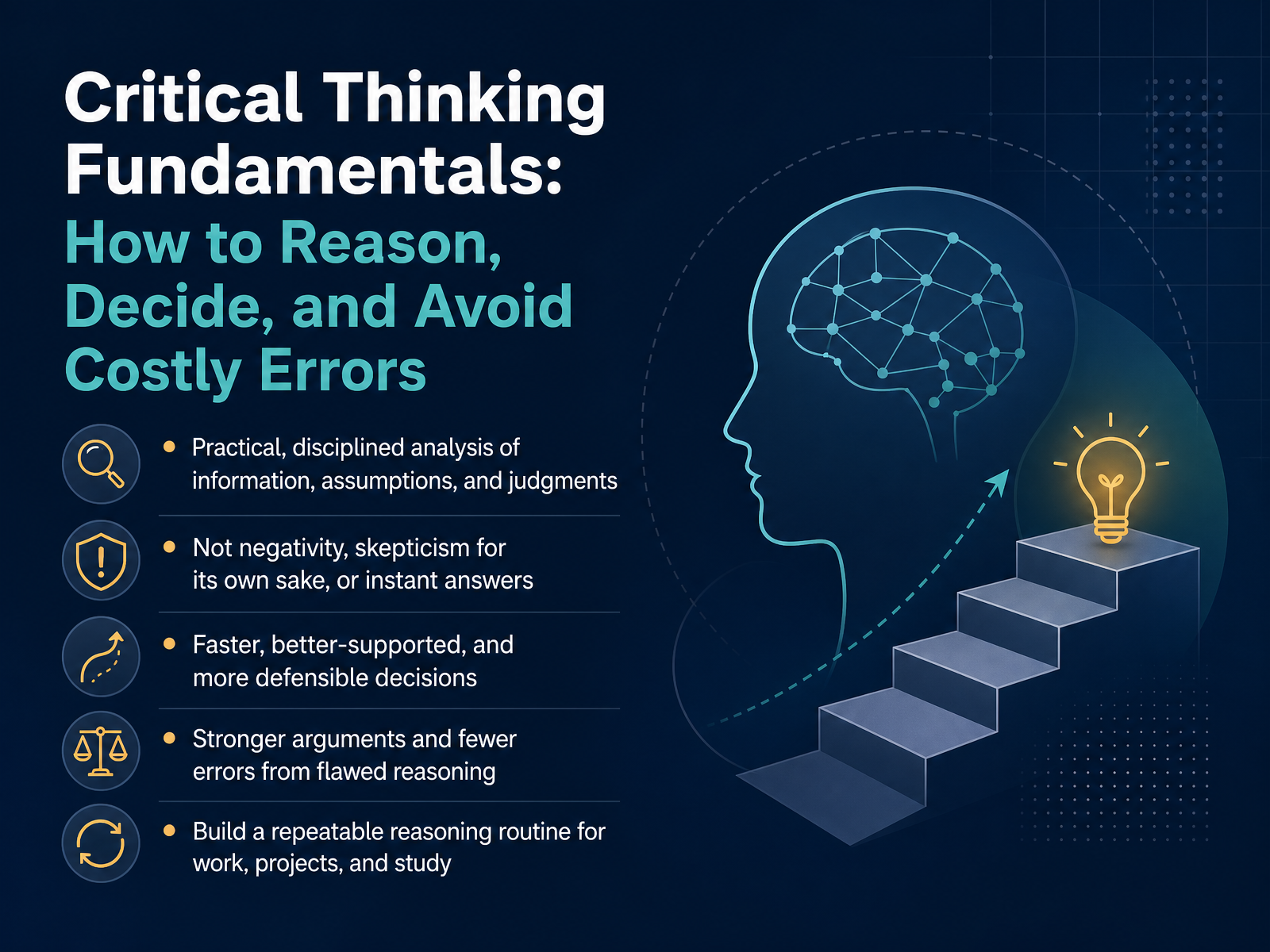
- 01Critical Thinking Fundamentals: How to Reason, Decide, and Avoid Costly ErrorsWelcome. Over the next few minutes, we are going to build a practical foundation in critical thinking. And the goal here is not to turn you into a philosopher. The goal is to help you reason more clearly, make better decisions, and avoid the kind of expensive mistakes that come from flawed thinking. So what exactly is critical thinking? At its core, it is a disciplined way of examining information, checking the assumptions behind it, and forming judgments you can defend. It is not about being negative, and it is not about doubting everything just for the sake of it. It is also not about having an instant answer. Think of it this way. Critical thinking is less about the conclusion you reach, and more about how you approach the question in the first place. Why does that matter? Because when you apply this process consistently, you get faster and better supported decisions. Your arguments become stronger. And you make fewer errors from flawed reasoning. In this course, we are going to build a repeatable reasoning routine. One you can use on your projects, in your studies, and in everyday workplace decisions. Let us start by looking at why weak reasoning costs you at work and school.blogs.lse.ac.ukshopify.comdalecarnegie.com+21 min
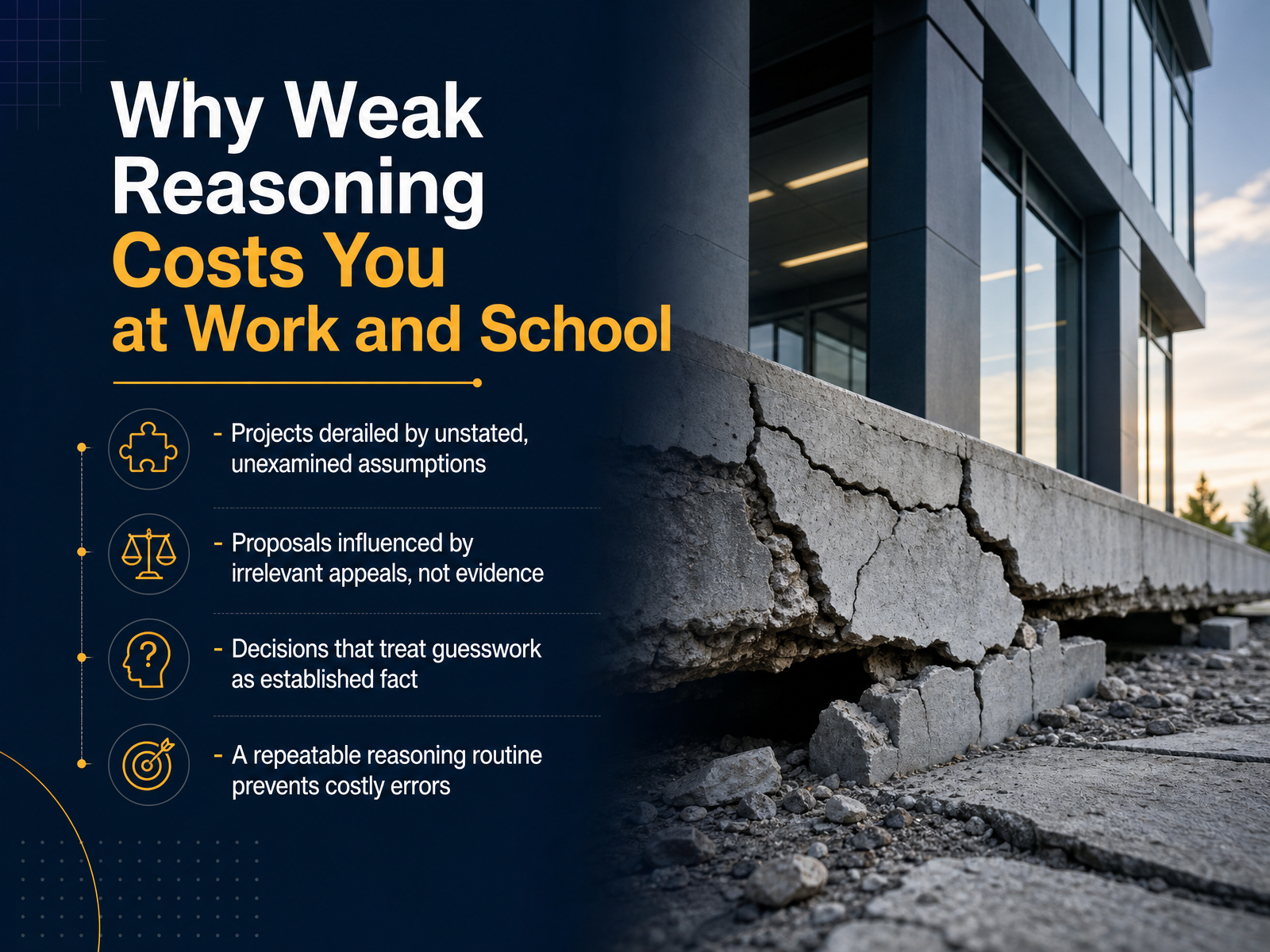
- 02Why Weak Reasoning Costs You at Work and SchoolNow, let’s talk about what weak reasoning actually costs you. It shows up in projects that get derailed by assumptions nobody ever said out loud. It shows up in proposals that win people over because of a confident voice or an emotional story, not because the evidence holds up. And it shows up in decisions where a guess slowly becomes treated as established fact. The common thread here is that none of these failures happen on purpose. They happen by default. The good news is that critical thinking gives you a repeatable reasoning routine. A way to pause, name what you are assuming, check the quality of the evidence, and decide with more confidence. Think of it as a simple quality check for your own thinking, before it becomes an expensive mistake. Up next, we’ll look at why that pause matters by exploring the two systems of thinking: fast intuition versus slow analysis.
 blogs.lse.ac.ukshopify.comdalecarnegie.com+21 min
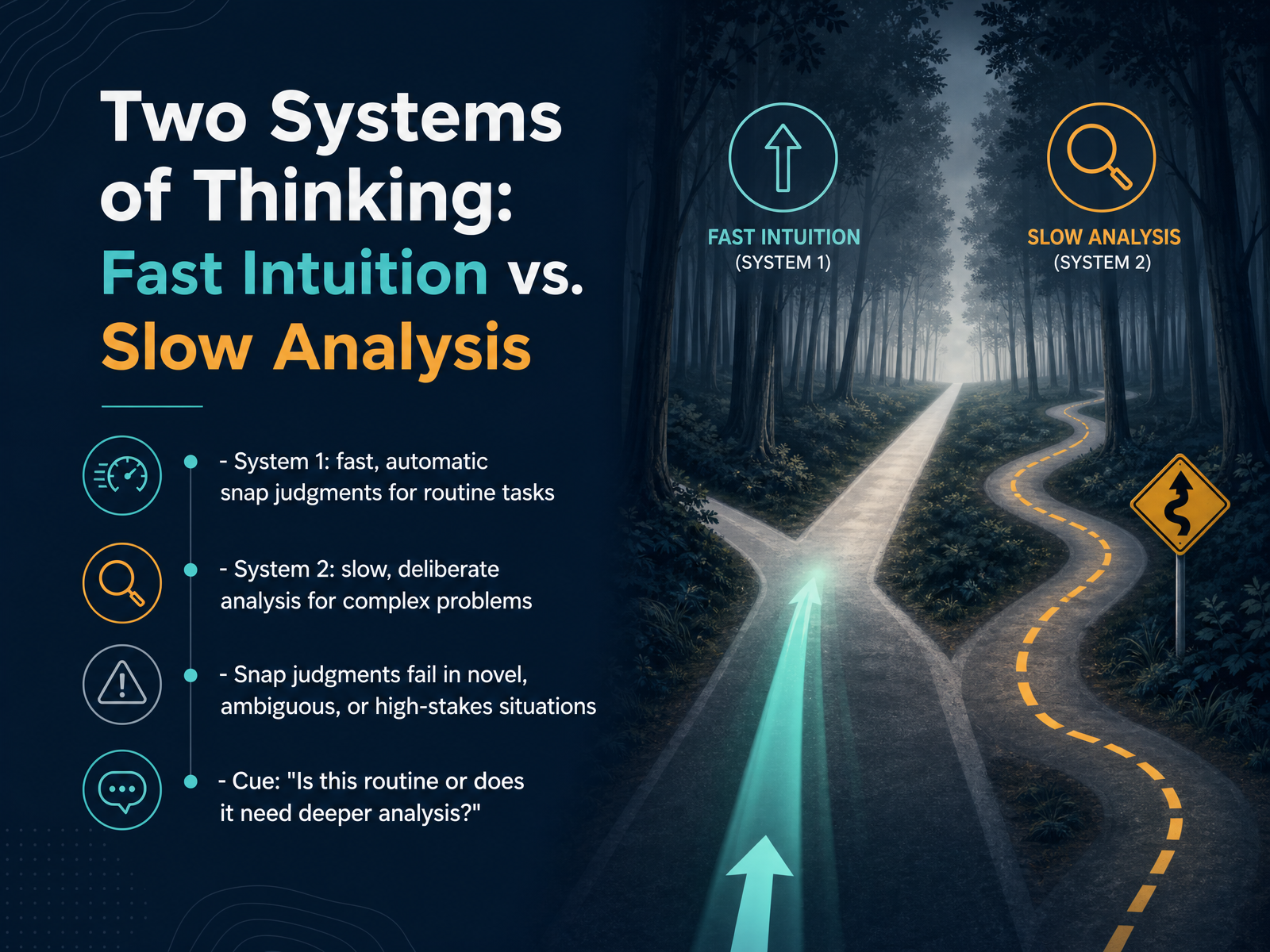
 - 03Two Systems of Thinking: Fast Intuition vs. Slow AnalysisNow, let's look at why some decisions feel effortless while others demand real mental work. We can think of this as two systems of thinking. System one is fast and intuitive. It is the snap judgment you use for routine tasks, like recognizing a familiar face or driving a route you know well. System two is slow and deliberate. It is the careful analysis you need for complex problems, like evaluating a budget trade-off or comparing vendor proposals. The challenge is that snap judgments often fail in novel, ambiguous, or high-stakes situations. They feel efficient, but they can quietly rely on hidden assumptions. So here is a practical cue to keep in mind: ask yourself, is this routine, or does it need deeper analysis? That one question can help you decide when to pause and switch gears. Coming up next, we will explore a simple but powerful distinction: facts, opinions, and inferences, and why you should never confuse them.
 blogs.lse.ac.ukshopify.comdalecarnegie.com+22 min
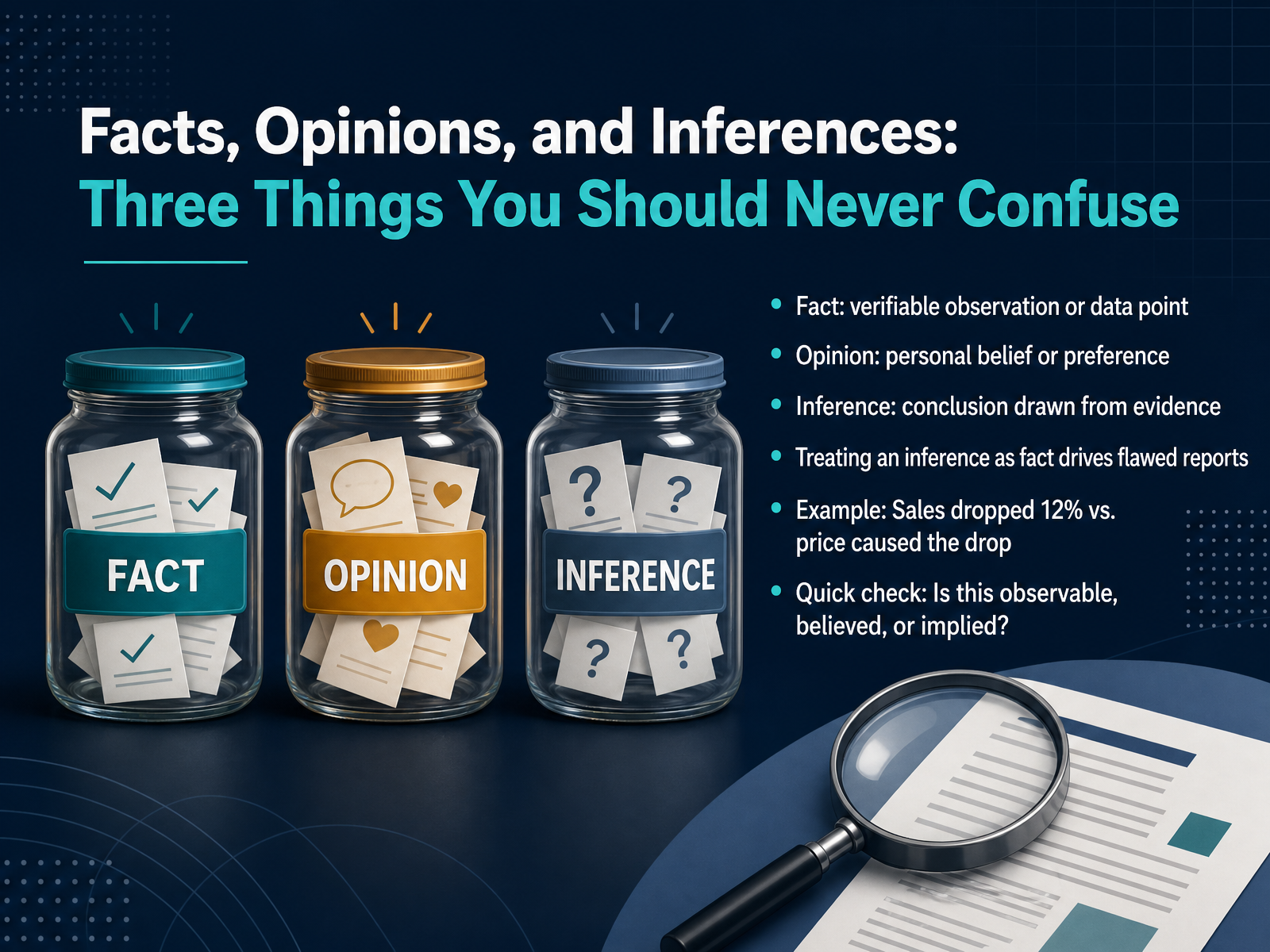
 - 04Facts, Opinions, and Inferences: Three Things You Should Never ConfuseNow, let's talk about three things that often get tangled up in workplace conversations: facts, opinions, and inferences. A fact is something you can verify, like a sales number or a completion date. An opinion is a personal belief or preference. An inference is a conclusion you draw from evidence. Here's why this matters. Treating an inference as a fact is how flawed reports get written. For example, saying sales dropped twelve percent is a fact. Saying the price caused the drop is an inference. The data shows a change, but the cause is a theory until you investigate it. So here's a quick check you can use in your next meeting. Ask yourself: is this statement observable, believed, or implied? That simple pause can keep your team from building decisions on shaky ground.
 blogs.lse.ac.ukshopify.comdalecarnegie.com+21 min
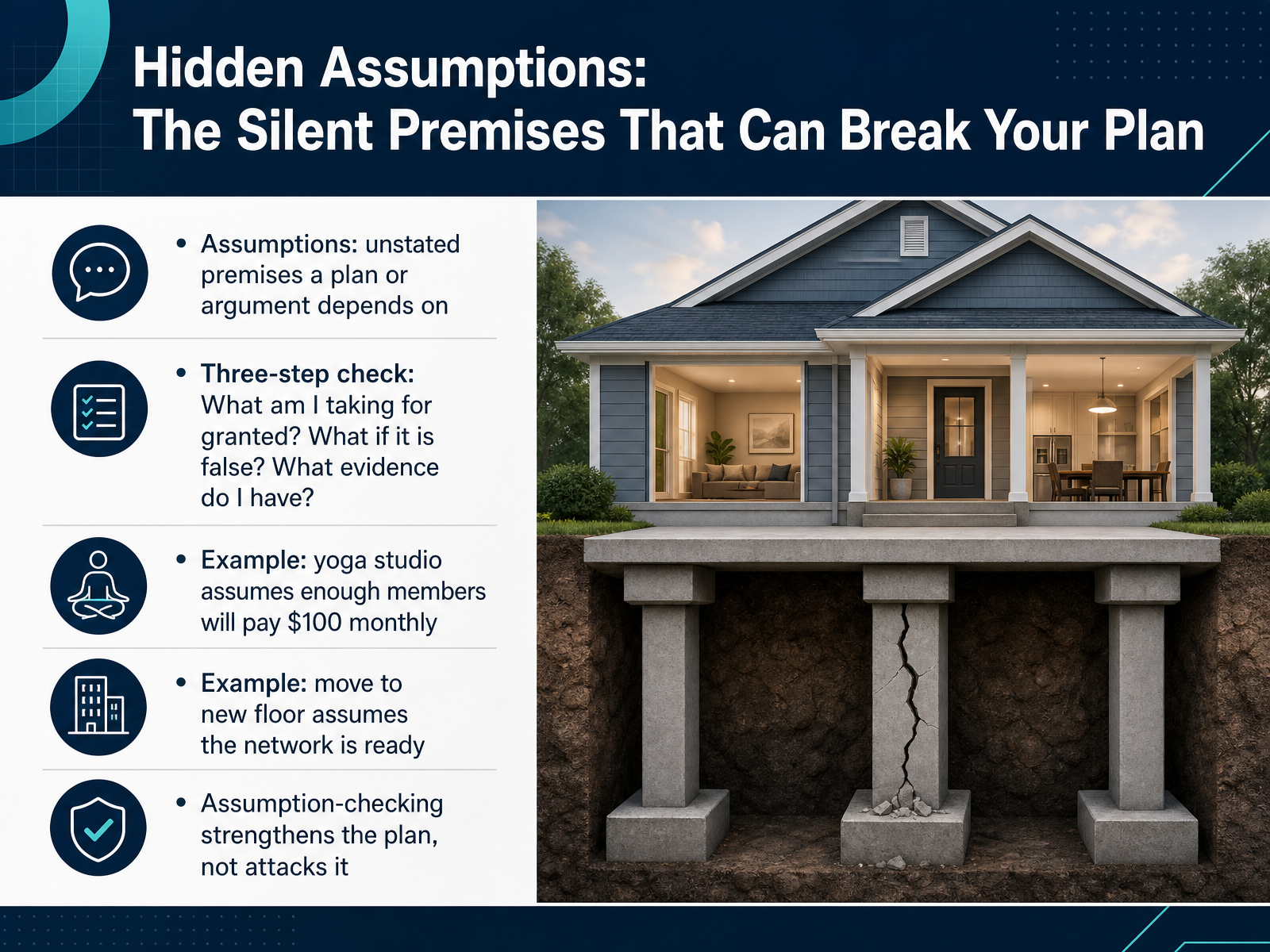
 - 05Hidden Assumptions: The Silent Premises That Can Break Your PlanEvery plan, every strategy, rests on a foundation we rarely inspect. Those foundations are our assumptions, the unstated premises we treat as facts. A yoga studio, for example, only works if enough people are willing to pay one hundred dollars a month for a membership. And moving to a new office floor only works if the network is already set up to handle your team. To surface these silent premises, use a simple three step check. First, ask yourself what am I taking for granted right now? Second, ask what happens to my plan if that is not true? And third, ask what evidence do I actually have to support it? This is not about attacking a good idea. It is about making that idea resilient before it meets reality. When we check our assumptions early, we strengthen the plan itself. Next, we will look at finding assumptions before they find you.
 sloanreview.mit.edusbs.ox.ac.uksloanreview.mit.edu+21 min
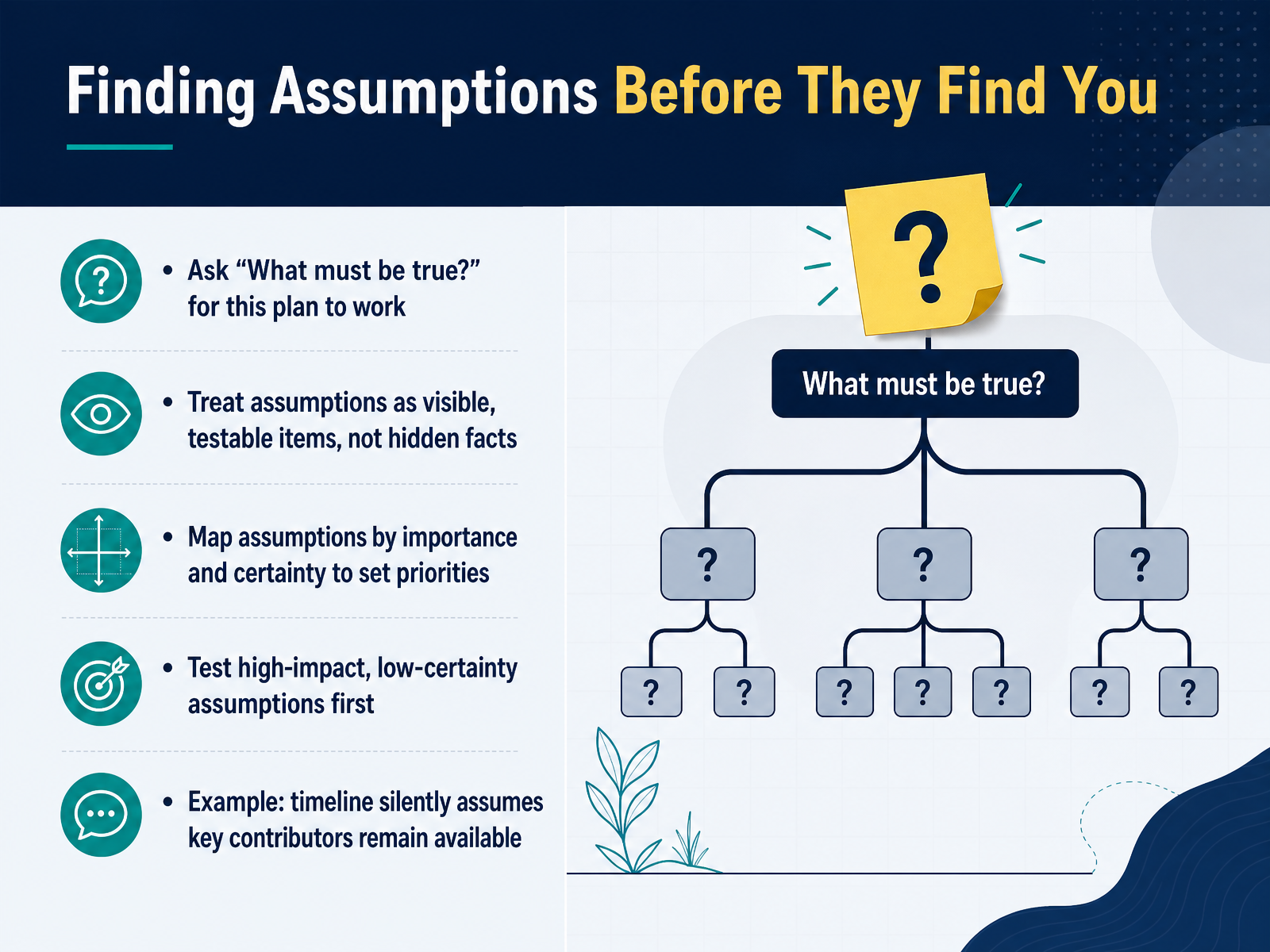
 - 06Finding Assumptions Before They Find YouLet's get practical about a step many plans skip. Assumptions are not just vague risks. They are specific beliefs you are treating as facts, often without realizing it. The first tool is a simple question. Ask yourself: what must be true for this plan to work? That one question can bring dozens of silent dependencies to the surface. For example, a timeline quietly assumes that key contributors will stay healthy, available, and assigned to your project. That might be true, but it might not be. So instead of letting such beliefs hide, make them visible and testable. Write them down on the table next to the plan. Then map them. For each assumption, ask two things. How important is it to our success? And how certain are we that it is true? Focus your limited time on the high impact, low certainty items first. Those are the ones that can quietly sink a budget or a schedule. By treating assumptions as a checklist instead of an afterthought, you stop being surprised later. With that in mind, let's turn to the reasoning errors that often creep in once those assumptions are on the table.
 sloanreview.mit.edusbs.ox.ac.uksloanreview.mit.edu+21 min
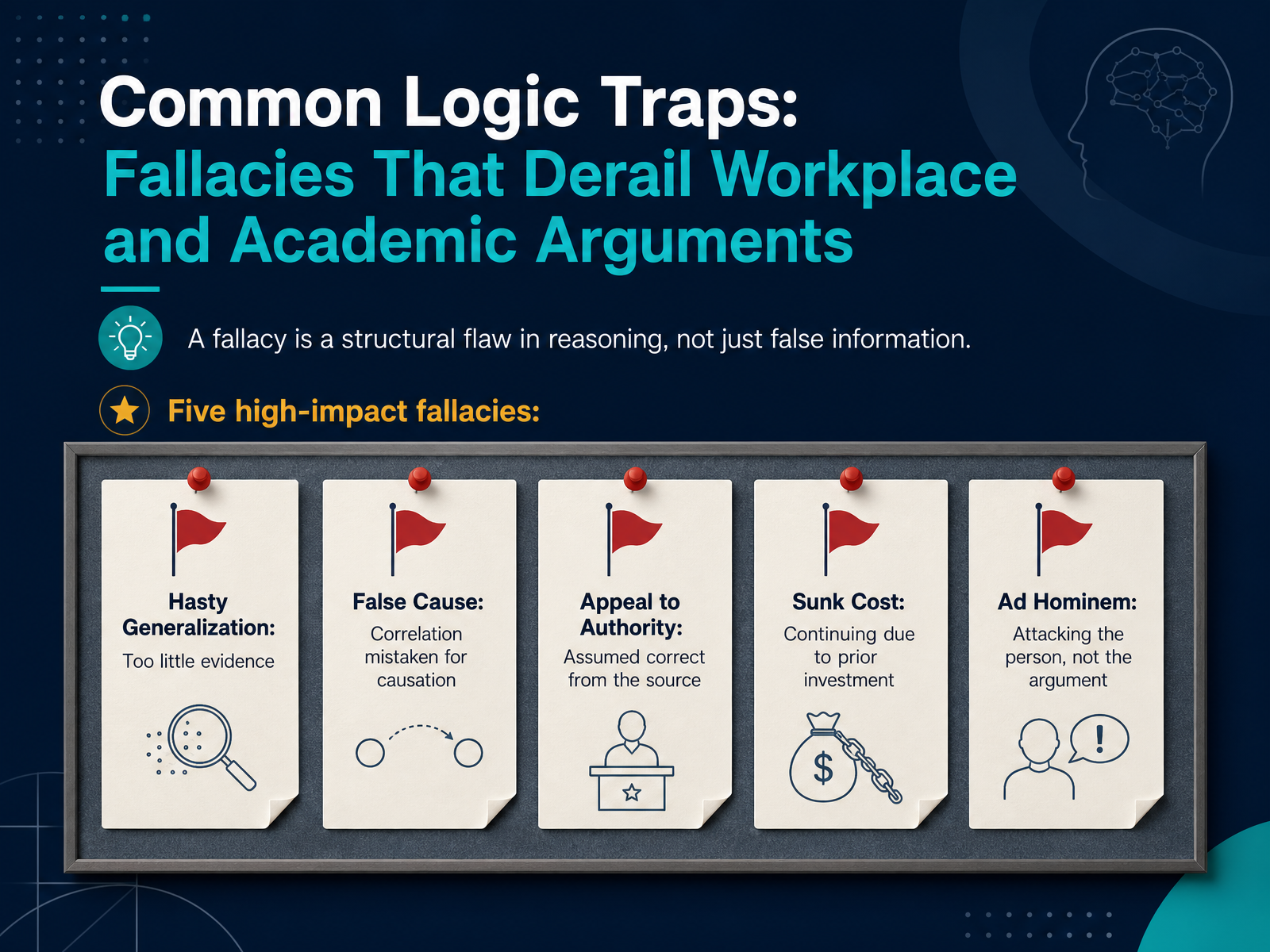
 - 07Common Logic Traps: Fallacies That Derail Workplace and Academic ArgumentsA fallacy is not simply false information. It is a structural flaw in the reasoning itself. Being able to spot these patterns is what separates a truly critical thinker from someone who just reacts. Let’s look at five of the most common ones you’ll encounter. The first is hasty generalization, where a broad conclusion is drawn from too little evidence. If one pilot project struggles, that does not mean the entire initiative is doomed. Next is the false cause fallacy. This happens when we mistake correlation for causation. Sales went up after the website changed, but was the change the cause, or was it simply the season? Then there is the appeal to authority, where an idea is accepted as correct just because someone important said it. Even experts and bosses need to show their evidence. The sunk cost fallacy is especially common in business. It is the instinct to keep investing simply because we have already spent time or money, even when the data tells us to stop. We must value future results over past losses. Finally, we have ad hominem, which is attacking the person instead of the argument. Saying a colleague is difficult to work with does not disprove their analysis. These five traps can silently derail a meeting. Recognizing them is the first step toward defending against them. Next, we’ll move from spotting these flaws to learning how to effectively respond when they show up in real conversations.
 ejournal.ayasophia.orgoakinnovation.compressbooks.bccampus.ca+22 min
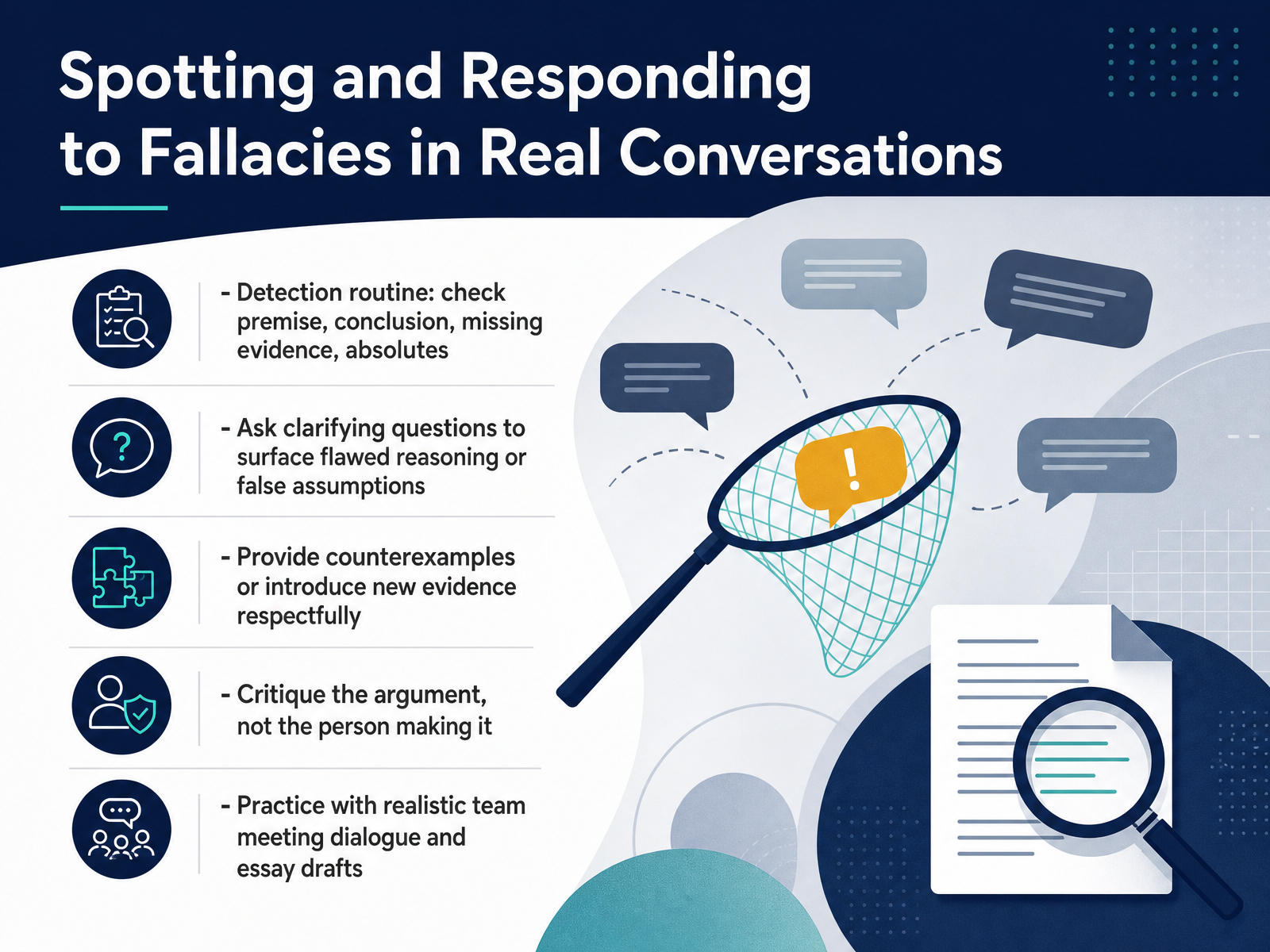
 - 08Spotting and Responding to Fallacies in Real ConversationsSo let's talk about spotting fallacies in real conversations, because in a fast moving meeting, this can feel harder than it looks. A solid detection routine helps. First, check the premise. Does it rely on facts, or is it driven by emotion? Then, look at the conclusion. Does it actually follow from the premise? Also, watch for missing evidence, and be careful of absolutes. Words like everyone, always, or never are often red flags. When you notice a flawed argument, don't attack. Instead, ask a clarifying question. Something like, 'What data supports that timeline?' or 'Are there other options we haven't considered?' You can also respectfully introduce new evidence or a counterexample. The goal is to critique the argument, never the person. Remember, a bad argument doesn't make someone a bad colleague. The best way to build this habit is through practice, using realistic team meeting dialogue or even reviewing essay drafts. In our next slide, we'll shift our focus to the questions you can ask to improve the quality of the answer itself.
 ejournal.ayasophia.orgoakinnovation.compressbooks.bccampus.ca+22 min
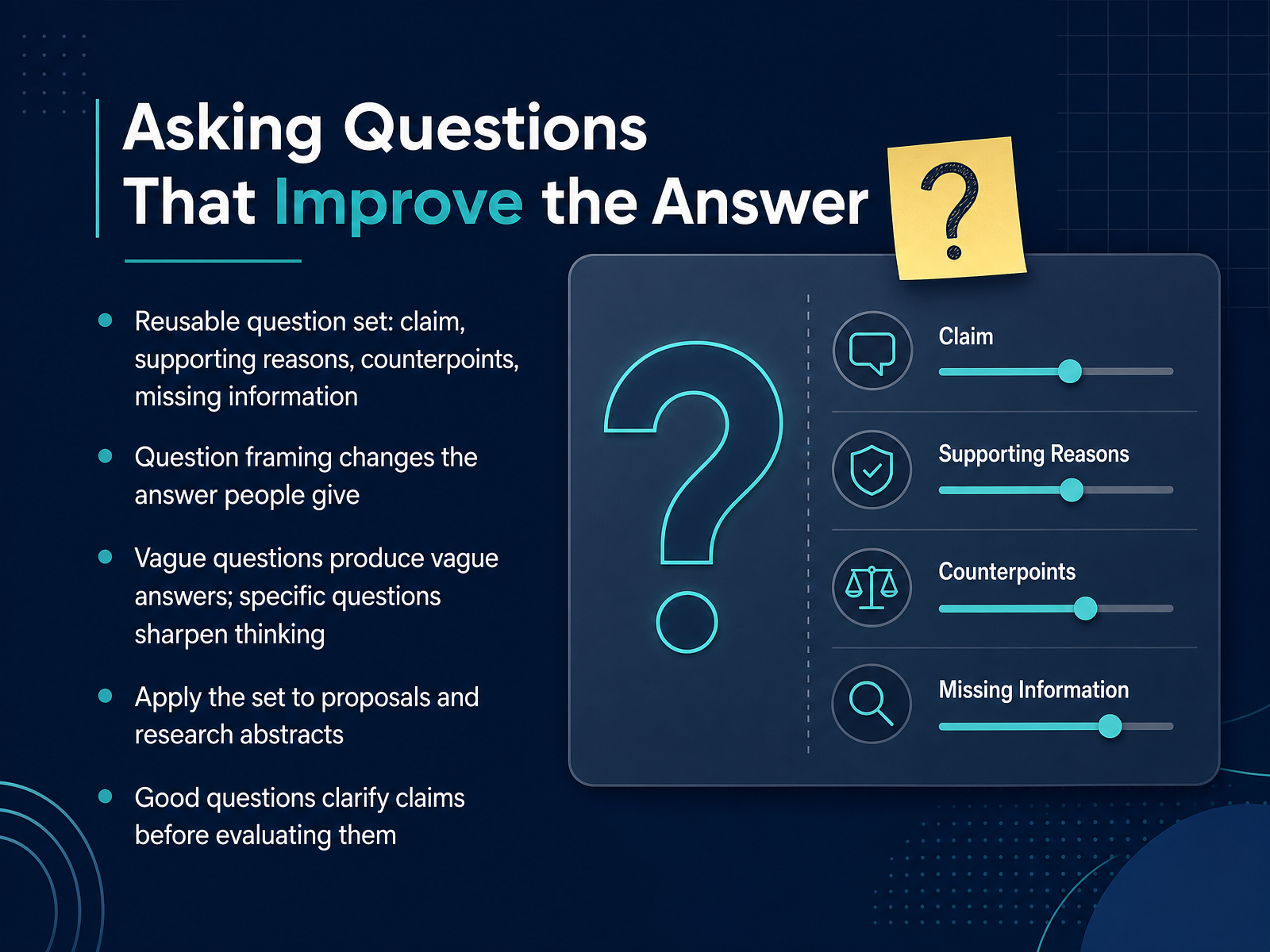
 - 09Asking Questions That Improve the AnswerA better answer starts with a better question. When someone presents a proposal, we often jump straight to judging whether we like it. That is a mistake. First, we need to clarify the claim. Use a simple, reusable set of questions. What exactly is being claimed? What reasons support that claim? What counterpoints exist against it? And finally, what important information is missing? Remember, how you frame a question changes the answer you receive. A vague question like, is this a good idea, produces a vague, unhelpful response. A specific question, such as, what assumption must be true for this to work, forces sharper thinking. Apply this set to any proposal or research abstract before you evaluate it. Guide the presenter through the claim, the reasons, the counterpoints, and the gaps. Clarifying first prevents you from critiquing a version of the idea that the speaker did not actually mean. Clarify the claim before you evaluate it. Up next, we will explore a related trap: how correlation is often mistaken for causation.
 cambridge.orgroutledge.comuk.sagepub.com+21 min
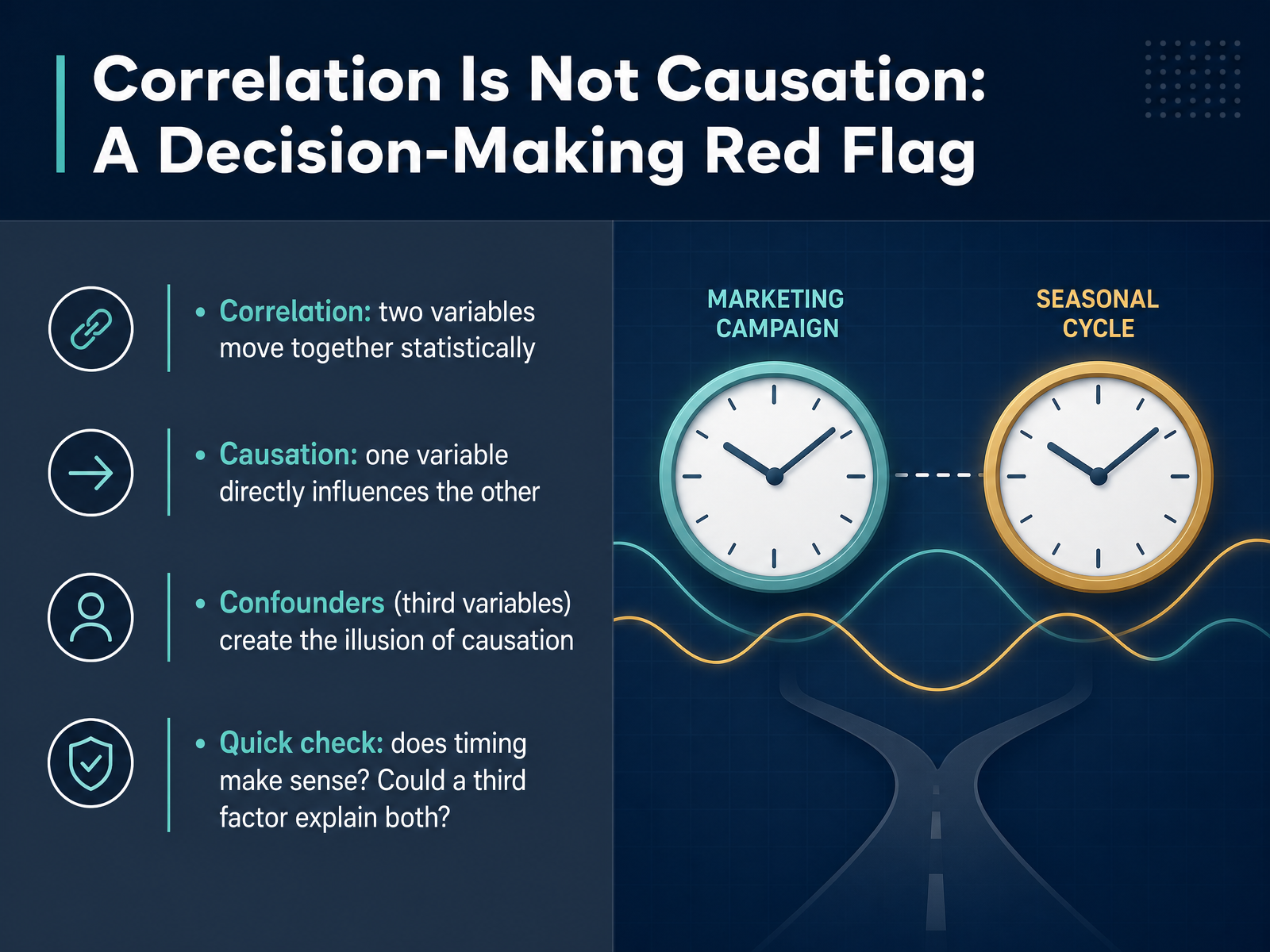
 - 10Correlation Is Not Causation: A Decision-Making Red FlagNow, let's talk about one of the biggest red flags in decision-making: confusing correlation with causation. Correlation simply means two things move together. Causation means one thing directly causes the other. But here's where it gets tricky. There's often a hidden third variable, a confounder, creating the illusion of a direct link. Think about the classic example: ice cream sales and drowning incidents both rise in summer. Does ice cream cause drowning? Of course not. The confounder is hot weather. This happens all the time in business. You might see that high-performing teams all use a specific software tool, and assume the tool caused their success. Before acting on that, use a quick check. Ask yourself, does the timing actually make sense? Could a third factor, like better training or a more experienced manager, explain both? Catching this before you invest resources can save you from a very costly mistake. Next, we'll explore how to evaluate evidence before you decide.
 ejournal.ayasophia.orgoakinnovation.compressbooks.bccampus.ca+22 min
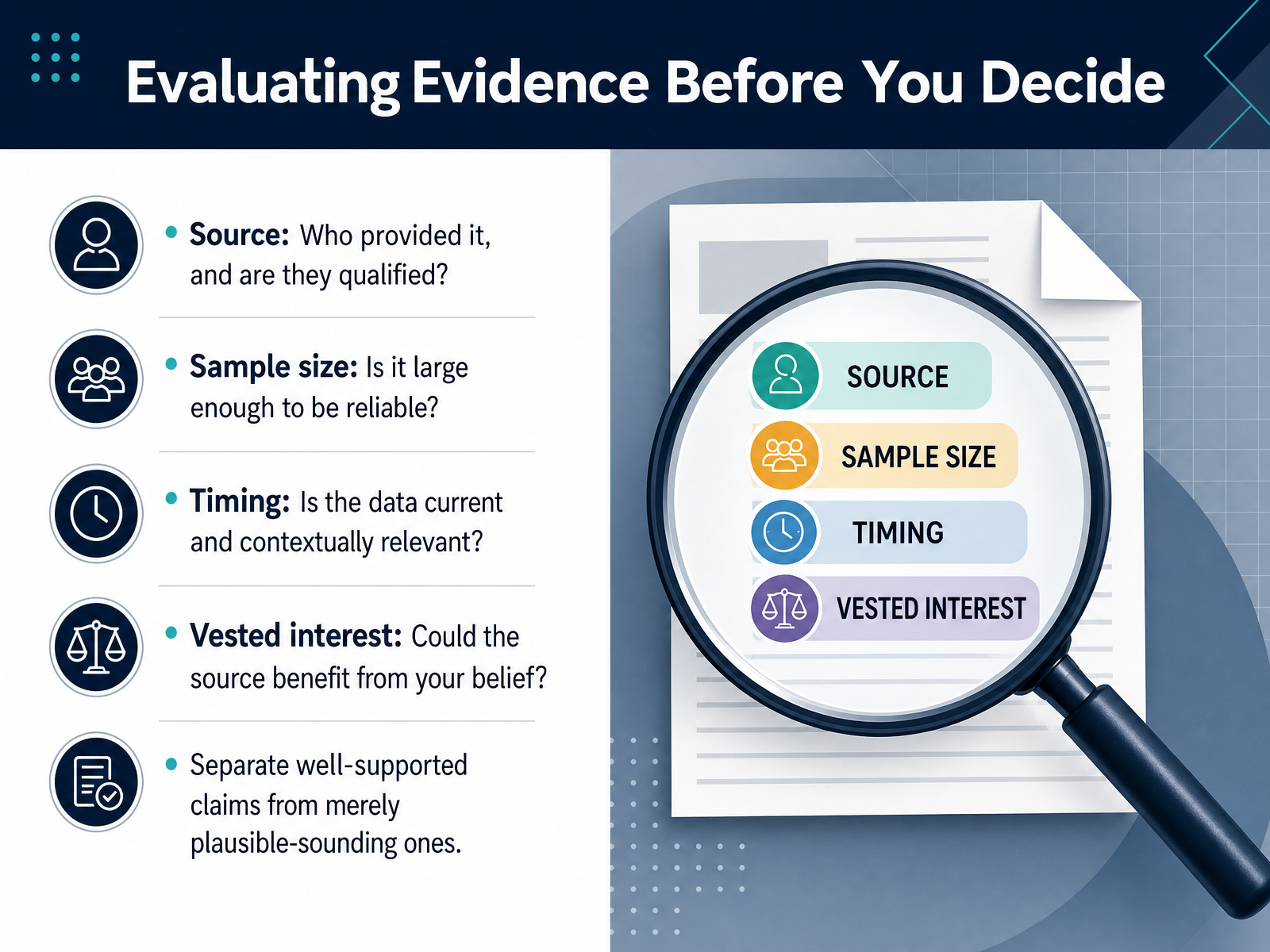
 - 11Evaluating Evidence Before You DecideBefore you commit to a decision, give the evidence a quick stress test. Start with the source. Who provided it, and do they actually have the expertise? A confident voice is not the same as a qualified one. Next, look at the sample size. If a conclusion is based on a handful of examples, treat it as a hint, not a fact. Then, check the timing. Old data can still be interesting, but it might not reflect today's reality. And here is a question we often skip. Does the source have a vested interest? If someone benefits from you believing their claim, apply a little extra scrutiny. Finally, separate what is well supported from what simply sounds plausible. Two things can look connected, like a website redesign and a spike in traffic, but that does not prove one caused the other. Use these five checks, and you will replace risky assumptions with sharper judgment. Up next, we will build on this by looking at group reasoning and how to make better decisions together.
 blogs.lse.ac.ukshopify.comdalecarnegie.com+21 min
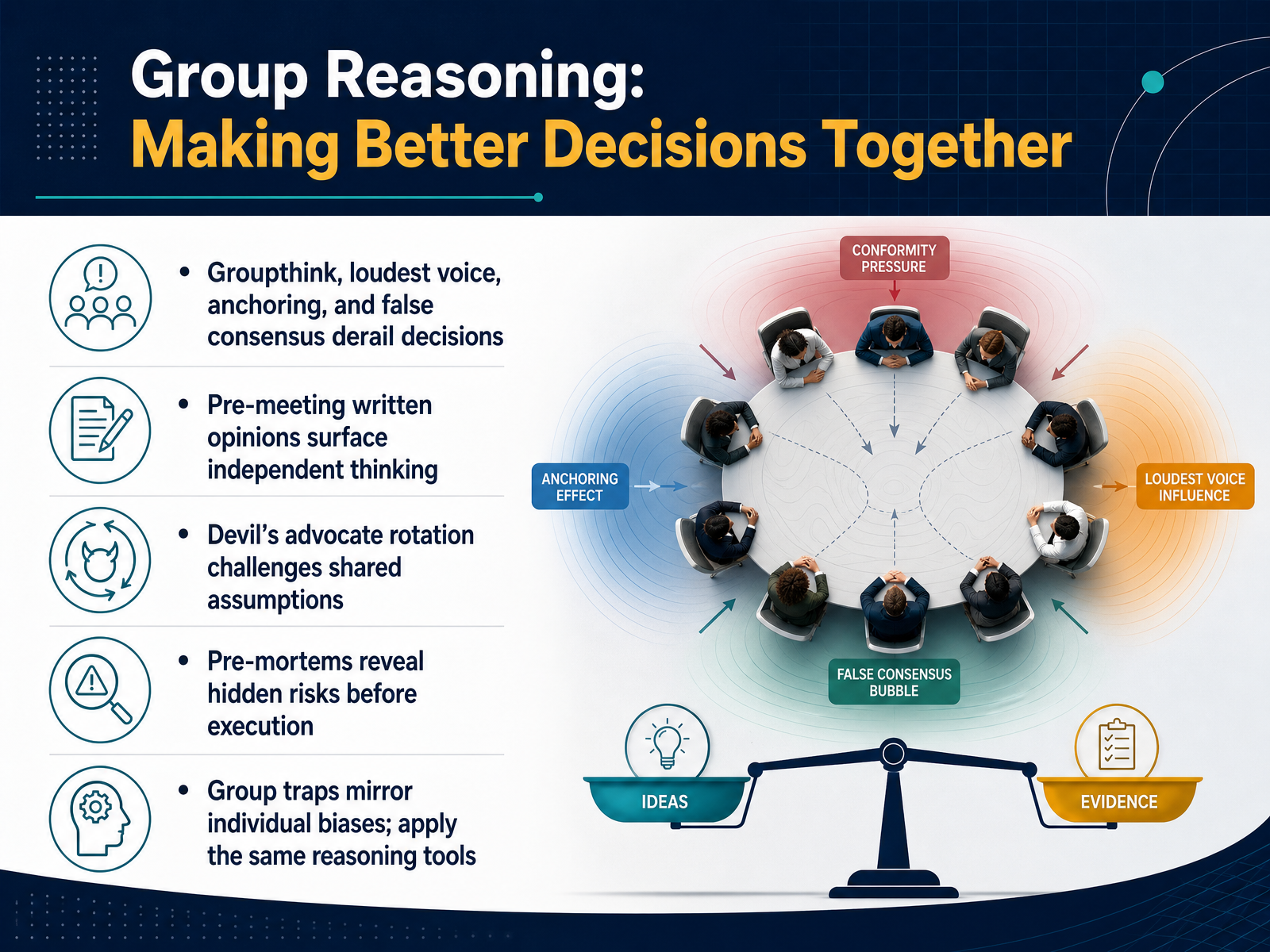
 - 12Group Reasoning: Making Better Decisions TogetherGood decisions rarely happen by accident, especially in a group. When we get together, we face a new set of traps. Groupthink can push everyone toward a comfortable, but flawed, consensus. The loudest voice in the room can dominate, and we tend to anchor on the first idea that gets mentioned. Then there is false consensus, where we assume everyone agrees with us just because they are not speaking up. The good news is that the same reasoning tools we use individually apply here too. Start by collecting written opinions before the meeting. This surfaces independent thinking before anyone can be influenced. Rotate a devil's advocate to challenge the group's shared assumptions. And before you commit to a plan, run a pre-mortem. Imagine the project has already failed, and ask what went wrong. This simple shift reveals hidden risks that normal planning misses. These small structural changes can dramatically improve the quality of your team's decisions. Next, let's look at how to build a personal reasoning routine.
 sloanreview.mit.edusbs.ox.ac.uksloanreview.mit.edu+22 min
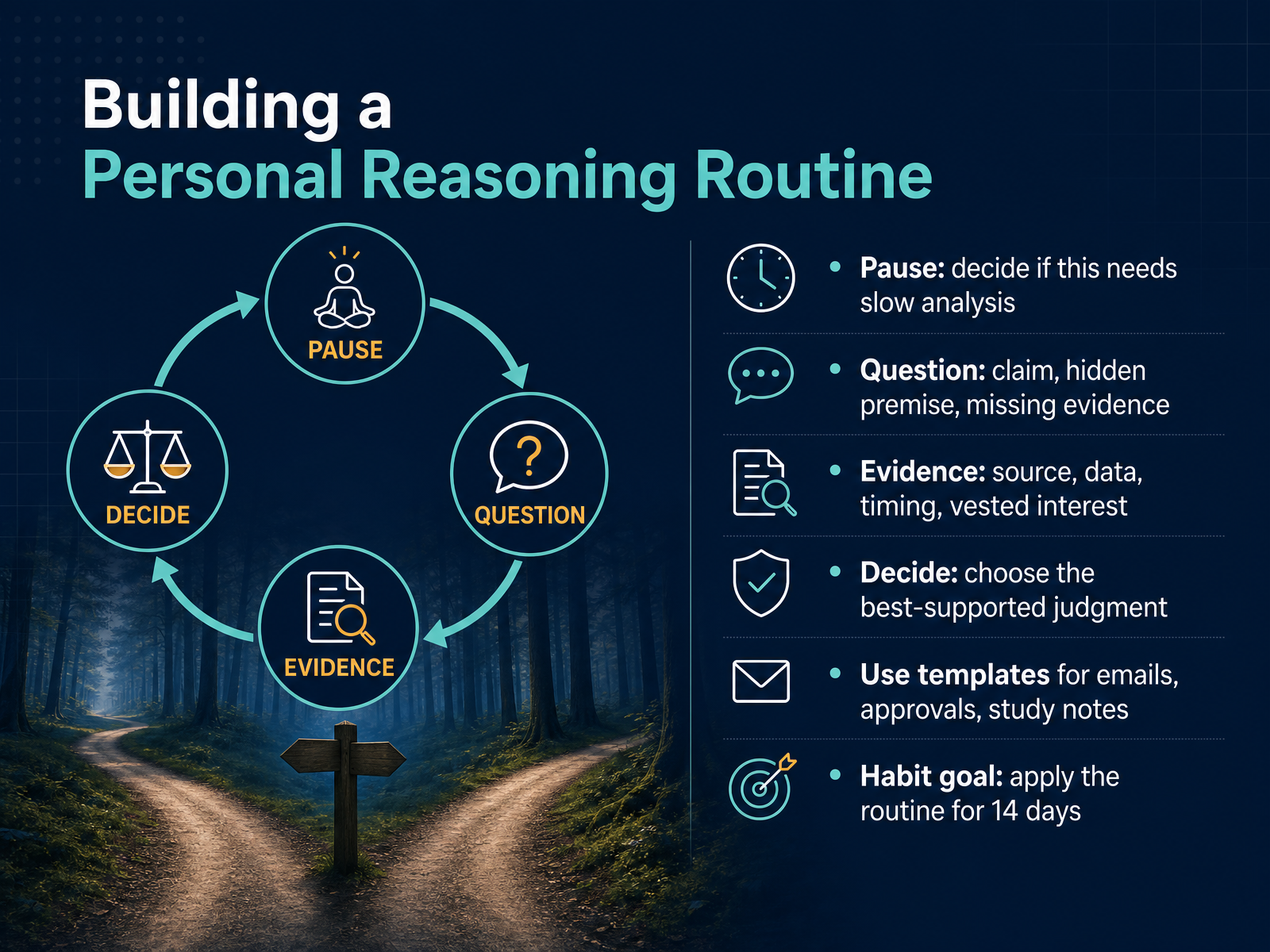
 - 13Building a Personal Reasoning RoutineLet's turn this into a routine you can actually use. The goal here isn't to think harder on every single thing, but to know when to slow down. First, pause. Ask yourself if this decision truly needs slow analysis, or if a quick judgment is fine. Next, question the claim. What is the hidden premise here? What evidence is missing? Then, check the evidence itself. Look at the source, the data, the timing, and whether anyone has a vested interest in the answer. Only after that, decide. Choose the judgment that has the strongest support, not just the loudest advocate. To make this practical, build simple templates for emails, approvals, or study notes. This keeps the process repeatable. Your goal is to apply this routine for fourteen days. By the end, it won't feel like a checklist. It will feel like how you naturally make sense of things. Next, we'll look at an action plan, a self-assessment, and the resources to keep building this skill.
 blogs.lse.ac.ukshopify.comdalecarnegie.com+22 min
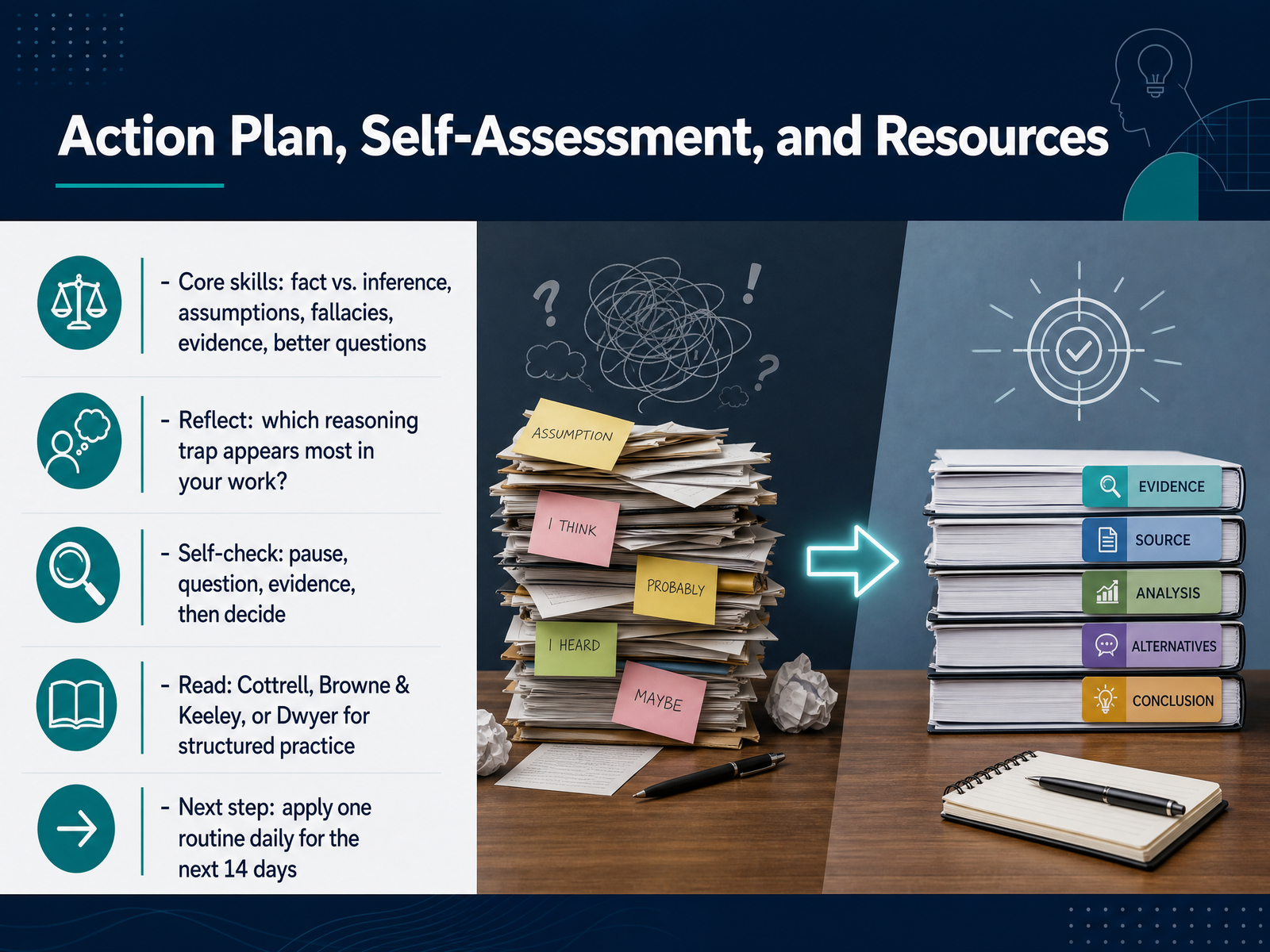
 - 14Action Plan, Self-Assessment, and ResourcesBefore we close, let's turn all of this into a personal action plan. Think back over the core skills we covered: separating fact from inference, spotting assumptions, recognizing fallacies, weighing evidence, and asking better questions. Now, here is your reflection prompt. Which of those reasoning traps shows up most often in your own work? Take a moment to name it, because awareness is the first step. Then, use this simple self-check before your next decision: pause, question the claim, look at the evidence, and then decide. To go deeper, I recommend structured practice with books by Cottrell, Browne and Keeley, or Dwyer. They offer exercises that build thinking muscle over time. Your next step is a small one. Choose one routine, just one, and apply it daily for the next fourteen days. You won't master critical thinking in two weeks, but you can build a habit that changes how you lead, teach, and decide. So thank you for thinking with me today, and start now. Your better questions begin with the very next choice you face.
 cambridge.orgroutledge.comuk.sagepub.com+21 min
Take the deck with you
Download this course as a file — free, no sign-up needed.
- PDF handoutEvery slide page, ready to print or share.15 pages · 3.8 MBDownload
- Narrated PowerPointThe deck that presents itself — every slide carries the digital human's narration video.15 pages · 15.7 MBDownload
- PowerPoint slidesThe full deck as a .pptx — open it in PowerPoint, Keynote, or Google Slides.15 pages · 3.8 MBDownload
Free to use in your own training — please keep the PersonWise credit page at the end.
Have your own deck? Turn it into a course
Sources consulted
Web sources consulted while building this course.
- Critical thinking in the workplace: what does it mean in practice? — blogs.lse.ac.uk
- How To Practice Critical Thinking In Business (2026) - Shopify — shopify.com
- Critical Thinking in Modern Decision Environments | Dale Carnegie — dalecarnegie.com
- Critical Thinking Is the Key to Strategic Thinking | Gallagher — ajg.com
- Capability unlocked: Strategic and critical thinking | INTHEBLACK — intheblack.cpaaustralia.com.au
- The Dangers of Untested Assumptions — sloanreview.mit.edu
- Leaders as assumption brokers: How to question the dangerous beliefs that shape how we lead | Saïd Business School — sbs.ox.ac.uk
- How Ghost Scenarios Haunt Strategy Execution — sloanreview.mit.edu
- Jeffrey Pfeffer: Untested Assumptions May Have a Big Effect | Stanford Graduate School of Business — gsb.stanford.edu
- How To Find The Hidden Assumptions That Put Your Brand At Risk - Map and Fire — mapandfire.com
- The Impact of Logical Fallacies in Business Communication: Exploring their Impact on Decision Making and Interpersonal Relationships in the Professional World | Indonesian Journal of Management and Economic Research — ejournal.ayasophia.org
- How To Effectively Address Logical Fallacies At Work — oakinnovation.com
- Fundamentals of Business Communication Revised (2022) — pressbooks.bccampus.ca
- Strive for Fallacy-Free Persuasion – Business Communication: Five Core Competencies — saalck.pressbooks.pub
- 14.6 Speaking Ethically and Avoiding Fallacies – Business Communication for Success — pressbooks.cuny.edu
- Good Thinking — cambridge.org
- The New Critical Thinking: An Empirically Informed Introduction - 2nd — routledge.com
- The Critical Thinking Toolkit | SAGE Publications Ltd — uk.sagepub.com
- Critical Thinking — cambridge.org
- Critical Thinking Skills: Effective Analysis, Argument and Reflection: Bloomsbury Study Skills Stella Cottrell Bloomsbury Academic - Bloomsbury — bloomsbury.com