Digital Marketing Starter Workflow
Begin
14 pages · ~28 min
Digital Marketing Starter Workflow
Learn a practical step-by-step workflow to launch digital marketing campaigns, ideal for beginners seeking a structured, actionable approach.
What you’ll learn
- 01How to Start Digital Marketing: A Practical WorkflowWelcome. If you have a product or a business you believe in but feel lost when it's time to market it online, you are in the right place. I'm going to show you how to start digital marketing with a practical, repeatable workflow. We will not chase every trend or spread ourselves thin across ten different platforms. The number one beginner mistake is trying to do everything at once. Instead, we will focus on one channel, one offer, and one simple data loop to build a real system from the ground up. Think of this as your GPS. By the time we finish, you will have a clear sequence to follow: setting goals, understanding your audience, picking a channel, creating assets, launching, reviewing what happened, and scaling what worked. Most importantly, you will learn how to do this on a limited budget, designed for the realities of today's market. Let's start by setting your destination. Up next, we will get specific about goals, key metrics, and the math that tells you what a customer is really worth.20minutemarketing.coleadpages.comsearchlab.nl+22 min
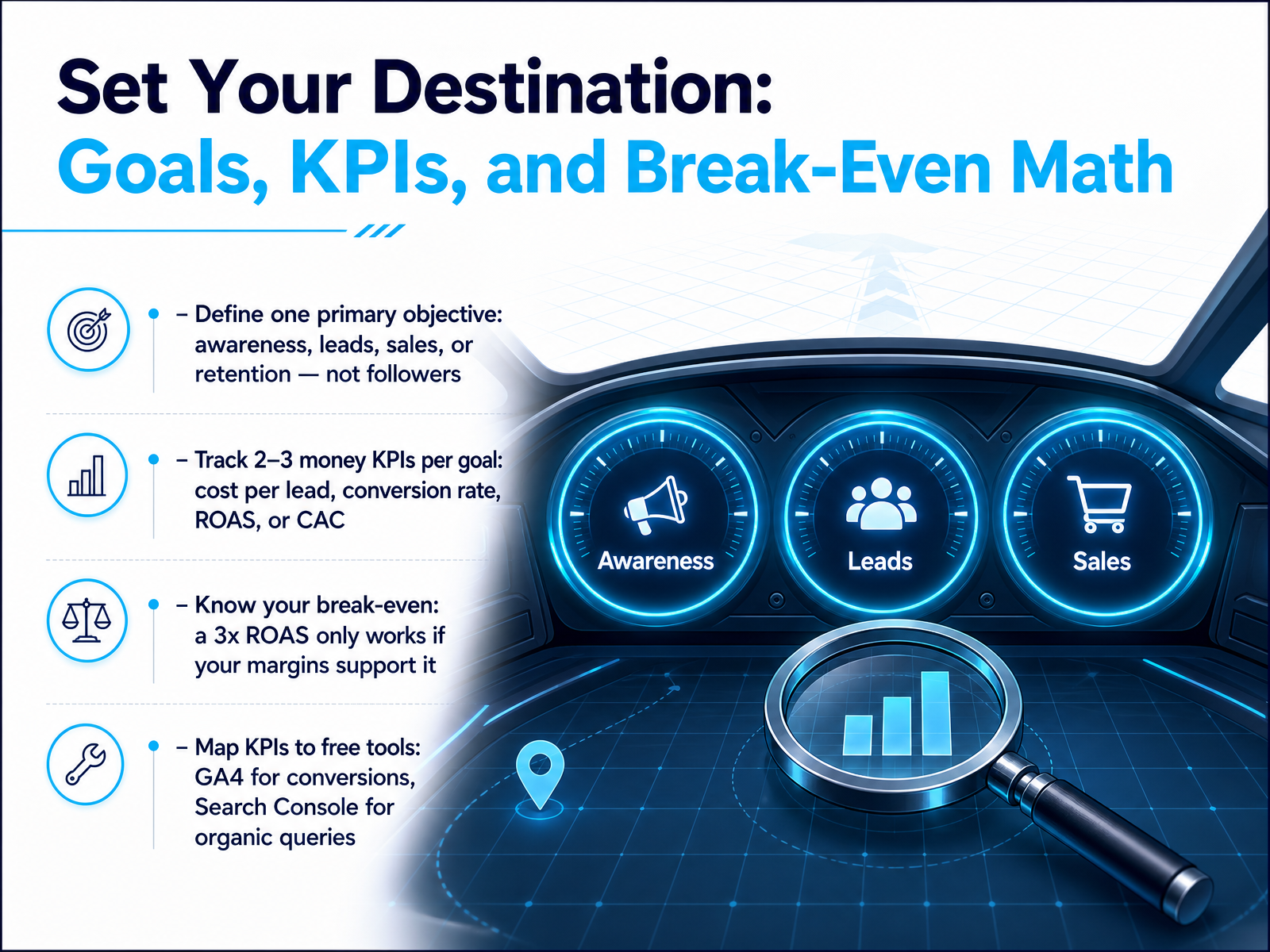
- 02Set Your Destination: Goals, KPIs, and Break-Even MathToo many businesses track followers that never become customers. Instead, let’s build a money-based compass. Pick one primary destination right now. Are you chasing awareness, leads, sales, or repeat buyers? Choose one, and only one, so your energy goes to the one that pays you this quarter. Next, track two or three money KPIs tied to that goal. Good examples are cost per lead, conversion rate, return on ad spend, or customer acquisition cost. Then, figure out your break-even math. A three-times return sounds strong, but it only works if your margins can support it. Lastly, you don’t need expensive tools yet. Use Google Analytics 4 for conversions and Search Console for organic queries. Knowing your numbers is what turns busy work into real growth. Let’s take that clarity and apply it directly to your customer. Next, we’ll create a one-page persona so you know exactly who you are talking to.
 zenweb.myclicksgeek.comtimeboostermarketing.com+22 min
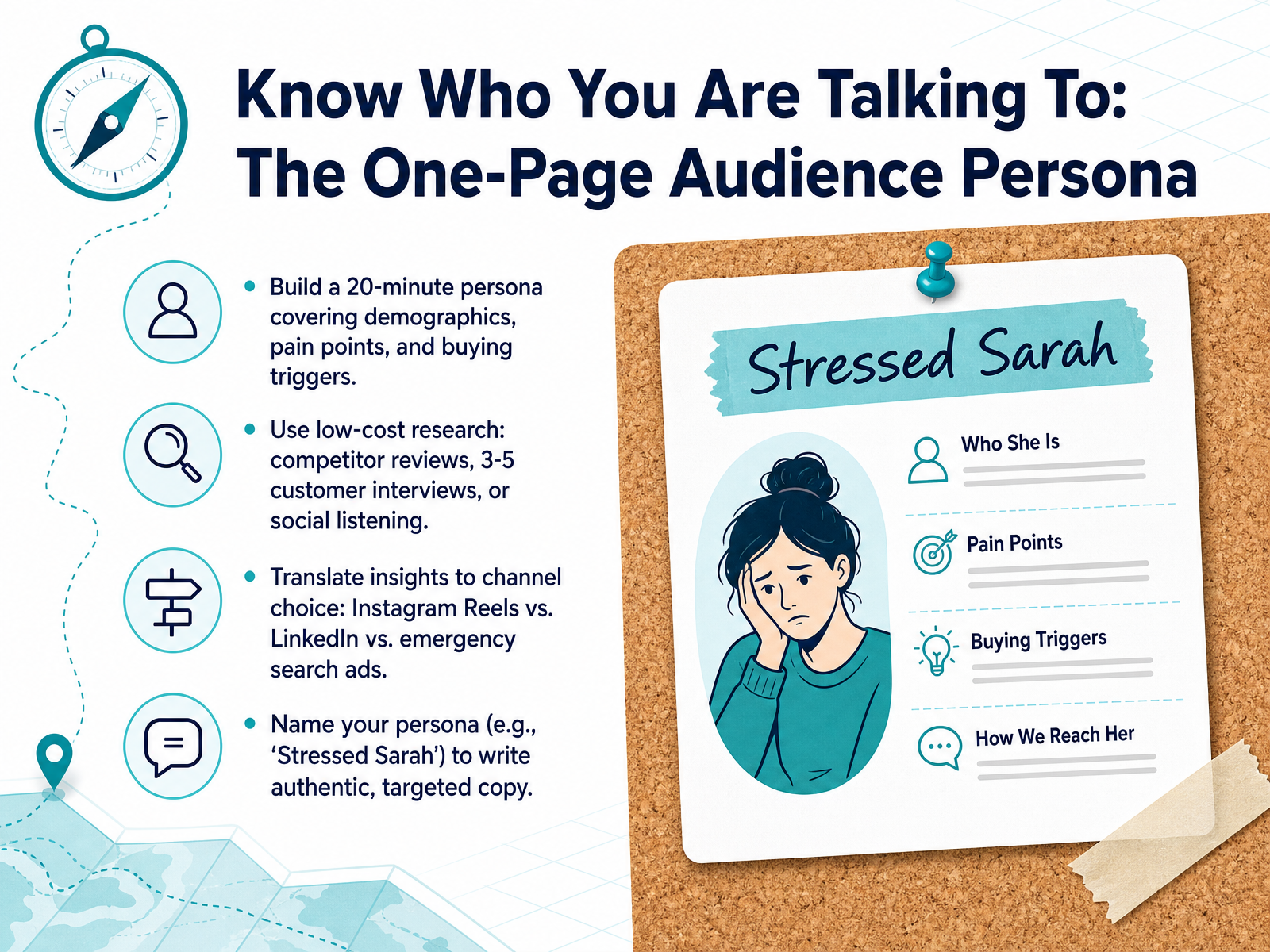
 - 03Know Who You Are Talking To: The One-Page Audience PersonaNow let's get specific. The biggest marketing mistake is trying to talk to everyone, because you'll end up reaching no one. So, we're going to fix that right now by building a simple one-page persona. Think of this as a quick sketch of your ideal customer, the real person you want to attract. We'll cover three key areas in about twenty minutes: basic demographics like age or role, their main pain points, and what actually triggers them to buy. You don't need a big budget for research. Start by reading competitor reviews to find common frustrations. Have three to five short conversations with existing customers. Or simply practice social listening and pay attention to the questions people ask online. Once you have these insights, they tell you exactly where to show up. Someone looking for emergency help might be on search ads, while a professional seeking tips could be on LinkedIn or watching Instagram Reels. Finally, give this persona a name, like 'Stressed Sarah' or 'Busy Brian'. It's a small trick that makes your writing sound like a natural, one-on-one conversation instead of a corporate broadcast. You'll know you're on the right track later when your copy feels authentic and actually connects. Let's put this into practice now by picking the perfect place to find them.
 katrinabrooksllc.combacklinko.compipedrive.com+22 min
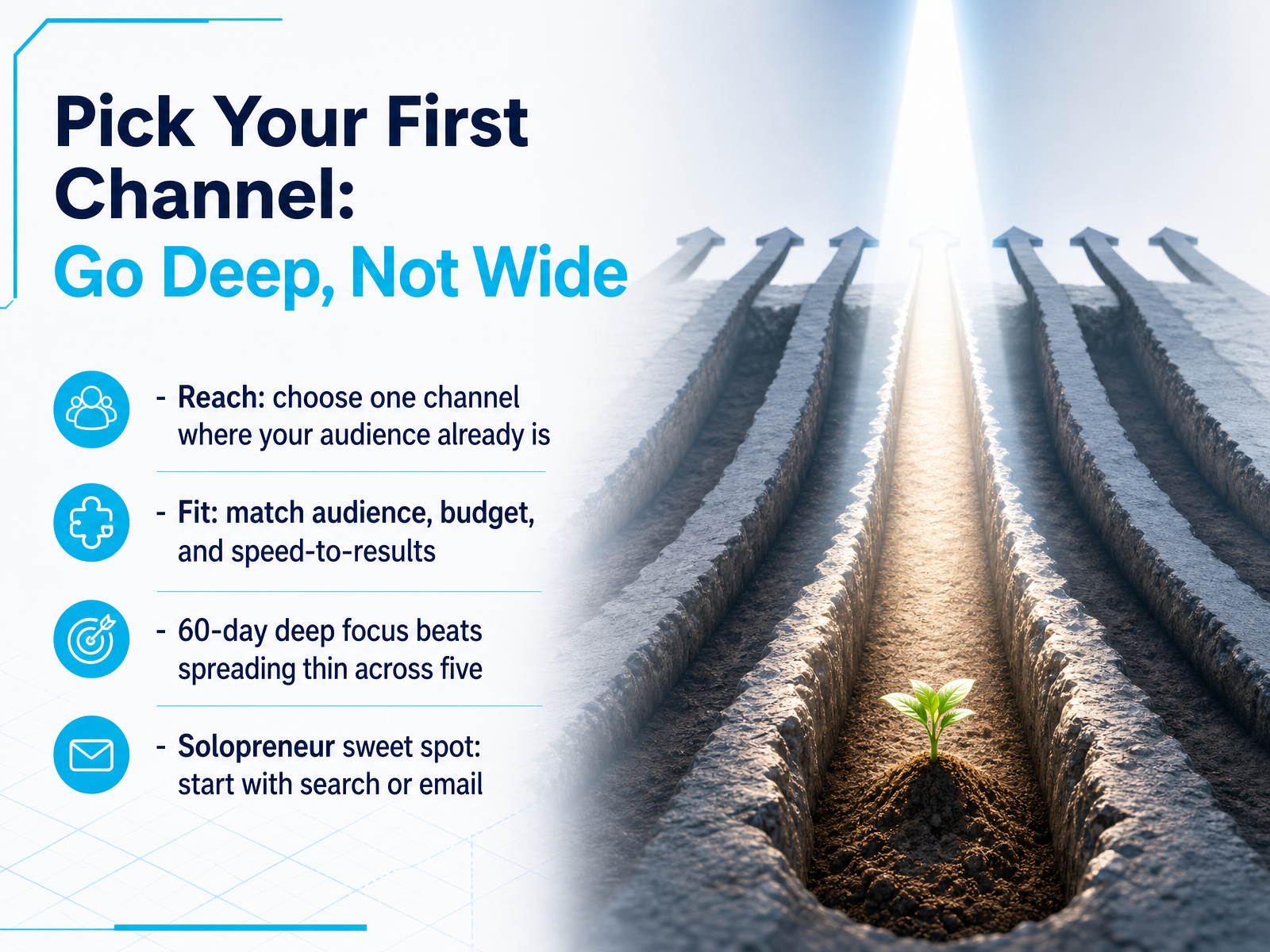
 - 04Pick Your First Channel: Go Deep, Not WideAlright, now you have your audience clearly in mind. The next question is where to find them. The golden rule here is simple: pick one channel, and go deep. Do not make the mistake of trying to be everywhere at once. You want to be where your customers already are, not where you think you should be. For most local businesses, that starting point is Google Business Profile, because it puts you right in front of people searching for exactly what you offer. If you are a solopreneur or service provider, search and email are your best friends. Email is the channel you fully own, and it gives you the highest return on every dollar spent. Commit to a single channel for a solid sixty days. Sixty days of deep focus will always beat spreading yourself thin across five platforms. You will actually see results this way. Next, let’s talk about how to design a simple offer that turns those visitors into actual leads.
 leadpages.commediafa.stforbes.com+21 min
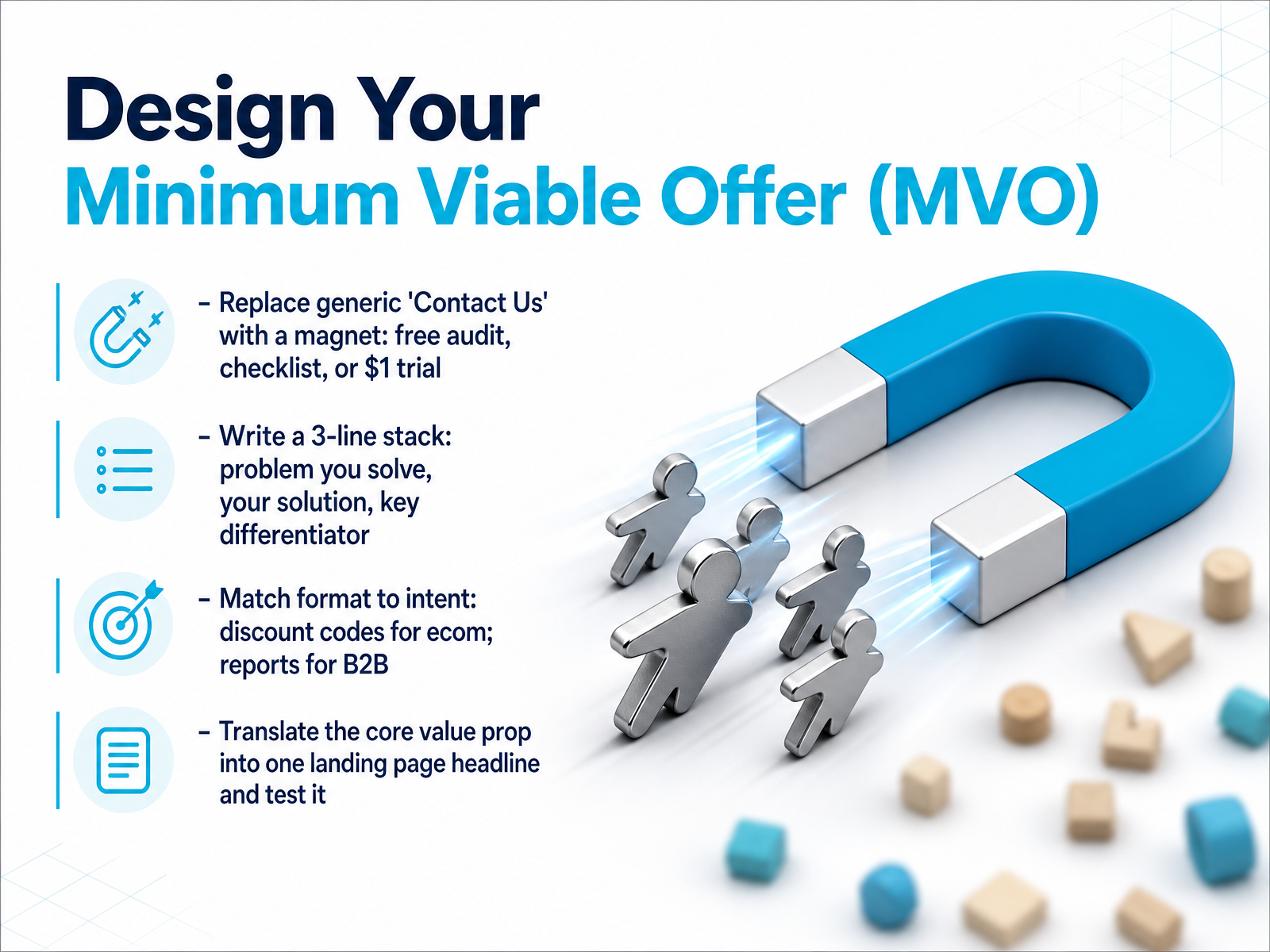
 - 05Design Your Minimum Viable Offer (MVO)Now, let's turn your value into something people actually want to trade their email for. We call this your Minimum Viable Offer. First, stop asking for a generic 'Contact Us.' Replace it with a magnet, something your specific customer would actually use right now. For an ecommerce shop, that is a discount code or a first-purchase offer. For a B2B service, it's a free audit or a benchmark report. Next, condense your whole story into a simple three-line stack. Line one, the urgent problem you solve. Line two, your solution. Line three, what makes you different from the rest. Then, translate this into a single, tested landing page headline. Your job is to see if the words make sense to a stranger in about five seconds. Match the format to the buyer's intent, discounts for shoppers, checklists for people evaluating a provider. Do this right, and you start building a list of people who already raised their hand. Let's get tactical and build the only digital assets you need right now.
 blog.aweber.com2 min
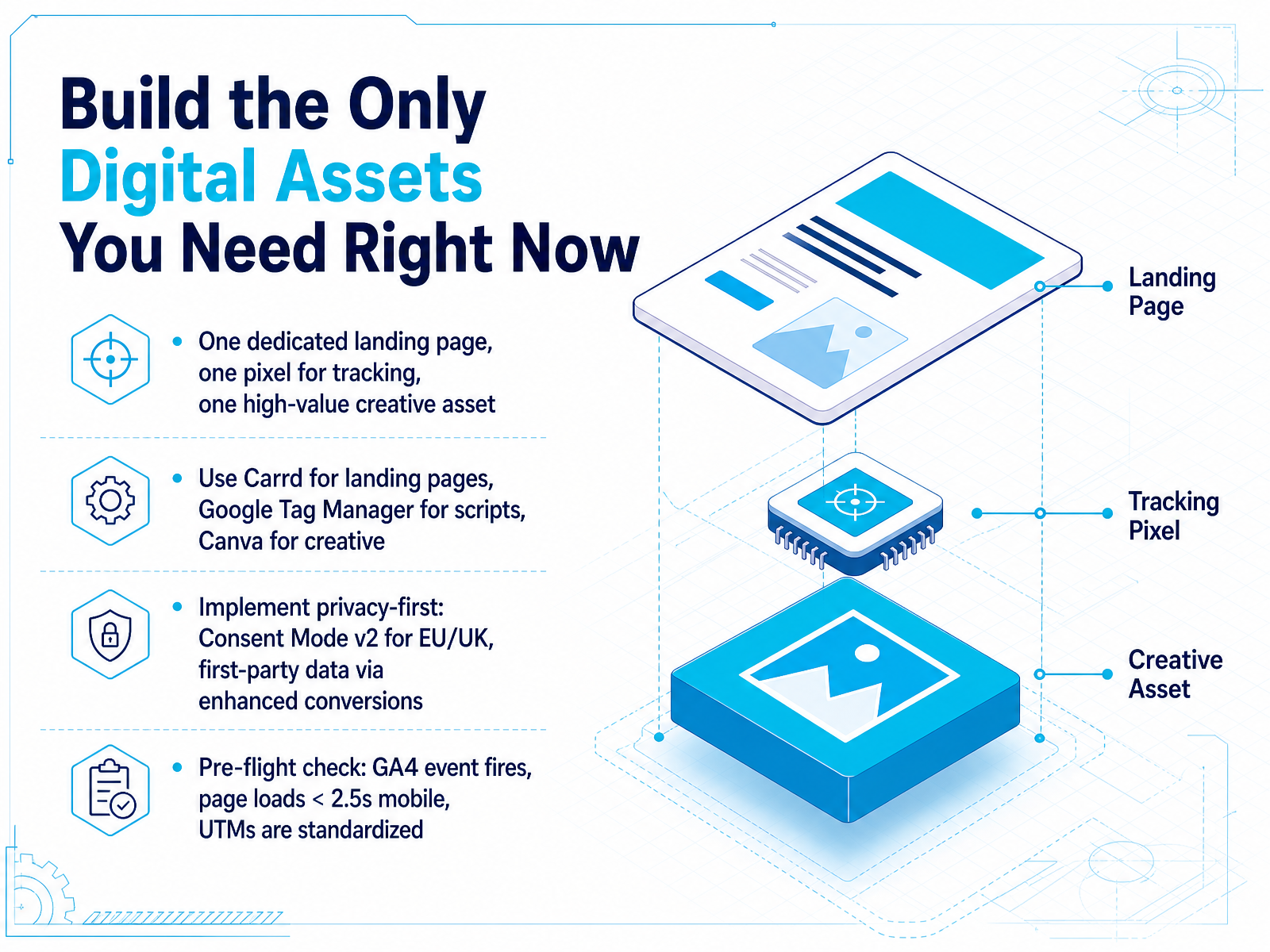
 - 06Build the Only Digital Assets You Need Right NowNext, let's build the only digital assets you actually need right now. You don't need a huge website. You need three things: one dedicated landing page, one tracking pixel, and one high-value creative asset. That's it. We'll keep the tools simple too. Use Carrd for your landing page—it's fast and easy. Use Canva for your creative if you don't have a design team. And use Google Tag Manager to install all your tracking scripts, including your pixel, just once. Here's a critical step: set up tracking in a privacy-first way. If you're serving customers in the EU or UK, you need Consent Mode version two. This keeps your ads smart while respecting user choices. Also, make sure your data is first-party by enabling enhanced conversions. Before you spend a dollar on ads, do a quick pre-flight check. Make sure your Google Analytics 4 events are firing correctly. Test that your page loads in under two point five seconds on mobile. And double-check that all your UTM tags are standardized so your data is clean from day one. Get these three assets right, and you've built a solid foundation. Next, let's take that foundation and launch your very first test campaign at a micro scale.
 2 min
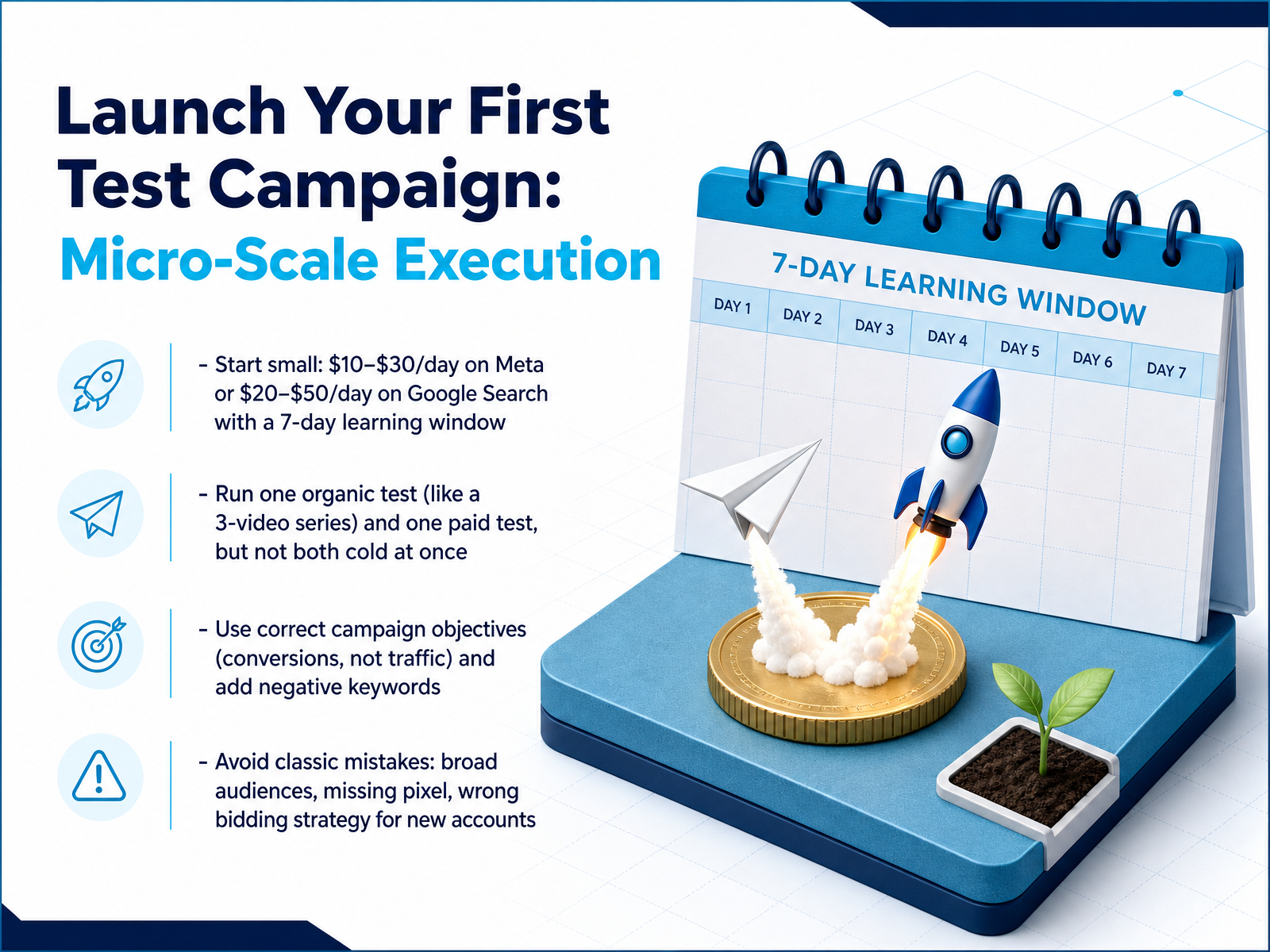
2 min - 07Launch Your First Test Campaign: Micro-Scale ExecutionNow let’s talk about your first test campaign. We are not betting the farm here. This is micro-scale execution. Start with just ten to thirty dollars a day on Meta, or twenty to fifty dollars a day on Google Search, and let it run inside a seven-day learning window. Run one organic test, like a three-video series, and one paid test. But do not launch both cold at the same time. Keep your signals clean. Choose the right campaign objective from day one. For most new marketers, that means optimizing for conversions, not just traffic. And on Google, immediately add negative keywords to block searches that do not match your offer. There are three classic mistakes to avoid: targeting an audience that is way too broad, going live without your tracking pixel installed, and picking a bidding strategy meant for mature accounts, like Target ROAS, before you have any data. Keep it tight, keep it direct, and protect your learning phase. Once you have a few days of results, we will move into a simple three-question review to see if your data is ready for the next step.
 2 min
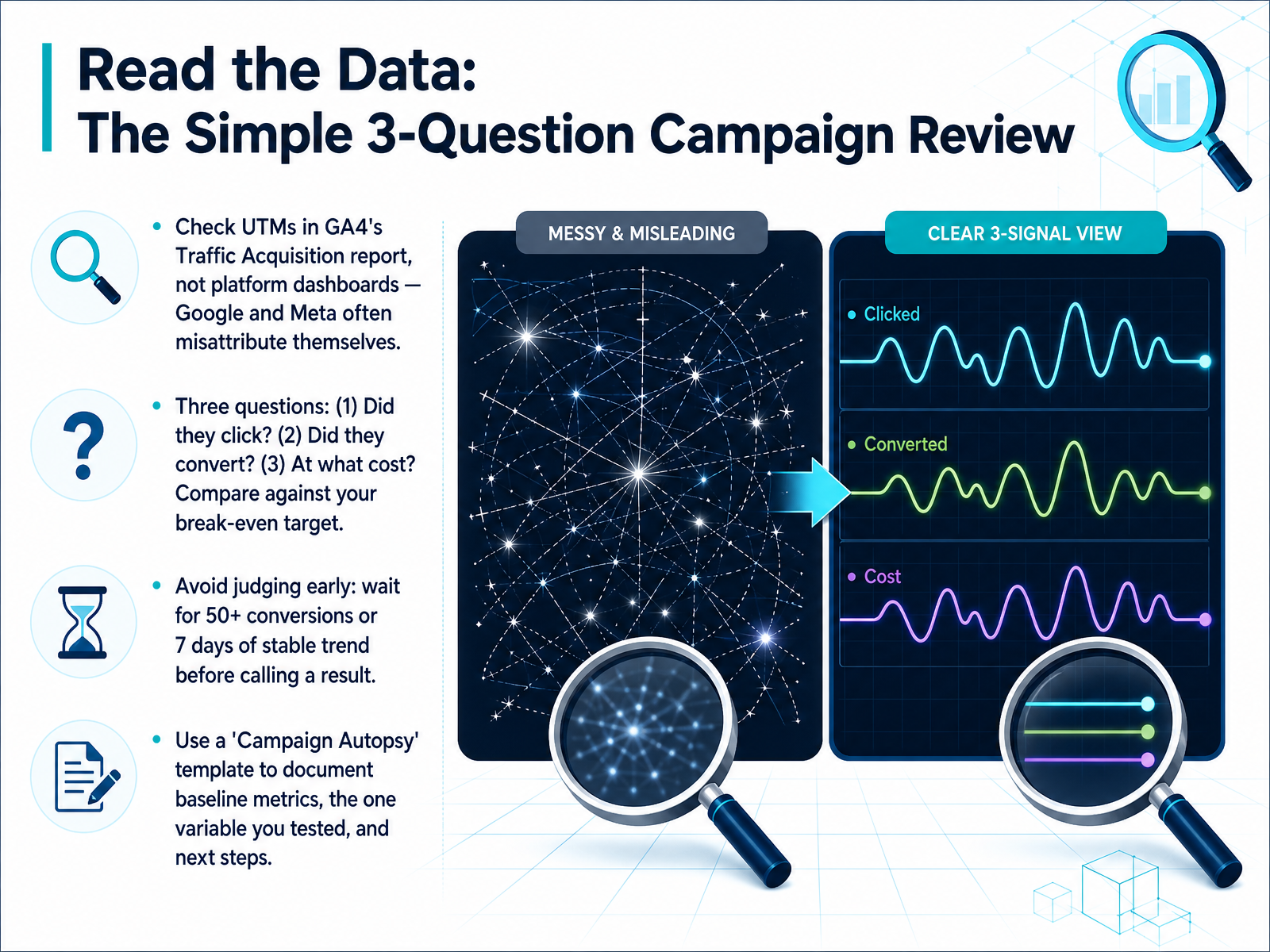
2 min - 08Read the Data: The Simple 3-Question Campaign ReviewAlright, the campaign is live and data is coming in. Let’s talk about how to actually read it without getting overwhelmed. My rule is: never trust the dashboards inside the ad platforms alone. Google and Meta like to take credit for everything. Instead, go straight to Google Analytics 4 and open the Traffic Acquisition report to check your UTMs. That is your single source of truth. Once you are in the right place, ask your campaign three simple questions. First, did they click? Second, and more importantly, did they convert into a lead or sale? Third, what did that cost you? Compare that cost against your break-even target. Now, a warning: do not judge your campaign too early. Wait until you have at least fifty conversions or a seven-day stable trend. Reacting to a slow Tuesday is a great way to kill a winning campaign. Before you move on, I want you to document everything in a 'Campaign Autopsy' template. Note your baseline metrics, the one big variable you tested, and your exact next steps. That’s how you turn guesses into a repeatable process. With that review done, we are ready for the big question. Let’s move on to the decision framework: iterate, scale, or pivot.
 zenweb.myclicksgeek.comtimeboostermarketing.com+22 min
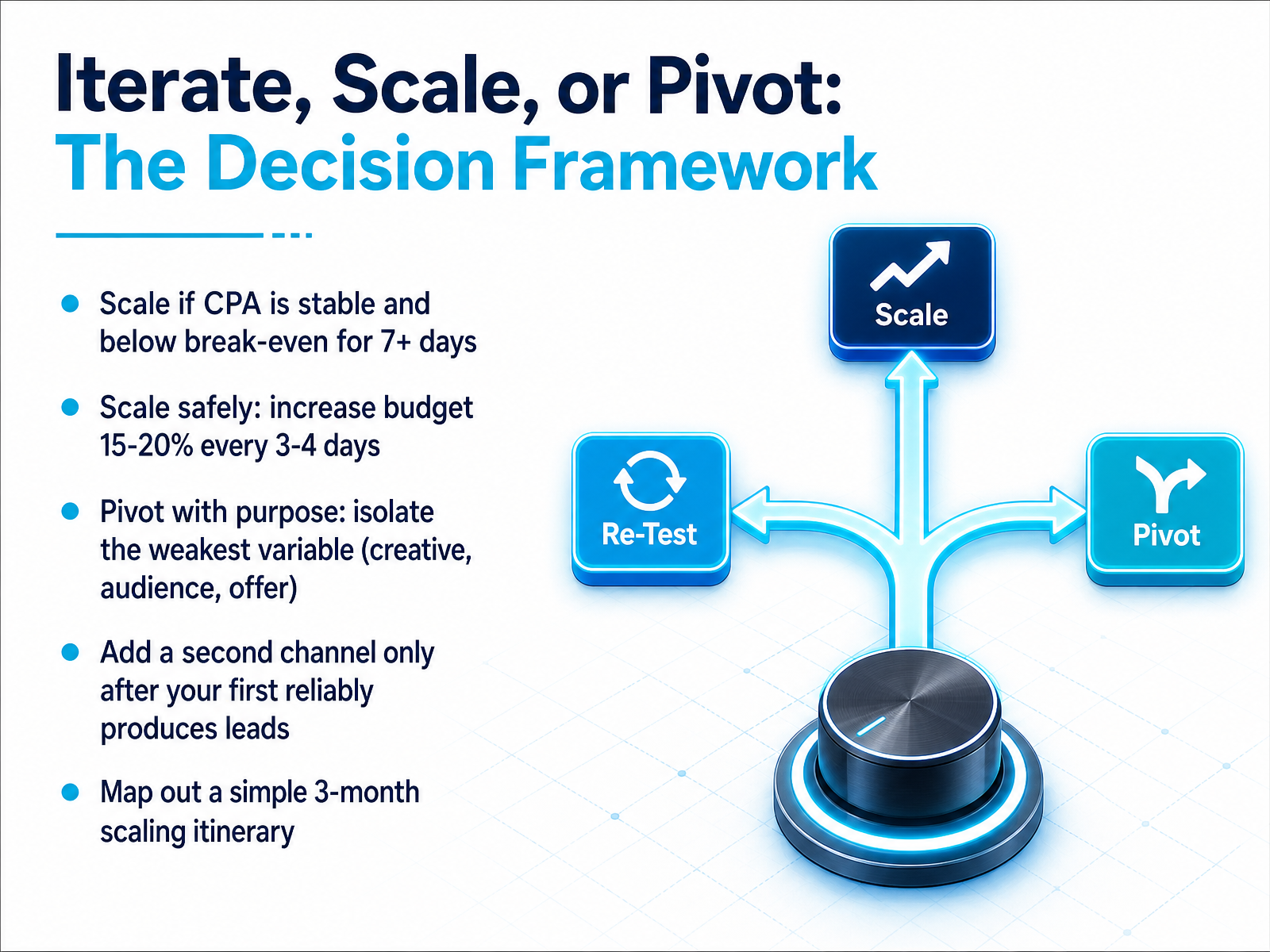
 - 09Iterate, Scale, or Pivot: The Decision FrameworkNow comes the most important skill in digital marketing: knowing exactly what to do after a campaign has been running. We use a simple decision framework: iterate, scale, or pivot. First, scale. You should scale your ad spend only if your cost per acquisition has been stable and below your break-even point for at least seven days straight. Do not double the budget overnight, that will break the algorithm. Instead, increase it safely by 15 to 20 percent every 3 to 4 days. If the numbers are not stable, it is time to pivot with purpose. Do not change everything at once. Isolate the single weakest variable, whether it is a tired creative, a misaligned audience, or a weak offer. Fix that one thing first. A quick note on channels: add a second marketing channel only after your first one is reliably producing leads. Finally, map out a simple 3-month scaling itinerary. This turns guesswork into a manageable growth path, so you control the pace instead of reacting to it. Next, let’s switch gears from strategy to your daily habits. We are going to build a marketing engine with the right tools and standard operating procedures.
 20minutemarketing.coleadpages.comsearchlab.nl+22 min
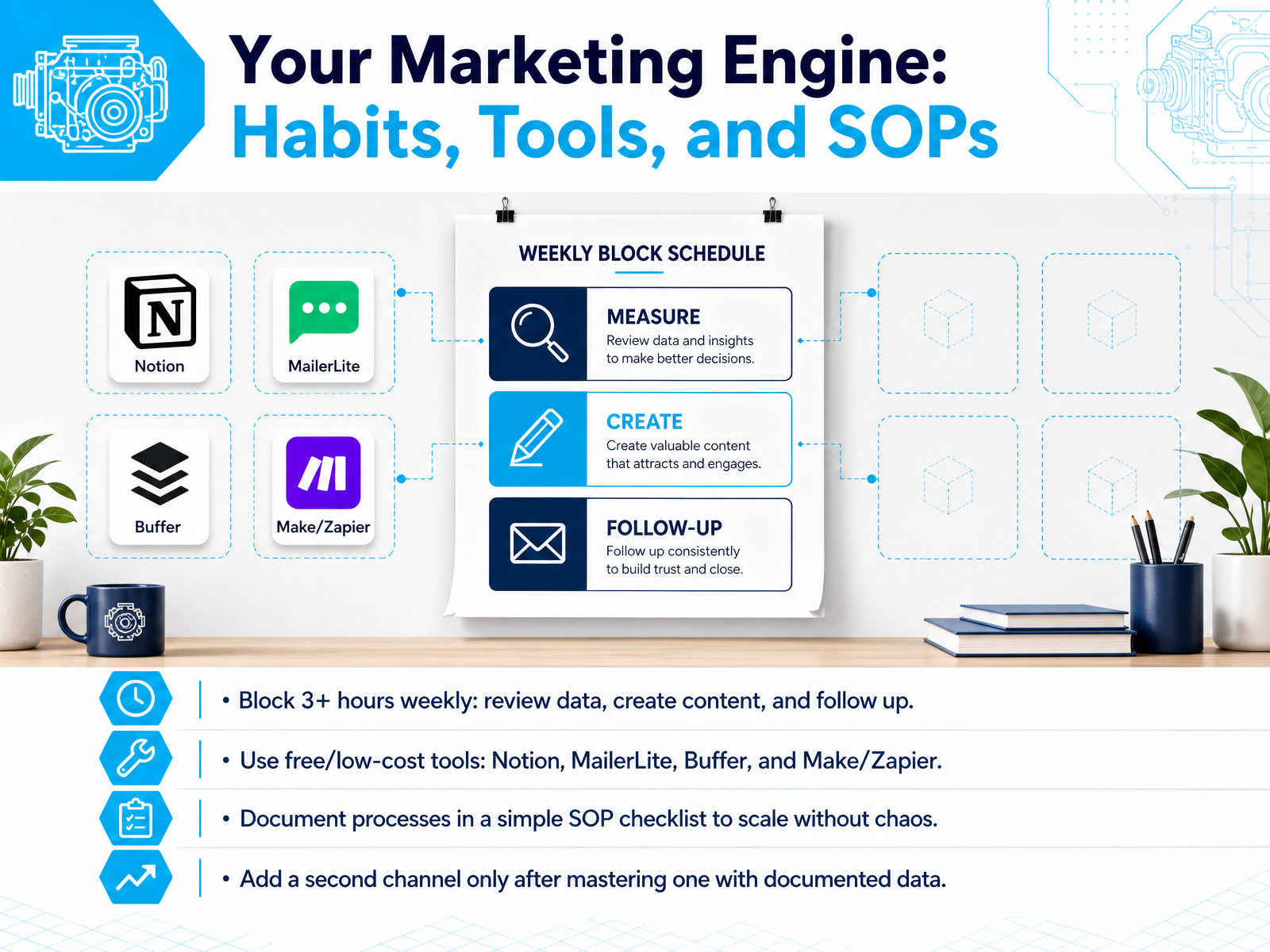
 - 10Your Marketing Engine: Habits, Tools, and SOPsNow let's build the engine that keeps your marketing running week after week. This is about habits, tools, and simple systems, not more theory. First, the core habit. Block at least three hours every single week. Use this time to review your analytics, write content, and follow up with customers. No distractions. It's a standing meeting with your business. Next, you don't need expensive software. Start with free tiers. Use Notion as your command center, MailerLite for email, Buffer to schedule social posts, and Make or Zapier to connect everything. Then, write down your process. A simple checklist SOP prevents chaos when things get busy. Document step one, step two, step three. It sounds basic, but a written SOP is what lets a one-person business scale. Finally, master one channel completely before adding a second. Get proof on paper. When you have documented data showing a channel works, then, and only then, expand. Coming up next, we'll get precise with your tracking. Let's dive into mastering UTM parameters and GA4.
 2 min
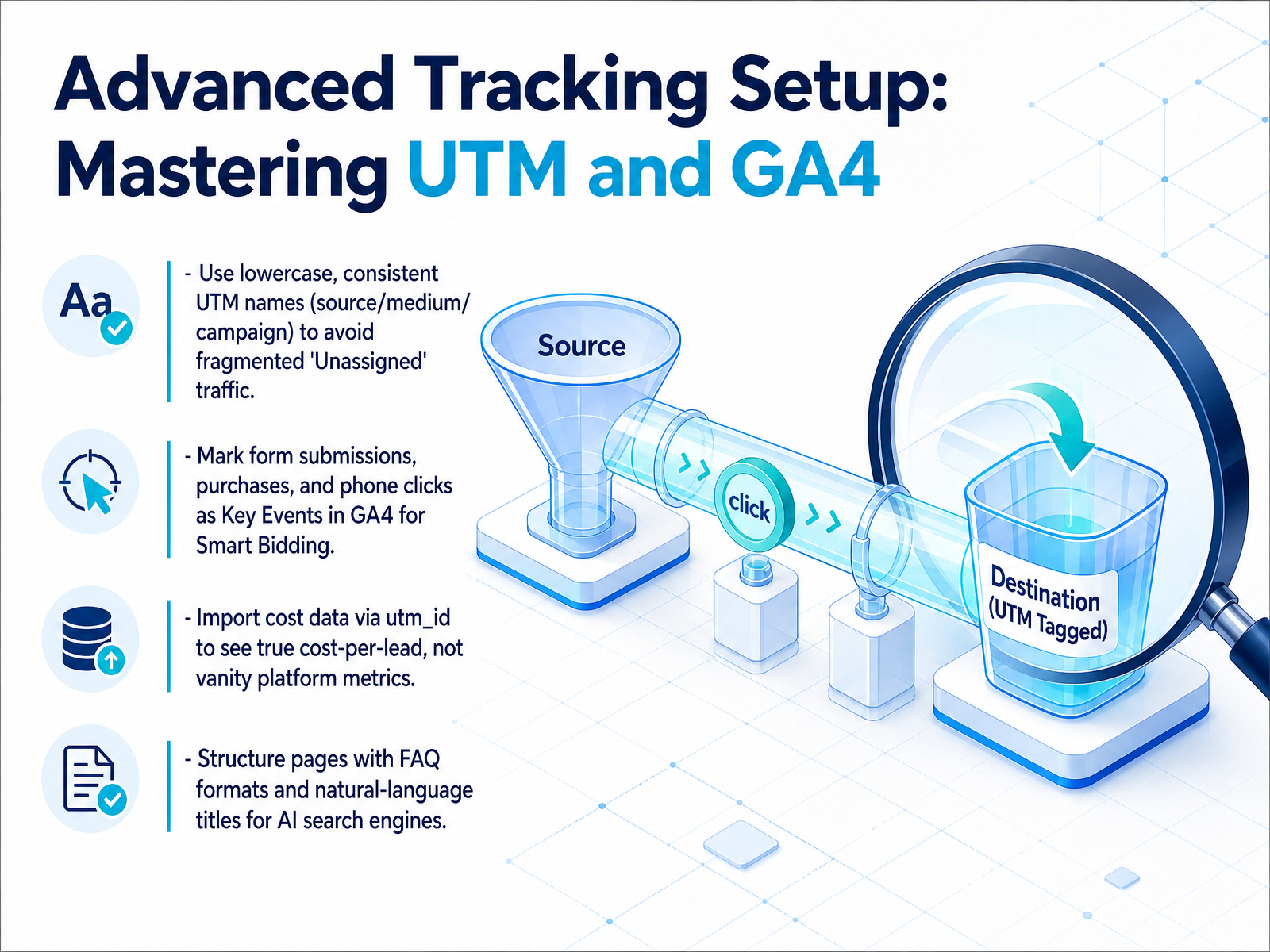
2 min - 11Advanced Tracking Setup: Mastering UTM and GA4Now let's make sure your tracking reveals what actually works. First, commit to lowercase UTM names. If you tag one link as 'facebook' and another as 'Facebook,' GA4 splits them into two sources and hides traffic in 'Unassigned.' Pick a simple, consistent format and stick to it. Next, inside GA4, mark the actions that matter as Key Events. Think form submissions, purchases, and phone clicks. This trains Smart Bidding to chase actual leads, not just clicks. To see your true cost per lead, use a utm_id parameter to import ad spend from your platforms. This lets you compare real profitability instead of relying on inflated platform metrics. Finally, structure your pages for AI search. Use natural-language titles and FAQ formats so large language models can surface your content easily. Let's carry this practical mindset into Content Marketing Essentials for Beginners.
 1 min
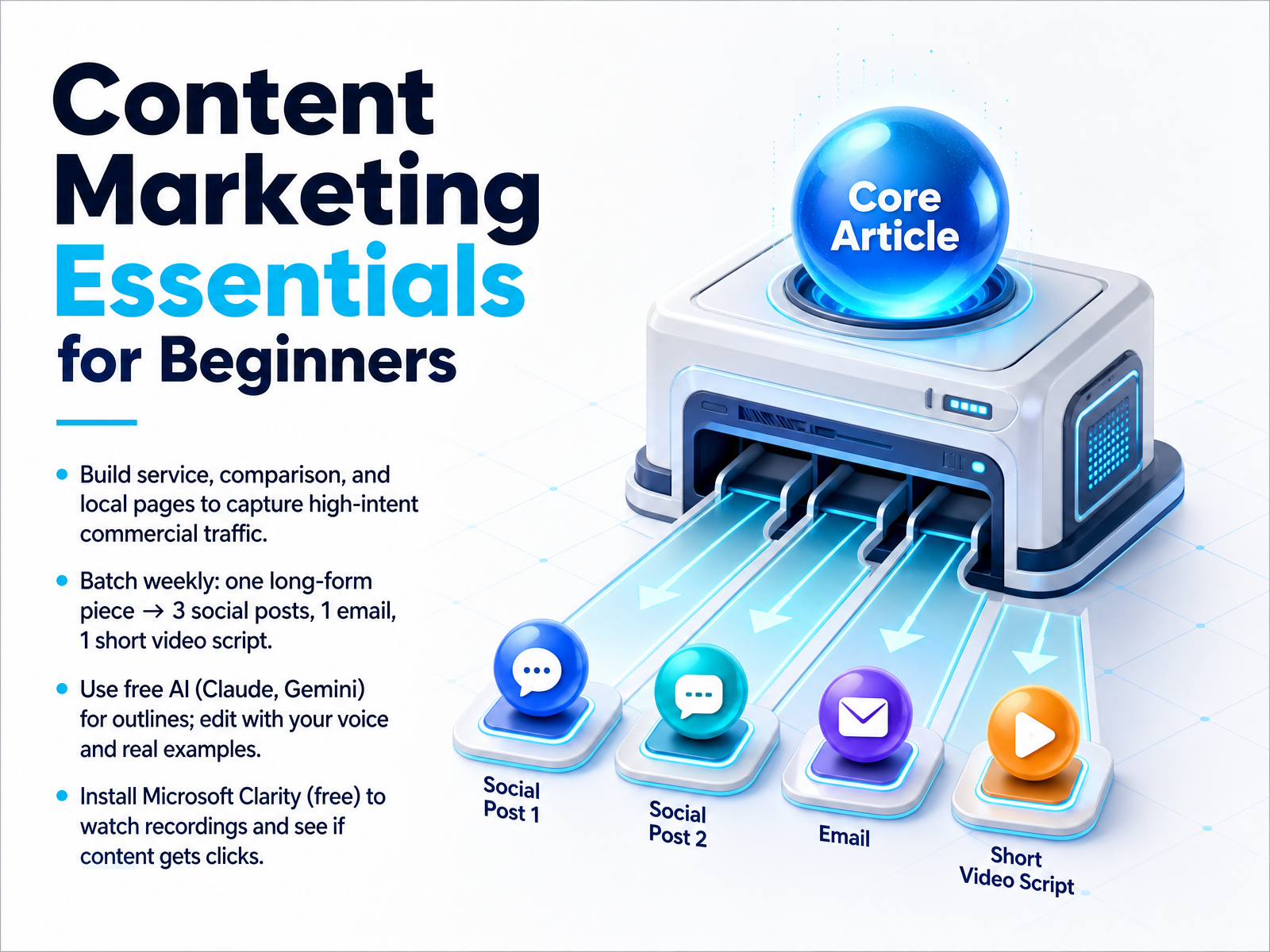
1 min - 12Content Marketing Essentials for BeginnersNow let's talk about the practical side of content creation. This is where the heavy lifting turns into a predictable weekly rhythm. First, you need pages that capture high-intent traffic. Think less about random blog posts and more about structured pages: detailed service descriptions, trustworthy comparison pages, and local landing pages. These answer specific buying questions right when someone is ready to make a decision. Once those are live, we move to a batching workflow to save you time. The goal here is to write one solid long-form piece of content per week. Then, you stretch that single asset across multiple channels. Take that main article and pull out three social media posts, use the key idea for an email to your list, and draft a one-minute video script from the same topic. This prevents the burnout of starting from scratch every day. To speed this up, use free AI tools like Claude or Gemini to generate your first outline. But remember, those outlines are just raw material. You then edit them thoroughly with your specific voice, your real customer stories, and your actual business numbers before you publish. Finally, let's make sure this effort pays off by watching user behavior. Install Microsoft Clarity on your site. It's completely free and lets you watch session recordings to see exactly where people click, where they get stuck, and whether your content is actually engaging them. Data guides your next edit. Now, once your content engine is running, we need to make sure people in your neighborhood can find you. Let's move into local visibility and owning your geographic market.
 20minutemarketing.coleadpages.comsearchlab.nl+22 min
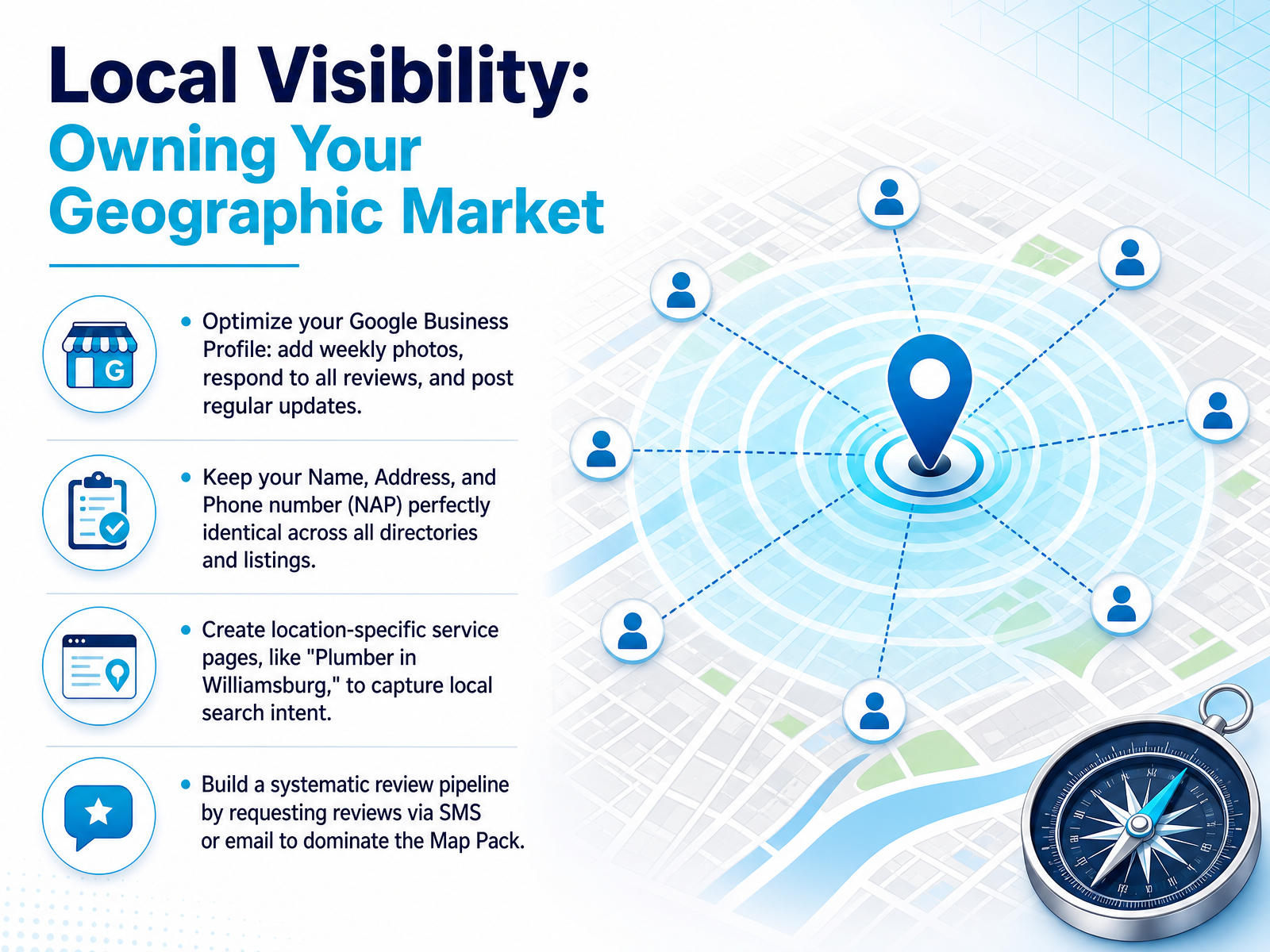
 - 13Local Visibility: Owning Your Geographic MarketNow let's get tactical about owning your local map. This is where you show up when someone nearby searches for what you do. First, treat your Google Business Profile like a living page. Add photos every week, reply to every single review, and post short updates regularly. Google rewards active profiles with higher visibility. Next, consistency is everything. Your business name, address, and phone number must be identical on every directory and listing out there. Even a small mismatch confuses search engines and hides you from customers. Then, create specific pages for each location you serve. Think 'Plumber in Williamsburg' rather than just 'Our Services.' That targeted language captures real search intent. Finally, build a repeatable review pipeline. Send a polite request by text or email right after a great customer experience. This is what fills the map pack with five-star trust signals and brings you steady local calls.
 leadpages.commediafa.stforbes.com+22 min
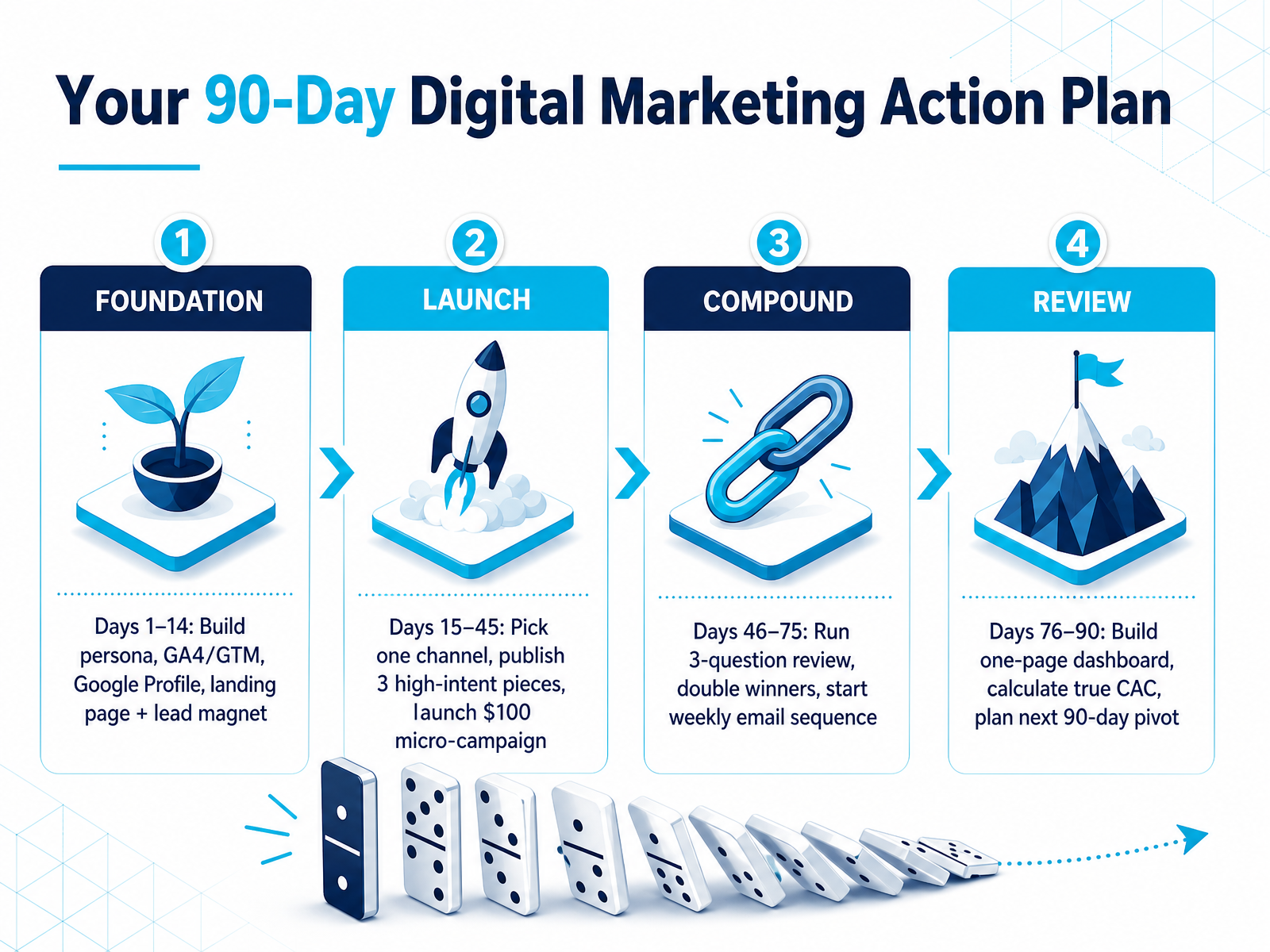
 - 14Your 90-Day Digital Marketing Action PlanHere is your complete 90 day action plan. In the first two weeks, build your foundation. Set up Google Analytics 4, claim your Google Business Profile, and create a simple landing page with a lead magnet. During days 15 to 45, pick just one channel, publish three high-intent pieces of content, and launch a small 100 dollar campaign to test the water. For days 46 to 75, run a three-question review of what worked, double down on your winners, and start a simple weekly email sequence. In the final stretch, days 76 to 90, build a one-page dashboard, calculate your true customer acquisition cost, and plan your next 90 day pivot based on real numbers, not guesses. You now have a complete system to start digital marketing with confidence. Thank you for joining me, and I cannot wait to see what you build.
 20minutemarketing.coleadpages.comsearchlab.nl+22 min
Take the deck with you
Download this course as a file — free, no sign-up needed.
- PDF handoutEvery slide page, ready to print or share.15 pages · 4.1 MBDownload
- Narrated PowerPointThe deck that presents itself — every slide carries the digital human's narration video.15 pages · 14.8 MBDownload
- PowerPoint slidesThe full deck as a .pptx — open it in PowerPoint, Keynote, or Google Slides.15 pages · 4.1 MBDownload
Free to use in your own training — please keep the PersonWise credit page at the end.
Have your own deck? Turn it into a course
Sources consulted
Web sources consulted while building this course.
- 30-Day Digital Marketing Implementation Plan for Small Business — 20minutemarketing.co
- Digital Marketing for Small Business: The 2026 Starter Guide | Leadpages. — leadpages.com
- Marketing Without an Agency: DIY Playbook [2026] | Searchlab — searchlab.nl
- Digital Marketing for Small Business: A Practical Roadmap to Get Your First Customers Online - Zyro Magazine — zyromagazine.com
- Digital Marketing Strategy for Small Business: A Complete 2026 Guide | BusinessFocusHub — businessfocushub.com
- How to Measure Marketing: Simple KPIs & GA4 Basics for Small Business — zenweb.my
- Digital Marketing KPIs for Small Business That Drive Revenue — clicksgeek.com
- 5 Marketing Metrics for Small Business Owners That Show If Your Marketing Is Working — timeboostermarketing.com
- 6 Marketing Metrics Every Small Business Should Track — rakosmediagroup.com
- Marketing Analytics for Small Business: What to Track and Why | The SMB Hub — thesmbhub.com
- FREE- Audience Persona Template | Katrina Brooks, MS — katrinabrooksllc.com
- How to Build Audience Personas for Modern Search + Template — backlinko.com
- Create an Audience Profile in 5 Simple Steps — pipedrive.com
- Audience Personas Guide for Small Business | Nine10 — nine10.ca
- Stop Guessing: How to Create an Audience Persona That Actually Sells — rockmybiz.com
- Digital Marketing for Small Business (2026): 8 Channels + Real Budgets | MediaFast — mediafa.st
- Small Business Marketing In 2026: The Ultimate Guide - Forbes — forbes.com
- Small Business Marketing Channels: What Actually Works in 2026 | Searchlab — searchlab.nl
- Best Digital Marketing Channels for Small Businesses in 2026 - TLSubmit — tlsubmit.com
- Lead Magnet Ideas to Grow Your Email List (11 That Work for Small Businesses) | AWeber — blog.aweber.com