Begin
14 pages · ~28 min
Technical Writing Experience Workflow
This training guides aspiring technical writers through a practical workflow for building hands-on experience and developing job-ready writing skills.
A digital instructor presents all 14 pages. Hold “Ask” at any point and ask out loud — the answer comes from this course. No sign-up needed.
What you’ll learn
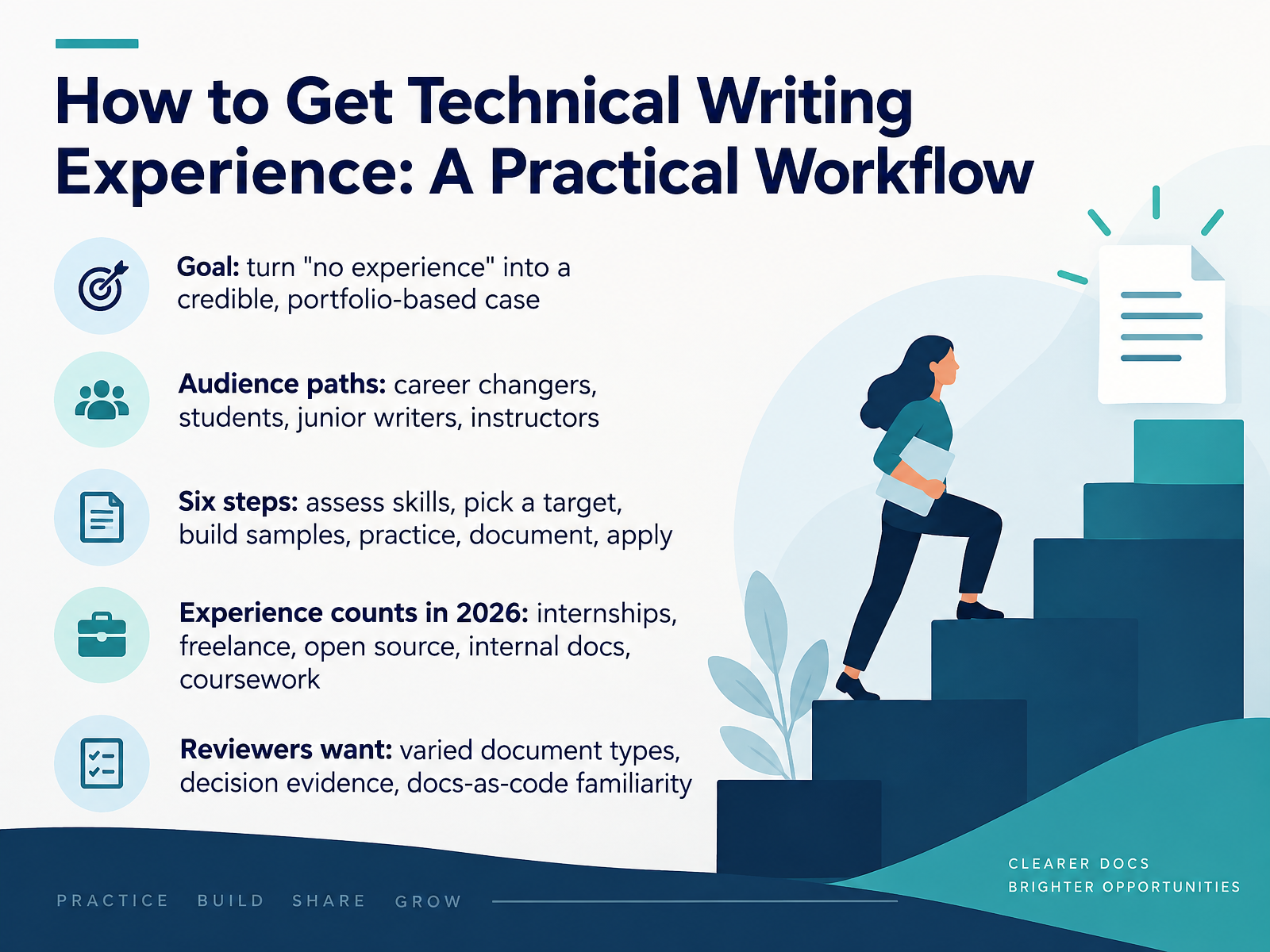
- 01How to Get Technical Writing Experience: A Practical WorkflowWelcome. This course is about turning a common problem into a concrete plan: you want technical writing experience, and you do not have the job title yet. We will treat that as a workflow, not a waiting game. Our goal is to turn no experience into a credible, portfolio-based case. The path is the same whether you are a career changer, a student, a junior writer, or an instructor supporting others. We will walk through six steps: assess your skills, pick a target, build samples, practice, document your work, and apply. Along the way, we will look at what counts as experience in twenty twenty-six, including internships, freelance work, open-source contributions, internal docs, and coursework. And we will cover what reviewers actually want to see: varied document types, evidence of your decisions, and familiarity with docs as code, which simply means writing and managing documentation using the same tools and version control that developers use. By the end, you will have a realistic plan you can start this week. Next, let us define what counts as technical writing experience.developers.google.comtechnicalwriterhq.comtexasagilabs.com+21 min
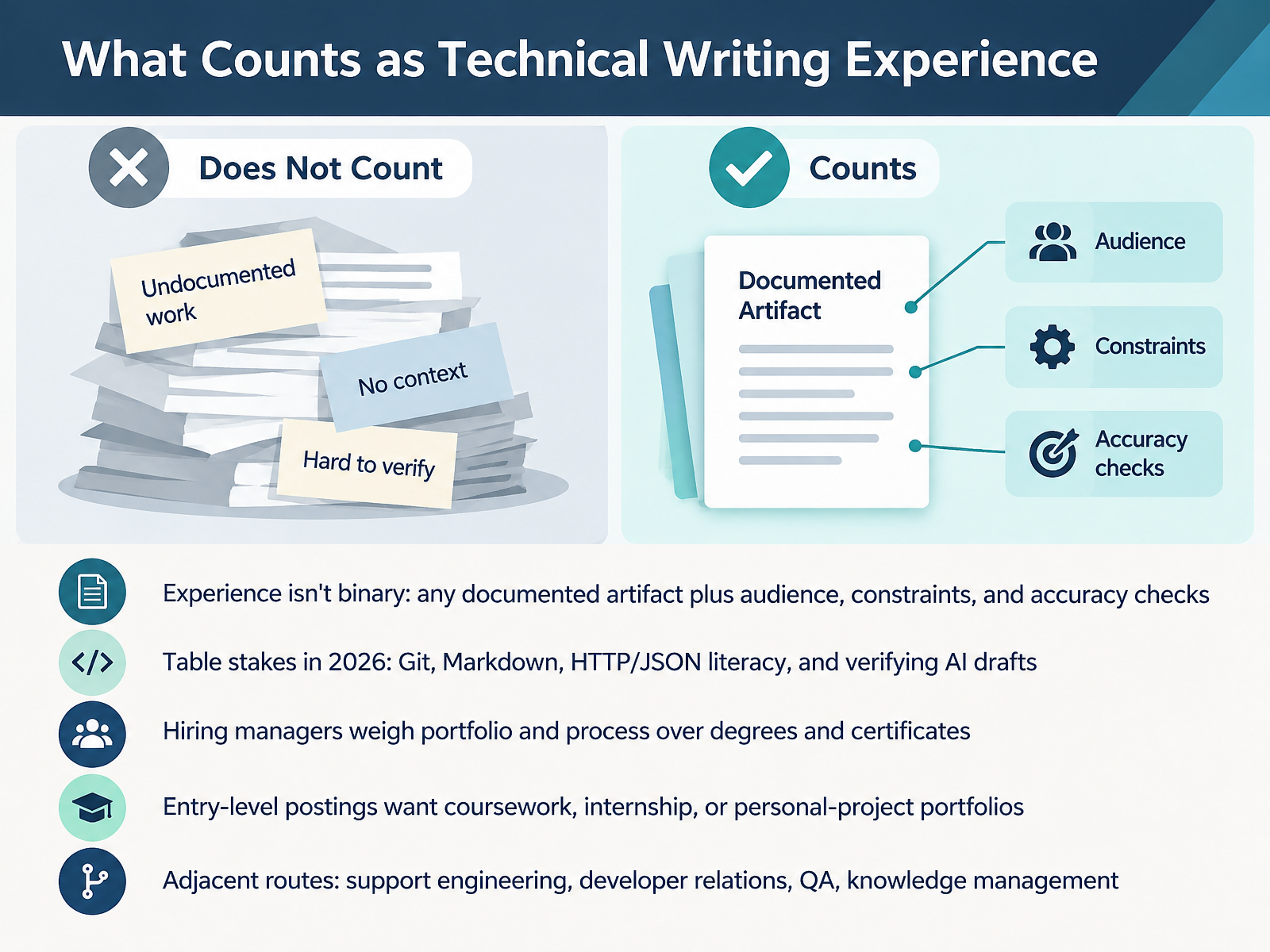
- 02What Counts as Technical Writing ExperienceLet's clear up a common worry first. Experience is not a yes or no question. Any documented artifact counts, as long as you can name the audience, the constraints you worked within, and how you checked accuracy. In 2026, the baseline is concrete. Use Git to clone, branch, commit, and open a pull request. Write in Markdown. Read HTTP methods, status codes, and JSON. And verify every AI draft before you trust it. Hiring managers weigh portfolio and process over degrees and certificates. Entry-level postings ask for coursework, an internship, or personal-project portfolios. So build three to five samples, including one case where you corrected a weak AI draft. And remember the adjacent routes: support engineering, developer relations, QA, and knowledge management all build real documentation experience. Next, we'll look at baseline skills and a readiness self-assessment.
 developers.google.comtechnicalwriterhq.comtexasagilabs.com+22 min
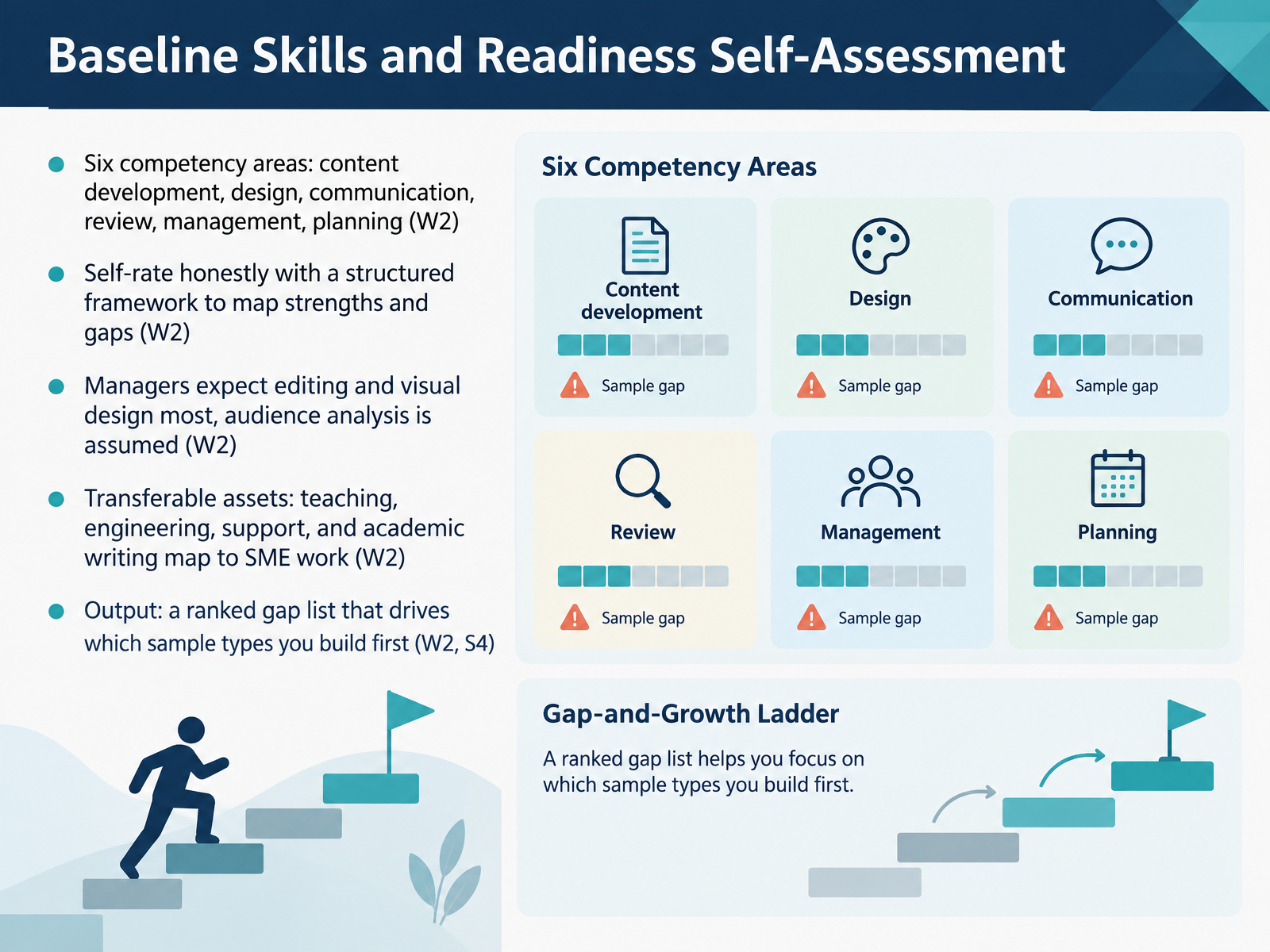
- 03Baseline Skills and Readiness Self-AssessmentNext, let's look at where you stand today. Start with six competency areas: content development, design, communication, review, management, and planning. Rate yourself honestly in each one, using a structured framework such as the tekom Profiling Tool, so strengths and gaps appear on paper rather than in your head. One finding helps here. Managers expect editing and visual design most, while audience analysis is simply assumed. So weight your sample work toward editing and design first. Then map your transferable assets. Teaching, engineering, support work, and academic writing all build subject matter expert skills, which means working with the people who hold the technical knowledge. Your output is one ranked gap list. Rank the gaps, and that list decides which sample types you build first. With it in hand, choose a target domain and set a measurable goal.
 competencies.technical-communication.orghdl.handle.netextendedstudies.ucsd.edu+22 min
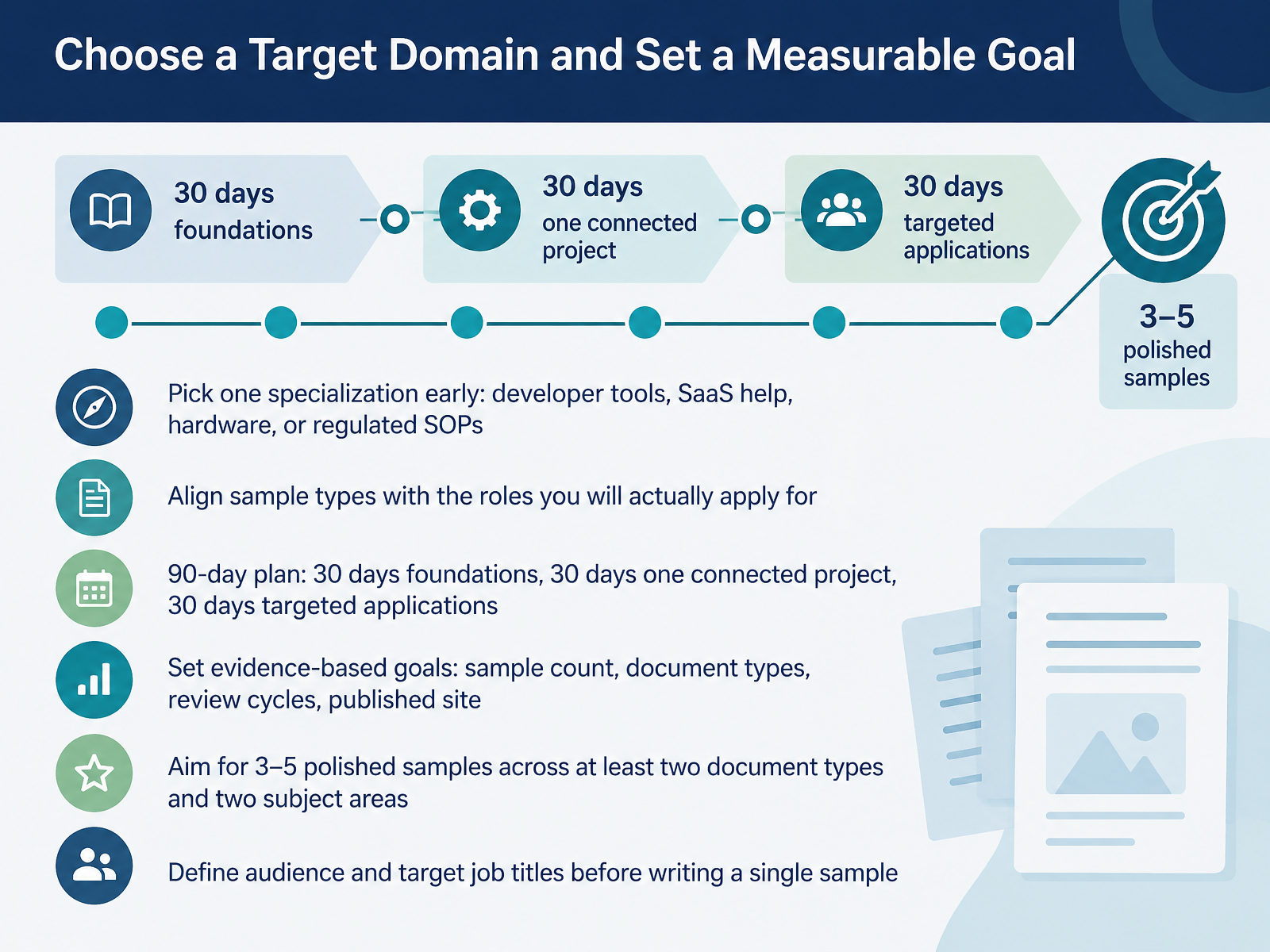
- 04Choose a Target Domain and Set a Measurable GoalNow let's narrow your focus. Pick one specialization early, such as developer tools, software-as-a-service help content, hardware, or regulated standard operating procedures. Then define your audience and the exact job titles you will apply for before you write a single sample. Your samples should match the roles you actually want, so check ten real job postings and note which document types they request. Set an evidence-based goal: three to five polished samples across at least two document types and two subject areas, hosted on a published site, with at least one review cycle each. Here is a practical ninety-day plan. Spend the first thirty days on foundations: Git, Markdown, and building a documentation site. Use the next thirty days for one connected project that shows the full loop from source to publication. Use the final thirty days for targeted applications, tailoring the evidence for each company. Next, we look at where to find that experience: open source, freelance, and internal documentation.
 developers.google.comtechnicalwriterhq.comtexasagilabs.com+22 min
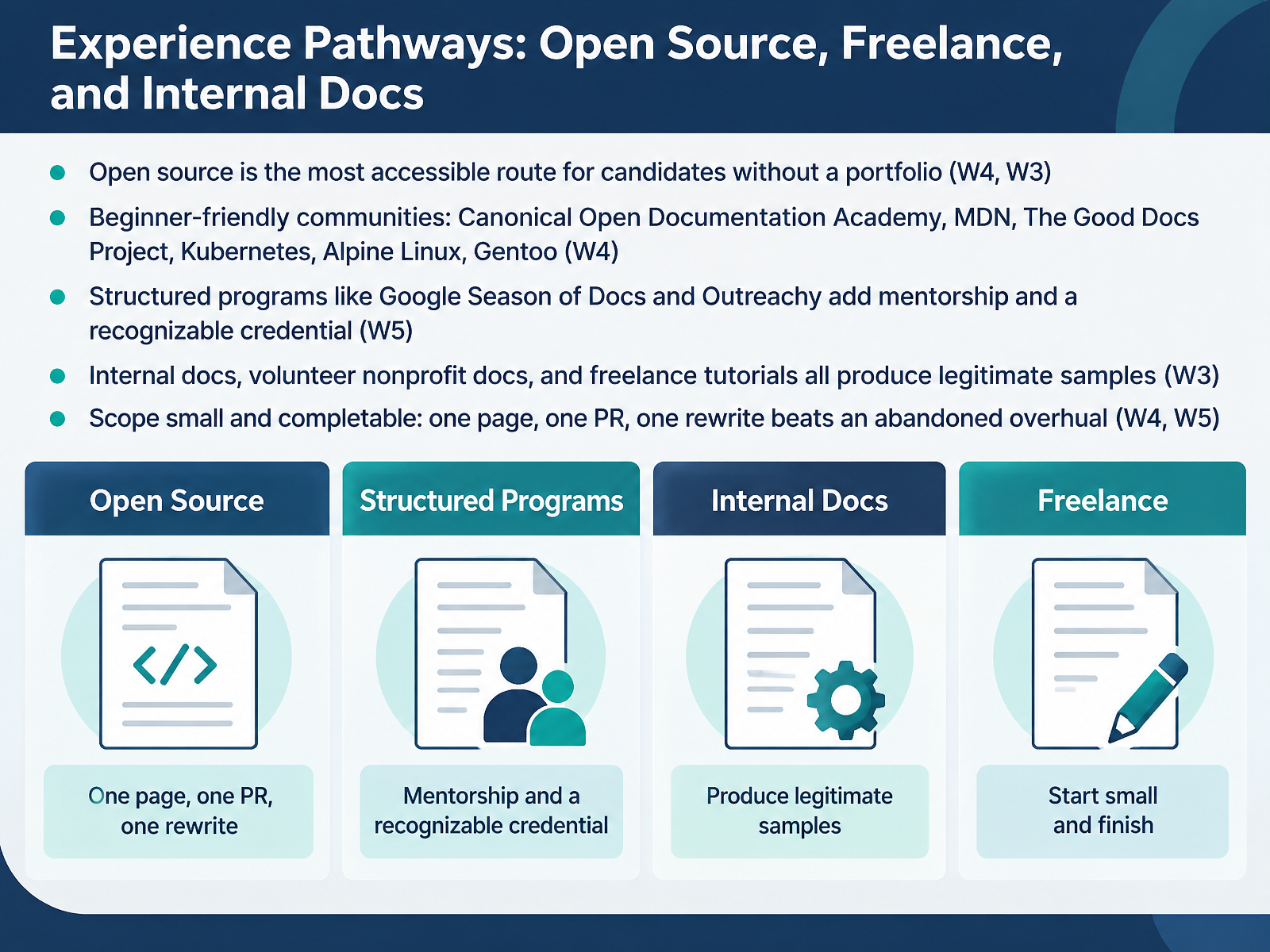
- 05Experience Pathways: Open Source, Freelance, and Internal DocsNow let's look at where experience actually comes from. Open source is the most accessible route if you don't have a portfolio, because no one asks for a job title first. Start with beginner-friendly communities: Canonical's Open Documentation Academy, M D N, The Good Docs Project, Kubernetes, Alpine Linux, and Gentoo. Each one lists tasks and welcomes newcomers. If you want structure and mentorship, try programs like Google Season of Docs or Outreachy. They pair you with a mentor and give you a recognizable credential. And don't overlook internal docs at your current job, volunteer documentation for a nonprofit, or freelance tutorials. All of these produce legitimate samples you can show. The key is to scope small and completable. One finished page, one merged pull request, or one rewrite beats an abandoned overhaul every time. Next, we'll look at building credible samples without a paid job.
 both.orgkubernetes.iocanonical-open-documentation-academy.readthedocs.io+22 min
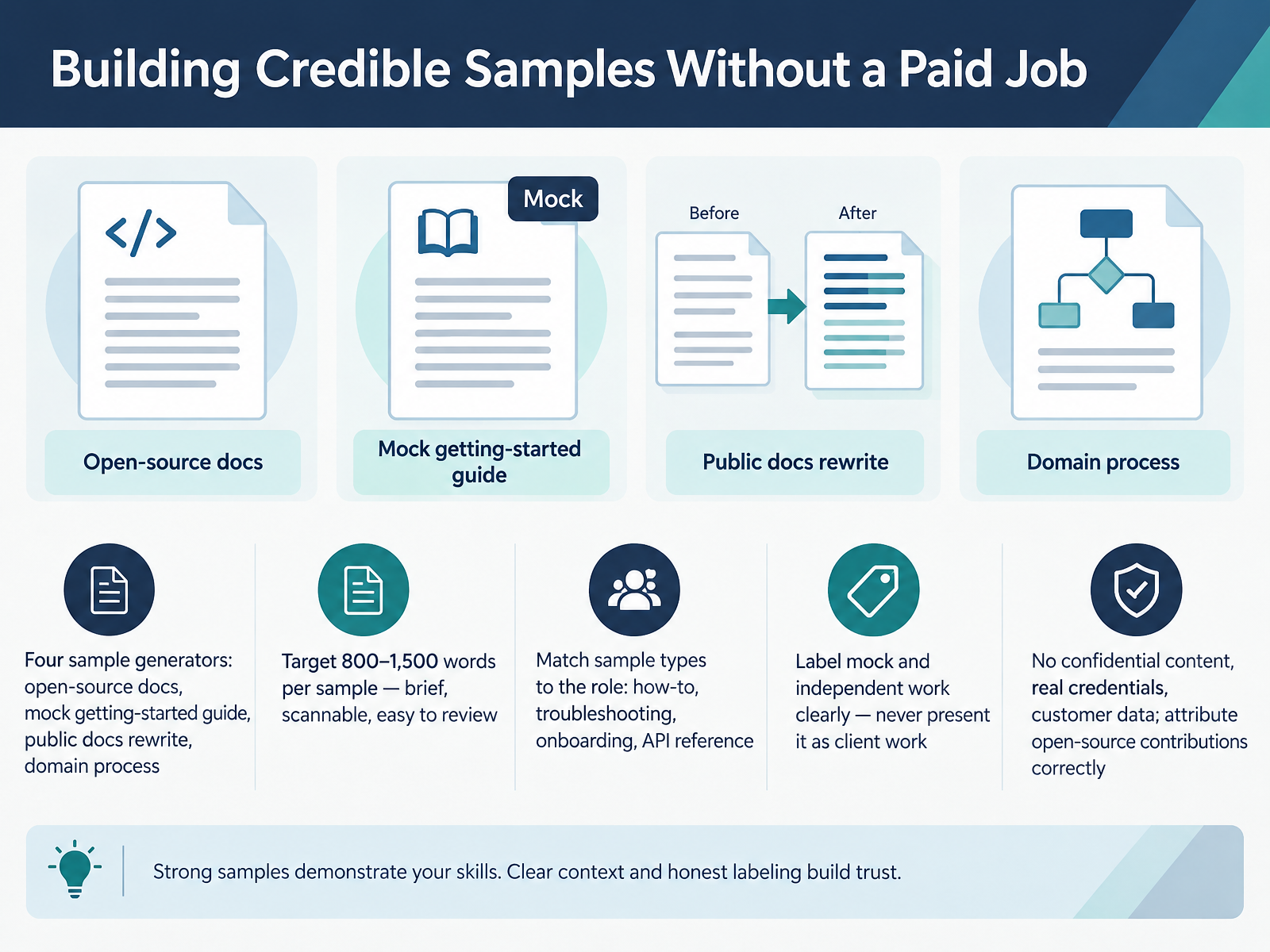
- 06Building Credible Samples Without a Paid JobNext, let's look at building credible samples without a paid job. You have four reliable generators: contributing to open-source docs, writing a mock getting-started guide, rewriting confusing public documentation, and documenting a process from your own domain. Keep each sample between eight hundred and one thousand five hundred words. Brief and scannable beats long and dense. Then match sample types to the role you want: how-to guides, troubleshooting articles, onboarding flows, and API reference. Label mock and independent work clearly, and never present it as client work. Leave out confidential content, real credentials, and customer data. If you contribute to open source, attribute your contribution correctly. Now let's move on to the anatomy of a strong portfolio.
 developers.google.comtechnicalwriterhq.comtexasagilabs.com+21 min
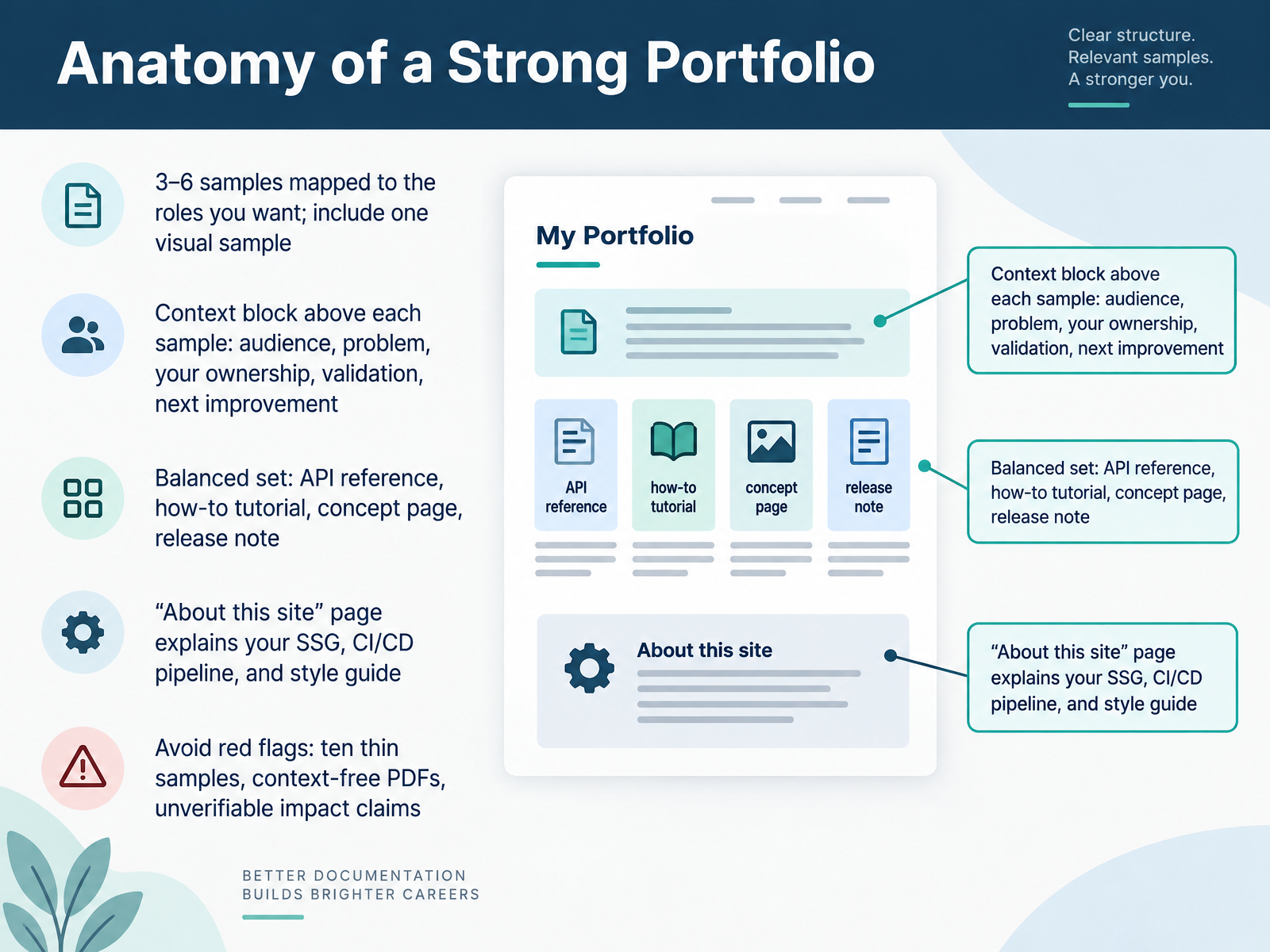
- 07Anatomy of a Strong PortfolioLet's break down what a strong portfolio actually contains. Aim for three to six samples, chosen to match the roles you want, and include at least one visual sample, such as a diagram or an annotated screenshot. Above each sample, add a short context block with five points: the audience, the problem it solves, what you owned, how you validated accuracy, and what you would improve next. Build a balanced set that shows range: an API reference, a how-to tutorial, a concept page, and a release note. Then add an About this site page. Explain your static site generator, your CI/CD pipeline, and your style guide. That page proves you understand documentation infrastructure, not just prose. Finally, avoid the common red flags: ten thin samples instead of a few strong ones, PDFs with no context, and impact claims a reader cannot verify. A small, well-explained portfolio outperforms a large, shallow one. Next, we'll walk through the practice workflow: research, draft, review, publish.
 knowledgeowl.comtechnicalwriterhq.comauthory.com+22 min
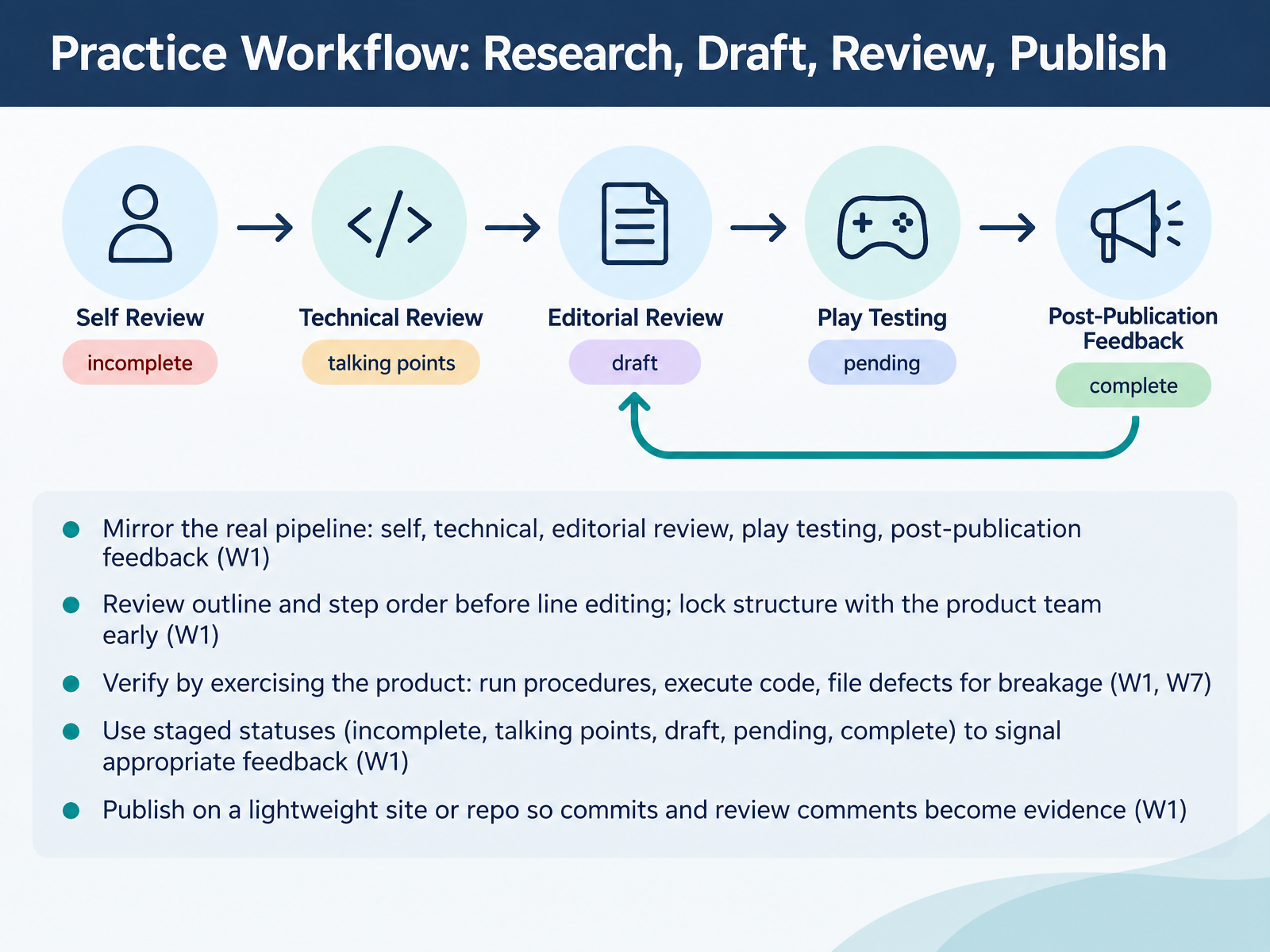
- 08Practice Workflow: Research, Draft, Review, PublishNow let's turn experience into a repeatable workflow. You research, draft, review, and publish, in that order, and you mirror the real pipeline: self review, technical review, editorial review, play testing, and post-publication feedback. Before you line edit, review your outline and step order, and lock the structure with the product team early. Verify by exercising the product: run the procedures, execute the code examples, and file defects when something breaks. Use staged statuses, including incomplete, talking points, draft, pending, and complete, so reviewers know what kind of feedback to give. Publish on a lightweight site or repository, so commits and review comments become evidence of your experience. That evidence is what stands in for a job title. Next, we look at working with subject-matter experts and handling ambiguity.
 2 min
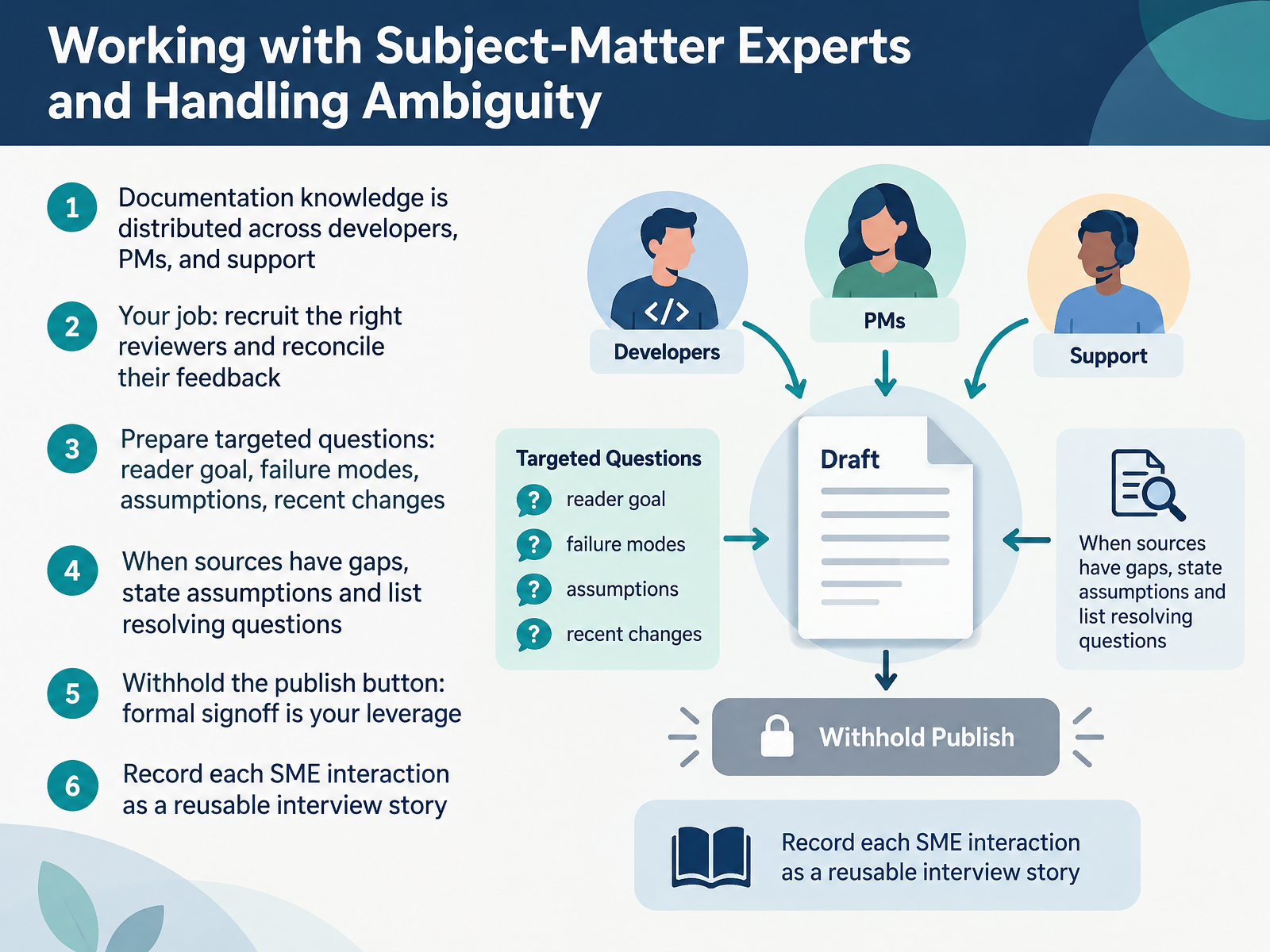
- 09Working with Subject-Matter Experts and Handling AmbiguityNext, working with subject matter experts and handling ambiguity. Documentation knowledge is spread across developers, product managers, and support. Your job is to recruit the right reviewers and reconcile their feedback into one clear document. Prepare targeted questions before each conversation. Ask about the reader's goal, likely failure modes, hidden assumptions, and recent changes. When sources leave gaps, state your assumptions in the draft and list the questions that would resolve them. And withhold the publish button. Formal signoff is your main leverage. After each expert conversation, write a short record of what you asked and what you learned. That record becomes a reusable interview story you can tell in a portfolio review. Coming up, tools and artifacts that signal readiness.
 competencies.technical-communication.orghdl.handle.netextendedstudies.ucsd.edu+21 min
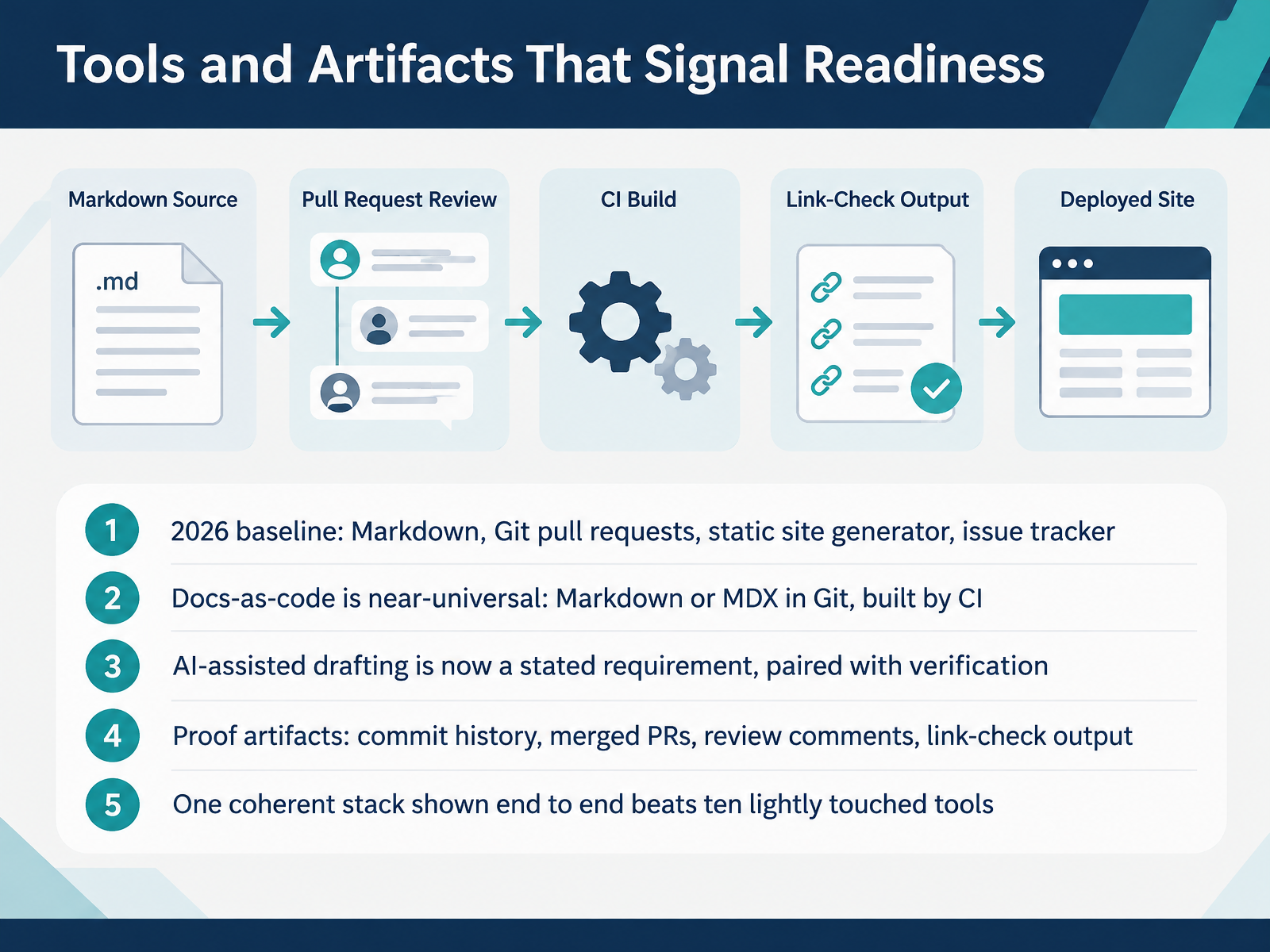
- 10Tools and Artifacts That Signal ReadinessNext, let's talk about the tools and artifacts that signal readiness. Here is the 2026 baseline. You should be able to write in Markdown, open a Git pull request, work with a static site generator, and track work in an issue tracker. Docs-as-code is now near-universal. That means documentation is written in Markdown or MDX, stored in Git, and built automatically by continuous integration, often called CI. AI-assisted drafting is also a stated requirement in many postings, always paired with verification. Hiring teams want proof, not a list of tools. Your commit history, merged pull requests, review comments, and link-check output are the artifacts that count. One coherent stack shown end to end beats ten lightly touched tools. So pick one small project and take it all the way through. Next, we'll look at documenting your experience through stories, metrics, and references.
 developers.google.comtechnicalwriterhq.comtexasagilabs.com+22 min
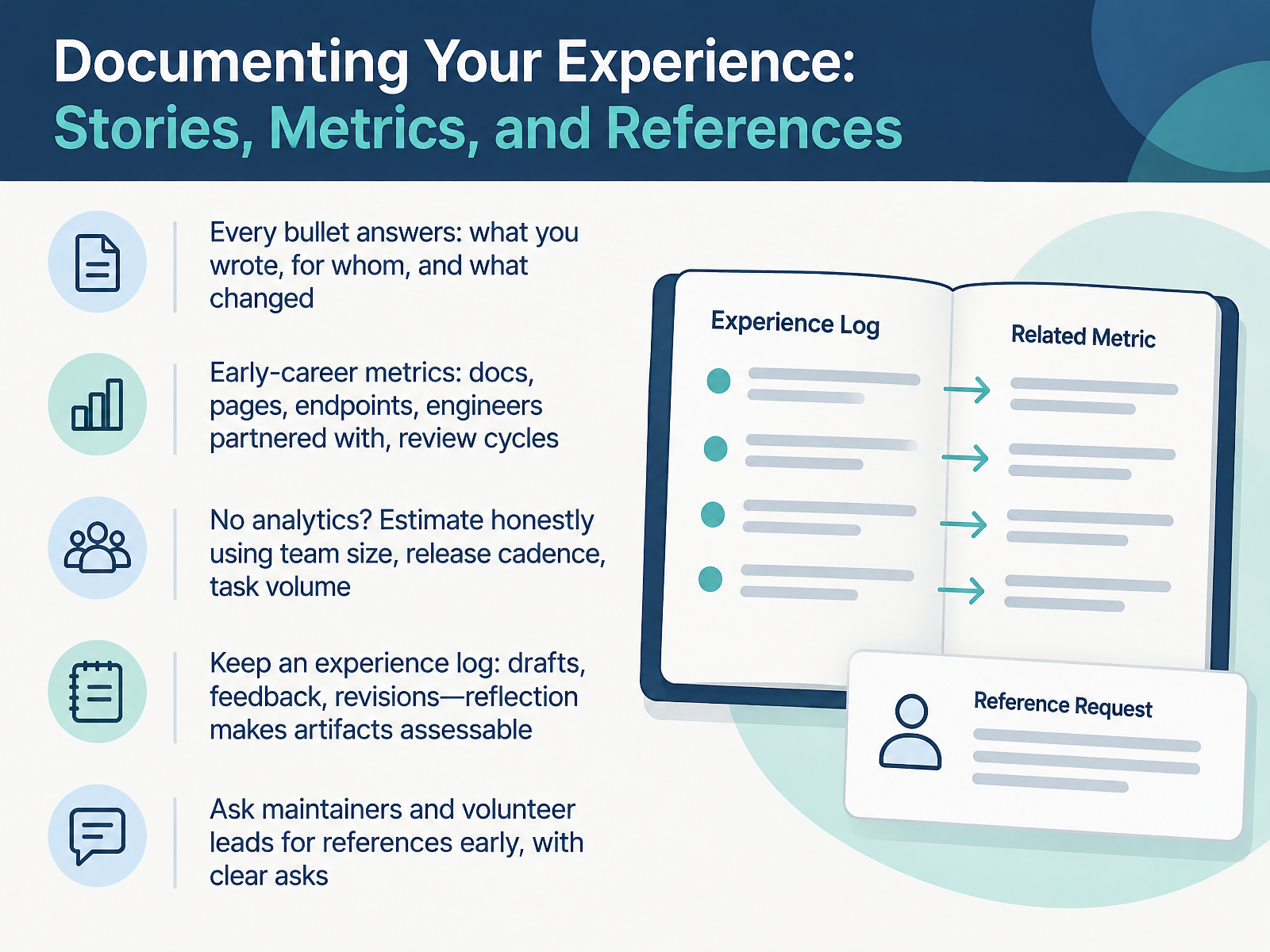
- 11Documenting Your Experience: Stories, Metrics, and ReferencesLet's turn your work into experience you can point to. Every bullet you write should answer three questions: what you wrote, who it was for, and what changed. For early-career metrics, count what you can see: documents, pages, API endpoints, engineers you partnered with, and review cycles. If you have no analytics, estimate honestly using team size, release cadence, and task volume. Keep an experience log of drafts, feedback, and revisions, because reflection makes your artifacts assessable. And ask maintainers and volunteer leads for references early, with a clear, specific ask. Next, we'll look at applying, interviewing, and defending your portfolio.
 both.orgkubernetes.iocanonical-open-documentation-academy.readthedocs.io+21 min
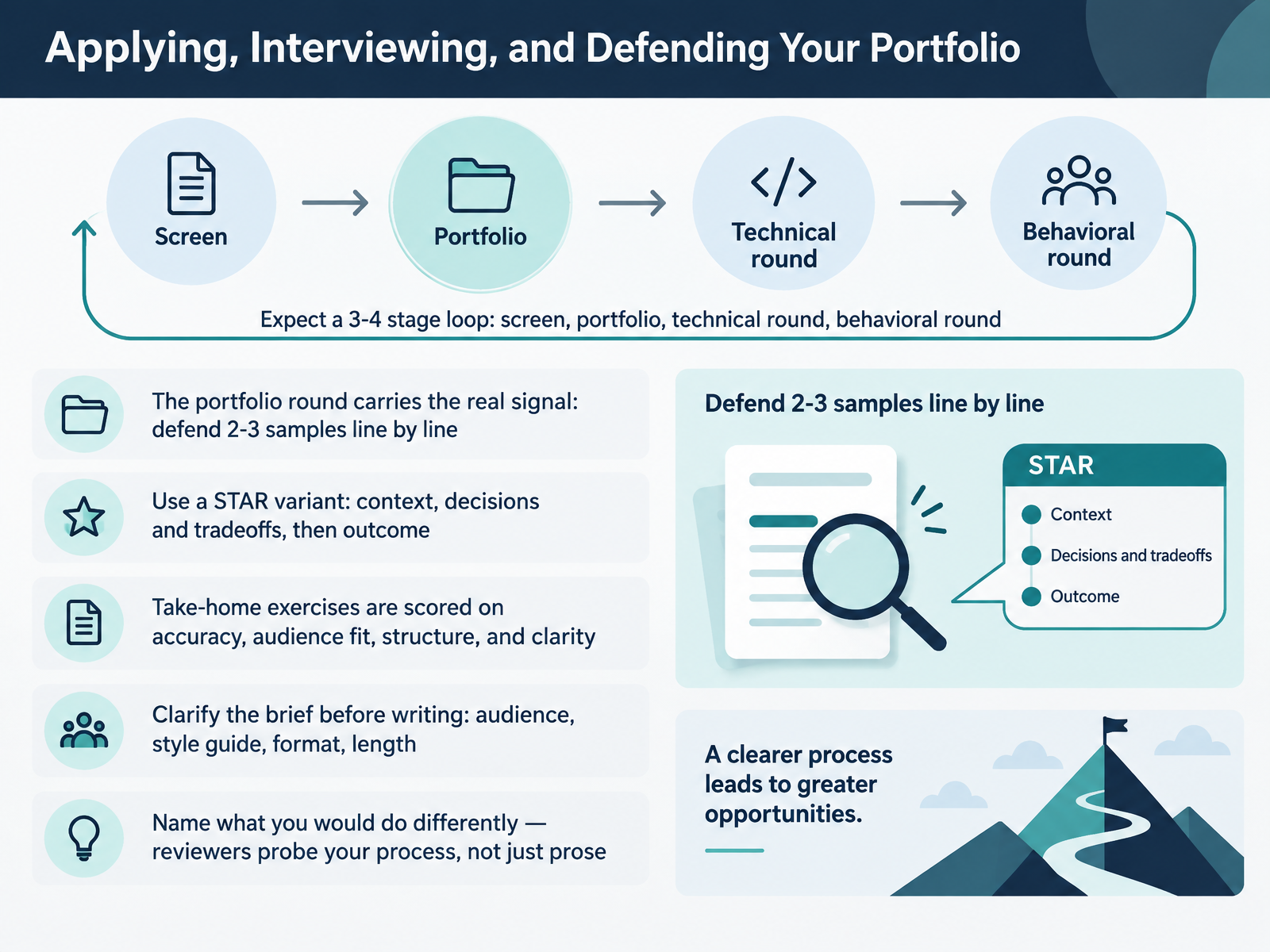
- 12Applying, Interviewing, and Defending Your PortfolioNow let's turn to applying, interviewing, and defending your portfolio. Expect a loop of three or four stages: a screen, a portfolio review, a technical round, and a behavioral round. The portfolio round carries the real signal. Choose two or three samples you can defend line by line, and prepare a STAR variant for each: the context, the decisions and tradeoffs you made, then the outcome. For take-home exercises, you are scored on accuracy, audience fit, structure, and clarity. Before you write, clarify the brief: audience, style guide, format, and length. Then be ready to name what you would do differently, because reviewers probe your process, not just your prose. So your takeaway is this: practice the walkthrough out loud, and treat every question as a chance to show how you think. Next, we look at the iteration loop: feedback, gaps, and the next project.
 competencies.technical-communication.orghdl.handle.netextendedstudies.ucsd.edu+21 min
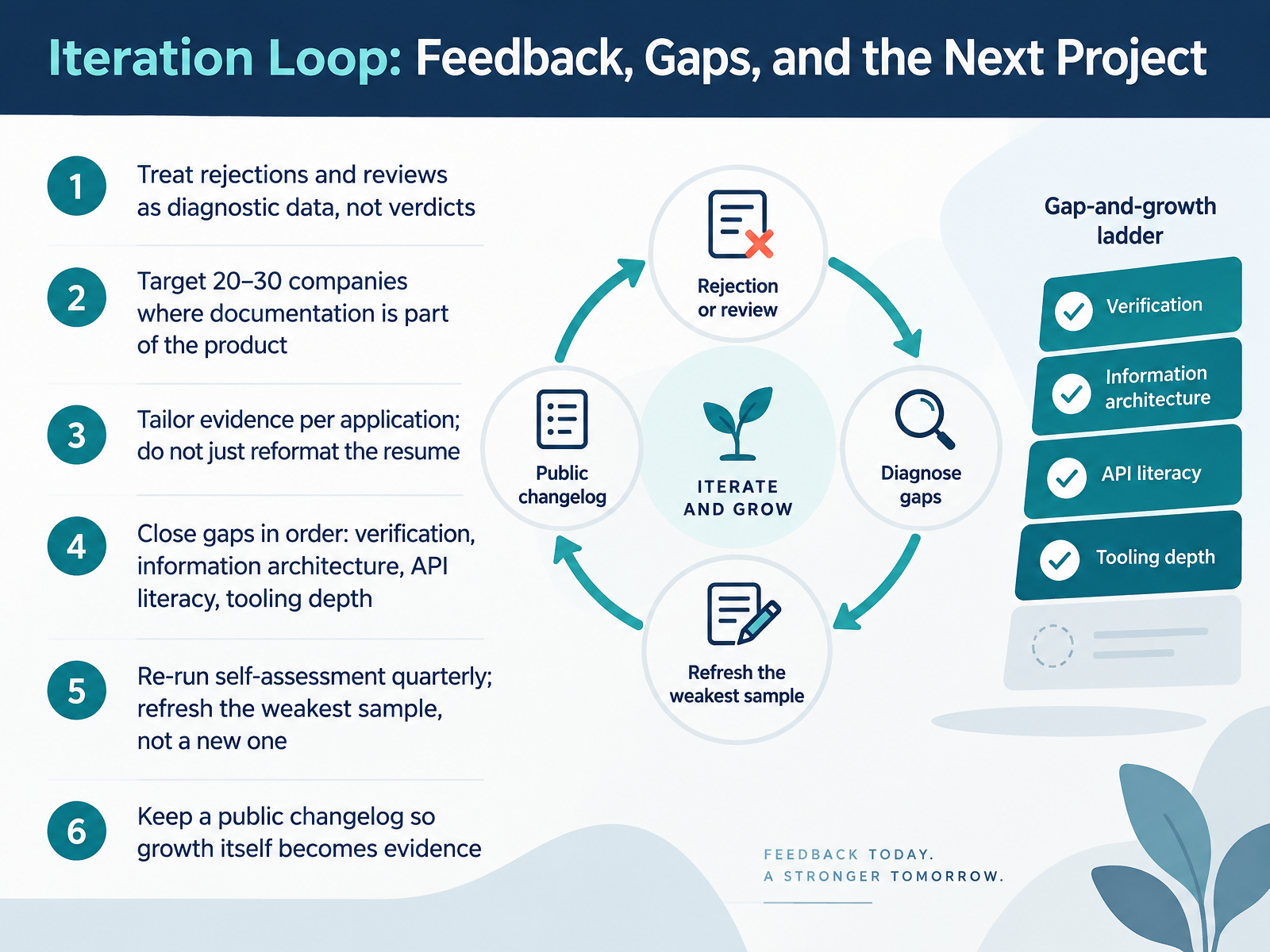
- 13Iteration Loop: Feedback, Gaps, and the Next ProjectNow let's close the loop on your job search. Treat every rejection and review as diagnostic data, not a verdict on your ability. Build a target list of twenty to thirty companies where documentation is part of the product, such as developer tools, APIs, or infrastructure. For each application, tailor the evidence, not just the resume formatting. Close skill gaps in a set order: verification first, then information architecture, then API literacy, then tooling depth. Re-run your self-assessment every quarter. Refresh your weakest sample rather than starting a new one. And keep a public changelog, so your growth itself becomes evidence. Next, we will look at how instructors can coach learners through this workflow.
 developers.google.comtechnicalwriterhq.comtexasagilabs.com+21 min
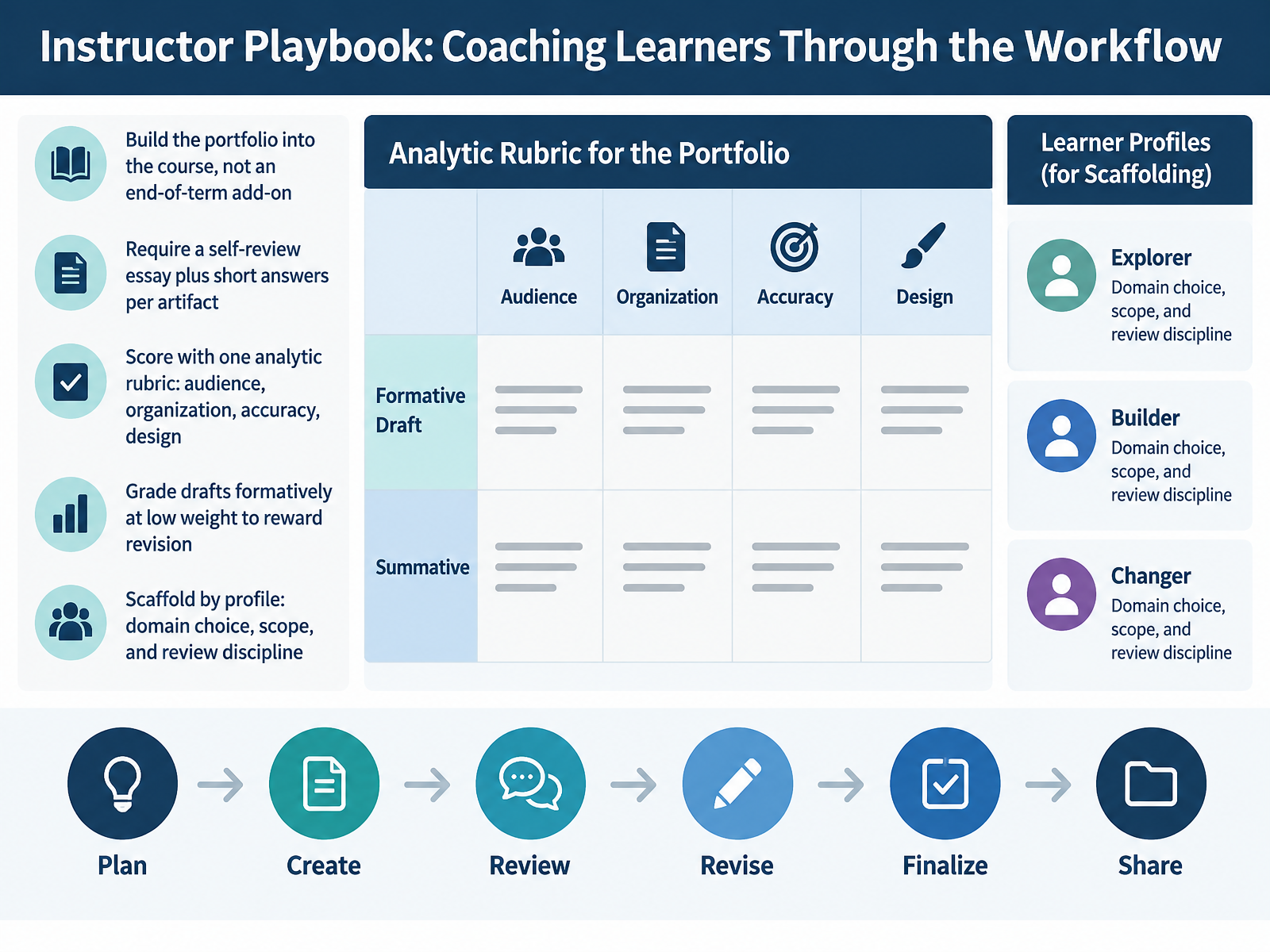
- 14Instructor Playbook: Coaching Learners Through the WorkflowAs we close, here is a short playbook for anyone teaching this workflow. Build the portfolio into the course from week one. Do not treat it as an end-of-term add-on. Require a self-review essay plus short answers for each artifact, and have learners write those answers as they finish each piece. Score with one analytic rubric covering audience, organization, accuracy, and design, and share it early so revision has a target. Grade drafts formatively at low weight to reward revision rather than punish first attempts. Finally, scaffold by profile. Help each learner choose a domain, set a realistic scope, and practice review discipline. Thank you for working through this course. Your next step is small and concrete: pick one artifact, write its short answer, and score it against the rubric today. You are ready to begin.
 competencies.technical-communication.orghdl.handle.netextendedstudies.ucsd.edu+22 min
Take the deck with you
Download this course as a file — free, no sign-up needed.
- PDF handoutEvery slide page, ready to print or share.15 pages · 3.4 MBDownload
- Narrated PowerPointThe deck that presents itself — every slide carries the digital human's narration video.15 pages · 12.0 MBDownload
- PowerPoint slidesThe full deck as a .pptx — open it in PowerPoint, Keynote, or Google Slides.15 pages · 3.3 MBDownload
Free to use in your own training — please keep the PersonWise credit page at the end.
Have your own deck? Turn it into a course
Sources consulted
Web sources consulted while building this course.
- Becoming a Technical Writer at Google | Technical Writing — developers.google.com
- The Technical Writer Education Requirements I’d Prioritize as a Newbie — technicalwriterhq.com
- Technical Writer — Trainee<!-- --> — TAL Corp Careers — texasagilabs.com
- How to enter technical writing in 2026 — TechWriters — techwriters.org
- Junior-Mid Technical Writer – Developer Tools Bhutan — developertools.bt
- Profiling Tool — competencies.technical-communication.org
- Entry-Level Technical Writing Skills: Managers’ Expectations and Experiences — hdl.handle.net
- How to Become a Technical Writer: Diverse Career Paths and Opportunities | UC San Diego Division of Extended Studies — extendedstudies.ucsd.edu
- Free Technical Writer Practice Assessment (2026) — cohesyve.com
- Personal competencies — teccom-frame.eu
- Make your first contribution to open source – Both.org — both.org
- Contribute to Kubernetes Documentation | Kubernetes — kubernetes.io
- Open Documentation Academy ¶ — canonical-open-documentation-academy.readthedocs.io
- Getting started with MDN Web Docs - MDN Web Docs | MDN — developer.mozilla.org
- Technically We Write — technicallywewrite.com
- Building a tech writing portfolio that will win you new clients — knowledgeowl.com
- Top Technical Writing Portfolio Examples I'd Use for Inspiration in 2026 — technicalwriterhq.com
- How To Create a Technical Writing Portfolio (with Examples) — authory.com
- How Do I Build a Technical Writing Portfolio With No Prior Experience? - Courseific — courseific.com
- How to Build a Technical Writing Portfolio and 5 Excellent ... — journoportfolio.com