Begin
13 pages · ~26 min
Project Management: Goals to Execution
This course teaches project managers and team leads how to turn project goals into actionable execution plans, covering scope, scheduling, and delivery.
A digital instructor presents all 13 pages. Hold “Ask” at any point and ask out loud — the answer comes from this course. No sign-up needed.
What you’ll learn
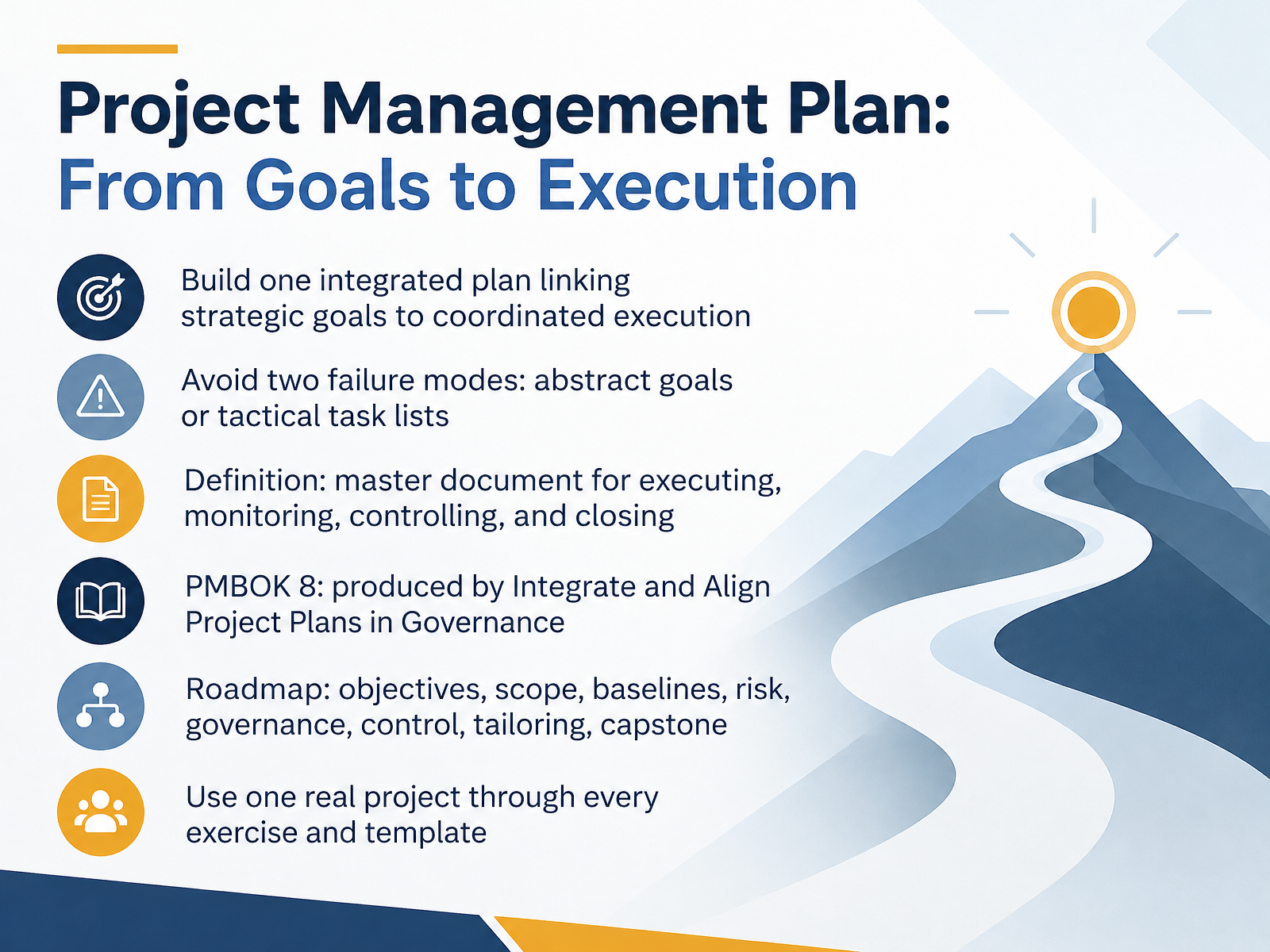
- 01Project Management Plan: From Goals to ExecutionWelcome. This course is about building one project management plan that actually carries you from goals to execution. You already know the pressure: goals that stay abstract, and task lists that never connect to strategy. We are going to avoid both. Here is our working definition. The project management plan is the master document describing how the project will be executed, monitored and controlled, and closed. In the eighth edition of the PMBOK Guide, it is produced by the Integrate and Align Project Plans process, inside the Governance performance domain. Over the next twelve slides, we will move through objectives, scope, baselines, risk, governance, control, and tailoring, finishing with a capstone. One ground rule: pick one real project and use it in every exercise and template. That is how this sticks. Next, let's look at why integrated planning matters.pmi.orgpmi.orgpmi.org+22 min
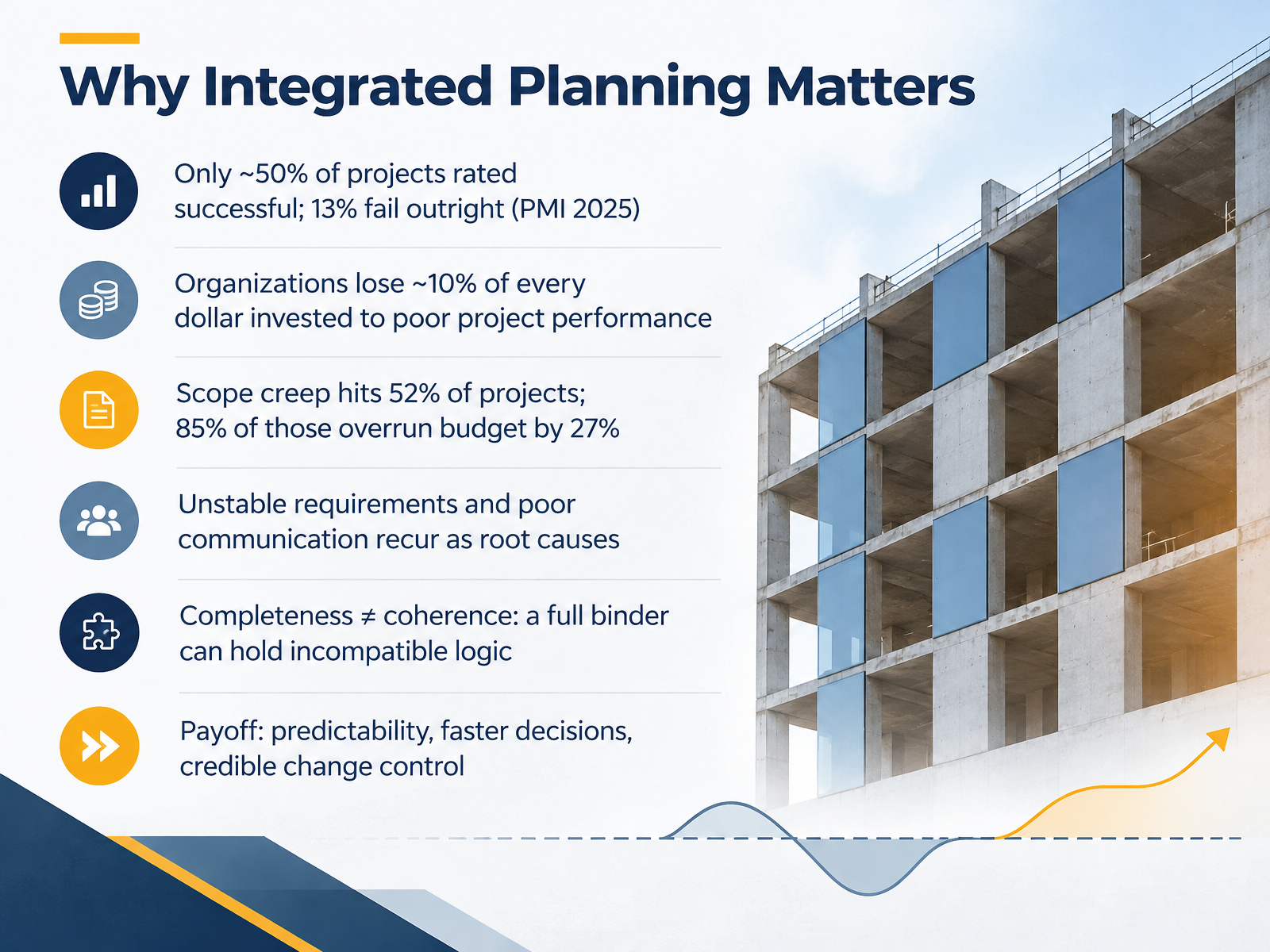
- 02Why Integrated Planning MattersLet's talk about why integrated planning matters. The numbers are sobering. PMI's twenty twenty-five data shows only about fifty percent of projects rated successful, and thirteen percent fail outright. Organizations lose roughly ten percent of every dollar invested to poor project performance. Scope creep hits fifty-two percent of projects, and eighty-five percent of those overrun budget by an average of twenty-seven percent. When you dig into root causes, two keep recurring: unstable requirements and poor communication. Here's the part that catches experienced teams. Completeness is not coherence. A full binder of plans can still hold incompatible logic. A schedule that ignores resource limits, or a budget that never funded the risk responses, looks finished but isn't integrated. The payoff for fixing this is real: predictability, faster decisions, and change control people actually trust. From Strategic Goals to Measurable Objectives.
 pmworldlibrary.netpmi.orgusetandem.ai+22 min
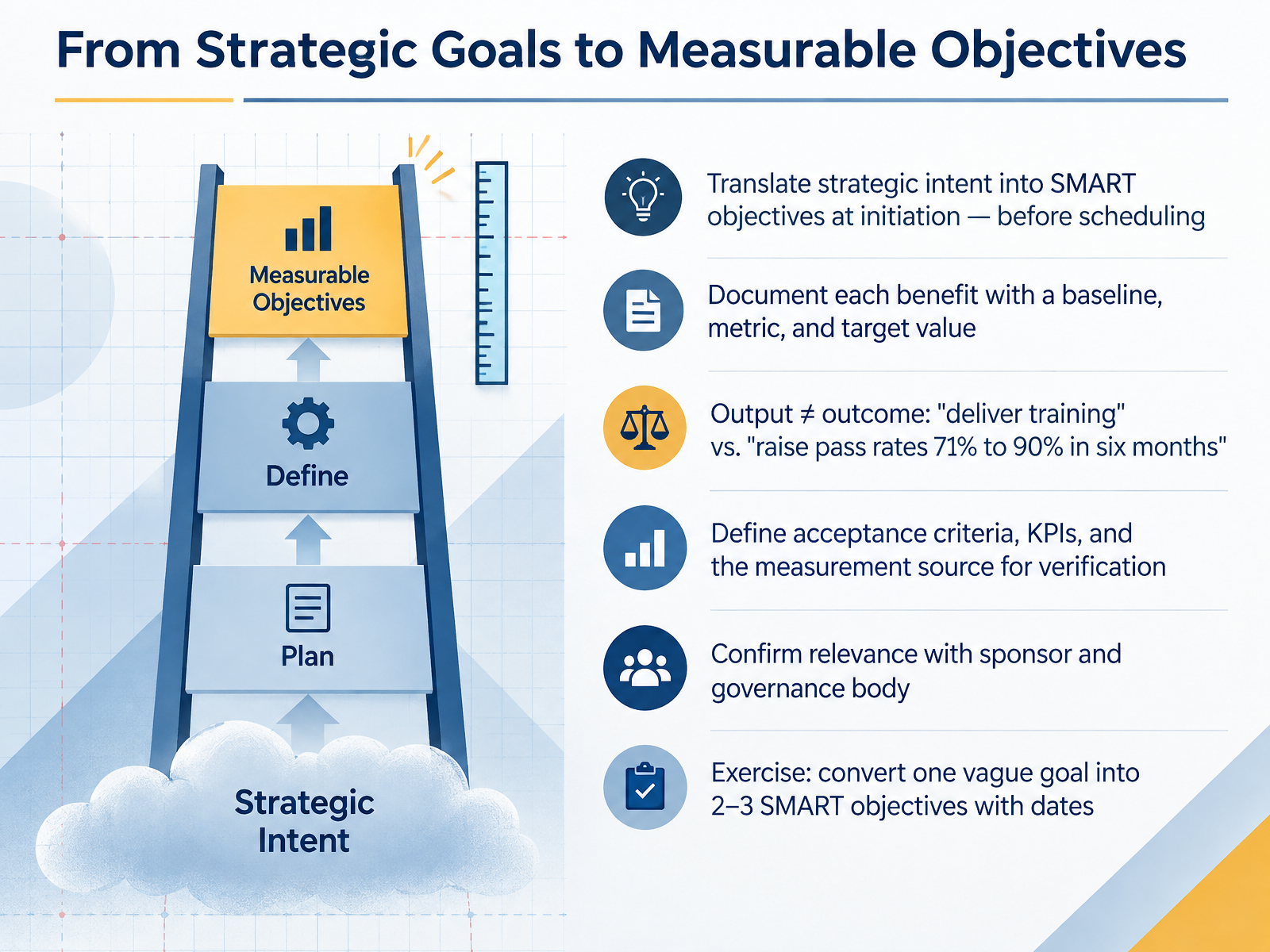
- 03From Strategic Goals to Measurable ObjectivesLet's move from strategic goals to measurable objectives. This work happens at initiation, before you schedule a single task. Translate strategic intent into SMART objectives, and document each benefit with a baseline, metric, and target value.
Here's the distinction that matters most. Output is not outcome. 'Deliver training' is an output. 'Raise pass rates from seventy-one percent to ninety percent in six months' is an outcome. Write the outcome.
Next, define acceptance criteria, your KPIs, and the measurement source you'll use for verification. Then confirm relevance with your sponsor and governance body, because a well-written objective that doesn't match current strategy fails the relevance test anyway.
Your exercise: take one vague goal and convert it into two or three SMART objectives with firm dates. That single habit prevents most scope disputes later. Now, let's move on to defining scope and requirements.
 pmi.orgpressbooks.ulib.csuohio.edularksuite.com+22 min
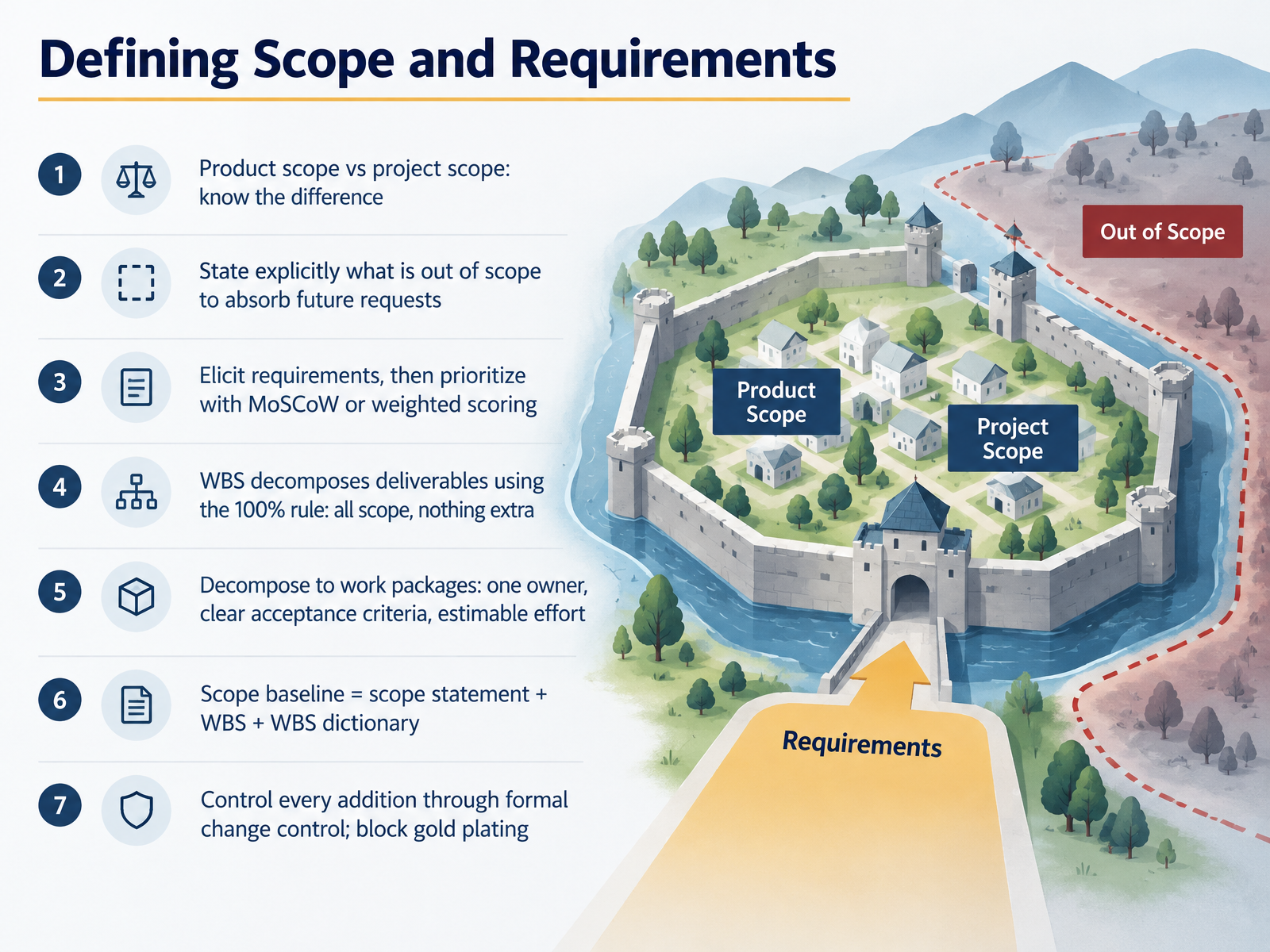
- 04Defining Scope and RequirementsLet's move into scope and requirements. First, separate product scope from project scope. Product scope is what you're building. Project scope is the work to build it. Second, write down what's out of scope. That's your shield against future requests. Then elicit requirements from stakeholders, and prioritize them using MoSCoW or weighted scoring. Next, the WBS. It decomposes deliverables using the 100% rule: all scope, nothing extra. Push down to work packages, each with one owner, clear acceptance criteria, and estimable effort. Together, the scope statement, WBS, and WBS dictionary form the scope baseline. And control every addition through formal change control. Block gold plating. If it's not in the baseline, it doesn't get built without a change request. Keep that discipline, and scope stays predictable. Up next, we put this into practice in our workshop: Building the First-Level WBS.
 pmp-guide.comtheprojectgroup.comsikhanaseekho.com+22 min
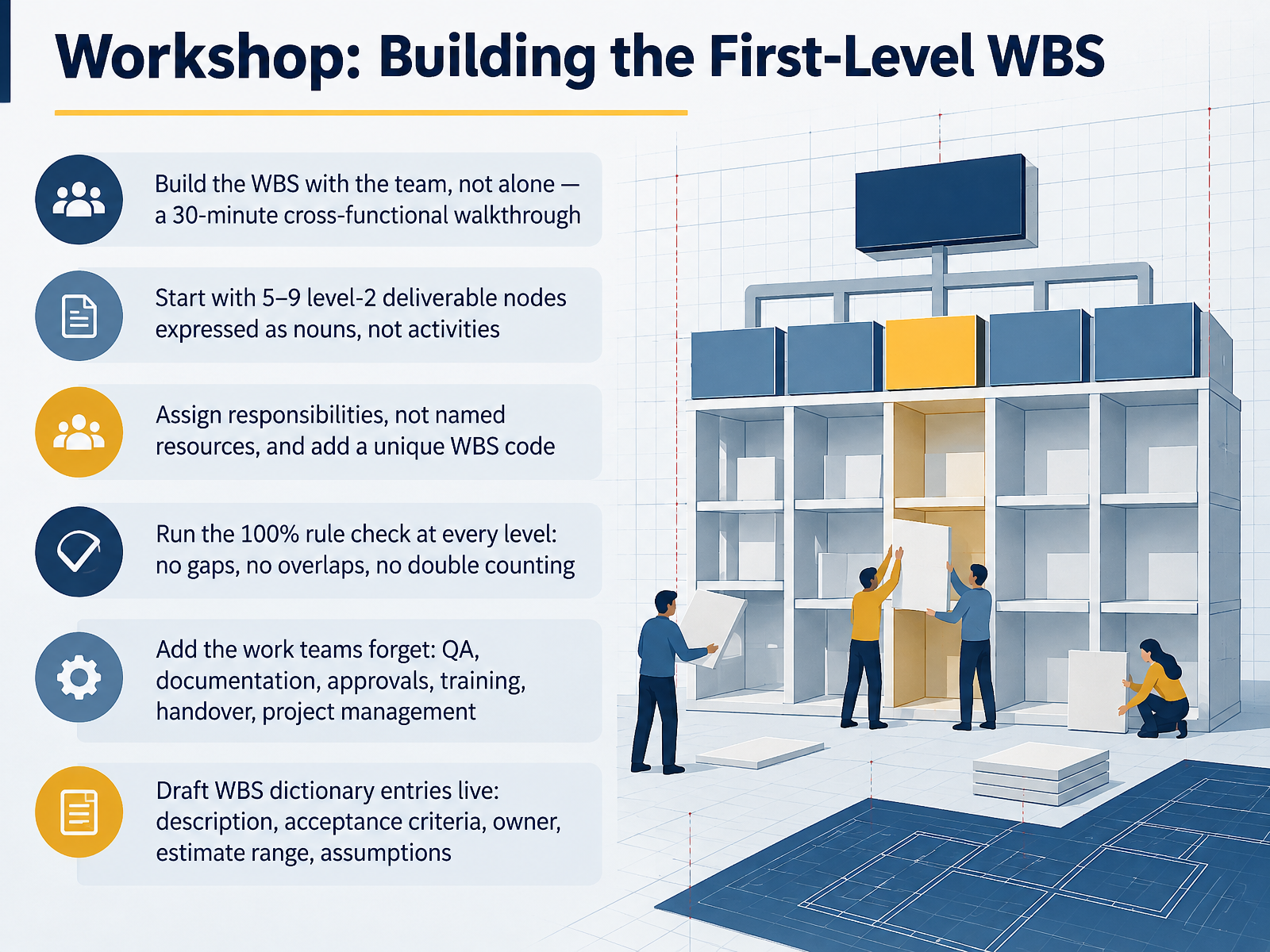
- 05Workshop: Building the First-Level WBSLet's put the WBS on the table and build it together. Book thirty minutes with your cross-functional team, and walk the scope once, live. Start with five to nine level two deliverable nodes, written as nouns: reports, components, environments. Not activities. Assign responsibilities, not named people, and give every node a unique WBS code. Then run the 100 percent rule at each level. No gaps, no overlaps, no double counting. Watch for the work teams forget: quality assurance, documentation, approvals, training, handover, and project management itself. Give those a home in the tree, or they surface later as rework. As you decompose, draft WBS dictionary entries in the room: description, acceptance criteria, owner, estimate range, and assumptions. That dictionary is your scope baseline. Building it live takes one meeting and saves weeks of we never agreed to that. Next, we turn this structure into plans. Building Schedule, Cost, and Resource Baselines.
 pmp-guide.comtheprojectgroup.comsikhanaseekho.com+22 min
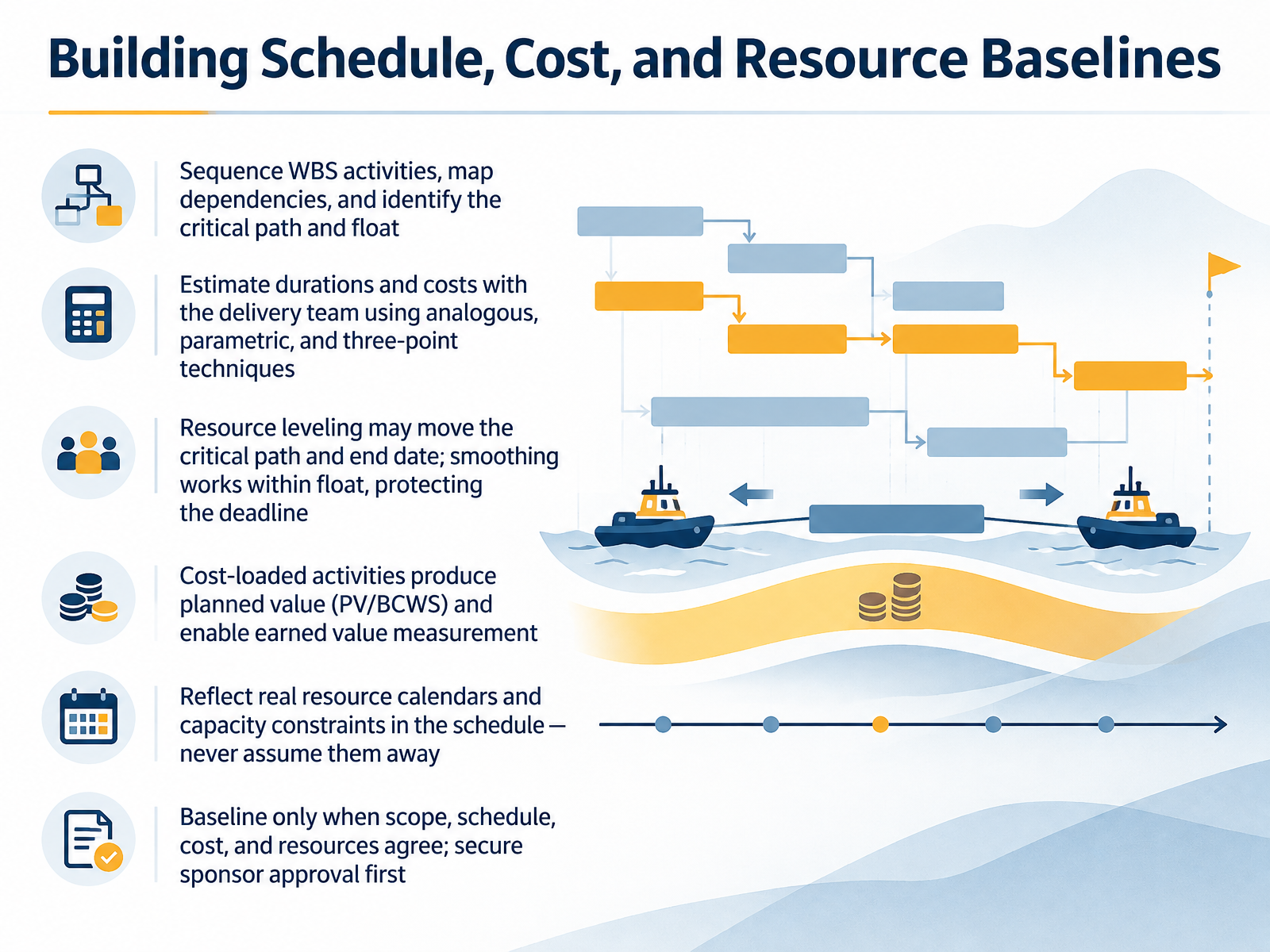
- 06Building Schedule, Cost, and Resource BaselinesNow let's build the baselines: schedule, cost, and resources. Start with your W B S activities. Sequence them, map the dependencies, and run the critical path. Then identify float. Float tells you where you have room, and where you do not.
Next, estimate durations and costs with the delivery team, not for them. Use analogous, parametric, and three point techniques together. The people doing the work know the real constraints.
Now handle resource conflicts. Leveling balances demand against supply, and it can move the critical path and end date. Smoothing works within float, so it protects the deadline. Use leveling when the resource limit is hard. Use smoothing when the date is fixed.
Cost load your activities to produce planned value, also called B C W S. That is what makes earned value measurement possible.
And reflect real resource calendars and capacity constraints. Never assume them away.
Baseline only when scope, schedule, cost, and resources agree. Then get sponsor approval before you freeze it.
Next, we move into risk, quality, and assumption management.
 2 min
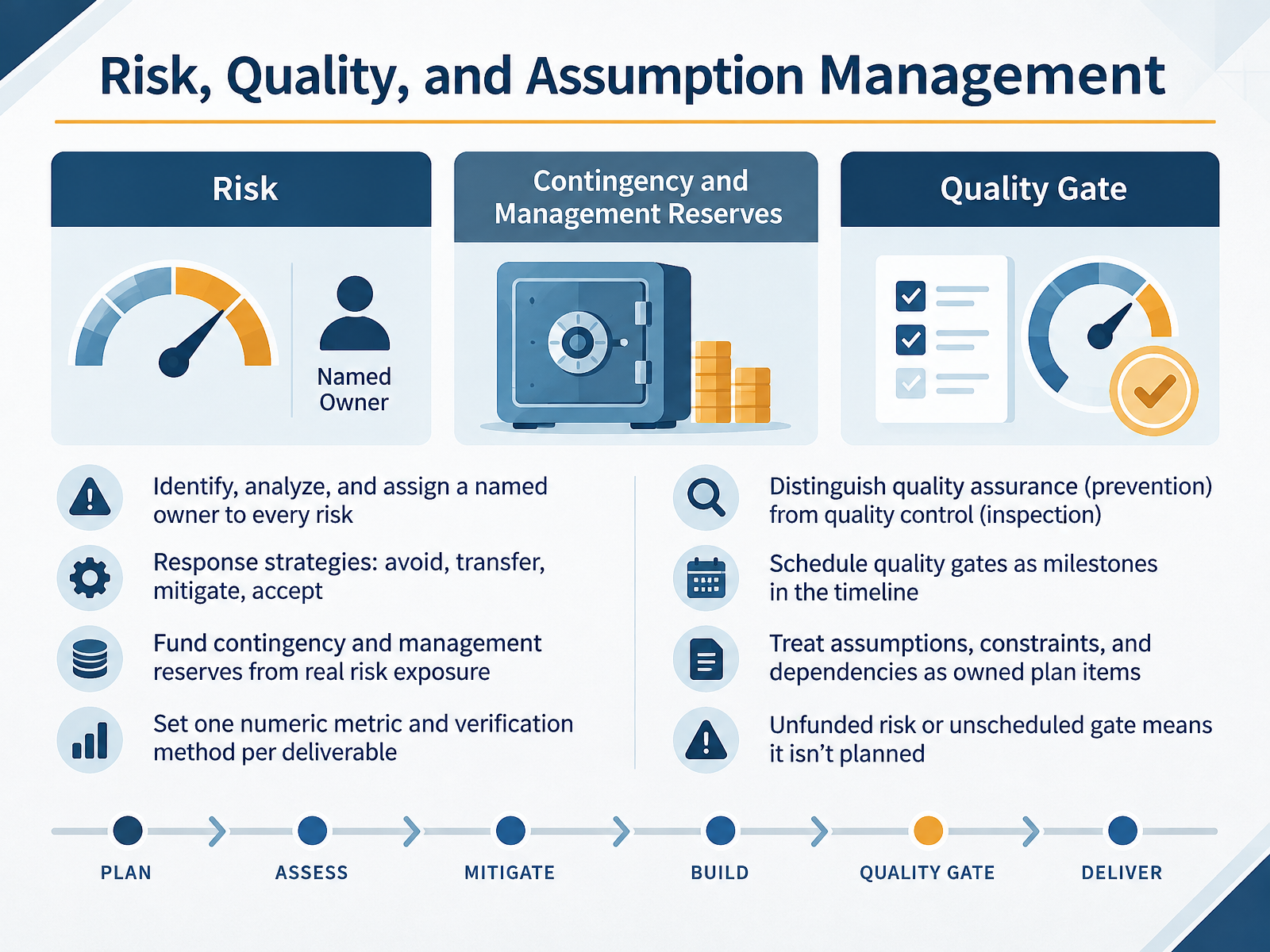
- 07Risk, Quality, and Assumption ManagementNow let's talk about risk, quality, and assumption management. Start with risk. Identify each risk, analyze its impact, and assign a named owner. No owner, no accountability. Then choose a response strategy: avoid, transfer, mitigate, or accept. And fund your contingency and management reserves from real risk exposure, not guesswork.
Quality works the same way. Set one numeric metric and one verification method per deliverable. Keep the distinction clear: quality assurance prevents defects, quality control inspects for them. Schedule your quality gates as milestones in the timeline.
Finally, treat assumptions, constraints, and dependencies as owned plan items. Here's the test. If a risk is unfunded, or a gate is unscheduled, it isn't planned. It's just a hope.
Next, we'll look at stakeholders, communication, and governance.
 2 min
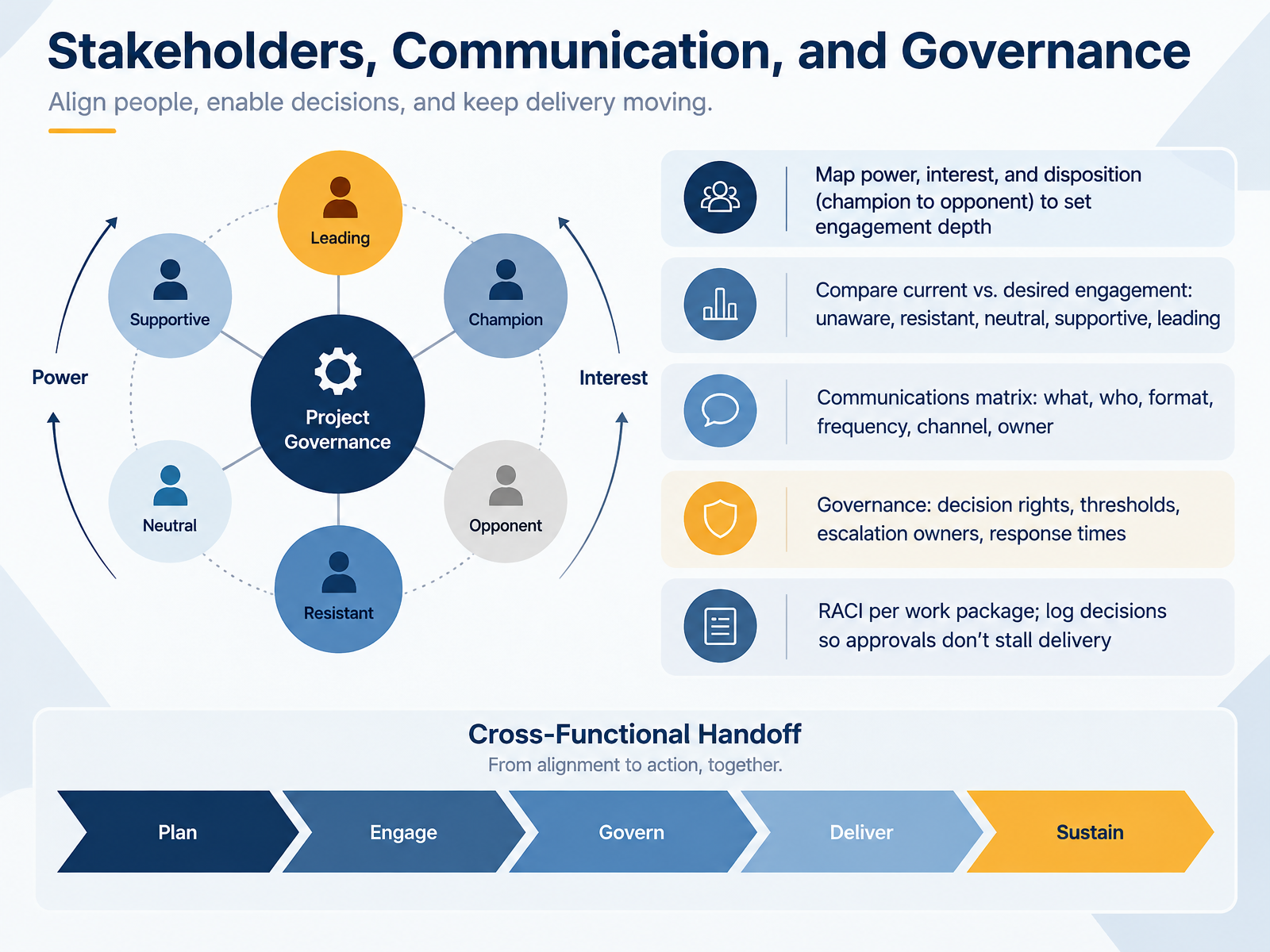
- 08Stakeholders, Communication, and GovernanceLet's talk about the people side of your plan: stakeholders, communication, and governance. Start by mapping each stakeholder on power, interest, and disposition, from champion to opponent. That combination sets how deeply you engage them. Next, compare current versus desired engagement: unaware, resistant, neutral, supportive, or leading. The gap tells you where to focus energy. A resistant function lead who needs to be supportive gets a very different approach than a supportive sponsor you want leading. Then build your communications matrix: what gets shared, with whom, in what format, at what frequency, through which channel, and who owns it. For governance, define decision rights, approval thresholds, escalation owners, and expected response times up front. That's what keeps small issues from becoming blockers. Finally, assign RACI per work package, and log every decision with date, rationale, and owner. Logged decisions stop approvals from stalling delivery and prevent the same debate from reopening. From Plan to Execution: Monitoring, Control, and Change.
 2 min
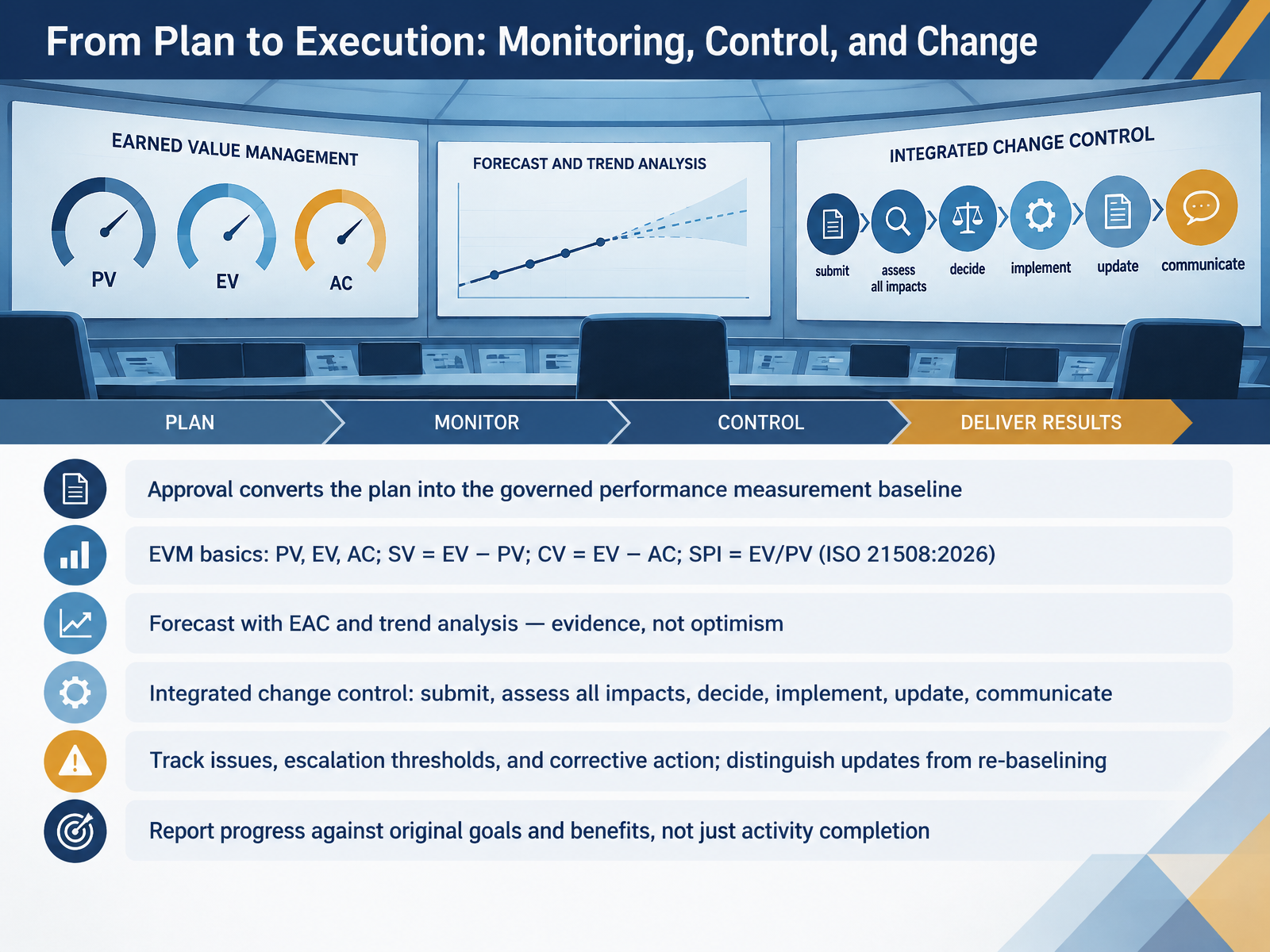
- 09From Plan to Execution: Monitoring, Control, and ChangeNow let's move from building the plan to running it. Approval is the switch. Once the sponsor signs off, your plan becomes the governed performance measurement baseline. From then on, you measure against it, not against memory.
At the core is earned value. Planned value is what you budgeted for the work scheduled. Earned value is what you budgeted for the work actually done. Actual cost is what you spent. Schedule variance equals earned value minus planned value. Cost variance equals earned value minus actual cost. And the schedule performance index equals earned value divided by planned value. A negative variance means trouble. An index below one means you are behind or overspending.
Forecast with your estimate at completion and trend data. That is evidence. Not optimism. When change comes, submit it, assess every impact, decide, implement, then update and communicate. Track issues against escalation thresholds, and take corrective action. But keep one line clear: updating a forecast is not re-baselining. Never move the baseline just to hide a variance. And report against your original goals and benefits, not just completed activities.
Next, we look at shaping the approach itself in Tailoring the Plan: Predictive, Agile, and Hybrid.
 2 min
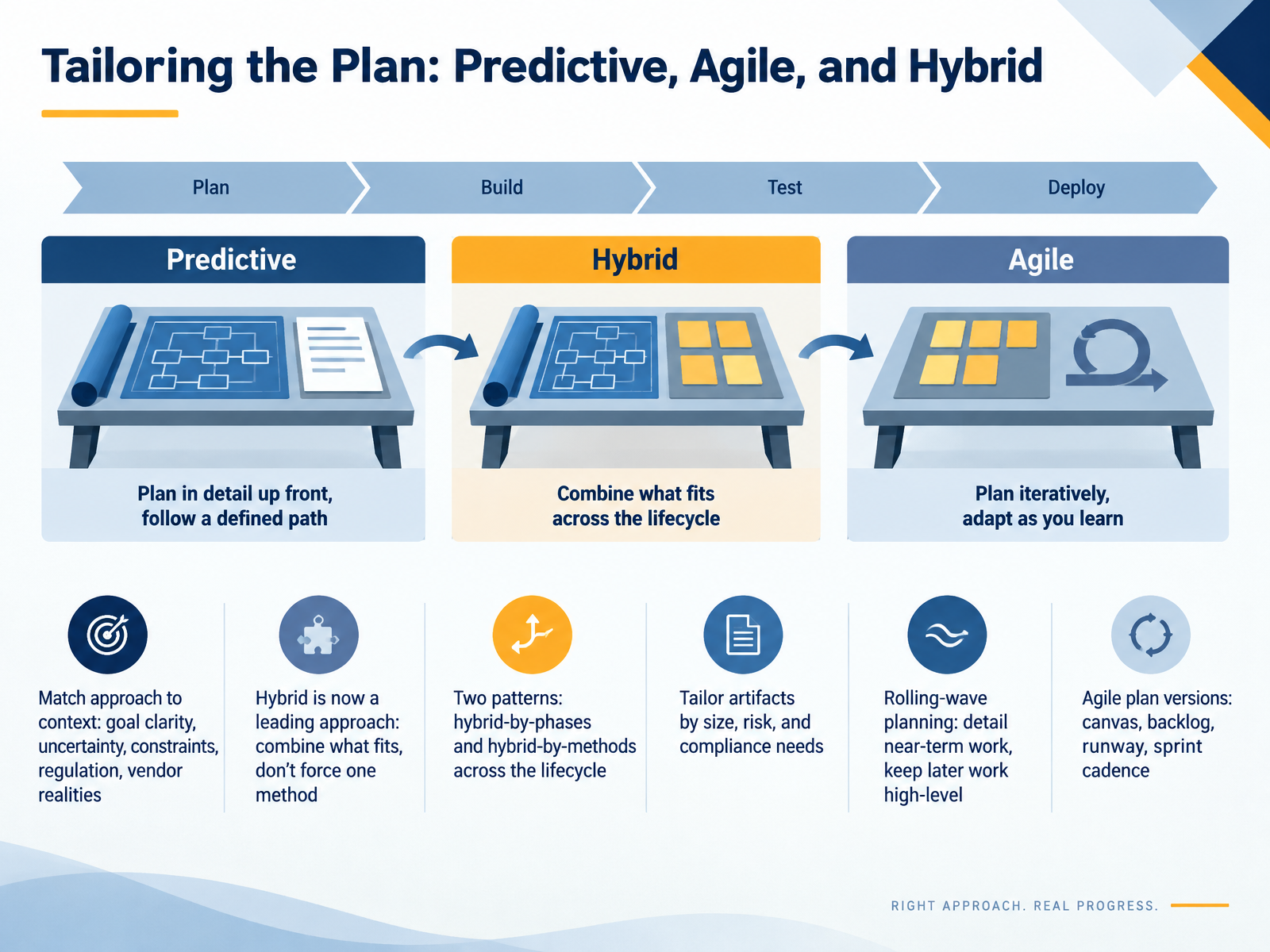
- 10Tailoring the Plan: Predictive, Agile, and HybridNow let's talk about tailoring. Your approach has to match your context. Goal clarity, uncertainty, constraints, regulation, vendor realities. Those five factors drive the decision, not preference.
Hybrid is now a leading approach. The data shows adoption climbing sharply, and the reason is simple. Hybrid pays off when you combine what fits instead of forcing one method everywhere. But be intentional. Mixing waterfall and agile randomly just creates confusion.
There are two patterns. Hybrid-by-phases applies different methods to different phases. Hybrid-by-methods weaves practices across the entire lifecycle. Both work.
Then tailor your artifacts. Size, risk, and compliance needs decide how much detail you need. Use rolling-wave planning. Detail the near-term work, keep later work high-level. And when agile fits, your plan versions are the canvas, the backlog, the runway, and the sprint cadence.
So pick deliberately, and be transparent about why. Next, we look at making the plan executable: kickoff, cadence, and operating norms.
 pmp-guide.comtheprojectgroup.comsikhanaseekho.com+22 min
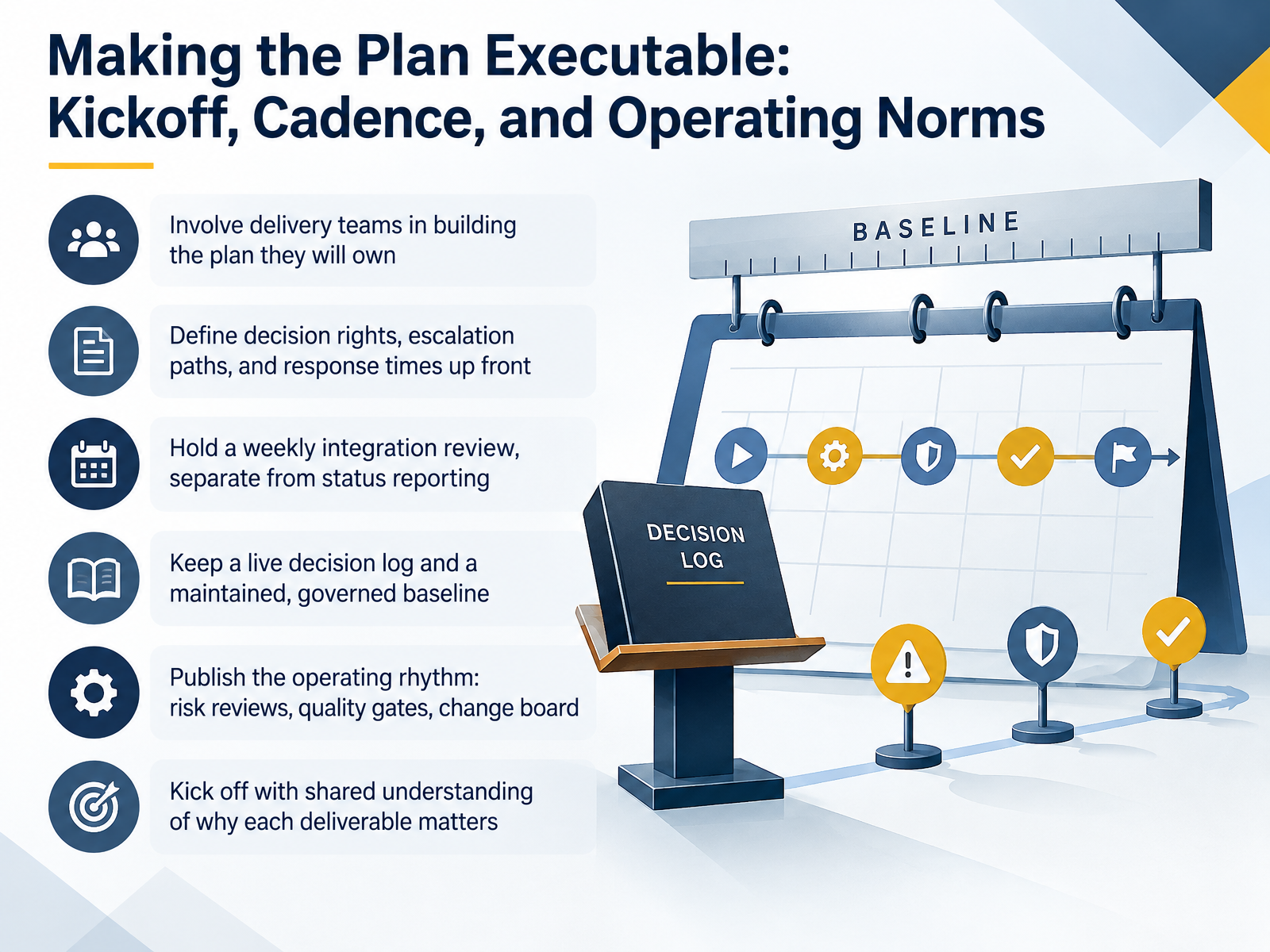
- 11Making the Plan Executable: Kickoff, Cadence, and Operating NormsLet's talk about making the plan executable. A plan only works when the delivery teams help build it, so pull them in early. They own what they create. Then lock down decision rights, escalation paths, and response times up front, before anyone is waiting on an answer. Run a weekly integration review, separate from status reporting, focused on cross-workstream dependencies and conflicts. Keep two artifacts alive: a decision log capturing what was decided, why, and by whom, and a governed baseline updated only through change control. Publish your operating rhythm so everyone knows when risk reviews, quality gates, and the change board happen. Finally, kick off with shared understanding of why each deliverable matters, not just what is due. That is how plans turn into coordinated delivery. Next, we bring it together in the capstone: assembling an integrated one-page plan.
 2 min
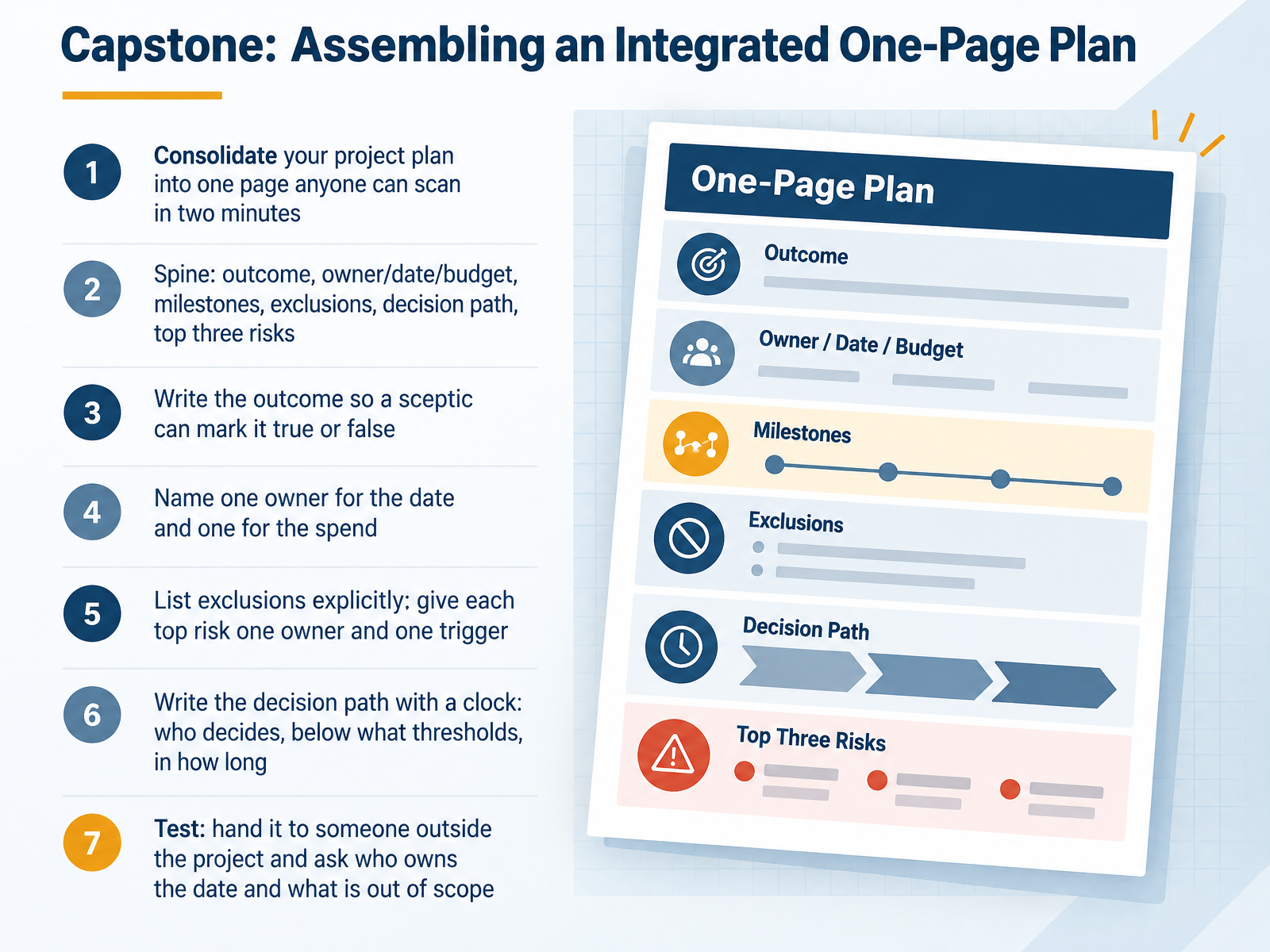
- 12Capstone: Assembling an Integrated One-Page PlanLet's assemble everything into one page anyone can scan in two minutes. This is the delivery spine, and every field is load bearing. First, the outcome, written so a sceptic can mark it true or false. "Customers book and pay online without calling by November thirtieth" works. "Improve booking" does not. Second, name one owner for the date and one owner for the spend. If nobody can say the name in three seconds, you do not have an owner. Next, three to six milestones you could demonstrate, not report. Then exclusions, written explicitly. State what you are not doing, like no mobile app and no online rescheduling. Every new request then arrives with a price. Give each of your top three risks one owner and one trigger. And write the decision path with a clock: who decides, below what thresholds, and in how long. "Escalate to steering" is not a path when steering meets every two weeks. Finally, test it. Hand the page to someone outside the project and ask two questions: who owns the date, and what is out of scope. If they cannot answer in two minutes, the page is not finished. Next, we move into peer review, defense, and action planning.
 2 min
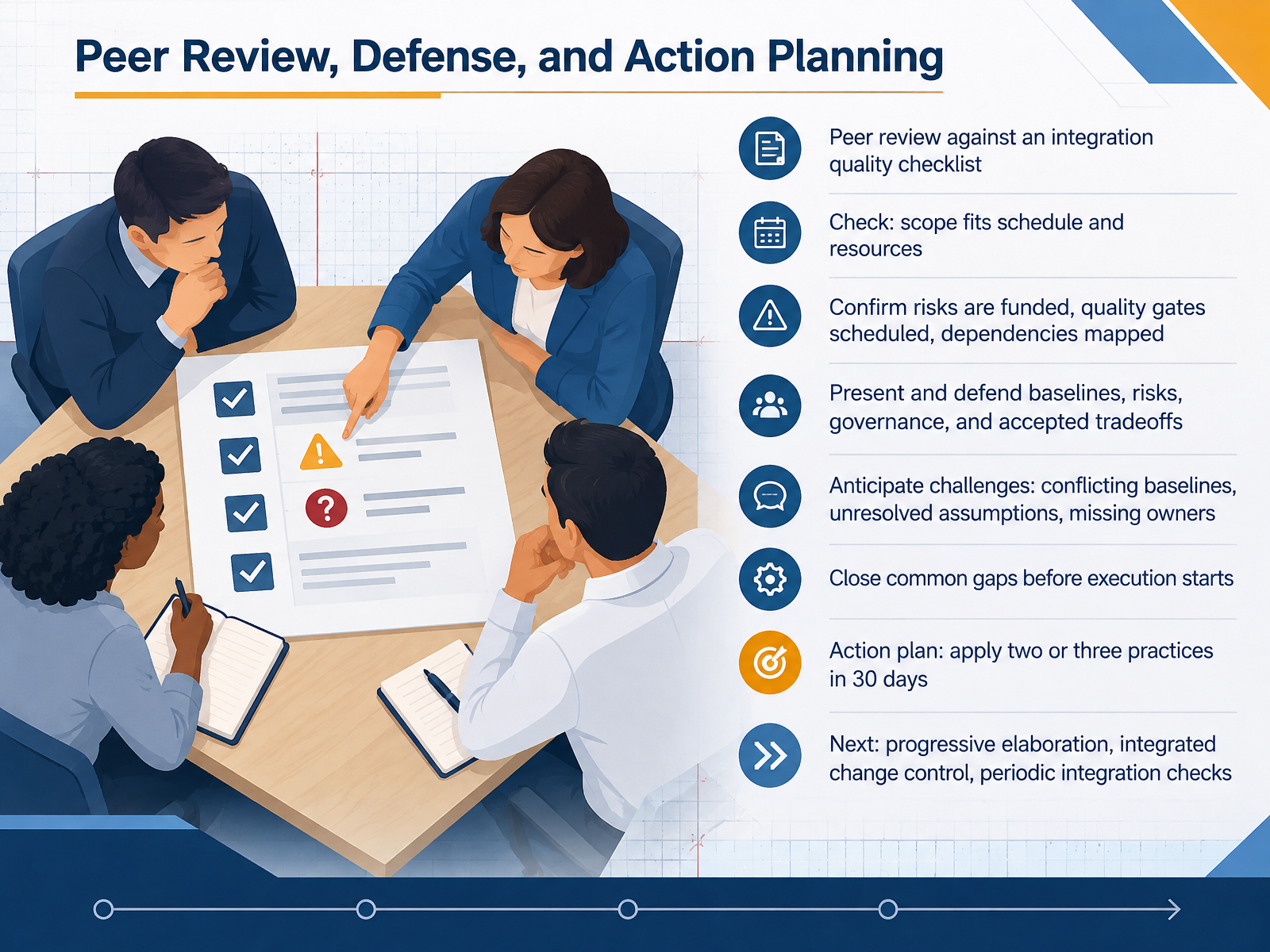
- 13Peer Review, Defense, and Action PlanningLet's close this out with the step that protects everything you've built. Peer review against an integration quality checklist. Ask the hard questions. Does scope fit schedule and resources? Are risks funded? Are quality gates on the schedule as milestones? Are dependencies mapped? Then present and defend your baselines, risks, governance, and accepted tradeoffs. Expect pushback on conflicting baselines, unresolved assumptions, and missing owners. Close those gaps before execution starts, because every conflict resolved now saves weeks later. Here's your action plan. Pick two or three practices and apply them within thirty days. Then move forward with progressive elaboration, integrated change control, and periodic integration checks. You now have what you need. Thank you for your attention, and go make your plan executable.
 pmi.orgpmi.orgpmi.org+22 min
Take the deck with you
Download this course as a file — free, no sign-up needed.
- PDF handoutEvery slide page, ready to print or share.14 pages · 3.5 MBDownload
- Narrated PowerPointThe deck that presents itself — every slide carries the digital human's narration video.14 pages · 14.9 MBDownload
- PowerPoint slidesThe full deck as a .pptx — open it in PowerPoint, Keynote, or Google Slides.14 pages · 3.5 MBDownload
Free to use in your own training — please keep the PersonWise credit page at the end.
Have your own deck? Turn it into a course
Sources consulted
Web sources consulted while building this course.
- PMI Lexicon of Project Management Terms — pmi.org
- PMBOK Guide | Project Management Institute — pmi.org
- PMBOK — pmi.org
- Project Management Plan in PMBOK 8 — Complete Guide — projectmanagement.com.br
- Project Management Plan in PMBOK 8 (2026 Guide) - Mudassir Iqbal — mudassiriqbal.net
- Comparative research on IT project failure rates: A 2025 longitudinal update — pmworldlibrary.net
- Scope Patrol — pmi.org
- Scope creep statistics 2026: 20+ numbers on frequency, cost, and causes for implementation and PS teams | Tandem — usetandem.ai
- Project Failure: 10 Causes and Prevention Strategies for ... — monday.com
- The State of Project Management 2026 — pmsolutions.com
- Project Benefit Management — pmi.org
- 2.2 SMART Objectives – Project Management, 2nd Edition — pressbooks.ulib.csuohio.edu
- Benefit Realization: A Complete Guide to Managing Project ... — larksuite.com
- How to Write S.M.A.R.T. Project Objectives Smartsheet — smartsheet.com
- SMART Goals Template: Free Download & PM Guide 2026 — instituteprojectmanagement.com
- WBS Work Breakdown Structure Best Practices for PMP | PMP Guide — pmp-guide.com
- Work Breakdown Structure (WBS) – Benefits & Tips (Update 2026) — theprojectgroup.com
- Project Scope Management: 6 PMBOK Processes and WBS — sikhanaseekho.com
- Work Breakdown Structure (WBS): Complete Guide | Datagrid — datagrid.com
- Work Breakdown Structure: How to Build One, With Examples — wiserhours.com