Begin
14 pages · ~28 min
L&D Strategy: Goals and Tradeoffs
A strategic course for L&D professionals on designing effective development strategies by balancing goals, choices, and tradeoffs.
A digital instructor presents all 14 pages. Hold “Ask” at any point and ask out loud — the answer comes from this course. No sign-up needed.
What you’ll learn
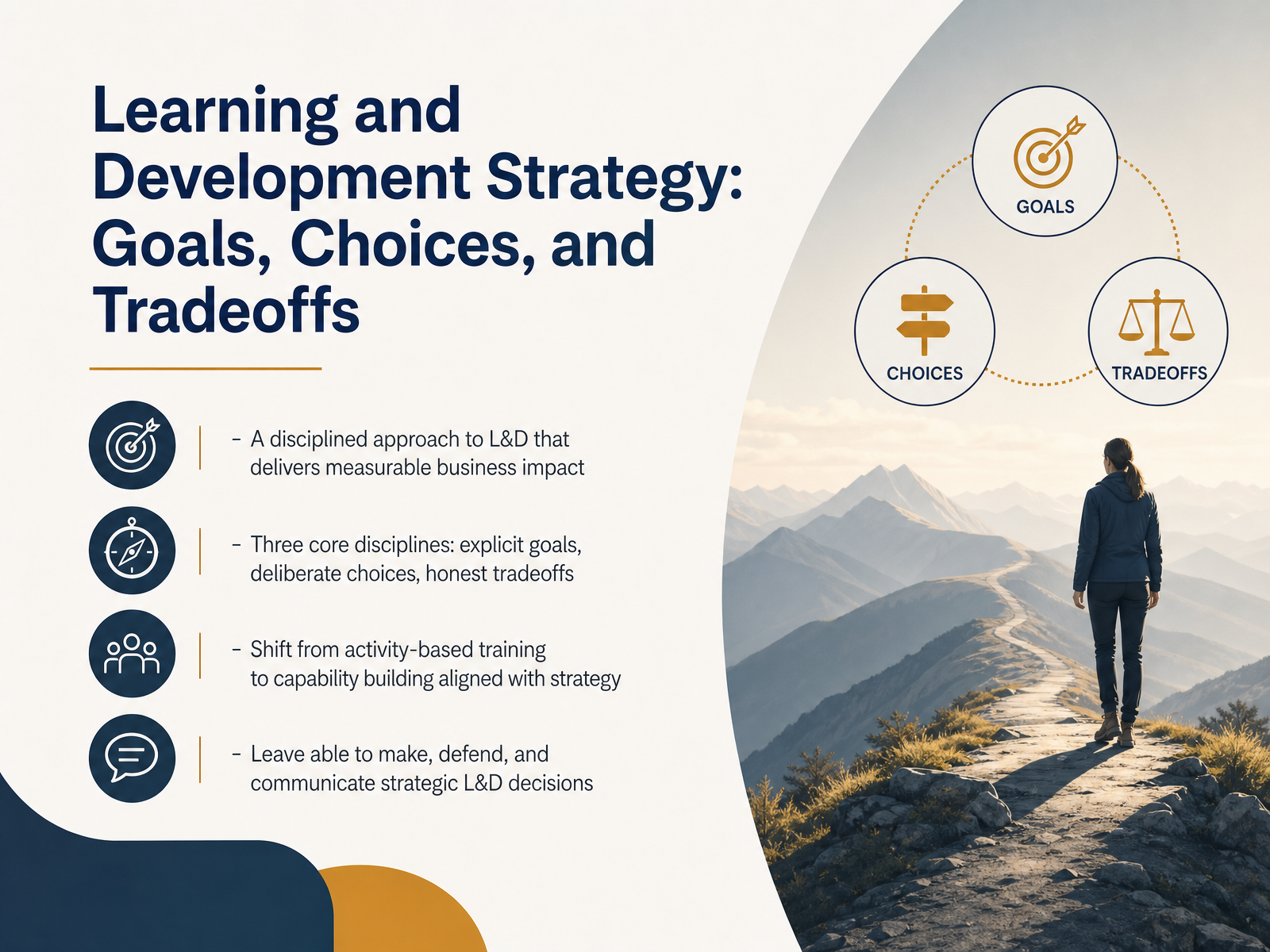
- 01Learning and Development Strategy: Goals, Choices, and TradeoffsWelcome, everyone. If you're responsible for learning and development, or you lead a team that depends on it, this session is for you. We're going to talk about L and D strategy in a way that's practical, disciplined, and tied directly to business outcomes. Not activity for the sake of activity. Real capability building. Over the next few minutes, we'll walk through three core disciplines. First, setting explicit goals. Second, making deliberate choices about where to invest. And third, getting comfortable with honest tradeoffs. Because let's be honest, you can't do everything well. The goal here is simple. By the time we're done, you'll be able to make, defend, and communicate strategic L and D decisions with confidence. Decisions that hold up under scrutiny and deliver measurable impact. So let's start with where most strategies actually begin. The starting points and the shared pain that push us to rethink what we're doing. Let's dive in.2 min
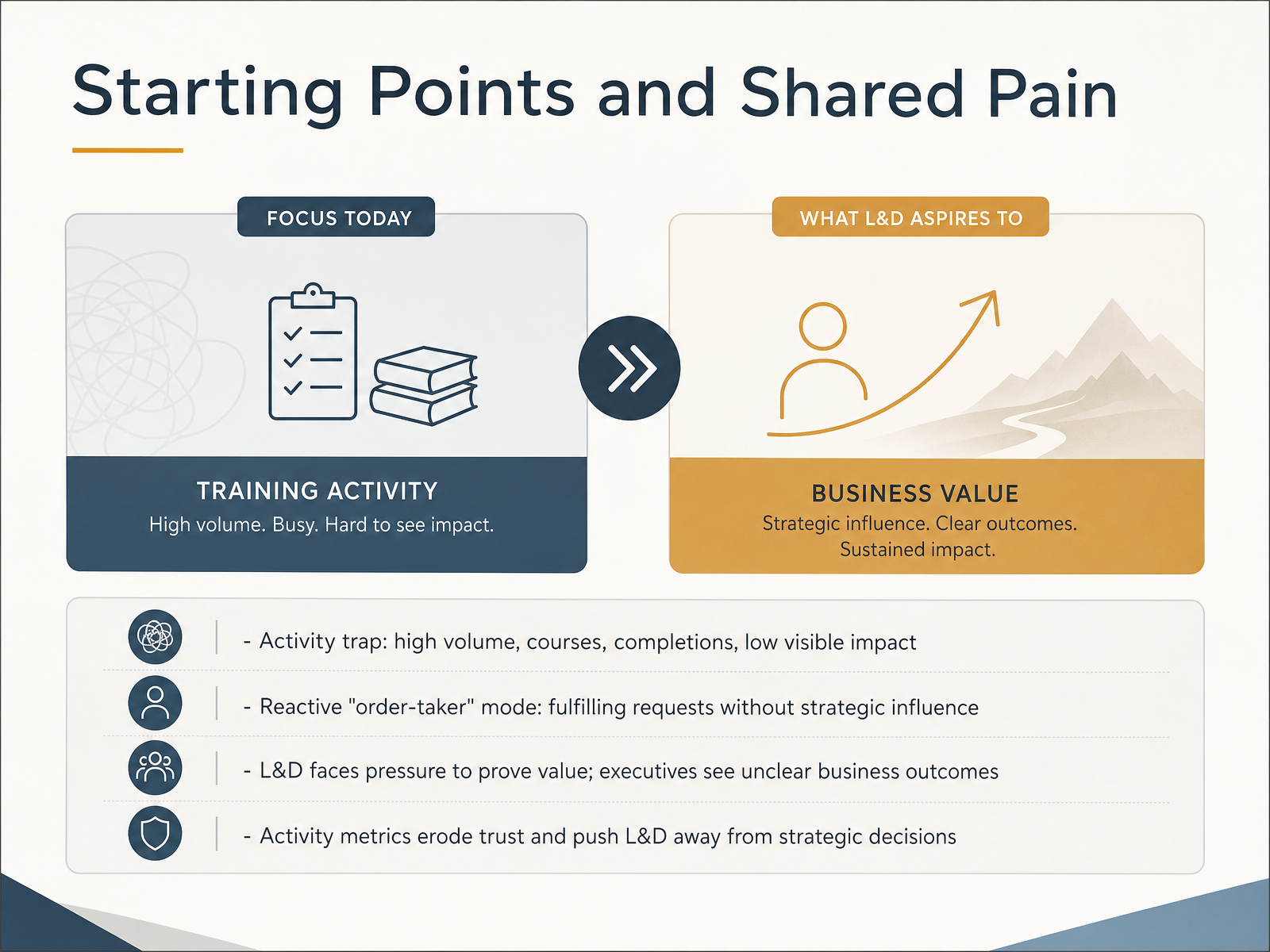
- 02Starting Points and Shared PainLet’s start with a reality check that many of us know all too well. L&D teams are busy—really busy. High course volumes, strong completion rates, packed training calendars. Yet when the business looks at the results, the impact is hard to see. That’s the activity trap. We’re measured on what’s easy to count, not on what actually moves the business forward. And too often, we fall into reactive mode—order-takers fulfilling requests without questioning whether the prescription is even right. Stakeholders come with solutions already in mind: “We need training on X.” We deliver it. But if the diagnosis is wrong, the training won’t fix anything. This erodes trust. Executives see unclear business outcomes, and L&D gets pushed out of strategic decisions. The hard truth? Only around two percent of L&D professionals believe they’re advanced at measuring the value they deliver. That gap is costing us influence. The good news is, it’s fixable—but it starts by acknowledging where we are today. So, what does a truly strategic L&D strategy look like? That’s exactly where we’re headed next.
 forbes.comthehrdirector.comtd.org+22 min
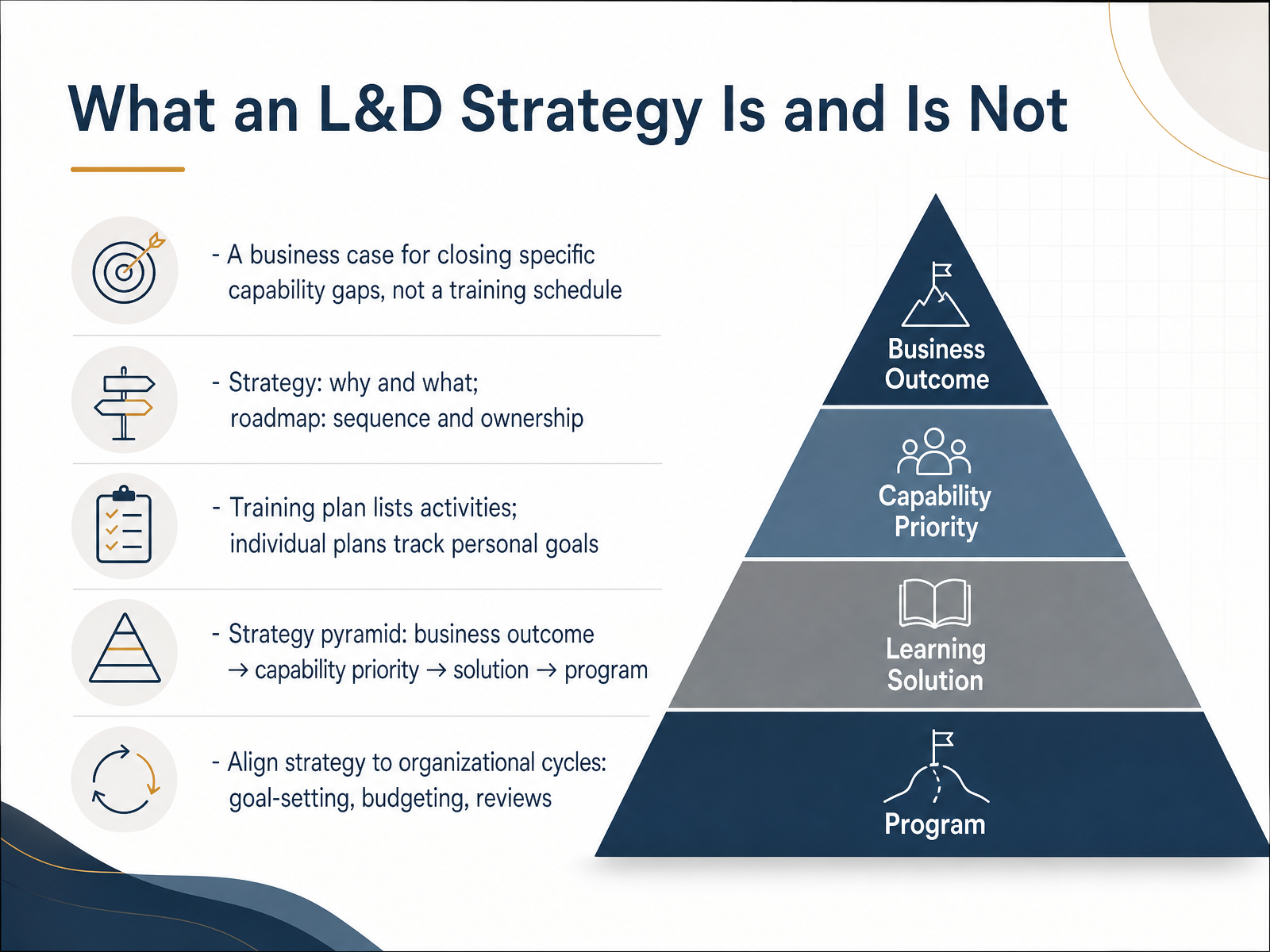
 - 03What an L&D Strategy Is and Is NotLet's clarify what we mean by a learning and development strategy, because the term gets used loosely. A strategy is not a training schedule. It's a business case for closing specific capability gaps that stand between you and your business outcomes. Think of the difference this way: a training plan lists activities—who attends what, and when. An individual development plan tracks personal goals. But a strategy answers why and what—why we need these capabilities, and what business objective they serve. A useful way to visualize this is a pyramid. At the top is the business outcome, say, reducing manager attrition. Below that, the capability priority, like improving coaching skills. Next, the solution, perhaps a blended leadership program. And at the base, the specific courses. Each layer must trace a line up to the business outcome. If a course can't do that, cut it. Finally, anchor your strategy to organizational cycles—goal-setting, budgeting, and performance reviews. If you lock in a roadmap before budget season, you risk building on assumptions. So, in short: strategy is the logic; the roadmap is the sequence and ownership. Get the logic right, and the roadmap becomes a tool for making tradeoffs, not just tracking tasks. Next, let's look at why L&D fails without explicit goals.
 synthesia.iothrivelearning.comag5.com+22 min
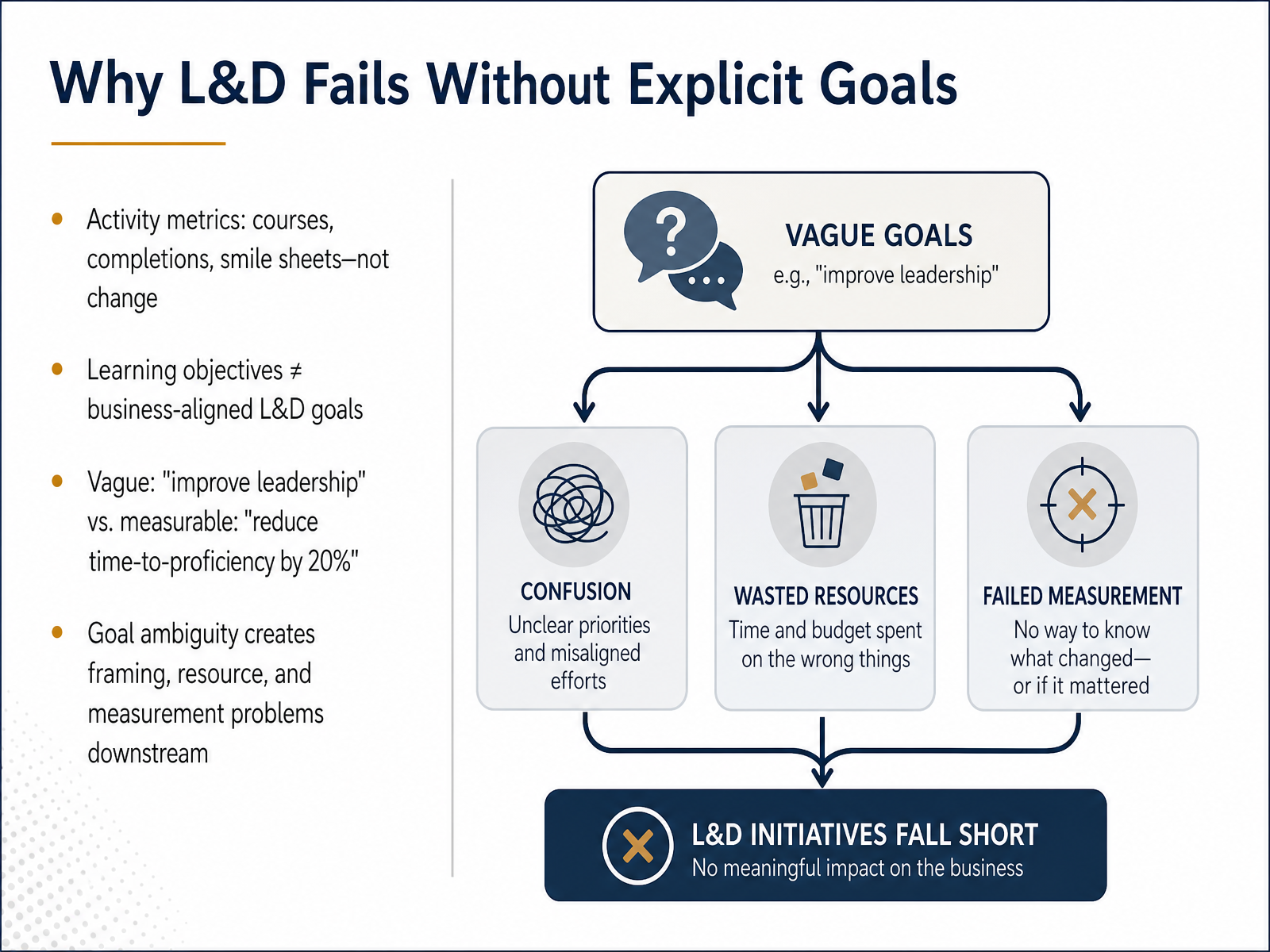
 - 04Why L&D Fails Without Explicit GoalsSo why does L&D fail without explicit goals? It usually starts with a very common trap: measuring activity instead of change. We track courses launched, completions, smile sheets. But those numbers don't tell us if anything actually improved on the job. A learning objective is not the same as a business goal. Saying we want to improve leadership is vague. Saying we will reduce time-to-proficiency by twenty percent is measurable. That distinction matters. When goals stay ambiguous, we create problems downstream. We can't frame the right solution, we can't allocate resources smartly, and we can't measure value in terms the business cares about. The fix starts with being explicit about the business outcome before designing any learning. Next, we'll look at the core concepts that make this work: capability, performance, and time-to-value.
 forbes.comthehrdirector.comtd.org+21 min
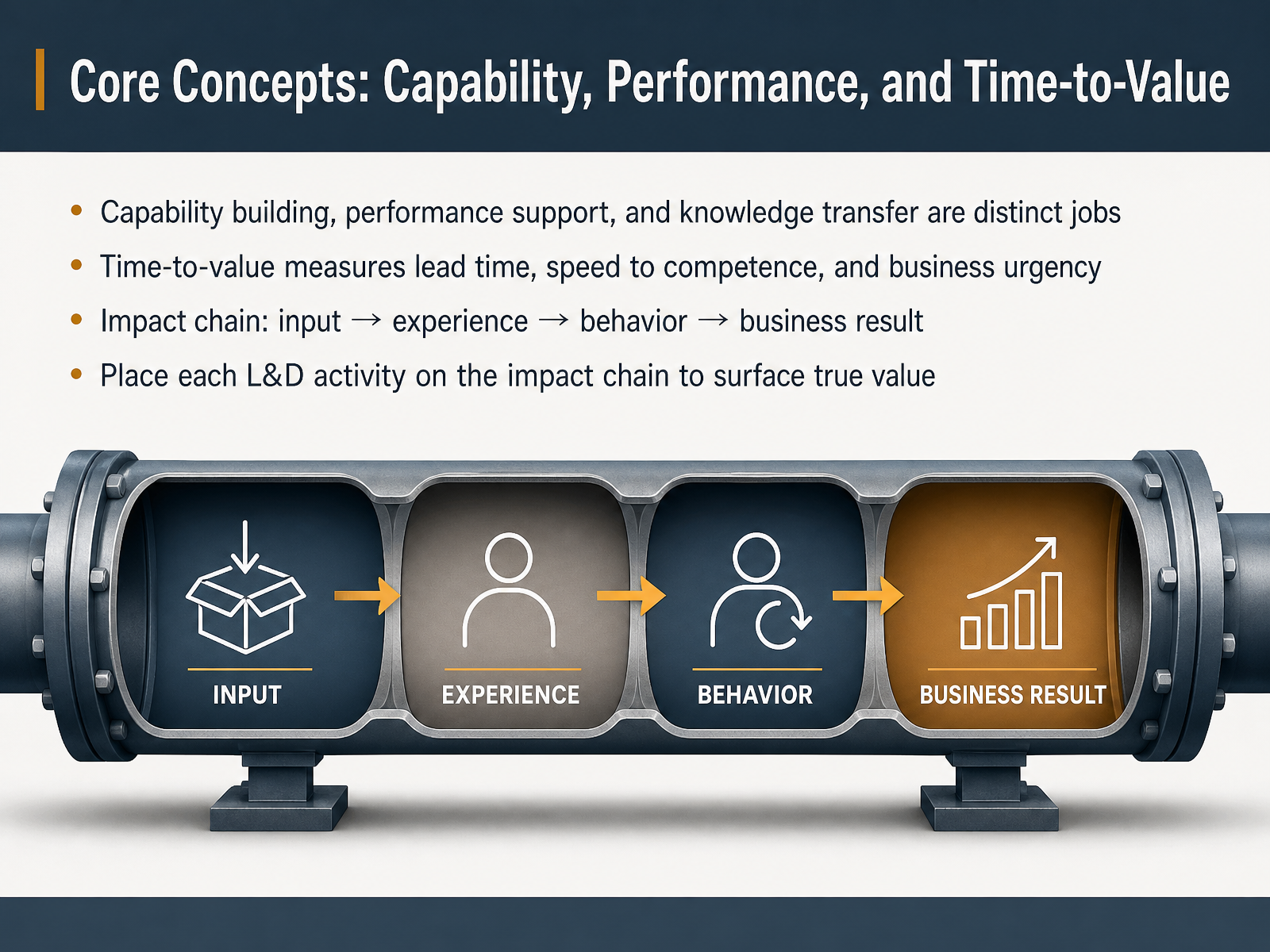
 - 05Core Concepts: Capability, Performance, and Time-to-ValueLet’s clarify three terms that often blur together in planning conversations: capability building, performance support, and knowledge transfer. They are distinct jobs. Capability building is developing skills for future challenges. Performance support gives people the right tools at the moment of need. Knowledge transfer ensures lessons from one part of the organization reach another. Mixing them up dilutes your strategy and obscures value. Now think about time-to-value. This metric captures lead time, speed to competence, and business urgency. It answers a simple question: how quickly does this effort start moving a business metric that matters? To bring this into focus, use the impact chain. Input leads to experience, which leads to behavior, which leads to a business result. Place each learning activity on that chain. If an activity does not progress beyond the experience stage, its real contribution is unproven. That discipline surfaces true value and flags investments that merely entertain. As we move into setting goals the business recognizes, keep this chain at the front of your thinking.
 forbes.comthehrdirector.comtd.org+21 min
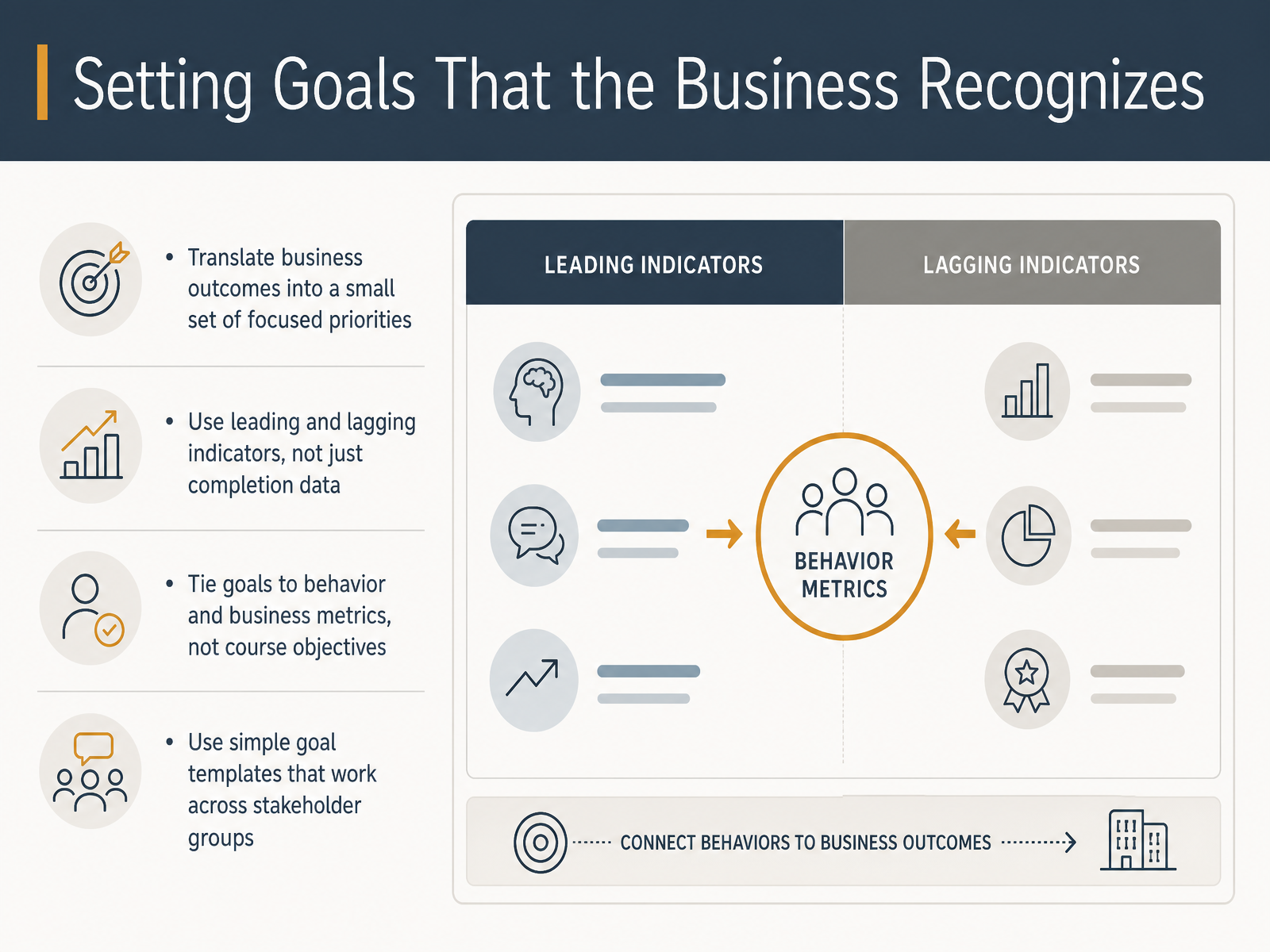
 - 06Setting Goals That the Business RecognizesLet's talk about setting goals the business actually recognizes. Start by translating business outcomes into a small set of focused priorities, not a long list of courses. If the goal is reducing manager attrition, name that as the priority, and tie every development initiative back to it. That's something leaders immediately understand. Next, use both leading and lagging indicators, not just completion data. Completion tells you someone clicked play. Engagement patterns and assessment scores are leading signals. Promotion rates and performance reviews are lagging signals that validate real capability. Tie your goals to behavior and business metrics, not course objectives. The question isn't 'did they finish the module', it's 'can they now do the work'. Finally, use a simple goal template that works across stakeholder groups. Something like: the business outcome, the priority audience, what they need to do differently, and how we will measure success. Keep it that crisp, and you will have goals that finance, operations, and HR all recognize. Now, let's move on to the strategic choices you'll face: build, buy, partner, curate, or stop.
 synthesia.iothrivelearning.comag5.com+22 min
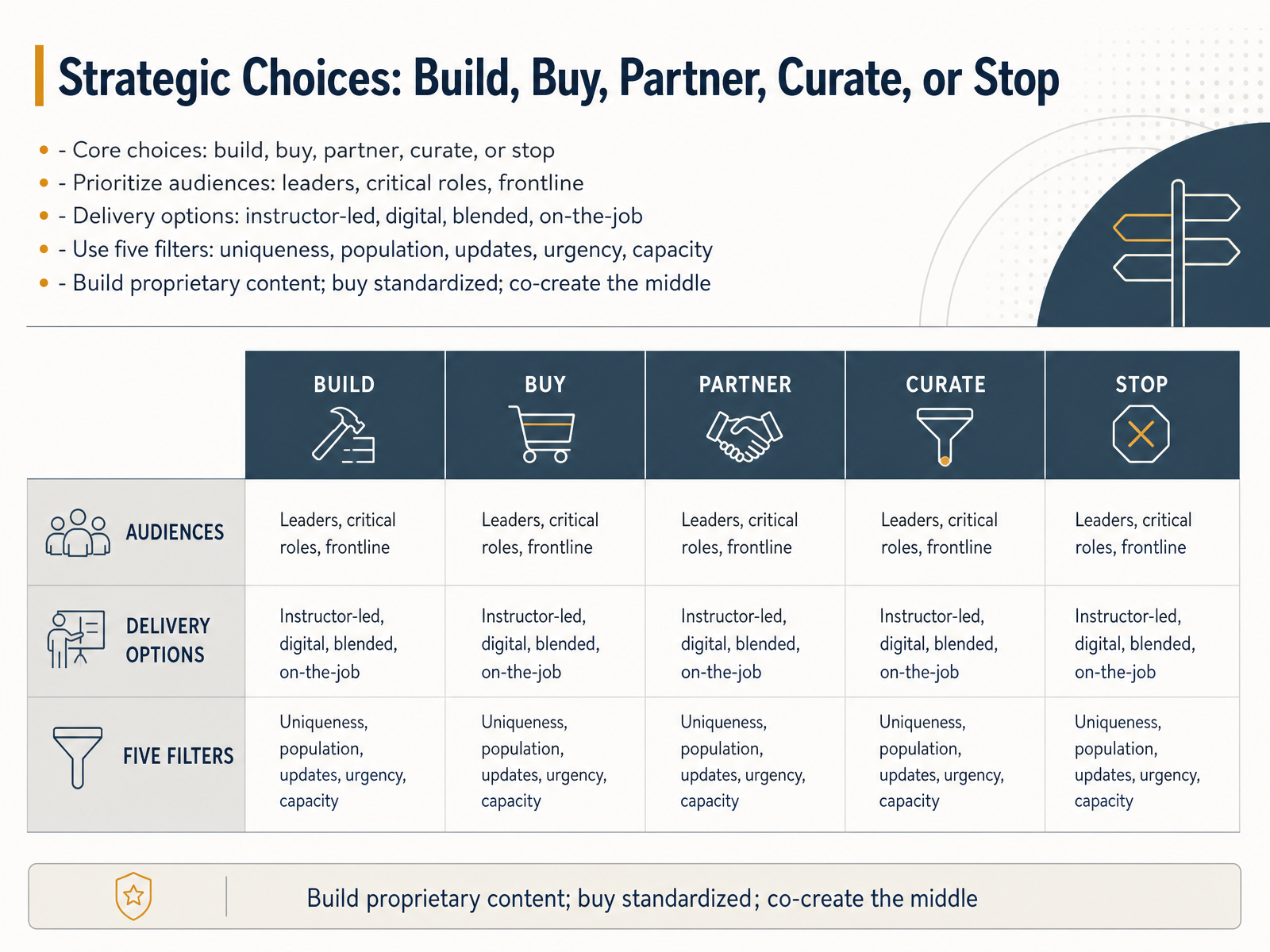
 - 07Strategic Choices: Build, Buy, Partner, Curate, or StopNow let's turn to the strategic choices in front of us: build, buy, partner, curate, or stop. This isn't about picking one approach for everything. It's about designing a portfolio. Start by prioritizing your audiences. Leaders, critical roles, and frontline teams each need different treatment. Then think about delivery options: instructor-led, digital, blended, or on-the-job. Your five filters are uniqueness, population, updates, urgency, and capacity. If the content is proprietary to how you operate, build it. If it's standardized knowledge like compliance or soft skills, buy it. And for that middle ground, co-create with a partner. Your subject matter experts bring the context; the partner brings instructional design and production. Here's a practical example. Onboarding for new hires that reflects your culture? Build. A cybersecurity refresher? Buy. Role-specific sales training? Co-create. And if a program is outdated or no longer aligns with strategy, be willing to stop it. That frees capacity for what matters. As you apply these filters, you'll find the right mix. Now let's move into a practical build-buy-partner framework to guide your decisions.
 mitrmedia.comniit.comqquench.ai+22 min
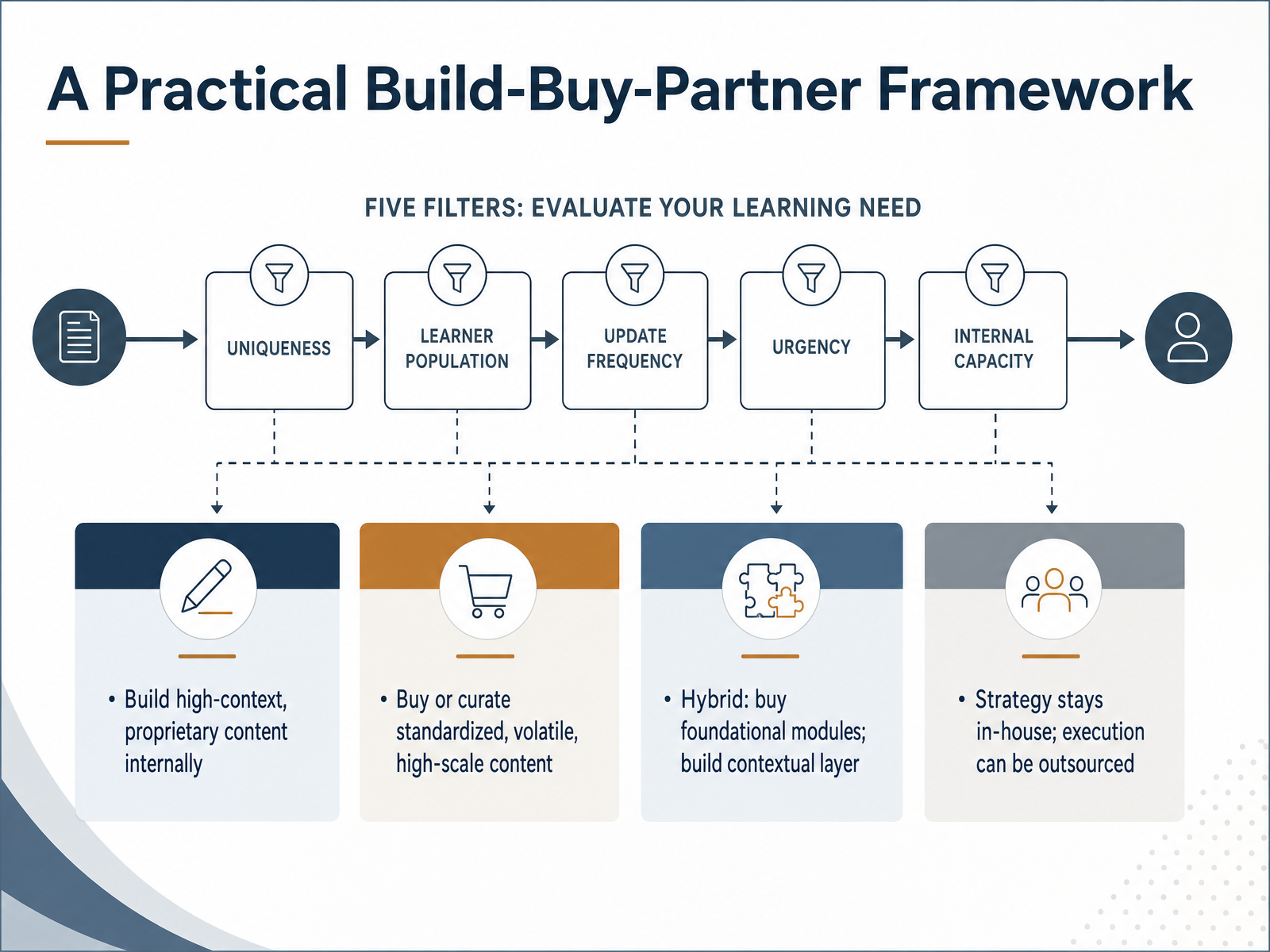
 - 08A Practical Build-Buy-Partner FrameworkSo how do you actually decide what to build, what to buy, and what to partner on? Start with five filters. Uniqueness: does the content require deep organizational context? Learner population: is it ten people or ten thousand? Update frequency: will this change monthly or annually? Urgency: does the business need it in weeks, not months? And internal capacity: does your team have the bandwidth and expertise to execute? Use these filters to route your work. Build high-context, proprietary content internally, things tied to your culture, your leadership philosophy, or your internal IP. Buy or curate standardized, volatile, high-scale content. Compliance refreshers, foundational leadership skills, anything that needs accuracy and speed without your team becoming the bottleneck. The third option is hybrid. Buy the foundational module and build a contextual layer on top. For example, license a GDPR principles course and build a custom module on your specific data workflows. The key principle is simple: strategy stays in-house, execution can be outsourced. Your team owns the standards, governance, and alignment. Production happens through a mix of internal and external capabilities. That is how you scale. Which brings us to the real resource tradeoffs, and that is what we will look at next.
 mitrmedia.comniit.comqquench.ai+22 min
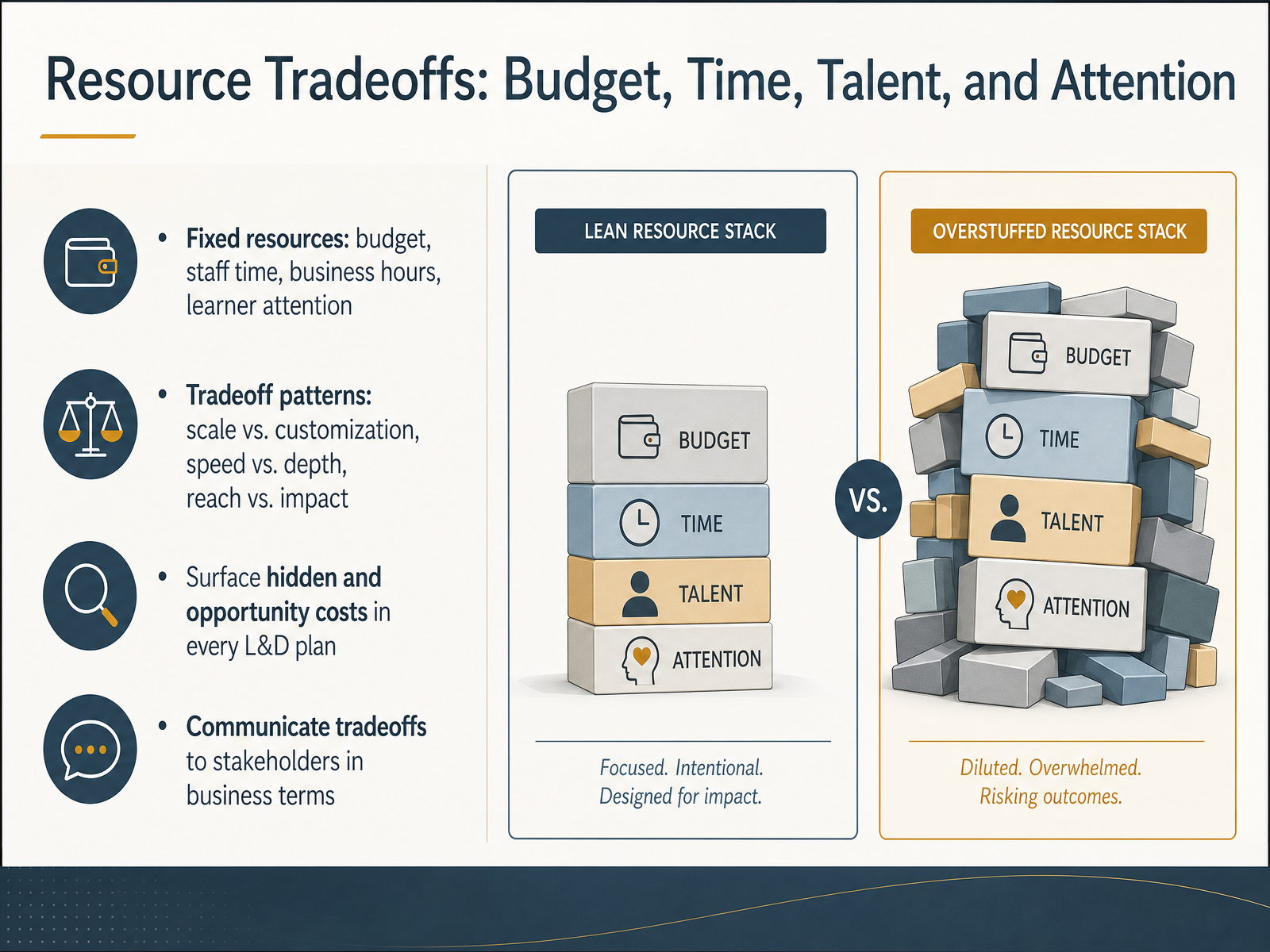
 - 09Resource Tradeoffs: Budget, Time, Talent, and AttentionNow let’s talk about resource tradeoffs. Every learning plan runs on four fixed resources: budget, staff time, business hours, and learner attention. You can’t stretch any of them indefinitely, so every decision means giving something up. Scale versus customization. Speed versus depth. Reach versus impact. Choosing one usually costs you the other. The risk is that hidden costs quietly accumulate. Custom content takes longer to build. A fast rollout may skip the practice that changes behavior. Broad reach can dilute the outcome that actually matters. Surface those tradeoffs early, in business terms. When you tell a stakeholder, we can train everyone in two weeks, but only a focused pilot will change the sales metric, you’re having a strategic conversation, not an order-taking one. Next, let’s look at stakeholder tradeoffs, and how the different priorities of business leaders, learners, and L-D itself pull your strategy in different directions.
 forbes.comthehrdirector.comtd.org+22 min
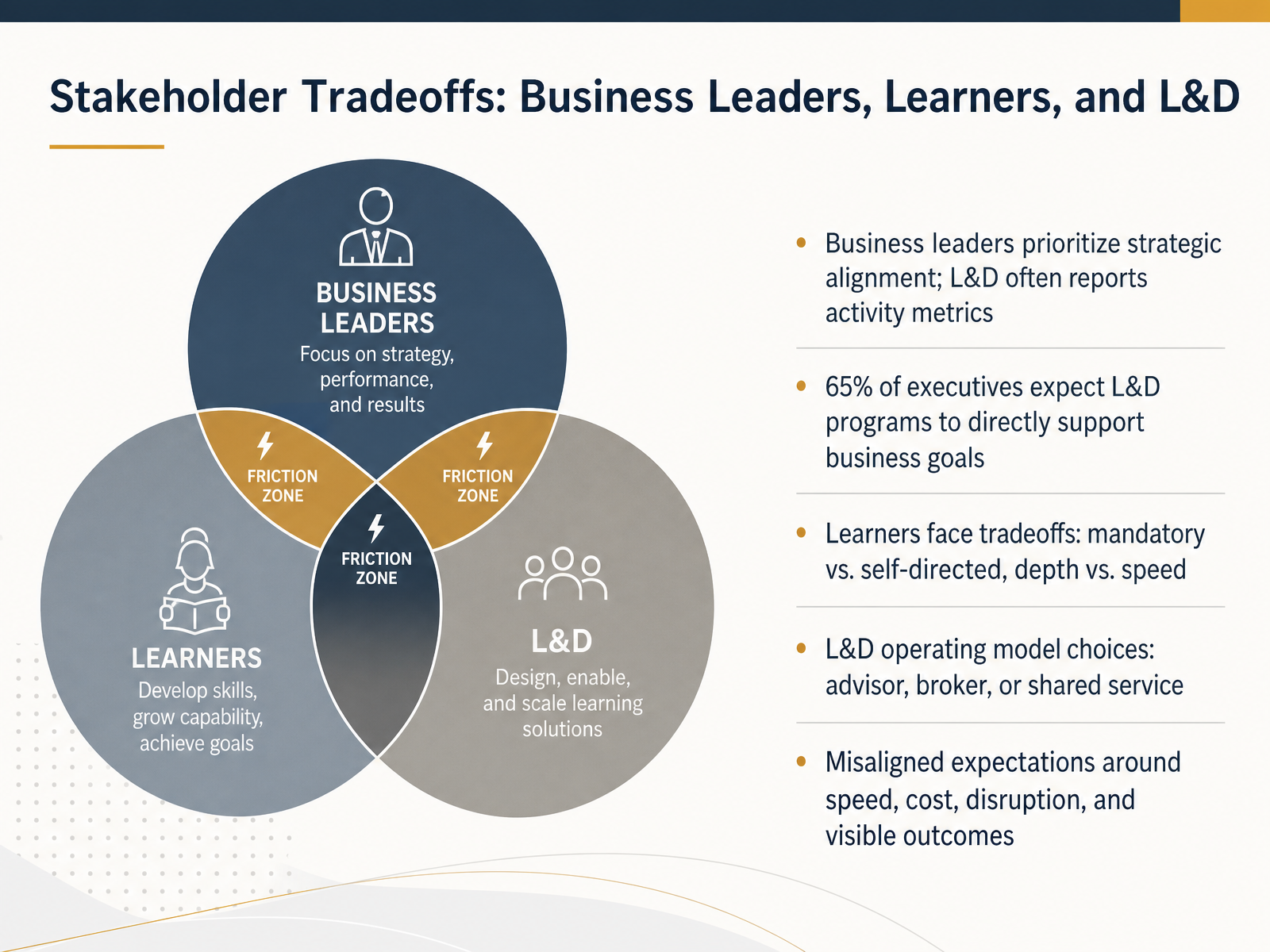
 - 10Stakeholder Tradeoffs: Business Leaders, Learners, and L&DLet’s talk about the tradeoffs that define this work. Business leaders care about strategic alignment. They want learning that moves revenue, productivity, or risk metrics. But L&D often reports activity numbers, like completion rates or hours logged. That gap in expectations is where trust erodes. Here’s a striking data point: sixty-five percent of executives expect L&D programs to directly support business goals. That’s not a soft aspiration, it’s a performance requirement. Meanwhile, learners are making their own tradeoffs. They balance mandatory compliance training against self-directed upskilling, and they weigh depth of understanding against the speed of delivery. And L&D itself faces an operating model choice. Are you an advisor that shapes strategy, a broker that connects learners to the best external content, or a shared service focused on efficiency? Each model has real consequences for speed, cost, and visibility. The core tension is simple: leaders want fast, cheap, and visible outcomes, while meaningful development is often slower, more expensive, and harder to measure. The first step is naming these tensions openly. Then we can make these tradeoffs deliberately, and that’s exactly what we’ll cover next.
 harvardbusiness.orgharvardbusiness.orgharvardbusiness.org+21 min
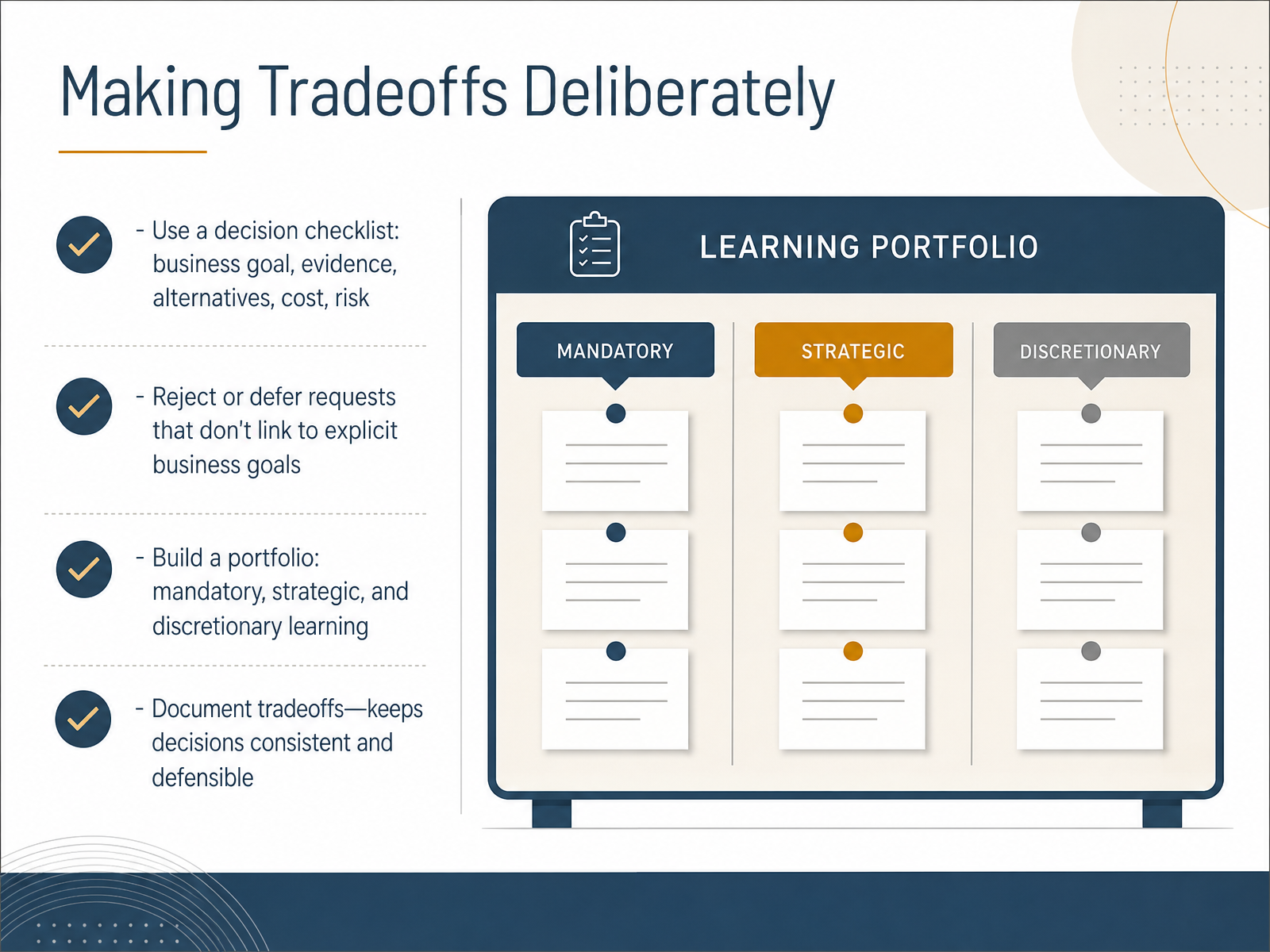
 - 11Making Tradeoffs DeliberatelyNow let's talk about making tradeoffs deliberately. This is where strategy gets real. Start with a simple decision checklist: Does this request link to a clear business goal? What evidence do we have? Have we considered alternatives? What does it cost, and what's the risk if we say no? If a request doesn't connect to an explicit business outcome, reject it or defer it. That's not being difficult; that's being disciplined. Next, build your portfolio across three buckets: mandatory learning, like compliance; strategic learning, tied directly to growth or transformation; and discretionary learning, which is valuable but flexible. This mix keeps you responsive without losing focus. Finally, document your tradeoffs. Write down what you chose, why, and what you deferred. That record keeps decisions consistent, makes them defensible to stakeholders, and prevents you from revisiting the same debate every quarter. Remember, a deliberate no is far more powerful than an automatic yes. Coming up, we'll walk through three realistic scenarios to see these tradeoffs in action.
 forbes.comthehrdirector.comtd.org+22 min
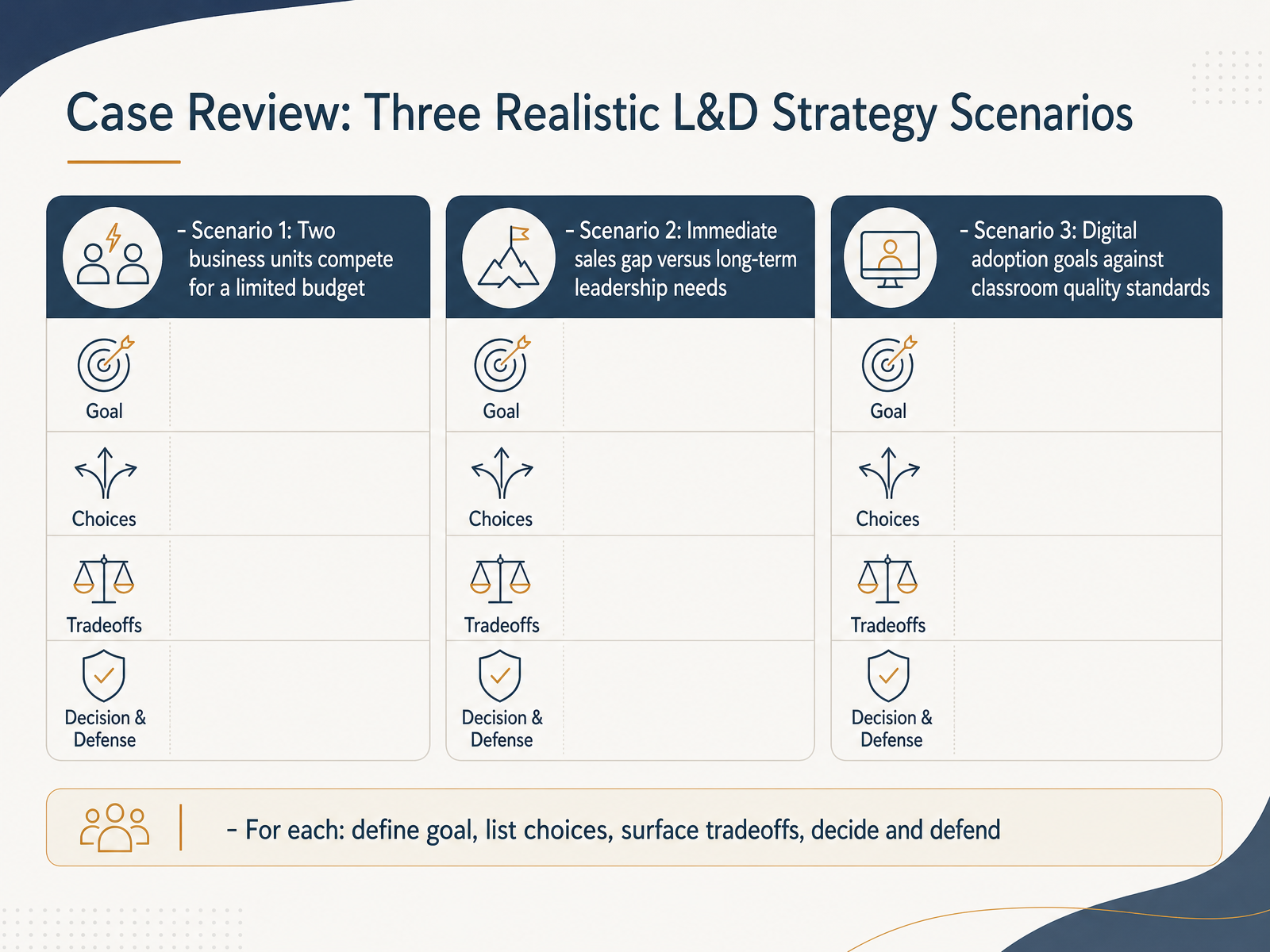
 - 12Case Review: Three Realistic L&D Strategy ScenariosLet's put our framework to work with three realistic scenarios. First, two business units are competing for one limited budget. Your goal is to decide where the investment creates the most strategic value. The choices are to split the funds evenly, prioritize the unit with the nearest revenue impact, or hold both to a clearer business case. Here's the tradeoff: splitting feels fair but may dilute impact; prioritizing one unit might feel political but can drive faster results. Decide by asking which unit's goal aligns more tightly with this year's strategy, then defend that choice with data and a clear rationale. Second, we have a short-term sales gap versus a long-term leadership pipeline. Training to close the gap now is tangible and measurable, but it may starve future leaders. The leadership program is vital for sustainability, but its payoff is slower. Balance by funding a quick, focused sales intervention and a leaner leadership track, protecting both. Third, digital adoption goals versus classroom quality. Learners want flexible online tools, but your classroom programs have proven value. Don't force a binary choice. You can create a blended path that keeps quality while adding digital access. For every scenario, define the goal, list your choices, surface the tradeoffs, then decide and defend. Now, let's take this into action planning and see how to bring it back to your organization.
 2 min
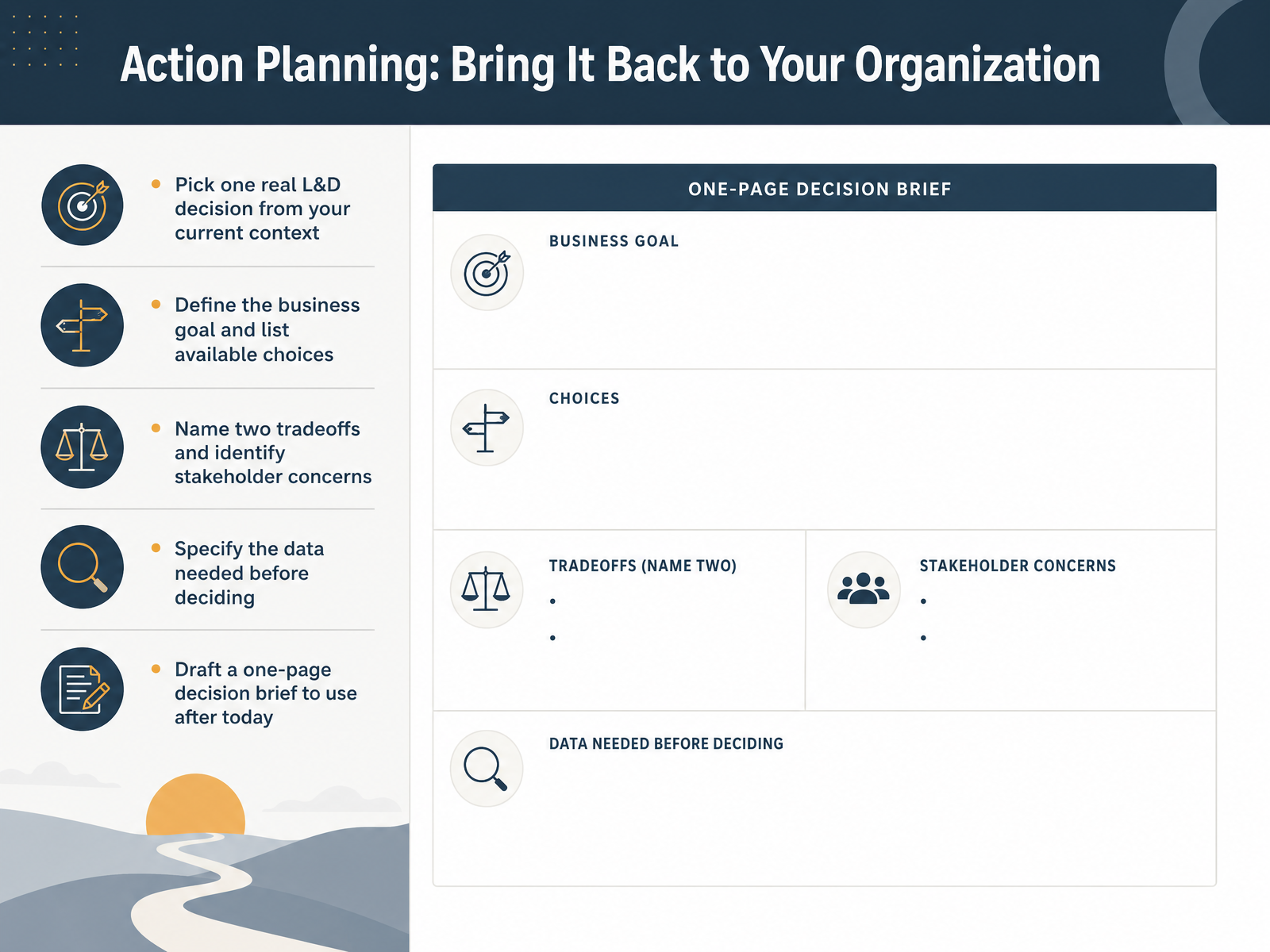
2 min - 13Action Planning: Bring It Back to Your OrganizationLet’s turn this into action you can use on Monday. Pick one real L&D decision you are facing right now. It could be a new leadership program, a tool upgrade, or a compliance refresh. Define the business goal behind it in one sentence. Not the learning outcome, the business outcome. Then list your available choices. For each choice, name two tradeoffs. What do you gain, and what do you give up? Identify who will care most about those tradeoffs. A VP might worry about time away from the floor. A team lead might worry about workload. Now, what data would make this decision easier? Engagement scores, productivity metrics, or turnover trends. Specify that data before you decide. Finally, draft a one-page decision brief. Keep it tight. Business goal, options, tradeoffs, stakeholders, and the data you need. That brief becomes your anchor after today, so you can move from conversation to commitment. And it sets you up perfectly for our key takeaways and next steps.
 1 min
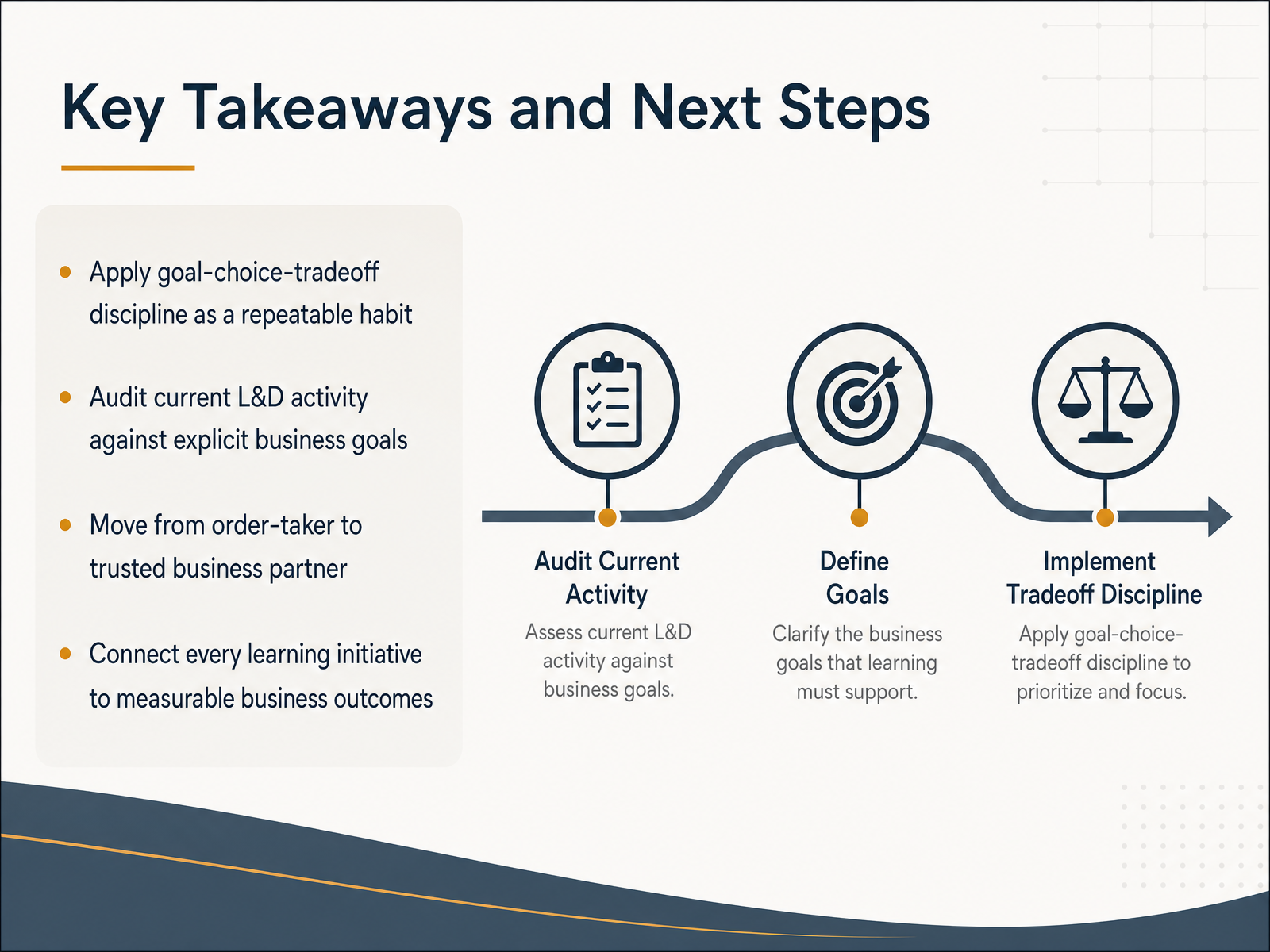
1 min - 14Key Takeaways and Next StepsLet’s turn this into action. The discipline we’ve talked about — goals, choices, tradeoffs — is not a one-time exercise. It’s a habit you build into every planning cycle. First, audit what you’re doing today. Map each current initiative to an explicit business goal. If it doesn’t connect, either rethink it or retire it. Second, stop being an order-taker. When a stakeholder asks for training, ask what business outcome they want to move. Work backward from that. That shift turns you from a service desk into a trusted partner. And third, tie every learning initiative to a measurable outcome. Not completion rates or smile sheets. Reduce compliance incidents. Increase sales velocity. Cut time-to-productivity. This is how you prove value and earn your seat at the table. The research is clear: only a small fraction of teams are doing this well, and that’s the opportunity. Starting today, pick one program, define the outcome, and measure it. It’s a small step, but it builds momentum. Thank you for your time and your commitment. You have what you need to make learning a true business driver. Now go make it happen.
 forbes.comthehrdirector.comtd.org+22 min
Take the deck with you
Download this course as a file — free, no sign-up needed.
- PDF handoutEvery slide page, ready to print or share.15 pages · 3.1 MBDownload
- Narrated PowerPointThe deck that presents itself — every slide carries the digital human's narration video.15 pages · 13.9 MBDownload
- PowerPoint slidesThe full deck as a .pptx — open it in PowerPoint, Keynote, or Google Slides.15 pages · 3.0 MBDownload
Free to use in your own training — please keep the PersonWise credit page at the end.
Have your own deck? Turn it into a course
Sources consulted
Web sources consulted while building this course.
- Why Learning And Development Is Failing The Business — forbes.com
- Why L&D is stuck in the activity trap and how to escape it | theHRD — thehrdirector.com
- Driving Business Impact: Aligning Training With Strategic Goals — td.org
- Mind the Gap: Closing the Distance Between Learning and Business Strategy — td.org
- Measuring the Business Impact of Learning 2025 — gpstrategies.com
- L&D Strategy and Roadmap (5 Phase Framework) — synthesia.io
- L&D strategy framework: a step-by-step guide for 2026 - Thrive — thrivelearning.com
- Learning and Development Strategy: A Practical Guide for 2026- AG5 — ag5.com
- Enterprise Learning and Development 2026: The Ultimate Guide | D2L — d2l.com
- How To Build An L&D Strategy That Aligns With Business Goals In 2026 — excel-communications.com
- Build vs Buy vs Outsource eLearning Development: L&D Guide — mitrmedia.com
- Build vs. Buy: A CLO's Guide to Outsourcing L&D in 2026 — niit.com
- Build Vs Buy. Making The Right Training Content Decision For Enterprise L&D - Qquench Ai — qquench.ai
- Build vs. Buy Training Content: A Decision Framework — litmos.com
- Build vs. Buy: When to Outsource Corporate Training — trainingindustry.com
- 2025 Global Leadership Development Study: Research Report - Harvard Business Impact — harvardbusiness.org
- 2025 Global Leadership Development Study: Research Findings - Harvard Business Impact — harvardbusiness.org
- Fast, Fluid and Future-Focused: Building the Collective Intelligence of Humans and Machines — harvardbusiness.org
- 2025 State of the Industry — assets.td.org
- L&D playbook 2025: — 7157e75ac0509b6a8f5c-5b19c577d01b9ccfe75d2f9e4b17ab55.ssl.cf1.rackcdn.com