Begin
14 pages · ~28 min
Public Speaking Initiative Plan
This training helps professionals plan and launch a public speaking initiative, covering goal setting, audience analysis, and program design.
A digital instructor presents all 14 pages. Hold “Ask” at any point and ask out loud — the answer comes from this course. No sign-up needed.
What you’ll learn
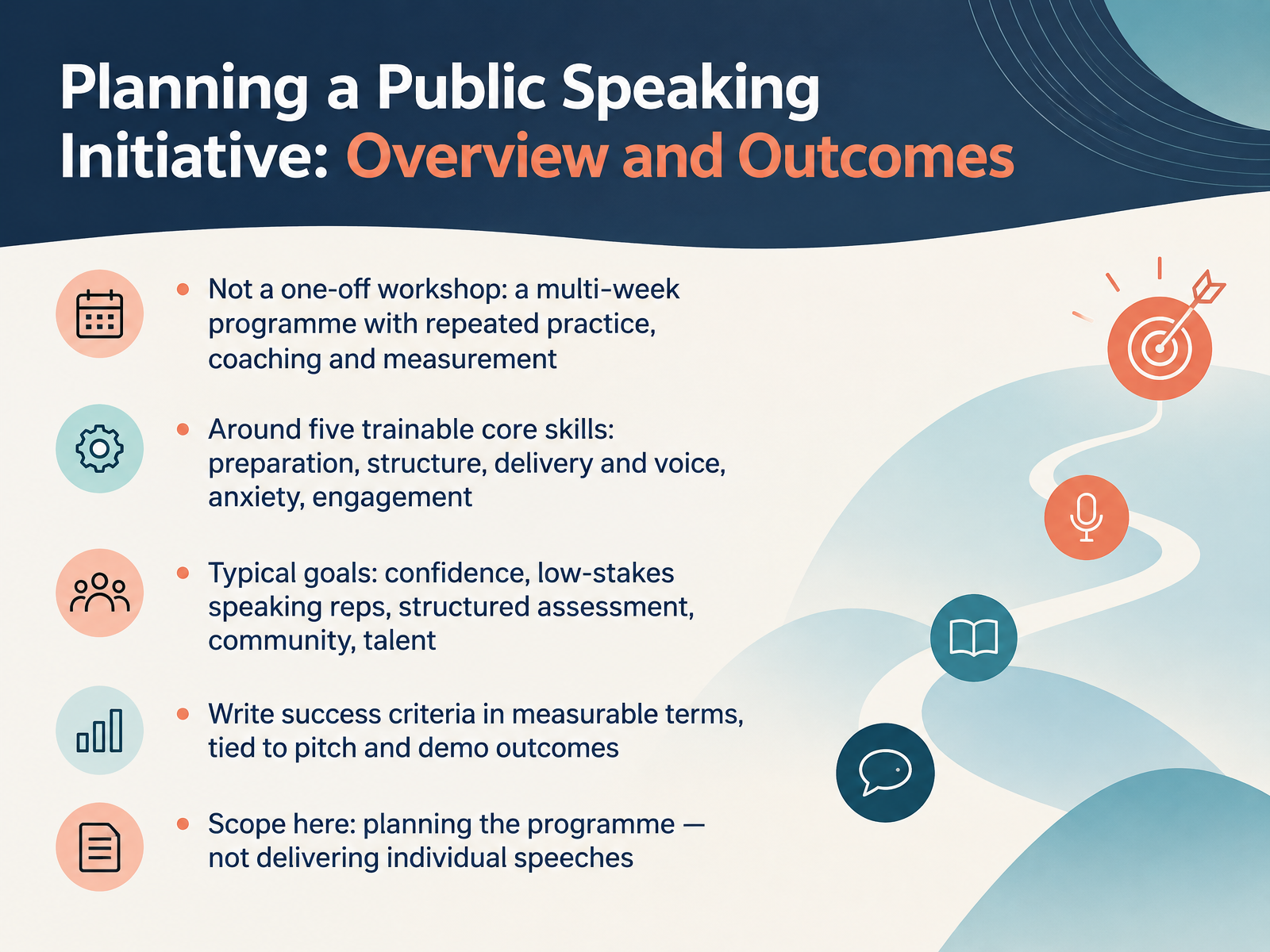
- 01Planning a Public Speaking Initiative: Overview and OutcomesWelcome. This is the opening of Planning a Public Speaking Initiative, a working series for L&D teams, educators, and speaking-club coordinators who need to launch or sharpen a structured programme. Here is the framing for everything that follows. This is not a one-off workshop. It is a multi-week programme with repeated practice, coaching, and measurement. At the centre are roughly five trainable skills: preparation, structure, delivery and voice, managing anxiety, and audience engagement. Typical goals include confidence, low-stakes speaking reps, structured assessment, community, and spotting talent. Write your success criteria in measurable terms, tied to real moments like pitch win rate or demo conversion. For example, if your cohort is frontline sellers, measure pitch outcomes; if it is new managers, measure town hall and briefing feedback. One scope note: we are planning the programme here, not delivering individual speeches. So keep two decisions in front of you. Which role are you piloting with, and which two skills hurt most? Start there. Next, we look at Start With the Outcome: Defining Purpose and Success Criteria.disprz.aimatimtl.camatsh.co+22 min
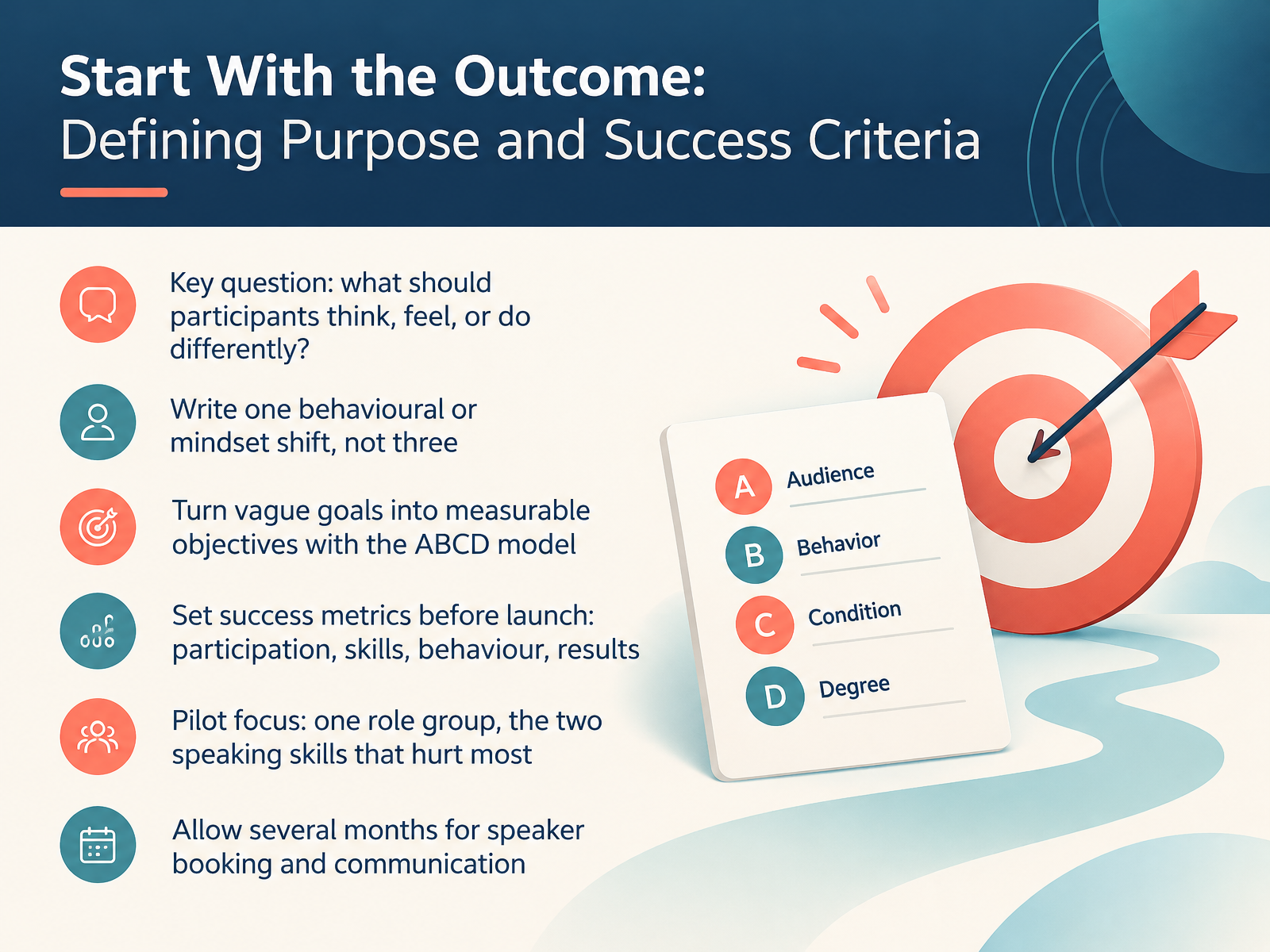
- 02Start With the Outcome: Defining Purpose and Success CriteriaLet's talk about where a speaking programme actually starts. Not with the speaker search. With the outcome. Ask one question first: what should participants think, feel, or do differently? Then write down one behavioural or mindset shift. Not three. One. For example, a manager will open a team update with the main point, instead of the background. That is specific, coachable, and measurable. To turn vague goals into measurable ones, use the A B C D model. Audience, Behaviour, Condition, and Degree. Here is a worked version. Given a five slide deck, first line managers will deliver a three minute update, holding eye contact at least seventy percent of the time. Notice how that is testable. Now set your success metrics before launch, across four levels: participation, skills, behaviour, and results. That gives you a before and after story, not just a satisfaction score. For a pilot, keep the scope tight. Choose one role group, and the two speaking skills that hurt most in your context. And allow several months for speaker booking and communication, especially if you are bringing in external voices. Quick takeaway: one outcome, one behaviour, four metrics, before you book anything. Next, let's look at Needs Assessment and Audience Analysis.
 disprz.aimatimtl.camatsh.co+22 min
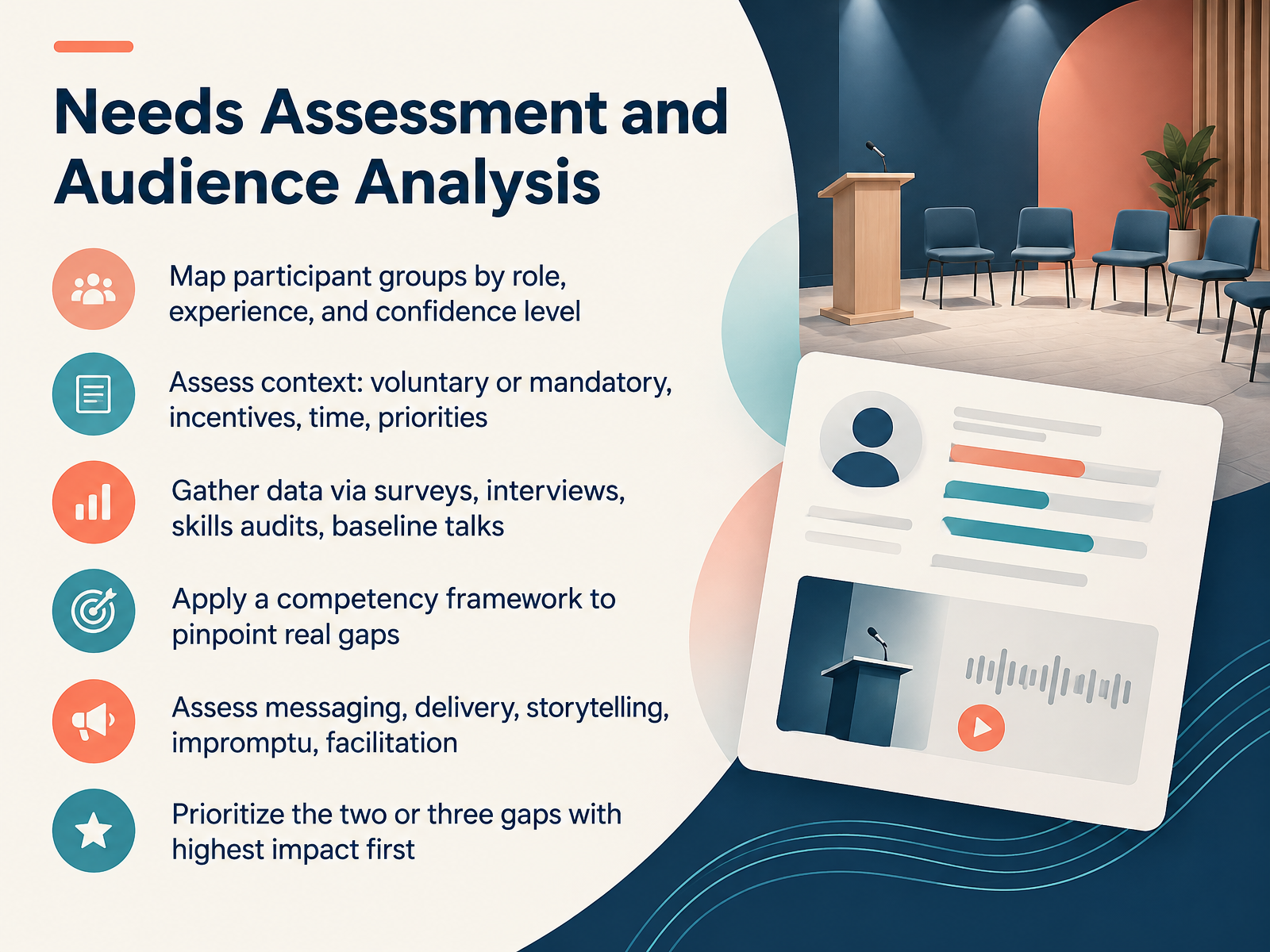
- 03Needs Assessment and Audience AnalysisNow, before you book a single trainer or room, run a needs assessment. Start by mapping participant groups: role, experience, and confidence level. A new manager and a senior engineer need very different sessions. Next, assess context. Is attendance voluntary or mandatory? What incentives, time, and priorities are in play? If your cohort is mandatory, expect lower initial motivation and plan for quick wins. Gather data three ways: a short survey, a few interviews, and baseline talks. A five-minute recorded talk tells you more than any self-rating. Then apply a competency framework to pinpoint real gaps. Assess messaging, delivery, storytelling, impromptu, and facilitation. If you have limited budget, pick the two or three highest-impact gaps and build the program around those. That focus protects your volunteers from burnout and your calendar from overload. With your gaps defined, you are ready to choose the right format, length, and cadence.
 ecommons.udayton.eduwebsite.archivenatcom.orgmagneticspeaking.com+22 min
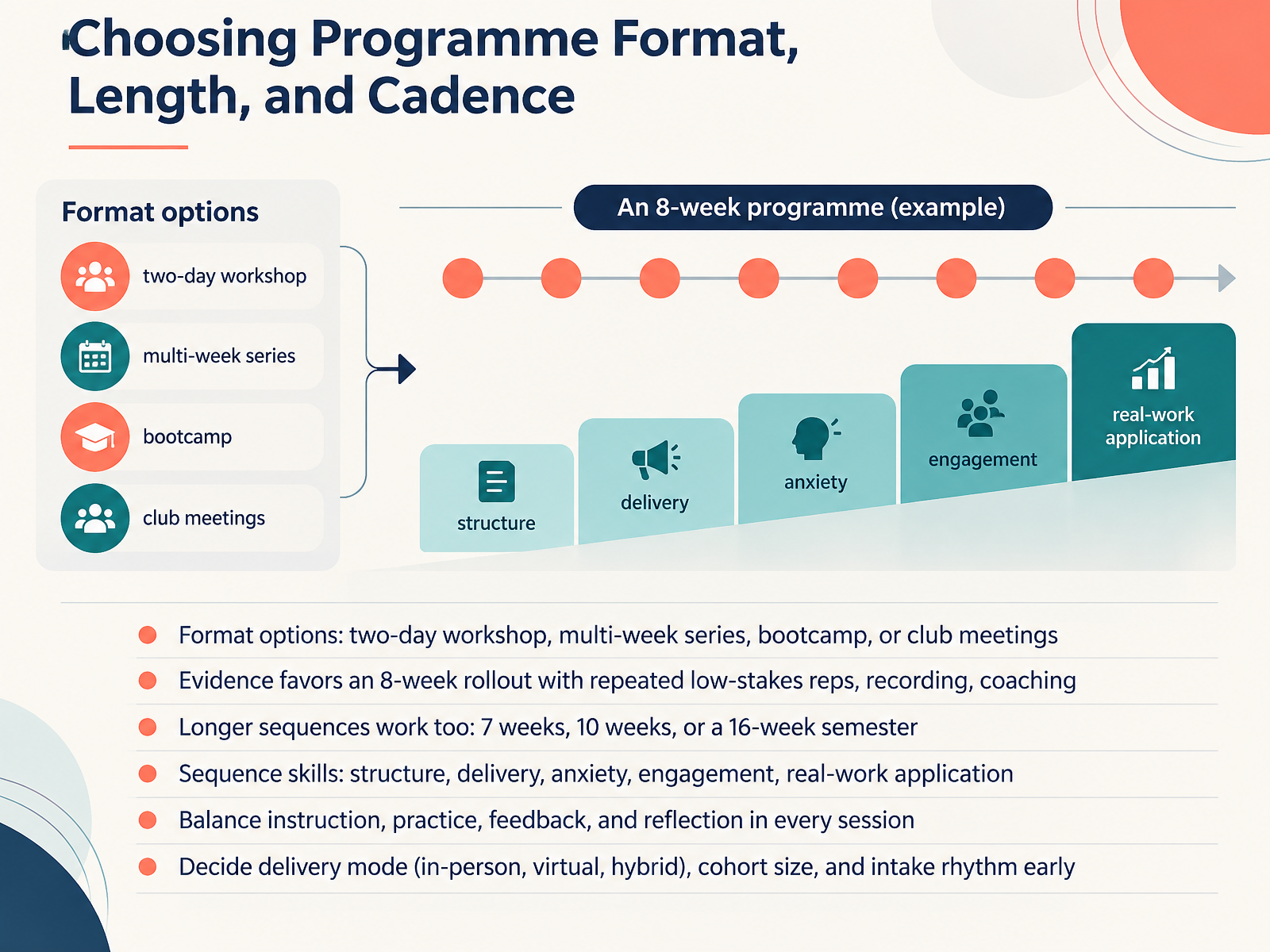
- 04Choosing Programme Format, Length, and CadenceLet us talk format, length, and cadence. You have four basic options: a two-day workshop, a multi-week series, a bootcamp, or ongoing club meetings. The evidence favors an eight-week rollout with repeated low-stakes reps, recording, and coaching. Longer sequences work equally well: seven weeks, ten weeks, or a full sixteen-week semester. Whichever length you pick, sequence the skills deliberately. Start with structure, then delivery, then anxiety management, then audience engagement, and finish with real-work application. In every session, balance four things: instruction, practice, feedback, and reflection. If your cohort is large, lean on virtual or hybrid delivery and cap live practice groups. If scheduling rooms is your bottleneck, move feedback online and protect only the practice time in person. Decide three things early: delivery mode, cohort size, and intake rhythm. Get those wrong, and you will be rebuilding the calendar by week three. Next, let us look at designing the curriculum and skill progression.
 milnepublishing.geneseo.edueruditemillennium.comspeechanddebate.org+22 min
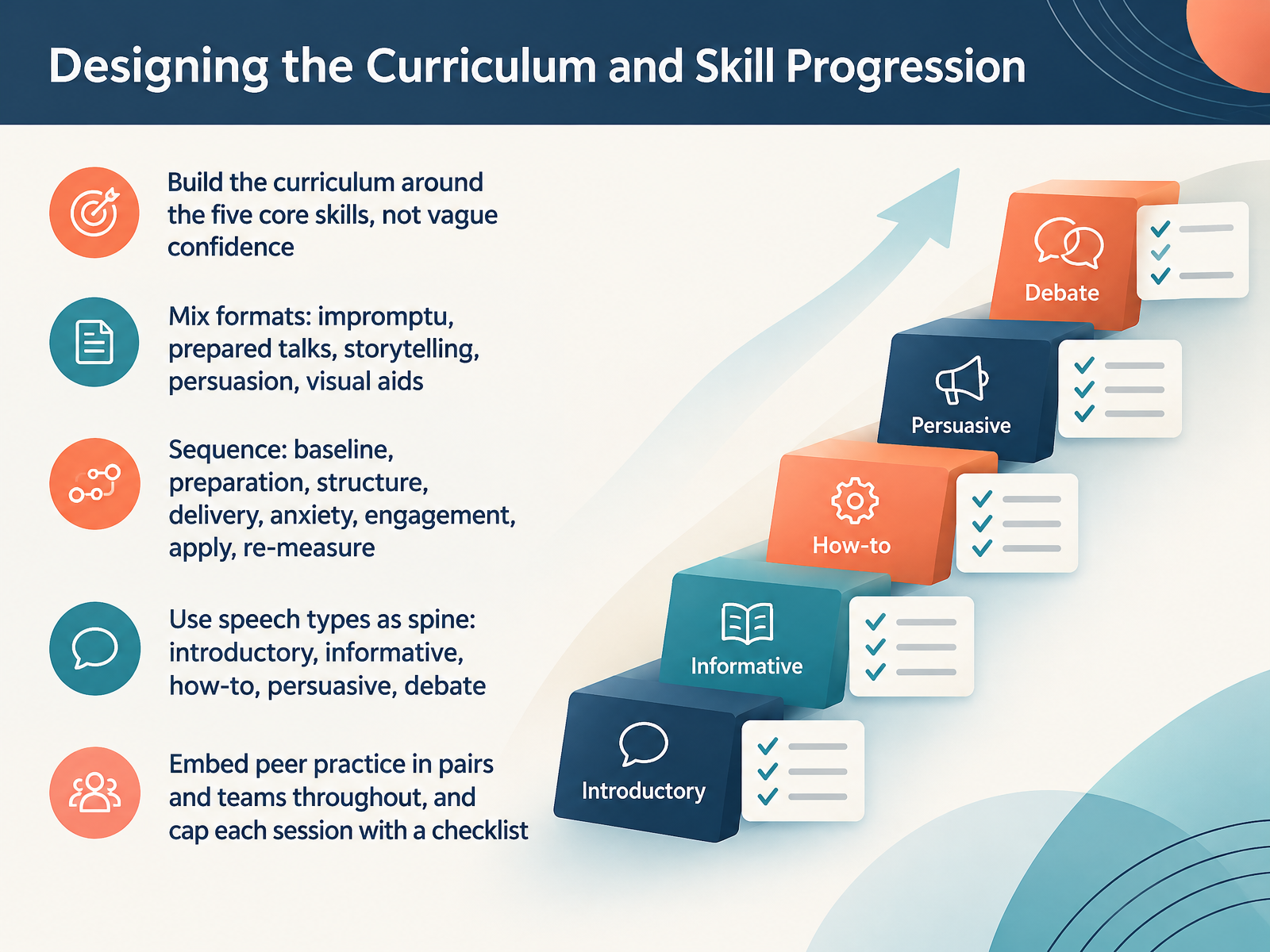
- 05Designing the Curriculum and Skill ProgressionNow let's build the curriculum itself. Anchor everything to the five core skills: preparation, structure, delivery and voice, managing anxiety, and audience engagement. Skip vague confidence goals. Confidence follows competence. Define the observable behaviour you want, like holding eye contact or pausing on the key line. Then mix your formats across the programme, impromptu, prepared talks, storytelling, persuasion, and visual aids. Use a clear sequence: baseline, preparation, structure, delivery, anxiety, engagement, apply, then re-measure. That mirrors the eight-week rollout, one focus per week. Speech types give you the spine: introductory, informative, how-to, persuasive, and debate. If your cohort is new, start with an introductory talk and a how-to. If they are experienced, lead with persuasive and debate. Embed peer practice in pairs and teams throughout. Pair work lowers the stakes. Team work adds feedback. Cap every session with a short checklist. One message, three beats, rehearse aloud, record, review. Coaches score against that checklist, so progress is visible. That gives you eight weeks of reps, and a rubric you can compare before and after. Next, let's look at stakeholders, sponsorship, and governance.
 disprz.aimatimtl.camatsh.co+22 min
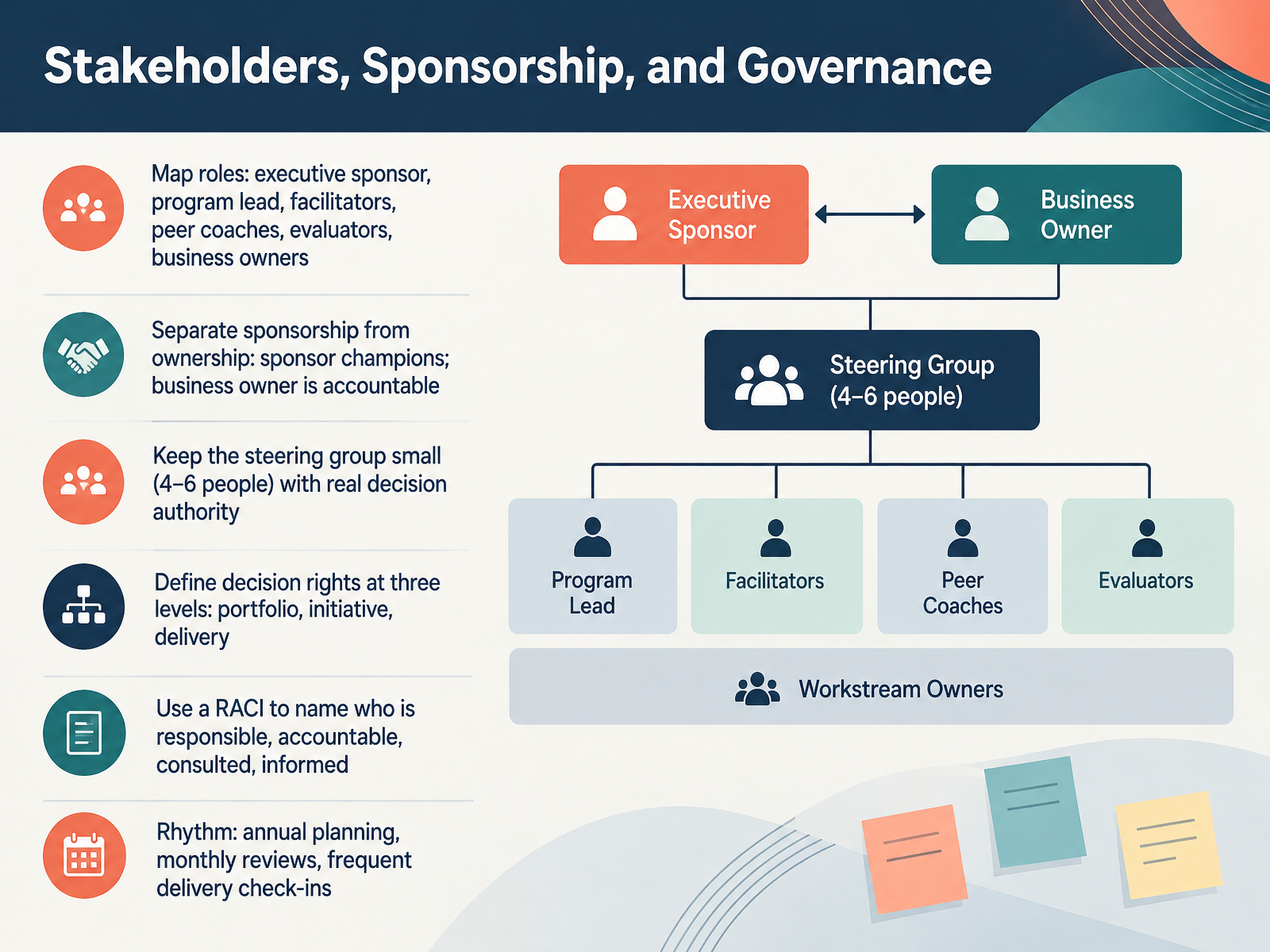
- 06Stakeholders, Sponsorship, and GovernanceLet's talk about who holds the program together. Start by mapping roles: executive sponsor, program lead, facilitators, peer coaches, evaluators, and business owners. Then separate sponsorship from ownership. Your sponsor champions the program and opens doors. The business owner stays accountable for the operating outcome. That distinction prevents your team from carrying results it cannot control. Keep your steering group small, four to six people with real decision authority. Large committees stall; small ones decide. Next, define decision rights at three levels: portfolio, initiative, and delivery. Portfolio decisions set investment across workstreams. Initiative decisions approve scope, funding, and success measures. Delivery decisions handle day-to-day trade-offs. When these levels are clear, executives stay out of operational details and delivery teams stop waiting on approvals. Capture all of it in one RACI, naming who is responsible, accountable, consulted, and informed. Finally, set a rhythm: annual planning, monthly reviews, and frequent delivery check-ins. Send routine status updates in advance. Use the meetings to decide. Next, we look at resources, budget, and logistics.
 cognistry.cocognota.comechelonacademy.co.uk+22 min
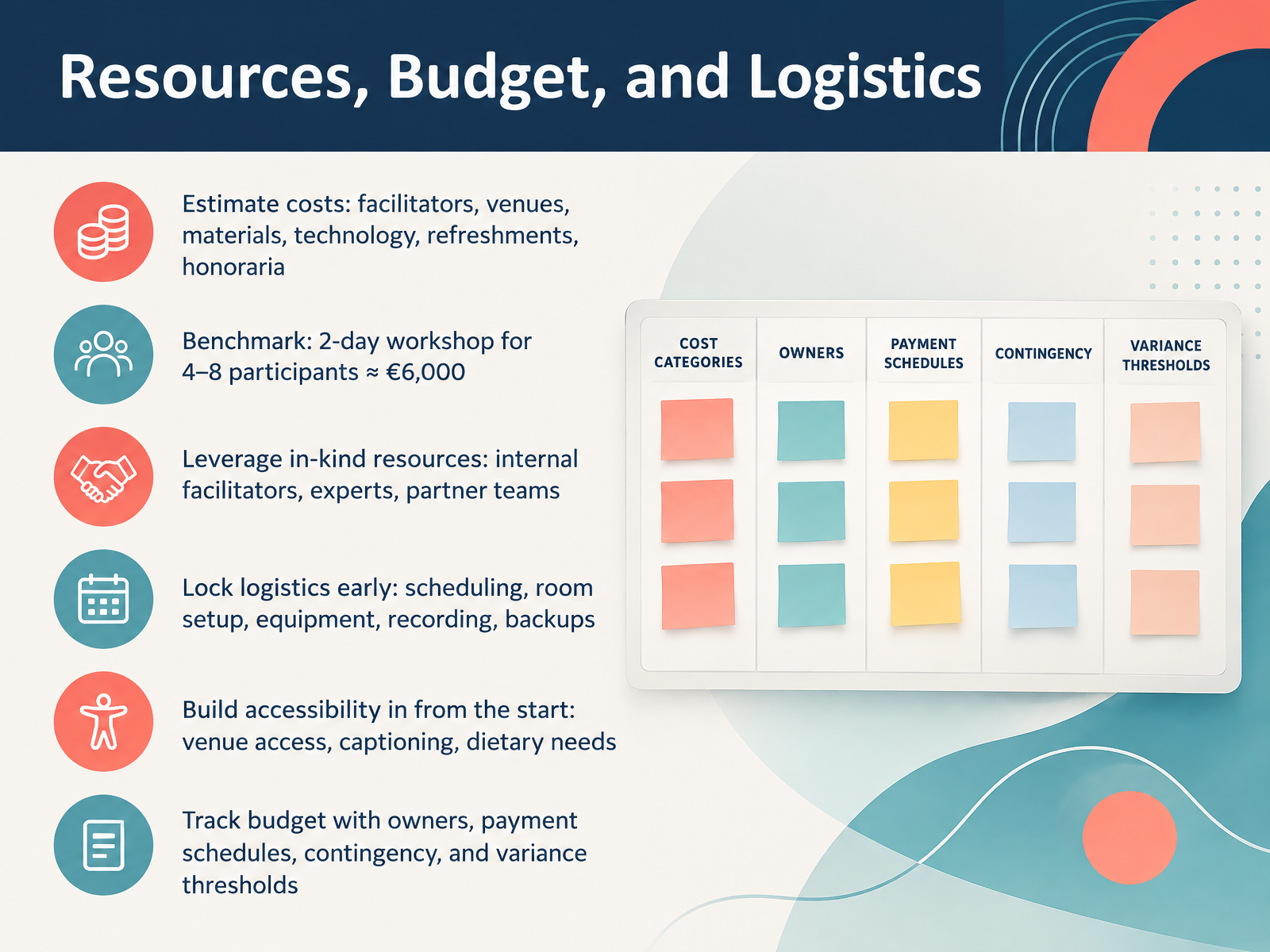
- 07Resources, Budget, and LogisticsNow let's talk resources, budget, and logistics, because this is where good programme ideas either get funded or quietly stall. Start with cost categories: facilitators, venue, materials, technology, refreshments, and honoraria. As a benchmark, a two-day workshop for four to eight participants runs approximately six thousand euros, so use that as your anchor when you build a line-item estimate. Then reduce it. Lean on in-kind resources: internal facilitators, subject-matter experts, and partner teams who can co-deliver. Lock logistics early. Scheduling, room setup, equipment, recording, and backups all need owners, not assumptions. Build accessibility in from the start: venue access, captioning, and dietary needs. Finally, track the budget properly, with an owner per line, payment schedules, contingency, and a variance threshold, say anything over five percent triggers a review. So the takeaway is simple: estimate, offset with in-kind support, lock logistics, and assign owners. Next, we move to marketing, recruitment, and participant engagement.
 2 min
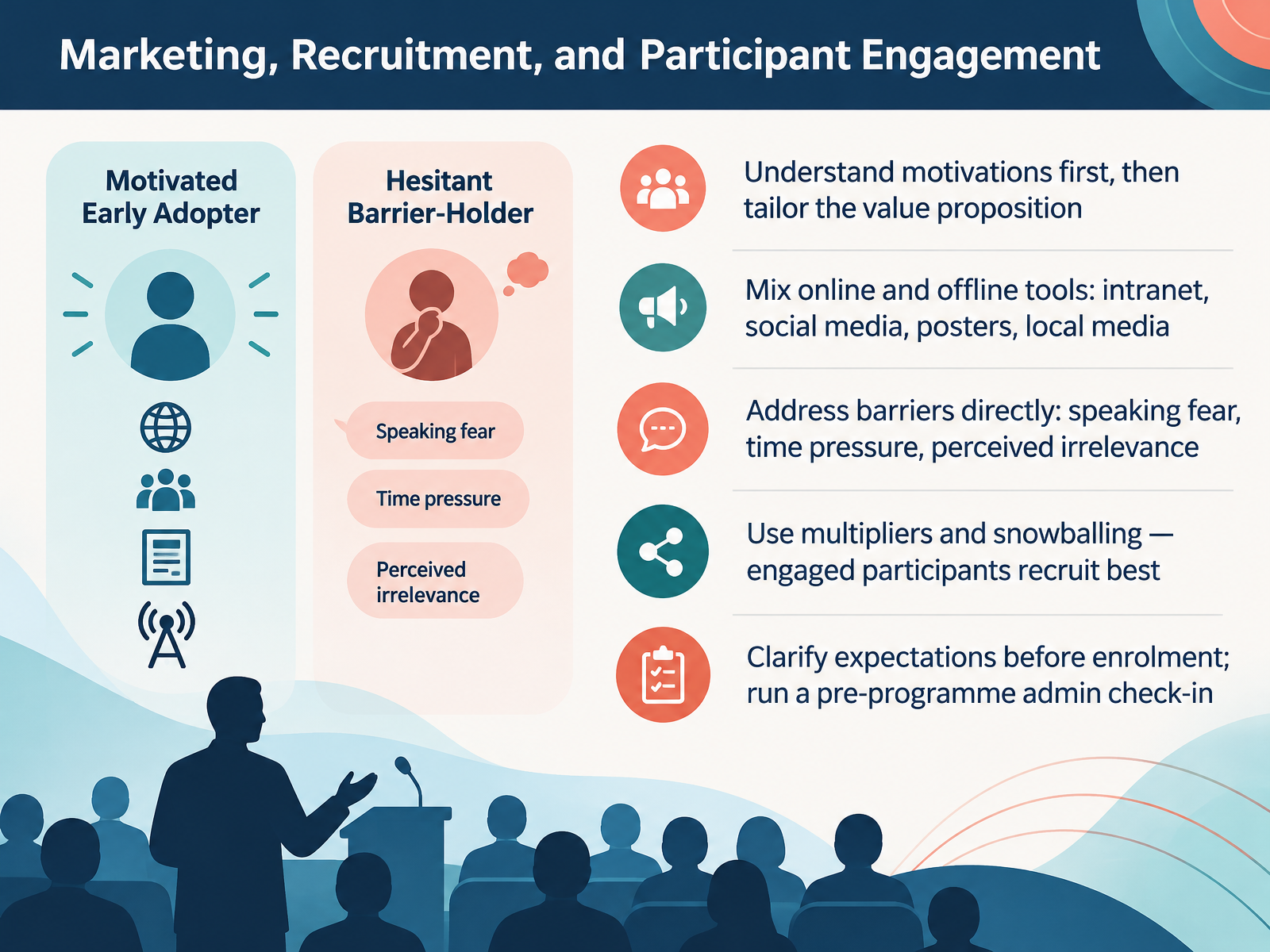
- 08Marketing, Recruitment, and Participant EngagementLet's talk about how you actually fill the room. Start with motivations, not marketing. Ask why someone would join, then build your value proposition around that. A shy first-timer wants confidence; a manager wants credibility. Same programme, different pitch.
Next, mix your channels. Intranet, social media, printed posters, and local media all reach different people. If your cohort skews older, printed posters in libraries and community centres still work.
Then name the barriers out loud. Speaking fear, time pressure, and the sense that this is not relevant to my role. Address each one directly in your messaging.
Use multipliers. Engaged participants recruit best, so give them a referral link and ask them to bring one colleague. Finally, clarify expectations before enrolment and run a short admin check-in. That single step cuts drop-off more than any poster.
That foundation sets up the next piece: facilitation, coaching, and feedback systems.
 2 min
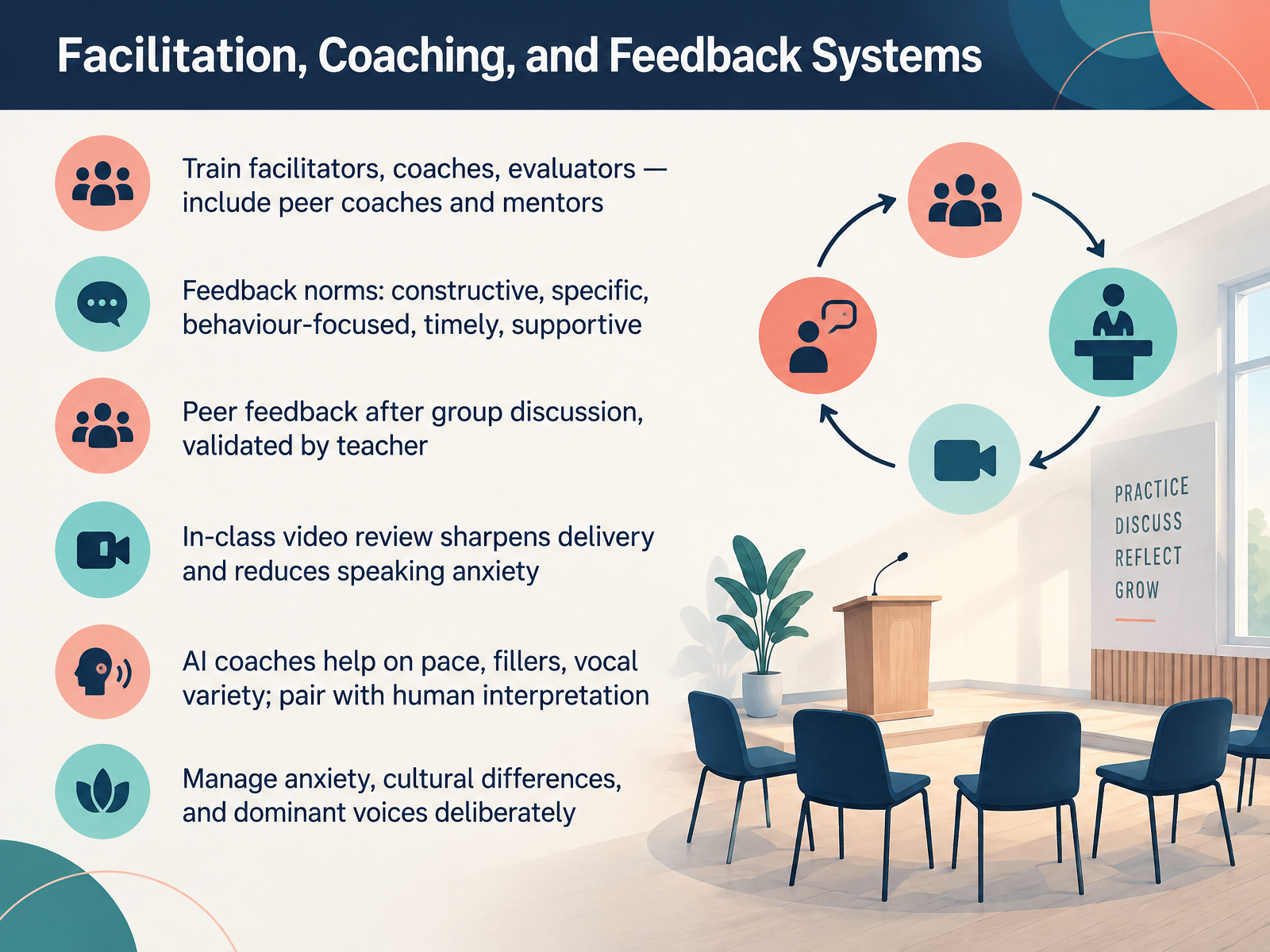
- 09Facilitation, Coaching, and Feedback SystemsNow let's talk about the people and systems behind good feedback. First, train your facilitators, coaches, and evaluators, and build peer coaches and mentors into the mix. A quick win here is a shared feedback rubric. Set clear feedback norms too. Feedback should be constructive, specific, behavior focused, timely, and supportive. So instead of saying that was good, try: your opening was strong, and slowing down on the thesis would make it clearer. Structure the flow deliberately. After a group discussion, have peers give feedback, then let the teacher validate and add to it. Research shows that peer feedback preceded by group discussion, and followed by teacher input, keeps learners most engaged. Video review is another lever. Watching short clips in class sharpens delivery and, done supportively, lowers speaking anxiety. AI coaches are useful for pace, filler words, and vocal variety, but pair them with human interpretation, because they miss context and audience. Finally, manage three things on purpose: anxiety, cultural differences, and dominant voices. Next, we move into Assessment, Evaluation, and Continuous Improvement.
 2 min
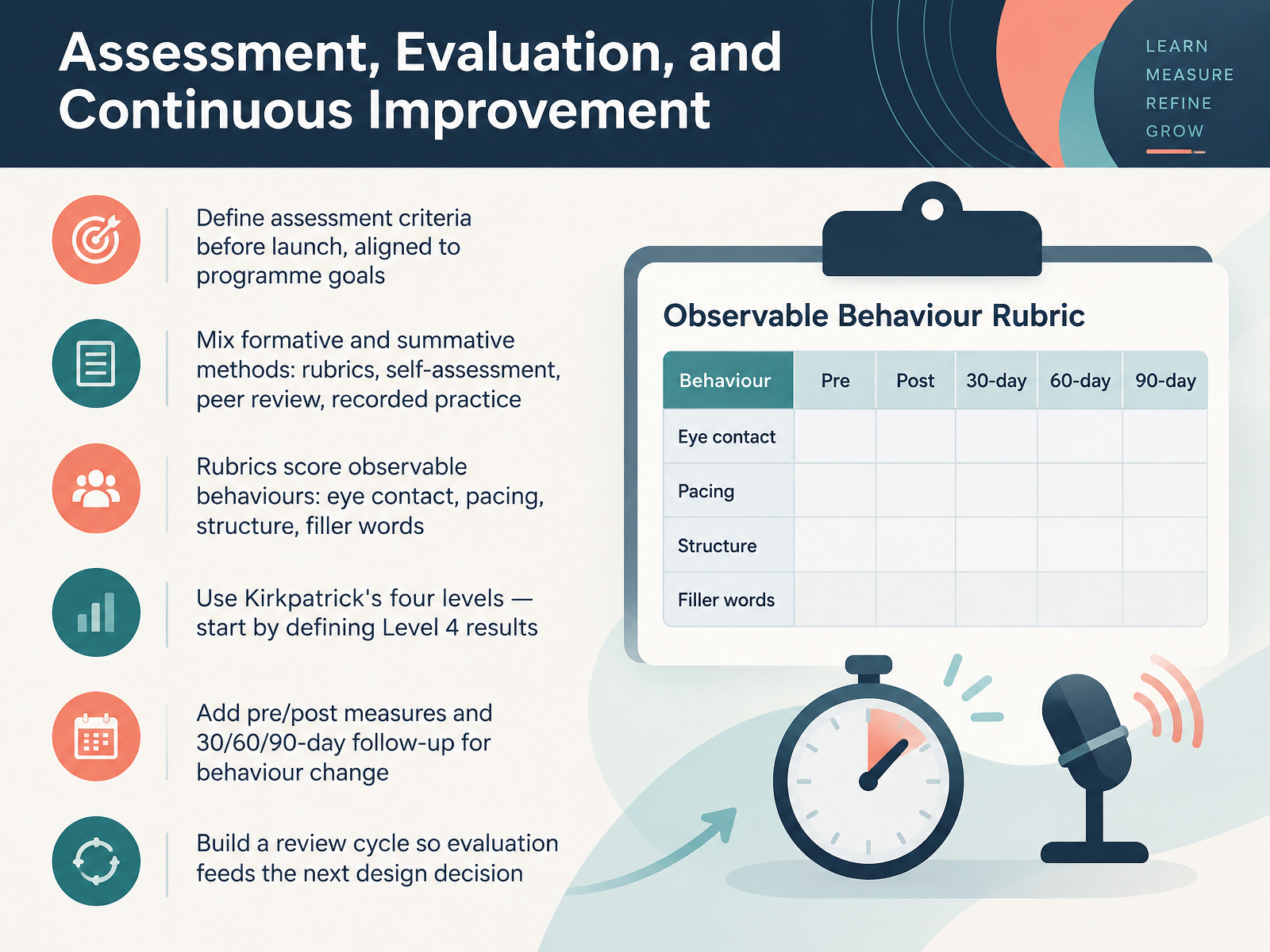
- 10Assessment, Evaluation, and Continuous ImprovementLet's talk about assessment, evaluation, and continuous improvement. The key move: define your assessment criteria before launch, aligned to programme goals. A simple rule for coordinators, if your goal is confident delivery, measure observable behaviours, not feelings. Mix formative and summative methods. Use rubrics, self-assessment, peer review, and recorded practice. Your rubrics should score what you can actually see and hear: eye contact, pacing, structure, and filler words. Then use Kirkpatrick's four levels. Start by defining Level Four results, the organizational outcome you want, then work backward. Add pre and post measures, plus a thirty, sixty, and ninety day follow-up to check behaviour change. Finally, build a review cycle so evaluation feeds your next design decision. That turns feedback into programme improvement instead of a one-time report. Next, we'll look at scaling, sustainability, and technology integration.
 2 min
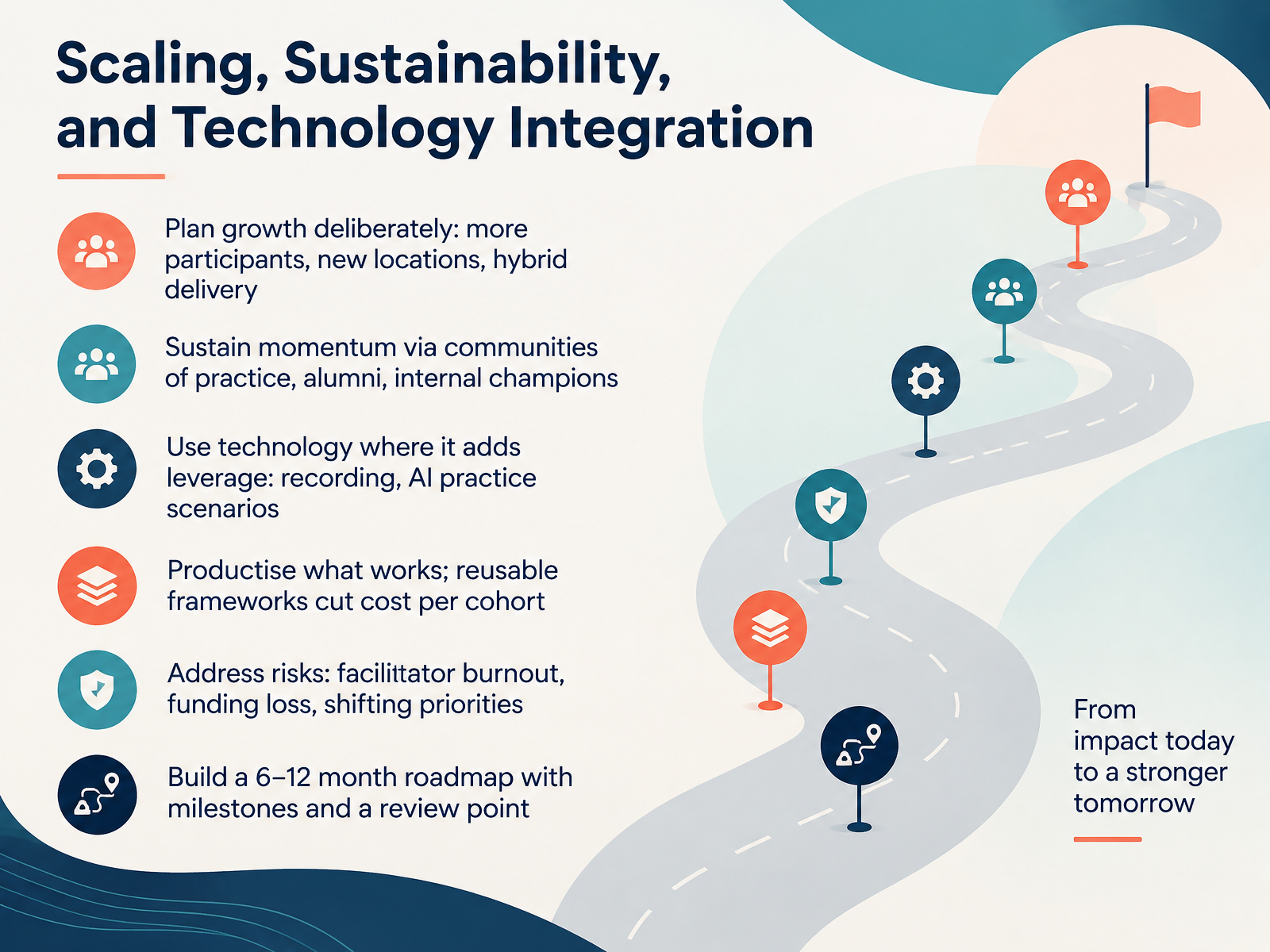
- 11Scaling, Sustainability, and Technology IntegrationNow let's talk about scaling without burning out. Growth should be deliberate: more participants, new locations, hybrid delivery. But only expand when your current cohort runs smoothly. Sustain momentum with communities of practice, an alumni track, and internal champions. Technology adds leverage, not complexity. Record sessions so people can catch up. Use AI practice scenarios for between-session reps. The coach focuses on judgement; the tools handle measurement. Then productise what works. Reusable frameworks cut the cost per cohort. Address risks directly: facilitator burnout, funding loss, shifting priorities. Assign two facilitators per cohort, not one. Build a six to twelve month roadmap with milestones and one formal review point. From Plan to Pilot: A Phased Rollout.
 1 min
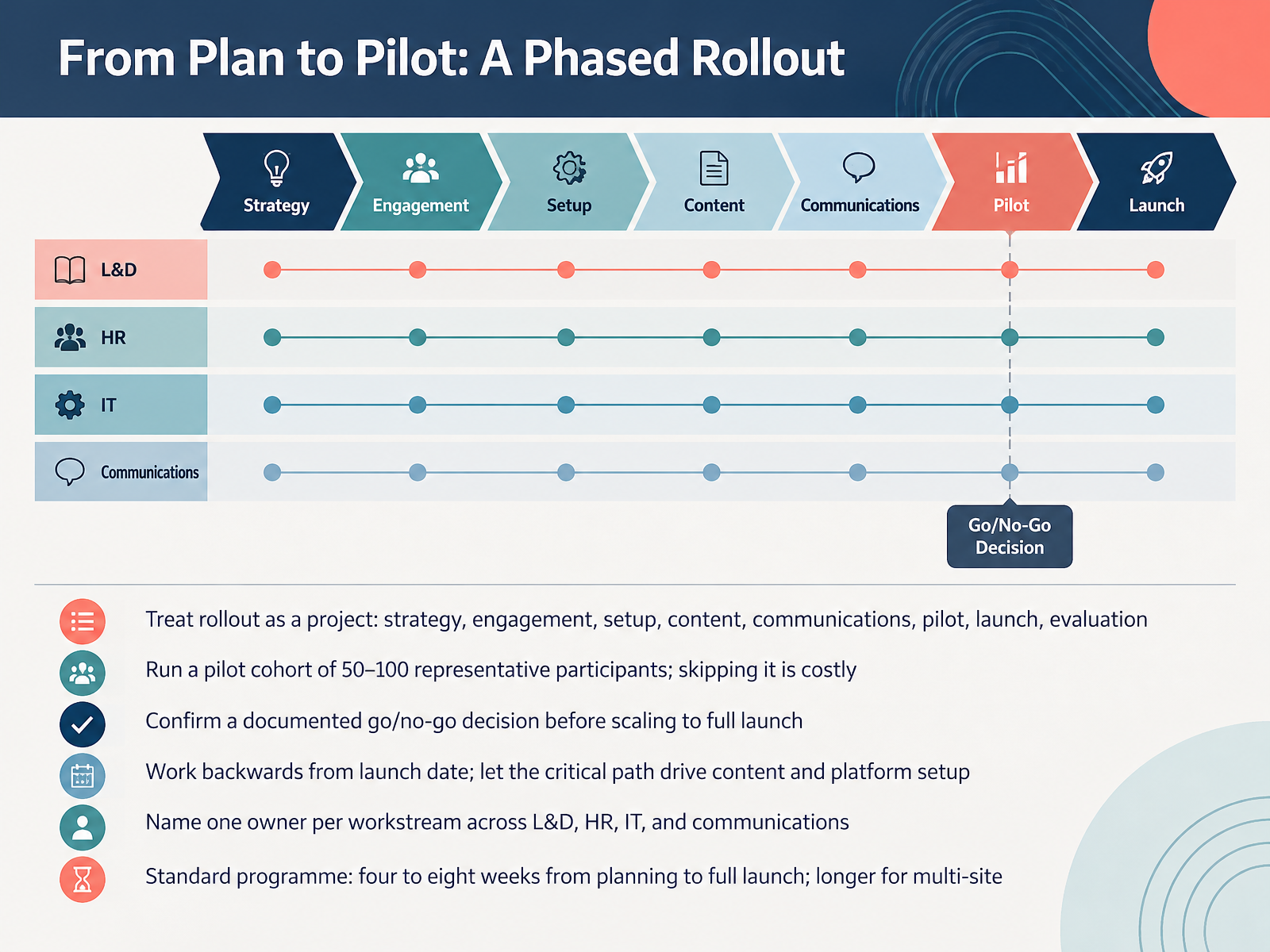
- 12From Plan to Pilot: A Phased RolloutLet's talk about moving from plan to pilot with a phased rollout. Treat rollout as a project with eight phases: strategy, engagement, setup, content, communications, pilot, launch, and evaluation. Now, run a pilot cohort of fifty to one hundred representative participants. Skipping it is the most common and most expensive shortcut. Before you scale, confirm a documented go or no go decision based on pilot outcomes. Work backwards from your launch date. Let the critical path drive content development and platform setup, because those two almost always take longer than planned. Name one owner per workstream across L and D, H R, I T, and communications. If your program is standard, budget four to eight weeks from planning to full launch. Multi-site or global deployments take longer. So before you move on, pick your pilot group and lock your go or no go date. Building the Initiative Action Plan.
 1 min
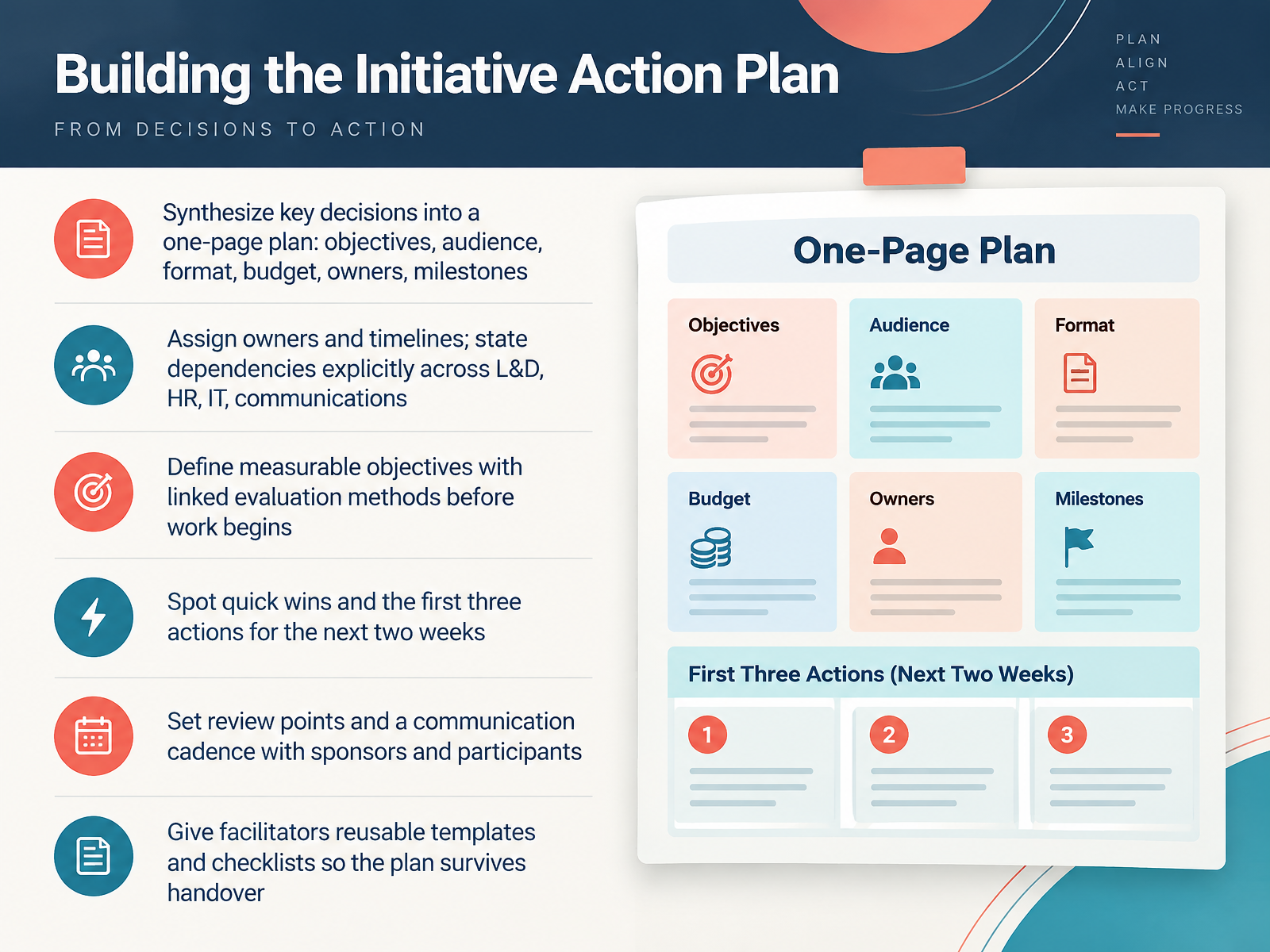
- 13Building the Initiative Action PlanLet's turn all of those decisions into a one-page action plan. Keep it to a single page: objectives, audience, format, budget, owners, and milestones. Then assign owners and timelines, and state dependencies out loud. L and D owns content and facilitation, H R owns audience definition and manager briefing, I T owns platform setup and testing, and communications owns the campaign. If your cohort is small, you can merge roles, but name one accountable lead. Next, define measurable objectives with a linked evaluation method before work begins. For example, eighty percent completion, or a manager-observed behavior check at ninety days. Then spot quick wins and lock your first three actions for the next two weeks. Set review points and a communication cadence with sponsors and participants, say a biweekly stand-up and a monthly sponsor update. Finally, give facilitators reusable templates and checklists, so the plan survives handover. Now let's look at common pitfalls and next steps.
 2 min
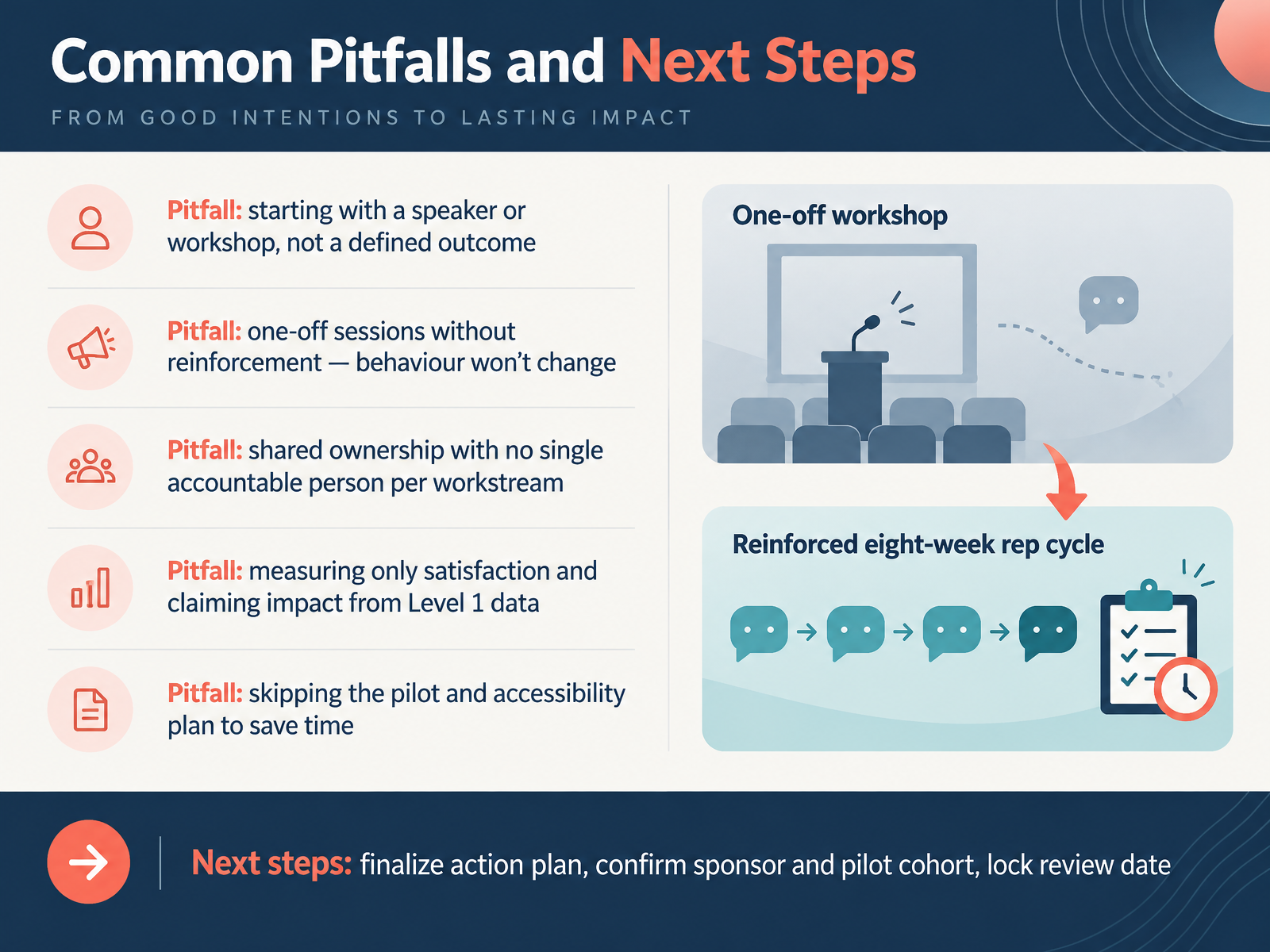
- 14Common Pitfalls and Next StepsLet's close on the pitfalls to avoid and the moves to make next. First, don't start with a speaker or a workshop. Start with the defined outcome. Ask what your audience should do differently, then build backward. Second, skip one-off sessions at your peril. Behaviour changes through reinforcement, so build in repeated practice and follow-up. Third, shared ownership is no ownership. Name one accountable person per workstream, whether that's curriculum, logistics, or measurement. Fourth, don't measure only satisfaction and then claim impact. Level one reaction data tells you people enjoyed it, not that anything changed. Track Level two learning, Level three behaviour, and Level four results. Fifth, resist skipping the pilot and the accessibility plan to save time. Both protect you from expensive rework later. So here are your next steps. Finalise the action plan, confirm your sponsor and pilot cohort, and lock a review date. Do those three things this week. Thank you for working through this with me. You now have a practical path to launch, and you are ready to run a programme that sticks.
 disprz.aimatimtl.camatsh.co+22 min
Take the deck with you
Download this course as a file — free, no sign-up needed.
- PDF handoutEvery slide page, ready to print or share.15 pages · 3.4 MBDownload
- Narrated PowerPointThe deck that presents itself — every slide carries the digital human's narration video.15 pages · 26.6 MBDownload
- PowerPoint slidesThe full deck as a .pptx — open it in PowerPoint, Keynote, or Google Slides.15 pages · 3.3 MBDownload
Free to use in your own training — please keep the PersonWise credit page at the end.
Have your own deck? Turn it into a course
Sources consulted
Web sources consulted while building this course.
- Public Speaking at Work: A Guide to Training Confident Speakers | Disprz — disprz.ai
- How to Plan a Keynote Speaker Program That Inspires Real Change in 2026 - Matimti.ca — matimtl.ca
- Public Speaking Course | Matsh — matsh.co
- Planning Your 2026 Events Calendar – When to Book Speakers - Expert Keynote and Motivational Speakers | Chartwell Speakers — chartwellspeakers.com
- Public Speaking & Presentation Skills | Di PURBA — dipurba.com
- Measuring Essential Learning Outcomes for Public Speaking — ecommons.udayton.edu
- Measuring College Learning in Public Speaking — website.archivenatcom.org
- How Do I Assess My Team's Public Speaking Skills? — magneticspeaking.com
- 1.6: Speaking Competencies - Social Sci LibreTexts — socialsci.libretexts.org
- [PDF] The Competent Speaker Speech Evaluation Form — une.edu
- Syllabus 16-Weeks (Fully Seated) – Stand Up, Speak Out – Instructor's Material — milnepublishing.geneseo.edu
- Practical: Speaking to Persuade, Inform or Convince — eruditemillennium.com
- PUBLIC SPEAKING — speechanddebate.org
- Course: Public Speaking — resources.finalsite.net
- Speak it up - curriculum — speakitupproject.eu
- Learning Governance Framework for L&D Leaders — cognistry.co
- Corporate Learning Governance Guide for L&D Leaders - Cognota — cognota.com
- Guide to Workplace Learning Governance for Leaders - Echelon Academy UK — echelonacademy.co.uk
- The Importance of Learning & Development Governance — linkedin.com
- Pave Your Path — cdt.ca.gov