Begin
14 pages · ~28 min
Generative AI Roles and Responsibilities
This training clarifies generative AI roles, responsibilities, and handoffs, helping cross-functional teams understand ownership and collaborate effectively across the AI development lifecycle.
A digital instructor presents all 14 pages. Hold “Ask” at any point and ask out loud — the answer comes from this course. No sign-up needed.
What you’ll learn
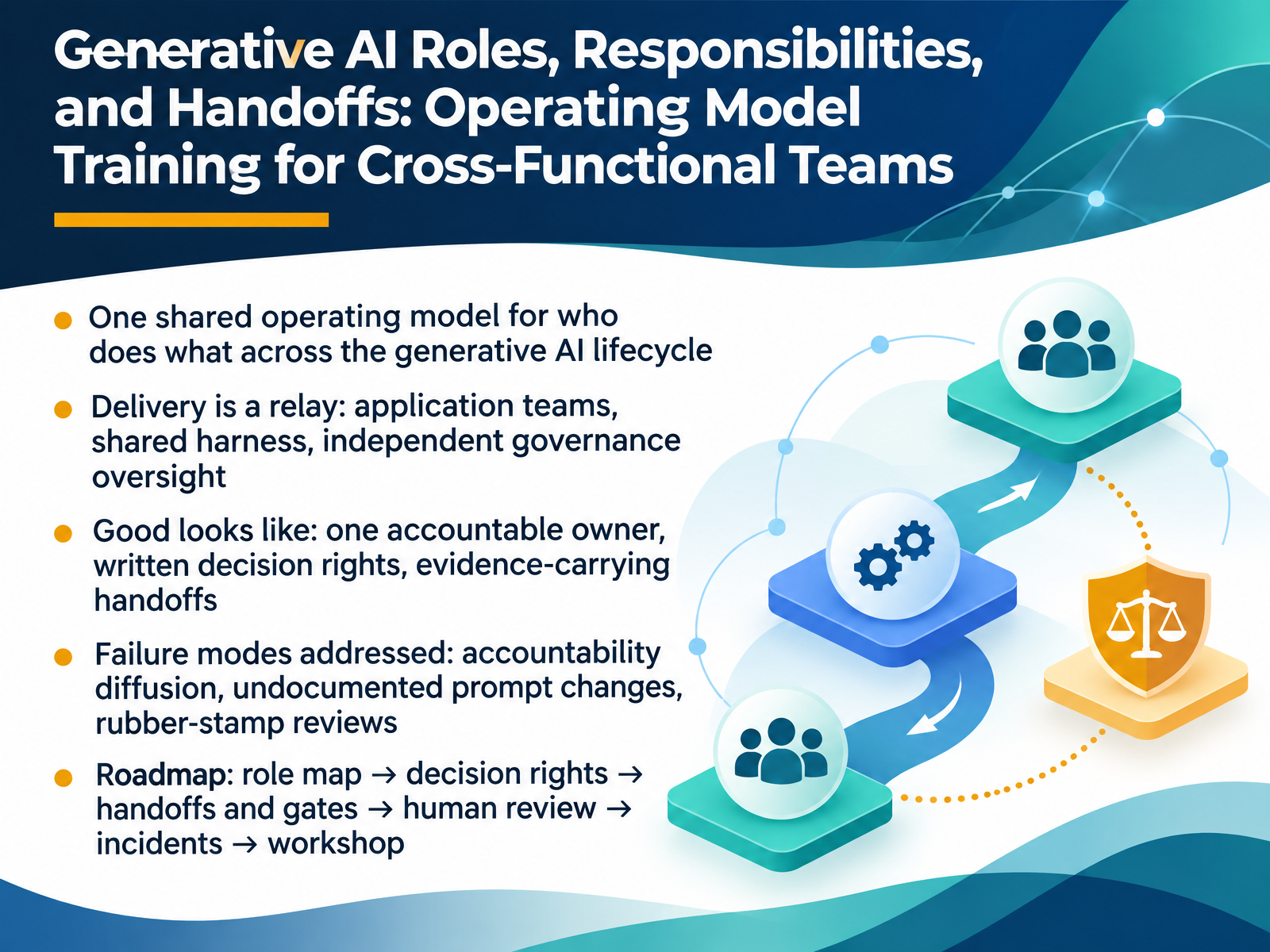
- 01Generative AI Roles, Responsibilities, and Handoffs: Operating Model Training for Cross-Functional TeamsWelcome. This training gives cross-functional teams one shared operating model for generative AI. Our goal is simple. By the end, you should be able to state who owns each decision, what evidence a handoff carries, and when work passes to the next role. You are accountable for one thing in particular. Without written decision rights, accountability diffuses, prompt changes go undocumented, and reviews become rubber stamps. So treat delivery as a relay. Application teams own the workflow and its outcome. The shared harness provides tooling, evaluation, and controls. Governance keeps independent oversight. Good looks like one accountable owner per activity, decision rights in writing, and handoffs that carry evidence. Across the next slides we will build a role map, define decision rights, set handoffs and gates, then cover human review, incidents, and a workshop. Each step is testable, so your reviewers can confirm role boundaries and handoff completeness without ambiguity. Next, we look at why role design is the underrated lever.deploy.copronix.aivdf.ai+22 min
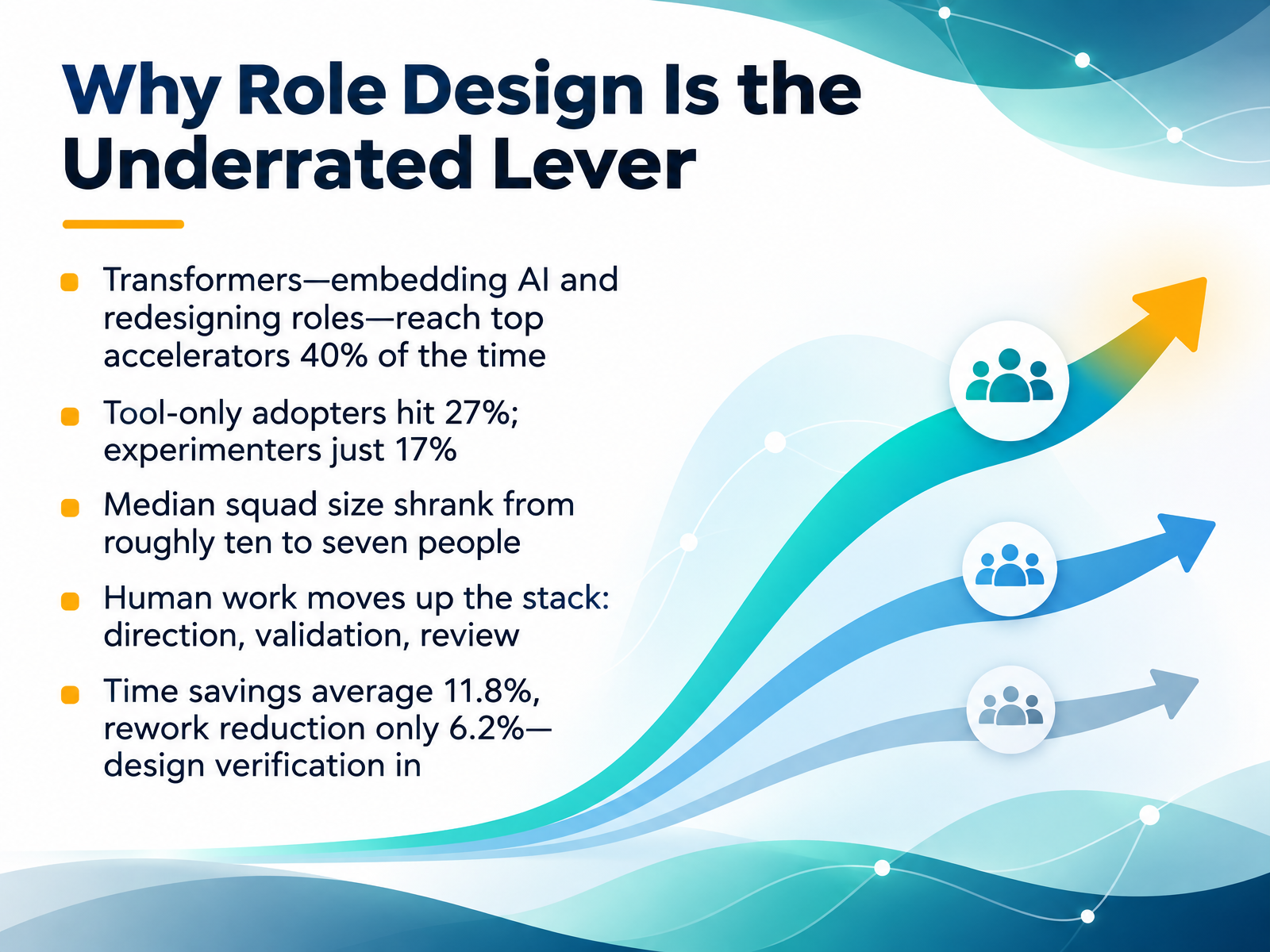
- 02Why Role Design Is the Underrated LeverLet's look at where role design actually pays off. As a project lead, you are accountable here for one decision. Do you redesign roles, or only deploy tools? The evidence is clear. Teams that embedded AI and redesigned roles, the transformers, became top accelerators forty percent of the time. Tool-only adopters reached twenty-seven percent. Experimenters, who adopted tools without embedding them in the workflow, reached just seventeen percent. Role design is the underrated lever. Notice what happens to team shape. Median squad size shrank from roughly ten people to seven. Human work moves up the stack toward direction, validation, and review. Outputs are speeding up faster than quality is. Average time savings are eleven point eight percent, but rework reduction is only six point two percent. Treat that gap as a design signal. Build verification into every handoff. Name who reviews each output before it advances. Agree the evidence a reviewer needs to accept or reject a result. That keeps role boundaries and approval rights testable. Next, we will look at the operating structure that holds this together. The Federated Model: Application Teams, Shared Harness, Independent Oversight.
 deploy.copronix.aivdf.ai+22 min
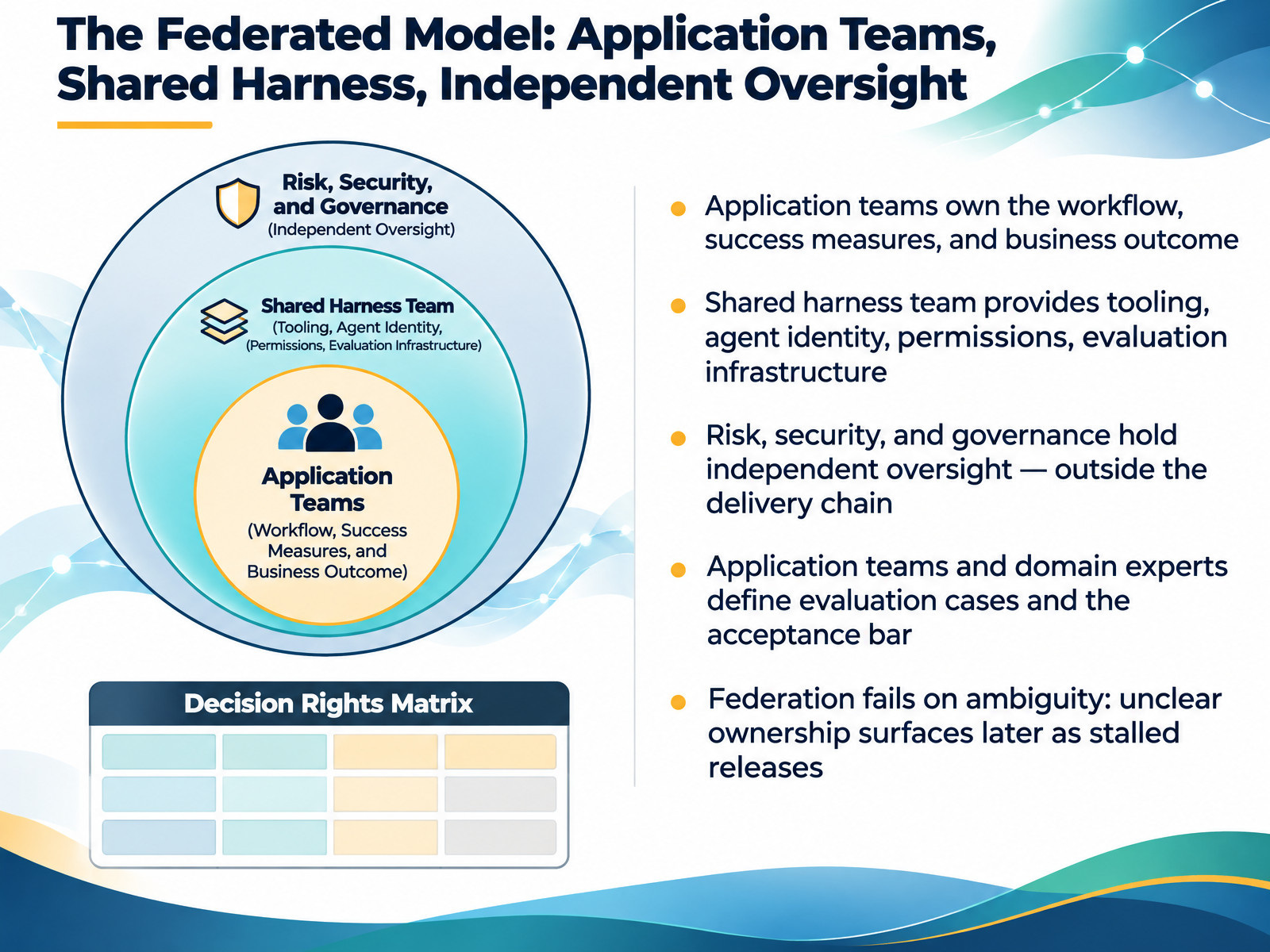
- 03The Federated Model: Application Teams, Shared Harness, Independent OversightNow let's look at the federated model, and the ownership decisions you're accountable for inside it. Three groups, three separate accountabilities. Application teams own the workflow, the success measures, and the business outcome. The shared harness team provides tooling, agent identity, permissions, and evaluation infrastructure. Risk, security, and governance hold independent oversight, outside the delivery chain, so approving a high-risk use case is never a judgment on their own team's work. One boundary catches most teams. Application teams and domain experts define the evaluation cases and the acceptance bar. The harness team supplies the infrastructure to run those evaluations consistently. Federation fails on ambiguity. Unclear ownership surfaces later as stalled releases nobody can unblock. So write the decision rights down, one accountable owner per activity. Next, we'll map these roles across the generative AI lifecycle.
 deploy.copronix.aivdf.ai+21 min
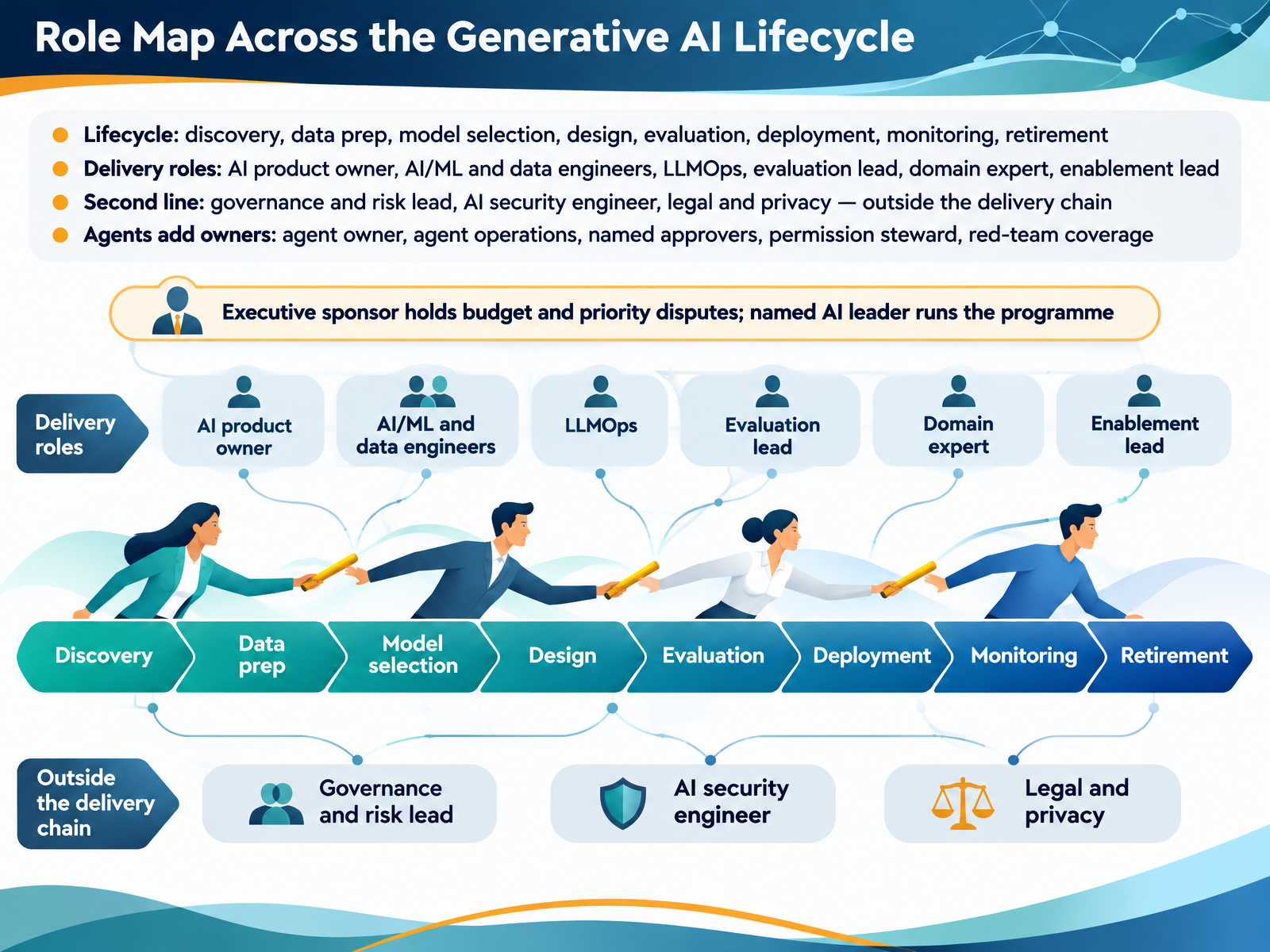
- 04Role Map Across the Generative AI LifecycleNext, the role map itself. Your accountability on this slide is simple to state. Every lifecycle stage must have one named owner, and no stage should pass without a clear handoff cue. The lifecycle runs from discovery through data preparation, model selection, design, evaluation, deployment, monitoring, and retirement. The delivery roles cover the AI product owner, AI and ML engineers, data engineers, LLMOps, the evaluation lead, the domain expert, and the enablement lead. Keep governance and risk lead, AI security engineer, and legal and privacy in the second line, outside the delivery chain, so approvals are not self-assessed. Above the pods, the executive sponsor holds the budget and settles priority disputes, and a named AI leader runs the programme. If you deploy agents, add five owners: agent owner, agent operations, named approvers, permission steward, and red-team coverage. Write these owners into the plan before the first handoff, and confirm each transition with the receiving role. Next, we turn to decision rights written down: a RACI by decision, not by team.
 vdf.aiopenempower.comryzlabs.com+22 min
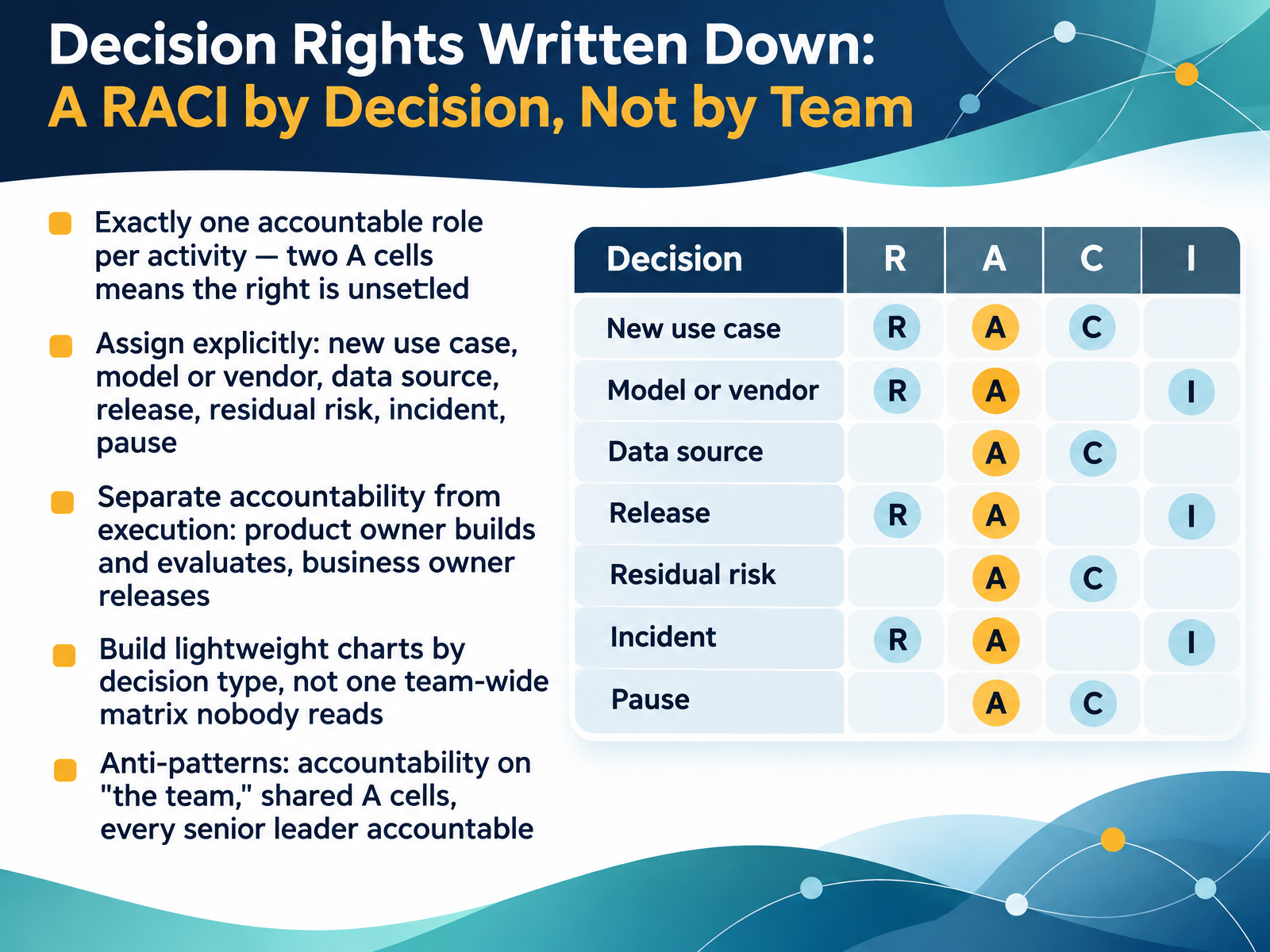
- 05Decision Rights Written Down: A RACI by Decision, Not by TeamNext, let's make decision rights visible. Your risk here is a matrix that looks complete but settles nothing. The rule is simple. Exactly one accountable role per activity. If two cells both say accountable, the decision right is not settled, so resolve it in the operating model, not in the chart. Assign accountability explicitly for these decisions: a new use case, the model or vendor, the data source, the release, residual risk, an incident, and who can pause the system. Then separate accountability from execution. The product owner builds and evaluates. The business owner releases. Keep the charts lightweight and organized by decision type, not one team-wide matrix nobody reads. Watch for three anti-patterns: accountability placed on the team, shared accountable cells, and every senior leader marked accountable. Pick one decision this week and confirm it has a single named owner. That gives us the basis for the next topic, Risk Tiers Drive Proportional Review.
 vdf.aiopenempower.comryzlabs.com+22 min
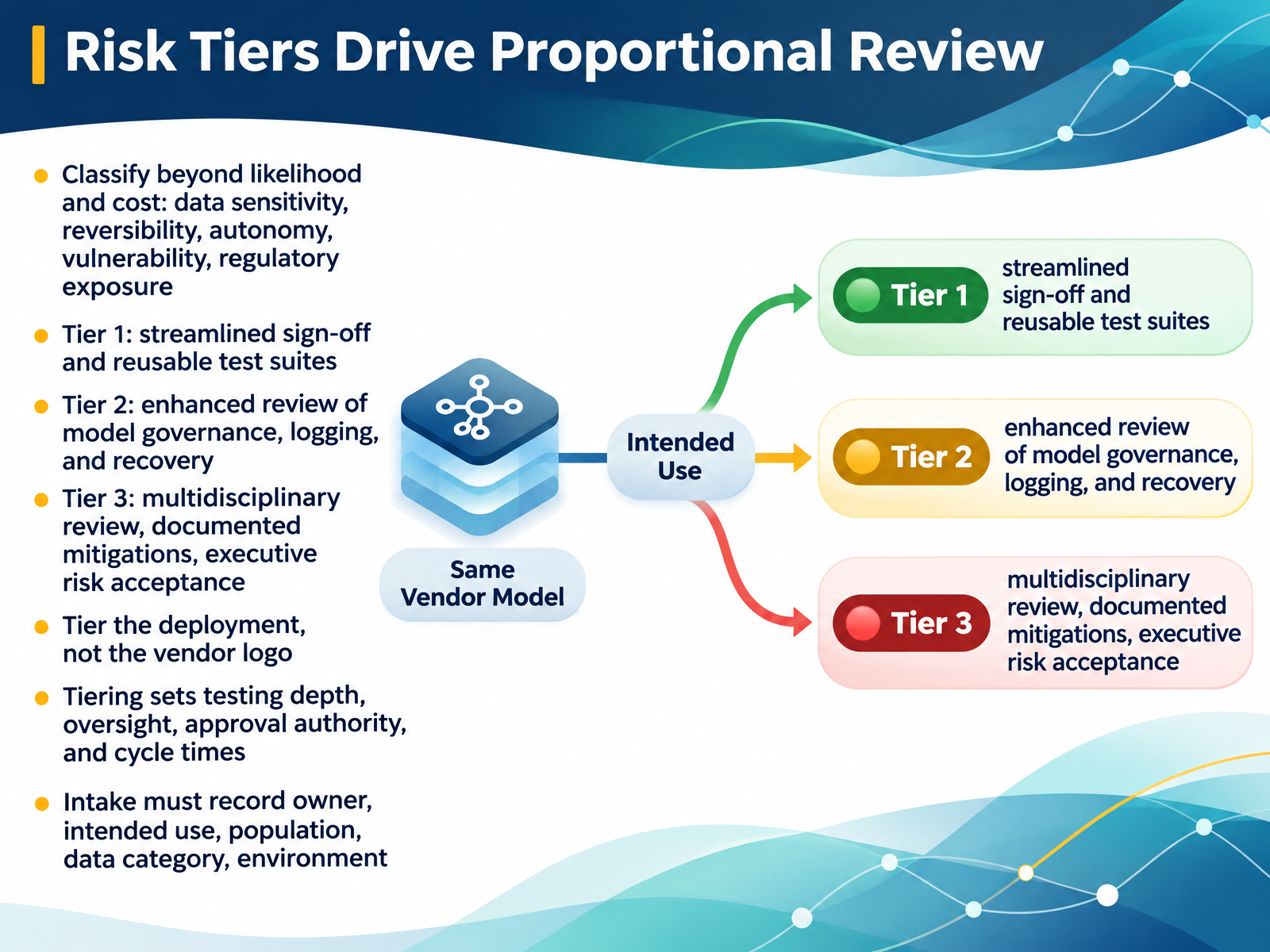
- 06Risk Tiers Drive Proportional ReviewNext, let's look at how risk tiers drive proportional review. Your decision here is tier assignment, and your risk is reviewing everything the same way. Classify beyond likelihood and cost. Use data sensitivity, reversibility, autonomy, vulnerability, and regulatory exposure. Tier one gets streamlined sign-off and reusable test suites. Tier two adds enhanced review of model governance, logging, and recovery. Tier three requires multidisciplinary review, documented mitigations, and executive risk acceptance. Tier the deployment, not the vendor logo. The same vendor can land in different tiers depending on how you use it. Tiering sets testing depth, oversight, approval authority, and cycle times. Before any of that, intake must record owner, intended use, population, data category, and environment. An incomplete intake record is treated as a missing control, not a paperwork slip. Handoffs That Hold: Artifacts, Gates, and Acceptance Criteria.
 rsmus.compwc.comtechtarget.com+22 min
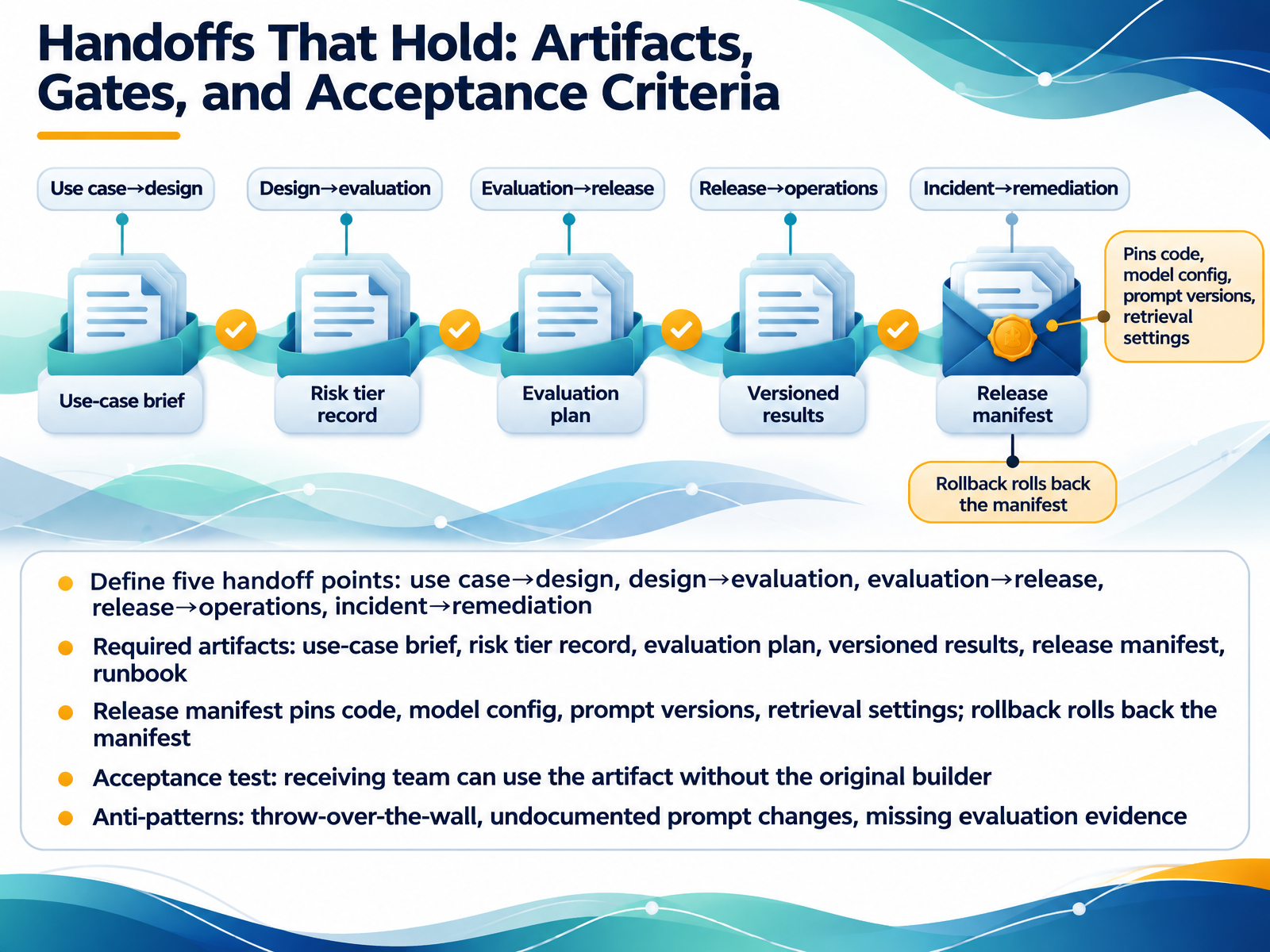
- 07Handoffs That Hold: Artifacts, Gates, and Acceptance CriteriaNow let's look at the handoffs themselves. Your accountability here is that work leaves one team complete enough for the next team to act on without you. So define five handoff points: use case to design, design to evaluation, evaluation to release, release to operations, and incident to remediation. At each gate, name the artifact, the reviewer who approves it, and the owner who receives it.
The required artifacts are the use case brief, the risk tier record, the evaluation plan, versioned results, the release manifest, and the runbook. The release manifest pins code, model configuration, prompt versions, and retrieval settings. Rollback rolls back the manifest, not individual pieces.
Test each handoff this way. The receiving team must be able to use the artifact without the original builder. If they cannot, the handoff is not done. Avoid the throw over the wall pattern, undocumented prompt changes, and missing evaluation evidence.
Next, we will look at versioning prompts, models, and retrieval as production code.
 lumay.aidocs.aws.amazon.comkastling.co+22 min
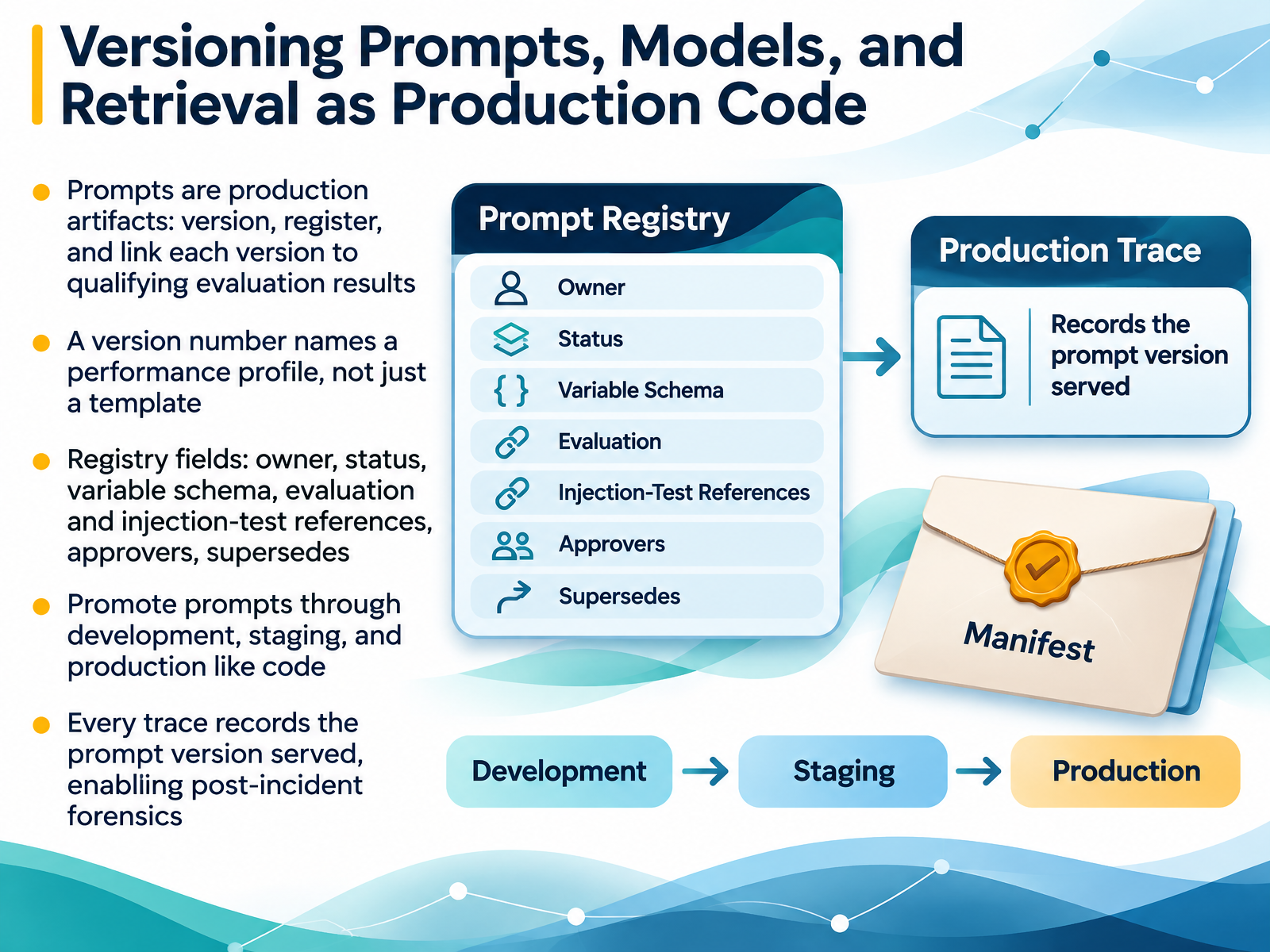
- 08Versioning Prompts, Models, and Retrieval as Production CodeNow let's talk about versioning prompts, models, and retrieval as production code. The decision you own here is this. Can your team state, for any request served, exactly which prompt, model, and retrieval configuration was running? If not, you cannot reproduce behavior or investigate an incident. So treat prompts as production artifacts. Version each one, register it, and link every version to its qualifying evaluation results. A version number names a performance profile, not just a template. The registry record carries the owner, status, variable schema, evaluation and injection-test references, approvers, and the version it supersedes. Promote prompts through development, staging, and production the same way you promote code. Pause here. No prompt reaches production without a named approver and a passing evaluation reference. Finally, every trace must record the prompt version served. That is what makes post-incident forensics possible. Next, we look at domain reviewers and human-in-the-loop design, which is design, not a rubber stamp.
 lumay.aidocs.aws.amazon.comkastling.co+22 min
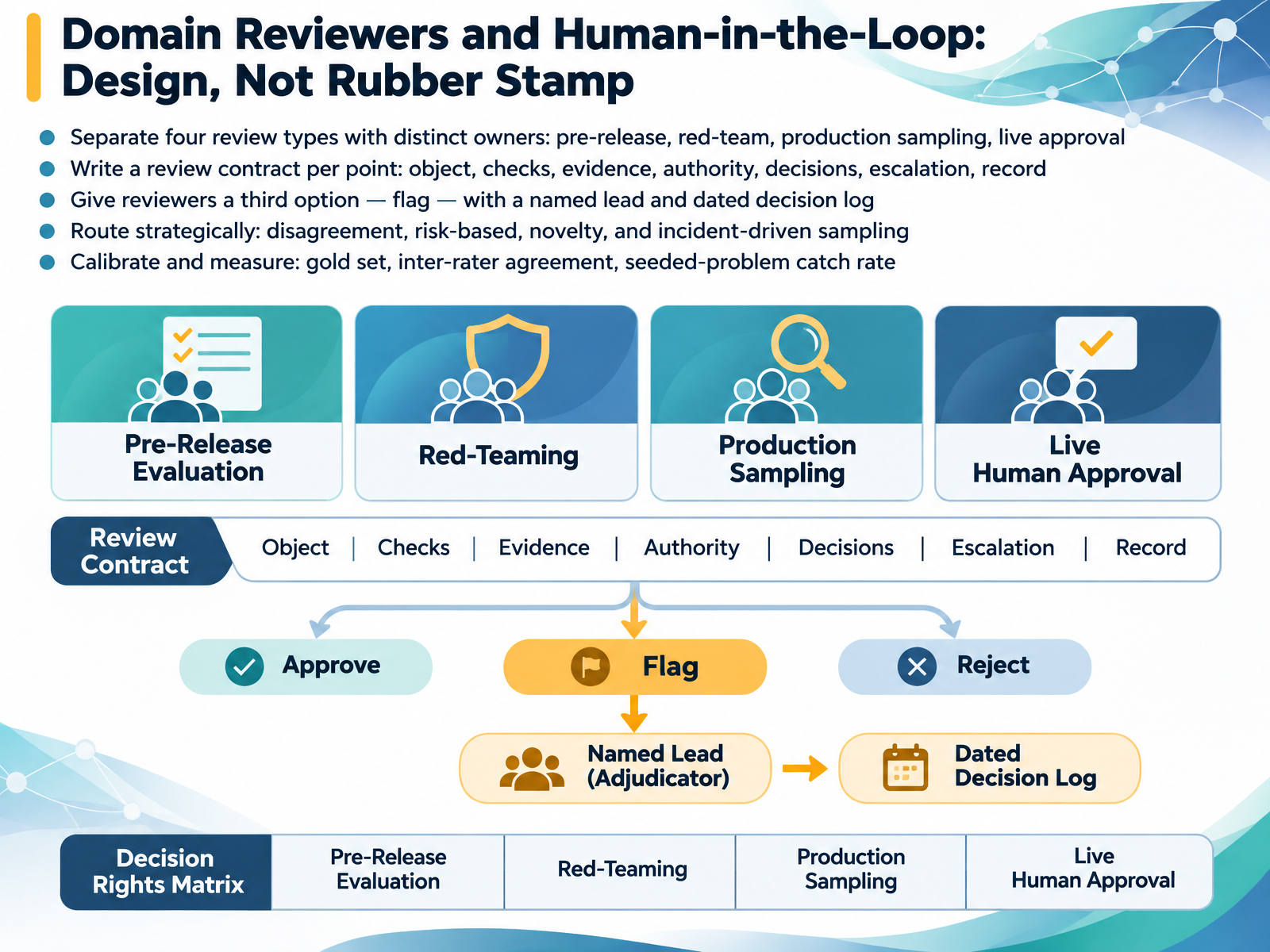
- 09Domain Reviewers and Human-in-the-Loop: Design, Not Rubber StampNext, let's look at the domain reviewer's role. Your accountability here is that human-in-the-loop does not become a rubber stamp. Separate four review types, each with its own owner: pre-release review, red-team review, production sampling, and live approval. For each review point, write a review contract. Specify the object under review, the required checks, the evidence shown, the reviewer's authority, allowed decisions, escalation path, and the record kept. Give reviewers a third option beyond pass and fail: flag. Assign a named lead for flags, and keep a dated decision log. Route cases strategically through disagreement, risk-based, novelty, and incident-driven sampling. Then calibrate and measure with a gold set, inter-rater agreement, and seeded-problem catch rate. Close the loop: when reviewers flag consistently, the rubric or the threshold gets updated, with a date and an owner. That keeps review a design decision, not a formality. Let's move on to review gates with real blocking power.
 splunk.com2 min
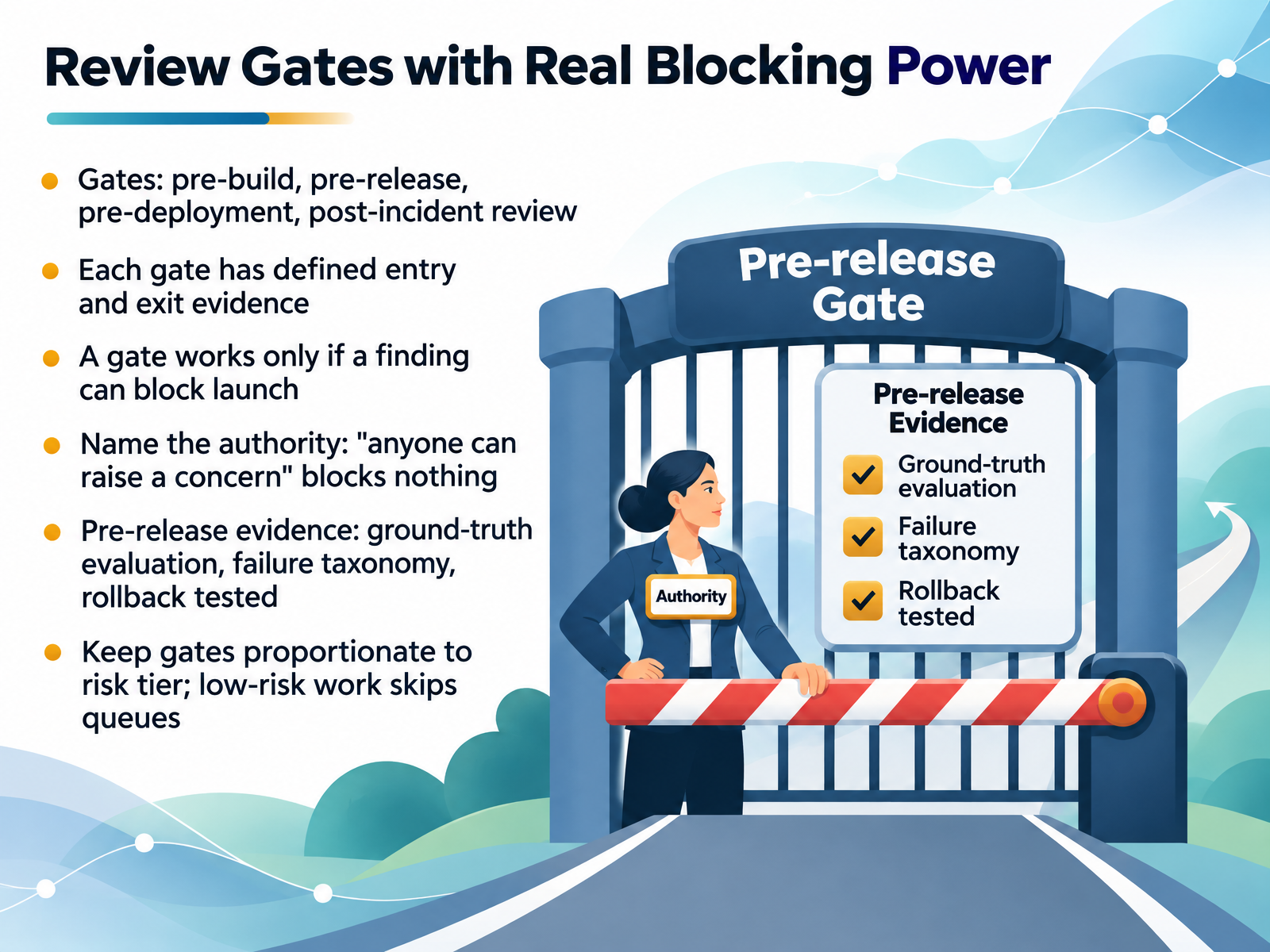
- 10Review Gates with Real Blocking PowerNow let's look at review gates, and what makes them real. Your accountability here is simple. If a gate cannot stop a launch, it is not a gate. You need four: pre-build, pre-release, pre-deployment, and post-incident review. Define the entry and exit evidence for each one. Then name the authority. If your rule is that anyone can raise a concern, nothing gets blocked. A finding must be able to stop the launch, and the blocker must be a named person with the power to hold it. For pre-release, require three pieces of evidence. Evaluation against a ground-truth set. A documented failure taxonomy. And a rollback plan that was actually tested, not just written. Keep gates proportionate to risk tier. Low-risk work should skip the queues and move through a single sign-off. High-risk work earns the full review. Reviewers should be able to confirm each gate has named evidence and a named approver. Next, we'll cover incident ownership and escalation paths.
 lumay.aidocs.aws.amazon.comkastling.co+22 min
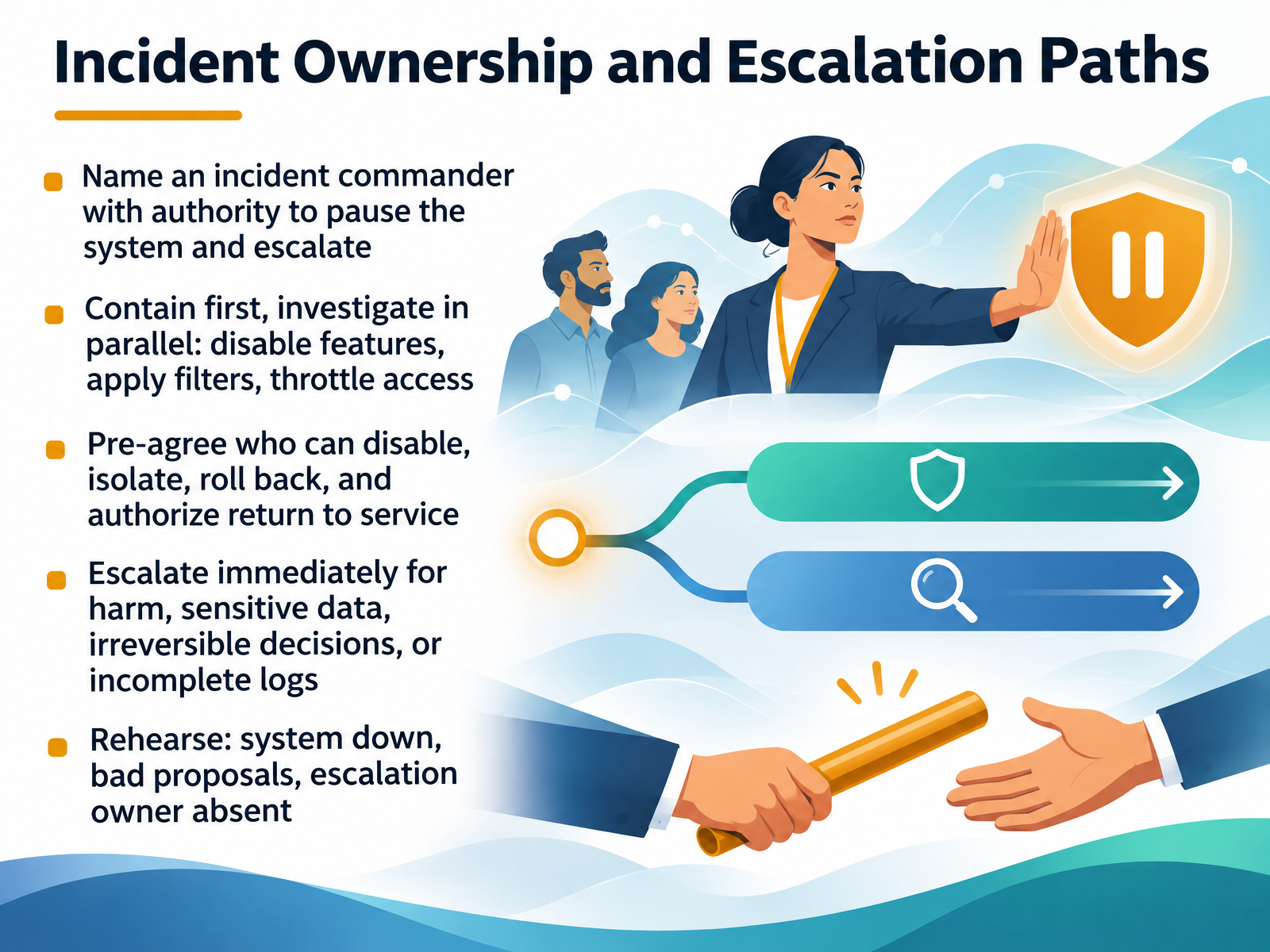
- 11Incident Ownership and Escalation PathsNow let us look at incident ownership and escalation paths. Your accountability here is a single question: when something goes wrong, does everyone know who is in charge, and can harm be stopped quickly? Name an incident commander with explicit authority to pause the system and escalate. That person does not need to be the deepest expert in the room, but ownership and decision authority must be clear. Contain first, and investigate in parallel. Disable the feature, apply a filter, or throttle access while you determine scope. Before an incident, agree in writing who can disable, isolate, and roll back the system, and who authorizes return to service. Escalate immediately for harm, sensitive data, irreversible decisions, or incomplete logs. Waiting for confirmed injury is not acceptable when the system can keep producing the same harmful result. Finally, rehearse three scenarios with the real responders: system down, bad proposals, and the escalation owner absent. After practice, confirm each role boundary and handoff is documented without ambiguity. Next, we turn to governance interfaces and third-party responsibilities.
 2 min
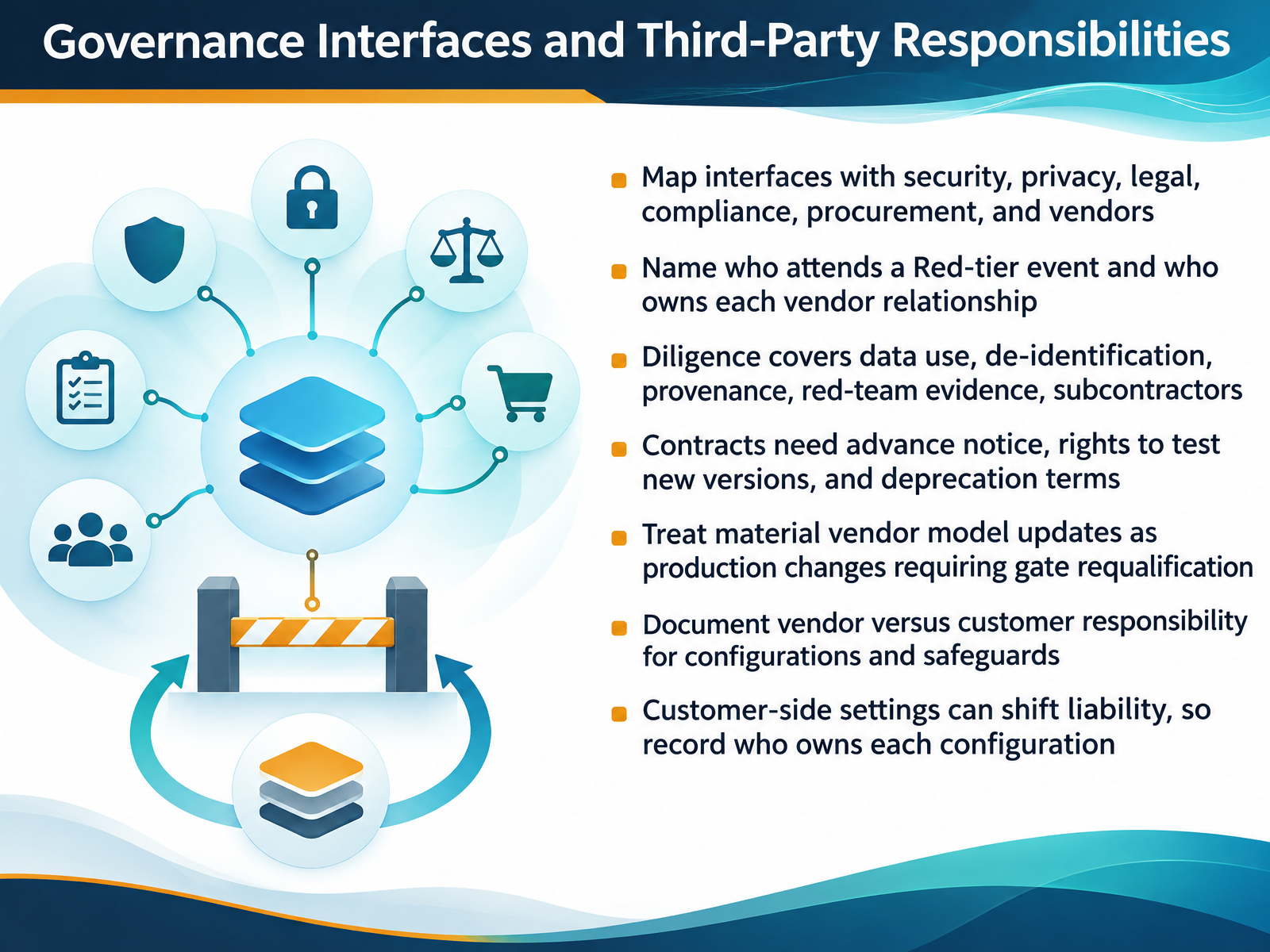
- 12Governance Interfaces and Third-Party ResponsibilitiesNow let's talk about governance interfaces and third-party responsibilities. Your accountability here is that no vendor relationship lands without a named interface owner. Start by mapping who sits at each interface: security, privacy, legal, compliance, procurement, and the vendor itself. For a Red-tier event, name in advance who attends and who owns each vendor relationship. Diligence must cover data use, de-identification standards, training data provenance, red-team evidence, and all material subcontractors. In your contracts, require advance notice of model changes, the right to test new versions before they go live, and clear deprecation terms. Treat any material vendor model update as a production change, and send it back through gate requalification. Document, in writing, which responsibilities belong to the vendor and which belong to you, especially for configurations and safeguards. Customer-side settings can shift liability, so record who owns each configuration. That document is proof. In the next section, we'll look at the operating rhythm, metrics, and continuous improvement that keep this working.
 rsmus.compwc.comtechtarget.com+21 min
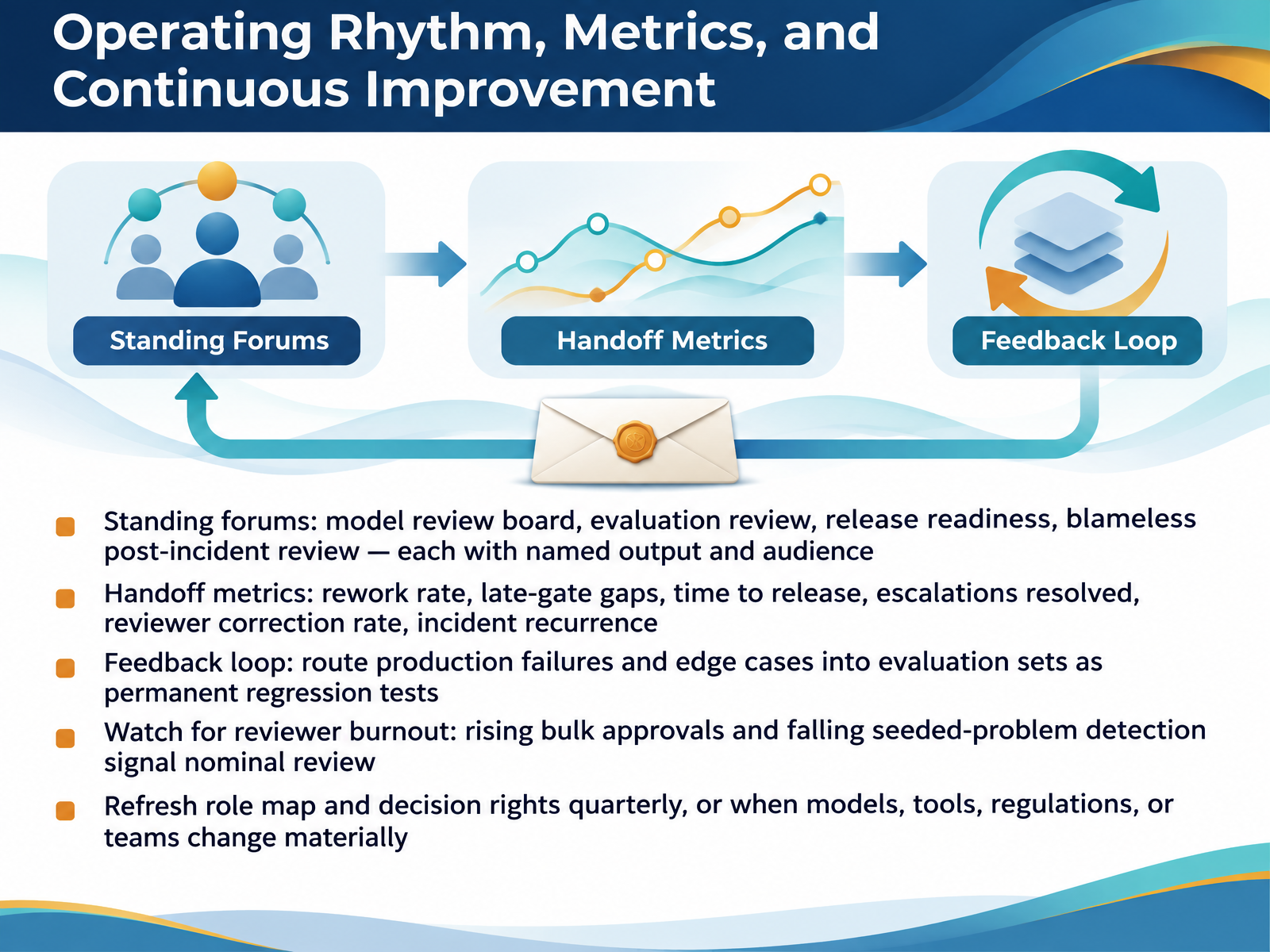
- 13Operating Rhythm, Metrics, and Continuous ImprovementNext, the operating rhythm. You own one decision here: does your governance actually run on a cadence, or does it only exist on paper? Four standing forums should carry named output and a named audience. The model review board, evaluation review, release readiness, and blameless post-incident review. Each one produces a documented decision or action list. If a forum has no output, retire it. Track handoff metrics: rework rate, late-gate gaps, time to release, escalations resolved, reviewer correction rate, and incident recurrence. Route every production failure and edge case into your evaluation set as a permanent regression test. Watch for reviewer burnout. Rising bulk approvals and falling detection of seeded problems mean review has become nominal. The review lead owns that check. Refresh the role map and decision rights quarterly, or whenever models, tools, regulations, or teams change materially. The sponsor approves the refresh. Now let's apply this. Workshop: Draft Your Team's Role and Handoff Charter.
 splunk.com2 min
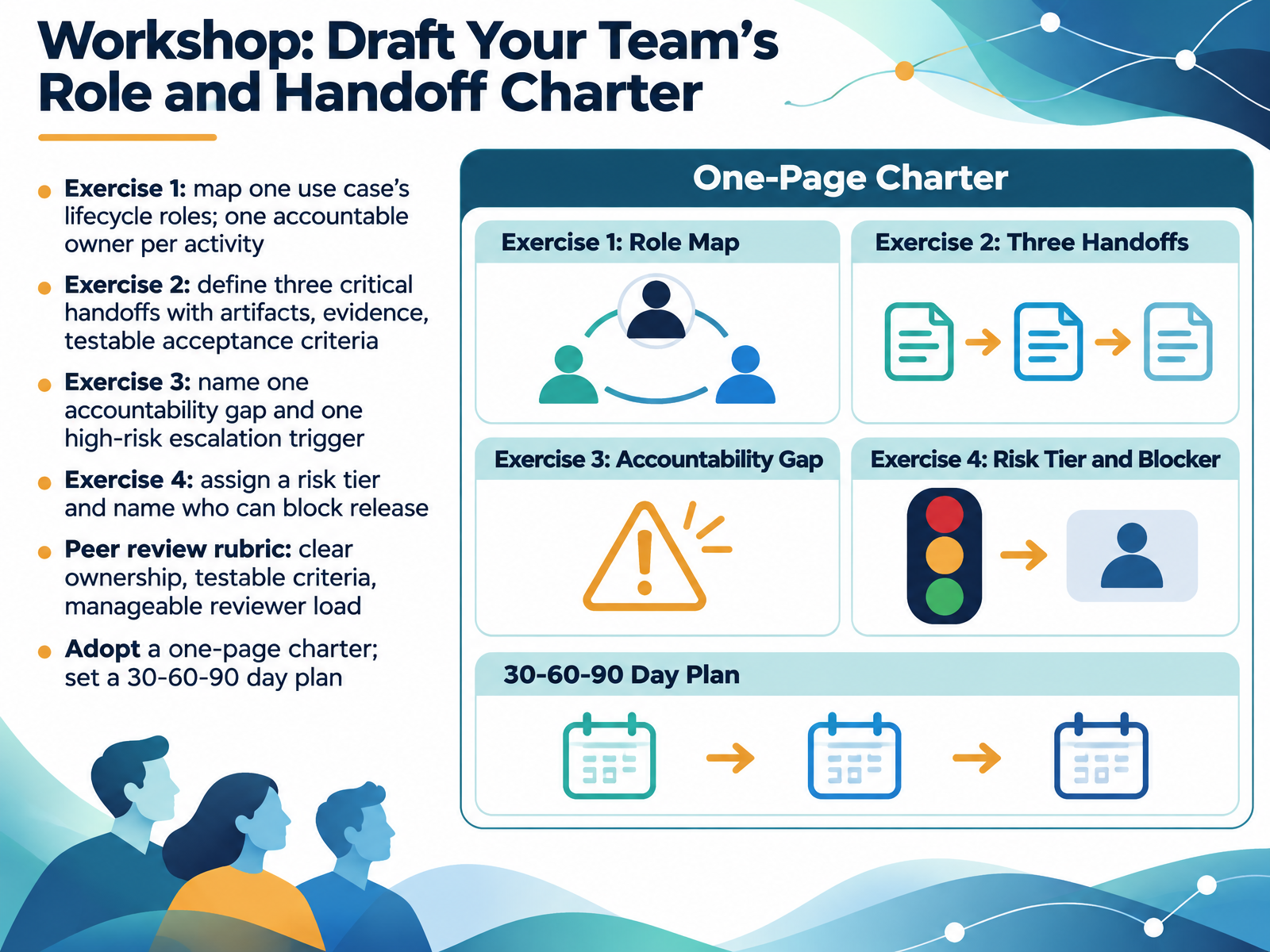
- 14Workshop: Draft Your Team's Role and Handoff CharterNow it's time to put this into practice. Your deliverable is a one-page charter your team can actually use. In Exercise one, map one use case's lifecycle roles, and name a single accountable owner for each activity. In Exercise two, define three critical handoffs. For each one, specify the artifact, the evidence, and acceptance criteria a reviewer can test. In Exercise three, name one accountability gap already in your workflow, and one escalation trigger for high-risk cases. In Exercise four, assign the use case a risk tier, then name exactly who can block release. Before adopting, run a peer review against three criteria: clear ownership, testable criteria, and a manageable reviewer load. Adopt the one-page charter and set a 30-60-90 day plan with named owners and review dates. Keep it visible, and revisit it quarterly. Thank you for your work across this course. You now have the rules to define roles, test handoffs, and hold accountability. Put your charter to work on one real use case this week.
 2 min
Take the deck with you
Download this course as a file — free, no sign-up needed.
- PDF handoutEvery slide page, ready to print or share.15 pages · 4.0 MBDownload
- Narrated PowerPointThe deck that presents itself — every slide carries the digital human's narration video.15 pages · 16.8 MBDownload
- PowerPoint slidesThe full deck as a .pptx — open it in PowerPoint, Keynote, or Google Slides.15 pages · 4.0 MBDownload
Free to use in your own training — please keep the PersonWise credit page at the end.
Have your own deck? Turn it into a course
Sources consulted
Web sources consulted while building this course.
- The operating model for AI-native engineering | OpenAI Deploy Co. — deploy.co
- The AI operating model for enterprise scale — pronix.ai
- AI Team Structure: Roles, Pods, Sizing and RACI (2026) — vdf.ai
- Rethinking agentic product development | McKinsey — mckinsey.com
- An operating model for product teams that build with agents — paelladoc.com
- AI Governance Roles & Responsibilities: The Complete RACI… — openempower.com
- AI Team Structure Template (Roles, Pods, RACI) | Ryz Labs — ryzlabs.com
- framework/operating-model/roles-genai.md — github.com
- Why AI programs need more than a classic responsibility matrix | PMI Space Coast, Florida — pmispacecoast.org
- Third-party AI risk management | RSM US — rsmus.com
- Trust AI and third-party risk management: PwC — pwc.com
- AI vendor risk assessment: A framework for CISOs | TechTarget — techtarget.com
- Key Considerations for Evaluating an AI Vendor – Tech & Sourcing @ Morgan Lewis — morganlewis.com
- Pre-Contract Due Diligence And Operational Safeguards For AI Vendor Engagements | Legal 500 — legal500.com
- AI POC to Production: An Engineering Handover Checklist — lumay.ai
- https://docs.aws.amazon.com/pdfs/prescriptive-guidance/latest/gen-ai-lifecycle-operational-excellence/gen-ai-lifecycle-operational-excellence.pdf — docs.aws.amazon.com
- AI Automation Handover Checklist + Template | Kastling — kastling.co
- AI Project Handover Checklist | PoliteTech — politetechsoftware.com
- Model, Prompt, and Index Registries | COMPEL Framework — compelframework.org
- What Is SME-in-the-Loop in AI Evals? | Splunk — splunk.com