Begin
14 pages · ~28 min
Audience Research: Patterns, Strengths, and Pitfalls
This training explores audience research examples to help learners identify patterns, evaluate strengths, and avoid common pitfalls in research design and analysis.
A digital instructor presents all 14 pages. Hold “Ask” at any point and ask out loud — the answer comes from this course. No sign-up needed.
What you’ll learn
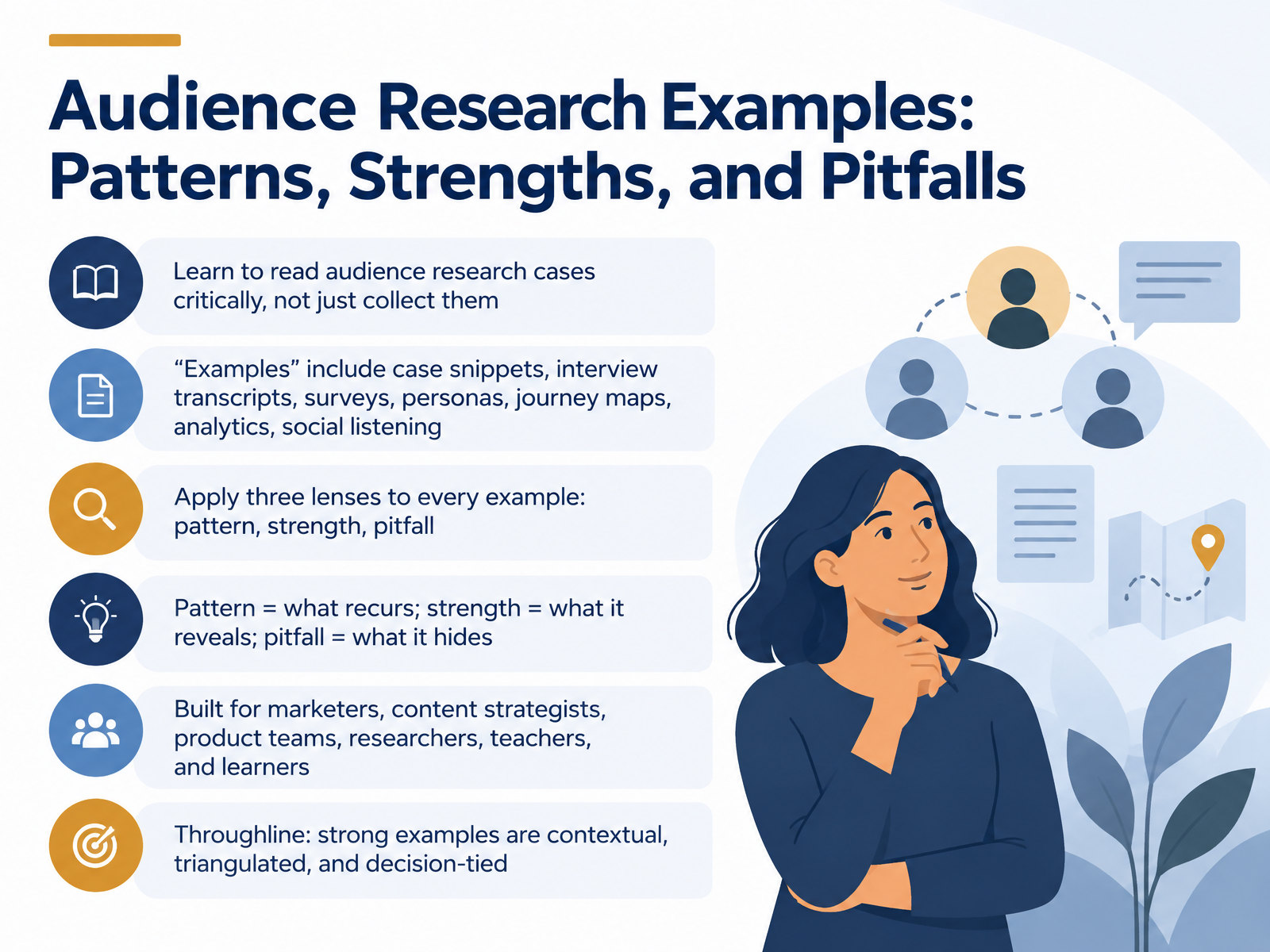
- 01Audience Research Examples: Patterns, Strengths, and PitfallsWelcome. I'm glad you're here. Over the next several slides, we're going to look at audience research examples, the patterns they reveal, their strengths, and the pitfalls they hide. Here's the goal. Not to collect more case studies, but to read them critically. And by examples, I mean all of it. Case snippets, interview transcripts, surveys, personas, journey maps, analytics, and social listening. Every example gets the same three lenses. Pattern, what recurs. Strength, what it reveals. Pitfall, what it hides. Think of a persona built from twelve interviews. The pattern is a shared need. The strength is real user language. The pitfall is treating one segment as everyone. This course is built for marketers, content strategists, product teams, researchers, teachers, and learners. And the throughline is simple. Strong examples are contextual, triangulated, and tied to a decision. So as we go, ask yourself what you should notice, decide, or try next. Let's begin with why examples shape audience insight.freshegg.co.ukpmftracker.comannakhakho.substack.com+21 min
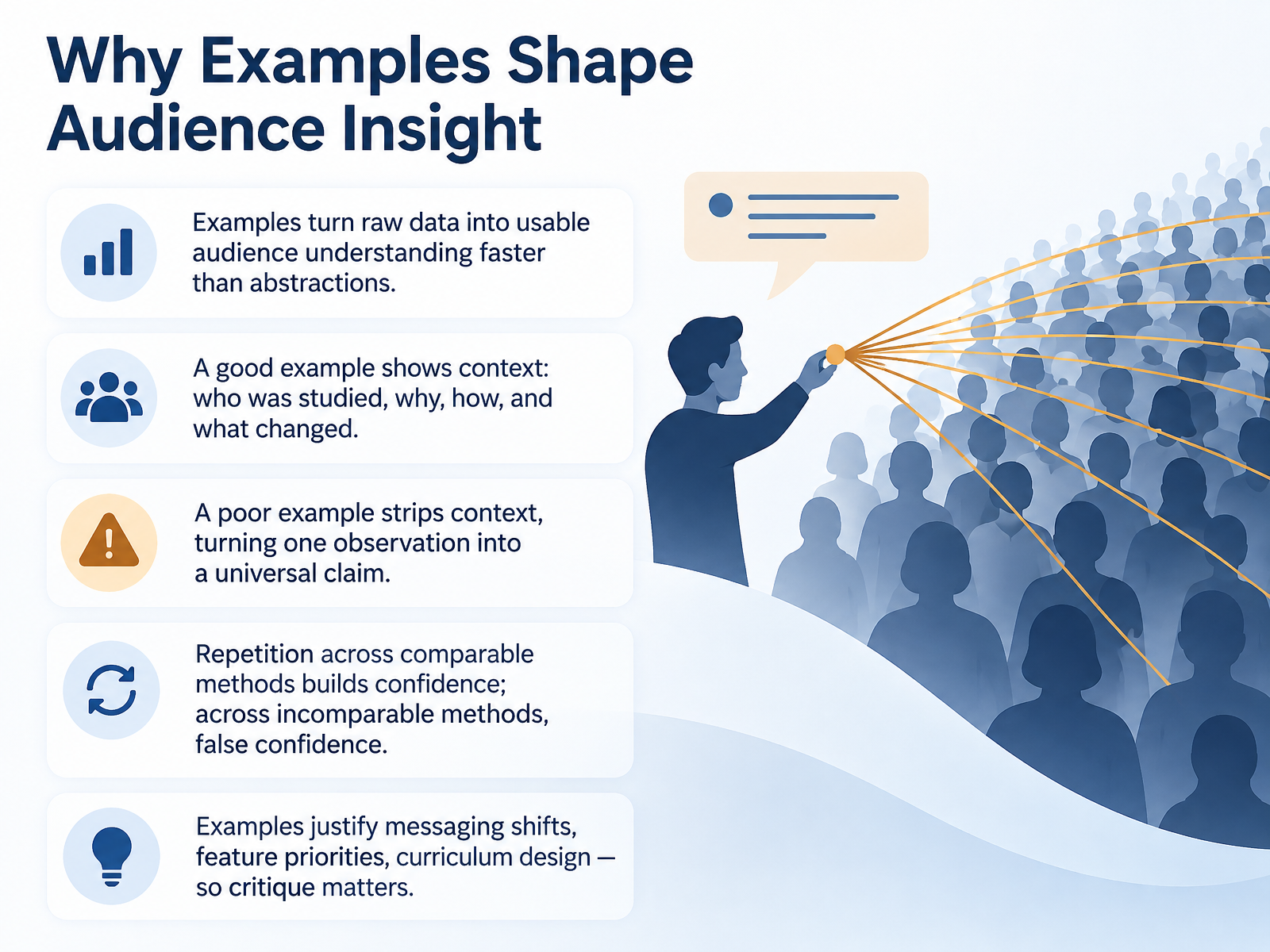
- 02Why Examples Shape Audience InsightLet's look at why the examples we choose shape what we actually learn about an audience. Examples do something abstractions can't. They turn raw data into usable audience understanding, and they do it faster. A good example shows context. Who was studied, why, how the work was done, and what changed afterward. Think of a team that interviewed nine paying users and heard the same use case from every one of them. That repetition gave them confidence to ship one focused change. A poor example strips all of that away. It takes a single observation and turns it into a universal claim, which is how weak insights become confident-sounding strategy. Repetition helps us too. When the same pattern shows up across comparable methods, it builds genuine confidence. When it shows up across methods that don't match, it builds false confidence. This matters because examples are what justify messaging shifts, feature priorities, and curriculum design. So critique them. Ask what context was kept, what was removed, and whether the pattern really repeats. Next, we'll look at recurring patterns in strong examples.
 freshegg.co.ukpmftracker.comannakhakho.substack.com+22 min
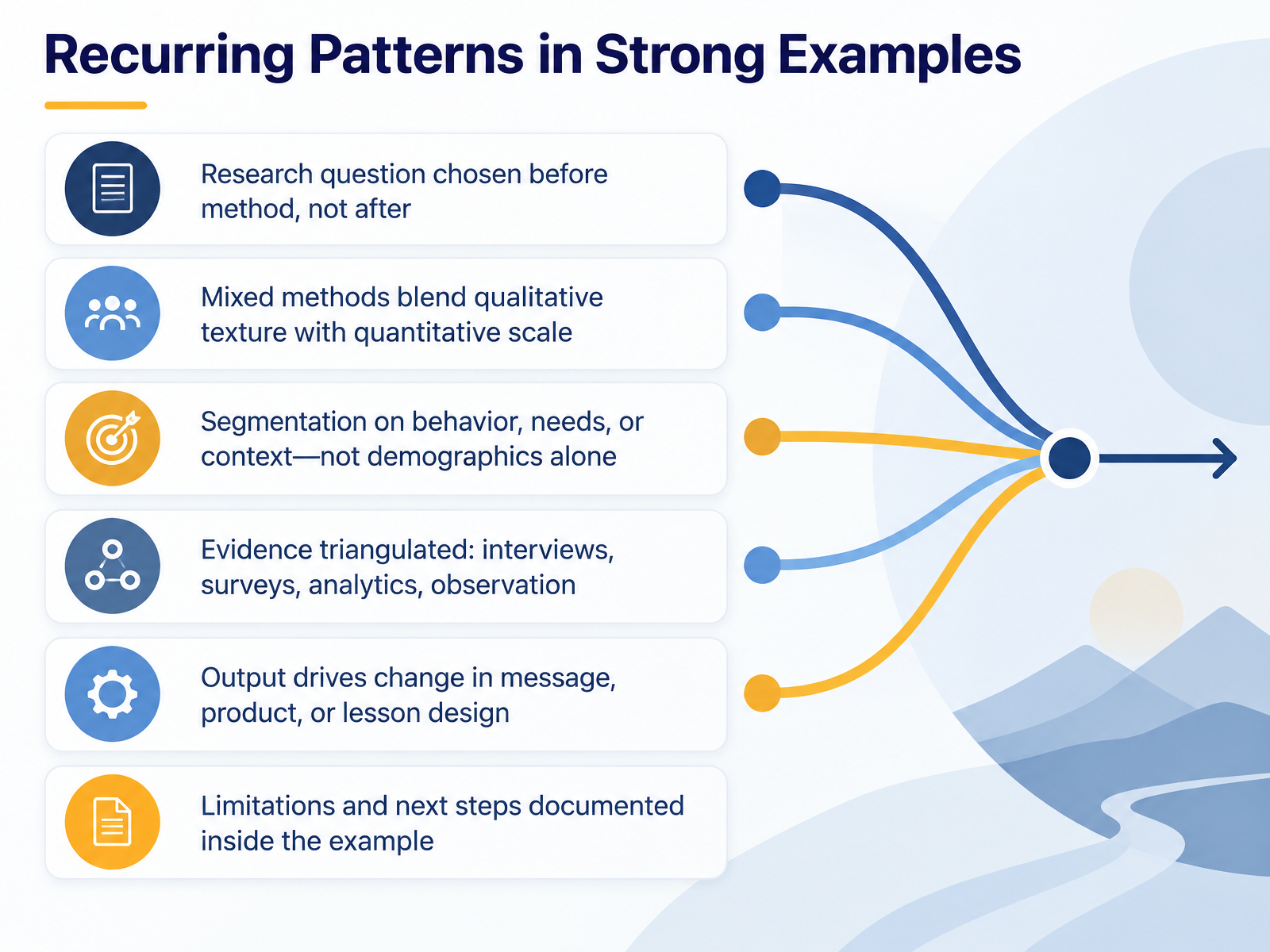
- 03Recurring Patterns in Strong ExamplesNow let's look at the patterns that show up again and again in strong audience research examples. First, the research question comes before the method, not after. Decide what you actually need to learn, then pick the tools. Second, strong examples blend qualitative texture with quantitative scale. A diary study reveals how people feel in the moment; a large survey tells you how widespread that feeling is. Third, they segment on behavior, needs, or context, not demographics alone. Think about a streaming service grouping viewers by what job they want a platform to do, like watching with family or catching up quickly, rather than just by age. Fourth, evidence gets triangulated. Interviews, surveys, analytics, and observation all point to the same conclusion. Fifth, the output drives change in message, product, or lesson design. And sixth, limitations and next steps are documented right inside the example. So try this on your own project. Ask whether your segmentation reflects what people actually do, and whether your evidence comes from more than one source. Next, let's look at Jobs-to-Be-Done and needs-based segmentation.
 casestudies.comwaveforminsight.comwaveforminsight.com+22 min
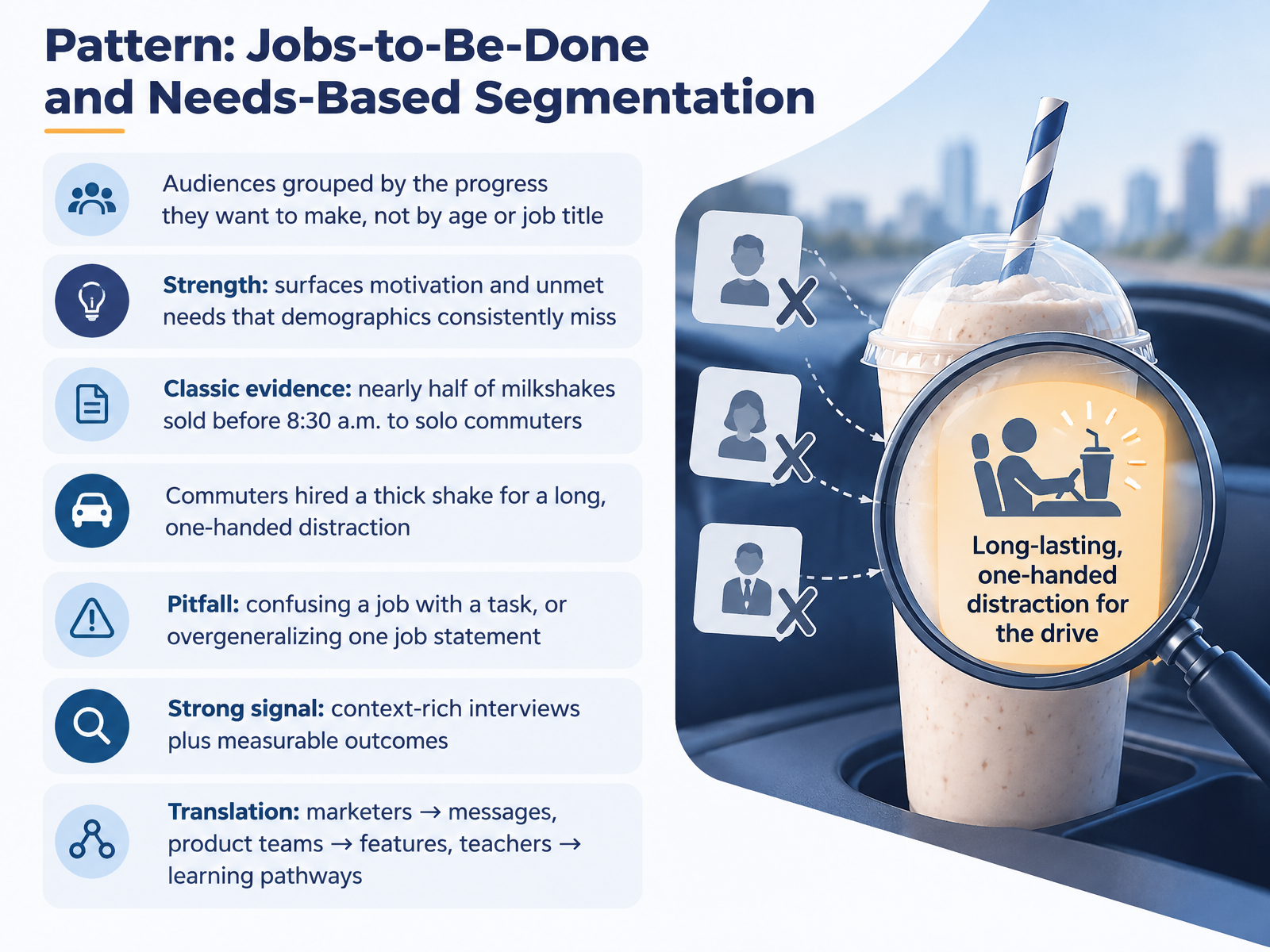
- 04Pattern: Jobs-to-Be-Done and Needs-Based SegmentationNow let's look at our first research pattern: jobs-to-be-done, and needs-based segmentation. The core idea is simple. Instead of grouping people by age or job title, you group them by the progress they're trying to make in a specific situation. The strength here is real. It surfaces motivation and unmet needs that demographics consistently miss. Think of the classic milkshake study. Nearly fifty percent of shakes were sold before eight thirty in the morning to solo commuters. Those commuters weren't hungry for dessert. They hired a thick shake as a long, one-handed distraction for a boring drive. One product, two completely different jobs. That's exactly what demographics hide. Now, two cautions. First, don't confuse a job with a task. A job is the underlying progress someone wants, not a single step they take. Second, avoid overgeneralizing from one job statement. Look for context-rich interviews paired with measurable outcomes before you commit. So how do you translate this? Marketers turn jobs into messages. Product teams turn them into features. Teachers turn them into learning pathways. Try it with one segment you already work with, and see what changes. Next, we'll move from jobs to people, with personas and empathy maps.
 exa.aivalchanova.meexa.ai+22 min
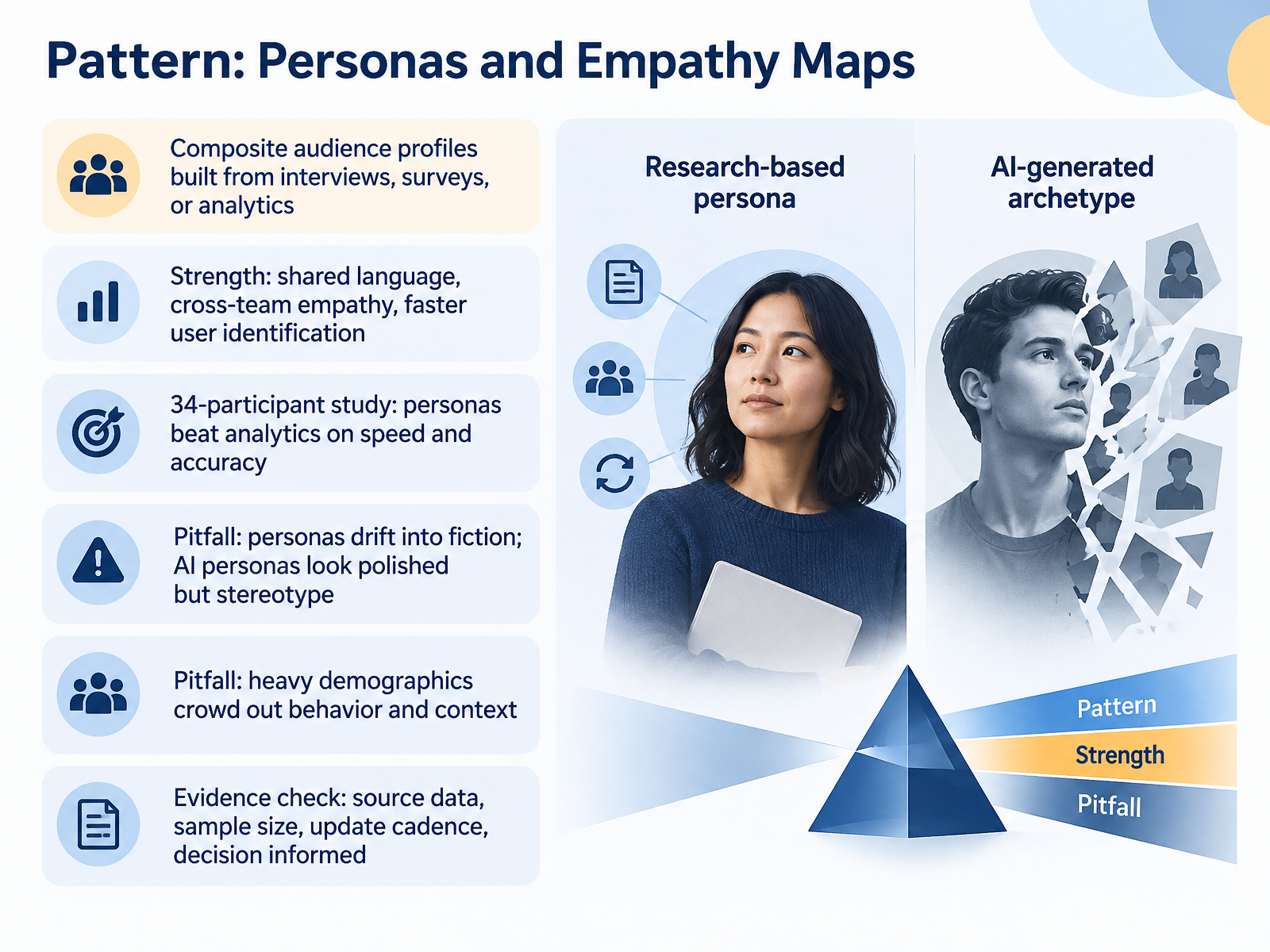
- 05Pattern: Personas and Empathy MapsLet's look at a pattern you have probably already seen in practice: personas and empathy maps. A persona is a composite audience profile built from interviews, surveys, or analytics. In plain terms, it is a stand-in for a group of real people, and it helps a team share one language. Empathy maps do something similar, laying out what users say, think, do, and feel. The strength is speed and alignment. Instead of debating who the user is, your team can point to the same profile. One study with thirty-four participants found personas beat analytics on both speed and accuracy for a user identification task. People finished faster and identified users more correctly. So personas can genuinely help a campaign team, a product squad, or a classroom plan instruction around a clearer learner. But watch two pitfalls. First, personas drift into fiction. When the details are not tied to data, people fill the gaps with their own assumptions. AI-generated personas look polished, but research shows they often lean on stereotypes. Second, heavy demographics can crowd out behavior and context. Knowing a persona's age or income matters less than what they are trying to do and why. So before you use a persona, check four things: the source data, the sample size, how often it gets updated, and which decision it will actually inform. That turns a pretty poster into a working tool. Next, we will compare this with surveys, analytics, and social listening.
 dl.acm.orginria.hal.scienceexa.ai+22 min
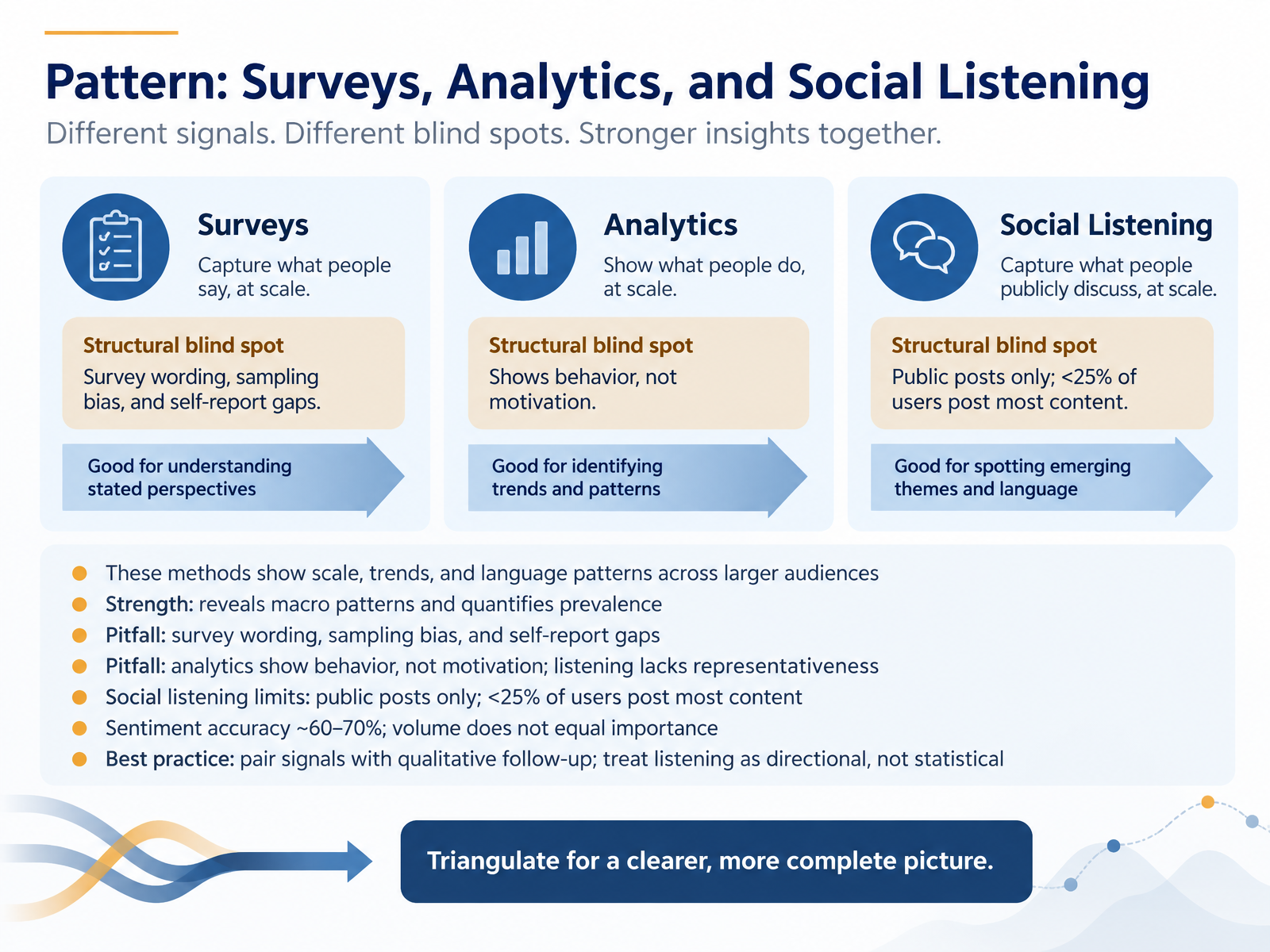
- 06Pattern: Surveys, Analytics, and Social ListeningLet's look at a pattern you have probably already used: surveys, analytics, and social listening. These methods are good at showing scale, trends, and language across larger audiences. Their strength is macro patterns, and they can quantify how common something is. But each carries pitfalls. Survey wording and sampling bias can distort results, and self-reports leave gaps between what people say and do. Analytics show behavior, not motivation. Social listening only captures public posts, and fewer than twenty five percent of users create most content. Sentiment accuracy lands around sixty to seventy percent, and volume does not equal importance. So treat listening as directional, not statistical. Pair these signals with qualitative follow up. Next, we will look at a critical reading checklist for strength and pitfall signals.
 1 min
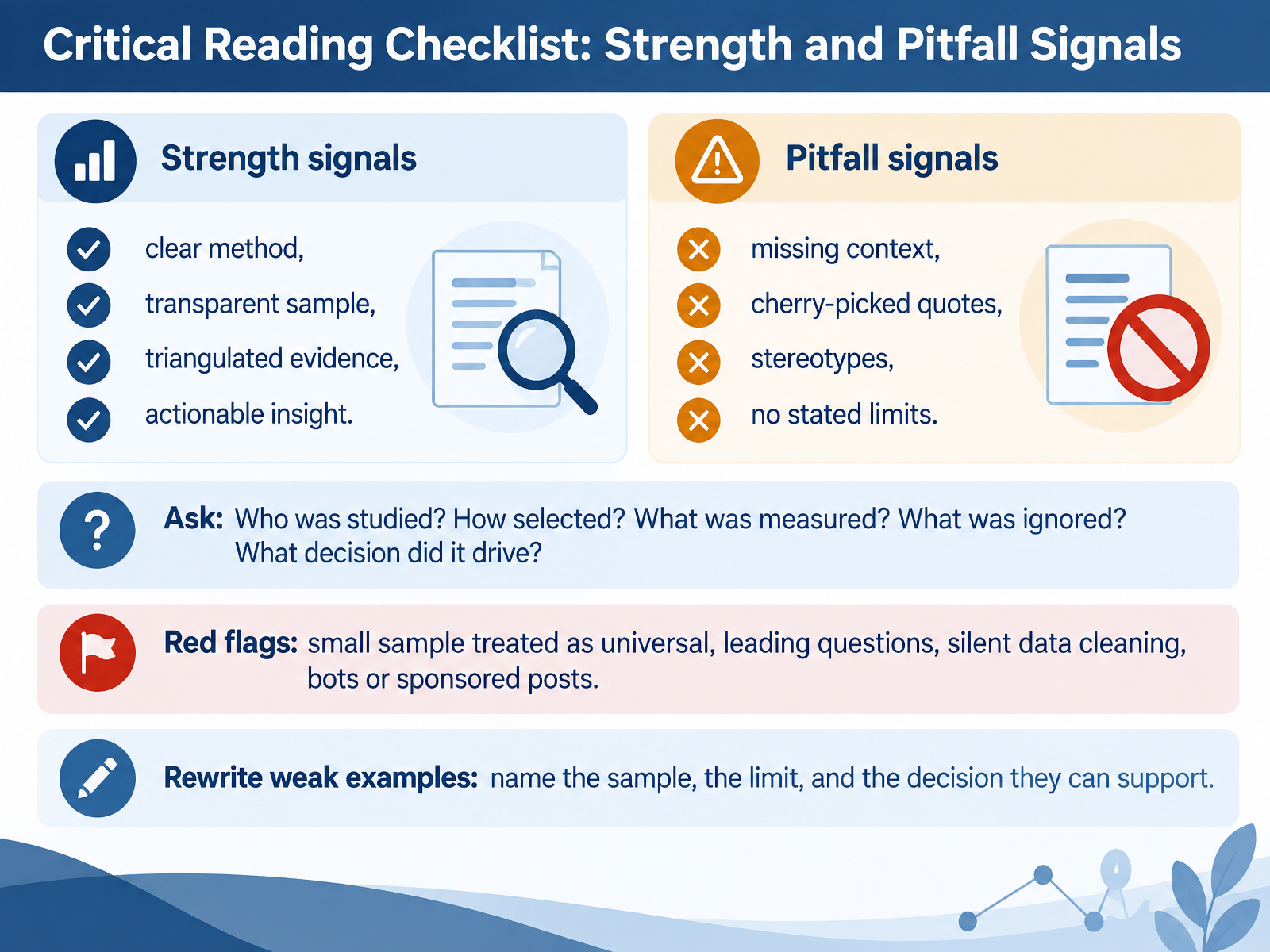
- 07Critical Reading Checklist: Strength and Pitfall SignalsHere is a quick checklist you can run on any audience research you read or commission. First, the strength signals. Look for a clear method, a transparent sample, evidence triangulated across more than one source, and an insight you can actually act on. Now the pitfall signals. Watch for missing context, cherry-picked quotes, stereotypes, and no stated limits. So ask five questions. Who was studied? How were they selected? What was measured? What was ignored? And what decision did it drive? A few red flags worth naming: a small sample treated as universal, leading questions, silent data cleaning, and bots or sponsored posts inflating the volume. Finally, rewrite weak examples. Name the sample, name the limit, and name the decision the data can support. That last habit, naming limits, is what makes your insight credible. Next, we will look at entry-point segmentation in education technology.
 dl.acm.orginria.hal.scienceexa.ai+22 min
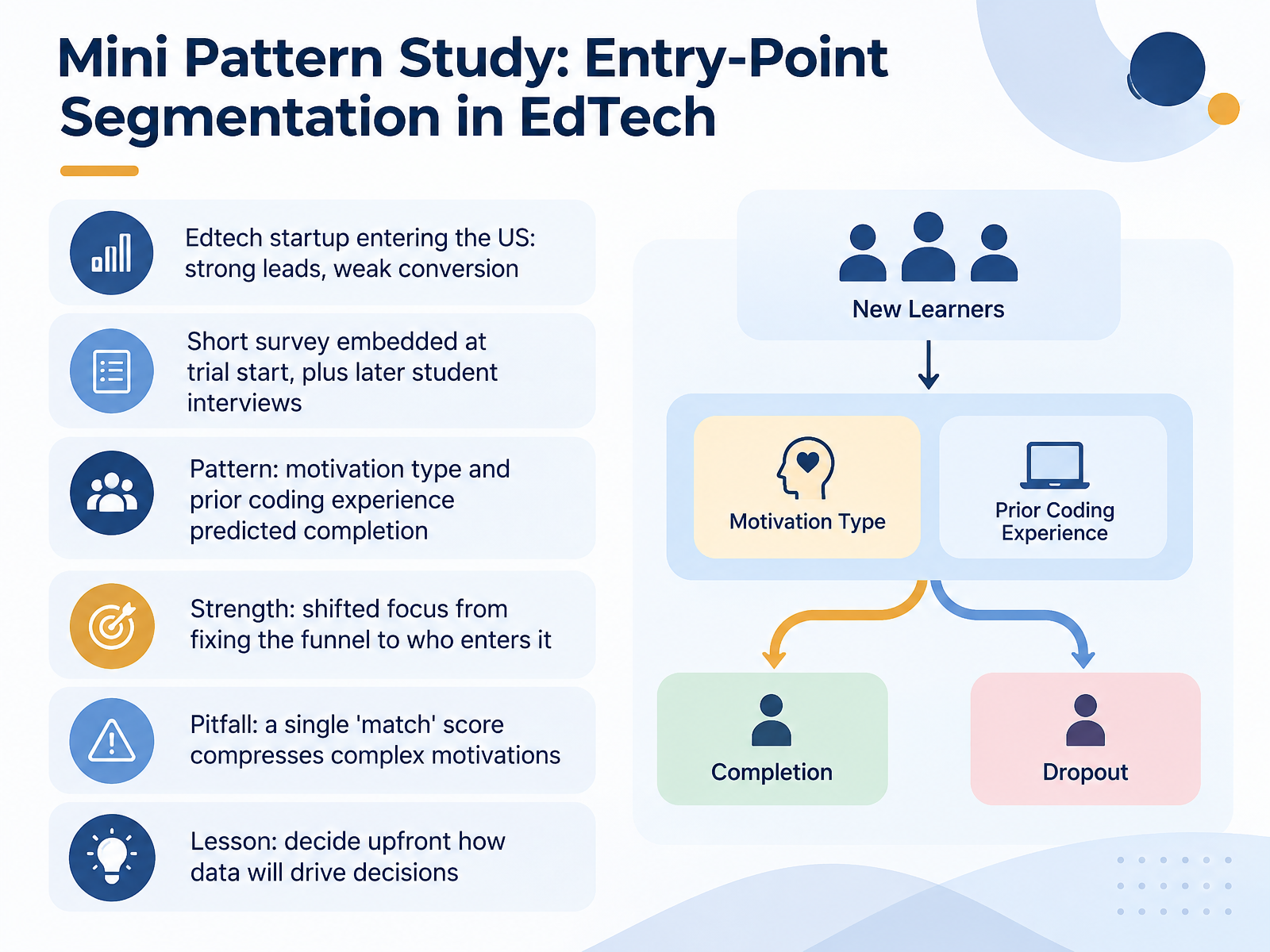
- 08Mini Pattern Study: Entry-Point Segmentation in EdTechNow let's look at a mini pattern study from edtech. A startup entered the US market with strong leads but weak conversion. The tactical request was to fix the funnel. Instead, the researcher embedded a short survey at trial start, then ran student interviews later. The pattern that emerged: motivation type and prior coding experience predicted completion. That strength is worth stealing. It shifted the focus from fixing the funnel to asking who enters it. Sales stopped burning time on calls that went nowhere. But here's the pitfall. A single match score compresses complex motivations into one number, and that flattens real people. So before you collect anything, decide upfront how the data will drive decisions. What will you do differently based on the answer? Next, we'll see how one team validated creative before a big spend.
 freshegg.co.ukpmftracker.comannakhakho.substack.com+21 min
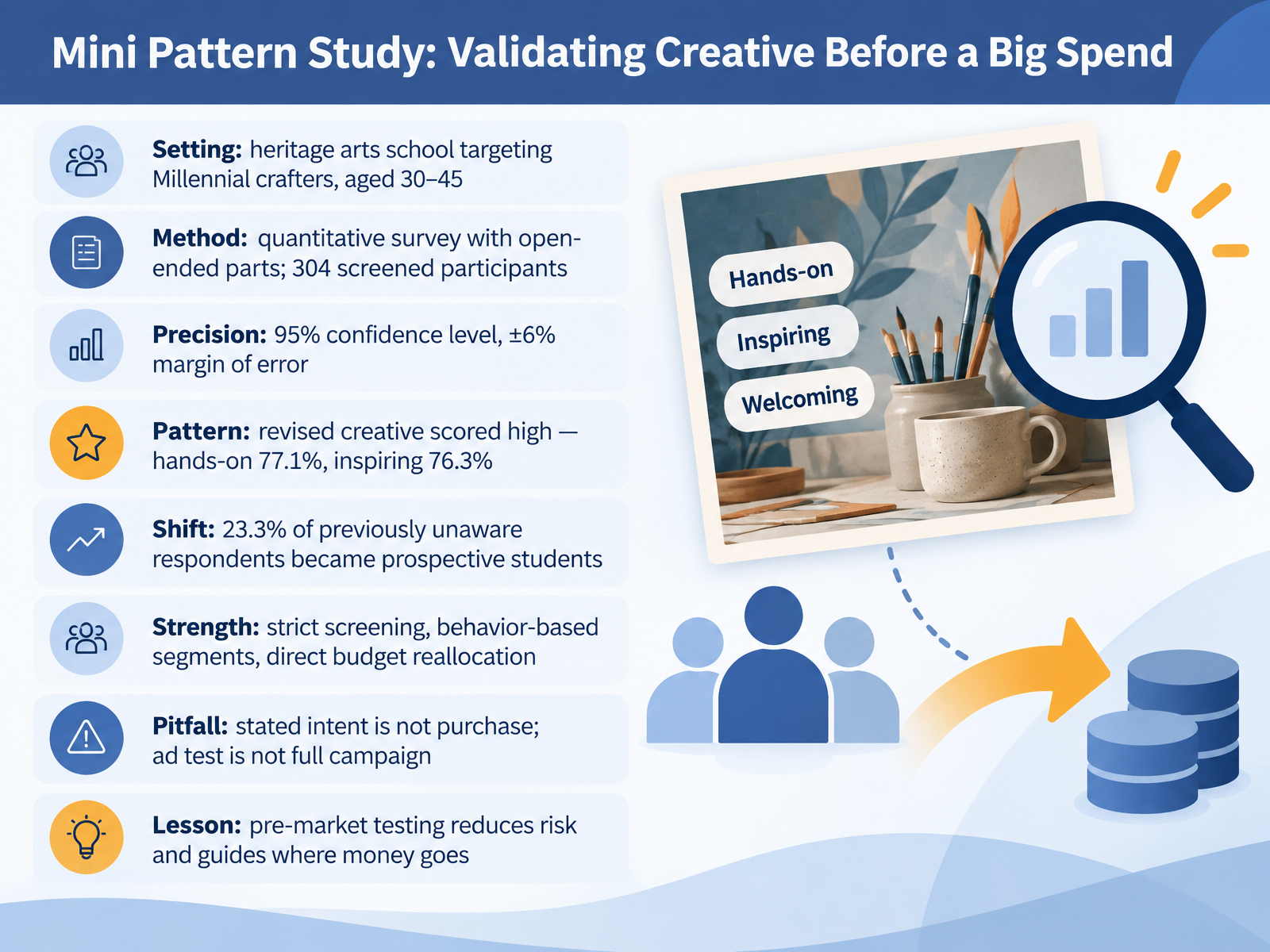
- 09Mini Pattern Study: Validating Creative Before a Big SpendNow, let's walk through a real mini pattern study that shows how to validate creative before a big spend. Picture a heritage arts school trying to reach Millennial crafters, ages thirty to forty-five. They ran a quantitative survey with open-ended questions, using three hundred four screened participants. That gives them ninety-five percent confidence and a margin of error of plus or minus six percent. The revised creative scored high. Hands-on came in at seventy-seven point one percent, and inspiring at seventy-six point three percent. More striking, twenty-three point three percent of people who had never heard of the school shifted to identifying as prospective students. What made this strong? Strict screening, behavior-based segments, and a direct budget reallocation. The pitfall to watch: stated intent is not purchase, and an ad test is not a full campaign. The lesson is clear. Pre-market testing reduces risk and shows you where the money should go. Next, we will look at how personas get rebuilt on evidence.
 freshegg.co.ukpmftracker.comannakhakho.substack.com+21 min
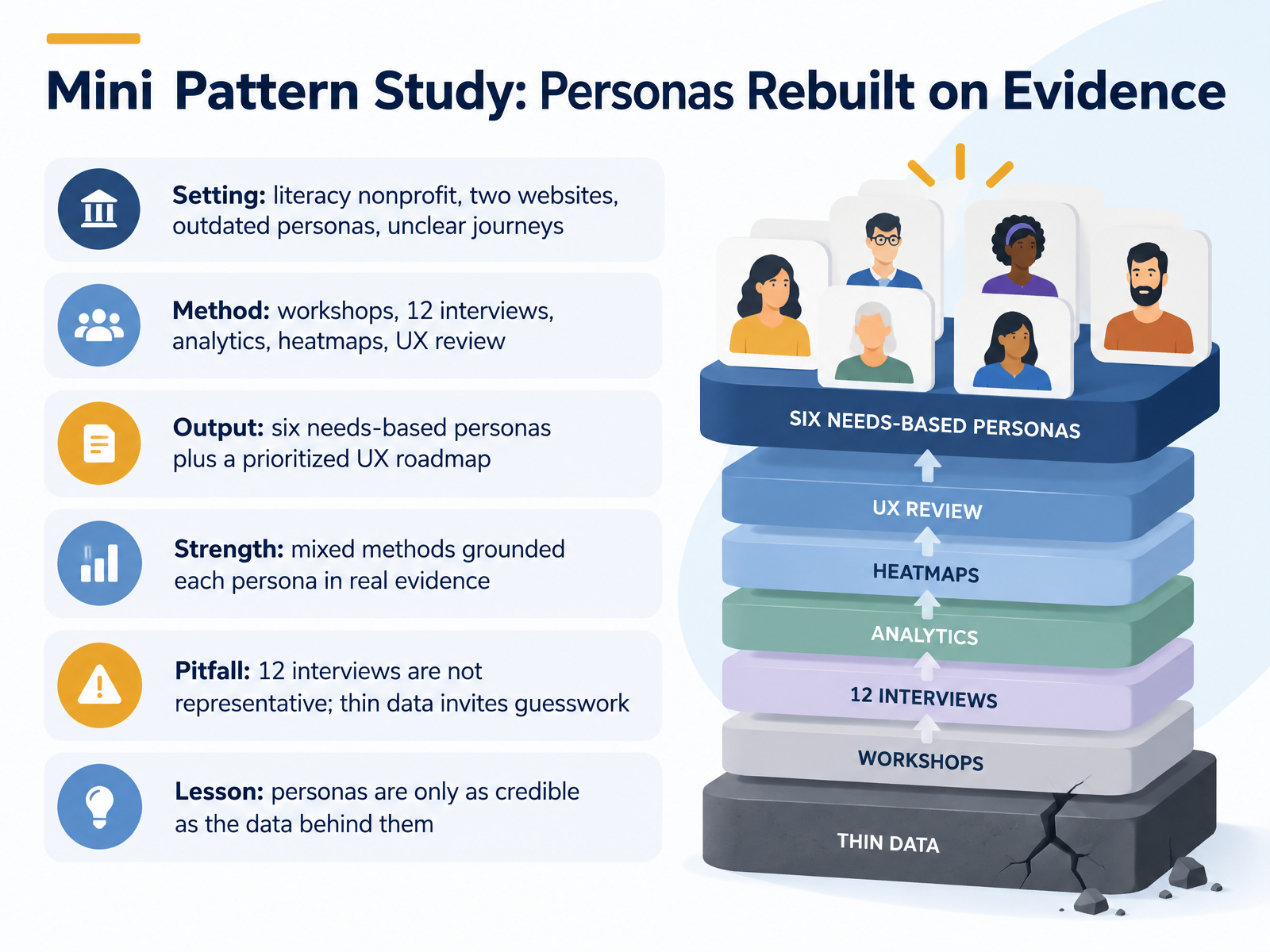
- 10Mini Pattern Study: Personas Rebuilt on EvidenceLet's look at a real pattern study, where personas were rebuilt on evidence. Picture a literacy nonprofit running two websites. Their personas were outdated, and their user journeys weren't clear. So they combined methods. Stakeholder workshops. Twelve interviews with teachers and parents. Website analytics. Heatmaps. And a full UX review. The output? Six needs-based personas, plus a prioritized UX roadmap. The strength here is that mixed methods grounded each persona in real evidence, not assumptions. But notice the pitfall. Twelve interviews are not representative. Thin data invites guesswork, and some personas will carry more weight than the evidence behind them. So next time you rebuild personas, ask yourself: what data backs each one, and where is it thin? Because personas are only as credible as the data behind them. Next, we'll look at mixing social listening with other data.
 freshegg.co.ukpmftracker.comannakhakho.substack.com+21 min
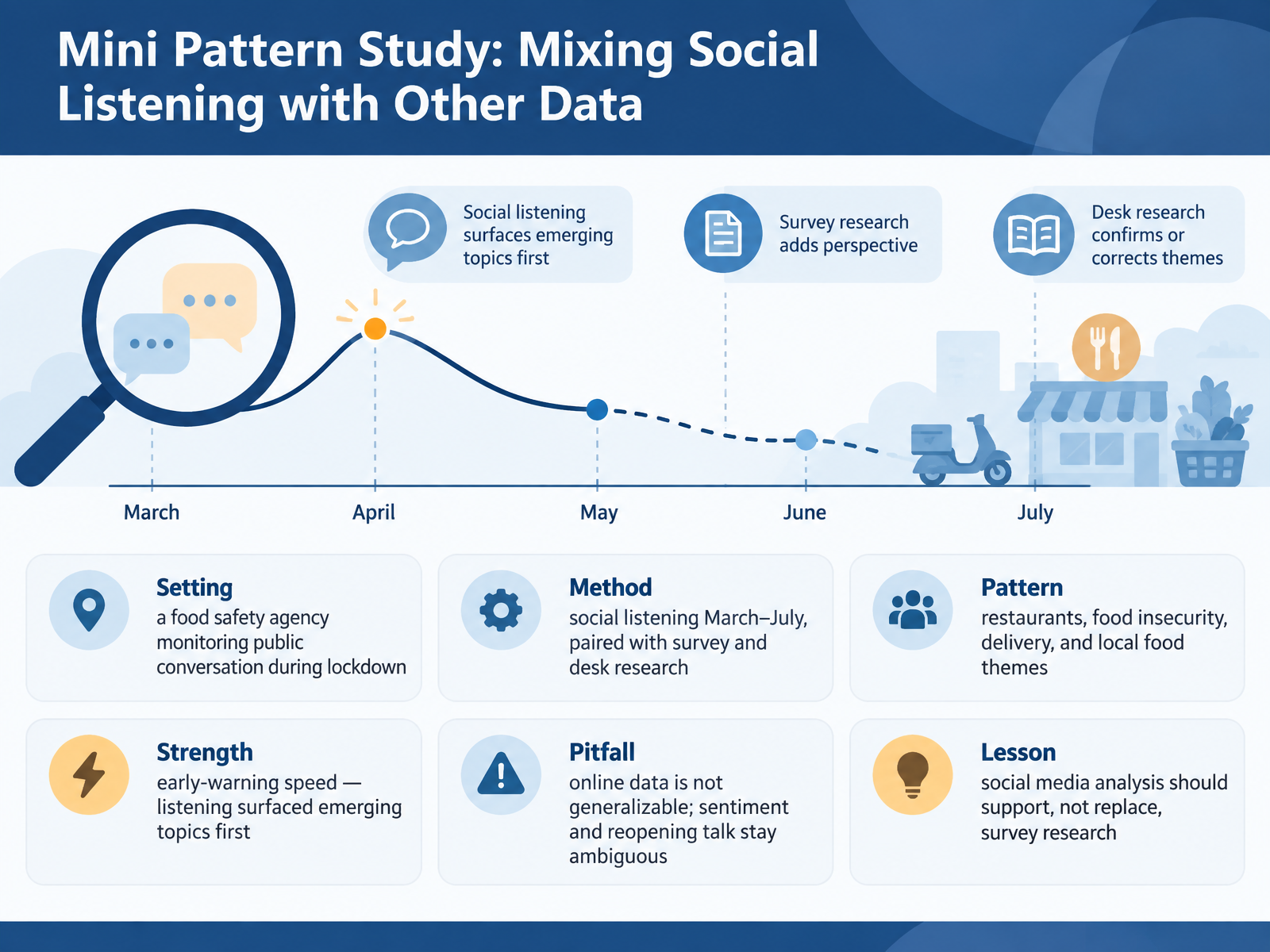
- 11Mini Pattern Study: Mixing Social Listening with Other DataLet's walk through a real mini pattern study that shows how social listening works best when it's paired with other data. Imagine a food safety agency during lockdown. From March through July, they tracked public conversation on Twitter, Facebook, Reddit, and news sites. Then they layered in survey and desk research alongside it. The listening surfaced clear themes: restaurants, food insecurity, delivery, and local food. And here's the strength. Listening gave them early warning speed. It picked up emerging topics before those topics showed up anywhere else. Now the pitfall. Online data is not representative, so you can't generalize it. Sentiment around reopening was genuinely ambiguous, and factual posts about opening hours blurred together with real opinion. The takeaway is direct. Treat social media analysis as your discovery layer, not your final answer. Let it help you ask better questions of surveys and desk research, and let those methods confirm what the noise suggested. Turning Examples into Decisions Across Roles.
 2 min
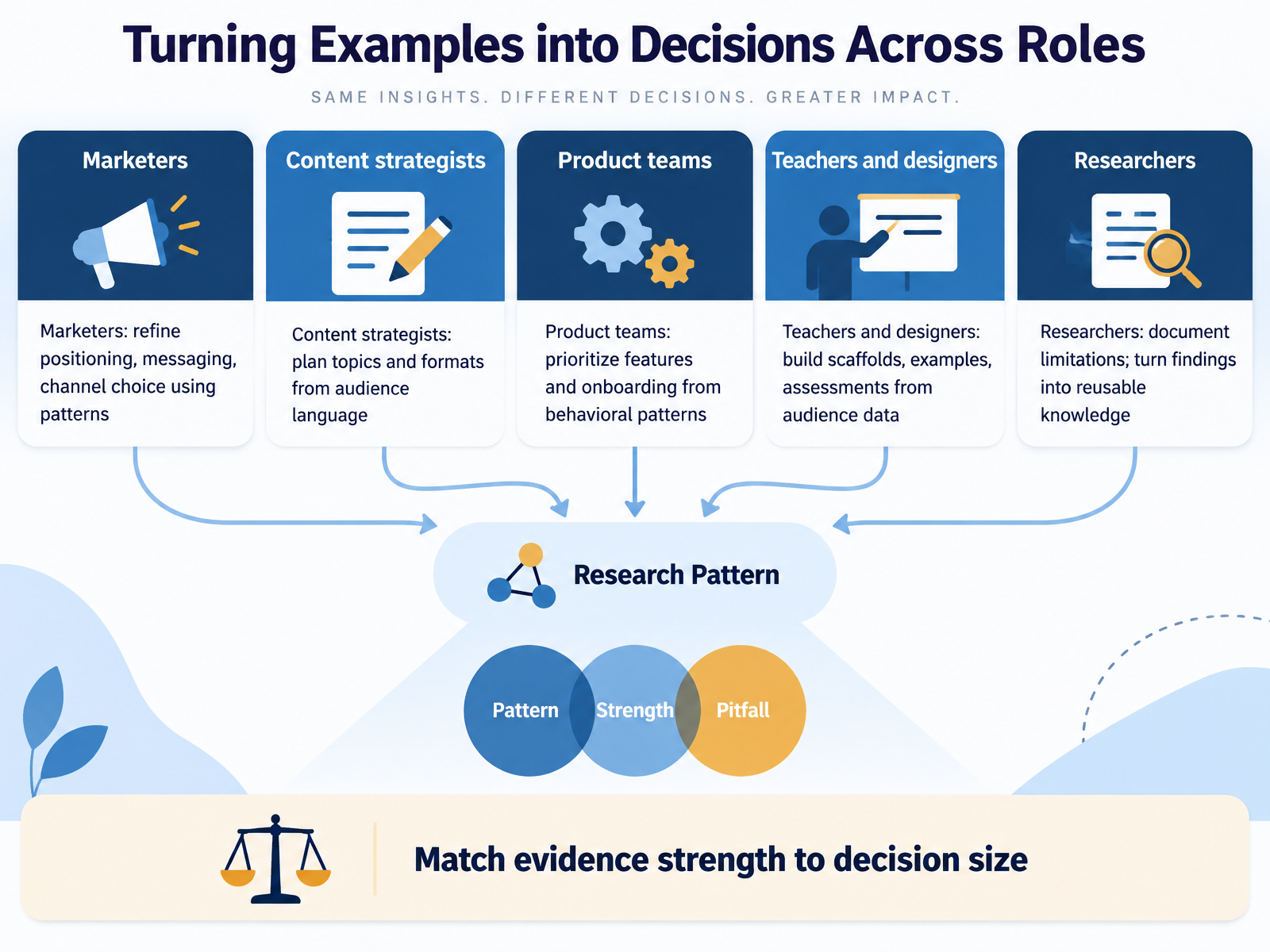
- 12Turning Examples into Decisions Across RolesSo how do these patterns actually turn into decisions? Let's walk through it by role. Marketers, you can use recurring patterns to refine positioning, sharpen messaging, and choose the right channels. If interviews keep showing that teachers trust peer recommendations over ads, that reshapes your channel mix. Content strategists, plan topics and formats straight from the language your audience already uses. When nine out of nine users describe the same moment in their workflow, that phrase becomes your headline. Product teams, let behavioral patterns set your feature priorities and shape onboarding around the real first step people take. Teachers and designers, build scaffolds, examples, and assessments from what your audience data reveals about where people struggle. And researchers, document your limitations and turn findings into reusable knowledge so the next study starts further ahead. Here's the guiding rule: match evidence strength to decision size. A handful of interviews is enough to test a message. A campaign budget or a roadmap commitment calls for larger validation. Small decision, small study. Big stakes, stronger evidence. Next, let's put this into practice. Practice Lab: Critique an Audience Research Example.
 freshegg.co.ukpmftracker.comannakhakho.substack.com+22 min
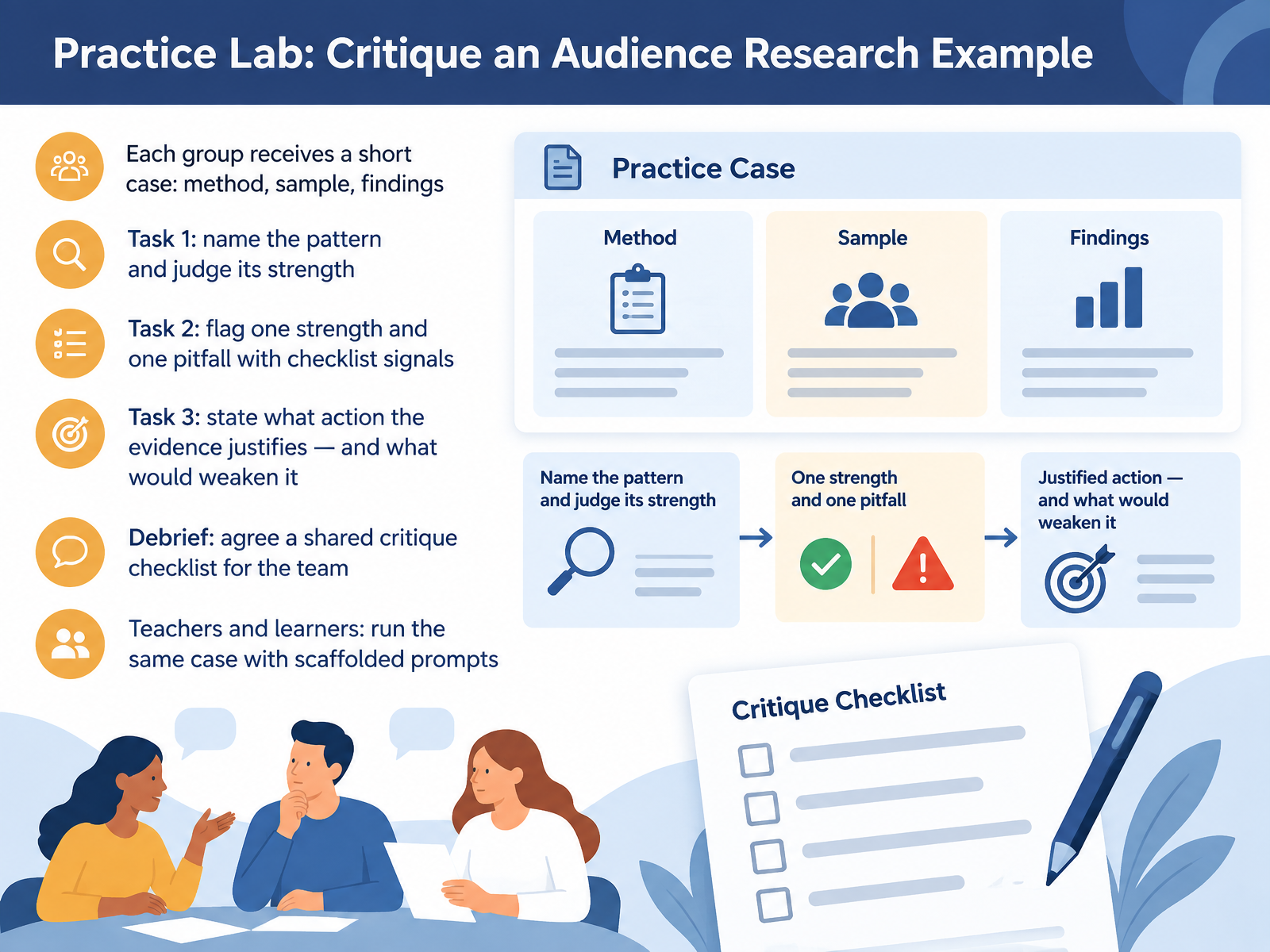
- 13Practice Lab: Critique an Audience Research ExampleNow let's put all of this into practice. In this lab, each group receives a short case with three things: the method, the sample, and the findings. Your first task is to name the pattern you see and judge how strong it really is. For example, if a team ran a quick five-person focus group and then claimed it reflects all young adults, your job is to say that pattern is suggestive, not conclusive. Task two: flag one strength and one pitfall, and point to the checklist signals that support your call. A strength might be a clear method; a pitfall might be a sample that skews toward one group. Task three: state what action the evidence actually justifies, and what new information would weaken that decision. So the question becomes, would you commit budget, adjust messaging, or hold off and test more? During the debrief, agree on a shared critique checklist your team can reuse. And if you are teaching or learning, you can run the same case with scaffolded prompts to guide each step. This turns one exercise into a reusable habit. Coming up next, Key Takeaways and Next Steps.
 2 min
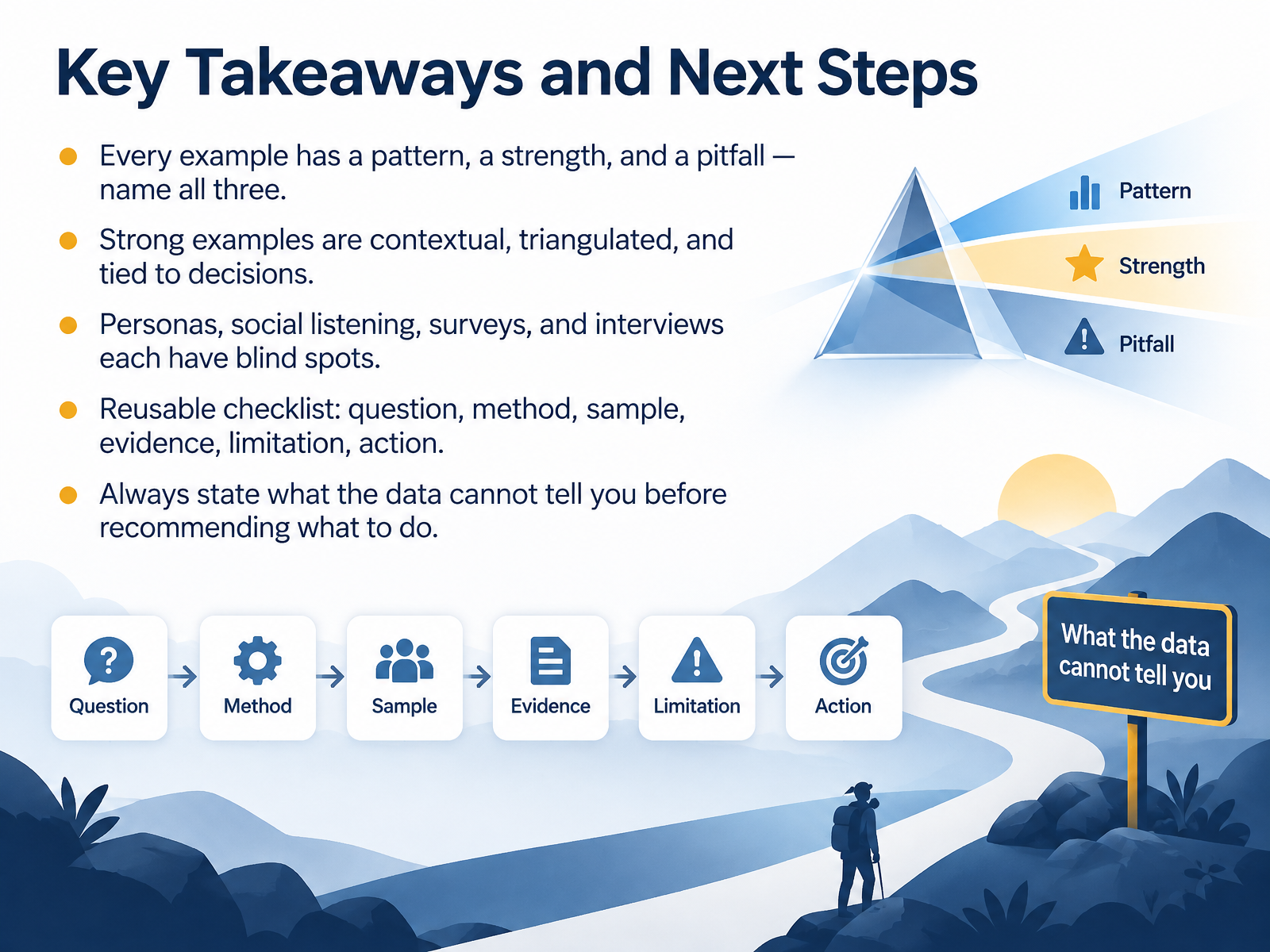
- 14Key Takeaways and Next StepsLet's bring it all together. First, every example you work with has a pattern, a strength, and a pitfall. Name all three out loud before you act on it. Second, strong examples are contextual, triangulated, and tied to a decision. A social listening spike tells you where to look. It does not tell you how big the issue is. Third, each method has blind spots. Personas can drift into stereotypes without real data. Surveys capture stated attitudes, not behavior. Interviews go deep with very few people. And social listening only sees public posts, often from a vocal minority. So keep this checklist handy: question, method, sample, evidence, limitation, action. And always state what the data cannot tell you before recommending what to do. That honesty builds trust and better decisions. Thank you for joining this course. You now have a practical way to read any audience research example with a sharper eye. Go try it on your next campaign or content plan, and keep asking what the data truly supports.
 freshegg.co.ukpmftracker.comannakhakho.substack.com+21 min
Take the deck with you
Download this course as a file — free, no sign-up needed.
- PDF handoutEvery slide page, ready to print or share.15 pages · 3.5 MBDownload
- Narrated PowerPointThe deck that presents itself — every slide carries the digital human's narration video.15 pages · 13.7 MBDownload
- PowerPoint slidesThe full deck as a .pptx — open it in PowerPoint, Keynote, or Google Slides.15 pages · 3.4 MBDownload
Free to use in your own training — please keep the PersonWise credit page at the end.
Have your own deck? Turn it into a course
Sources consulted
Web sources consulted while building this course.
- National Literacy Trust Persona & UX Research Project | Case Study | Fresh Egg | Fresh Egg — freshegg.co.uk
- How UX Pilot Found Its ICP in 9 Interviews | PMFtracker — pmftracker.com
- Case study. Entry-point segmentation for TripleTen: learning to recognize our student — annakhakho.substack.com
- PowerUpEDU | Reaching Core Customers Through Audience Personas - Between Pixels — betweenpixels.com
- Mac Purchase UX Research: Apple Case Study | MindMarket — mindmarket.com
- Case Study: a womenswear retailer defines its target audience with Savanta | CaseStudies.com — casestudies.com
- Case Study - Freely - Jobs to be Done — Waveform Insight — waveforminsight.com
- Waveform Case Study - ITVX - Jobs to be Done — Waveform Insight — waveforminsight.com
- Solving the segmentation challenge at Warner Bros in 2023 — merlien.com
- Oxfam - Audience research and segmentation to support a £400m ambition - Glew Marketing — glewmarketing.co.uk
- Jobs-to-be-done:–A new method to learn more about reasons for ticket purchases — exa.ai
- The Ultimate Guide: Jobs to be Done Interviews for Customer Development [with Templates] - Valchanova.me — valchanova.me
- Jobs to Be Done: An Innovative Needs Assessment Method for Supporting Extension Product and Program Design — exa.ai
- Jobs to Be Done and Demographic Segmentation Milkshake Case Study — research.mental-momentum.ai
- Jobs-to-be-done interviews: how to run them and analyse what you find — skimle.com
- Personas and Analytics: A Comparative User Study of Efficiency and Effectiveness for a User Identification Task | Proceedings of the 2020 CHI Conference on Human Factors in Computing Systems — dl.acm.org
- https://inria.hal.science/hal-04196842v1/file/520516_1_En_20_Chapter.pdf — inria.hal.science
- An international survey of practitioner's views on personas: benefits, resource demands and pitfalls — exa.ai
- The ability of personas: An empirical evaluation of altering incorrect preconceptions about users — bernardjjansen.com
- Persona Creation Based on Secondary Data: A Study on Perceived Reliability in UX design — exa.ai