Begin
14 pages · ~28 min
AI Tools for Generative Engine Optimization
This training helps marketers and content professionals use AI tools to optimize content for generative search engines and improve visibility in AI-generated results.
A digital instructor presents all 14 pages. Hold “Ask” at any point and ask out loud — the answer comes from this course. No sign-up needed.
What you’ll learn
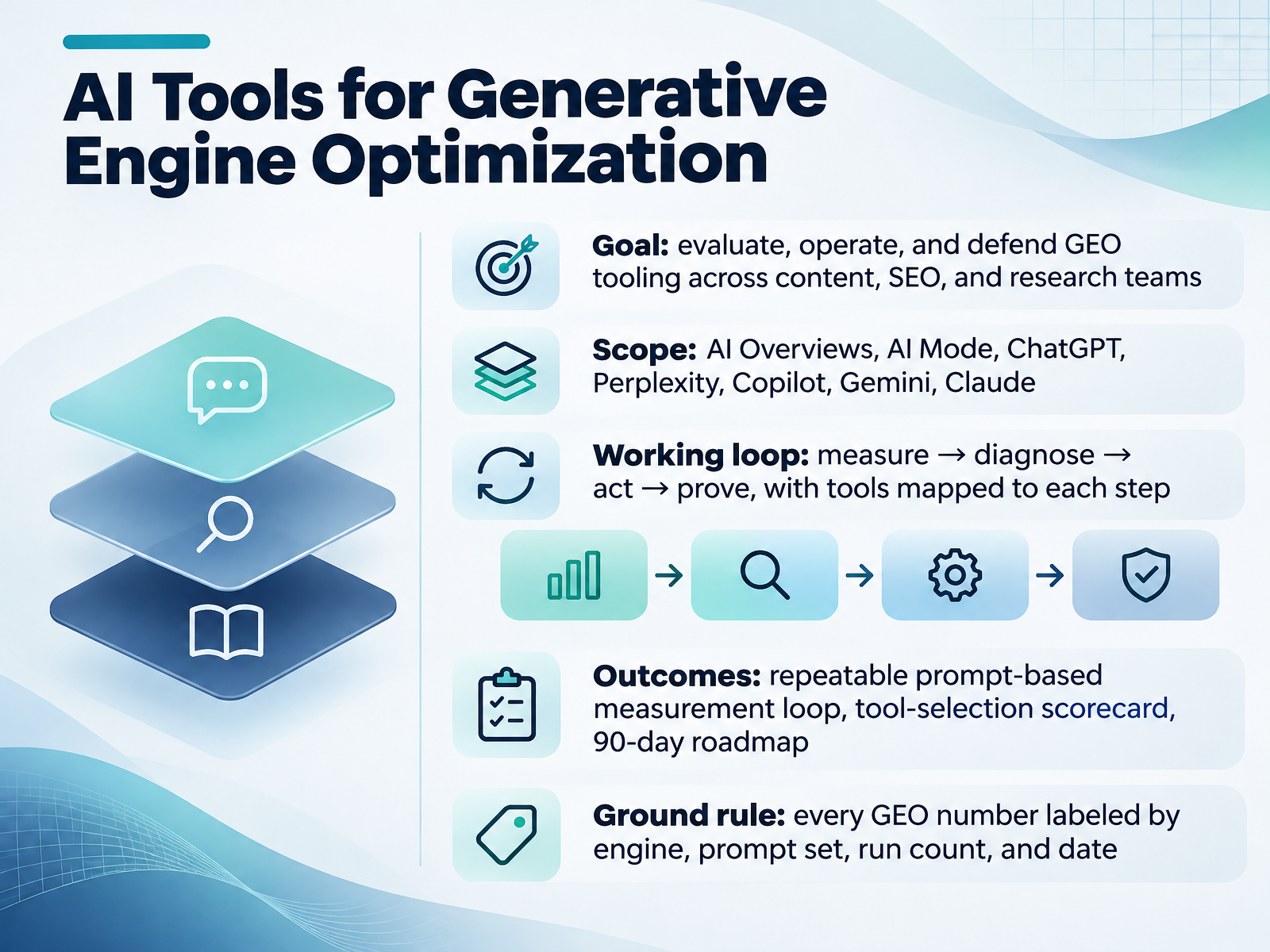
- 01AI Tools for Generative Engine OptimizationWelcome. This course is about choosing and running generative engine optimization tools without guesswork. Our goal is practical: evaluate, operate, and defend GEO tooling across your content, SEO, and research teams. We will cover AI Overviews, AI Mode, ChatGPT, Perplexity, Copilot, Gemini, and Claude. The working loop is measure, diagnose, act, prove, and we will map tools to each step. By the end you will have a repeatable prompt-based measurement loop, a tool-selection scorecard, and a ninety-day roadmap. One ground rule from the start. Every GEO number gets labeled by engine, prompt set, run count, and date. Otherwise you cannot compare results or defend them. Next, we will ground our terms with GEO, AEO, and SEO definitions and market context.martechseries.compresenc.aiansvisor.com+22 min
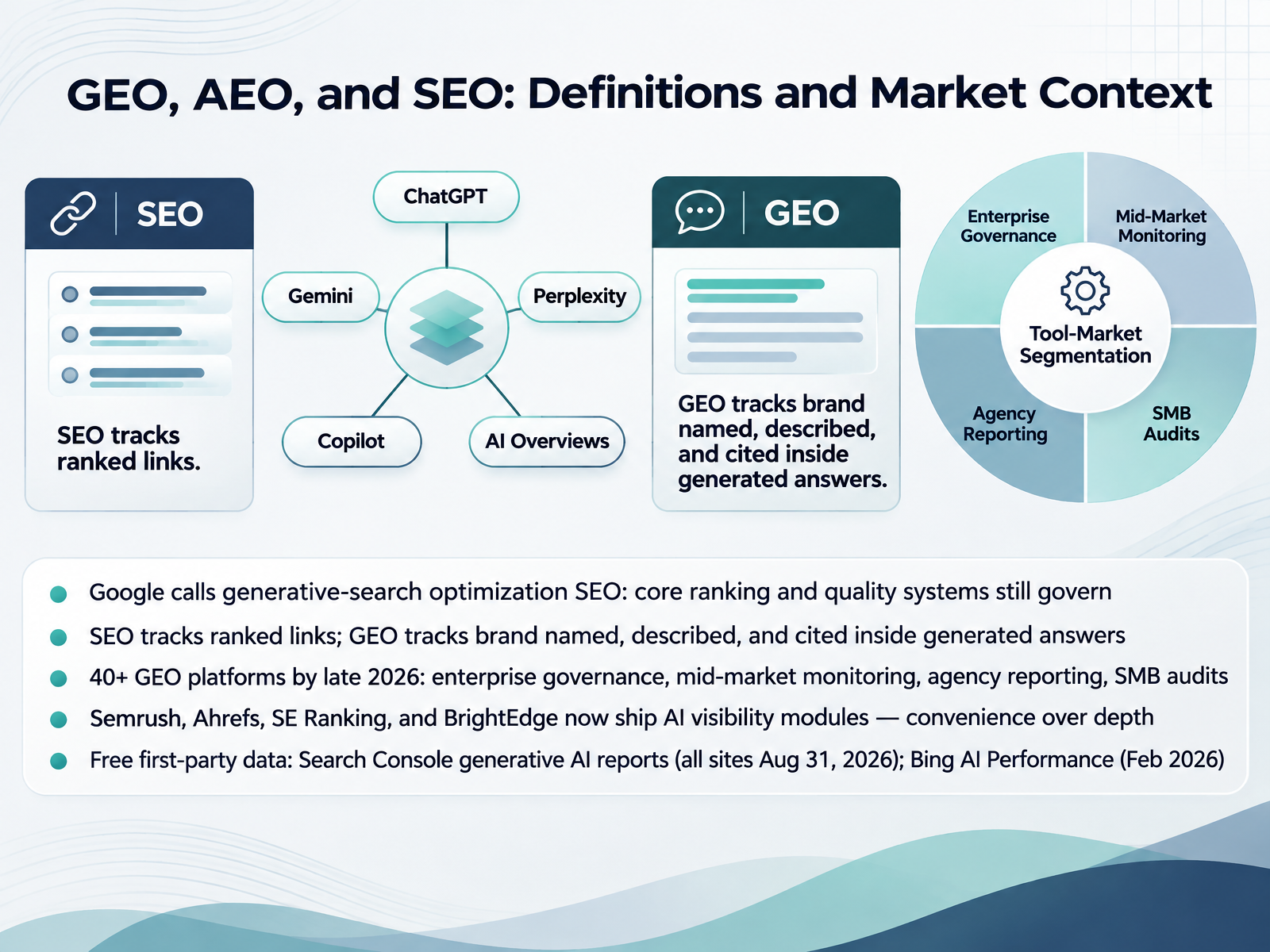
- 02GEO, AEO, and SEO: Definitions and Market ContextLet's get our terms straight. Google calls generative-search optimization SEO. The ranking and quality systems still govern retrieval, so indexing and snippet eligibility remain the floor. SEO tracks ranked links. GEO tracks whether your brand is named, described, and cited inside generated answers. By late 2026, more than 40 GEO platforms compete across four buyer clusters: enterprise governance, mid-market monitoring, agency reporting, and SMB audits. Semrush, Ahrefs, SE Ranking, and BrightEdge now ship AI visibility modules. They're convenient, but depth lags purpose-built trackers. Before you buy, check two free sources. Search Console generative AI reports opened to all sites on August thirty-first, 2026. Bing AI Performance arrived in February 2026 with citation-level data. Confirm both are verified this week. Next, we move from blue links to generated answers.
 martechseries.compresenc.aiansvisor.com+22 min
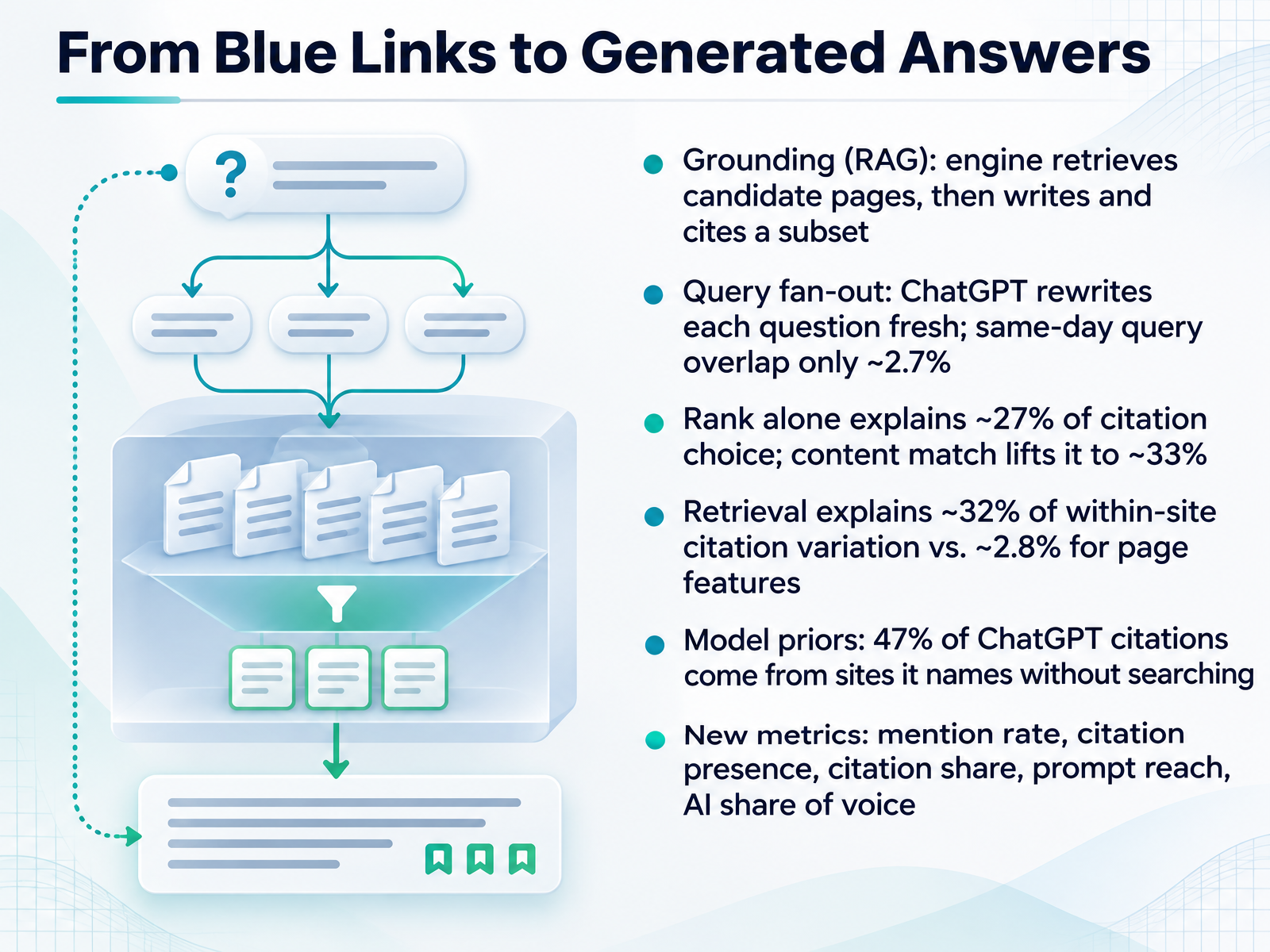
- 03From Blue Links to Generated AnswersLet's move from blue links to how answers actually get assembled. Most generative engines run grounding, or retrieval-augmented generation. The engine retrieves candidate pages, then writes and cites a subset. Two practical implications follow. First, query fan-out. ChatGPT rewrites each question fresh, and same-day query overlap is only about two point seven percent. So repeat runs can surface different sources, and one clean ranking test proves little. Second, ranking is not the whole story. Rank alone explains roughly twenty-seven percent of citation choice, and content match lifts that to about thirty-three percent. Retrieval explains about thirty-two percent of within-site citation variation, against roughly two point eight percent for page features. Model priors matter too. Forty-seven percent of ChatGPT citations come from sites it names without searching. So add new metrics to your dashboard: mention rate, citation presence, citation share, prompt reach, and AI share of voice. Track them per engine, per prompt set, and per week. Next, we map the tool landscape.
 arxiv.orgarxiv.orgproceedings.mlr.press+22 min
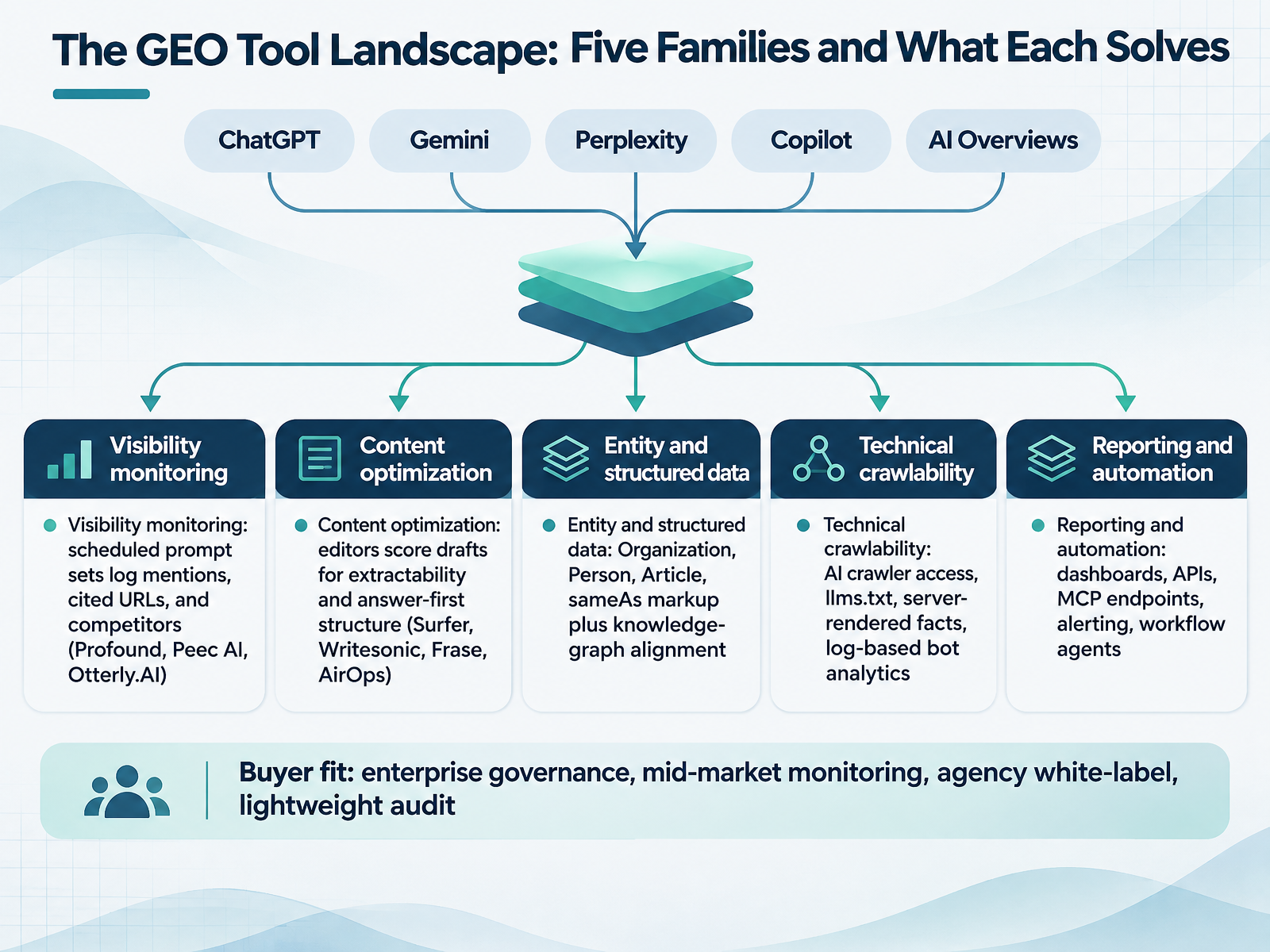
- 04The GEO Tool Landscape: Five Families and What Each SolvesLet's map the tool market by job, not by feature list. Five families matter. First, visibility monitoring. Scheduled prompt sets log mentions, cited URLs, and competitors. Think Profound, Peec AI, Otterly dot A I. Second, content optimization. Editors score drafts for extractability and answer-first structure, tools like Surfer, Writesonic, Frase, and AirOps. Third, entity and structured data. That means Organization, Person, and Article markup, plus sameAs and knowledge-graph alignment. Fourth, technical crawlability. Check AI crawler access, llms dot t x t, server-rendered facts, and log-based bot analytics. Fifth, reporting and automation. Dashboards, APIs, M C P endpoints, alerting, and workflow agents. Now match family to buyer. Enterprise governance sits with monitoring-plus-compliance platforms. Mid-market teams want affordable monitoring. Agencies need white-label reporting. Lightweight audits suit single-site teams. Write your buyer profile down, then shortlist two vendors per family you actually need.
 martechseries.compresenc.aiansvisor.com+22 min
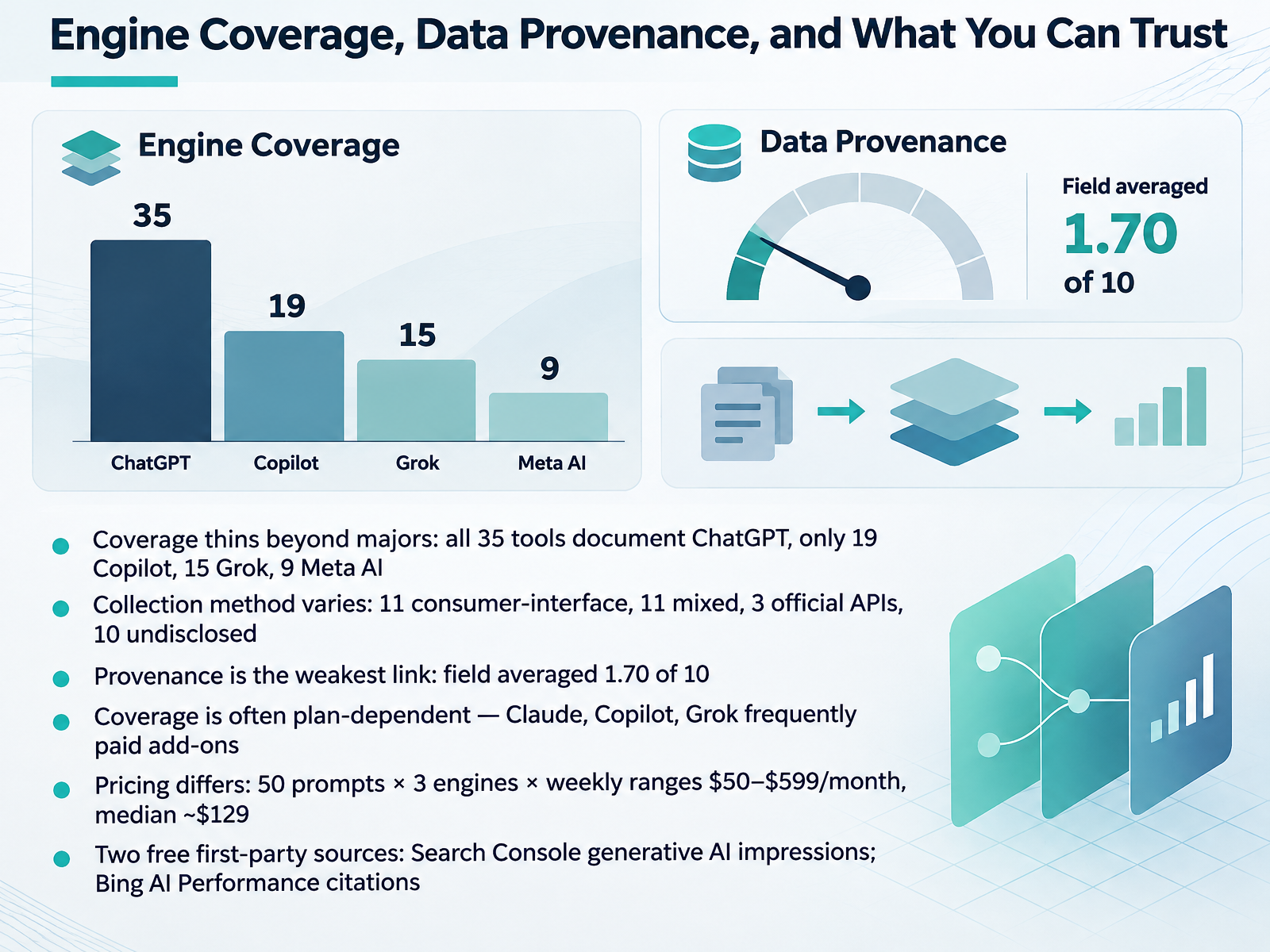
- 05Engine Coverage, Data Provenance, and What You Can TrustNow let's look at what you can actually trust in this toolset. Coverage thins beyond the majors. All thirty five tools document ChatGPT. Only nineteen document Copilot, fifteen document Grok, and nine cover Meta AI. Collection method matters too. Eleven tools capture the consumer interface, eleven mix methods, only three use official APIs, and ten don't disclose how they collect answers.
Provenance is the weakest link. The field averaged one point seven out of ten. Coverage is often plan-dependent, so check whether Claude, Copilot or Grok are paid add-ons. Pricing also diverges. Fifty prompts across three engines, checked weekly, ranges from fifty to five hundred ninety nine dollars a month, with a median around one hundred twenty nine.
Before you buy, start with the two free first-party sources. Search Console reports generative AI impressions. Bing Webmaster Tools AI Performance reports citations. Use both as your trust baseline.
Next, we move into the baseline audit, defining prompts and measuring AI visibility.
 zapier.comsurfer.airankability.com+22 min
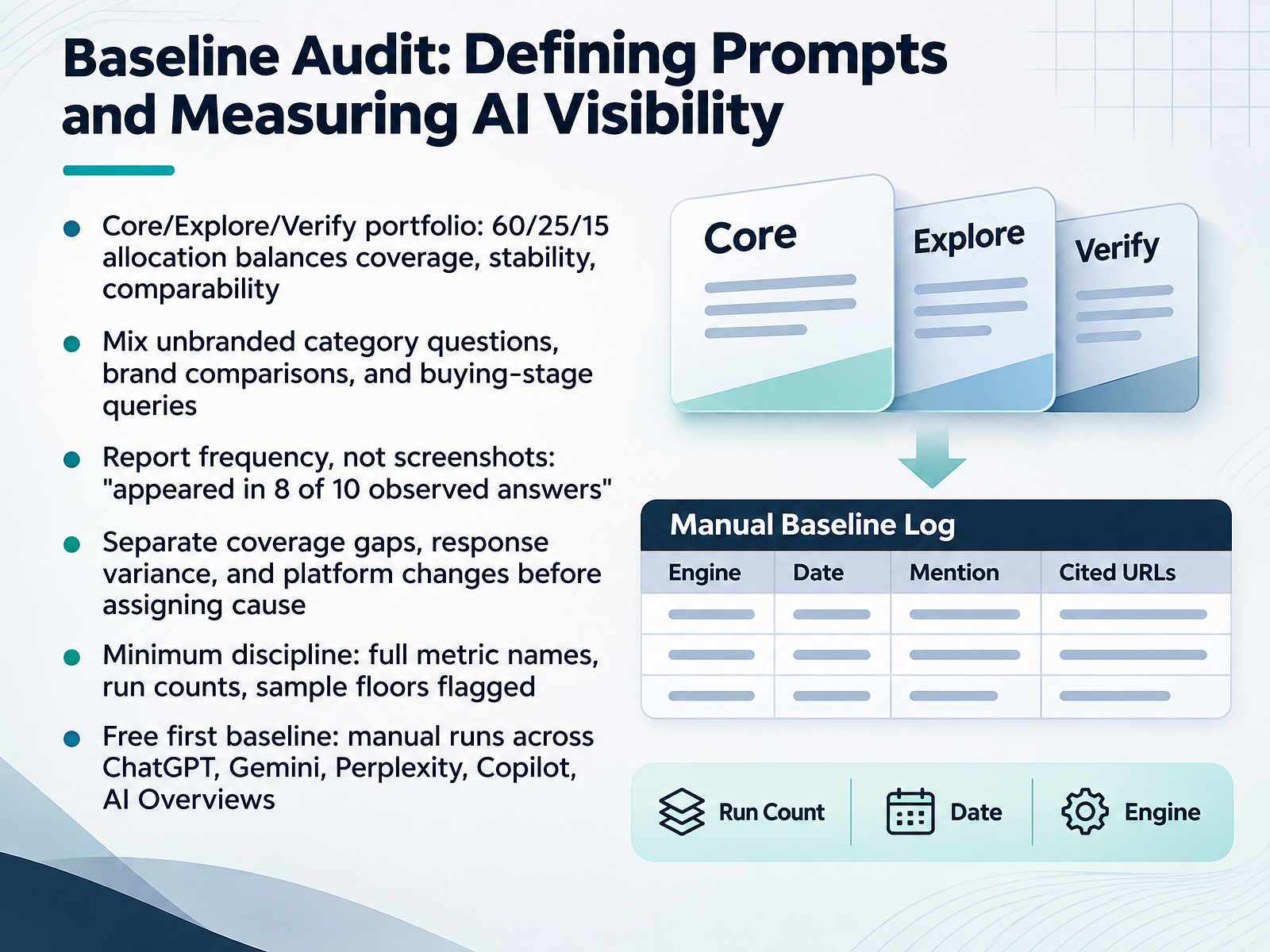
- 06Baseline Audit: Defining Prompts and Measuring AI VisibilityNow let's set your baseline audit. Start with a Core, Explore, Verify portfolio at roughly sixty, twenty-five, and fifteen percent. That split balances coverage, stability, and comparability. Mix unbranded category questions with brand comparisons and buying-stage queries. Report frequency, not screenshots. Say your brand appeared in eight of ten observed answers. When results move, separate coverage gaps, response variance, and platform changes before you assign cause. Full metric names, run counts, and sample floors flagged are your minimum discipline. And your first baseline can be free: manual runs across ChatGPT, Gemini, Perplexity, Copilot, and AI Overviews. Next, we'll look at Content Formats That Earn Citations.
 semrush.comadviora.aisearchengineland.com+21 min
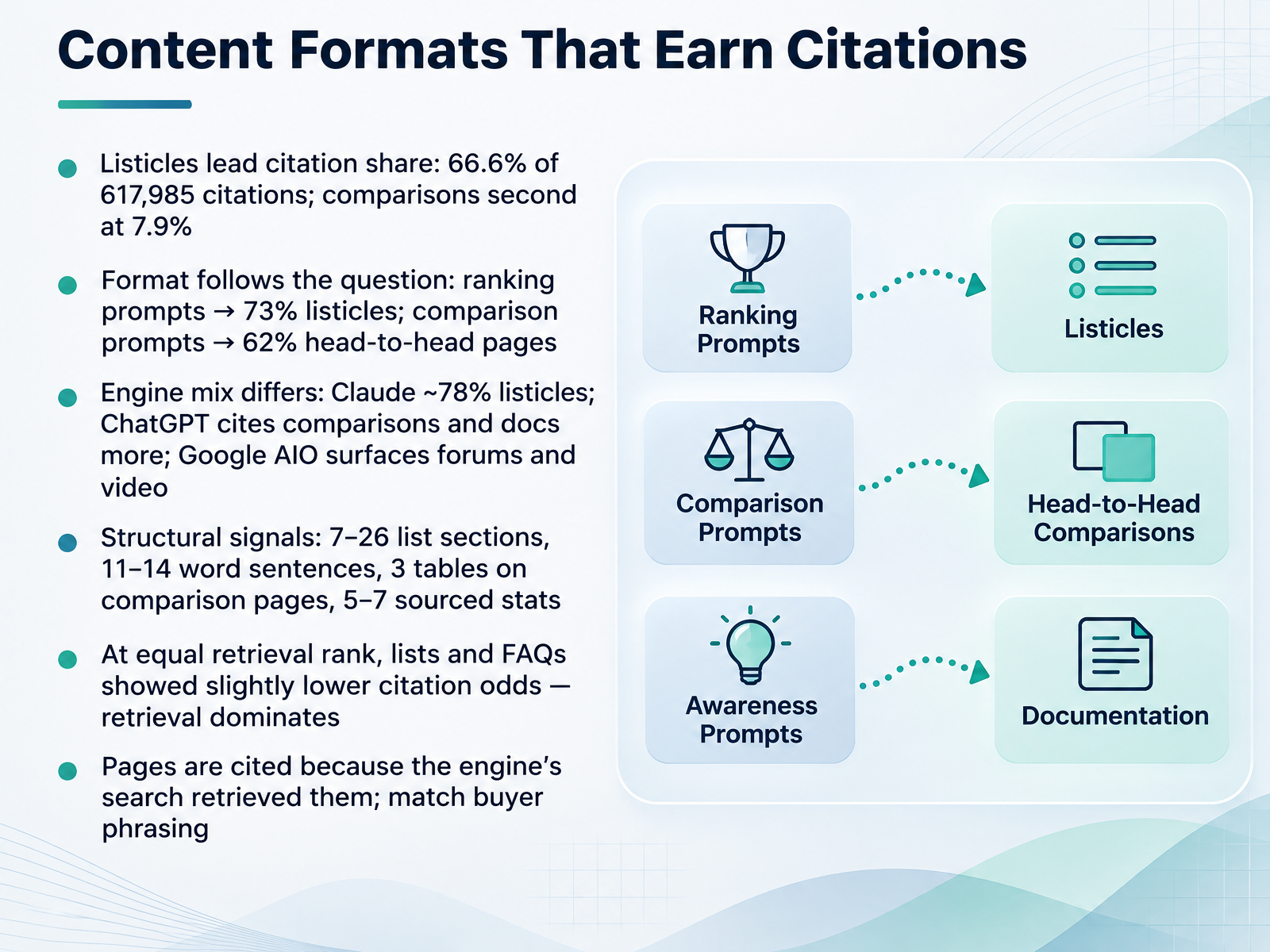
- 07Content Formats That Earn CitationsNow let's look at the formats that actually earn citations. In one study of six hundred seventeen thousand citations, listicles took sixty six point six percent, and comparisons came second at seven point nine percent. Format follows the question. For ranking prompts, seventy three percent of cited pages were listicles. For comparison prompts, sixty two percent were head-to-head pages. Engine mix differs. Claude cites roughly seventy eight percent listicles. ChatGPT leans toward comparisons and documentation. Google AI Overviews surfaces forums and video. Structural signals matter too. Aim for seven to twenty six list sections, sentences averaging eleven to fourteen words, three tables on comparison pages, and five to seven sourced stats. But here is the caveat. At equal retrieval rank, lists and FAQs showed slightly lower citation odds. Retrieval dominates. Pages get cited because the engine's search retrieved them. So match buyer phrasing in your titles and paragraphs. Your check for this week is simple. Pull your top ranking prompts, confirm the cited pages are listicles, and rewrite any comparison pages with tables. Next, we move into answer-first writing and entity clarity.
 arxiv.orgarxiv.orgproceedings.mlr.press+22 min
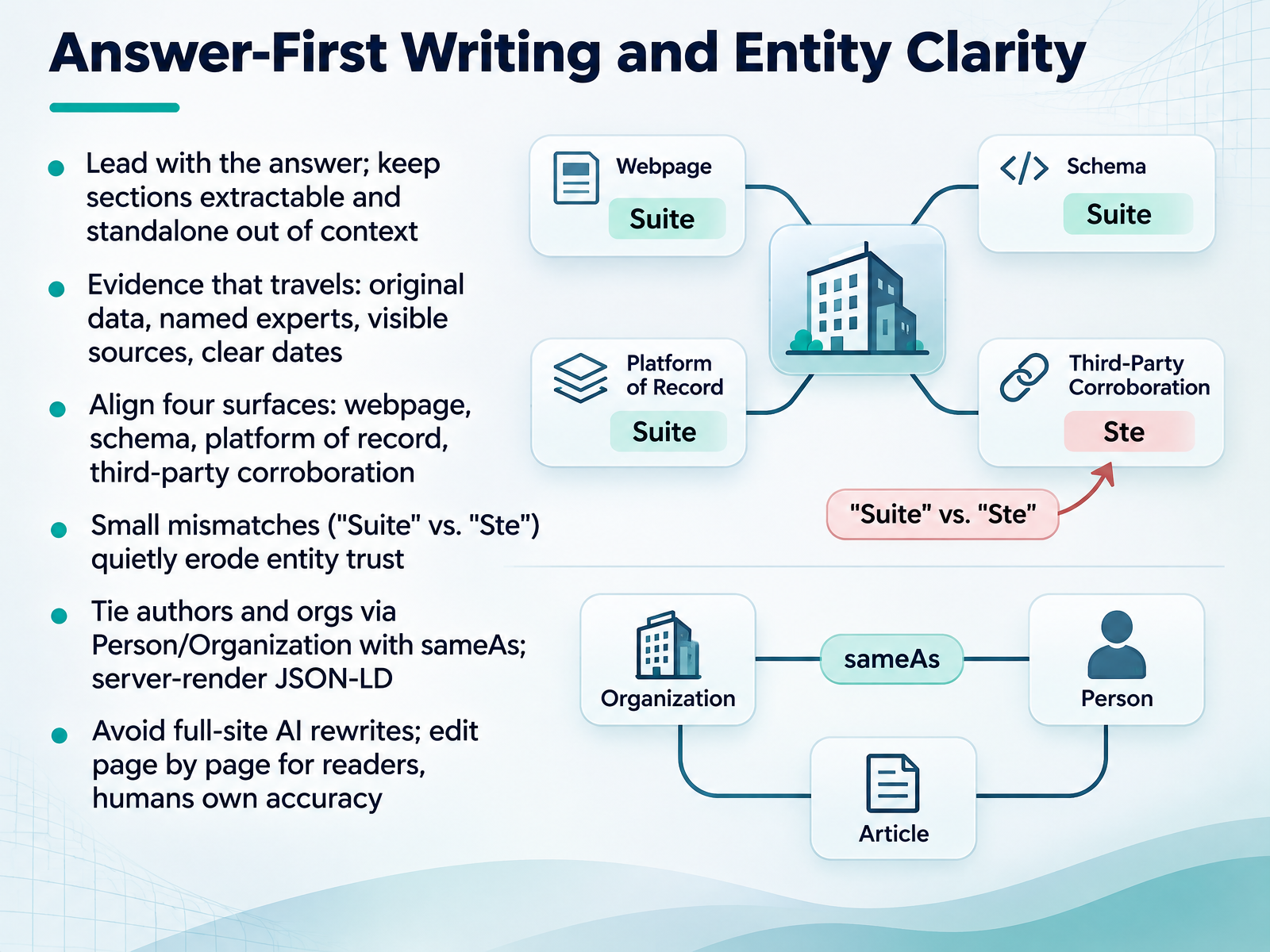
- 08Answer-First Writing and Entity ClarityNext, let's talk about answer-first writing and entity clarity. Lead every section with the answer, and keep each section standalone, so a retrieved passage still makes sense out of context. Make your evidence travel: original data, named experts, visible sources, and clear dates. Now align four surfaces: the webpage, the schema, the platform of record, and third-party corroboration. Small mismatches erode entity trust. Suite on the page versus Ste in the markup is enough to create doubt. Tie authors and organizations together with Person and Organization markup and sameAs links, and server-render your JSON-LD. Avoid full-site AI rewrites. Edit page by page for readers, and let humans own accuracy. So check your next article for that Suite versus Ste mismatch, and confirm its JSON-LD arrives in the server HTML. Coming up next, Technical Readiness: Crawlers, robots dot txt, and Structured Data.
 arxiv.orgarxiv.orgproceedings.mlr.press+22 min
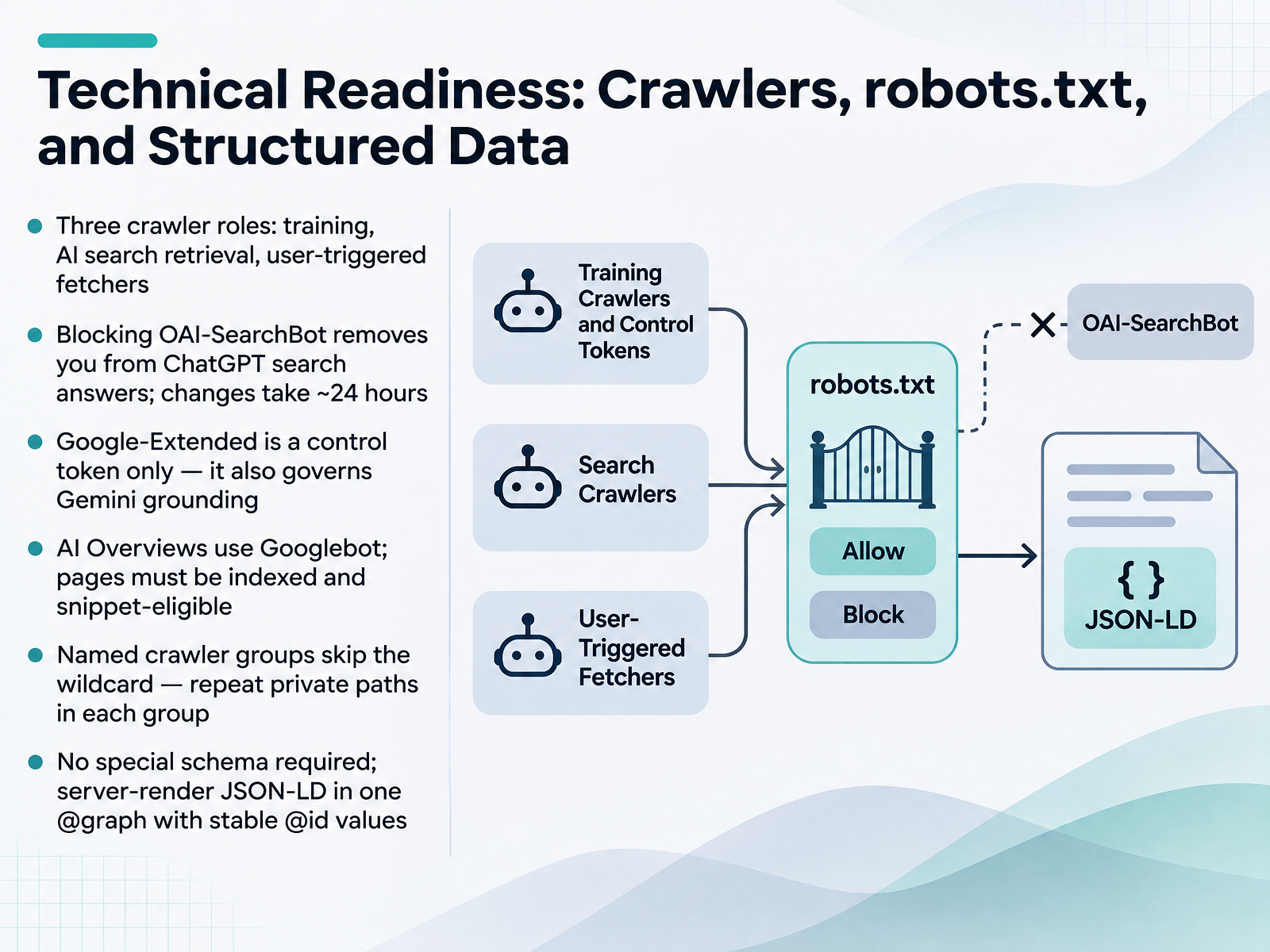
- 09Technical Readiness: Crawlers, robots.txt, and Structured DataNow let's look at technical readiness: crawlers, robots dot text, and structured data. Start with the three crawler roles. Training crawlers collect pages for models. AI search crawlers index pages so answers can cite them. User-triggered fetchers open a page when someone asks about it. Blocking OAI-SearchBot removes you from ChatGPT search answers, so verify that group in robots dot text. Changes take about twenty-four hours. Google-Extended is a control token only. It also governs Gemini grounding, so treat it as a separate decision. AI Overviews use Googlebot. Your pages must be indexed and snippet-eligible. One check worth running: named crawler groups skip the wildcard. Repeat your private paths inside every named group. No special schema is required. Server-render JSON-LD in one graph, with stable identifiers, so crawlers that skip JavaScript still read it. Confirm that in your rendered HTML. Next, Monitoring, Alerting, and Reporting.
 1 min
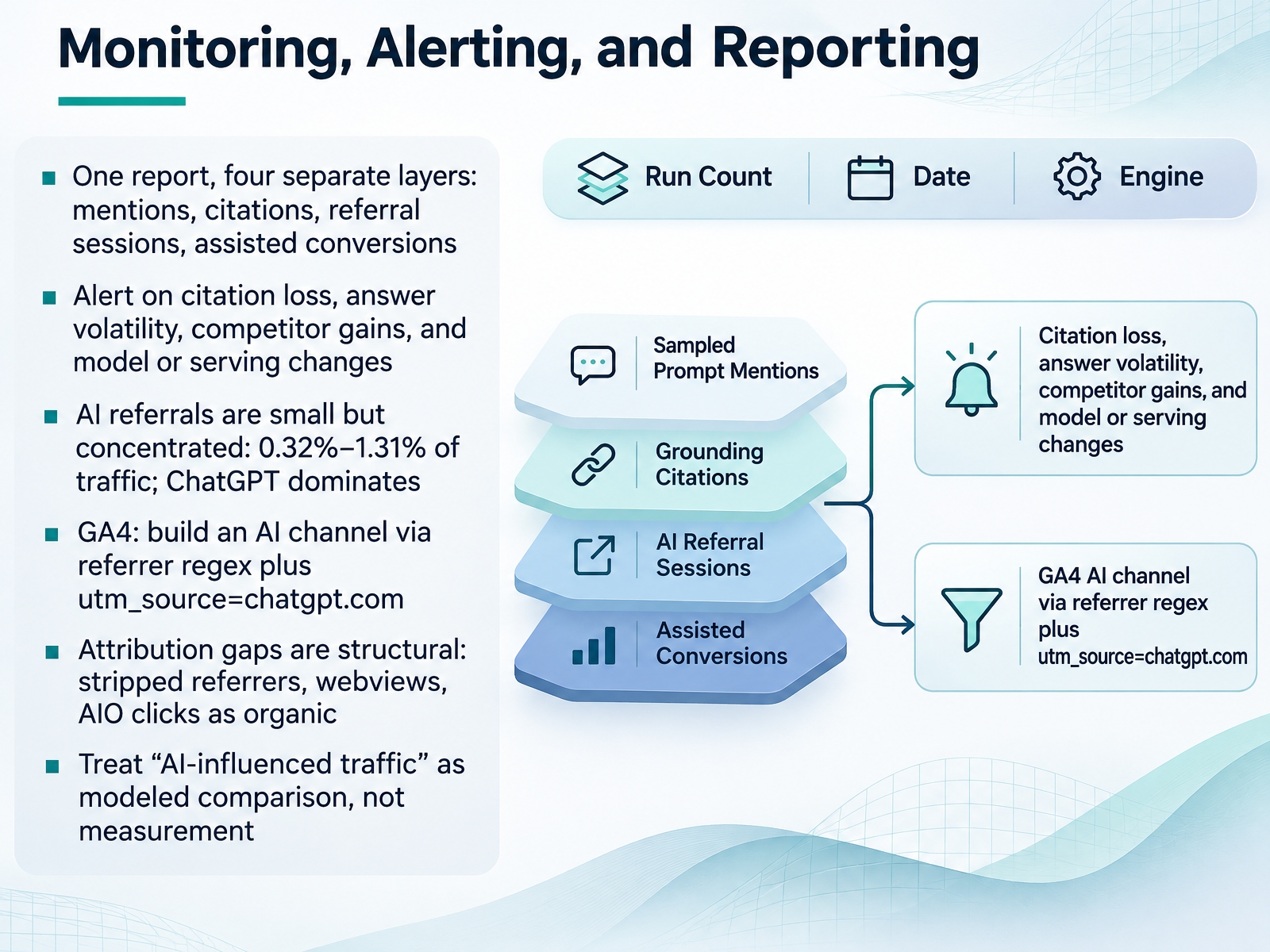
- 10Monitoring, Alerting, and ReportingNext, let's turn measurement into monitoring. Keep one report with four separate layers: mentions, citations, referral sessions, and assisted conversions. Never merge them into a single score. Then set alerts on citation loss, answer volatility, competitor gains, and model or serving changes. AI referrals are small but concentrated. Across major studies they run roughly zero point three two percent to one point three one percent of traffic, and ChatGPT dominates. In GA4, build an AI channel using a referrer regex plus utm source equals chatgpt dot com. Expect attribution gaps. Stripped referrers, webviews, and AI Overview clicks counted as organic will hide sessions. So treat AI-influenced traffic as a modeled comparison, not a measurement. You can now check your four layers and confirm your alerts fire on citation loss. That sets up governance, risk, and quality controls.
 zapier.comsurfer.airankability.com+22 min
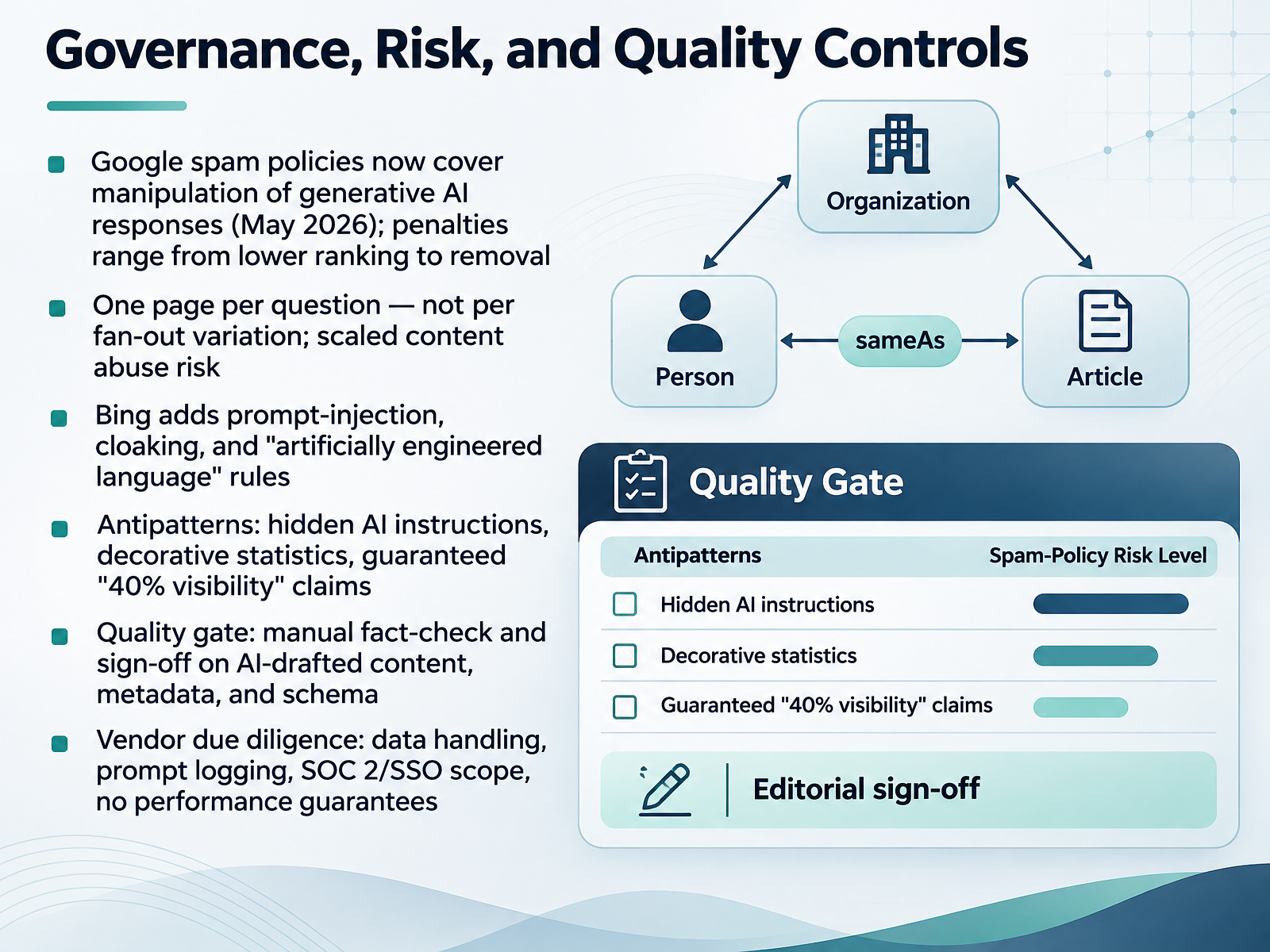
- 11Governance, Risk, and Quality ControlsNext, let's talk about governance, risk, and quality controls. As of May 2026, Google's spam policies explicitly cover manipulation of generative AI responses. Penalties range from lower ranking to full removal, so treat visibility in AI Overviews as earned, not engineered. Build one page per distinct question, not one page per fan-out variation. That pattern is scaled content abuse. Bing now adds prompt injection, cloaking, and artificially engineered language rules to its own guidelines. Watch for three antipatterns. Hidden AI instructions, decorative statistics, and guaranteed forty percent visibility claims. Set a quality gate: manual fact-check and written sign-off on AI-drafted content, metadata, and schema before publishing. And run vendor due diligence on data handling, prompt logging, SOC two and single sign-on scope. No vendor should promise performance. Now let's turn to the ninety day rollout, starting with our implementation roadmap.
 2 min
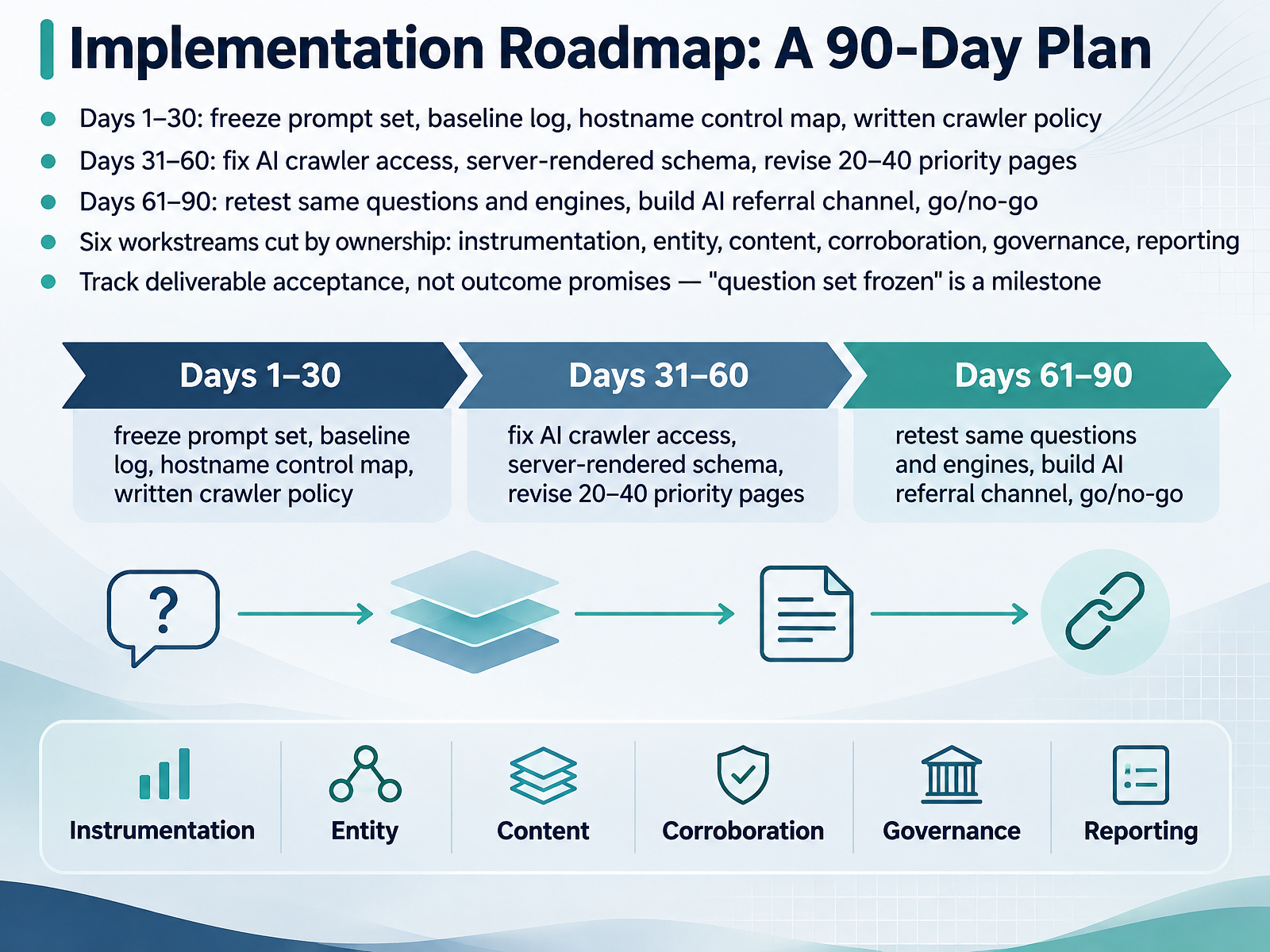
- 12Implementation Roadmap: A 90-Day PlanNow let's put this into a ninety-day plan you can actually accept. Days one to thirty: freeze your prompt set, build the baseline log, map hostname control, and publish a written crawler policy. Days thirty-one to sixty: fix AI crawler access, ship server-rendered schema, and revise twenty to forty priority pages through the substantiation gate. Days sixty-one to ninety: retest the same questions on the same engines, stand up an AI referral channel, then make a go or no-go call. Six workstreams, cut by ownership, not by tactic: instrumentation, entity, content, corroboration, governance, reporting. Each has a named owner, because ownership is what blocks enterprises. And here is the discipline that matters: track deliverable acceptance, not outcome promises. The question set frozen is a milestone. Visibility up by some percent is not. Write schedules that list actions, never outcomes. Next, we move to the Tool Selection Scorecard.
 nomahq.appnicklafferty.commartechseries.com+22 min
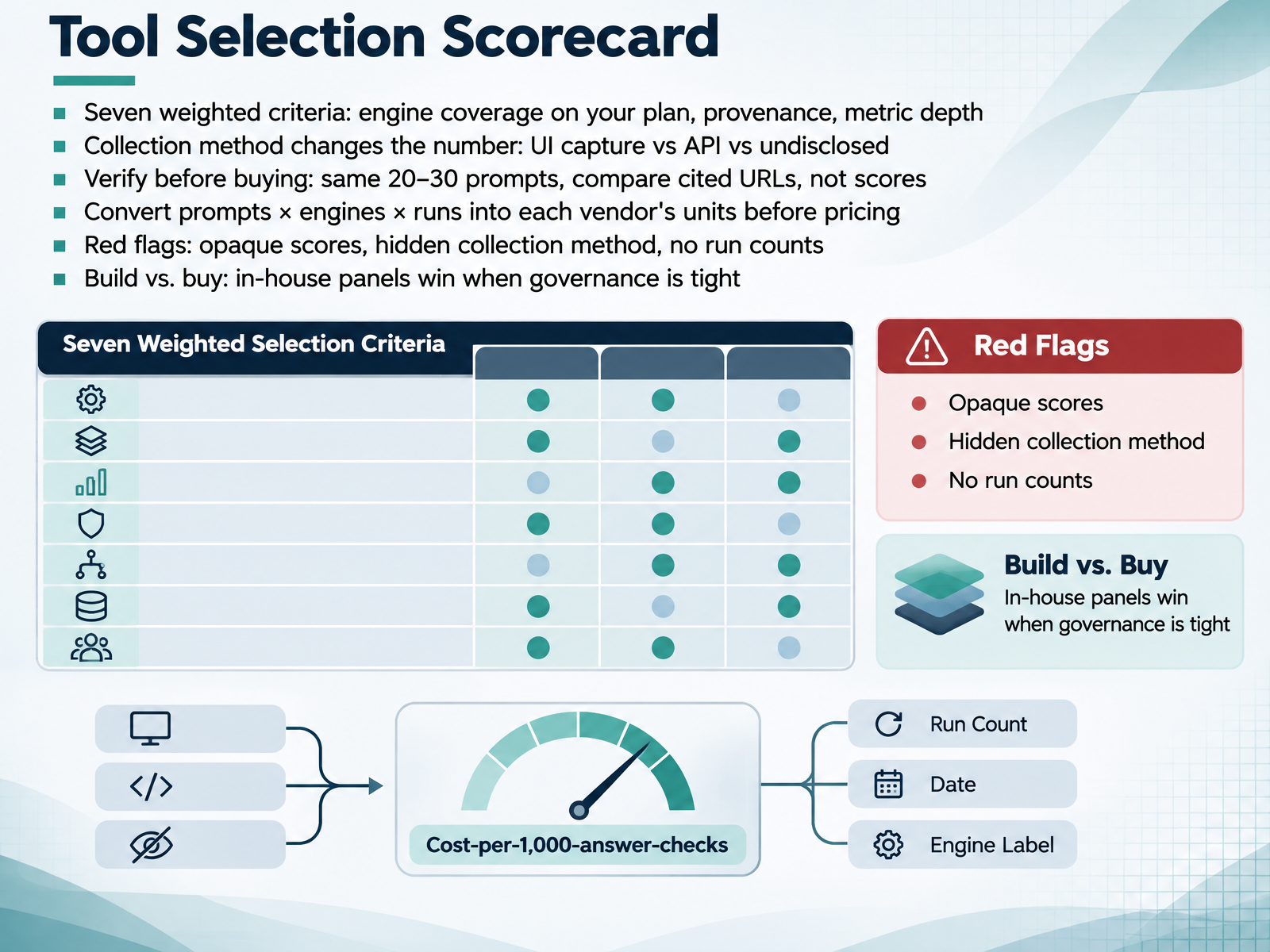
- 13Tool Selection ScorecardNow let's talk tool selection, and how to score vendors before you commit budget. Build your scorecard on seven weighted criteria. Start with engine coverage on the plan you would actually buy, then provenance, then metric depth. Collection method changes the number: consumer interface capture, API calls, and undisclosed methods all give different answers. One source found that roughly seventy five percent of brands named via APIs did not match what the real interfaces showed. So verify before buying. Run the same twenty to thirty prompts across vendors, and compare cited URLs, not scores. Convert prompts times engines times runs into each vendor's units before you discuss pricing. Treat these as red flags: opaque scores, a hidden collection method, and no published run counts. On build versus buy, in-house panels win when governance is tight. You can now shortlist two or three tools and book the same prompt test with each one. Next, we move to the Hands-On Lab and Assessment.
 zapier.comsurfer.airankability.com+22 min
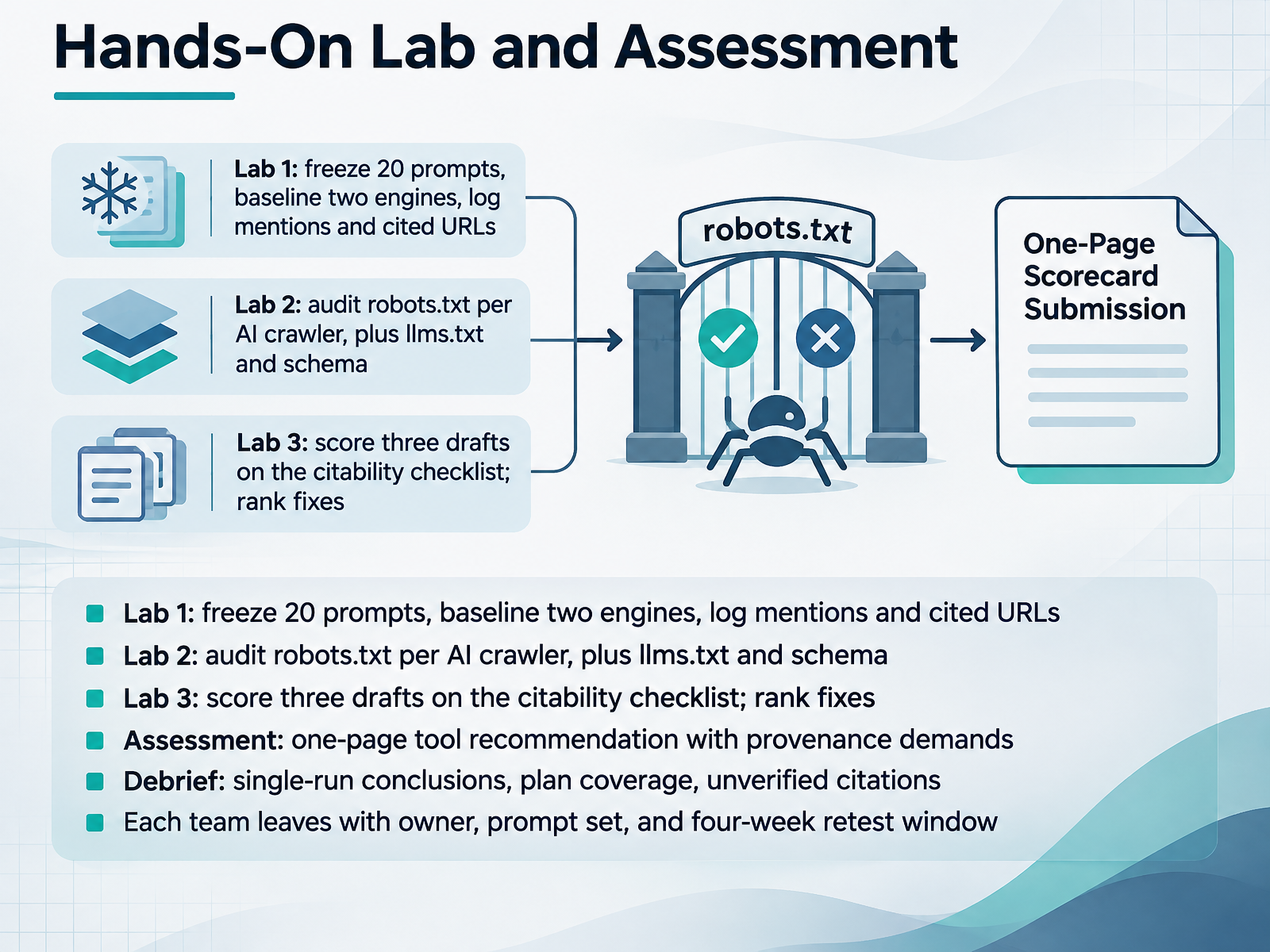
- 14Hands-On Lab and AssessmentLet's put this into practice. In Lab one, freeze twenty prompts, baseline two engines, and log every mention and cited URL. Run the same prompts more than once, so you can report frequency, not a single snapshot. In Lab two, audit robots.txt per AI crawler. Check OAI-SearchBot and Googlebot separately, then confirm llms.txt and your schema. In Lab three, score three drafts on the citability checklist and rank the fixes. For the assessment, write a one-page tool recommendation with provenance demands. For debrief, flag single-run conclusions, plan coverage gaps, and unverified citations. Every team leaves with an owner, a frozen prompt set, and a four-week retest window. That is your loop for the next month. Thank you for the work you brought today. Keep the discipline of repeated checks, and your visibility reporting will hold up when someone asks how you know.
 semrush.comadviora.aisearchengineland.com+22 min
Take the deck with you
Download this course as a file — free, no sign-up needed.
- PDF handoutEvery slide page, ready to print or share.15 pages · 3.8 MBDownload
- Narrated PowerPointThe deck that presents itself — every slide carries the digital human's narration video.15 pages · 14.3 MBDownload
- PowerPoint slidesThe full deck as a .pptx — open it in PowerPoint, Keynote, or Google Slides.15 pages · 3.7 MBDownload
Free to use in your own training — please keep the PersonWise credit page at the end.
Have your own deck? Turn it into a course
Sources consulted
Web sources consulted while building this course.
- Generative Engine Optimization Goes Mainstream: The 2026 AI-Visibility ... — martechseries.com
- GEO Tools Landscape 2026, 40+ Platform Map | Presenc AI — presenc.ai
- The Complete AI SEO Tools List (2026): AEO and GEO Tools - Ansvisor — ansvisor.com
- The 13 Best AEO & GEO Tools for Marketers in 2026 (Categorized by ... — nicklafferty.com
- Generative Engine Optimization Tools 2026: 12 GEO Tool Picks — nomahq.app
- What Drives AI Citations? Content, Retrieval and Model Knowledge in Generative Engine Optimization (GEO) — arxiv.org
- Understanding ChatGPT Citations: Evidence from Production Web Search Across Model Generations — arxiv.org
- Auditing Citation Behavior in AI-Generated Search Summaries: A Framework and a Case Study of Google AI Overviews — proceedings.mlr.press
- Answer Bubbles: Information Exposure in AI-Mediated Search — aclanthology.org
- From Citation Selection to Citation Absorption: A Measurement Framework for Generative Engine Optimization Across AI Search Platforms — arxiv.org
- The 9 best AI visibility tools in 2026 — zapier.com
- 14 Best AI Visibility Tools in 2026: LLM Trackers Compared - Surfer AI — surfer.ai
- 21 Best AI Visibility Tracker Tools for AI Search (2026) — rankability.com
- Best AI Visibility Tools in 2026, Compared | RankControl Blog — rctrl.com
- Best AI Visibility Tools (2026): 10 Tools Compared – Goldie Agency — goldie.agency
- Prompt tracking methodology to measure AI visibility — semrush.com
- AI Visibility Research Methodology v1.0 — adviora.ai
- How to measure prompt-level visibility in AI search — searchengineland.com
- How to Choose Prompts to Track for AI Visibility | Omnius — omnius.so
- AI search tracking tools: How to track your brand’s presence in answer engines — blog.hubspot.com