Migration in World History
Begin
14 pages · ~28 min
Migration in World History
Explore the causes and effects of human migration across world history, examining major population movements and their global impacts.
What you’ll learn
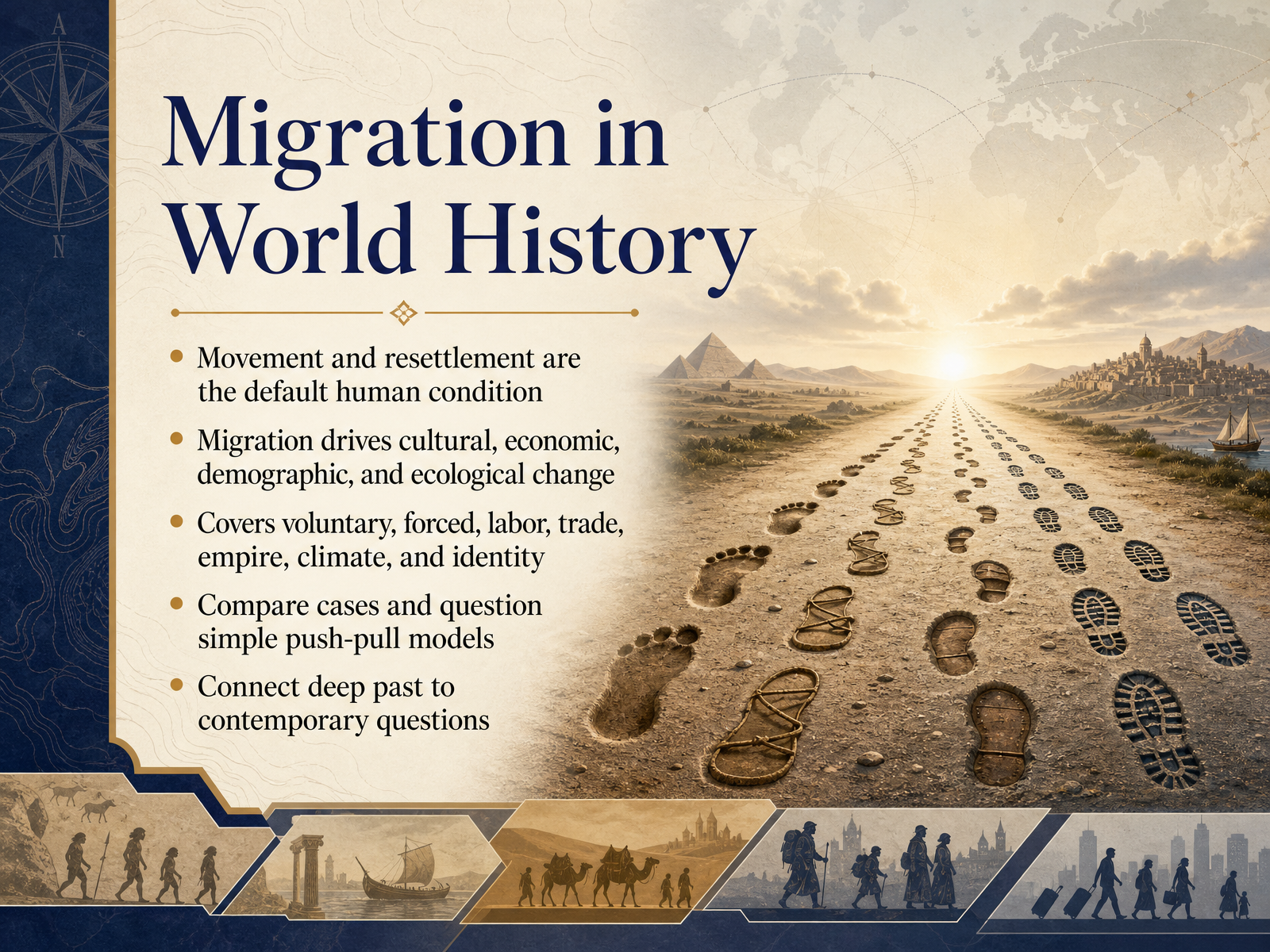
- 01Migration in World HistoryWelcome to Migration in World History. In this course, we are going to treat movement and resettlement not as an exception, but as the default human condition. From the first Homo sapiens who walked out of Africa more than seventy thousand years ago, to farmers opening new fields, to merchants, laborers, refugees, and exiles crossing oceans in the nineteenth and twentieth centuries. Migration has shaped cultural, economic, demographic, and ecological change on every inhabited continent. We will look carefully at voluntary movement, forced displacement, labor migration, trade routes, empire building, climate pressures, and the formation of diasporas. Along the way, I want us to do something historians find essential. We will compare cases across time and place, and we will question simple explanations. The old push pull model is a useful shorthand, but it often misses human agency, networks, and the resources people need in order to move at all. Consider how often leaving home is not a simple reflex, but an investment, a family strategy, or an act of hope. Our goal is to connect the deep past to the questions people ask today about borders, belonging, and movement. Next, we will begin with core concepts and categories.cambridge.orglink.springer.comuniversiteitleiden.nl+22 min
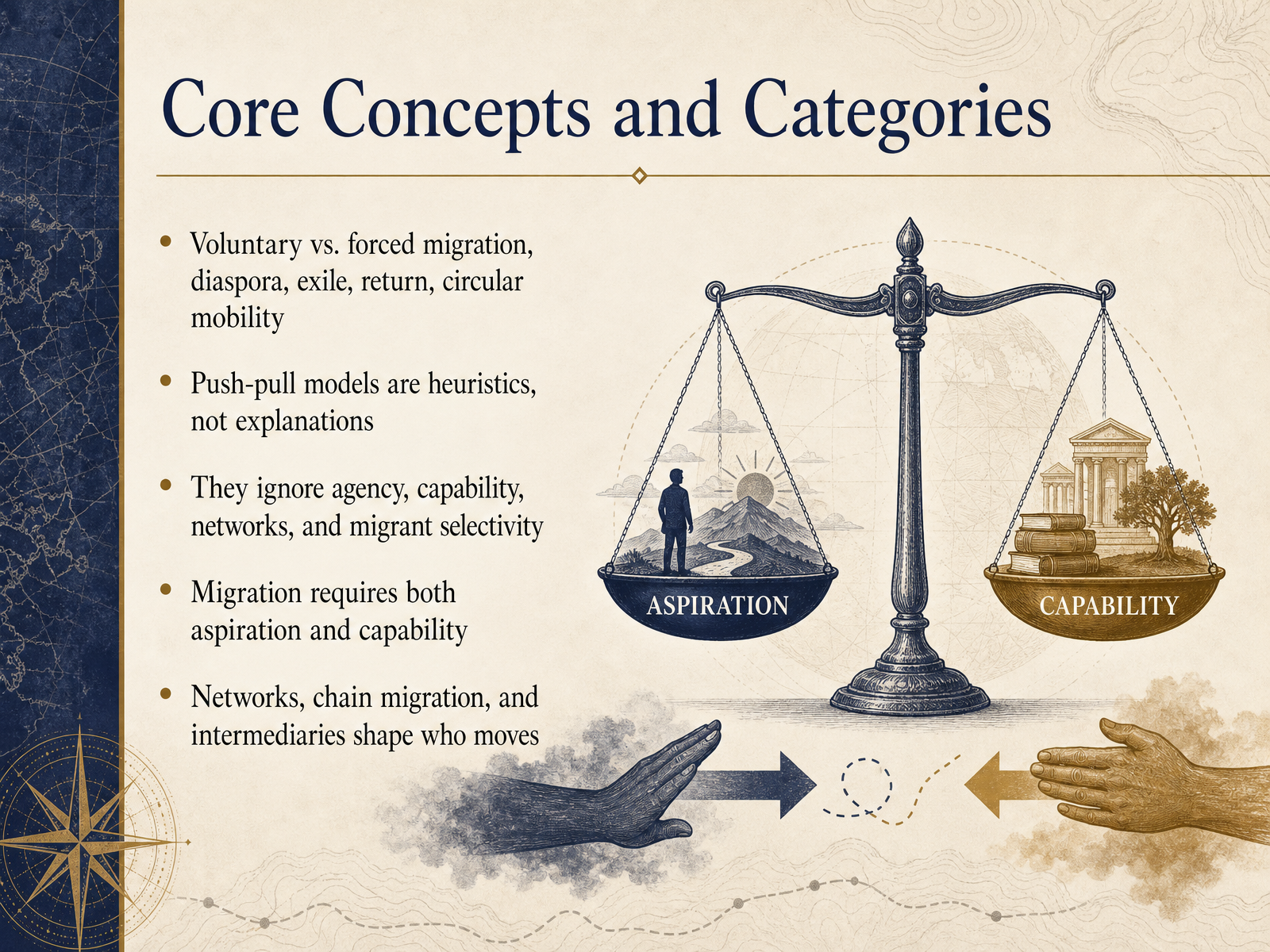
- 02Core Concepts and CategoriesNow, let's establish some core concepts and categories. We often divide migration into voluntary and forced movement, and we use terms like diaspora, exile, return, and circular mobility. But here is a key point: the classic push-pull model is a useful starting point, yet it is a heuristic, not a full explanation. It oversimplifies a deeply human process. Real migration requires both aspiration and capability. A person might dream of leaving, but lack the resources to do so. In fact, extreme hardship can sometimes trap people in place rather than push them out. Think of social networks, chain migration, and intermediaries. These often determine who actually moves, where they go, and how they get there. Consider how this pattern repeats across history. Next, we will trace the earliest examples of this with early dispersals and the peopling of continents.
 link.springer.comaeaweb.orgrefugees.org+21 min
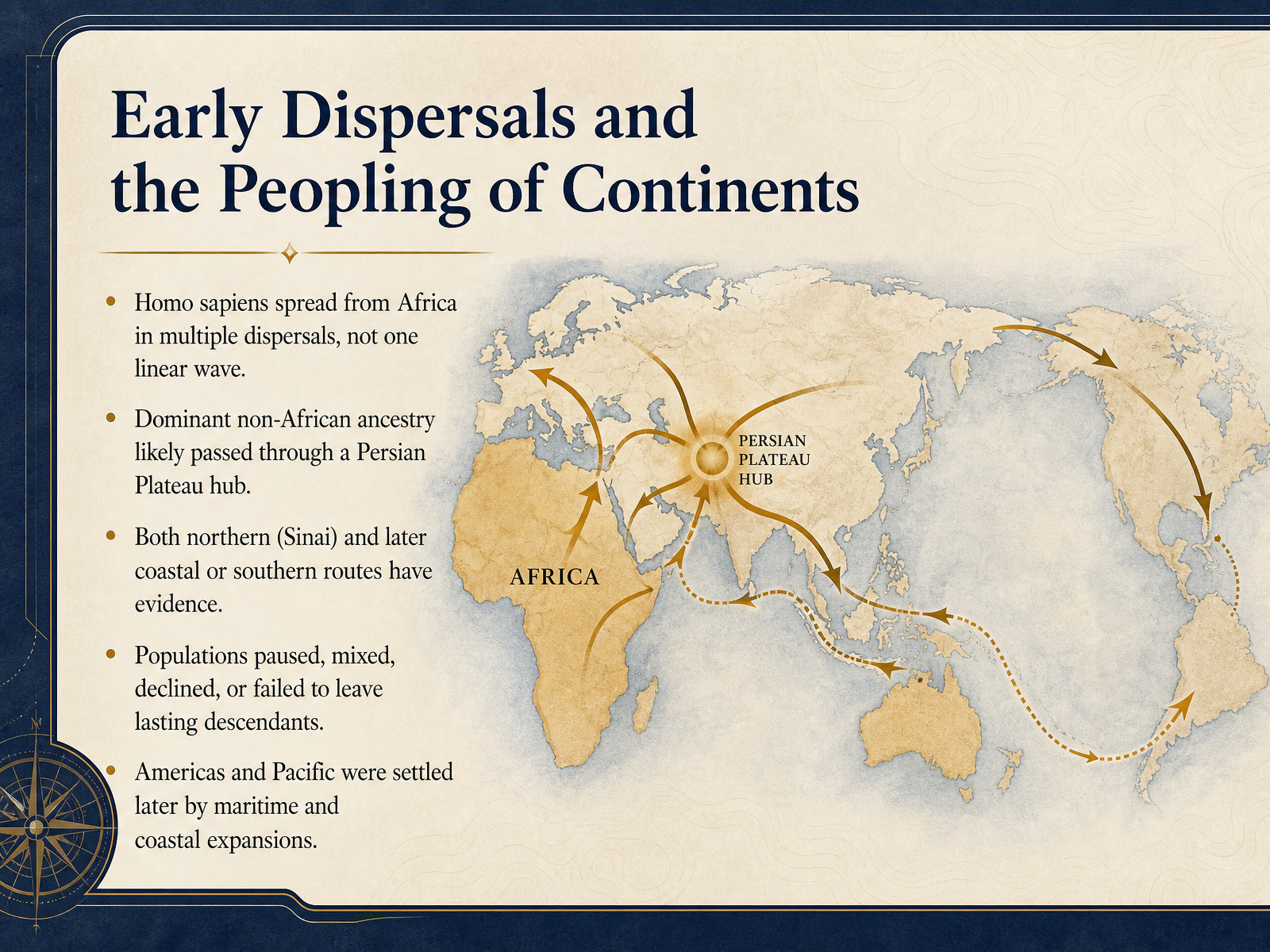
 - 03Early Dispersals and the Peopling of ContinentsNow we arrive at one of the most important revisions in the story of human origins. Homo sapiens did not leave Africa in a single, tidy wave. Instead, researchers now see multiple dispersals, staggered across tens of thousands of years. The dominant ancestry of people outside Africa appears to have moved through a hub on the Persian Plateau, roughly seventy to forty five thousand years ago. Pause on that window for a moment. It means populations did not simply walk out and keep walking. They waited, adapted, and mixed. Evidence also supports movement through the Sinai Peninsula, as well as later coastal or southern routes. Some groups moved out, then declined or vanished without leaving lasting descendants. Think of migration not as one highway, but as a branching trail where many paths end. The Americas and the Pacific tell a later chapter, settled through maritime and coastal expansions that demanded entirely new ways of living. Consider how this pattern of pauses, mixing, and regional adaptation repeats across world history. That same logic carries us into our next theme: agriculture, language spread, and demographic expansion.
 science.orgnature.comjournals.plos.org+21 min
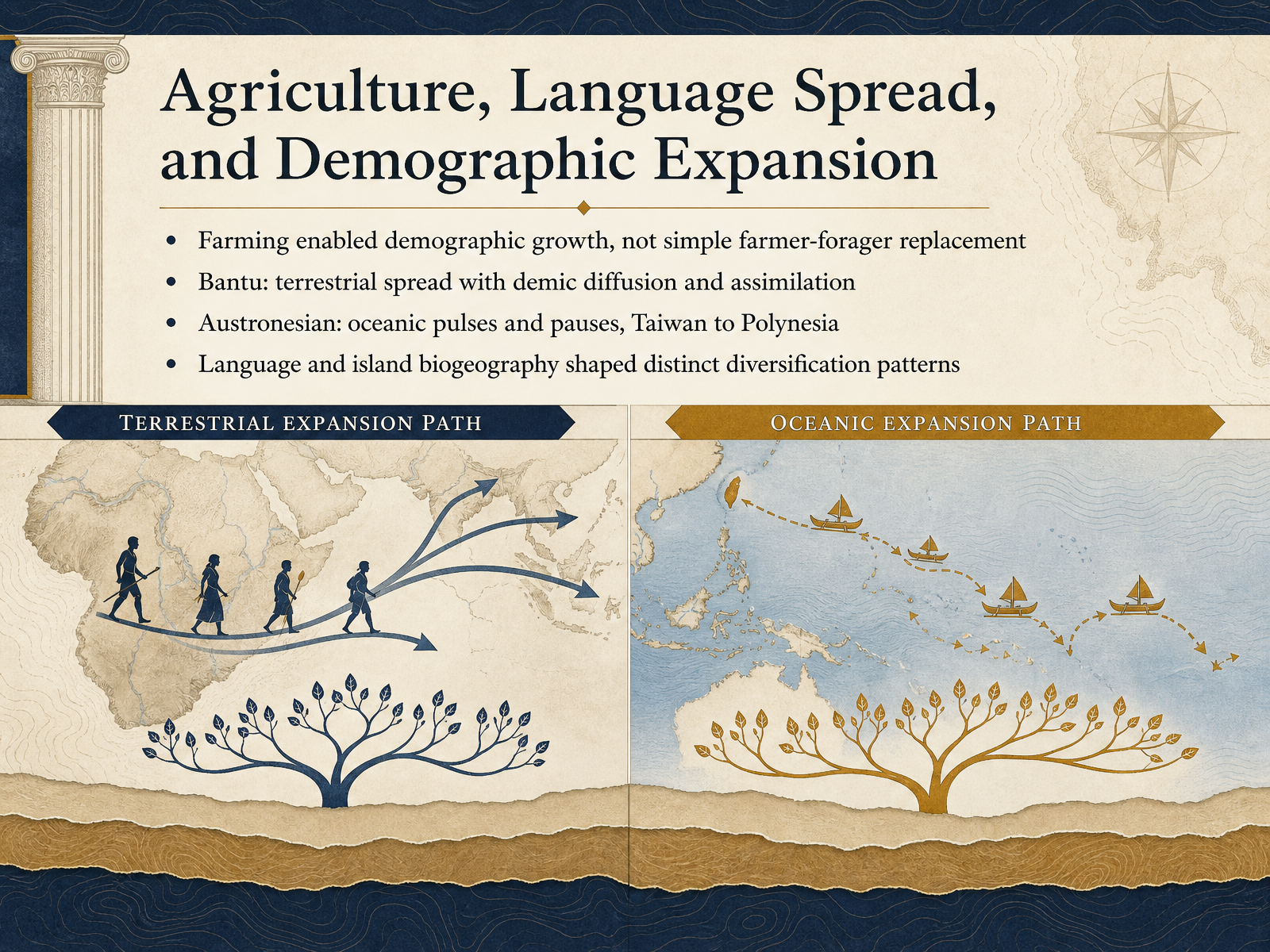
 - 04Agriculture, Language Spread, and Demographic ExpansionNow, let's bring farming into the story. Agriculture didn't just change what people ate; it changed how many of them there were. And that demographic shift is one of the great engines of migration. But here is the key finding: it was not a simple replacement of hunter-gatherers by farmers. It was a much more textured process of growth, interaction, and gradual assimilation. Take the Bantu expansion, for example. Beginning roughly five thousand years ago from the region near Cameroon and Nigeria, Bantu-speaking farmers moved across sub-Saharan Africa. This was a terrestrial spread, a slow wave of demic diffusion and cultural exchange. People moved, yes, but they also absorbed and converted the foragers and pastoralists they encountered. Compare that with the Austronesian expansion. This was fundamentally oceanic. Starting from Taiwan around fifty-two hundred years ago, these seafaring agriculturalists moved in pulses and pauses. They hopped from island to island, eventually reaching the far corners of Polynesia. Those pauses, sometimes lasting centuries, were often tied to innovations in sailing technology. The shape of the land and sea shaped the languages that survived. Bantu remained more connected and wave-like, while Austronesian languages, isolated on distant island clusters, diversified rapidly and dramatically. Same initial spark, radically different human stories. Next, we see how these foundational patterns fed into the vast networks of empires and trade across Afro-Eurasia.
 royalsocietypublishing.orgunm.edubiblio.ugent.be+21 min
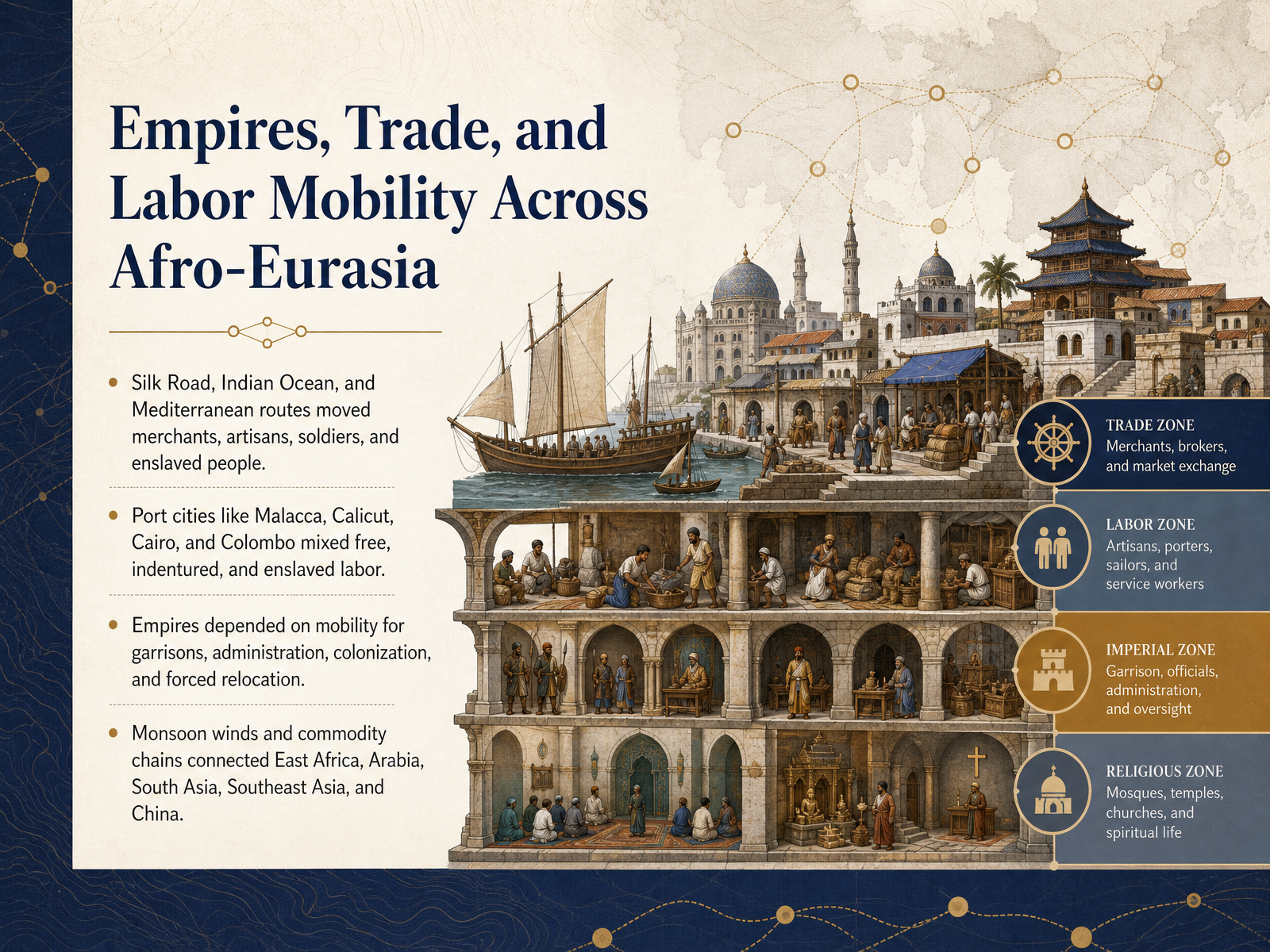
 - 05Empires, Trade, and Labor Mobility Across Afro-EurasiaEmpires rarely stayed in one place, and neither did the people who made them work. Across Afro-Eurasia, the Silk Road, the Indian Ocean, and the Mediterranean moved merchants, artisans, and soldiers, but also enslaved people. Port cities like Malacca, Calicut, Cairo, and Colombo became dense mixes of free, indentured, and enslaved labor. A monsoon wind was not just weather. It was an engine of mobility, linking East Africa, Arabia, South Asia, Southeast Asia, and China in rhythms of arrival and departure. Empires depended on this movement, for garrisons, for administration, for colonization, and for forced relocation. Push-pull factors operated here in very human form. A drought pushed a farmer toward the coast. A demand for cloth pulled a weaver toward Gujarat. Consider how this pattern repeats. Mobility was not a disruption of empire. It was often the structure that held it together. Next, we turn to forced migration before Atlantic slavery.
 cambridge.orglink.springer.comuniversiteitleiden.nl+22 min
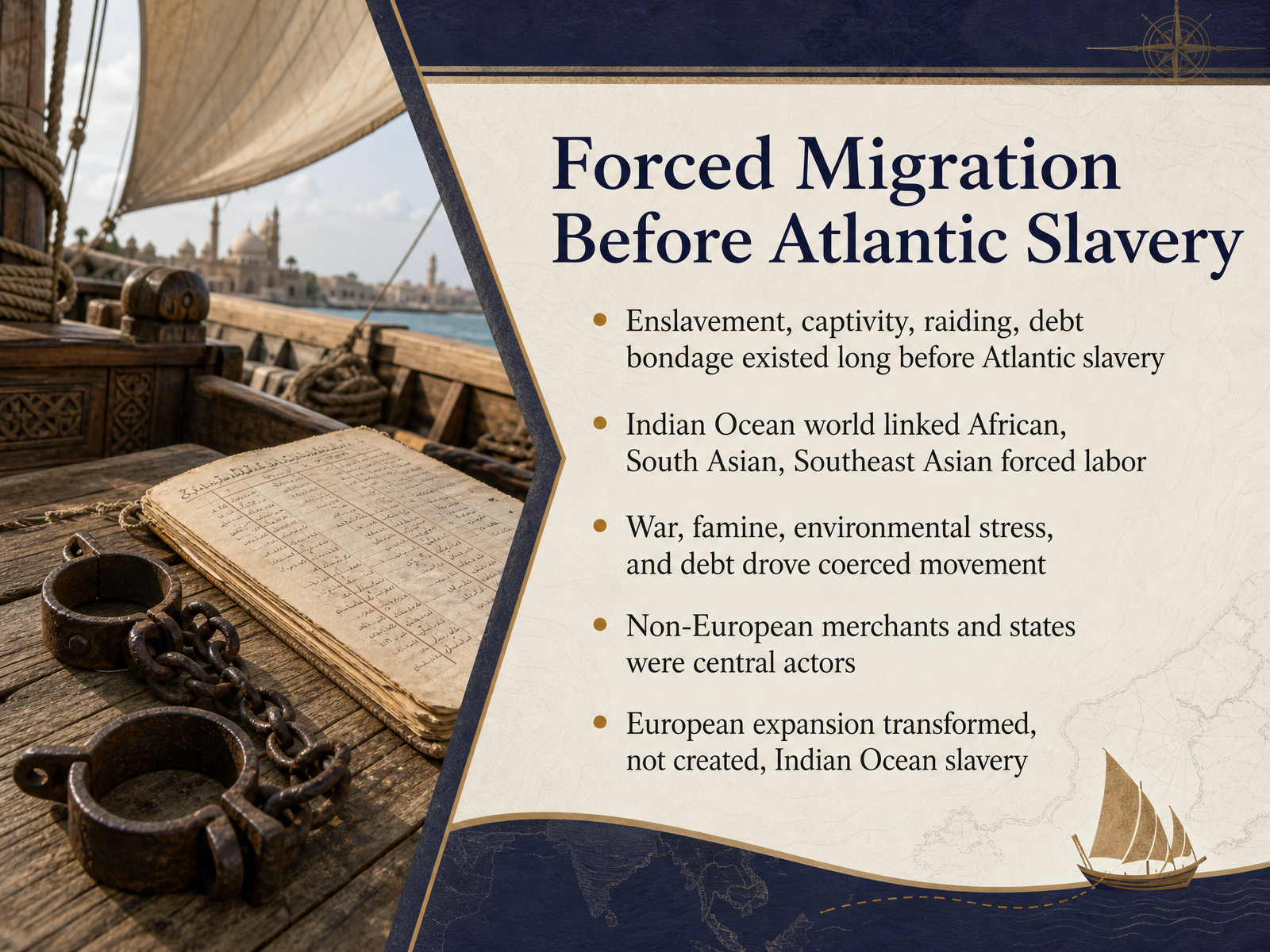
 - 06Forced Migration Before Atlantic SlaveryNow let's turn to an older and often overlooked chapter. Forced migration did not begin with the Atlantic slave trade. Long before European ships crossed the ocean, enslavement, captivity, raiding, and debt bondage shaped movement across the Indian Ocean world. This vast maritime zone connected East Africa, the Arabian Peninsula, South Asia, and Southeast Asia. War, famine, and environmental stress pushed people into dependence, while merchants and states turned that dependence into labor. Non-European actors were central. Gujarati merchants, Swahili traders, and regional sultanates moved captives from Mozambique to India, from Madagascar to the Mascarenes, and from the Indonesian archipelago to the Cape of Good Hope. Debt bondage was especially widespread. In many communities, a family might mortgage a child or a wife to secure a loan, a survival strategy born from crisis rather than conquest. What European expansion did was not invent these systems, but absorb, intensify, and redirect them. Consider how Dutch and English companies tapped existing slave networks and added new demand. In this way, European empire transformed an older forced migration. Next, we turn to the Atlantic slave trade and Atlantic migrations.
 2 min
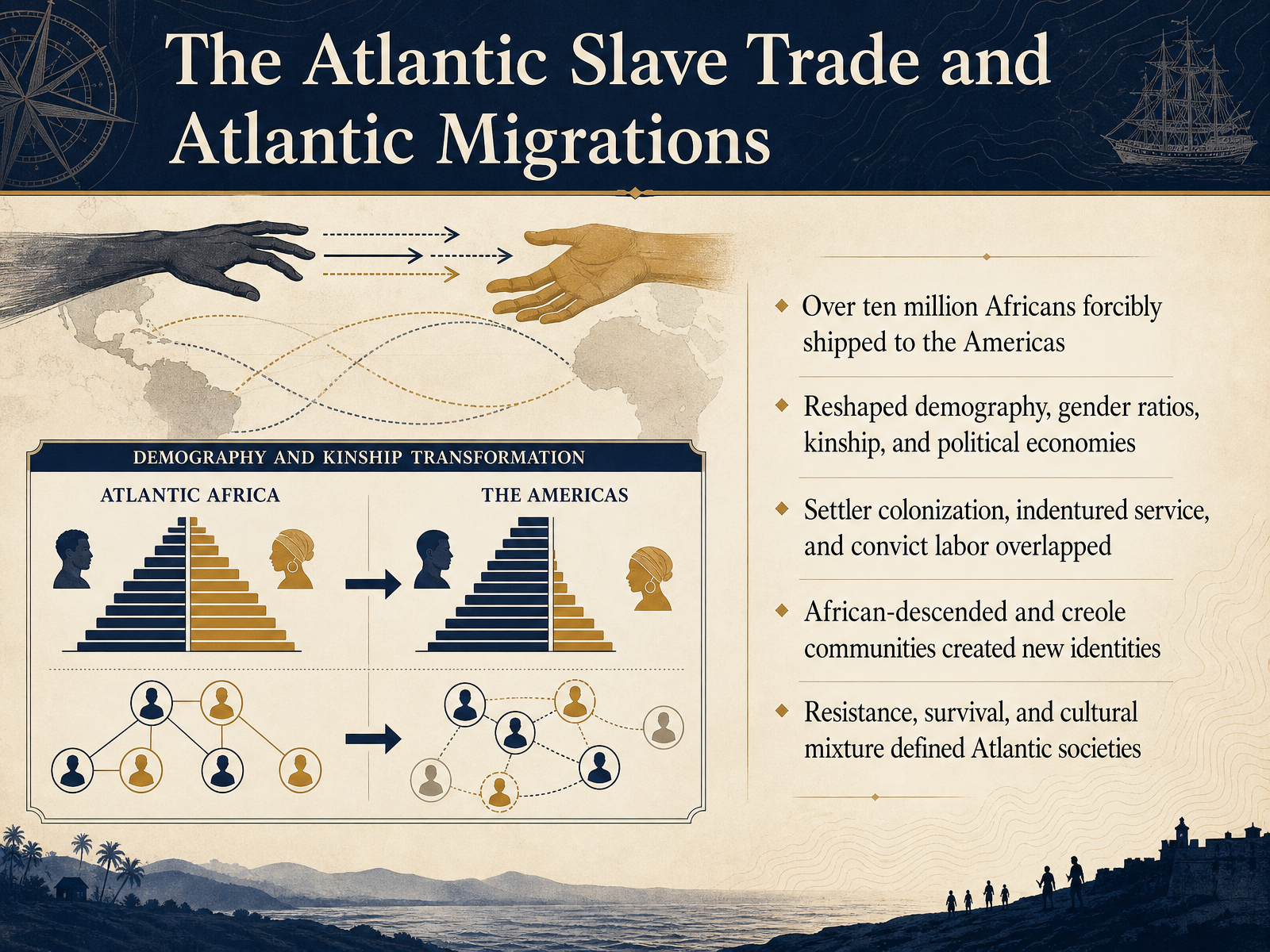
2 min - 07The Atlantic Slave Trade and Atlantic MigrationsThe Atlantic marks a drastic change in the human story. Over ten million Africans were forcibly shipped to the Americas between the sixteenth and nineteenth centuries. This was not simply a movement of people. It reshaped gender ratios, disrupted kinship systems, and altered political economies on both sides of the ocean. Recent scholarship suggests the demographic cost within Africa was severe, with population growth reduced for generations. In the Americas, slavery overlapped with settler colonization, indentured servitude, and convict labor, so many kinds of mobility were entangled. Under those pressures, African-descended and creole communities built new identities. They combined languages, spiritual practices, kinship forms, and resistance strategies. Survival itself became a daily act of cultural creation. Consider how this pattern repeats. Forced movement does not erase culture. It transforms it, often in ways that shape entire regions for centuries. Next, we move to industrialization and mass mobility from eighteen hundred to nineteen forty.
 2 min
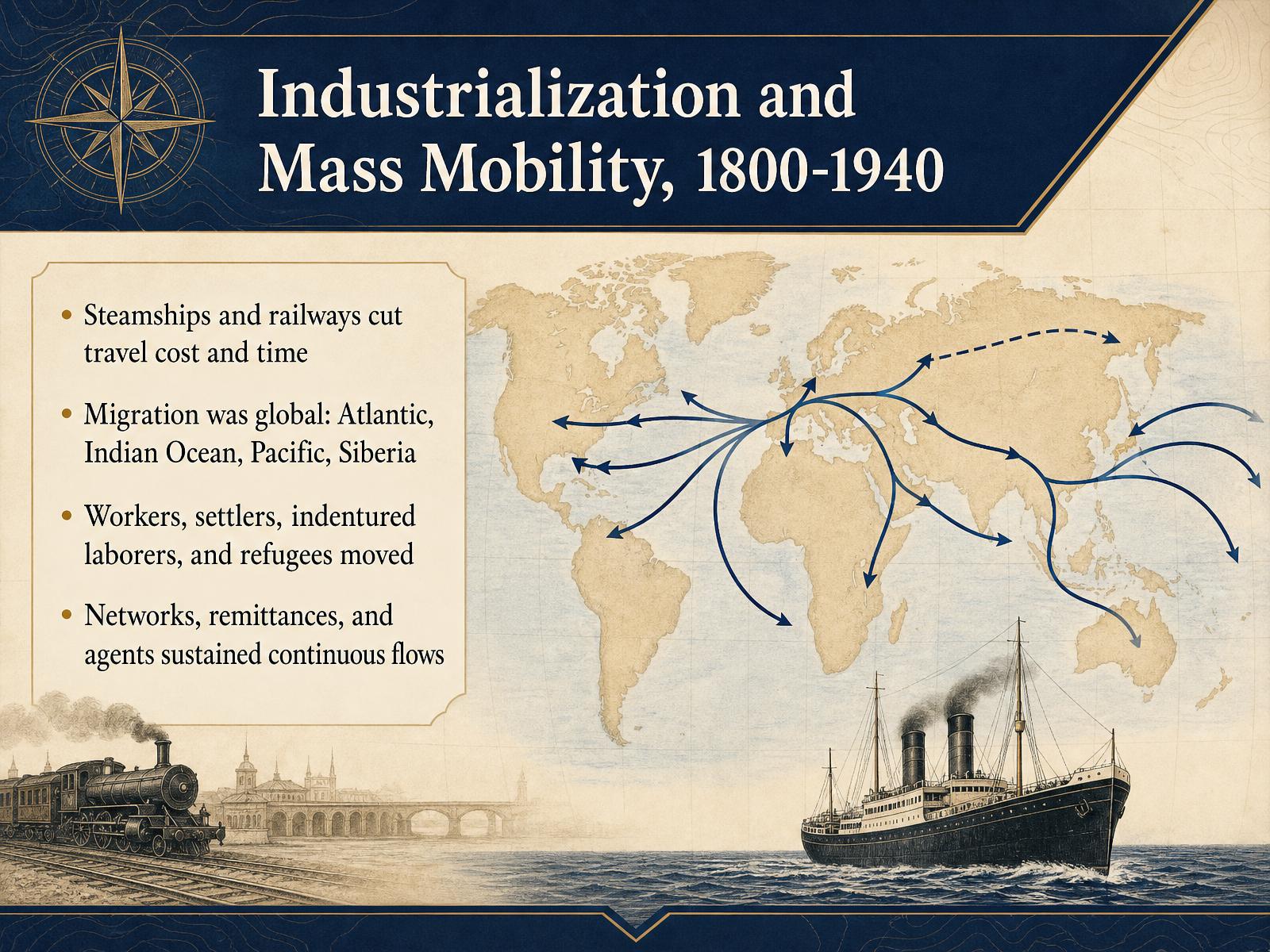
2 min - 08Industrialization and Mass Mobility, 1800-1940Between eighteen hundred and nineteen forty, the speed of movement itself redrew the world map. Steamships and railways cut crossing times from over a month to less than two weeks, and ticket prices fell enough to make departure a real option for ordinary workers. This was not one migration story, but many happening at once. Across the Atlantic, settlers and laborers moved to the Americas. Across the Indian Ocean and into the Pacific, workers and indentured laborers traveled to Mauritius, Malaya, Fiji, and beyond. And overland, millions pressed into Siberia and Manchuria. These flows were not random. Recruitment agents, kinship networks, and returning migrants kept channels open year after year, while remittances linked wages abroad to households back home. So when we ask who moved in this era, the better question is who did not. Consider how the same pattern appears again and again. A plantation needs hands. A frontier needs settlers. A port city needs dockworkers. Each demand pulls a new group into motion. And the result was a connected world built on mobility, but not equally shared. That growing tension brings us to the next shift, the rise of passports, borders, and the invention of regulated mobility.
 2 min
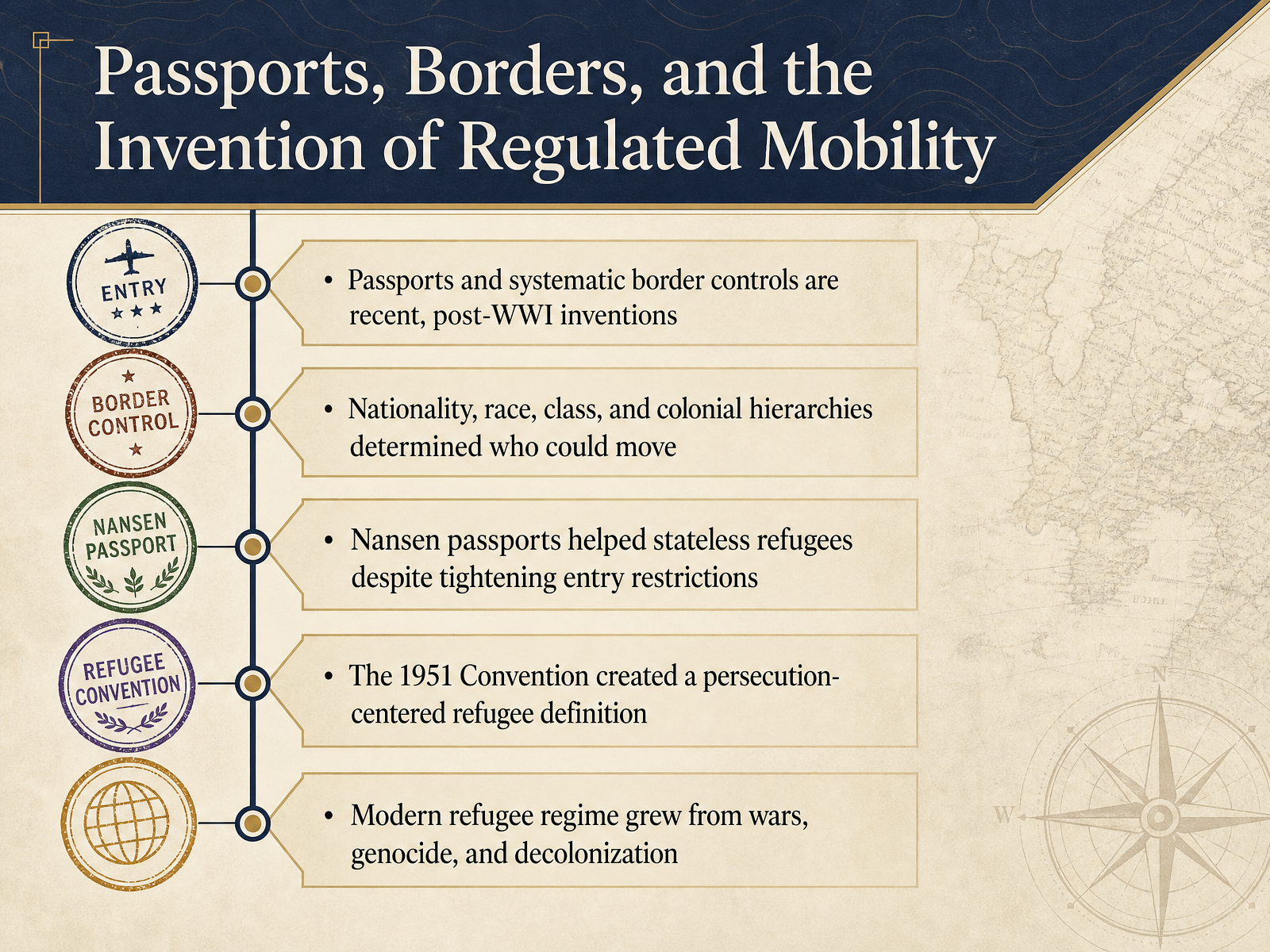
2 min - 09Passports, Borders, and the Invention of Regulated MobilityNow let's turn to a more recent chapter: the invention of regulated mobility. Before the First World War, borders across much of Europe were remarkably open. Passports as we know them were not the standard. Then, in the early twentieth century, states tightened entry and exit controls, driven by nationalism, economic protectionism, and fears about ethnic difference. Nationality, race, class, and colonial status began to determine who could cross a border and who could not. One response to this new reality was the Nansen passport, introduced in the nineteen twenties. It helped stateless refugees, especially Russians and Armenians, travel even when many countries were closing their doors. Yet the document did not guarantee admission. It simply made movement possible for people who had lost the protection of their own state. After the Second World War, the nineteen fifty-one Refugee Convention gave the international system a formal definition of a refugee, centered on persecution. This framework grew directly from the wars, genocide, and decolonization of the mid-twentieth century. Consider how this pattern repeats: as borders became harder to cross, new categories and documents emerged to manage people who had no clear state to belong to. Next, we'll examine refugees, displacement, and population transfers in the twentieth century.
 cambridge.orglink.springer.comuniversiteitleiden.nl+21 min
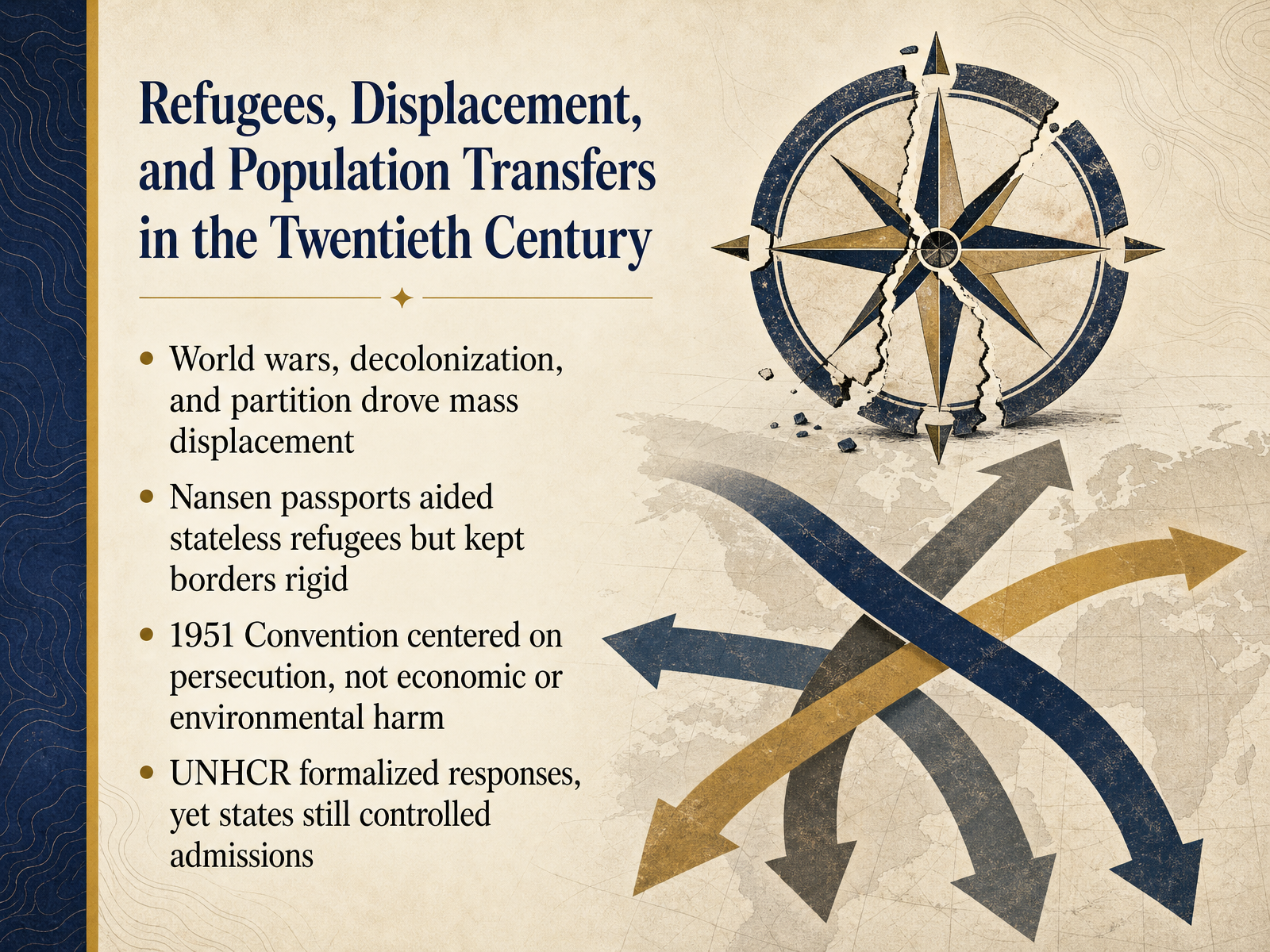
 - 10Refugees, Displacement, and Population Transfers in the Twentieth CenturyThe twentieth century turned migration into a crisis of borders. Two world wars, the collapse of empires, decolonization, and partitions across Europe and Asia forced millions from their homes. In the nineteen twenties, displaced Russians, Armenians, and Assyrians faced a new problem: they lacked documents in a world that had become sharply more restrictive. The Nansen passport, created by the League of Nations, helped these stateless refugees travel, but did not guarantee admission. States still controlled who could enter. After the Second World War, the nineteen fifty one Refugee Convention formalized protection, yet its definition centered narrowly on persecution, leaving out those driven by severe economic distress or environmental harm. The United Nations High Commissioner for Refugees, or U N H C R, institutionalized responses, but admission policy remained firmly in state hands. So consider how this pattern repeats: even as international systems expanded, the right to cross a border stayed conditional. Next, we turn to post nineteen forty five labor migration, guest workers, and the reshaping of diasporas.
 cambridge.orglink.springer.comuniversiteitleiden.nl+22 min
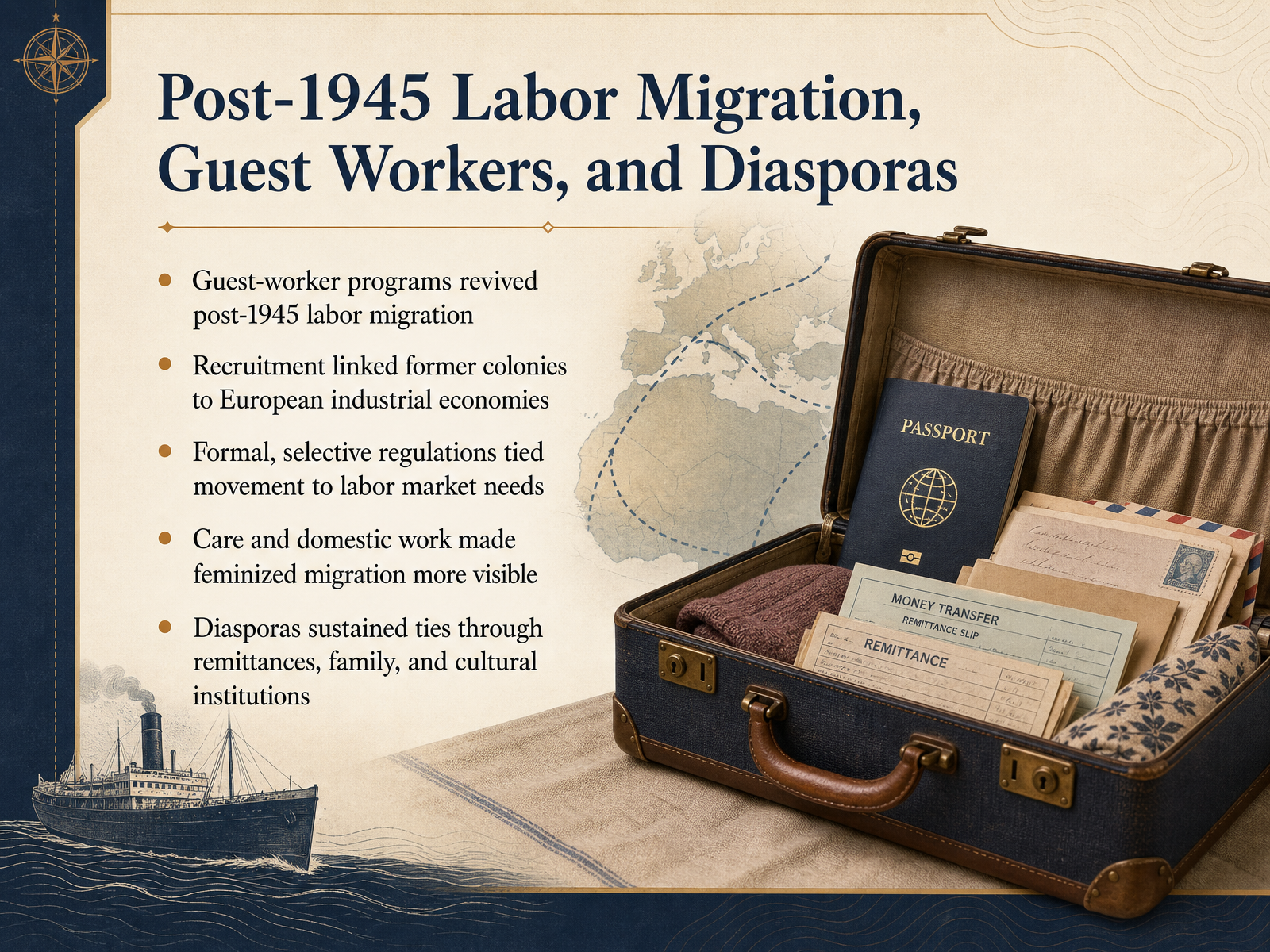
 - 11Post-1945 Labor Migration, Guest Workers, and DiasporasAfter the Second World War, labor migration took on a new shape. European economies needed workers to rebuild, and guest-worker programs brought people from Turkey to West Germany, from the Caribbean to Britain, and from North Africa to France. Recruitment often followed older imperial routes, connecting former colonies directly to industrial centers. But the movement was now formal and selective. Governments admitted workers only when labor markets demanded them, and they tied residence to employment. Over time, this pattern made one thing especially visible: migration was not only male. As care work and domestic service expanded, women became central figures in these flows. Behind the workers, enduring diasporas took root. Families sent remittances home, raised children across borders, and built cultural institutions, from temples and mosques to community schools. These ties kept sending and receiving regions connected long after the original labor contract ended. Consider how this pattern repeats in later guest-worker systems, from the Gulf states to Singapore. Next, we turn to migration in the contemporary world.
 2 min
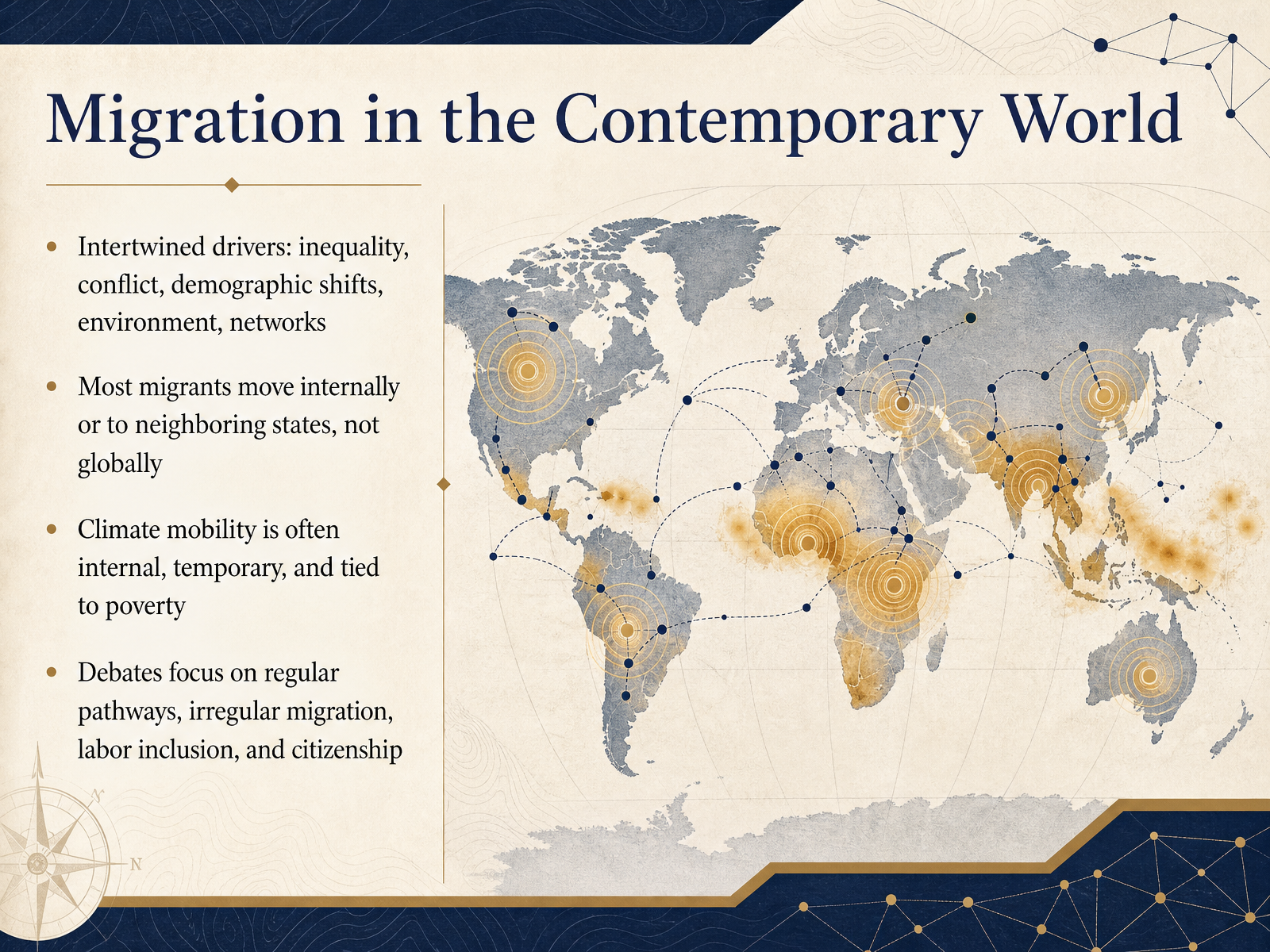
2 min - 12Migration in the Contemporary WorldNow let us bring this long story into the present. Migration in the contemporary world is rarely driven by one single factor. Inequality, conflict, demographic shifts, environmental pressure, and established family or community networks often work together. But here is one of the most important corrections to popular assumptions: most people who move do not cross an ocean or a distant border. The majority migrate within their own country, or to a neighboring state. The typical migrant is not necessarily heading to Europe or North America. Climate mobility can serve as a useful example. It is often internal, temporary, and closely tied to poverty. A drought may push a farming household toward a regional city for a season, not permanently to another continent. Contemporary policy debates therefore focus less on a single flood of movement and more on practical questions. How can states create regular pathways, address irregular migration humanely, include workers in local labor markets, and decide who can become a citizen. Think of these not as abstract issues, but as choices about belonging, work, and the right to stay. We will turn next to rethinking drivers, agency, and the limits of simple models.
 link.springer.comaeaweb.orgrefugees.org+22 min
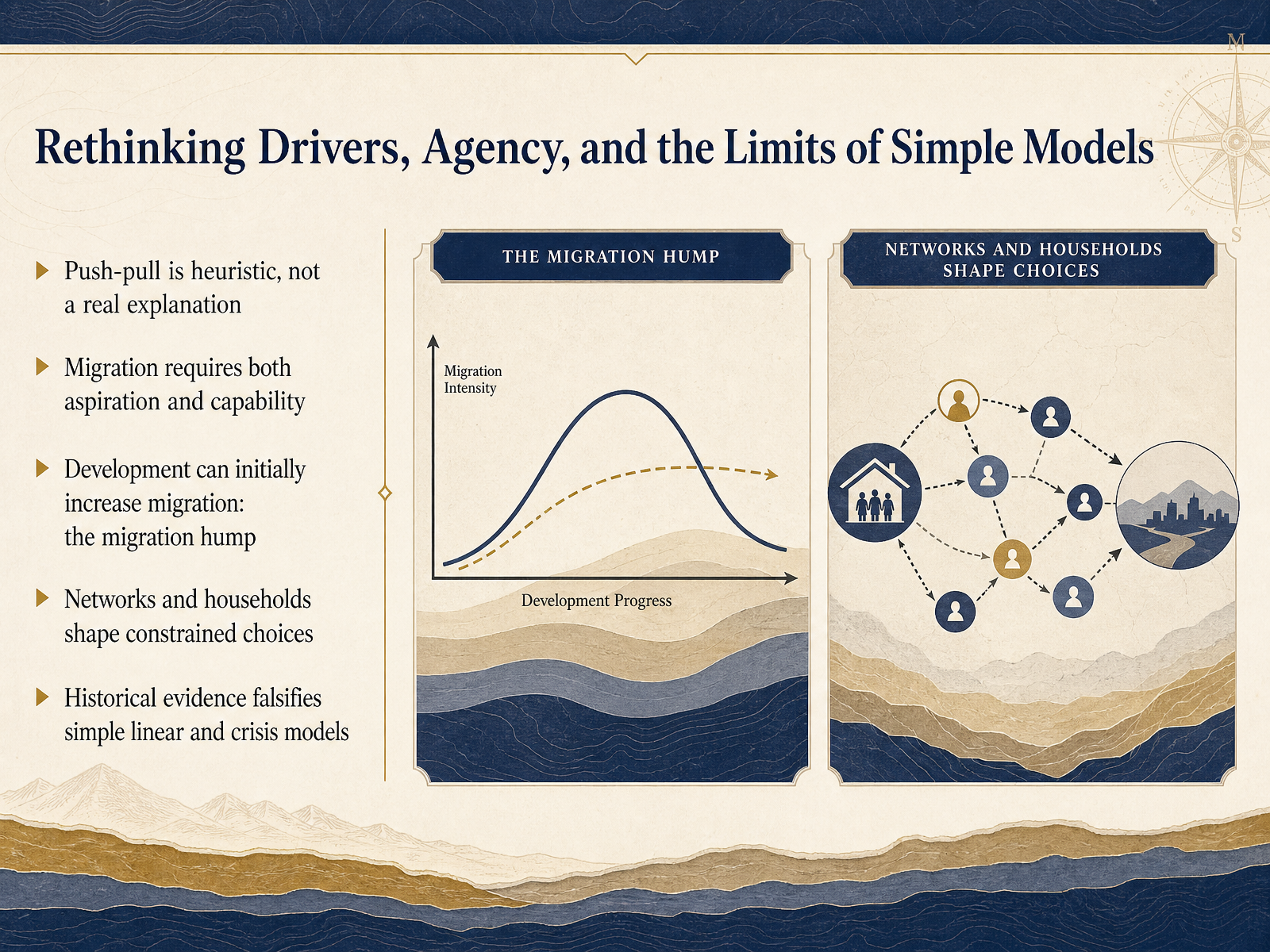
 - 13Rethinking Drivers, Agency, and the Limits of Simple ModelsWe have reached a point where the familiar tools start to feel a little too small for the stories they are trying to tell. Take the push-pull model, for example, the idea that poverty pushes people out and opportunity pulls them in. It is a useful shorthand, a heuristic. But on its own, it is not really an explanation. Why? Because migrating is not simply a reaction to bad conditions. It requires two things at once. People need the aspiration to move, a desire for something different, and they need the capability, the money, the documents, the social connections, to actually make the journey. This helps explain something counterintuitive. As a country develops, emigration often rises, at least for a while. Scholars call this the migration hump. Development gives people new skills and new resources, which unlocks mobility. Think of it as moving from having the dream to having the means. It also reminds us that families and communities shape decisions. People rarely migrate as isolated individuals. Their choices are constrained, guided, and enabled by the networks around them. So, the historical record consistently pushes back against simple linear models, and against the idea that migration only happens in moments of crisis. It is a richer, more human process than that. As we look ahead, let us turn to the key takeaways and discussion questions.
 link.springer.comaeaweb.orgrefugees.org+22 min
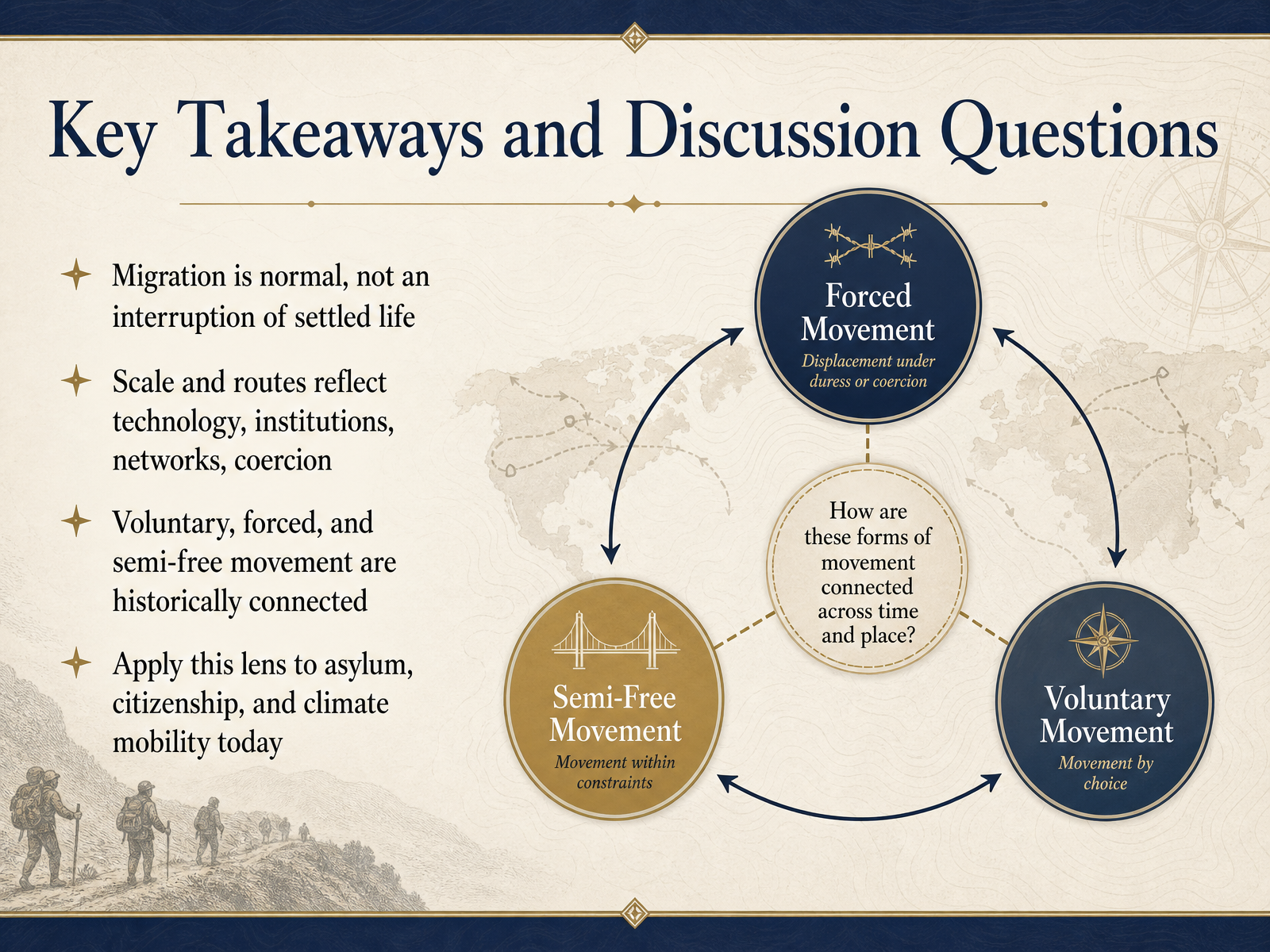
 - 14Key Takeaways and Discussion QuestionsSo where does this leave us? The first takeaway is that movement is not an exception to the settled life. It is a core part of how human societies have always worked. Second, when we see big population flows, from the Atlantic crossings to labor routes across the Indian Ocean, we should ask what made them possible. Technology and institutions shape the scale and direction of movement, but so do coercion and unequal networks. Third, the line between voluntary, forced, and semi-free movement is rarely sharp. Indentured servants, refugees, and so-called free laborers often shared the same routes and even the same ships. Now consider how this lens applies today. When we talk about asylum, citizenship, or climate mobility, we are not facing entirely new problems. We are seeing old patterns repeat under new pressures. How would you connect a twentieth century refugee movement to a climate-related displacement in the twenty-first century? Thank you for joining this journey through migration in world history. The past does not give us a simple forecast, but it does give us a clearer set of questions to ask.
 cambridge.orglink.springer.comuniversiteitleiden.nl+22 min
Take the deck with you
Download this course as a file — free, no sign-up needed.
- PDF handoutEvery slide page, ready to print or share.15 pages · 5.9 MBDownload
- Narrated PowerPointThe deck that presents itself — every slide carries the digital human's narration video.15 pages · 20.3 MBDownload
- PowerPoint slidesThe full deck as a .pptx — open it in PowerPoint, Keynote, or Google Slides.15 pages · 5.9 MBDownload
Free to use in your own training — please keep the PersonWise credit page at the end.
Have your own deck? Turn it into a course
Sources consulted
Web sources consulted while building this course.
- Migration and World History: Reaching a New Frontier — cambridge.org
- Migration Histories | Springer Nature Link — link.springer.com
- Migration History in World History. Multidisciplinary Approaches | Studies in Global Social History, Volume: 3 - Leiden University — universiteitleiden.nl
- What is Migration History? | Wiley — wiley.com
- World History Connected | Vol. 11 No. 3 | Patrick Manning: Introduction to the Forum on Studies in Migration Worldwide — worldhistoryconnected.press.uillinois.edu
- Towards a global migration paradigm | Comparative Migration Studies | Springer Nature Link — link.springer.com
- Migration on the Rise, a Paradigm in Decline: The Last Half-Century of Global Mobility - American Economic Association — aeaweb.org
- Understanding Migration: Why “Push Factors” and “Pull Factors” Do Not Explain Very Much — refugees.org
- Why Push and Pull Factors Do Not Explain Very Much? USCRI — refugees.org
- Push-pull migration models have long dominated migration research. Here’s why that’s only half the story. - Political Violence at a Glance — politicalviolenceataglance.org
- A geographic history of human genetic ancestry — science.org
- The Persian plateau served as hub for Homo sapiens after the main out of Africa dispersal | Nature Communications — nature.com
- Sri Lankan maternal ancestry reveals early migrations from Africa along the Indian Ocean | PLOS One — journals.plos.org
- Earliest modern human genomes constrain timing of Neanderthal admixture | Nature — nature.com
- Resolving out of Africa event for Papua New Guinean population using neural network | Nature Communications — nature.com
- Social complexity and linguistic diversity in the Austronesian and Bantu population expansions — royalsocietypublishing.org
- and Bantu population expansions — unm.edu
- Proto Oceanic (Austronesian) and Proto East Bantu (Niger-Congo) kin terms ca. 1000 BC — biblio.ugent.be
- The Austronesian Homeland and Dispersal | Annual Reviews — annualreviews.org
- Language Phylogenies Reveal Expansion Pulses and Pauses in Pacific Settlement — science.org