Begin
14 pages · ~28 min
Digital Marketing Case Studies: Patterns & Tradeoffs
This training analyzes real-world digital marketing case studies to help marketers recognize recurring patterns and make informed tradeoffs in campaign strategy.
A digital instructor presents all 14 pages. Hold “Ask” at any point and ask out loud — the answer comes from this course. No sign-up needed.
What you’ll learn
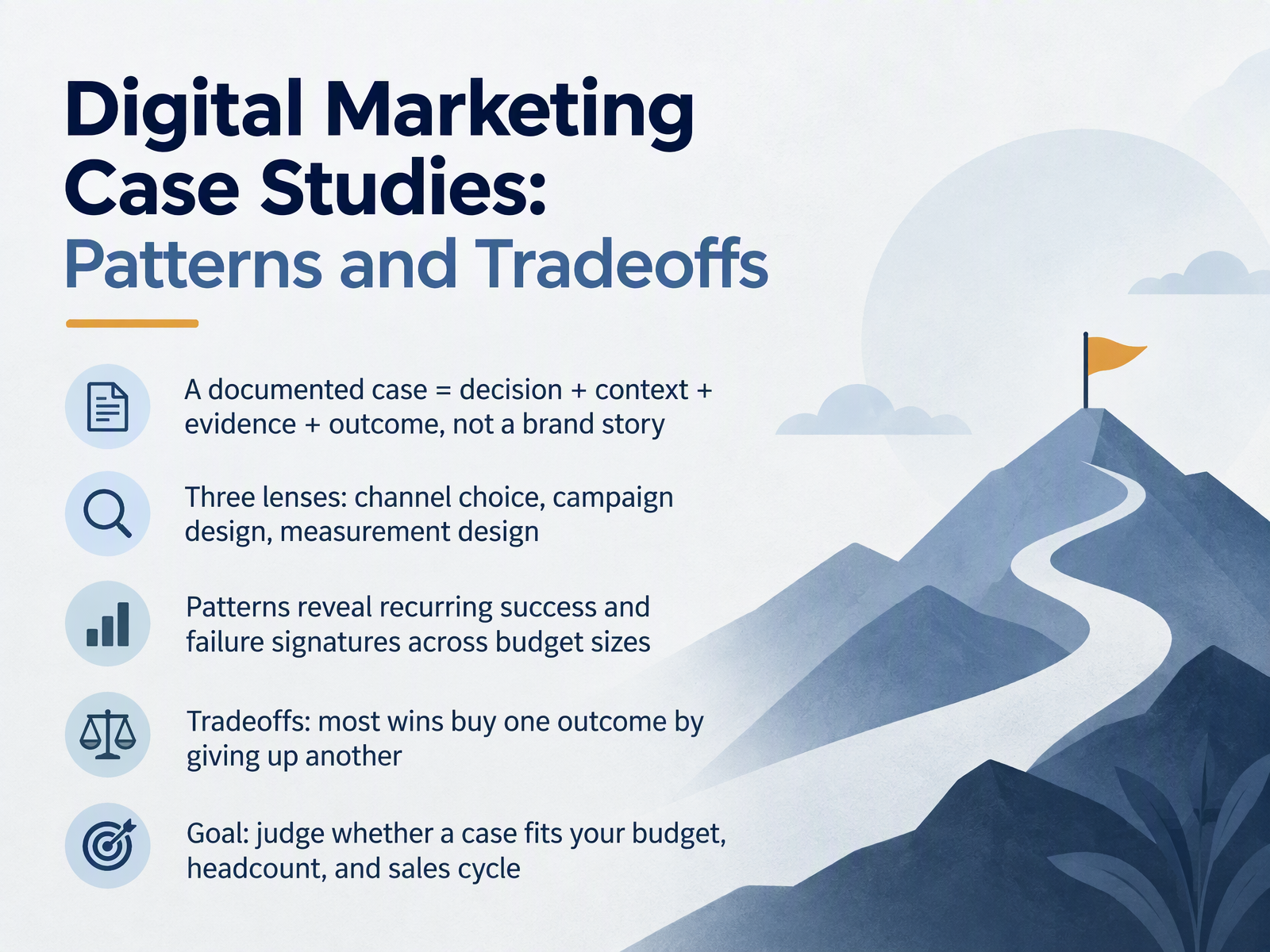
- 01Digital Marketing Case Studies: Patterns and TradeoffsWelcome. Let's start by setting up how we'll read digital marketing case studies together. Throughout this course, treat a documented case as a decision plus context, evidence, and outcome. Not a brand story. We'll look through three lenses. Channel choice. Campaign design. And measurement design. As we go, you'll notice patterns. Recurring signatures of success and failure that show up across budget sizes. You'll also see tradeoffs. In most cases, a win buys one outcome by giving up another. For example, a channel may look efficient but be saturating, or a campaign may lift short-term conversions while building little long-term demand. When evidence is missing, we'll name the assumption, because that's part of the judgment. The goal is practical. By the end, you should be able to judge whether a case actually fits your budget, your headcount, and your sales cycle. That's the skill we're building. Next, let's look at how to read a case through its claims, its evidence, and its context.github.comblog.breakthrough3x.comdoi.org+22 min
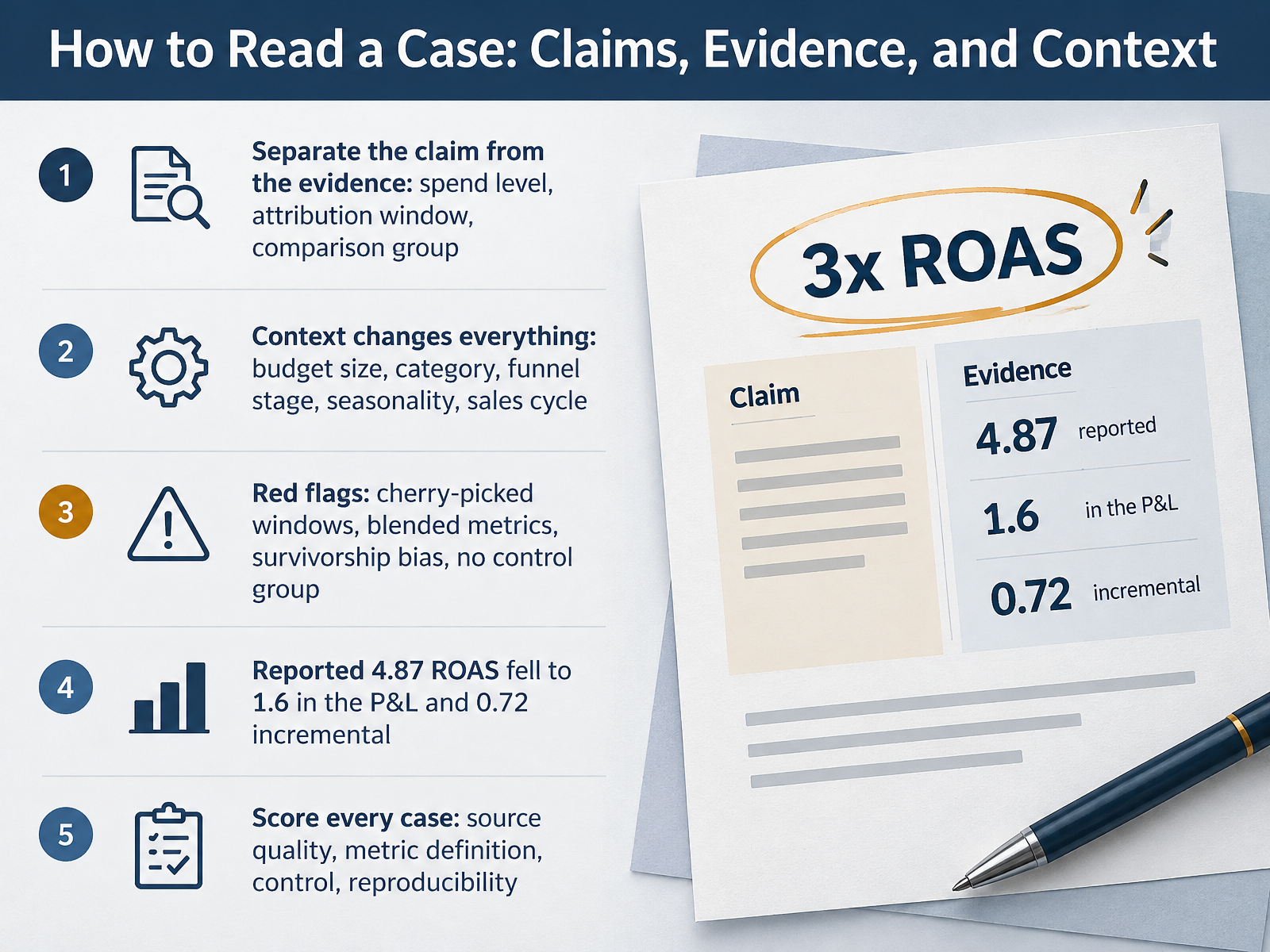
- 02How to Read a Case: Claims, Evidence, and ContextLet's look at how to read a case properly. Start by separating the claim from the evidence. What spend level, what attribution window, what comparison group? In one activewear case, reported return was four point eight seven, the profit and loss showed one point six, and the incremental return was zero point seven two. Same spend, three different numbers, and only the last one is causal. Context changes everything too: budget size, category, funnel stage, seasonality, sales cycle. Watch for red flags such as cherry-picked time windows, blended metrics, survivorship bias, and no control group. So score every case on source quality, metric definition, whether there was a control, and whether it could be reproduced. Next, we move into channel cases for paid search, paid social, and retail media.
 thisisbetter.co.ukdl.acm.orgcrealytics.com+21 min
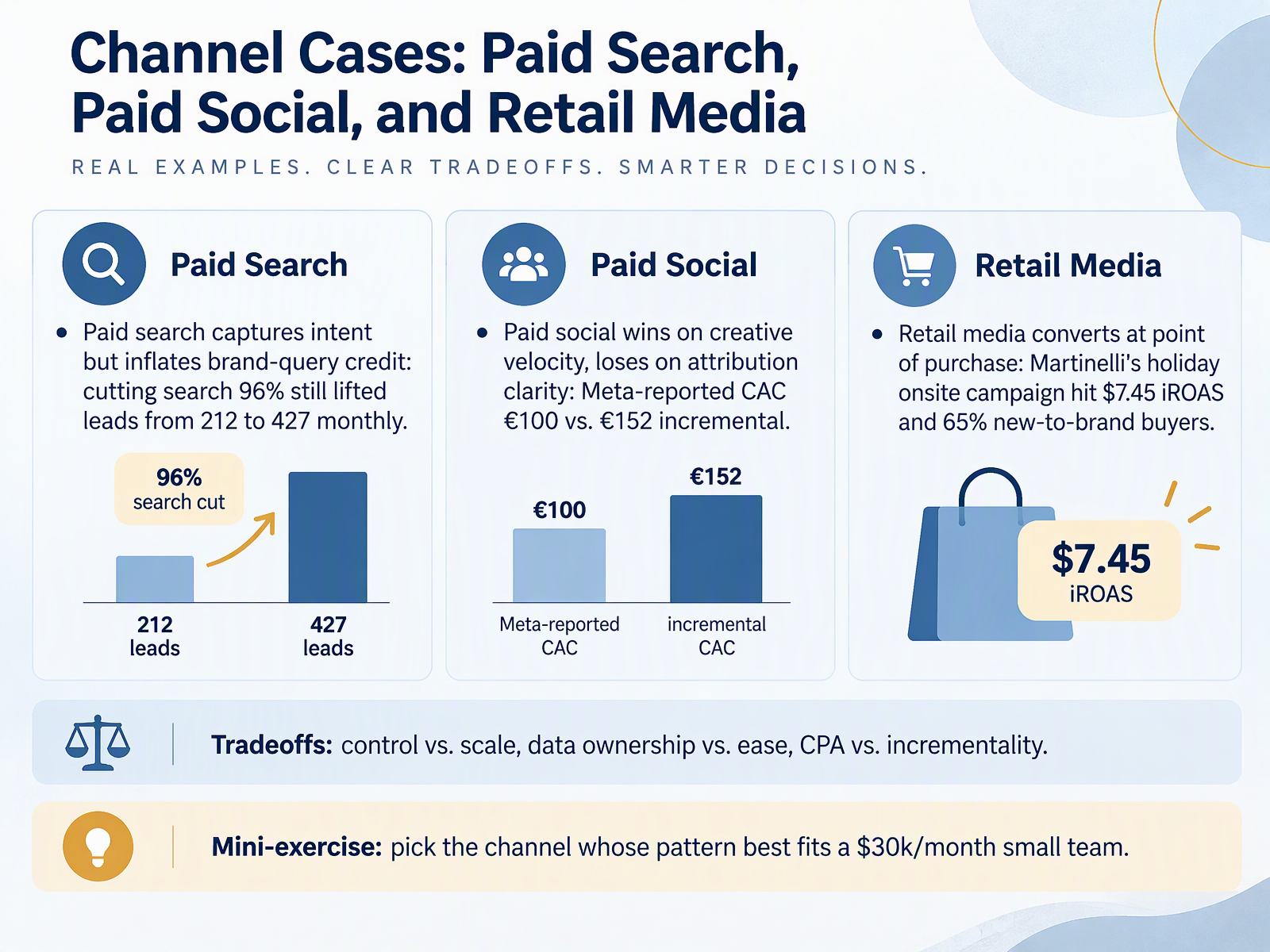
- 03Channel Cases: Paid Search, Paid Social, and Retail MediaNow let's look at three channel cases, and the tradeoffs behind them. Paid search captures intent, but it inflates credit for brand queries. In one documented case, cutting search by ninety six percent still lifted monthly leads from two hundred twelve to four hundred twenty seven. That was a sequence, not a controlled test, so treat it as a prompt to question brand-query credit. Paid social wins on creative velocity, but attribution is murky. In one benchmark, Meta reported a cost per acquisition of one hundred euros, while the incremental figure was one hundred fifty two. Retail media converts at the point of purchase. Martinelli's holiday onsite campaign hit seven point four five dollars incremental return on ad spend, with sixty five percent new-to-brand buyers. Notice the recurring tradeoffs: control versus scale, data ownership versus ease, and reported cost per acquisition versus true incrementality. Here's your mini exercise. If your small team had thirty thousand dollars a month, which channel's pattern fits you best, and what would you test first? Next, we'll spot the design patterns that repeat across winners and losers.
 grassfish.comiuf.digitalalbertsonsmediacollective.com+22 min
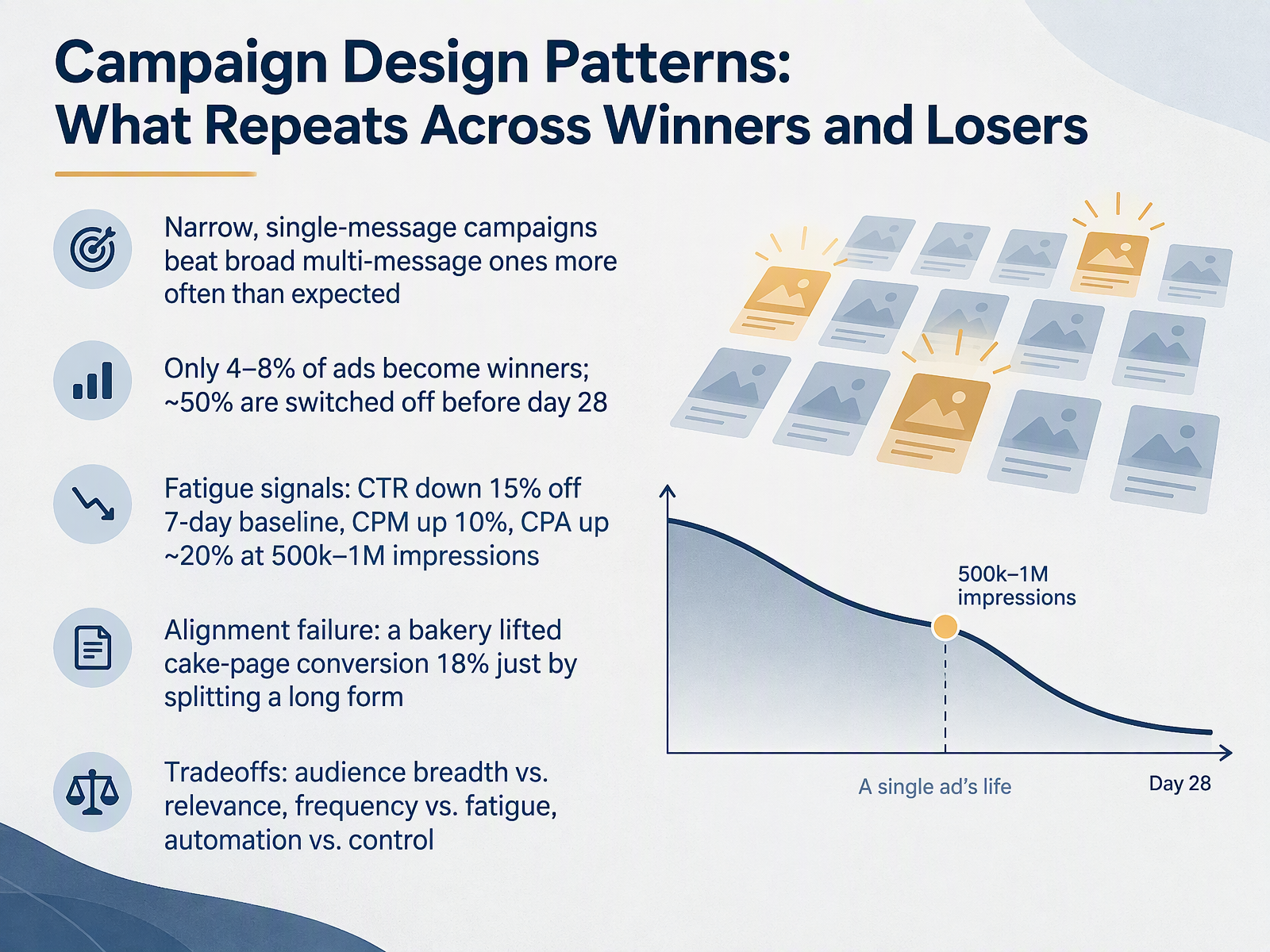
- 04Campaign Design Patterns: What Repeats Across Winners and LosersLet's look at the campaign design patterns that keep showing up, in both winners and losers. First, narrow single-message campaigns tend to beat broad multi-message ones more often than most teams expect. Second, the odds are steep. Only about four to eight percent of ads become winners, and roughly half are switched off before day twenty-eight. So plan for testing, not for one big bet. Third, watch for fatigue signals against a seven-day baseline. A click-through drop of fifteen percent, cost per thousand impressions up ten percent, and cost per acquisition up about twenty percent around the five hundred thousand to one million impression mark. And alignment matters. In one bakery case, simply splitting a long cake order form lifted conversion on that page by eighteen percent. Every move here is a tradeoff: audience breadth versus relevance, frequency versus fatigue, automation versus control. Ask which tradeoff you're accepting before you launch. Next, we move into measurement, with Measurement Cases: Attribution, Experiments, and M M M.
 adlibrary.comgenyad.comquickads.ai+22 min
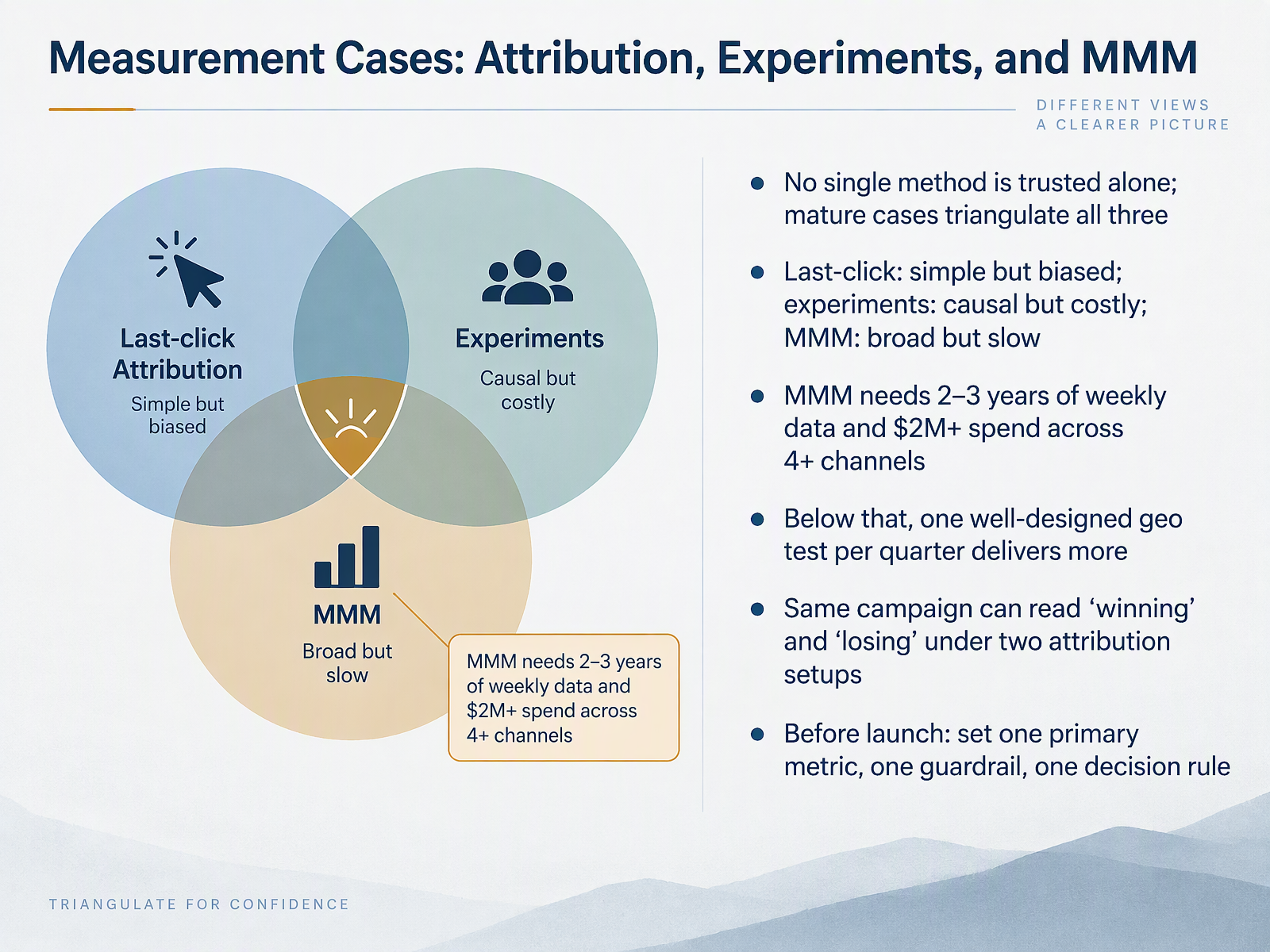
- 05Measurement Cases: Attribution, Experiments, and MMMNow let's talk measurement, because this is where good campaigns get misjudged. No single method is trusted alone. Mature teams triangulate three: last-click, experiments, and marketing mix modeling. Last-click is simple, but biased. Experiments are causal, but costly. Marketing mix modeling is broad, but slow. MMM is demanding. It needs roughly two to three years of weekly data, and around two million dollars or more in spend across four or more channels. Below that threshold, one well-designed geo test per quarter usually teaches you more. Here's the trap: the same campaign can read winning under one attribution setup and losing under another. Platforms often over-credit lower-funnel clicks. So before launch, set one primary metric, one guardrail metric, and one decision rule written down in advance. That way, the data informs the decision instead of the reporting shaping the story. Next, we'll look at budget and funnel tradeoffs, where cases usually go wrong.
 thisisbetter.co.ukdl.acm.orgcrealytics.com+21 min
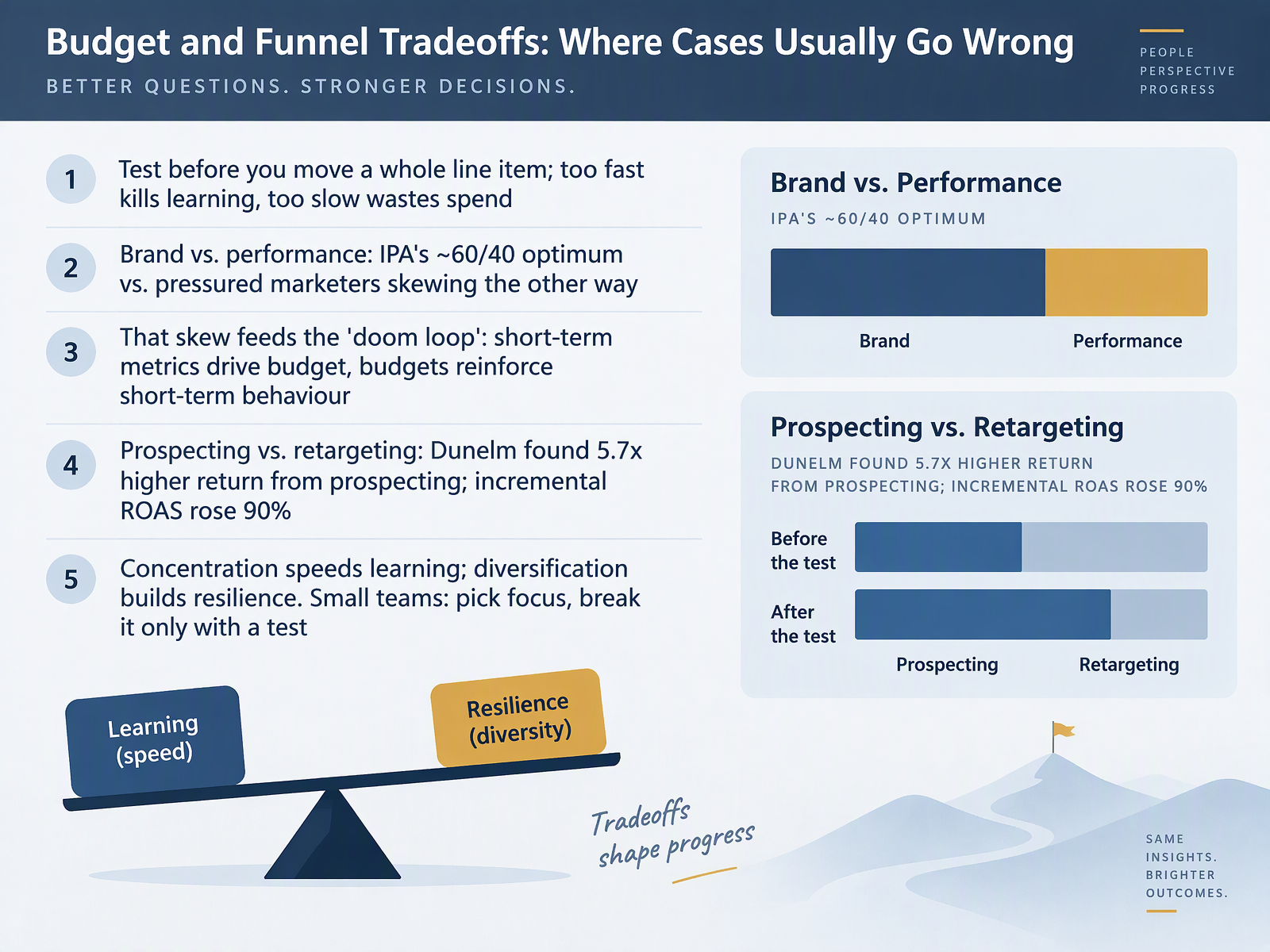
- 06Budget and Funnel Tradeoffs: Where Cases Usually Go WrongLet's look at where budget and funnel decisions usually go wrong. First rule: test before you move a whole line item. Move too fast and you lose the learning. Move too slow and you keep wasting spend. Second, brand versus performance. The IPA's analysis of forty years of effectiveness cases points to roughly sixty percent brand and forty percent activation. But WARC finds that when budgets tighten, marketers skew the other way. And that skew feeds the doom loop. Short-term metrics drive budget, and budgets reinforce short-term behaviour. Prospecting versus retargeting is the clearest example. Dunelm tested it and found a five point seven times higher return from prospecting than retargeting. Incremental return on ad spend rose ninety percent. So concentration speeds up learning, while diversification builds resilience. For small teams, pick one focus, and break it only with a test. Next, we'll look at small-team constraints and patterns for limited budgets and headcount.
 thisisbetter.co.ukdl.acm.orgcrealytics.com+22 min
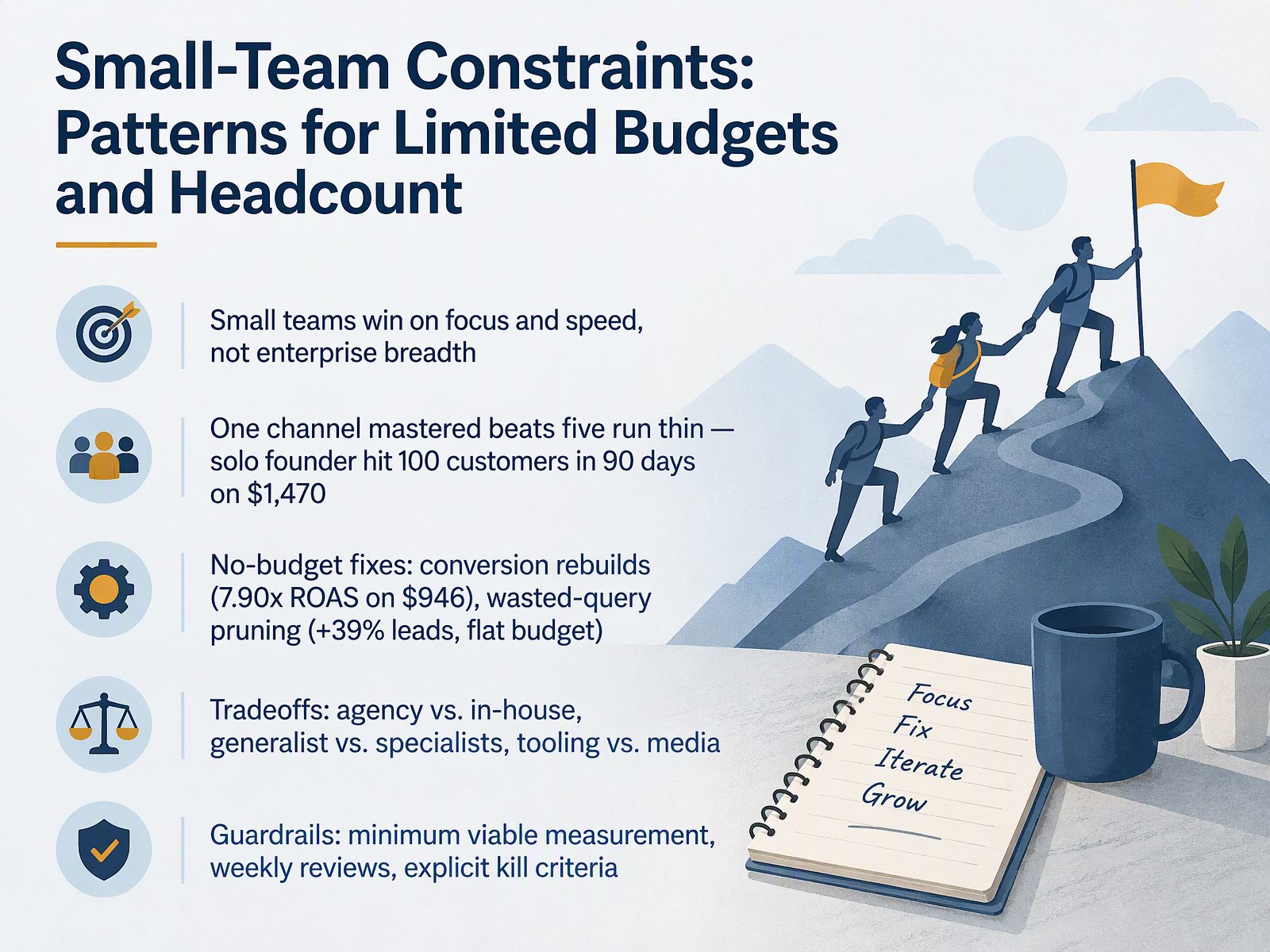
- 07Small-Team Constraints: Patterns for Limited Budgets and HeadcountLet's talk about small-team constraints. The pattern here is simple. Small teams win on focus and speed, not enterprise breadth. One channel mastered beats five run thin. In one documented case, a solo founder reached one hundred paying customers in ninety days on one thousand four hundred seventy dollars, with LinkedIn voice messages as the best channel and cold email as the worst. No-budget fixes matter too. A remodeling company hit seven point nine zero times return on ad spend on nine hundred forty six dollars by rebuilding conversion after the click. A duct cleaning business lifted leads thirty nine percent on a flat budget by pruning wasted queries. Now the tradeoffs. Agency versus in-house. Generalist versus specialists. Tooling versus media. Each buys something and costs something else. So set guardrails: minimum viable measurement, weekly reviews, and explicit kill criteria. Shift now to reading platform-published cases critically.
 2 min
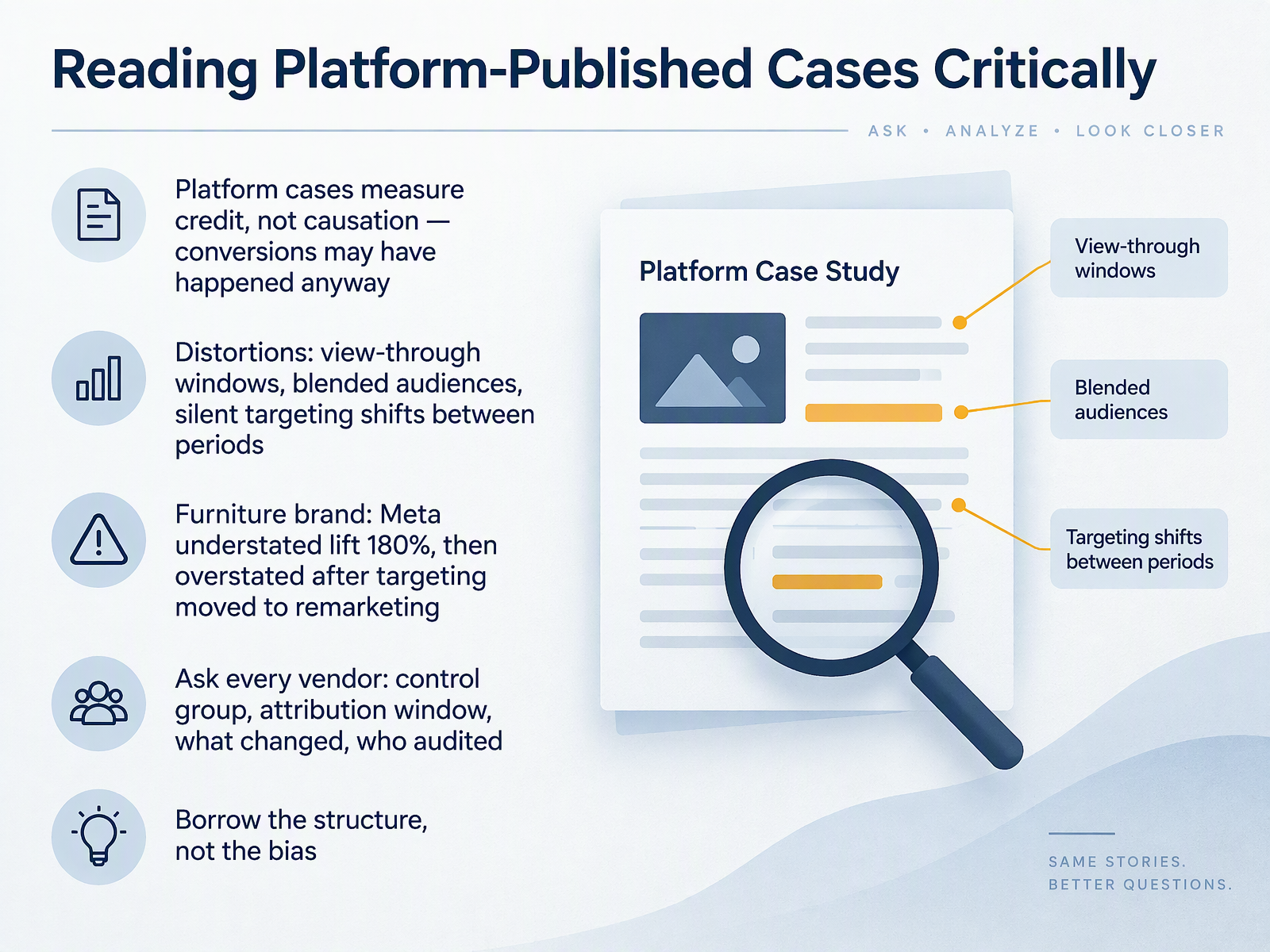
- 08Reading Platform-Published Cases CriticallyLet's talk about reading platform-published cases critically. Platform cases measure credit, not causation. A conversion gets credited to an ad, but it may have happened anyway. Watch for three common distortions: view-through windows, blended audiences, and silent targeting shifts between periods. Here's a documented example. A furniture brand found Meta understated incremental lift by one hundred eighty percent. A year later, once targeting moved to remarketing, Meta overstated it. Same platform, opposite error. So ask every vendor four questions. Was there a control group? What attribution window was used? What changed between periods? And who audited the result? Borrow the structure of their case, not the bias. Next, we'll turn this into a reusable tradeoff checklist.
 thisisbetter.co.ukdl.acm.orgcrealytics.com+21 min
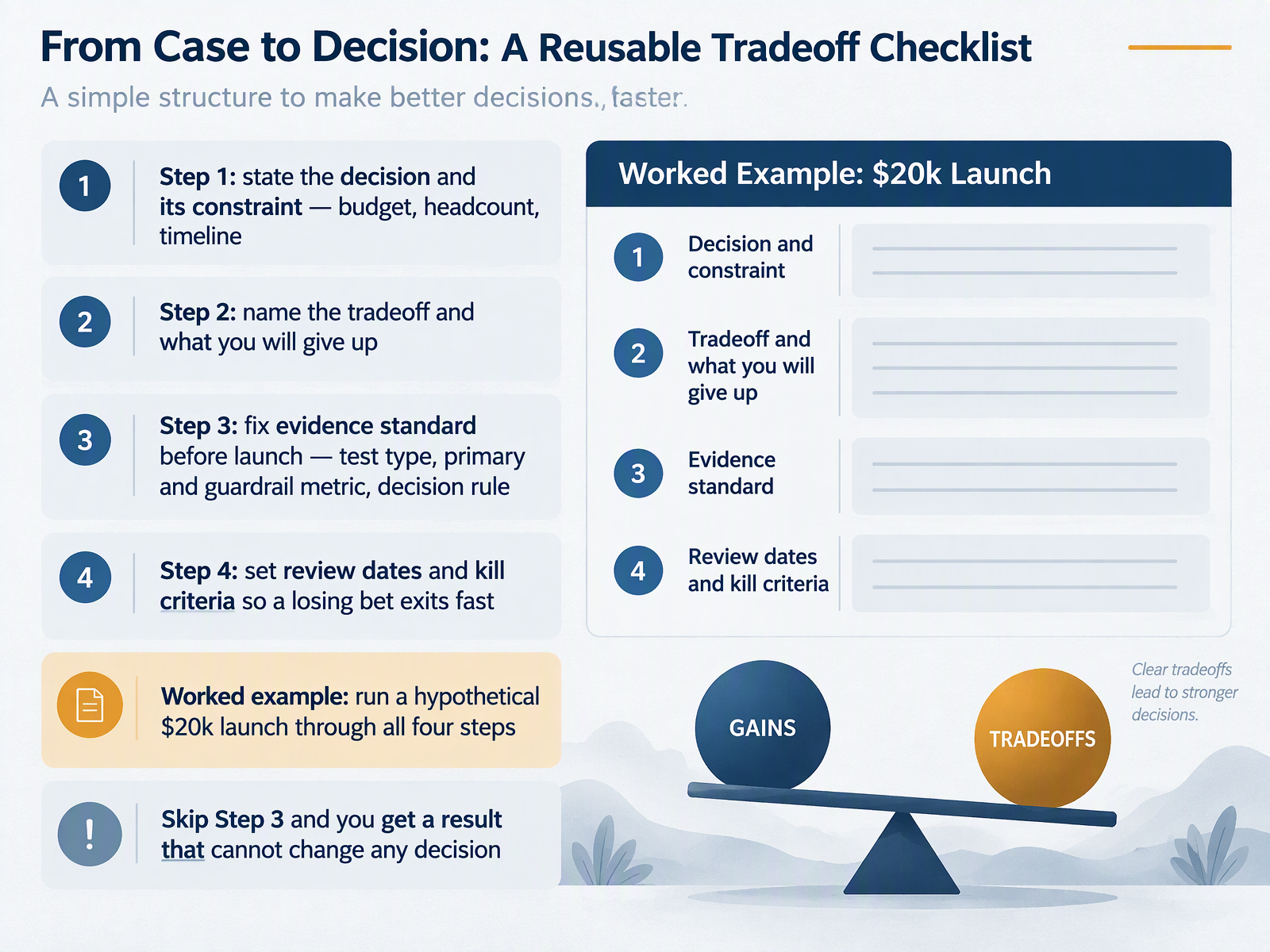
- 09From Case to Decision: A Reusable Tradeoff ChecklistSo let's pull everything together into a checklist you can actually reuse. Step one: state the decision and its constraint. Is it budget, headcount, or timeline? Write it down before you look at any data. Step two: name the tradeoff and say what you will give up. If you shift spend toward your best-performing channel, you may lose reach or learning elsewhere. That is a real cost, so say it out loud. Step three, and this is the one people skip: fix your evidence standard before launch. Choose the test type, the primary metric, one guardrail metric, and the decision rule. Guardrail means a metric that signals harm, like lead quality dropping. Then step four: set review dates and kill criteria, so a losing bet exits fast. Picture a hypothetical twenty thousand dollar launch. Two weeks in, the primary metric is flat and the guardrail is slipping. Because you wrote the rule in advance, nobody argues about interpretation. Skip step three and you get a result that cannot change any decision. Next, we will practice. Hands-On, Part 1: Score a Case's Evidence Quality.
 github.comblog.breakthrough3x.comdoi.org+22 min
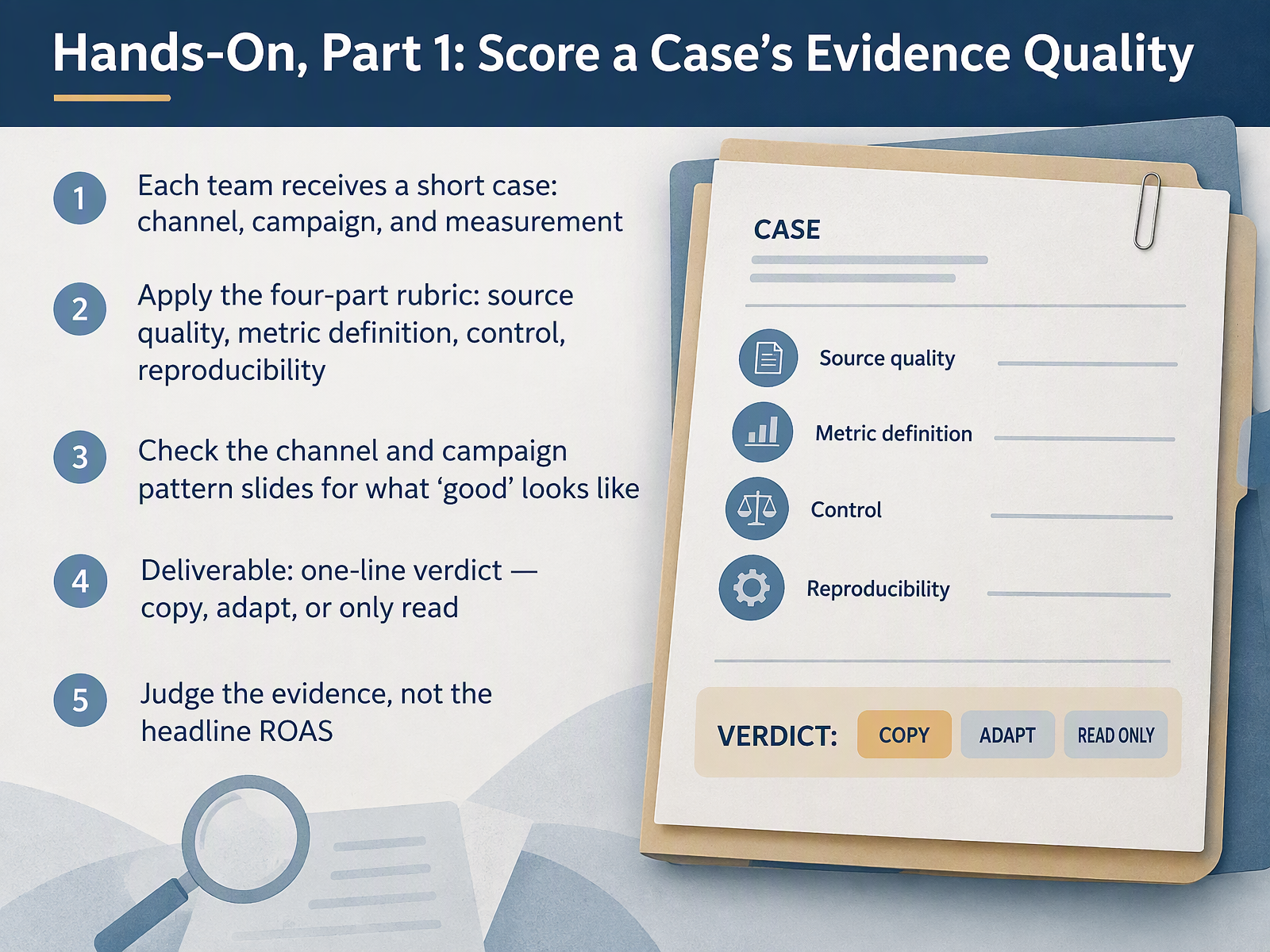
- 10Hands-On, Part 1: Score a Case's Evidence QualityNow let's put this into practice. Each team receives a short case covering a channel, a campaign, and how it was measured. You'll score that case with a four-part rubric. Source quality: where did the numbers come from? Metric definition: what exactly is being counted? Control: was there a holdout or comparison group? And reproducibility: could someone else rerun this and get a similar read? If you need a reference point, revisit the channel and campaign pattern slides for what good evidence looks like. Then write a one-line verdict: copy it, adapt it, or only read it. One reminder: judge the evidence, not the headline return on ad spend, because a big number can still rest on weak attribution. Next, in Hands-On, Part 2: Defend a Reallocation and Its Tradeoff.
 thisisbetter.co.ukdl.acm.orgcrealytics.com+21 min
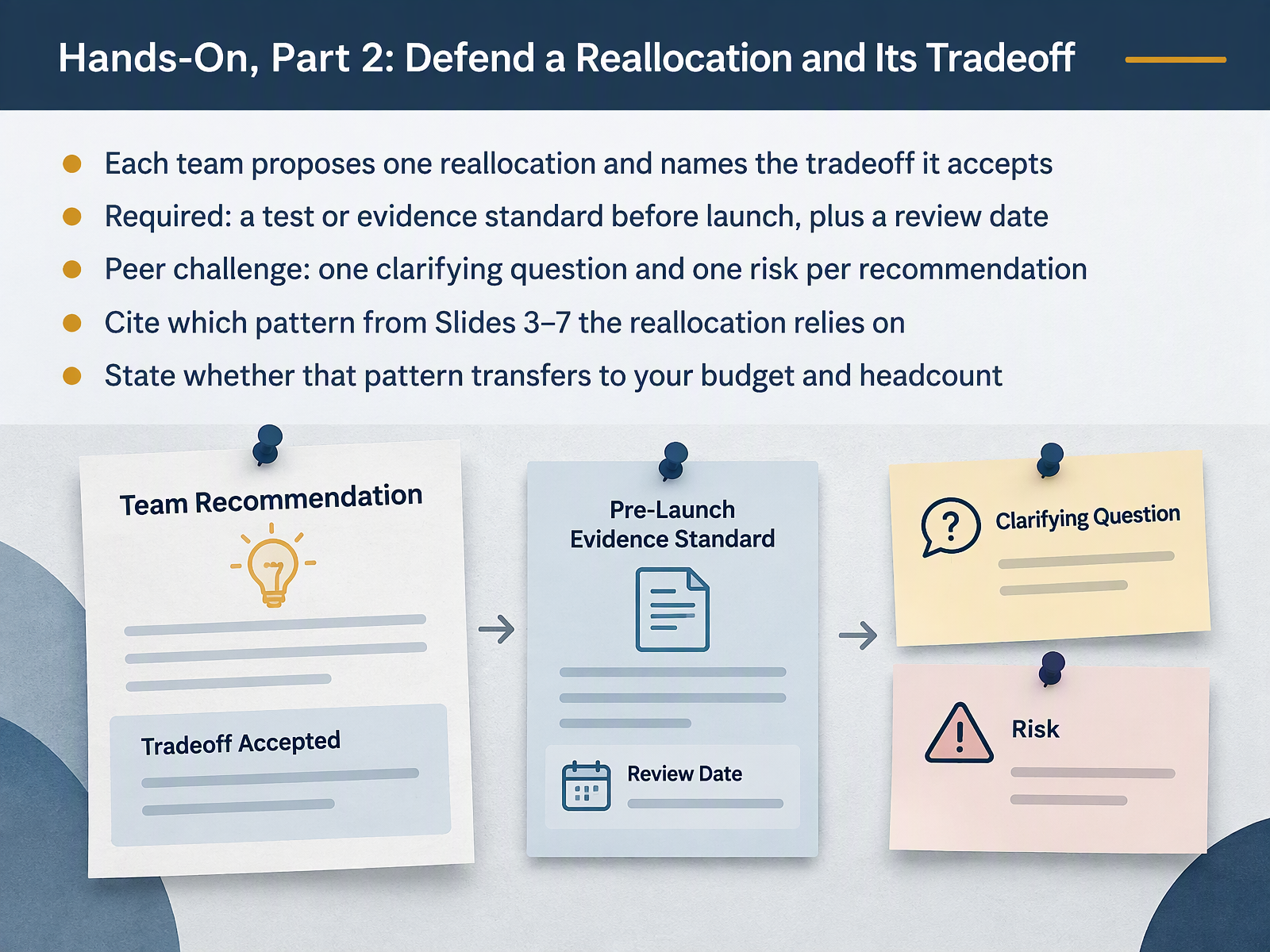
- 11Hands-On, Part 2: Defend a Reallocation and Its TradeoffNow it's your turn to make the case. Each team proposes one reallocation, and just as important, names the tradeoff it accepts. So if you shift spend toward video, say what you're giving up. Maybe it's reach, or a channel that still works but is maturing. Then set the evidence standard before launch. What test will you run, and what result would tell you the move is working? Add a review date, so the decision gets judged on evidence, not momentum. For example, a documented mix modeling case shifted budget away from out of home, toward social, content, and video, and gained roughly three hundred eight incremental registrations within the same total budget. The tradeoff there was reducing a channel that still contributed some value. Peer challenge comes next. Each team gets one clarifying question and one risk per recommendation. And cite which pattern from slides three through seven your reallocation relies on, like diminishing returns or incrementality. Then say whether it transfers to your budget and headcount. A pattern from a larger budget may not scale down cleanly. Be honest about that gap, because naming it makes your recommendation stronger. Next, we debrief. Debrief: Which Patterns Held, Which Tradeoffs Stayed Vague.
 github.comblog.breakthrough3x.comdoi.org+22 min
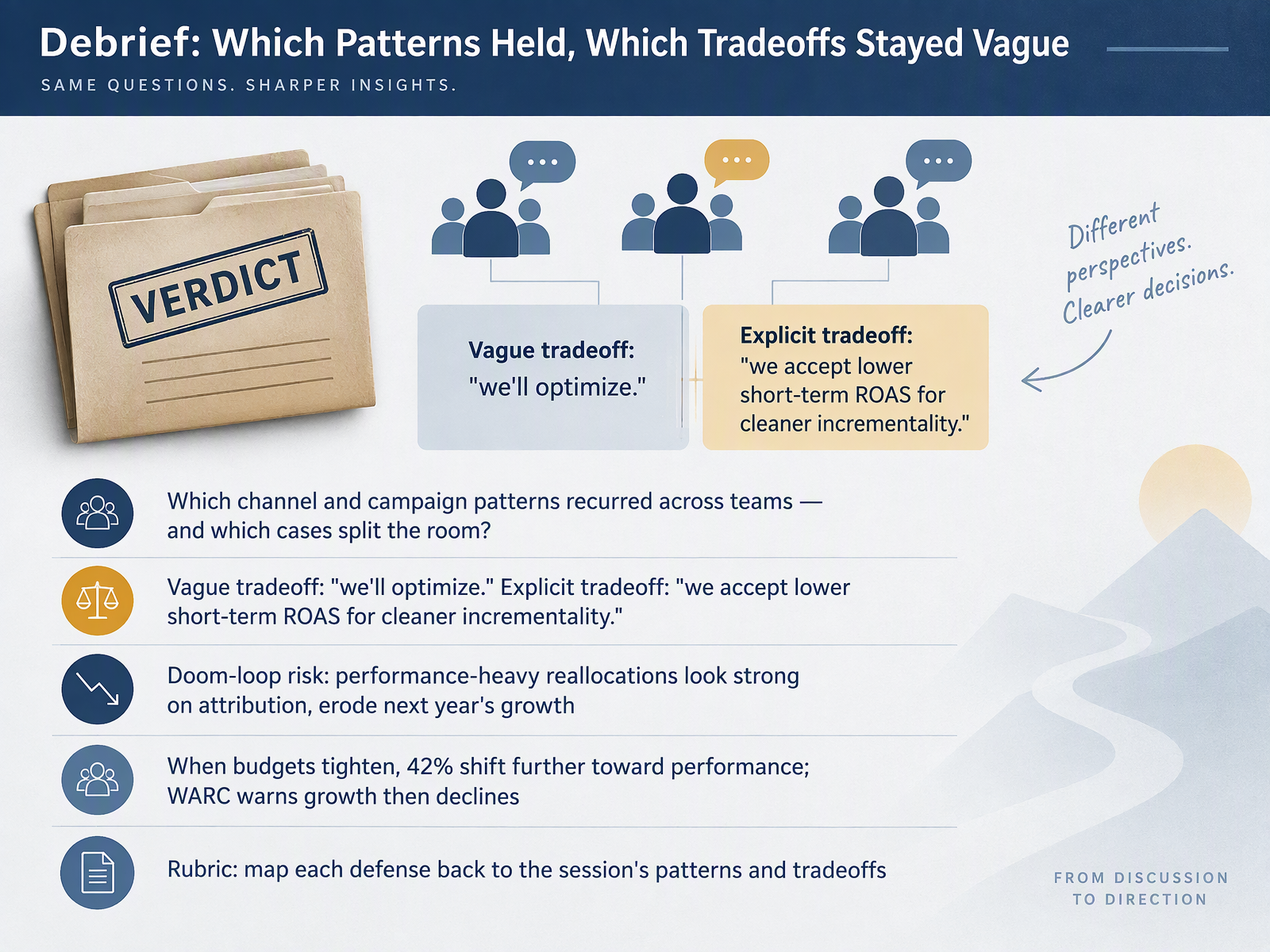
- 12Debrief: Which Patterns Held, Which Tradeoffs Stayed VagueLet's debrief. Which patterns held, and which tradeoffs stayed vague? Start with the recurring pattern. When budgets tighten, teams lean harder on performance. WARC data shows forty-two percent of marketers expecting a cut shift more spend toward performance, against twenty-nine percent toward brand. WARC warns this can become a doom loop. Reallocations look strong on attribution, but they erode next year's growth. So watch the language in a defense. If someone says, we'll optimize, that's vague. A stronger version is explicit: we accept lower short-term ROAS for cleaner incrementality. That names the tradeoff and makes it testable. One caution on the data. The forty-two percent describes intent across surveyed marketers, not your account. Your job is to map each defense back to the session's patterns and tradeoffs, and mark where evidence is missing. Next, take-home: apply the checklist to your next live decision.
 thisisbetter.co.ukdl.acm.orgcrealytics.com+21 min
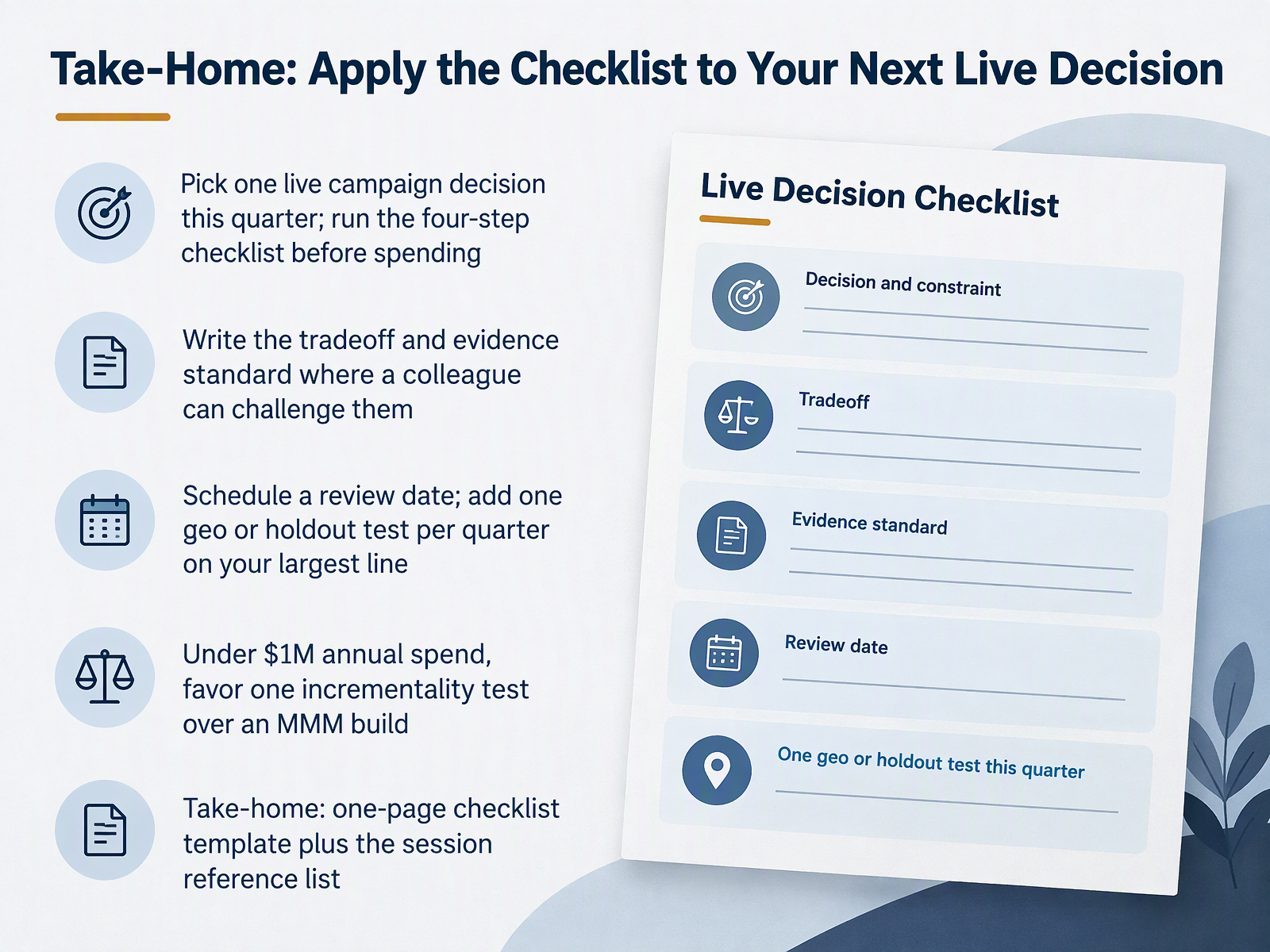
- 13Take-Home: Apply the Checklist to Your Next Live DecisionNow let's put this to work. Pick one live campaign decision this quarter. Before you spend, run the four-step checklist. Then write down the tradeoff and the evidence standard where a colleague can challenge them. Next, schedule a review date, and add one geo test or holdout per quarter on your largest line. One note on scale. Under one million dollars in annual spend, favor a single incrementality test over building an MMM. Sources put the practical MMM threshold near two million dollars and two to three years of varied spend. Finally, you're leaving with a one-page checklist template and the session reference list. So choose one decision, and test it against the evidence you have. Next, we wrap up with Course Recap: Three Lenses, One Habit.
 github.comblog.breakthrough3x.comdoi.org+21 min
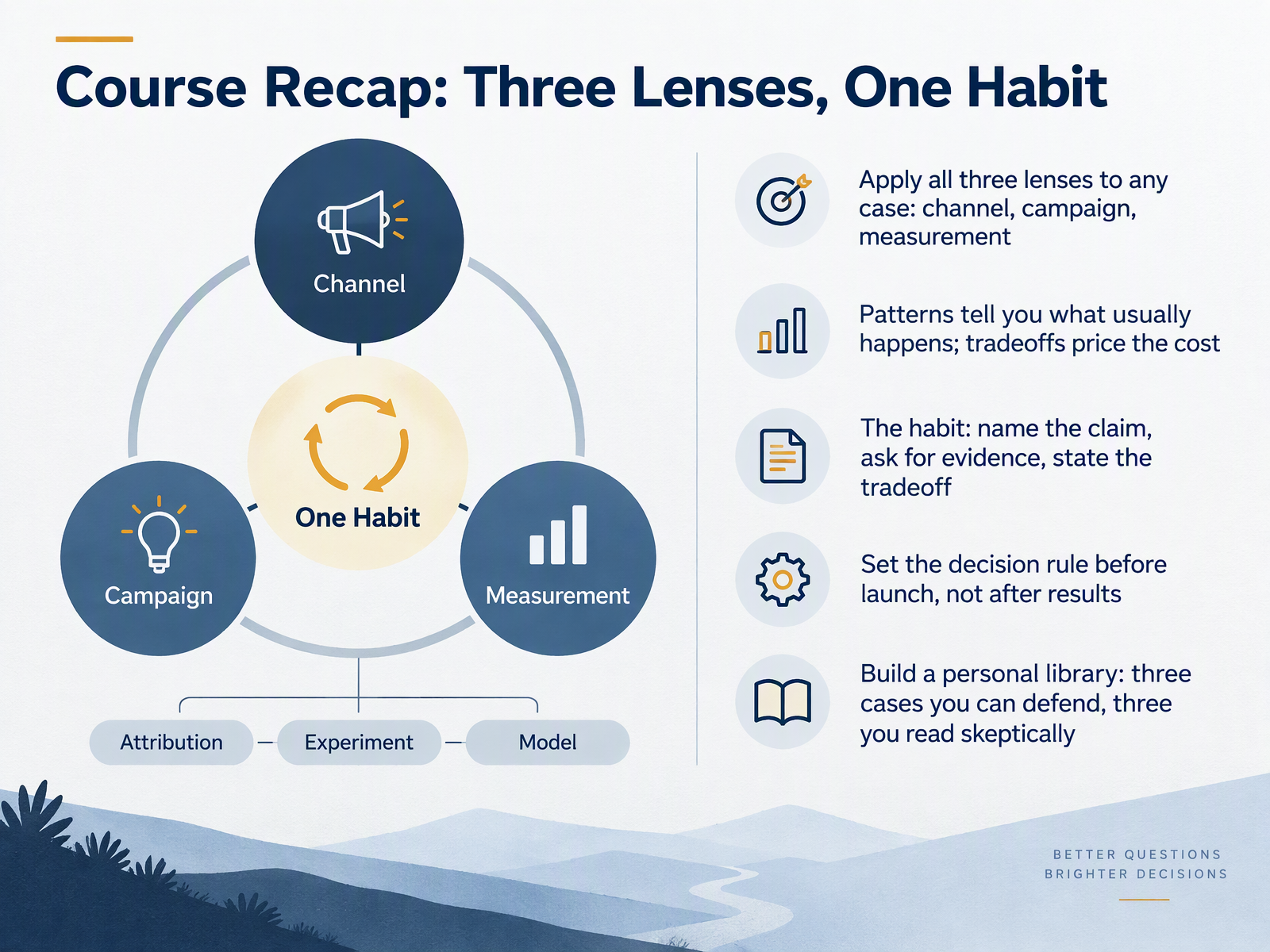
- 14Course Recap: Three Lenses, One HabitSo let's pull the course together. Three lenses, one habit. Apply all three lenses to any case you meet: channel, campaign, and measurement. Channel asks whether the spend caused the outcome. Campaign asks whether the execution was sound. Measurement asks how much confidence the evidence deserves. Patterns tell you what usually happens, and tradeoffs price what it costs. For example, a channel can show a strong reported return and still be buying customers you already had, so the tradeoff is real efficiency against volume. The habit is simple: name the claim, ask for evidence, then state the tradeoff out loud. And set your decision rule before launch, not after results, so you are not just rationalizing what happened. Finally, build a personal library: three cases you can defend, and three you read skeptically. Thank you for working through this with me. Keep asking for evidence, and trust that your judgment will sharpen with each case.
 github.comblog.breakthrough3x.comdoi.org+22 min
Take the deck with you
Download this course as a file — free, no sign-up needed.
- PDF handoutEvery slide page, ready to print or share.15 pages · 3.8 MBDownload
- Narrated PowerPointThe deck that presents itself — every slide carries the digital human's narration video.15 pages · 15.6 MBDownload
- PowerPoint slidesThe full deck as a .pptx — open it in PowerPoint, Keynote, or Google Slides.15 pages · 3.8 MBDownload
Free to use in your own training — please keep the PersonWise credit page at the end.
Have your own deck? Turn it into a course
Sources consulted
Web sources consulted while building this course.
- yoshandgosh/Marketing-Mix-Modelling-MMM-Case-Study — github.com
- How to Allocate Marketing Spend Across Channels — blog.breakthrough3x.com
- Designing Effective Multichannel Advertising Strategies in Competitive Markets: A Case-Based Framework — doi.org
- From Attribution to Causality in Digital Advertising: Blackout Experiments and Incrementality-Adjusted Profitability at Dropbox — doi.org
- Evaluating Marketing Decision Systems Under Experimental Constraints — digitalcommons.georgiasouthern.edu
- The channel that looked free — thisisbetter.co.uk
- Online Advertising Incrementality Testing: Practical Lessons And Emerging Challenges — dl.acm.org
- Crealytics Case Study: Measuring for incrementality makes Dunelm’s Facebook Ads 90% more effective — crealytics.com
- Audit file: a deteriorating LTGP:CAC hidden by platform ROAS (Activewear) | Blue Sense Digital — bluesensedigital.com.au
- Incrementality Test Reveals Hidden Costs of Bad Ad Measurement — measured.com
- The most innovative retail-media network in the UAE - Grassfish — grassfish.com
- How Did Cotswolds Outdoor Turn Its Store Estate into a Retail Media Network? — iuf.digital
- Albertsons Media Collective - Case Study: Breakout Onsite Media Performance Worth Celebrating — albertsonsmediacollective.com
- How Ace Hardware's dual-path campaign boosted SodaStream orders by 70% | The Drum — thedrum.com
- Albertsons Media Collective - Case Study: Converting Reach into Revenue with In-Store Activation — albertsonsmediacollective.com
- Ad Fatigue in 2026: Diagnose, Cap, Refresh — adlibrary.com
- Ad Frequency Benchmark: What Number Is Actually Too High | Genyad — genyad.com
- The Creative Fatigue Benchmark 2026 | QuickAds — quickads.ai
- Motion's Creative Benchmarks 2026: Ad Volume by Spend Tier | Sepia — sepia-lab.com
- How Often Do Brands Actually Refresh Their Facebook Ads? 773 Ads, Measured | SOCIALFUEL — socialfuel.io