Construction Project Management
Begin
14 pages · ~28 min
Construction Project Management
A comprehensive training course on construction project management, covering core principles and practices for professionals overseeing building projects from inception to completion.
What you’ll learn
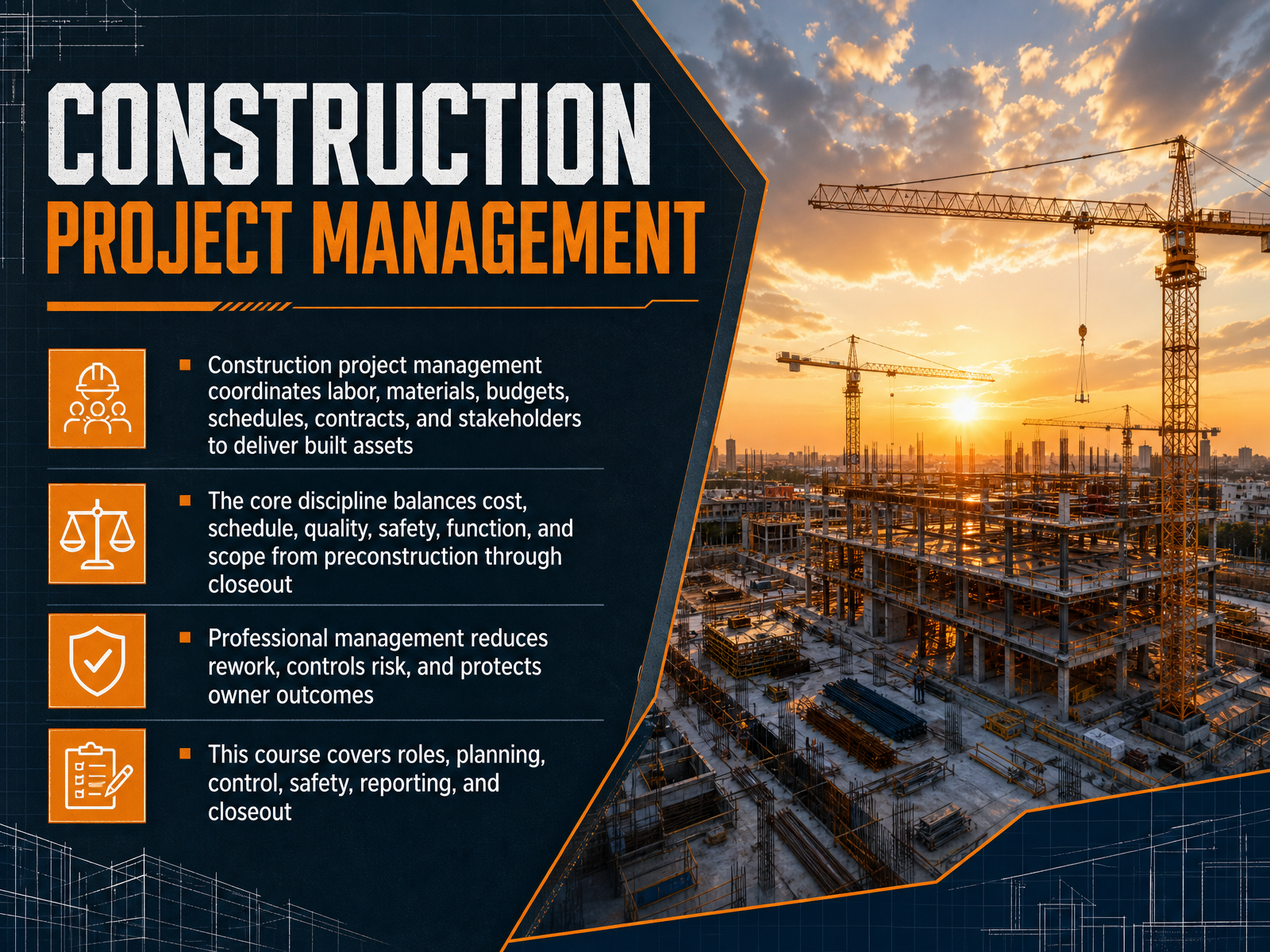
- 01Construction Project ManagementWelcome. If you're leading a build, you already know the job is bigger than a set of plans. Construction project management coordinates labor, materials, budgets, schedules, contracts, and stakeholders to deliver a built asset. The core discipline balances cost, schedule, quality, safety, function, and scope, from preconstruction through closeout. That balance is what keeps a project from slipping, whether it's a change order that wasn't priced or an RFI that sat unanswered. Professional management reduces rework, controls risk, and protects owner outcomes. In this course, we'll cover roles, planning, control, safety, reporting, and closeout. We'll keep it practical and tied to the decisions you make on site. Let's start with the structure that holds a project together: roles, responsibilities, and governance.constructable.aiproject-management.comprojectmanagementformula.com+21 min
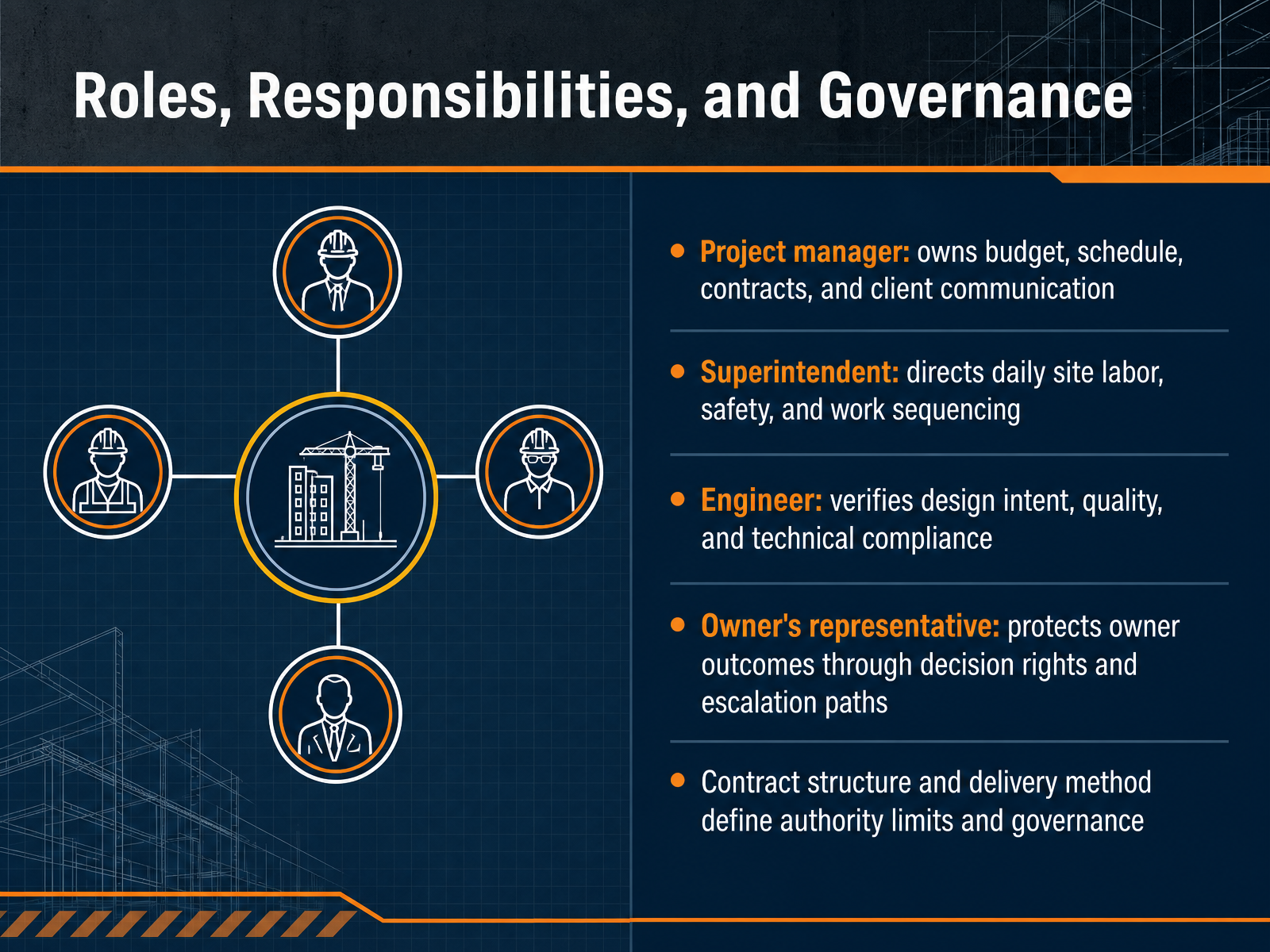
- 02Roles, Responsibilities, and GovernanceNow let’s establish who owns what on a project. Clear roles prevent costly overlaps. The project manager owns the budget, the master schedule, the contracts, and client communication. In short, the PM owns the outcome. The superintendent directs daily site labor, enforces safety, and sequences the work. If the PM owns the outcome, the superintendent owns the execution. The engineer verifies design intent, quality, and technical compliance. If it doesn’t match the drawings, it doesn’t move forward. The owner’s representative protects the owner’s interests through defined decision rights and clear escalation paths. Here is the rule to remember: your contract structure and delivery method define your authority. If your contract doesn’t grant the authority, you don’t have it. Know your governance limits before you issue a directive. This clarity is what keeps a project moving. Next, we walk through the construction project lifecycle, phase by phase.
 constructable.aiproject-management.comprojectmanagementformula.com+21 min
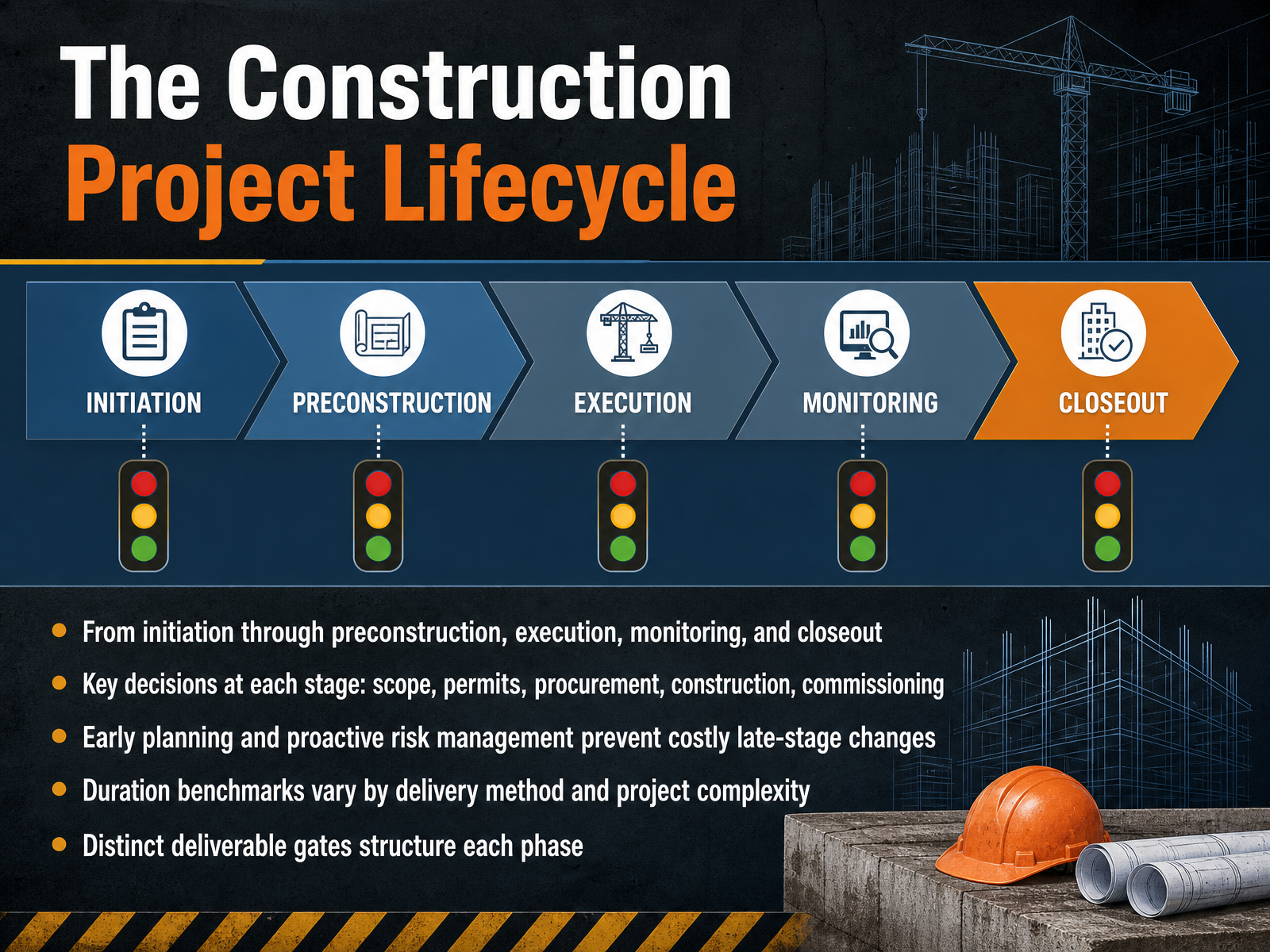
 - 03The Construction Project LifecycleNow let's walk the full construction project lifecycle. It starts with initiation, moves through preconstruction, execution, monitoring, and then closeout. Each stage forces key decisions. Scope definition. Permits. Procurement strategy. Construction sequencing. And finally, commissioning. The decisions you make early determine the grief you avoid later. Early planning and proactive risk management are your best tools to prevent costly late-stage changes. Duration benchmarks vary widely here. They depend on your delivery method and project complexity. Design-bid-build runs differently than design-build. Keep that in mind when you set expectations. Structure each phase with distinct deliverable gates. These gates create decision points where you verify work, confirm scope, and release the next tranche of work or funding. A gate is not a formality. It is your control point. Use it to confirm the schedule, check the budget, and catch drift before it compounds. Once you have the lifecycle mapped, you can match it to the right delivery method. That is our next topic: contract types and delivery methods.
 constructable.aiproject-management.comprojectmanagementformula.com+22 min
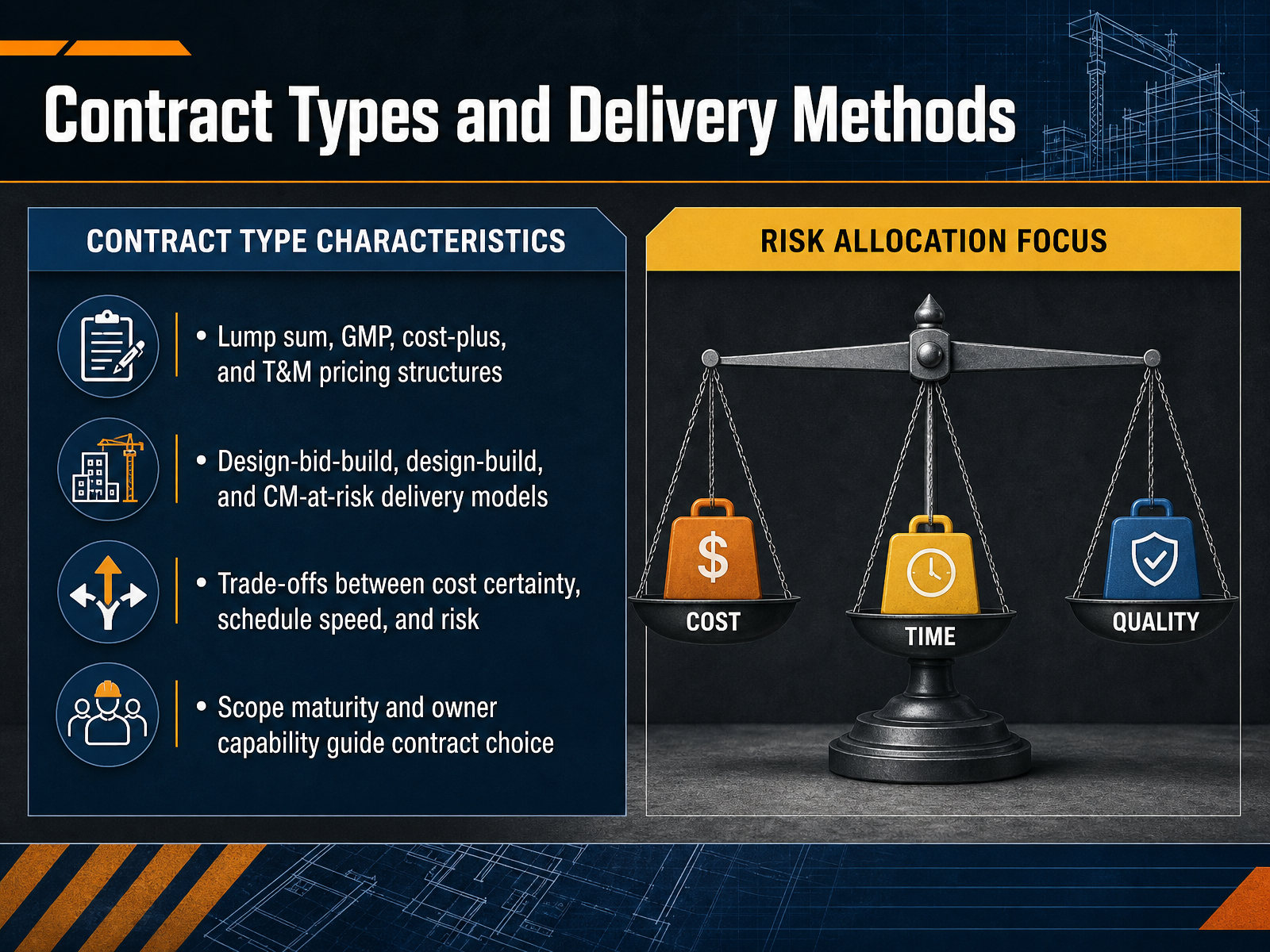
 - 04Contract Types and Delivery MethodsNow let’s talk about how you actually buy and deliver the work. Contract types and delivery methods are not branding exercises. They are risk allocation decisions. And you have to make them early. On one side, you have pricing structures: lump sum, GMP, cost-plus, and time and materials. On the other, delivery models: design-bid-build, design-build, and CM-at-risk. Do not see them as labels. See them as the answer to one question: who controls, prices, and administers each major project risk? A lump sum fixed price only works when scope is mature and drawings are complete. If you force a hard price too early, the market will price in large contingencies, and certainty will be challenged later through claims. GMP gives you a ceiling with open-book transparency. It is a strong fit for negotiated work where design is still developing. Cost-plus and T&M keep cost risk on the owner. Use them when scope is undefined, but be prepared for rigorous oversight and strict change authorization. Now, look at the delivery models. Design-bid-build pushes design risk to the owner and construction risk to the contractor. It is sequential but slow, with the highest change-order exposure. Design-build merges design and construction under one contract, compresses the schedule, and shifts coordination risk to the builder. CM-at-risk brings the builder in during design, and typically converts to a GMP at sixty to ninety percent design. That gives you preconstruction input while keeping the design contract separate. Never match a delivery model to what worked on your last project. Match it to scope maturity, owner capability, and required price certainty. When the model and the project reality align, the contract supports delivery. When they do not, it becomes a claims engine. Next, we will detail how to structure the procurement strategy and manage bids.
 constructionfront.comprovision.comlegalclarity.org+22 min
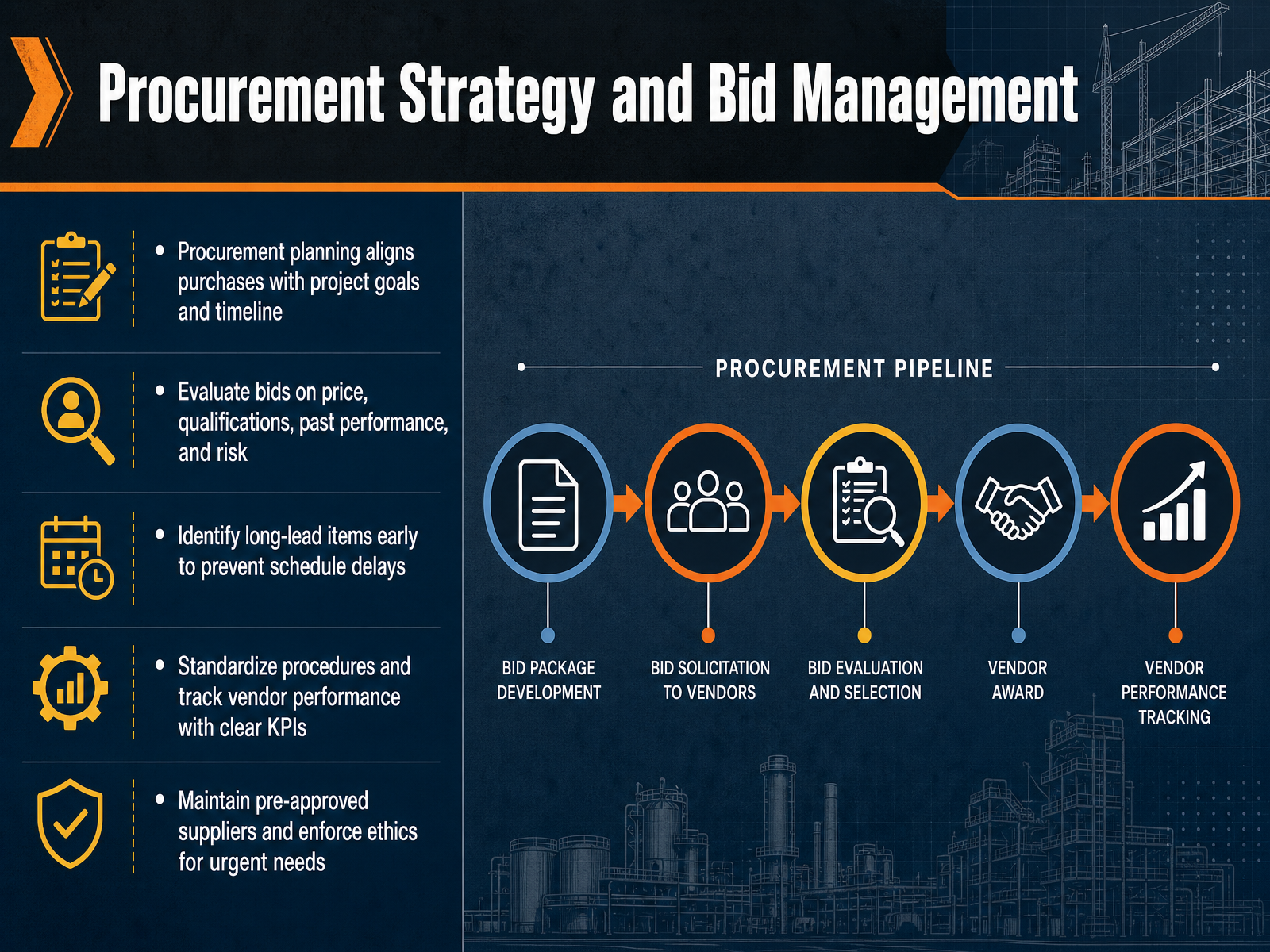
 - 05Procurement Strategy and Bid ManagementNow let's turn to procurement strategy and bid management. This is where you align every purchase with the project schedule and the bottom line. Start with planning. Know what you need, and when. Identify long-lead items like switchgear, transformers, or custom facade systems early. If you wait, you will own the delay. When bids come in, do not default to the lowest number. Evaluate price, but weigh qualifications, past performance, and real risk exposure side by side. A cheap bid from an unproven vendor becomes a costly change order later. Standardize your evaluation. Use the same criteria, the same scoring, and document the decision rationale. That protects you in an audit or a dispute. Then track vendor performance. Use clear KPIs, on-time delivery, quality defect rates, and responsiveness. Review them quarterly. If a supplier slips, act before it hits the schedule. Last, keep a pre-approved supplier list for urgent needs. When an emergency hits, you do not have time to vet new vendors. And enforce ethics in every transaction, especially under pressure. Fair, documented bidding keeps you out of legal trouble and keeps the project moving. Next, we'll cover how to lock that plan into a baseline.
 constructionfront.comprovision.comlegalclarity.org+21 min
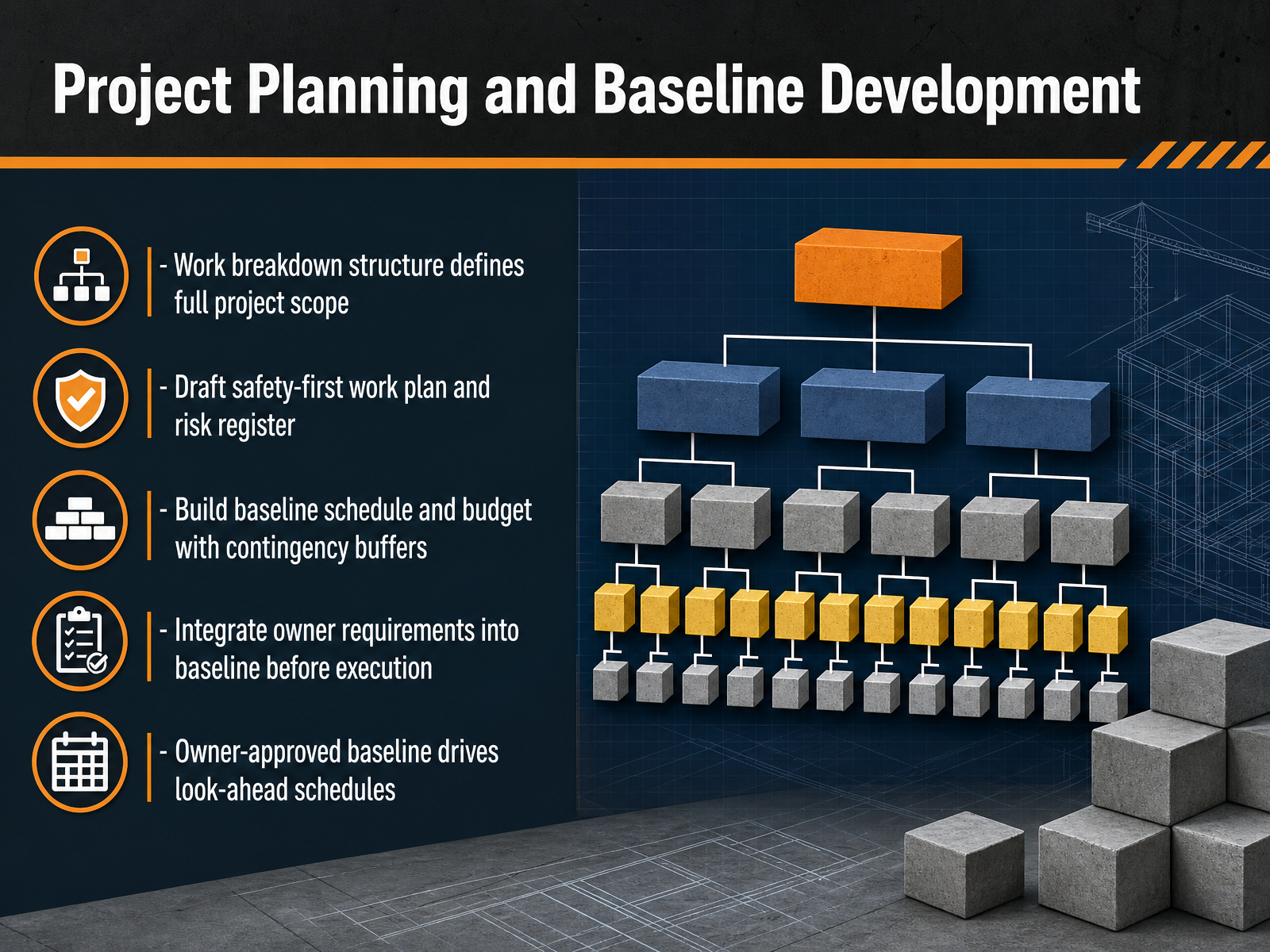
 - 06Project Planning and Baseline DevelopmentNow let’s talk about the baseline. This is where the project is won or lost, before any equipment mobilizes. Start with the work breakdown structure. It must define the full project scope, with no ambiguity. Ambiguity at this stage becomes change orders and disputes later. Draft the safety-first work plan and the risk register side by side. Sequence the work, identify the hazards, and log what could go wrong, from ground conditions to supply chain delays. Build the baseline schedule and the budget together, with contingency buffers sized to the project’s complexity. Then, integrate owner requirements into that baseline. Confirm their expectations on quality, milestones, and reporting before you execute. An owner-approved baseline is your control document. It drives the look-ahead schedules and keeps subcontractors accountable. Without it, you are managing opinions instead of a plan. Next, we move into Scheduling and Critical Path Management.
 constructable.aiproject-management.comprojectmanagementformula.com+22 min
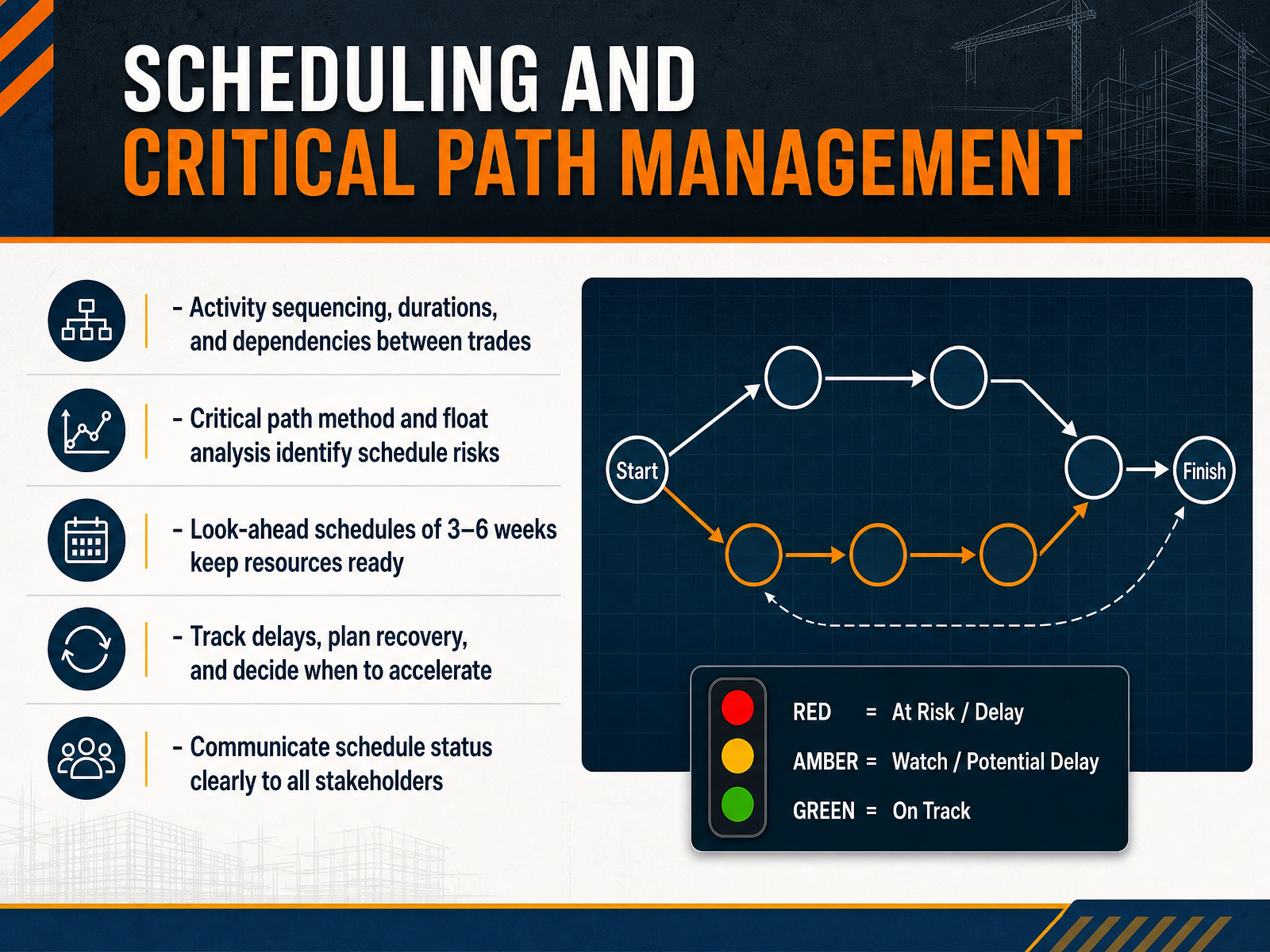
 - 07Scheduling and Critical Path ManagementNow we get into the backbone of daily delivery: scheduling and critical path management. The master schedule is not a static document. It is a working tool that sequences every activity, sets realistic durations, and maps dependencies between trades. If you do not know which trade precedes another, you cannot protect the schedule. Run a critical path analysis and use float to see where you have flexibility. Here is the decision point: if a task on the critical path slips, the project end date slips with it. Protect that path with a three-to-six-week look-ahead schedule. This keeps labor, materials, and equipment ready when the crew arrives, and it prevents the delays that come from idle time. When delays do hit, log them, quantify the impact immediately, and decide whether recovery is possible or acceleration is justified. Do not wait until the monthly meeting to surface a problem. Communicate schedule status clearly to the owner, subcontractors, and the field team so everyone knows the timeline they are committed to. A schedule only works when everyone believes in it and sees their part in it. Next, we shift to cost control and earned value management.
 constructable.aiproject-management.comprojectmanagementformula.com+22 min
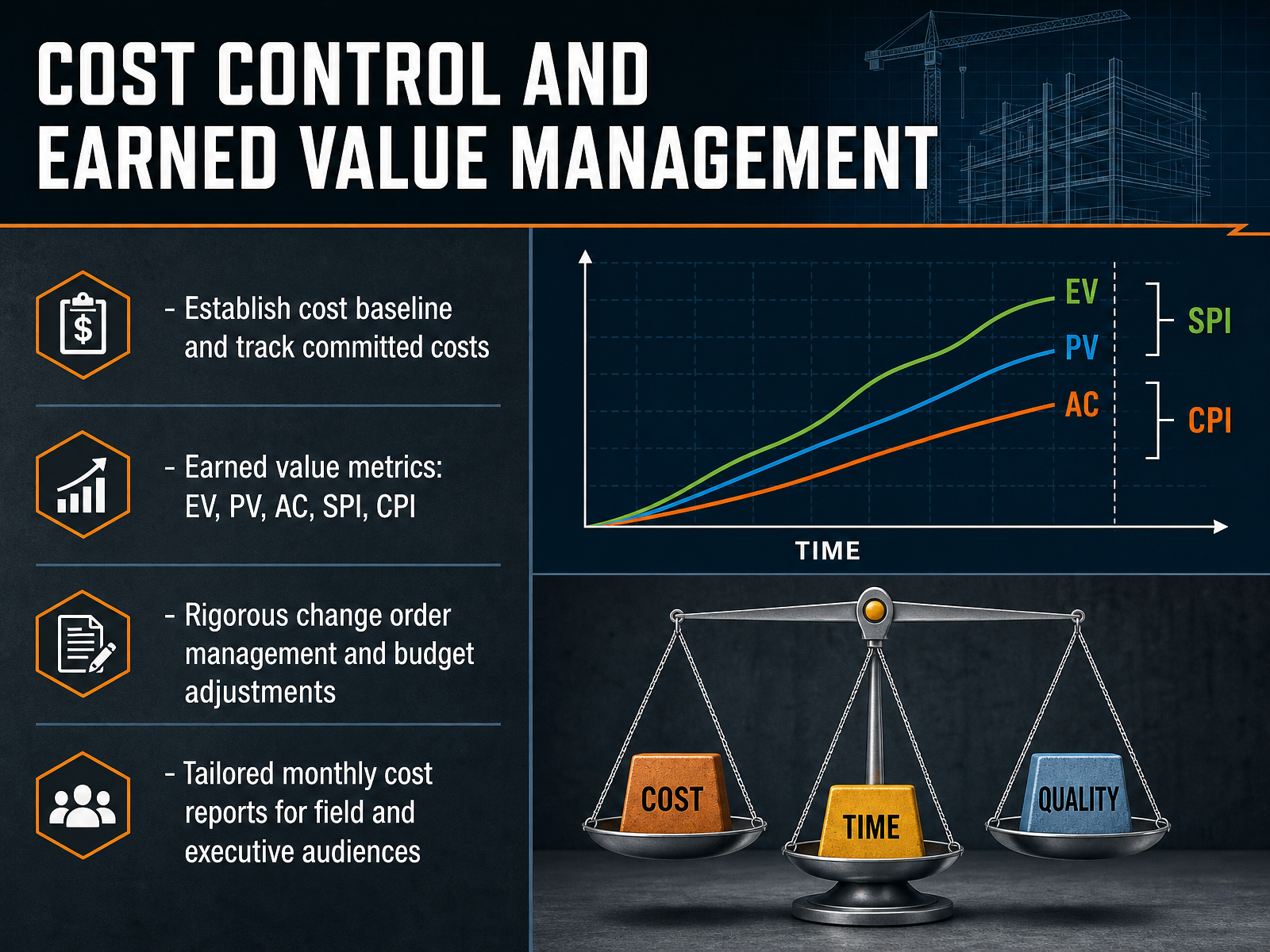
 - 08Cost Control and Earned Value ManagementNow we move to cost control and earned value management. This is where you protect the margin. First, establish your cost baseline and track committed costs, not just what you have paid out. Commitments hit the budget the moment you sign the subcontract or place the material order. Then apply earned value metrics. Planned value is your schedule baseline. Earned value is the budgeted cost of work actually performed. Actual cost is what you have really spent. Compare them. Schedule performance index and cost performance index tell you in one number whether you are ahead or behind, over or under. A cost performance index below one means you are spending more than the work you have earned. Act on it now, not at month end. Rigorous change order management is non negotiable. No signed change order, no work. Period. Adjust the budget only when the change is documented and approved. Finally, tailor your monthly cost reports. The field team needs actionable detail on variances and upcoming commitments. The executive audience needs trends, forecasts, and risk flags. Same data, different lens. Keep the reports clear, and you keep control. Next, we will cover quality assurance and quality control.
 constructable.aiproject-management.comprojectmanagementformula.com+22 min
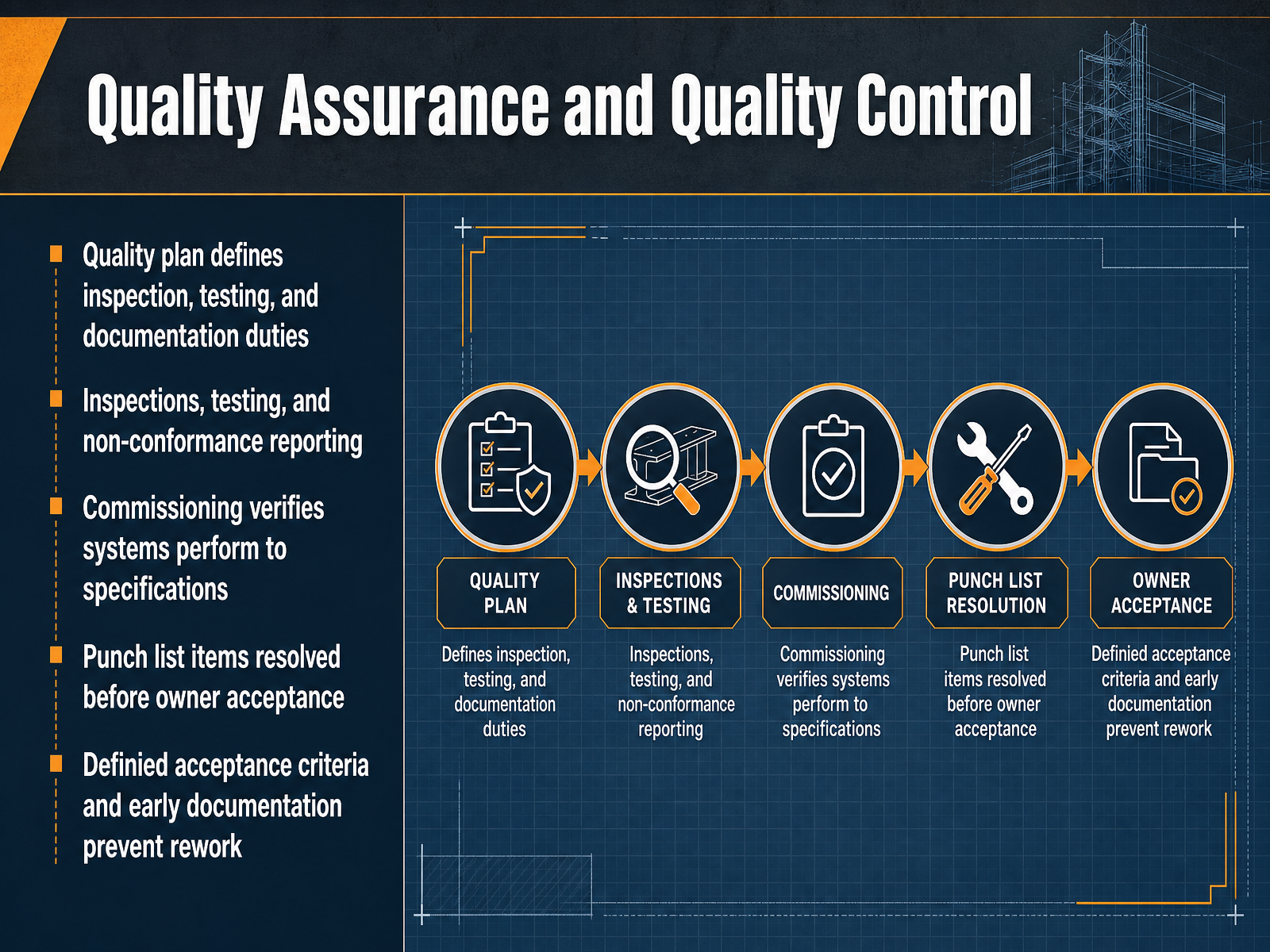
 - 09Quality Assurance and Quality ControlNow let’s shift from documentation to the systems that prove the work. Quality assurance starts with a plan that names who inspects, what gets tested, and how results are recorded. No exceptions. QA defines the standard. Quality control is where you enforce it on the ground. Schedule inspections at the point of work, not after finishes conceal the installation. When something fails, issue a non-conformance report immediately. Log it, assign it, and track it until it closes. Commissioning is the final proof. Every system is tested against the specifications, not against what the installer thinks is good enough. Fire alarm, HVAC, life safety—verified and certified before handover. The punch list is the last filter. Walk the job with the owner, document every deficiency, set clear priorities, and complete a second walkthrough to verify the work. Then and only then do you transfer responsibility through formal acceptance. Here is the governing principle from owners who do this well: documented verification is leverage. Collect as-builts, test reports, and manuals as the job progresses. Early documentation prevents rework and protects final payment. Next, we’ll cover site safety leadership and compliance.
 sitemanagerai.commastt.combuildxact.com+22 min
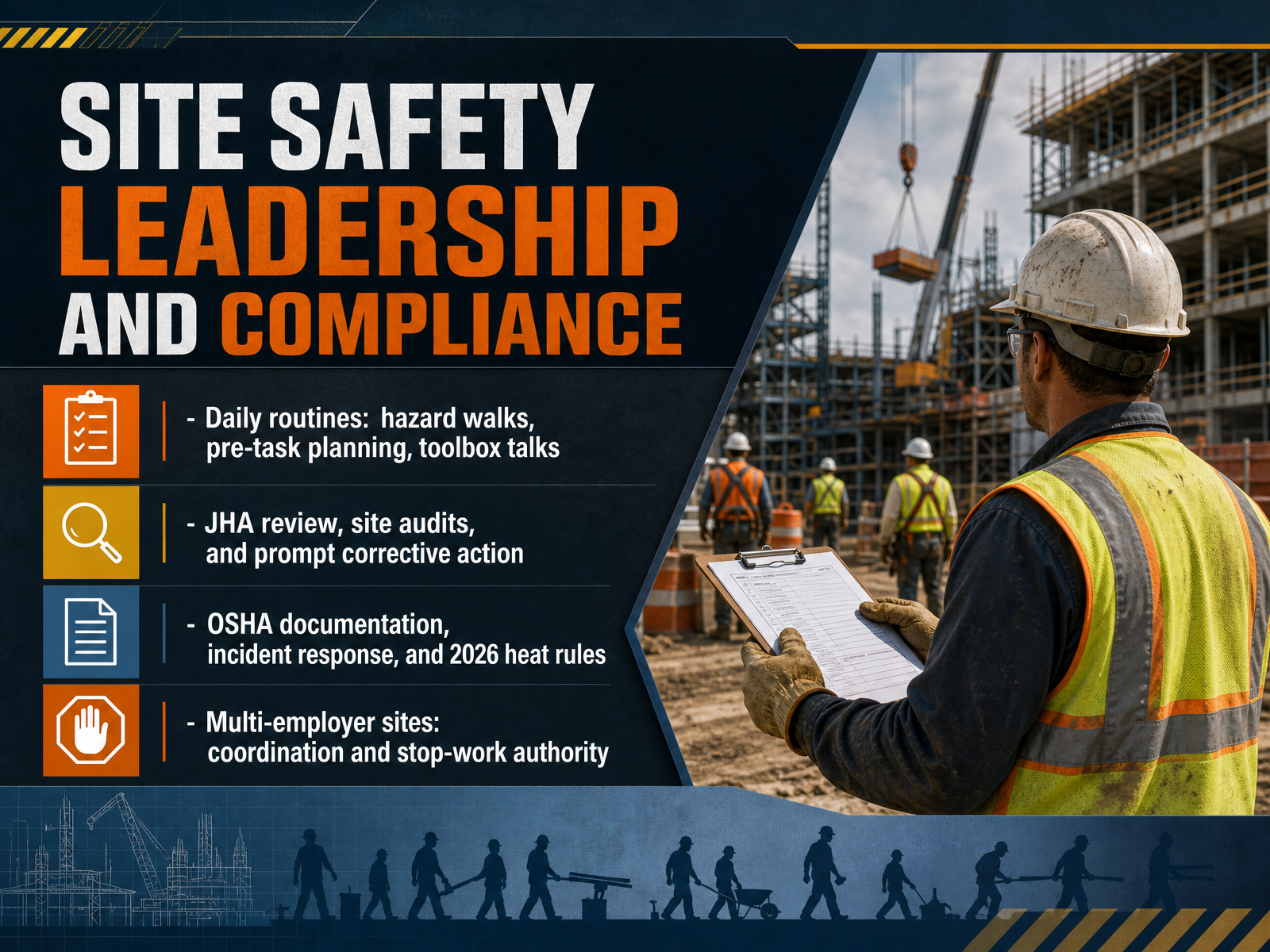
 - 10Site Safety Leadership and ComplianceNow let’s talk about safety leadership on-site, because compliance is a daily function, not a quarterly review. Start every shift with structured routines: a hazard walk, pre-task planning with the crew, and a toolbox talk that matches the actual work scheduled. Review your job hazard analyses before the trade begins, and audit active work areas systematically. When you find a hazard, issue the corrective action on the spot. Document it. Close it out. Prompt correction is your first line of defense against both incidents and citations. Your paper trail matters. OSHA now expects training logs, inspection records, and injury data to align with field conditions. Make sure your documentation is audit-ready. Also, account for the 2026 heat rules. Build a written heat program based on the 80 and 90 degree triggers, regardless of final federal rule status. On multi-employer sites, coordination is critical. Ensure subcontractors communicate about shared hazards, and verify your contract gives you stop-work authority. That authority means nothing if the site leadership does not back it up. Enforce it consistently, and you shape the entire culture of the job. Next, we will cover risk management, insurance, and bonding.
 safetyproresources.comoshacademy.com3psafetystaffing.com+22 min
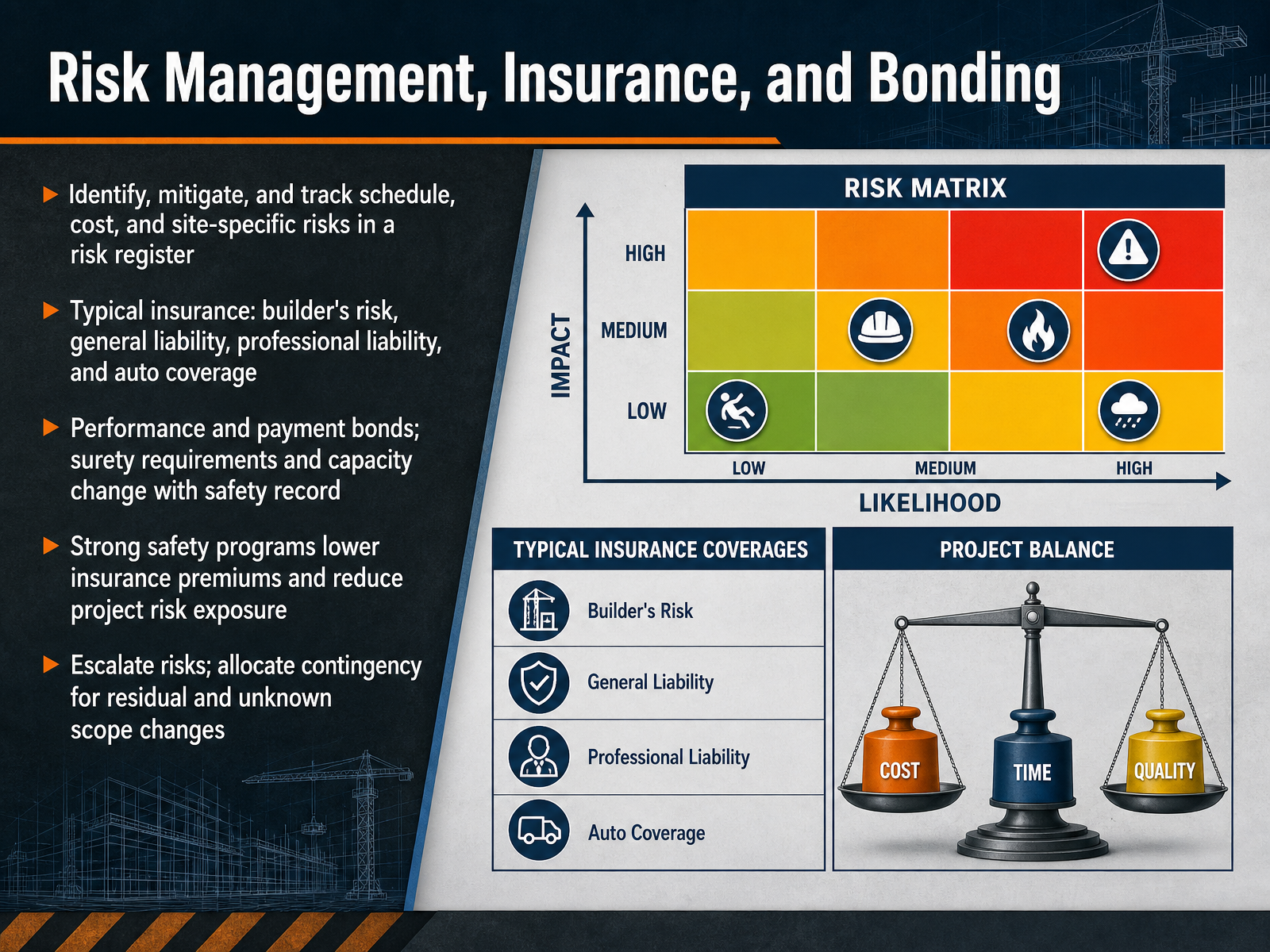
 - 11Risk Management, Insurance, and BondingNow let’s talk about protecting the project from a different angle: risk transfer and financial security. On every job, you need a working risk register. Identify threats to schedule, cost, and site conditions. Then track them, assign owners, and mitigate them proactively. A risk that isn’t logged will surface as a surprise. Insurance is your safety net. You’ll typically see builder’s risk for the work in progress, general liability for site operations, professional liability for design, and auto coverage. Know which party carries which policy, and verify certificates before anyone mobilizes. Bonding is equally critical. Performance and payment bonds protect the owner from contractor default. But here’s the key point: surety capacity is tied to your track record. A strong safety program does more than protect your people—it lowers your premiums and strengthens your bonding position. It reduces risk exposure across the board. Finally, escalate risks early, not late. And allocate contingency for residual or unknown scope changes. Don’t strip it from the budget to make the numbers look better; you’ll need it when conditions change. Now, let’s move on to stakeholder communication and progress reporting.
 constructionfront.comprovision.comlegalclarity.org+22 min
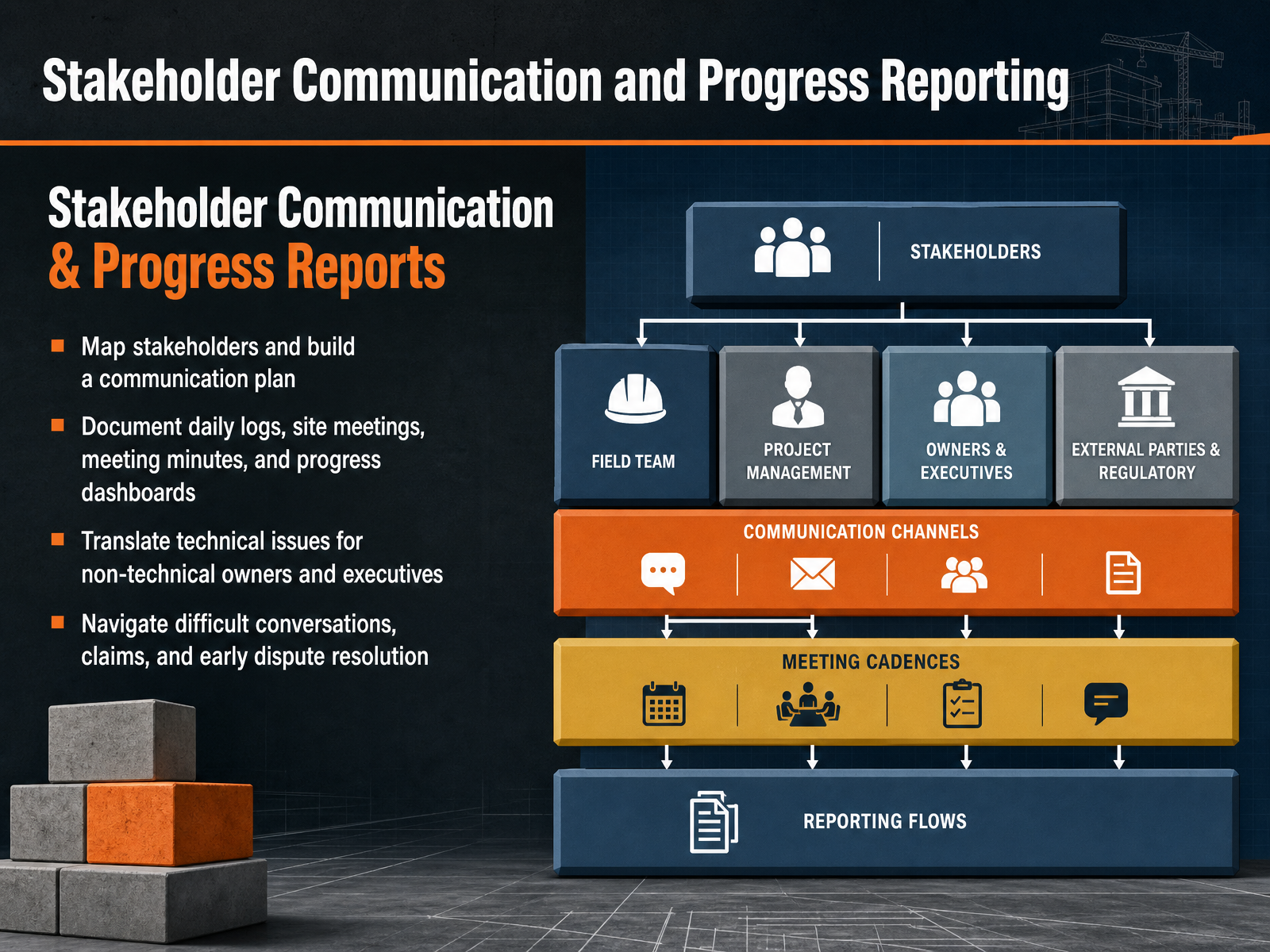
 - 12Stakeholder Communication and Progress ReportingNow let’s talk about stakeholder communication and progress reporting. First, map your stakeholders and build a communication plan. Know who needs what, when, and in what format. Then document everything. Daily logs, site meetings, meeting minutes, and progress dashboards. These are your record of truth. When an issue surfaces weeks later, your documentation is your defense. Now, translation. Owners and executives do not live in RFI terminology. Convert technical delays into schedule impact and cost exposure. Tell them what it means for their money and their move-in date. And when the conversation turns difficult, whether it is a claim, a delay, or a quality dispute, address it early. Letting a problem sit never reduces its cost. Raise it, document it, and move toward resolution while options are still open. Last word: communication is not sending updates. It is ensuring the other party actually understands the risk. Keep it clear, keep it current, and keep it honest. Next, we move into closeout, handover, and documentation.
 constructable.aiproject-management.comprojectmanagementformula.com+21 min
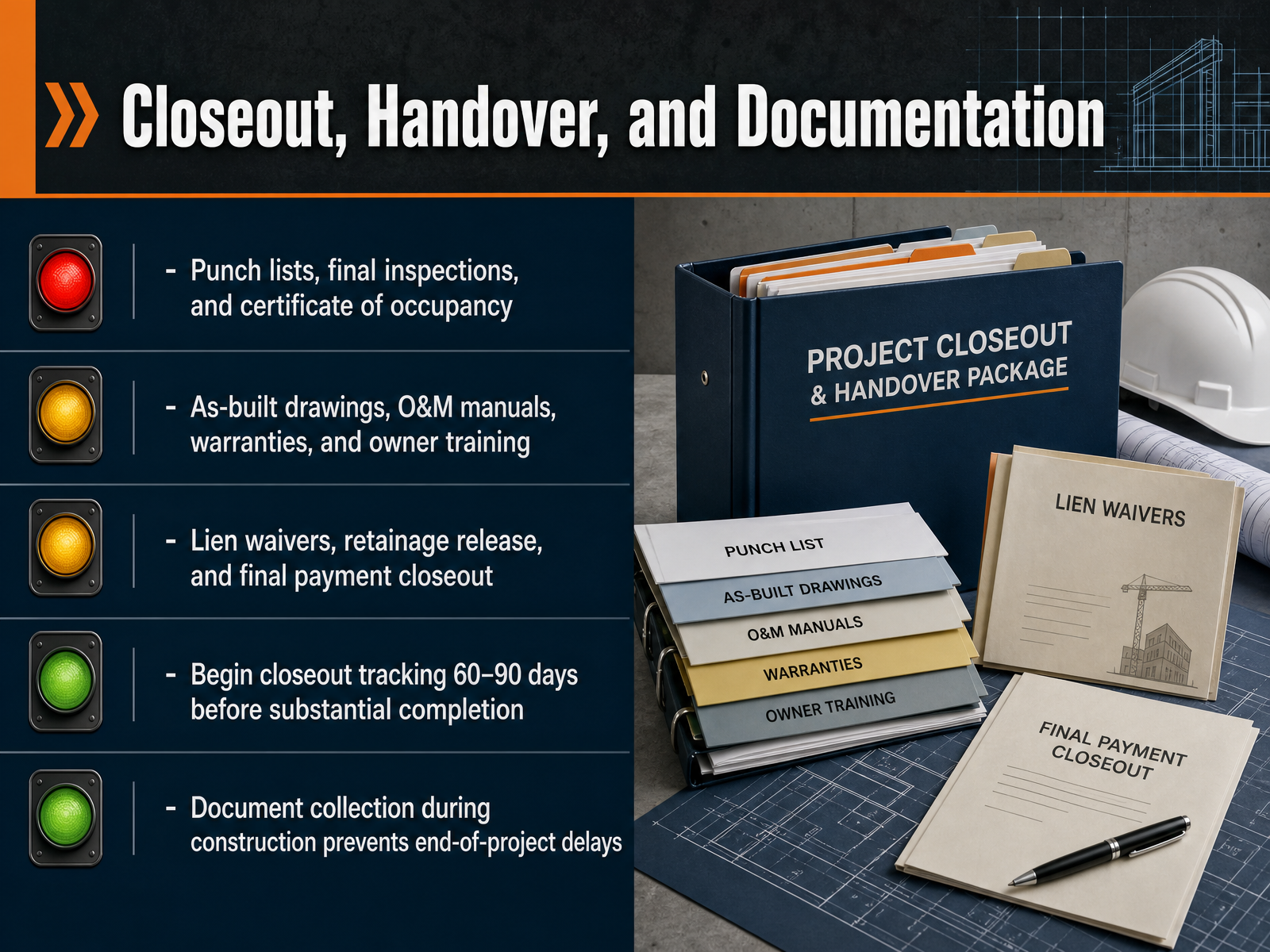
 - 13Closeout, Handover, and DocumentationNow let’s talk about the final phase: closeout, handover, and documentation. This is where projects either finish clean or drag into disputes. Start your closeout tracking sixty to ninety days before substantial completion. Waiting until the last week guarantees delays. The punch list drives this phase. Walk the site with the owner and architect. Document every deficiency with a photo, a location, and an assigned trade. Then verify completion with a second walkthrough and get written sign-off. Do not rely on memory. As-built drawings must reflect what was actually installed, not the original design. Collect redlines from your trades weekly, not after crews have demobilized. Compile operations and maintenance manuals that are specific to the installed equipment, with model numbers, settings, and maintenance schedules. A binder of generic brochures will not pass review. Gather warranties and confirm their activation dates. Many extended warranties are void if not registered. Schedule owner training before final acceptance, and record it so knowledge survives staff turnover. On the financial side, collect unconditional lien waivers from every subcontractor and supplier. This protects the owner from mechanic’s liens and unlocks your retainage. Submit the final invoice as a complete package: signed punch list, inspection certificates, warranties, and as-builts. Owners release payment faster when they are not chasing paperwork. Remember, final payment releases against verified deliverables, not promises. Keep the closeout log active and hold acceptance until every item is complete. This discipline is what separates a professional handover from a months-long cleanup. Next, we will review lessons learned and continuous improvement to capture what went well and what to adjust on the next project.
 sitemanagerai.commastt.combuildxact.com+22 min
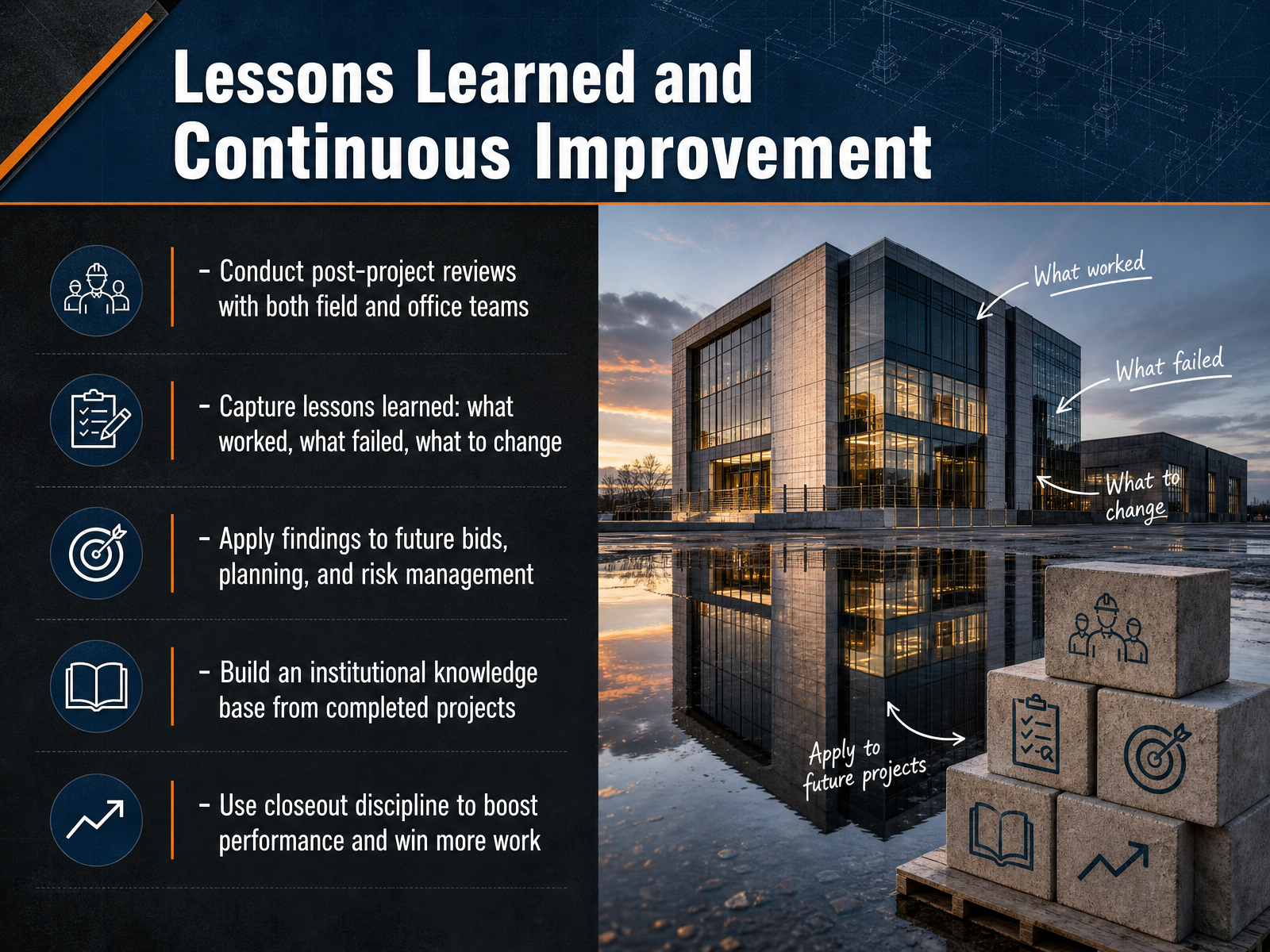
 - 14Lessons Learned and Continuous ImprovementEvery project you finish is a deposit into your next bid. That's why lessons learned are not an administrative afterthought. They're a competitive advantage. Conduct a post-project review while the details are still fresh. Bring the field team and the office team into the same room. The superintendent sees what the estimator missed. The accountant sees what the field burned through. Capture what worked, what failed, and what you would change. Be specific. Vague notes like 'better coordination' are useless next year. Write down the exact RFI bottleneck or the submittal that stalled your critical path. Then, apply those findings to your next bid, your next schedule, your next risk register. That is how you stop repeating mistakes. Build an institutional knowledge base. Store the lessons digitally, indexed by project type and trade so your next team can searchable. Closeout discipline wins more work. Owners remember who handed over a clean, complete project and who walked away. Make your last impression your best one. Thank you for your time. Now get out there, build your book of knowledge, and make it count.
 constructable.aiproject-management.comprojectmanagementformula.com+21 min
Take the deck with you
Download this course as a file — free, no sign-up needed.
- PDF handoutEvery slide page, ready to print or share.15 pages · 5.1 MBDownload
- Narrated PowerPointThe deck that presents itself — every slide carries the digital human's narration video.15 pages · 17.1 MBDownload
- PowerPoint slidesThe full deck as a .pptx — open it in PowerPoint, Keynote, or Google Slides.15 pages · 5.0 MBDownload
Free to use in your own training — please keep the PersonWise credit page at the end.
Have your own deck? Turn it into a course
Sources consulted
Web sources consulted while building this course.
- What Do Construction Project Managers Do? A Complete Guide for June 2026 - Constructable Blog — constructable.ai
- What Is Construction Project Management?: A Complete Guide — project-management.com
- Construction Project Manager Duties – Project Management Formula — projectmanagementformula.com
- Construction Project Management: Everything You Need to Know — autodesk.com
- "Construction Project Manager Job Description (2026): AI-Era Skills, Responsibilities & Hiring Guide" — resources.rework.com
- Construction Contract Types and Procurement Methods: Choosing the Right Delivery Model — constructionfront.com
- Construction Contract Types Compared: Lump Sum, GMP, T&M, — provision.com
- Construction Procurement Methods: Types and How to Choose - LegalClarity — legalclarity.org
- Construction Procurement Methods: Types, Comparison and Best Fit for 2026 — firstbit.ae
- Design-Build vs. CM-at-Risk vs. Design-Bid-Build (2026 Guide) | Terrapin Construction Group — terrapincg.com
- Construction Project Handover Checklist [2026] | Site Manager AI — sitemanagerai.com
- Construction Project Handover Checklist (Word, Excel) — mastt.com
- Construction Project Handover: Checklist, Process and Best Practices | Buildxact US — buildxact.com
- Building Handover Checklist: What to Inspect and Document - LegalClarity — legalclarity.org
- Construction Project Closeout Checklist: Process, Documents, Phases, and Final Closeout Steps — constructionleadpro.com
- Construction Safety Management Roles & Responsibilities Explained — safetyproresources.com
- Recommended Practices for Safety and Health Programs in Construction — oshacademy.com
- Site Safety Manager Job Description [2026]: Duties & Certs — 3psafetystaffing.com
- Construction Safety Officer: Role, Duties & Skills 2026 — lumberfi.com
- Hiring a Construction Safety Manager in 2026: What to Know — thebirmgroup.com