Begin
14 pages · ~28 min
Black Holes: Evidence and Misconceptions
Explore the science of black holes, separating fact from fiction, and understand the evidence behind these cosmic phenomena.
A digital instructor presents all 14 pages. Hold “Ask” at any point and ask out loud — the answer comes from this course. No sign-up needed.
What you’ll learn
- 01Black Holes: Evidence and MisconceptionsWelcome. For a long time, black holes lived only in theory and science fiction. Today, they are supported by real observational evidence. In this course, we will explore that evidence together, and also untangle some of the most common myths. You may have heard that black holes are cosmic vacuum cleaners, or that our Sun could become one. As curious explorers, we will replace those ideas with clear, evidence-based explanations. This topic matters because black holes represent extreme gravity, and they play a key role in modern astrophysics. By the end, you will have a clearer, more confident understanding of these fascinating objects. Let's begin by looking at what a black hole actually is.science.nasa.govscience.nasa.govskyatnightmagazine.com+21 min
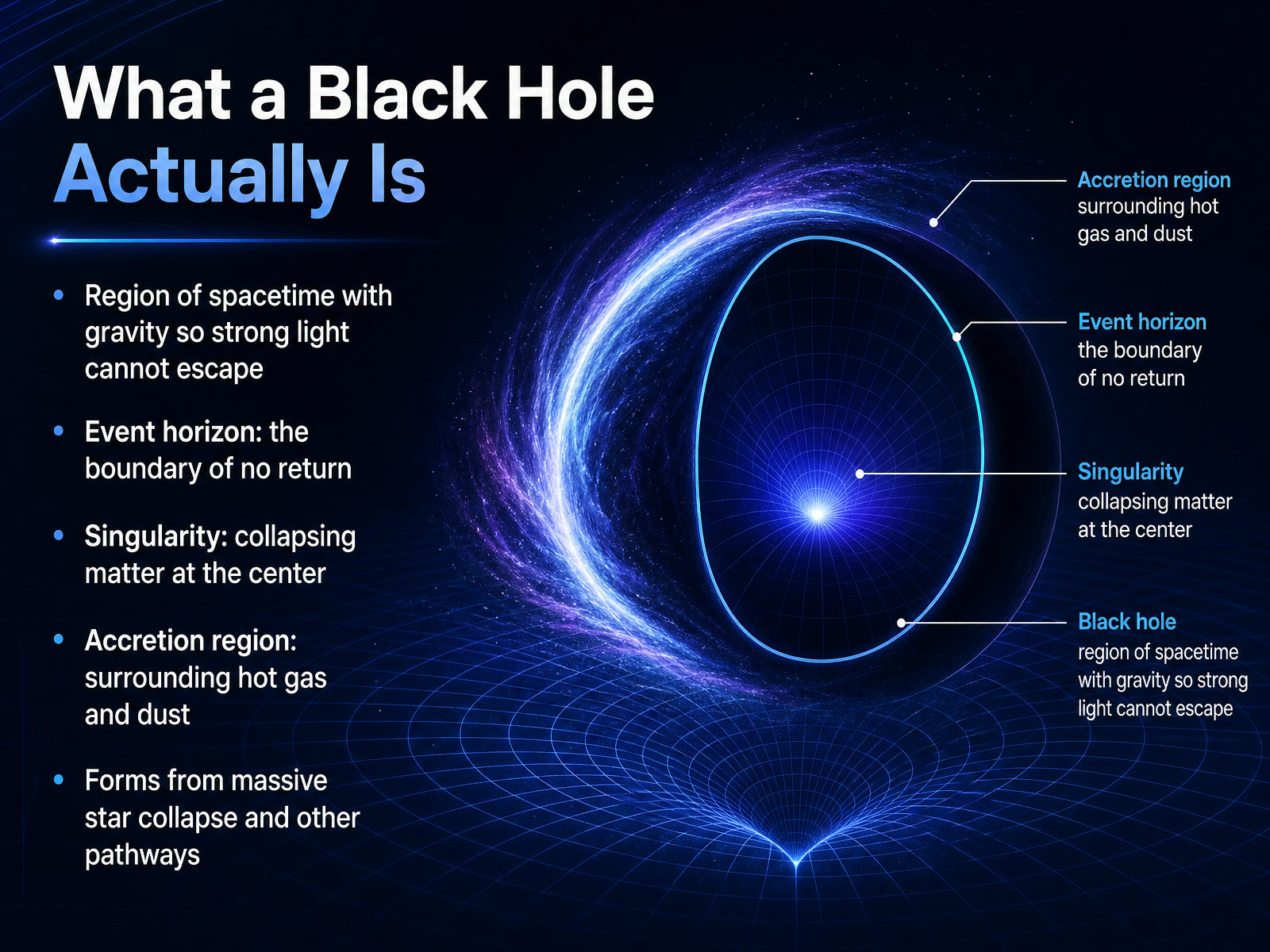
- 02What a Black Hole Actually IsSo what is a black hole, really? You may have heard it described as a cosmic vacuum cleaner, but the reality is more precise. At its heart, a black hole is simply a region of space where gravity has become so incredibly strong that nothing, not even light, can escape from it. To an outside observer, it appears truly black. The boundary that seals it off is called the event horizon. Think of it as the ultimate point of no return. On one side, you can still, in theory, move freely. On the other side, escape is impossible. Deep inside lies the singularity, a point where all the collapsing matter is crushed to unimaginable density. But perhaps the most visible part is the swirling disk of superheated gas and dust just outside the horizon. This ring, called the accretion region, glows brilliantly because of intense friction and heat. Most black holes form when a truly massive star, at least twenty times the mass of our Sun, reaches the end of its life and collapses. But there are other pathways too, including collisions between smaller dense objects. This basic structure, the horizon, the singularity, and the glowing disk, sets the stage for debunking some persistent myths. Next, let's step closer and explore the very boundary that defines them: the event horizon and singularity.
 science.nasa.govscience.nasa.govskyatnightmagazine.com+22 min
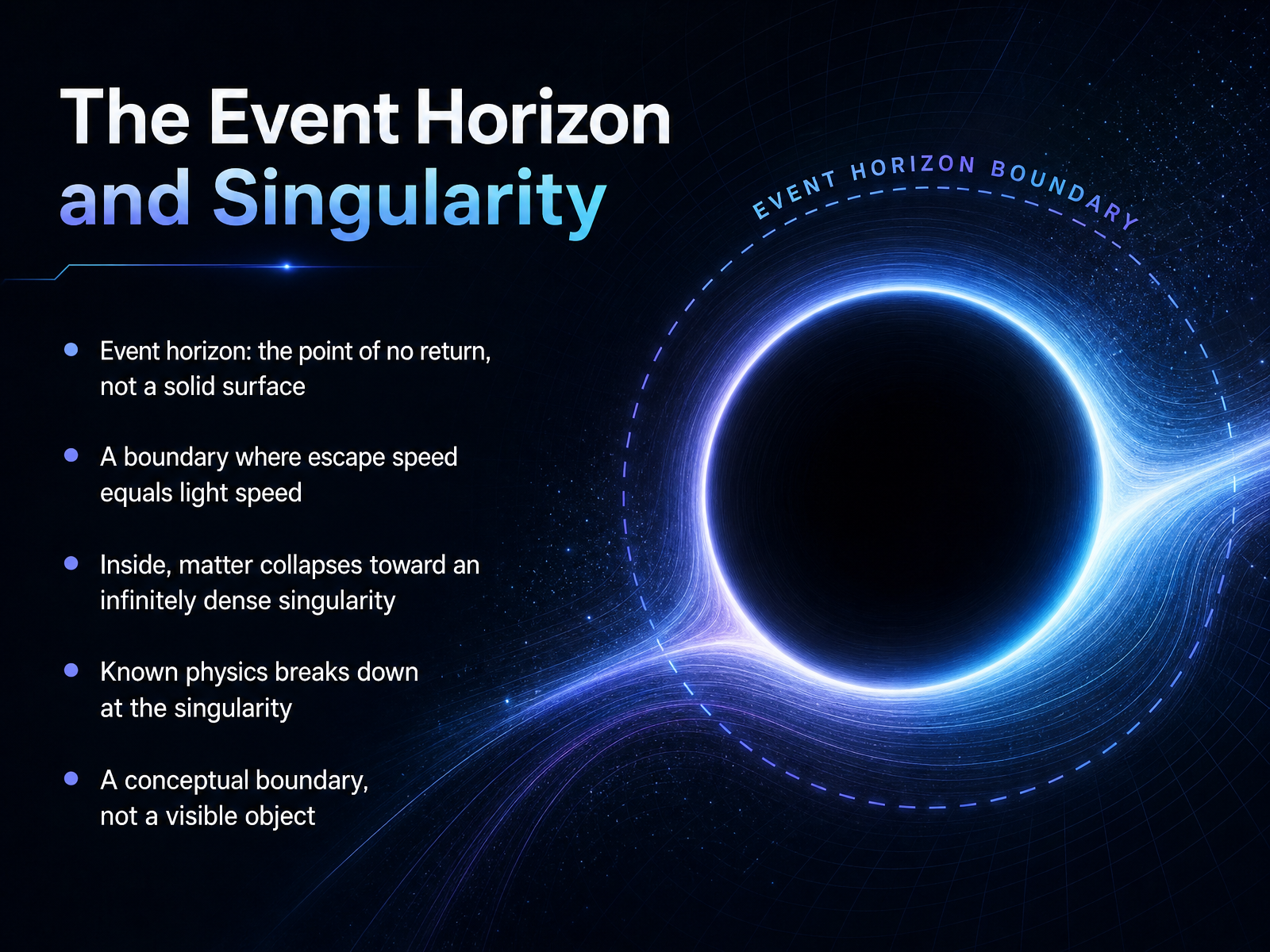
 - 03The Event Horizon and SingularityNow let's step up to that famous boundary, the event horizon. You may have heard that a black hole has some kind of solid surface, but that's not quite right. The event horizon isn't like the ground or a wall. It's more like a one-way door in space. Once anything crosses it, even moving at the speed of light, it cannot come back. That's because the escape speed at this boundary equals the speed of light. Since nothing travels faster than light, nothing can get out. You can think of it as a cosmic cliff edge, invisible but very real. Inside this boundary, matter is pulled toward a central point called the singularity, where all the mass is crushed into an incredibly dense point. Here's the twist. Our known laws of physics simply break down at the singularity. We call it infinitely dense, but honestly, that's a clue that we still have much to learn. So for now, see the event horizon as a conceptual boundary, not a visible object. Next, we'll explore how astronomers actually captured an image of one.
 science.nasa.govscience.nasa.govskyatnightmagazine.com+22 min
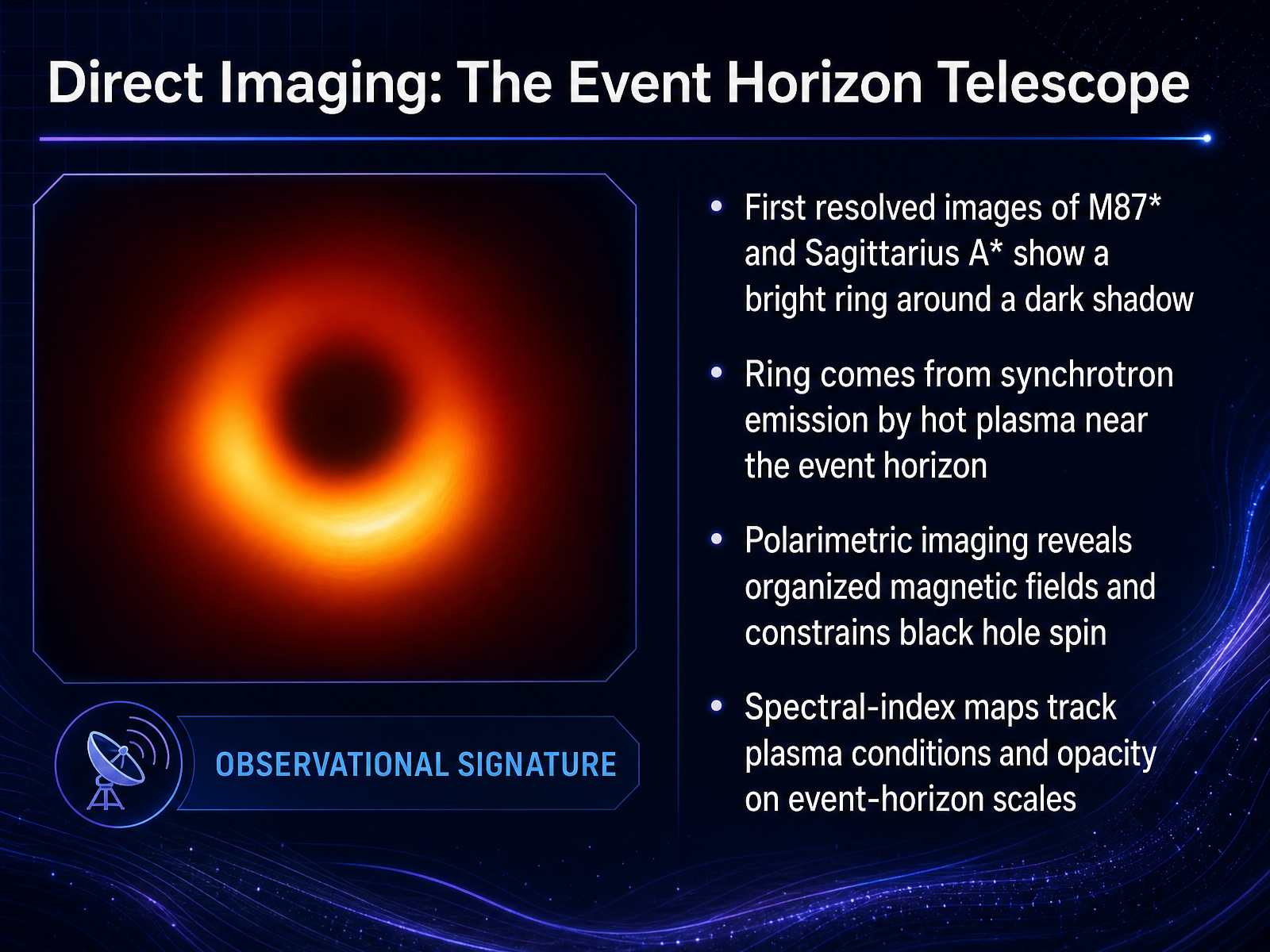
 - 04Direct Imaging: The Event Horizon TelescopeNow let's look at one of the most exciting breakthroughs in modern astronomy: actually taking a picture of a black hole. You may have heard that black holes are invisible, and in a sense, that's true. But the Event Horizon Telescope did something remarkable. It captured images of two supermassive black holes: M87 star and Sagittarius A star, at the center of our own Milky Way. The pictures show a bright, glowing ring surrounding a perfectly dark shadow. That dark center is the black hole's event horizon. The bright ring isn't the black hole itself, of course. It's light from superheated gas, called plasma, spiraling in at nearly the speed of light. As this plasma moves through magnetic fields near the black hole, it emits a type of radiation known as synchrotron emission, like a cosmic lightbulb tracing the edge of the shadow. Even more impressive, by studying the polarization of this light, astronomers can map the magnetic fields themselves. These fields are organized and powerful, and they help reveal how fast the black hole is spinning. Scientists are even using maps of the ring's brightness across different wavelengths to understand the conditions of this extreme plasma. It's like taking the temperature and density of the infalling matter. Next, we'll explore a completely different way to study black holes: by listening to the ripples they create in spacetime.
 iopscience.iop.orgreporter.anu.edu.auiopscience.iop.org+22 min
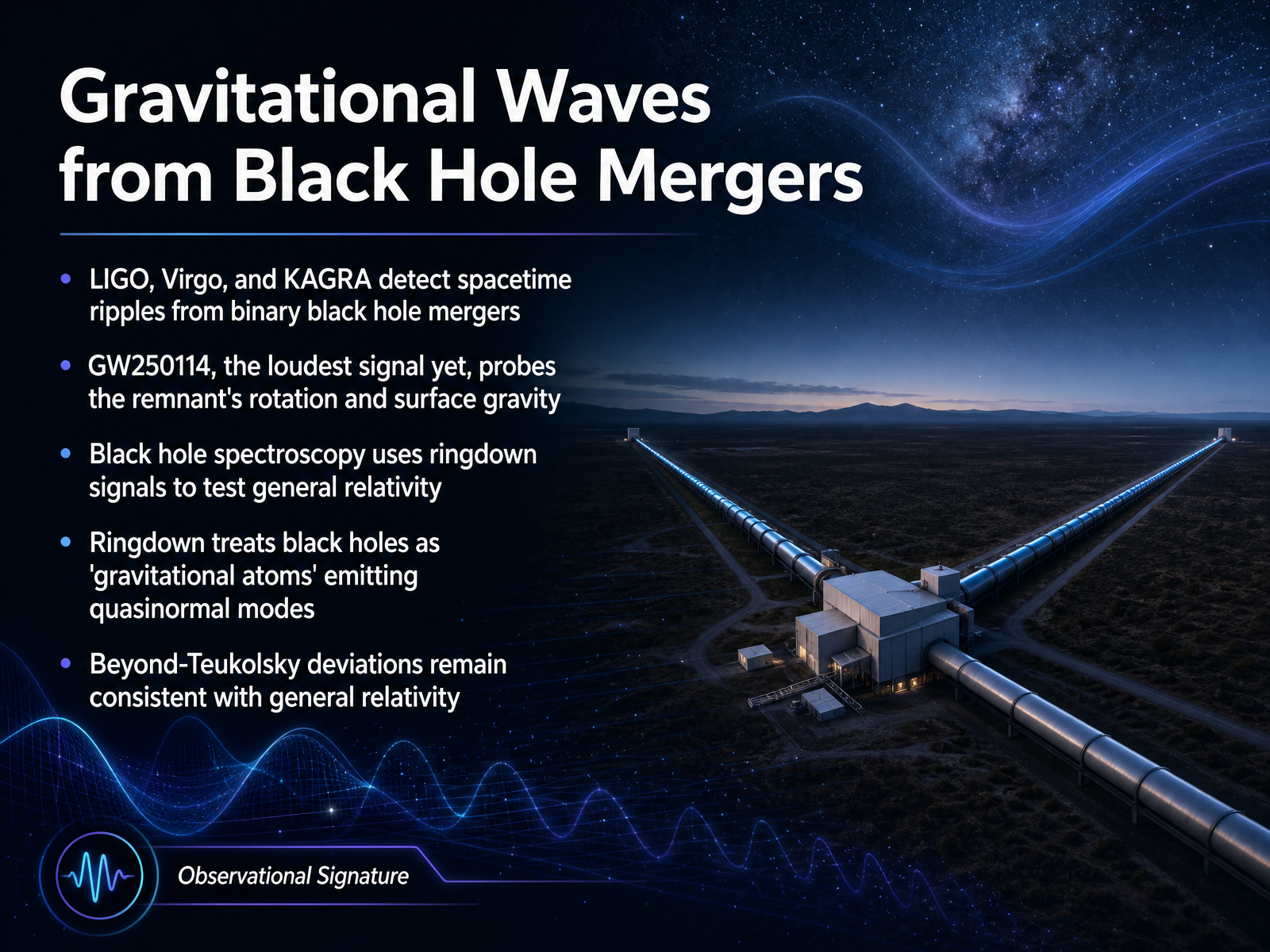
 - 05Gravitational Waves from Black Hole MergersNow let’s look at how gravitational waves let us listen in on black hole mergers. You may have heard that black holes are invisible, and in ordinary light that’s true. But when two black holes spiral together and merge, the crash sends ripples through spacetime itself. Detectors called LIGO, Virgo, and KAGRA can sense those ripples. Think of them like microphones listening for the faintest rumble in the fabric of the universe. The loudest signal so far, called GW250114, was about three times stronger than the very first detection. Scientists used it to measure two basic properties of the newly formed black hole: how fast it spins, and how strong its surface gravity is. Here’s a lovely idea. After a merger, the new black hole is a bit like a struck bell. It rings for a moment, shaking off energy. That ringdown is how we study it. Researchers even treat black holes as gravitational atoms, with natural ringing tones like an atom’s spectral lines. So far, everything in those tones agrees beautifully with Einstein’s general relativity. Next, let’s turn to indirect evidence. We will explore how orbits, X-rays, and gravitational lensing reveal black holes without waiting for a merger.
 mdpi.comadscft.orgiopscience.iop.org+22 min
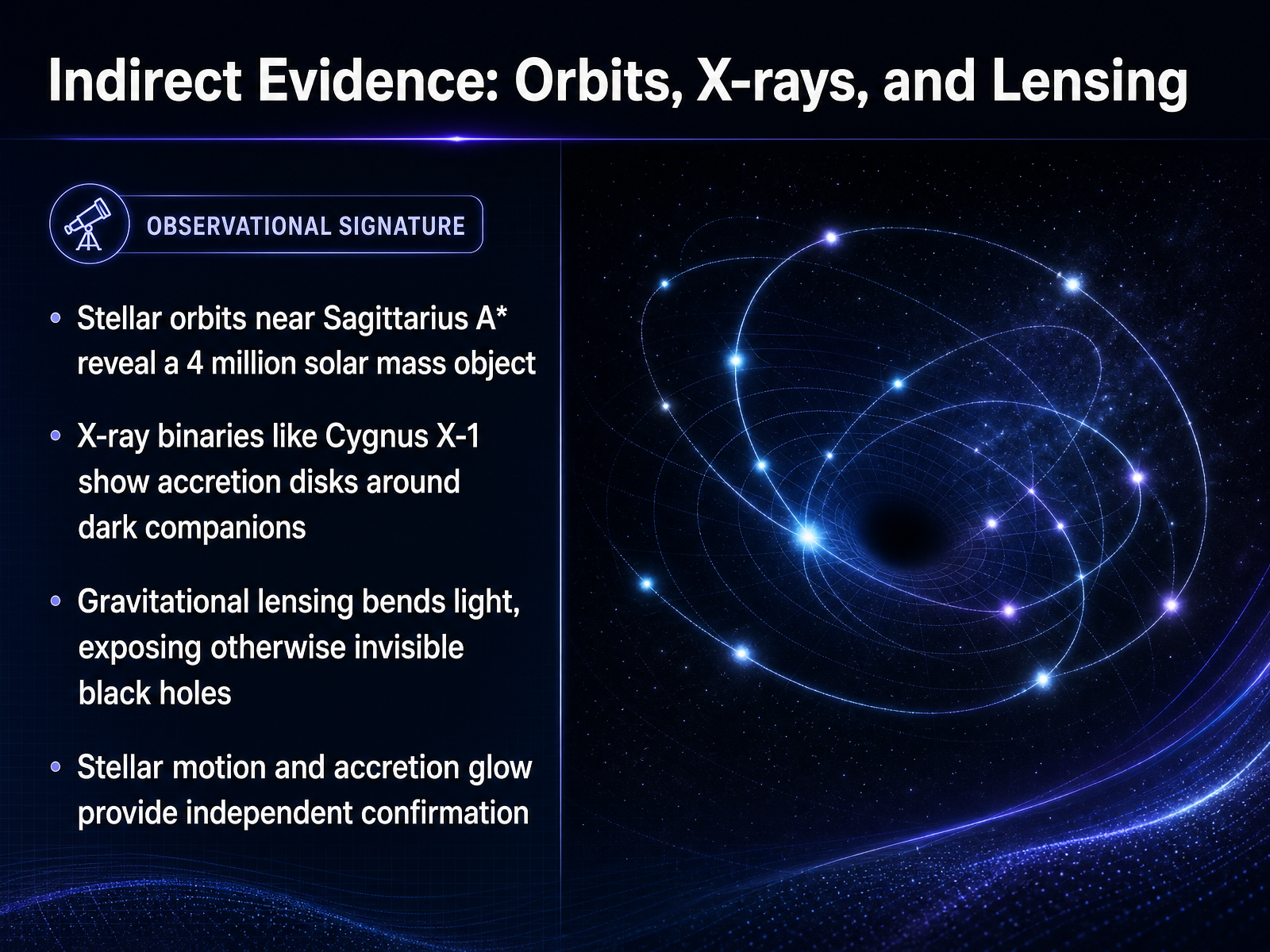
 - 06Indirect Evidence: Orbits, X-rays, and LensingSince we can't see black holes directly, we find them by watching the world around them. Think of it like spotting wind because you see branches swaying. Near the center of our own Milky Way, stars whip around an invisible point. Astronomers tracked those stars and found they orbit something with about four million times the mass of our Sun. That is a supermassive black hole. In other systems, like Cygnus X-1, a black hole pulls gas from a nearby star. As the gas spirals inward, it heats to millions of degrees and blazes in X-rays. A black hole can also bend light, like a lens, distorting whatever sits behind it. So orbits, glowing gas, and bent light all point to the same thing. They give us independent, repeatable proof that black holes exist. Up next, let's look at the different types and sizes of black holes.
 science.nasa.govscience.nasa.govskyatnightmagazine.com+21 min
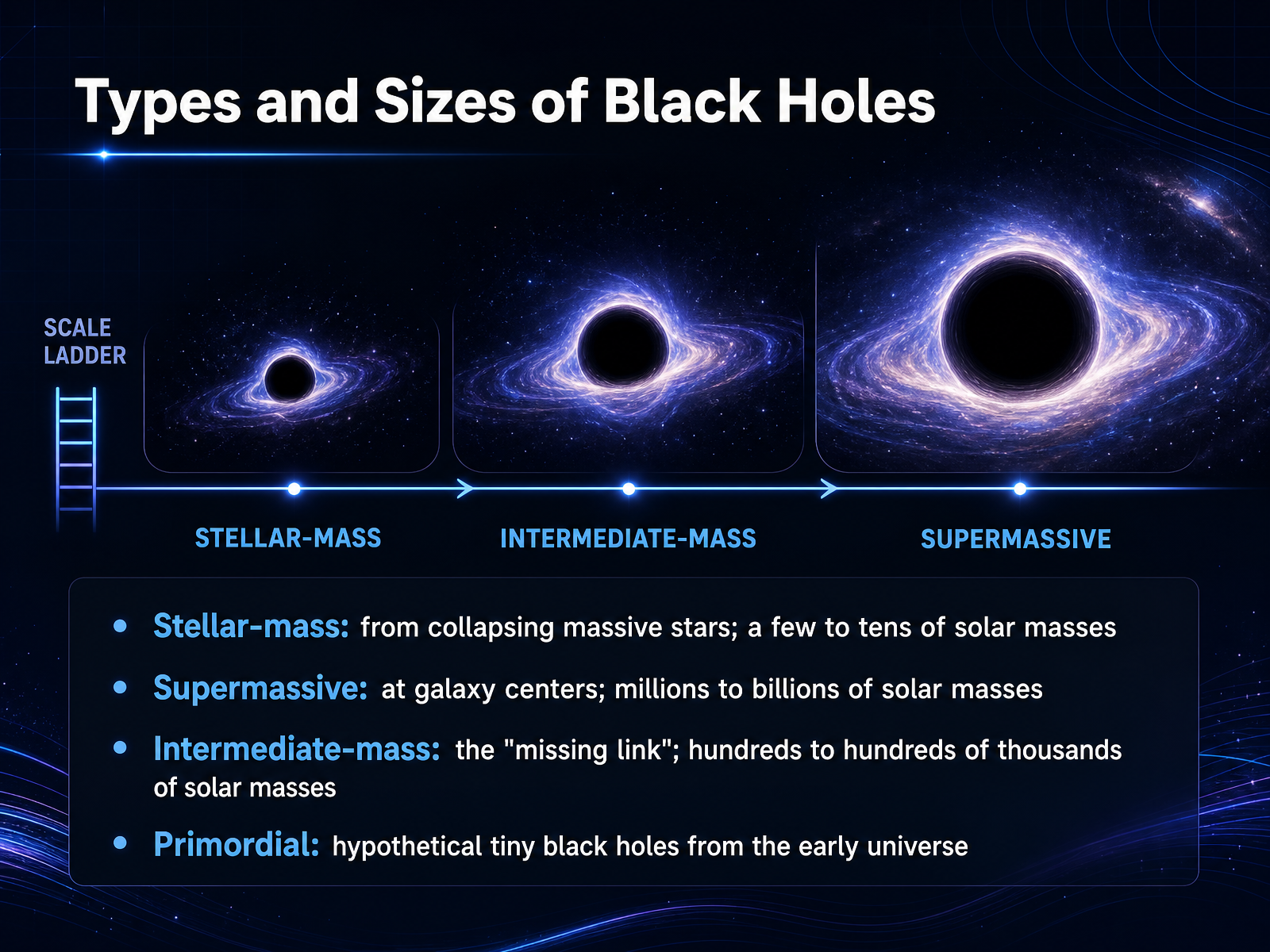
 - 07Types and Sizes of Black HolesNow let's talk about the different types of black holes, because they're not all the same size. You may have heard that every black hole is a giant monster, but that's a misconception we can set aside. We find stellar-mass black holes when massive stars collapse. These are the compact remnants, packing a few to tens of times the Sun's mass into a very small space. At the other extreme are supermassive black holes, the giants at the centers of most galaxies. They contain millions to billions of solar masses. Then there are intermediate-mass black holes, often called the missing link. They range from hundreds to hundreds of thousands of solar masses, and finding them helps us understand how smaller black holes might grow into supermassive ones. Finally, primordial black holes are purely hypothetical and may have formed in the very early universe. So remember, a black hole's size depends on its mass, and they are not cosmic vacuum cleaners. Coming up next, we'll explore intermediate-mass black holes and the evidence for these missing links.
 nature.comiopscience.iop.orggoogle.iopscience.iop.org+22 min
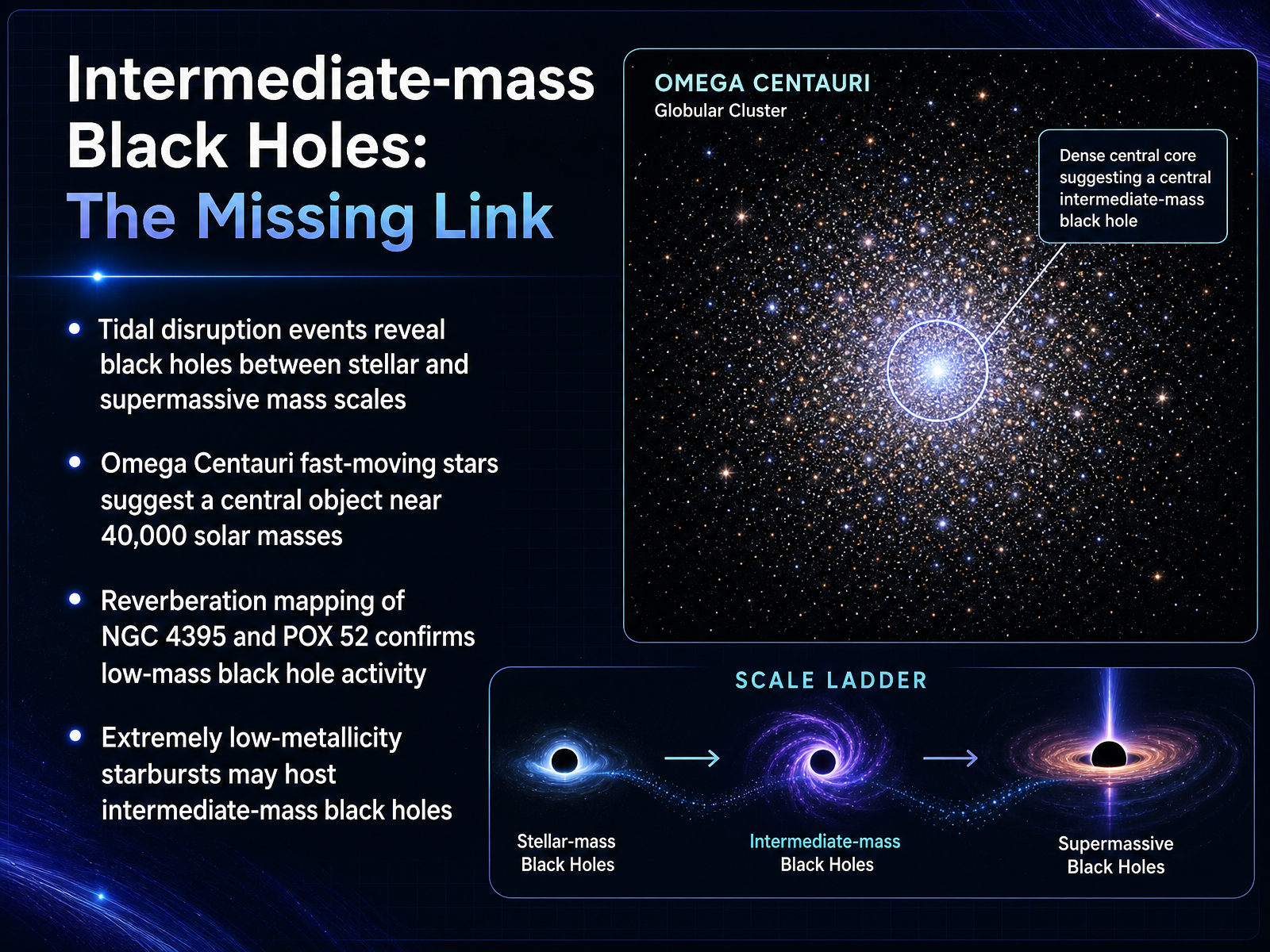
 - 08Intermediate-mass Black Holes: The Missing LinkNow let's explore the fascinating search for intermediate-mass black holes. These are the missing link between stellar-mass black holes and the supermassive giants at galaxy centers. You may have heard that black holes only come in small or enormous sizes, but evidence increasingly points to a middle category. One powerful clue comes from tidal disruption events, when a black hole shreds a passing star. A recent event in a dwarf galaxy showed a long-lasting X-ray plateau, suggesting a black hole around one hundred thousand times the mass of our Sun. In Omega Centauri, astronomers found fast-moving stars near the cluster's core, moving so quickly that only a central object near forty thousand solar masses could hold them bound. Reverberation mapping of galaxies like NGC 4395 and POX 52 also confirms lower-mass black holes actively pulling in matter. These signals often involve very low metallicity starbursts, where massive stars may collapse directly into intermediate-mass black holes. These findings help fill a crucial gap in black hole evolution. Next, we will look at how black holes affect their surroundings.
 nature.comiopscience.iop.orggoogle.iopscience.iop.org+22 min
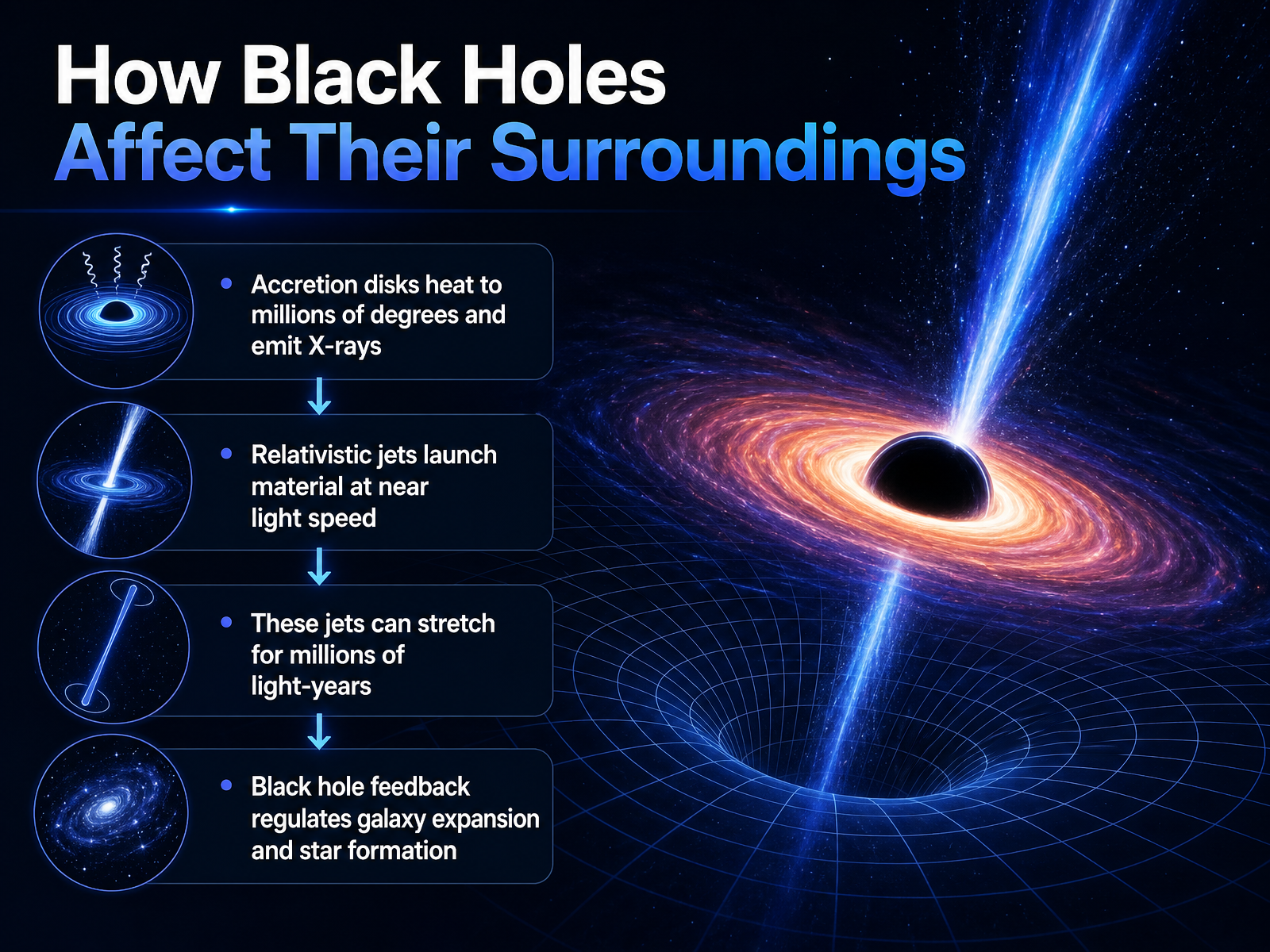
 - 09How Black Holes Affect Their SurroundingsNow that we know black holes are real, let's look at how they reshape their neighborhoods. You may have heard that black holes just pull everything in and go dark. But the reality is far more active. When gas and dust spiral toward a black hole, they don't fall straight in. Instead, they pile up into a swirling structure called an accretion disk. Friction inside that disk heats the material to millions of degrees, and the disk glows brightly in X-rays. It is like a cosmic whirlpool that shines before it disappears. Even more surprising, black holes can launch enormous jets of particles away from themselves. These jets move at nearly the speed of light and can stretch for millions of light-years, far larger than the galaxy that hosts them. This outflow is called black hole feedback, and it does something remarkable. It pushes on surrounding gas, regulating how galaxies grow and how many new stars they can form. In a sense, black holes act as cosmic thermostats for entire galaxies. Up next, we will unpack some of the biggest myths about these objects, including the idea that they are giant vacuum cleaners.
 science.nasa.govscience.nasa.govskyatnightmagazine.com+21 min
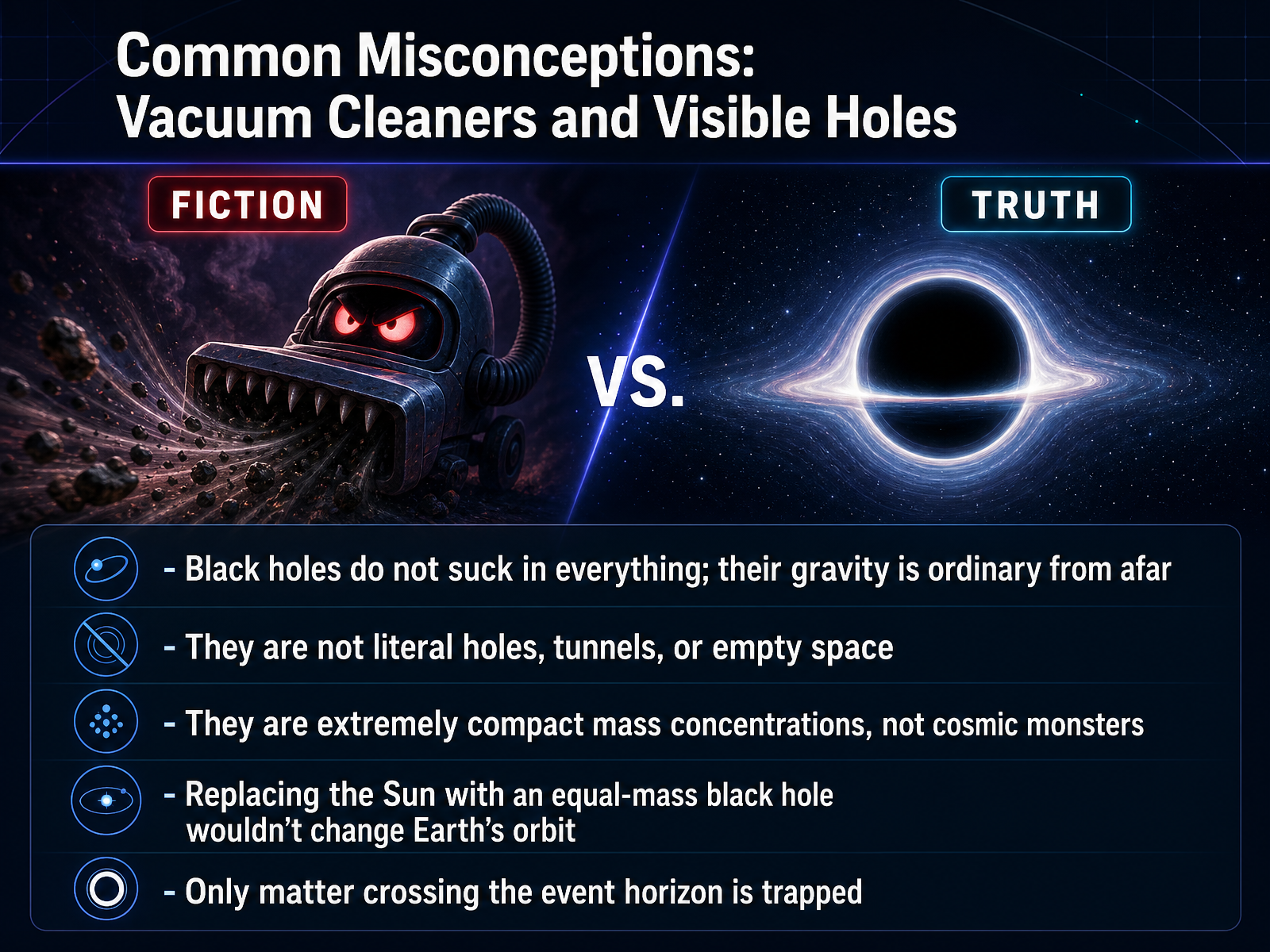
 - 10Common Misconceptions: Vacuum Cleaners and Visible HolesLet's clear up some of the biggest myths. You may have heard that black holes are like cosmic vacuum cleaners, roaming around and sucking in everything nearby. But that is not how their gravity works. From a distance, a black hole pulls on things just like any other object with the same mass. If we could magically swap our Sun for a black hole of exactly the same mass, Earth would not get dragged in. Our planet would keep orbiting in the same path. It would get very cold and dark, but our orbit would be safe. Another myth is that a black hole is a literal hole, like a tunnel or an empty void in space. In reality, it is the opposite of empty. It is an enormous amount of matter squeezed into an incredibly tiny point. So it is not a tunnel to somewhere else. It is more like an ultra compact, massive object. And the danger zone is not everywhere. Only matter that crosses the event horizon, the point of no return, gets trapped. Next, we will look at more myths about their size, our Sun, and whether they could swallow the universe.
 science.nasa.govscience.nasa.govskyatnightmagazine.com+21 min
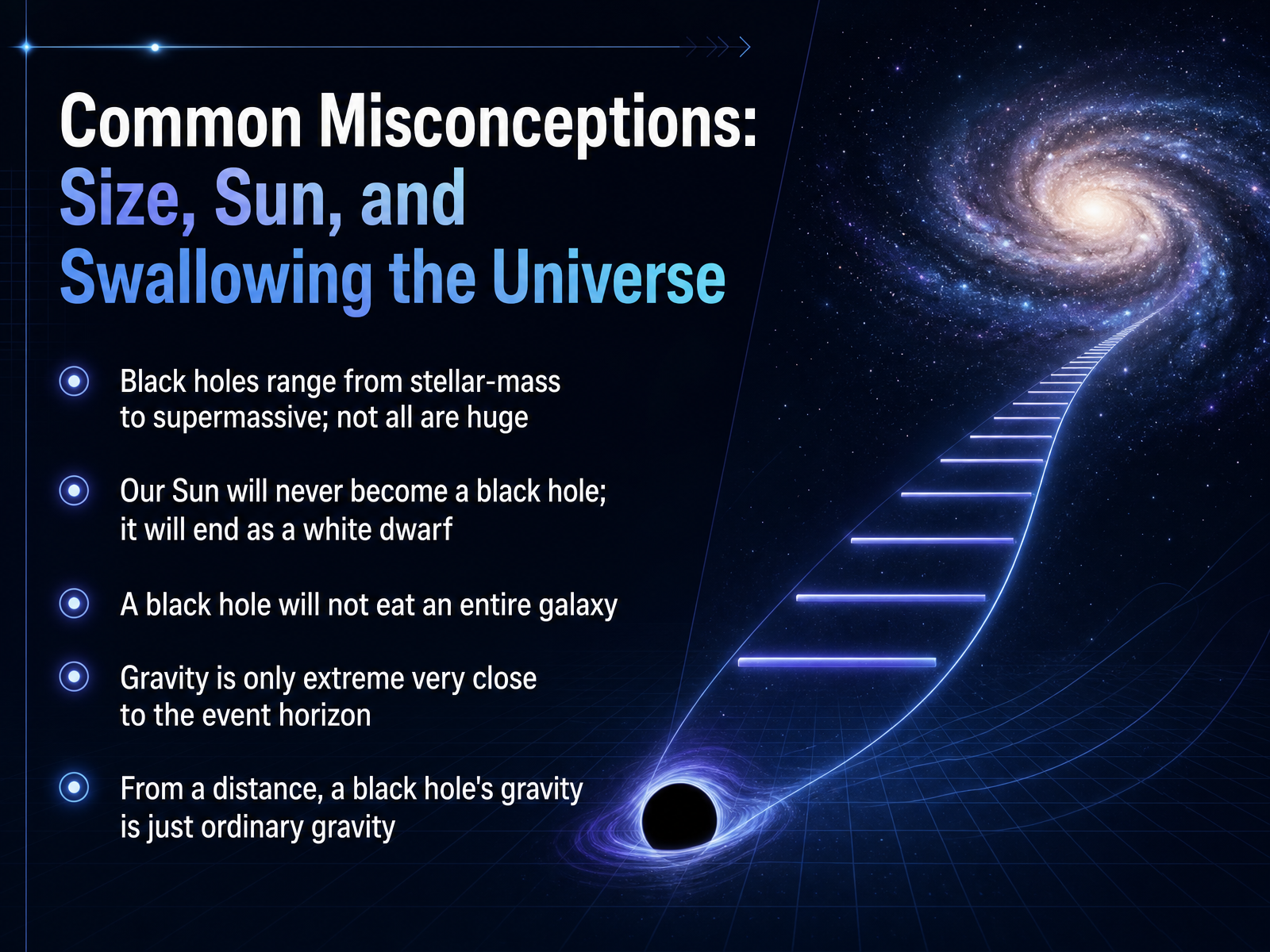
 - 11Common Misconceptions: Size, Sun, and Swallowing the UniverseNow let's clear up a few ideas that often get tangled. You may have heard that all black holes are gigantic monsters, but they actually come in a wide range of sizes. Some are only a few times the mass of our Sun, while others, the ones at the centers of galaxies, can be millions or even billions of times more massive. You may have also wondered whether our Sun will one day become a black hole. The answer is no. Our Sun isn't massive enough for that dramatic ending. Instead, billions of years from now, it will gently shed its outer layers and end its life as a much smaller, dense object called a white dwarf. And here's another important point. A black hole is not a cosmic vacuum cleaner that will eventually swallow its entire galaxy. From a distance, its gravity is really just ordinary gravity. The extreme pull only happens when you get very, very close, near the boundary called the event horizon. So if you could swap our Sun with a black hole of the same mass, Earth would keep orbiting exactly as it does now. It would just get very dark and very cold. With those myths set aside, let's move to a truly strange question: what actually happens if you fall into a black hole, and what in the world is spaghettification?
 science.nasa.govscience.nasa.govskyatnightmagazine.com+22 min
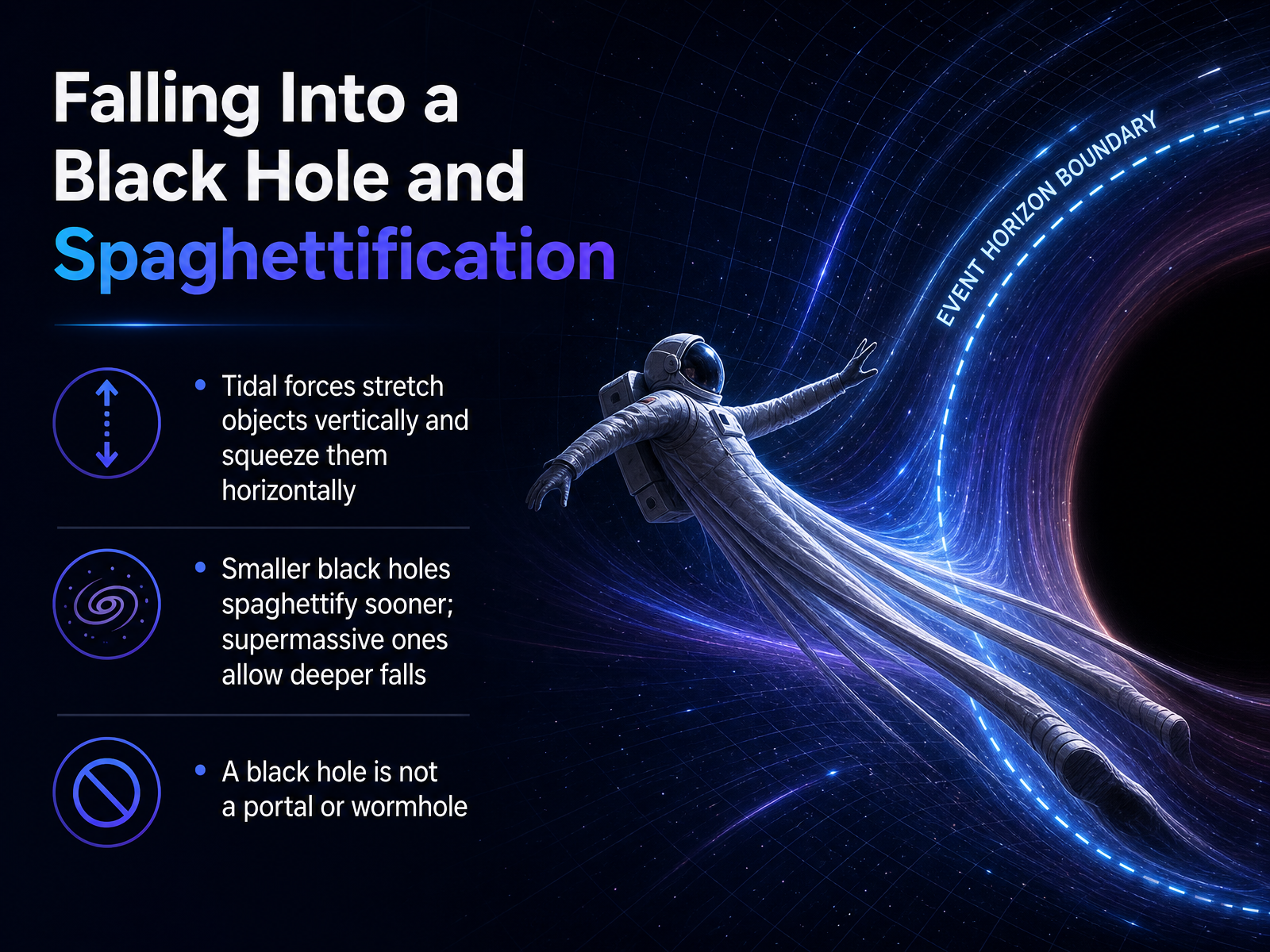
 - 12Falling Into a Black Hole and SpaghettificationNow, let's take that thought experiment a step further. You may have heard that if you fell into a black hole, you'd just be crushed. But the reality is far stranger. Because gravity gets dramatically stronger as you approach, the pull on your feet would be much greater than the pull on your head. This creates a powerful stretching force, while simultaneously squeezing you in from the sides. Scientists have a wonderfully whimsical name for this. They call it spaghettification, because you'd be stretched into a long, thin strand, much like a noodle. But here's a surprising twist. The timing depends entirely on the black hole's size. For smaller black holes, this stretching happens far outside the horizon, quite quickly. But with a supermassive black hole, the change in gravity is much more gradual. You could actually fall past the event horizon before being pulled apart. And one final myth to address. Despite what many movies suggest, a black hole is not a doorway. It is not a portal to another dimension or a shortcut through a wormhole. It is simply a place where gravity becomes infinite, and there is no exit. Understanding this helps us see them not as magic doors, but as extreme objects in nature. Next, let's see how these scientific concepts compare to the stories we see in popular culture.
 science.nasa.govscience.nasa.govskyatnightmagazine.com+22 min
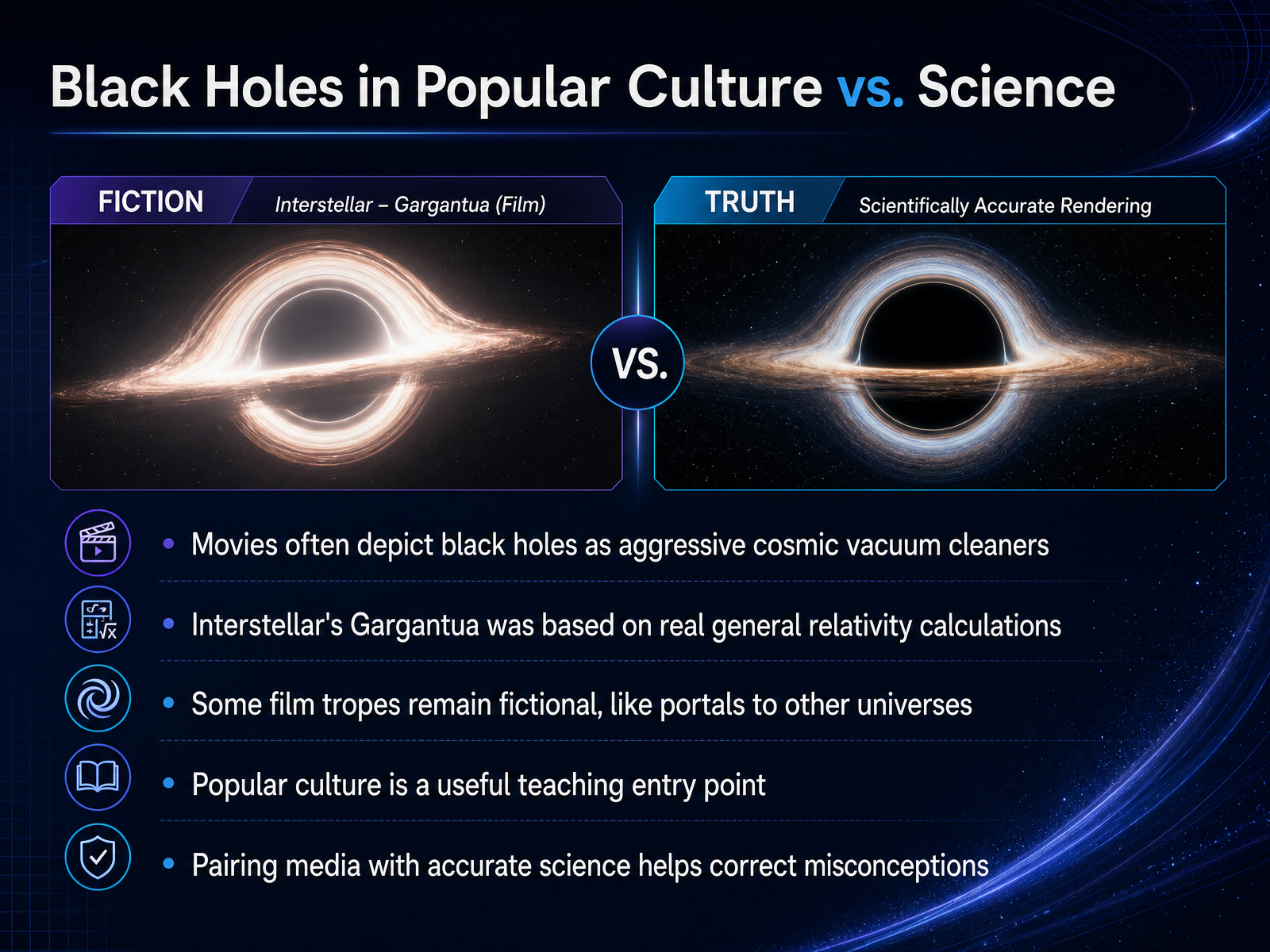
 - 13Black Holes in Popular Culture vs. ScienceNow let's turn to a place you may already feel familiar with, black holes in popular culture, and ask how the movie versions compare to the real science. You may have heard that black holes are aggressive cosmic vacuum cleaners. That's a common image, but as we have seen, from a distance their gravity works like any other object of the same mass. They don't roam around hunting for matter. Still, some films get the details surprisingly right. For example, Interstellar featured a black hole called Gargantua, and its appearance was based on actual calculations from general relativity. That glowing ring of warped light was not pure fantasy. But other film tropes remain fictional, like the idea that black holes are portals to other universes. The science does not support that. The good news is that popular culture gives us a useful teaching entry point. Bring the movie clip, then pair it with accurate science, and you turn a misconception into a memorable lesson. Next, we'll explore the open questions that still puzzle researchers, and some teaching takeaways you can share with your learners.
 science.nasa.gov2 min
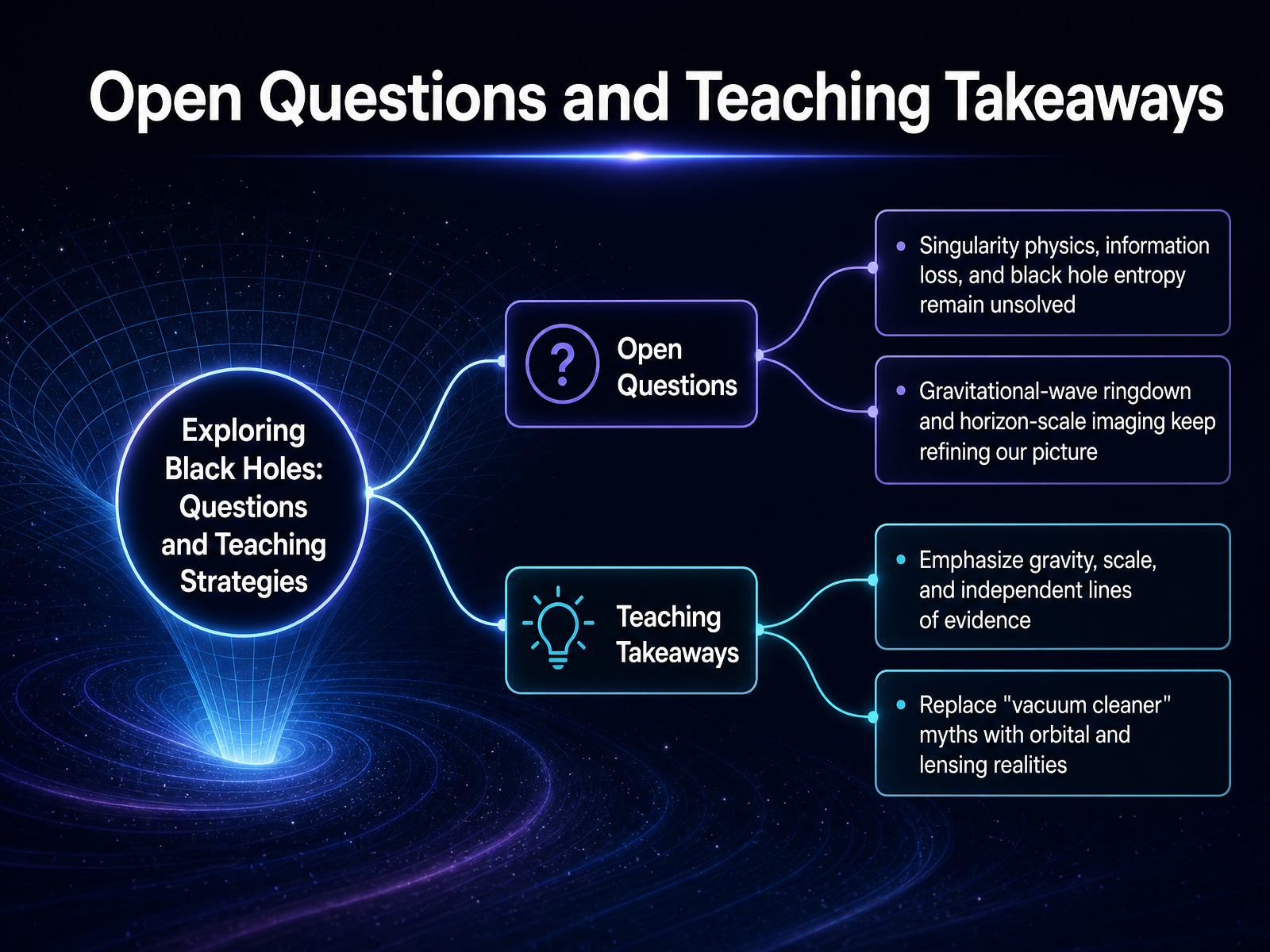
 - 14Open Questions and Teaching TakeawaysLet's step back and look at what we've explored together. Black holes are real, and they're no longer just a wild idea. We have many independent lines of evidence for them, from stars whipping around an invisible companion, to glowing disks of hot gas, to the ripples in space-time from colliding black holes. And those famous images from the Event Horizon Telescope gave us our first direct look at a black hole's shadow. Along the way, we replaced a few stubborn myths with firmer ground. You may have heard that black holes act like cosmic vacuum cleaners that suck in everything. But really, from a distance, a black hole is just another massive object. If our Sun were swapped with a black hole of the same mass, Earth would keep orbiting in its usual path. What makes black holes special is what happens up close, where gravity becomes extreme and space-time bends light into lenses and rings. There is still so much we do not know. What happens at the singularity? Where does information go? Those open questions are exactly what make black holes such exciting puzzles. Thank you for exploring with me, and keep asking those big questions.
 mdpi.comadscft.orgiopscience.iop.org+22 min
Take the deck with you
Download this course as a file — free, no sign-up needed.
- PDF handoutEvery slide page, ready to print or share.15 pages · 4.4 MBDownload
- Narrated PowerPointThe deck that presents itself — every slide carries the digital human's narration video.15 pages · 15.0 MBDownload
- PowerPoint slidesThe full deck as a .pptx — open it in PowerPoint, Keynote, or Google Slides.15 pages · 4.4 MBDownload
Free to use in your own training — please keep the PersonWise credit page at the end.
Have your own deck? Turn it into a course
Sources consulted
Web sources consulted while building this course.
- How Do We Know There Are Black Holes? - NASA Science — science.nasa.gov
- 10 Questions You Might Have About Black Holes - NASA Science — science.nasa.gov
- Confused about black holes? Get the key facts in our beginner's guide | BBC Sky at Night Magazine — skyatnightmagazine.com
- How Can You ‘See’ a Black Hole? | Scientific American — scientificamerican.com
- Black hole truths, myths and mysteries - Curious — curious.science.org.au
- Spatially Resolved Spectral Properties of M87* on Event Horizon Scales - IOPscience — iopscience.iop.org
- Scientists find a way to study the event horizon where light ... — reporter.anu.edu.au
- Black Hole Polarimetry. II. The Connection between Spin and Polarization - IOPscience — iopscience.iop.org
- Ring Asymmetry and Spin in M87* - IOPscience — iopscience.iop.org
- Probing jet base emission of M87* with the 2021 Event Horizon Telescope observations | Astronomy & Astrophysics (A&A) — aanda.org
- Topical Collection : Open Questions in Black Hole Physics — mdpi.com
- Open Problems in Black Hole Information | AdS/CFT Duality — adscft.org
- Black hole spectroscopy: from theory to experiment - IOPscience — iopscience.iop.org
- 2026 Simons Collaboration on Black Holes and Strong ... — simonsfoundation.org
- Black hole spectroscopy: from theory to experiment - IOPscience — google.iopscience.iop.org
- A tidal disruption event from an intermediate-mass black hole revealed by comprehensive multi-wavelength observations | Nature Communications — nature.com
- The Intermediate-mass Black Hole in Omega Centauri: Constraints on Accretion from JWST - IOPscience — iopscience.iop.org
- Properties of “Lite” Intermediate-mass Black Hole Candidates in LIGO-Virgo’s Third Observing Run - IOPscience — google.iopscience.iop.org
- The Intermediate-mass Black Hole Reverberation Mapping Project: Stable Optical Continuum Lags of an Intermediate-mass Black Hole in the Dwarf Galaxy NGC 4395 over Years - IOPscience — iopscience.iop.org
- The Intermediate-mass Black Hole Reverberation Mapping Project: First Detection of Mid-infrared Lags in Prototypical Intermediate-mass Black Holes in NGC 4395 and POX 52 - IOPscience — iopscience.iop.org