Begin
13 pages · ~26 min
Design Systems Portfolio Development
Create a professional design systems portfolio that showcases your components, tokens, and documentation skills to impress hiring managers and clients.
A digital instructor presents all 13 pages. Hold “Ask” at any point and ask out loud — the answer comes from this course. No sign-up needed.
What you’ll learn
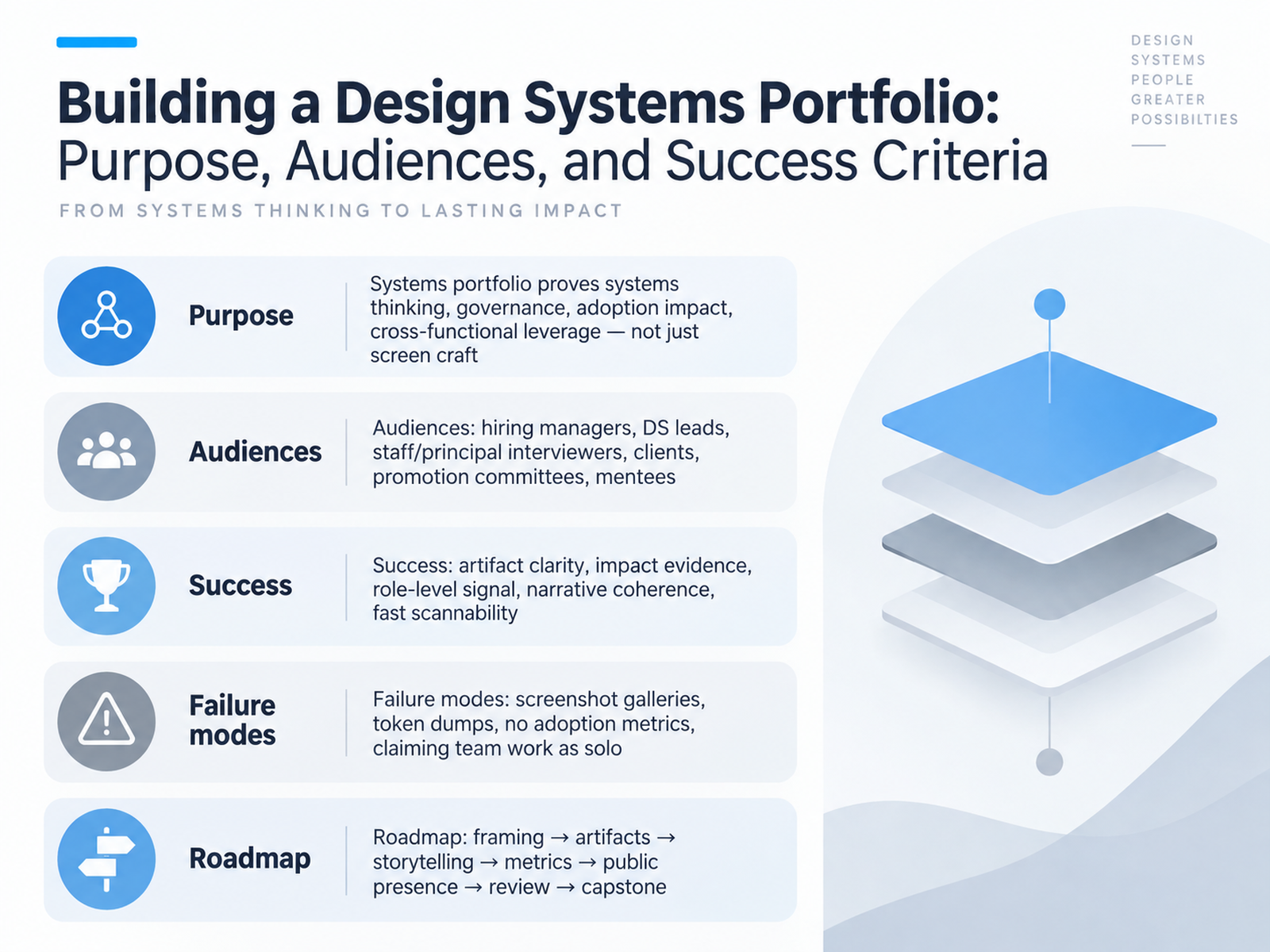
- 01Building a Design Systems Portfolio: Purpose, Audiences, and Success CriteriaWelcome. In this course, we're building a design systems portfolio. Not a screenshot gallery. A portfolio that proves systems thinking, governance, and adoption impact.
Here's the core idea. Hiring managers, design system leads, staff and principal interviewers, and promotion committees are not scoring your screens. They're looking for evidence of leverage. Did your work help other teams ship faster? Did it scale?
So think about your audience and pick a target. Success means artifact clarity, impact evidence, and a coherent narrative a reviewer can scan in seconds. Also know the failure modes: screenshot galleries, token dumps without context, no adoption metrics, and claiming team work as solo work.
Our roadmap runs from framing to artifacts, storytelling, metrics, public presence, review, and a capstone. Next, let's look at who reviews systems work and what they score.learn.thedesignsystem.guidehandbook.gitlab.commedium.muz.li+22 min
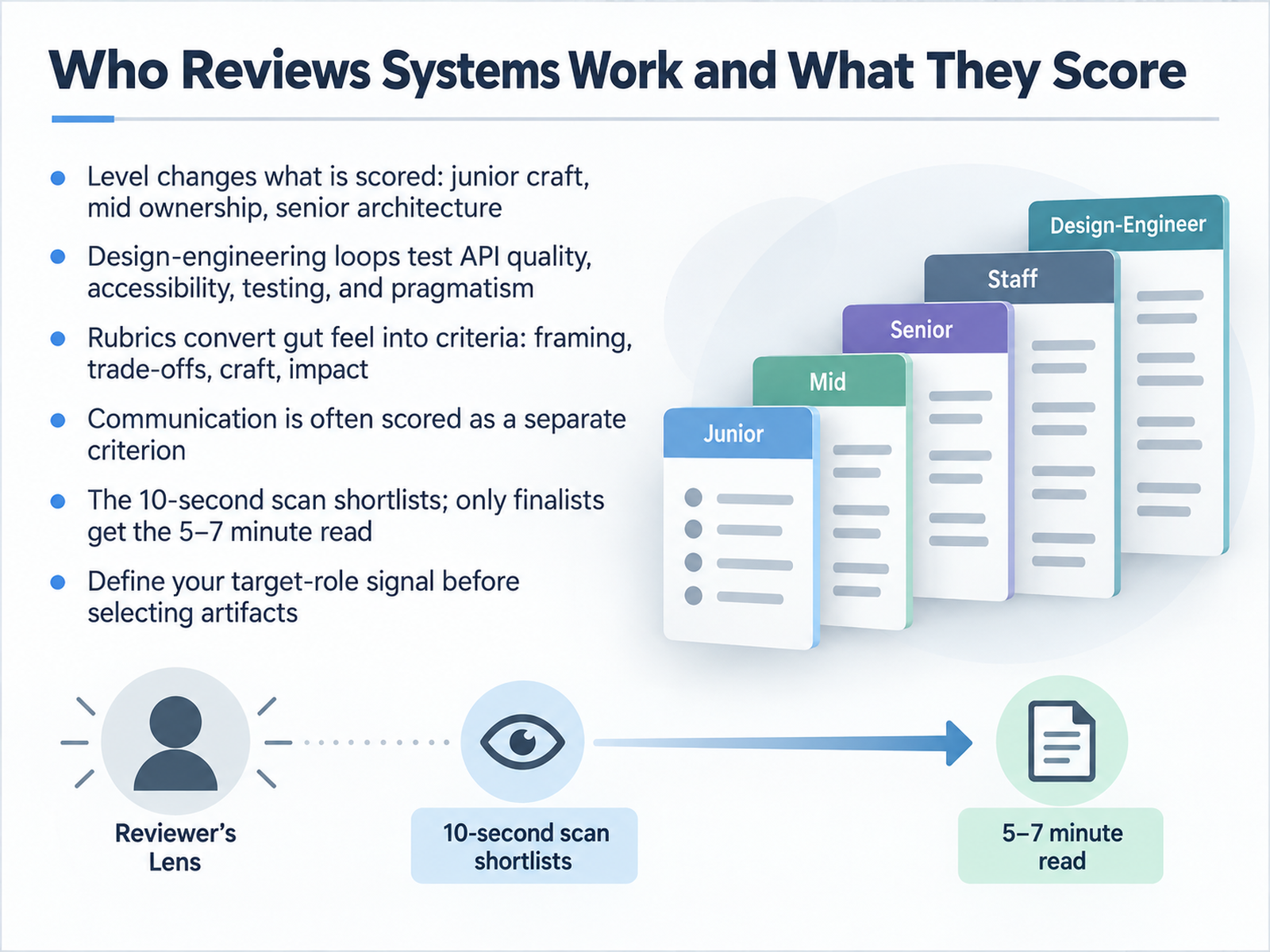
- 02Who Reviews Systems Work and What They ScoreLet's talk about who actually reads your systems portfolio, and what they score. Level changes the target. Junior reviews lean on craft. Mid-level leans on ownership. Senior leans on architecture and governance. Design engineering loops test something different: API quality, accessibility, testing, and pragmatism. Most teams score against a rubric too. Common criteria include problem framing, trade-offs, craft, impact, and communication as its own line item. Here's the practical part. Reviewers run a ten-second scan first. That scan shortlists. Only finalists get the five to seven minute read. So your first screen has to earn the deep dive. And before you pick a single artifact, define the signal for your target role. A senior architecture story and a mid-level ownership story need different evidence. Pick the level, then pick the proof. Next, we'll look at choosing three to five hero artifacts that prove systems work.
 learn.thedesignsystem.guidehandbook.gitlab.commedium.muz.li+22 min
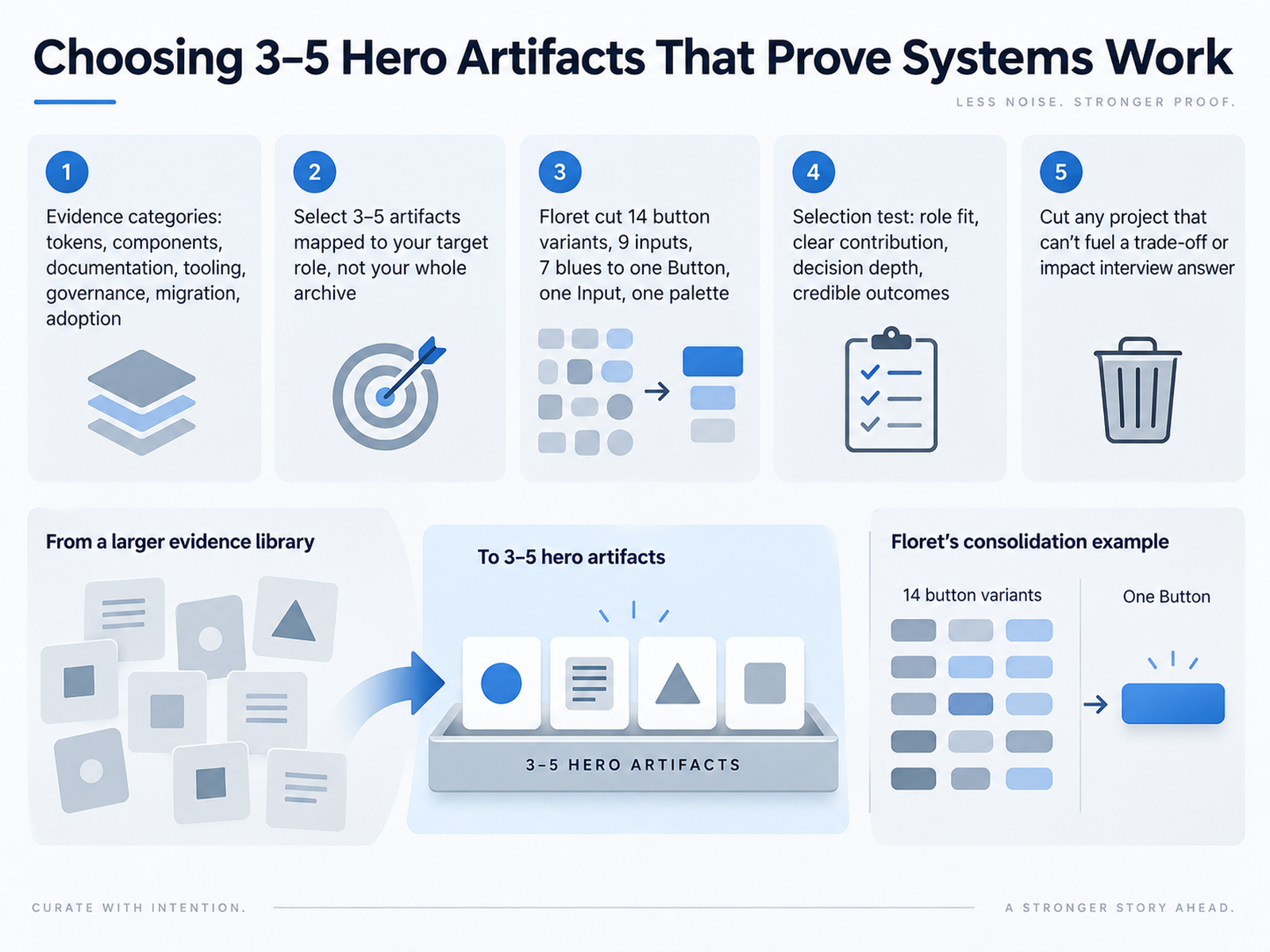
 - 03Choosing 3–5 Hero Artifacts That Prove Systems WorkNow let's build your artifact shortlist. Evidence comes in a few categories: tokens, components, documentation, tooling, governance, migration, and adoption. You don't need all seven. Pick three to five artifacts that map to your target role, not your whole archive.
Take Floret. One designer catalogued every button, input, card, and icon across five product files, and found fourteen button variants, nine input styles, and seven distinct blues. The portfolio move wasn't to show all of it. It was to show one Button, one Input, one palette, and the reasoning that got there.
So run the selection test. Does it fit your role? Can you state your contribution clearly? Does it show decision depth? Are the outcomes credible? If a project can't fuel a trade-off or impact answer in an interview, cut it. Harsh curation reads as judgment.
Next, let's get into the messier problem: handling confidential and NDA-covered work, and artifacts your teammates built.
 andryta.comnadirdesign.comshahzebkazmi.com+22 min
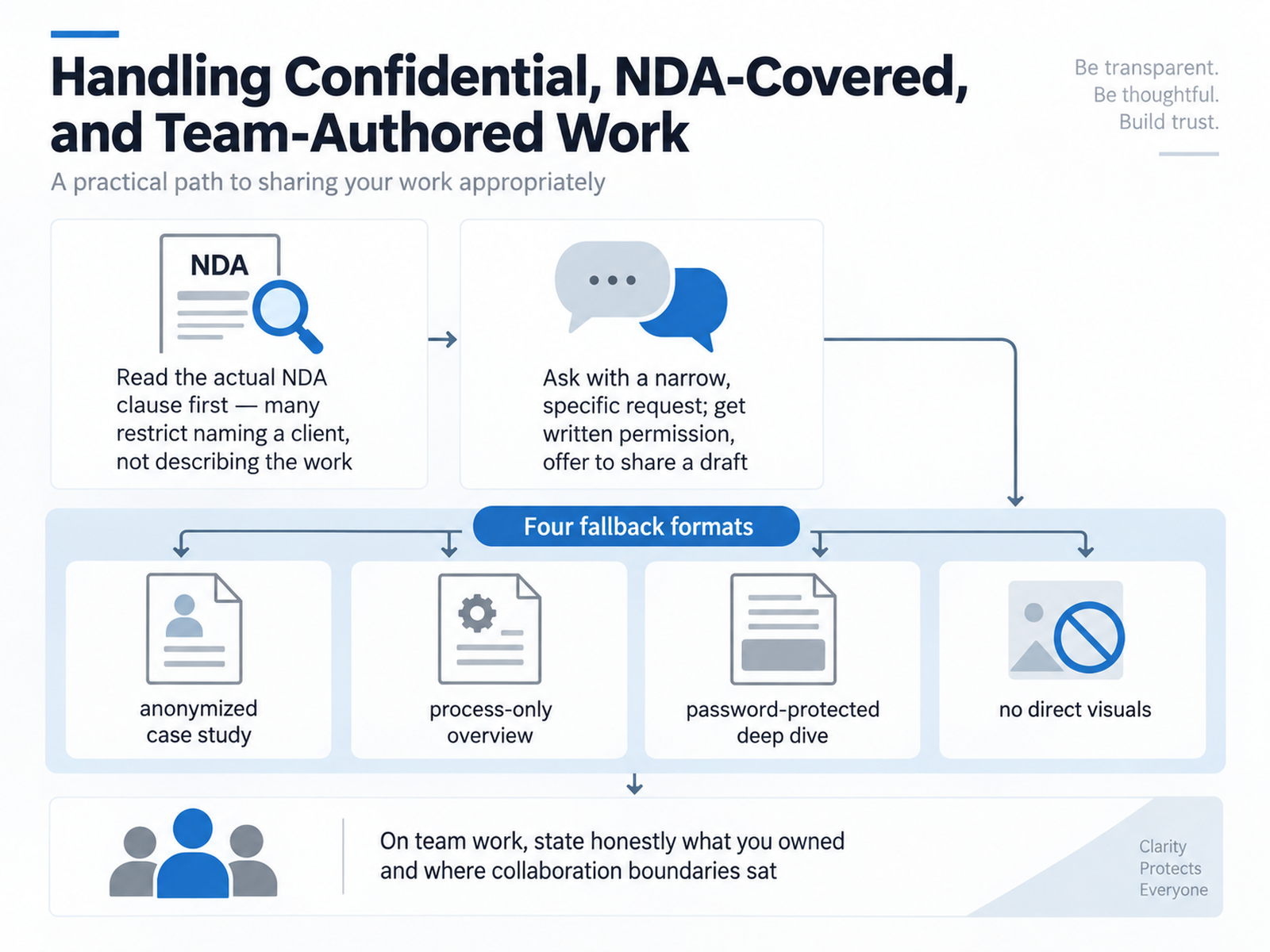
 - 04Handling Confidential, NDA-Covered, and Team-Authored WorkNow let's talk about the work you can't show freely. Start with the NDA itself. Read the actual clause before you assume anything. Many agreements restrict naming a client, not describing the work. That distinction is worth ten minutes of rereading. Next, ask for permission, but keep the request narrow. "Can I put this in my portfolio" is easy to reject. "Can I describe the problem and my process, with no client name and no metrics" is much harder to refuse. Get the answer in writing, and offer to share a draft first. If the answer is no, you have four fallback formats. An anonymized case study. A process-only overview. A password-protected deep dive. Or no direct visuals at all, just your own diagrams and role description. When you redact, label it explicitly. "Redacted, specific performance metrics protected by confidentiality agreement." Unexplained gaps read as sloppy. Labeled redactions read as professional discretion. Finally, on team work, state honestly what you owned and where collaboration boundaries sat. Naming your lane, and your teammates', builds more credibility than claiming everything. Next, let's turn systems work into a story. The Core Narrative: Turning Systems Work into a Story.
 uxplaybook.orgxperiencewave.comdribbble.com+22 min
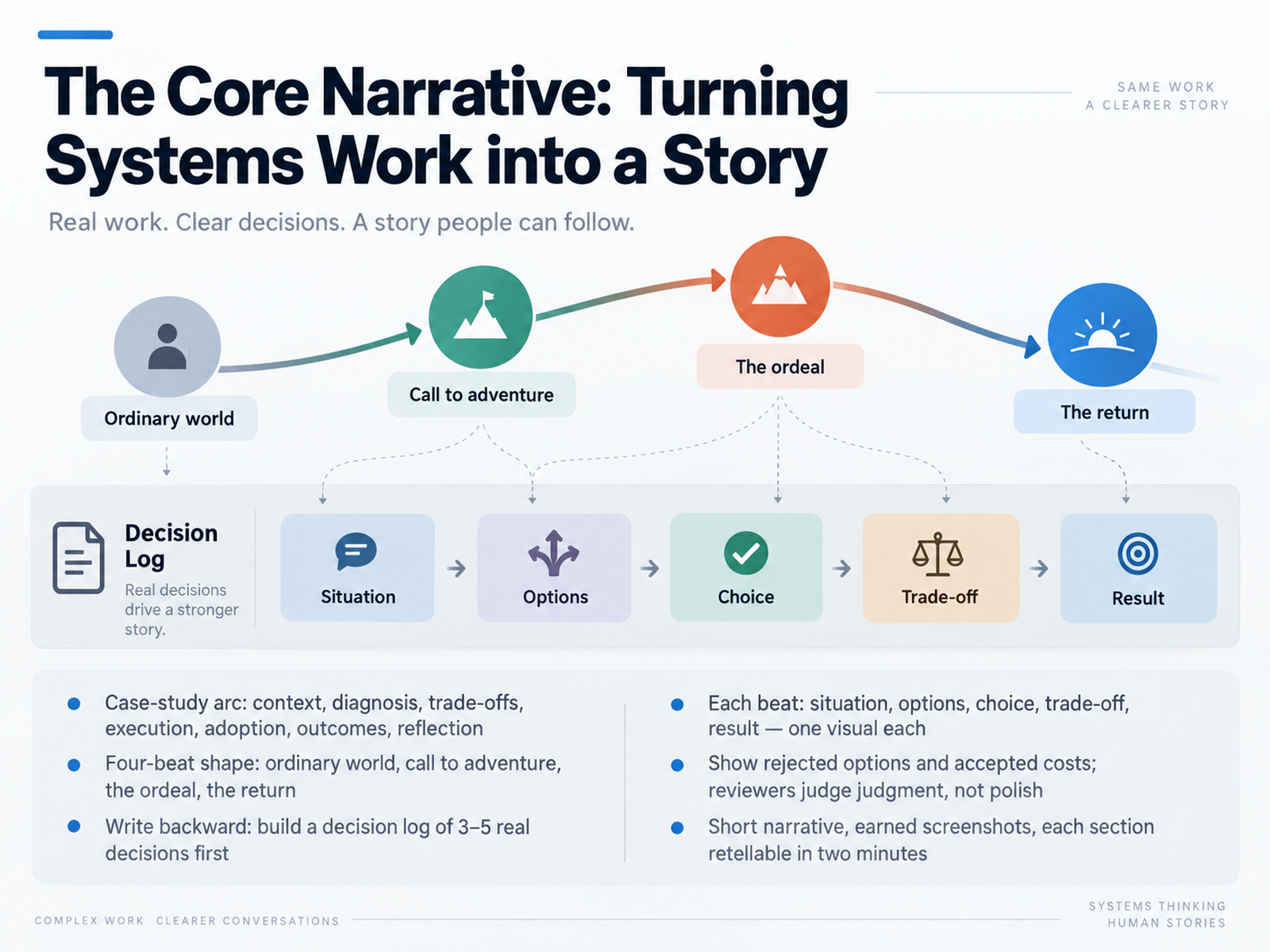
 - 05The Core Narrative: Turning Systems Work into a StoryLet's talk about the core narrative. This is where systems work becomes a story a reviewer can follow. Start with a decision log. Write down three to five real decisions from the project. Then shape the arc: context, diagnosis, trade-offs, execution, adoption, outcomes, and reflection. A four-beat shape helps too. Ordinary world, call to adventure, the ordeal, and the return. For each beat, keep it tight: situation, options, choice, trade-off, result. One visual each. And show the rejected options. Reviewers judge your judgment, not your polish. Keep the narrative short, make every screenshot earned, and make sure you can retell each section in two minutes. Next, we'll look at demonstrating impact with metrics and evidence.
 superhive.coemilybackes.designblog.opendoorscareers.com+21 min
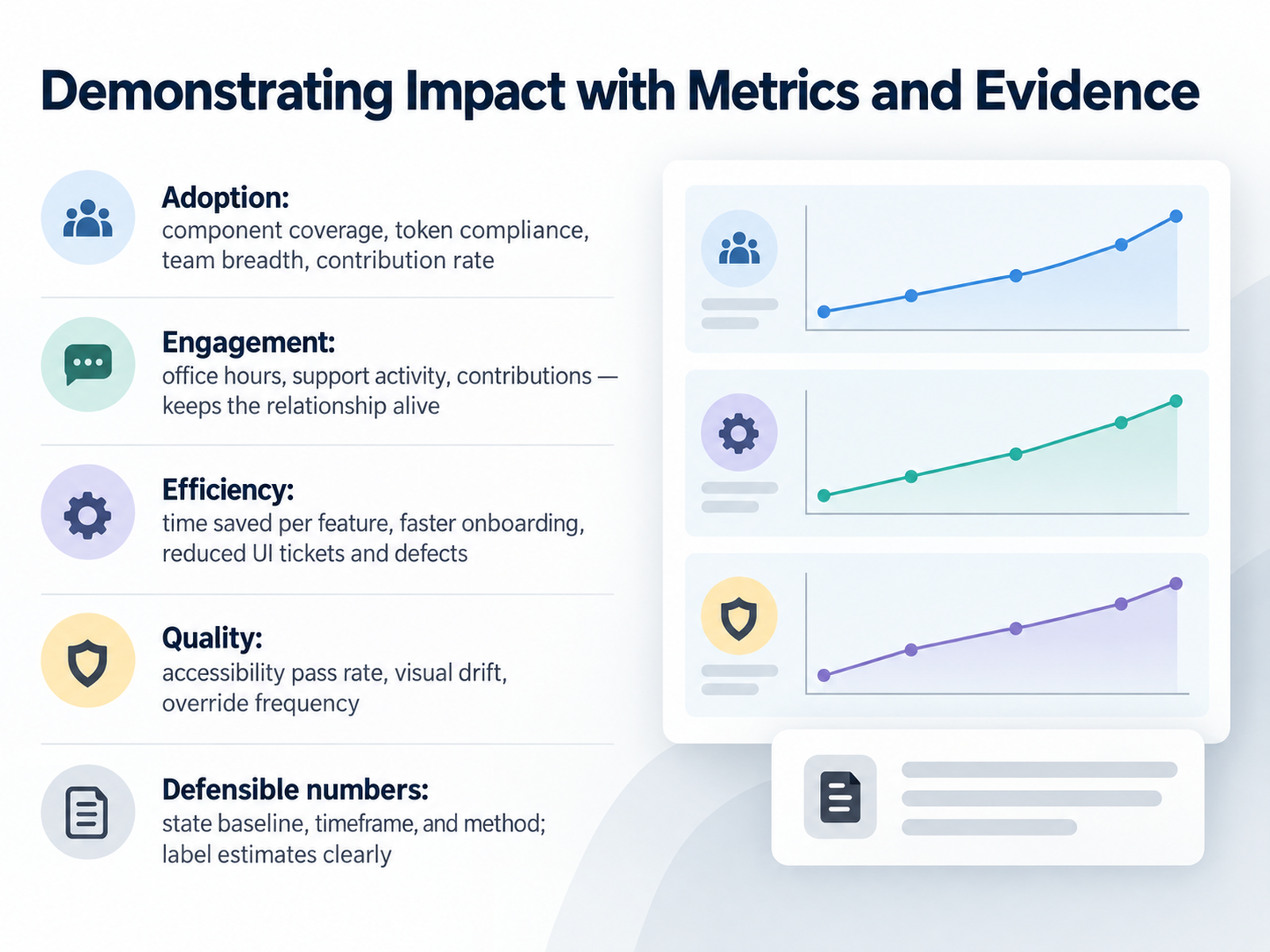
 - 06Demonstrating Impact with Metrics and EvidenceNow let's talk about demonstrating impact with metrics and evidence. Adoption is your baseline: component coverage, token compliance, team breadth, contribution rate. But adoption alone is incomplete. Add engagement, like office hours, support activity, and contributions. That's the relationship that keeps the system alive. Then efficiency: time saved per feature, faster onboarding, fewer UI tickets and defects. And quality: accessibility pass rate, visual drift, override frequency. One caution. Make your numbers defensible. State the baseline, the timeframe, and how you measured it. Label estimates as estimates. So what story will your evidence tell? Next, we look at showcasing craft: tokens, component APIs, and documentation.
 1 min
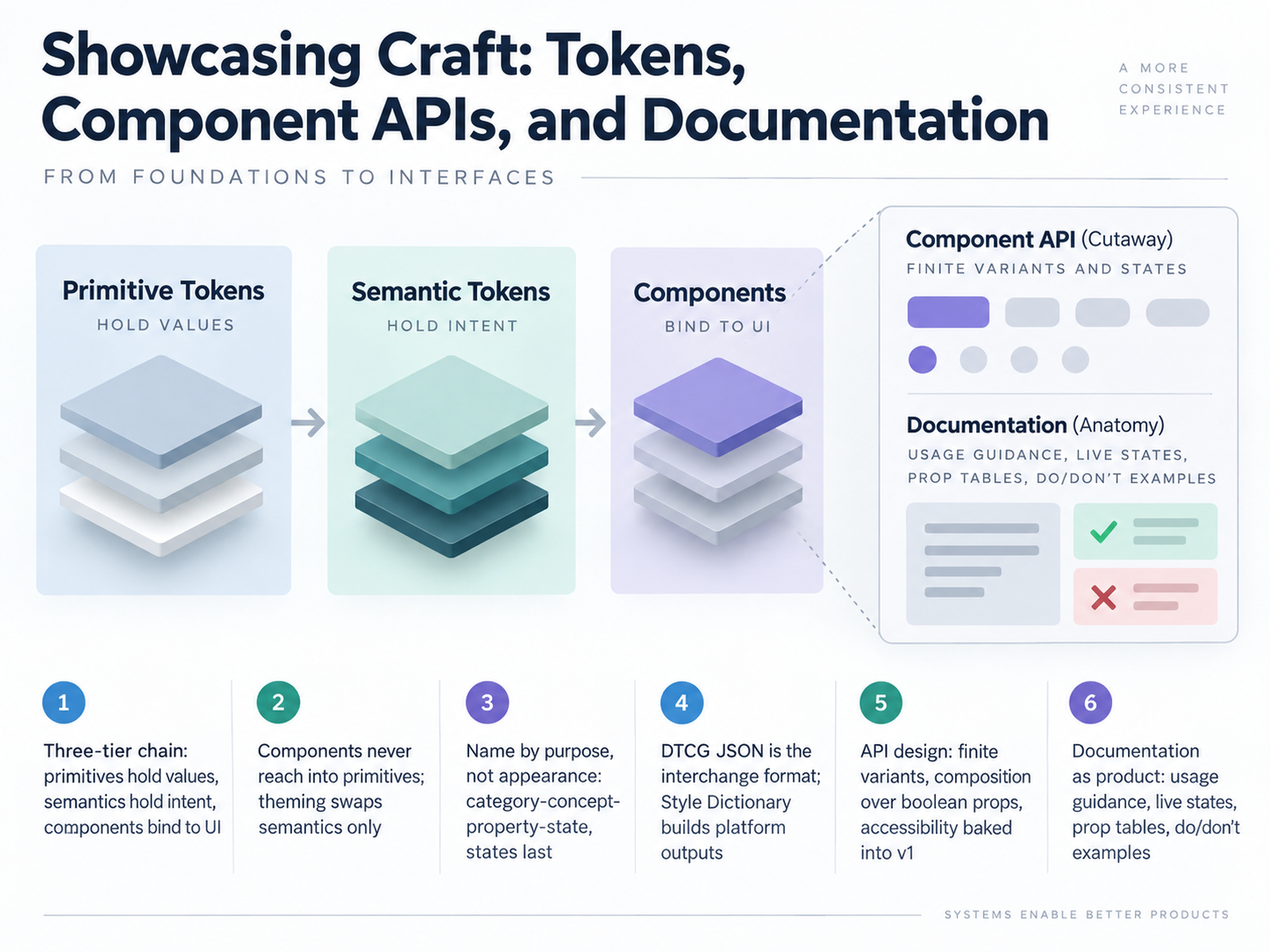
1 min - 07Showcasing Craft: Tokens, Component APIs, and DocumentationLet's talk about craft, because this is the part hiring managers slow down for. Show the chain. Primitives hold values, semantics hold intent, components bind to UI. One rule: components never reach into primitives. Theming swaps semantics only. Name by purpose, not appearance, something like category, concept, property, state, with states last, so hovered, pressed, and disabled group together.
Then show the pipeline. DTCG JSON is the interchange format, and Style Dictionary builds your platform outputs. On the API side, keep variants finite, prefer composition over boolean props, and bake accessibility in at v1. Document it like a product: usage guidance, live states, prop tables, and do and don't examples.
Next, governance, contribution, and adoption stories.
 andryta.comnadirdesign.comshahzebkazmi.com+21 min
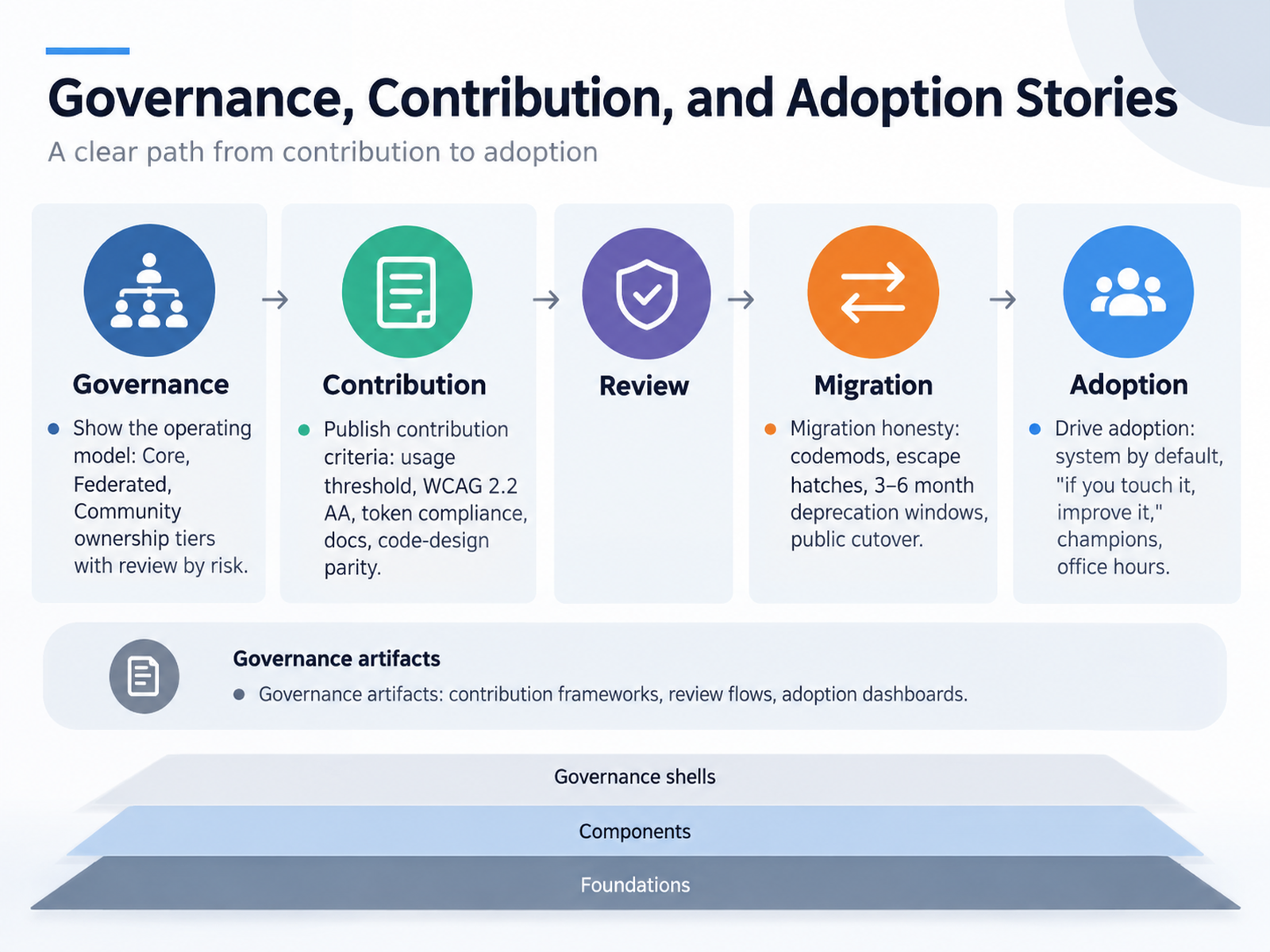
 - 08Governance, Contribution, and Adoption StoriesLet's talk about governance, contribution, and adoption. This is where a portfolio stops looking like a component gallery and starts showing how a system actually runs. Start with your operating model. Show three tiers: Core, Federated, and Community. Core owns tokens and architecture, so review is heaviest. Federated extends the system inside product domains, with medium review. Community covers fixes and docs, with light review. Then publish your contribution criteria so nobody guesses. A common bar: the pattern appears in three or more distinct product areas, meets WCAG 2.2 double A, uses existing tokens exclusively, ships with documentation, and keeps design and code parity across breakpoints. For adoption, make the system the default. Encourage the rule: if you touch it, improve it. Add champions and weekly office hours. Be honest about migration too. Codemods, escape hatches, three to six month deprecation windows, and a public cutover. Finally, name your artifacts: contribution frameworks, review flows, and adoption dashboards. Next, we'll cover Portfolio Format, Platform, and Presentation.
 2 min
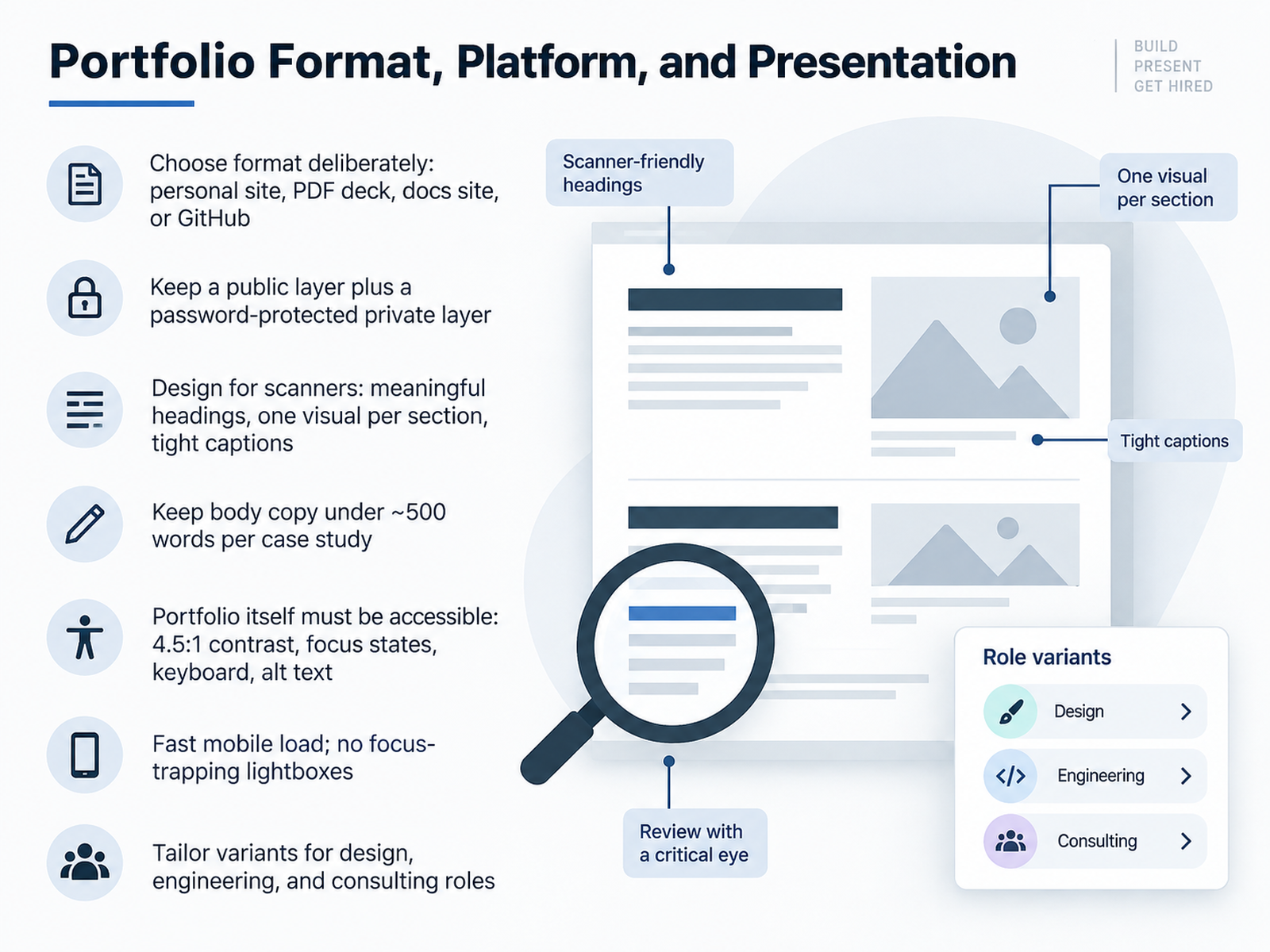
2 min - 09Portfolio Format, Platform, and PresentationNow let's talk about format, platform, and presentation. Choose your format deliberately. A personal site, a PDF deck, a docs site, or GitHub each send a different signal, so pick the one that matches how your audience will review your work. In practice, keep two layers: a public layer anyone can scan, and a password-protected private layer for NDA work and deeper detail. Design for scanners, because that is how reviewers actually read. Use meaningful headings, one visual per section, and tight captions. Keep body copy under about five hundred words per case study. And your portfolio itself has to be accessible. Four point five to one contrast for normal text, visible focus states, full keyboard reach, alt text on every image. Watch for focus-trapping lightboxes, and make sure it loads fast on mobile. Then tailor variants. Design roles lean toward craft and process. Engineering roles lean toward architecture and code. Consulting roles lean toward outcomes and stakeholder decisions. Next, public work and community presence.
 superhive.coemilybackes.designblog.opendoorscareers.com+21 min
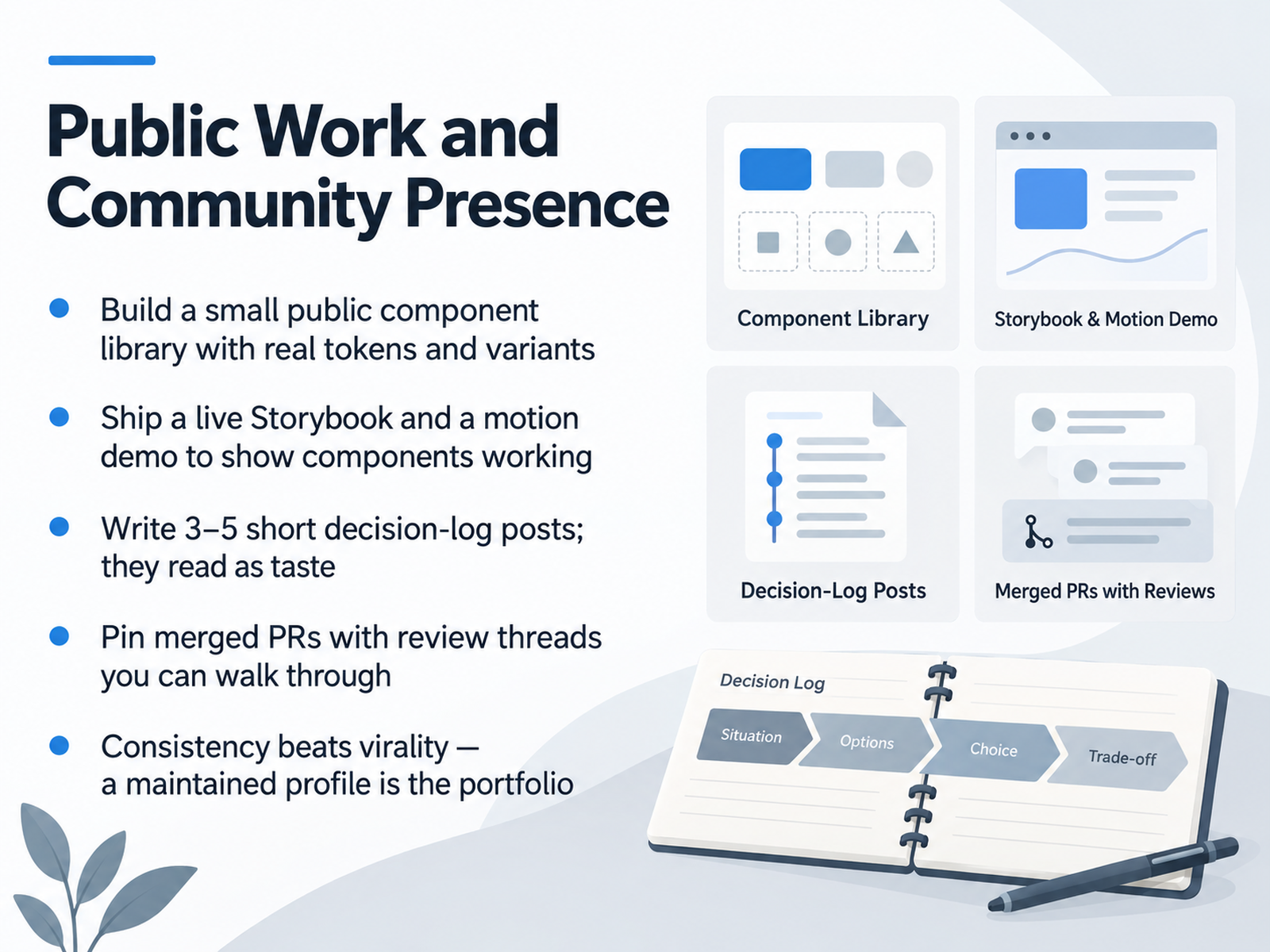
 - 10Public Work and Community PresenceLet's talk about public work and community presence. A portfolio gets stronger when people can see the work, not just read about it. So build a small public component library. Real tokens, real variants. Then ship a live Storybook, plus a motion demo, so a reader can click through components actually working. That proof matters more than polished screenshots.
Next, write three to five short decision-log posts. Explain why you chose a naming convention, a token tier, a variant strategy. These posts read as taste. They show how you think. And pin the merged pull requests with review threads you can walk through. The issue asked for one thing. You changed another. You answered the maintainer. That thread is the artifact.
Here's the tradeoff to hold onto. Consistency beats virality. A maintained profile is the portfolio. One reviewed merge, clearly explained, outperforms twenty drive-by typo fixes and a green commit graph.
So pick a small public surface and keep it alive. Next, we look at review, feedback, and iteration, and how to turn both into visible evidence.
 andryta.comnadirdesign.comshahzebkazmi.com+22 min
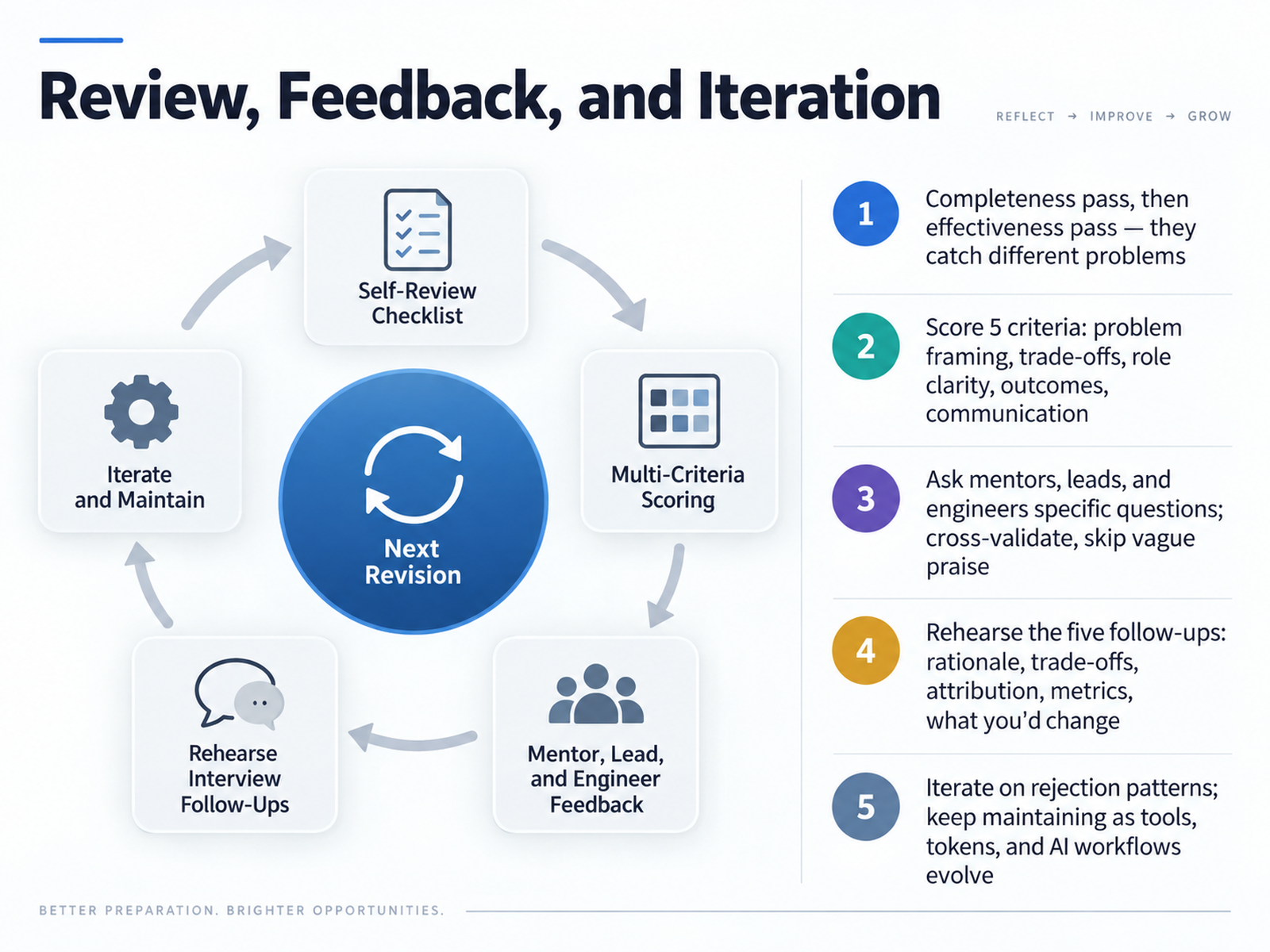
 - 11Review, Feedback, and IterationLet's talk about review, feedback, and iteration. Run two passes, in order. First a completeness pass: is everything there? Then an effectiveness pass: is it earning its place? They catch different problems, so don't merge them. When you score, use five criteria: problem framing, trade-offs, role clarity, outcomes, and communication. Then get outside eyes. Ask mentors, leads, and engineers specific questions, like whether the problem statement lands in one sentence or whether your role is clear on a team project. Cross-validate across reviewers to spot patterns, and skip vague praise. It tells you nothing. Rehearse the five follow-ups you'll get: rationale, trade-offs, attribution, metrics, and what you'd change. Write short answers for each project before you present. Finally, iterate on rejection patterns. If three reviewers miss your outcomes, that's your signal. And keep maintaining, because tools, tokens, and AI workflows keep moving. Next, we pull it all together: Capstone: Assembling and Presenting Your Portfolio.
 2 min
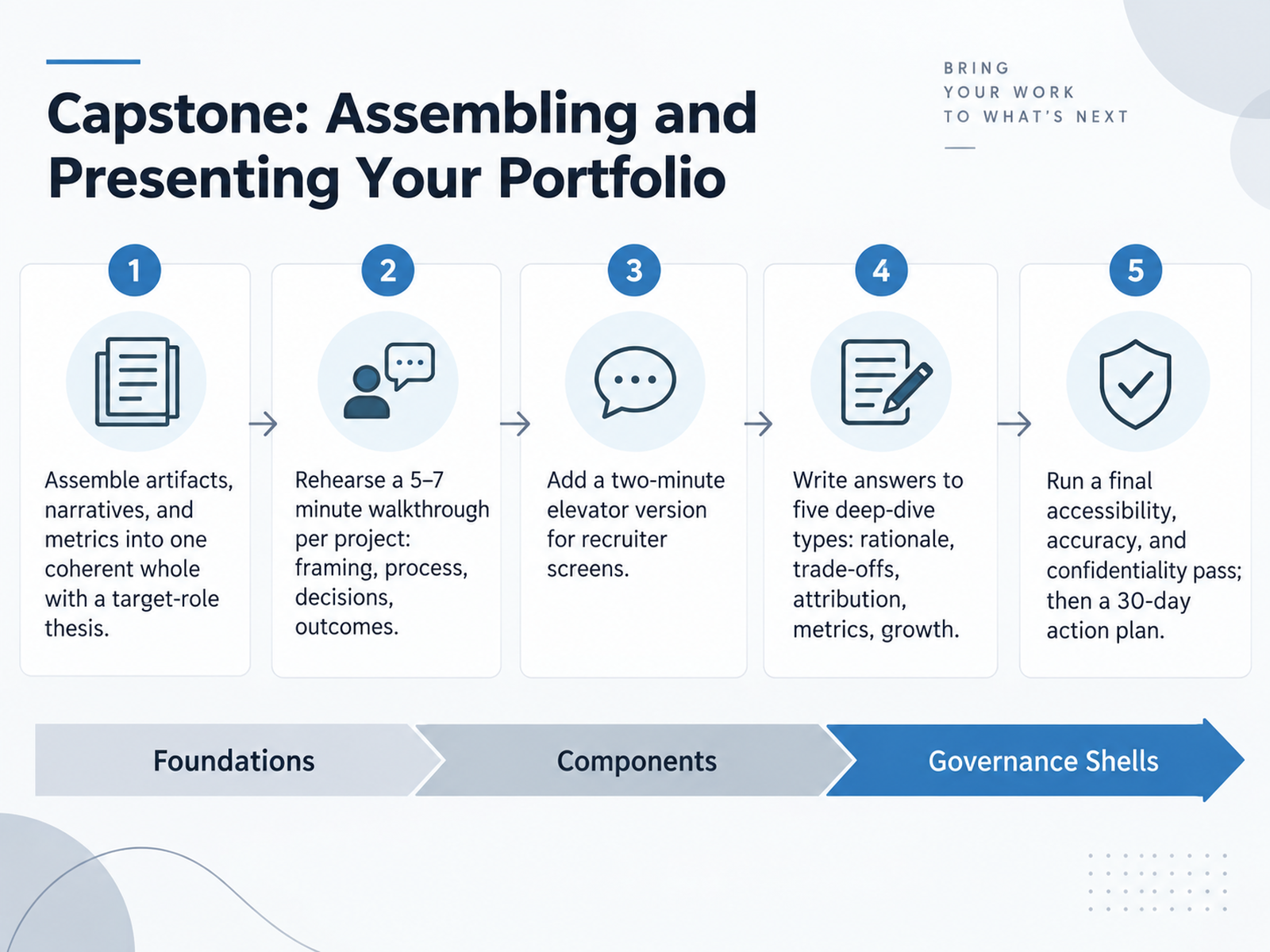
2 min - 12Capstone: Assembling and Presenting Your PortfolioLet's pull everything together into the capstone. Your portfolio isn't a folder of artifacts. It's one coherent argument, tied to a target-role thesis. So state the role you want, then let each project support it. Assemble three things per project: the artifacts, the narrative, and the metrics. Rehearse a five to seven minute walkthrough covering four stages: framing, process, decisions, outcomes. Under four minutes, you skip process evidence. Over eight, you crowd out the deep-dive questions where offers get confirmed. Add a two-minute elevator version for recruiter screens. Then write answers to five deep-dive types: rationale, trade-offs, attribution, metrics, and growth. Write them out before the interview. Not a script, just key points that keep you specific. Attribution matters, so be clear about your contribution versus the team's. Finally, run a closing pass: accessibility, accuracy, confidentiality. Check contrast, alt text, and keyboard navigation. Verify every metric and claim. And confirm you have written permission for any NDA-protected work. Labelled redactions read as professional discretion. Unexplained gaps read as sloppy. Then build a thirty-day action plan with one concrete step per week. Where the Discipline Is Heading: AI-Ready Systems and Your Next Portfolio Update.
 uxplaybook.orgxperiencewave.comdribbble.com+22 min
 - 13Where the Discipline Is Heading: AI-Ready Systems and Your Next Portfolio UpdateLet's close by looking ahead, and by deciding what you'll add to your portfolio next.
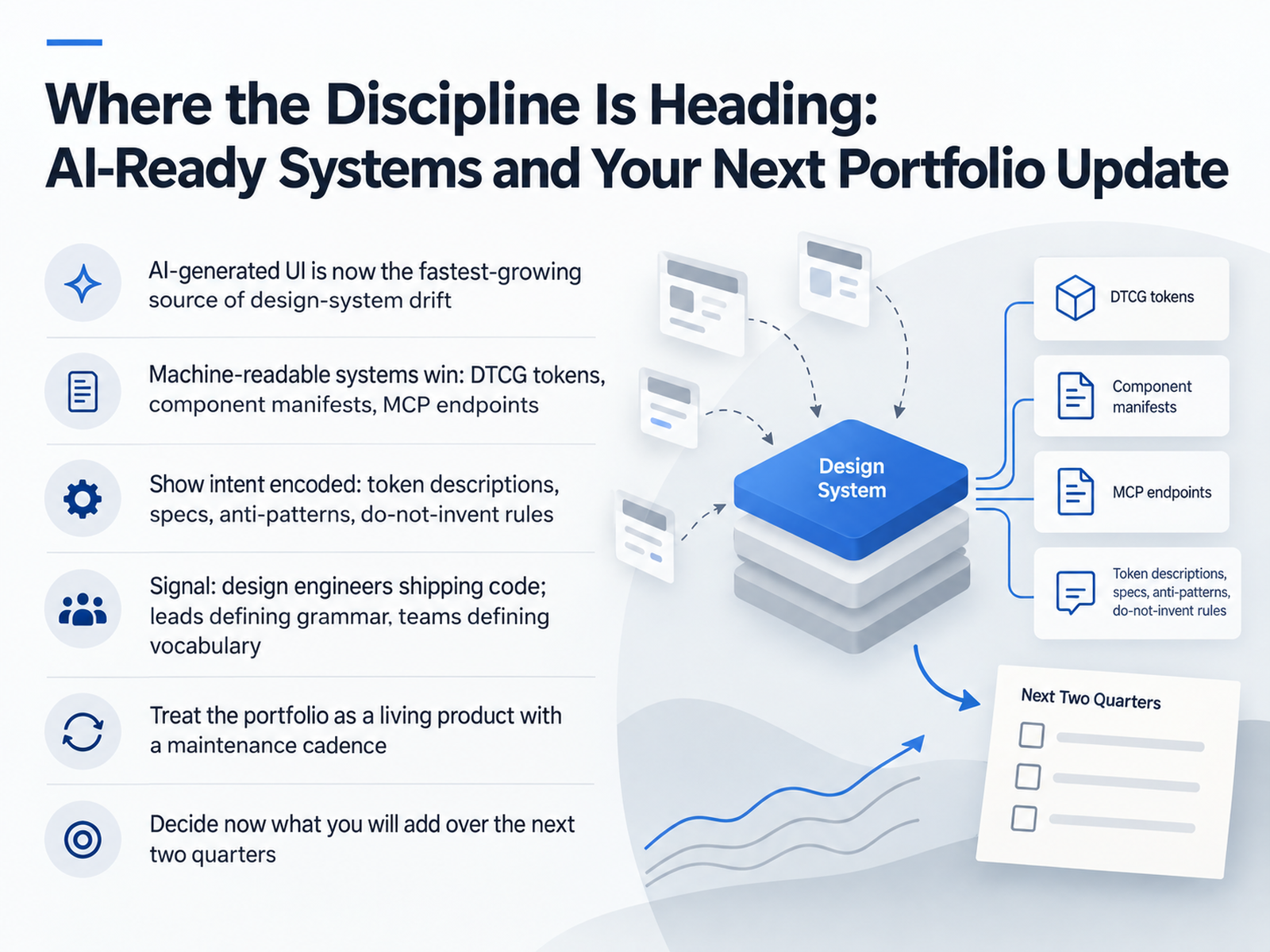
Here's the shift. AI-generated UI is now the fastest-growing source of design-system drift. Interfaces get produced faster than your system can absorb them. So the systems that hold up are the machine-readable ones: tokens in the Design Tokens Community Group format, component manifests, and MCP endpoints that agents can actually query.
The move is to encode intent, not just values. Token descriptions that explain purpose, specs, anti-patterns, and clear do-not-invent rules. That's what keeps output consistent without you reviewing every screen.
On roles, the signal is splitting. Design engineers are shipping code. Leads are defining the grammar. Teams are defining the vocabulary.
And treat your portfolio as a living product, with a maintenance cadence. You don't need to rebuild it. Decide now what you'll add over the next two quarters: one new case study, one refreshed artifact, one clear point of view.
So here's your recap. Machine-readable systems win. Intent beats values. Keep the portfolio alive.
Thank you for working through this with me. You already have the judgment this field needs. Go build the proof, and keep it moving.
 2 min
2 min
Take the deck with you
Download this course as a file — free, no sign-up needed.
- PDF handoutEvery slide page, ready to print or share.14 pages · 2.7 MBDownload
- Narrated PowerPointThe deck that presents itself — every slide carries the digital human's narration video.14 pages · 14.3 MBDownload
- PowerPoint slidesThe full deck as a .pptx — open it in PowerPoint, Keynote, or Google Slides.14 pages · 2.6 MBDownload
Free to use in your own training — please keep the PersonWise credit page at the end.
Have your own deck? Turn it into a course
Sources consulted
Web sources consulted while building this course.
- Design systems team structure in 2026 - by Romina Kavcic — learn.thedesignsystem.guide
- Product Designer, Design System | The GitLab Handbook — handbook.gitlab.com
- Medium — medium.muz.li
- Design Systems Product Design Career Levels — figma.com
- What a Career in Design Systems Actually Looks Like ... — designsystemscollective.com
- MCM Design System — Foundation to Production | Andrea Valerio - Senior Product Designer — andryta.com
- Iksir Design System (Case Study) · Nadir Mostefaoui — nadirdesign.com
- Ginmon Design System Case Study | Shahzeb Kazmi — shahzebkazmi.com
- Floret Design System — Mohammed Patel - Product UX Designer — uxpatel.com
- Alex Lima - Senior Product Designer — alequise.com
- How to Present NDA Design Work in Your UX Portfolio? — uxplaybook.org
- NDA Work in Your UX Portfolio: 5 Strategies That Work | Xperience Wave — xperiencewave.com
- How To Build A Strong Design Portfolio When Your Best Work Is Under NDA | Dribbble — dribbble.com
- Your Best Work Is Under NDA: How to Build a Freelance Portfolio Anyway – Veravix — veravix.com
- An NDA Doesn’t Mean Your Best Work Has to Stay Hidden 🔒 — blog.opendoorscareers.com
- Writing a UX Design case study that shows thinking, not just pixels — superhive.co
- How to Fix UX Case Studies in 2026: A Portfolio Guide — emilybackes.design
- How to Write a Strong Case Study for Your Portfolio in 2026 🧠 — blog.opendoorscareers.com
- Anatomy of an Interview-Ready UX Case Study — designcase.app
- UX Portfolio Guide 2026: Get Hired Faster — uxmagic.ai