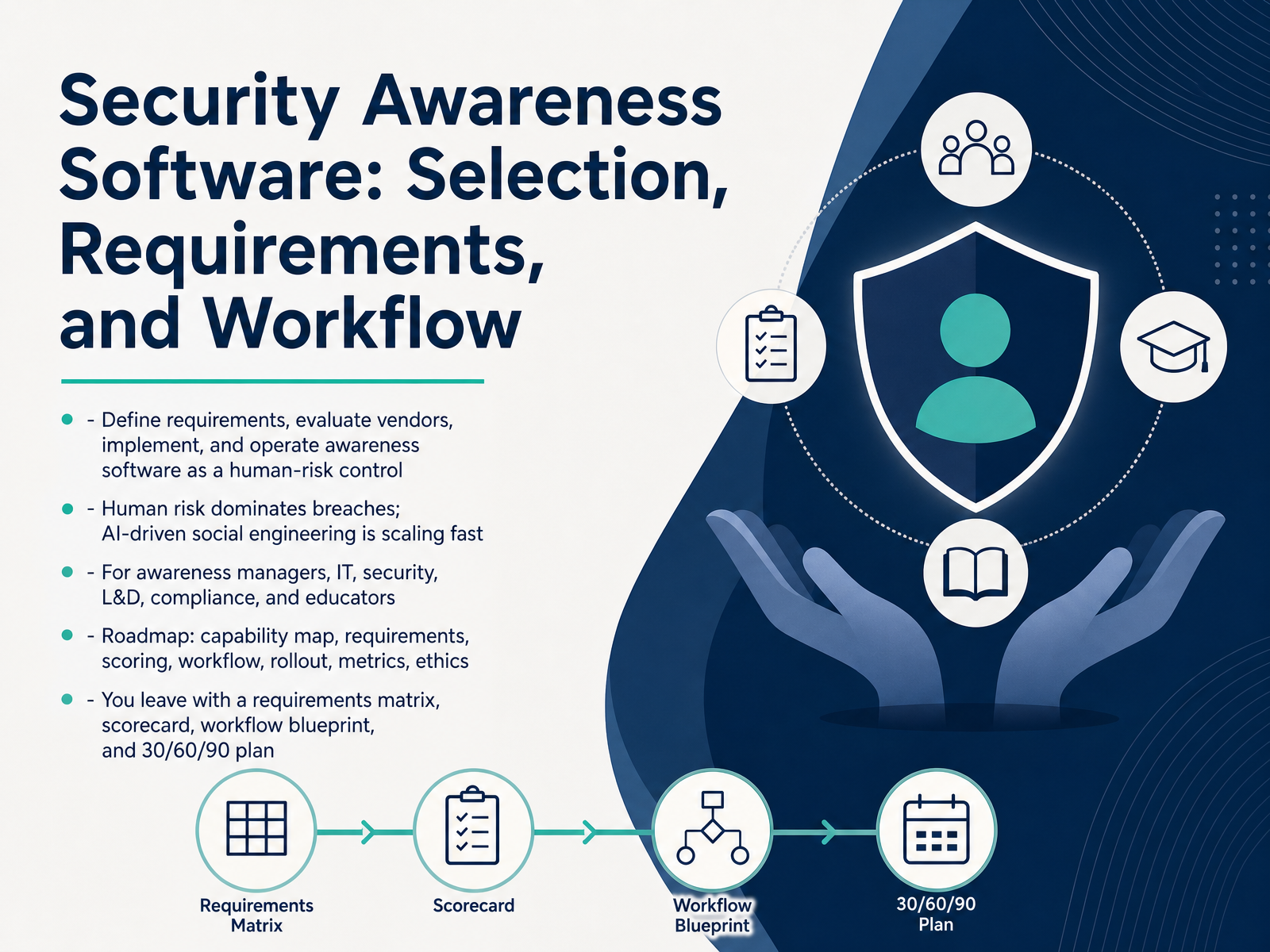
Security Awareness Software Selection
Begin
13 pages · ~26 min
Security Awareness Software Selection
This training guides security professionals in selecting security awareness software, defining requirements, and building effective implementation workflows.
What you’ll learn
- 01Security Awareness Software: Selection, Requirements, and WorkflowWelcome. This course is about treating security awareness software as a control, not a checkbox. Over the next slides, we'll define requirements, evaluate vendors, and build a workflow you can actually operate. Here's why this matters. Human risk is now the dominant driver of breaches, and AI-generated social engineering is scaling fast, so awareness programs have to become continuous control programs instead of an annual event. This course is built for awareness managers, IT and security teams, learning and development, compliance, and educators. Along the way, you'll build four practical artifacts you can reuse: a requirements matrix, a vendor scorecard, a workflow blueprint, and a thirty, sixty, ninety day plan. Our roadmap covers capability mapping, requirements, scoring, workflow, rollout, metrics, and the ethics of monitoring. Before we go further, note two criteria you'll want to score every vendor against: integration with your identity and email stack, and audit-ready evidence. Those two items predict rollout friction more reliably than content library size. Next, let's look at why awareness platforms matter in 2026.softwareanalyst.substack.commordorintelligence.comgiiresearch.com+22 min
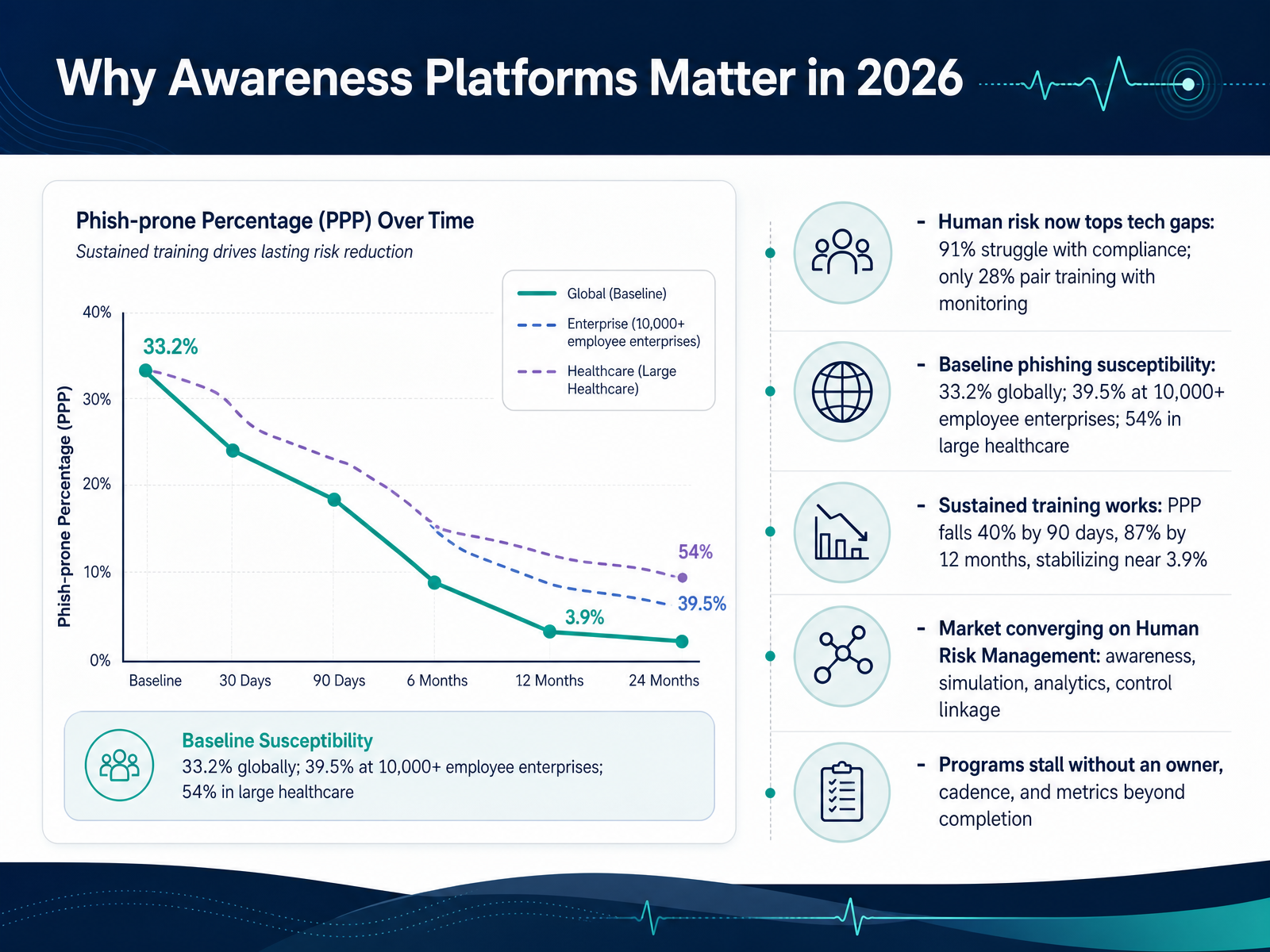
- 02Why Awareness Platforms Matter in 2026Let's start with why awareness platforms matter right now. The data tells a clear story. Human risk has overtaken technology gaps as the top cybersecurity challenge, and yet the execution is fragmented. Ninety-one percent of organizations struggle with employee compliance, and only twenty-eight percent pair regular training with continuous monitoring. That gap between knowing and doing is where breaches happen. At baseline, phishing susceptibility sits at thirty-three point two percent globally, rising to thirty-nine point five percent in enterprises with more than ten thousand employees, and peaking at fifty-four percent in large healthcare environments. But here's the encouraging part. Sustained training works. Susceptibility drops forty percent within ninety days, and eighty-seven percent by twelve months, stabilizing near three point nine percent. The key takeaway is that the biggest gains occur between month three and month twelve, so a one-time campaign will leave most of your risk reduction on the table. The market is also converging around Human Risk Management, blending awareness, simulation, and analytics. But programs stall without three things: an owner, a consistent cadence, and metrics beyond completion rates. As we move on, we'll explore how to build the business case and map the market categories.
 softwareanalyst.substack.commordorintelligence.comgiiresearch.com+22 min
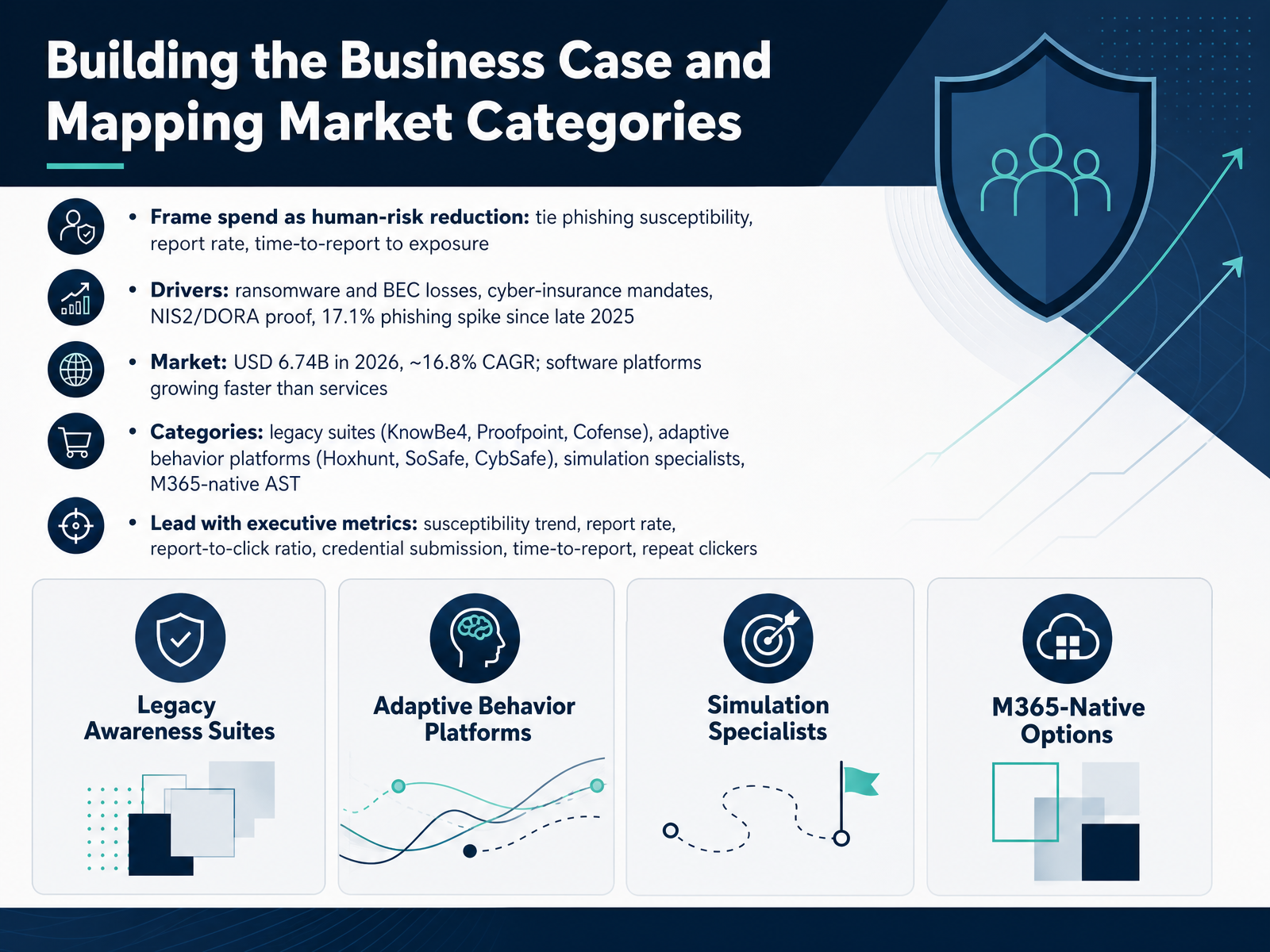
 - 03Building the Business Case and Mapping Market CategoriesNow let's build the case that actually gets funded. Frame your spend as human-risk reduction, not training hours. Tie susceptibility, report rate, and time-to-report directly to exposure. Your drivers: ransomware and business email compromise losses, cyber-insurance mandates, NIS2 and DORA proof, and a seventeen point one percent phishing spike since late 2025. The market itself sits at six point seven four billion dollars in 2026, growing at roughly sixteen point eight percent a year, with software platforms outpacing services. Four categories to map: legacy suites like KnowBe4, Proofpoint, and Cofense; adaptive behavior platforms like Hoxhunt, SoSafe, and CybSafe; simulation specialists; and native Microsoft 365 attack simulation. Lead every executive conversation with metrics, not modules: susceptibility trend, report rate, report-to-click ratio, credential submission, time-to-report, and repeat clickers. Next, the core capability map.
 softwareanalyst.substack.commordorintelligence.comgiiresearch.com+21 min
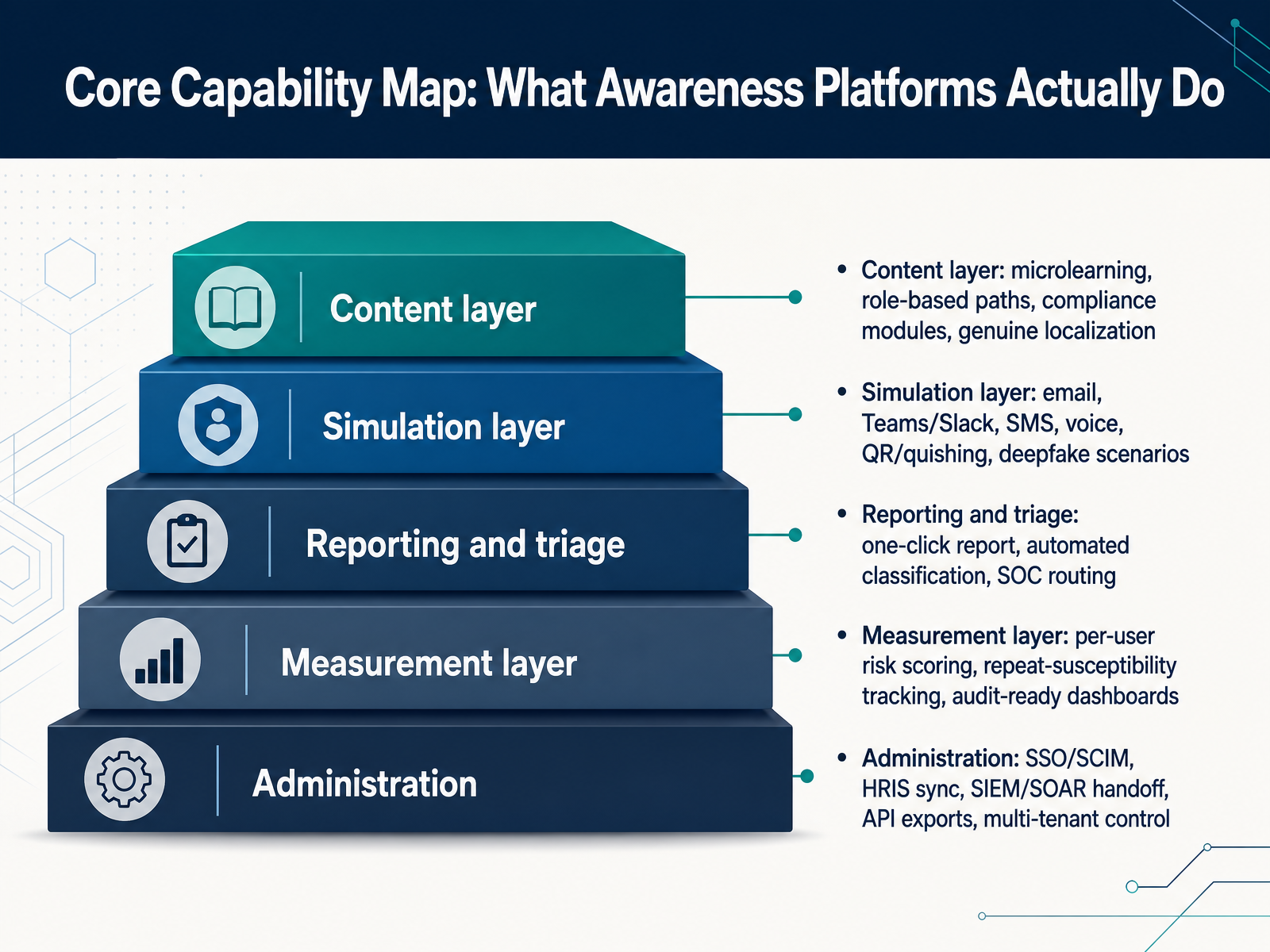
 - 04Core Capability Map: What Awareness Platforms Actually DoLet's break down what these platforms actually do, because the capability map should drive your requirements, not the vendor's feature list. Five layers matter. First, the content layer: microlearning, role-based paths, compliance modules, and genuine localization. Ask how many items are refreshed each quarter, and check whether translations are natively written or machine-translated, since translated content measurably lowers engagement and distorts your results. Second, the simulation layer. Email alone is no longer enough. Your real exposure includes Teams and Slack, SMS, voice calls, QR codes, and increasingly deepfake scenarios, so confirm which channels are mature versus on a roadmap. Third, reporting and triage: one-click reporting, automated classification, and clean routing into your SOC. That determines whether employee reports become real detection signal or just noise in a shared mailbox. Fourth, the measurement layer: per-user risk scoring, repeat-susceptibility tracking, and audit-ready dashboards. Prioritize report rate and time-to-report alongside click rate, because a user who avoids clicking but never reports still leaves you blind. And fifth, administration: single sign-on, SCIM provisioning, HRIS sync, SIEM and SOAR handoff, API exports, and multi-tenant control. That layer decides your steady-state admin load, not the demo. Next, we'll look at requirements gathering and stakeholder alignment.
 eastbaycyber.comdefend.networkransomleak.com+22 min
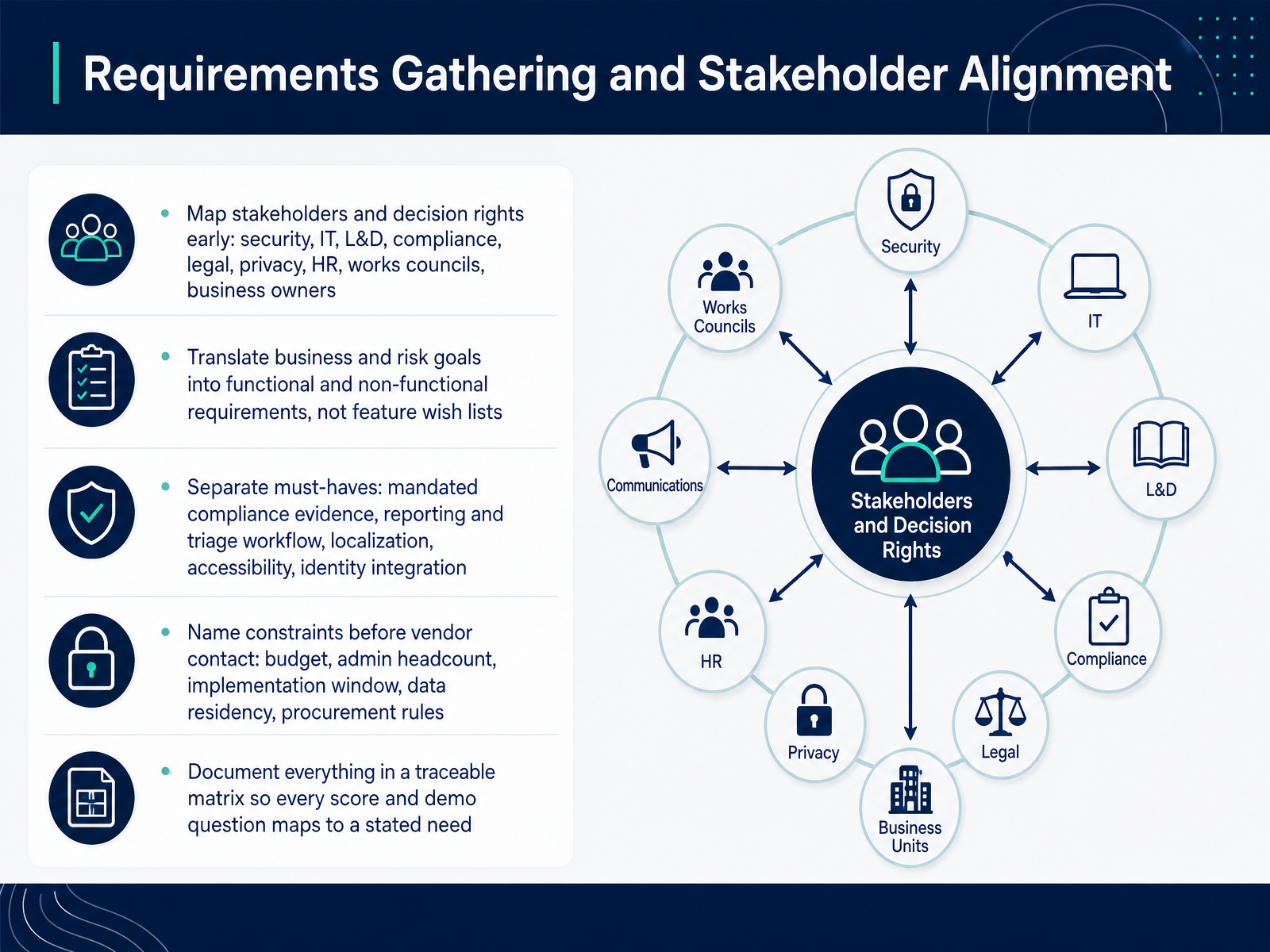
 - 05Requirements Gathering and Stakeholder AlignmentLet's talk about requirements gathering and stakeholder alignment. Map your stakeholders and decision rights before anything else, so security, IT, learning and development, compliance, legal, privacy, HR, works councils, and business owners all know who signs off on what. Then translate your business and risk goals into functional and non-functional requirements. That keeps you out of feature wish list territory. Separate your must-haves, like mandated compliance evidence, reporting and triage workflow, localization, accessibility, and identity integration. Name your constraints before vendor contact, including budget, admin headcount, implementation window, data residency, and procurement rules. Finally, document everything in a traceable matrix, so every score and every demo question maps back to a stated need. That matrix becomes your defense when someone asks why a vendor lost. Selection criteria, weighted scorecards, and total cost of ownership are next.
 palomarr.combaitandphish.comungm.org+21 min
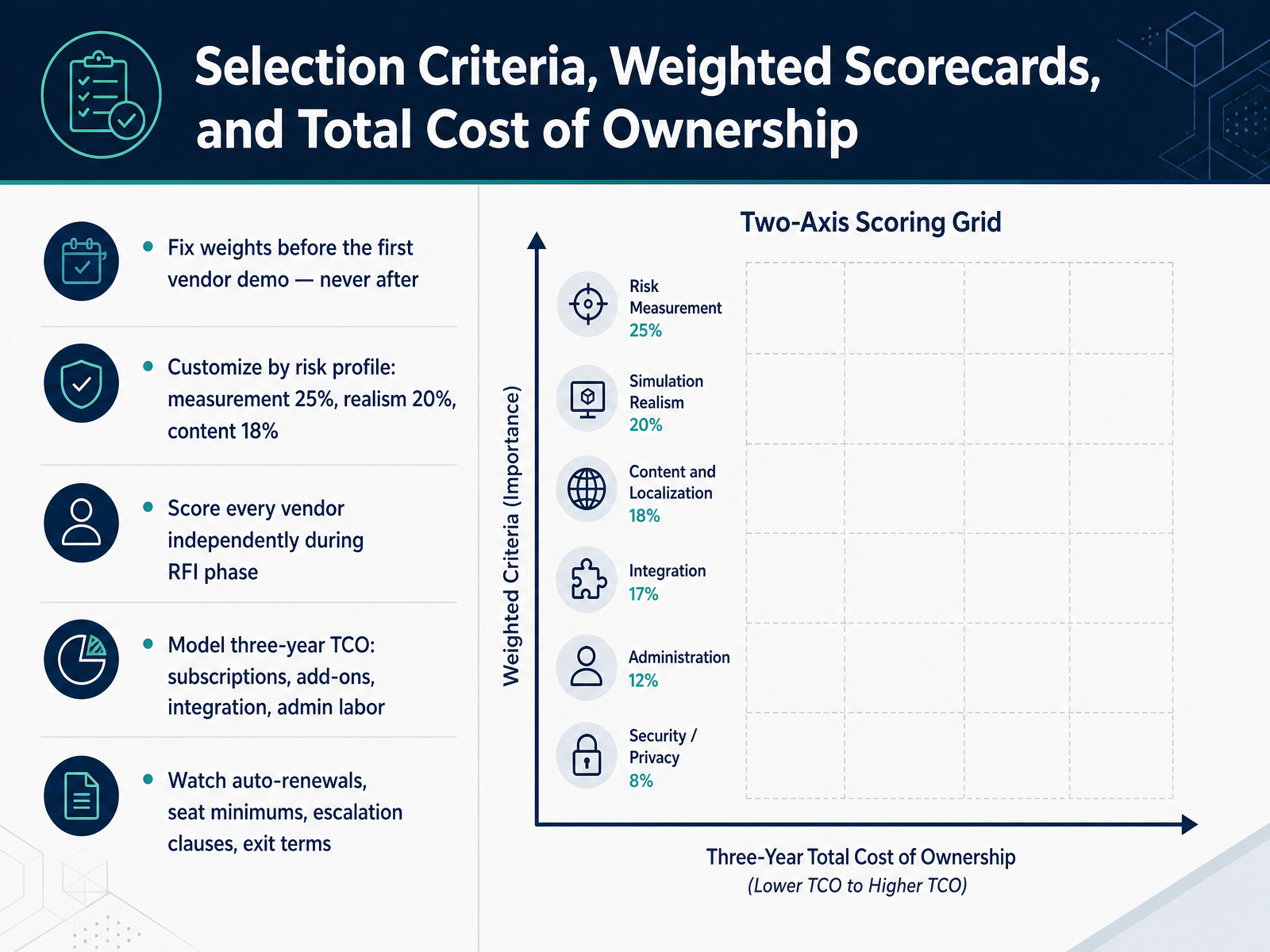
 - 06Selection Criteria, Weighted Scorecards, and Total Cost of OwnershipLet's walk through how to select a vendor without letting the demo drive the decision. First rule: fix your weights before the first vendor demo, never after. Adjusting weights later turns a scorecard into a justification for a choice you've already made. A common distribution is risk measurement at twenty-five percent, simulation realism at twenty percent, and content at eighteen percent. Then customize by risk profile. A heavily regulated organization might shift weight toward analytics and evidence generation, while a lean team raises administrative burden, because hidden labor inflates cost. Next, score every vendor independently during the RFI phase, before anyone presents. That blunts the persuasive effect of a polished slide deck. Then model three-year total cost of ownership, not just the license. Include subscriptions, add-on modules, integration work, and admin labor, since implementation and hidden administration often outweigh the seat fee. Finally, read the contract closely. Watch auto-renewals with sixty or ninety day opt-out windows, seat minimums, escalation clauses, and exit terms. Confirm data export rights before you sign. Treat the completed scorecard as your audit artifact. Next, running a pilot that produces evidence, not anecdotes.
 adaptivesecurity.comcyberaware.comsmartfense.com+22 min
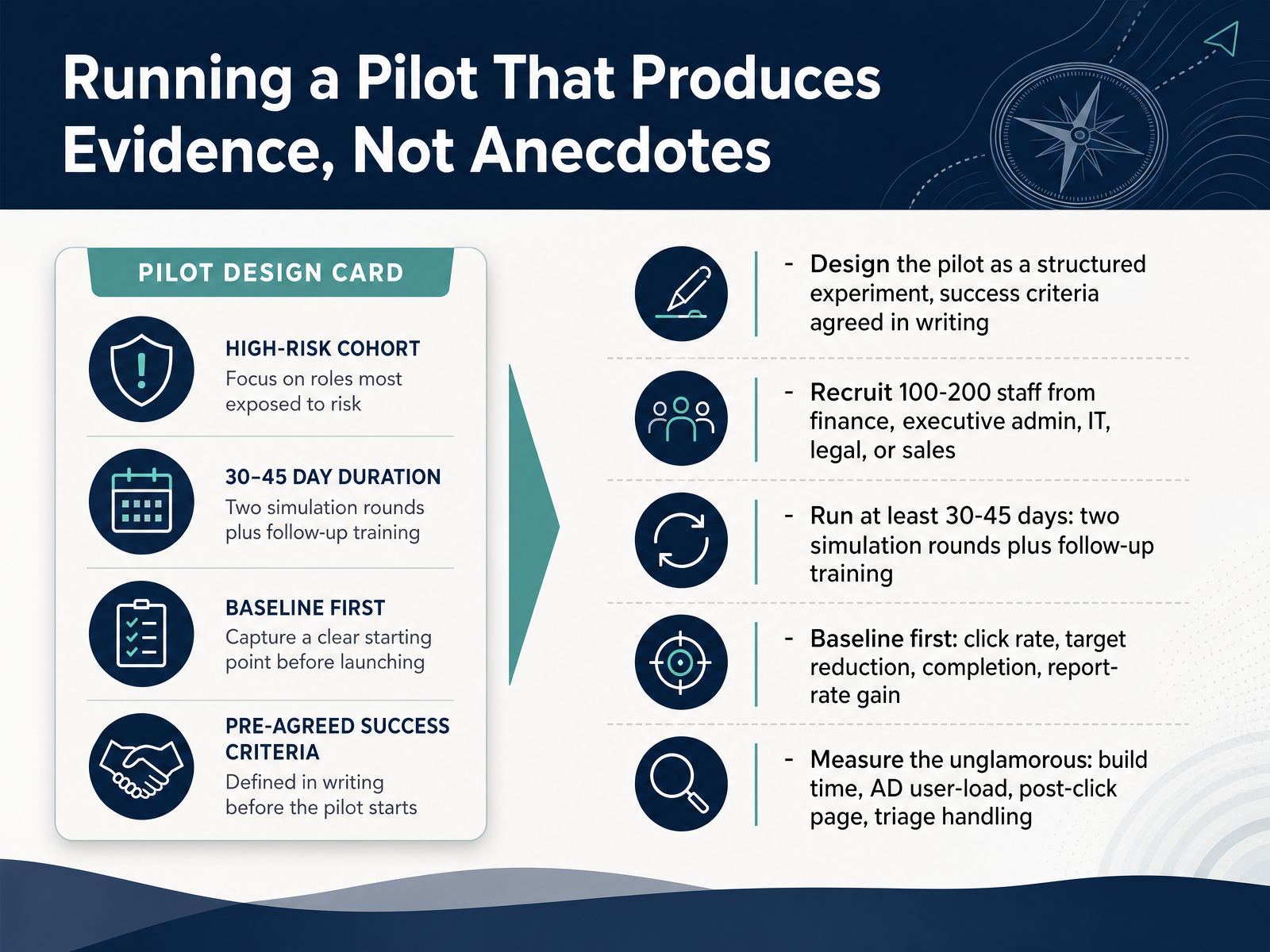
 - 07Running a Pilot That Produces Evidence, Not AnecdotesNext, let's look at running a pilot that produces evidence, not anecdotes. Treat the pilot as a structured experiment, with success criteria agreed in writing before anything launches. That single step is what turns a demo into defensible data. Recruit one hundred to two hundred staff across finance, executive admin, IT, legal, or sales. Not the security team, because they spot every simulation instantly, and your results will not generalize. Run at least thirty to forty five days. That gives you time for two simulation rounds plus follow-up training. Baseline first. Capture click rate, your target reduction, completion, and report-rate gain, so you can prove change later. Then measure the unglamorous operational metrics. Build time per campaign, A D user-load effort, the post-click page employees actually see, and triage handling. Those numbers predict your first-year cost far better than any dashboard. Pause here and note your criteria. Workflow Design: From Campaign Calendar to Behavior Change.
 adaptivesecurity.comcyberaware.comsmartfense.com+22 min
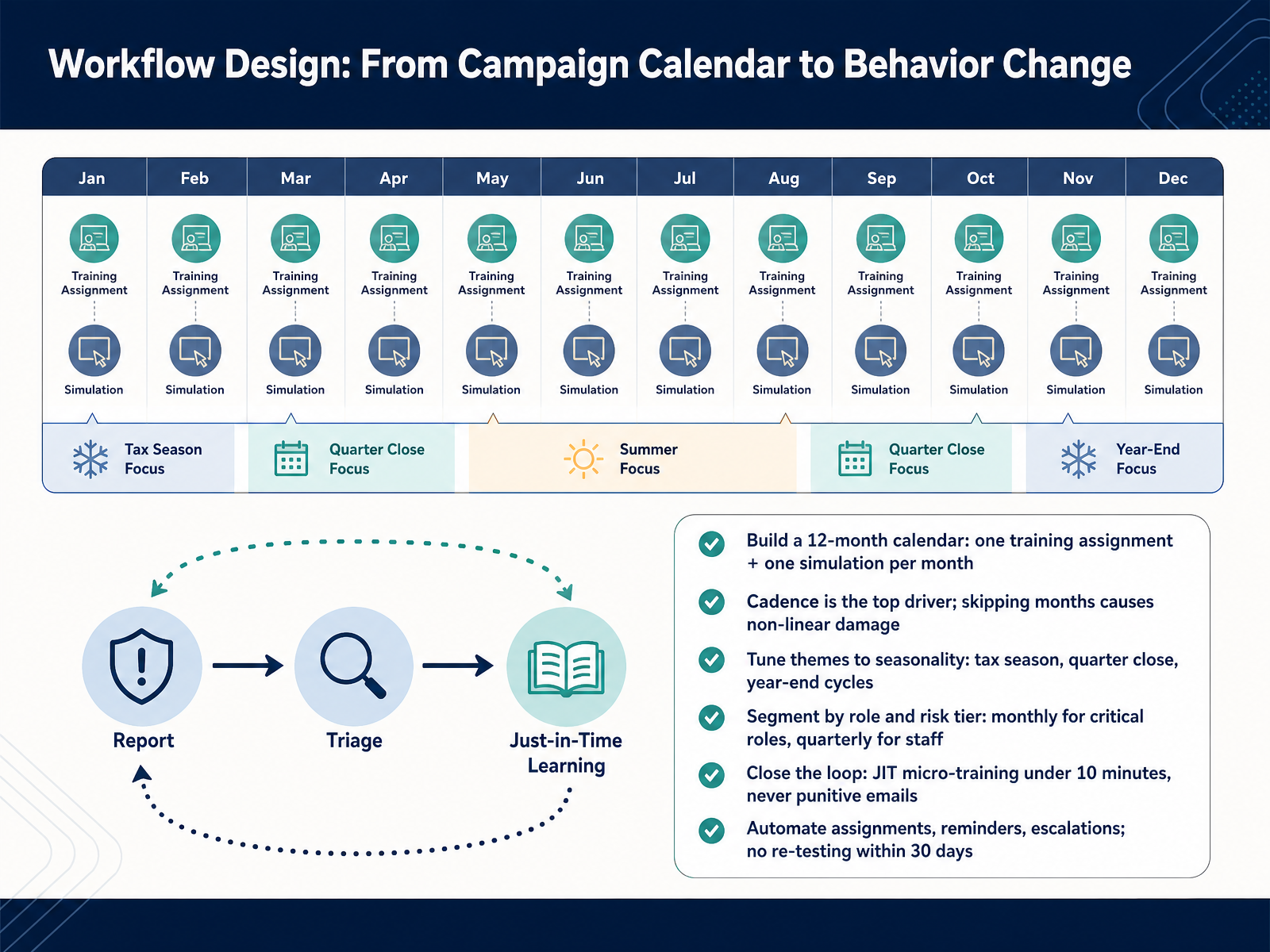
 - 08Workflow Design: From Campaign Calendar to Behavior ChangeNow let's put cadence into practice. The working structure most programs adopt is one training assignment plus one simulation every month for twelve months. Cadence is the single biggest driver of behavior change. Skipping months causes non-linear damage. A program that runs eight months out of twelve produces closer to thirty percent of the behavior change of a full-year program, not sixty-seven percent. So treat the calendar as non-negotiable. Next, tune themes to seasonality. Tax-related lures in March and April. Wire fraud and fake executive requests around quarter close. Year-end bonus and holiday themes in December. Relevance is what makes the simulation land. Then segment by role and risk tier. Critical roles like finance, IT admins, and executives get monthly simulation. General staff can run quarterly. And close the loop. Just-in-time micro-training should be under ten minutes and never punitive. The click is a teaching moment, not a disciplinary event. Finally, automate assignments, reminders, and escalations, and hold a thirty-day cooling period so nobody is re-tested on the same channel too soon. Pause here and compare these six criteria against your current calendar. Next, we move into implementation, change management, and user adoption.
 2 min
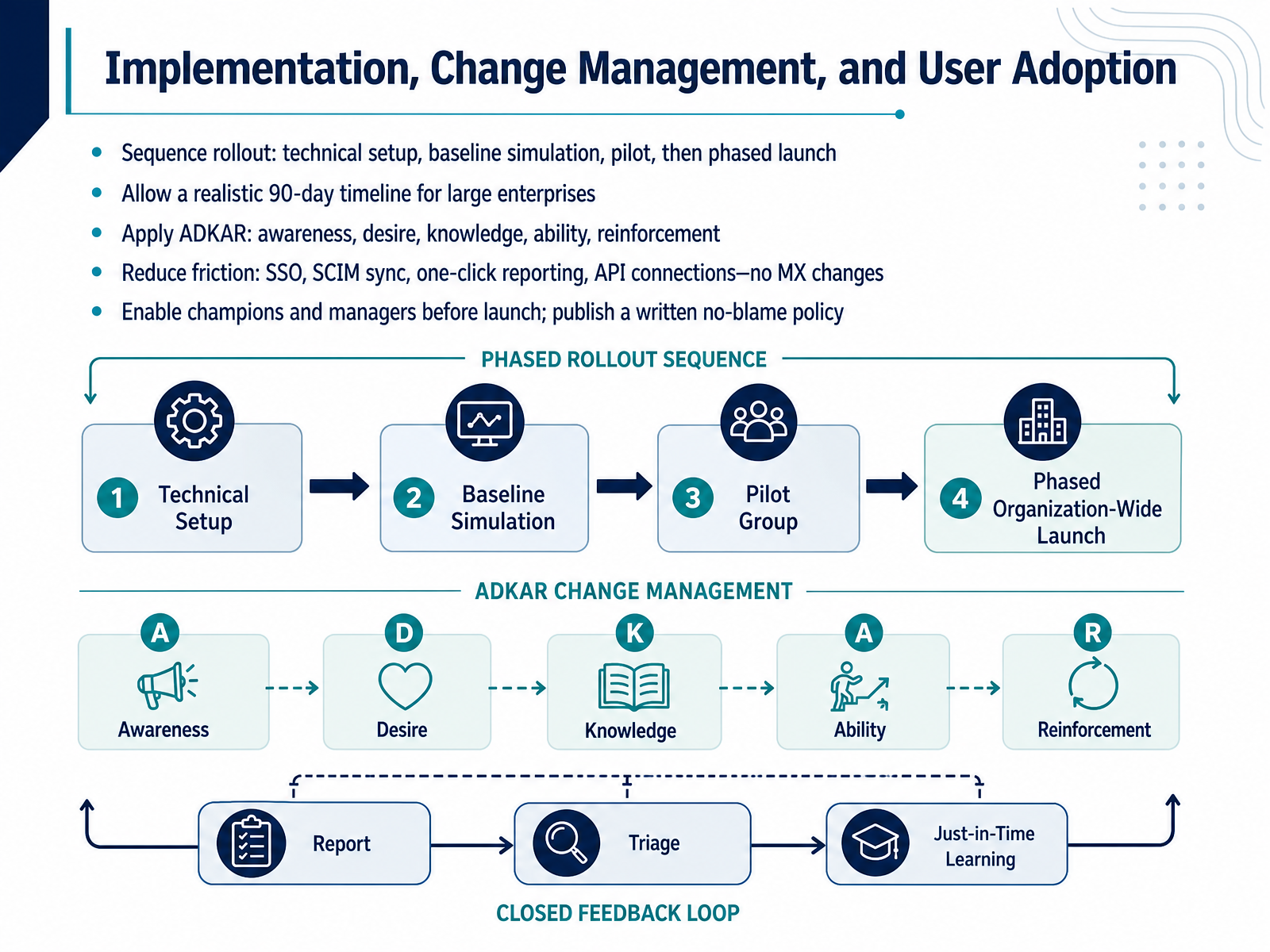
2 min - 09Implementation, Change Management, and User AdoptionLet's move from selection into implementation. This is where most programs succeed or quietly stall, so sequence your rollout deliberately. Technical setup first, then a baseline simulation, then a pilot with a friendly team, and only then a phased launch. For enterprise environments, plan on a realistic ninety-day timeline. Now apply the ADKAR model to your people: build awareness of why the program exists, create desire by framing it as skill building, not surveillance, deliver knowledge through role-specific training, support ability so employees can actually succeed, and reinforce continuously to prevent regression. Reduce friction up front. Single sign-on, SCIM provisioning, one-click reporting, and API connections keep adoption clean, and confirm the platform needs no MX record changes, so mail flow stays untouched. Finally, enable your champions and managers before launch, and publish a written no-blame policy that turns every click into a coaching moment. Next, we look at measurement, dashboards, and continuous improvement.
 eastbaycyber.comdefend.networkransomleak.com+21 min
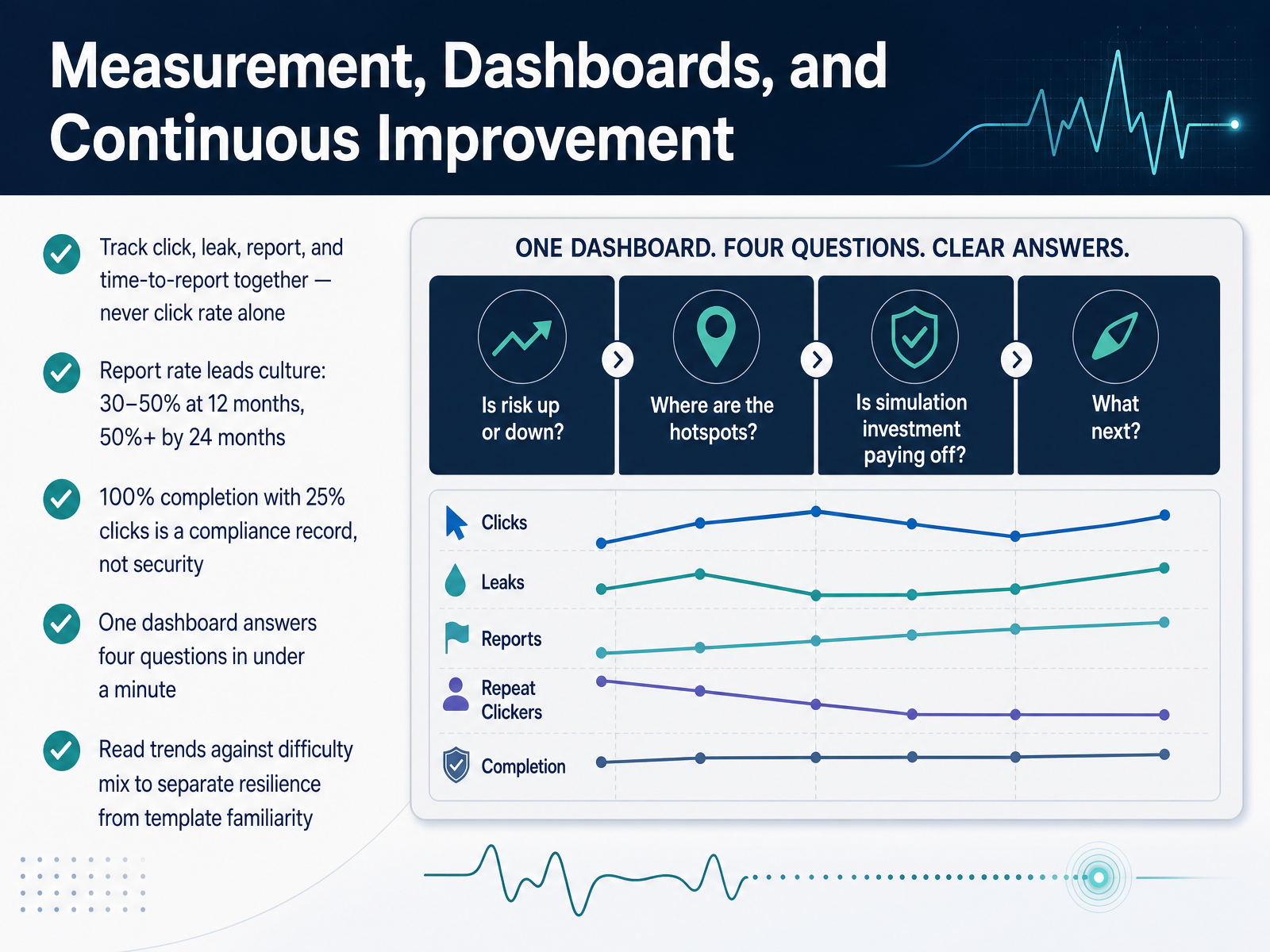
 - 10Measurement, Dashboards, and Continuous ImprovementNow let's talk about measurement, dashboards, and continuous improvement. The first principle is simple: track click, leak, report, and time-to-report together, never click rate alone. Click rate tells you who avoided harm. Report rate tells you whether your people are actively defending the organization. What should you target? A report rate of thirty to fifty percent at twelve months, and over fifty percent by twenty-four months. And here's a check on false comfort: one hundred percent training completion with a twenty-five percent click rate is a compliance record, not security. For your dashboard, keep it to one page that answers four questions in under a minute: Is risk going up or down? Where are the hotspots by department? Are we getting return on our simulation investment? And what should we do next? Finally, always read your trends against the difficulty mix. If clicks fall while the hard simulation share stays constant, you're building resilience. If clicks fall against the same repeated templates, you're measuring familiarity, not security. Coming up next: Risk, Compliance, and Ethical Guardrails.
 2 min
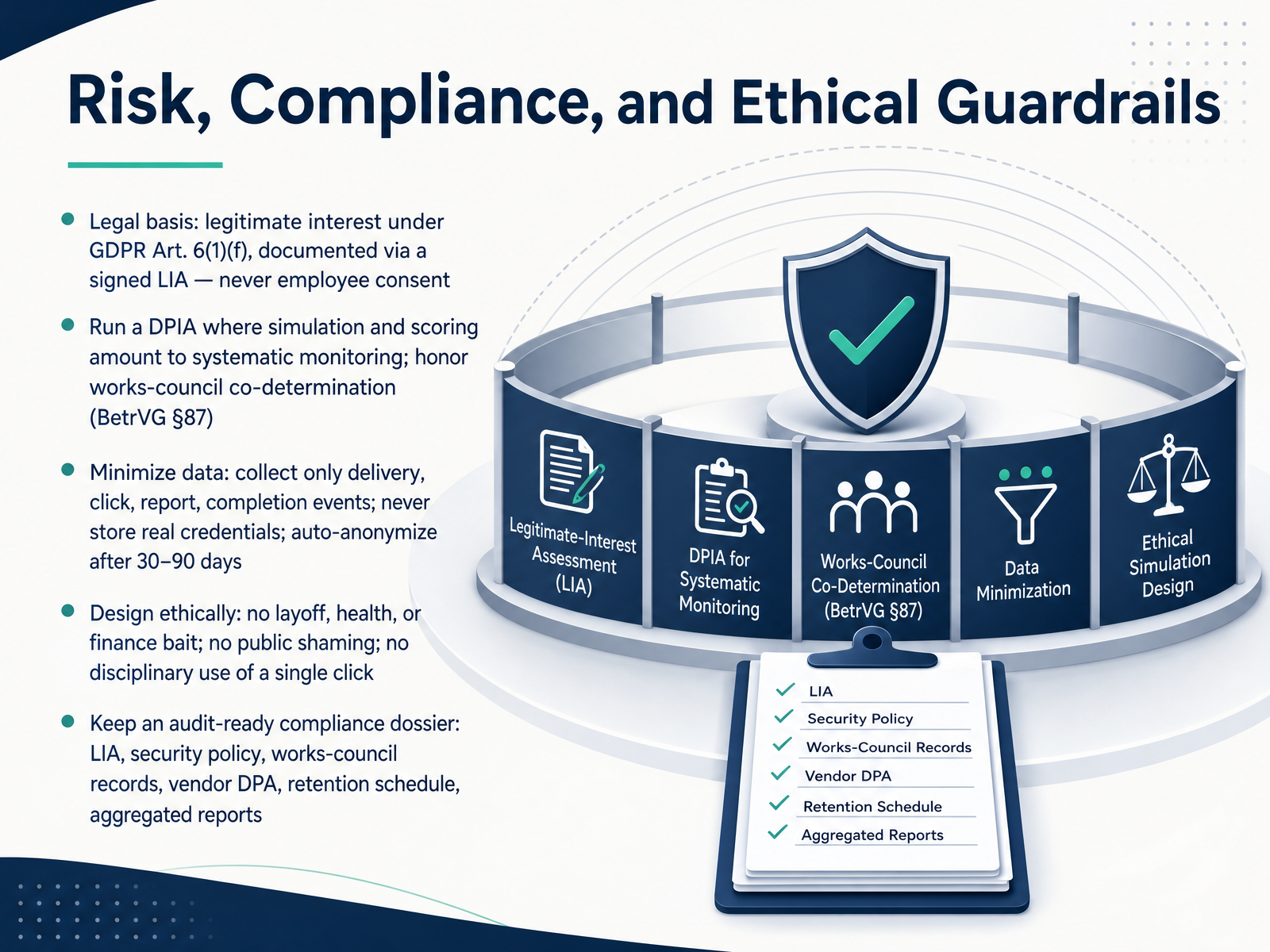
2 min - 11Risk, Compliance, and Ethical GuardrailsLet's move to risk, compliance, and ethical guardrails, because these decide whether your program survives an audit. First, legal basis. Under GDPR, run phishing simulations on legitimate interest, Article six, paragraph one, section f, documented with a signed Legitimate Interest Assessment. Never use employee consent. The power imbalance makes it invalid, and warning people kills the test. Second, run a DPIA where simulation and scoring amount to systematic monitoring, and honor works council co-determination, such as BetrVG section eighty-seven. Third, minimize data. Collect only delivery, click, report, and completion events. Never store real credentials, and auto-anonymize after thirty to ninety days. Fourth, design ethically. No layoff, health, or finance bait. No public shaming. No disciplinary use of a single click. Fifth, keep an audit-ready dossier: your LIA, security policy, works council records, vendor data processing agreement, retention schedule, and aggregated reports. Next, we'll see how this plays out across three organization types, with Case Walkthroughs: Small Regulated Firm, Global Enterprise, Education and Nonprofit.
 palomarr.combaitandphish.comungm.org+22 min
 - 12Case Walkthroughs: Small Regulated Firm, Global Enterprise, Education and NonprofitNow let's ground all of this in real deployments. Three profiles tell the story.
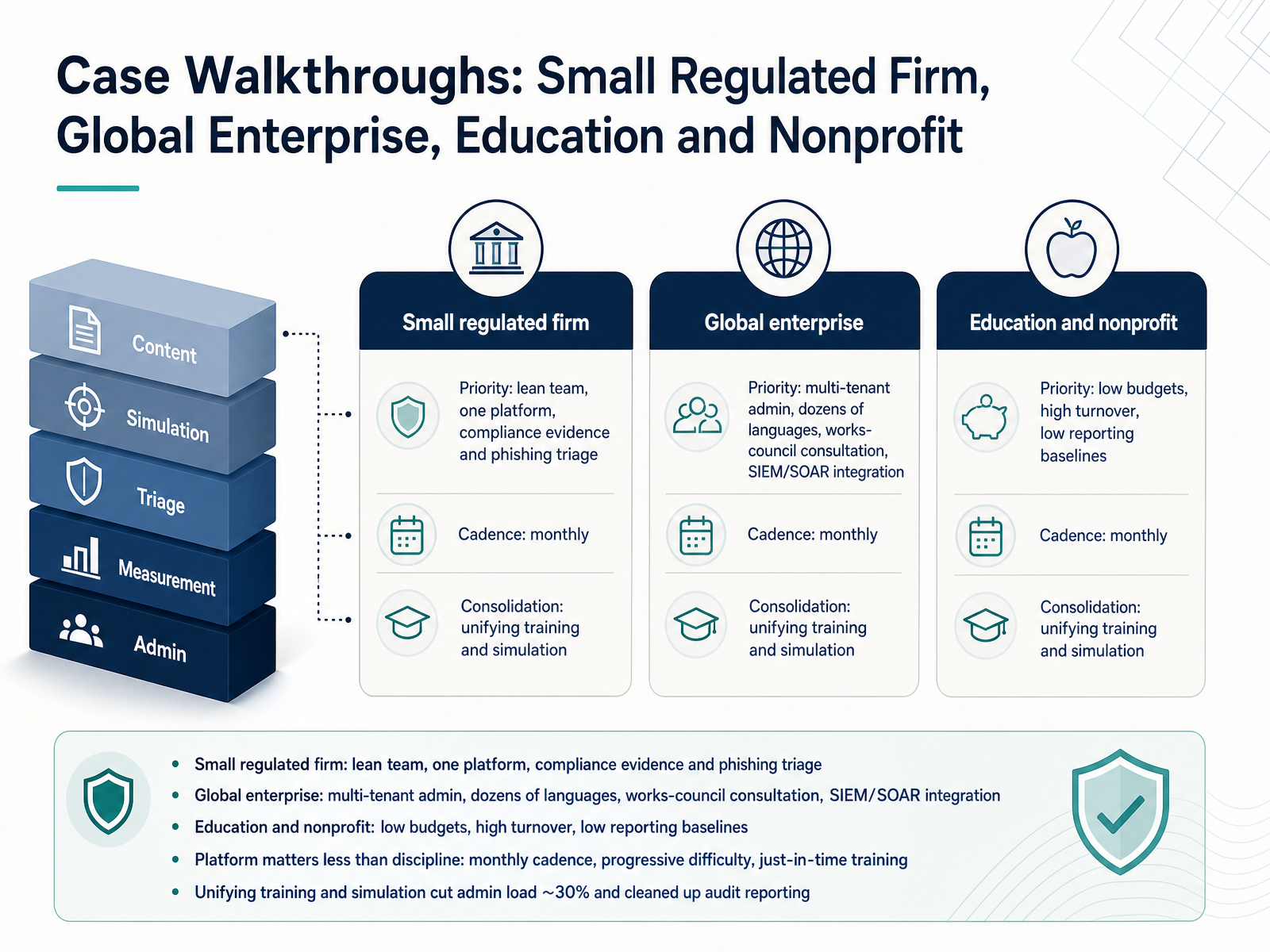
First, a small regulated firm. Lean team, likely one person wearing three hats. They need one platform that produces compliance evidence and handles phishing triage, because they cannot staff a separate reporting tool.
Second, a global enterprise. Here you are managing multiple tenants, dozens of languages, and in some regions, works council consultation before you can even run a simulation. SIEM and SOAR integration is not optional, because reported phish must flow into the systems your analysts already use. If human risk signals sit in a vendor dashboard nobody opens, they are wasted.
Third, education and nonprofit. Low budgets, high turnover, and low reporting baselines. Reporting rates often start in the five to ten percent range. Progress here is about reducing friction and acknowledging every report, not buying the biggest suite.
Notice what these three share. The platform matters less than the discipline. Monthly cadence. Progressive difficulty so people do not just memorize templates. Just-in-time training the moment someone clicks. One organization found that unifying training and simulation cut admin load by roughly thirty percent and cleaned up audit reporting at the same time.
So before you commit, ask your vendors two questions. How much manual work does my team absorb per month, and what does your audit export actually contain?
That sets up your final step. Your Takeaway Toolkit and 30/60/90-Day Action Plan.
 2 min
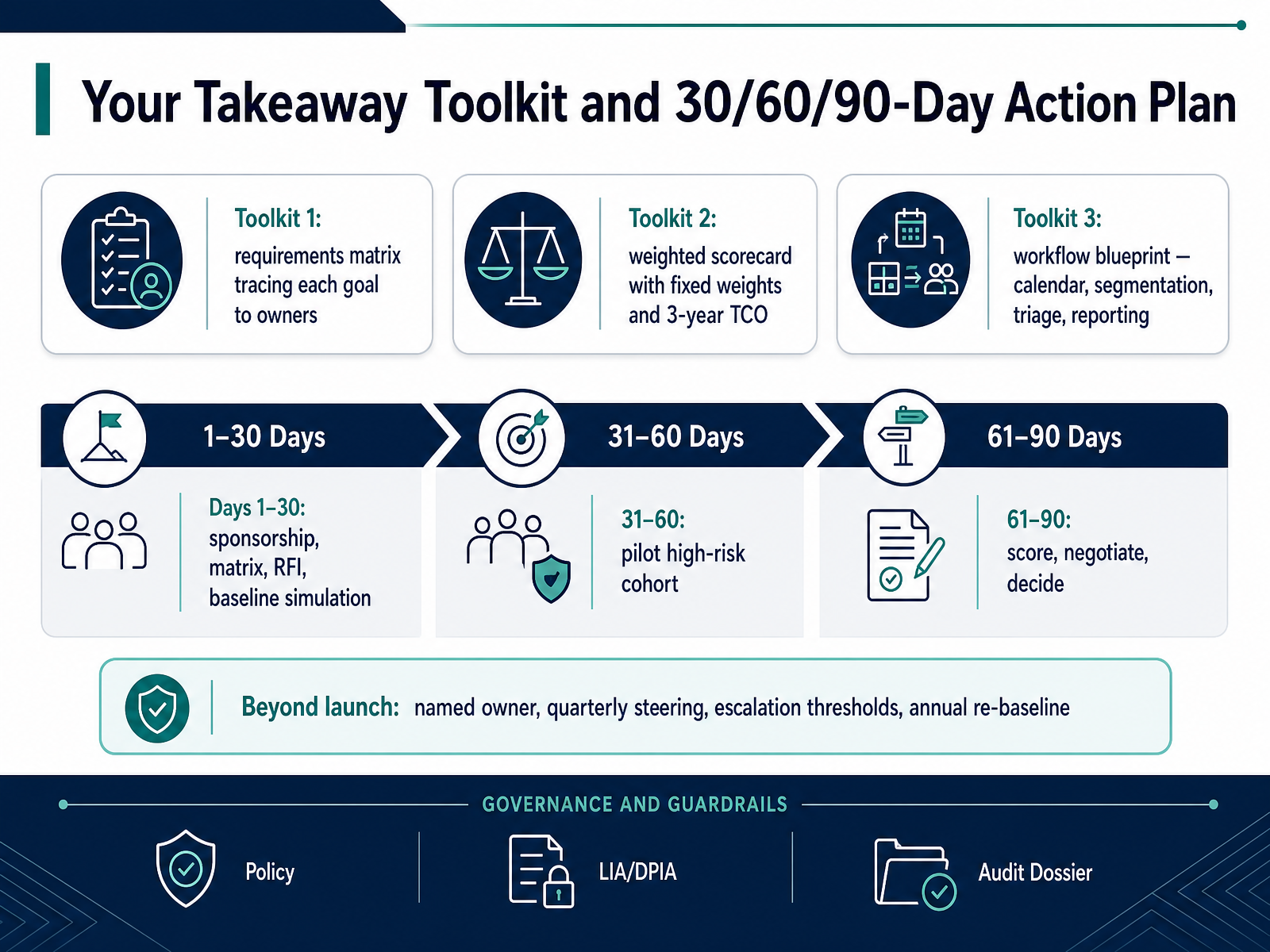
2 min - 13Your Takeaway Toolkit and 30/60/90-Day Action PlanLet's close by turning all of this into something you can actually run. Three toolkit items. First, a requirements matrix that traces every goal to a named owner, so nothing quietly falls through. Second, a weighted scorecard with weights fixed before the first demo, plus a three-year total cost of ownership. Third, a workflow blueprint covering calendar, segmentation, triage, and reporting. For timing, days one to thirty go to sponsorship, the matrix, your RFI, and a baseline simulation. Days thirty-one to sixty, pilot with a high-risk cohort, ideally one hundred to two hundred people, not IT. Days sixty-one to ninety, score, negotiate, and decide. Beyond launch, lock in a named owner, quarterly steering, escalation thresholds, and an annual re-baseline. Those four habits are what keep the program from drifting back into a compliance checkbox. That's the course. Thank you for working through it with me. Pick one toolkit, start it this week, and you'll walk into your next steering meeting with evidence instead of opinion.
 adaptivesecurity.comcyberaware.comsmartfense.com+22 min
Take the deck with you
Download this course as a file — free, no sign-up needed.
- PDF handoutEvery slide page, ready to print or share.14 pages · 3.5 MBDownload
- Narrated PowerPointThe deck that presents itself — every slide carries the digital human's narration video.14 pages · 15.2 MBDownload
- PowerPoint slidesThe full deck as a .pptx — open it in PowerPoint, Keynote, or Google Slides.14 pages · 3.4 MBDownload
Free to use in your own training — please keep the PersonWise credit page at the end.
Have your own deck? Turn it into a course
Sources consulted
Web sources consulted while building this course.
- The Evolution of Human Risk Management (HRM) Across Cybersecurity — softwareanalyst.substack.com
- Security Awareness Training Market Size & Share Analysis - Growth Trends and Forecast (2026 - 2031) — mordorintelligence.com
- Automated Security Awareness Platform Market by Component, End User, Organization Size, Deployment Mode, Industry Vertical - Global Forecast 2026-2032 — giiresearch.com
- HUMAN RISK — assets.mimecast.com
- SANS 2026 Security Awareness & Culture Report — sans.org
- Best Security Awareness Training Platforms 2026: KnowBe4 vs Proofpoint vs More — eastbaycyber.com
- Security Awareness Training Tools Compared (2026) — defend.network
- 15 Security Awareness & HRM Platforms Compared | RansomLeak — ransomleak.com
- 10 security awareness platforms compared for 2026 — usecure.io
- Top KnowBe4 Competitors (2026): Enterprise Security Awareness Platforms Compared - Hoxhunt — hoxhunt.com
- Security awareness and training RFP template and vendor questions | Palomarr — palomarr.com
- Phishing Simulation RFP Template (Free, Copy-and-Paste) | Bait & Phish — baitandphish.com
- PHISHING SIMULATION AND SECURITY AWARENESS TRAINING PLATFORM — ungm.org
- Project: Request for Quotes (“RFQ”) for Security Awareness Training and Automated Phish Response Management Software as a Service (“SaaS”) — massschoolbuildings.org
- CUSTOMER NAME Security Awareness Education Request for Proposal — levelblue.com
- Security Awareness Training Platform Evaluation Checklist: 7 Criteria to Compare and Choose With Confidence | Adaptive Security — adaptivesecurity.com
- Evaluate a Security Awareness Vendor: 2026 Procurement ... — cyberaware.com
- Security awareness platform: a CISO decision framework — smartfense.com
- Security Awareness Training RFI/RFP questionnaire — 0-Doubt — 0doubt.ai
- Buyer's Guide: Security Awareness Training | CIOPages Buyer Guide — ciopages.com