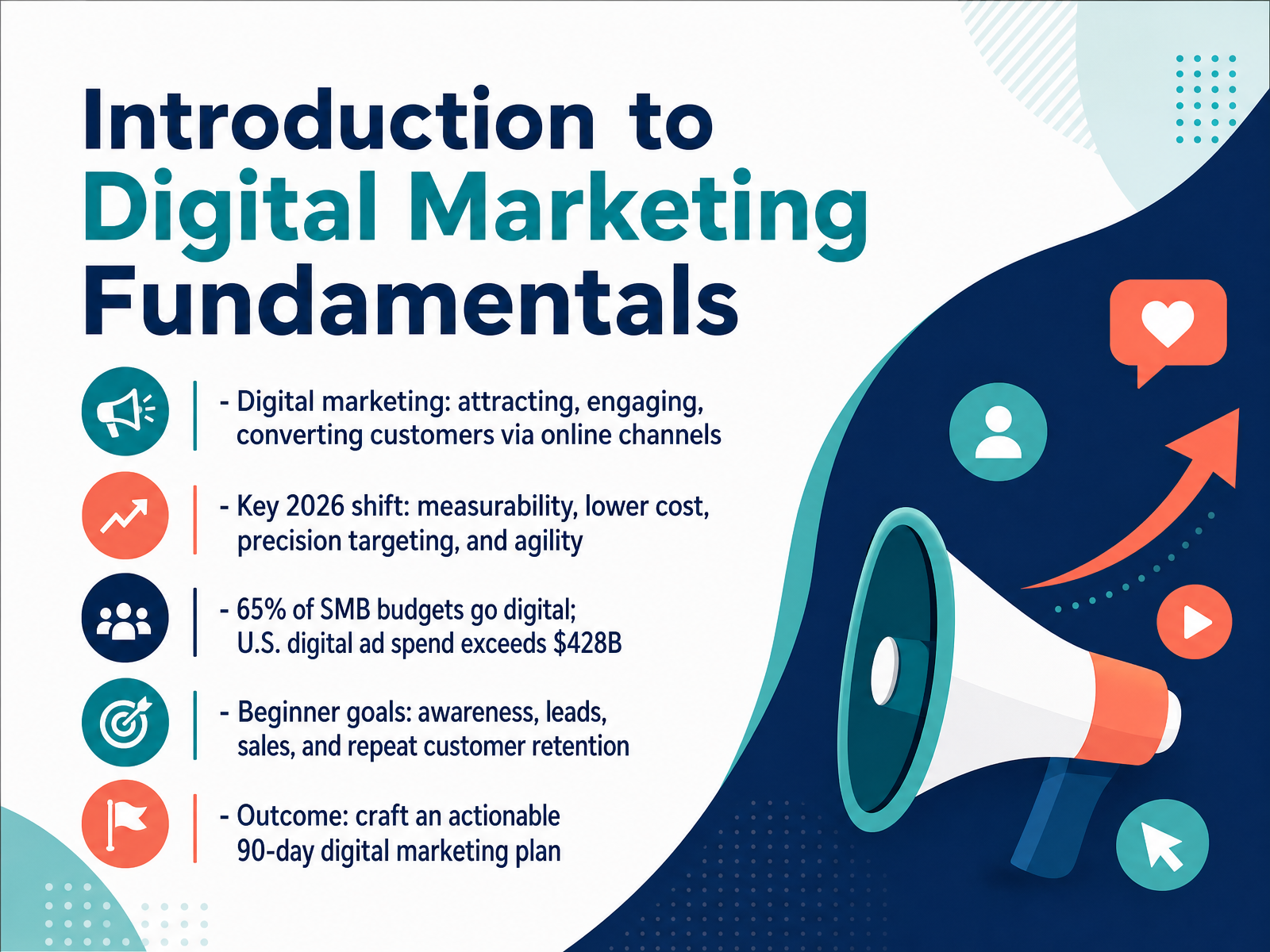
Digital Marketing Fundamentals
Begin
14 pages · ~28 min
Digital Marketing Fundamentals
This training introduces the core concepts of digital marketing, including key channels and strategies, for beginners seeking a foundational understanding to apply in real-world scenarios.
What you’ll learn
- 01Introduction to Digital Marketing FundamentalsWelcome. This course is all about digital marketing fundamentals, and I'm glad you're here. Whether you're running a small business, launching a startup, or just starting your career, you're in the right place. Think of digital marketing as how you attract, engage, and convert customers online. Here's the exciting part for 2026: it's more measurable and affordable than ever, with precision targeting that lets you reach exactly who you need. That's why sixty-five percent of small business marketing budgets now go to digital channels, and U.S. digital ad spending has topped four hundred twenty-eight billion dollars. For you, this means we'll focus on practical goals: building awareness, generating leads, driving sales, and keeping customers coming back. By the end, you won't just have theory. You'll walk away with an actionable ninety-day digital marketing plan you can start using immediately. Let's begin by exploring the modern digital marketing ecosystem.localiq.comrevenuememo.comlocaliq.com+22 min
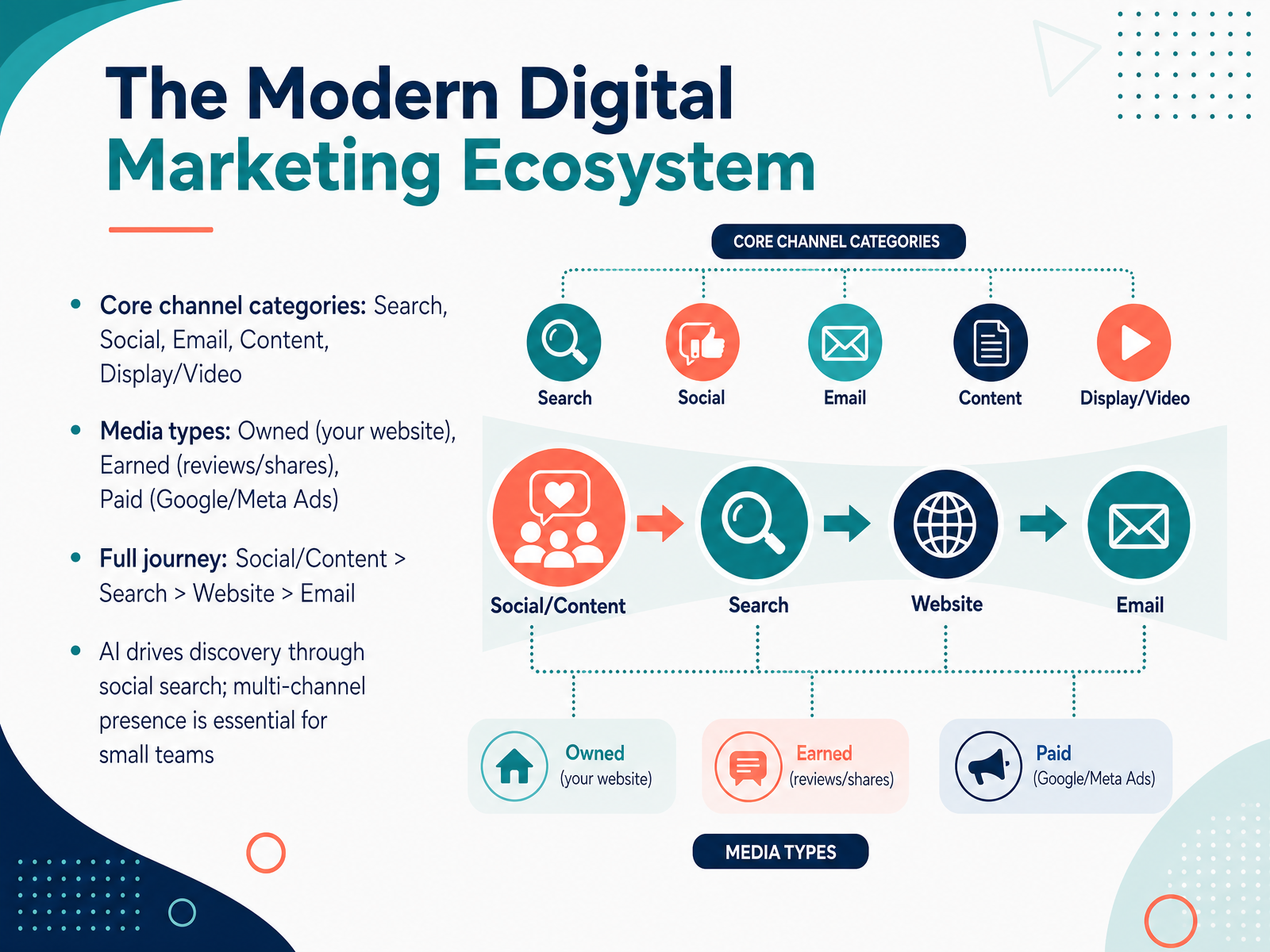
- 02The Modern Digital Marketing EcosystemAlright, let's map out the whole playing field. Think of the digital marketing ecosystem as a handful of core channels, each with a specific job. We have Search, which is Google; Social platforms like Facebook and Instagram; Email; Content; and Display or Video ads. Now, within these channels, you have three types of media. First, 'Owned' media is your turf: your website, your email list. You control it completely. Second, 'Earned' media is word-of-mouth: those glowing reviews and shares you get from happy customers. And third, 'Paid' media is what you rent, like Google or Meta ads. Understanding how they connect is the real secret. A typical journey looks like this: someone discovers you through a social post or your content, then they search for you, land on your website, and finally, sign up for your email list. With AI increasingly driving discovery through social search, being present on multiple channels, even with a small team, isn't a luxury—it's essential. You don't have to be everywhere, but you do need a few connected dots. Keeping that full journey in mind, let's get specific about who you're talking to and what you want them to do as we move into Your Audience and SMART Goal Setting.
 localiq.comrevenuememo.comlocaliq.com+22 min
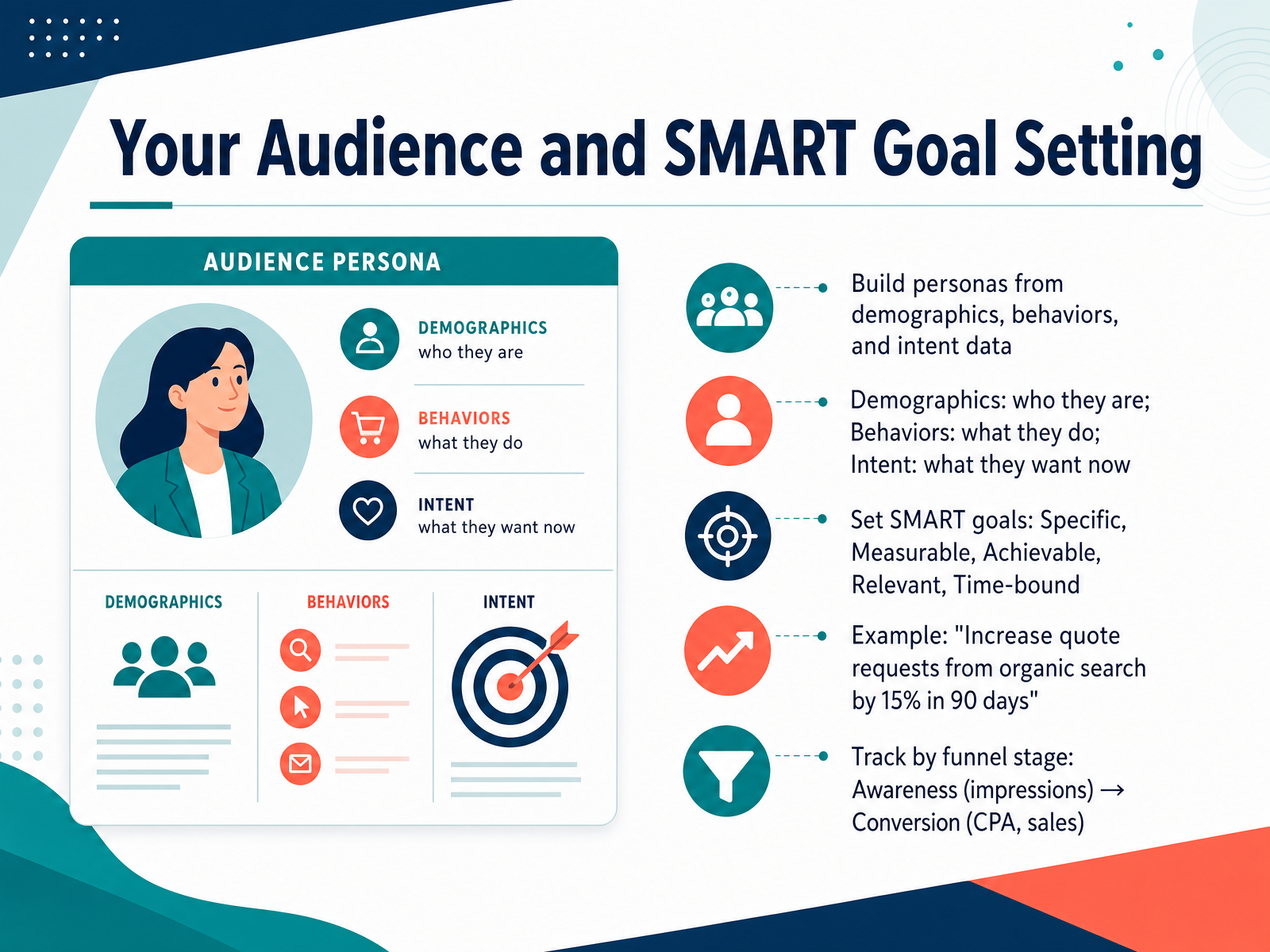
 - 03Your Audience and SMART Goal SettingNow, let's get practical: who are you talking to, and what does success look like? First, think about your audience as a small set of personas. Look at three layers. Demographics tell you who they are—like a local parent or a busy student. Behaviors reveal what they do—maybe they search on mobile late at night. And intent data shows what they want right now—a quick fix, not a long sales pitch. Once you know your person, set a S M A R T goal. That stands for Specific, Measurable, Achievable, Relevant, and Time-bound. For example, instead of saying 'get more leads,' try: 'Increase quote requests from organic search by fifteen percent in ninety days.' That gives you a finish line. Then, track progress by funnel stage. At the awareness stage, watch impressions. At the conversion stage, track your cost per acquisition and actual sales. To make this real, focus your energy where small businesses win—unpaid social media and email. Nearly seventy percent of S M Bs expect social media to deliver the most value this year. A clear goal and a focused channel beat guessing every time. Next, we'll build your website and S E O essentials.
 localiq.comrevenuememo.comlocaliq.com+22 min
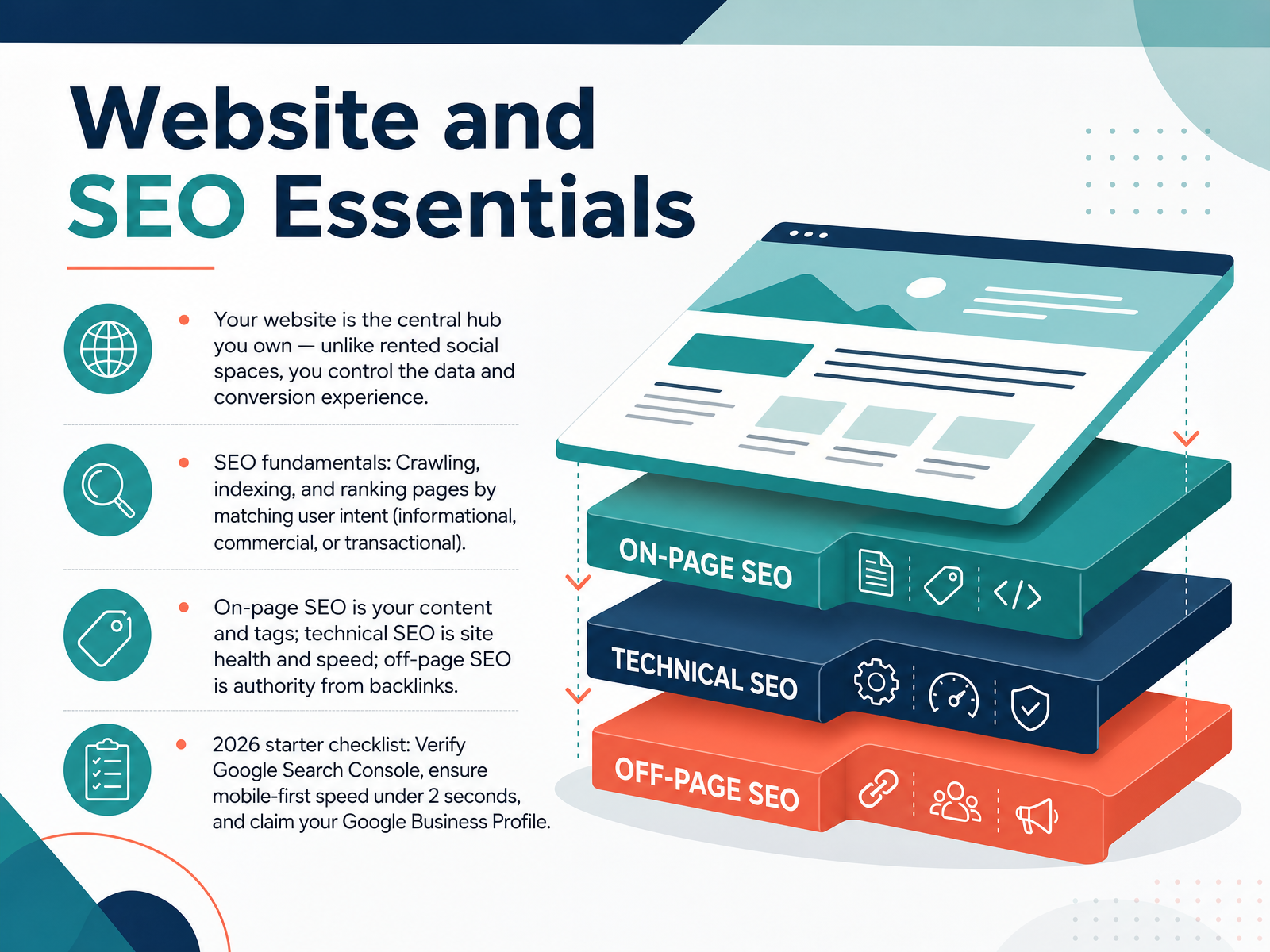
 - 04Website and SEO EssentialsNow, let's talk about your website and the basics of SEO. Think of your website as your digital home base. Unlike social media platforms you rent, you own this space completely. You control the experience and the data, which is powerful. SEO, or search engine optimization, is simply how you help the right customers find that home base. It's a three-part process: crawling, where search engines discover your pages; indexing, where they file those pages away; and ranking, where they decide who shows up first based on user intent. That intent is usually to learn something, compare options, or to buy. We break this work down into three buckets. On-page SEO is what your visitors see, like your words and page titles. Technical SEO is the health underneath, like how fast your site loads. Off-page SEO is your reputation, built through backlinks from other sites. For a quick-start checklist right now, focus on three high-impact wins. First, verify your site with Google Search Console. It's free and tells you how Google sees you. Second, ensure your site loads in under two seconds on mobile. Speed is a direct trust signal. Third, claim your Google Business Profile. A complete profile can double your chances of being seen as a trusted business. These simple steps build a strong foundation. Next up, we'll build on this base to talk about Content Marketing That Performs.
 blog.theseoengine.comsearchpirates.comrabbitseo.com+22 min
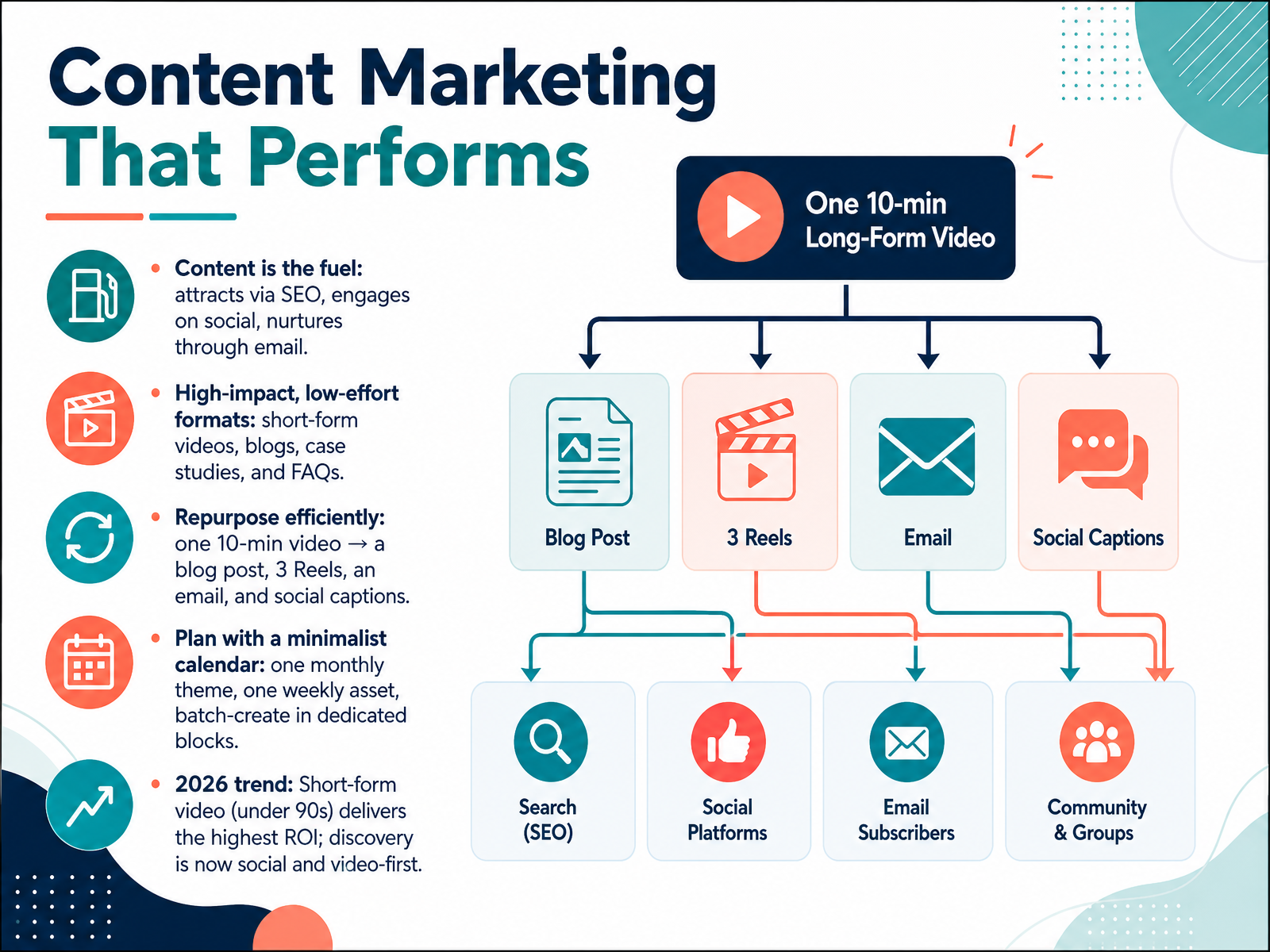
 - 05Content Marketing That PerformsLet's talk about content marketing that actually performs. Think of content as the fuel for your entire digital engine. It helps people find you through search, connects with them on social media, and nurtures relationships over email. The good news? You don't need a huge budget or a film crew. High-impact formats like short videos, simple how-to blogs, customer case studies, and FAQ pages can do a lot of heavy lifting. Here's a smart trick: work once, publish everywhere. That one ten-minute video you recorded on your phone can become a blog post, three short Reels, an email, and several social captions. To stay sane, use a minimalist calendar. Pick one monthly theme and create one core asset per week. Batch-record everything in one dedicated block of time. For twenty twenty-six, short-form video under ninety seconds is your highest-ROI tool. Discovery is now social and video-first, so the algorithm will bring new customers right to your feed. Your takeaway is to repurpose relentlessly and start with video. Up next, we'll look at social media marketing and how to choose and create for the right channels.
 localiq.comrevenuememo.comlocaliq.com+22 min
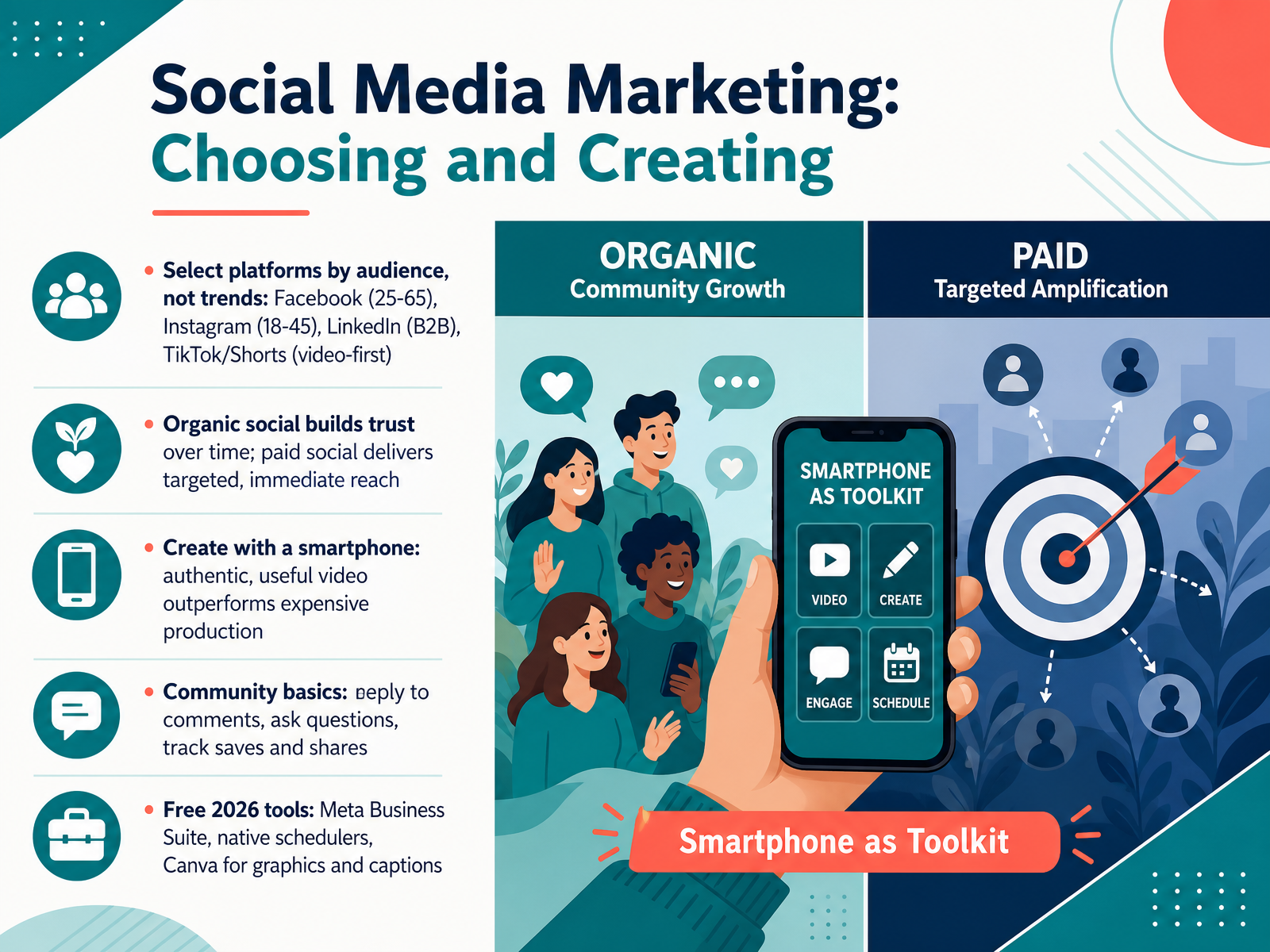
 - 06Social Media Marketing: Choosing and CreatingSocial media can feel overwhelming, but it really comes down to two simple decisions: where to show up, and what to create. Let's start with choosing your platform. Forget chasing trends. Go where your actual customers are. Think of Facebook as the community hub, strongest with audiences roughly twenty-five to sixty-five. Instagram is your visual storefront for the eighteen to forty-five crowd. LinkedIn is your professional handshake for business-to-business relationships. And TikTok or YouTube Shorts are where you capture attention fast with video. Pick one or two and do them well. Now, what do you post? You don't need a fancy studio. Your smartphone is your best tool. Authentic, helpful video filmed in good light beats an expensive ad almost every time. And here's the rhythm of it: organic posts build real trust over the long haul, while a small paid boost gets you in front of new people fast. Never forget the social part. This is community, not a billboard. So reply to every comment, ask questions in your captions, and pay attention to saves and shares over just likes. That's the real engagement signal. Finally, you've got free tools to pull this all together: use the Meta Business Suite to schedule, your platform's native planner, and Canva to make everything look polished. So, find your people, start creating with your phone, and treat every comment like a conversation. Up next, we'll talk about how to keep those conversations going with email marketing and lead nurturing.
 localiq.comrevenuememo.comlocaliq.com+22 min
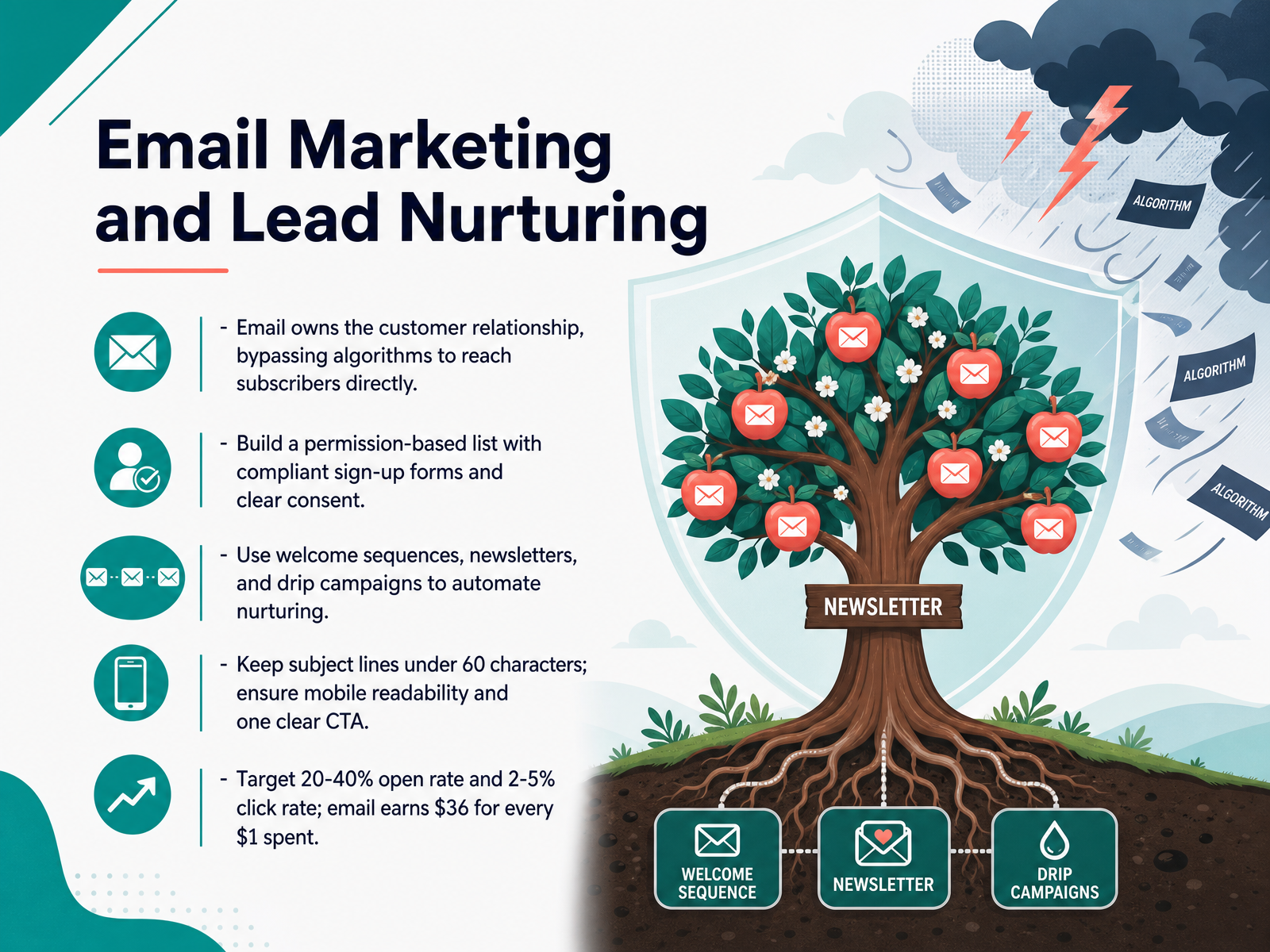
 - 07Email Marketing and Lead NurturingNow, let's talk about a channel you truly own: email. Unlike social media, where an algorithm decides who sees your post, email lands directly in your subscriber's inbox. It's a direct line, and it’s incredibly efficient—on average, it earns back thirty-six dollars for every single dollar you spend. But this only works if you build your list the right way, with permission. Make sure you use a sign-up form where people clearly agree to hear from you. Once they're in, don't just let them sit there. Set up a simple welcome sequence to say hello, send a helpful newsletter now and then, and use automated drip campaigns to nurture them over time. When you sit down to write, keep your subject line short—under sixty characters—and make sure it looks great on a phone. Most importantly, every email should have one clear call to action. Don't ask them to do five things; just ask them to do one. A healthy goal is a twenty to forty percent open rate and a two to five percent click rate. This all sounds technical, but it boils down to having a real conversation at scale. Next up, we're going to shift gears and look at paid channels with an introduction to paid advertising.
 localiq.comrevenuememo.comlocaliq.com+22 min
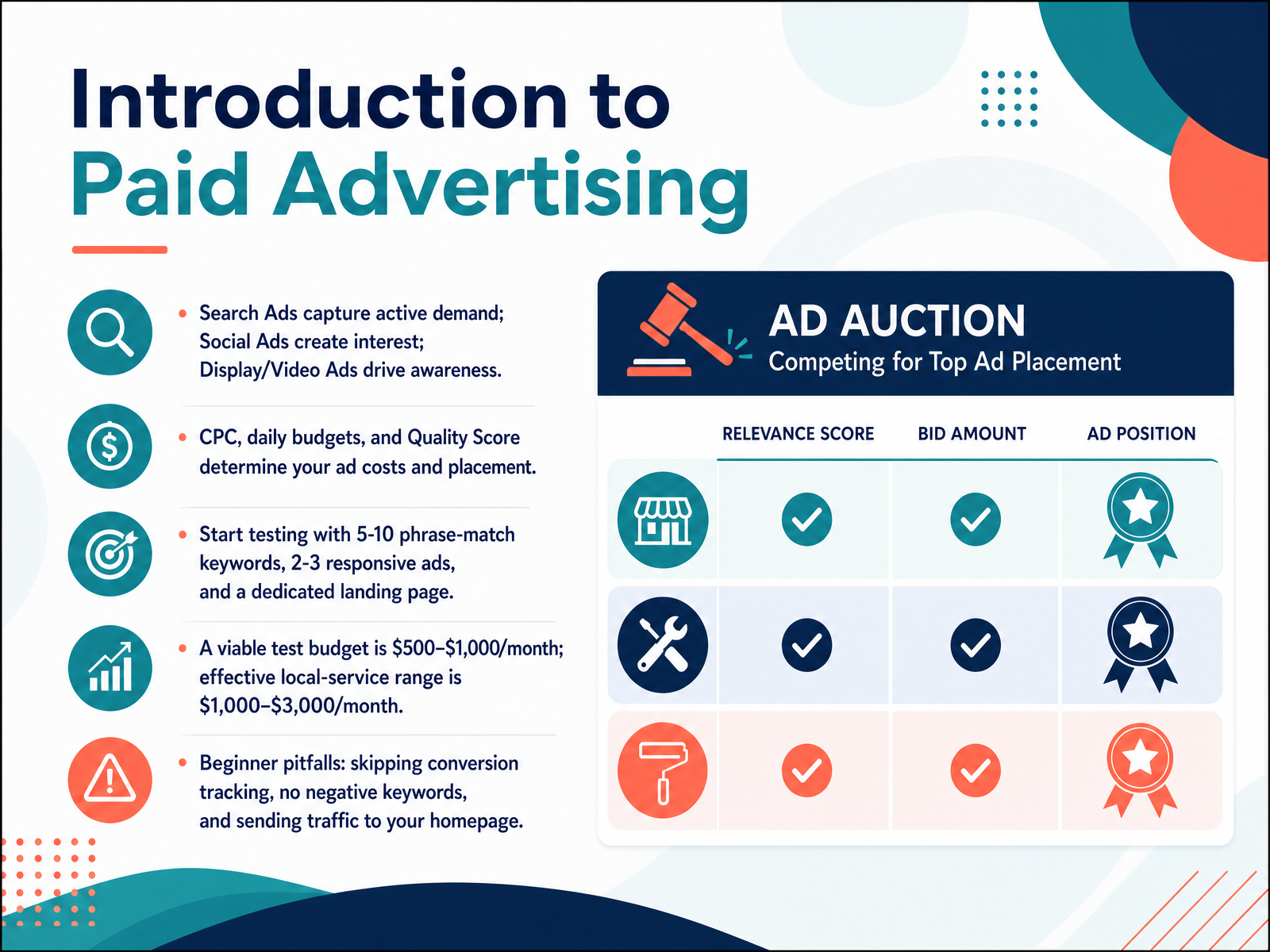
 - 08Introduction to Paid AdvertisingNow let's talk about where the rubber meets the road: paid advertising. To keep things simple, I want you to think about ads in three buckets. First, search ads capture active demand. This is someone searching for 'emergency plumber' right now. Second, social ads create interest. You're putting your message in front of people who match your ideal customer profile but aren't searching yet. Third, display and video ads drive awareness, keeping you top of mind. Your costs depend on three levers: your cost-per-click, your daily budget, and a thing called Quality Score, which is basically Google's rating of how relevant your ad is. A higher score actually gets you a discount. For your first test, don't overcomplicate it. Start with five to ten tightly-themed, phrase-match keywords, and write two or three responsive ads. Point every single click at a dedicated, simple landing page, not your homepage. The homepage is where good ad money goes to die. Realistically, a viable test budget is about five hundred to one thousand dollars a month, while effective local service campaigns often run in the one thousand to three thousand range. Watch out for the three biggest beginner traps: skipping conversion tracking so you're flying blind, forgetting to add negative keywords like 'free' or 'DIY' that waste your budget, and sending traffic to a cluttered homepage. Next, we're going deeper into how this works on the two main platforms: Google and Meta.
 novapixeldev.comadlibrary.comadbot.ai+22 min
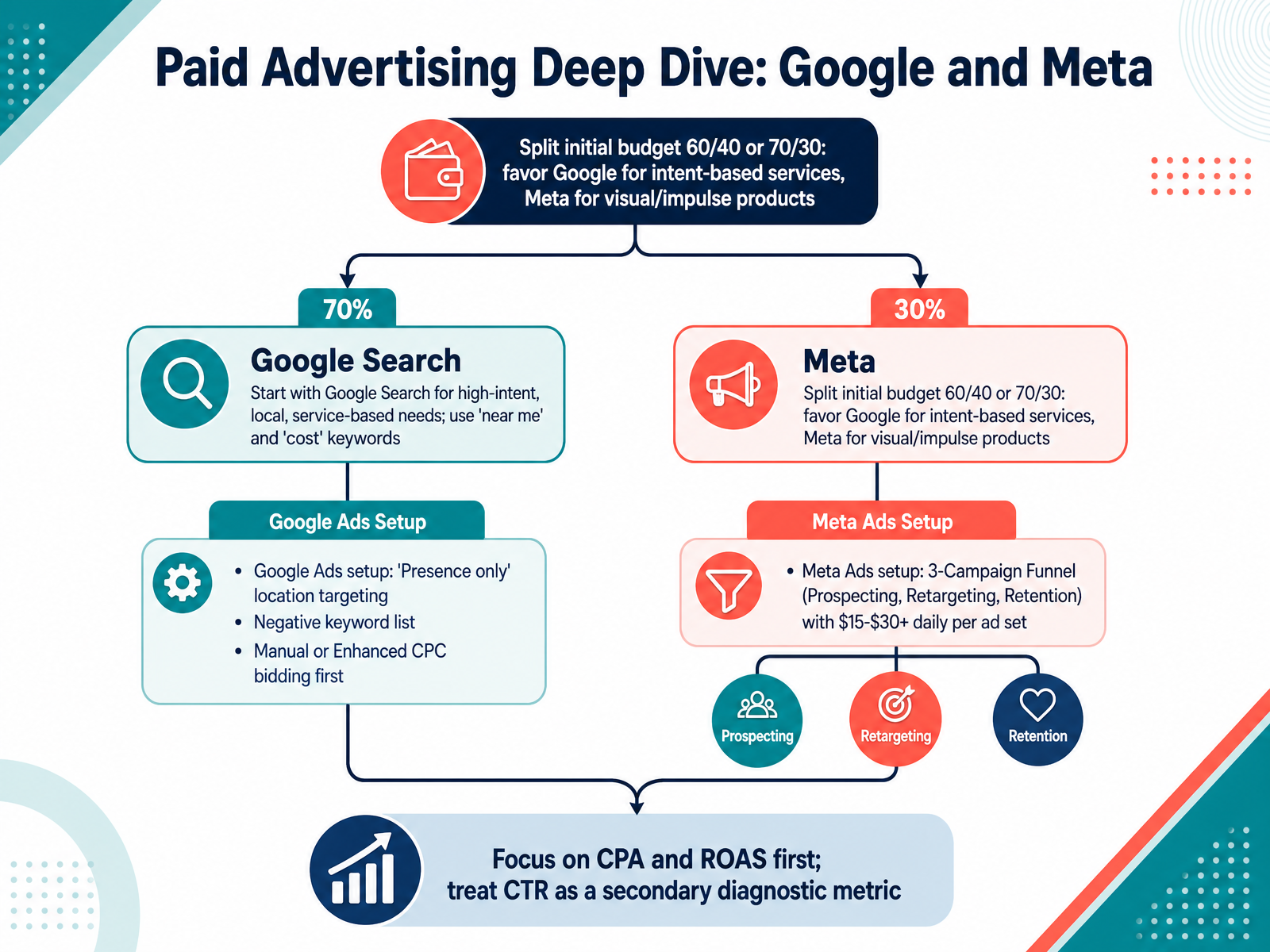
 - 09Paid Advertising Deep Dive: Google and MetaNow let's get practical with paid advertising on the two platforms that matter most: Google and Meta. Think of Google as capturing demand. Someone searches 'plumber near me' or 'best price running shoes', and your ad appears. That's high-intent. Meta, on the other hand, creates demand. You interrupt someone scrolling with an eye-catching video or image. For a small budget, start with a sixty-forty or seventy-thirty split. Favor Google if you offer intent-based services. Favor Meta for visual or impulse products. On Google, set your location targeting to 'presence only' so only people physically in your area see your ads. Build a negative keyword list right away to block waste, and start with Manual or Enhanced C P C bidding. On Meta, use a simple three-campaign funnel: one for prospecting new customers, one for retargeting visitors, and one for retention. Plan for at least fifteen to thirty dollars a day per ad set to give the algorithm enough data. Most importantly, focus on your cost per acquisition and return on ad spend first. Click-through rate is just a secondary health check, not the main goal. Next, we'll build on these metrics in our session on Measuring and Analyzing Performance.
 novapixeldev.comadlibrary.comadbot.ai+22 min
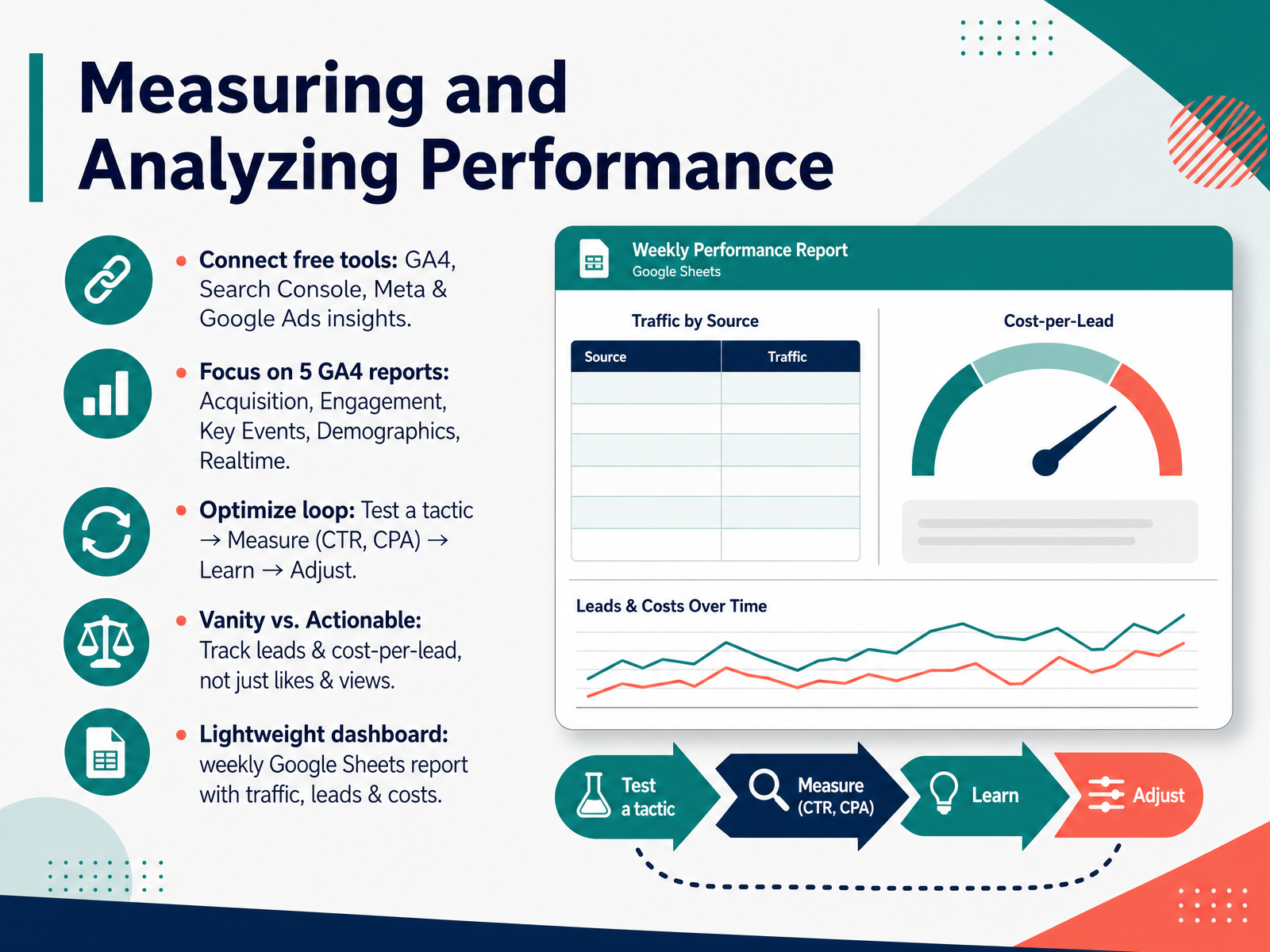
 - 10Measuring and Analyzing PerformanceAlright, let's talk about measuring your success without getting overwhelmed. First, connect the free tools you need: Google Analytics 4, Search Console, and your ad platform insights. These are your nerve center. Once that's done, don't get lost in a million reports. Focus on just five in GA4: Acquisition to see where visitors come from, Engagement to see what they do, Key Events for your leads, Demographics, and the real-time report to confirm everything is actually working. Here's the real secret: adopt a test, measure, learn loop. Pick one small marketing tactic, then check its click-through rate or cost per acquisition. Learn from the numbers and adjust. And please, ignore vanity metrics. A thousand likes feel good, but a low cost per lead pays the bills. Track the actions that generate profit. Finally, don't overcomplicate things. Build a lightweight weekly dashboard in a simple spreadsheet with just three columns: traffic, leads, and ad costs. That one habit will transform your confidence. Now, metrics are only powerful when people can find you. Let's explore how to design your content for AI-driven discovery.
 faststrat.aigrowthjunction.agencyad2place-digital.net+22 min
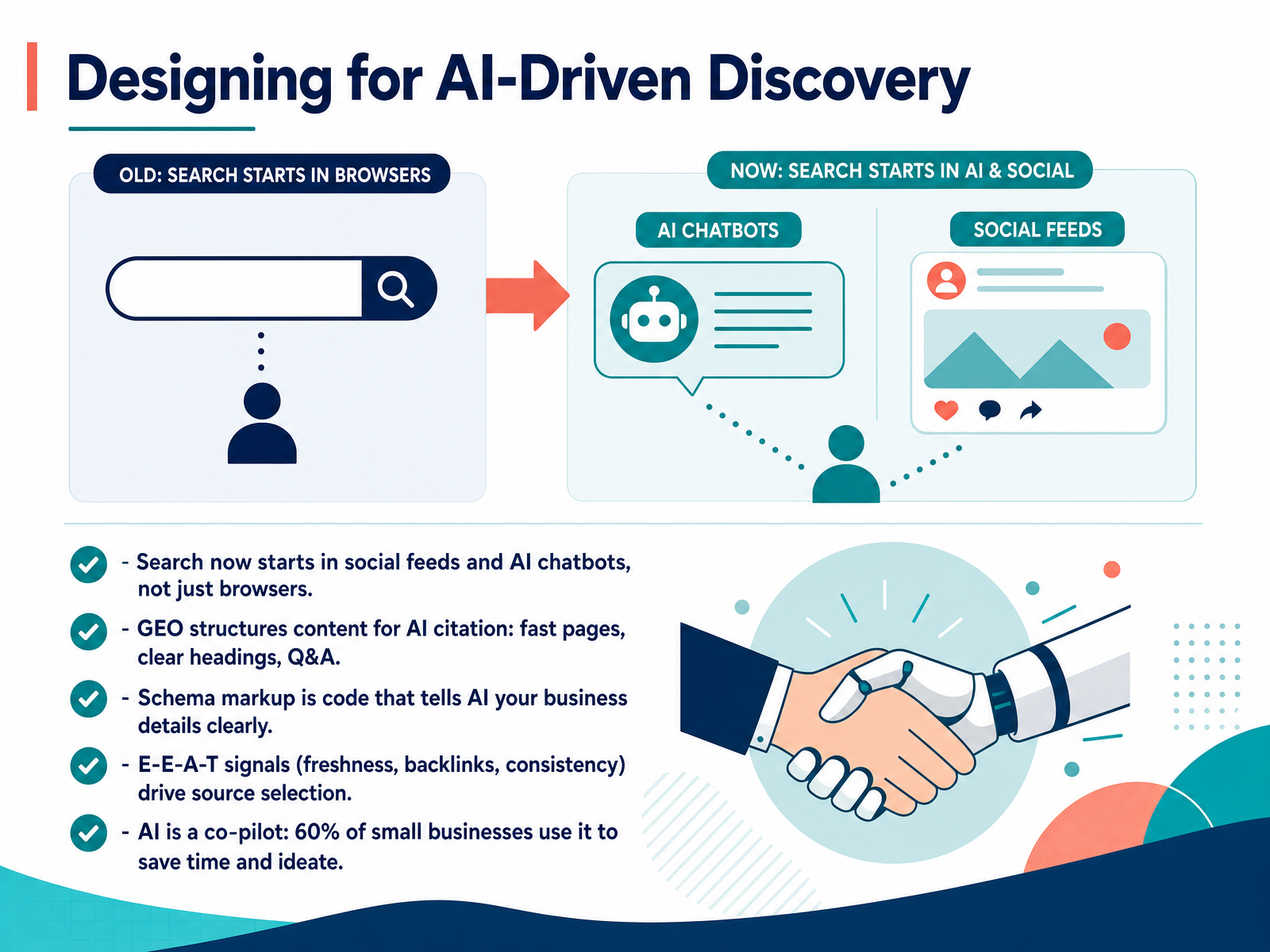
 - 11Designing for AI-Driven DiscoveryNow, let’s talk about designing your content so AI can actually find and cite it. Search no longer starts only in a browser. It begins inside social feeds, and more and more, inside AI chatbots like ChatGPT and Gemini. That shift matters. We structure our content differently for what’s now called generative engine optimization, or G E O. Think fast pages, clear headings, and direct question-and-answer formats. One piece of code helps enormously: schema markup. Schema is simply a behind-the-scenes label that tells AI your business name, address, and phone number in a language it understands instantly. It’s easier to add than you might think, and most small business sites still don’t use it, so doing this puts you ahead. AI also cares about trust signals: things like freshness, backlinks, and consistent business details across the web. Those are all part of what Google calls E E A T signals. The good news? You don’t have to master this alone. Right now, sixty percent of small businesses already use AI as a co-pilot to save time and spark ideas. Use it to brainstorm clear Q and A headings, or to check your schema markup, not to replace your voice, but to clear the path so your expertise shines through. Next up, we’ll explore what AI-powered marketing looks like for small teams.
 localiq.comrevenuememo.comlocaliq.com+22 min
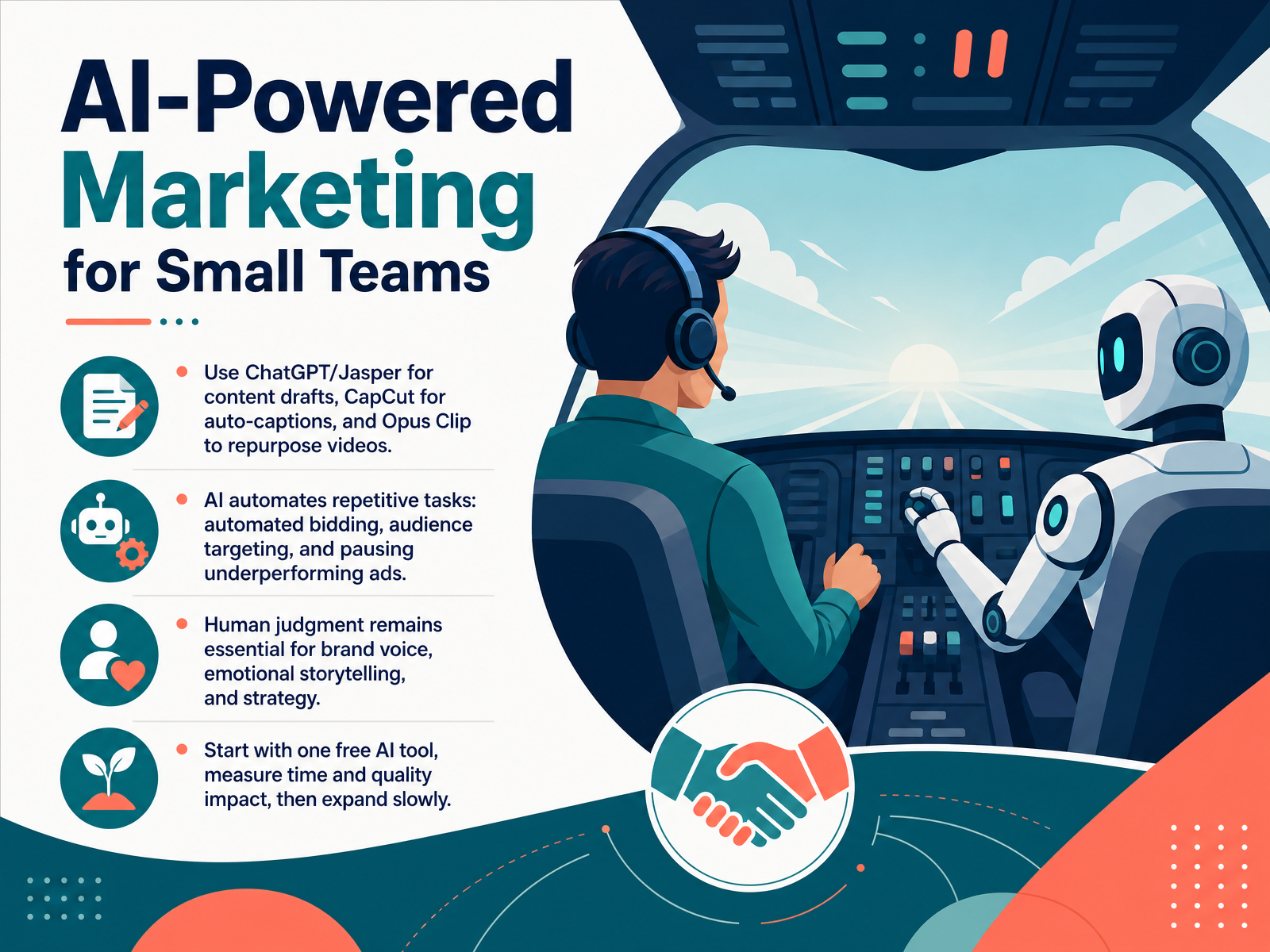
 - 12AI-Powered Marketing for Small TeamsNow, let's talk about one of the most practical ways to get leverage as a small team. We're diving into AI-powered marketing. I want to demystify this because you don't need a big budget or a technical background. Start by thinking of AI as your tireless assistant. For creating content drafts, tools like ChatGPT and Jasper can help you break through the blank page. Then, tools like CapCut can instantly add professional auto-captions to your videos, and Opus Clip can magically repurpose one long video into a dozen short clips. AI also handles the repetitive money tasks in advertising, like automated bidding, fine-tuning audience targeting, and automatically pausing ads that aren't performing well. But this is crucial: your human judgment is still the boss. AI doesn't understand your unique brand voice, it can't craft a deeply emotional story, and it definitely can't set your big-picture strategy. My practical advice is to pick one free tool first. Use it to save time on a single task, measure the impact on your output, and then expand slowly. The goal is to work smarter, not just faster. Up next, we'll map out the career paths and skills you'll need to put all of this into practice for the future.
 localiq.comrevenuememo.comlocaliq.com+22 min
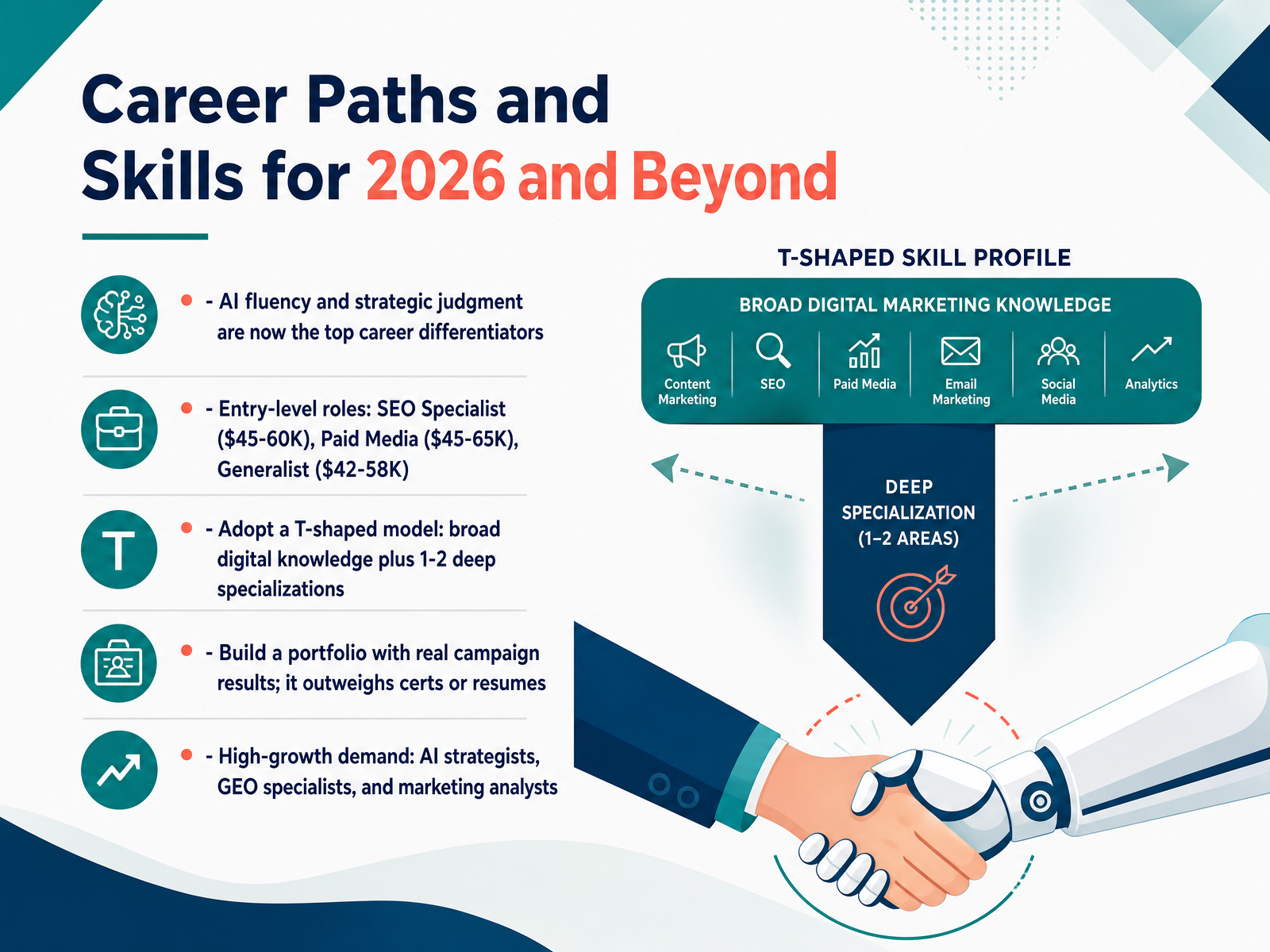
 - 13Career Paths and Skills for 2026 and BeyondLet's look ahead at the career paths and skills that matter most right now. The number one career differentiator in 2026 is actually a pair: AI fluency plus strategic judgment. It's not enough to use the tools. You need to know which levers to pull and why. For entry-level roles, you can expect solid starting pay. An SEO specialist or paid media role typically ranges from forty-five to sixty-five thousand dollars a year. A digital marketing generalist, common at small businesses, starts around forty-two to fifty-eight thousand. But here's the model that gets you hired fast. Adopt a T-shaped approach. Build a broad understanding across all of digital marketing, and then go deep in one or two specializations, like analytics or paid search. And to prove you can do it, build a real portfolio with campaign results. Recruiters now value this over a resume full of certificates. Looking forward, demand is skyrocketing for AI strategists, generative engine optimization specialists, and marketing analysts who can turn data into stories. The future is wide open for those who combine human insight with smart technology. Next, let's turn that insight into action with your ninety-day digital marketing plan.
 localiq.comnovapixeldev.comadlibrary.com+22 min
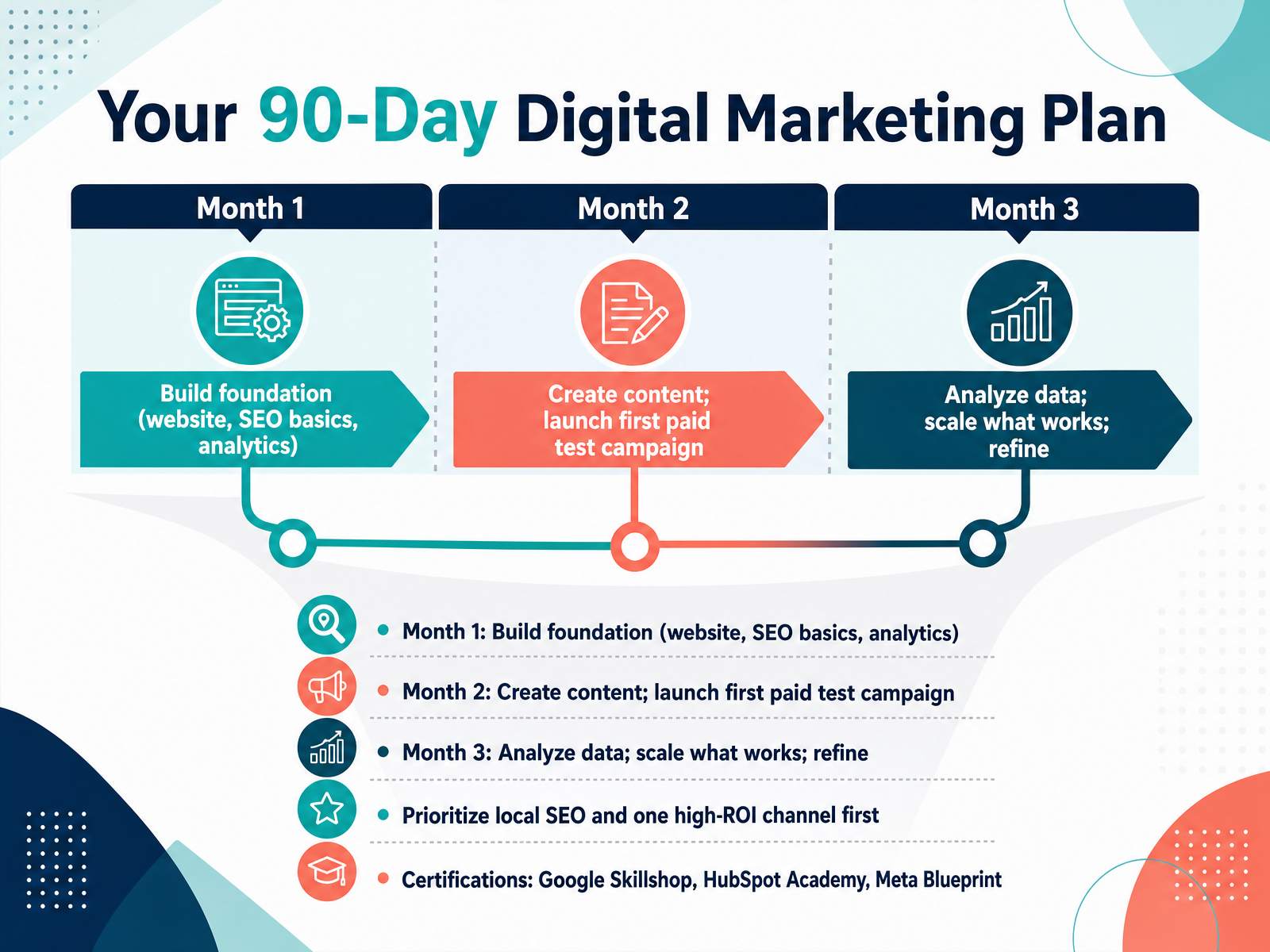
 - 14Your 90-Day Digital Marketing PlanHere we are at your ninety-day plan. This is where everything clicks into place. In month one, focus on the foundation. Build a clean, mobile-friendly website, set up basic SEO, and install analytics. Do not skip the Google Business Profile if you are local. In month two, start creating content and launch one small, paid test campaign on Google or Meta. We are talking fifty dollars, not five hundred. In month three, you become a detective. Analyze the data. Cut what is not working. Put more fuel behind what is. Always prioritize local SEO and one high-ROI channel first, like email or paid search. Once you see results, you can branch out. And please, invest in yourself. Free certifications on Google Skillshop, HubSpot Academy, and Meta Blueprint are how you turn a ninety-day experiment into a real career advantage. You have the exact roadmap to run a business or become a digital marketer. Now go do the work. You have truly got this.
 localiq.comrevenuememo.comlocaliq.com+22 min
Take the deck with you
Download this course as a file — free, no sign-up needed.
- PDF handoutEvery slide page, ready to print or share.15 pages · 3.7 MBDownload
- Narrated PowerPointThe deck that presents itself — every slide carries the digital human's narration video.15 pages · 15.3 MBDownload
- PowerPoint slidesThe full deck as a .pptx — open it in PowerPoint, Keynote, or Google Slides.15 pages · 3.6 MBDownload
Free to use in your own training — please keep the PersonWise credit page at the end.
Have your own deck? Turn it into a course
Sources consulted
Web sources consulted while building this course.
- The Big Small Business Marketing Trends Report for 2026 | LocaliQ — localiq.com
- Marketing statistics for small business in 2026: A comprehensive analysis — revenuememo.com
- 92 Small Business Marketing Stats You Need to Know | LocaliQ — localiq.com
- Small Biz vs 2026 Inflation | Constant Contact — constantcontact.com
- Small Business & Entrepreneurship Council — sbecouncil.org
- Small Business SEO Checklist: 2026 Proven Action Plan — The Seo Engine — blog.theseoengine.com
- SEO Audit Checklist for Small Businesses (2026) — searchpirates.com
- Small Business SEO Checklist | Practical Guide | Rabbit SEO — rabbitseo.com
- SEO for Small Business Websites: 2026 Guide - DreamHost — dreamhost.com
- Small Business SEO: The 2026 Playbook (With Free Audit Tools) | Rankeo — rankeo.io
- Google vs Meta: Where to Spend Your First $1,000 (The Technical Playbook) — Nova Pixel Insights — novapixeldev.com
- Online Advertising for Small Business: 2026 Playbook — adlibrary.com
- Google Ads for Small Business: What Actually Works in 2026 | AdBot — adbot.ai
- Digital advertising for Australian small business: the 2026 guide | Nexiiom — nexiiom.com
- Advertising & PPC for Tiny Teams: What Works When You're Under 20 People | Listicler — listicler.com
- GA4 Setup for Small Businesses in 2026: Step-by-Step Guide (No Agency Needed) - faststrat.ai — faststrat.ai
- GA4 Setup Guide for Small Business 2026 — growthjunction.agency
- Google Analytics 4: The Complete Tutorial for 2026 | Ad2Place Digital — ad2place-digital.net
- Google Analytics Training For Small Businesses and Startups — salesforce.com
- How to Set Up GA4: Complete Business Owner Guide (2026) | Codeble | Codeble — codeble.com.au