Begin
14 pages · ~28 min
Exoplanet Detection Methods
This training provides an overview of exoplanets and the methods used to detect them, teaching learners the key techniques scientists employ to identify planets beyond our solar system.
A digital instructor presents all 14 pages. Hold “Ask” at any point and ask out loud — the answer comes from this course. No sign-up needed.
What you’ll learn
- 01Exoplanets and How We Detect ThemWelcome, everyone. I'm so glad you're here. Today, we're setting off on one of the greatest adventures in modern science: the search for new worlds. We call these distant planets exoplanets. Think of them as cosmic islands, worlds that orbit stars far beyond our own Sun. For a long time, they were only ideas. Early claims came and went, but with time, we learned to confirm them with real evidence. And the result? It's staggering. We have now confirmed more than six thousand of these worlds, with thousands more waiting in line as candidates. So, how do we actually find a planet that is trillions of miles away? That's the question that will guide us today. We're going to explore our four main tools of discovery: the transit method, the radial velocity method, and direct imaging. Each one is a different way of listening to the faint whispers of these distant worlds. Let's begin by laying the foundation.exoplanetarchive.ipac.caltech.eduscience.nasa.govexoplanetarchive.ipac.caltech.edu+22 min
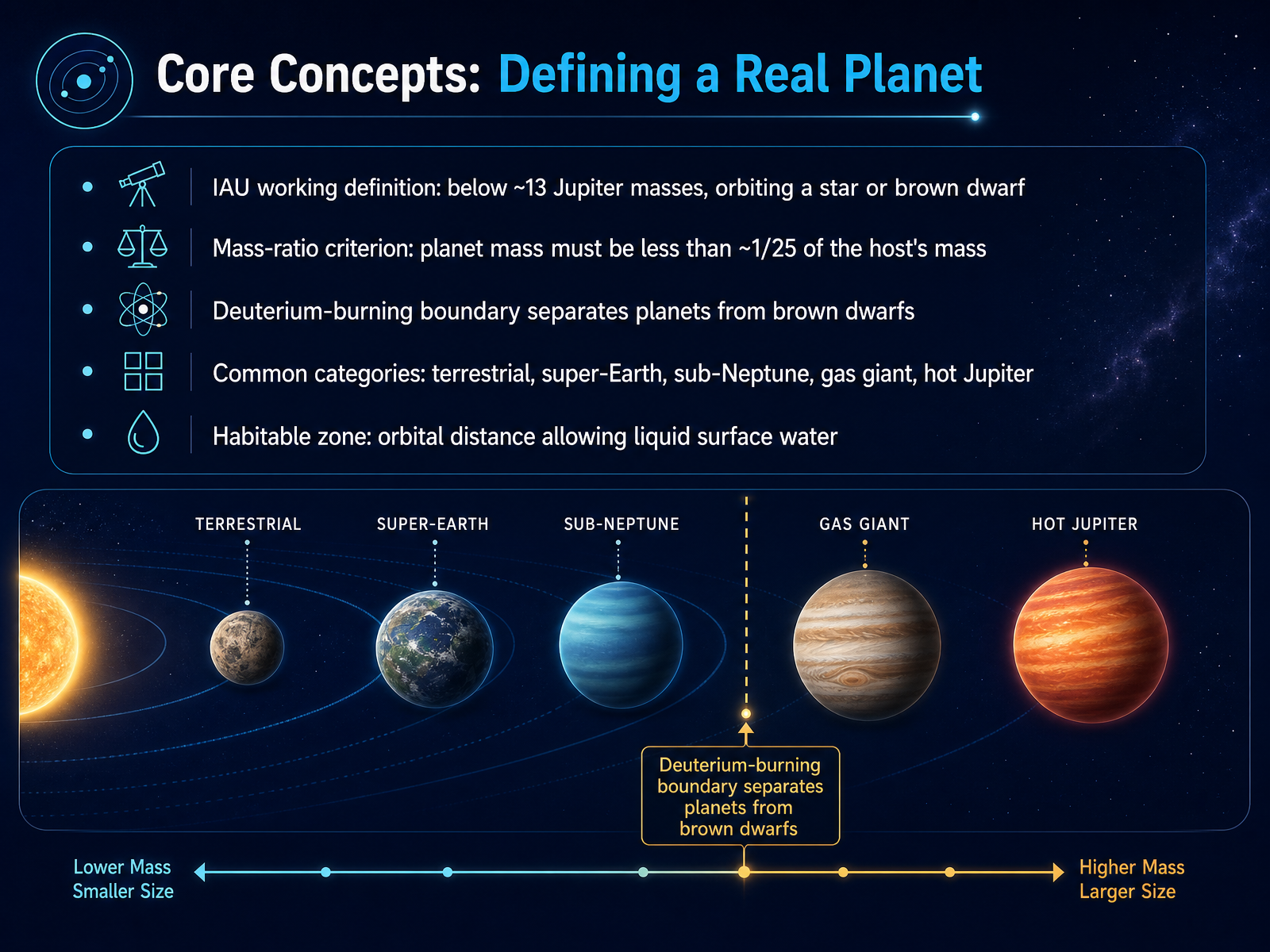
- 02Core Concepts: Defining a Real PlanetBefore we hunt for worlds, we should agree on what counts as a real planet. The International Astronomical Union uses a few clear guideposts. First, a planet must stay below about thirteen Jupiter masses. Push past that limit, and the object can briefly fuse deuterium, which makes it a brown dwarf, not a planet. Think of it as a furnace that never quite gets hot enough to become a true star. There is also a mass ratio rule. A planet should be less than roughly one twenty-fifth the mass of the object it orbits. That keeps the relationship a true orbit, instead of two similar bodies tugging on each other like paired dancers. Under that boundary, we find familiar families of worlds. Terrestrial planets are rocky, like Earth. Super-Earths and sub-Neptunes fill the in-between sizes. Gas giants and hot Jupiters dominate the heavy end. And of course, we look closely at the habitable zone, the comfortable distance where a planet could hold liquid water on its surface. Next, we will meet our first tool for finding such worlds: the transit technique.
 sciencedirect.comiau.orgdoi.org+21 min
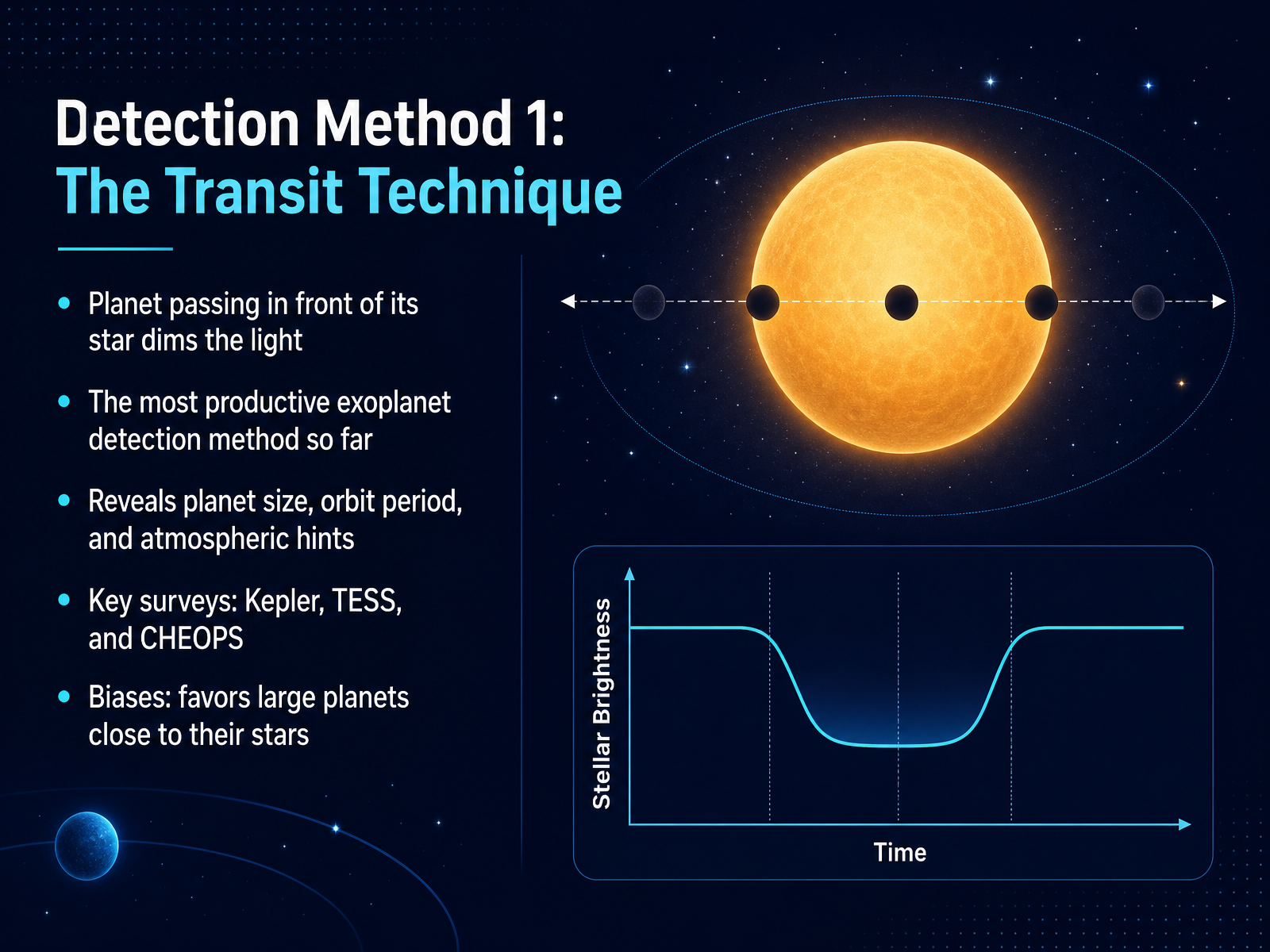
 - 03Detection Method 1: The Transit TechniqueNow, let's look at our first detection method, the transit technique. Imagine watching a distant streetlamp at night. If a tiny moth flies right in front of it, the lamp dims just a little. That is essentially what we observe when a planet crosses in front of its star. We measure a small, periodic dip in the starlight. This method is the most productive we have, accounting for about three quarters of all confirmed exoplanets. By studying these dips, we learn the planet's size and how long its year lasts. The timing of the dimming tells us the orbital period. And when starlight filters through the planet's atmosphere during the crossing, we can even get hints of what that atmosphere is made of. Missions like Kepler, TESS, and CHEOPS have used this technique to reveal thousands of new worlds. For instance, a recent analysis of TESS data alone announced more than ten thousand new planet candidates. That is more than double the existing count. But we should note the technique has a bias. It works best for large planets orbiting close to their stars, where the dip in light is bigger and easier to spot. So, the transit method gives us a rich but incomplete picture. To find planets that don't pass directly in front of their stars, we need a different approach. Next, we will explore Detection Method Two: Radial Velocity and Stellar Wobble.
 iopscience.iop.orgarxiv.orgiopscience.iop.org+22 min
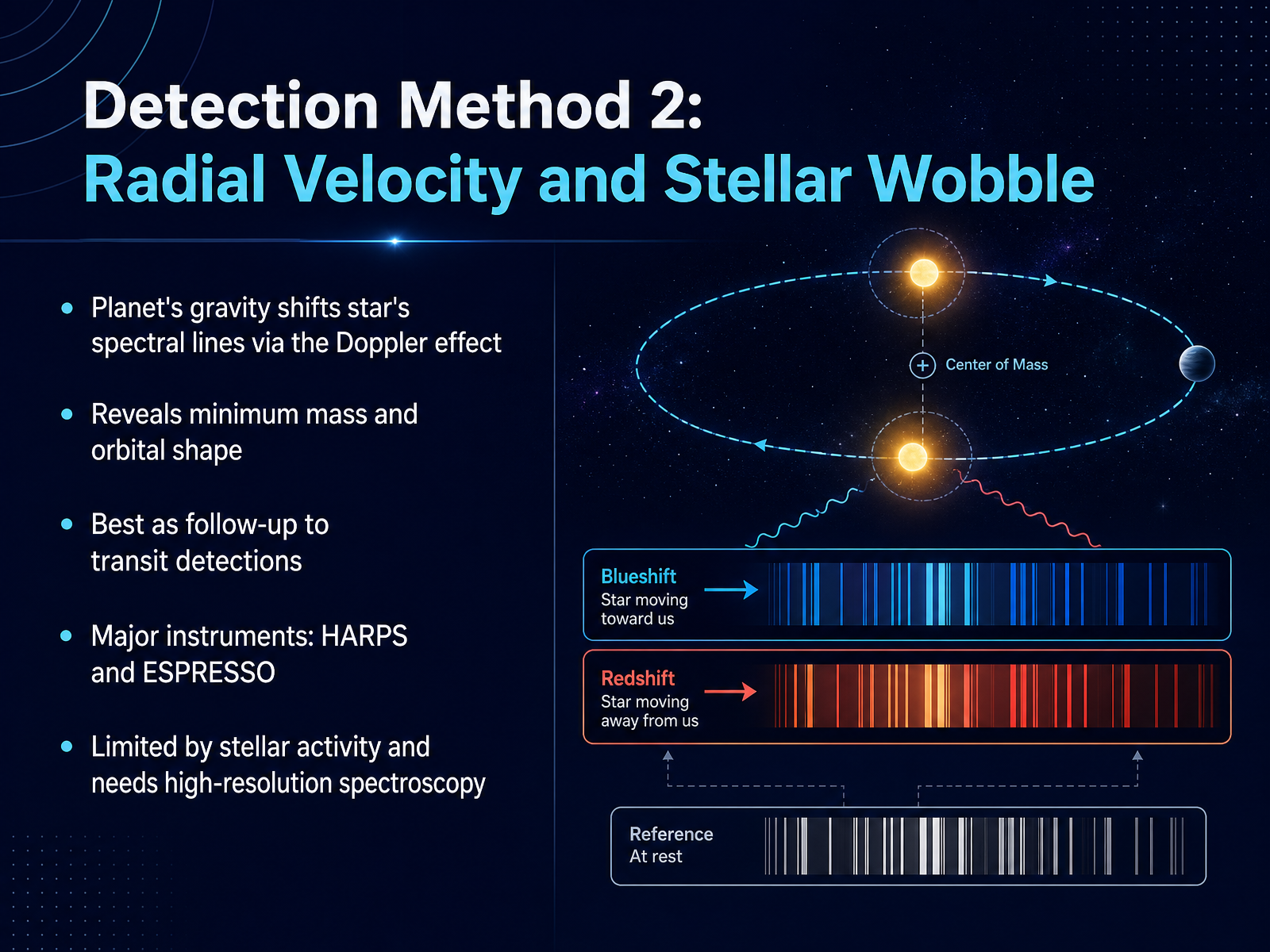
 - 04Detection Method 2: Radial Velocity and Stellar WobbleNow let's look at another powerful way we find these hidden worlds. It's called radial velocity, and it makes use of something called stellar wobble. A planet doesn't just orbit a star. The star and the planet both orbit a shared center of mass. So, as a planet pulls on its star, the star makes a tiny, repeating motion. We can detect that motion by watching the star's light. As the star sways toward us, its light shifts slightly blue. As it sways away, the light shifts slightly red. This is the Doppler effect, like the changing pitch of a siren as an ambulance passes by. This method tells us the planet's minimum mass and the shape of its orbit. It doesn't give us the planet's size, so it works best as a follow-up to transit detections. Instruments like HARPS and ESPRESSO are so precise they can measure a star moving slower than a person walking. The main challenge is that stellar activity, like sunspots, can mimic a planet's signal, so it requires very high resolution spectroscopy. Next, we'll explore other methods, including microlensing, direct imaging, and astrometry.
 iopscience.iop.orgiopscience.iop.orgiopscience.iop.org+22 min
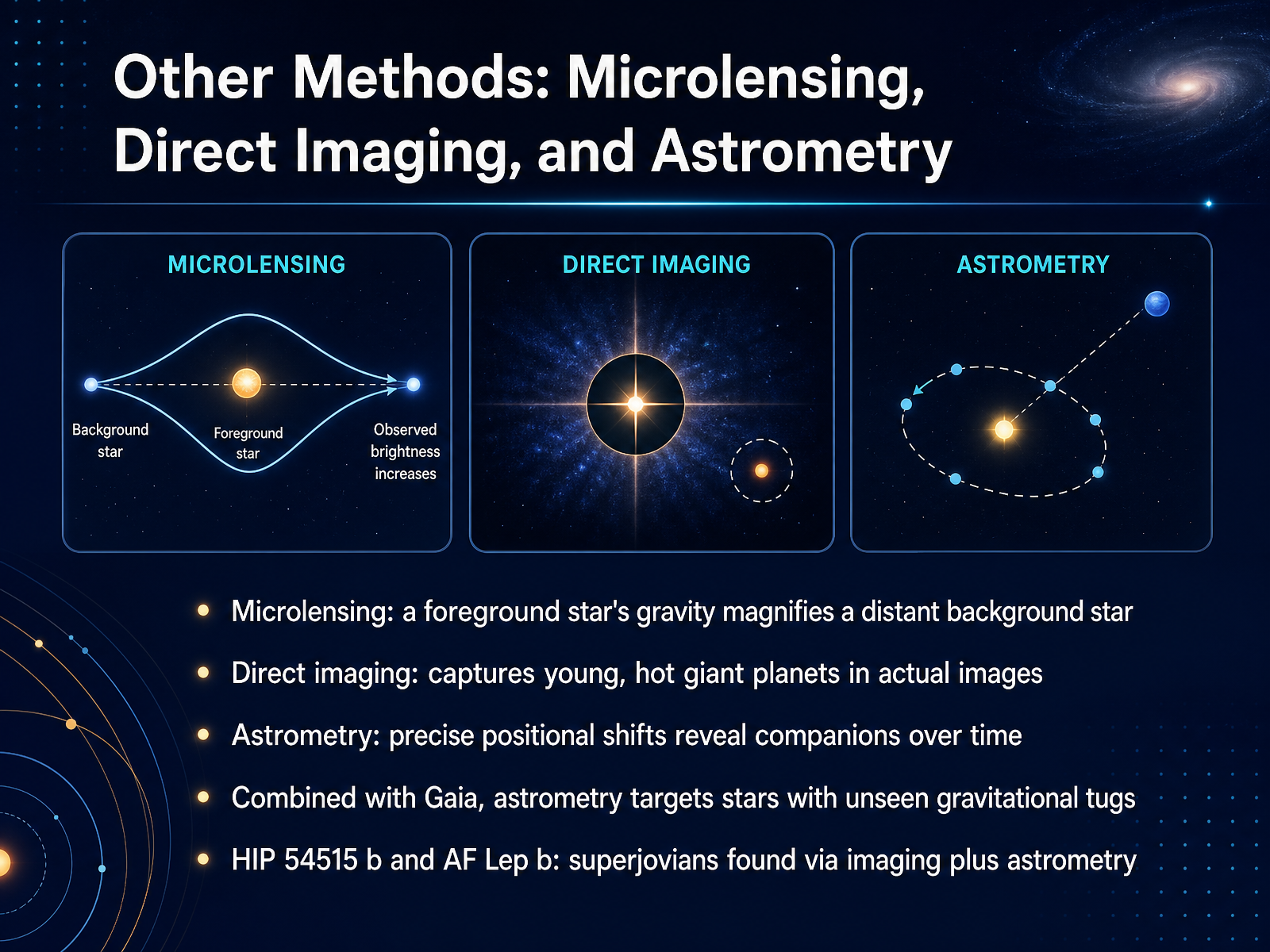
 - 05Other Methods: Microlensing, Direct Imaging, and AstrometryNow, let's explore three other powerful techniques. First, microlensing. When a foreground star passes in front of a distant background star, its gravity acts like a lens, briefly magnifying the background star's light. If that foreground star has a planet, we see a tiny extra blip in brightness. Think of it as a cosmic magnifying glass revealing a hidden marble. Next, direct imaging. This is exactly what it sounds like. We take actual pictures of planets. But because planets are so faint next to their stars, this works best for young, hot giant worlds that still glow brightly. It's like trying to photograph a firefly next to a searchlight. Finally, astrometry. We watch a star's position very, very carefully over time. The gravitational tug of an unseen planet makes the star wobble. It's like seeing an unseen dog pull on its leash. Combined with Gaia's precision astrometry, we can target stars showing these subtle tugs. Systems like HIP 54515 b and AF Lep b were found using this powerful partnership of imaging and astrometry. Next, let's see how we combine all these methods to turn candidates into truly characterized worlds.
 iopscience.iop.orgiopscience.iop.orgiopscience.iop.org+22 min
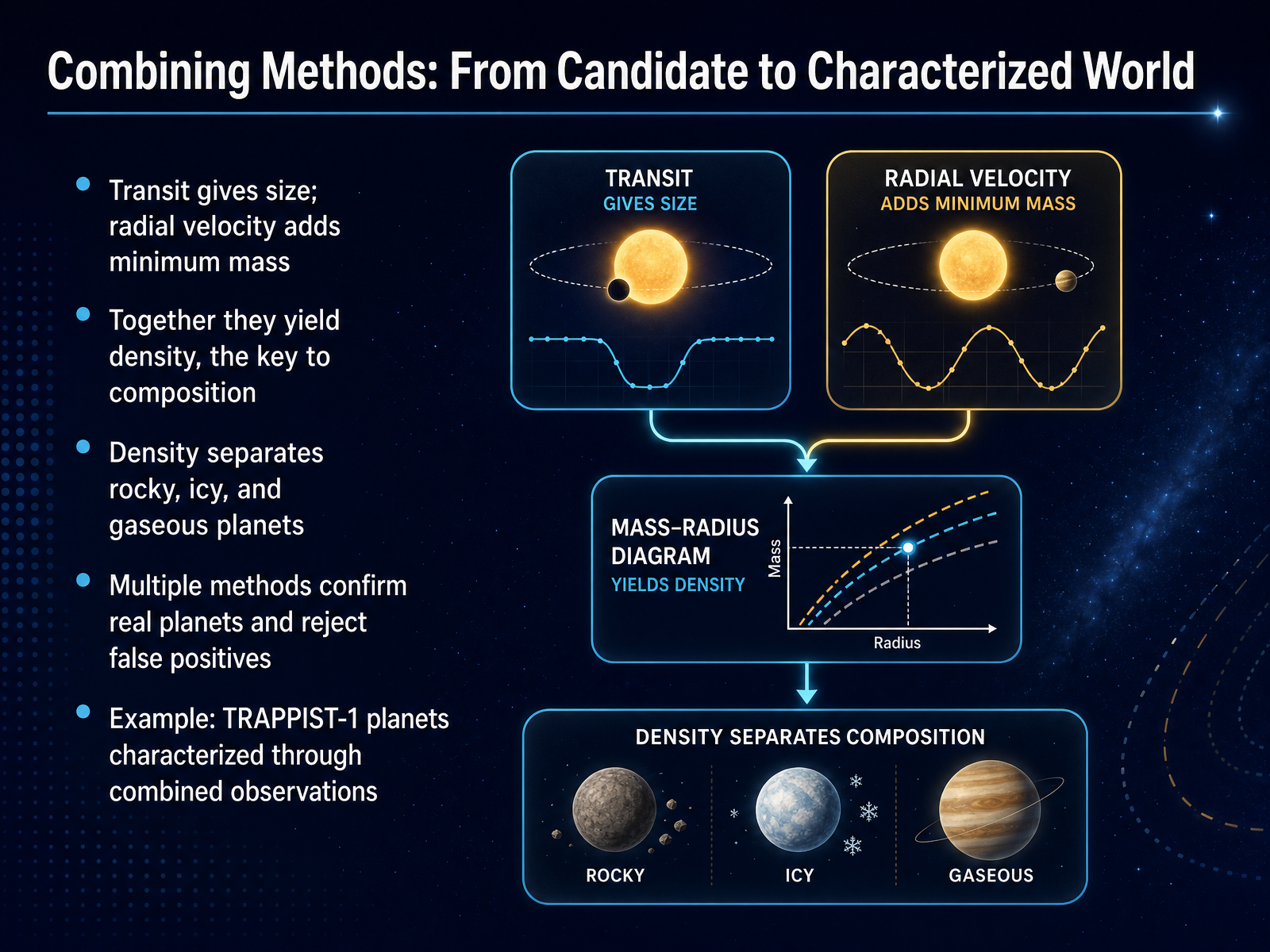
 - 06Combining Methods: From Candidate to Characterized WorldNow we take a crucial step forward by combining our detection methods. Think of a transit as measuring the size of a planet’s shadow. Meanwhile, radial velocity provides its minimum mass. Alone, size is just a number. But together, size and mass give us density. That is the key to composition. Density lets us separate heavy rocky worlds from lighter icy worlds, and from puffy gaseous giants. It is a bit like holding two spheres of the same size, one made of lead and one of foam. Combining methods also protects us from false positives. A signal that looks like a planet in one method is much harder to explain away when confirmed by another. A beautiful example is the TRAPPIST-1 system. There, multiple methods worked together to characterize several Earth-sized worlds. We learned which ones might be rocky, and which ones might hold thick envelopes. This is how candidates become real, characterized planets. Next, let us peek into their atmospheres.
 2 min
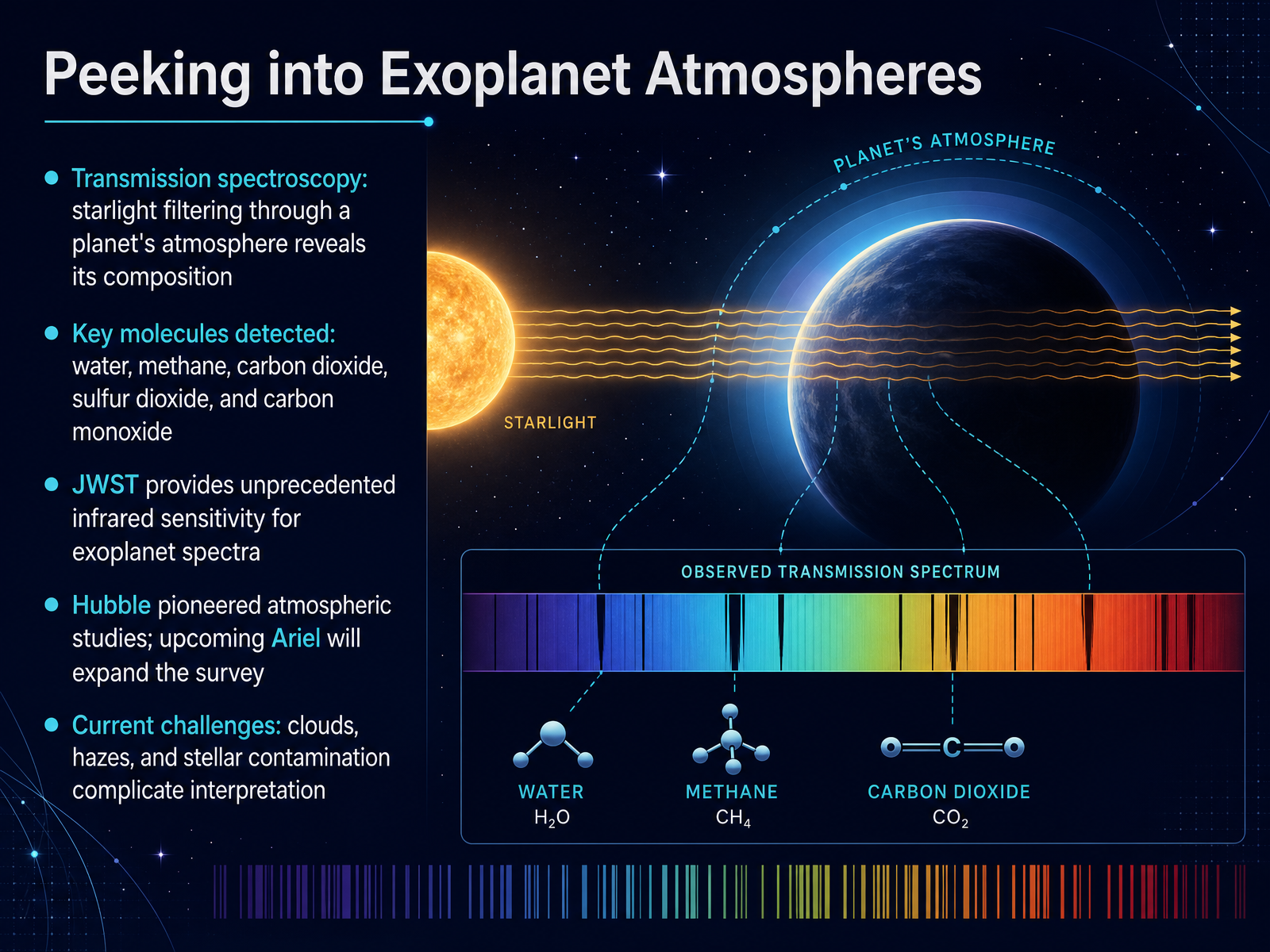
2 min - 07Peeking into Exoplanet AtmospheresNow we arrive at one of the most exciting frontiers, peeking into exoplanet atmospheres. How can we possibly know what the air is like on a world light years away? We use a technique called transmission spectroscopy. When a planet passes in front of its star, a tiny fraction of the starlight filters through the planet’s atmosphere. The gases there absorb specific colors of light, leaving a fingerprint we can read from Earth. Think of it like a prism that separates light into a rainbow, except some of the colors are missing because atmospheric gases have swallowed them. Using this method, we have detected water, methane, carbon dioxide, sulfur dioxide, and even carbon monoxide on distant worlds. The James Webb Space Telescope has revolutionized this field with its incredible infrared sensitivity. Hubble pioneered these studies years ago, and a future mission called Ariel will survey the atmospheres of hundreds more planets. But we still face challenges. Clouds and hazes can block our view, and light from the star itself can contaminate our data. Up next, we explore how these atmospheric clues lead us to the search for truly habitable worlds and biosignatures.
 2 min
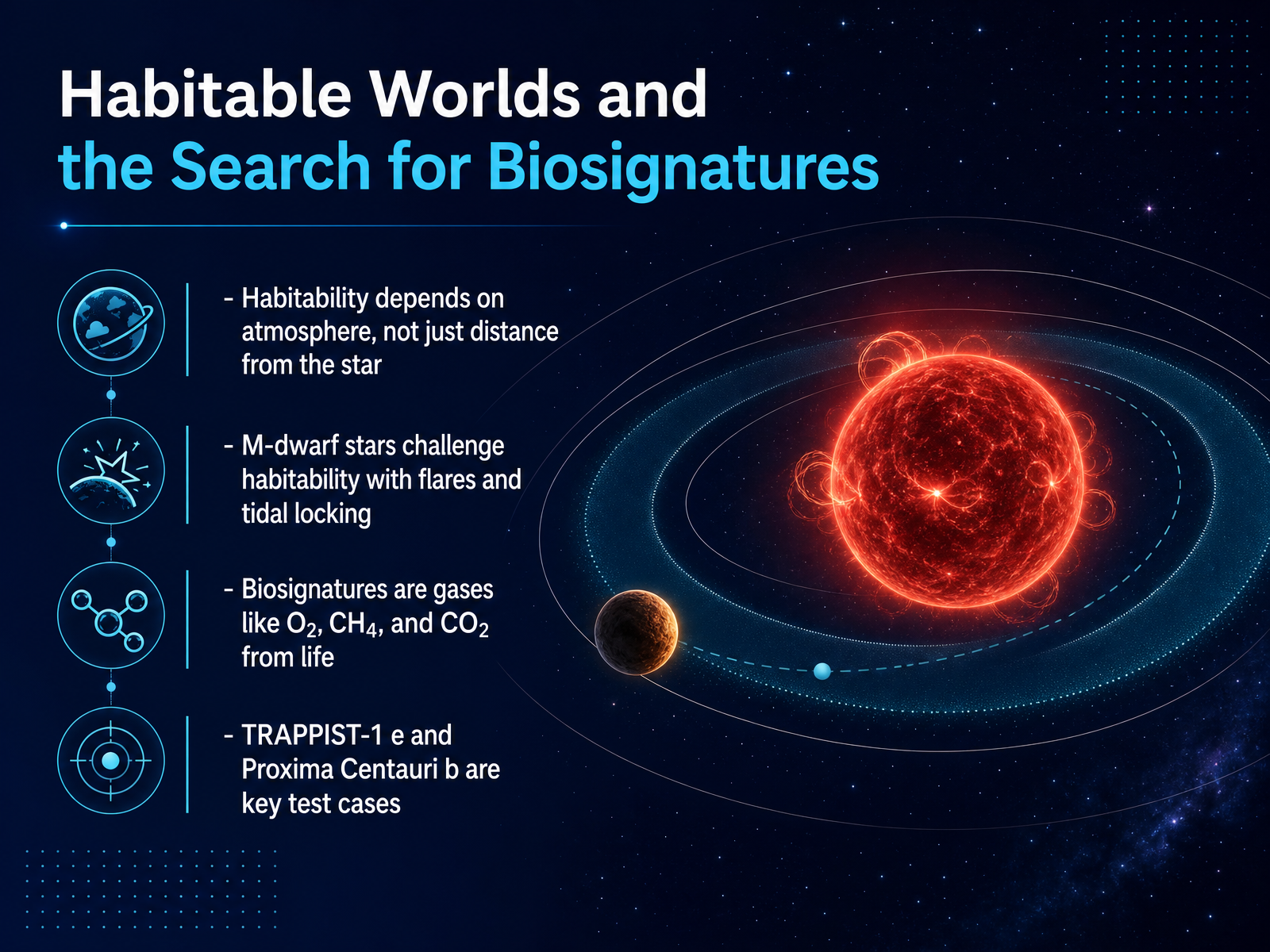
2 min - 08Habitable Worlds and the Search for BiosignaturesNow we turn from finding planets to asking a more exciting question. Could any of them support life? Habitability is not just about being the right distance from a star. It depends even more on whether a world has the right kind of atmosphere. Think of it like a house. Location matters, but you also need walls, heating, and air. Now some worlds orbit small red suns called M dwarf stars. These stars are common, and their planets are easier to study, but they can flare violently and lock one side of a planet in permanent daylight. That makes habitability a real puzzle. So how would we know if life is present? We search for biosignatures, gases like oxygen, methane, and carbon dioxide that, together, can point to living processes. Two worlds have become key test cases for this search. TRAPPIST one e and Proxima Centauri b. Each could have the right conditions, but the evidence is still tentative. We are learning to read the chemistry of distant skies. Next, we will step back and look at demographics, the patterns emerging across the whole exoplanet population.
 2 min
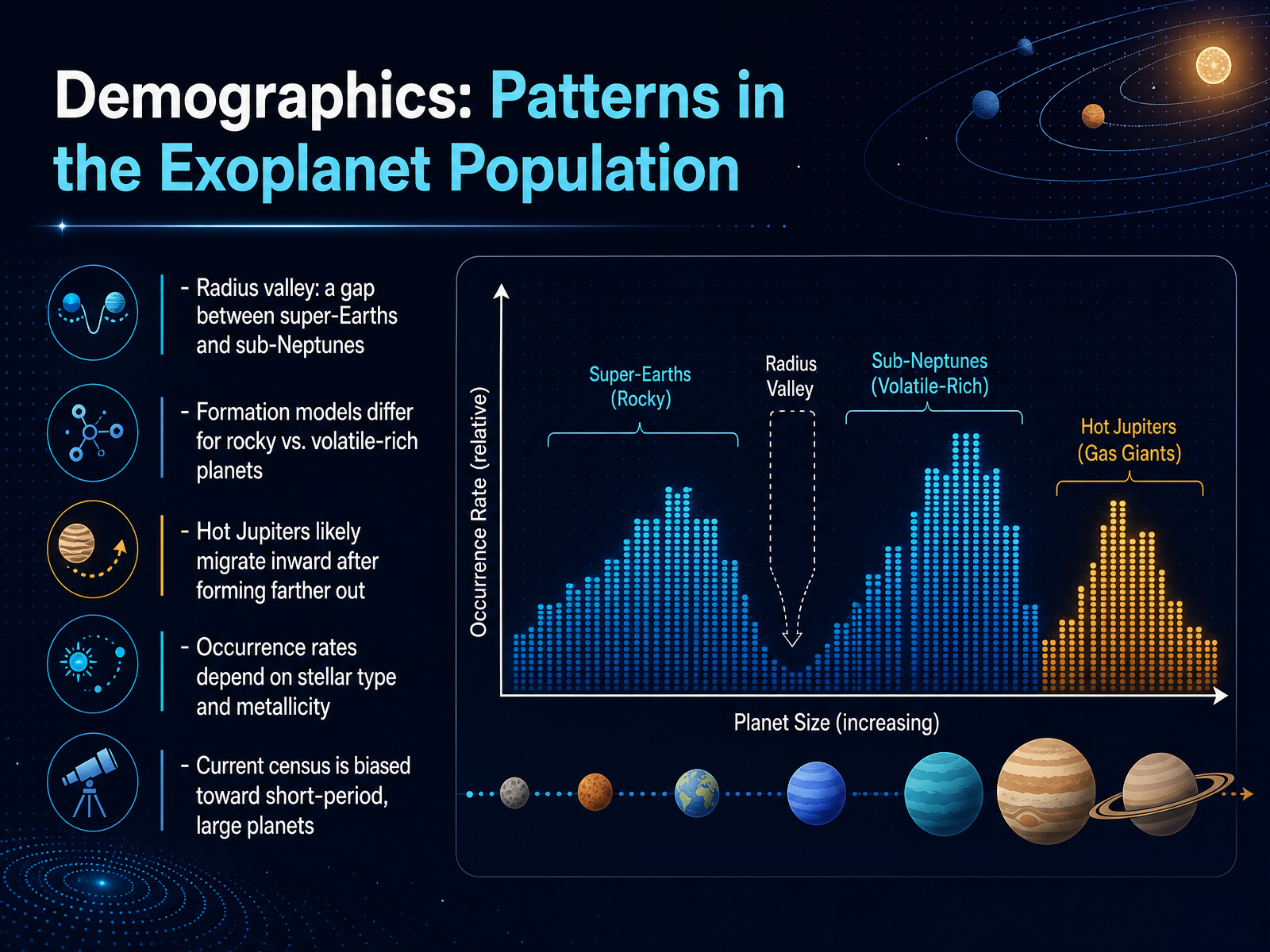
2 min - 09Demographics: Patterns in the Exoplanet PopulationAs we step back and look at the thousands of worlds we have found, patterns start to emerge. One of the most striking is the radius valley. This is a noticeable gap in planet sizes. We see a lot of rocky super-Earths, and a lot of gassy sub-Neptunes, but very few planets in between. Think of it like a demographic census of our galaxy. It suggests that rocky worlds and volatile-rich worlds form and evolve in fundamentally different ways. We also see that hot Jupiters, those giant planets hugging their stars, likely did not form there. They probably migrated inward from much farther out in their solar systems. Finally, we must remember our own bias. Our current census is skewed. We have mostly found short-period, large planets simply because they are easier to detect. With that in mind, let's turn to how the James Webb Space Telescope is now transforming this field and challenging our models.
 1 min
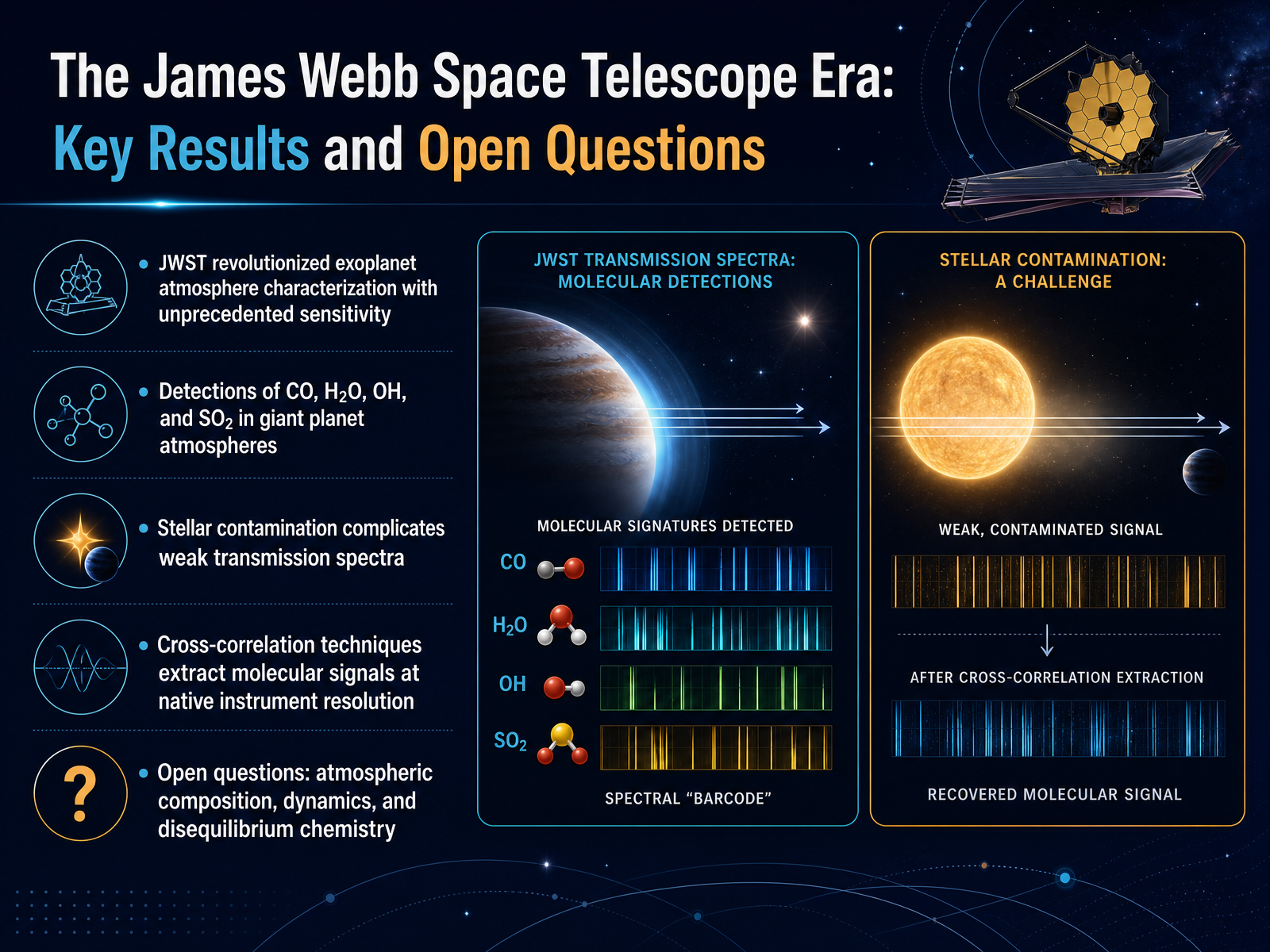
1 min - 10The James Webb Space Telescope Era: Key Results and Open QuestionsNow we arrive at the James Webb Space Telescope era. With its incredible sensitivity, Webb has transformed how we study exoplanet atmospheres. Think of it as moving from a blurry photograph to reading fine print on a distant page. We have now detected molecules like carbon monoxide, water, hydroxyl, and even sulfur dioxide in the skies of giant planets. Each fingerprint tells us what those alien atmospheres are made of. But there is a challenge. The star itself can contaminate weak signals, like trying to hear a whisper beside a bright lamp. To solve this, we use cross correlation. It is like tuning a radio, matching a known pattern to pull a faint molecular voice out of the noise. This lets us see signals at the instrument’s native resolution. Still, open questions remain. What are these atmospheres really made of? How do their winds and clouds move? What happens when chemistry falls out of balance? These mysteries pull us forward. Next, we look to the road ahead and new missions that will help answer them.
 2 min
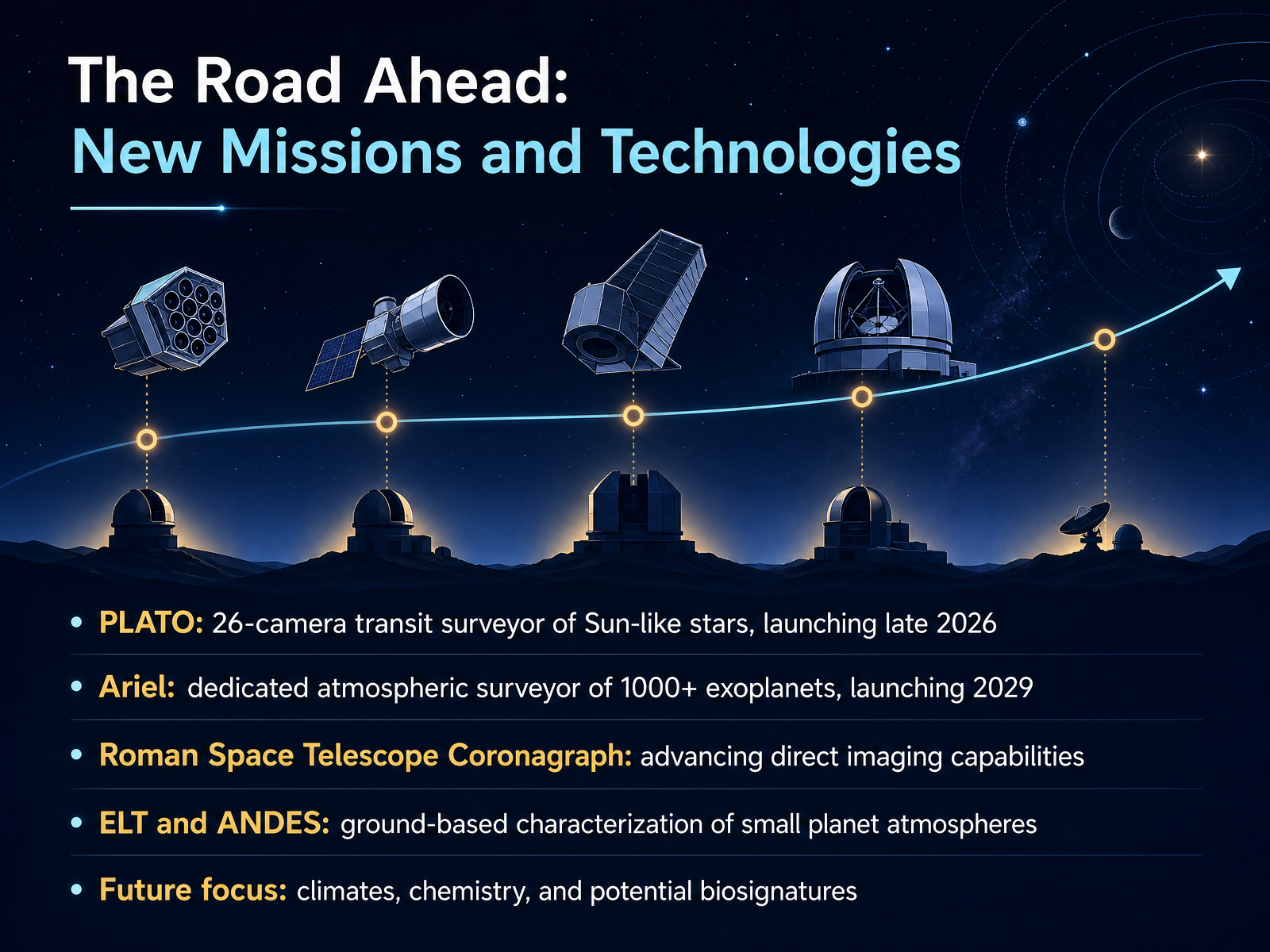
2 min - 11The Road Ahead: New Missions and TechnologiesSo where do we go from here? The next few years are going to be a golden age for exoplanet science. ESA’s Plato mission is scheduled to launch late in 2026. It will use an array of twenty-six cameras to act like a giant compound eye, staring at Sun-like stars to find rocky worlds in their habitable zones. Following that, in 2029, the Ariel mission will take over. Its job is to be a dedicated atmospheric surveyor, sniffing the chemical makeup of over a thousand different worlds. We are also pushing the limits of direct imaging with the Roman Space Telescope’s coronagraph. It will use a special mask to block starlight, just like holding up your hand to block the sun so you can see a distant bird. Back on the ground, powerful observatories like the ELT and the Andes instrument will study the atmospheres of small planets. Our focus is shifting from simply finding planets to understanding their climates and chemistry. One day soon, we might even find the first hints of biosignatures. Now, let's put this into practice by interpreting a transit light curve.
 2 min
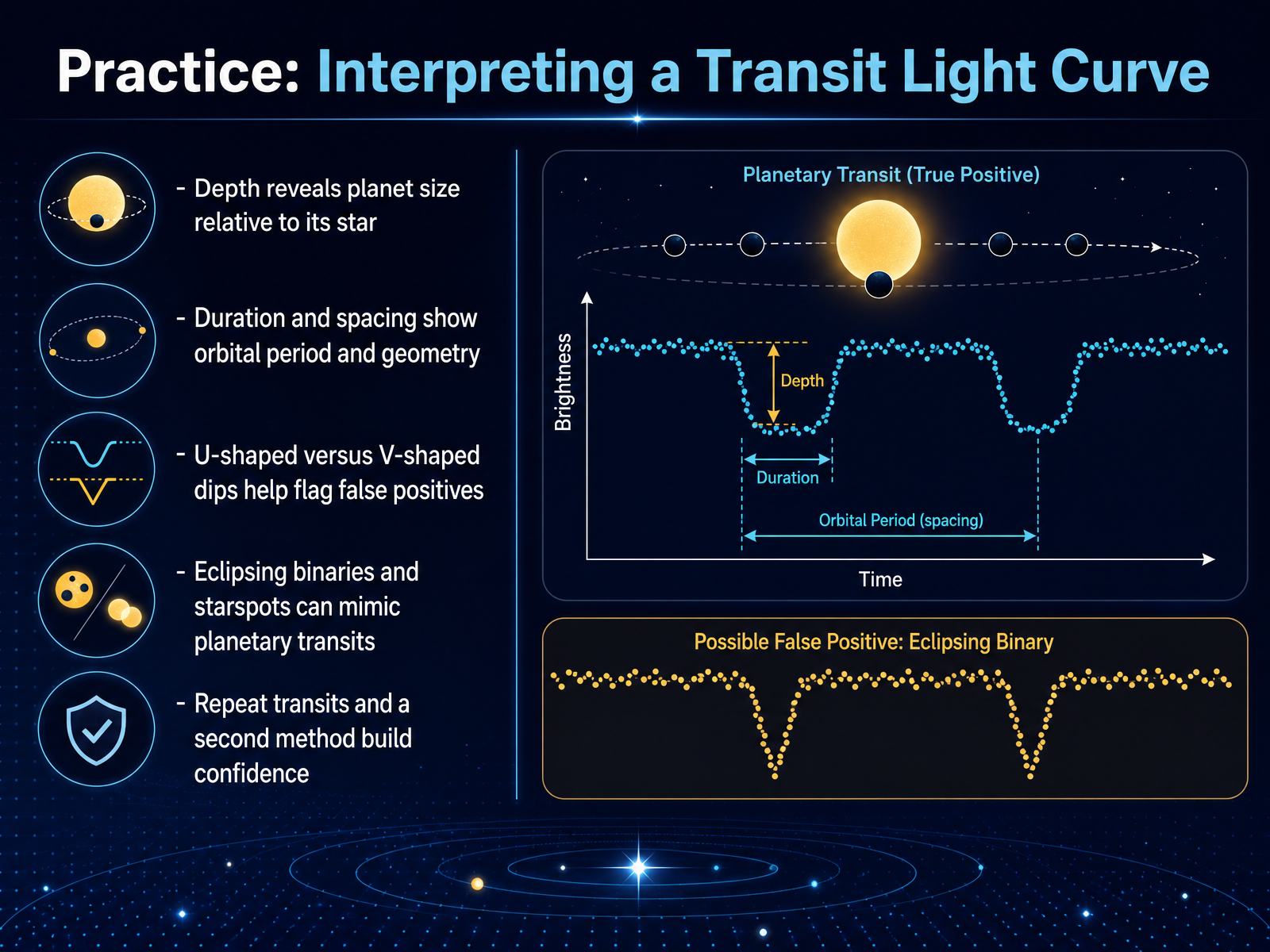
2 min - 12Practice: Interpreting a Transit Light CurveNow let’s try reading a transit light curve ourselves. The first thing we look at is depth. How much did the star dim? That dip tells us the planet’s size relative to its star. Think of it like measuring an eclipse by how much light is blocked. Next we look at duration and spacing. How long does the dip last, and how often does it repeat? That timing reveals the planet’s orbital period and the geometry of its path. Shape matters too. A real planet transit usually has a flat bottom, like a shallow U. A V-shaped dip often points to a blended star or an eclipsing binary. Starspots can also mimic a transit, so we stay cautious. That’s why we require repeat transits, ideally seen again on schedule. Adding a second method, like radial velocity, builds real confidence. Up next, we’ll put this into practice as we decide if a signal is a real planet.
 iopscience.iop.orgarxiv.orgiopscience.iop.org+21 min
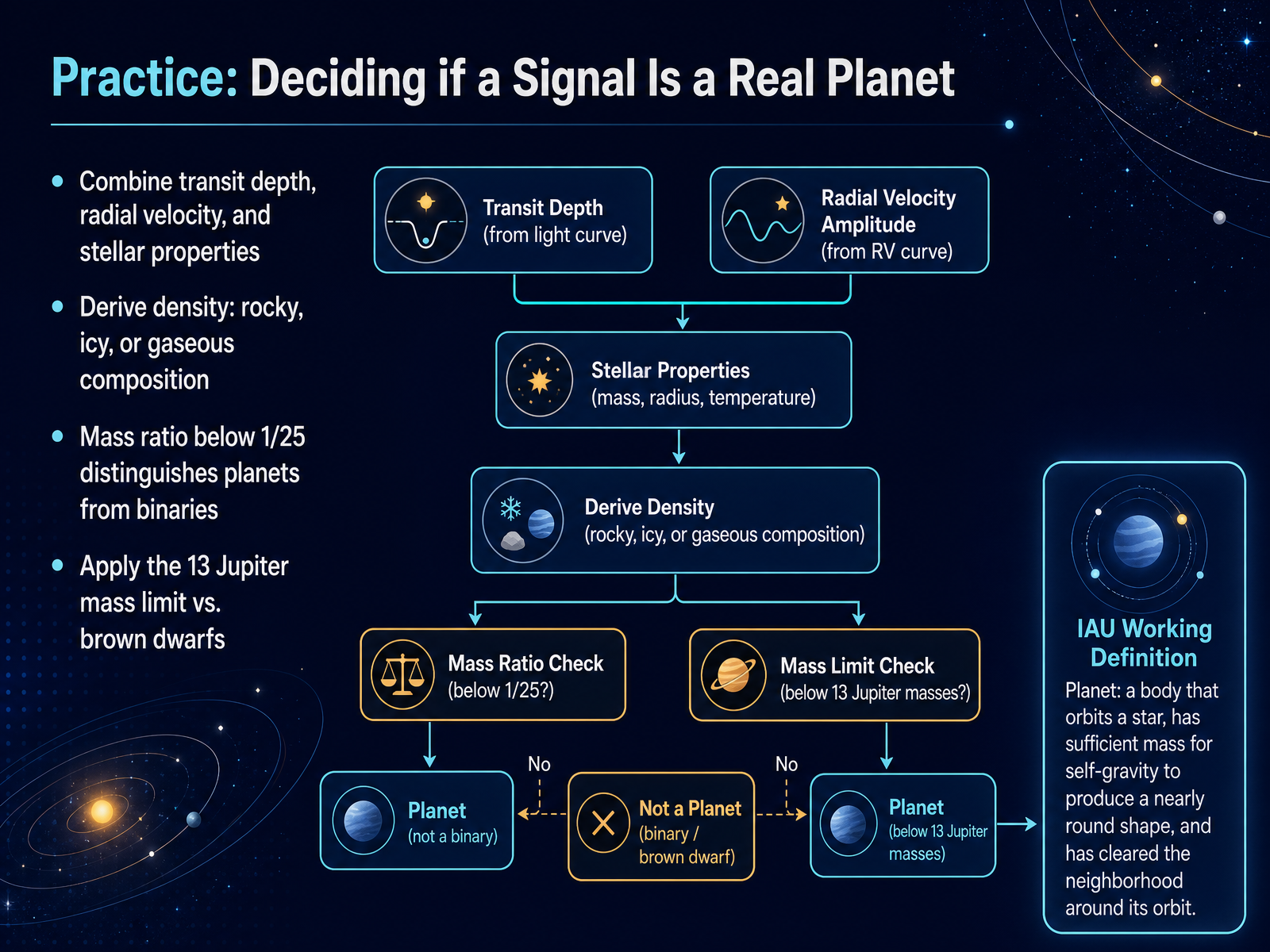
 - 13Practice: Deciding if a Signal Is a Real PlanetNow let’s put all of that together into a real decision. Suppose a signal shows a small dip in starlight, and radial velocity suggests a companion with low mass. First, we combine transit depth and stellar size to get the companion’s radius. Then we combine radial velocity with the star’s mass to estimate the companion’s mass. From mass and radius we derive density. A high density, something like rock, points to a rocky world. A moderate density, perhaps like water ice, suggests an icy body. A very low density, like a puffy ball of gas, points to a gas world. Next we check the mass ratio. If the companion is less than about one twenty fifth of the central star’s mass, it behaves like a planet. Think of a tugboat following a cargo ship rather than two ships pulling on each other equally. Finally we apply the thirteen Jupiter mass limit. Below that, it can be a planet. Above that, it may be a brown dwarf, an object big enough to briefly fuse deuterium but not big enough to shine like a star. So a real planet must be low mass compared with its star, below thirteen Jupiter masses, and consistent in density with rock, ice, or gas. Next, we step back to see how all of this becomes scientific discovery.
 sciencedirect.comiau.orgdoi.org+21 min
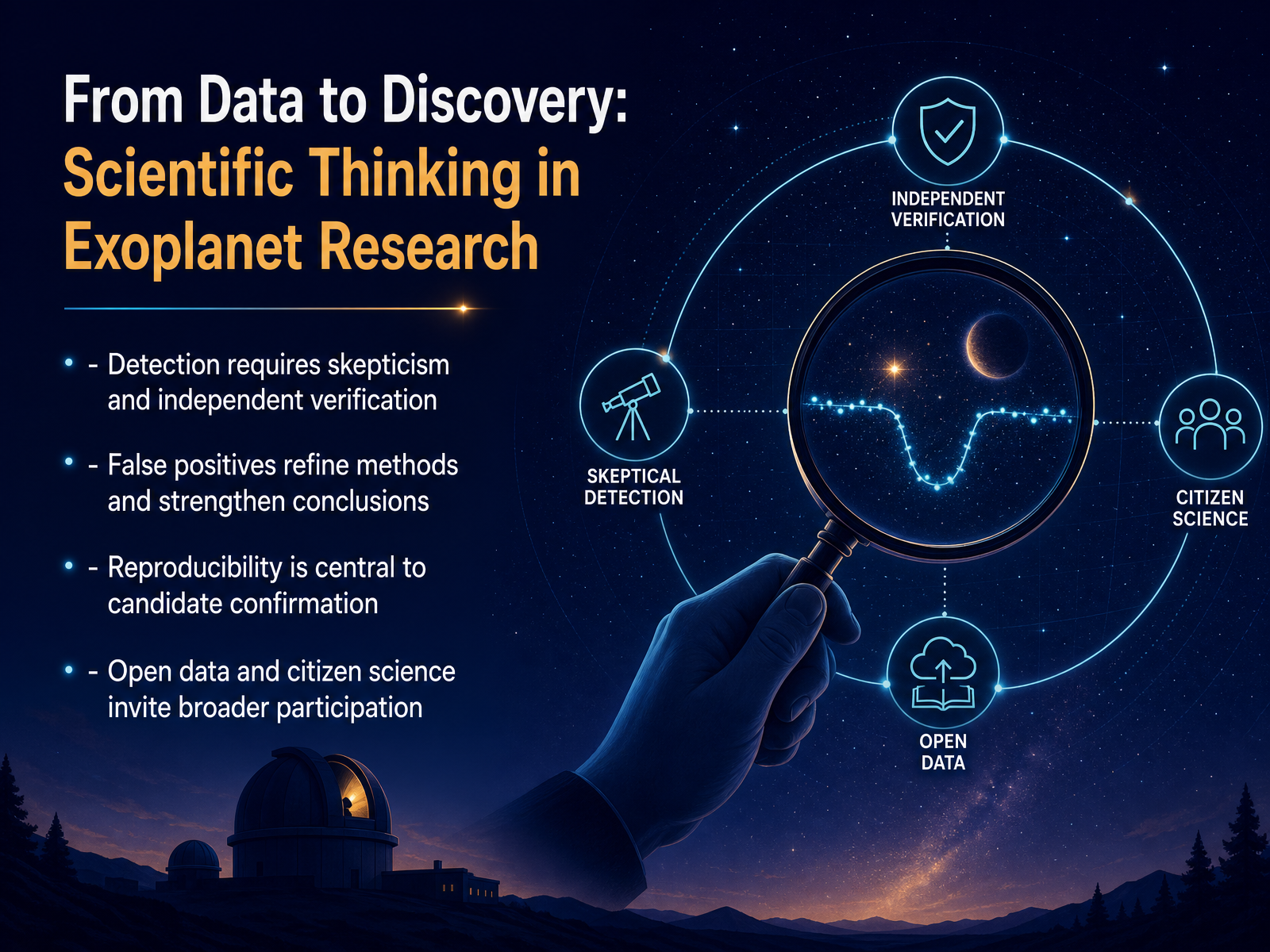
 - 14From Data to Discovery: Scientific Thinking in Exoplanet ResearchNow we come to the heart of how discovery actually works. A signal is not a planet until it survives skepticism. We saw that with the transit method, where a dip in starlight might be a planet, or it might be a blended background star or a stellar companion. So researchers demand independent verification. A transit signal might be checked with radial velocity measurements, or with ground-based telescopes observing in different colors of light. Think of it like verifying a faint echo before announcing you have heard a voice. False positives are not failures in this field. They sharpen our methods. Every time a candidate turns out to be something else, we learn to recognize that impostor more quickly. Reproducibility sits at the center of confirmation. A detection must be repeatable, predictable, and consistent across instruments, like the same musical note played on two different pianos with the same clear pitch. Finally, open data and citizen science invite all of us into the search. Public archives and community projects let students, educators, and curious observers examine real light curves and help identify candidates. We have moved from a handful of known worlds to more than six thousand confirmed planets because science is a shared, careful, and self-correcting process. Thank you for joining this journey. Keep asking questions, because the next discovery might begin with someone just like you looking closely at a small change in starlight.
 exoplanetarchive.ipac.caltech.eduscience.nasa.govexoplanetarchive.ipac.caltech.edu+22 min
Take the deck with you
Download this course as a file — free, no sign-up needed.
- PDF handoutEvery slide page, ready to print or share.15 pages · 3.9 MBDownload
- Narrated PowerPointThe deck that presents itself — every slide carries the digital human's narration video.15 pages · 15.8 MBDownload
- PowerPoint slidesThe full deck as a .pptx — open it in PowerPoint, Keynote, or Google Slides.15 pages · 3.8 MBDownload
Free to use in your own training — please keep the PersonWise credit page at the end.
Have your own deck? Turn it into a course
Sources consulted
Web sources consulted while building this course.
- NASA Exoplanet Archive — exoplanetarchive.ipac.caltech.edu
- Discoveries Dashboard - NASA Science — science.nasa.gov
- NASA Exoplanet Archive — exoplanetarchive.ipac.caltech.edu
- 2026 Exoplanet Archive News — exoplanetarchive.ipac.caltech.edu
- Exoplanet Catalog - NASA Science — science.nasa.gov
- The IAU working definition of an exoplanet - ScienceDirect.com — sciencedirect.com
- Documents - International Astronomical Union (IAU) — iau.org
- The IAU working definition of an exoplanet — doi.org
- Commission F2: Documents | IAU — iauarchive.eso.org
- A Review on Substellar Objects below the Deuterium Burning Mass Limit: Planets, Brown Dwarfs or What? — mdpi.com
- The T16 Planet Hunt: 10,000 New Planet Candidates from TESS Cycle 1 and the Confirmation of a Hot Jupiter around TIC 183374187 - IOPscience — iopscience.iop.org
- COUNTESS I: A Uniformly Vetted Catalog of Known and New Transiting Exoplanets in the TESS Northern Continuous Viewing Zone — arxiv.org
- Validation of TESS Planet Candidates with Multicolor Transit Photometry and TRICERATOPS+ - IOPscience — iopscience.iop.org
- List of exoplanets discovered in 2025 - Wikipedia — en.wikipedia.org
- ExoMiner++: Enhanced Transit Classification and a New Vetting Catalog for 2-minute TESS Data - IOPscience — iopscience.iop.org
- SCExAO/CHARIS and Gaia Direct Imaging and Astrometric Discovery of a Superjovian Planet 3–4 λ/D from the Accelerating Star HIP 54515 - IOPscience — iopscience.iop.org
- OASIS Survey Direct Imaging and Astrometric Discovery of HIP 71618 B: A Substellar Companion Suitable for the Roman Coronagraph Technology Demonstration - IOPscience — iopscience.iop.org
- Gaia-4b and 5b: Radial Velocity Confirmation of Gaia Astrometric Orbital Solutions Reveal a Massive Planet and a Brown Dwarf Orbiting Low-mass Stars - IOPscience — iopscience.iop.org
- Multi-band Spectral and Astrometric Characterization of the HIP 99770 b Planet with SCExAO/CHARIS and Gaia - IOPscience — iopscience.iop.org
- HD 143811 AB b: A Directly Imaged Planet Orbiting a Spectroscopic Binary in Sco-Cen - IOPscience — iopscience.iop.org