Writing Effective Project Briefs
Begin
14 pages · ~28 min
Writing Effective Project Briefs
Learn to write clear, compelling project briefs that align stakeholders and define project scope, goals, and deliverables.
What you’ll learn
- 01Writing Effective Project BriefsWelcome to Writing Effective Project Briefs. In my work with cross-functional teams, I've seen that a project brief is the single most important document for alignment before work begins. When a brief is unclear, teams drift. You get misalignment, rework, scope creep, and delayed decisions. The research is startling. Studies show that up to one third of budgets can be wasted because of poor briefing. That's a massive cost for something we can fix. This training is designed to give you a repeatable framework. It's a way to start every project with clarity, a shared purpose, and a written contract that everyone can commit to. Let's get started by looking at the brief as your project's single source of truth.doi.orgdoi.orgiag.biz+21 min
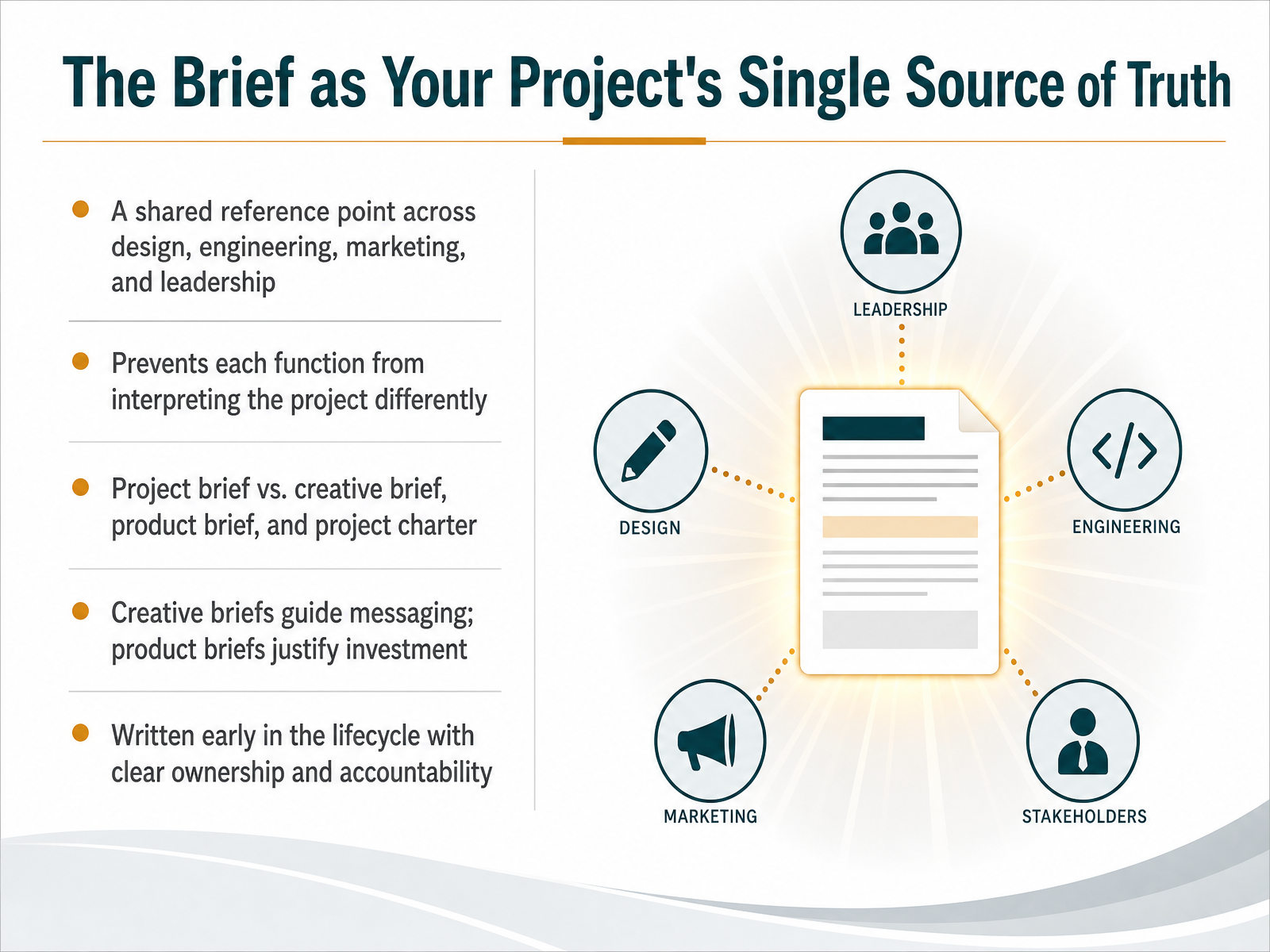
- 02The Brief as Your Project's Single Source of TruthNow, let's talk about the most important role of any project brief. It serves as the single source of truth for your entire team. Think of it as a shared reference point that sits right at the center of design, engineering, marketing, and leadership. Without this alignment, each function can interpret the project differently, and that's where rework and confusion start. But here's a critical distinction: a project brief is not the same as a creative brief or a product brief. A creative brief guides messaging, tone, and visual direction. A product brief justifies the business investment and opportunity. The project brief wraps around all of that, capturing the full scope, goals, timelines, and deliverables. It is written early in the lifecycle, with clear ownership and accountability, so everyone knows who is driving what from the very beginning. Let's look at the core anatomy of an effective brief.
 plane.soideaplan.iomonday.com+21 min
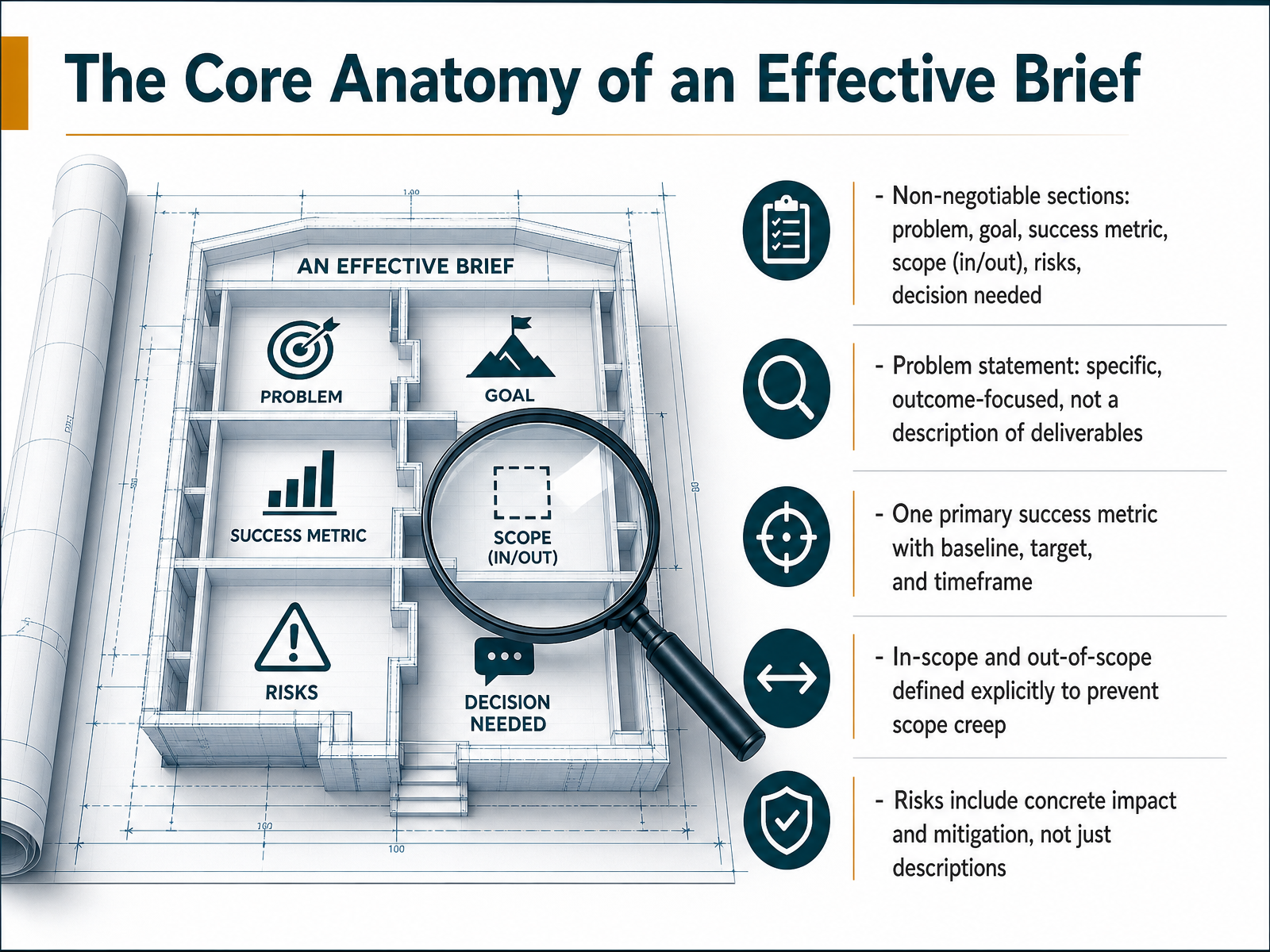
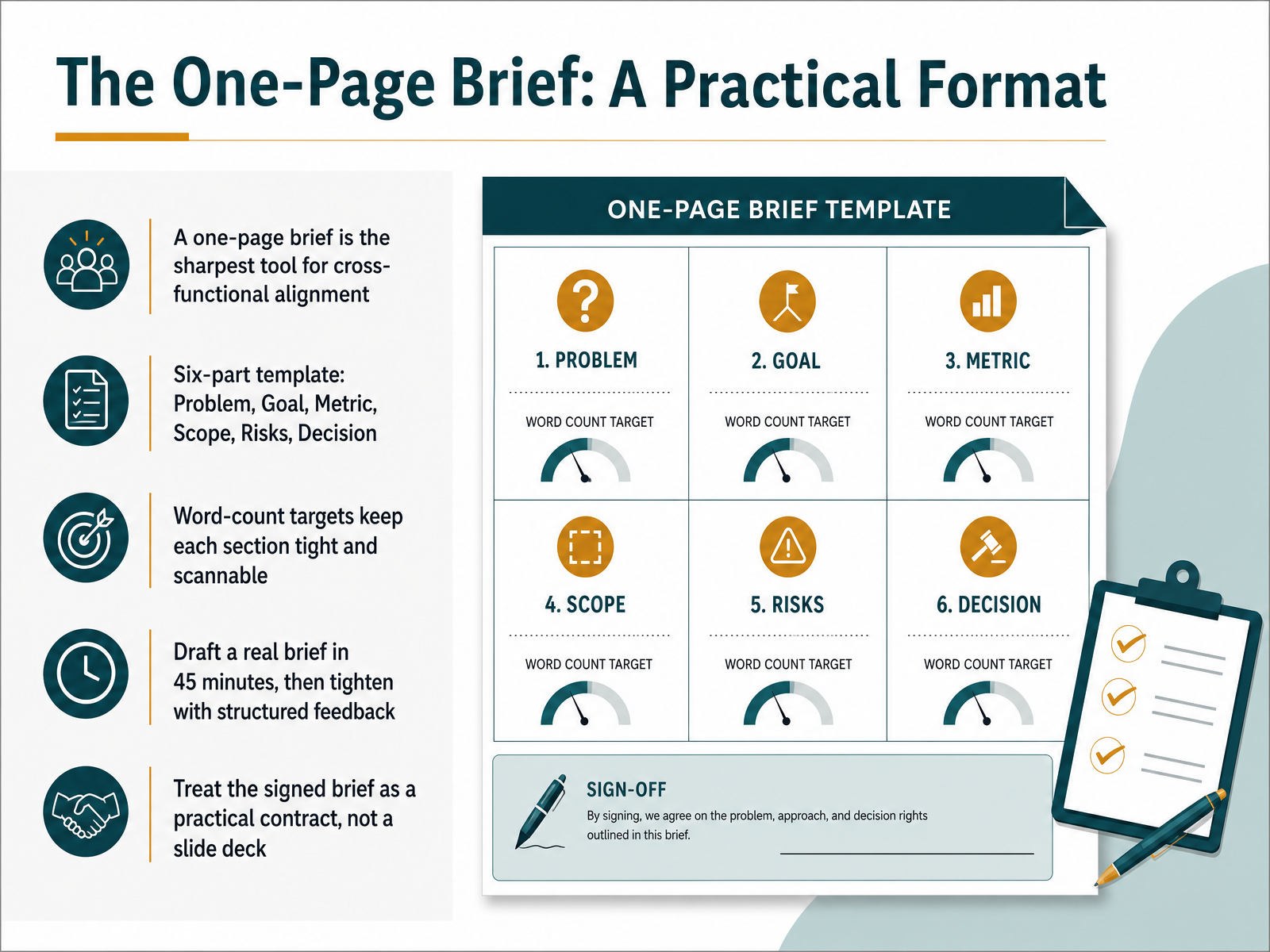
 - 03The Core Anatomy of an Effective BriefNow let's look at the core anatomy of an effective brief. There are six non-negotiable sections that form a practical contract before work starts. First, the problem statement. This is not a description of deliverables. It is a specific, outcome-focused description of what is broken or missing for the user or business. Second, the goal, which describes the desired future state. Third, and this is critical, one primary success metric. You must pick a single behavior to change, expressed as a number with a baseline, a target, and a timeframe. Fourth, scope. Define explicitly what is in scope and, just as importantly, what is out of scope. This prevents scope creep and later arguments. Fifth, risks. For each risk, describe the concrete impact and a mitigation. Do not just list scary descriptions. Sixth, the decision needed. State the clear yes or no choice you are asking stakeholders to make. These six sections keep the brief sharp and prevent rework. Let's move on to translating strategy into actionable scope.
 plane.sopathhub.aiones.com+21 min
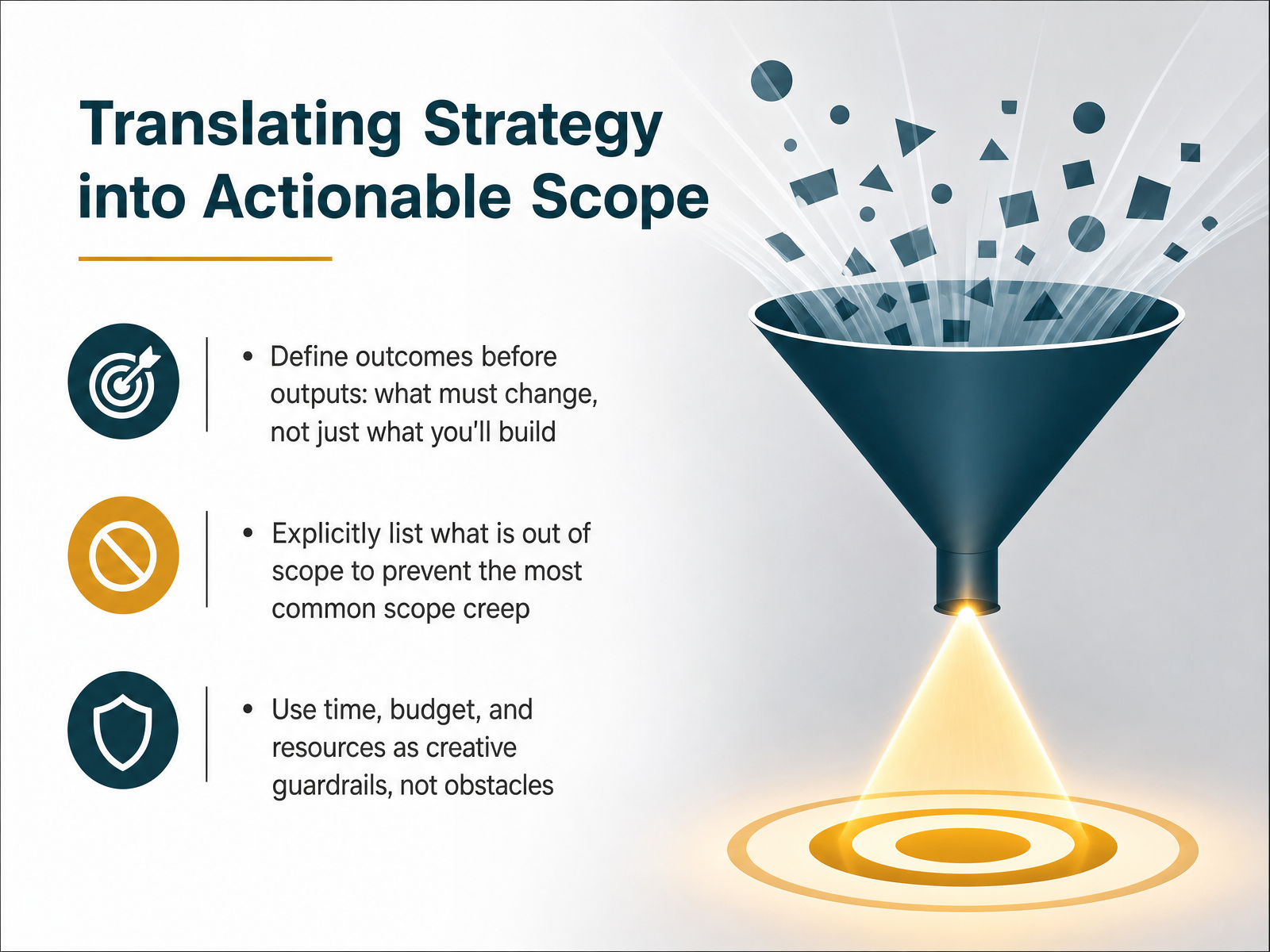
 - 04Translating Strategy into Actionable ScopeNow, let's look at how to translate that high-level strategy into an actionable scope. This is where we move from the big picture to the concrete boundaries of the work. The first step is to define the outcomes before the outputs. Ask yourselves, what must change in the business or for the user, not just what will we build. For example, instead of saying we will build a reporting dashboard, the outcome might be that the marketing team can make campaign decisions in under an hour. This shift in focus keeps the team aligned on the result, not just the feature. Next, we need to explicitly list what is out of scope. This feels counterintuitive, but it is our most powerful tool against scope creep. Clearly stating what the project will not deliver protects the team's focus and prevents those well-meaning add-ons that can derail a timeline. Finally, treat your time, budget, and resources as creative guardrails, not obstacles. Constraints force us to prioritize and innovate. When we know the hard limits, we can make smarter trade-offs and find the highest-impact path to the outcome. In the next slide, we'll explore how to communicate all of this clearly by writing for a cross-functional audience.
 pmexams.comcacm.acm.orga-sisyphean-task.com+22 min
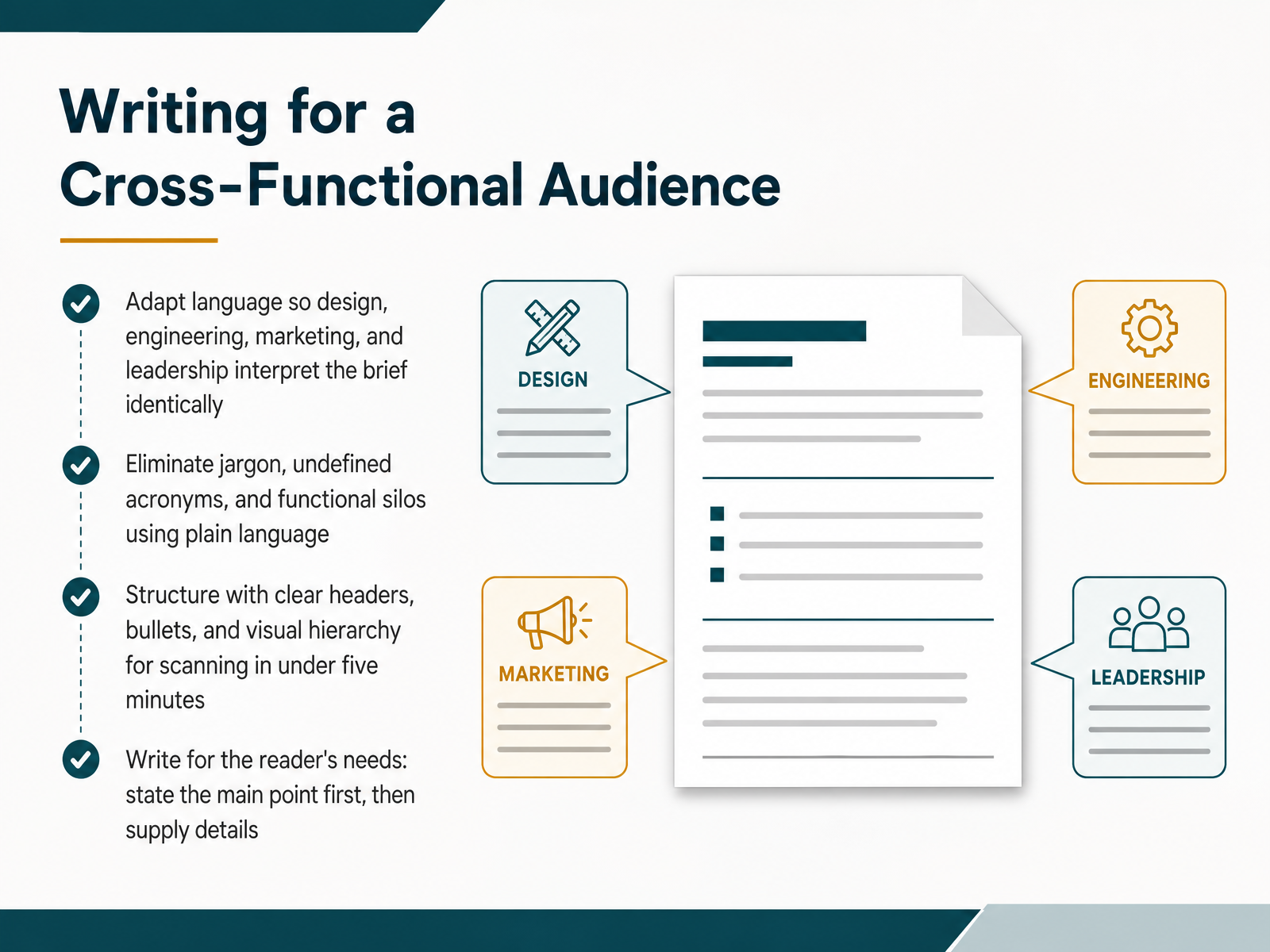
 - 05Writing for a Cross-Functional AudienceNow let's talk about writing for a cross-functional audience. When design, engineering, marketing, and leadership all read the same brief, they need to interpret it identically. That starts with removing jargon, undefined acronyms, and any language that only one team uses. Replace those with plain, everyday words your whole audience shares. If you must use a technical term, explain it the first time you see it. Next, structure your brief for speed. Use clear headers, short bullets, and a visual hierarchy so someone can scan it in under five minutes. The most important rule is to write for the reader's needs. State your main point first, then supply the details. That way, everyone walks away with the same understanding, and you avoid the rework that comes from misaligned language. Next, we'll look at a practical format for putting this into action: the one-page brief.
 archives.gov2 min
 - 06The One-Page Brief: A Practical FormatNow let's look at the one-page brief. It's the sharpest tool we have for cross-functional alignment. We use a simple six-part template: Problem, Goal, Metric, Scope, Risks, and Decision. Each section has a tight word-count target, so the document stays scannable. For example, the Problem section might be sixty to ninety words, while the Goal section might be forty to seventy. This discipline forces clarity. A good draft can be written in about forty-five minutes. Then you tighten it with structured feedback from your key stakeholders. The goal is to treat the signed brief as a practical contract, not a slide deck. When everyone agrees on this single page, you avoid countless hours of rework and confusion. Next, we'll walk through the entire briefing process, from that first draft to full alignment.
 pathhub.aiplane.sotaim.io+11 min
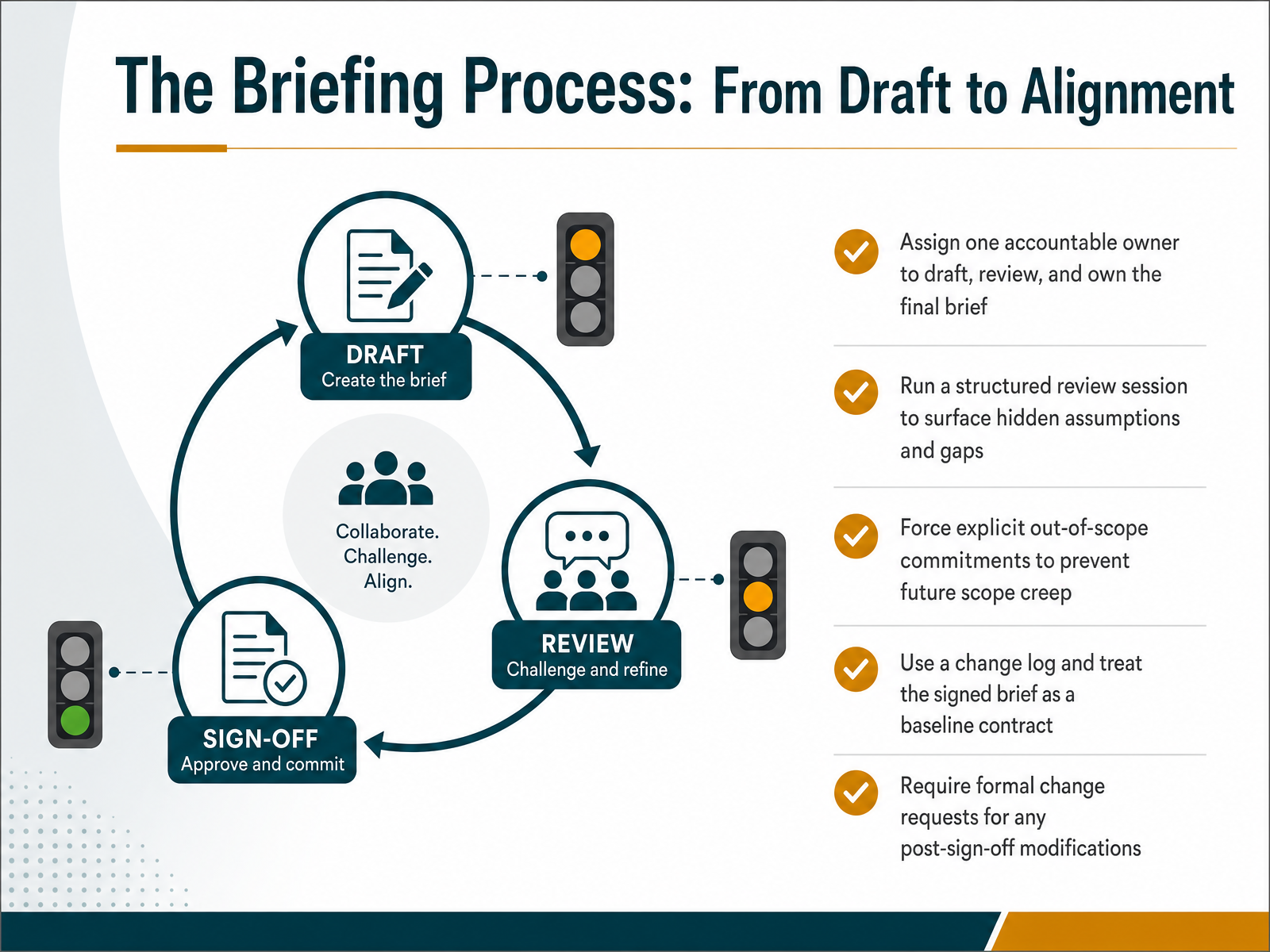
 - 07The Briefing Process: From Draft to AlignmentNow, let's walk through the briefing process itself, from draft to signed alignment. The first step is to assign one accountable owner who drafts, facilitates the review, and owns the final brief. This is not a shared responsibility; a single name prevents the document from becoming an orphan. Next, schedule a structured review session. This is not a casual read-through. Use a timed agenda and techniques like a parking lot to surface hidden assumptions and gaps before they become expensive rework. During that session, force explicit out-of-scope commitments. The items you explicitly exclude are just as important as what you include. Write them down to prevent future scope creep. Once the brief is stable, treat it as a baseline contract. Use a change log to track any modifications. Finally, require a formal change request for any post-sign-off adjustment. This discipline protects the team's capacity and keeps everyone aligned on the original agreement. Next, we'll look at how to facilitate these cross-functional brief review meetings effectively.
 2 min
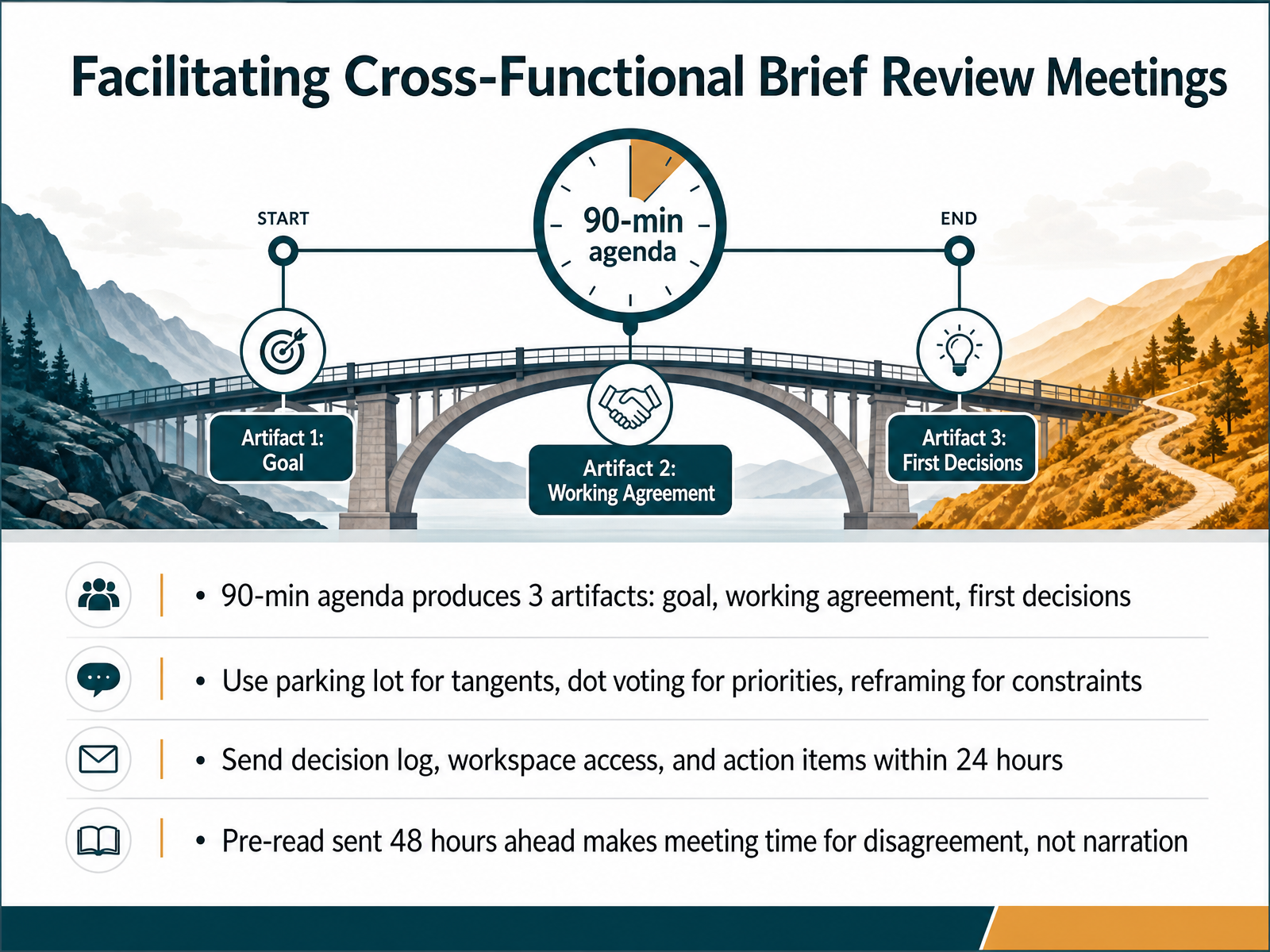
2 min - 08Facilitating Cross-Functional Brief Review MeetingsNow, let’s move into the practical rhythm of facilitating the review itself. A ninety-minute cross-functional brief review is designed to produce three specific artifacts before you leave the room: a single-sentence goal, a working agreement, and the first committed decisions. To get there, you need a few reliable tools. Use a parking lot to capture tangents without losing momentum. When priorities clash, stop debating and use dot voting to let the group’s visual consensus speak. When someone says something is impossible, reframe the constraint by asking what alternative achieves the same goal. These techniques keep the session productive. After the meeting, your follow-up is critical. Within twenty-four hours, send out the decision log, grant access to the shared workspace, and confirm the action items with owners and dates. And remember, this ninety-minute session only works if you send a pre-read forty-eight hours in advance. The meeting should be used for disagreement and alignment, not for narrating a document people could have read on their own. Next, we’ll look at how to surface risks, assumptions, and the decision needed to keep the project honest.
 2 min
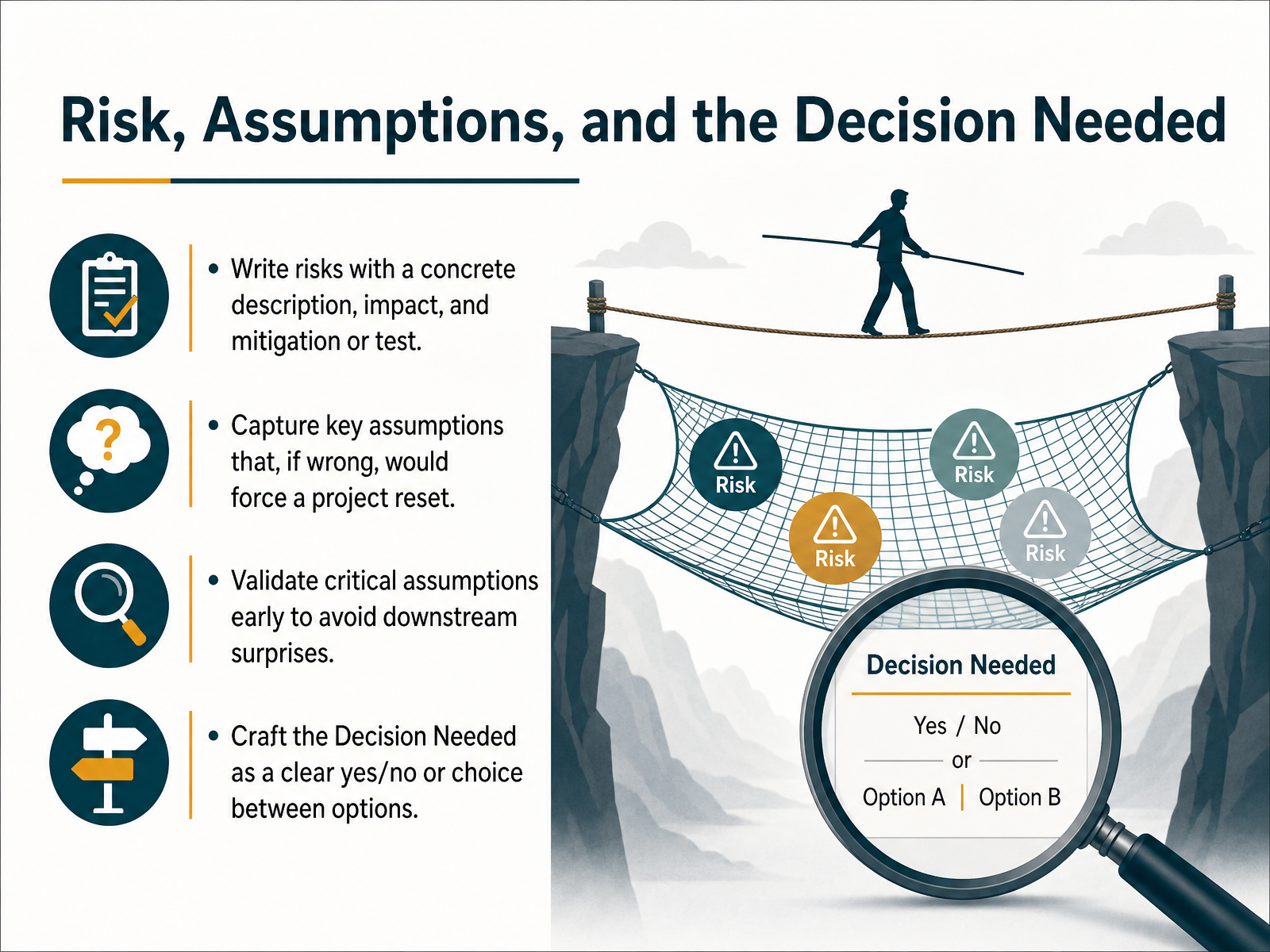
2 min - 09Risk, Assumptions, and the Decision NeededNow let's talk about a section that often makes teams uncomfortable: risks, assumptions, and the decision you need. But here's the thing: naming them early is what keeps a project from derailing later. First, write risks with three parts. A concrete description of what could happen, the impact if it does, and a way to mitigate or test it early. So instead of writing 'we might miss the deadline,' you write 'the vendor API might be unstable, which could delay integration by two weeks. We'll run a proof of concept in week one to test it.' Next, capture your key assumptions. These are the things you're taking as given. If an assumption turns out to be wrong, it could force a full reset. So name them and plan to validate the critical ones early to avoid downstream surprises. Finally, craft the decision needed as a clear yes or no, or a choice between options. This turns your brief into a contract. For example, 'Approve a six-week build starting June third, with a checkpoint at week three to confirm the success metric trajectory.' Next, we'll walk through a practical checklist to assess your brief's quality before you share it.
 plane.sopathhub.aiones.com+22 min
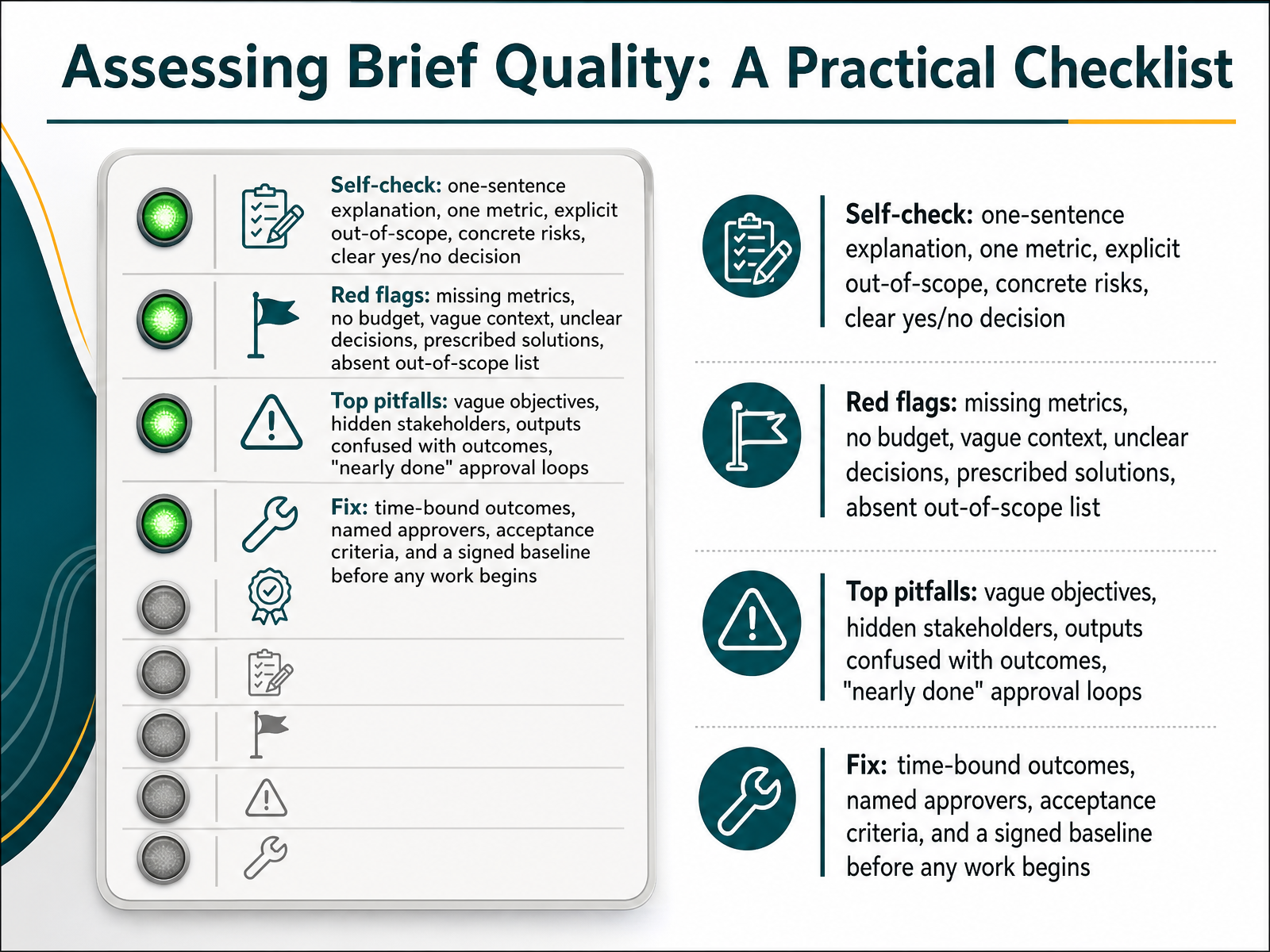
 - 10Assessing Brief Quality: A Practical ChecklistNow let's look at a practical checklist you can use to pressure-test your brief before anyone writes a single line of code. First, the self-check. Can you explain the project in one sentence and tie it to one measurable metric? Have you written down what is explicitly out of scope, and named the concrete risks that could delay delivery? And most importantly, can a stakeholder read your brief and answer a clear yes or no on whether to proceed? If not, tighten it. Next, watch for red flags. If you see missing metrics, no budget range, vague context, or unclear decision rights, the brief is not ready. The absence of an out-of-scope list is an especially dangerous signal—it leaves the door open to scope creep. The top pitfalls usually come down to three things. Vague objectives that sound good but can't be measured. Hidden stakeholders who appear late with new requirements. And confusing outputs—like impressions—with real outcomes. The fix is straightforward. Define time-bound outcomes, name the specific approvers, write clear acceptance criteria, and get a signed baseline before any work begins. Up next, we'll break down the top mistakes and how to avoid them.
 toimi.protaim.ioplane.so2 min
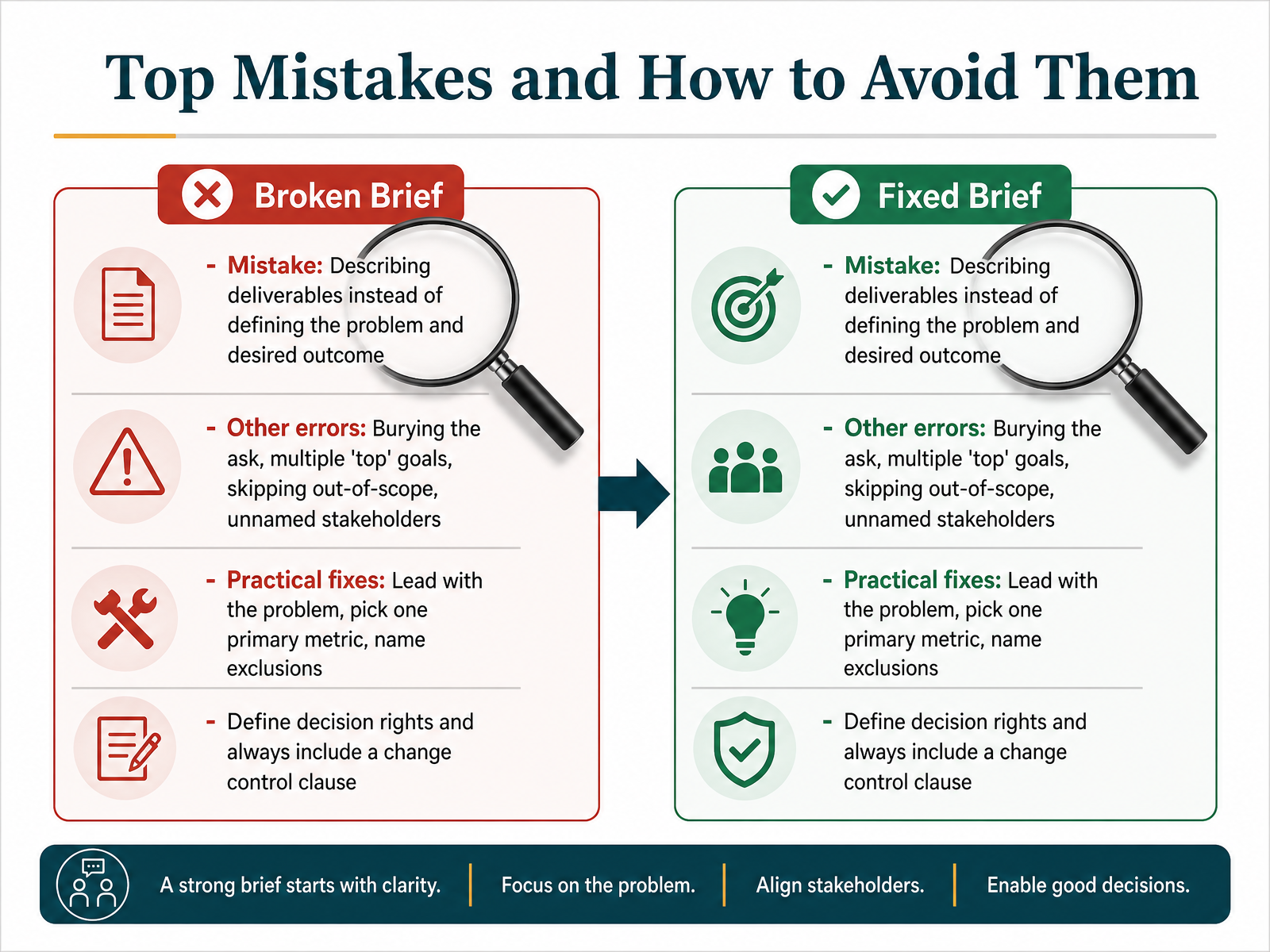
 - 11Top Mistakes and How to Avoid ThemNow let's talk about the most common mistakes that turn a project brief into a source of confusion, and the practical fixes you can apply right away. The biggest mistake is describing deliverables instead of defining the problem and the desired outcome. If you only say "we need a customer portal," the team starts building features without understanding what business pain they're solving. Instead, lead with the problem. Say something like "customers wait four days for a response, and our target is four hours." That gives everyone a clear purpose. Other frequent errors include burying the ask in a long document, having multiple top goals that compete for resources, skipping the out-of-scope section, and leaving stakeholders unnamed. The fixes are simple but powerful. Pick one primary metric so the team knows what good looks like. Name specific exclusions to prevent scope creep. Define decision rights by naming the final approver, not just a role. And always include a change control clause so that scope adjustments are managed, not assumed. Let's carry these principles forward and look at adapting the brief for different project types.
 taim.iotoimi.proplane.so2 min
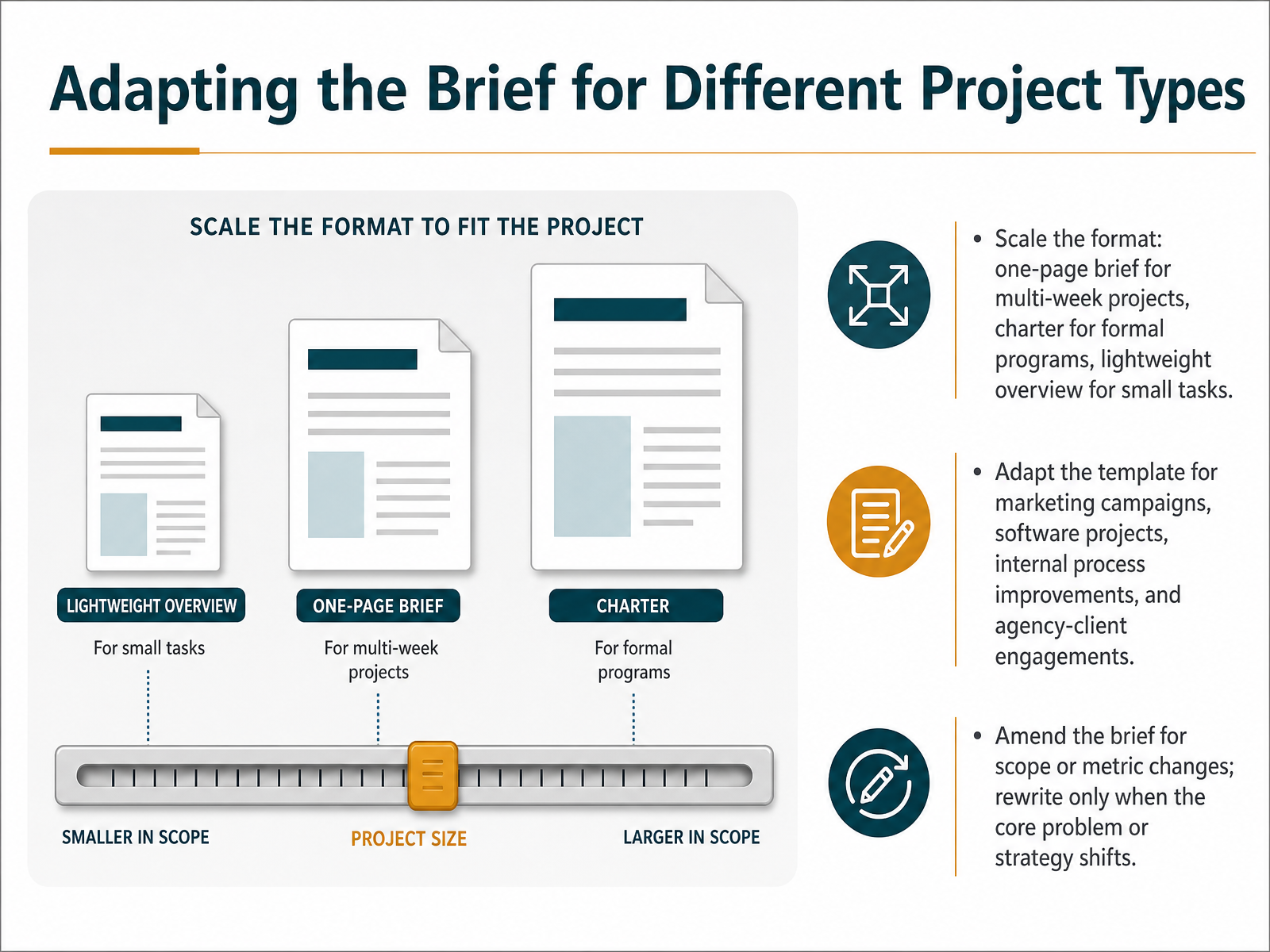
 - 12Adapting the Brief for Different Project TypesNow let's talk about adapting the brief for different kinds of projects. The format should scale to the work. For a multi-week project, aim for that one-page brief. For a formal program with a large budget and multiple teams, a longer charter makes sense. And for a small, quick task, a lightweight overview or even a well-structured email might be enough. The template itself is flexible. You can use the same core sections for marketing campaigns, software projects, internal process improvements, or agency-client engagements. What changes is the depth of detail, not the structure. Finally, know when to update it. Amend the brief when the scope or metrics change. You only need a full rewrite when the core problem or strategy shifts. Treat the brief as a living log, but protect its role as a stable contract. Coming up next, we'll put this into practice with a hands-on exercise: Draft and Review a Real Brief.
 pathhub.aiplane.sotaim.io+12 min
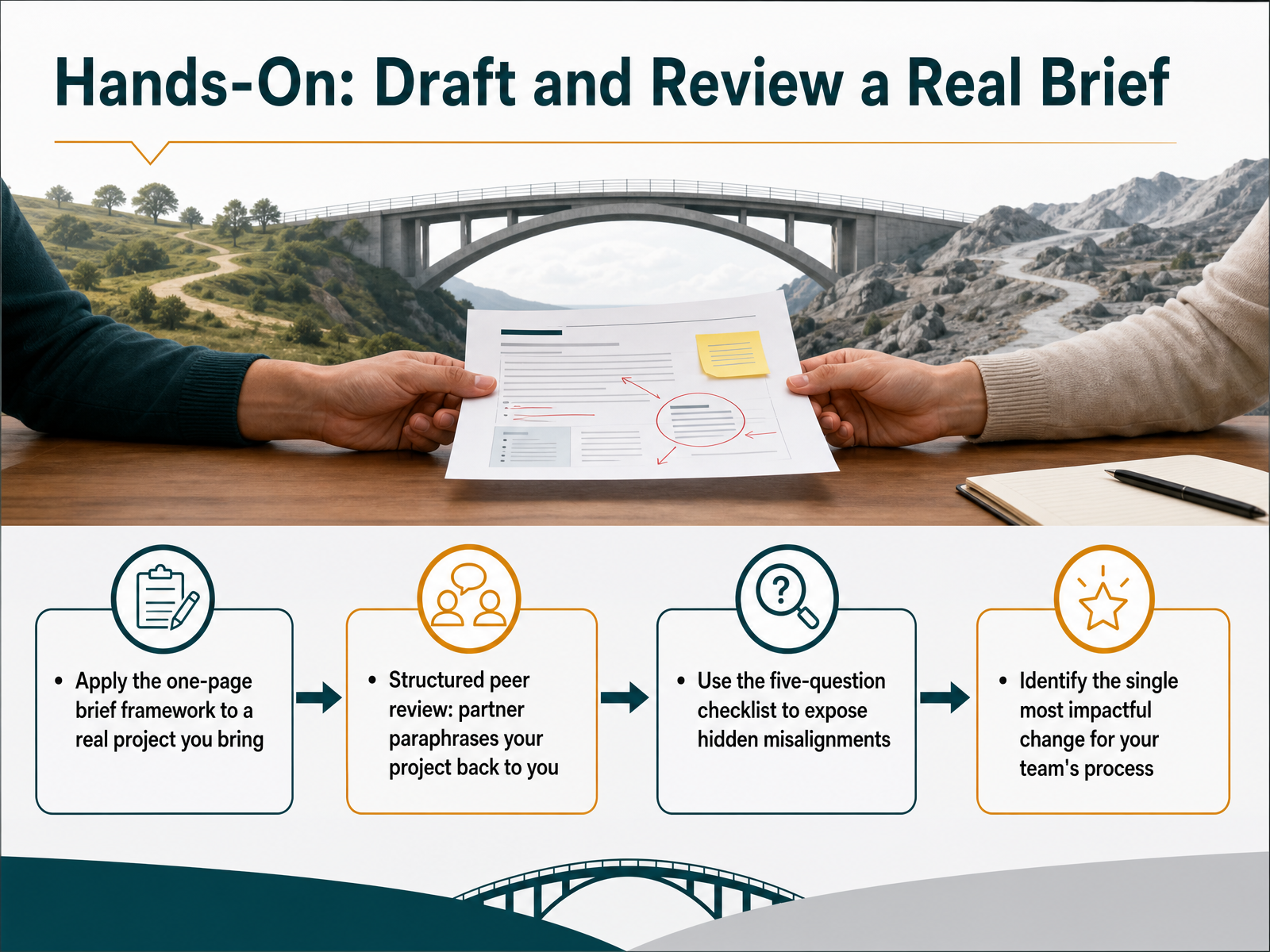
 - 13Hands-On: Draft and Review a Real BriefNow it’s your turn to put the framework into practice. Take a real project you’re working on and draft it using the one-page brief structure. Start with the problem and goal, define scope in and out, and name one primary success metric with a baseline and target. Then we’ll pair you up for a structured peer review. Your partner will paraphrase the project back to you. If their words diverge from your intent, you’ve just found a hidden misalignment. Next, run the five-question checklist: Is the problem clear? Is there exactly one measurable metric? Are tempting extras explicitly out of scope? Are risks paired with mitigations? And is the decision-needed line a clear yes or no? Use what you uncover to identify the single most impactful change for your team’s process. Fix that one thing, and you’ll prevent the rework that usually comes from unspoken assumptions. Coming up next, we’ll build a personal action plan so this skill sticks beyond today’s session in Sustaining the Skill: Action Plan and Resources.
 pathhub.aiplane.sotaim.io+12 min
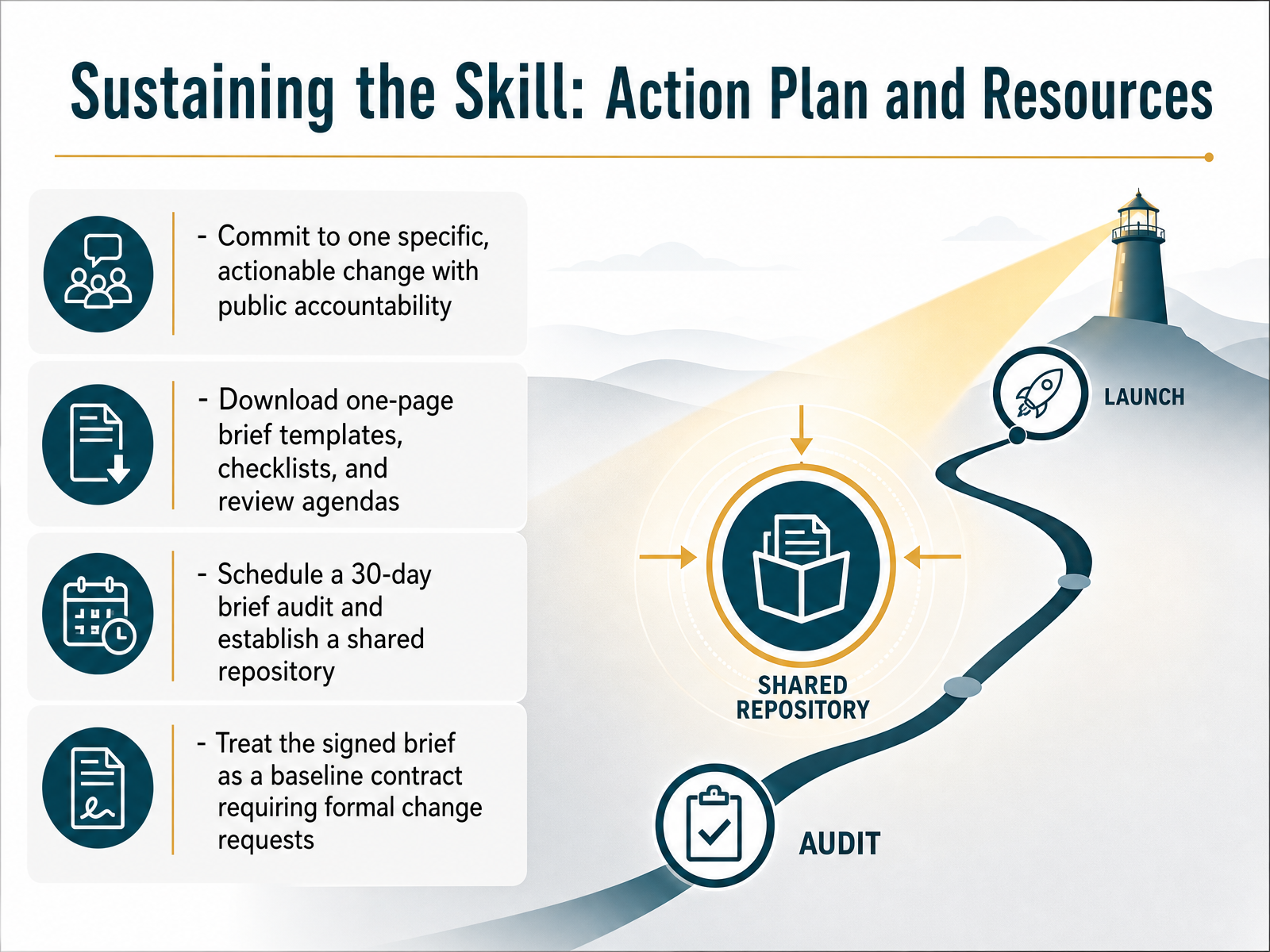
 - 14Sustaining the Skill: Action Plan and ResourcesWe have covered the structure and the reasoning. Now let's make sure this skill sticks. Sustaining clarity is a team habit, not a one-time event. Your first action step is to commit to one specific change in your next kickoff. Pick one thing, like always naming out-of-scope work explicitly, and tell your teammates you will do it. Public accountability turns good intentions into real practice. Next, download the one-page brief templates, checklists, and review agendas from the resource hub. These are practical tools, not just theory, and they make it easier to apply what you learned right away. Then, schedule a thirty-day brief audit. Block thirty minutes to review your active briefs against the criteria we discussed. Establish a shared repository where the latest signed version lives, so no one wastes time on an outdated draft. Finally, treat the signed brief as a baseline contract. Once work begins, any change to scope, timeline, or budget requires a formal change request, not a quiet edit. This protects the team and the work. Thank you for joining this session. The best briefs are not the longest; they are the clearest. Go make clarity your competitive advantage.
 pathhub.aiplane.sotaim.io+12 min
Take the deck with you
Download this course as a file — free, no sign-up needed.
- PDF handoutEvery slide page, ready to print or share.15 pages · 3.6 MBDownload
- Narrated PowerPointThe deck that presents itself — every slide carries the digital human's narration video.15 pages · 18.9 MBDownload
- PowerPoint slidesThe full deck as a .pptx — open it in PowerPoint, Keynote, or Google Slides.15 pages · 3.5 MBDownload
Free to use in your own training — please keep the PersonWise credit page at the end.
Have your own deck? Turn it into a course
Sources consulted
Web sources consulted while building this course.
- Impact of project briefing clarity on construction project performance — doi.org
- Assessing the impact of project brief clarity using project definition rating index tool and system dynamic — doi.org
- Assessing the Impact of Poor Requirements on Companies — iag.biz
- https://dctradesmentoring.com/wp-content/uploads/2023/07/Construction_Disconnected.pdf — dctradesmentoring.com
- The High Cost of Low Performance 2014 | PMI Pulse of Profession — pmi.org
- How to write a project brief: Template and examples | Plane Blog — plane.so
- PRD vs Product Brief vs Spec 2026: When to Use Each — ideaplan.io
- Creative brief template: step-by-step guide for effective projects in 2026 — monday.com
- Product Brief Template: How to Write One + Steps [2026] — asana.com
- How To Write a Product Brief: Product Brief Template + Guide (2026) - Shopify — shopify.com
- Project Brief Template 2026 (Free) — Structure + Example — pathhub.ai
- How to Write a Project Brief | ONES.com Blog — ones.com
- Writing a project brief people actually read | Taim.io — taim.io
- How to Write a Project Brief: Complete Guide — toimi.pro
- PMI-CP Outcome-Focused Scope Definition | PM Exams — pmexams.com
- Software Project Scope Alignment: An Outcome-Based Approach — cacm.acm.org
- Using Outcome Based Documentation for Scoping Agile Developments | Creating Software - A Sisyphean Task? — a-sisyphean-task.com
- Scope Management User Guide — projectperfect.com.au
- Project management - Scope — marcus.codes
- Top 10 Principles for Plain Language | National Archives — archives.gov