Project Kickoff Planning
Begin
15 pages · ~30 min
Project Kickoff Planning
Learn how to plan and execute a successful project kickoff meeting to align your team and set clear expectations from the start.
What you’ll learn
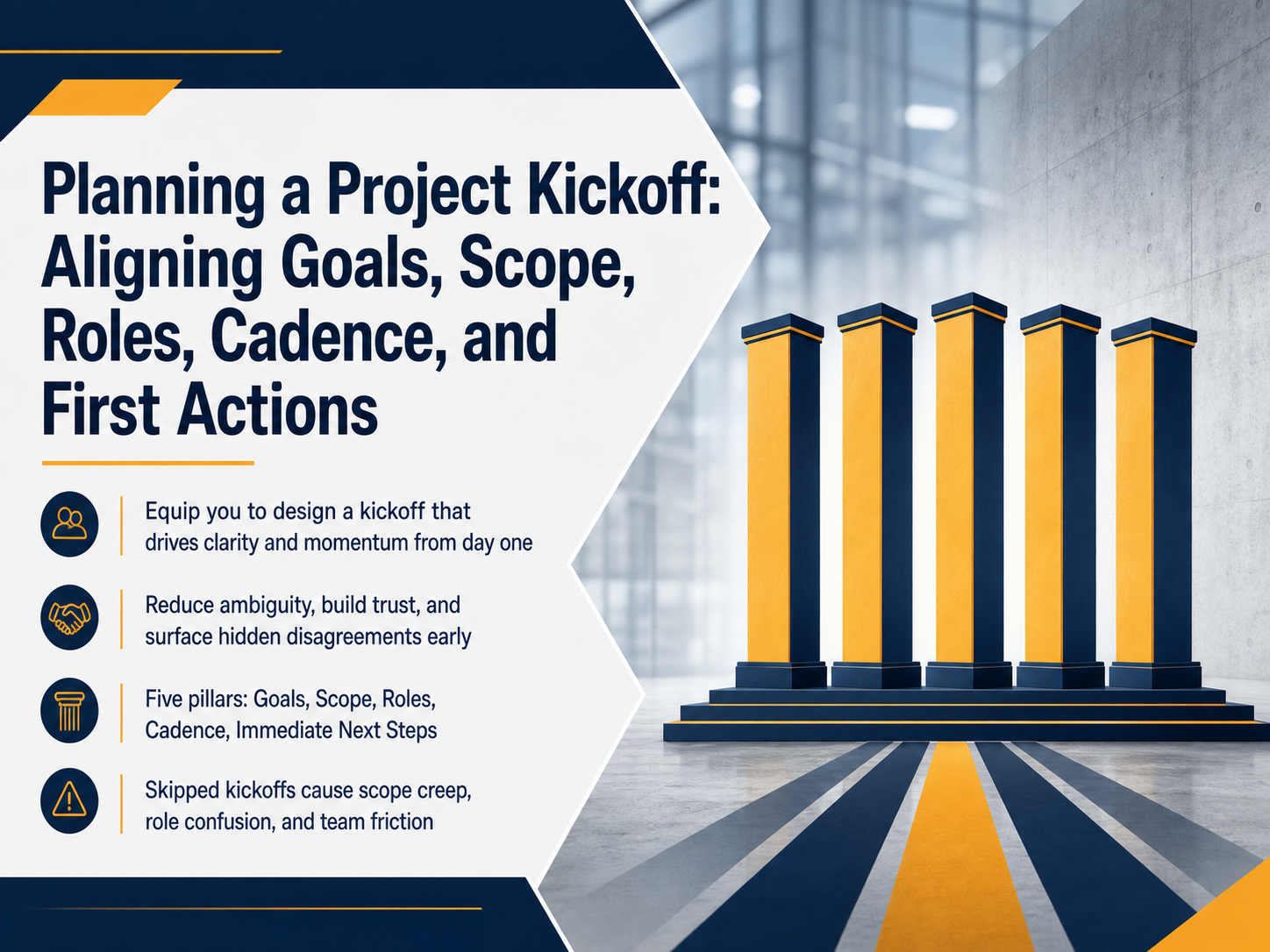
- 01Planning a Project Kickoff: Aligning Goals, Scope, Roles, Cadence, and First ActionsWelcome. I'm glad you're here. We are going to talk about planning a project kickoff. The goal is simple: align the team on goals, scope, roles, cadence, and first actions so you can build real momentum from day one. Think about past projects where things drifted. Often the root cause is a skipped or rushed kickoff. That leads to scope creep, role confusion, and friction that slows everyone down. We want to prevent that. Today we will focus on five pillars. First, we set clear goals everyone agrees on. Then we lock in scope so we all know what we are and are not building. Next, we define roles explicitly so decisions don't stall. We also set a meeting cadence that keeps us accountable without burning people out. And finally, we agree on immediate next steps so we leave the room with momentum. By the end, you'll be equipped to design a kickoff that surfaces hidden disagreements early and builds trust from the start. Let's move into the strategic purpose of a modern kickoff.2 min
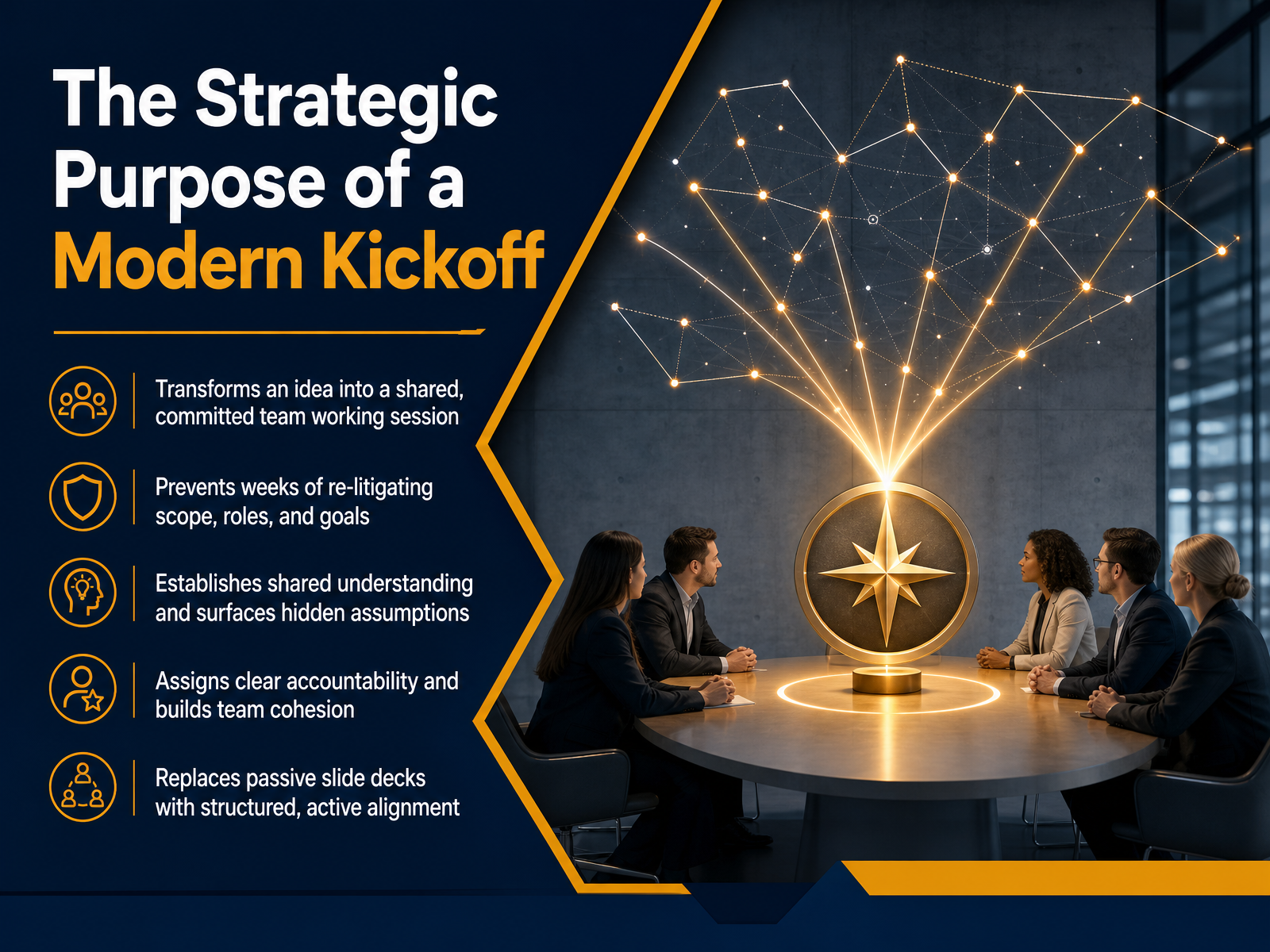
- 02The Strategic Purpose of a Modern KickoffNow let's look at what a modern kickoff actually achieves for your project. Think of it this way. A kickoff transforms an abstract idea into a committed, shared working session. Every team member leaves with the same picture in their head. That alone prevents weeks of re-litigating scope, roles, and goals down the road. We surface hidden assumptions early. You know, the ones that usually surface as surprises later. We also assign clear accountability right there in the room. Names next to actions. That builds real team cohesion, not just slide-deck politeness. In short, we replace passive presentations with structured, active alignment. Next, let's get specific about clarifying strategic goals and measurable success criteria.
 1 min
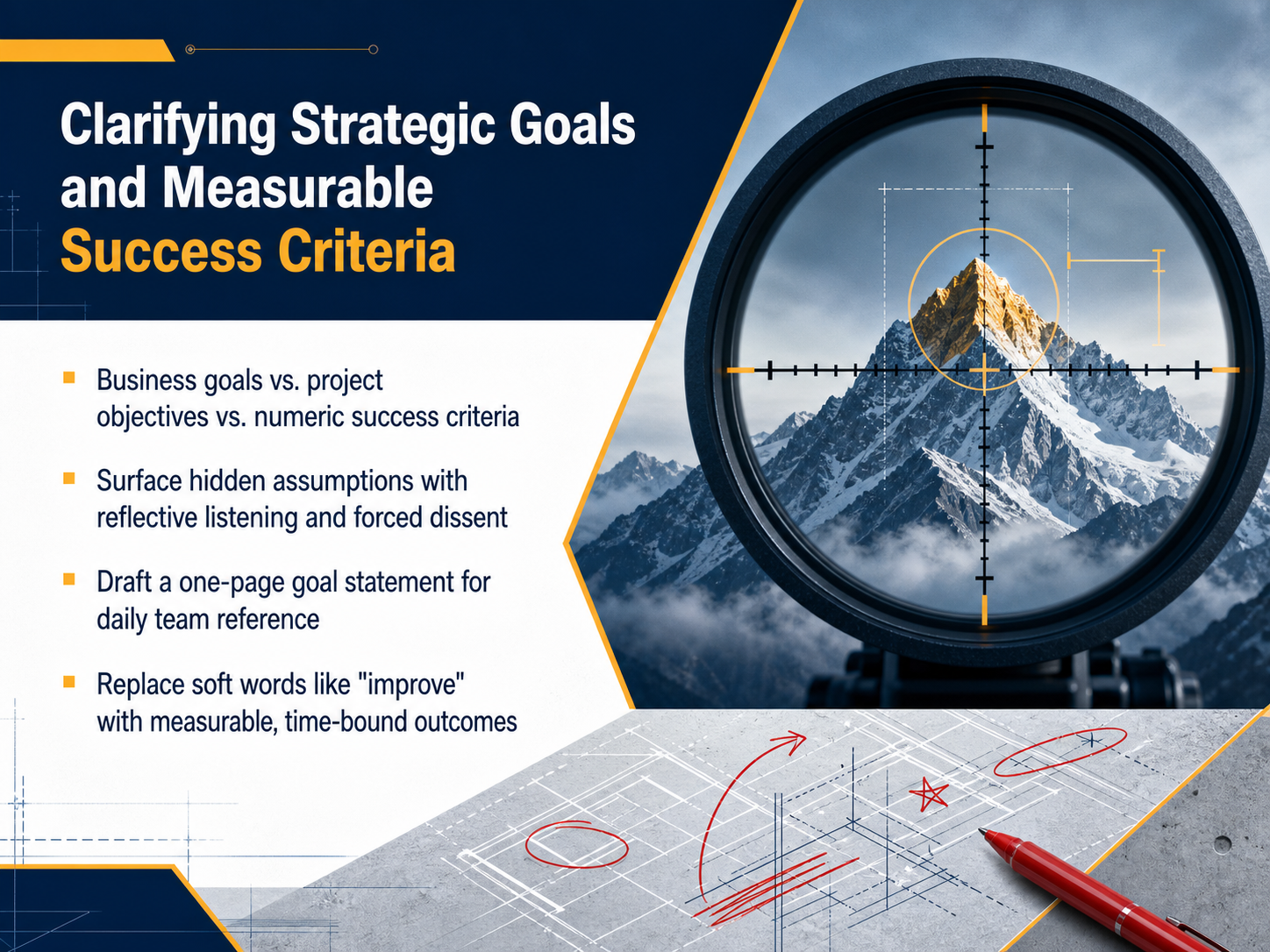
1 min - 03Clarifying Strategic Goals and Measurable Success CriteriaLet’s get specific about what success actually looks like for this project. We often mix up business goals, project objectives, and the numbers that tell us we’ve won. A business goal is the big picture, like expanding into a new market. A project objective is what we will build or do to get there, like launching a localized ordering app. And a success criteria is the hard number attached to a deadline, for example, two thousand monthly active users in the new region within ninety days. To test these, we need to uncover assumptions nobody is saying out loud. Try asking “What would need to be true for this goal to fail?” and use reflective listening to push back. It feels awkward, but it works. Once aligned, draft a one-page goal statement your team can glance at every morning. And ruthlessly replace soft words like “improve” with measurable, time-bound outcomes. Now, even a clear goal needs clear boundaries. Next, we’ll define our scope boundaries and the trade-off levers we can pull when things get tight.
 2 min
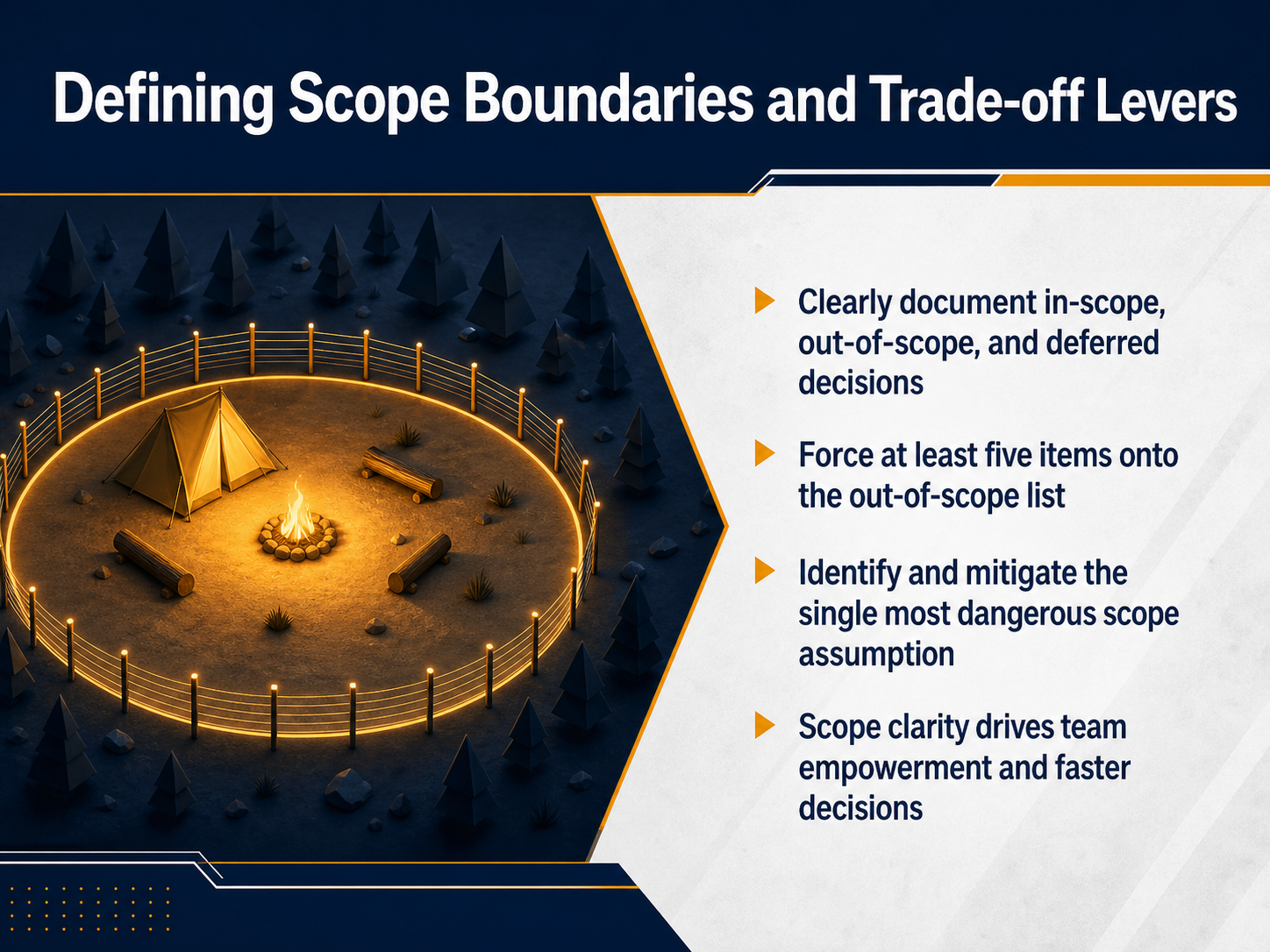
2 min - 04Defining Scope Boundaries and Trade-off LeversNow we get concrete about what’s in and what’s out. Start by clearly documenting three categories: in-scope, out-of-scope, and deferred decisions. This isn’t just a list—it’s our contract with each other. I’m going to challenge you here: force at least five items onto the out-of-scope list. Why five? Because the team that says yes to everything probably delivers very little. Push back early to protect what truly matters. Next, let’s find the single most dangerous scope assumption—the quiet belief that could unravel our timeline if it’s wrong. Name it, and then immediately agree on how we’ll check it. When we do all this, scope clarity becomes our engine. It gives the team the power to say no, to move fast, and to make decisions without waiting for permission. Let’s apply that same ownership mindset to the next piece—mapping roles, decision rights, and accountability.
 1 min
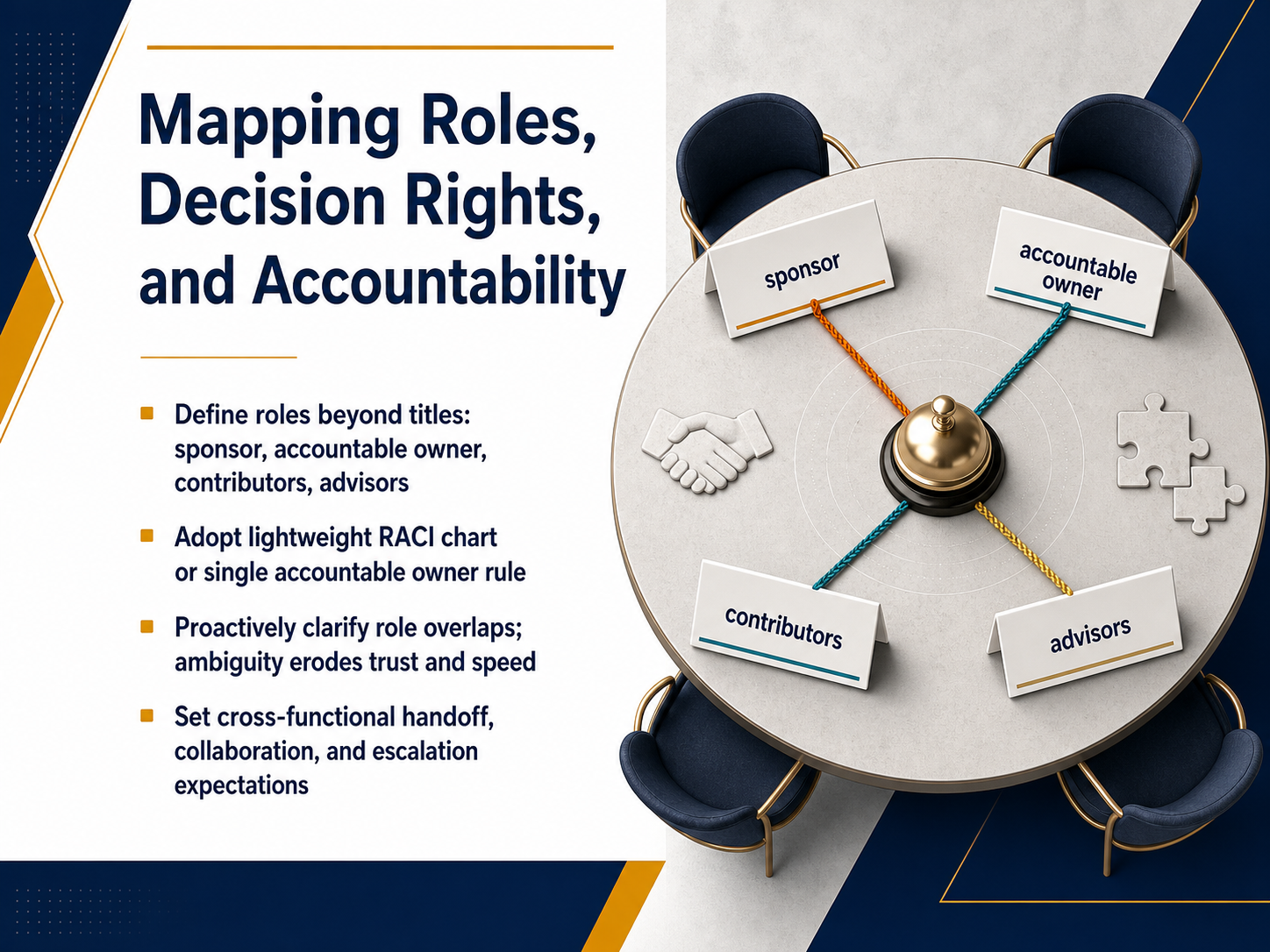
1 min - 05Mapping Roles, Decision Rights, and AccountabilityNow let's make ownership real, not just a label. We move beyond job titles and define actual roles here. Think about who is the sponsor, who is the single accountable owner, and who are the contributors and advisors. A lightweight RACI chart works wonders, or we simply apply the rule of one accountable owner per work stream. Ambiguity kills speed, so let's proactively clarify any overlaps right now. We also set clear expectations for cross-functional handoffs and how we escalate issues. When everyone knows their decision rights, trust goes up and execution accelerates. Next, we'll design the project cadence and communication rhythm to lock this alignment in.
 1 min
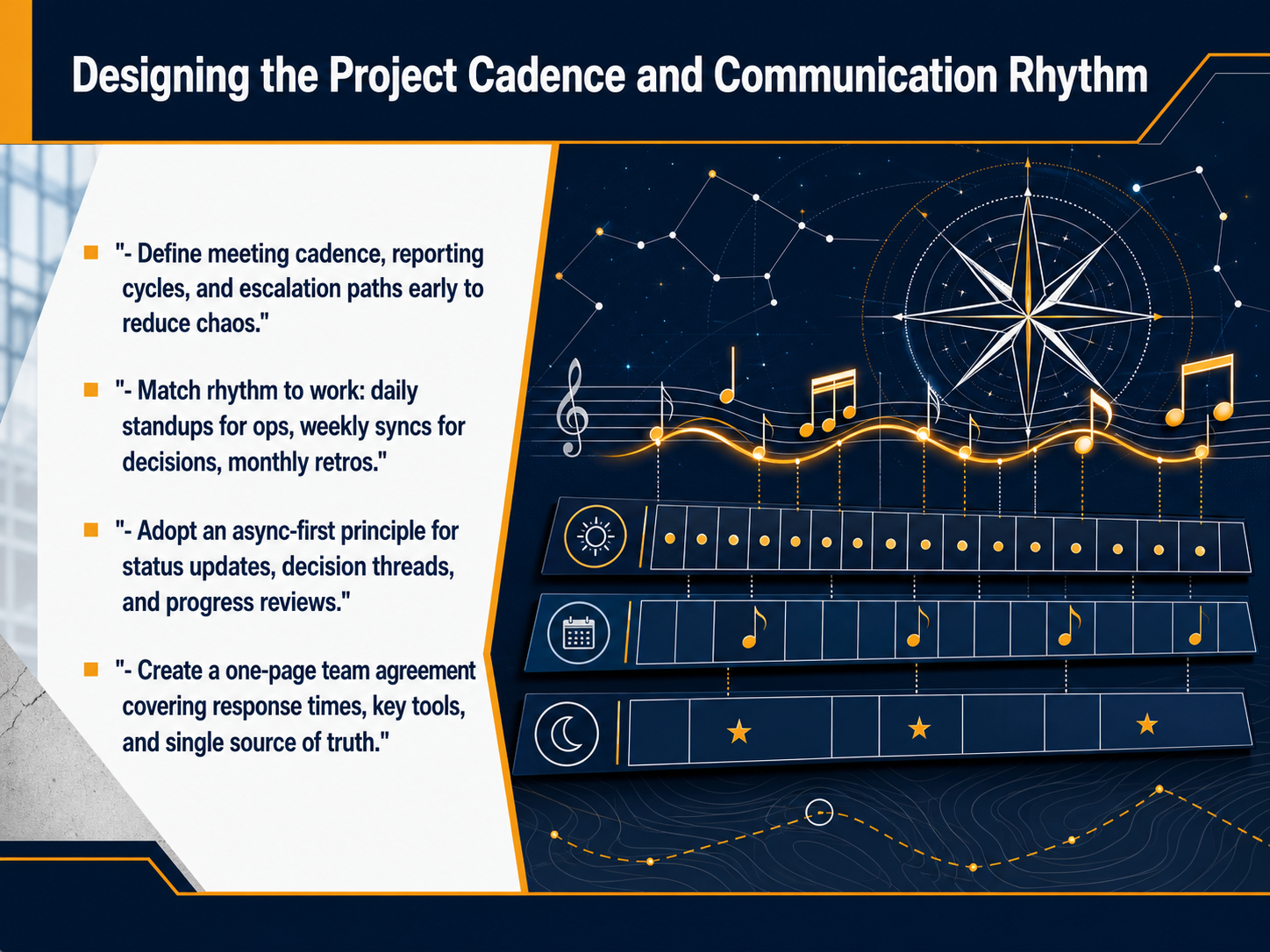
1 min - 06Designing the Project Cadence and Communication RhythmLet’s get practical and design how we’ll actually work together week to week. Setting our cadence and communication rhythm early removes a ton of chaos later. Start by defining three things: our meeting schedule, how we report status, and clear escalation paths. Then, match the rhythm to the work. If we’re running daily operations, a quick 15-minute standup works best. For bigger decisions, a weekly sync gives us the right forum. And to step back and learn, we schedule a monthly retrospective. We should also adopt an async-first mindset. Put status updates, decision threads, and progress reviews in our shared channels first. This lets everyone contribute on their own time and keeps meetings focused on discussion, not just reading out reports. To make all this stick, I recommend we create a simple one-page team agreement. It captures our expected response times, names the key tools we’ll use, and points everyone to a single source of truth for project documents. That clarity prevents endless searching and mixed messages. Next, let’s explore the balance between synchronous and asynchronous work models.
 2 min
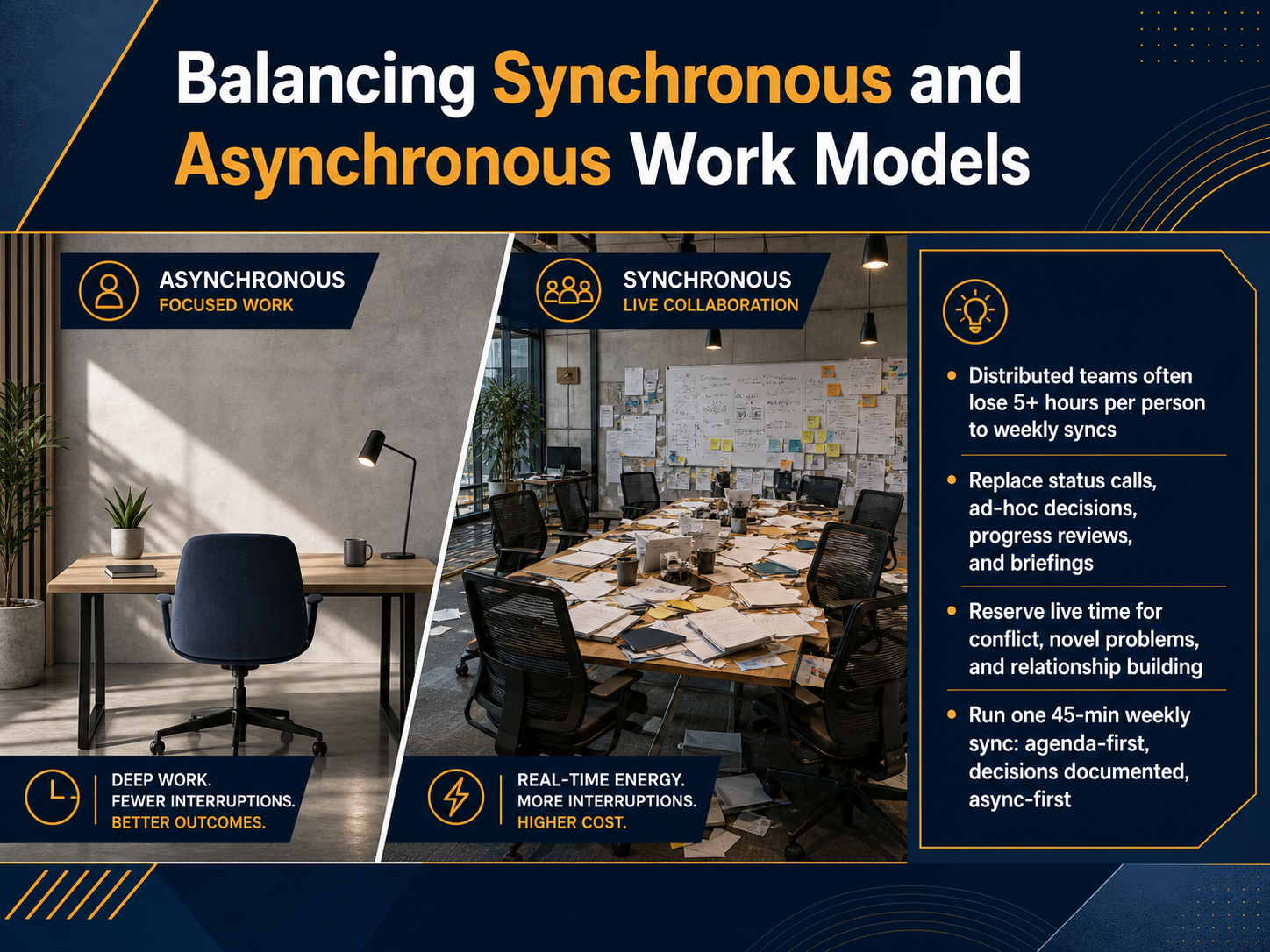
2 min - 07Balancing Synchronous and Asynchronous Work ModelsLet's talk about something that quietly drains our teams. Distributed teams often lose more than five hours per person every week just in status meetings. That time adds up fast. We should replace those standard status calls, ad-hoc decision threads, progress reviews, and long briefings with written updates. Reserve our live time for the work where real-time conversation matters most. That means tackling conflict, solving completely novel problems, and building relationships. Here is a practical rule. Run just one forty-five-minute weekly sync. Come in with an agenda already set, document decisions immediately, and default to asynchronous work for everything else. This keeps us moving fast without burning out. Now let's translate that philosophy into a concrete plan. Next, we will focus on structuring the kickoff agenda for engagement and output.
 1 min
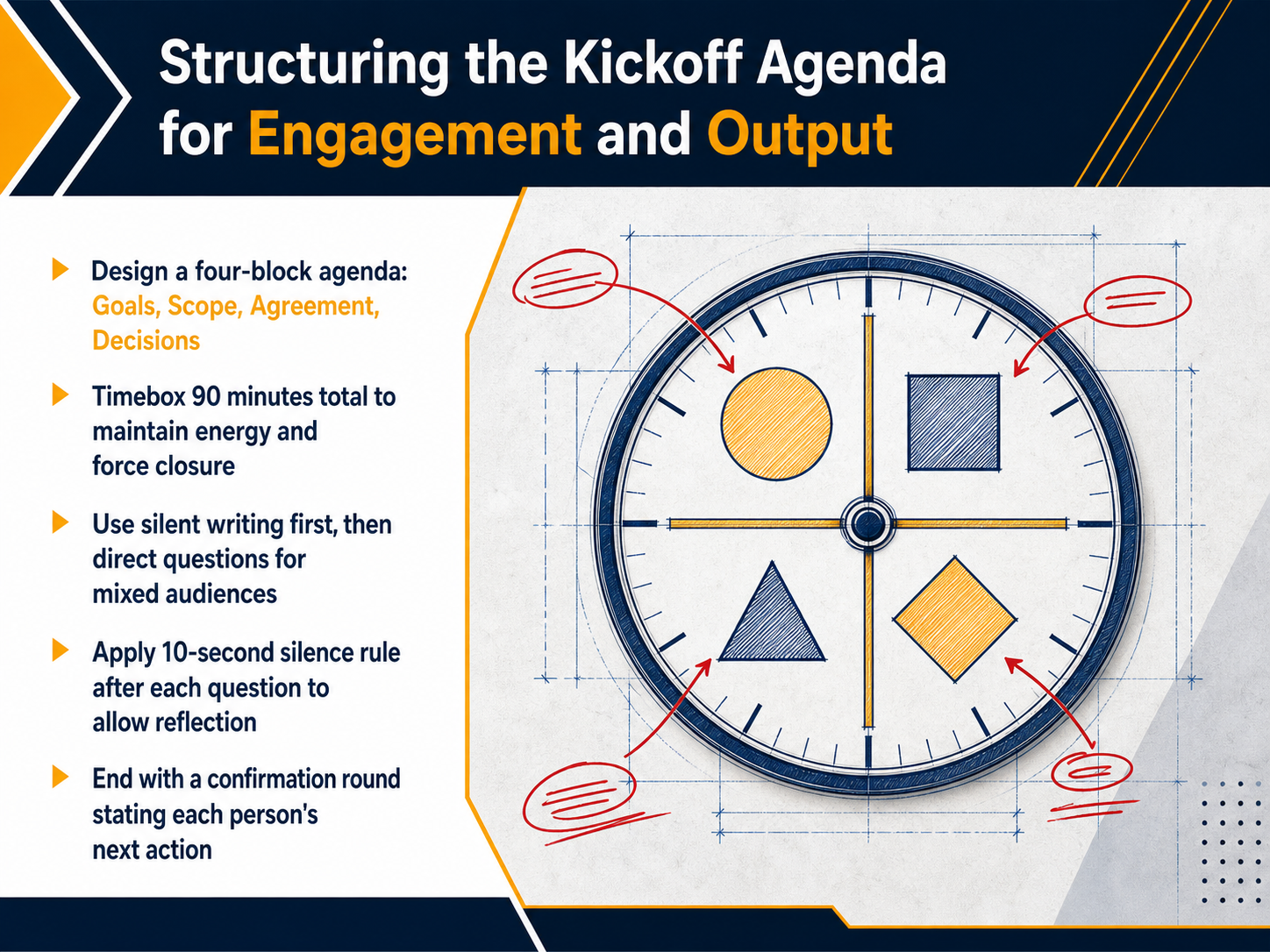
1 min - 08Structuring the Kickoff Agenda for Engagement and OutputLet's structure a kickoff agenda that people actually want to participate in. We'll design four clear blocks. First, Goals. We align on why we're here. Second, Scope. We define exactly what's in and what's out. Third, Agreement. We confirm roles, timeline, and how we'll work together. Fourth, Decisions. We capture the choices we need to make right now. We'll timebox the whole thing to ninety minutes. This keeps energy high and forces us to reach closure. For mixed audiences, start with silent writing. Give everyone a few minutes to jot down thoughts before open discussion. This balances introverts and extroverts. When you ask a direct question, apply the ten-second silence rule. Count slowly in your head. That space lets people reflect and often leads to more honest answers. Finally, end with a confirmation round. Go around the room, or the virtual room, and have each person state their single next action out loud. This transforms talk into ownership. Up next, we'll look at your pre-kickoff preparation during the forty-eight-hour window before the meeting.
 2 min
2 min - 09Pre-Kickoff Preparation: The 48-Hour WindowNow let's talk about the most critical window—the forty-eight hours before your kickoff. This is where a great meeting is won or lost. First, send a one-page strawman pre-read forty-eight hours before the meeting. This isn't a polished document. It's a draft of the scope, goals, and key decisions you think need to be made. It gets people thinking early, so they don't walk into the room cold. Next, schedule a private twenty-minute call with your sponsor. Use this time to pre-align on the scope. You want to surface any concerns privately so you can address them before the larger group sees them. Then, cut the spectators. Ask yourself a simple question: will this person provide input or make a decision? If the answer is no, they don't need to be there. Finally, pre-fill all shared templates with the information you already have. Things like the timeline, the roster, and known risks. This reserves the meeting time for debate and decision-making, not data entry. So, the forty-eight-hour window is all about removing surprises and creating space for real conversation. Let's turn that conversation into action now and define our immediate first steps and build a decision log.
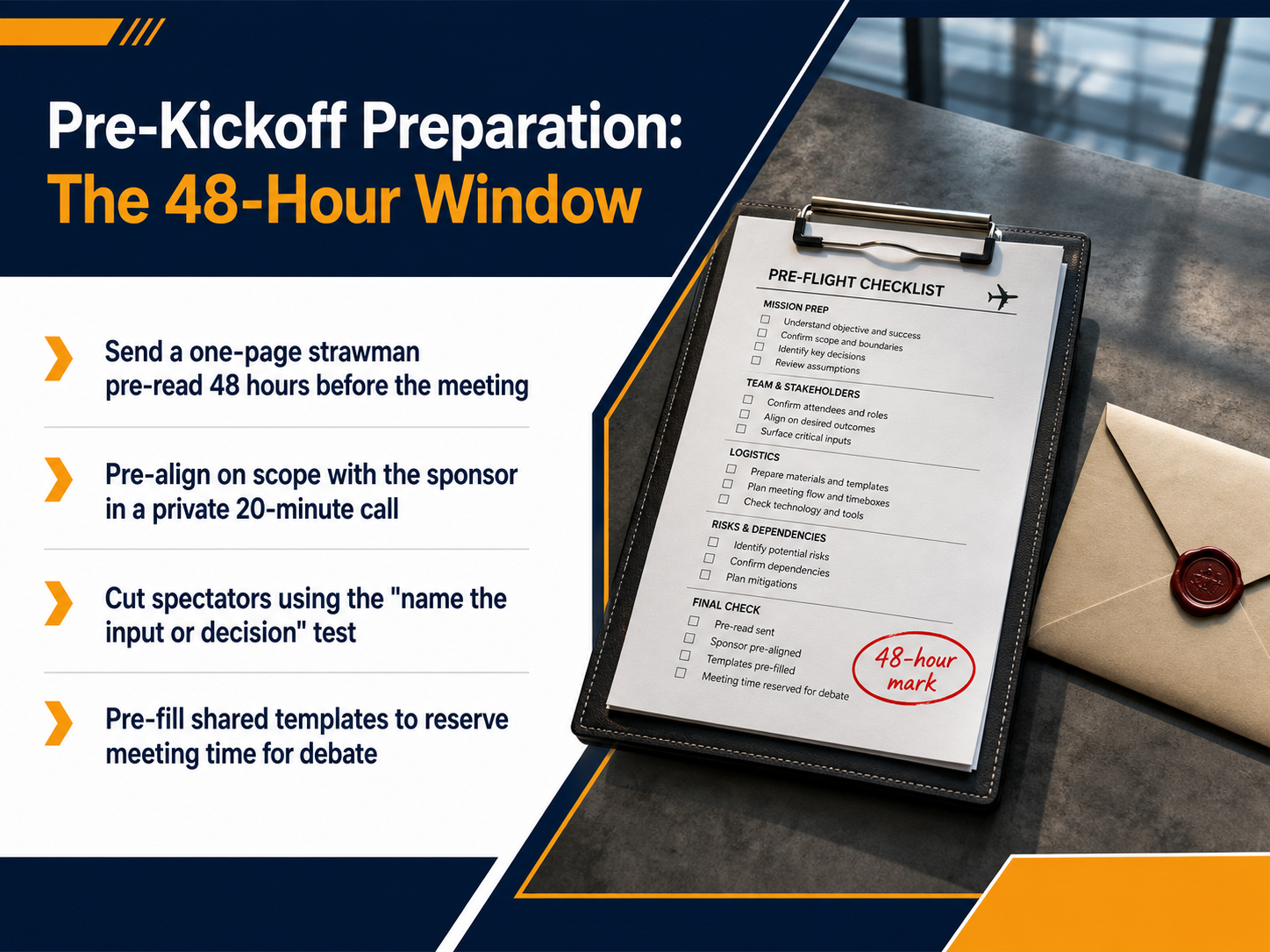 2 min
2 min - 10Defining Immediate First Actions and Building a Decision LogLet’s turn our planning into clear, immediate moves. We’ll start by pulling out two lists from today’s outputs: a forty-eight-hour action list and a first-week action list. For each item, assign one owner and a real deadline. Keep it simple. Next, pick just one or two high-signal first actions. These are moves that build credibility fast and let us test the working agreement we just set. For example, shipping a draft comms plan to stakeholders in two days shows follow-through. Now, we need a single source of truth for decisions. Set up a decision log with four columns: date, decision, owner, and rationale. One row per decision. This keeps us aligned and avoids re-litigating choices later. Finally, close the loop within twenty-four hours. Send a summary email, calendar invites for key syncs, and a link to the project workspace. Make sure everyone can access it immediately. That’s how we turn readiness into momentum. Now let’s shift to identifying risks and creating a team working agreement.
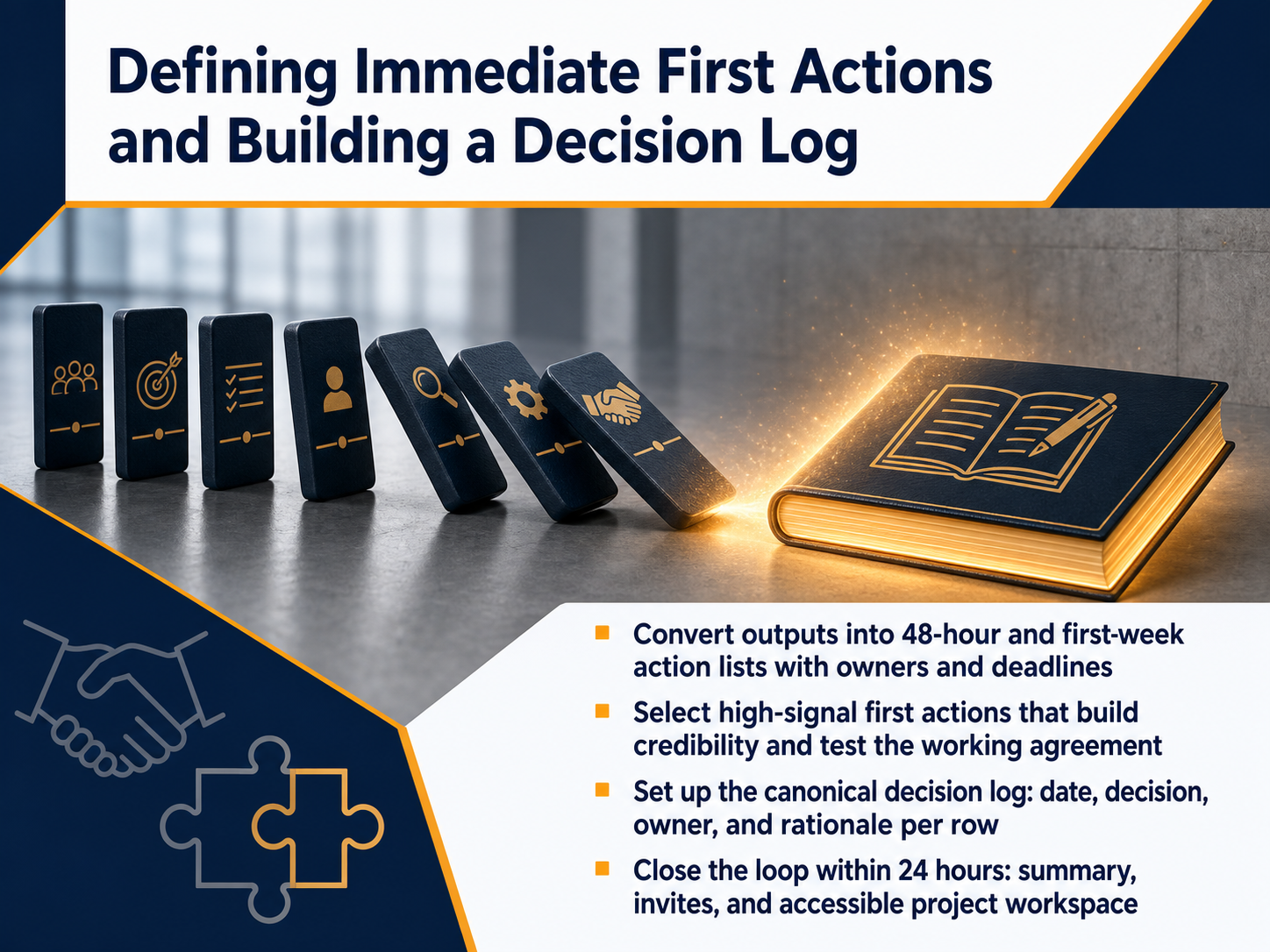 2 min
2 min - 11Identifying Risks and Creating a Team Working AgreementNow, let’s talk about risks and our team working agreement. First, let’s run a lightweight risk scan. Challenge yourselves to name five to seven risks that could derail us. For each one, rate the likelihood and the impact, then assign a clear owner. This keeps threats from becoming surprises. Next, try a pre-mortem. Ask the team one simple question. What could make this plan fail? This exercise surfaces blind spots early, while we still have time to act. After that, we’ll draft our working agreement. This covers our meeting cadence, decision rights, the definition of done for key tasks, and clear escalation paths. Write it down and keep it visible. It’s not a static document. It’s our active governance tool. Refer to it in every status check. Next, we’ll take that risk list and turn it into action by anticipating risks and preparing mitigation triggers.
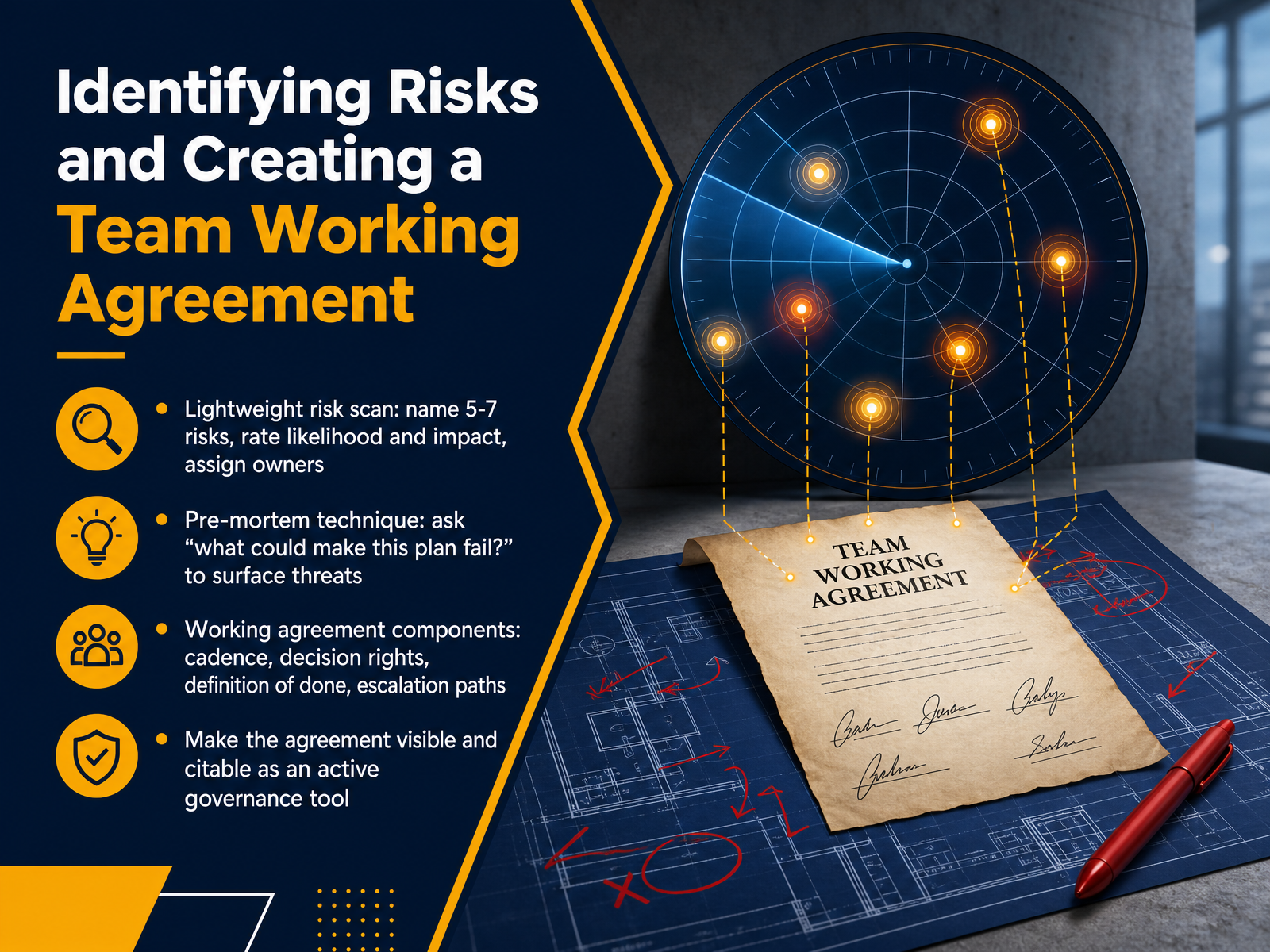 2 min
2 min - 12Anticipating Risks and Preparing Mitigation TriggersNow, let’s look ahead and ask: what could go wrong, and how will we respond? We start by naming the top three risks that might surface during the kickoff itself. For example, unresolved scope disagreements or silent objections from key stakeholders. The sponsor sets the risk-aware tone from the very first session. When they openly invite concerns, they make it safe for everyone to speak up. We always frame risks constructively, focusing on the work, not the person, to protect psychological safety. Once a risk is named, we assign a clear owner and link that owner to an escalation path in our working agreement. So the team knows exactly who to tell, and what happens next. With this, we can move on to adapting the kickoff for distributed and hybrid teams.
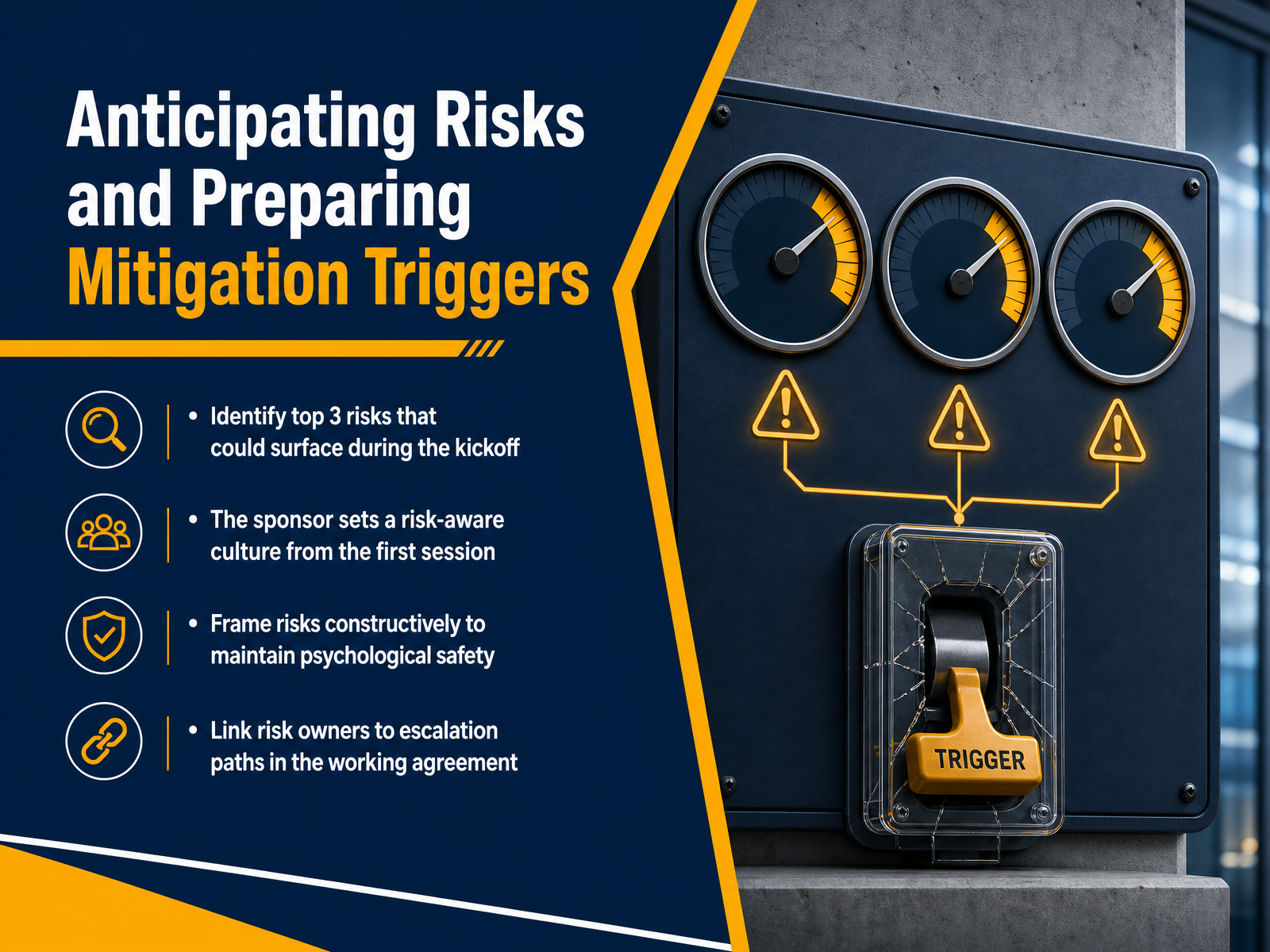 1 min
1 min - 13Adapting the Kickoff for Distributed and Hybrid TeamsNow let's adapt our approach for distributed and hybrid teams. First, rethink your session design. Keep sections short and use breakout rooms for small group discussions. We also recommend a chat co-facilitator who can give a voice to people in the chat. Next, adopt a remote-first rule. Always call on remote attendees first and treat the shared document as the single source of truth. For complex work, reserve anchor days. Bring the team together in person or on a long video call to build relationships and solve novel problems. Finally, guard against proximity bias. Rotate who is visible on screen and give written public recognition so great work gets noticed no matter where it happens. Up next, we put these ideas into practice with a hands-on exercise to build your own kickoff canvas.
 1 min
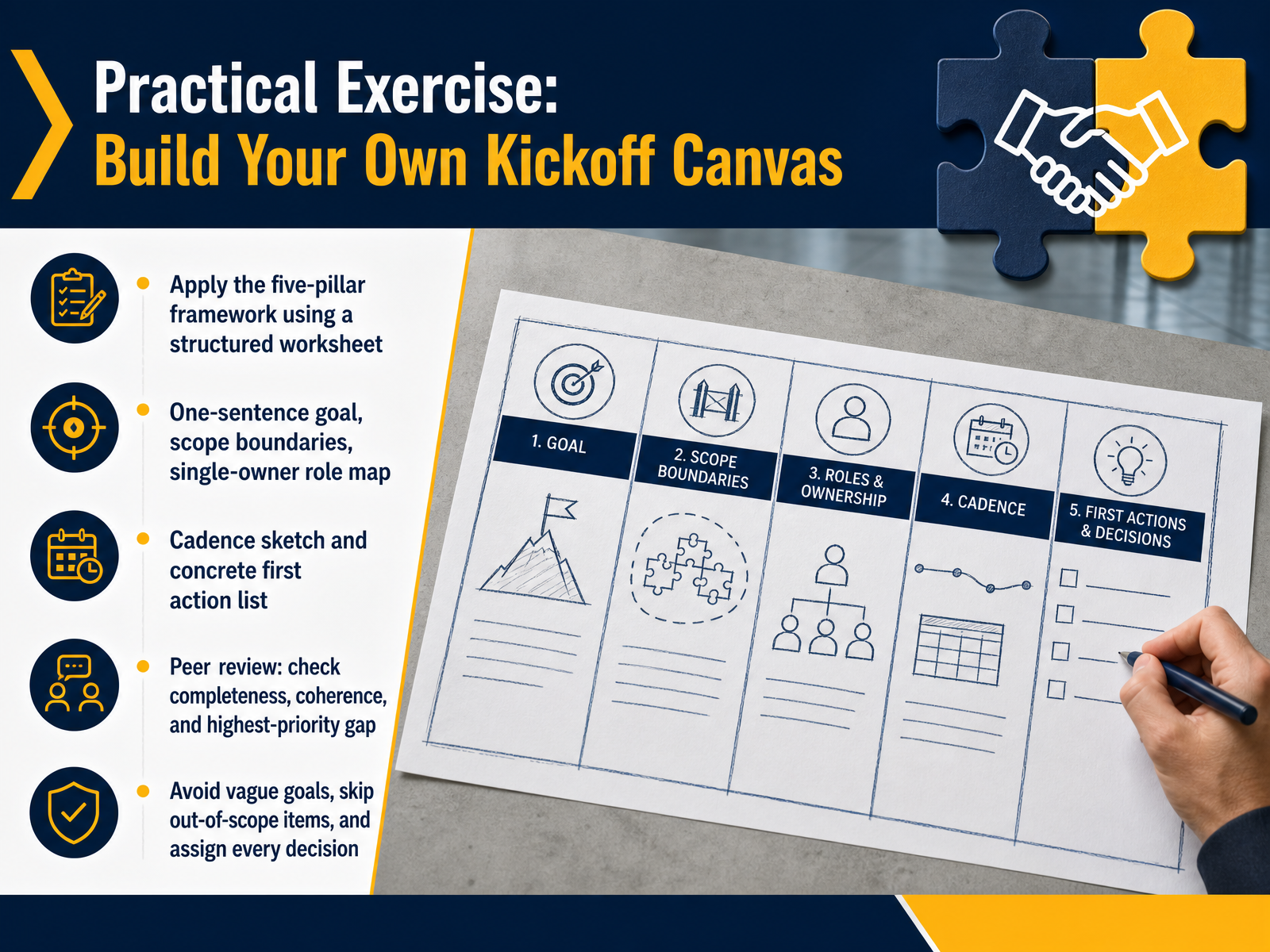
1 min - 14Practical Exercise: Build Your Own Kickoff CanvasNow it's your turn to put the framework into practice. We will build your own project kickoff canvas right here. You'll have a structured worksheet to guide you. Start with a one-sentence goal. Make it sharp and memorable. Then define your scope boundaries, what's in and what's out. Next, map single owners for key decisions. One name per role, no shared accountability gaps. Sketch out your meeting cadence, just the rhythm and frequency for now. And finally, draft a concrete list of first actions, things you can act on this week. When you're done, we'll do a quick peer review. Check for completeness, coherence, and ask, what is the single highest-priority gap we must close today? A few quick tips as you work. Avoid vague goals like 'improve collaboration.' Tell us exactly what changes. Skip any item clearly out of scope, we are not listing wishes here. And crucially, assign every decision to one person. Nobody leaves without clear ownership. Let's build your canvas now. We'll move next into sustaining kickoff momentum beyond the session.
 2 min
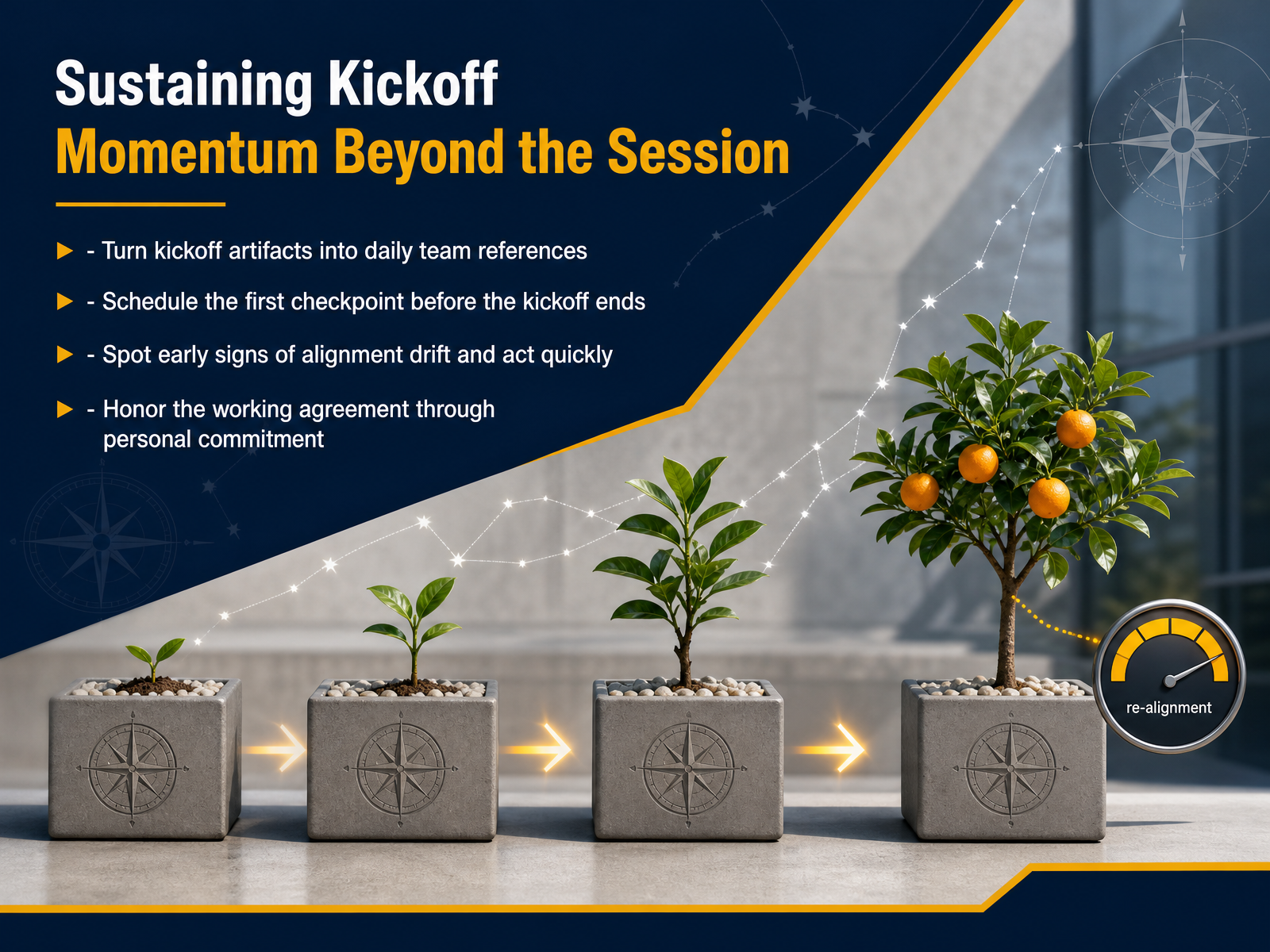
2 min - 15Sustaining Kickoff Momentum Beyond the SessionBefore we wrap up, let's talk about keeping this energy alive after the meeting. First, don't let your artifacts gather dust. Turn your scope statement and timeline into quick-reference guides the team uses every day. Second, schedule your first checkpoint before the kickoff ends. Even a fifteen-minute sync next week keeps accountability high. Third, watch for alignment drift. If you hear confusion about a deliverable or see scope shifting, speak up immediately. Small course corrections now are much easier than fixing major gaps later. Finally, honor your working agreement through personal commitment. When you meet a deadline or loop in a stakeholder early, you're modeling the team culture you all agreed on. You've set a strong foundation today. Protect that momentum, and your project will hit the ground running. Thank you, and let's make this a great launch.
 1 min
1 min
Take the deck with you
Download this course as a file — free, no sign-up needed.
- PDF handoutEvery slide page, ready to print or share.16 pages · 4.8 MBDownload
- Narrated PowerPointThe deck that presents itself — every slide carries the digital human's narration video.16 pages · 15.2 MBDownload
- PowerPoint slidesThe full deck as a .pptx — open it in PowerPoint, Keynote, or Google Slides.16 pages · 4.7 MBDownload
Free to use in your own training — please keep the PersonWise credit page at the end.
Have your own deck? Turn it into a course