Begin
14 pages · ~28 min
Agile Product Management Essentials
Equips product managers and teams with agile practices to prioritize backlogs, deliver customer value, and drive iterative product success.
A digital instructor presents all 14 pages. Hold “Ask” at any point and ask out loud — the answer comes from this course. No sign-up needed.
What you’ll learn
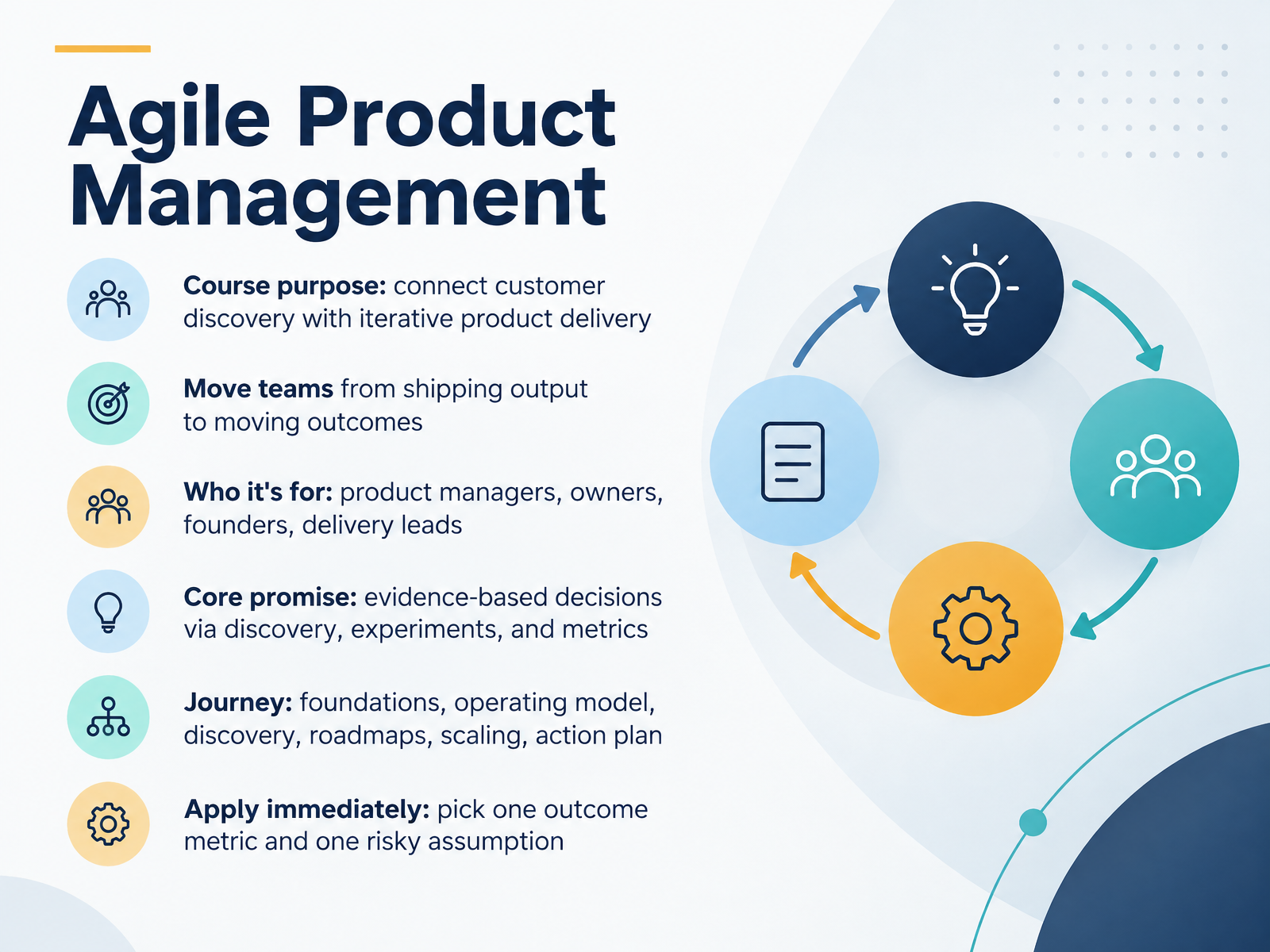
- 01Agile Product ManagementWelcome. If you're a product manager, product owner, founder, or delivery lead, you already know the tension. Discovery tells you one thing. Delivery pressure tells you another. This course is about closing that gap. Our purpose is simple. Connect customer discovery to iterative delivery, and move your team from shipping output to moving outcomes. That means less time asking did we finish the sprint, and more time asking did we change the metric. A product owner arguing for one more sprint, a founder choosing what not to build, that's where this work gets real. Our promise is evidence-based decisions through discovery, experiments, and metrics. Here's the journey. Foundations, operating model, discovery, roadmaps, scaling, then your action plan. And you can start today. Pick one outcome metric and one risky assumption, and go test it. Next, we look at why Agile delivery alone does not create value.productplan.comideaplan.iomakeitnice.de+21 min
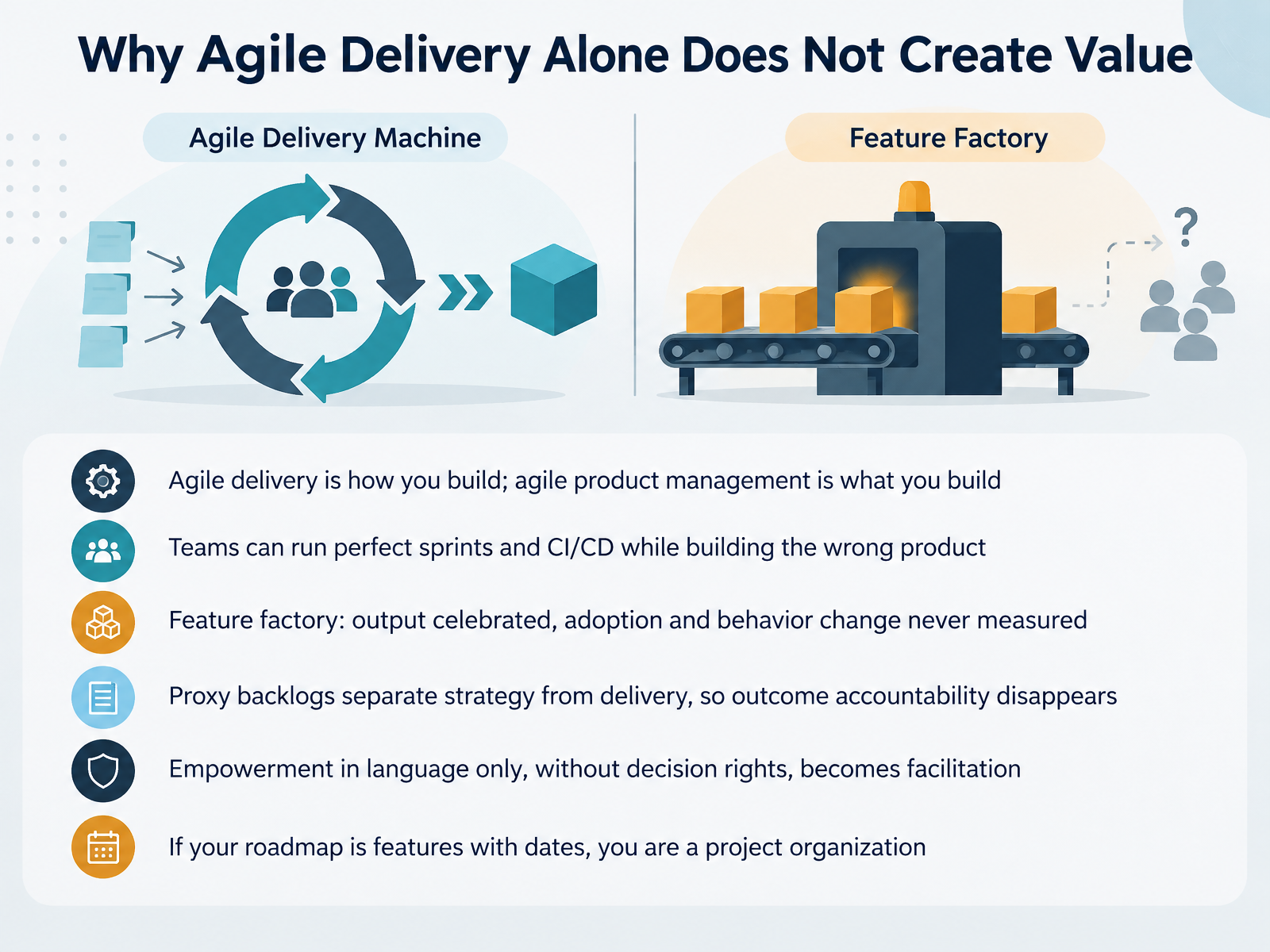
- 02Why Agile Delivery Alone Does Not Create ValueLet's start with the uncomfortable part. Agile delivery is how you build. Agile product management is what you build and why. You can run flawless sprints, clean CI/CD, and still ship the wrong product. That is the feature factory: output gets celebrated, but adoption and behavior change never get measured. Here is the tell. If your roadmap is features with dates, you are a project organization, no matter how many standups you attend. Watch for proxy backlogs too. When strategy sits in one room and delivery in another, outcome accountability quietly disappears. And when empowerment is language only, no decision rights, the product manager becomes a facilitator, not a product leader. So before you add process, check who can actually say no, and what changed for the customer. Next, the Product Operating Model in 2026.
 roadmap.onesaasfractionalcpo.comscrummanager.com+21 min
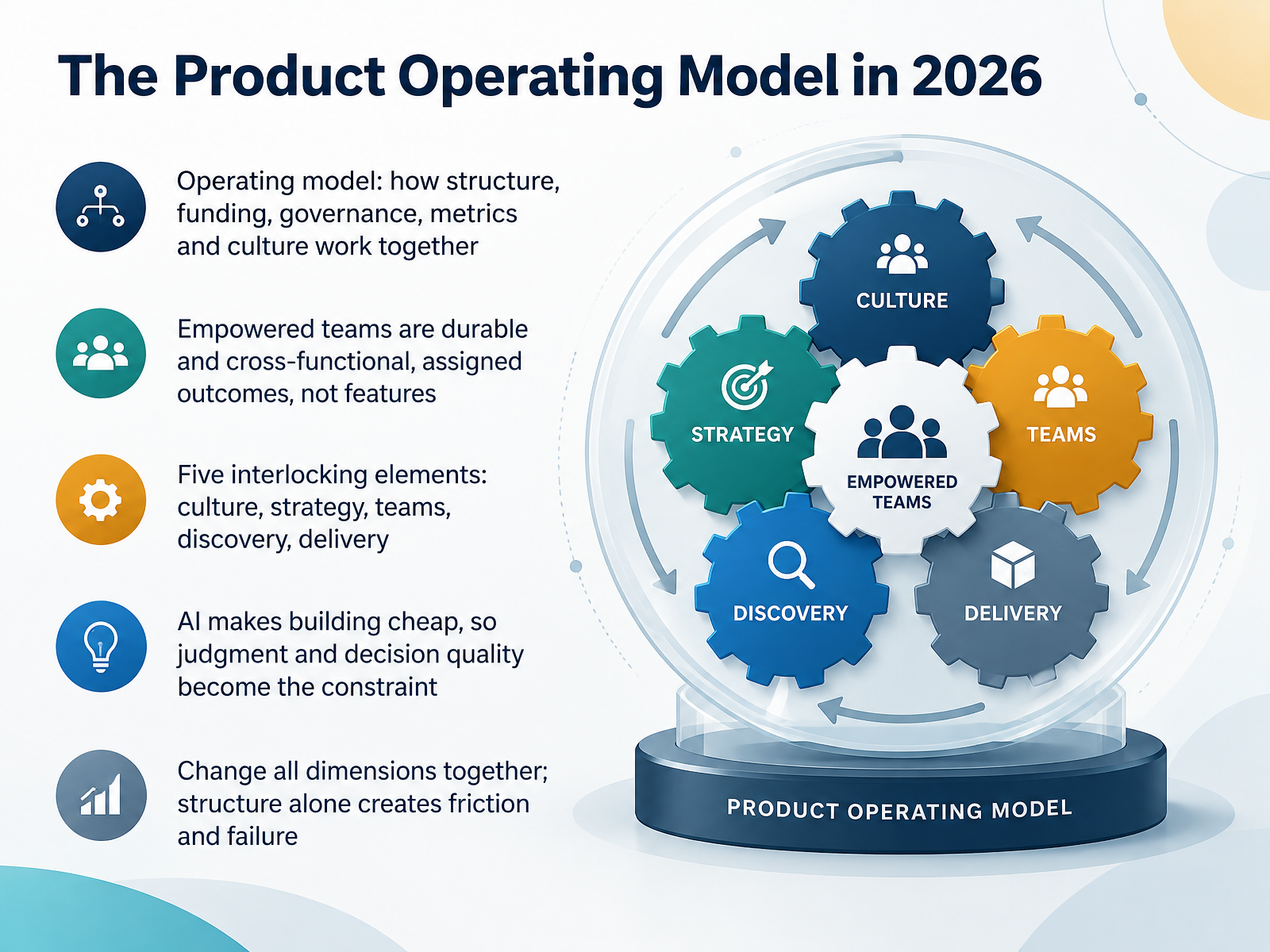
 - 03The Product Operating Model in 2026Let's talk about the product operating model as it stands heading into 2026. The term gets overused, so here's the practical definition. An operating model is how structure, funding, governance, metrics, and culture work together. It is not a process you install or a framework you license. And if you change only one of those dimensions, say you restructure into squads but still fund by project, you get friction and a stalled transition. The atomic unit is the empowered team: durable, cross-functional, and assigned outcomes, not features. Test it in one question. Is your roadmap a list of features with dates? That's a project organization. Is it objectives with capacity allocated against them? That's a product organization. Underneath, five interlocking elements have to move together: culture, strategy, teams, discovery, and delivery. And in 2026, one shift matters most. AI has made building cheap. Code is a commodity now. So the real constraint is judgment and decision quality. Your competitive advantage is no longer how fast you ship, it's how well you choose what to ship. Next, we go deeper into roles, decision rights, and team topologies.
 roadmap.onesaasfractionalcpo.comscrummanager.com+22 min
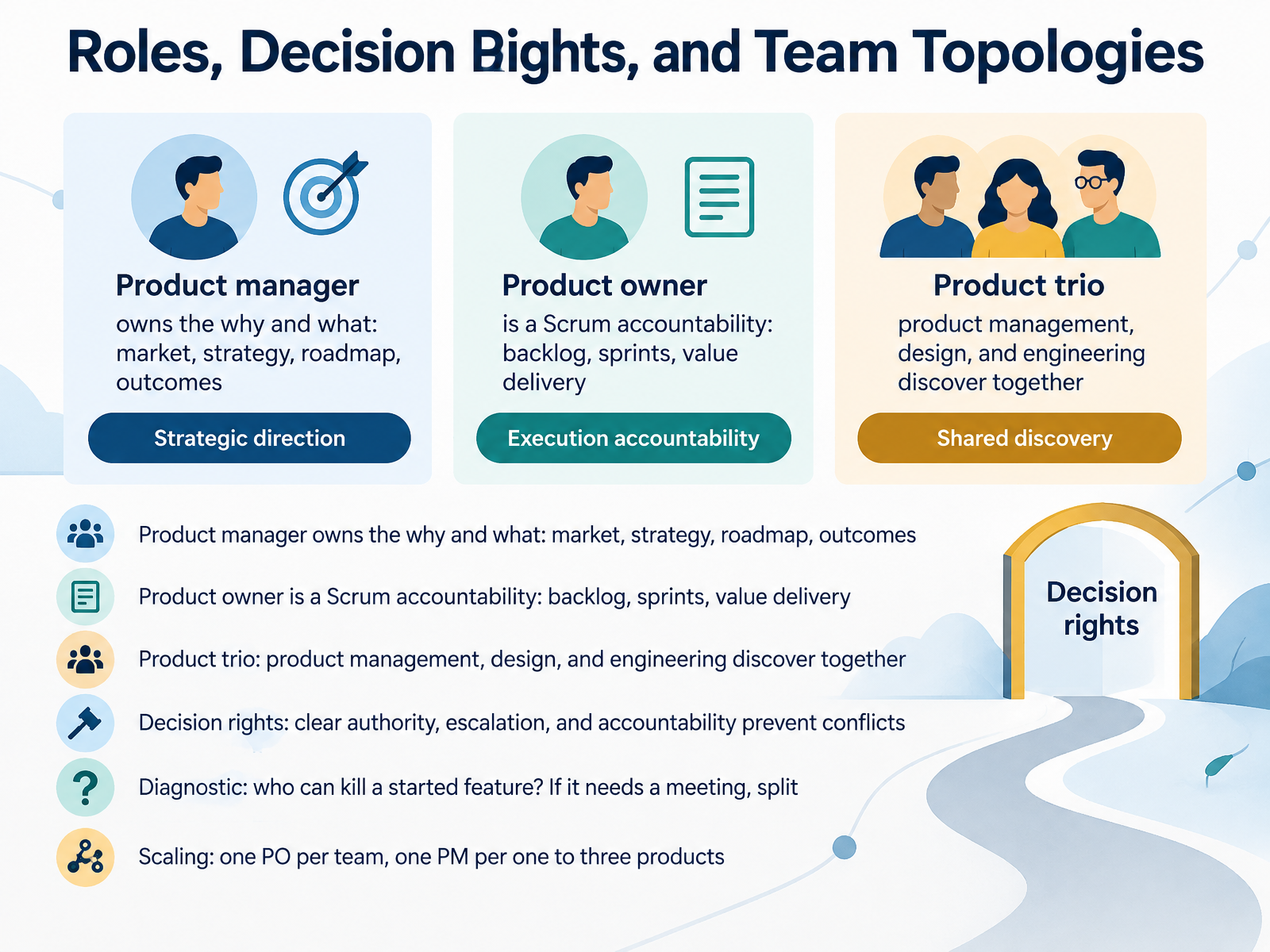
 - 04Roles, Decision Rights, and Team TopologiesNow let's get into roles, decision rights, and team topologies. The product manager owns the why and the what: market, strategy, roadmap, outcomes. The product owner is a Scrum accountability, owning the backlog, sprints, and value delivery. Keep those separate in your head. The product trio, product management, design, and engineering, should discover together. Now here is the hard part: decision rights. You need clear authority, clear escalation, and clear accountability, or conflict eats the team. Try this diagnostic. Who can kill a started feature without a meeting? A product owner arguing one more sprint should be able to say no. If killing it needs a meeting, your accountability is already split. Fix it by pushing the decision to the lowest accountable level. When scaling, one product owner per team, and a product manager spans one to three products. That is where strategy stays real and delivery stays sharp. Next, customer discovery and opportunity framing.
 ideaplan.iothoughtspot.compragmaticinstitute.com+21 min
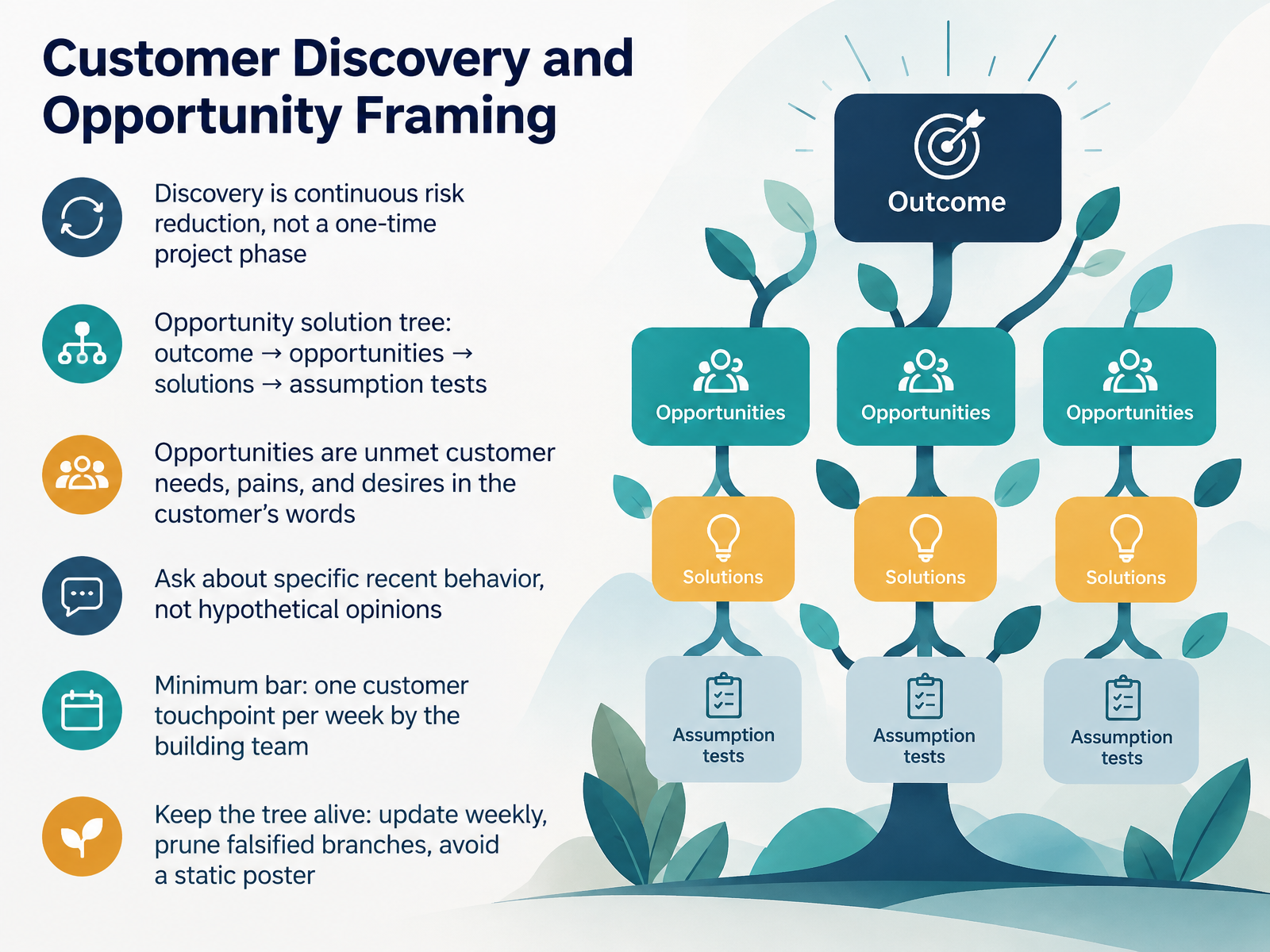
 - 05Customer Discovery and Opportunity FramingLet's talk about customer discovery and opportunity framing. First, reframe discovery in your head. It is continuous risk reduction, not a phase you finish. The opportunity solution tree is your working artifact: one desired outcome at the root, then customer opportunities, then solutions, then assumption tests. Notice the order. Opportunities are unmet needs, pains, and desires in the customer's own words, not features in disguise. A product owner arguing for one more sprint should be able to trace that work back to a real opportunity. So how do you surface them? Ask about specific recent behavior, not hypothetical opinions. Ask what they did last Tuesday, not what they would do if. Your minimum bar is one customer touchpoint per week by the building team, not a researcher proxy. Then keep the tree alive. Update it weekly, prune falsified branches, and resist the static poster. If no new opportunity has appeared in two weeks, your tree is starving. From opportunities to prioritized bets.
 producttalk.orgtalkful.iogetperspective.ai+22 min
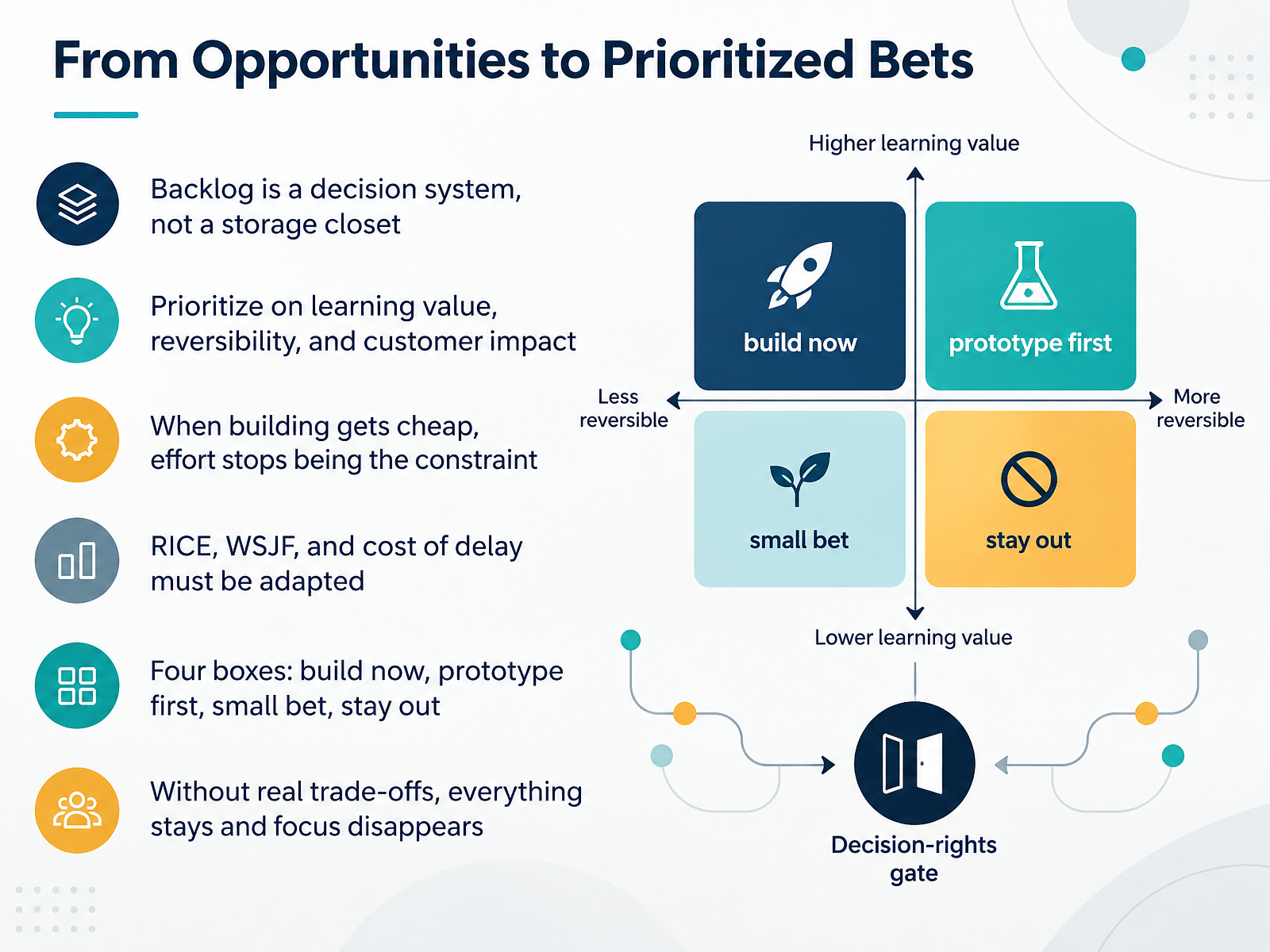
 - 06From Opportunities to Prioritized BetsNow let's talk about turning opportunities into prioritized bets. Start with this: your backlog is a decision system, not a storage closet. Every item you accept is an implicit no to something else. So prioritize on three things. Learning value, reversibility, and customer impact. Here's the twist. When building gets cheap, effort stops being the constraint. RICE, weighted shortest job first, cost of delay, they all put effort in the denominator. That assumption is breaking. So adapt them. I like a simple two-by-two. High learning value and easy to reverse, build now. High learning, hard to reverse, prototype first. Low learning, easy to reverse, make a small bet and move on. Low learning, hard to reverse, stay out. Four boxes, four directives. Now the hard part. If you never make a real trade-off, everything stays, and focus disappears. So assign a single accountable owner, put a clock on the call, and record why you decided. That is the work. Next, we'll look at outcome-based roadmaps and story slicing.
 ideaplan.ioproductzip.com2 min
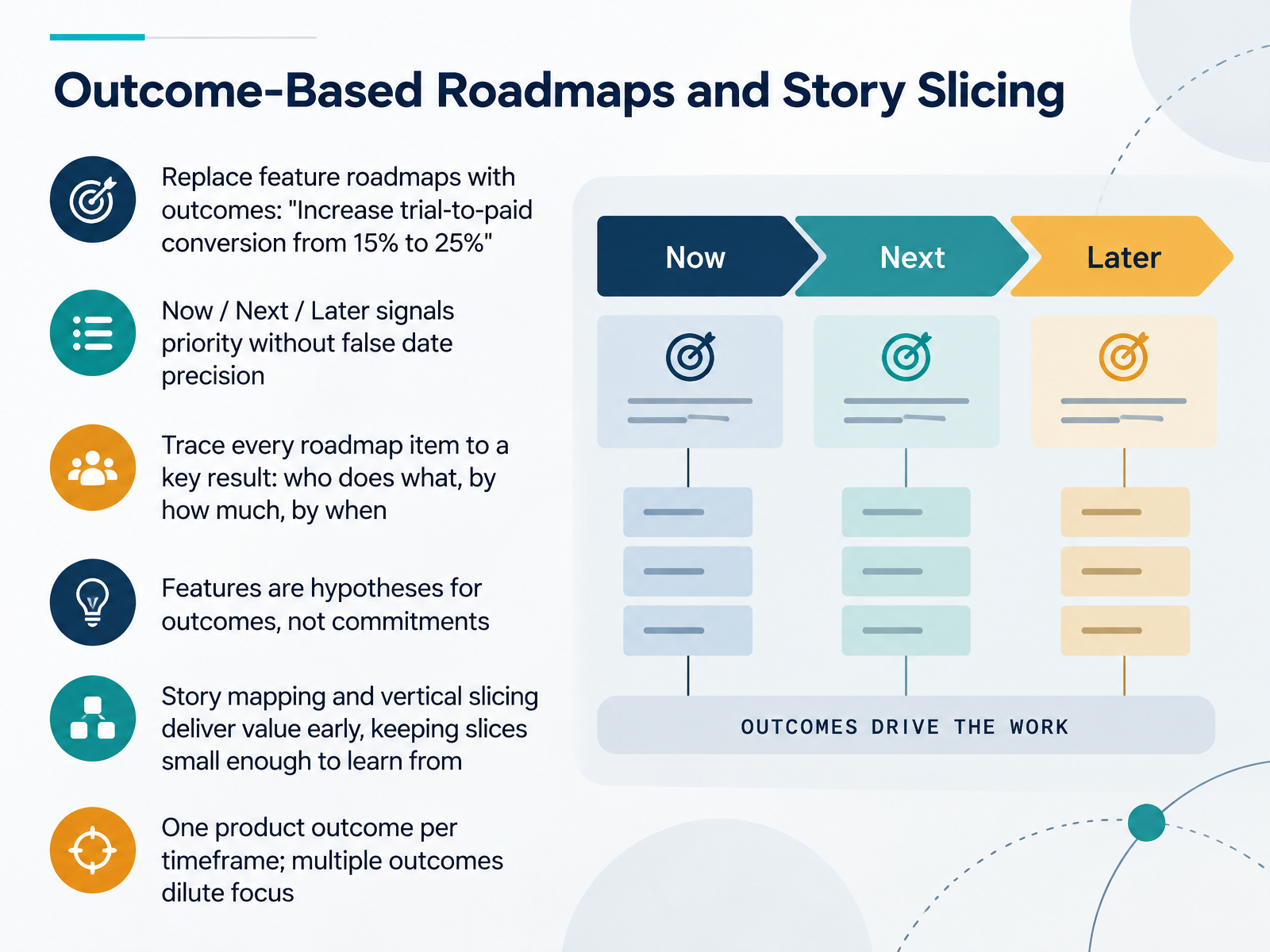
 - 07Outcome-Based Roadmaps and Story SlicingNow let's talk about outcome-based roadmaps and story slicing. Stop listing features. Write outcomes instead. Not build a new onboarding flow, but increase trial-to-paid conversion from fifteen percent to twenty-five percent. Use Now, Next, and Later to signal priority without fake date precision. Next means high confidence, not a promise. Every item traces to one key result: who does what, by how much, by when. Features are hypotheses, not commitments. That holds when you're still learning what moves the metric. The failure signal is a roadmap item nobody can tie to a key result. Then slice stories vertically so each slice delivers value and teaches you something. One outcome per timeframe. Multiple outcomes dilute focus. Next, we move into experiments, hypotheses, and iterative delivery.
 1 min
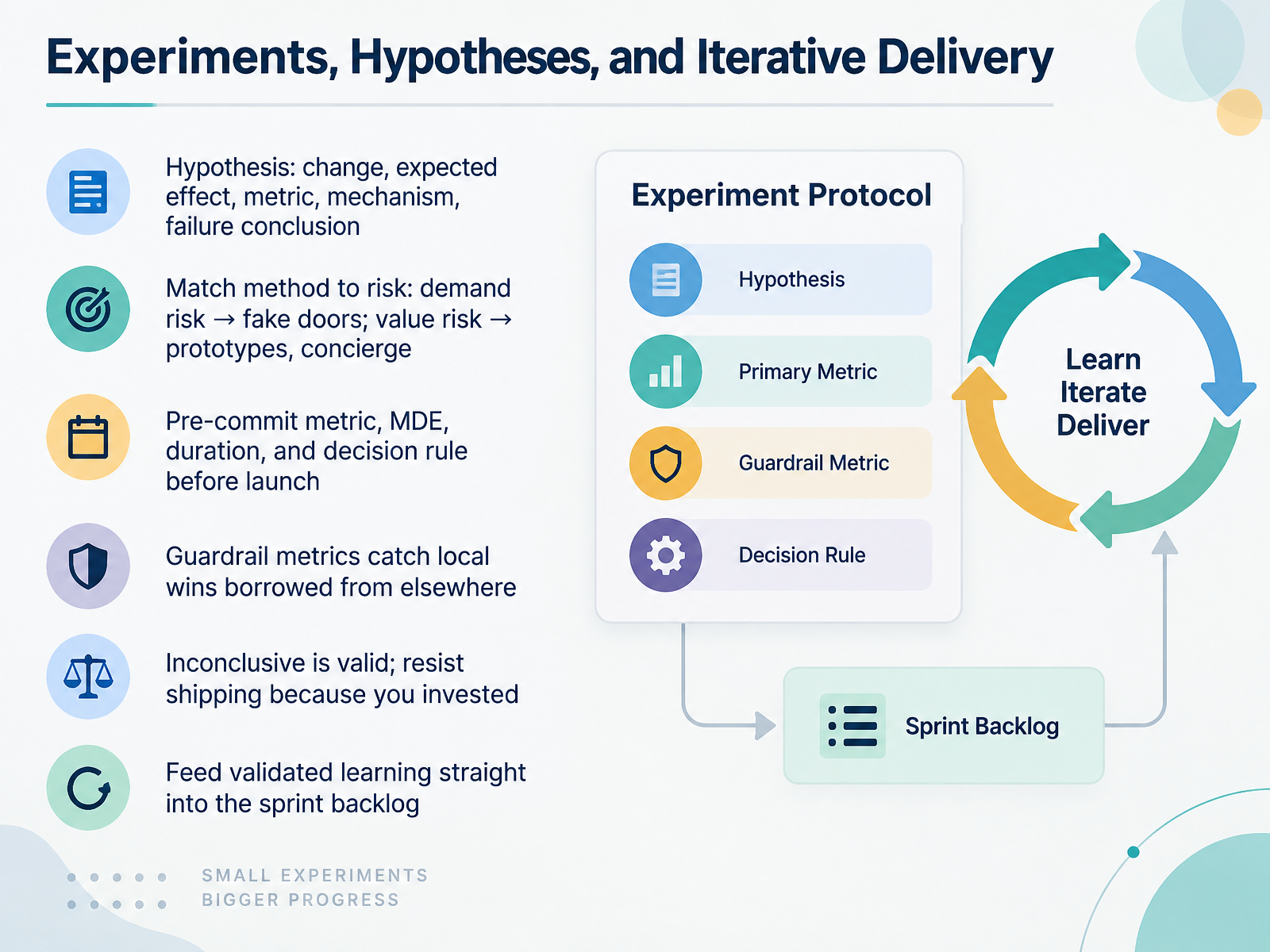
1 min - 08Experiments, Hypotheses, and Iterative DeliveryNow let's turn hypotheses into decisions. A usable hypothesis has five parts: the change, the expected effect, the metric, the mechanism, and the conclusion you'll draw if it fails. Write it as one falsifiable sentence. Match your method to the risk. Demand risk, meaning will anyone want this, use fake doors and smoke tests. Value risk, meaning will it work once they have it, use prototypes, concierge tests, or a Wizard of Oz build. Before launch, pre-commit the primary metric, the minimum detectable effect, the duration, and the decision rule. Apply it mechanically. Peeking early inflates false positives, so either fix one end date or use sequential testing. Also set guardrail metrics, because most local wins are borrowed from somewhere else. An upsell lifts trial revenue and quietly raises churn. A shorter signup lifts conversion and lowers activation. And remember, inconclusive is a valid result. When your test is underpowered or the mechanism never fired, resist shipping just because you invested the sprint. Either redesign the test or narrow the claim. Then feed validated learning straight into the sprint backlog, so the next iteration starts from evidence, not opinion. Next, we look at metrics and evidence of product outcomes.
 2 min
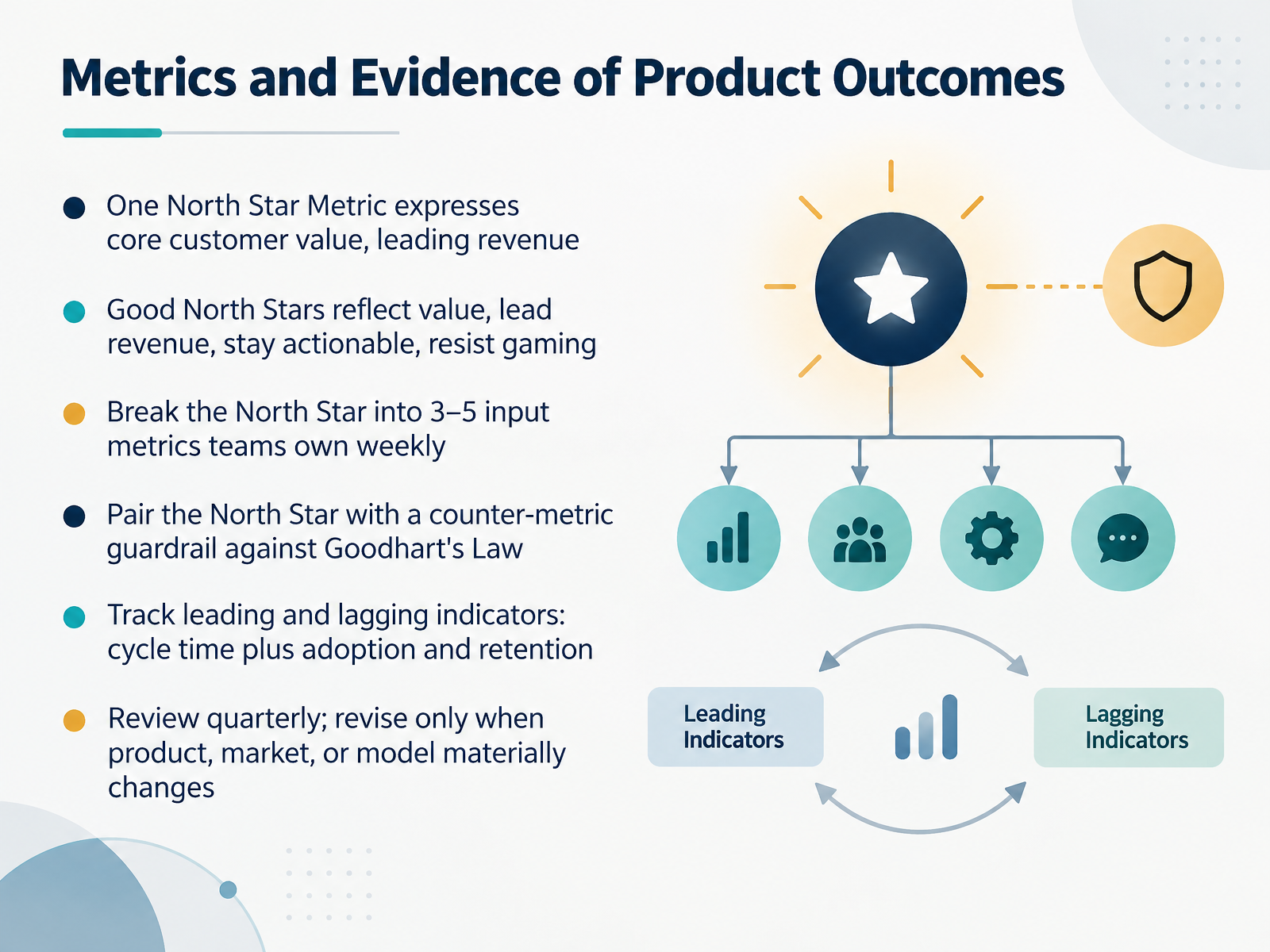
2 min - 09Metrics and Evidence of Product OutcomesNow let's talk about the evidence that tells you your product is actually working. Metrics are proof. Start with one North Star Metric. It should express core customer value and lead revenue by weeks or months, not lag it. A good North Star reflects real value, stays actionable, and resists gaming. So if a product owner can inflate the number without helping a single customer, it's the wrong metric. Next, break that North Star into three to five input metrics teams own weekly. For example, a founder choosing what not to build can trace activation or adoption directly to the North Star. Then pair it with a counter-metric guardrail against Goodhart's Law. When a measure becomes a target, it stops being a good measure. Track leading and lagging indicators together. Cycle time tells you how fast you're learning. Adoption and retention tell you if it stuck. Review quarterly, and revise only when the product, market, or business model materially changes. That keeps your metrics honest. Next, let's connect this to Operating Rhythms and Stakeholder Communication.
 1 min
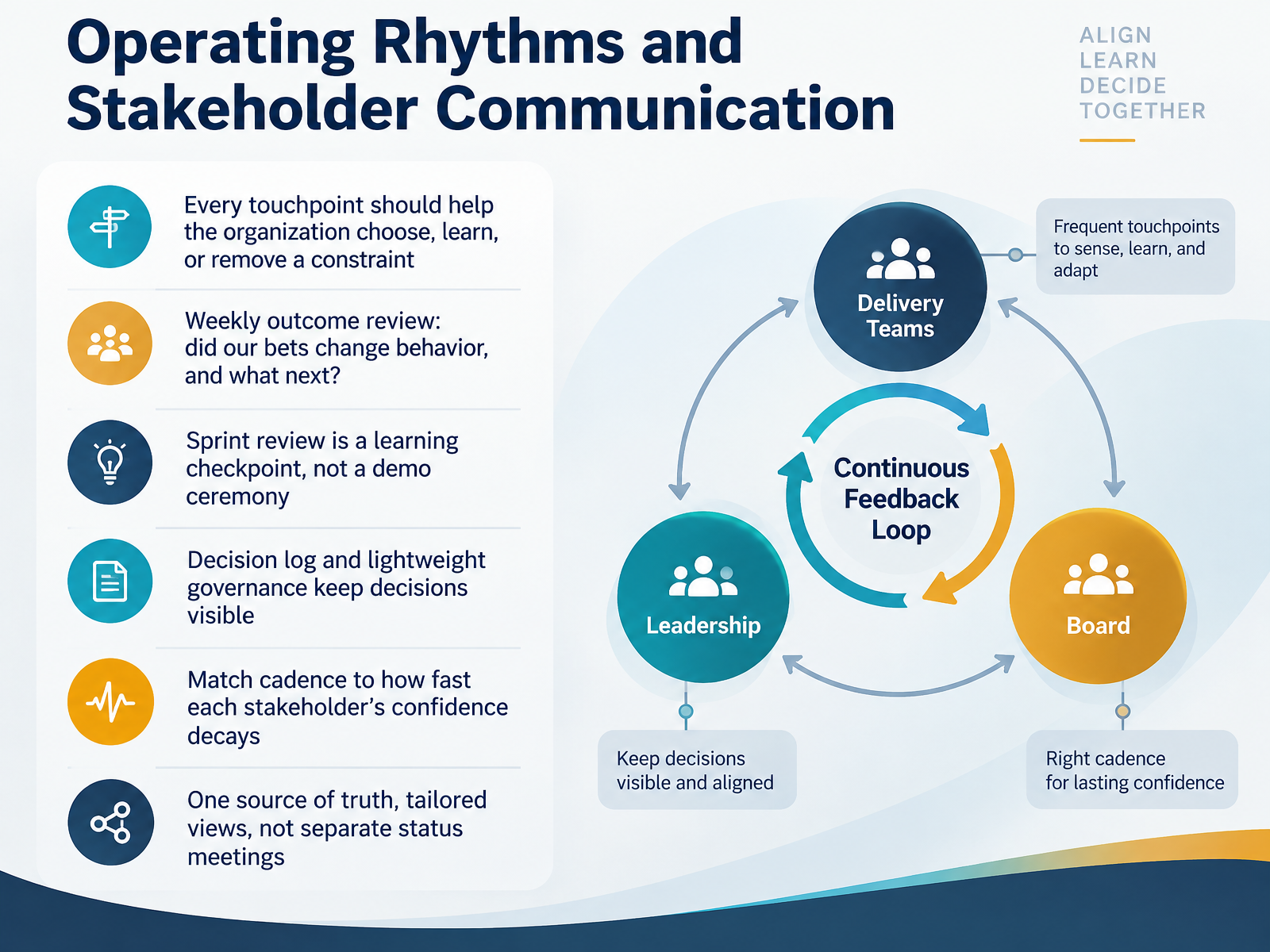
1 min - 10Operating Rhythms and Stakeholder CommunicationNow let's talk about operating rhythms and stakeholder communication. Here's the governing rule. Every recurring touchpoint should help the organization choose, learn, or remove a constraint. If it does none of those, cut it. Start with a weekly outcome review. One question: did our bets change behavior, and what do we do next? That's a decision meeting, not a status report. Treat sprint review the same way. It's a learning checkpoint, not a demo ceremony. And keep a decision log so decisions stay visible and don't quietly reopen. Match cadence to how fast each stakeholder's confidence decays. A board narrative holds for a month. A customer waiting on a fix starts losing patience in days. One source of truth, tailored views. Not three separate status meetings saying slightly different things. That's how you manufacture your own misalignment. If a weekly summary already answers the right questions, you don't need the extra pings. So this week, look at your calendar. How many meetings are status, and how many drive decisions? Now let's move on to scaling product practice across teams.
 1 min
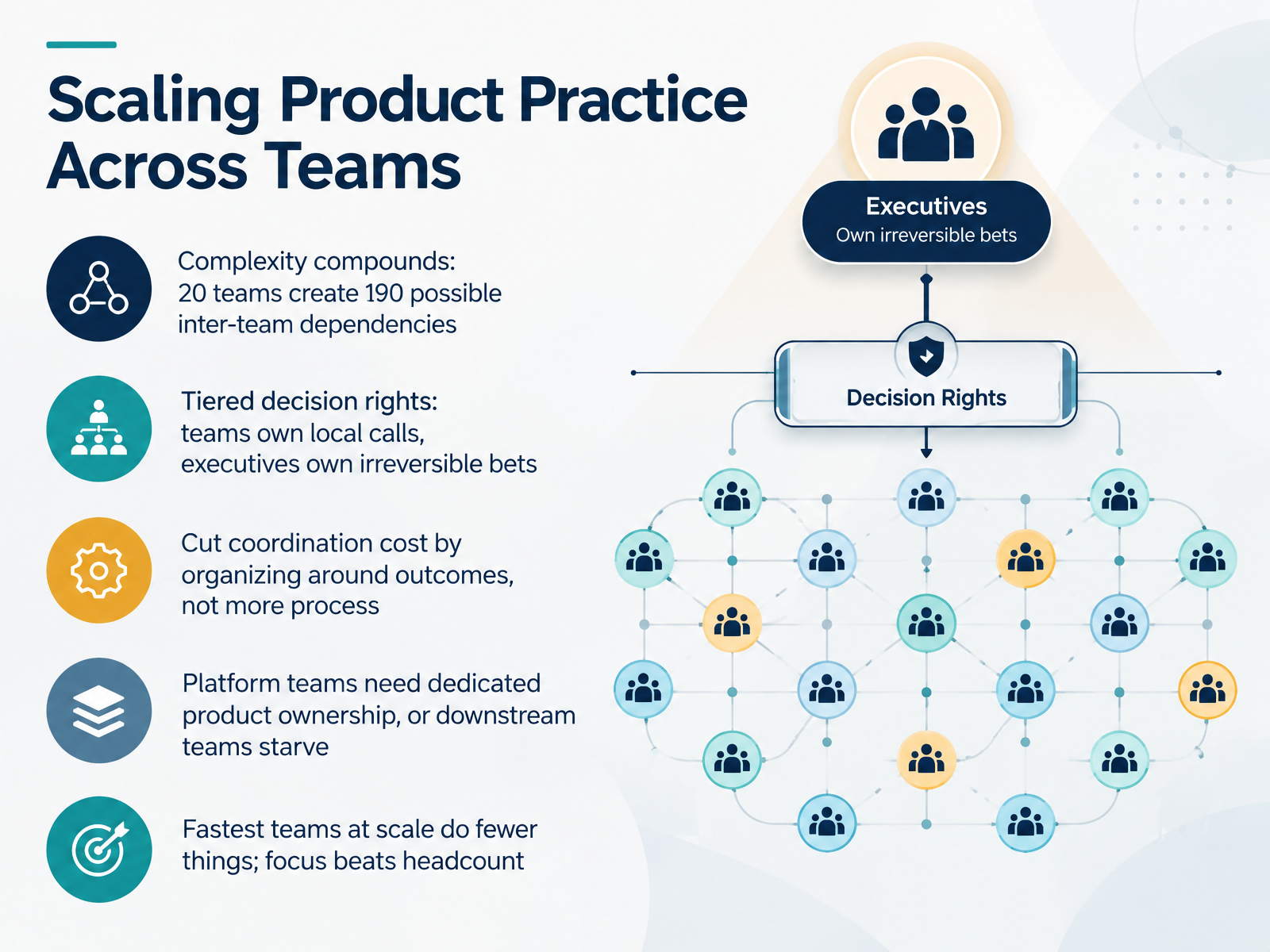
1 min - 11Scaling Product Practice Across TeamsLet's talk about scaling product practice across teams. Here is the math that breaks most orgs. With five teams, you have ten possible inter-team dependencies. With twenty teams, you have one hundred ninety. Individual teams can move fast while the whole company feels slow. So don't add process. Cut coordination cost. Organize around outcomes, not handoffs. Then set tiered decision rights. Teams own local, reversible calls. Executives own irreversible bets, like architecture migrations or entering a new market. Write those tiers down and enforce them. One trap: platform teams without dedicated product ownership. Engineering runs the roadmap, downstream teams file requests, and platform gets underinvested right where everyone needs it. Watch dependency resolution time. If unblocking takes weeks, your structure is failing. Finally, the fastest teams at scale do fewer things. Focus beats headcount. Next, we look at AI, judgment, and the 2026 product context.
 2 min
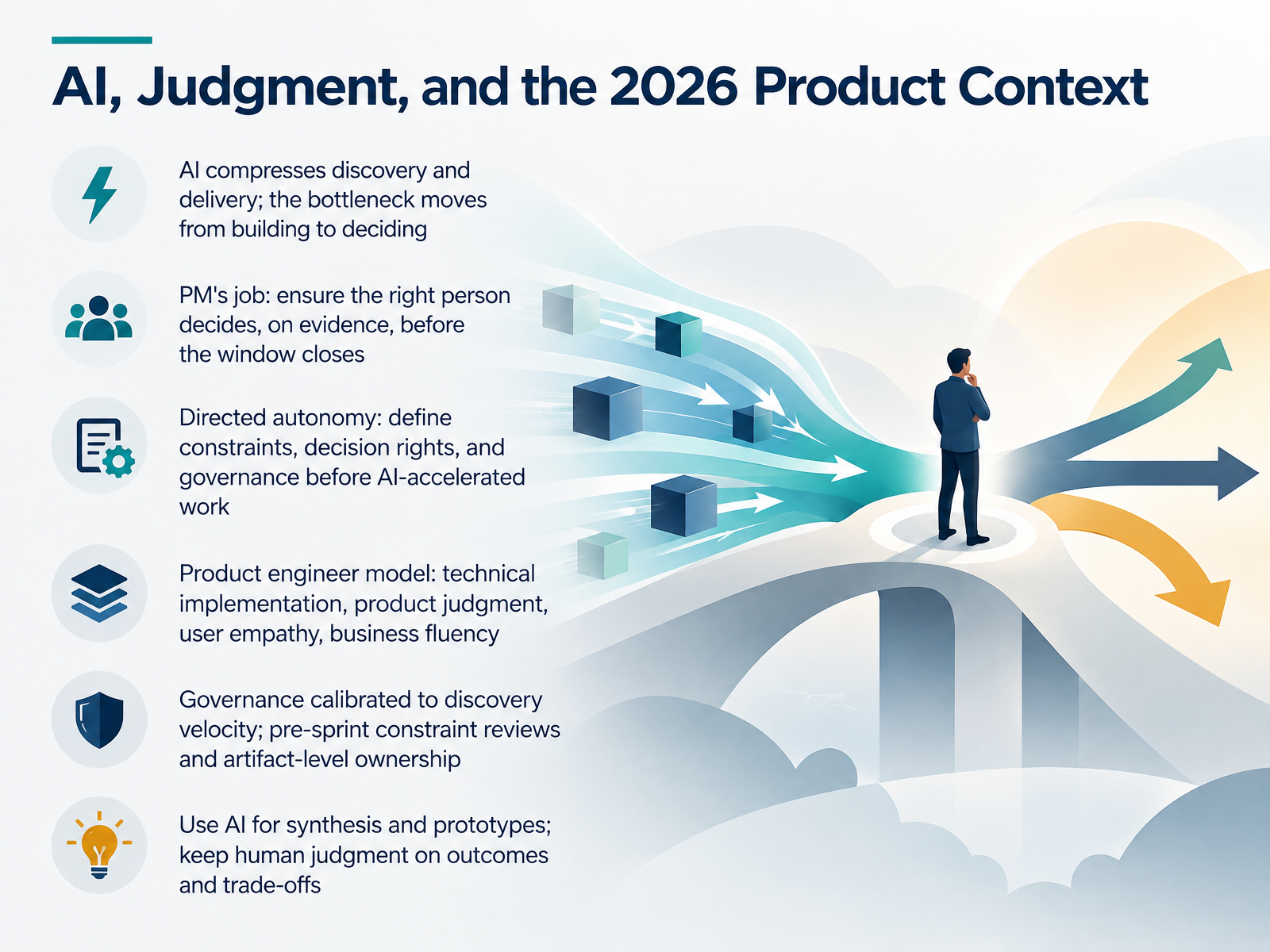
2 min - 12AI, Judgment, and the 2026 Product ContextNow let's get to the 2026 context, because AI changes the shape of this job. AI compresses both discovery and delivery. The bottleneck moves from building to deciding. Real talk: it is not the product manager's job to make every call. It is to make sure the right person decides, on evidence, before the window closes. That is what directed autonomy means. Define constraints, decision rights, and governance before AI-accelerated work starts, not after. Watch the product engineer model emerge, blending technical implementation, product judgment, user empathy, and business fluency. Then calibrate governance to discovery velocity. Run pre-sprint constraint reviews and name artifact-level ownership per sprint. Use AI for synthesis and prototypes, but keep human judgment on outcomes and trade-offs. Next up, Common Pitfalls and How to Course-Correct.
 roadmap.onesaasfractionalcpo.comscrummanager.com+21 min
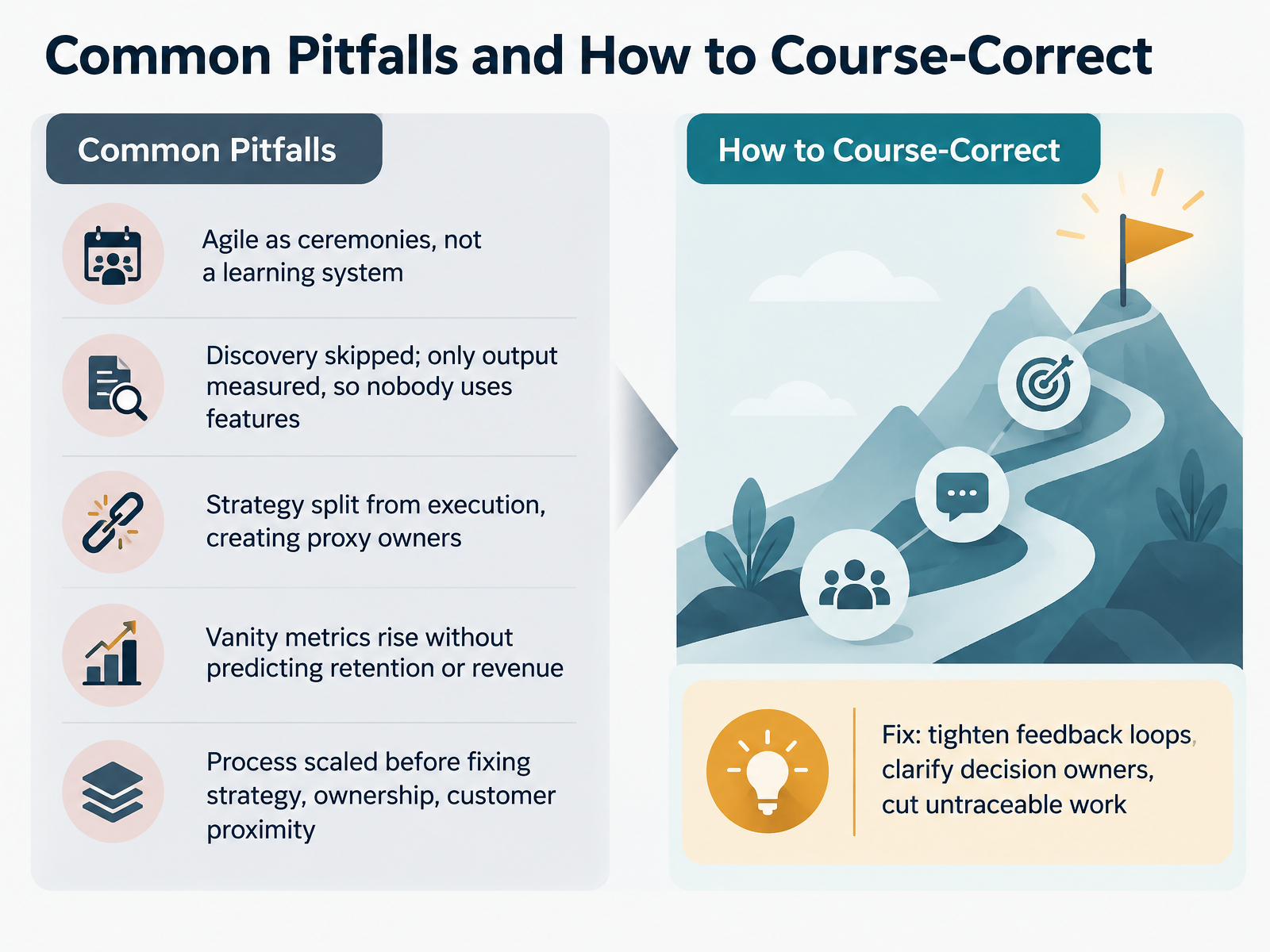
 - 13Common Pitfalls and How to Course-CorrectLet's talk about the traps that catch good teams. The first is running Agile as ceremonies, not a learning system. Standups and retros happen, but nothing changes based on what you learn. Course-correct by asking one question every sprint: what decision did this cycle change? The second pitfall is skipping discovery and only measuring output. You hit velocity, but nobody uses the feature because you never talked to a customer before building it. So a product owner arguing for one more sprint should bring evidence, not just estimates. Third, strategy split from execution creates proxy owners. A product owner who can't say no without escalating is managing a queue, not owning a product. Ask who can kill a feature engineering has already started. If that takes a meeting, accountability is already split. Fourth, vanity metrics rise without predicting retention or revenue. Signups look good; retention tells the truth. Fifth, teams scale process before fixing strategy, ownership, and customer proximity. Adding SAFe to dysfunction just adds process on top of it. The fix is consistent: tighten feedback loops, clarify decision owners, and cut untraceable work. If a backlog item can't trace back to a validated opportunity, cut it. That discipline is what turns Agile from theater into a decision engine. Next, let's get practical with your 30-60-90 Day Action Plan.
 ideaplan.iothoughtspot.compragmaticinstitute.com+22 min
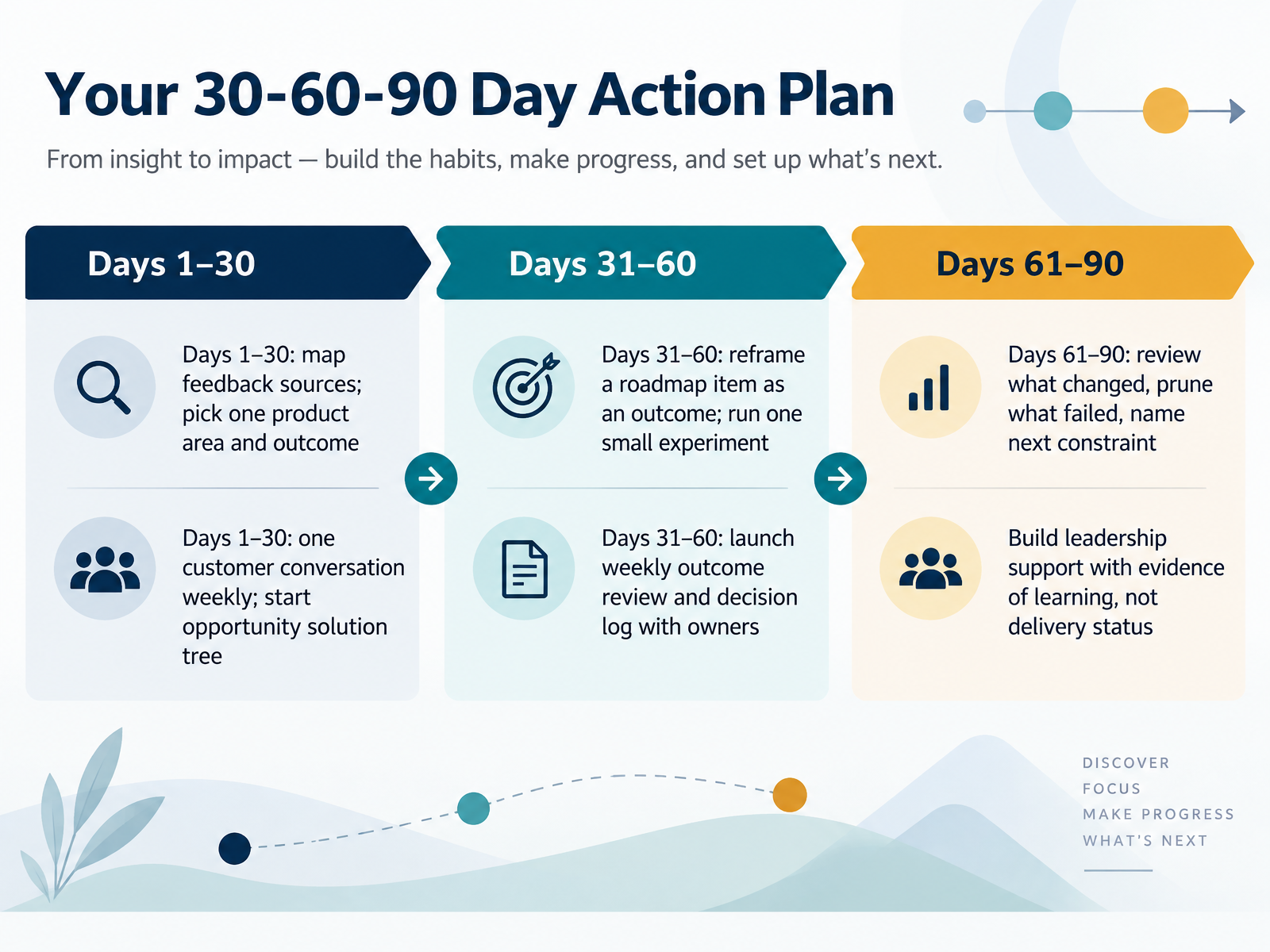
 - 14Your 30-60-90 Day Action PlanLet's close with your 30-60-90 day plan. First 30 days: map your feedback sources, then pick one product area and one outcome. One customer conversation weekly, every week, and start your opportunity solution tree. Days 31 to 60: reframe one roadmap item as an outcome, not a feature, and run one small experiment against it. Launch a weekly outcome review with a decision log and named owners. One bet, one metric, one call: double down, pivot, pause, or stop. Days 61 to 90: review what changed, prune what failed, and name your next constraint. Here's the key move. Build leadership support with evidence of learning, not delivery status. A product owner arguing for one more sprint wins with a decision log and behavioral data, not a green dashboard. If your outcome review keeps sliding to status, that's your signal to tighten the agenda. You don't need a reorg or a new tool. You need consistent habits that compound. Pick your first outcome this week, run the loop, and let evidence decide what's next. Thanks for joining me, and go make your next bet a smaller, smarter one.
 2 min
2 min
Take the deck with you
Download this course as a file — free, no sign-up needed.
- PDF handoutEvery slide page, ready to print or share.15 pages · 3.3 MBDownload
- Narrated PowerPointThe deck that presents itself — every slide carries the digital human's narration video.15 pages · 13.5 MBDownload
- PowerPoint slidesThe full deck as a .pptx — open it in PowerPoint, Keynote, or Google Slides.15 pages · 3.2 MBDownload
Free to use in your own training — please keep the PersonWise credit page at the end.
Have your own deck? Turn it into a course
Sources consulted
Web sources consulted while building this course.
- The Ultimate Guide to Agile Product Management | ProductPlan — productplan.com
- What Is Agile Product Management? The Complete | IdeaPlan — ideaplan.io
- Agile Product Management: The Practitioner's Guide (2026) — The Complete Guide | Make it Nice — makeitnice.de
- What is agile product management? Tips for better project alignment — notion.com
- Agile Product Management: Frameworks, Roles, and Best Practices - Airtable — airtable.com
- The Product Operating Model: A Practical Guide From Inside Cagan's Trainline Case Study - RoadmapOne — roadmap.one
- Product Operating Model for SaaS: The 2026 Blueprint — saasfractionalcpo.com
- Agile product operating model — scrummanager.com
- The rise of the agentic product operating model: What… | PA Consulting — paconsulting.com
- How to create a product operating model to support ... — thoughtworks.com
- PM vs Product Owner: Strategy vs Delivery (2026) | IdeaPlan — ideaplan.io
- Product owner vs product manager: 6 key differences in 2026 — thoughtspot.com
- The Agile Manifesto and Product Team Roles — pragmaticinstitute.com
- Product Manager vs. Product Owner: What's Actually the Difference — productleader.cv
- Product owner vs product manager in portfolios | ProductZip — productzip.com
- Opportunity Solution Tree | Definition and Overview - Product Talk — producttalk.org
- How to build an opportunity solution tree · Talkful — talkful.io
- The Opportunity Solution Tree in 2026: A Practical Guide for ... — getperspective.ai
- The Opportunity Solution Tree: A 2026 Guide for Continuous ... — getperspective.ai
- Opportunity Solution Tree (OST) | Qualz.ai Research Guide — qualz.ai