L&D Manager Role Essentials
Begin
10 pages · ~20 min
L&D Manager Role Essentials
This training prepares professionals for the Learning and Development Manager role, covering key responsibilities and essential skills for success in organizational development.
What you’ll learn
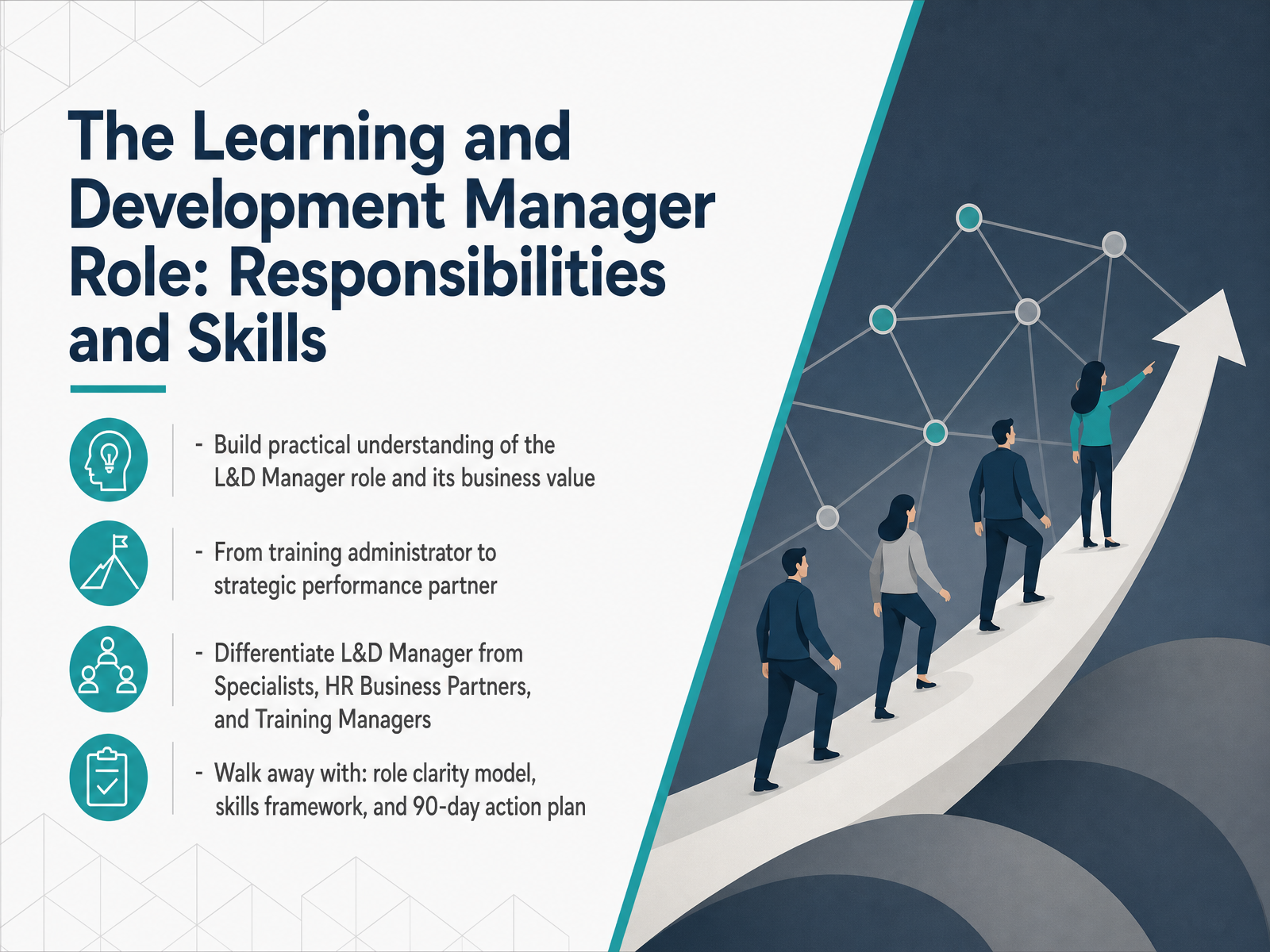
- 01The Learning and Development Manager Role: Responsibilities and SkillsWelcome. If you are stepping into a learning and development manager role, or you want to sharpen what you already do, this session is for you. Here is what we will build together today. First, we will ground you in the practical reality of what an L&D manager owns, and why it matters to the bottom line. Second, we will make the shift explicit, moving you from a training administrator mindset to a strategic performance partner who influences outcomes. Third, we will draw a clean line between this role and the specialists, HR business partners, or training managers you collaborate with daily. By the end, you will leave with three concrete tools. A role clarity model to define your scope, a skills framework to guide your growth, and a ninety-day action plan you can apply the moment you get back to your desk. Expect to see your work reflected in real scenarios, like aligning a leadership program with a stalled business unit, or making a budget case that executives actually approve. Stay results-oriented and be ready to challenge how you currently measure success. Let us begin by looking at why L&D leadership matters to business performance.online.edgewood.edubls.govroberthalf.com+22 min
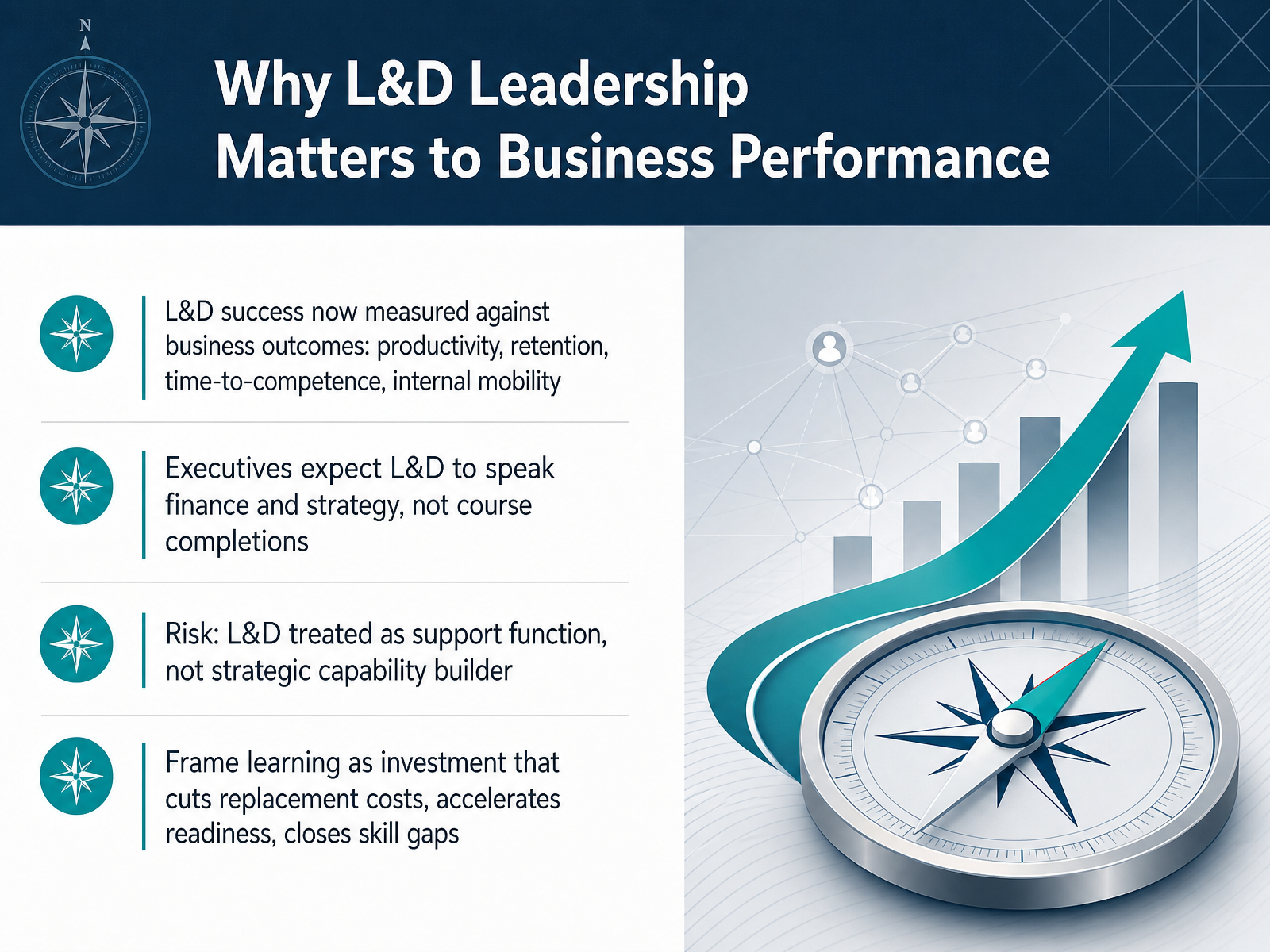
- 02Why L&D Leadership Matters to Business PerformanceLet’s get straight to the point: how your executive team views L&D is shifting, and fast. Gone are the days when success meant high completion rates or satisfied smile sheets. Today, L&D leadership is judged by business outcomes, like productivity gains, employee retention, shorter time-to-competence, and stronger internal mobility. Executives expect us to speak their language, finance and strategy, not course counts. Here’s the risk: if we don’t, L&D gets treated as a support function rather than a strategic capability builder. But here’s the opportunity: when we frame learning as an investment, we can show how it cuts replacement costs, accelerates workforce readiness, and closes critical skill gaps. That reframes every budget conversation from expense to growth lever. Next, we’ll dig into the core responsibilities that make an L&D manager effective in driving that kind of impact.
 blog.myngle.comskillscaravan.comelearningindustry.com+21 min
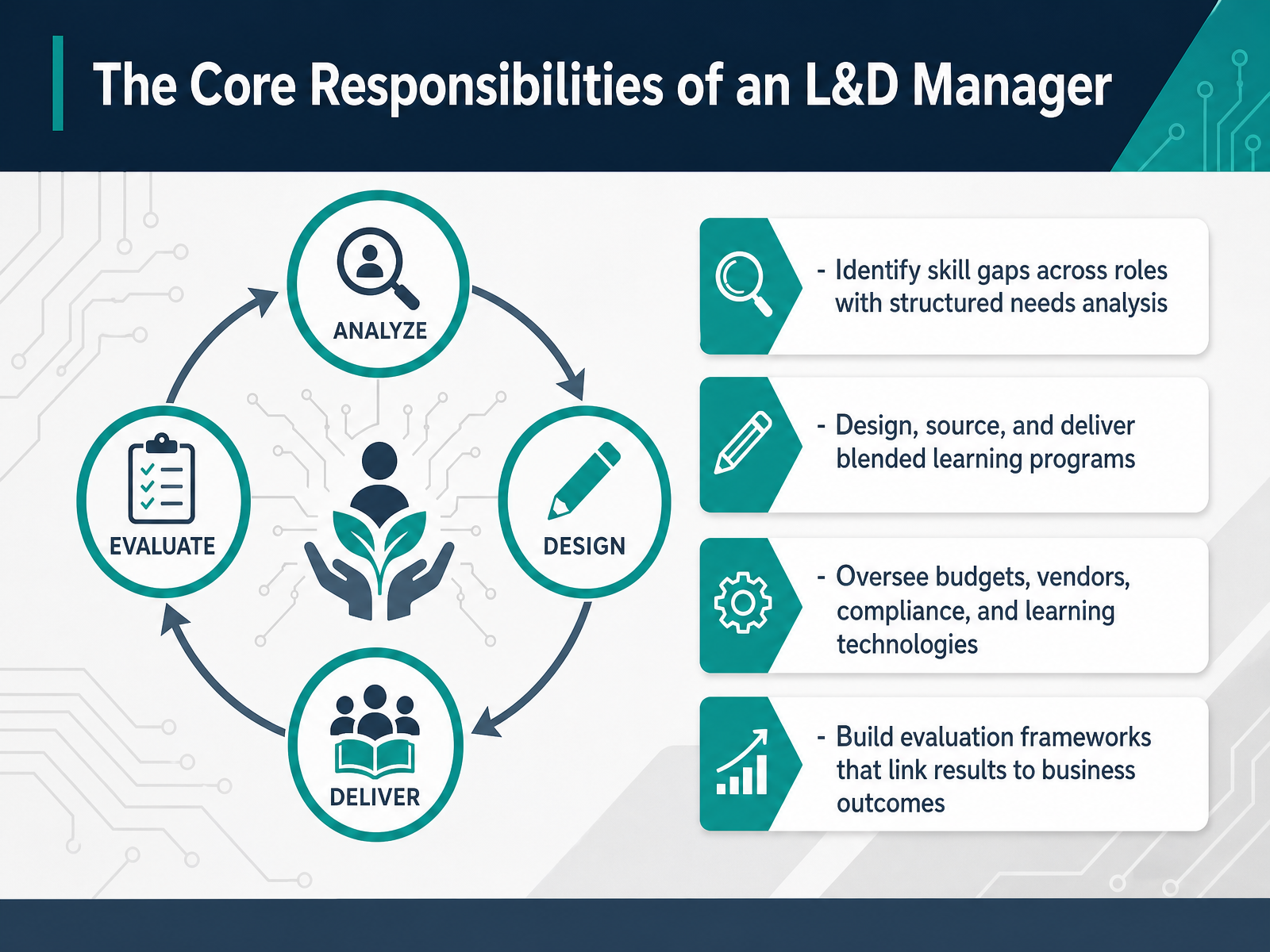
 - 03The Core Responsibilities of an L&D ManagerLet's walk through what actually occupies your calendar. Your core responsibilities fall into four connected buckets. First, needs analysis. This isn't just asking managers what they want. You're identifying skill gaps across specific roles using structured data, so every program you build is solving a real, measurable problem. Second, program design and delivery. You're curating or building blended learning that fits the context, whether that's e-learning, workshops, or on-the-job coaching. Third, the operational spine of the role. You own the budget, manage vendor contracts, ensure compliance, and maintain the learning technology stack. These areas demand vigilance, but they create the stability that makes great learning possible. Finally, and most critically, evaluation. You build frameworks that connect learning results directly to business outcomes, not just completion rates or satisfaction scores. When you link the training investment to performance, you secure ongoing stakeholder buy-in. Master these four areas, and you move from being an order-taker to a true strategic partner. Which brings us to the skills that set effective L&D managers apart.
 aihr.comtrainual.comindeed.com+21 min
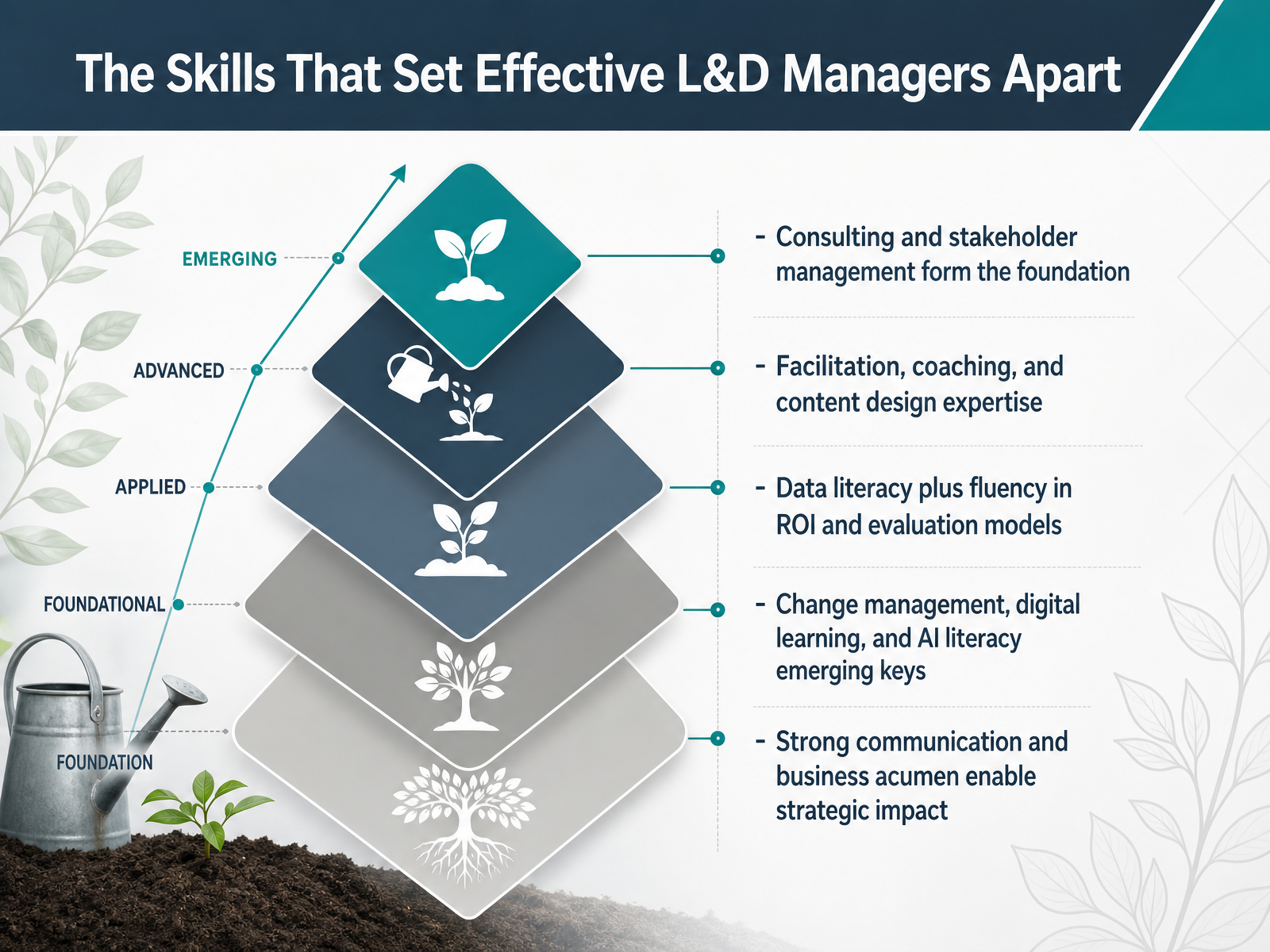
 - 04The Skills That Set Effective L&D Managers ApartNow let's get into the specific capabilities that separate effective L&D managers from the rest. Think of these as the levers you pull to create real change. Consulting and stakeholder management are your foundation. Before any program exists, you're diagnosing needs, asking the right questions, and getting leaders invested. Then come facilitation, coaching, and the craft of designing learning that actually sticks. But here’s where the role has changed. You can’t run on intuition anymore. You need genuine data literacy and fluency in evaluation models like Kirkpatrick, so you can speak in terms of ROI and business impact. Meanwhile, the landscape keeps shifting. Change management isn't just nice to have—it's essential. And as digital tools and AI reshape work, your literacy there determines how relevant your programs will be. Tying it all together is communication and sharp business acumen. That's what elevates you from delivering training to driving outcomes. With that foundation, let's look at how your role shifts entirely—from being a training provider to a true performance consultant.
 thirst.ioonline.edgewood.edulinkedin.com+22 min
 - 05From Training Provider to Performance ConsultantNow, let's talk about one of the most consequential shifts you can make in your career: moving from being a training provider to being a true performance consultant. For years, L&D functions operated as internal vendors, ready to take orders for courses and build exactly what was asked. But that approach often leaves the root problem untouched. So, how do you break that pattern? Start by refusing to lead with the training request. Instead, ask your stakeholders what business outcome they're trying to achieve. Are they trying to reduce errors in a process? Speed up onboarding? Improve customer satisfaction scores? That is your starting point. Then, diagnose the gap. Ask what's really preventing the desired performance. Is it truly a skill issue, or is it a process problem, a motivation issue, an environment that creates friction, or perhaps unclear expectations? Here's a useful reality check: research suggests that roughly eighty percent of performance problems are not primarily solved by training alone. So, once you identify the root cause, you can recommend the right intervention, which often includes process redesign, better tools, clearer communication, or stronger management support. Training may be part of the solution, but it shouldn't be your default answer. Your goal is to improve measurable business results, not simply to deliver content. By making this shift, you engage more deeply with your business partners, you build credibility through insight, and you position L&D as a driver of strategy rather than a service counter. And this naturally brings us to the question of how you prove that impact, which we'll turn to next.
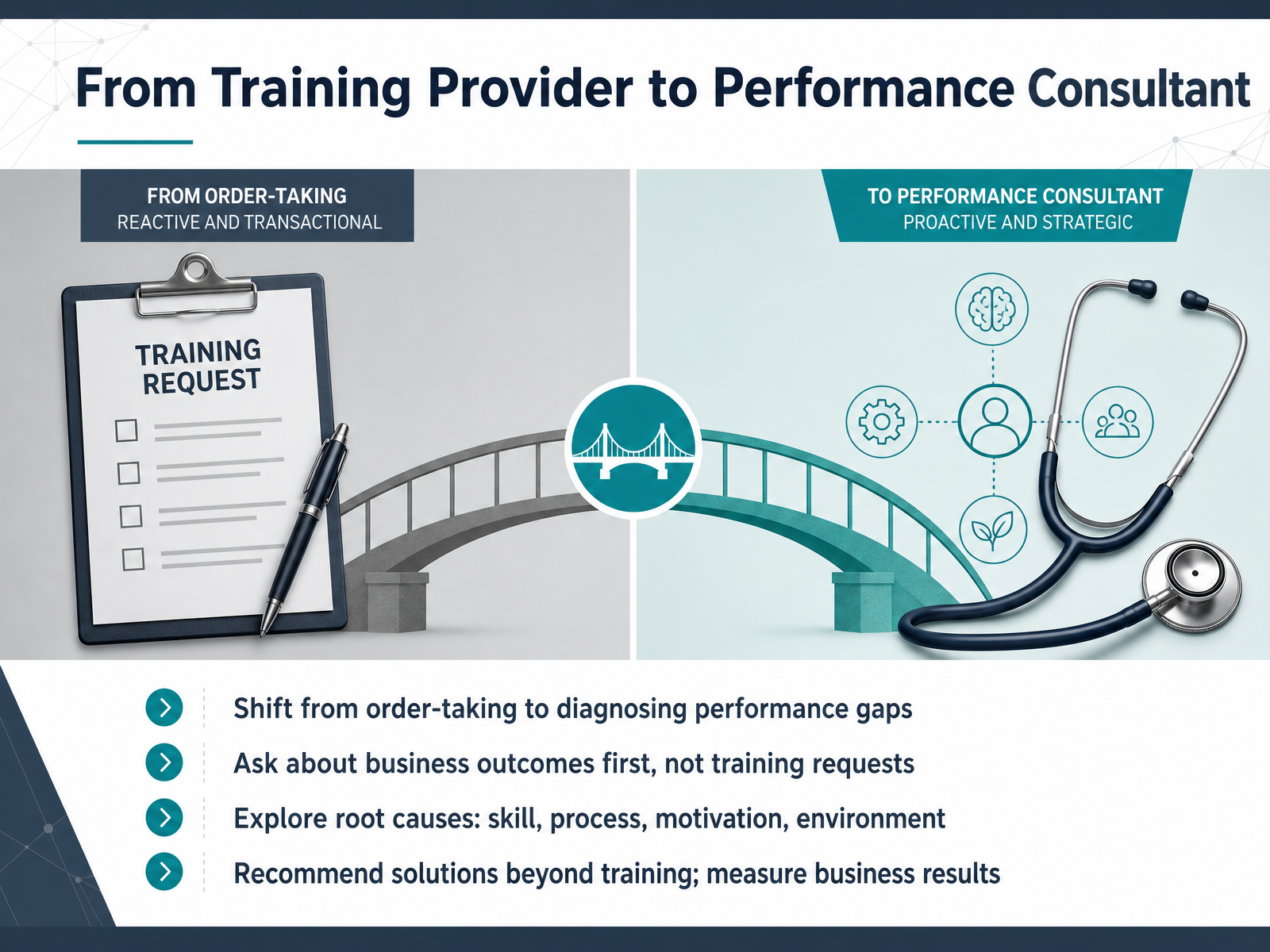 trainingpros.comblog.trainingpros.com2 min
 - 06Evaluating L&D Impact and Reporting ResultsNow let's turn to the critical piece: evaluating impact and reporting results. You already know Kirkpatrick's Four Levels—reaction, learning, behavior, and results. And the Phillips ROI Methodology adds that crucial cost-benefit lens. But here's where the rubber meets the road: don't track everything. Choose metrics based on the learning type. For compliance, track completion and audit readiness. For skills, measure pre- and post-assessment gains. For leadership, look at 90-day application on the job. And whatever you pick, focus your dashboard on outcomes, not attendance or completion. Completion is an operations number, not a proof of value. Instead, show one business metric moved, like error rate down or sales up. That's the data that earns you a seat at the strategy table and secures your next budget. So, when you build that next report, ask: does each number show a change that mattered? If not, swap it for one that does. Up next, we'll explore managing the modern learning ecosystem.
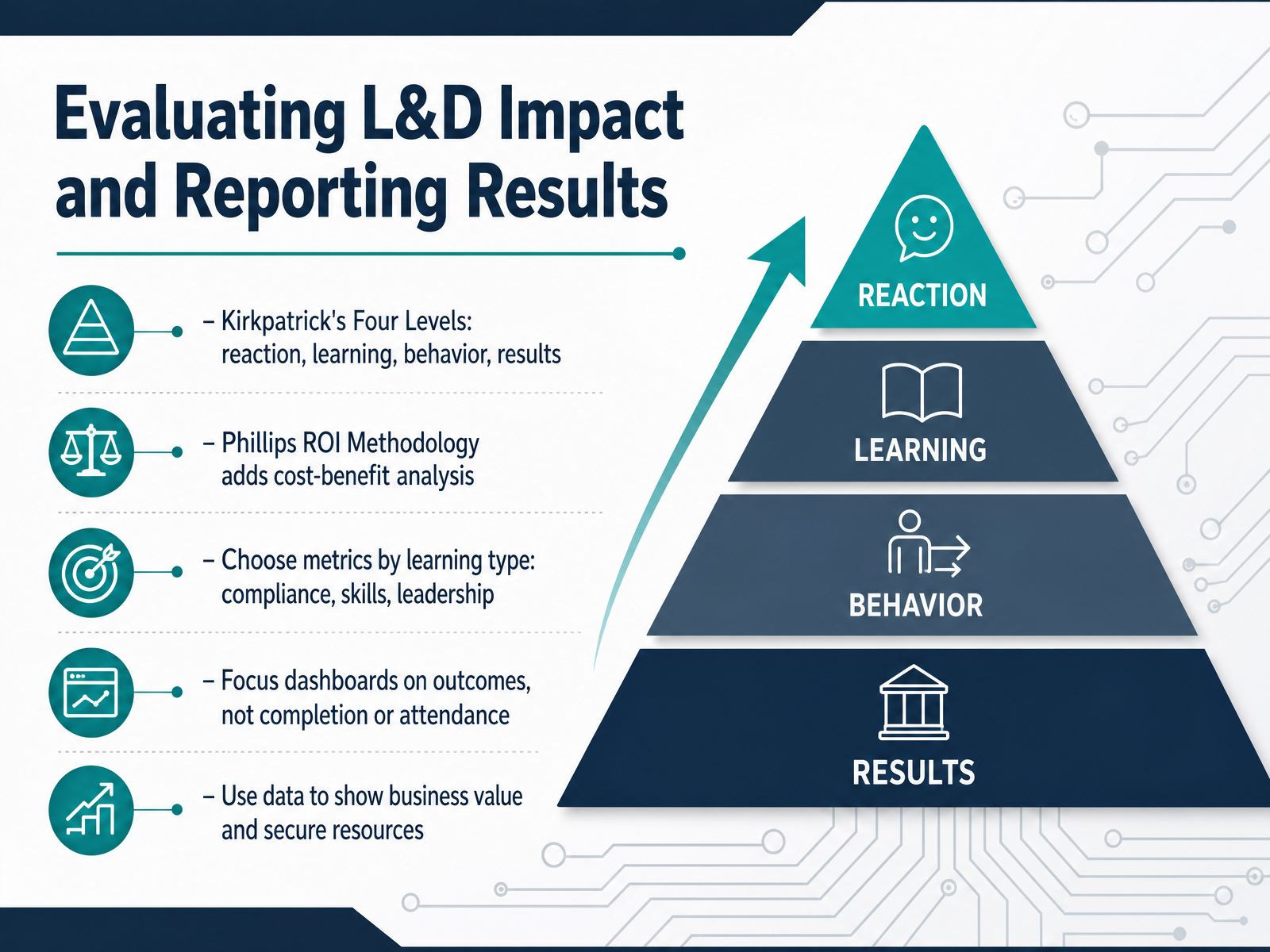 1 min
1 min - 07Managing the Modern Learning EcosystemLet’s turn to the ecosystem itself. The days of choosing between an LMS and an LXP are behind us. In practice, your LMS remains the backbone for compliance, certifications, and audit-ready reporting. Your LXP, on the other hand, drives personalized discovery and keeps learners engaged. The real work is orchestrating both. You also need to balance formal courses with social learning and on-the-job application, because skills stick when they’re practiced, not just watched. And don’t overlook your vendors and internal subject-matter experts; they are strategic assets. Negotiate with a clear roadmap, and give your SMEs the tools to create content that actually reflects how work gets done. Finally, embrace AI and adaptive learning, but keep humans in the loop. Use the intelligence to surface the right content at the moment of need, while you apply judgment to what truly drives performance. Get this mix right, and you move from managing courses to building capability. Up next, we’ll look at how you lead your team and manage stakeholders.
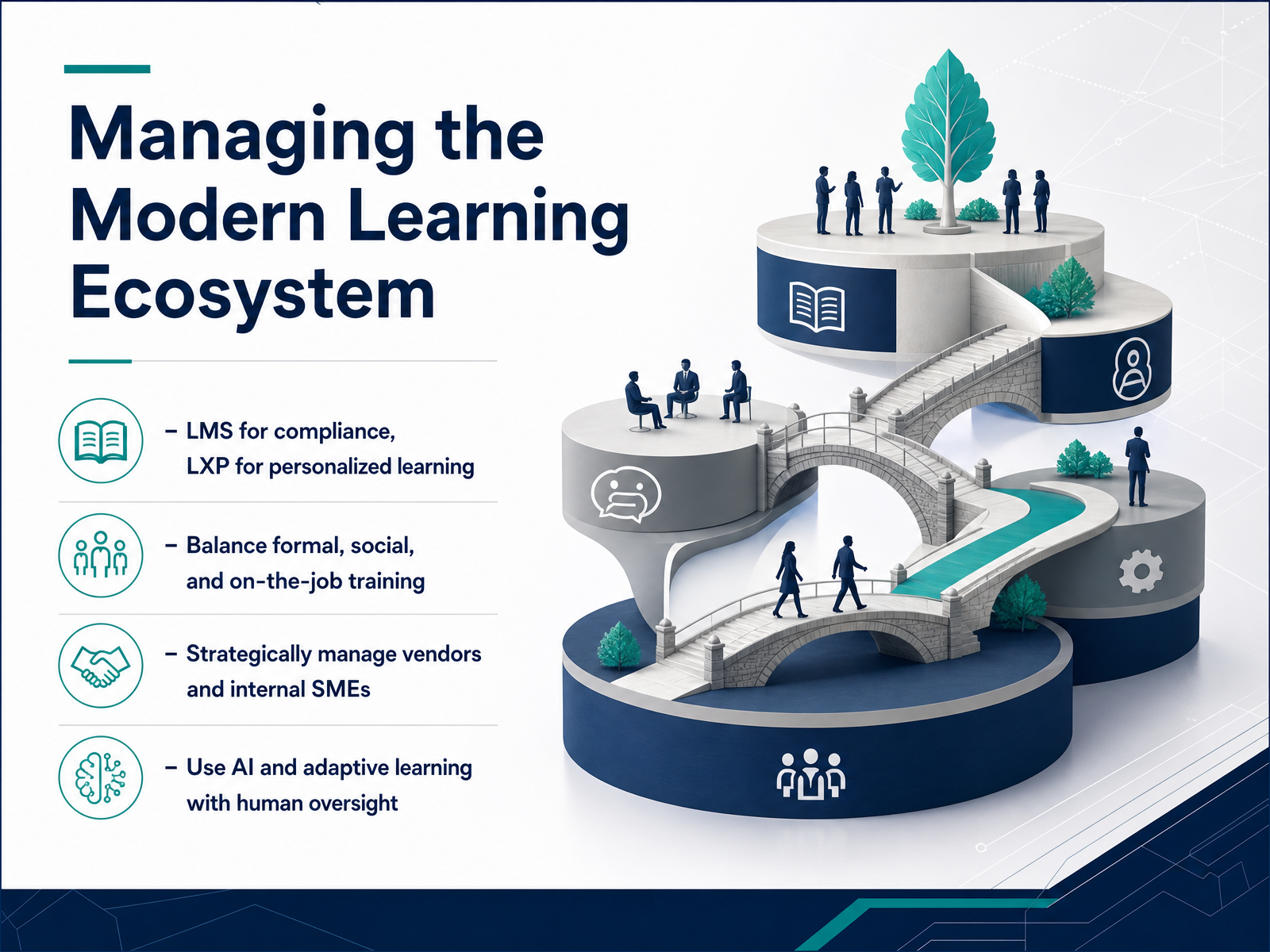 1 min
1 min - 08Leading the L&D Team and Managing StakeholdersNow let's shift focus from the individual leader to the team you're building and the stakeholders you serve. Leading an L&D team starts with attracting and retaining top talent. That means delegating based on strengths—letting your instructional designers design, your facilitators deliver, and your operations people run the engines. Your role is to create an environment where they can do their best work. But even a high-performing team will struggle without strong stakeholder alignment. Start by mapping your stakeholders on influence and interest. High influence, high interest? Those are your key players. They need frequent, direct engagement. Once you know who matters, use tools like a RACI matrix to clarify who is responsible, accountable, consulted, and informed for every task. This prevents confusion and duplicated effort. For even bigger decisions, RAPID helps you identify who recommends, who agrees, who inputs, who decides, and who performs. The goal is to remove ambiguity. When you have competing priorities from different business leaders, your transparency becomes your greatest asset. Don't hide the conflict. Bring your stakeholders into the open, share the trade-offs, and build the business case together. This is how you move from being an order-taker to a true strategic partner. Next, we'll look at the specific actions and mindsets needed as you step fully into the L&D manager role.
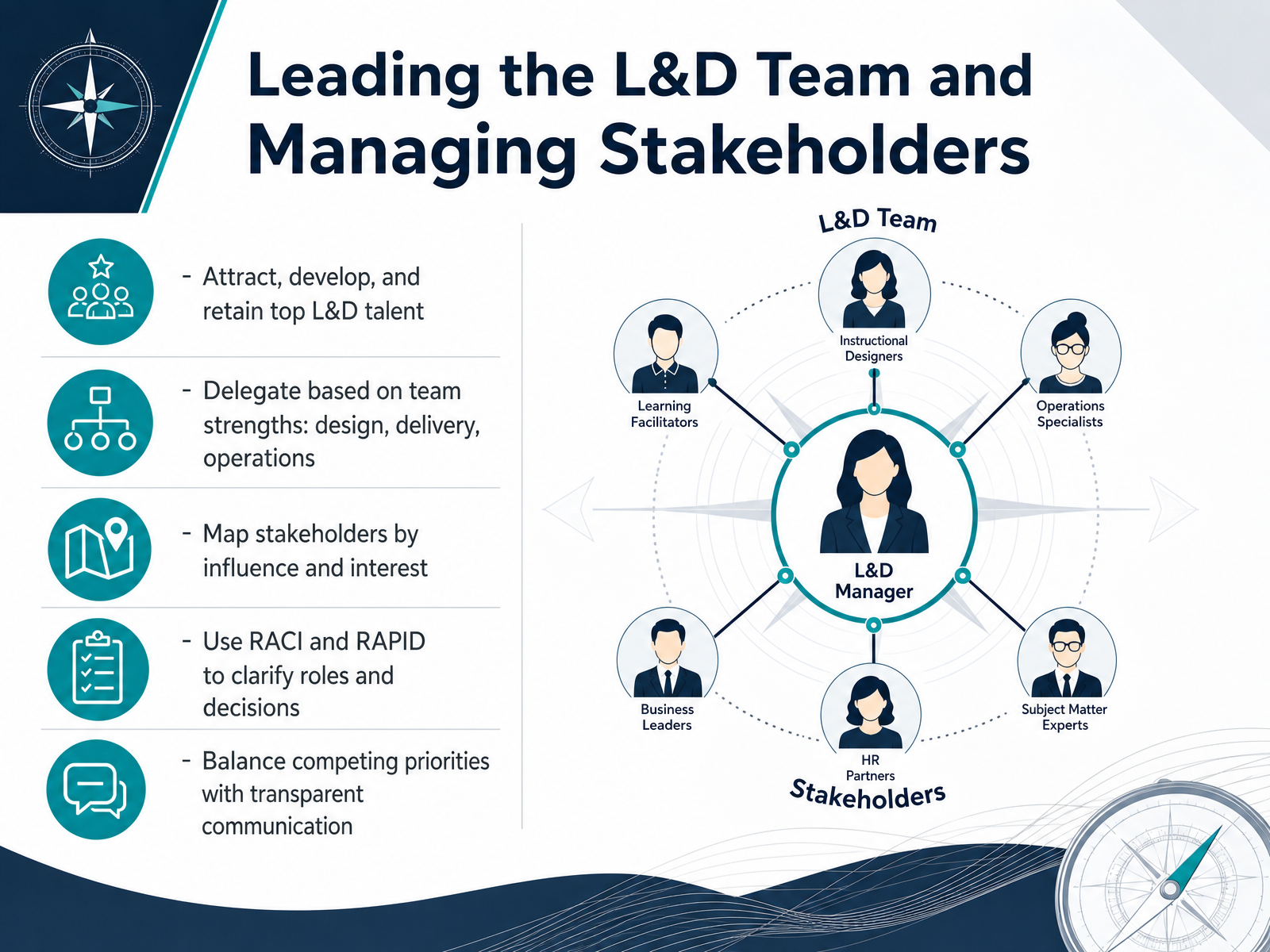 2 min
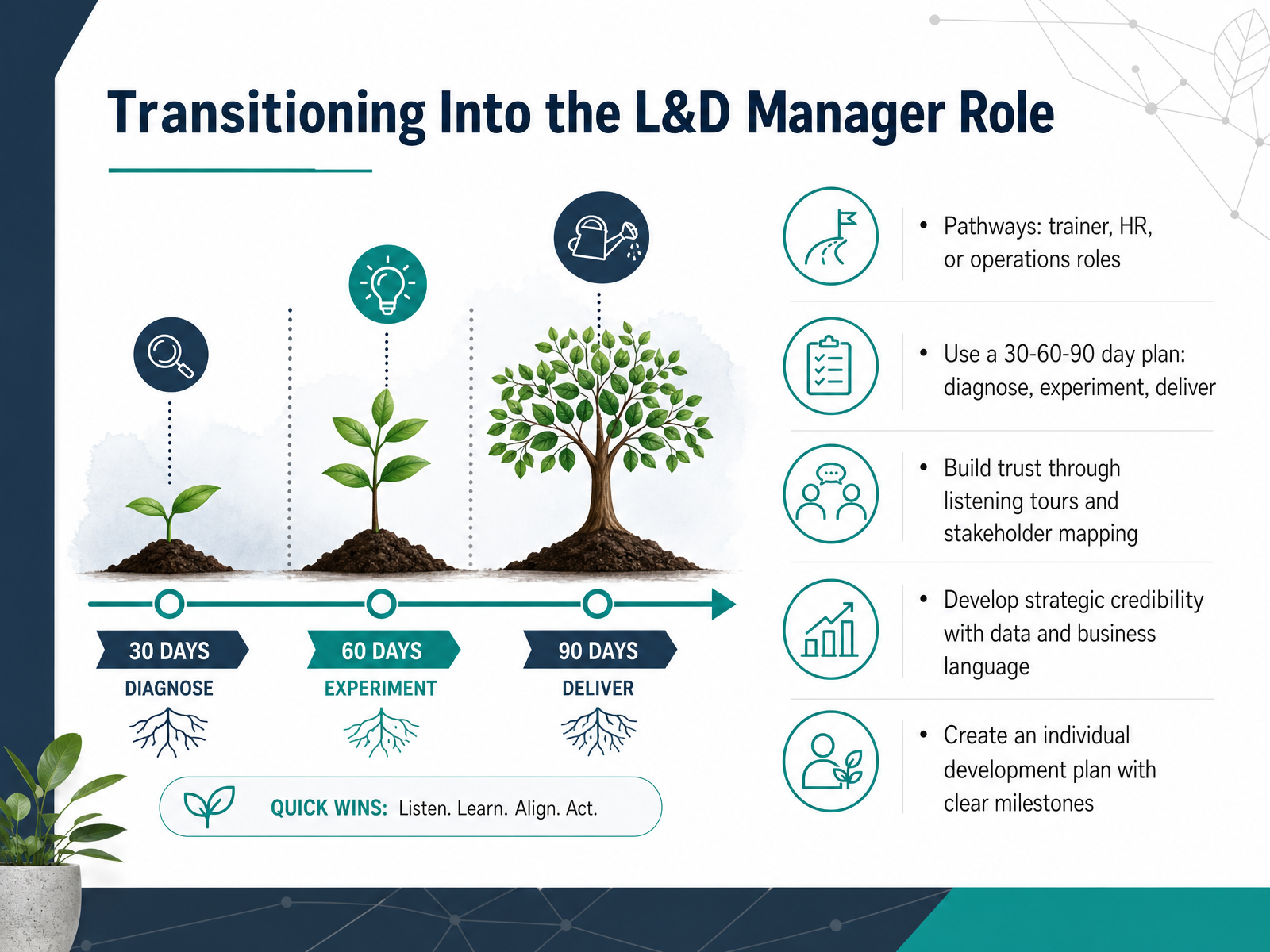
2 min - 09Transitioning Into the L&D Manager RoleLet’s talk about stepping into the role itself. Maybe you’re coming from a trainer position, from HR, or from operations. Each path brings useful instincts, but the manager role asks you to see the whole system. If you're starting fresh, structure your first ninety days in three phases. Diagnose first. Spend the initial thirty days listening. Map your stakeholders, understand how decisions really get made, and note where learning happens informally. Resist the urge to fix everything. Then, experiment. In the next thirty days, launch one small, high-impact pilot. Pick a pain point that matters to the business, and prove your approach works. Delivering that tangible result builds your credibility faster than any presentation. After that, you shift to delivery and scale. Standardize what worked, and start measuring outcomes that leaders care about, like time to proficiency. Throughout this transition, build trust by hearing people out, and speak the language of business, using data to back your recommendations. Finally, create a personal development plan with clear milestones. Schedule your own learning as strictly as you would for your team. Ninety days is enough to establish a rhythm, not to have all the answers. That clarity, consistency, and willingness to listen will carry you forward into a more detailed action plan, which we will tackle next.
 2 min
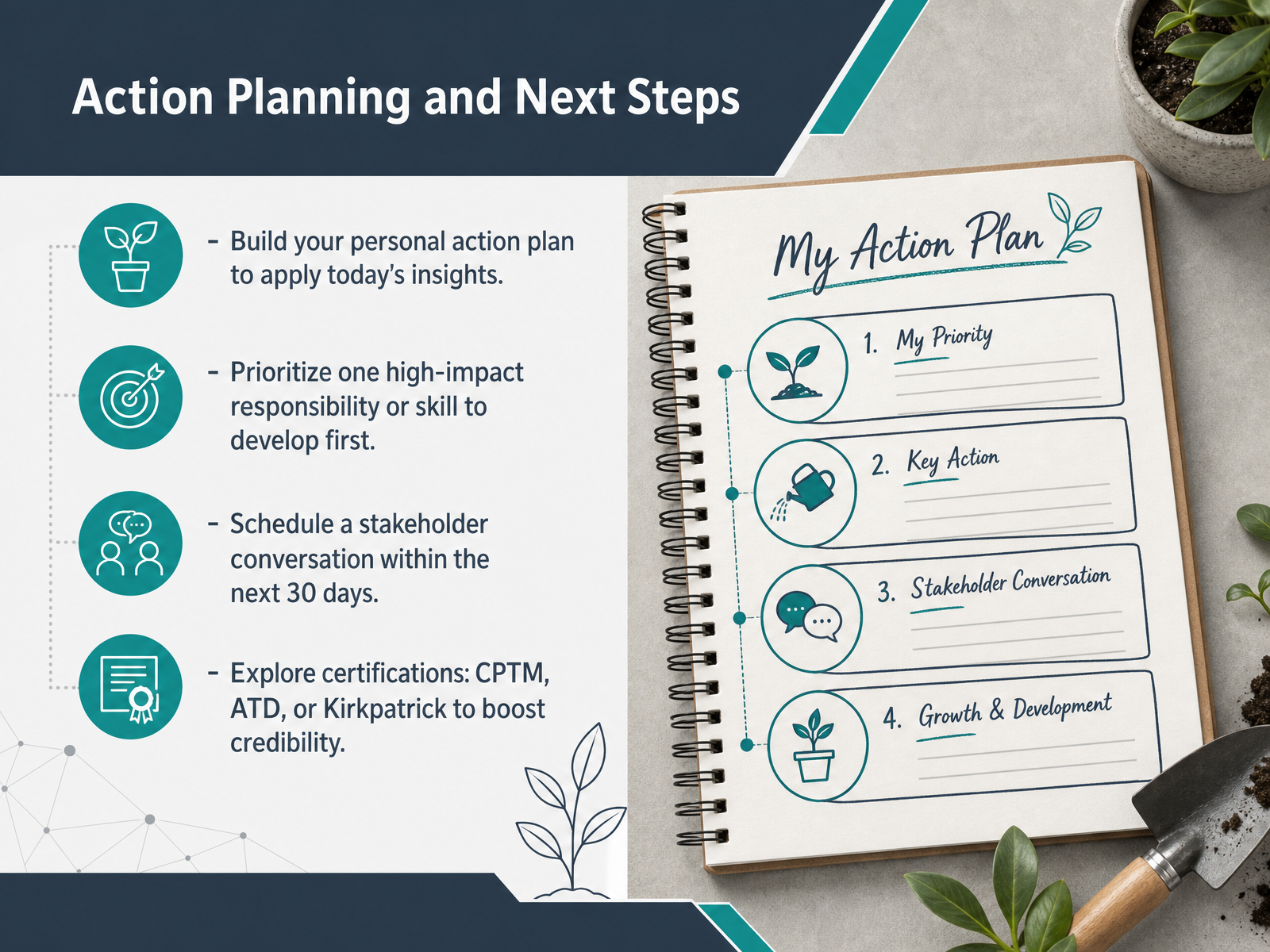
2 min - 10Action Planning and Next StepsSo, we have covered a lot of ground today. Now let’s turn that insight into action. Start by building your own personal action plan. Don’t try to change everything at once. Pick just one responsibility or skill that will make the biggest difference in your role and focus your energy there. Next, schedule a conversation with a key stakeholder within the next thirty days. Use that time to align on business priorities and position learning as the strategic lever it truly is. To strengthen your credibility, explore certifications that match your goals. The C P T M from Training Industry is built specifically for the training manager role. A T D offers certificates for those newer to management. And the Kirkpatrick certification is ideal if you want to formalize impact evaluation. The best next step is the one you commit to this week. Build your plan, start that conversation, and take the next step with confidence. Thank you for your time today, and I wish you every success as you lead learning forward.
 2 min
2 min
Take the deck with you
Download this course as a file — free, no sign-up needed.
- PDF handoutEvery slide page, ready to print or share.11 pages · 2.6 MBDownload
- Narrated PowerPointThe deck that presents itself — every slide carries the digital human's narration video.11 pages · 10.4 MBDownload
- PowerPoint slidesThe full deck as a .pptx — open it in PowerPoint, Keynote, or Google Slides.11 pages · 2.6 MBDownload
Free to use in your own training — please keep the PersonWise credit page at the end.
Have your own deck? Turn it into a course
Sources consulted
Web sources consulted while building this course.
- Complete Career Guide on How to Become a Learning and Development Manager in 2026 — online.edgewood.edu
- Training and Development Managers — bls.gov
- Learning and Development Manager Job Description — roberthalf.com
- Learning & Development Manager: All You Need To Know — aihr.com
- What Is a Learning and Development Manager? — indeed.com
- The New ROI of Employee Development in 2026: From Training Activity to Business Performance — blog.myngle.com
- The L&D Metrics That Actually Matter to Your CFO in 2026 — skillscaravan.com
- Corporate Learning ROI: How To Measure Training Impact - eLearning Industry — elearningindustry.com
- How to Measure Training ROI and Prove L&D Business Value — trainingindustry.com
- Training ROI Model: How To Measure Impact With Phillips – Training Central — training-central.net
- Learning & Development Manager Role and Responsibilities — trainual.com
- Human Resources Development Manager Job Description, Salary & Career Outlook | JobDescription.org — jobdescription.org
- Learning Development Manager Job Description | Velvet Jobs — velvetjobs.com
- L&D Skills of the Future: 12 Essential Skills for 2026 | Thirst — thirst.io
- Learning and Development Manager Jobs: Skills, Roles & Career Path — online.edgewood.edu
- 💼 If Your L&D Role Ends with "Training," You're Missing Half the Job.! | Aarti Pagare — linkedin.com
- The Evolving Role of L&D Professionals in 2026-From Training Administrators to Strategic Value Architects | Muhammad Usman Iftikhar Dev CPT-IAPPD(UK), CODA-HRCI(USA), OLRP-UoB(UK) — linkedin.com
- How to Start a Career in L&D in 2026 (Skills, Roles & Tips) — thelndacademy.com
- Performance Consulting For Corporate Learning Leaders — trainingpros.com
- What Is Performance Consulting? A Practical Guide For L&D Leaders — blog.trainingpros.com