Digital Marketing Fundamentals
Begin
14 pages · ~28 min
Digital Marketing Fundamentals
An overview of digital marketing types, covering key channels and strategies for professionals seeking foundational knowledge.
What you’ll learn
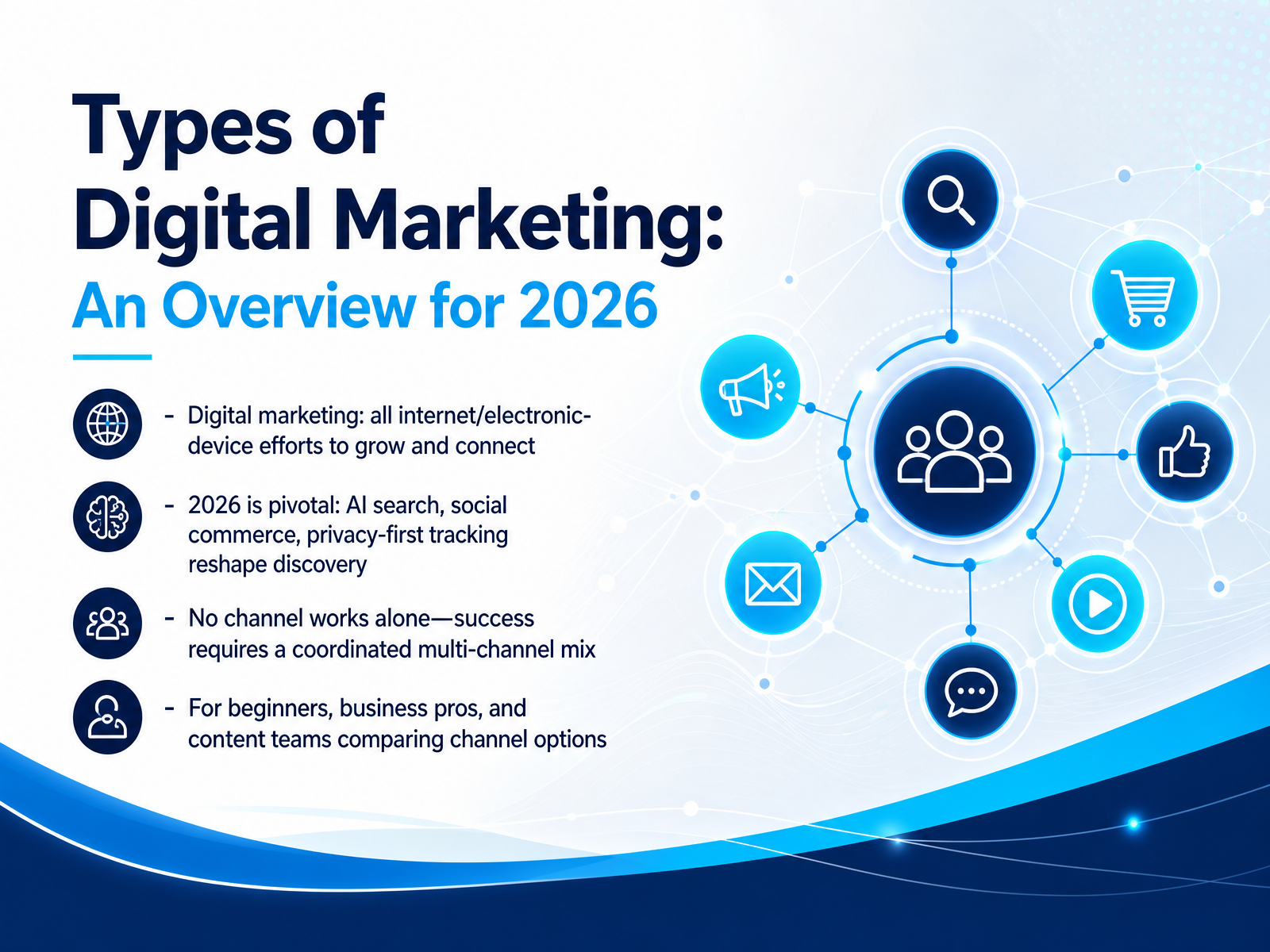
- 01Types of Digital Marketing: An Overview for 2026Welcome. Today we are walking through the types of digital marketing that matter in 2026, and I want you to think of this as a friendly tour, not a lecture. We will look at what each channel actually does, how they fit together, and how to compare them for your own business or team. You have probably heard that digital marketing is changing fast. AI search is reshaping discovery, social commerce is growing up, and privacy-first tracking is making us rethink how we measure what works. But here is the key idea we will keep coming back to: no single channel runs the whole show anymore. Success comes from a coordinated mix where each channel plays a clear role. So whether you are new to this, a business professional, or part of a content team comparing options, you are in the right place. Let us start with the big picture of the 2026 digital marketing ecosystem.blog.hubspot.comblog.hubspot.commabo.co.uk+21 min
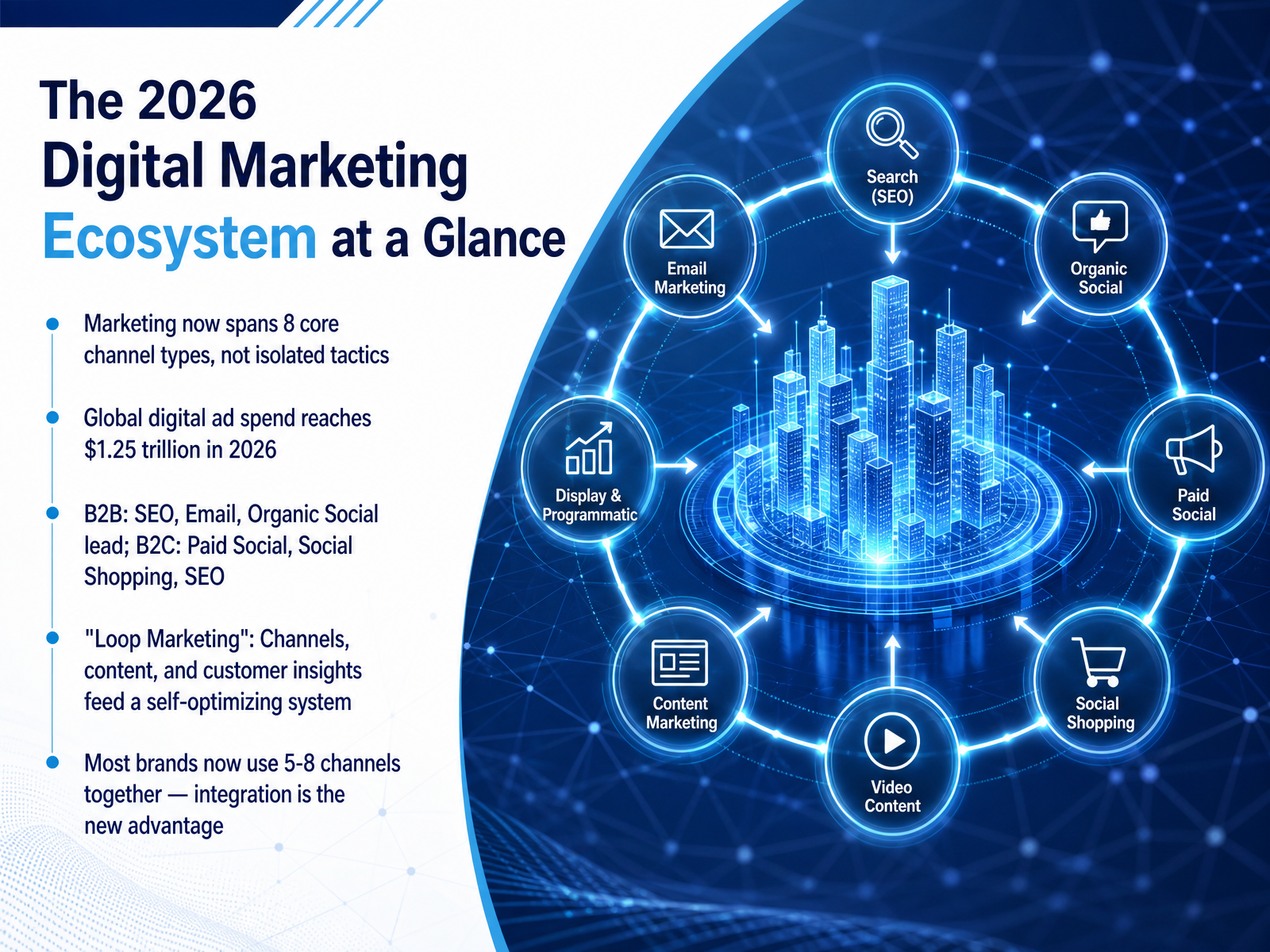
- 02The 2026 Digital Marketing Ecosystem at a GlanceNow let's zoom out and look at the whole digital marketing picture as it stands right now. Marketing today is really about eight core channel types working together, not a bunch of separate tactics. Globally, we're looking at digital ad spend hitting one point two five trillion dollars this year. The mix is also shifting depending on who you're talking to. For business-to-business, the leaders are website and SEO, email, and organic social. On the consumer side, it's paid social, social shopping, and SEO. The big idea connecting all of this is something we call Loop Marketing. Channels, content, and customer insights now feed into a system that optimizes itself over time. The practical takeaway is this: most brands today are using five to eight channels together. Integration itself has become the real competitive advantage. Up next, let's dig into one of the foundational pieces by exploring Search Engine Marketing, the art of being found.
 blog.hubspot.comblog.hubspot.commabo.co.uk+22 min
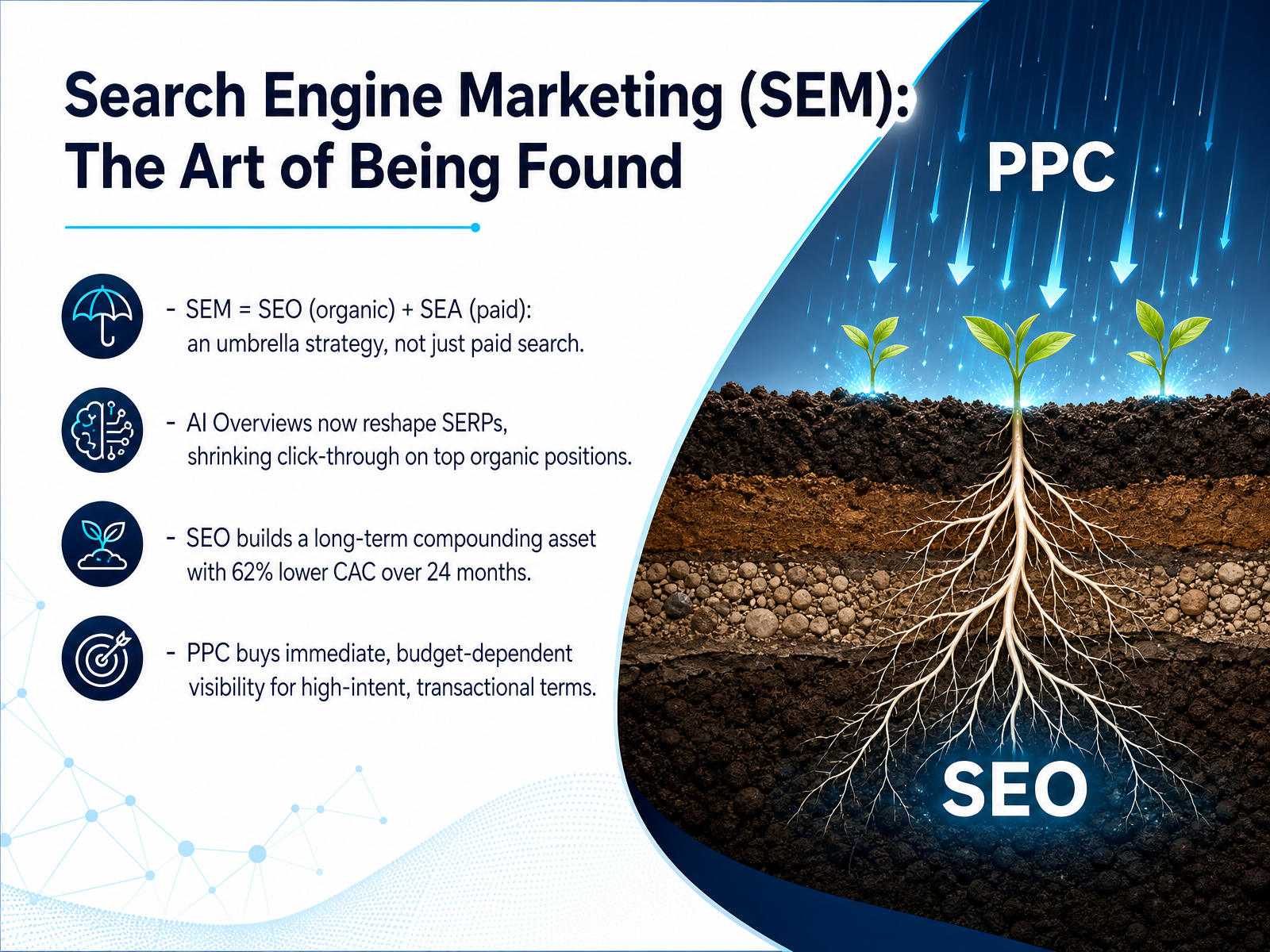
 - 03Search Engine Marketing (SEM): The Art of Being FoundLet's unpack what search engine marketing really means. Many people use the abbreviation SEM as shorthand for paid search ads alone. But SEM is actually an umbrella strategy that combines two distinct approaches. The first is search engine optimization, or SEO, which earns organic visibility by creating content and authority that search engines trust. The second is search engine advertising, often called SEA, which buys immediate paid placements for high-intent terms. Think of SEO as building a long-term asset that compounds over time—research shows it can lead to a sixty-two percent lower cost to acquire a customer over twenty-four months. Paid search, on the other hand, is like renting instant attention that stops the moment you pause the budget. It is perfect when you need to capture demand on transactional queries like 'pricing' or 'demo' right away. We also have to acknowledge a new reality: search results pages are changing. When Google shows an AI Overview at the top, it can dramatically shrink click-through rates on even the number one organic spot. That means a modern SEM strategy isn't just about winning a position. It is about managing your total on-screen presence across organic and paid spaces. Up next, we will explore how this connects to AI-driven citations in 'SEO and Answer Engine Optimization in Practice.'
 incremys.comseologist.comflux.la+22 min
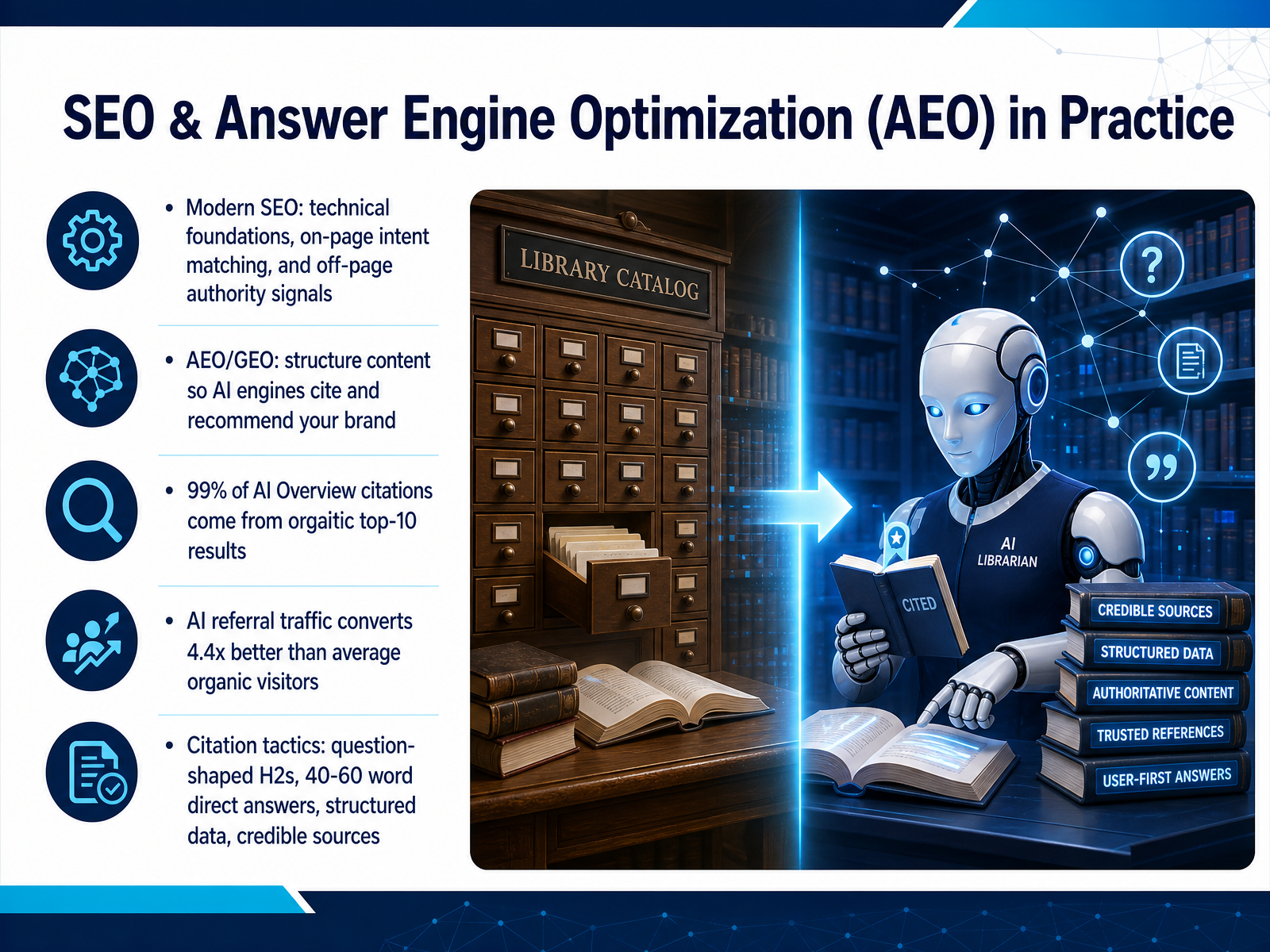
 - 04SEO & Answer Engine Optimization (AEO) in PracticeNow, let's move from the theory of buying attention to the practical side of earning it, starting with SEO and Answer Engine Optimization. Think of modern SEO as doing three jobs at once. First, you build a strong technical foundation so search engines can find and read your site. Second, you match every page to the real intent behind what someone typed. And third, you build authority by getting other credible sites to reference you. But today, there's a new layer: Answer Engine Optimization, or AEO. This is about structuring your content so AI tools like ChatGPT or Google's AI Overviews can easily cite and recommend your brand. The link between the two is very tight. Research shows that ninety-nine percent of AI Overview citations come from pages already ranking in the top ten organic results. So you can't just optimize for robots, you earn citations by first doing great SEO. The business payoff is concrete. AI referral traffic converts at four point four times the rate of the average organic visitor because these users arrive with high intent. To make your content easy for AI to cite, use question-shaped headings, lead with a direct answer of about forty to sixty words, add structured data behind the scenes, and back up your claims with credible sources. Up next, we'll explore another discovery engine where your buyers are spending their time: social media.
 incremys.comseologist.comflux.la+22 min
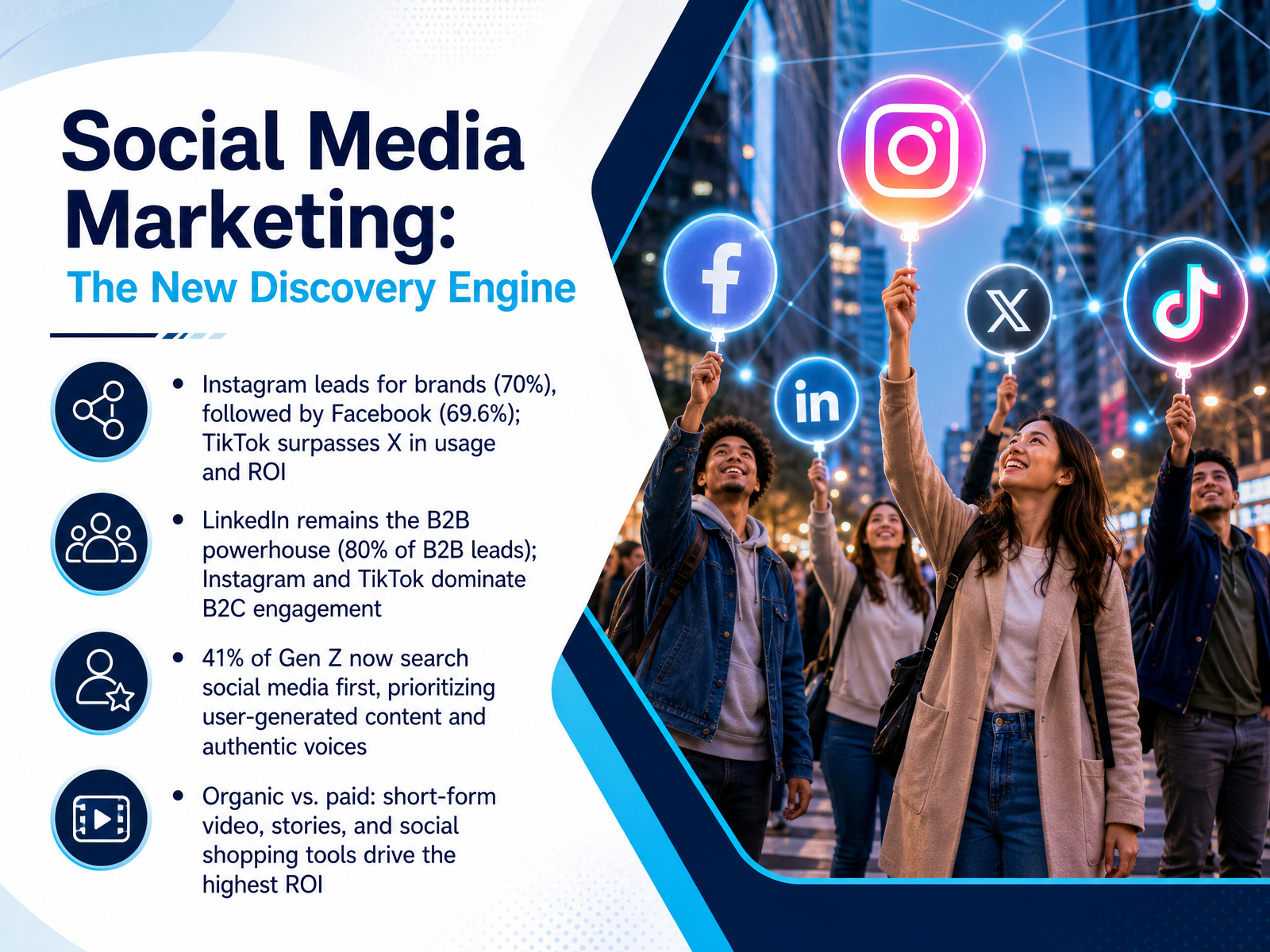
 - 05Social Media Marketing: The New Discovery EngineSocial media has quietly become the place where many customers first discover a brand, not just where they connect with it. You can think of it as today’s discovery engine. Let’s look at the landscape in a practical way. Instagram now leads among brands, used by seventy percent of them, just ahead of Facebook at sixty-nine point six percent. And TikTok has surpassed X in both usage and return on investment. For B2B teams, LinkedIn is still the powerhouse, generating about eighty percent of B2B leads. Meanwhile, Instagram and TikTok dominate consumer engagement. What’s changing is how younger audiences search. Forty-one percent of Gen Z now turn to social media first, and they prioritize user-generated content and authentic voices over polished ads. When you plan your mix, think about organic versus paid. Short-form video, stories, and social shopping tools are currently driving the highest return. So you’re not just posting; you’re building discoverability. Up next, let’s see how content marketing fuels the entire funnel.
 blog.hubspot.comblog.hubspot.commabo.co.uk+22 min
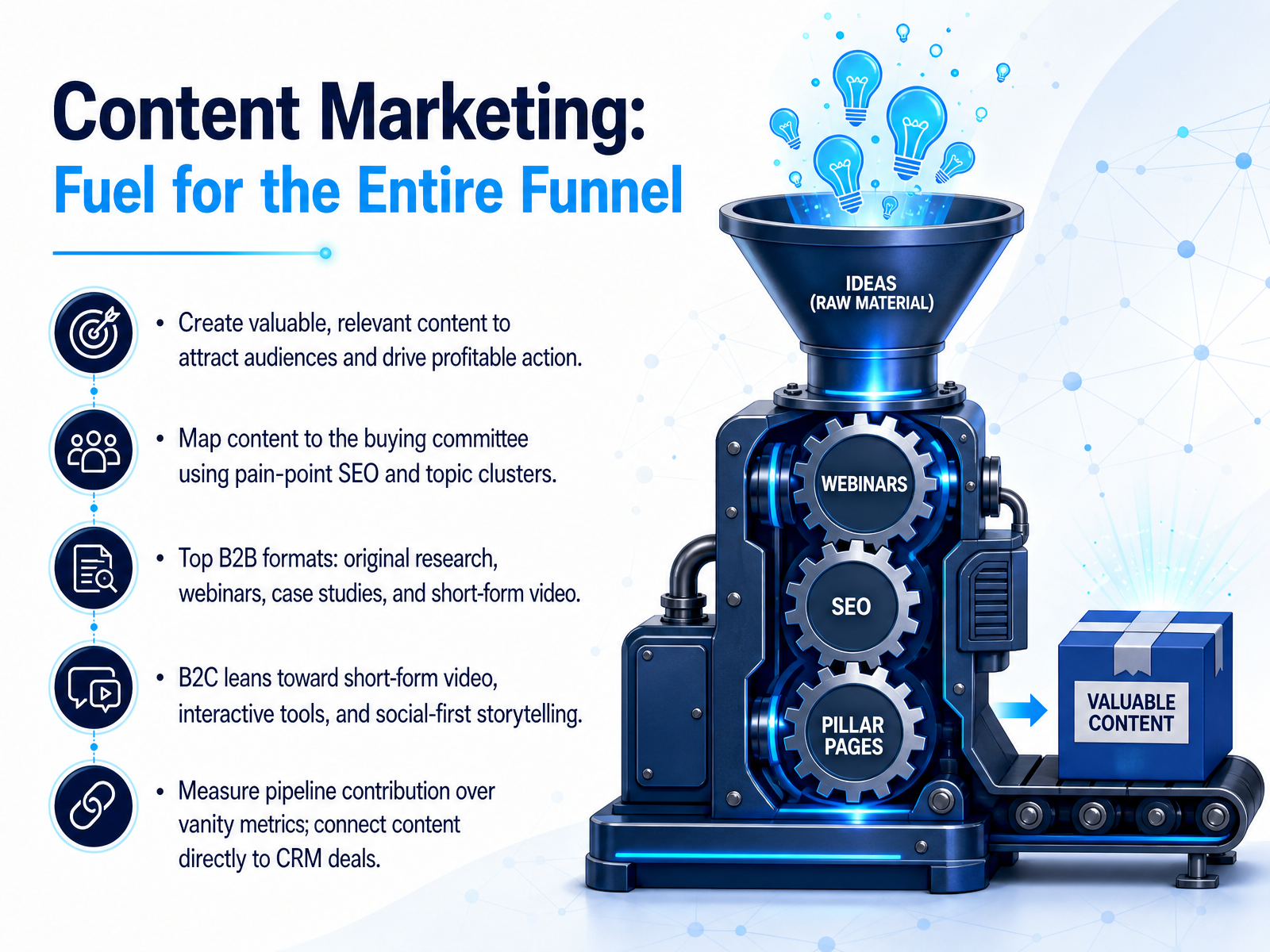
 - 06Content Marketing: Fuel for the Entire FunnelNow let's talk about content marketing, which really is the fuel for your entire funnel. At its simplest, content marketing means creating valuable, relevant material that attracts an audience and, over time, drives profitable action. In B2B, the best performers map content directly to buying committees. Instead of guessing at topics, they use pain-point SEO and topic clusters to answer real questions from every role in the room. The formats that work hardest in B2B tend to be original research, webinars, detailed case studies, and yes, even short-form video. B2C content leans more toward social-first storytelling, short video, and interactive tools. But across both, the smartest shift we are seeing is measuring pipeline contribution instead of vanity metrics. That means connecting your content directly to deals in your CRM so you know which pages and videos actually influenced revenue. Next, we will look at how email marketing can turn a thirty-six dollar investment into a one dollar return.
 thegrowthsyndicate.comgogreymatter.commarketful.com+22 min
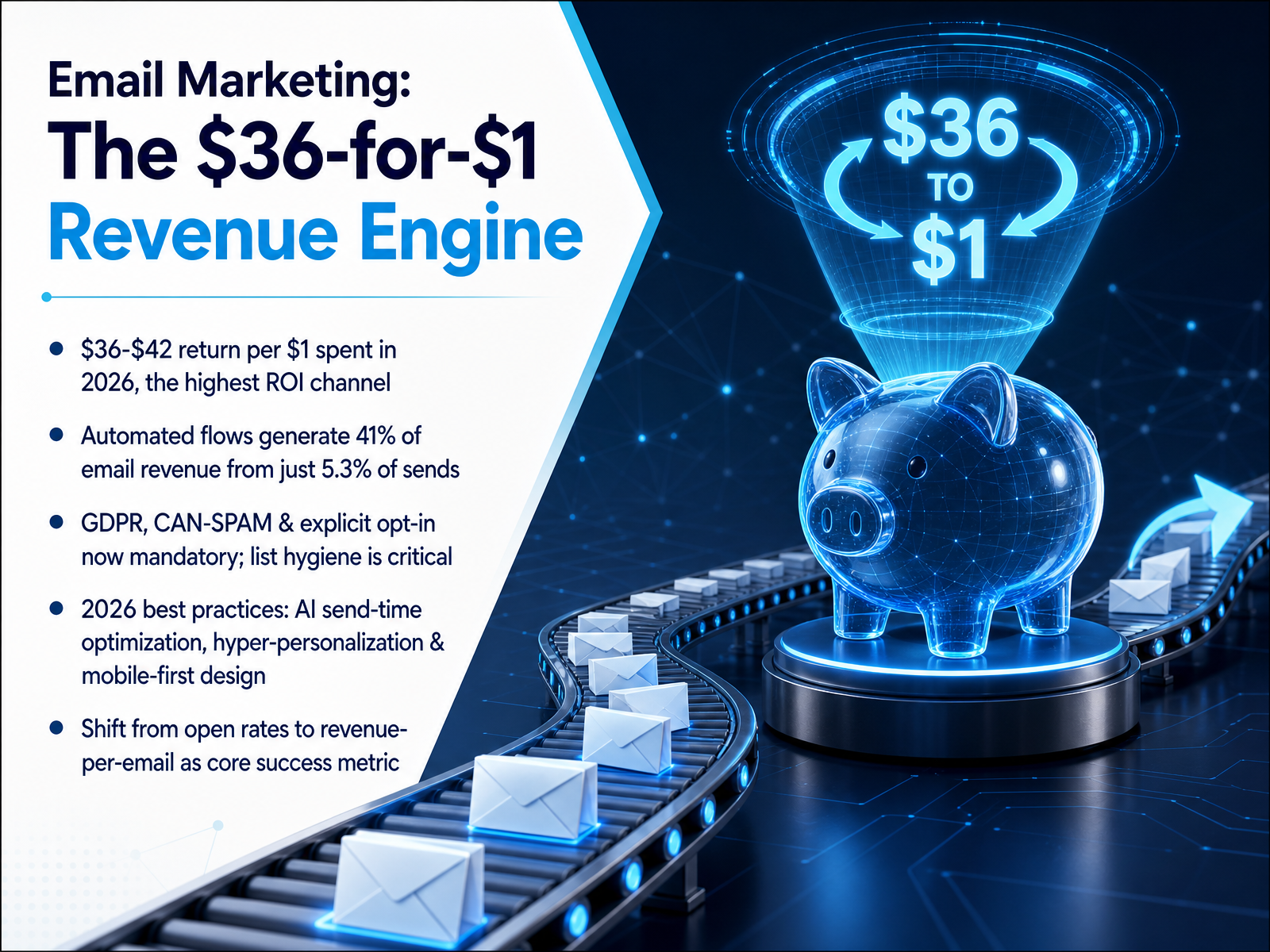
 - 07Email Marketing: The $36-for-$1 Revenue EngineNow let's look at a channel that consistently delivers the highest return on investment across digital marketing: email. The industry average is around thirty-six to forty-two dollars back for every single dollar spent. That's a three-thousand-six-hundred to four-thousand-two-hundred percent return, which is why so many teams call it their revenue engine. But the real story isn't just about sending more campaigns. Automated flows, like welcome series or abandoned cart reminders, now generate about forty-one percent of all email revenue from just over five percent of total sends. These are messages triggered by specific actions, so they reach the right person at the right moment. Of course, with regulations like the GDPR and the CAN-SPAM Act, getting explicit permission and keeping a clean list isn't optional anymore. It's critical for deliverability. For best practices in twenty twenty-six, we're seeing teams embrace artificial intelligence for send-time optimization and hyper-personalization, while designing every email to look great on mobile. The biggest shift is how we measure success. Instead of focusing on open rates, which can be unreliable, top-performing programs now track revenue per email. This tells you the real business value of every send. Next up, we'll explore how to build that trust at scale with affiliate and influencer marketing.
 omnisend.comlitmus.comblog.hubspot.com+22 min
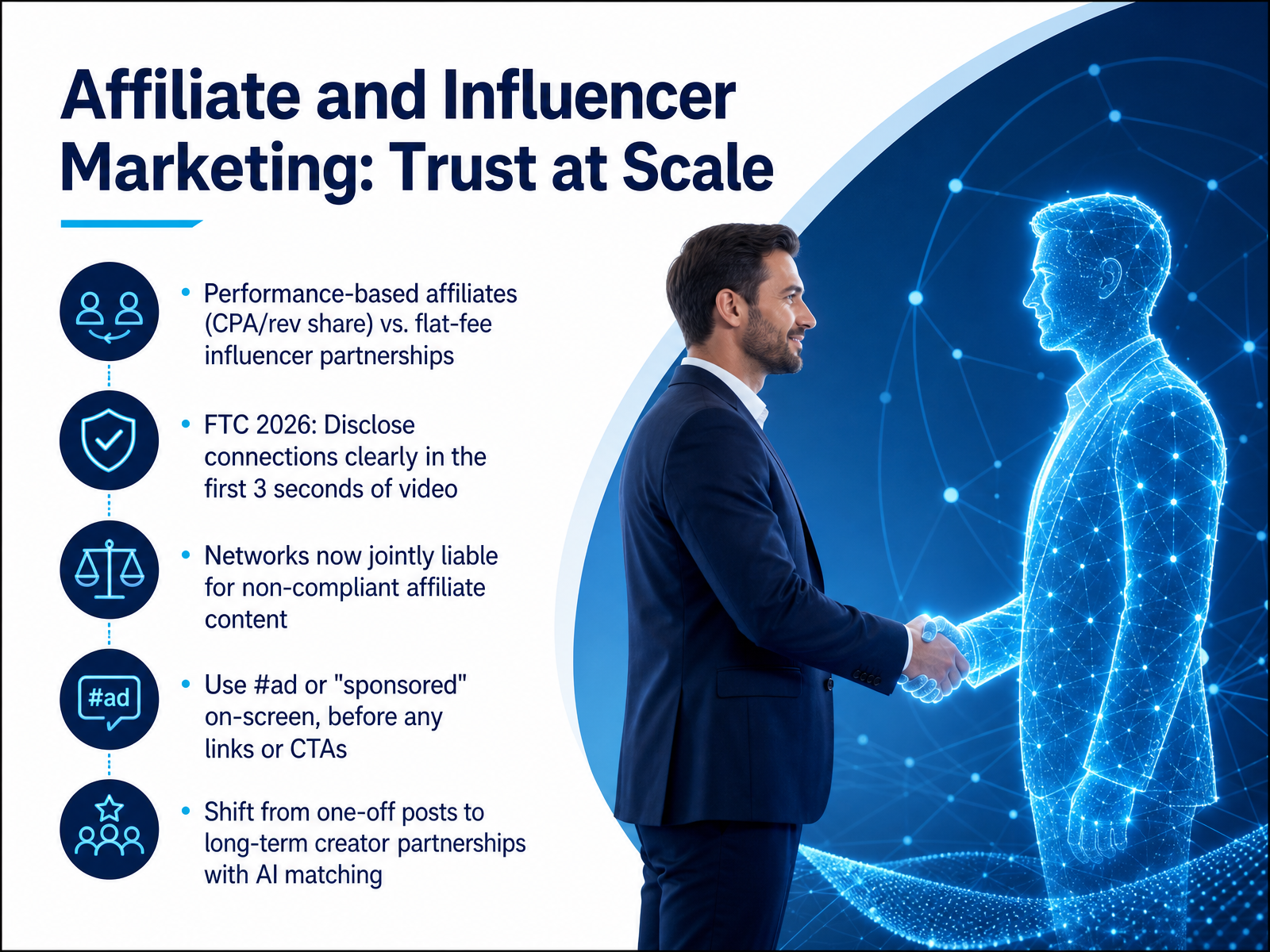
 - 08Affiliate and Influencer Marketing: Trust at ScaleNow let's talk about affiliate and influencer marketing, two channels that operate on borrowed trust at scale. An affiliate is a performance-based partner who earns a commission when someone clicks their link and buys, so you pay for results. An influencer is someone with a social following who creates content around your brand, often paid a flat fee for their reach and creative work. The distinction matters because cost, risk, and control are very different. With affiliates you can track every dollar. With influencers you are really investing in awareness and credibility, which is harder to measure directly. A practical shift we are seeing is the move from one-off influencer posts to long-term creator partnerships, often discovered and matched through artificial intelligence. But here is the part nobody can afford to ignore in 2026. The Federal Trade Commission now requires a clear disclosure of the paid connection in the first three seconds of any video content. That means the hashtag ad or the word sponsored must appear on-screen before any link or call to action, not buried at the end. Affiliate networks themselves can now be held jointly liable if the creators they work with fail to disclose properly. So whether you manage a program or create content, get the disclosure up front, make it obvious, and keep it simple. Up next we will look at video marketing, where attention and trust converge.
 2 min
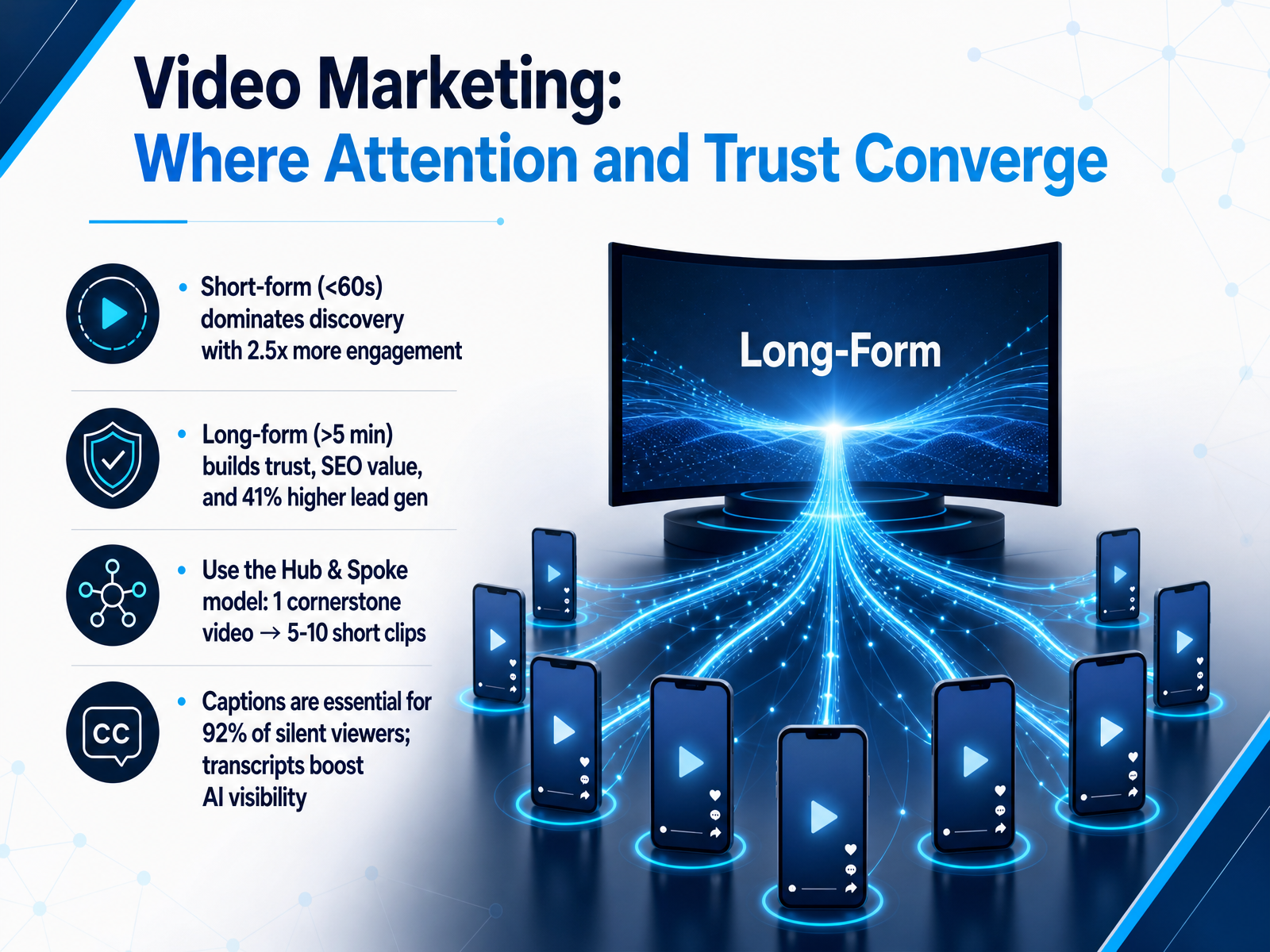
2 min - 09Video Marketing: Where Attention and Trust ConvergeNow let's look at how short-form and long-form video play different roles, and how you can use them together. Think of short-form video, clips under sixty seconds, as your discovery engine. It stops the scroll and generates two and a half times more engagement, which makes it perfect for introducing your brand on platforms like Reels or Shorts. Long-form video, on the other hand, is your trust builder. When someone watches a tutorial or a webinar that's five minutes or longer, they're ready to go deeper. This format drives forty-one percent higher lead generation and builds lasting SEO value because it answers complex questions. The most practical approach is the Hub and Spoke model. You create one cornerstone long-form video, then extract five to ten short clips from it. This means one interview or product demo can fuel weeks of social content. And remember, the majority of viewers watch without sound, so adding captions is essential. Transcripts also help AI search engines understand your content. Next, let's move on to Display and Programmatic Advertising, and see how it goes beyond the banner.
 2 min
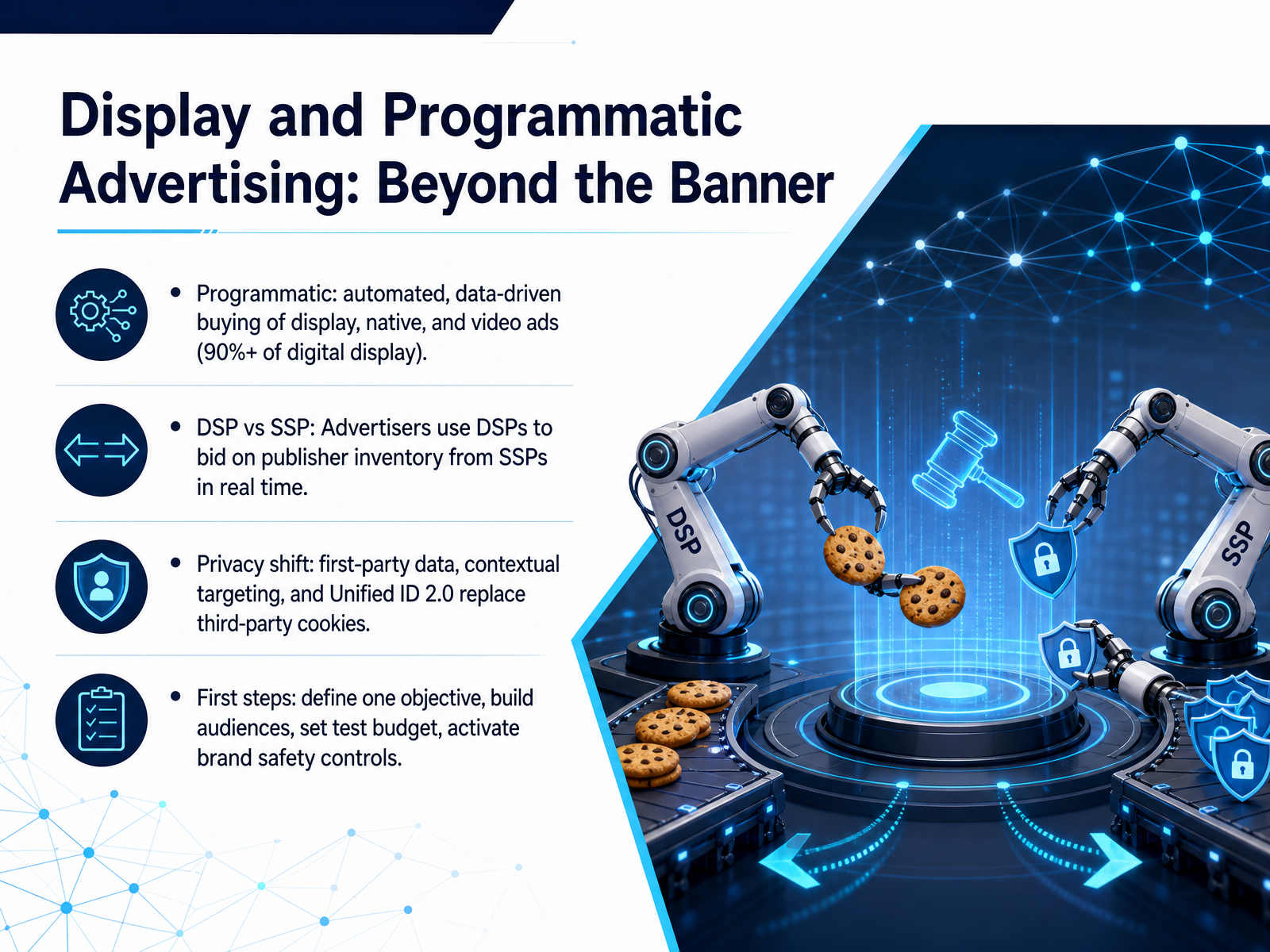
2 min - 10Display and Programmatic Advertising: Beyond the BannerNow let's look at how most digital banner ads are actually bought and sold today, through programmatic advertising. A simple way to think about it is this: display is what you see, like a banner or a video, while programmatic is the automated, behind-the-scenes system that places it in front of the right person at the right moment. In fact, over ninety percent of digital display spend now moves through these real-time pipelines. There are two main players in every auction. We, the advertisers, use a demand-side platform, or DSP, to set our goals and bid on ad space. Publishers use a supply-side platform, or SSP, to offer their inventory. The whole transaction happens in milliseconds while the page loads. One major shift we are all adapting to is the decline of third-party cookies. Privacy regulations have pushed us toward smarter, more durable strategies like using first-party data from our own customer relationships, contextual targeting that matches ads to page content, and identity frameworks like Unified ID 2.0. If you are thinking about testing this, start with a focused objective, build a clear audience from your first-party data or context, set a modest test budget, and always turn on your brand safety controls to keep your ads off unsuitable sites. Coming up, we'll move beyond the browser to explore mobile, in-app, and emerging channels where attention is moving next.
 2 min
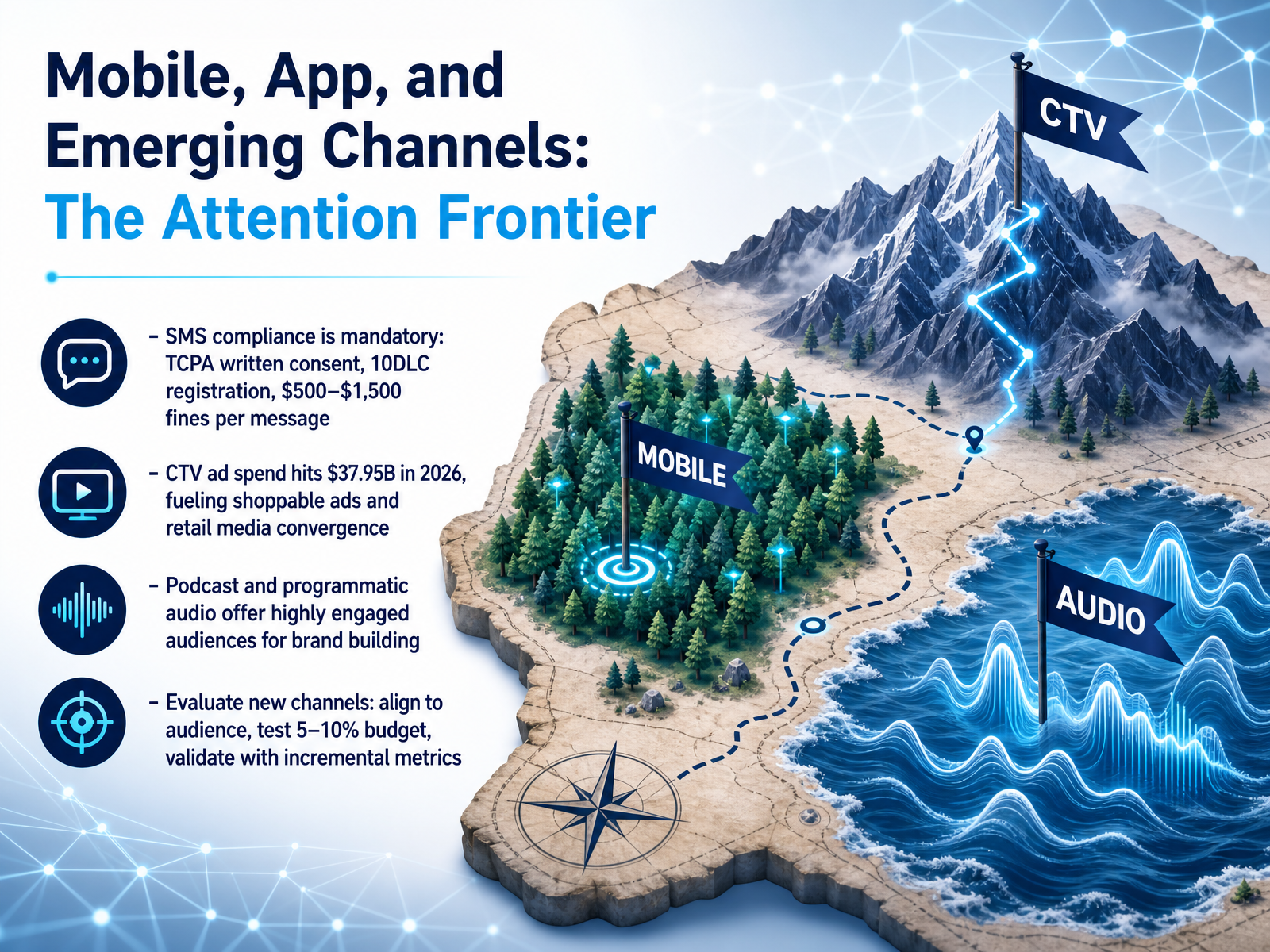
2 min - 11Mobile, App, and Emerging Channels: The Attention FrontierNow let's turn to the channels where attention is moving fastest: mobile, apps, and the connected TV space. These aren't futuristic concepts anymore, they're where your audience already spends time. But each one comes with distinct rules and trade-offs. Let's start with SMS. If you send marketing texts in the US, compliance isn't optional, it's mandatory. We're talking about the TCPA, which requires clear written consent before you message anyone. The fines are serious: five hundred to fifteen hundred dollars per violating text. You also need your brand and campaigns registered in the ten DLC system, or your messages simply won't get delivered. Next, consider Connected TV. Ad spending there is projected to hit nearly thirty-eight billion dollars this year. But the real story is accountability. Brands are demanding proof of performance. What's working? Shoppable ads that turn viewers into buyers, and retail media partnerships that link what people watch to what they actually purchase. There's also a growing space in podcast and programmatic audio, where highly engaged audiences are perfect for brand building. So, how do you evaluate any new channel? Start with your audience, not the hype. Test with five to ten percent of your budget, and validate using incremental metrics, like actual sales lift or foot traffic, not just impressions. Up next, we'll unpack one of these channels in much more detail: SMS Marketing, the High-Stakes, High-Reward Channel.
 2 min
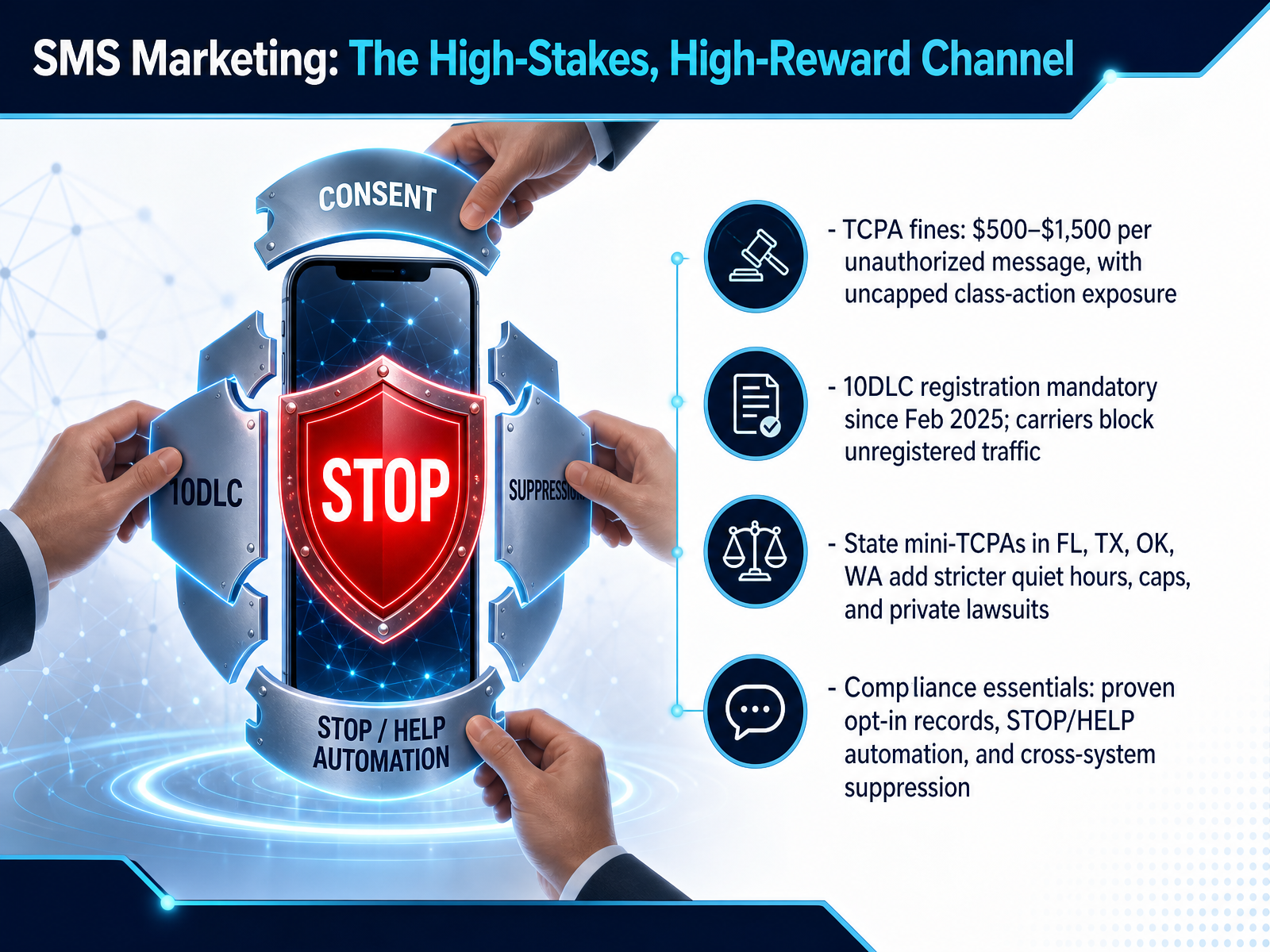
2 min - 12SMS Marketing: The High-Stakes, High-Reward ChannelNow let's turn to a channel that's incredibly direct but carries serious legal weight: SMS marketing. The basic idea is simple. We send a promotional text straight to someone's phone. The reality, though, is that SMS is the most heavily regulated digital channel we have. The big one is the federal TCPA. Statutory fines for sending a single unauthorized text range from five hundred to fifteen hundred dollars. And in a class action, there's no cap on total exposure, so mistakes with large lists can get very expensive very fast. Since early 2025, there's a second non-negotiable layer called 10DLC registration. If your business isn't registered with the carriers through The Campaign Registry, your marketing texts are simply blocked. They never arrive. On top of that, several states like Florida, Texas, and Oklahoma now have their own mini-TCPA laws with stricter quiet hours, per-day message caps, and private lawsuit rights. So what does a defensible program look like? It starts with airtight opt-in records you can actually prove in court, automated STOP and HELP keyword handling that works instantly, and a suppression system that syncs opt-outs across your entire tech stack in real time. Next, we'll shift gears to measuring what all of this activity is worth by exploring marketing in a cookieless world.
 2 min
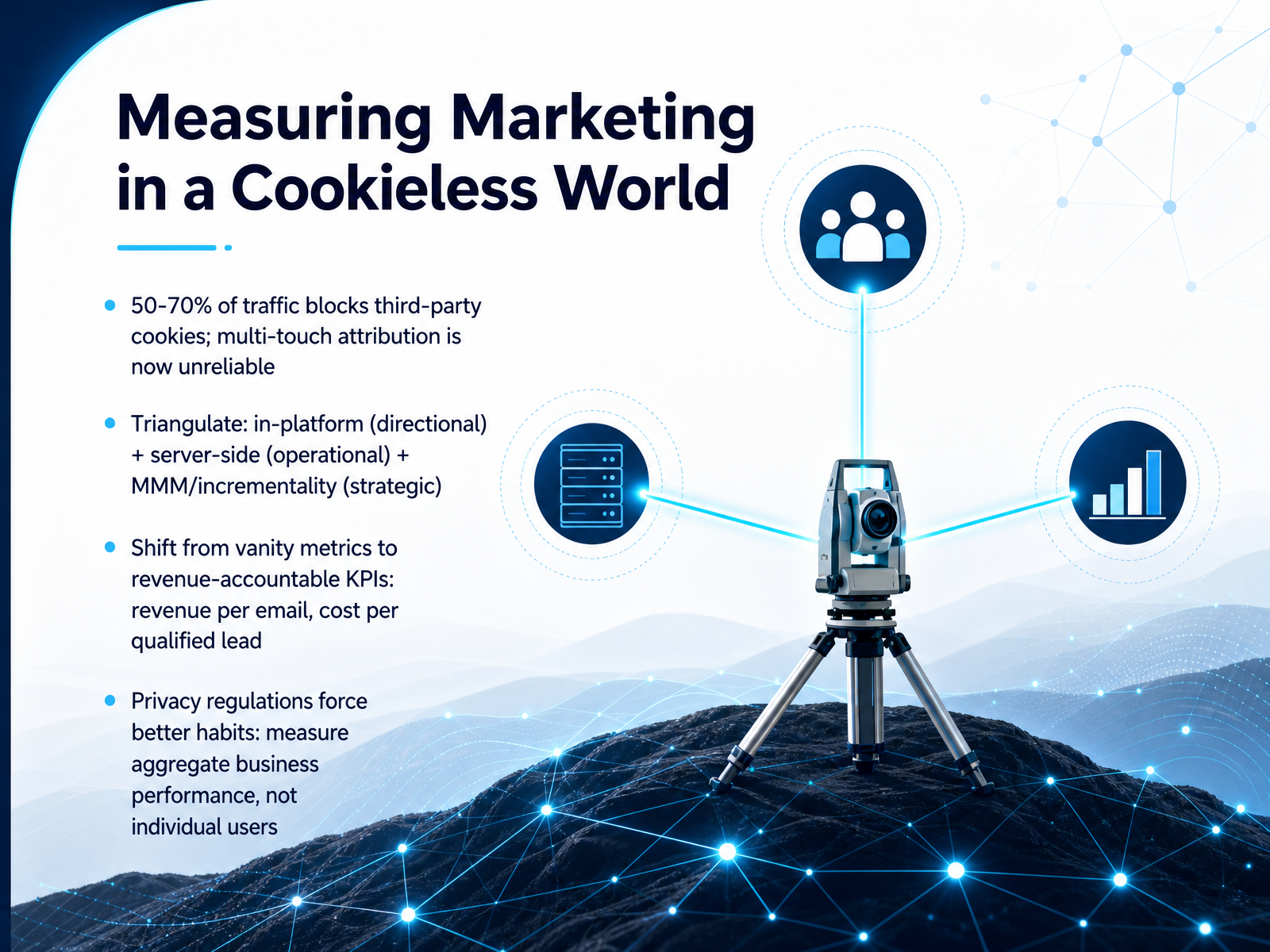
2 min - 13Measuring Marketing in a Cookieless WorldNow, let's talk about a shift that changes how we measure success: measuring marketing in a cookieless world. You've probably heard that third-party cookies are going away. In practice, fifty to seventy percent of traffic is already in browsers that block or restrict them. So the old way of following one person's entire journey just doesn't work reliably anymore. Multi-touch attribution has become unreliable, and that's actually okay, because it pushes us toward a healthier approach. We move from tracking individual users to measuring aggregate business performance. The best teams now use triangulation. They combine three independent methods. First, in-platform data for directional, daily decisions. Second, server-side tracking for a cleaner, operational view. Third, marketing mix modeling and incrementality tests for strategic, causal truth. Privacy regulations aren't just a hurdle; they force better habits. We shift from vanity metrics to revenue-accountable KPI s, like revenue per email sent or cost per qualified lead. Next, we'll pull everything together, and I'll share a playbook for building your mix in the final slide: your digital marketing strategy.
 2 min
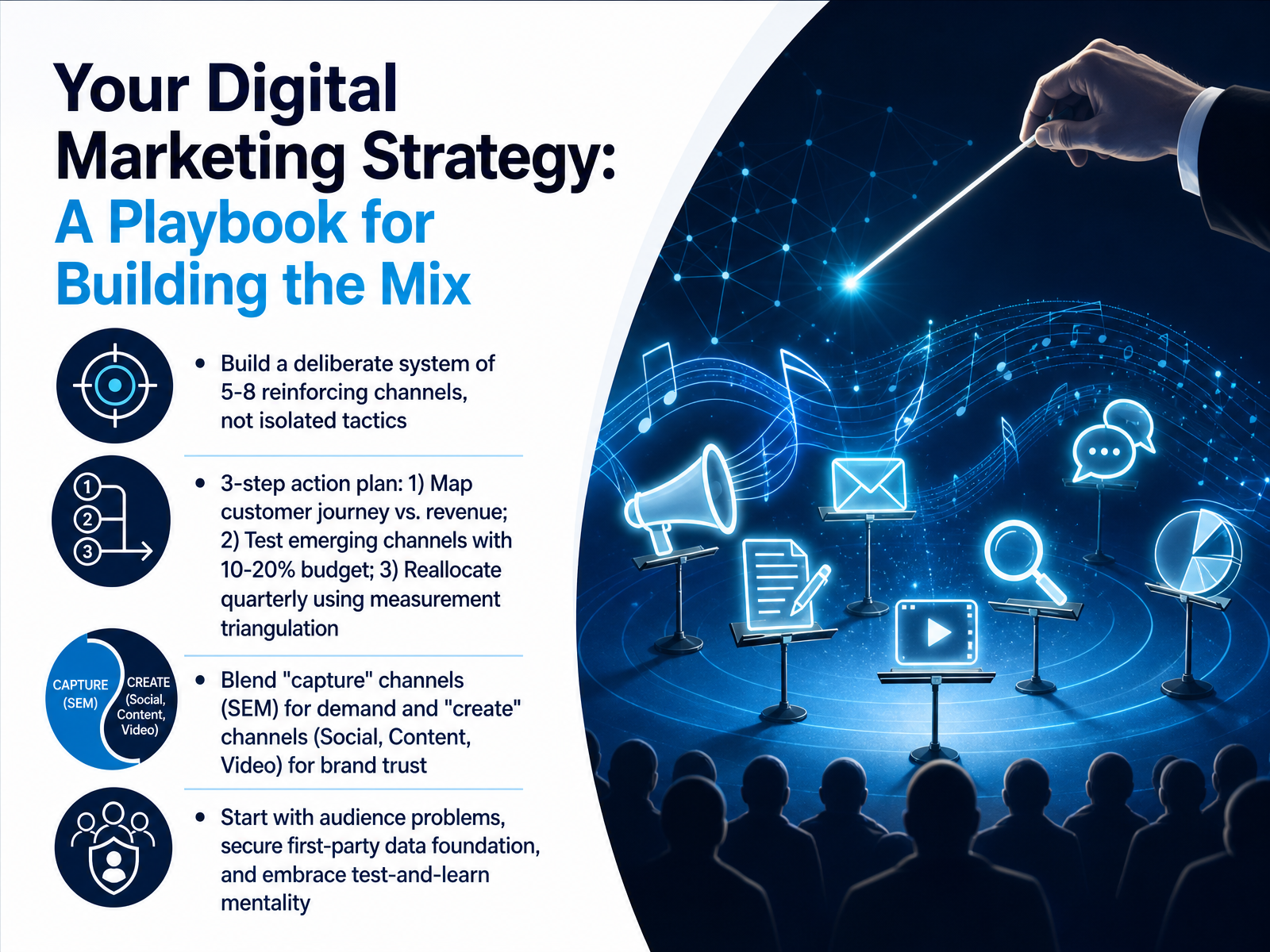
2 min - 14Your Digital Marketing Strategy: A Playbook for Building the MixWe've covered a lot of ground together, so let's bring it all together into a simple, actionable plan. Think of your strategy not as a collection of isolated tactics, but as a deliberate system of five to eight channels that support and strengthen each other. Start by mapping your customer's journey and comparing it directly to your revenue. Where are the gaps? Then, set aside a modest ten to twenty percent of your budget to test emerging channels. The key is to reallocate that budget quarterly using measurement triangulation—that means looking for the overlap between your platform data, your attribution tools, and your incrementality tests. Blend channels that capture existing demand, like search, with channels that create demand and build trust over time, like social, content, and video. Always lead with your audience's real problems, build your strategy on a secure foundation of first-party data, and embrace a test-and-learn mindset. Measurement is your competitive advantage, so get comfortable with it. Thank you for learning with me. Now, go build a thoughtful, connected strategy that grows with your customers.
 blog.hubspot.comblog.hubspot.commabo.co.uk+22 min
Take the deck with you
Download this course as a file — free, no sign-up needed.
- PDF handoutEvery slide page, ready to print or share.15 pages · 4.6 MBDownload
- Narrated PowerPointThe deck that presents itself — every slide carries the digital human's narration video.15 pages · 30.0 MBDownload
- PowerPoint slidesThe full deck as a .pptx — open it in PowerPoint, Keynote, or Google Slides.15 pages · 4.6 MBDownload
Free to use in your own training — please keep the PersonWise credit page at the end.
Have your own deck? Turn it into a course
Sources consulted
Web sources consulted while building this course.
- 2026 state of marketing: Data from 1,500+ global marketers — blog.hubspot.com
- The top marketing channels of 2026, according to marketers [data] — blog.hubspot.com
- Mid-Year Digital Marketing Review: What's Changed in 2026 So Far? — mabo.co.uk
- Marketing Priorities 2026: Your Mid-Year Review — wsidigitaladvisors.uk
- Marketing Channels: Types, Examples & How to Choose | Similarweb — similarweb.com
- SEO, SEA and SEM: Differences and Use Cases (2026) - Incremys — incremys.com
- SEO vs SEM: What’s the Difference and When to Use Them in 2026 - SEOlogist Inc — seologist.com
- SEM in 2026: paid search when the SERP is half AI | Flux.LA — flux.la
- What Is Search Engine Marketing? A Practical Guide for 2026 — tryanalyze.ai
- Paid Ads vs SEO vs GEO in 2026: What Actually Broke in the Last 12 Months | GEO Tracker AI Blog — geotrackerai.com
- B2B Content Marketing: Strategy, Examples, Best Practices (2026) — thegrowthsyndicate.com
- B2B Content Marketing Strategy for 2026: Build for Buyers and AI Search — gogreymatter.com
- Content Marketing Strategy: How to Build One in 2026 — marketful.com
- 20 inspirational B2B content marketing examples for 2026 — tabithawhiting.com
- B2B content marketing strategy: a 2026 guide & examples — scribenational.ca
- Email Marketing ROI: 2026 Benchmarks + Free Calculator — omnisend.com
- State of Email Reports 2025-2026: Email Marketing Trends — litmus.com
- Email marketing ROI: Key stats & proven effectiveness — blog.hubspot.com
- 2026 Email Marketing Benchmarks by Industry — klaviyo.com
- Email Marketing Benchmarks by Industry: 2026 Data and Trends — webfx.com