Data Science vs Machine Learning Roles and Methods
Begin
15 pages · ~30 min
Data Science vs Machine Learning Roles and Methods
This training distinguishes data science from machine learning, covering their distinct roles, methodologies, and real-world use cases for professionals seeking clarity on the disciplines.
What you’ll learn
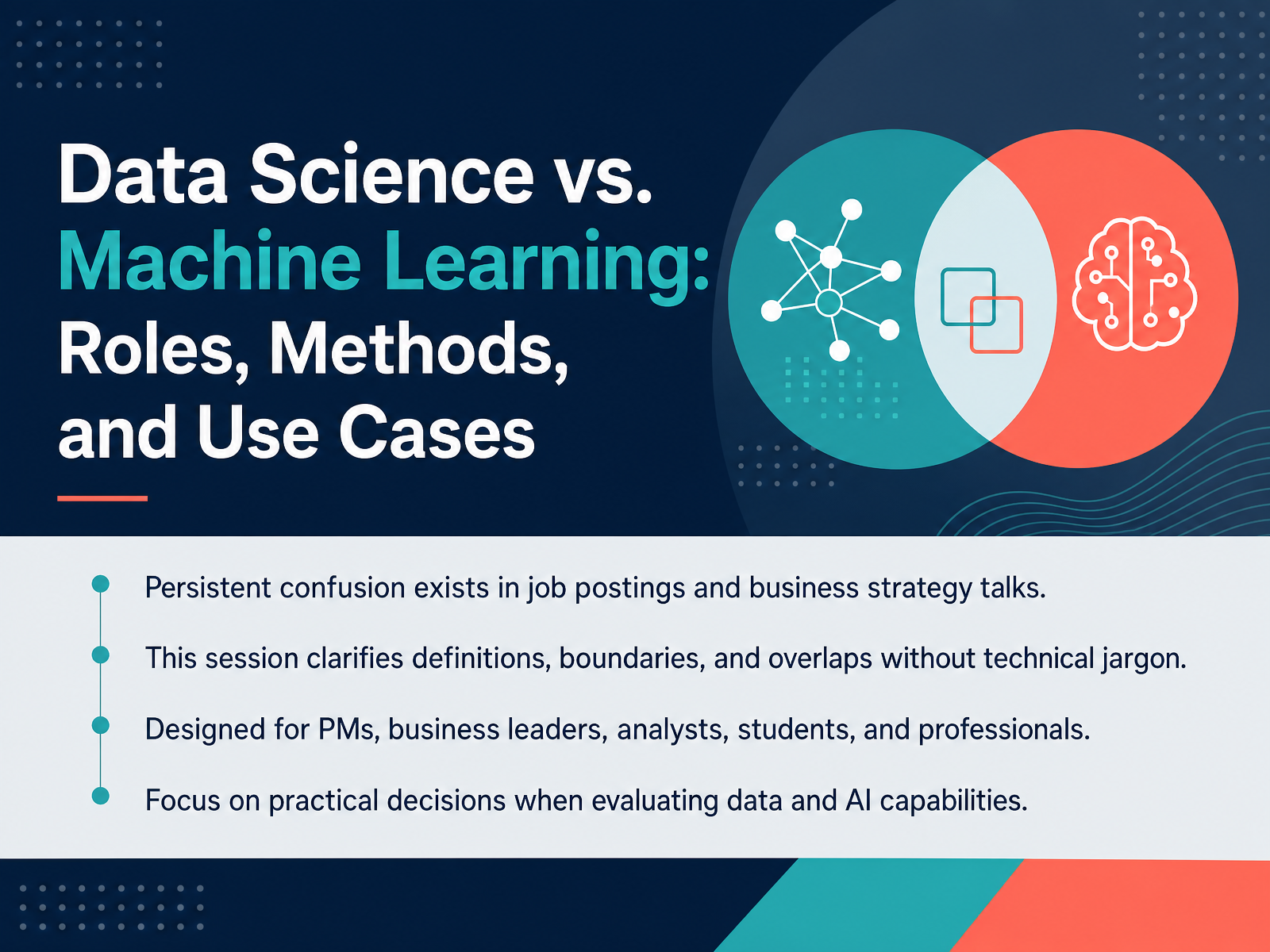
- 01Data Science vs. Machine Learning: Roles, Methods, and Use CasesWelcome. If you have ever read a job posting asking for a 'data scientist' when the work described is clearly machine learning engineering—or sat in a strategy meeting where the two terms were used as if they mean the same thing—you are not alone. Persistent confusion exists, and it creates real friction when you are trying to staff a team, scope a project, or evaluate a vendor. This session is designed to clear that up without technical jargon. My goal is to give you a practical mental model you can use right away, whether you are a product manager, a business leader, an analyst, or a student preparing for the market. We will focus on the definitions, the boundaries, and the overlaps—all framed around the decisions you actually make when investing in data and AI capabilities. With that foundation set, let's step into why drawing this line matters more right now than it did even two years ago.googlecloudpresscorner.comaws.amazon.comdataiku.com+21 min
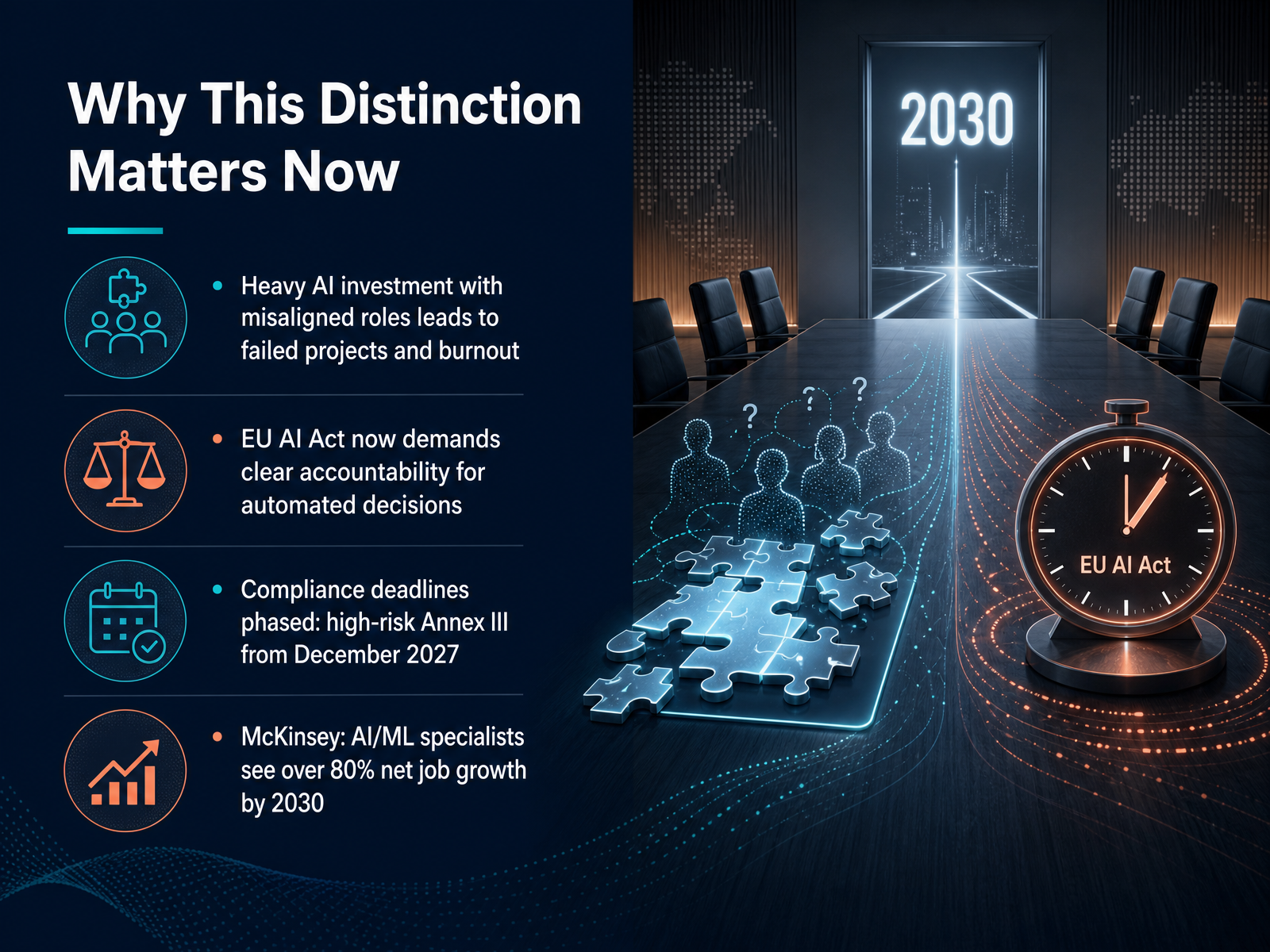
- 02Why This Distinction Matters NowLet's get straight to the heart of why this conversation, right now, is so critical. It's not just about spending money on AI, it's about spending it on the right kind of talent to avoid very real and expensive problems. When roles and methods are misaligned, we see good projects fail and good people burn out, quietly costing the business. At the same time, the regulatory landscape is hardening. The EU AI Act, specifically, now mandates clear human accountability for automated decisions. For high-risk systems listed under Annex Three, the compliance deadline is no longer a distant concept; it's phased for December 2027. That timeline sounds comfortable, but the operational work to get there is substantial. And this careful structuring of talent will only become more critical. McKinsey projects that specialists in AI and machine learning will see over 80 percent net job growth by 2030. So, understanding who does what isn't just an academic exercise. It is a strategic foundation for growth, compliance, and durable team health. Let's build that foundation by starting with the core definitions of data science.
 futurium.ec.europa.euconfir.eueur-lex.europa.eu+22 min
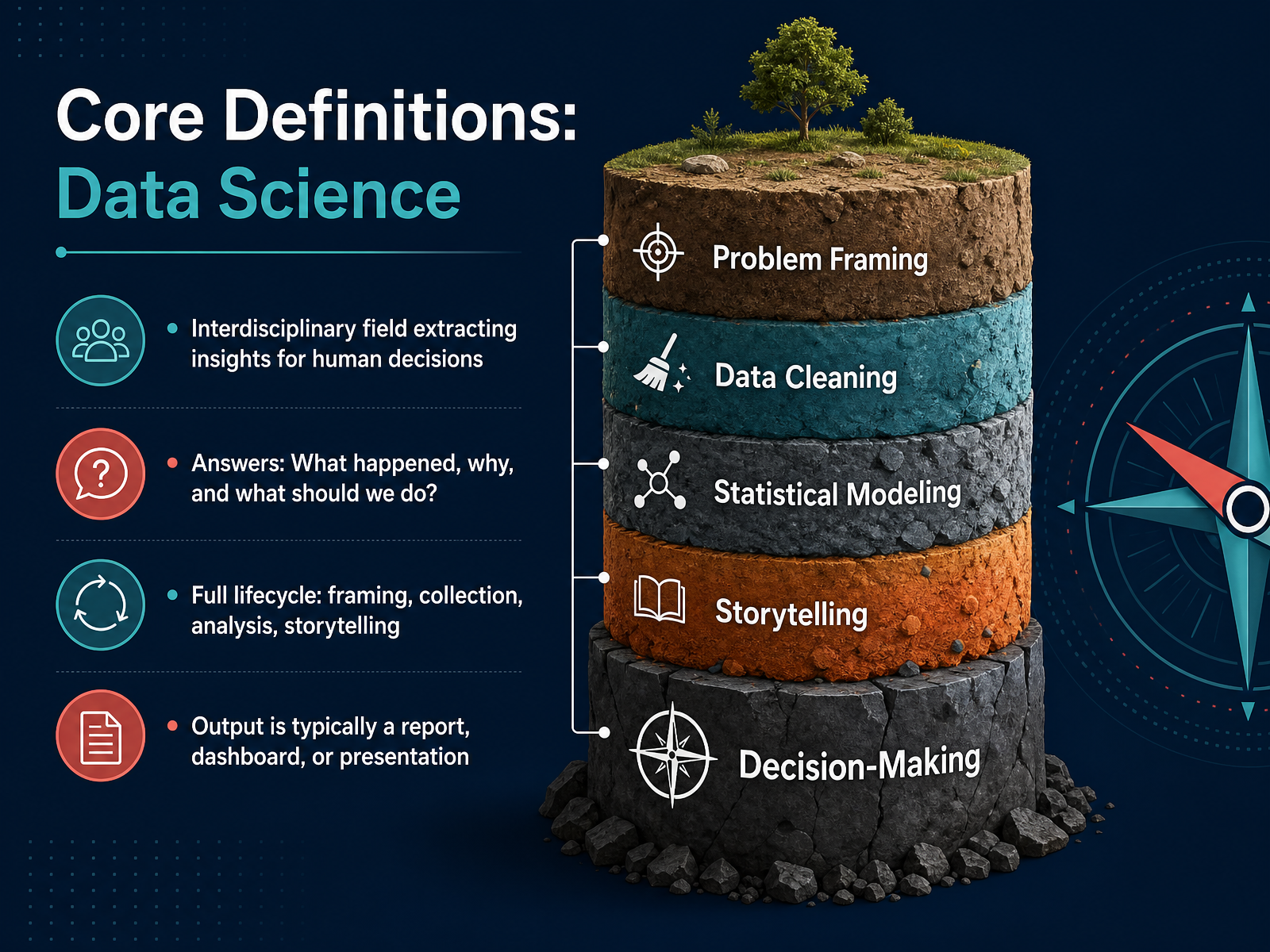
 - 03Core Definitions: Data ScienceLet's ground ourselves in what data science really means in practice. Think of data science as the discipline of extracting insights to guide human decisions. It answers three core questions: What happened, why did it happen, and what should we do about it? The work spans the entire lifecycle. It starts with framing the right business problem, moves through data collection and rigorous analysis, and ends with storytelling. The output is rarely a model. More often, it's a report, a dashboard, or a presentation that helps a leader make a smarter call. So data science is your compass for understanding the past and present. Next, we'll look at machine learning, where the focus shifts from understanding to automated prediction.
 1 min
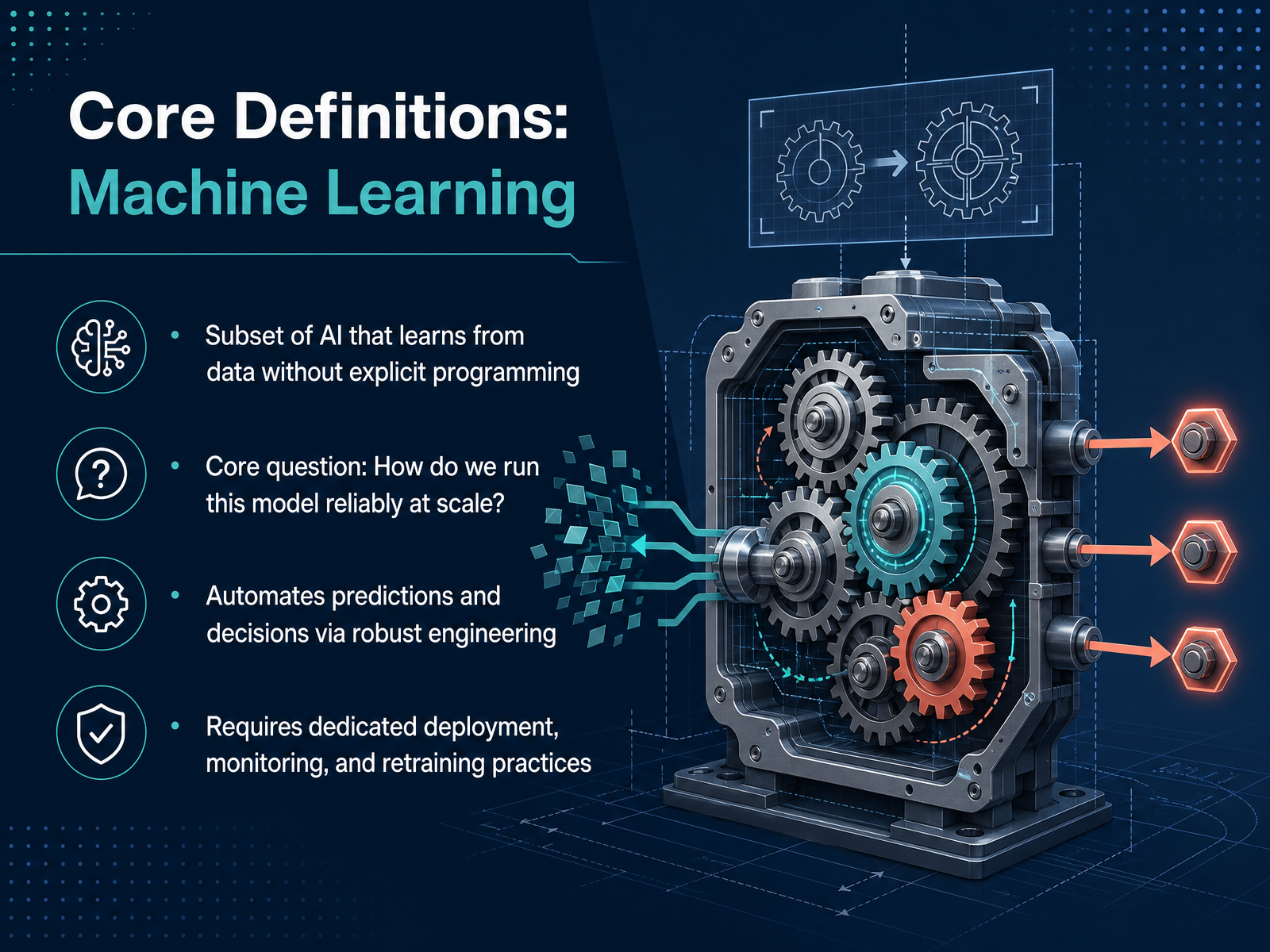
1 min - 04Core Definitions: Machine LearningNow, let's turn to machine learning. If data science is about asking the right questions, machine learning is about automating the answers at scale. The core definition is simple but powerful: it's a subset of AI that learns patterns from data without being explicitly programmed for every rule. You might be wondering, what's the real difference in practice? For a product or business leader, machine learning asks a fundamentally different core question: not 'what does the data tell us?' but 'how do we run this model reliably at scale?' It's the discipline of turning a promising proof-of-concept into a production system that automates predictions and decisions. Think of it this way: data science builds the prototype engine, while machine learning engineering fits it into the car and keeps it running smoothly on the road. This requires a robust engineering backbone—dedicated deployment pipelines, constant performance monitoring, and a disciplined process for retraining models when the world changes. It's less about exploration and more about operational excellence. Next, we'll see how these two disciplines visually overlap and connect, with a clear Venn diagram of AI, machine learning, and data science.
 2 min
2 min - 05The Relationship: Venn Diagram of AI, ML, and DSNow let's zoom out and see where these fields overlap. Picture a Venn diagram of AI, Machine Learning, and Data Science. It's easy to assume they're the same thing, but the relationship is more like a toolkit inside a broader strategy. Machine Learning is a tool used within the Data Science lifecycle, yet their goals are fundamentally different. Think of Data Science as the effort to find clarity and insight from complex data. When the final output is a slide deck, a visualization, or a report that helps a leader make a strategic choice, that's the work of Data Science. Machine Learning, on the other hand, is focused on automating predictions at scale. When the final output is a running system, a fraud detection API, or a recommendation engine that makes decisions without human intervention, that's Machine Learning learned from data. The question you should ask is simple. Is the goal to inform a human action, or to automate a software action?
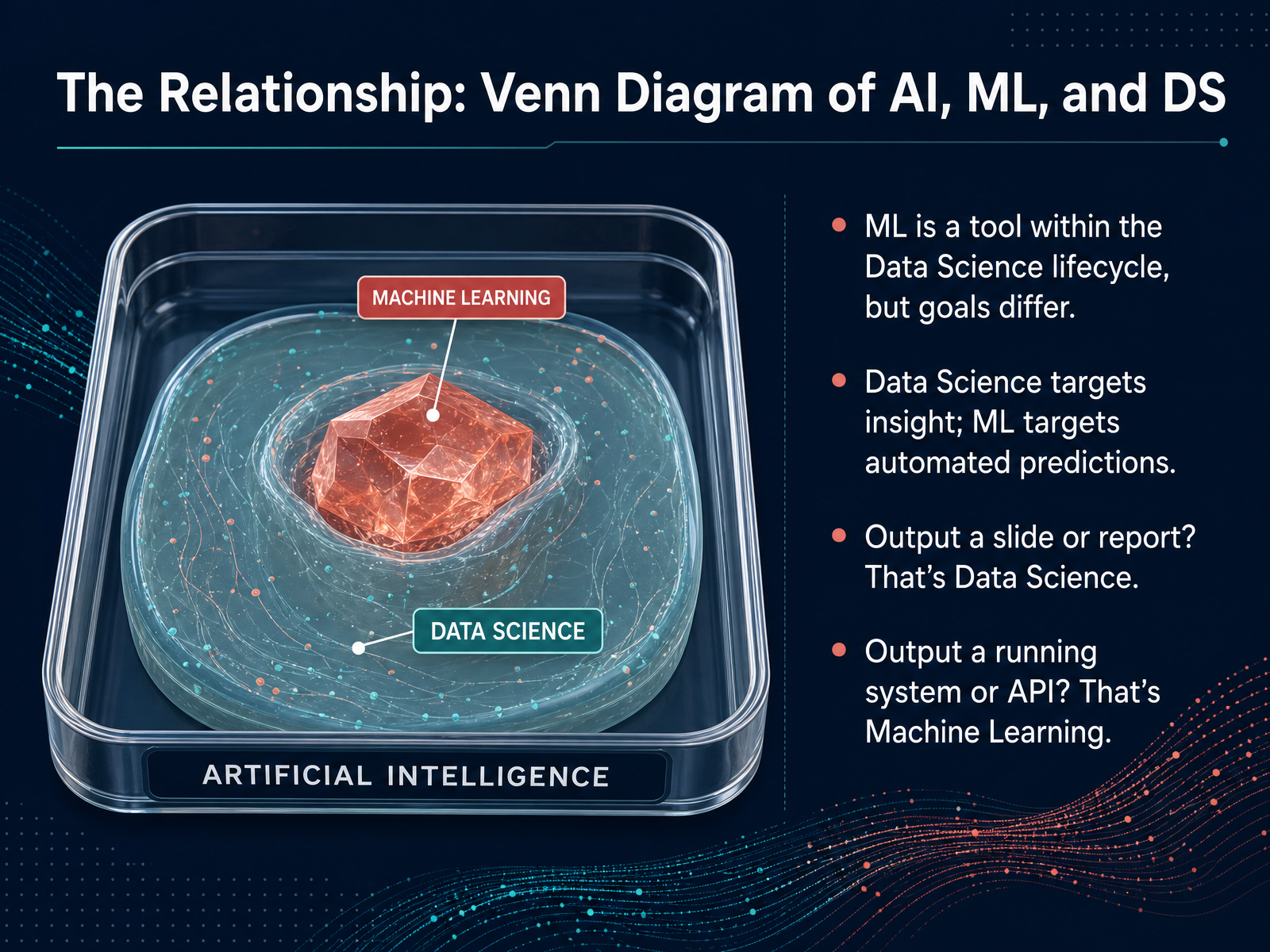 2 min
2 min - 06Distinct Roles: Data ScientistLet's get specific about the data scientist. Think of this role as the person who turns messy, real-world data into clear business decisions. You might hear a stakeholder say, 'Our churn is up, but we don't know why.' The data scientist takes that fuzzy question and frames it into something answerable. They ask: Are we even measuring the right thing? Is there a hidden bias in the data? Their job starts long before any model is built. In a typical week, they're designing A/B tests, defining metrics that actually track business impact, and using techniques like causal inference to separate real effects from noise. Their core tools reflect this: SQL to pull the data, Python or R to analyze it, and tools like Tableau to communicate the story. And speaking of communication, that's not a soft skill for this role. It is the deliverable. The best analysis is worthless if a skeptical VP can't follow the recommendation. A data scientist's background is usually in statistics, economics, or a quantitative field. They are the ones who deliver the 'what next' after the experiment ends. Next, we'll look at the role that takes that answer and makes it live in production: the machine learning engineer.
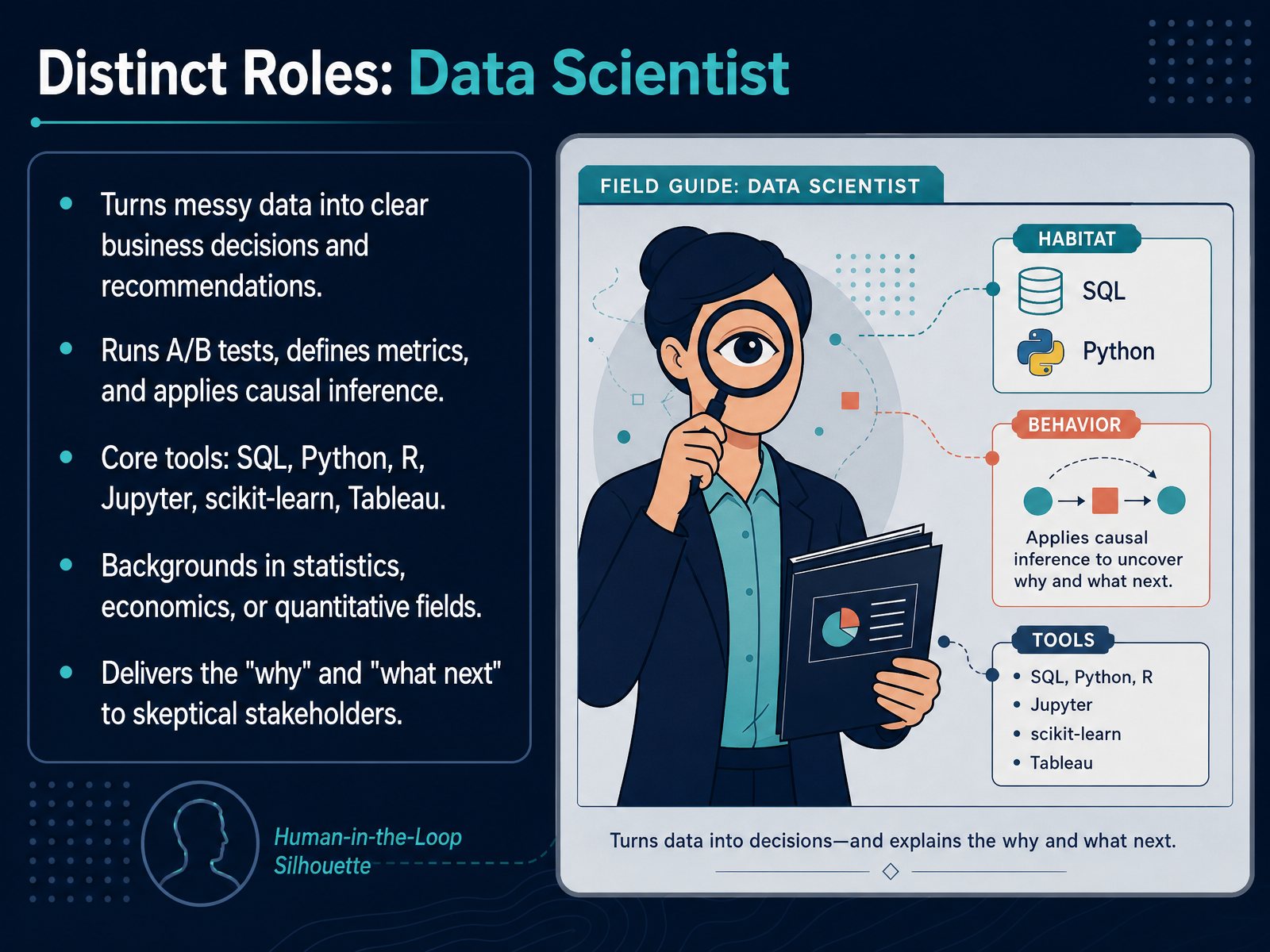 kore1.comintuit.comskillenai.com+22 min
 - 07Distinct Roles: Machine Learning EngineerNow let’s shift to the other side of the partnership: the Machine Learning Engineer. If the data scientist hands back a working prototype, the ML engineer makes it live. Their core job is productionization. That means they own the serving infrastructure, the latency budget, the throughput, the monitoring, and especially drift detection. They catch the model when it goes quietly wrong. The toolset tells the story. These engineers live in PyTorch and TensorFlow, but the job really runs on Docker, Kubernetes, CI/CD pipelines, cloud platforms, and feature stores. Their daily work is not about running experiments. It is about building the systems that serve predictions reliably at scale, forever. The background is usually computer science or software engineering, with real experience shipping production software. And the market rewards it. In the US, a senior ML engineer earns about one hundred eighty thousand to two hundred forty thousand dollars. That commands roughly a forty-three-thousand-dollar premium over a senior data scientist. You might be wondering why. Because when a model has to answer in milliseconds and never sleep, every second of downtime has a price tag. That deployment territory is an engineering job, and the premium follows the responsibility. Next, let’s look at how these roles fit together in emerging team structures.
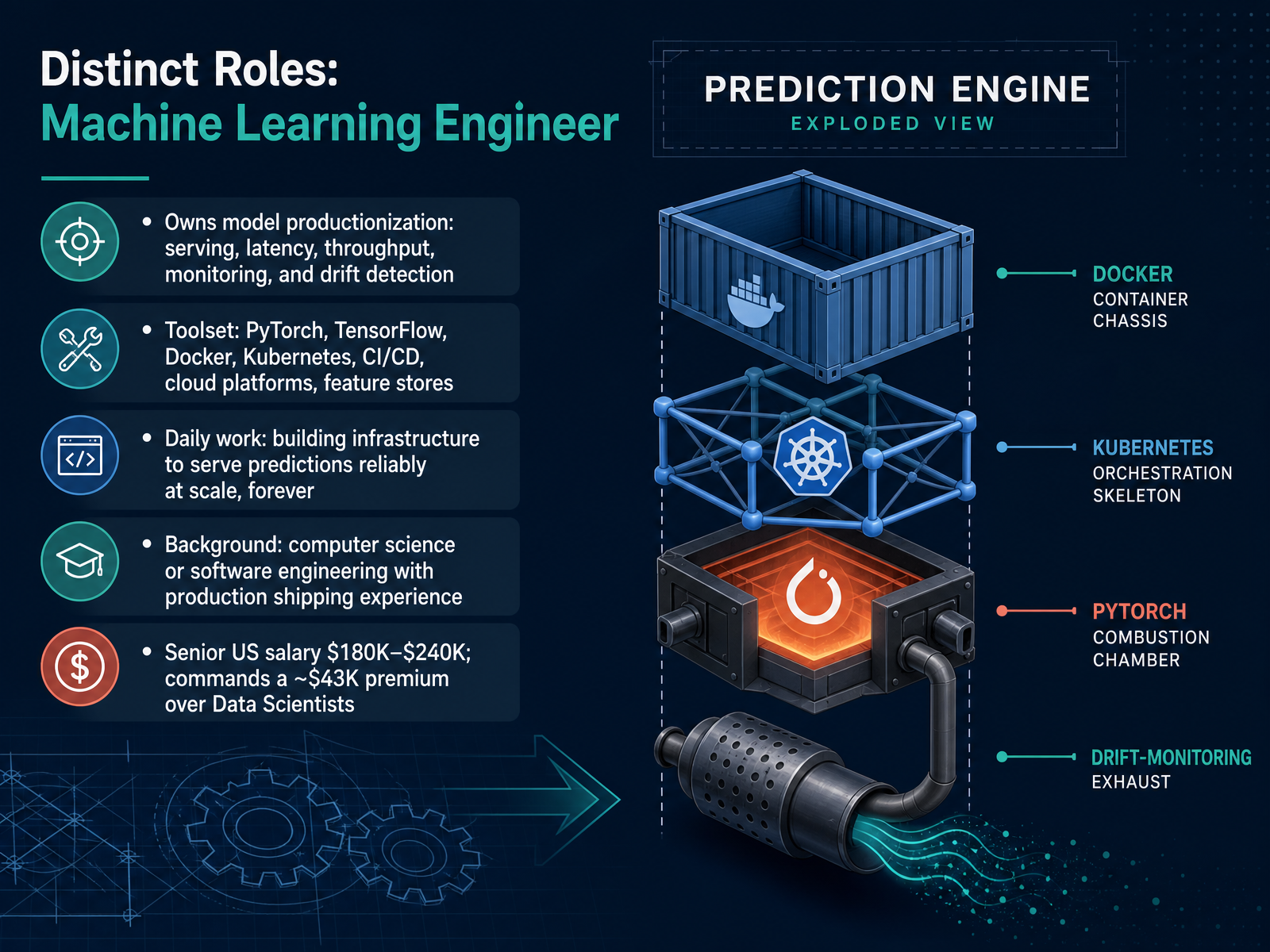 kore1.comintuit.comskillenai.com+22 min
 - 08Emerging Roles and Team StructuresSo, who actually does the work when ML becomes mission-critical? We're seeing new roles emerge, and team structures are shifting fast. First, there's the AI Engineer. This isn't a data scientist who retrained a model. An AI engineer builds applications on top of foundation models—think of them wiring up large language model APIs, not training neural networks from scratch. On the other side, mature organizations like Manulife have embedded roughly two hundred data scientists and machine learning engineers directly inside their business units. That proximity speeds up decision-making. But here's the pattern that really matters: when machine learning becomes load-bearing for the business, the smartest setup puts both roles on one unified team with a shared roadmap. Why? Because it eliminates the 'game of telephone' at handoff. The data scientist defines what's worth building, the ML engineer makes it durable, and they iterate together instead of throwing work over a wall. Now let's talk about how each discipline actually gets the work done, starting with methodology.
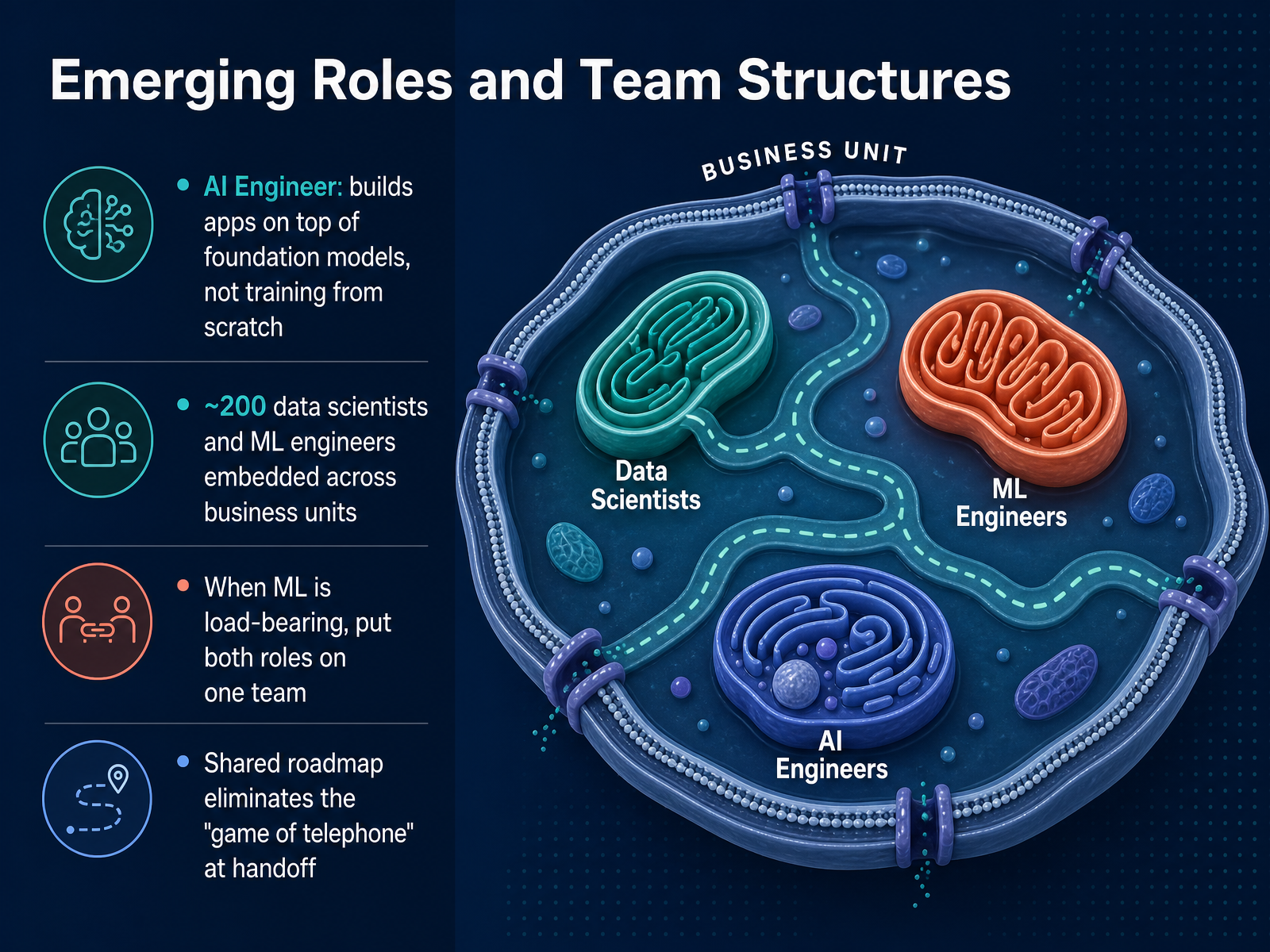 googlecloudpresscorner.comaws.amazon.comdataiku.com+22 min
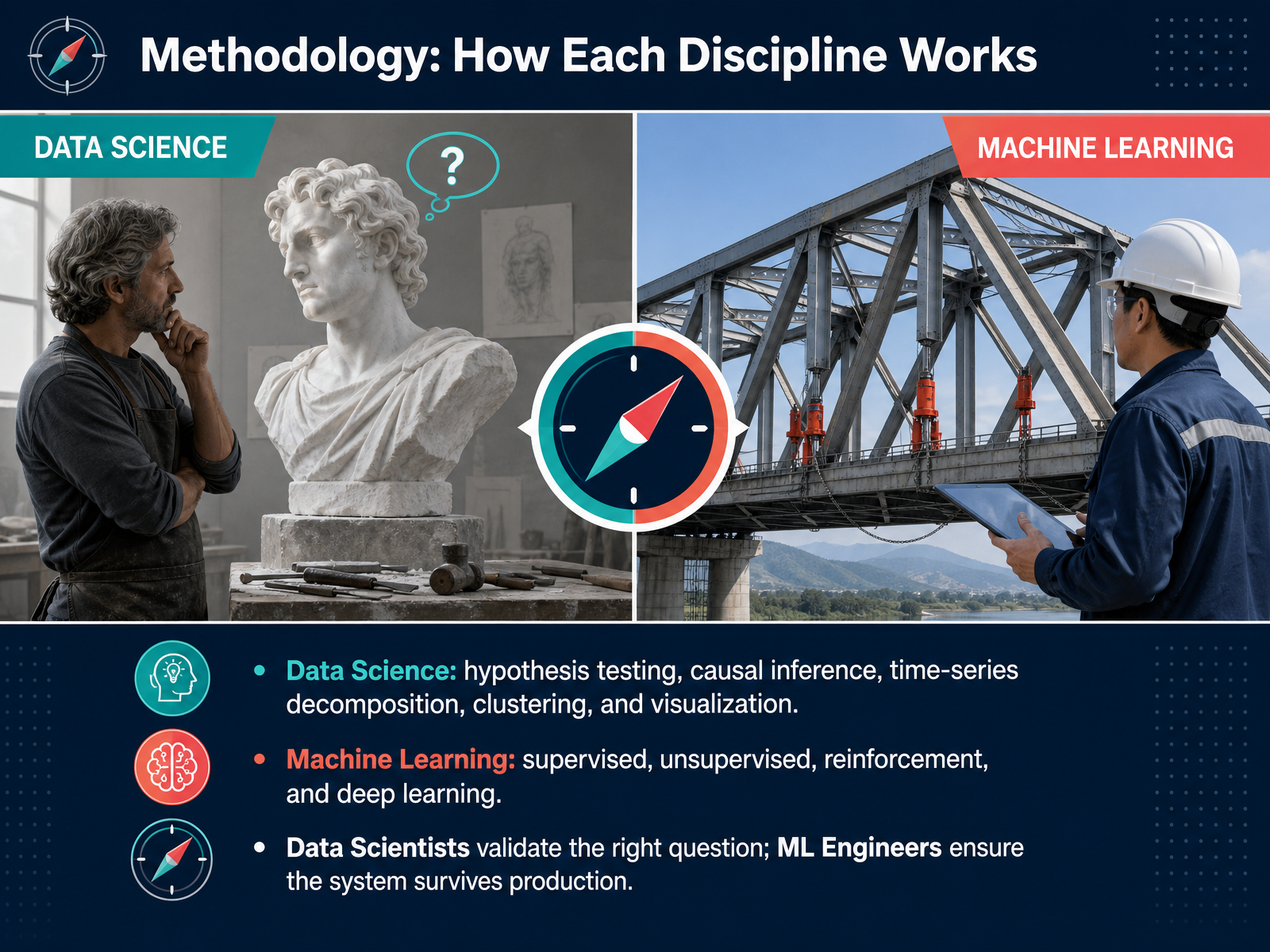
 - 09Methodology: How Each Discipline WorksNow let's get under the hood and look at how each discipline actually works. Think of it as the difference between scientific discovery and engineering at scale. A data scientist's toolkit is built around inquiry. They use hypothesis testing to prove or disprove a business assumption, causal inference to understand the 'why' behind a trend, and time-series decomposition to separate seasonality from a genuine growth signal. You might see them clustering customers for segmentation or creating visualizations to find the story in the noise. Their core job is to validate that we're asking the right question. Machine learning engineers, on the other hand, work with algorithms that learn from data directly. They apply supervised learning when we have labeled examples, unsupervised learning to find hidden patterns, and reinforcement learning when a model needs to make a sequence of decisions. And deep learning? That's for the really heavy lifting, like image recognition or natural language. Here's the practical distinction: data scientists explore and validate ideas, but ML engineers harden those ideas so the system doesn't break the moment it faces real-world traffic. Next, let's connect these methodologies to the yardsticks that actually matter to the business in 'Success Metrics and Evaluation'.
 2 min
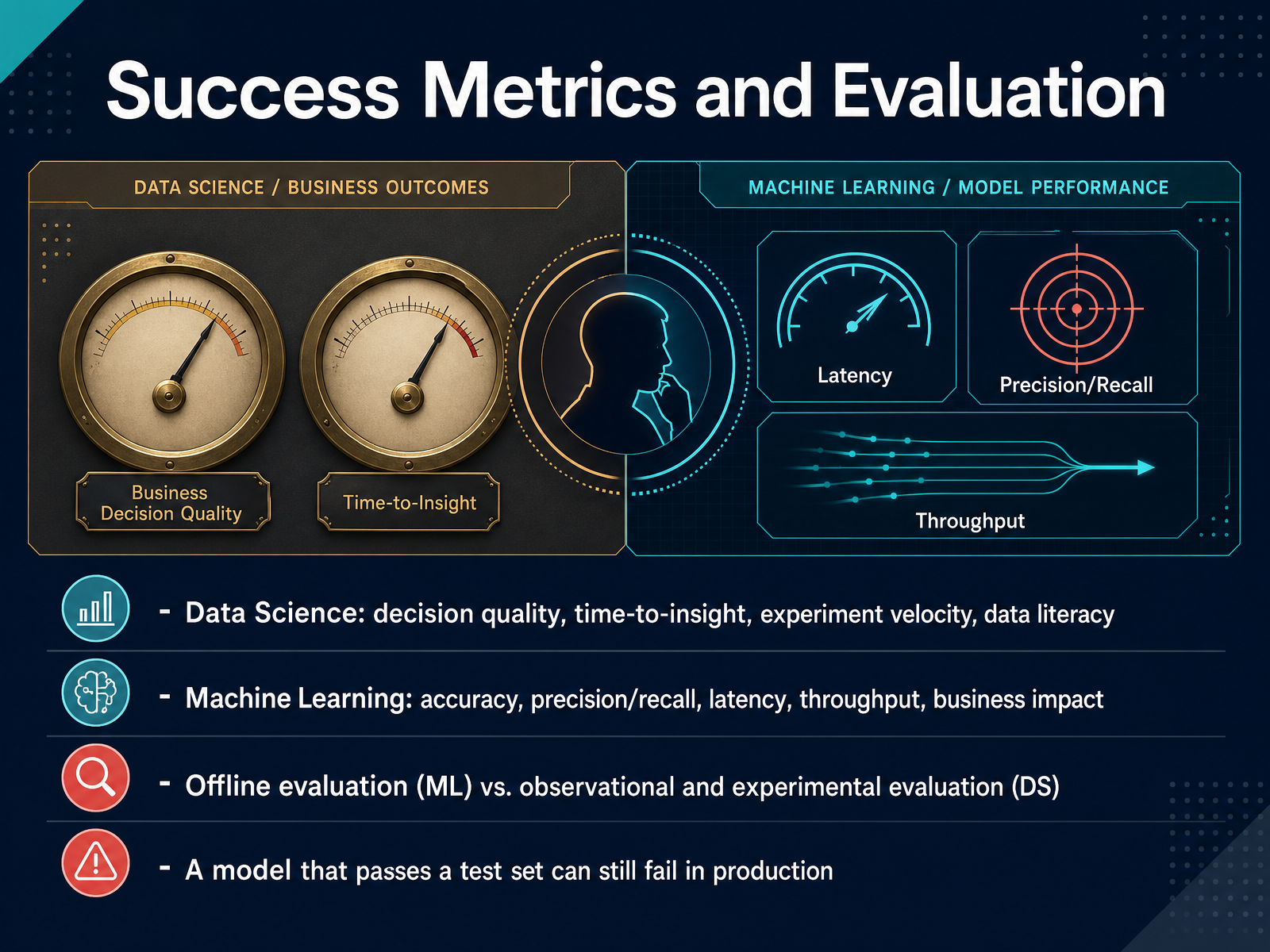
2 min - 10Success Metrics and EvaluationSo how do you measure success for these two disciplines? The scorecards are quite different, and confusing them leads to misplaced investment. Data science success hinges on decision quality and speed. We track time-to-insight, experiment velocity, and rising data literacy across the team. The goal is better, faster decisions. Machine learning success is more engineering-driven. We look at accuracy, precision and recall, latency, and throughput. Those metrics tell you the model works technically. But the one that truly matters is business impact. You can have ninety-nine percent accuracy and zero value if it doesn't change a user behavior or save costs. Even evaluation methods differ. In machine learning, we rely heavily on offline evaluation, holding back a test set to validate performance before launch. Data science leans more on observational methods and live experiments, like A B tests, to measure causal impact. And here is a critical point. A model that passes a test set with flying colors can still fail in production. Why? The real-world data drifts, user behavior changes, and the metrics you optimized offline may not align with the live business outcome. Next, let's look at what it takes to support these workflows, specifically, infrastructure and operational needs.
 2 min
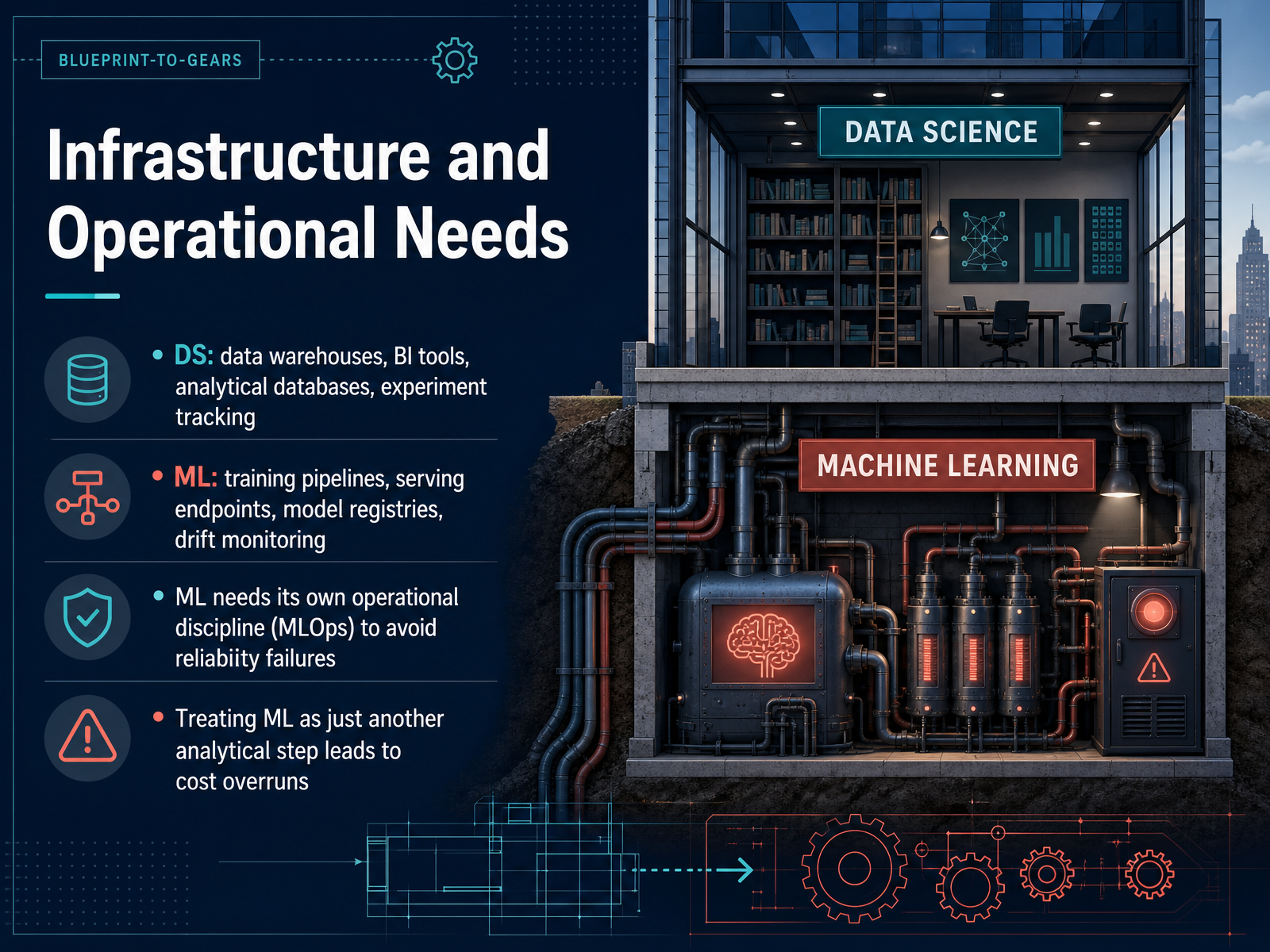
2 min - 11Infrastructure and Operational NeedsMoving from methods to mechanics, let’s talk about the infrastructure each discipline needs, because this is where the operational costs and risks really show up. Data science typically lives on data warehouses, BI tools, analytical databases, and experiment tracking systems. Think of it as the environment for exploration and insight generation. Machine learning, on the other hand, demands a different set of plumbing. We’re talking about training pipelines, live serving endpoints, model registries, and automated drift monitoring. You might be wondering why the distinction matters so much. Here’s the hard-won lesson from the field: machine learning needs its own operational discipline, widely known as MLOps, to avoid silent reliability failures. If you treat an ML model as just another analytical step and skip that discipline, the most common result is significant cost overruns from firefighting and rework. Up next, let’s ground this in reality by looking at use cases where data science is the hero, starting with its direct application in action.
 2 min
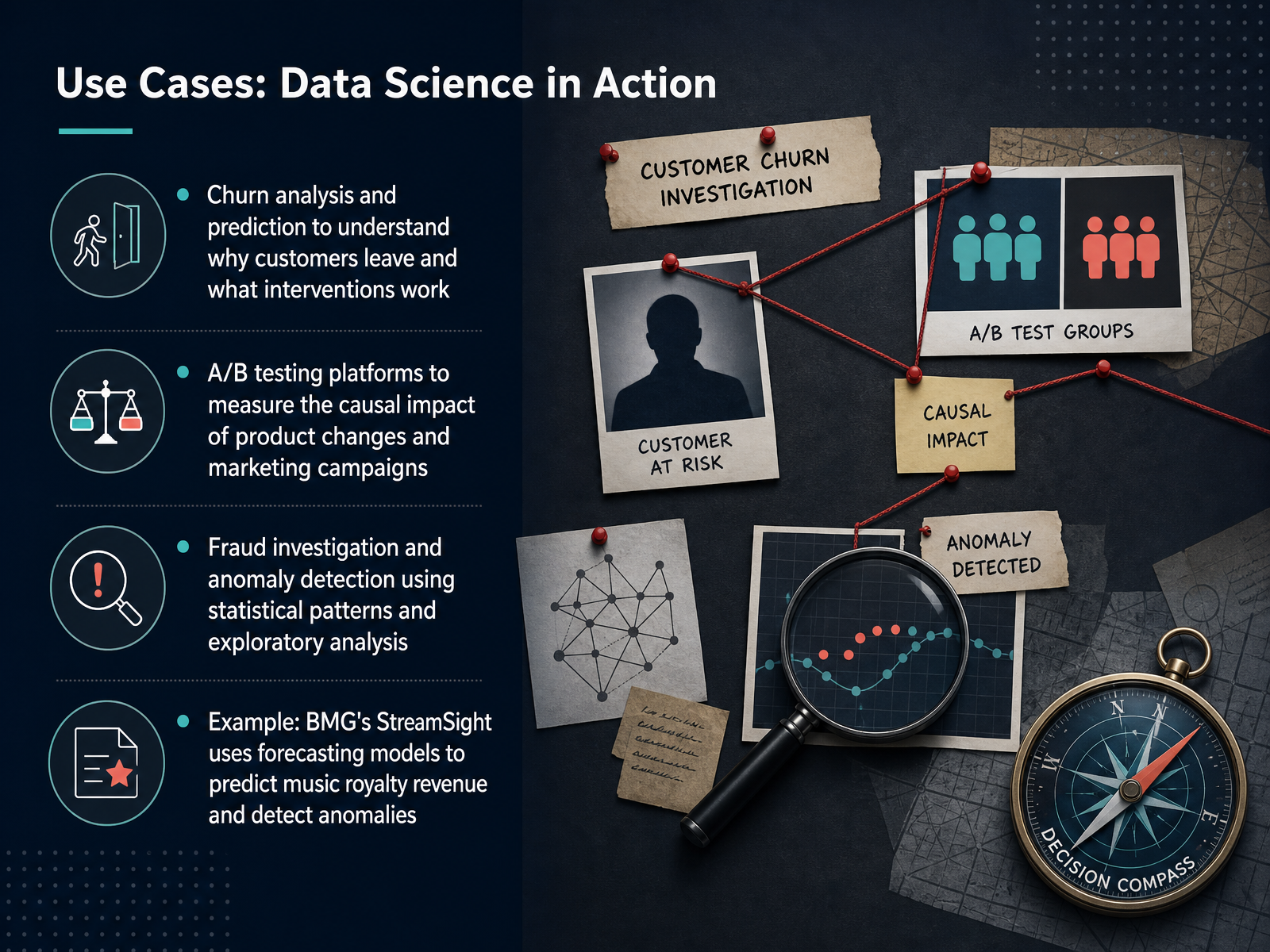
2 min - 12Use Cases: Data Science in ActionLet’s bring data science down to the decisions you actually manage. Think of three core patterns you’ll see across products and business units. First: churn analysis. Data scientists don’t just measure that customers are leaving. They explore behavioral patterns, build survival models, and test interventions to understand why people leave and what actually brings them back. Second: A B testing platforms. Running an experiment is one thing. Designing it to measure true causal impact, while controlling for confounders, is where data science ensures your product changes really moved the needle. Third: fraud investigation and anomaly detection. Here, the work is deeply exploratory. Teams use statistical patterns, clustering, and visual analysis to surface the unusual before it becomes a loss. BMG’s StreamSight is a great example. They built forecasting models in BigQuery ML to predict royalty revenue and automatically flag anomalies like missing sales periods or unexplained spikes. That starts as a data science question: what’s normal, and what demands a closer look? In the next slide, we flip the lens and examine where machine learning takes the lead.
 googlecloudpresscorner.comaws.amazon.comdataiku.com+22 min
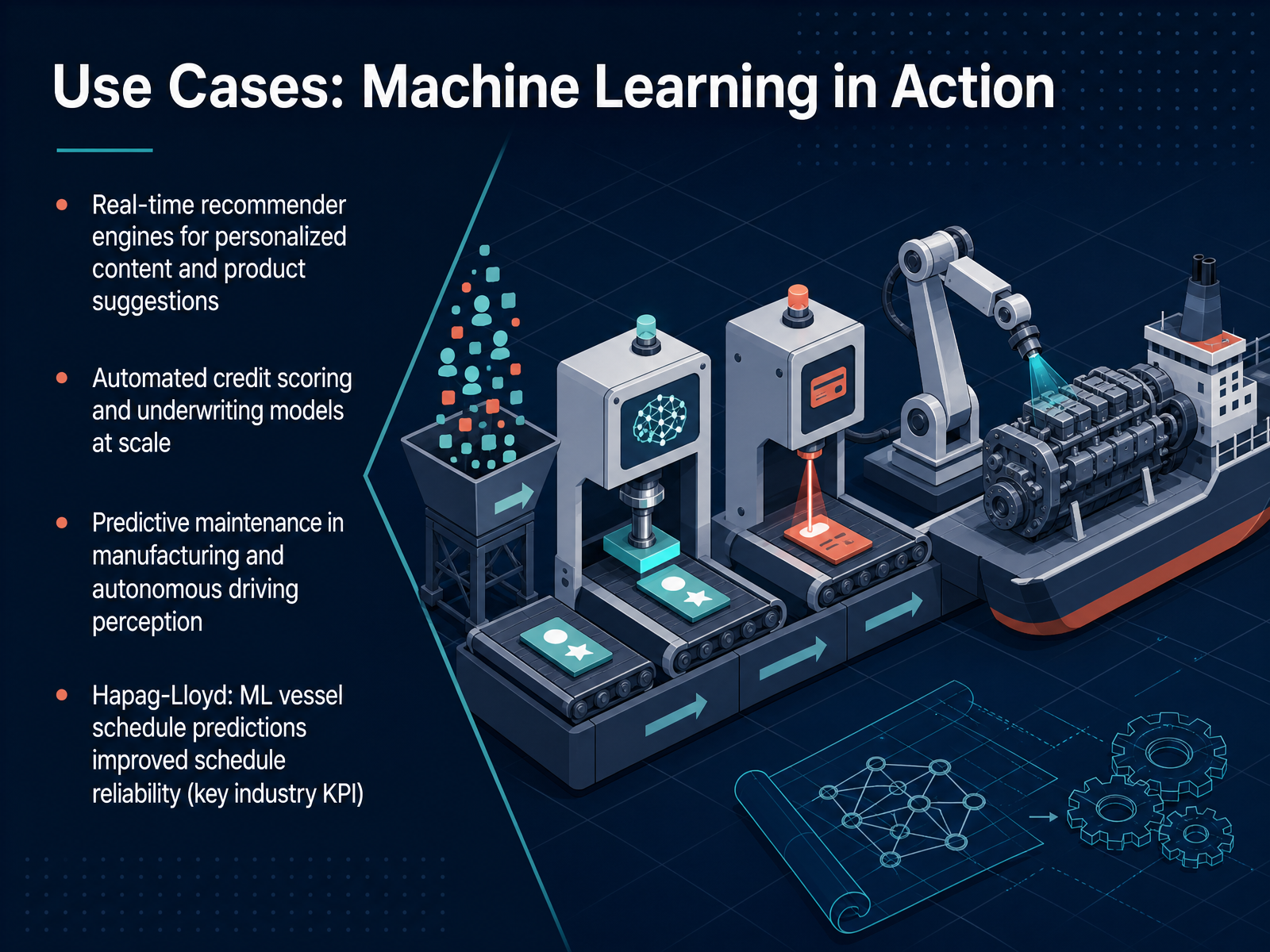
 - 13Use Cases: Machine Learning in ActionNow, let's look at what happens when machine learning moves from theory to practice. These use cases aren't far-off experiments. They are live, production-grade systems that change how businesses operate. Take real-time recommender engines. When you see a personalized product suggestion, that is a model sifting through millions of interactions to decide what matters most right now. In credit scoring and underwriting, ML models process applications at scale, reducing verification steps from days to seconds. Then, in heavy industry, predictive maintenance analyzes sensor data to prevent equipment failure before it happens. And here is a concrete example. Hapag-Lloyd, a global shipping leader, used machine learning to predict vessel arrival times. The result? Their schedule reliability, a key industry KPI, climbed by two positions in international rankings. This was not a simple forecast; it required a hierarchy of models working together to outperform older statistical methods by twelve percent. So, real business impact, not just model accuracy. Next, let's explore how data science and machine learning must collaborate to deliver results like these.
 googlecloudpresscorner.comaws.amazon.comdataiku.com+22 min
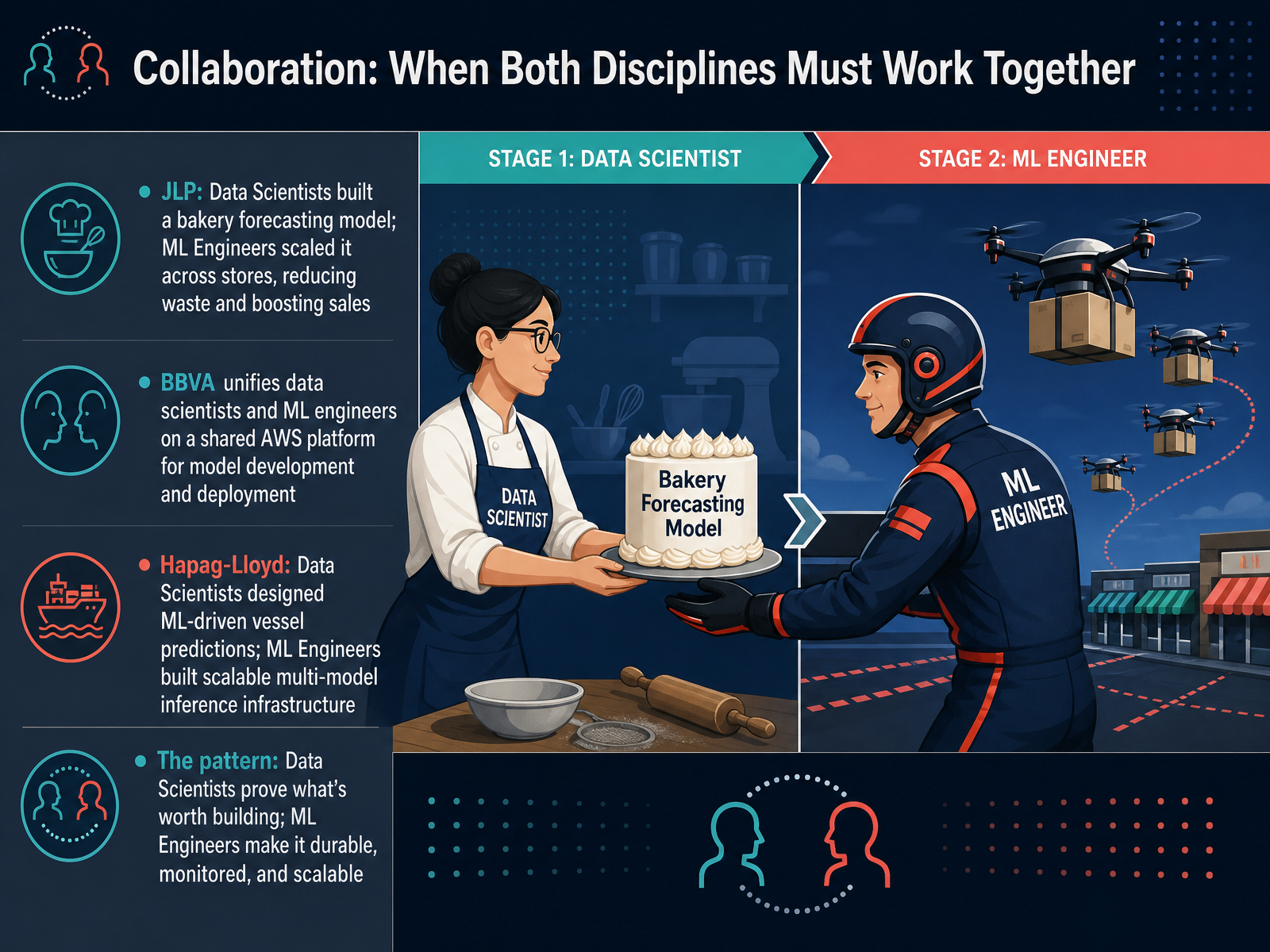
 - 14Collaboration: When Both Disciplines Must Work TogetherNow, let's look at what happens when these two disciplines truly collaborate. The pattern is remarkably consistent across industries. Consider John Lewis Partnership. Data scientists built a bakery forecasting model to predict what each store should bake. But it was the machine learning engineers who scaled that model across the entire store network, reducing waste and boosting sales. It's a clear division of labor. Data scientists prove what's worth building. Machine learning engineers make it durable, monitored, and scalable. We see this same pattern at BBVA, where data scientists and machine learning engineers now share a unified AWS platform, dramatically speeding up model development and deployment. And at Hapag-Lloyd, data scientists designed vessel prediction models, while machine learning engineers built the multi-model inference infrastructure that serves real-time predictions across their global fleet. The takeaway is simple. One team validates the opportunity. The other team industrializes it. That is the partnership that drives real business value. Next, let's move on to strategic decisions for leaders.
 googlecloudpresscorner.comaws.amazon.comdataiku.com+22 min
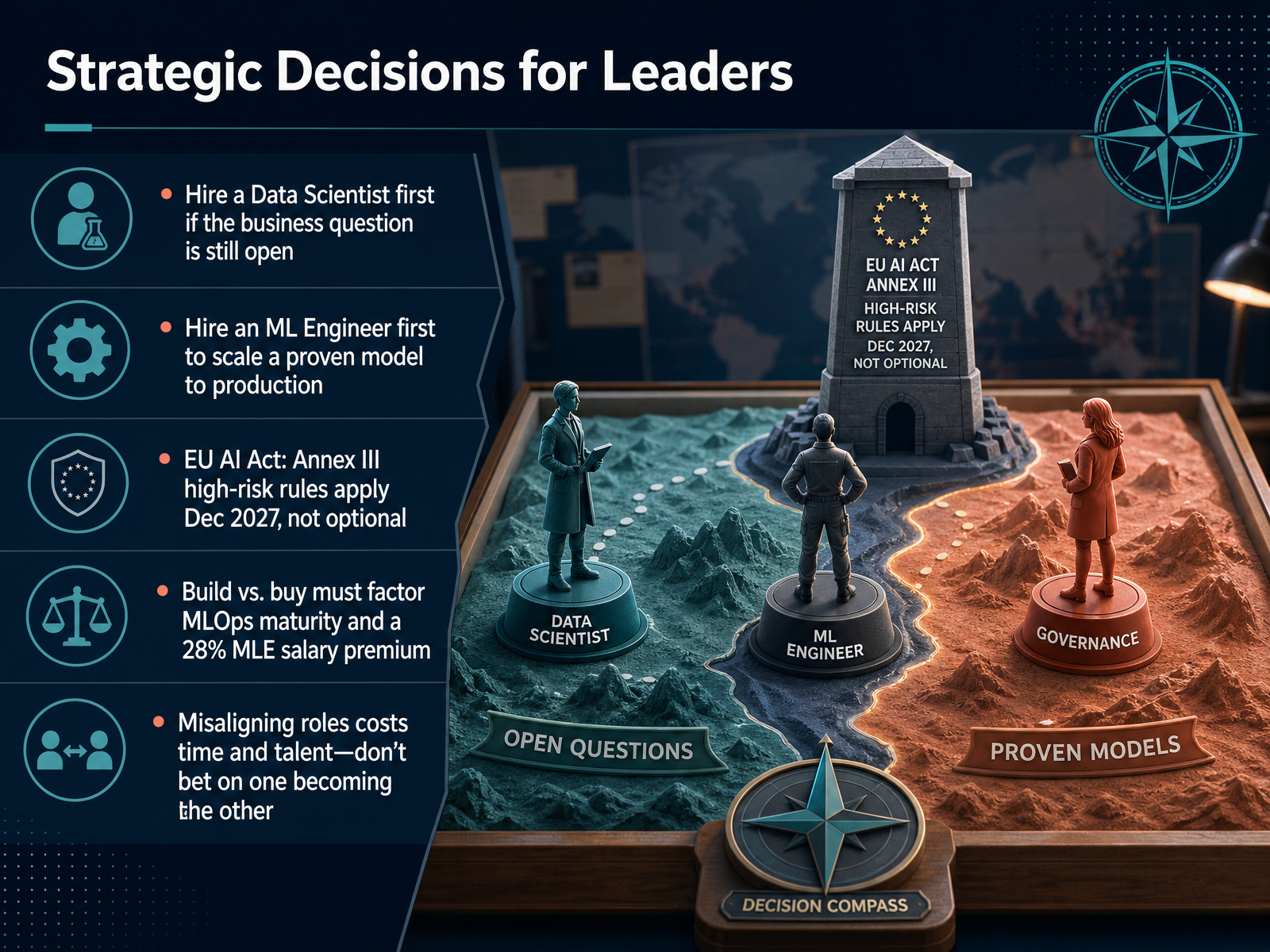
 - 15Strategic Decisions for LeadersSo let’s bring this together into a clear, strategic lens. Who do you hire first? If the business question is still open—why are customers churning, what’s actually driving cost—you need a data scientist. They turn ambiguity into a testable hypothesis and a clear recommendation. But if you already know the model works and you just need it to run reliably in production, at scale, every single time, hire a machine learning engineer. That’s an engineering problem, not a research one. And here’s the governance reality you can’t postpone. Under the EU AI Act, the high-risk system rules for Annex three take effect December 2027. That’s not optional, and the runway for building your inventory, documentation, and quality management system is shorter than it looks. When you’re weighing build versus buy, you must factor in MLOps maturity and a real cost signal: machine learning engineers command roughly a twenty-eight percent salary premium over data scientists. Finally, and I say this from watching teams get this wrong, misaligning these roles costs you time, money, and good people. Do not hire one hoping they quietly become the other. They’re different crafts, and betting against that burns out talent faster than you can backfill it. Thank you for walking through these distinctions with me. The decisions you make here shape whether your AI investments actually deliver. Go build smart.
 futurium.ec.europa.euconfir.eueur-lex.europa.eu+22 min
Take the deck with you
Download this course as a file — free, no sign-up needed.
- PDF handoutEvery slide page, ready to print or share.16 pages · 4.8 MBDownload
- Narrated PowerPointThe deck that presents itself — every slide carries the digital human's narration video.16 pages · 16.6 MBDownload
- PowerPoint slidesThe full deck as a .pptx — open it in PowerPoint, Keynote, or Google Slides.16 pages · 4.7 MBDownload
Free to use in your own training — please keep the PersonWise credit page at the end.
Have your own deck? Turn it into a course
Sources consulted
Web sources consulted while building this course.
- Lloyds Banking Group Accelerates AI Innovation with Google Cloud - Apr 9, 2025 — googlecloudpresscorner.com
- How Hapag-Lloyd improved schedule reliability with ML-powered vessel schedule predictions using Amazon SageMaker | Artificial Intelligence — aws.amazon.com
- John Lewis Partnership: From MLOps Foundations to Exploring Agentic AI — dataiku.com
- Turning Disruption into Momentum: Manulife’s AI Flywheel - RBC — rbc.com
- How TP ICAP transformed CRM data into real-time insights with Amazon Bedrock | Artificial Intelligence — aws.amazon.com
- Implementation Guidance for the EU AI Act — futurium.ec.europa.eu
- Governing AI at Enterprise Scale Under the EU AI Act | Confir — confir.eu
- Regulation (EU) 2026/1744 of the European Parliament and of the Council of 8 July 2026 amending Regulations (EU) 2024/1689, (EU) 2018/1139 and (EU) 2023/1230 as regards the simplification of the implementation of harmonised rules on artificial intelligence (Digital Omnibus on AI) (Text with EEA rele — eur-lex.europa.eu
- AI Act | Shaping Europe's digital future - European Union — digital-strategy.ec.europa.eu
- EU AI Act High-Risk Deadline: Enterprise Readiness Gap — labs.cloudsecurityalliance.org
- Data Scientist vs ML Engineer: Which to Hire (2026) — kore1.com
- Machine Learning Engineer vs Data Scientist - Intuit Blog — intuit.com
- Data Scientist vs ML Engineer vs AI Engineer - Skillenai — skillenai.com
- Machine Learning Engineer vs. Data Scientist: What's the Difference? — coursera.org
- Machine Learning Engineer vs. Data Scientist — dataversity.net