Begin
14 pages · ~28 min
Literary Analysis Essay Writing
This training teaches students how to write a literary analysis essay, covering thesis development, textual evidence, and structured argumentation for academic writing success.
A digital instructor presents all 14 pages. Hold “Ask” at any point and ask out loud — the answer comes from this course. No sign-up needed.
What you’ll learn
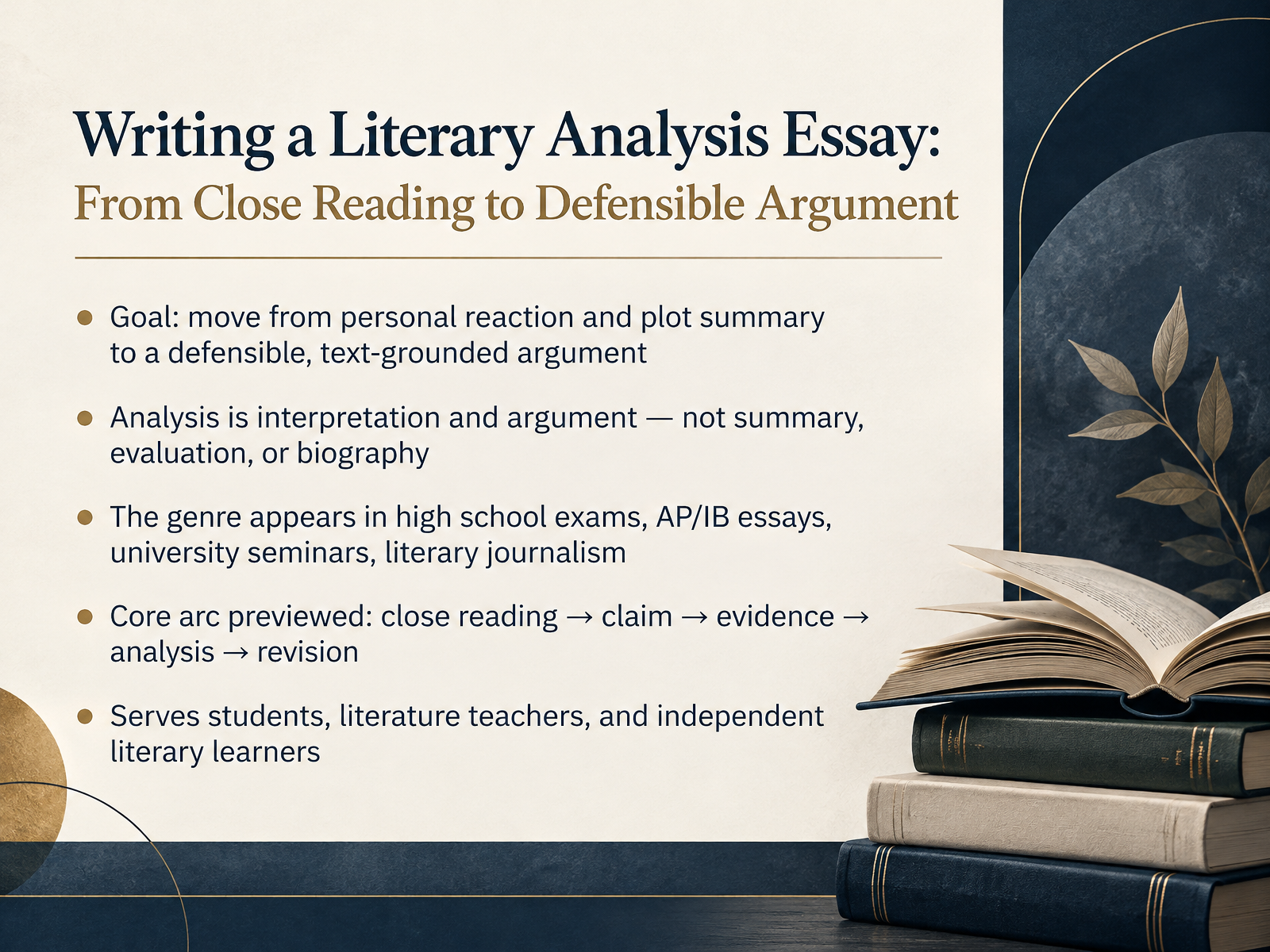
- 01Writing a Literary Analysis Essay: From Close Reading to Defensible ArgumentWelcome. I'm glad you're here, and I want to start by naming the goal of this course. By the end, you'll be able to move from a personal reaction or a plot summary to a defensible argument grounded in the text itself. That shift is the heart of literary analysis. Analysis means interpretation and argument, not summary, not simple evaluation, and not biography. You'll meet this genre in high school exams, in AP and IB essays, in university seminars, and in literary journalism. Here's the core arc we'll follow together: close reading, then a claim, then evidence, then analysis, then revision. Think of each step as a decision you make and your reader notices. And this course serves students, literature teachers, and independent literary learners alike. So here's your takeaway for this slide: before you write anything, decide whether your idea is a reaction or an argument. That single choice shapes everything that follows. In the next slide, we'll look closely at analysis versus summary, and really define this genre.apsu.eduowl.purdue.eduwritingcenter.unc.edu+21 min
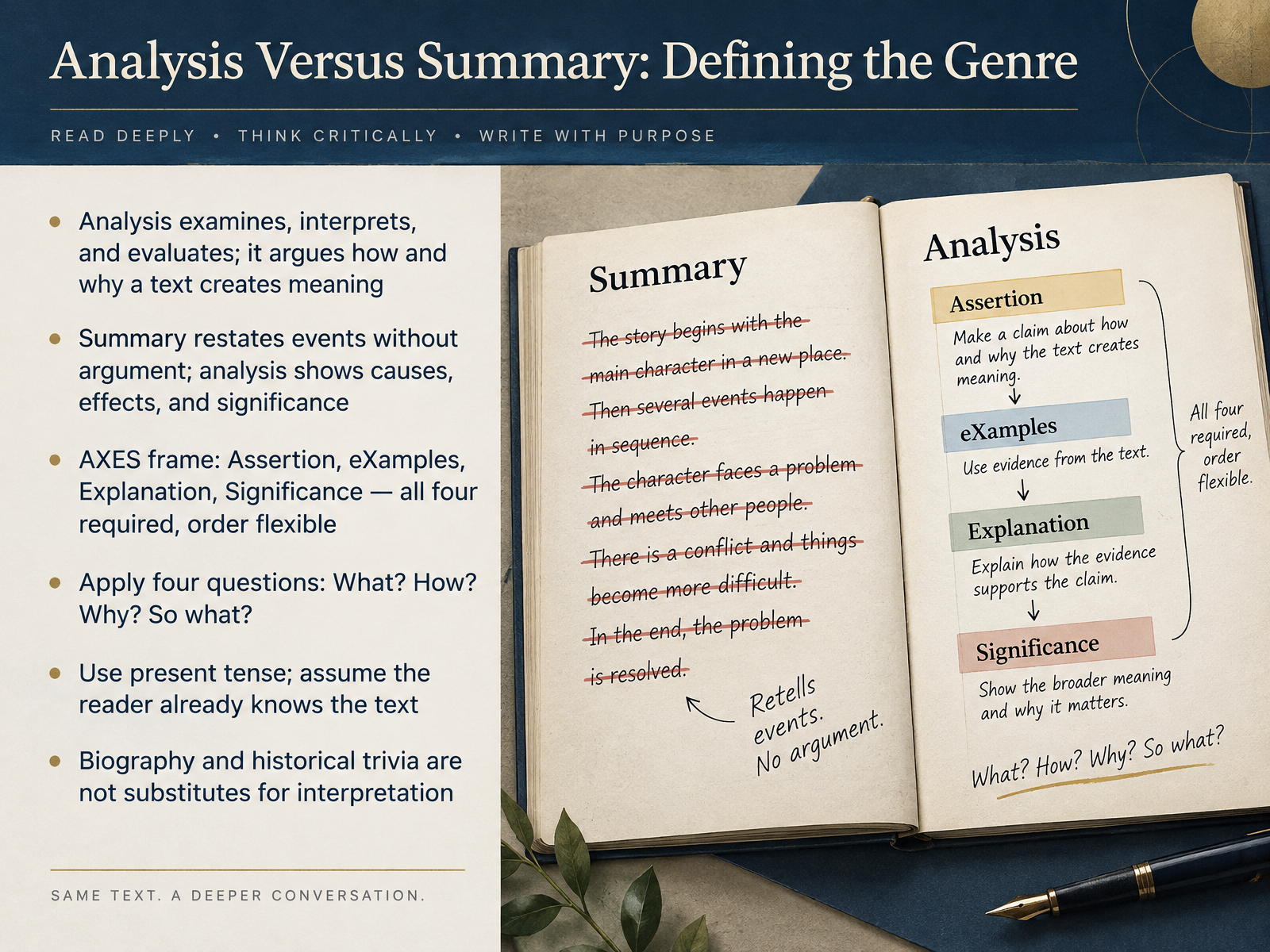
- 02Analysis Versus Summary: Defining the GenreLet's move on to a distinction that shapes everything you write: analysis versus summary. Summary restates events without an argument. Analysis examines, interprets, and evaluates. It argues how and why a text creates meaning. So keep asking four questions: What is happening? How is the author doing it? Why does it matter? And so what does it change for the reader? A simple frame to carry is A X E S: Assertion, eXamples, Explanation, Significance. All four are required, and the order is flexible. Two quick habits. Write in present tense, and assume your reader already knows the text. One caution. Biography and historical trivia are not substitutes for interpretation. Here is your takeaway: open your draft, pick one paragraph, and underline where it interprets rather than retells. Next, we will look at assignment types and the writing workflow.
 apsu.eduowl.purdue.eduwritingcenter.unc.edu+21 min
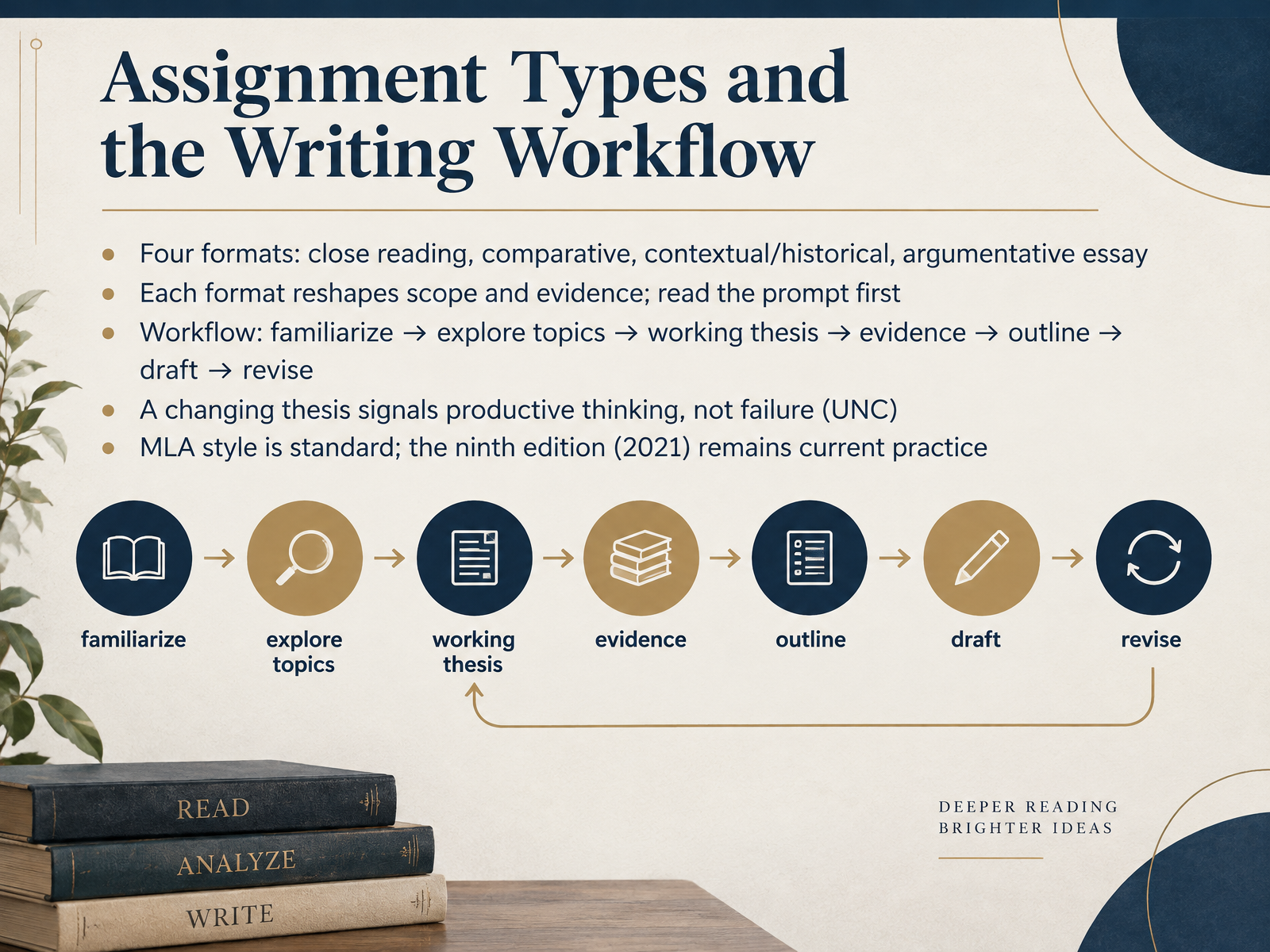
- 03Assignment Types and the Writing WorkflowNow let's talk about assignment types and the writing workflow. You'll meet four common formats. A close reading zooms in on a short passage and asks how the language creates meaning. A comparative essay puts two or more texts side by side. A contextual or historical essay uses background to deepen your interpretation. And an argumentative essay defends one debatable claim across a whole work. Each format reshapes your scope and your evidence, so read the prompt first. Notice which format it's asking for, and let that guide your choices.
Here's the workflow. Familiarize yourself with the text, explore possible topics, write a working thesis, gather evidence, outline, draft, and revise. Keep in mind that a changing thesis is a good sign. As the Writing Center at UNC puts it, a shifting thesis signals productive thinking, not failure. And format your essay in MLA style. The ninth edition, published in twenty twenty-one, remains current practice.
So your takeaway is simple. Identify your format from the prompt, then follow the workflow in order. Next, we'll go deeper into close reading: reading for craft, patterns, and meaning.
 apsu.eduowl.purdue.eduwritingcenter.unc.edu+22 min
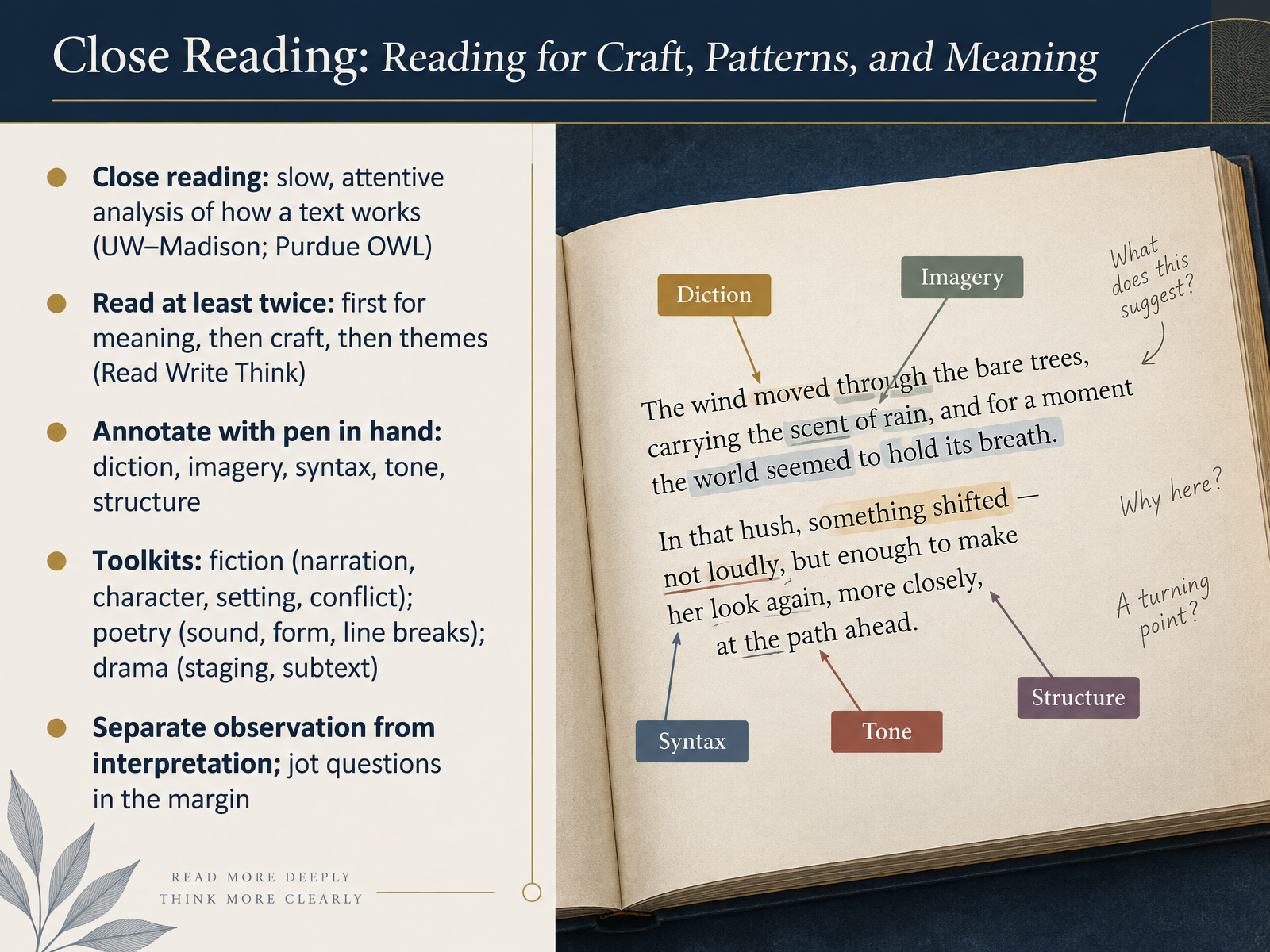
- 04Close Reading: Reading for Craft, Patterns, and MeaningNow let's slow down and look at close reading. Close reading means reading slowly and attentively to see how a text works, not just what it says. Here's a simple plan. Read at least twice. First for meaning, then for craft, then for themes. This second and third pass is where interpretation starts. And keep a pen in hand. Annotate diction, imagery, syntax, tone, and structure. Mark the words that stand out, and write questions in the margin. Different genres need different toolkits. For fiction, track narration, character, setting, and conflict. For poetry, listen to sound, form, and line breaks. For drama, notice staging and subtext. One last habit: separate observation from interpretation. Say what you see before you say what it means. So right now, open your draft and mark one pattern you notice. Then move from passages to evidence, building an evidence log.
 writing.wisc.edureadwritethink.orgscholarscompass.org+22 min
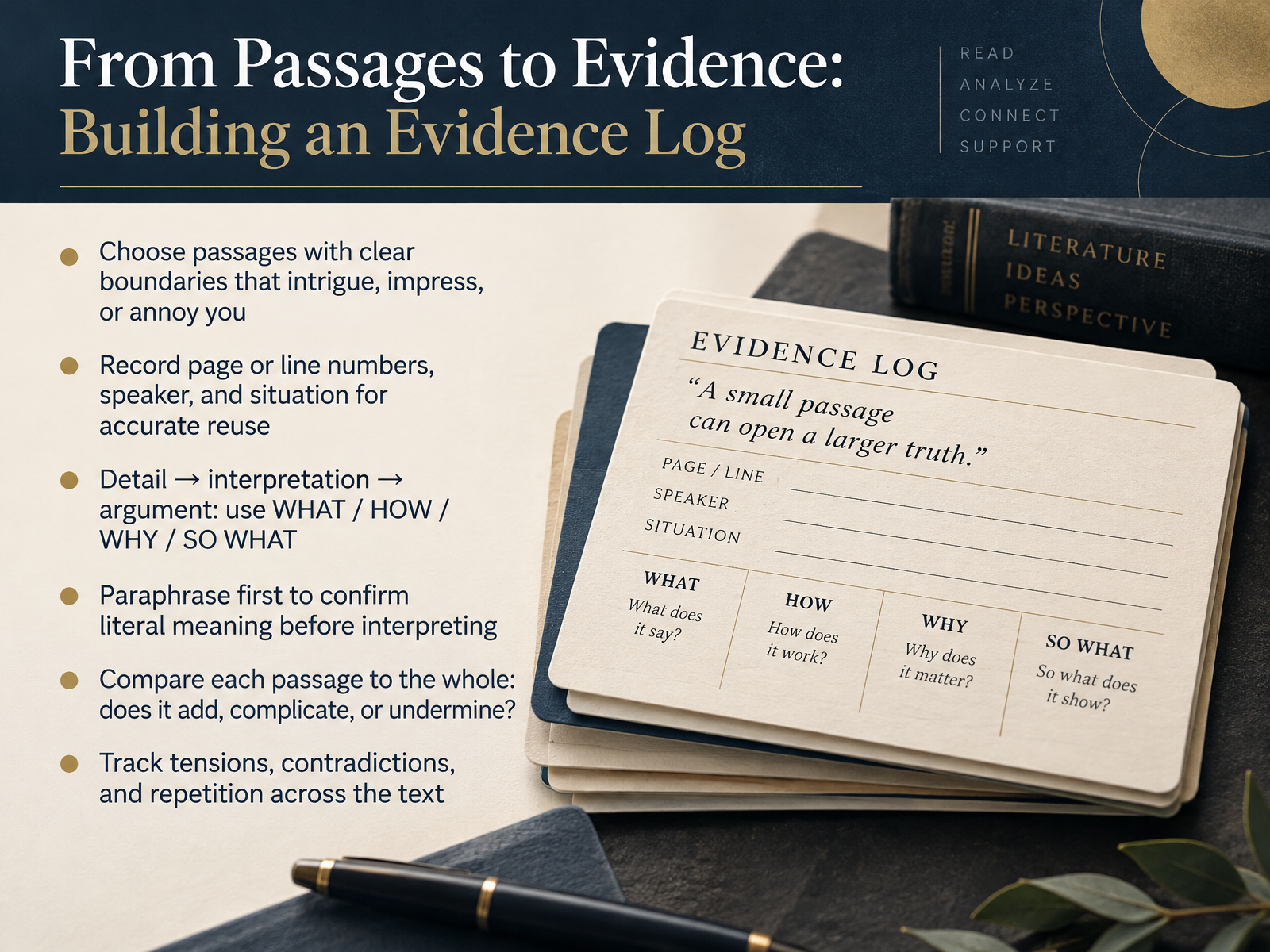
- 05From Passages to Evidence: Building an Evidence LogNow let's turn passages into real evidence. Here is the problem many students hit: you highlight a great quote, but when you draft, you can't remember where it came from or why it mattered. So build an evidence log as you read. First, choose passages with clear boundaries, ones that intrigue, impress, or even annoy you. Second, record the page or line number, the speaker, and the situation, so you can reuse the quote accurately. Third, move from detail to interpretation to argument using four questions: what is happening, how is it shown, why does the author do it, and so what does it matter? Before you interpret, paraphrase the passage in your own words to confirm the literal meaning. Then compare it to the whole text. Does it add, complicate, or undermine something? Finally, track tensions, contradictions, and repetition across the text. These gaps often become your best arguments. Your takeaway: start one evidence log today, with three entries, each with a page number and one sentence of interpretation. Next, we will turn those entries into an interpretive question and a working thesis: Formulating an Interpretive Question and a Working Thesis.
 writing.wisc.edureadwritethink.orgscholarscompass.org+22 min
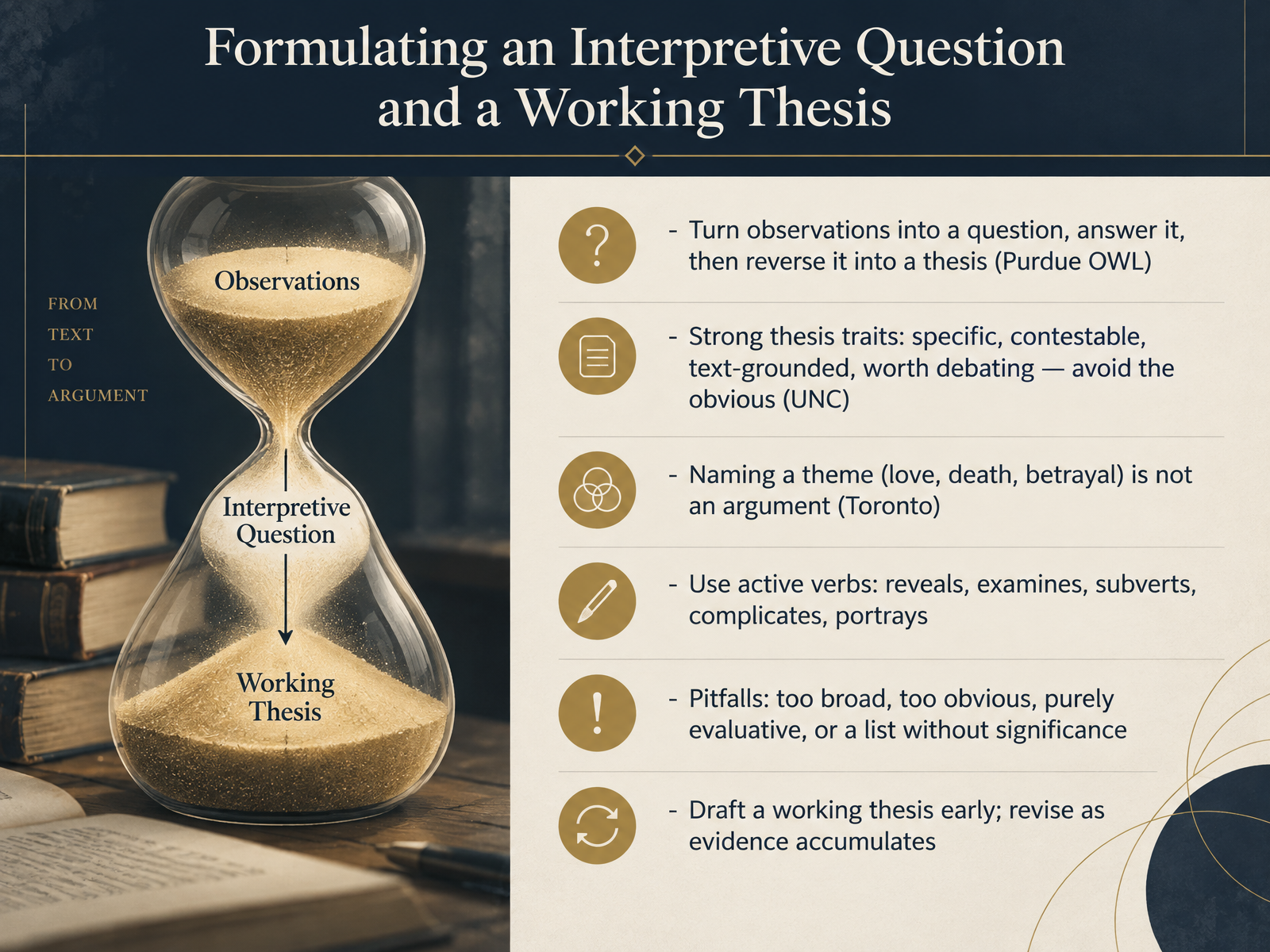
- 06Formulating an Interpretive Question and a Working ThesisNow let's build your argument. Here's a simple method from Purdue OWL. Turn your observations into a question, answer it, then reverse them into a working thesis. For example, ask, what does Conrad suggest about London society? Answer, that every class is corrupt. Reverse it: Conrad uses beast and cannibal imagery to suggest corruption at every level. Notice the strong, active verb: suggests. Verbs like reveals, subverts, and complicates work well too. A strong thesis is specific, contestable, and grounded in the text. And here's a common worry: naming a theme is not an argument. Saying a story is about love, death, or betrayal tells your reader nothing they didn't already know. Be careful of pitfalls too: a thesis that's too broad, too obvious, purely evaluative, or just a list without significance. Draft your working thesis early, and revise it as evidence accumulates. So here's your takeaway: write one question-and-answer pair about your text, flip it into a working thesis, then check it against those pitfalls. Next, we'll look at structuring the argument: paragraphs, transitions, and outlines.
 owl.purdue.edulibguides.uta.eduscribbr.com+22 min
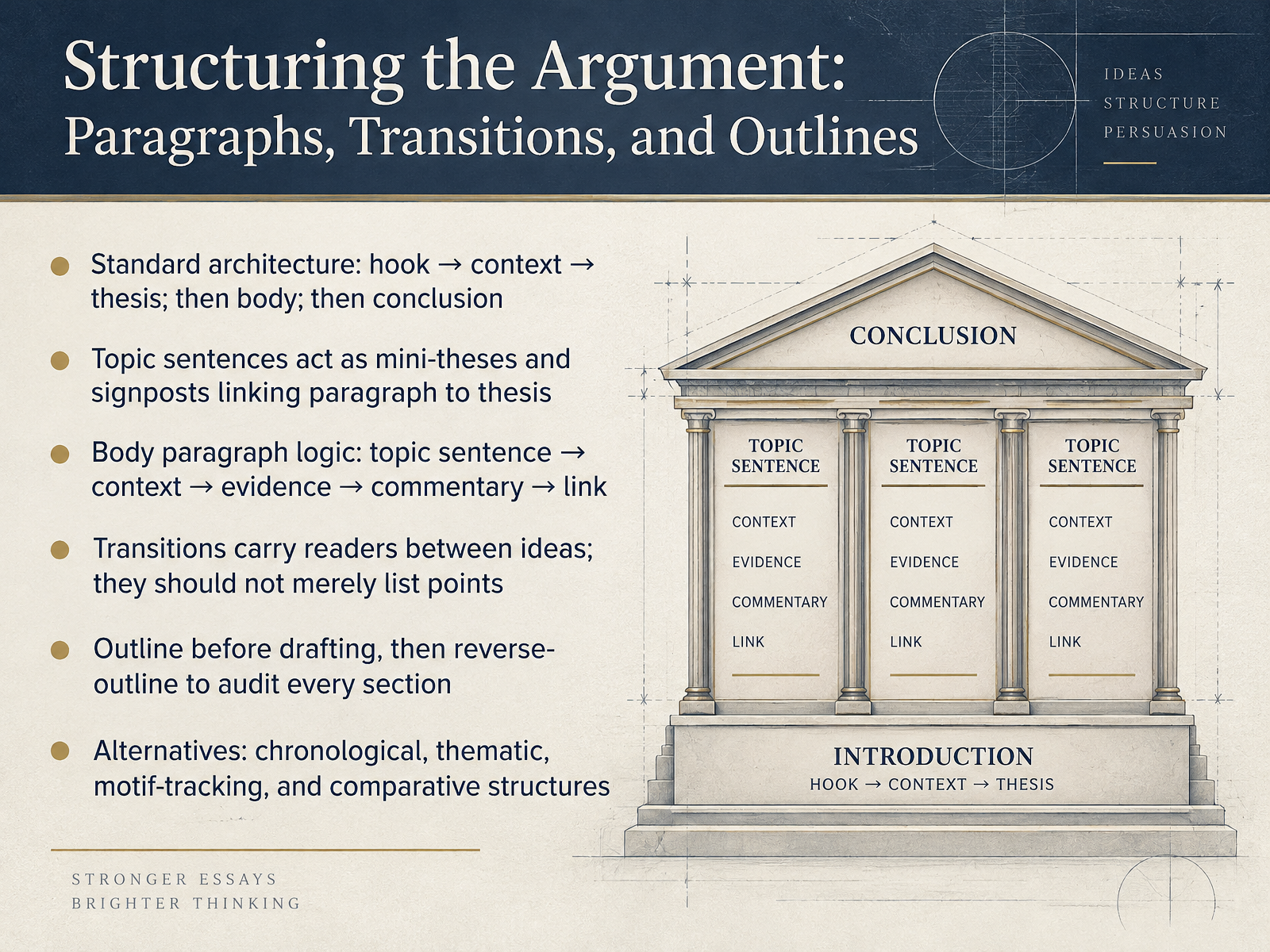
- 07Structuring the Argument: Paragraphs, Transitions, and OutlinesNow let's talk about structure, the part where interpretation becomes an argument a reader can follow. Most literary essays follow a familiar architecture: a hook, some context, then your thesis. After that come the body paragraphs, and finally a conclusion. Each body paragraph should begin with a topic sentence, a mini-thesis that works like a signpost, linking that paragraph back to your main claim. Inside the paragraph, the logic runs like this: topic sentence, context, evidence, commentary, then a link forward. Transitions carry readers between ideas, so don't just list points; connect them. Here's a practical habit. Outline before drafting, then reverse-outline afterward to audit every section. If you are unsure how to organize, try an alternative structure, such as chronological, thematic, motif-tracking, or comparative. Quick takeaway: write your topic sentences first, and check that each one points back to your thesis. Next, we'll look at how to use textual evidence well: quote, paraphrase, and cite.
 albright.edufiles.udc.eduapsu.edu+22 min
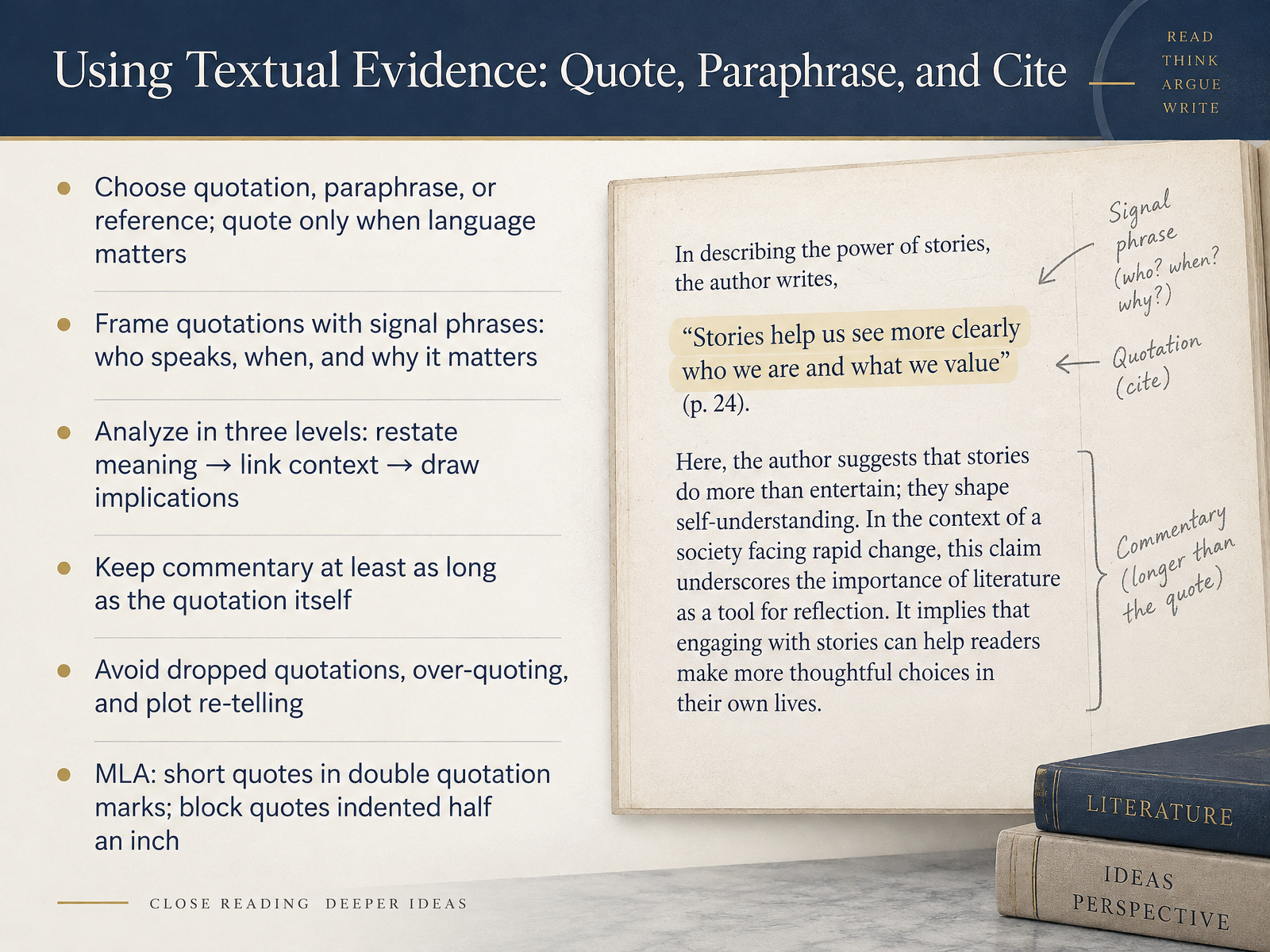
- 08Using Textual Evidence: Quote, Paraphrase, and CiteNow let's talk about how you bring evidence into your essay. You have three options: quote, paraphrase, or simply refer to a passage. Quote only when the language itself matters, when the exact words carry the meaning you need. When you do quote, frame it with a signal phrase. Tell us who speaks, when it happens, and why it matters. Then analyze in three levels. First, restate the meaning. Second, link it to its context. Third, draw out the implications for your argument. And here is a rule of thumb: keep your commentary at least as long as the quotation itself. Avoid dropped quotations, over-quoting, and re-telling the plot. In MLA style, put short quotes in double quotation marks, and indent block quotes half an inch. Your takeaway: choose your evidence deliberately, frame it clearly, and always explain why it matters. Next, we'll look at critical lenses and scholarly sources.
 writingaboutliterature.comwriting.caltech.edualbright.edu+21 min
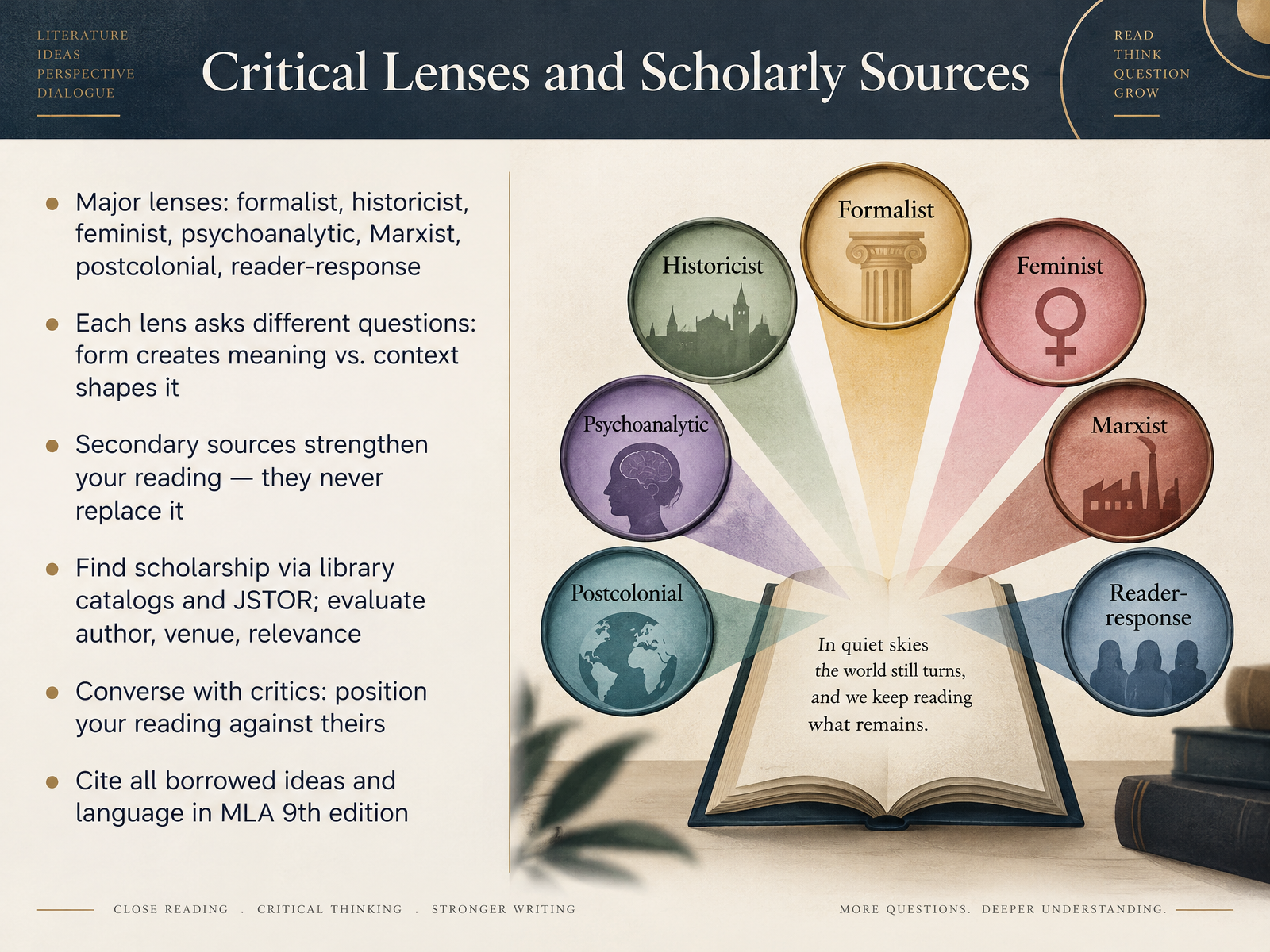
- 09Critical Lenses and Scholarly SourcesNow let's bring in critical lenses and scholarly sources. A critical lens is simply the set of questions you choose to ask. A formalist lens asks how form creates meaning, while a historicist lens asks how context shapes it. Feminist, psychoanalytic, Marxist, postcolonial, and reader-response lenses each ask their own questions. Pick the lens that fits your thesis, and name it openly. Here's a worry you may have. Won't secondary sources drown out my own reading? No, if you use them well. Scholarship strengthens your reading. It never replaces it. Find articles through your library catalog and JSTOR. Then evaluate the author, the venue, and the relevance to your argument. Don't just collect critics. Converse with them. Position your reading against theirs, and show where you agree or push back. Finally, cite every borrowed idea and every borrowed phrase in MLA ninth edition style. Your takeaway: choose one lens, find one scholarly voice to answer, and cite it correctly. Next, we look at crafting introductions that set up the argument.
 2 min
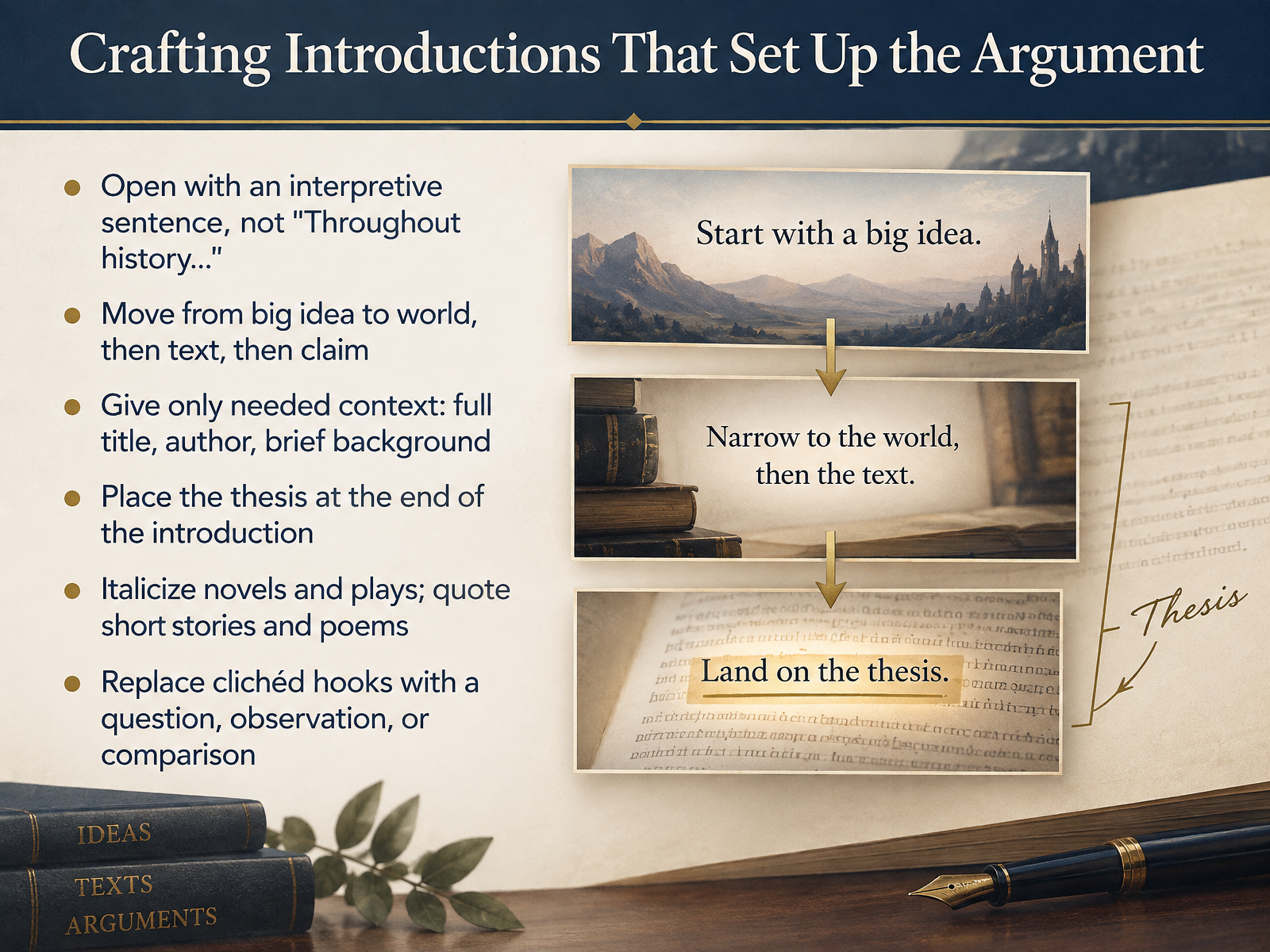
- 10Crafting Introductions That Set Up the ArgumentNow let's build the introduction that actually sets up your argument. Here is the problem many writers hit: a first sentence like "Throughout history, people have struggled with love." It sounds safe, but it tells your reader nothing about your text. So make a decision. Open with an interpretive sentence instead. Then move in a clear order: big idea, to the world, to the text, and finally to your claim. Give only the context your reader needs: the full title, the author's full name, and a brief background. Save everything else for the body. Here is a formatting point readers notice right away. Italicize novels and plays. Put short stories and poems in quotation marks. And place your thesis at the very end of the introduction. Your reader arrives at it last, so it lands with force. If your hook feels clichéd, replace it with a question, a close observation, or a brief comparison. Try this on your own draft now. Read your first sentence. Does it interpret, or does it just warm up? Takeaway: rearrange your opening so the thesis sits last, and cut any context the essay does not need. Next, we move to conclusions that extend significance.
 scribbr.comwriting.caltech.eduapsu.edu+22 min
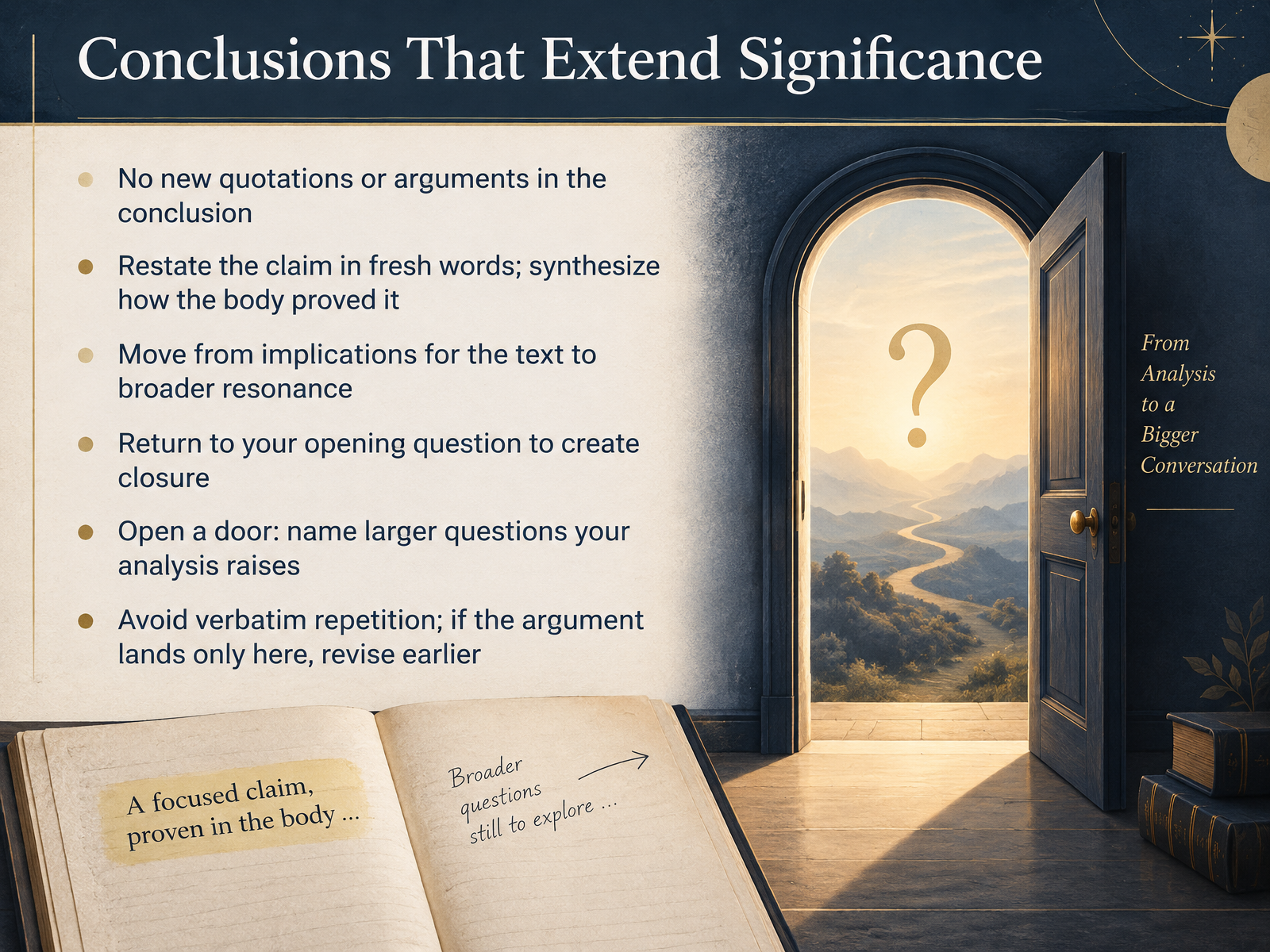
- 11Conclusions That Extend SignificanceSo let's talk about the conclusion. A good conclusion doesn't repeat your essay. It extends its significance. Here's the rule to remember: no new quotations and no new arguments. Instead, restate your claim in fresh words, and then synthesize how your body paragraphs proved it. Think of it as showing the reader the full shape of your argument. From there, move outward. Take the implications for the text, and connect them to a broader resonance. One reliable move is to return to your opening question. That creates closure, because the reader hears the circle close. Then open a door. Name the larger questions your analysis raises, questions about the text, the world, or how we read. And one caution: avoid verbatim repetition. If your argument only lands in the conclusion, that's a signal to revise earlier paragraphs, not to patch it at the end. Your takeaway for this slide: draft one sentence that restates your claim differently, and one question your essay leaves open. That's your conclusion in miniature. Next, we turn to revision, style, and responsible AI use.
 scribbr.comwriting.caltech.edualbright.edu+22 min
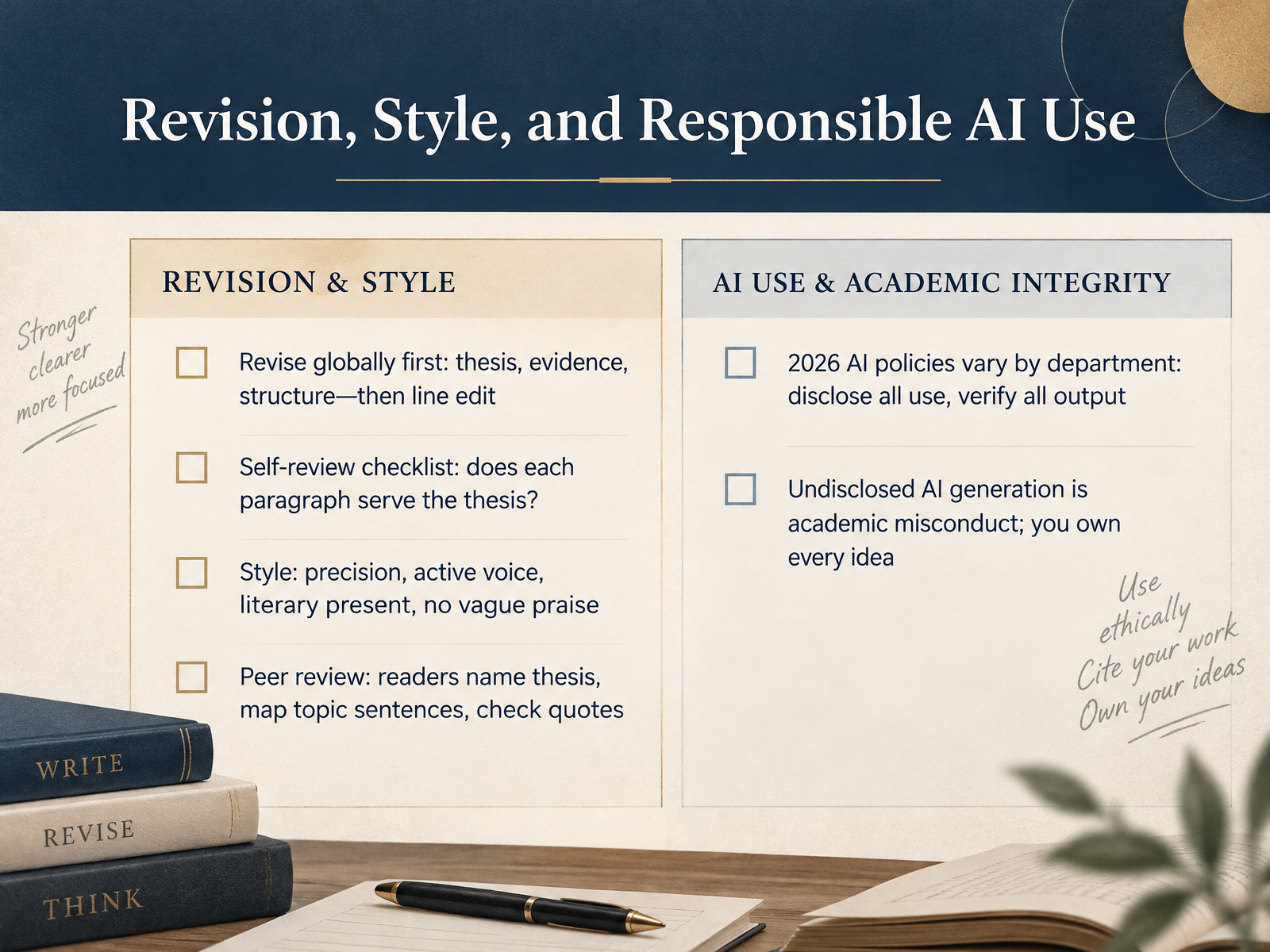
- 12Revision, Style, and Responsible AI UseNow let's talk about revision. And here is the key habit: revise globally first, then line edit. Check your thesis, your evidence, and your structure before you touch a single comma. Ask of every paragraph, does this serve my thesis? If not, cut it or rewrite it.
For style, aim for precision. Use active voice, write about literature in the present tense, and replace vague praise like powerful or deep with specific claims.
Peer review helps too. Have a reader state your thesis in their own words, map your topic sentences, and check that every quote is integrated and analyzed.
One last thing. AI policies in 2026 vary by department. Disclose all use, verify all output, and remember: undisclosed AI generation is academic misconduct. You own every idea.
Your takeaway: revise globally first, then sweat the sentences.
Next, we'll look at assessment: rubrics, feedback, and common grading pitfalls.
 albright.edufiles.udc.eduapsu.edu+22 min
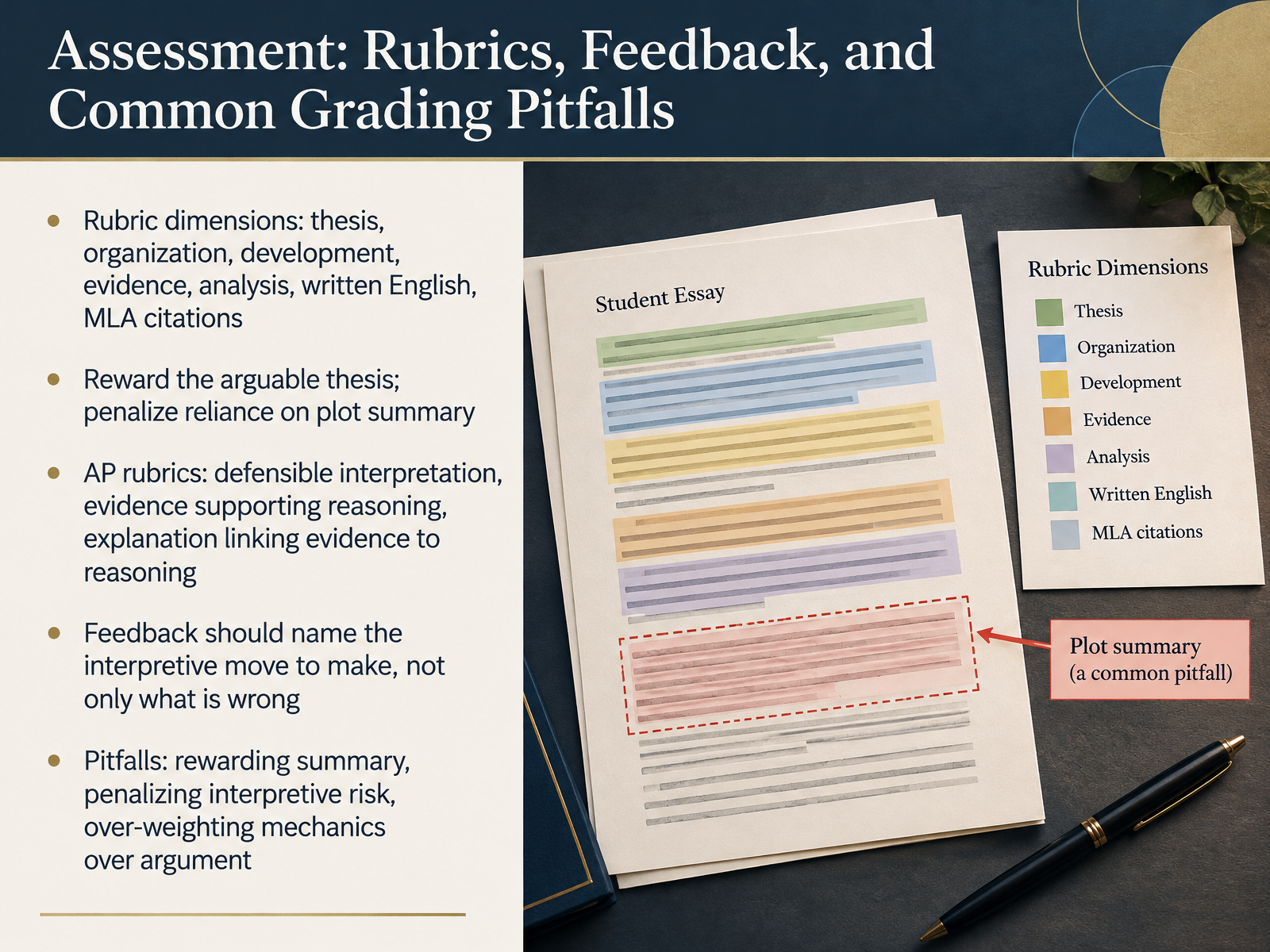
- 13Assessment: Rubrics, Feedback, and Common Grading PitfallsNow let's talk about how your essay will be assessed, so you can write toward the rubric instead of guessing. Most rubrics use dimensions you already know: thesis, organization, development, evidence, analysis, written English, and M L A citations. Two moves matter most. First, reward the arguable thesis. A rubric like Moorpark College's marks an A thesis as clear, specific, original, and interpretive, while a thesis that is not analytical falls to the bottom. Second, penalize reliance on plot summary. Summary retells events. Analysis explains how those events create meaning. The A P rubrics make this concrete: a defensible interpretation, evidence that supports your reasoning, and explanation that links the evidence to that reasoning. So when you revise, check that every quote is followed by explanation, not retelling. Good feedback names the interpretive move to make. Instead of only saying what is wrong, it says try connecting this image to your claim about tone. Watch three common pitfalls: rewarding summary, penalizing interpretive risk, and over-weighting mechanics over argument. Before you submit, read your draft against the rubric and ask one question per dimension. Your takeaway: score yourself honestly on thesis and analysis first, then fix mechanics. Next, we'll look at Classroom Application: Scaffolding, Tasks, and Next Steps.
 apsu.eduowl.purdue.eduwritingcenter.unc.edu+22 min
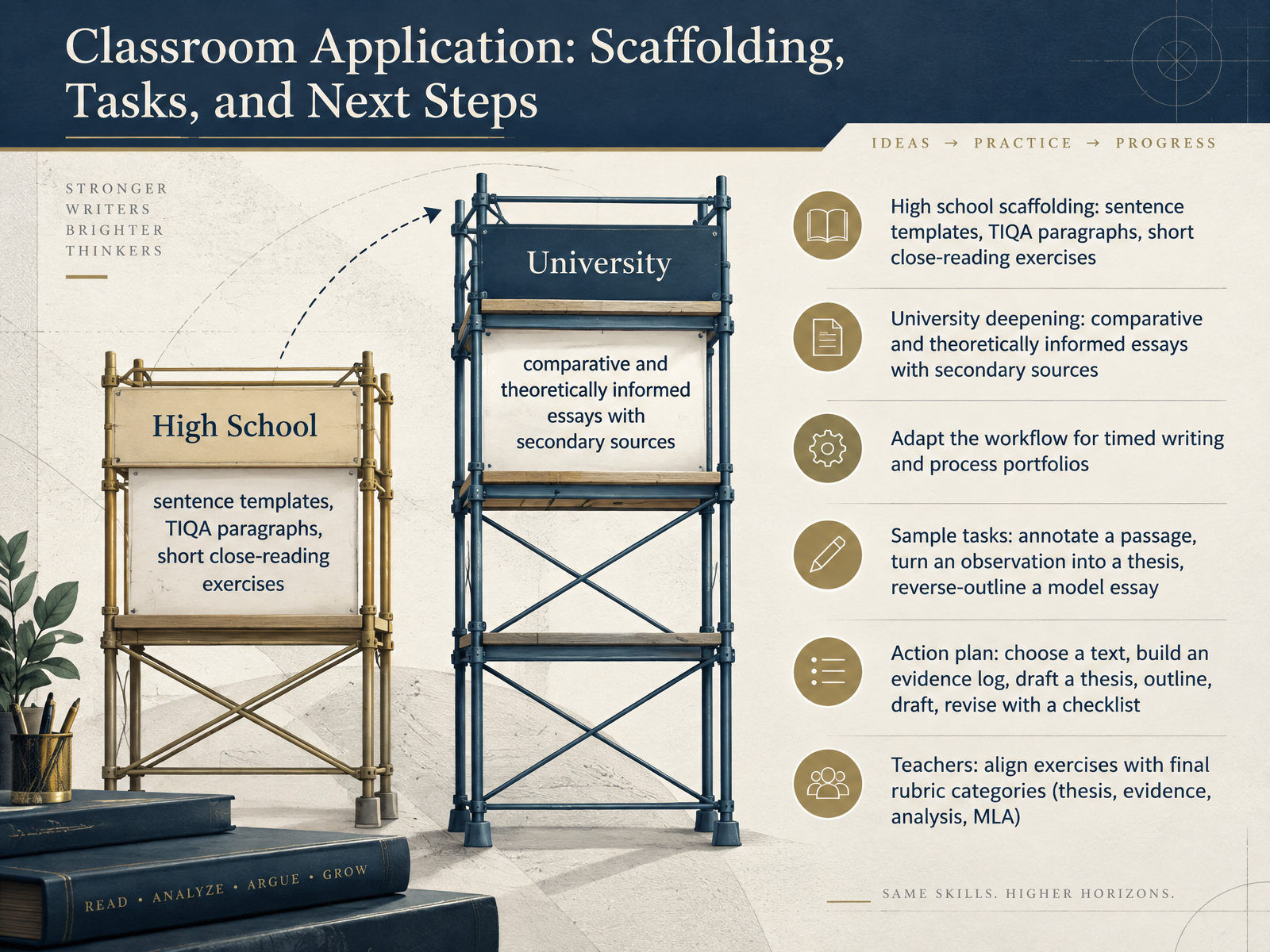
- 14Classroom Application: Scaffolding, Tasks, and Next StepsLet's bring all of this into the classroom, and into your own next steps. For high school students, scaffold the work. Give sentence templates, teach the TIQA paragraph, which stands for topic, introduction, quote, and analysis, and run short close reading exercises. For university students, deepen the challenge with comparative essays and theoretically informed arguments that use secondary sources. You can also adapt this workflow for timed writing or process portfolios. Three sample tasks work at any level. Annotate a passage. Turn one observation into a thesis. Or reverse outline a model essay. Here is your action plan: choose a text, build an evidence log, draft a thesis, outline, draft, then revise with a checklist. And teachers, align every exercise with your final rubric categories: thesis, evidence, analysis, and MLA format. So remember: scaffold the skill, deepen the thinking, and align the practice to the rubric. Thank you for working through this course with me. Pick one text this week and start small, and trust that your interpretations will grow with each careful reading. You are ready to write.
 apsu.edualbright.edufiles.udc.edu+22 min
Take the deck with you
Download this course as a file — free, no sign-up needed.
- PDF handoutEvery slide page, ready to print or share.15 pages · 4.8 MBDownload
- Narrated PowerPointThe deck that presents itself — every slide carries the digital human's narration video.15 pages · 16.4 MBDownload
- PowerPoint slidesThe full deck as a .pptx — open it in PowerPoint, Keynote, or Google Slides.15 pages · 4.8 MBDownload
Free to use in your own training — please keep the PersonWise credit page at the end.
Have your own deck? Turn it into a course
Sources consulted
Web sources consulted while building this course.
- Literary Analysis Handout — apsu.edu
- Writing a Literary Analysis — owl.purdue.edu
- Literature – The Writing Center — writingcenter.unc.edu
- A GUIDE TO WRITING ABOUT — writing.caltech.edu
- Guide to Writing in English — southwestern.edu
- A Short Guide to Close Reading for Literary Analysis – The Writing Center – UW–Madison — writing.wisc.edu
- Close Reading of Literary Texts | Read Write Think — readwritethink.org
- ENG 1020 — Scholar's Compass — scholarscompass.org
- Close-Reading Poetry: An Overview — owl.purdue.edu
- A Short Guide to Close Reading — ocw.mit.edu
- Developing a Thesis - Purdue OWL — owl.purdue.edu
- thesis examples - Literary Criticism - Subject and Course Guides at University of Texas at Arlington — libguides.uta.edu
- How to Write a Literary Analysis Essay | A Step-by-Step Guide — scribbr.com
- Writing about Literature | Writing Advice — advice.writing.utoronto.ca
- WRITING THE THESIS STATEMENT for a world literature paper — owl.purdue.edu
- Body Paragraphs in a Literary Analysis Paper — albright.edu
- Outline Structure for Literary Analysis Essay — files.udc.edu
- Writing about Literature — wwnorton.com
- Literary Analysis Paragraphs: Advice & Practice — hdl.handle.net
- Developing; adding textual evidence to a literary analysis essay – Writing About Literature — writingaboutliterature.com