Begin
15 pages · ~30 min
Knowledge Transfer in Management
This training covers the concepts, purpose, and practical examples of knowledge transfer in management, equipping managers with strategies to effectively share critical knowledge within their organizations.
A digital instructor presents all 15 pages. Hold “Ask” at any point and ask out loud — the answer comes from this course. No sign-up needed.
What you’ll learn
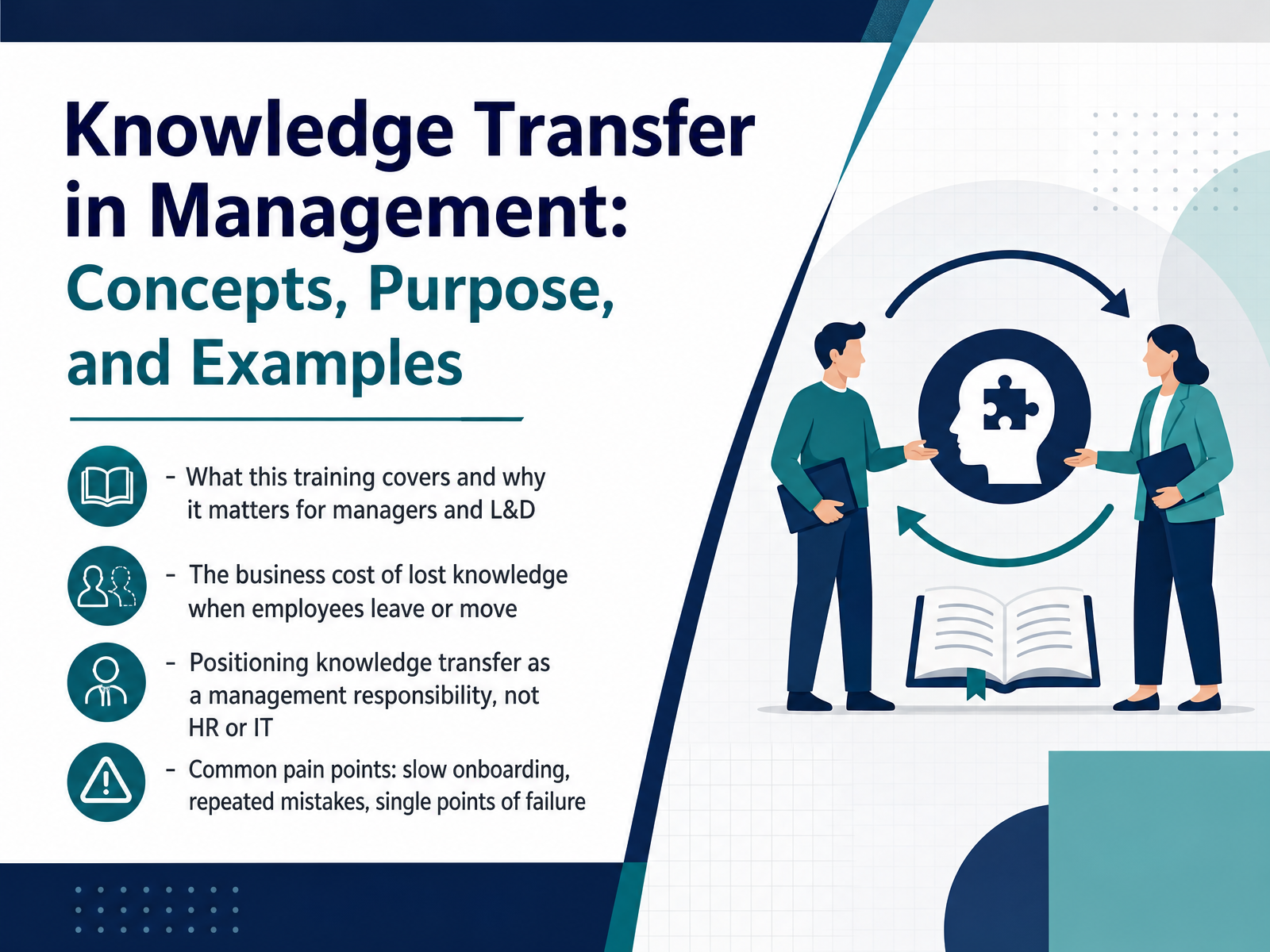
- 01Knowledge Transfer in Management: Concepts, Purpose, and ExamplesWelcome. Over the next few minutes, we're going to talk about knowledge transfer, not as a documentation project, but as a core management practice. The goal here is simple: protect your team's capability and speed when people leave or move roles. We all know the obvious costs of turnover, recruiting, onboarding, but the bigger risk is the operational knowledge that walks out the door. A new hire can take up to two years to reach full efficiency. And it's not just about losing the person. It's about the relationships, the internal know-how, and the judgment that made them effective. That's why this training positions knowledge transfer as your responsibility, not an I T or H R side project. We'll dig into the specific pain points you already see: slow onboarding, repeated mistakes, and that one person who holds an entire process together. By the end, you'll have clear, actionable practices to close those gaps. Let's start by looking at exactly why knowledge walks out the door.sloanreview.mit.eduemerald.comdl.acm.org+21 min
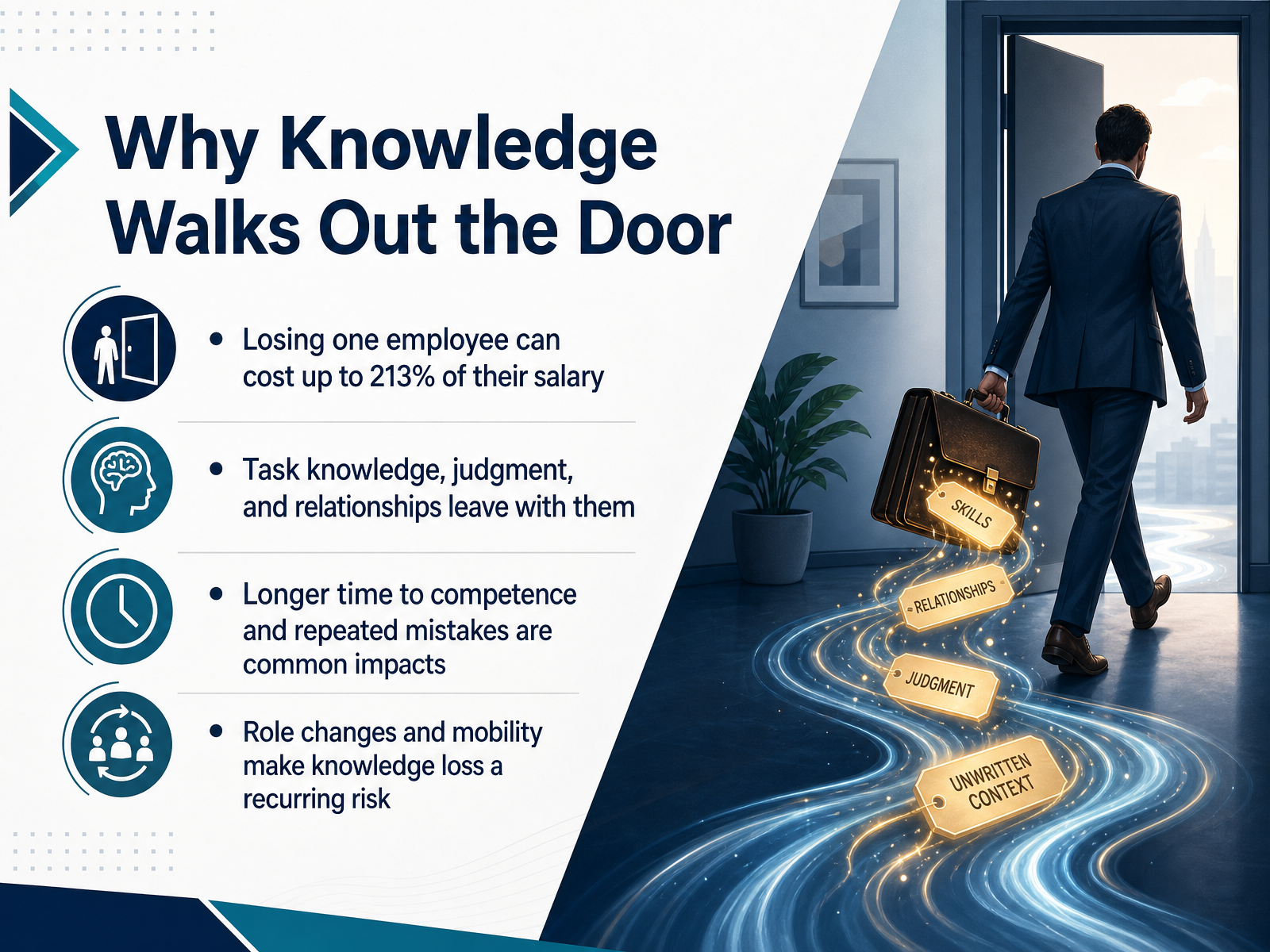
- 02Why Knowledge Walks Out the DoorLet's talk about why knowledge walks out the door. The numbers are stark. Losing one employee can cost up to two hundred and thirteen percent of their annual salary. That's not just about recruitment fees. It reflects the time it takes for a new hire to reach full productivity, often up to two years. When someone leaves, they take more than just task knowledge. They take judgment, built through years of experience, and relationships with clients and colleagues. These are the informal networks that make work happen. The immediate impact is a longer time to competence for the team and repeated mistakes. If a senior engineer leaves, the team doesn't just lose their code. They lose the context behind those decisions. This isn't a one-time event either. With regular role changes and internal mobility, knowledge loss is a recurring risk you need to manage. Up next, we'll break down the three types of knowledge you must recognize.
 sloanreview.mit.eduemerald.comdl.acm.org+21 min
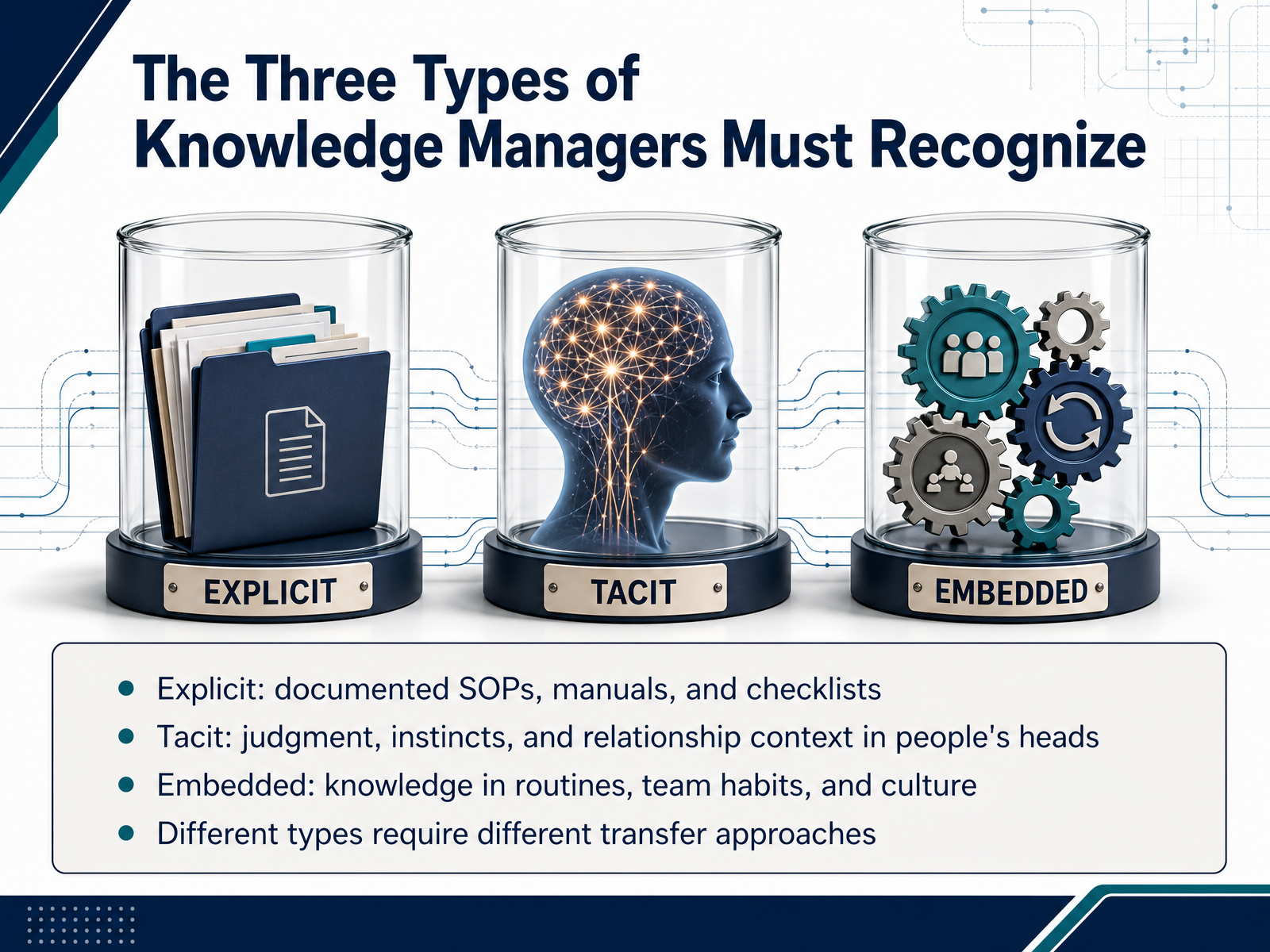
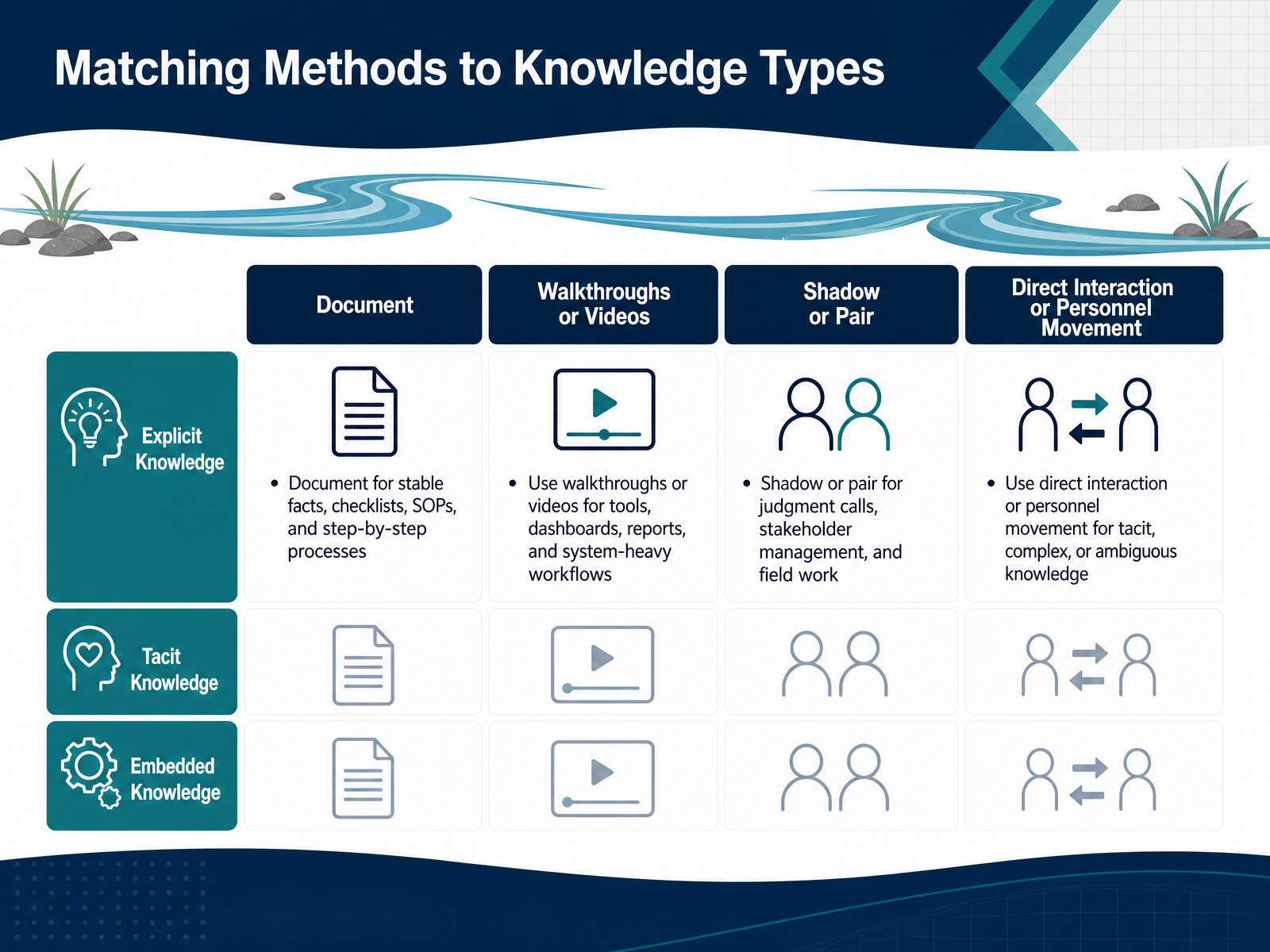
 - 03The Three Types of Knowledge Managers Must RecognizeNow, let's look at the three types of knowledge you need to plan for: explicit, tacit, and embedded. Explicit knowledge is the easy part. It's your documented SOPs, manuals, and checklists. You can store it in a shared drive, and a new hire can read it on day one. Tacit knowledge is different. This is the judgment, the instincts, and the relationship context that lives in people's heads. It's why a senior rep knows to call a specific client before sending a price increase. You cannot just hand over a PDF for this. Embedded knowledge is in your team's routines and habits. It's the unwritten rule that legal always reviews contracts before Thursday, or the way your team escalates issues during a standup. Recognizing these three types matters because they require different transfer approaches. You can document the explicit. You need shadowing and conversations for the tacit. And you have to redesign routines to shift embedded knowledge. Next, let's talk about what knowledge transfer is not, because that's where most plans go wrong.
 coassemble.comcarleton.cahr.cornell.edu+22 min
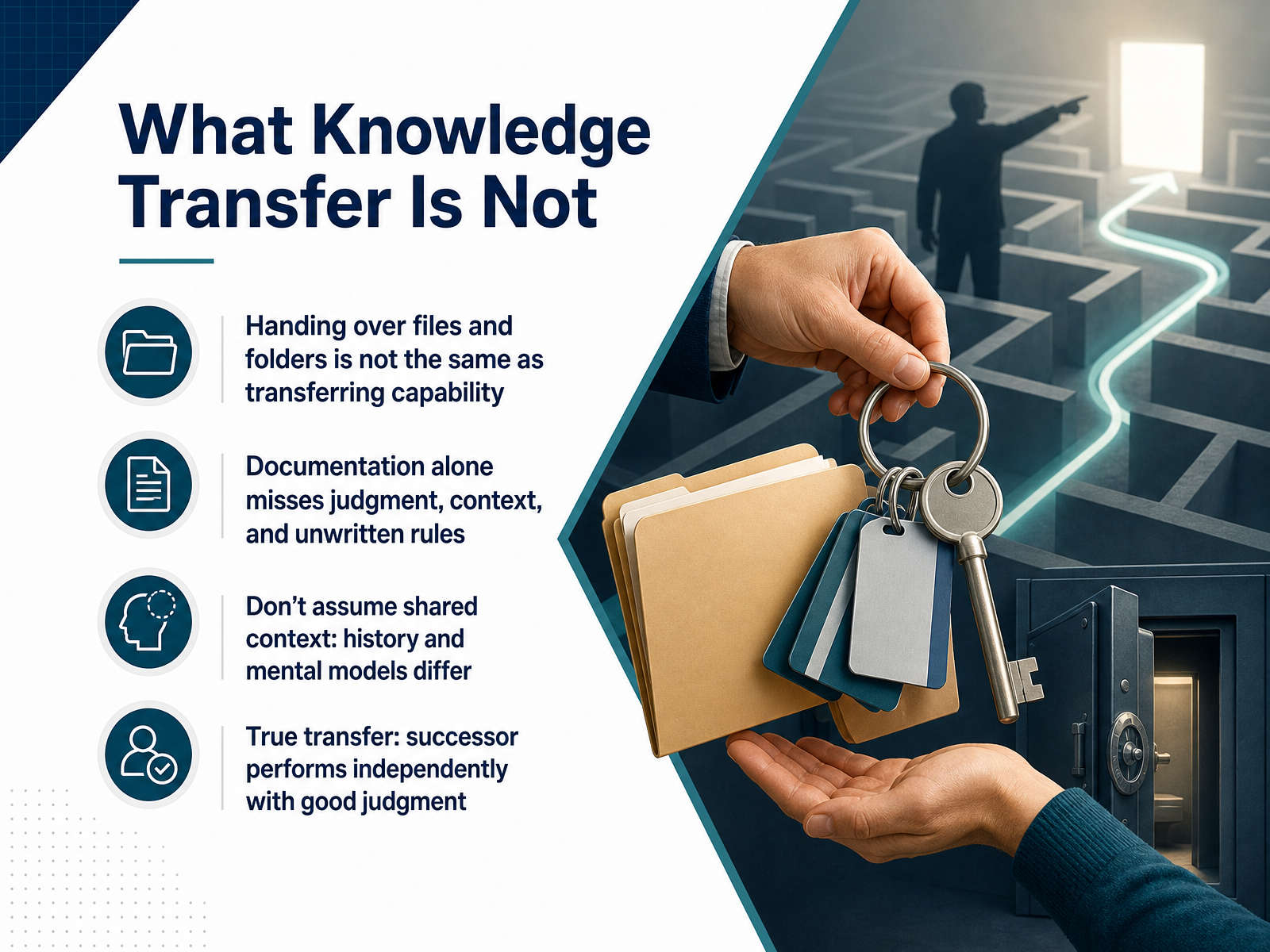
 - 04What Knowledge Transfer Is NotLet’s get clear on what knowledge transfer actually isn’t. Handing over a folder of files is not the same as transferring capability. Your successor can read every document and still miss the judgment that sits behind each decision. Documentation alone misses the context, the unwritten rules, and the history that shaped them. Also, don’t assume shared context. Two people can look at the same workflow and carry very different mental models of why it exists and how it should bend under pressure. True transfer is the moment your successor performs independently with good judgment. So when you plan a handoff, test for that: can they make the call, not just find the file? That standard separates activity from actual continuity, and it sets up the business case for why structured transfer matters.
 coassemble.comcarleton.cahr.cornell.edu+21 min
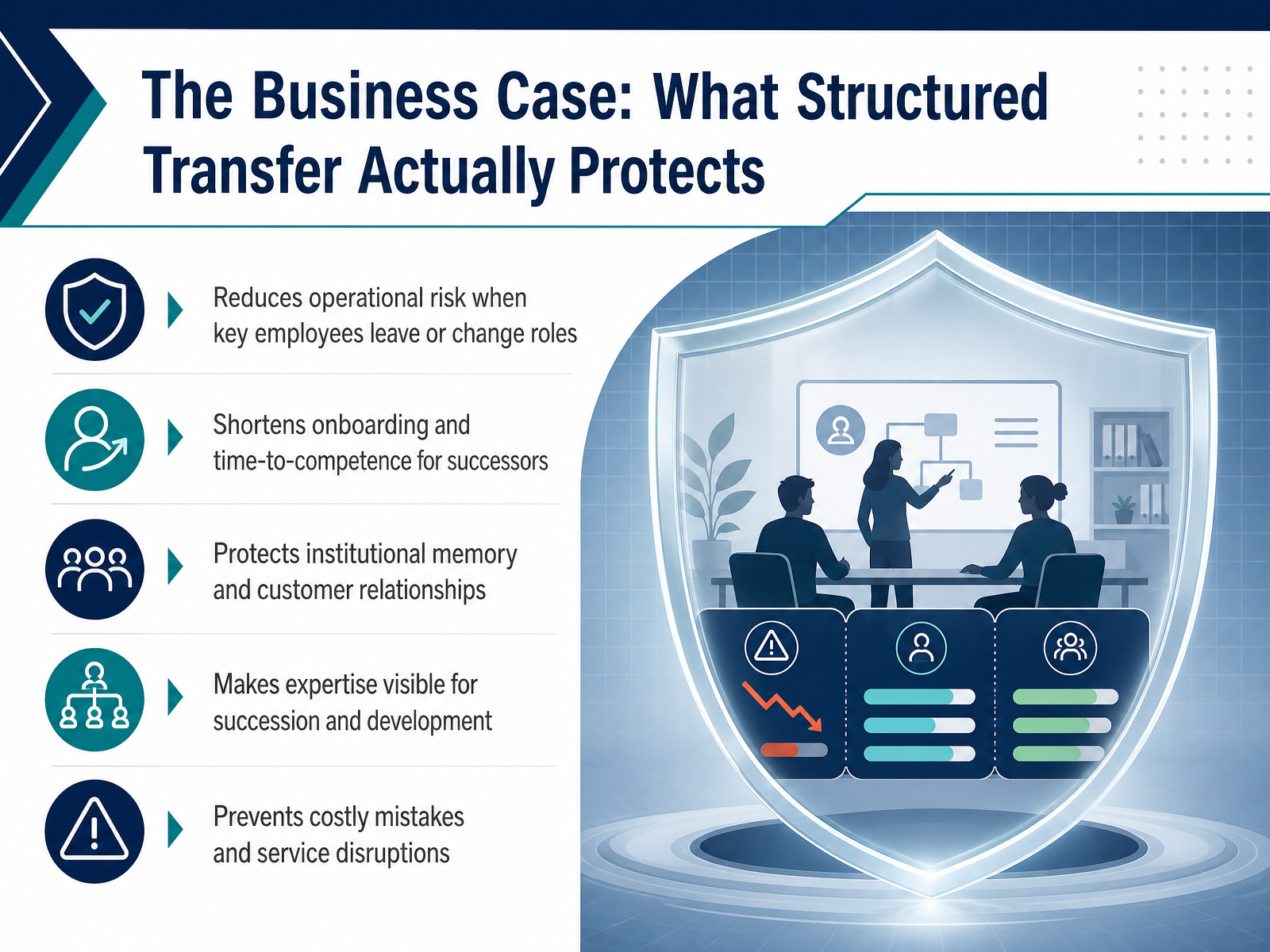
 - 05The Business Case: What Structured Transfer Actually ProtectsNow, let's talk about why this matters in dollars, risk, and time. Structured knowledge transfer isn't a nice-to-have; it's your insurance policy against operational chaos. Think about your top performer resigning tomorrow. Without a transfer plan, you lose the unwritten rules, the client history, and the short-cuts that keep service delivery smooth. This is how teams end up with costly mistakes or service disruptions during what should be a routine handoff. With a structured approach, though, you flip that outcome. You shorten onboarding from months to weeks because your successor isn't starting from zero. You protect institutional memory and the customer relationships that took years to build. You also make expertise visible. When you map out who knows what, succession planning stops being a guessing game and becomes a clear development path. The goal is simple: stop continuity from being a crisis by building a system that preserves your team's most valuable assets. Next, let's move from the concepts to the proof. We'll look at the metrics and evidence that show the real impact.
 www2.gov.bc.cawww2.gnb.capapers.academic-conferences.org+22 min
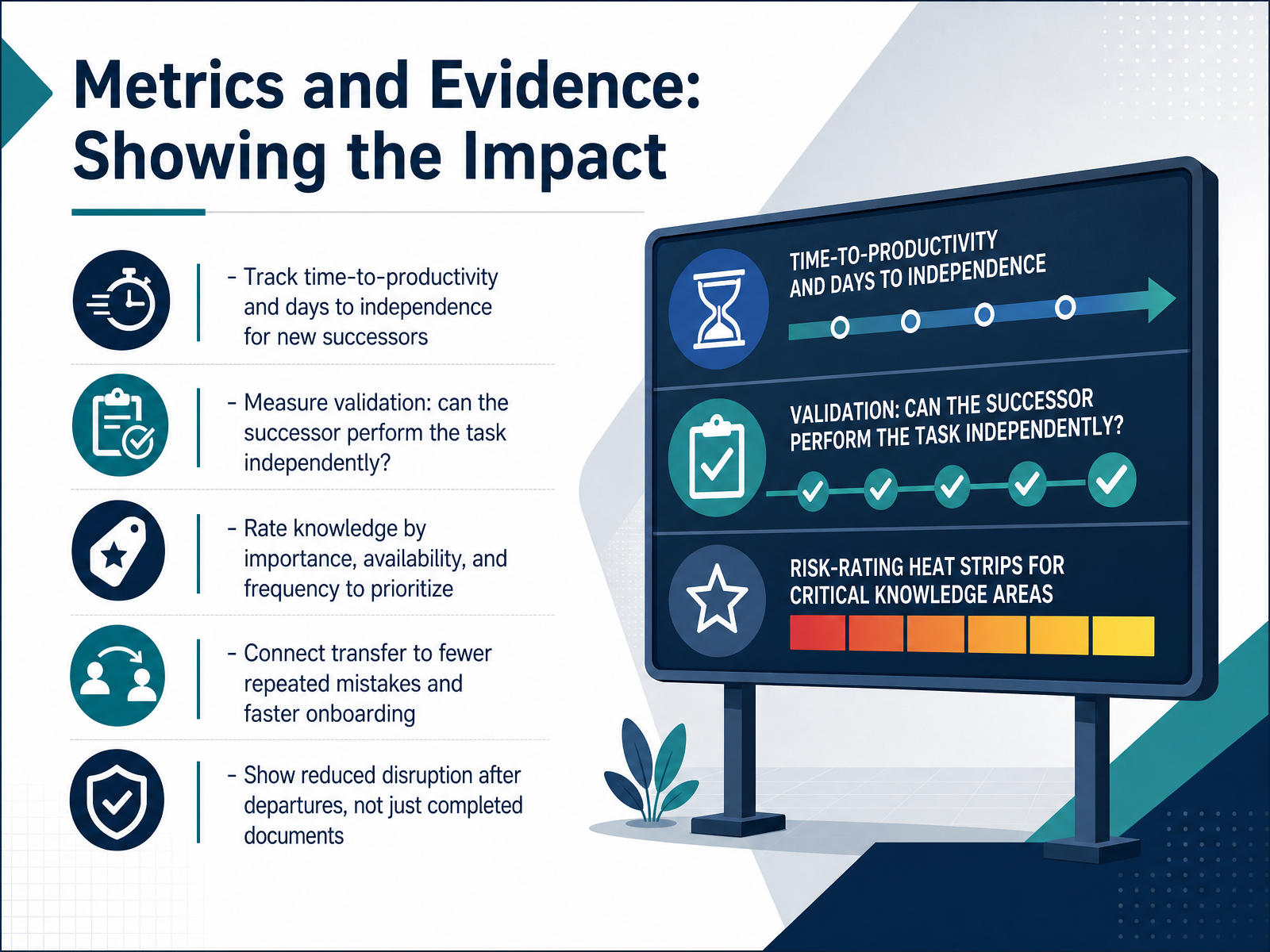
 - 06Metrics and Evidence: Showing the ImpactImpact beats activity. When you measure knowledge transfer, track outcomes that matter to the business. Instead of counting completed templates, watch time-to-productivity and days to independence for a new successor. The key validation question is simple: can that person now perform the task without help? To prioritize what to document, rate each knowledge area by importance, availability, and frequency. This flags the critical few items where losing a single person creates real risk. Connect these metrics to results stakeholders care about. Show fewer repeated mistakes, faster onboarding for backfills, and reduced disruption after departures. That makes the case for investing in transfer before a transition starts. Next, we focus on the manager-led methods that make this happen.
 coassemble.comcarleton.cahr.cornell.edu+22 min
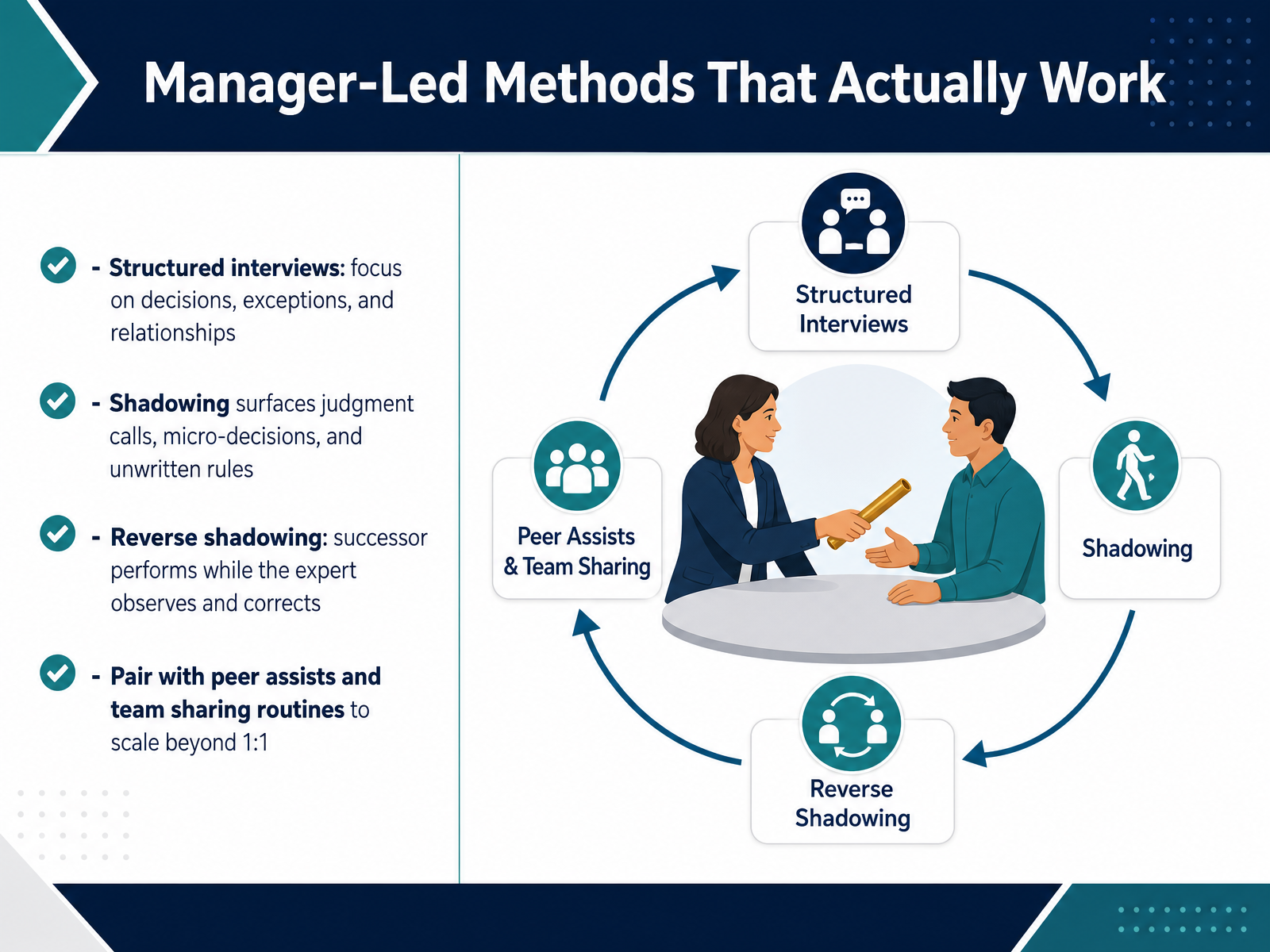
 - 07Manager-Led Methods That Actually WorkNow let's look at the manager-led methods that consistently deliver results. Structured interviews are your first reliable tool. Don't just ask what someone does. Ask about the decisions that matter, the exceptions that break the pattern, and the relationships that make things happen. For example, instead of asking how to run a monthly report, ask what they do when the report fails. That's where the real knowledge lives. Shadowing goes further. It surfaces the judgment calls and micro-decisions that never make it into documentation. You see the unwritten rules in action. Then, reverse the dynamic. Have your successor perform the task while the expert observes and corrects. This tests whether the knowledge actually transferred. To scale beyond one-to-one handoffs, pair these methods with peer assists and regular team sharing routines. That way, critical knowledge becomes a team asset, not a single point of failure. Next, we'll match these methods to the types of knowledge you're actually transferring.
 clickup.comwww2.gov.bc.caks-agents.com+22 min
 - 08Matching Methods to Knowledge TypesThe method you choose has to match the type of knowledge you are trying to move. Start with what is stable and factual. Standard operating procedures, checklists, and step-by-step process docs belong in writing. That is your baseline, and it is easy to search later. But if you are handing off a tool, a dashboard, or a system-heavy workflow, do not stop at a document. Record a live walkthrough so your successor can see exactly where to click, what to check, and what to ignore. Now for the harder layer. Judgment calls, stakeholder relationships, and field work do not transfer through reading. They transfer through shadowing. Pair your successor with the right person for real meetings and real decisions, not just a demo account. Finally, for knowledge that is tacit, complex, or ambiguous, use direct interaction or even short-term personnel movement. A temporary assignment or a structured interview with the person who knows the work beats any written summary. Remember, documentation captures information, but only practice and observation move judgment. Match the method to the knowledge, and your transfer plan becomes a capability plan instead of a filing exercise. Next, let us look at designing a simple knowledge transfer plan.
 clickup.comwww2.gov.bc.caks-agents.com+22 min
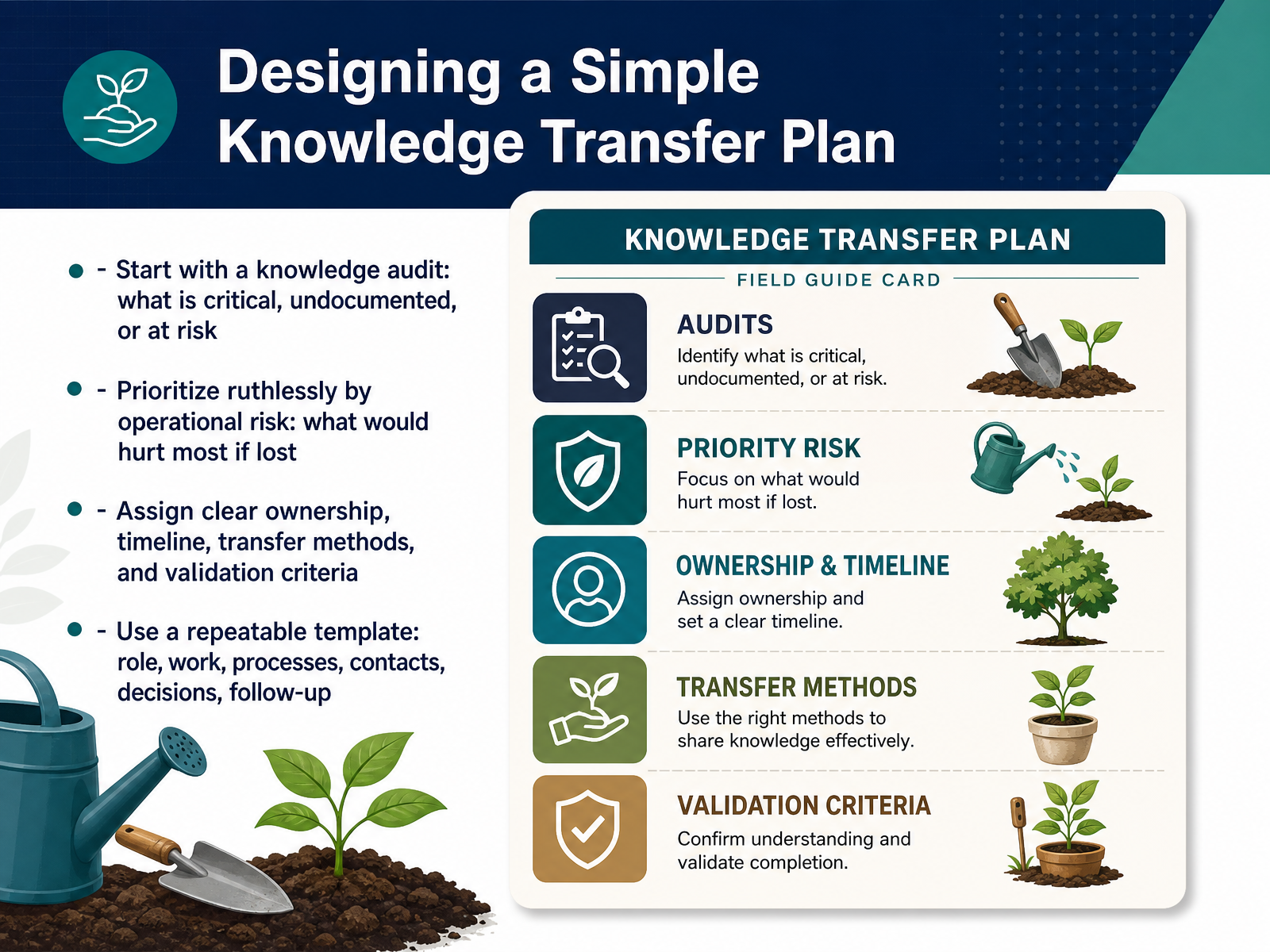
 - 09Designing a Simple Knowledge Transfer PlanLet’s turn all of this into something you can actually run. A knowledge transfer plan doesn’t need to be complex. It needs to be focused. Start with a knowledge audit. Ask one question: what is critical, undocumented, or at risk if this person walked out tomorrow? Don’t try to capture everything. Prioritize ruthlessly by operational risk. Focus on the work that would hurt most if it stopped. Then assign clear ownership, a timeline, transfer methods, and validation criteria. For example, a team lead owns documenting the monthly client reporting process by Thursday, and the successor validates it by running the report live. Finally, use a repeatable template. Cover six areas: role, work, processes, contacts, decisions, and follow-up. This keeps every handover consistent, whether it’s a planned promotion or a sudden departure. Up next, let’s look at the practical checklist and template you can adapt for your own team.
 coassemble.comcarleton.cahr.cornell.edu+21 min
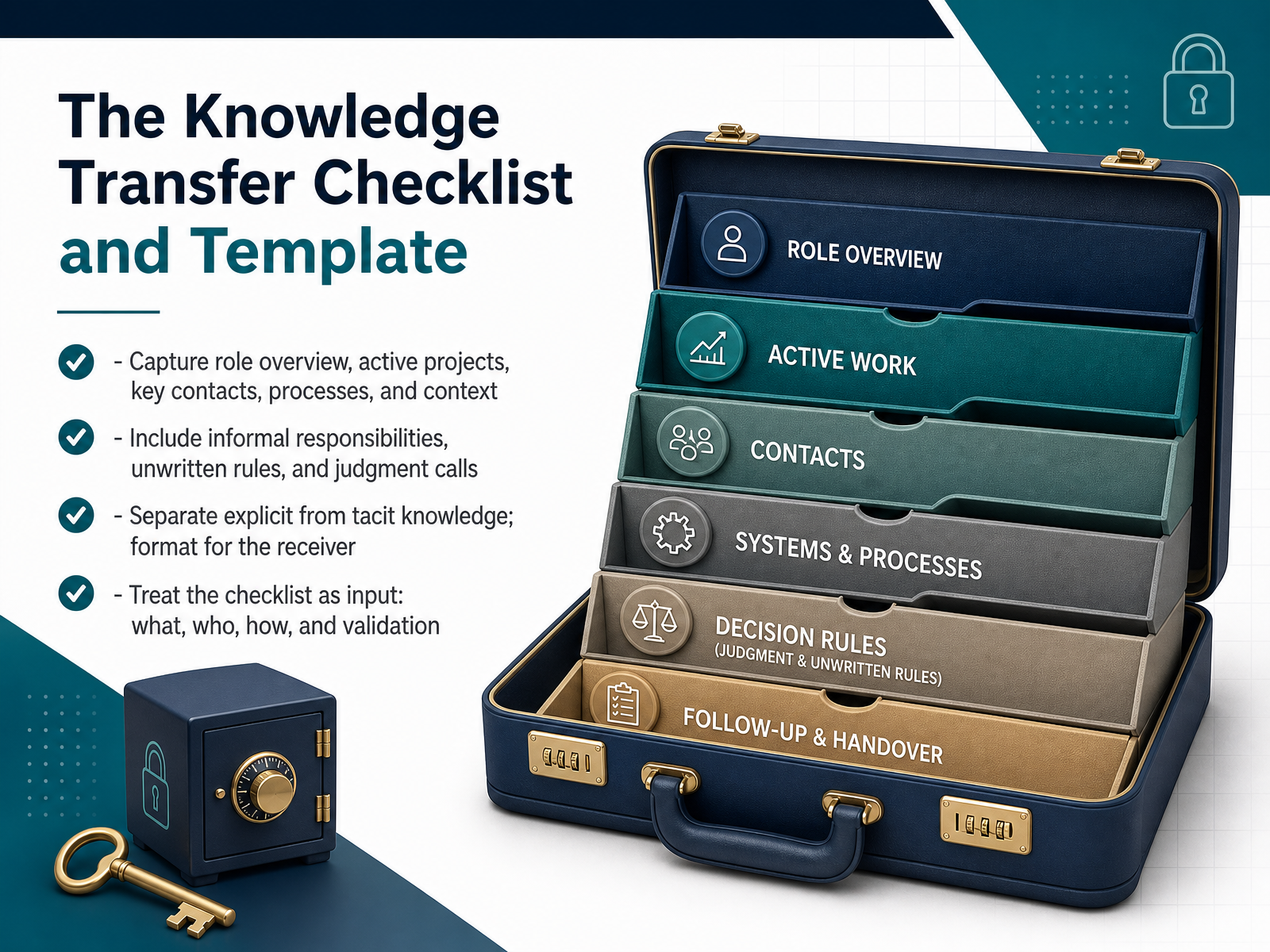
 - 10The Knowledge Transfer Checklist and TemplateLet's ground the process in a practical tool. A knowledge transfer checklist works when it captures five things. The role overview, active projects, key contacts, the core processes, and the context behind decisions. But you need to go beyond the job description. Include the informal responsibilities, the unwritten rules, and the judgment calls that live in someone's head. Separate the explicit steps from the tacit knowledge. A written procedure works for a step. A shadowing session works for a judgment call. Format every piece for the person receiving it. The checklist is not the final plan. It is the input. It tells you what needs to move, who needs to learn it, and how you will validate that it stuck. Use it to drive the handoff, not to replace it. Next, we'll look at how this plays out during onboarding and succession.
 coassemble.comcarleton.cahr.cornell.edu+21 min
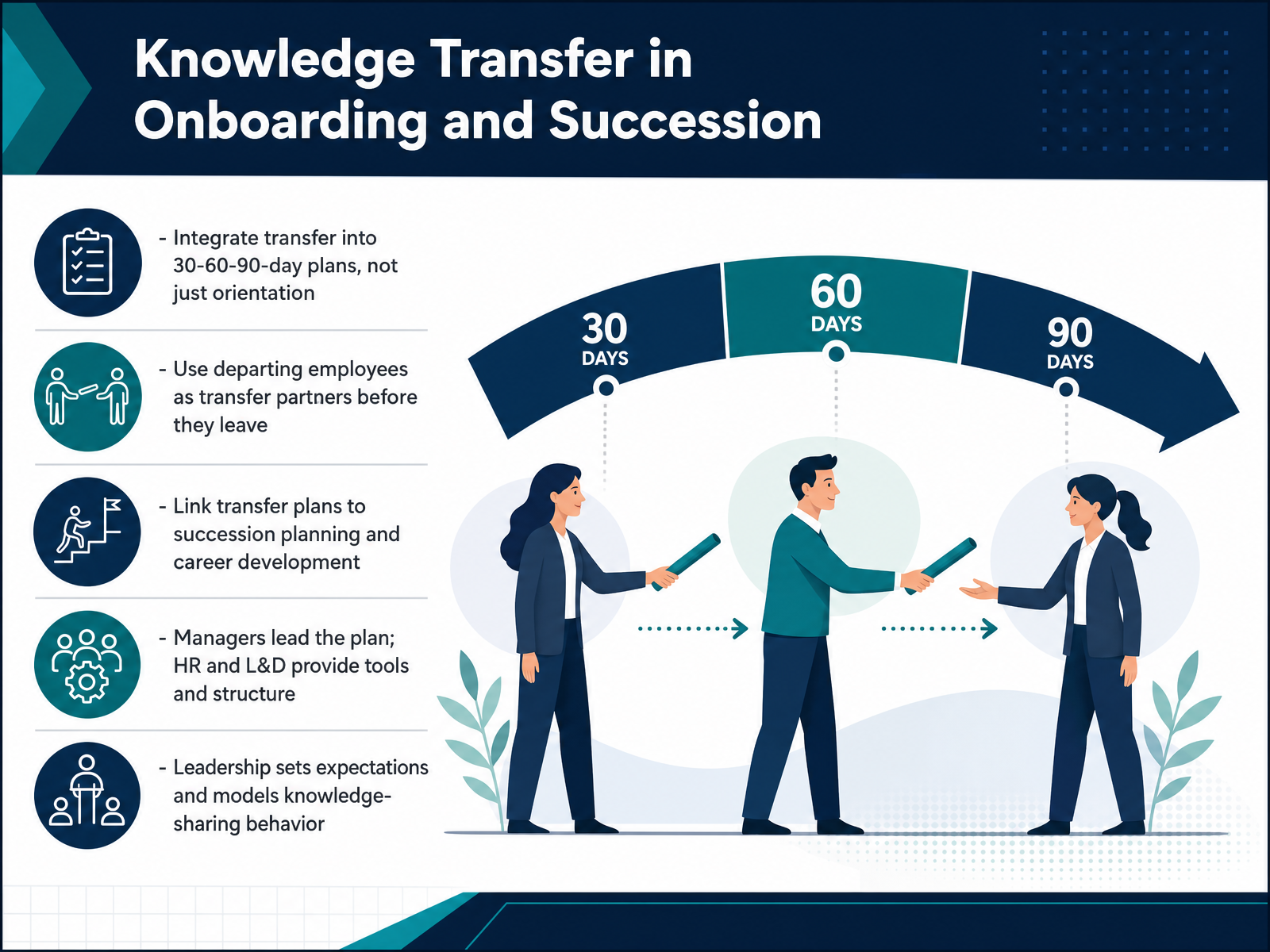
 - 11Knowledge Transfer in Onboarding and SuccessionNow let's talk about where knowledge transfer actually lives in your day-to-day operations. It starts with onboarding. Don't limit transfer to a new hire's first week. Build it into the 30-60-90 day plan. That is how you shorten the time from hire to productivity. Next, use departing employees as transfer partners. Give them structured time to document context and judgment, not just tasks, before they leave. Link this directly to succession planning. A named successor should not inherit a mystery. They should inherit a role-specific handover. Managers, you own this plan. HR and L&D provide the tools, the templates, and the structure. Leadership sets the expectation. When senior leaders model knowledge-sharing, it stops being a checkbox and becomes a habit. Remember, a formal process beats a heroic scramble every single time. Next, let's look at real-world examples and common failure patterns.
 www2.gov.bc.cawww2.gnb.capapers.academic-conferences.org+22 min
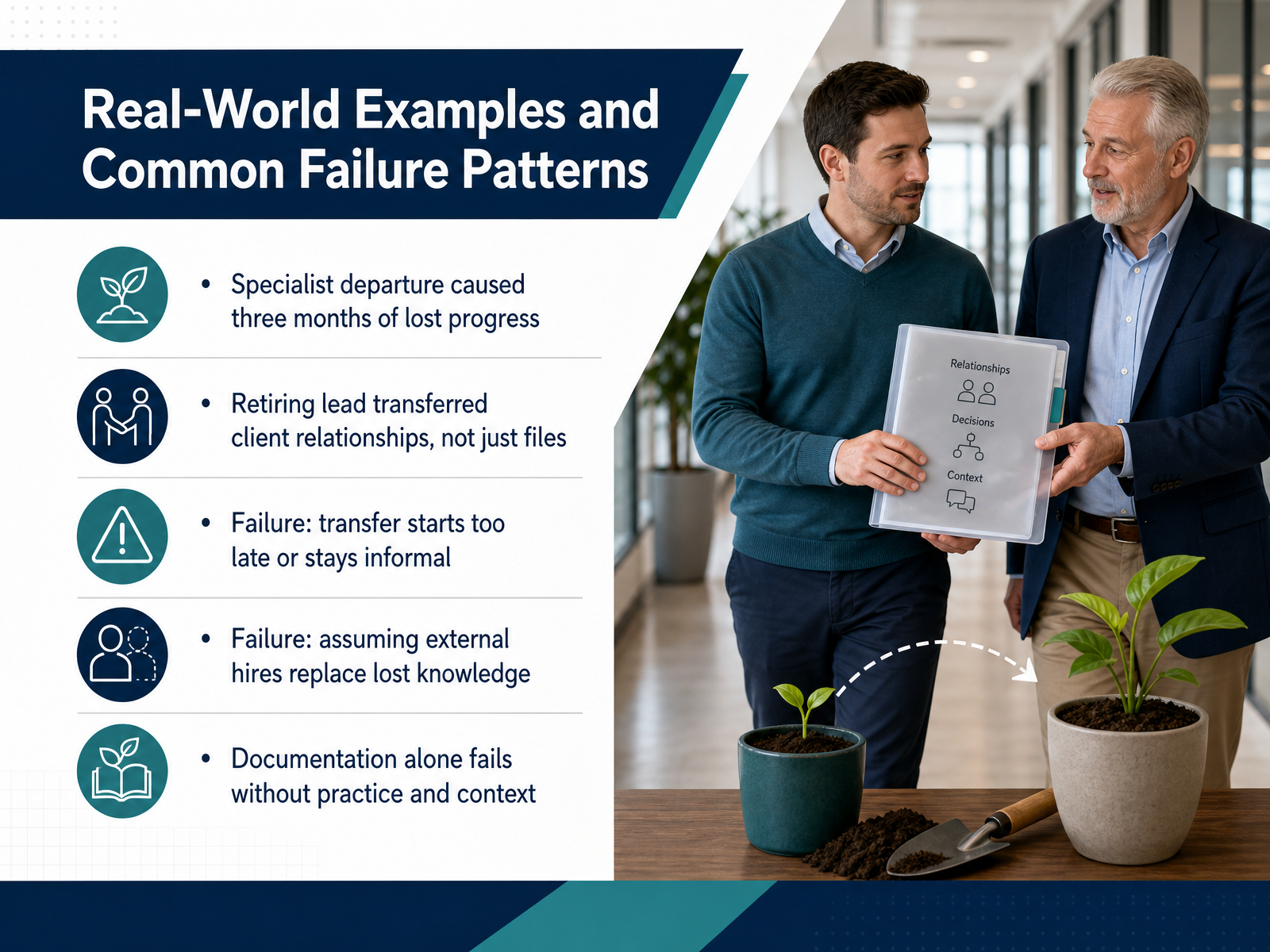
 - 12Real-World Examples and Common Failure PatternsLet's look at what real-world failure and success tell us. When a specialist departs without a handover, the loss is tangible. One organization reported three months of lost progress because a single employee's context walked out the door. That is not an anomaly. It is a planning gap. But here is the positive pattern. A retiring lead once focused their final weeks on transferring client relationships, not just files. That preserved trust and continuity. Now, the common failure patterns are clear. First, transfer starts too late or stays informal, so it dies in hallway conversations. Second, leaders assume an external hire can replace lost knowledge. They can learn the role, but not the relational history or the unwritten reasons behind decisions. Third, documentation alone fails. A binder without context, without practice, without shadowing, is a map drawn from memory. It shows landmarks, but not the turn-by-turn directions. So here is your takeaway: treat knowledge transfer as an active process, not a paperwork task. Look at your team now. Who holds the context you cannot afford to lose? And what would happen if they left next quarter? That question leads directly into our next step: assessing your team's knowledge transfer risk.
 utupub.fisloanreview.mit.edu1 min
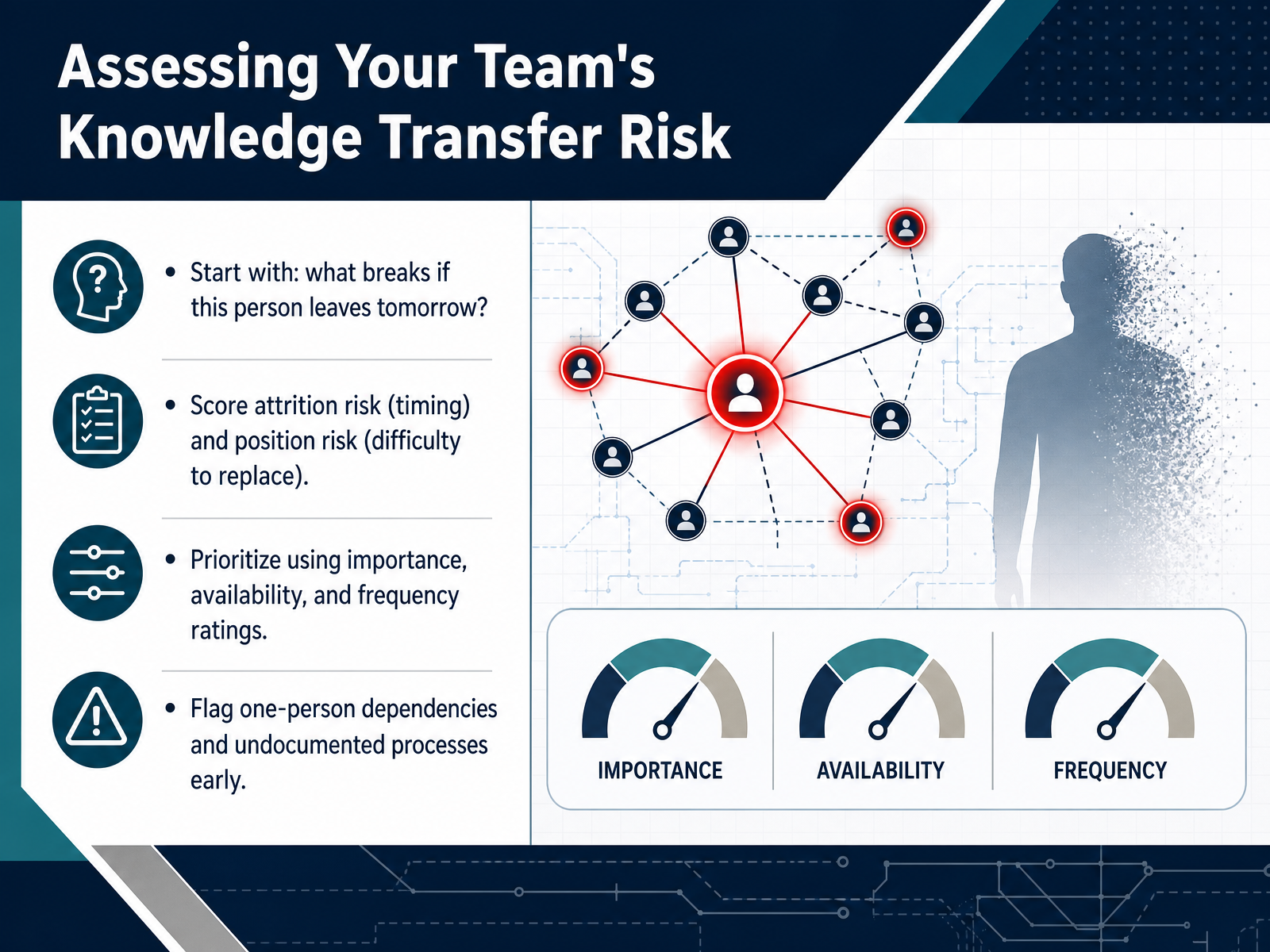
 - 13Assessing Your Team's Knowledge Transfer RiskLet’s turn this into a usable risk picture. Start with a blunt question for each person on your team: what breaks if they leave tomorrow? That answer signals the real value of their knowledge. Then score two things. First, attrition risk: is this person a flight risk now, within a year, or three years out? Second, position risk: how difficult is their role and learned knowledge to replace, especially if nothing is documented? Where both scores are high, that is your priority. Now refine using importance, availability, and frequency. Important means losing it hurts operations. Availability means few others hold it. Frequency means it is used often enough to matter daily or weekly. A payroll admin handling niche compliance checks scores high on all three. A shared meeting note owner may not. Flag one person dependencies and undocumented processes early. If only one manager knows how to backfill weekend scheduling, or a key vendor contact list lives in someone’s head, that is exposure you can act on now. Use this scoring to rank gaps, not to exhaust yourself. Next, we’ll move into roles and ownership across the organization.
 www2.gov.bc.ca2 min
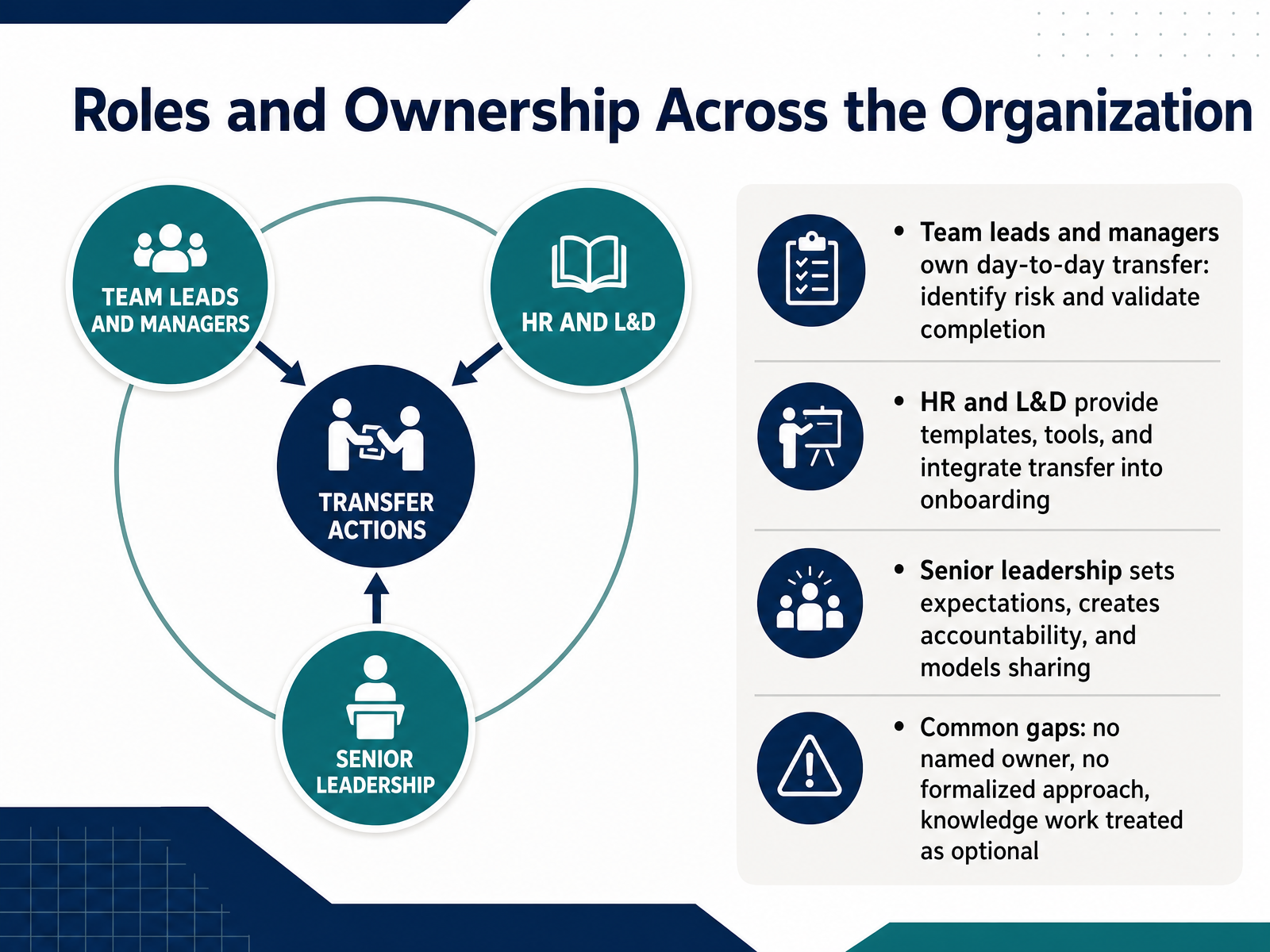
 - 14Roles and Ownership Across the OrganizationSo, let's make this concrete. Who actually owns knowledge transfer? It doesn't work when it's everyone's job in theory and no one's job in practice. Team leads and managers, you own the day-to-day. That means flagging risk early, when someone gives notice or a project shifts, and validating that the transfer actually landed, not just that a handover meeting happened. HR and L and D, your job is to lower the effort. Provide templates, tools, and bake knowledge transfer into onboarding so every new hire starts with context, not silence. Senior leadership, you set the tone. When you hold managers accountable and model sharing openly, you make it clear this isn't optional. The most common failure is treating knowledge work as a nice-to-have until a key person is already walking out the door. Name an owner for every critical transition, and make the approach formal enough to repeat. Real ownership is the difference between a plan that works and a scramble that doesn't. Next, let's turn ownership into motion with a concrete thirty-day action plan.
 www2.gov.bc.cawww2.gnb.capapers.academic-conferences.org+21 min
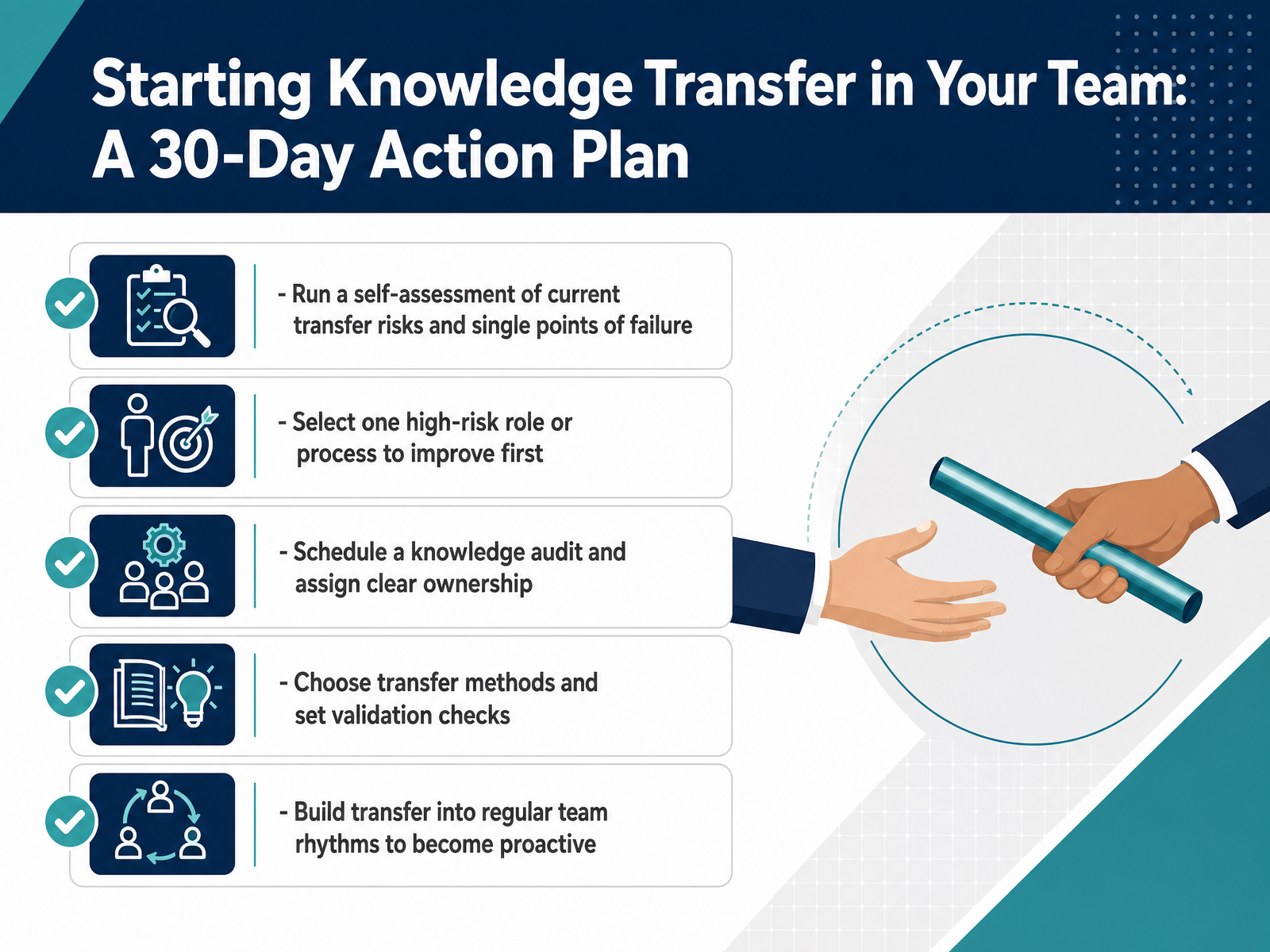
 - 15Starting Knowledge Transfer in Your Team: A 30-Day Action PlanLet's turn this into action. Over the next thirty days, make knowledge transfer part of your regular team rhythm. Start by running a self-assessment of your current transfer risks and single points of failure, then choose one high-risk role or process to improve first. Schedule a knowledge audit, assign a clear owner, and select the transfer methods and validation checks that fit the work. Finally, build the transfer into your recurring team cadence so you become proactive, not reactive. You now have a practical framework to protect continuity, strengthen your team, and move knowledge forward with confidence. Thank you for your time.
 coassemble.comcarleton.cahr.cornell.edu+21 min
Take the deck with you
Download this course as a file — free, no sign-up needed.
- PDF handoutEvery slide page, ready to print or share.16 pages · 4.1 MBDownload
- Narrated PowerPointThe deck that presents itself — every slide carries the digital human's narration video.16 pages · 15.0 MBDownload
- PowerPoint slidesThe full deck as a .pptx — open it in PowerPoint, Keynote, or Google Slides.16 pages · 4.0 MBDownload
Free to use in your own training — please keep the PersonWise credit page at the end.
Have your own deck? Turn it into a course
Sources consulted
Web sources consulted while building this course.
- Strategies for Preventing a Knowledge-Loss Crisis — sloanreview.mit.edu
- Measuring the impact of knowledge loss: a longitudinal study — emerald.com
- Quantifying and mitigating turnover-induced knowledge loss: case studies of chrome and a project at avaya — dl.acm.org
- wk.rr.lostknowledge.3.changes — smartworkforcestrategies.com
- Knowledge loss induced by organizational member turnover: — diva-portal.org
- How to build a knowledge transfer checklist that actually works — coassemble.com
- Knowledge Capture and Transfer Template — carleton.ca
- Knowledge Transfer | Working at Cornell — hr.cornell.edu
- Knowledge Transfer Plan Template For Handovers - The Workhint Blog — blog.workhint.com
- Knowledge Transfer Plan: What It Is and How to Build One — talentlms.com
- Knowledge Transfer Guide — www2.gov.bc.ca
- Succession Planning - GNB Knowledge Transfer Guide — www2.gnb.ca
- A Systematic Literature Review on Intergenerational Tacit Knowledge Transfer: A KPI Perspective | European Conference on Knowledge Management — papers.academic-conferences.org
- Onboarding and Knowledge Transfer — trainingindustry.com
- Relationships Between Generational Handover Protocols, Knowledge Transfer Behavior, and Key Organizational Outcomes — mdpi.com
- Knowledge Transfer: Methods, Common Failures, and How to Plan — clickup.com
- Knowledge Transfer Template: 7 Steps (2026) — ks-agents.com
- Knowledge Transfer Within Organizations: Mechanisms, Motivation, and Consideration | Annual Reviews — annualreviews.org
- Procedures for transferring organizational knowledge during ... — pmc.ncbi.nlm.nih.gov
- Why knowledge transfer fails? A failure story about timing and other factors — utupub.fi