Begin
14 pages · ~28 min
Clear Work Emails for English Learners
This training helps English learners write clear, professional work emails, focusing on structure, tone, and word choice to communicate effectively with colleagues and clients.
A digital instructor presents all 14 pages. Hold “Ask” at any point and ask out loud — the answer comes from this course. No sign-up needed.
What you’ll learn
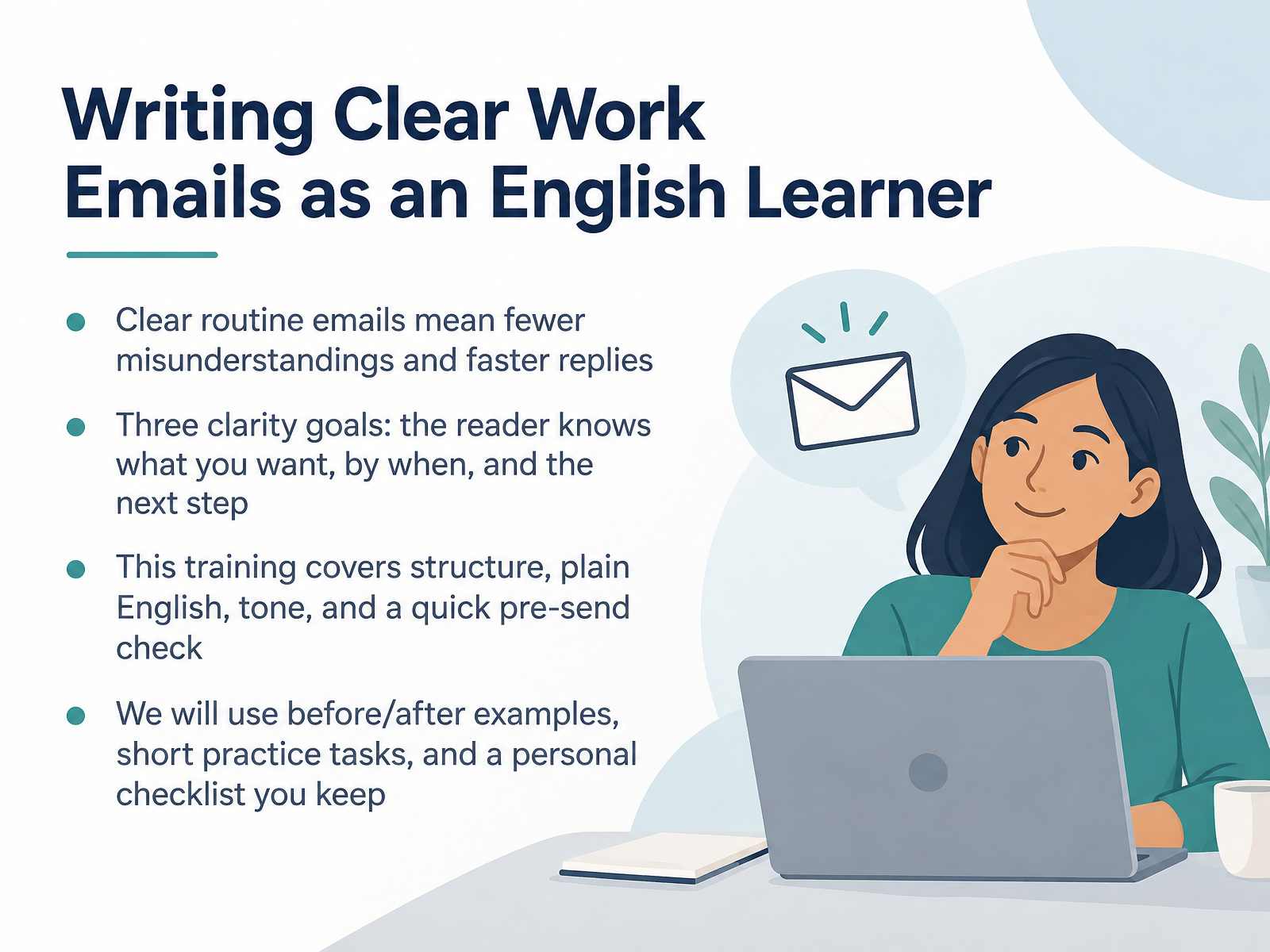
- 01Writing Clear Work Emails as an English LearnerWelcome. This training is about writing clear work emails in English. You already write routine emails every day, so our goal is simple. We'll make your messages easier to understand on the first read. When your emails are clear, you get fewer misunderstandings and faster replies. Throughout, we'll aim for three clarity goals. The reader knows what you want, by when, and what the next step is. First, we'll look at structure, then plain English and tone, and we'll finish with a quick pre-send check. We'll use before and after examples, short practice tasks, and a personal checklist you can keep and reuse. Here's one small step for today. Open your last sent email, and ask: does the first line say what I need? Let's start with where routine emails often go wrong.englishonline.britishcouncil.orgbbc.co.ukethesisarchive.library.tu.ac.th+21 min
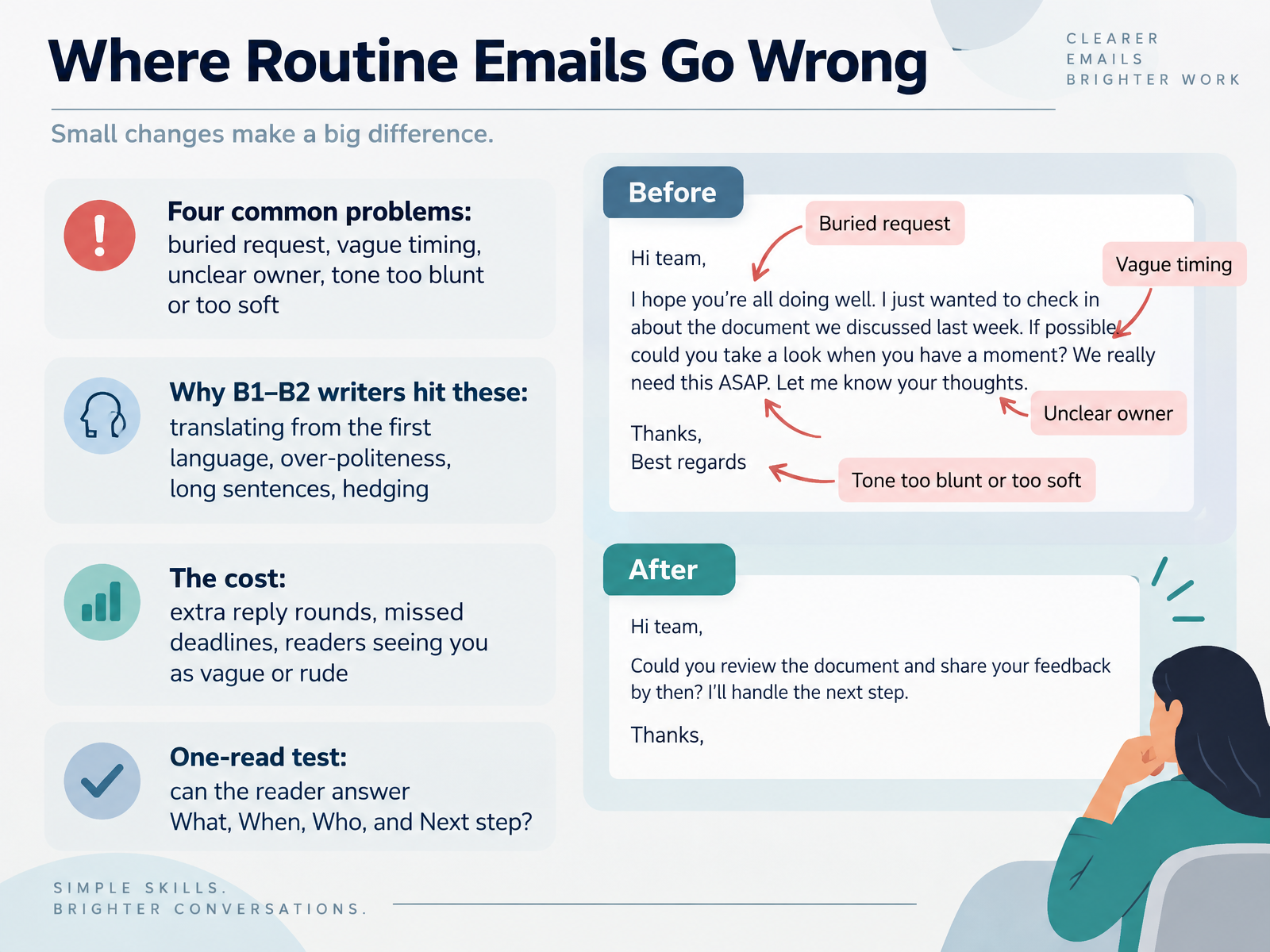
- 02Where Routine Emails Go WrongLet's look at where routine emails usually go wrong. Four problems come up again and again: a buried request, vague timing, an unclear owner, and tone that lands too blunt or too soft. Here's why you hit these. You translate from your first language, you add extra politeness, you write long sentences, and you hedge, meaning you soften your point until it disappears. The cost is real: extra reply rounds, missed deadlines, and readers who see you as vague or rude. Try this one-read test. After you write, can the reader answer four things: What do you need, When, Who does it, and what is the next step? Apply it to your next email today. Next, we'll look at the four-part skeleton of a clear email.
 englishonline.britishcouncil.orgbbc.co.ukethesisarchive.library.tu.ac.th+21 min
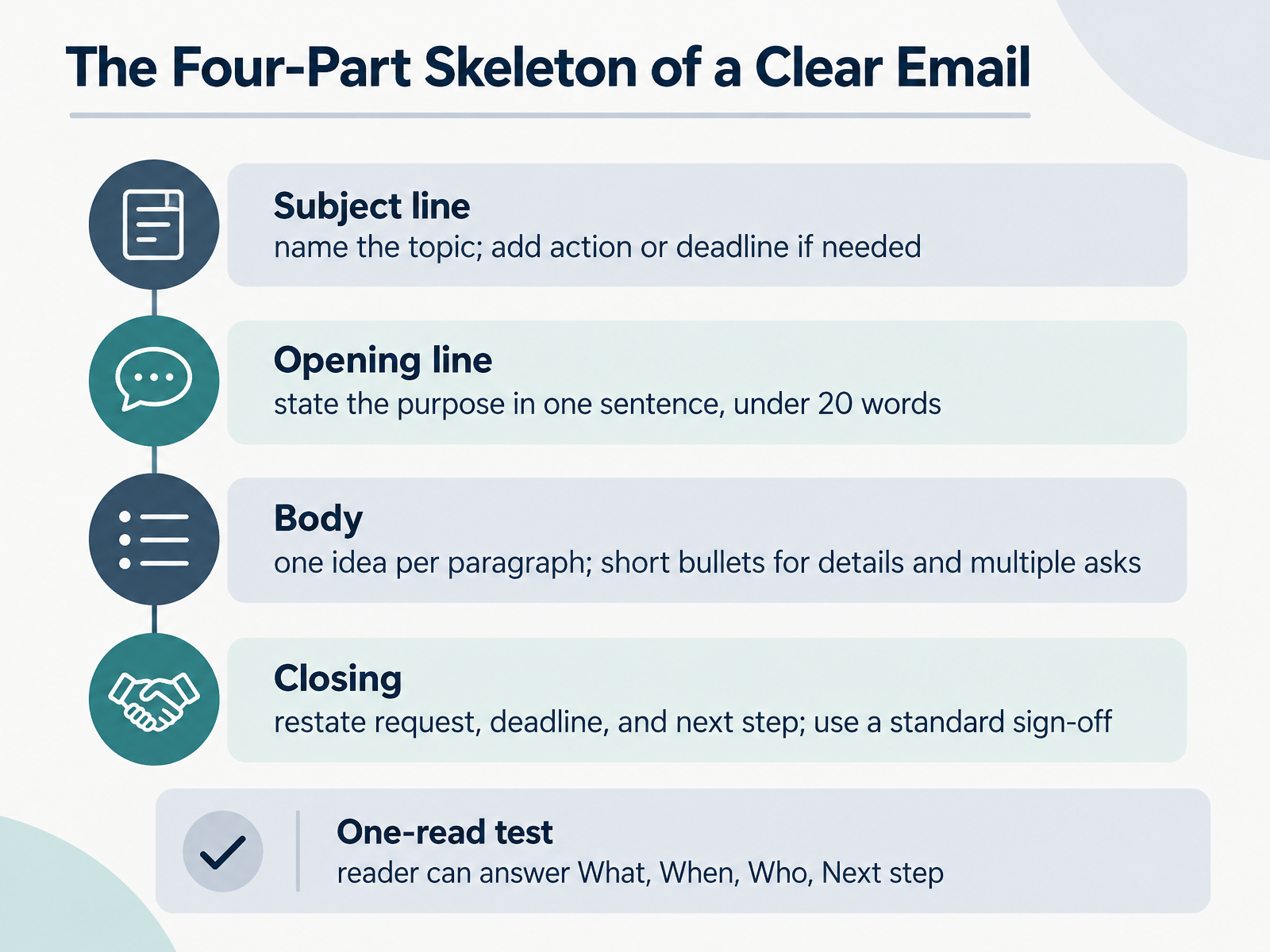
- 03The Four-Part Skeleton of a Clear EmailLet's look at the structure behind a clear email. Think of it as a four-part skeleton. First, the subject line. Name the topic, and add the action or deadline if needed. For example, Budget report due Friday. Second, the opening line. State your purpose in one sentence, under twenty words. Here's why. Your reader knows the point right away. Third, the body. Keep one idea per paragraph, and use short bullets for details and multiple asks. Fourth, the closing. Restate the request, the deadline, and the next step, then use a standard sign-off. Finally, run the one-read test. Can your reader answer four questions after reading once? What, When, Who, and Next step. Try this on your next email. Write your subject line and opening sentence first, then check the one-read test before you send. Next, we'll focus on subject lines that get opened and found again.
 2 min
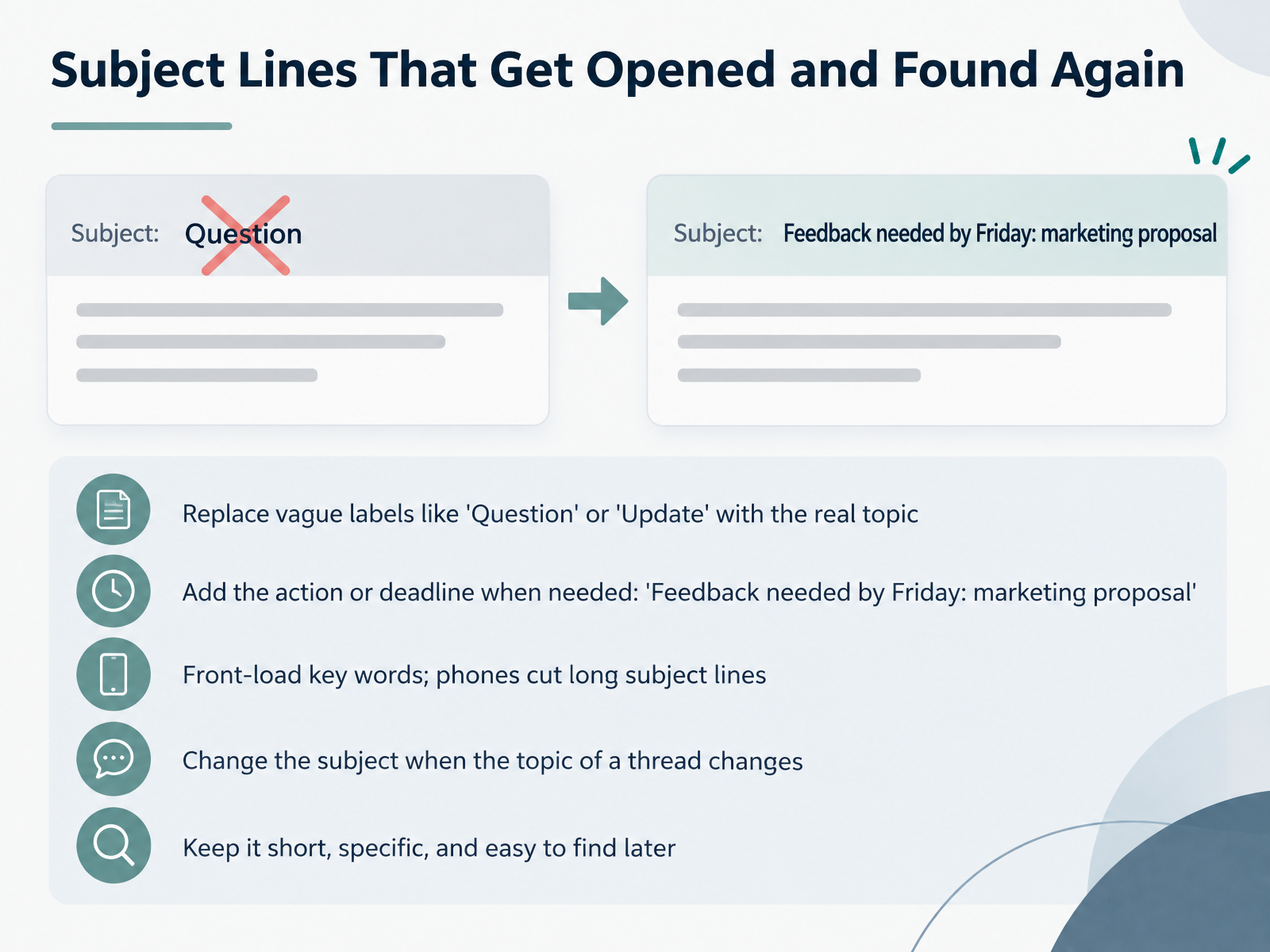
- 04Subject Lines That Get Opened and Found AgainNow let's look at subject lines. A clear subject line helps people open your email and find it again later. First, replace vague labels like Question or Update with the real topic. For example, Invoice question for March is much clearer. Second, add the action or deadline when it matters. Try this: Feedback needed by Friday, marketing proposal. Third, front-load (put first) the key words. Phones cut long subject lines, so lead with what matters most. Fourth, when a thread changes to a new topic, change the subject line too. Keep it short, specific, and easy to search for later. Here's your next step. Before you send your next email, rewrite the subject line so a busy colleague knows the topic and the action in one quick look. Next, we'll focus on plain English: short sentences and active voice.
 2 min
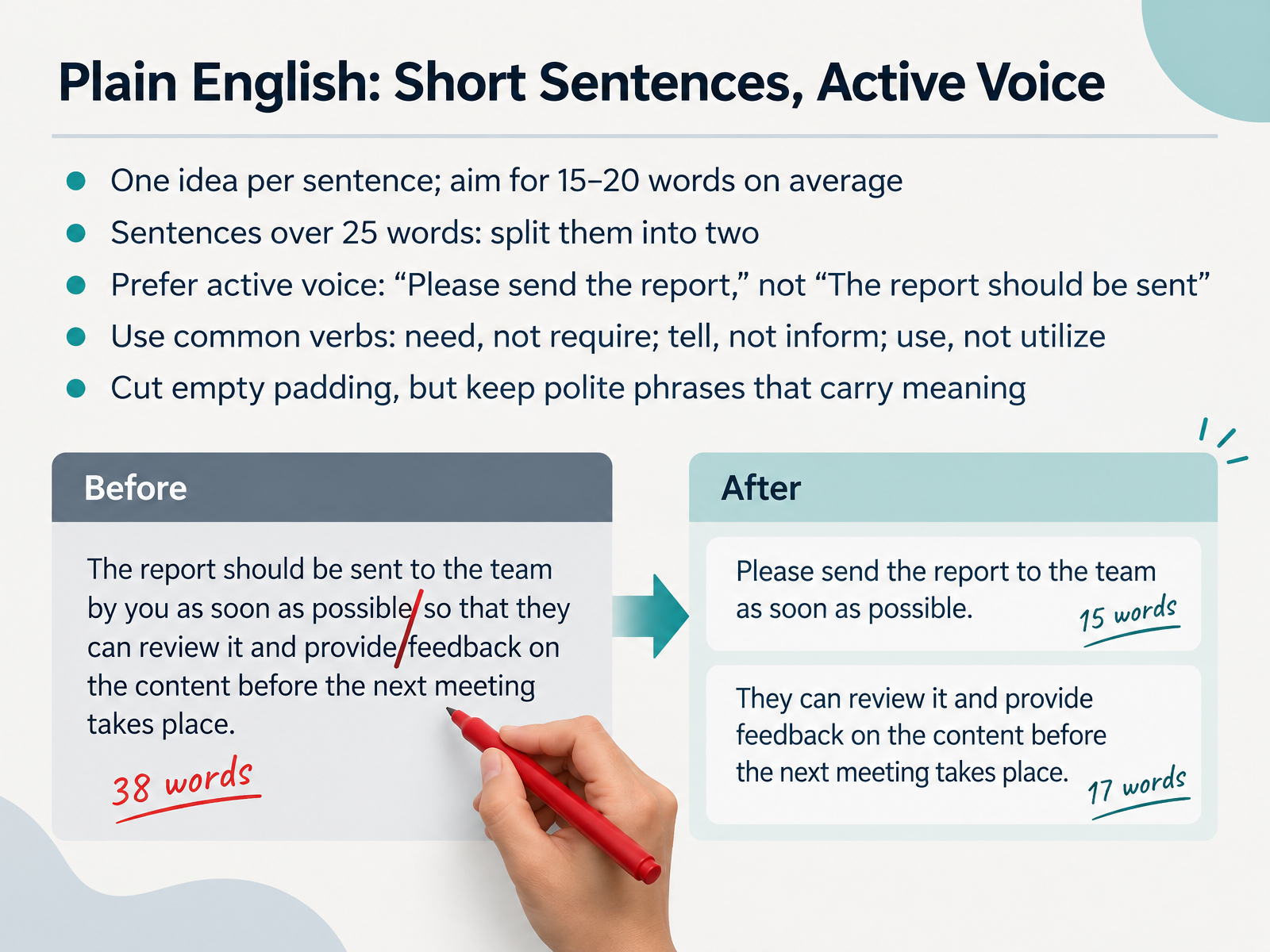
- 05Plain English: Short Sentences, Active VoiceLet's look at plain English: short sentences, active voice. Here's the first rule. Keep to one idea per sentence, and aim for around fifteen to twenty words on average. If a sentence passes twenty five words, split it into two. Next, prefer the active voice. Write, please send the report, not, the report should be sent. Active voice makes it clear who does what. Then choose common verbs. Say need, not require. Tell, not inform. Use, not utilize. Finally, cut empty padding like very or actually. But keep polite phrases that carry meaning, like please or thank you. Try this today. Open your next email, find the longest sentence, and split it in two before you send it. Coming up next, vocabulary that travels: words, phrases, and acronyms.
 kent.ac.ukdigital.govsouthwark.gov.uk+21 min
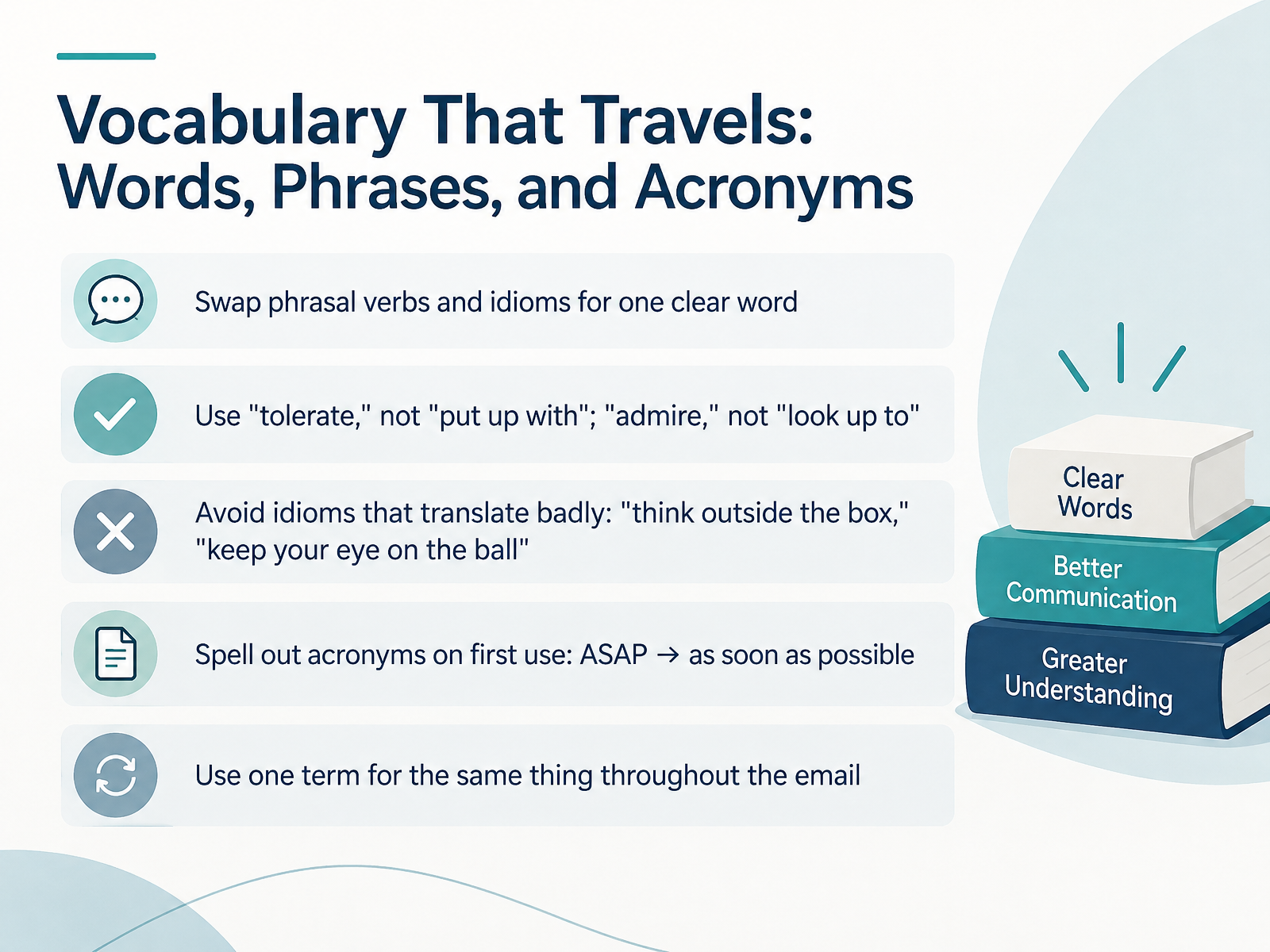
- 06Vocabulary That Travels: Words, Phrases, and AcronymsNow let's look at vocabulary that travels well. First, swap phrasal verbs and idioms for one clear word. Write tolerate, not put up with. Write admire, not look up to. Here's why. A reader may know each word but miss the meaning when translated. Second, avoid idioms that translate badly, like think outside the box, or keep your eye on the ball. Say the real action instead. Third, spell out acronyms on first use. Write ASAP as as soon as possible. Finally, use one term for the same thing throughout the email. If you say invoice, keep saying invoice, not bill. Try this today. Before you send your next email, pick one phrase and replace it with a single clear word. Next, we'll look at tone. Polite, direct, and professional.
 englishonline.britishcouncil.orgbbc.co.ukethesisarchive.library.tu.ac.th+22 min
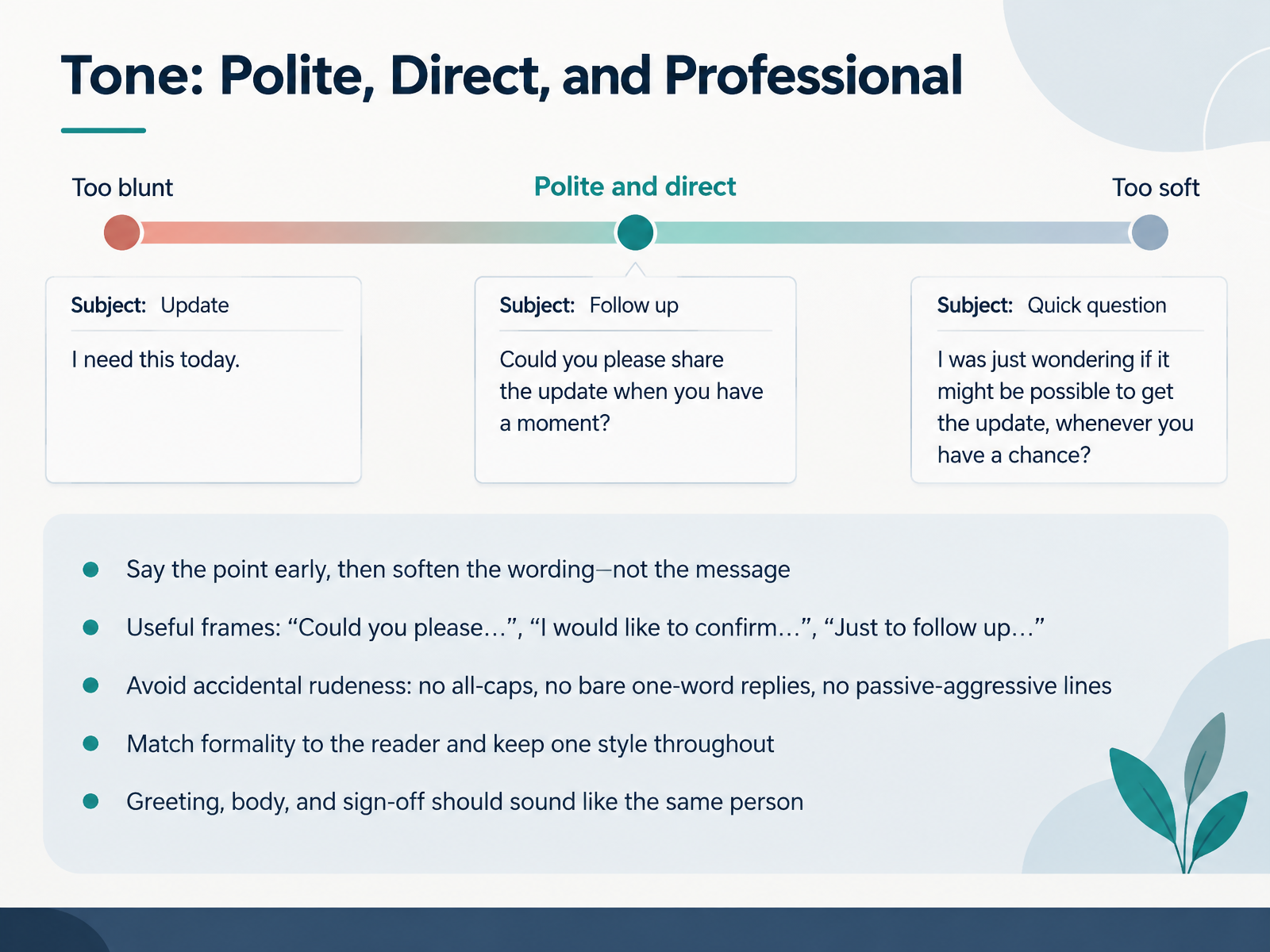
- 07Tone: Polite, Direct, and ProfessionalNow let's talk about tone. You want to sound polite, direct, and professional at the same time. Here is the key idea. Say your point early, then soften the wording, not the message. For example, instead of a bare command like send me the report, write, could you please send me the report by Thursday. The request stays clear, but it sounds respectful. A few frames help. Could you please. I would like to confirm. Just to follow up. Try this. Avoid accidental rudeness. No all-caps, no one-word replies, and no passive-aggressive lines. Also match the formality to your reader, and keep one style from greeting to sign-off, so the whole email sounds like the same person. Your next step: open your next email and check the first sentence. Is the point early and the wording polite? Then read the greeting and closing together, and make sure they match in tone.
 writingcenter.unc.eduuwaterloo.cacelpip.oathly.ca+22 min
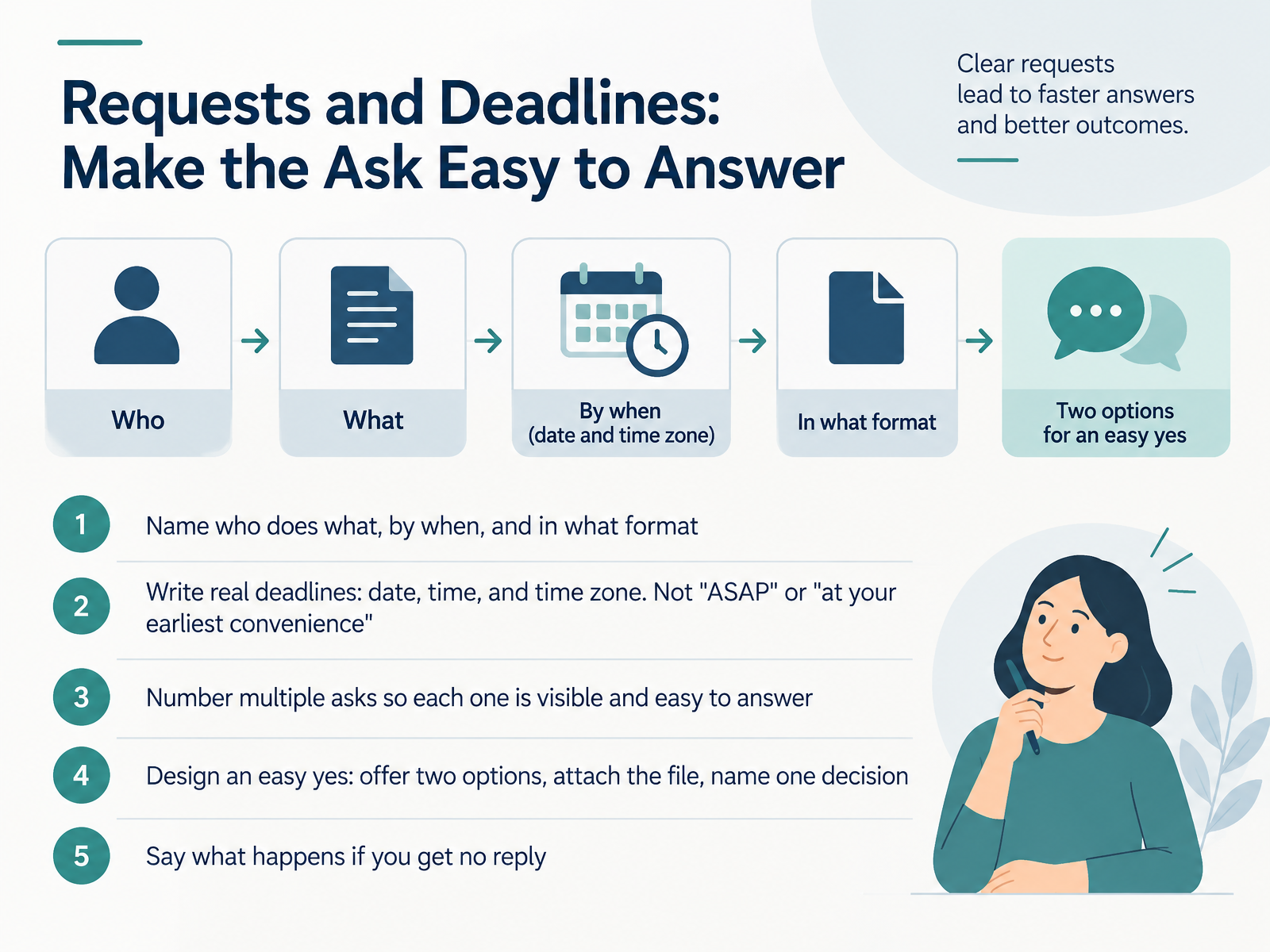
- 08Requests and Deadlines: Make the Ask Easy to AnswerNow let's look at requests and deadlines. Your goal here is simple. Make your ask easy to answer. First, name who does what, by when, and in what format. For example, ask Sam to send the budget as a spreadsheet by Thursday. Second, write real deadlines. Give a date, a time, and a time zone. Avoid ASAP or at your earliest convenience. Instead, say, by Wednesday, May twenty-seventh, at three p.m. your time. Third, if you have several asks, number them, so each one is visible and easy to reply to. Fourth, design an easy yes. Offer two options, attach the file, and name one clear decision. Finally, say what happens if you get no reply. For example, if I don't hear back by Friday, I'll go with option B. Try this on your next email today. Rewrite one request with a real deadline, and add one line about what happens if you hear nothing. Next, we'll look at follow-ups and reminders without sounding pushy.
 grammarly.comvengreso.commitcommlab.mit.edu+21 min
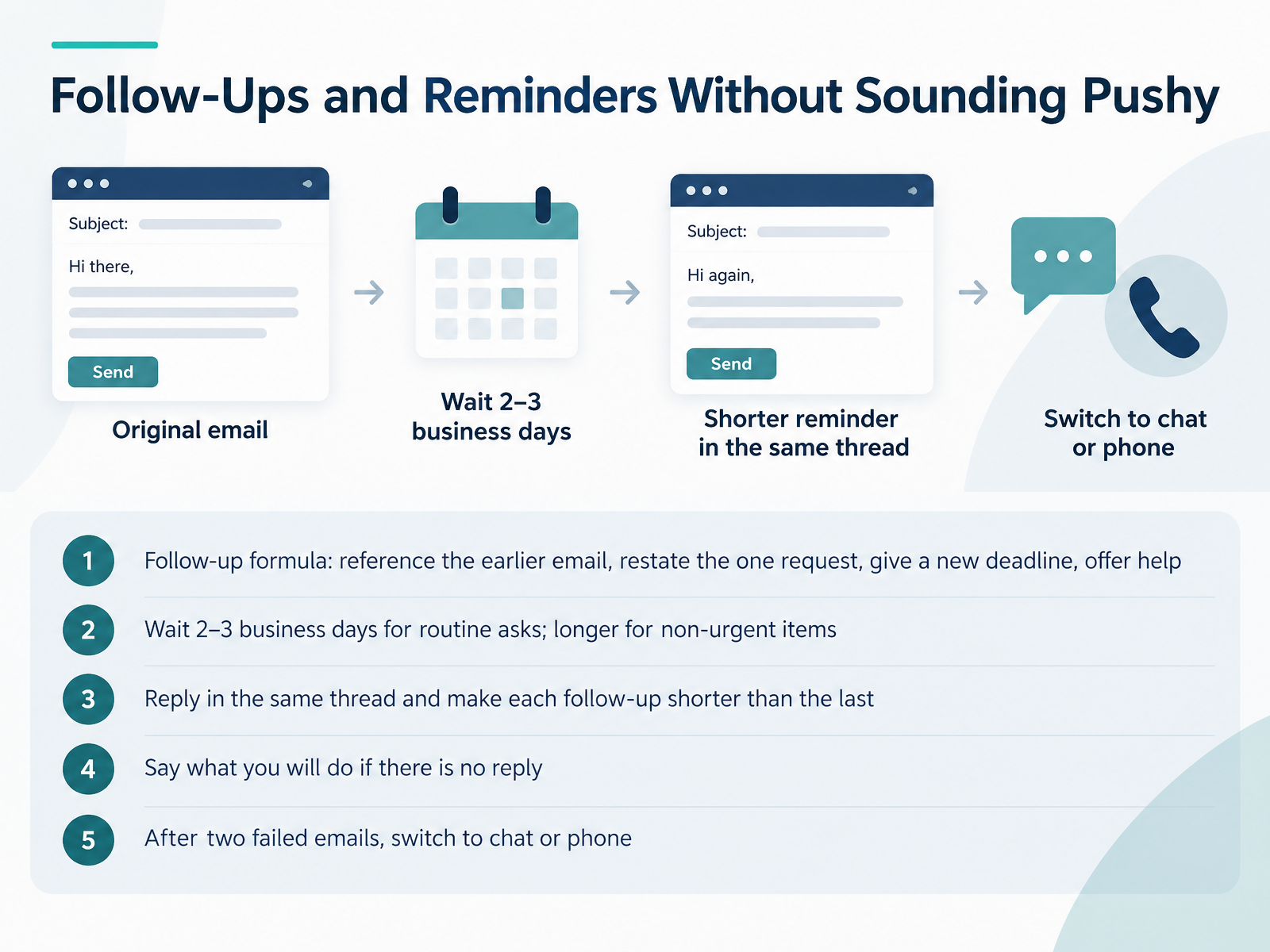
- 09Follow-Ups and Reminders Without Sounding PushyNext, let's look at follow-ups and reminders. Following up is normal at work. The key is to be clear, not pushy. Here is a simple formula. Reference the earlier email. Restate the one request. Give a new deadline. And offer help. For example: I am following up on my Monday email about the budget form. Could you confirm by Thursday? If it is easier, I can send the form again. For routine asks, wait two to three business days. For non-urgent items, wait longer. Always reply in the same thread, and make each follow-up shorter than the last. Also say what you will do if there is no reply. For example: If I do not hear back by Friday, I will move ahead with option B. After two emails with no answer, switch to chat or phone. Try this today. Open your last unanswered email and write one short follow-up using the formula. That leads us to the next step. A Five-Minute Check Before You Send.
 grammarly.comvengreso.commitcommlab.mit.edu+22 min
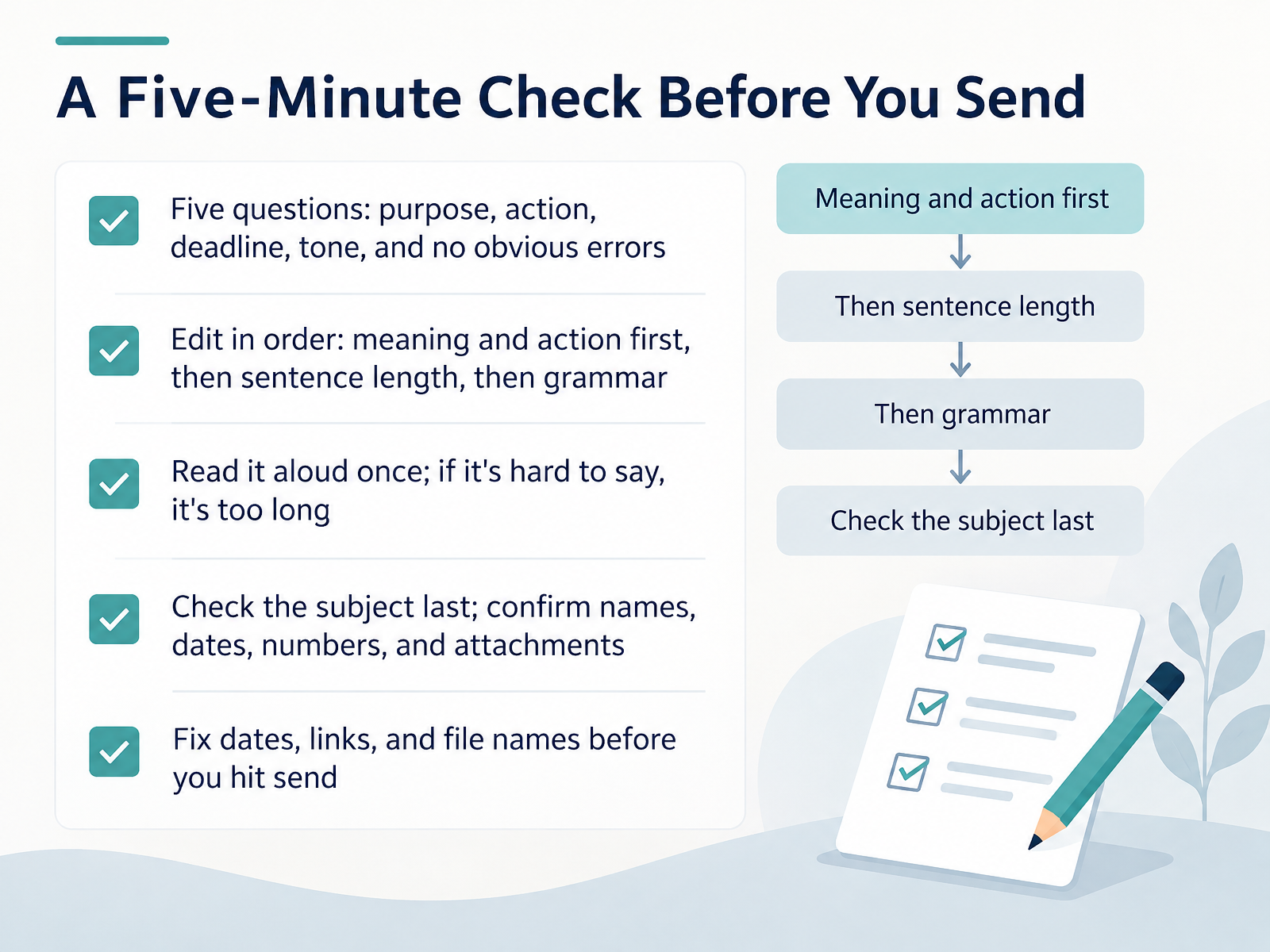
- 10A Five-Minute Check Before You SendNow, before you send any work email, give it a five-minute check. Ask yourself five questions: What is the purpose? What action do I want? What is the deadline? Is the tone right? And are there any obvious errors? Edit in order. First check meaning and action. Then shorten long sentences. Then fix grammar. Next, read the email aloud once. If it is hard to say, it is too long. Finally, check the subject line last. Confirm names, dates, numbers, and attachments. Fix dates, links, and file names before you hit send. Try this today: run these five questions on your next email before you send it. Next, we will look at small fixes that protect clarity.
 1 min
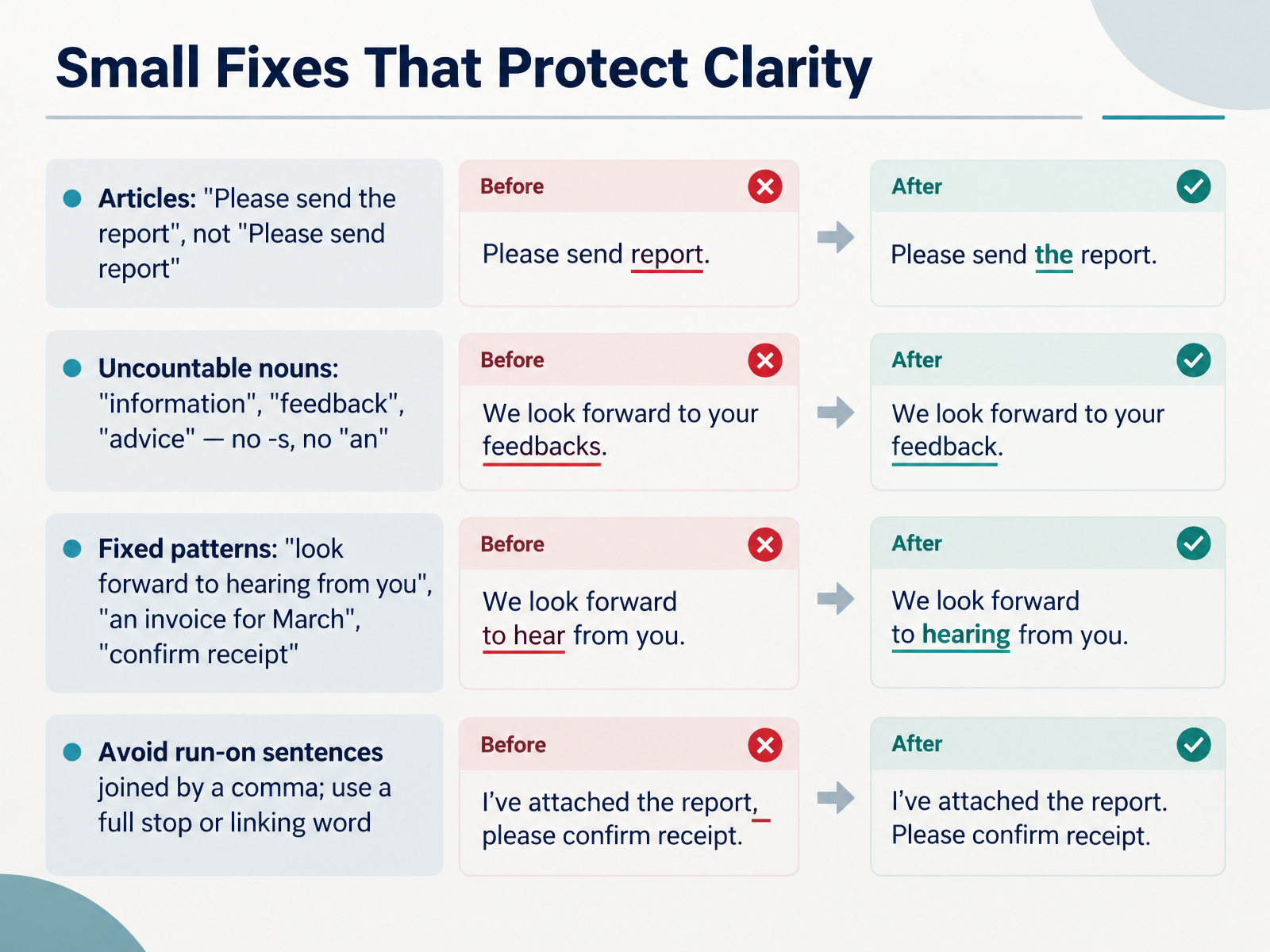
- 11Small Fixes That Protect ClarityNow let's look at small fixes that protect clarity. First, articles. Write, please send the report, not please send report. Singular nouns usually need a or the. Second, uncountable nouns. Information, feedback, and advice have no s, and no an. Say, please send me the information. Third, fixed patterns. These are set phrases you can trust: I look forward to hearing from you, an invoice for March, and could you confirm receipt. Fourth, avoid run-on sentences joined by a comma. The call is at three, please join on time, is better as two sentences, or with so or and. Try this today: before you send your next email, read it once and fix just these four points. Next, we'll look at reusable templates for routine emails.
 2 min
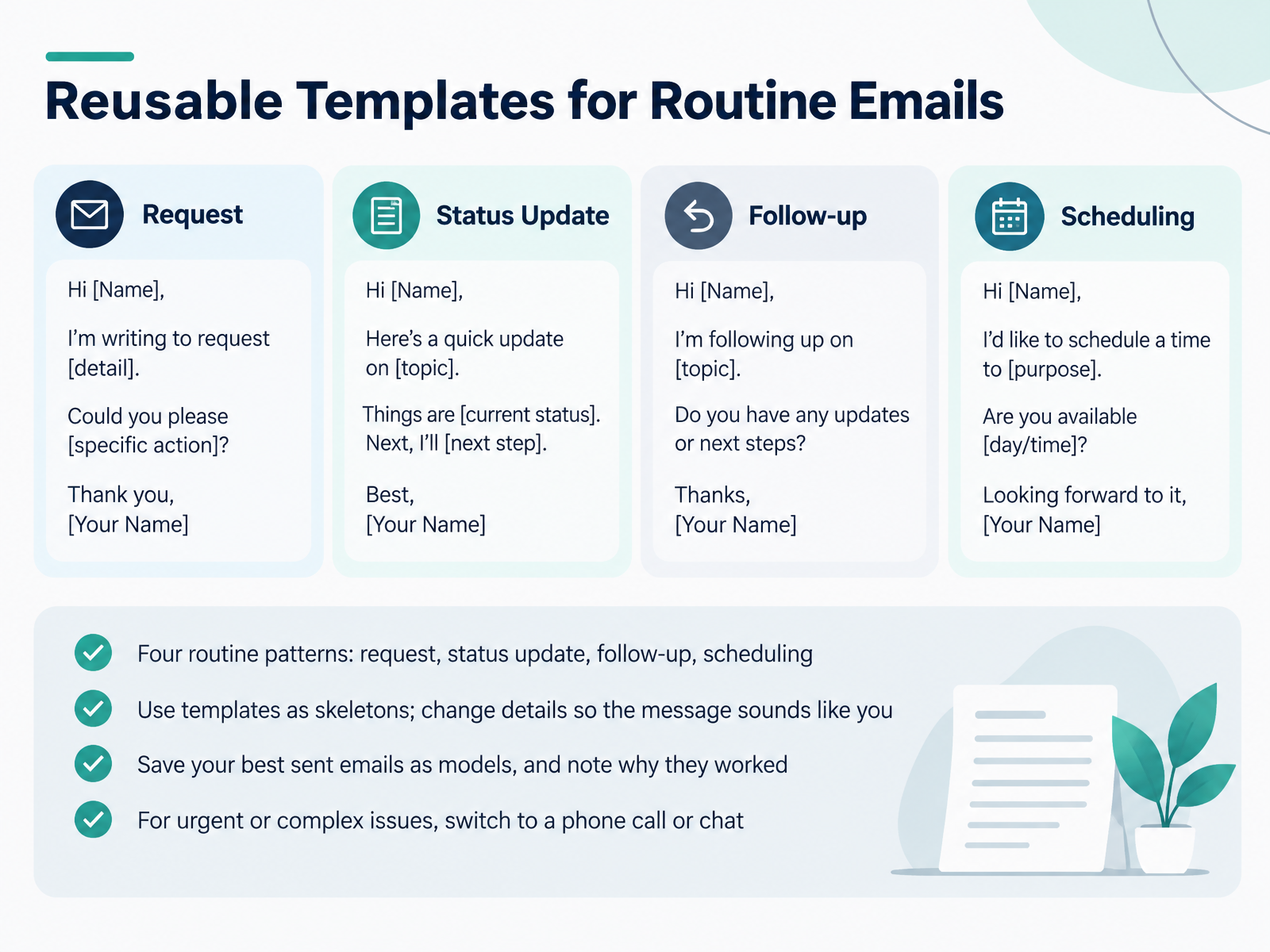
- 12Reusable Templates for Routine EmailsNow let's look at templates you can reuse. Templates work best for four routine patterns: a request, a status update, a follow-up, and scheduling a meeting. Think of a template as a skeleton. Change the names, dates, and details so the message still sounds like you. For example, instead of copying a formal request word for word, adjust the greeting and the deadline to fit the person. Here's another tip. Save a few of your best sent emails as models, and note why they worked. Maybe the request was clear, or the tone was friendly. Then, use them as a starting point. One caution. For urgent or complex issues, switch to a phone call or chat. Email can be too slow or unclear for those. Try this today. Pick one routine email you send often, and turn it into your own reusable skeleton before you log off. Next, we'll practice with a messy email and rewrite it together.
 1 min
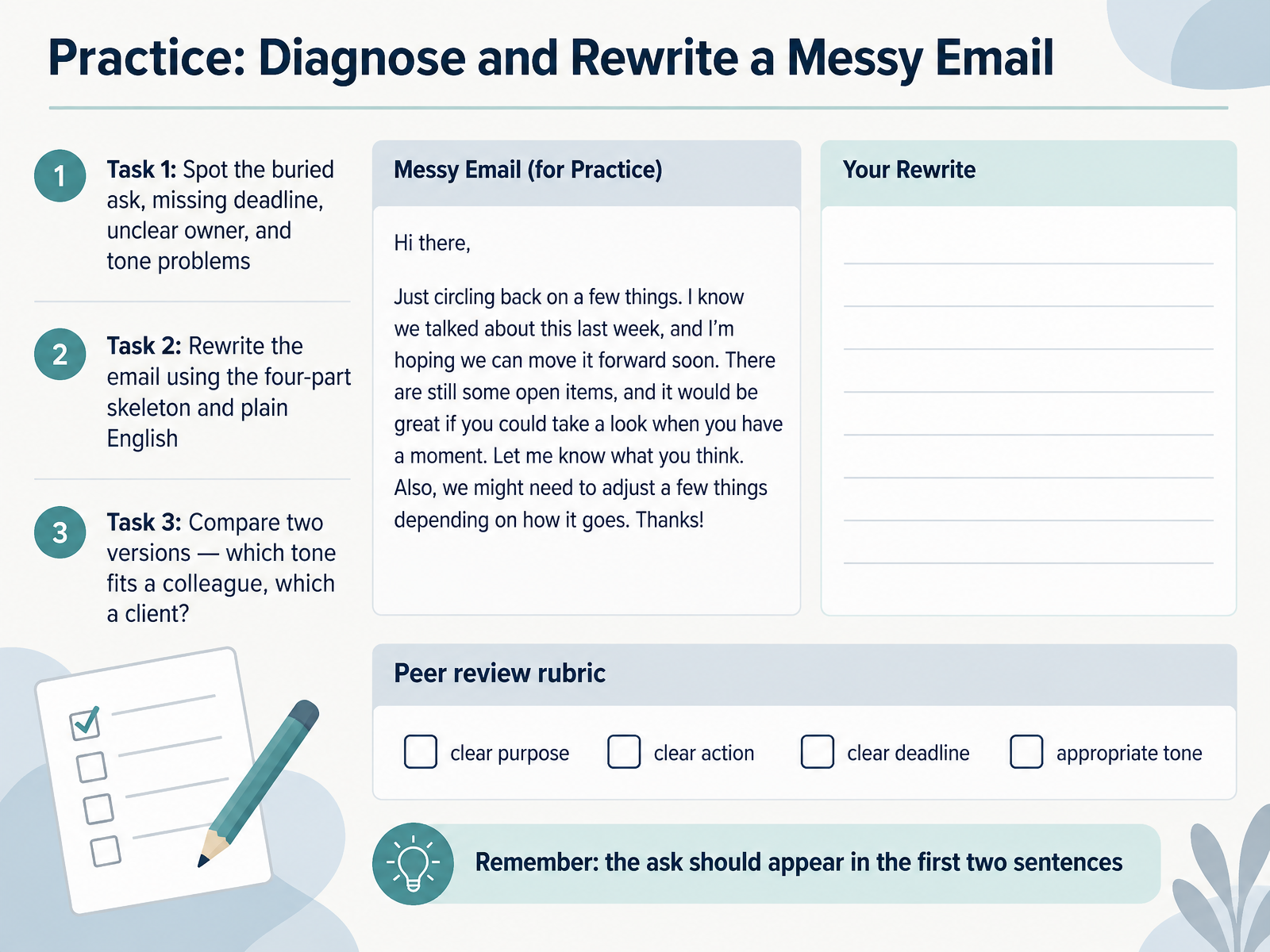
- 13Practice: Diagnose and Rewrite a Messy EmailNow let's put this into practice with a messy email you could easily receive. Here's the task. First, read the sample email and spot four problems: the buried ask, the missing deadline, the unclear owner, and the tone. The ask is the main request, the action you want. Often it hides in the last sentence. Second, rewrite that email with the four-part skeleton and plain English. Keep the ask in the first two sentences, say who does what, and give a real date. Third, compare two versions and decide which tone fits a colleague and which fits a client. Then review a partner's email with a simple rubric: clear purpose, clear action, clear deadline, appropriate tone. Your next step today: open your next draft, move the ask into the first two sentences, and add one exact date. That small habit fixes most messy emails. Next, let's build your personal email checklist and next step.
 englishonline.britishcouncil.orgbbc.co.ukethesisarchive.library.tu.ac.th+21 min
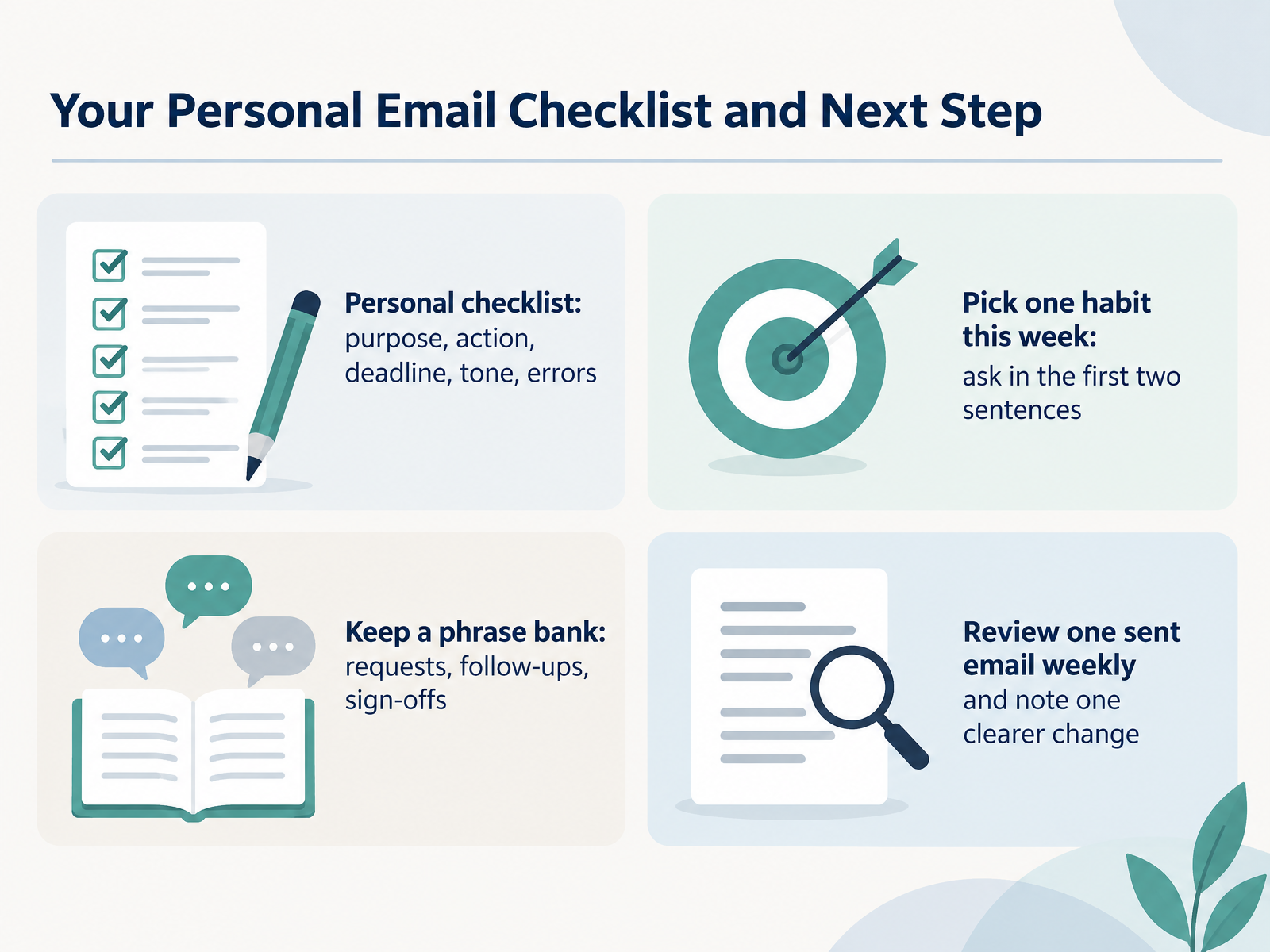
- 14Your Personal Email Checklist and Next StepLet's close with a short checklist you can keep beside your inbox. Before you send, check five things: purpose, action, deadline, tone, and errors. In plain terms, does your reader know why you're writing, what you need them to do, and by when, and does it sound polite? Then pick one habit for this week: put your actual ask in the first two sentences. Next, keep a phrase bank for requests, follow-ups, and sign-offs, so you're not building sentences from scratch every time. Finally, once a week, reread one sent email and note one change that would make it clearer. You already handle real inbox situations every day, and that is the best place to practice. Thank you for joining me. Try one of these habits on your very next email today. Keep going. You're doing well.
 2 min
Take the deck with you
Download this course as a file — free, no sign-up needed.
- PDF handoutEvery slide page, ready to print or share.15 pages · 2.9 MBDownload
- Narrated PowerPointThe deck that presents itself — every slide carries the digital human's narration video.15 pages · 12.8 MBDownload
- PowerPoint slidesThe full deck as a .pptx — open it in PowerPoint, Keynote, or Google Slides.15 pages · 2.8 MBDownload
Free to use in your own training — please keep the PersonWise credit page at the end.
Have your own deck? Turn it into a course
Sources consulted
Web sources consulted while building this course.
- 8 common faux pas in English Business emails — englishonline.britishcouncil.org
- BBC professional skills — bbc.co.uk
- Problems in writing English business emails of non-native speaking employees in an international real estate service company in Thailand, Problems in writing English business emails of non-native speaking employees in an international real estate service company in Thailand — ethesisarchive.library.tu.ac.th
- How to Write Effective Business English: The Essential Toolkit for Composing Powerful Letters, E-Mails and More, for Today's Business Needs (Better Business English) — eclass.uoa.gr
- Clear emails: from ‘shortly’ to an appointment — 7 patterns — be-inc.ai
- How to write in plain English - Help - University of Kent — kent.ac.uk
- Writing for understanding | Digital.gov — digital.gov
- Write in plain English | Southwark Council — southwark.gov.uk
- Plain Language Commission style guide — clearest.co.uk
- Plain English guidelines at a glance — nala.ie
- Writing Email – The Writing Center — writingcenter.unc.edu
- Writing Professional Emails in the Workplace | Writing and Communication Centre | University of Waterloo — uwaterloo.ca
- CELPIP Writing Phrase Bank | Task 1 & Task 2 Phrases — celpip.oathly.ca
- Unit 4: Starting and finishing emails | LearnEnglish — learnenglish.britishcouncil.org
- How to Write a Professional Email: Tone, Language, and Templates · engVid — engvid.com
- How to Write a Follow-Up Email, With Examples — grammarly.com
- How to Write an Email Requesting Something (With Templates) — vengreso.com
- Writing Professional Emails: Effective Strategies and Etiquette : Biological Engineering Communication Lab — mitcommlab.mit.edu
- Write the Perfect Request Email (Free Sample) - RequestLetters — requestletters.com
- Academic Email English for Requests and Follow-Ups — 5minuteenglish.com