Agentic AI vs Generative AI
Begin
14 pages · ~28 min
Agentic AI vs Generative AI
This training explains the differences, tradeoffs, and use cases of agentic AI versus generative AI for professionals evaluating AI solutions.
What you’ll learn
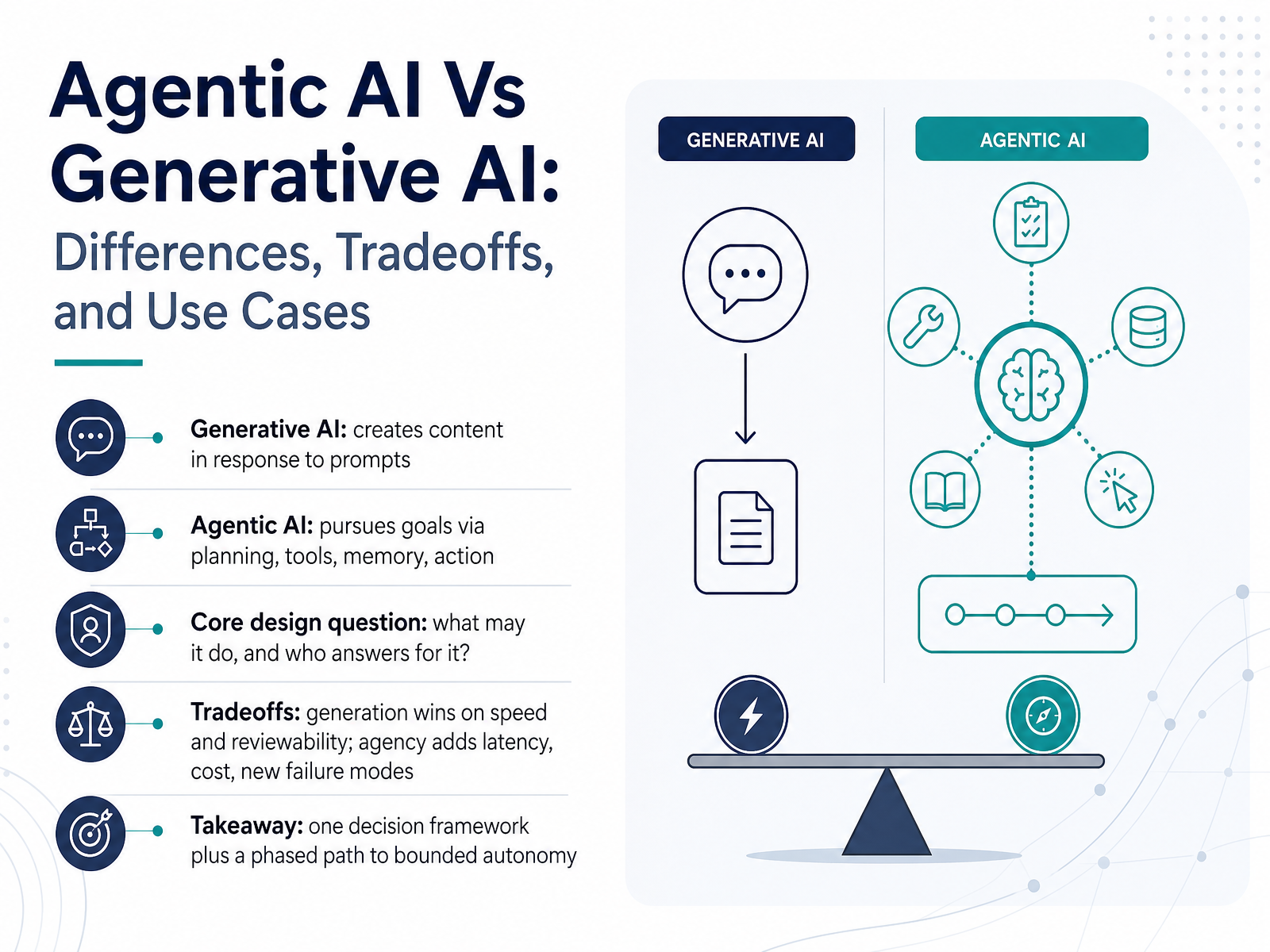
- 01Agentic AI Vs Generative AI: Differences, Tradeoffs, and Use CasesWelcome. Over the next fifteen minutes, we're going to draw a clear line between generative AI and agentic AI, and then use it. Here's the distinction that matters. Generative AI reacts. You give it a prompt, and it creates something: text, an image, a block of code. Agentic AI pursues a goal. It plans, calls tools, holds memory, and takes action across multiple steps. That shift changes your core design question. It's no longer just, what can it do? It's, what may it do, and who answers for it? The tradeoffs are real. Generation wins on speed and reviewability. You read the output, and you decide. Agency adds latency, cost, and new failure modes, because mistakes can cascade. So our takeaway is simple: one decision framework, plus a phased path to bounded autonomy. Let's start with the 2026 landscape, and why that boundary keeps blurring.ibm.comredhat.comgrammarly.com+22 min
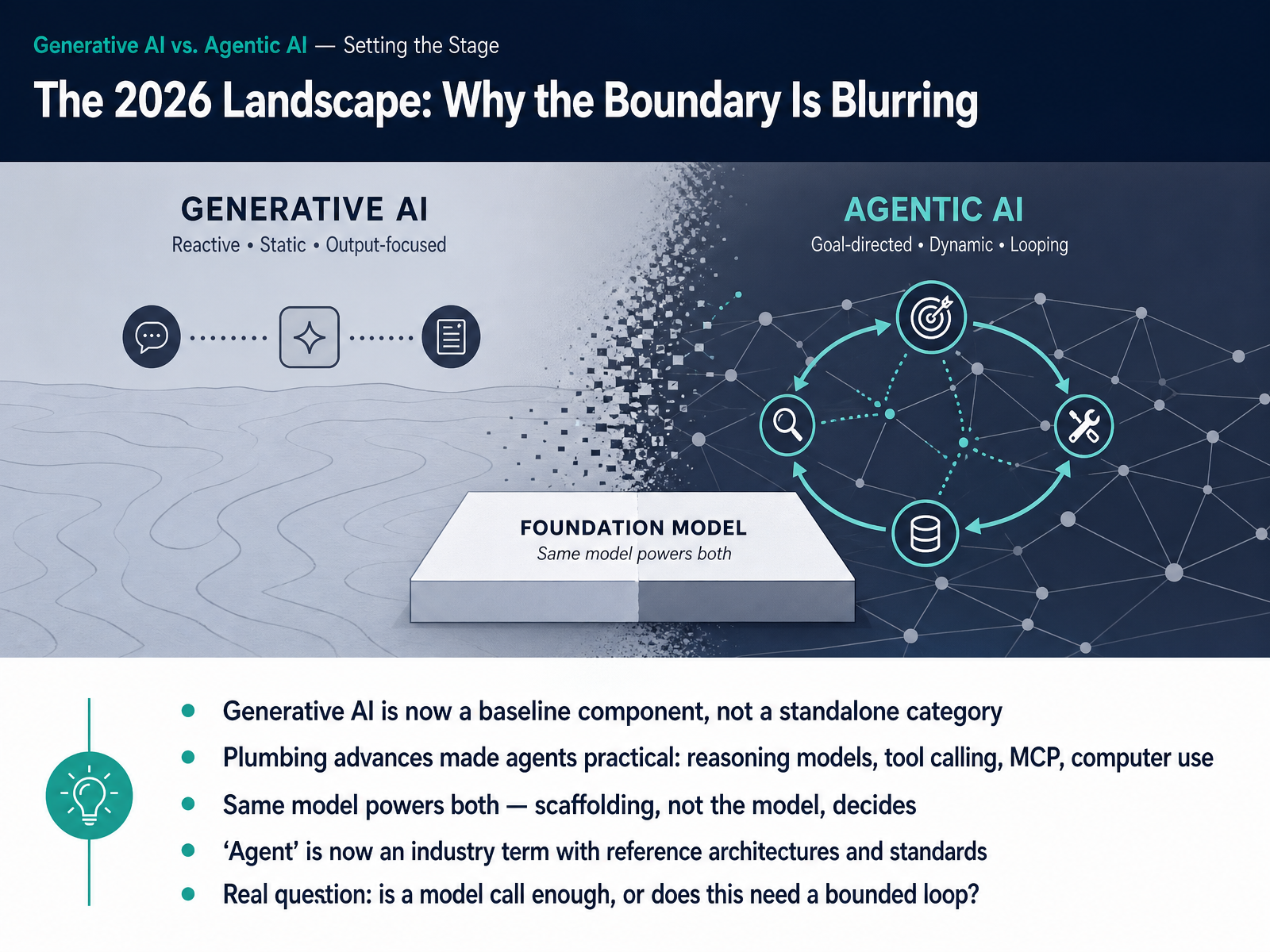
- 02The 2026 Landscape: Why the Boundary Is BlurringLet's look at the 2026 landscape, and why the boundary between generative and agentic AI keeps blurring. The first shift is status. Generative AI is no longer a standalone category. It's a baseline component, the way a database is. Nobody ships a product and calls it database-powered. Second, the plumbing finally caught up. Reasoning models, reliable tool calling, the Model Context Protocol, and computer use made agents practical, not just impressive in a demo. Here's the part that surprises people. The same model often powers both a chatbot and an agent. What differs is the scaffolding around it, not the model. And agent is now an industry term, with reference architectures, standards, and governance behind it. So the real question for your next feature is simple. Is a single model call enough, or does this work need a bounded loop? Answer that honestly, and you avoid over-engineering simple tasks and under-building complex ones. Next, let's trace how we got here: Background: From Content Generation to Goal-Directed Systems.
 link.springer.comarxiv.orglink.springer.com+22 min
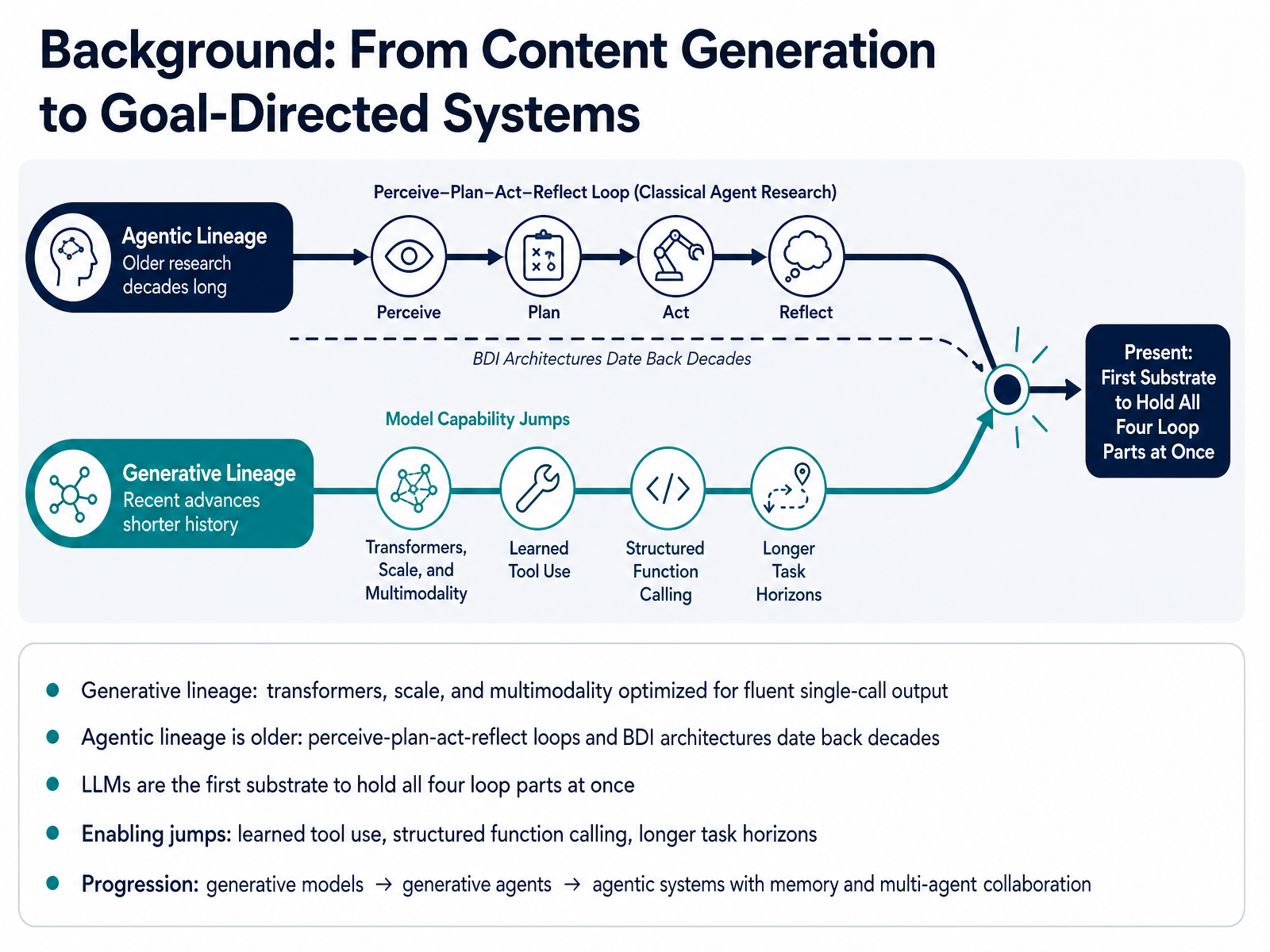
 - 03Background: From Content Generation to Goal-Directed SystemsLet's place agentic AI on a longer timeline. The generative lineage runs through transformers, scale, and multimodality. All of it optimized for one thing: fluent output from a single call. The agentic lineage is much older. Perceive, plan, act, reflect loops and BDI architectures go back decades in research. So what changed? Large language models are the first substrate that can hold all four parts of that loop at once. Symbolic planners could plan but not perceive messy reality. Reactive robots could perceive and act but not plan. Add three enabling jumps: learned tool use, structured function calling, and longer task horizons. That gives you a clear progression. Generative models, then generative agents, then agentic systems with persistent memory and multi-agent collaboration. Next, let's break down the capabilities, autonomy, and error modes that separate these systems in practice.
 link.springer.comarxiv.orglink.springer.com+21 min
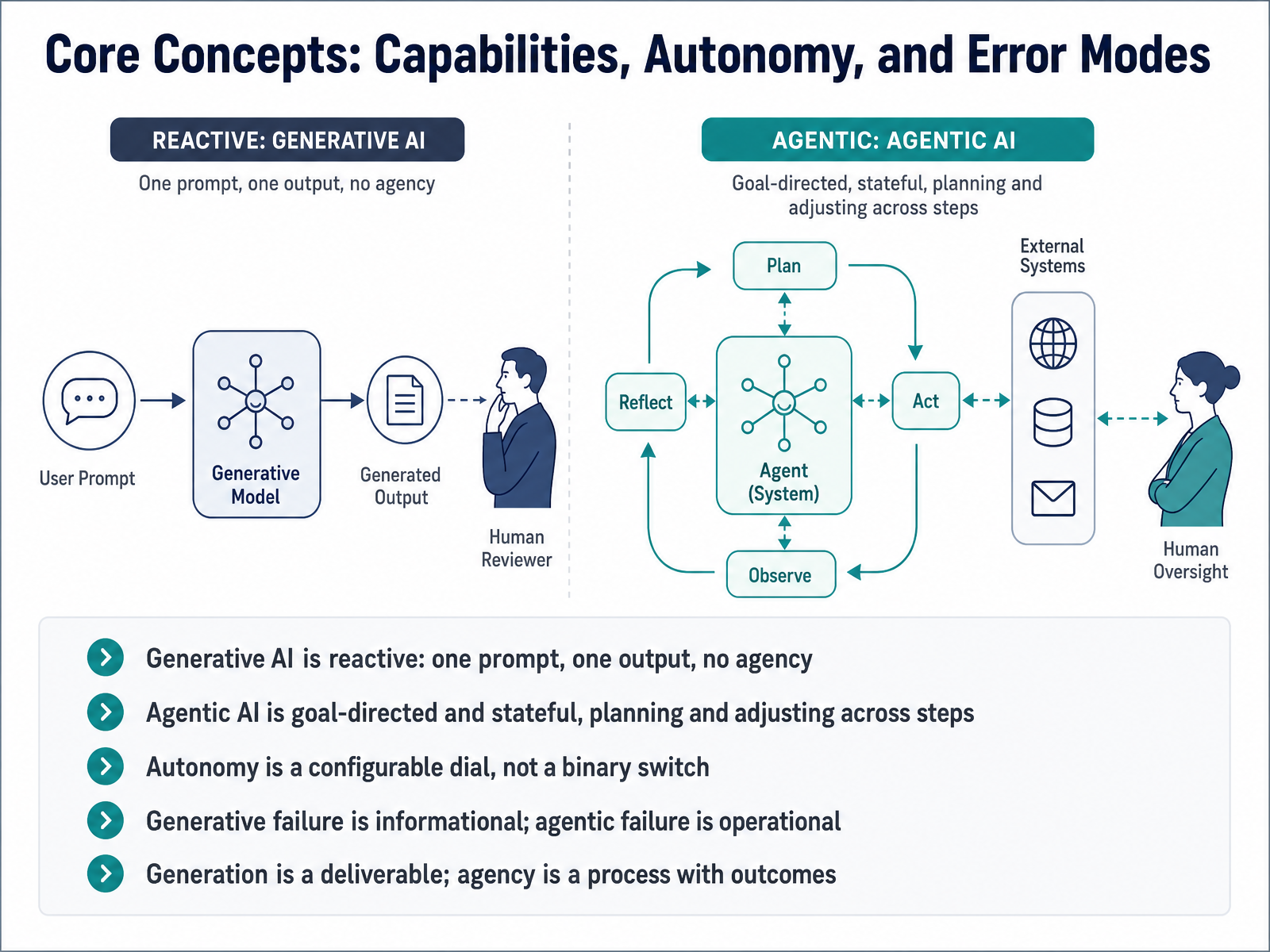
 - 04Core Concepts: Capabilities, Autonomy, and Error ModesNow let's break down three core concepts you'll rely on again and again: capabilities, autonomy, and error modes. Start with behavior. Generative AI is reactive. One prompt, one output, and then it stops. No agency. Agentic AI is goal-directed and stateful. It plans across steps, checks results, and adjusts as conditions change. Here's the key reframe: autonomy is a dial, not a binary switch. You decide how many steps run without human review, and where approvals sit. That single choice shapes your product, your engineering, and your risk. Next, error modes. When generative AI fails, the failure is informational. A wrong sentence, a weak summary. You catch it before it ships. When agentic AI fails, the failure is operational. It sends the email, updates the record, or moves the money. Mistakes can cascade. So the framing is simple. Generation is a deliverable. Agency is a process with outcomes. The better question is whether this task needs content alone, or a system that can reason through a workflow and act. Next, we look at architecture and how each system is built.
 ibm.comredhat.comgrammarly.com+22 min
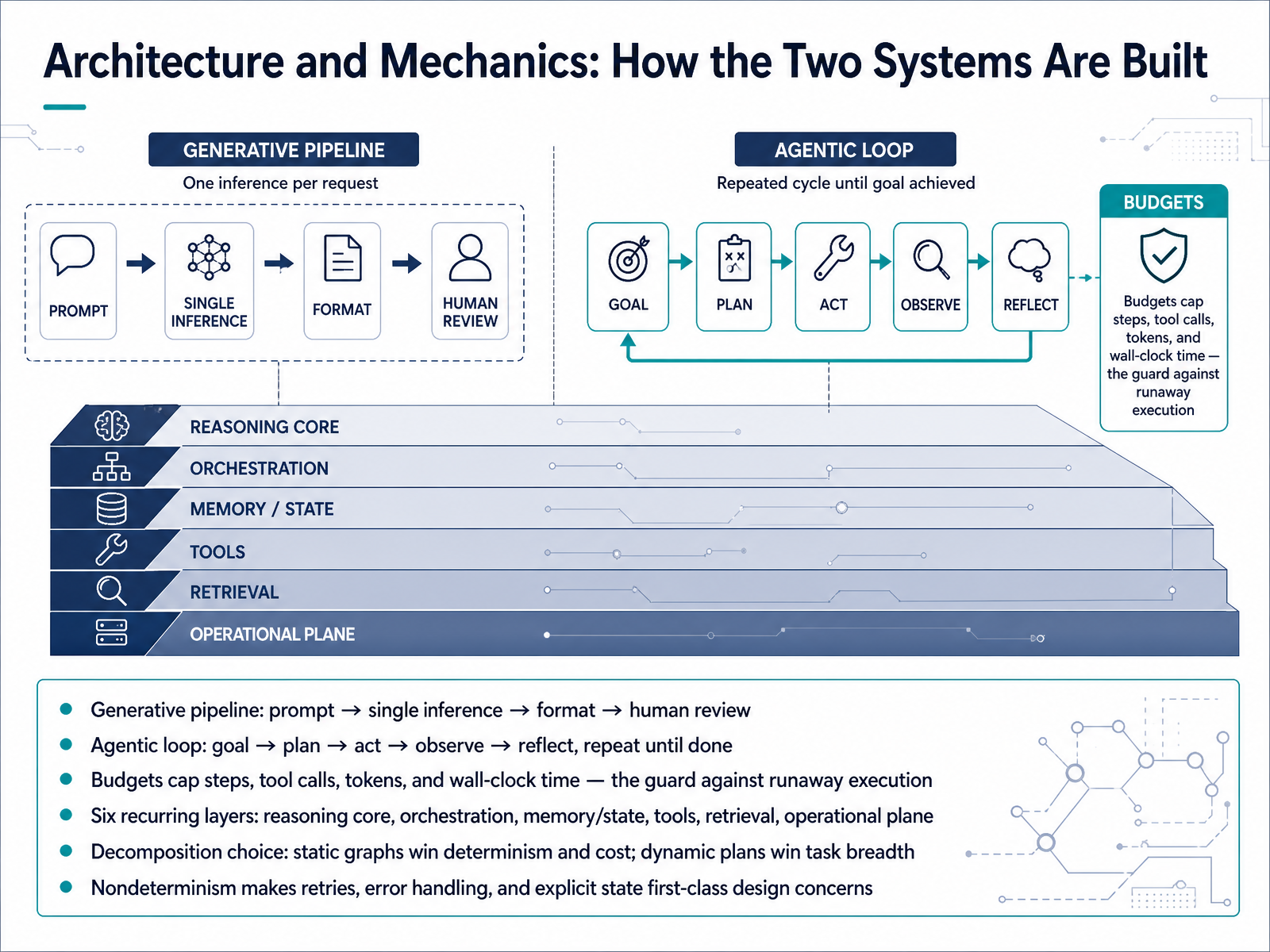
 - 05Architecture and Mechanics: How the Two Systems Are BuiltLet's look at how these systems are actually built. A generative pipeline is simple: a prompt goes in, a single inference runs, the output gets formatted, and a human reviews it. One pass, then done. An agentic system runs a loop: goal, plan, act, observe, reflect, then repeat until the task is complete. That loop is where the value lives, and also the risk. So you cap it. Budgets limit steps, tool calls, tokens, and wall-clock time. That is your guard against runaway execution. Now, across production systems, six layers keep recurring: a reasoning core, orchestration, memory and state, tools, retrieval, and an operational plane for guardrails and observability. You also face a decomposition choice. Static graphs win on determinism and cost. Dynamic plans win on task breadth. Most teams mix both. And because the loop is nondeterministic, retries, error handling, and explicit state become first-class design concerns, not afterthoughts. Next, we'll dig into memory and planning: what actually makes an agent capable.
 genaimaturity.netdocs.aws.amazon.commicrosoft.github.io+21 min
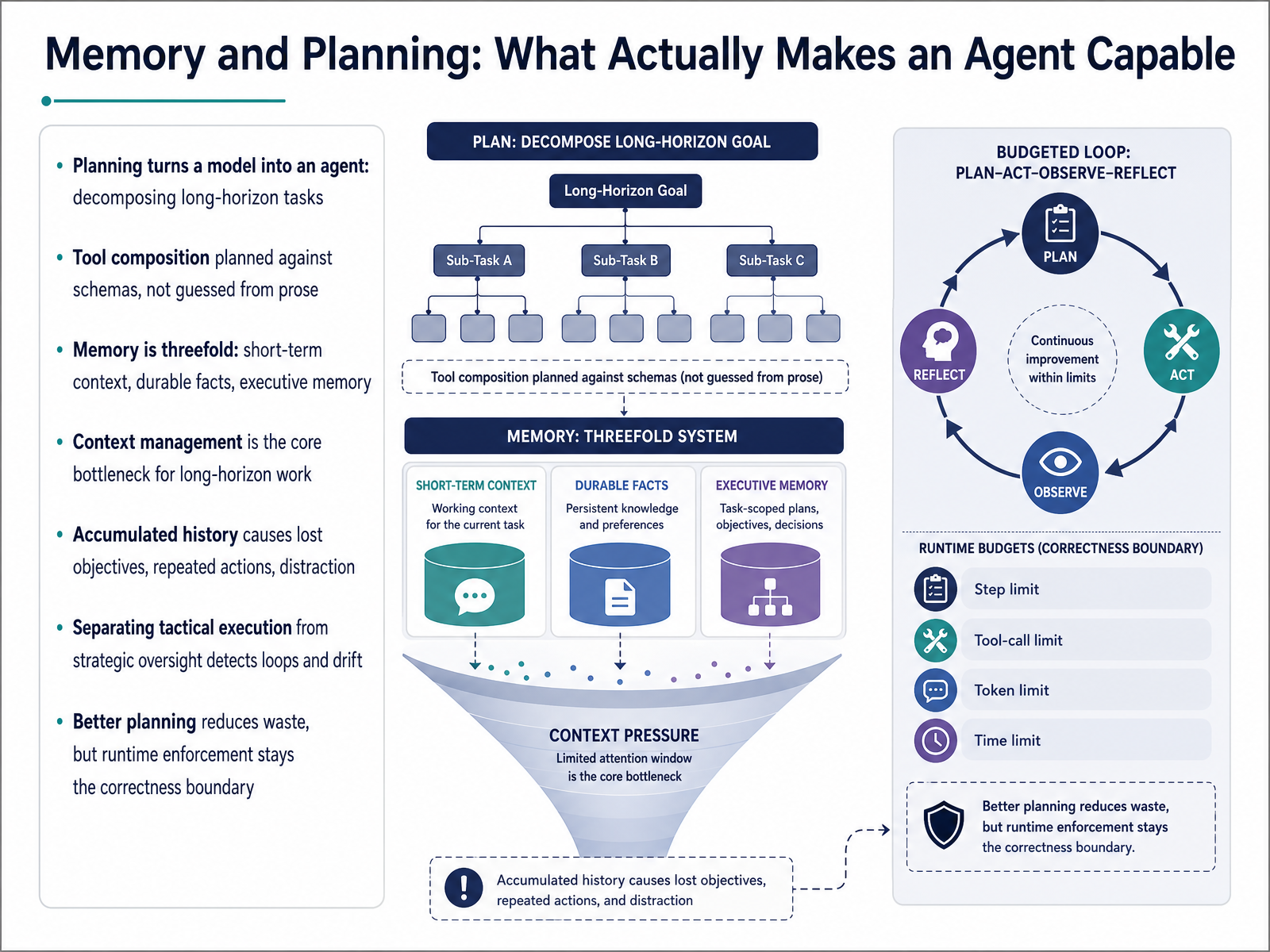
 - 06Memory and Planning: What Actually Makes an Agent CapableNow let's talk about what actually makes an agent capable: memory and planning. Planning is what turns a model into an agent. It means decomposing a long-horizon task into steps you can execute and verify. And those steps should be planned against tool schemas, not guessed from prose descriptions. If you infer tool composition from text alone, you get costly exploration and unreliable calls. When dependencies are modeled at the parameter level, the planner knows which outputs feed which inputs, and redundant API calls drop. Memory comes in three forms. Short-term context holds the current working state. Durable facts persist across sessions. Executive memory tracks the reasoning trajectory itself, pruning invalid steps and folding completed sub-trajectories so the goal stays visible. That matters because context management is the core bottleneck for long-horizon work. As history accumulates, agents lose objectives, repeat actions, and get distracted by irrelevant detail. The fix is architectural. Separate tactical execution from strategic oversight, so a monitor can detect loops and reasoning drift before errors cascade. Here is the takeaway. Better planning reduces waste. But runtime enforcement remains the correctness boundary. Planning gives you a good path; enforcement keeps you on it. Next, we look at Tradeoffs: When Agency Is Worth the Complexity.
 arxiv.orgaclanthology.orgaclanthology.org+22 min
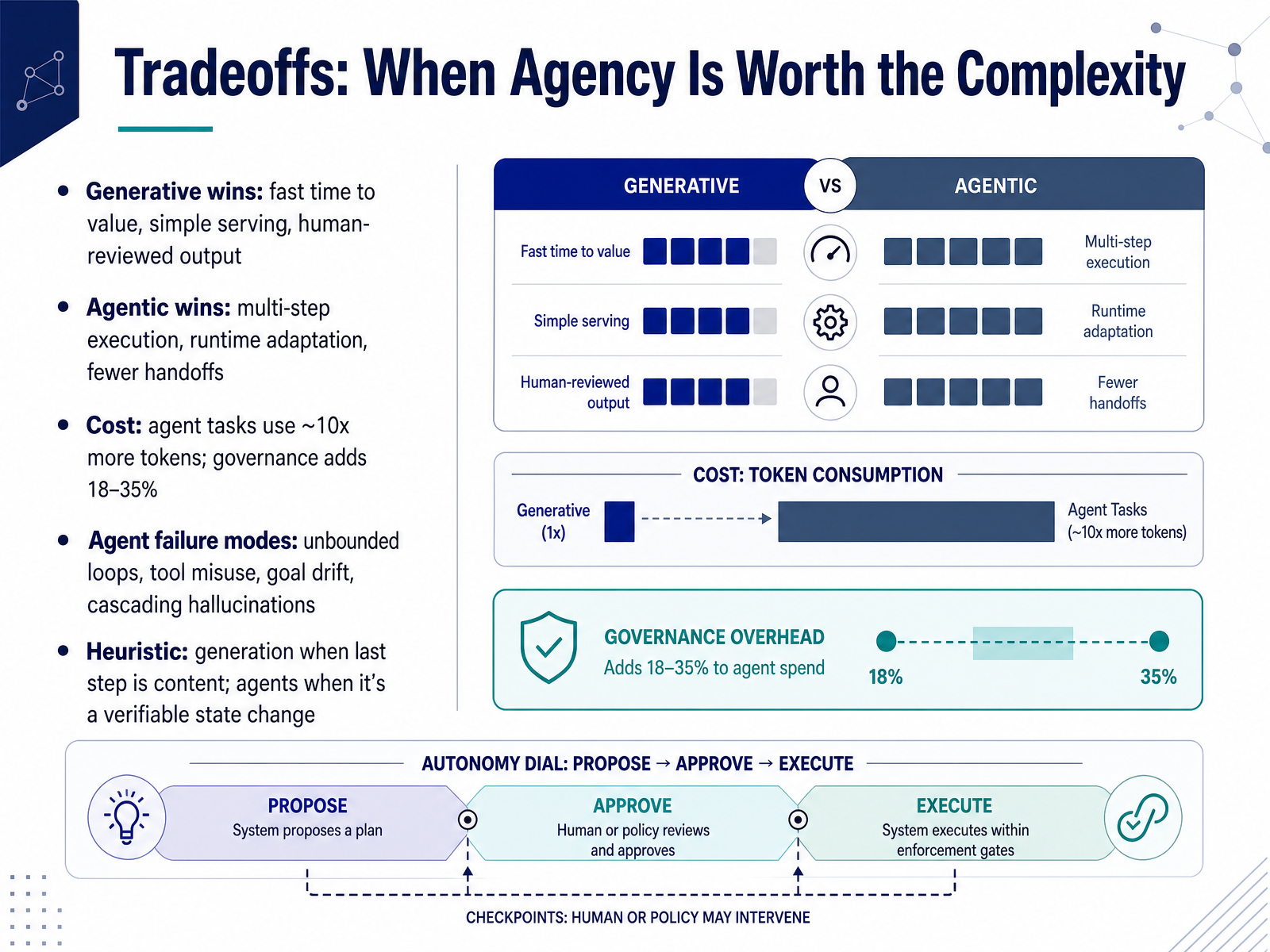
 - 07Tradeoffs: When Agency Is Worth the ComplexityLet's talk about when agency is actually worth the complexity it adds. Generative wins are real. Fast time to value, simple serving, and output a human reviews before anything happens. Agentic wins are different in kind. Multi-step execution, runtime adaptation, and fewer handoffs across systems. But that power is not free. A multi-step agent task uses roughly ten times more tokens than a single generative call. And governance, including monitoring, guardrails, and human review, adds about eighteen to thirty-five percent on top. Then there are the failure modes unique to agents. Unbounded loops that never terminate. Tool misuse. Goal drift, where the agent quietly optimizes the wrong thing. And cascading hallucinations, where one bad step propagates through every step after it. So here is the heuristic I want you to carry. Use generation when the last step is content. Use an agent when the last step is a verifiable state change in a system. That single question resolves most architecture debates. Next, we look at evaluation and observability, and how measuring agents differs from measuring models.
 ibm.comredhat.comgrammarly.com+22 min
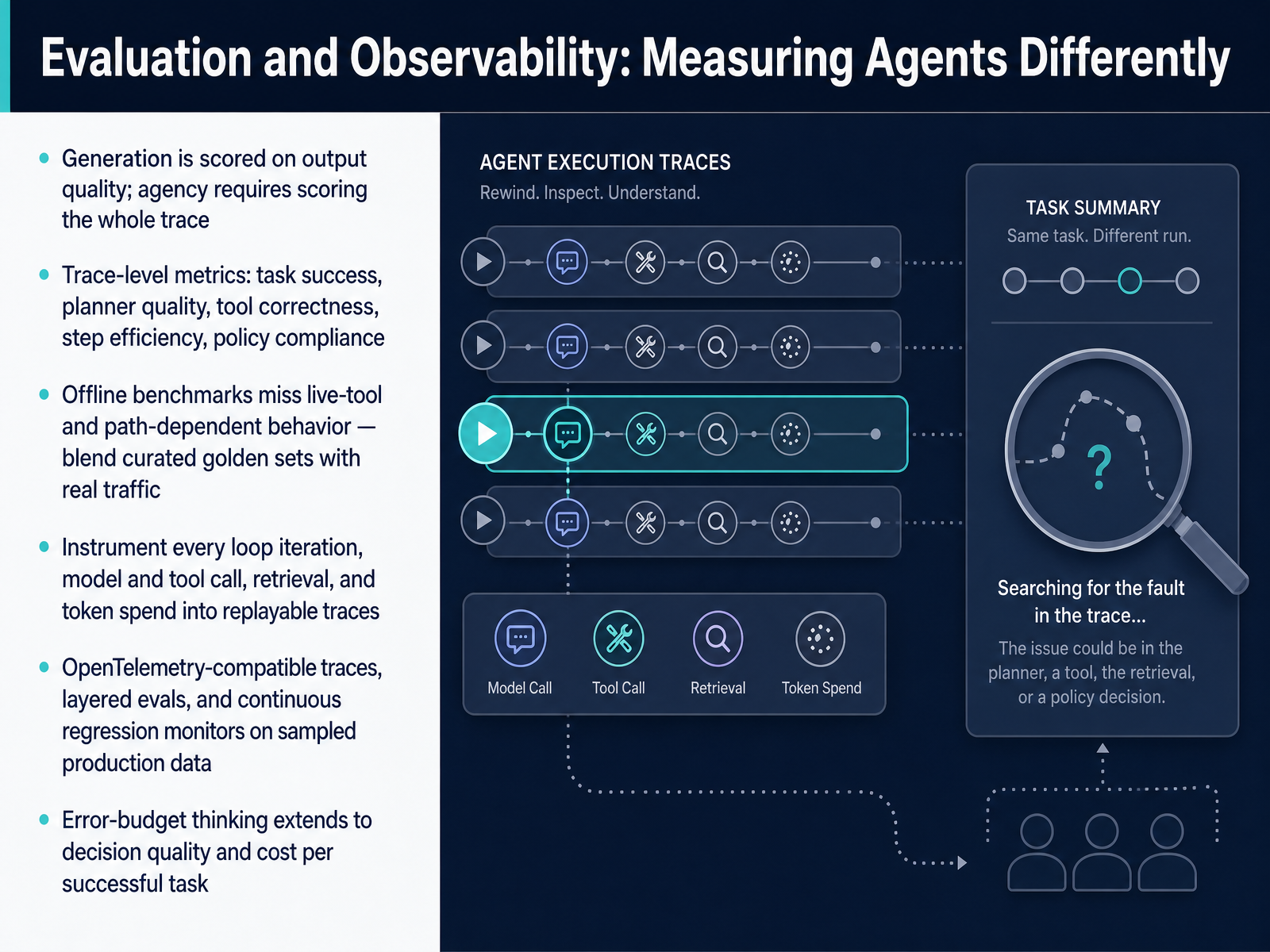
 - 08Evaluation and Observability: Measuring Agents DifferentlyNow let's talk about evaluation and observability, because measuring agents works differently. Generation is scored on output quality. Agency requires scoring the whole trace. That means looking at task success, planner quality, tool correctness, step efficiency, and policy compliance. Here is the key limitation. Offline benchmarks miss live-tool and path-dependent behavior, so blend curated golden sets with real production traffic. For instrumentation, capture every loop iteration, every model and tool call, retrieval, and token spend into replayable traces. Use OpenTelemetry-compatible traces, layered evals, and continuous regression monitors on sampled production data. And extend error-budget thinking beyond uptime to decision quality and cost per successful task. The takeaway is simple. You cannot score an agent on final output alone. You score the path it took to get there. That sets up our next section, Use Cases: Matching the Approach to the Problem.
 2 min
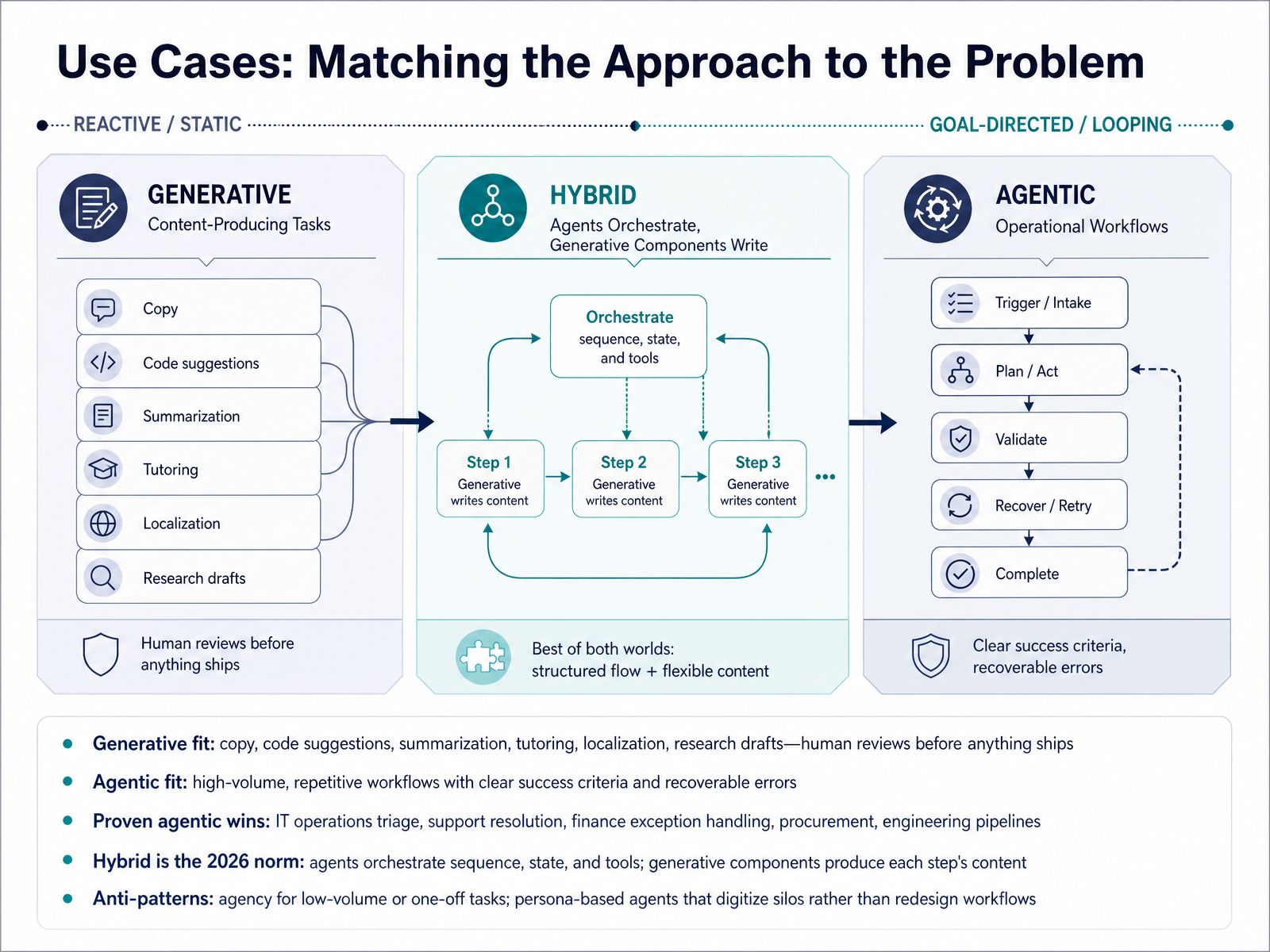
2 min - 09Use Cases: Matching the Approach to the ProblemNow let's match the approach to the problem. Generative AI fits bounded content work. Copy, code suggestions, summarization, tutoring, localization, and research drafts. The pattern is simple. A human reviews before anything ships. Agentic AI fits something different. High volume, repetitive workflows with clear success criteria and recoverable errors. Errors you can catch and correct. Where has that paid off? IT operations triage, support resolution, finance exception handling, procurement, and engineering pipelines. Notice the common thread. Volume justifies the build, and mistakes do not end the business. In practice, 2026 is a hybrid year. Agents orchestrate sequence, state, and tools, while generative components produce each step's content. Now the anti-patterns. Do not give agency to low volume or one off tasks. The setup cost will never pay back. And beware persona based agents. If you build an agent that just mimics a job title, you have digitized a silo instead of redesigning the workflow. Design for the outcome, not the org chart. Next, we turn to reliability and governance, making agency deployable.
 ibm.comredhat.comgrammarly.com+22 min
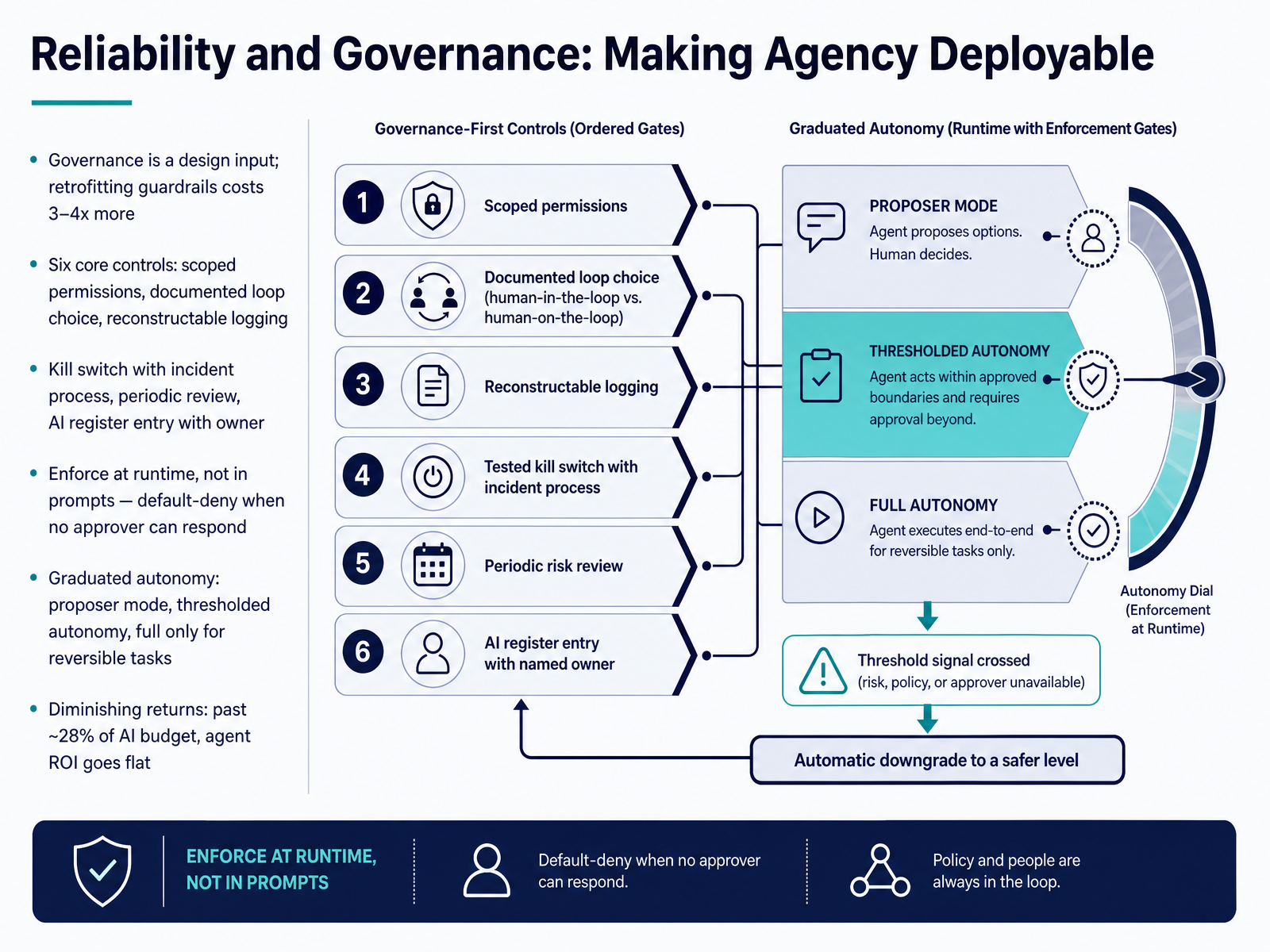
 - 10Reliability and Governance: Making Agency DeployableLet's talk about reliability and governance, and what actually makes agency deployable. Start with the core insight: governance is a design input, not a cleanup task. Retrofitting guardrails after launch costs three to four times more. So build it in from day one.
There are six core controls. Scoped permissions. A documented choice between in-the-loop and on-the-loop oversight. Reconstructable logging. A tested kill switch with an incident process. Periodic review. And an AI register entry with a named owner.
Enforce at runtime, not in prompts. A prompt is a suggestion; runtime checks are enforcement. And default to deny when no approver can respond in time.
Match autonomy to reversibility. Proposer mode for high-risk actions. Thresholded autonomy for bounded ones. Full autonomy only for reversible, low-impact tasks.
One last number to remember: past roughly twenty-eight percent of your AI budget, agent returns go flat. Governance is an investment, not an infinite one.
Next, regulation and accountability, what 2026 requires.
 2 min
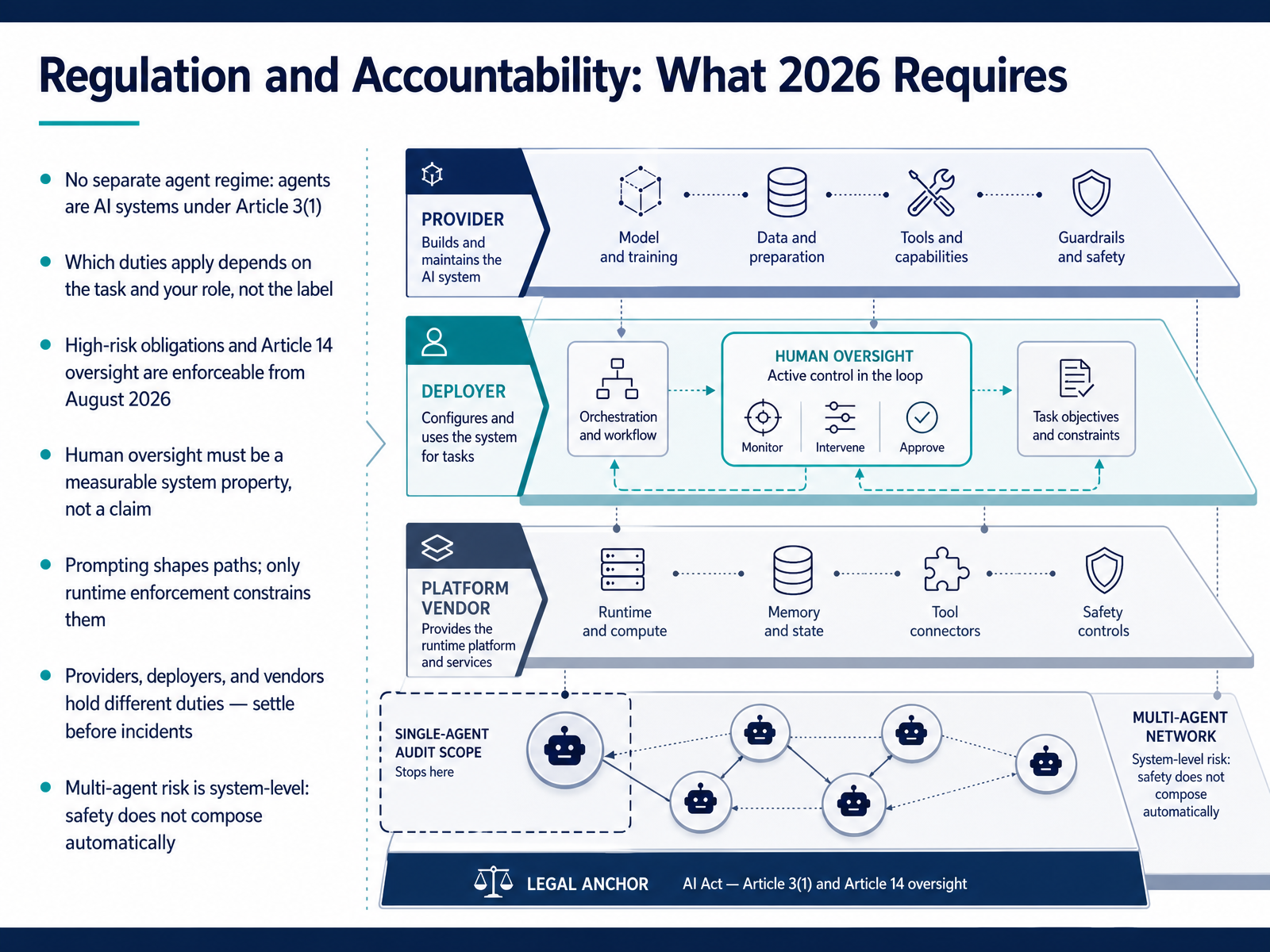
2 min - 11Regulation and Accountability: What 2026 RequiresNow let's look at regulation and accountability and what 2026 actually requires. First, there is no separate agent regime. Agents are AI systems under Article three, paragraph one, so the ordinary risk ladder applies. Which duties apply depends on the task and your role, not the label. High-risk obligations and Article fourteen oversight become enforceable from August 2026. This is the critical shift. Human oversight must be a measurable system property, not a claim. Prompting shapes paths. Only runtime enforcement constrains them. So in practice, prompts reduce the chance of bad behavior. They do not guarantee it. Providers, deployers, and vendors hold different duties, so settle those responsibilities in contracts before incidents, not after. And remember that multi-agent risk is system-level. Safety does not compose automatically. Agents that pass individual audits can still fail when they interact in a network. The takeaway is simple. Classify by task, define roles early, and enforce constraints at runtime. Next, we move into the implementation playbook, a phased path to bounded autonomy.
 2 min
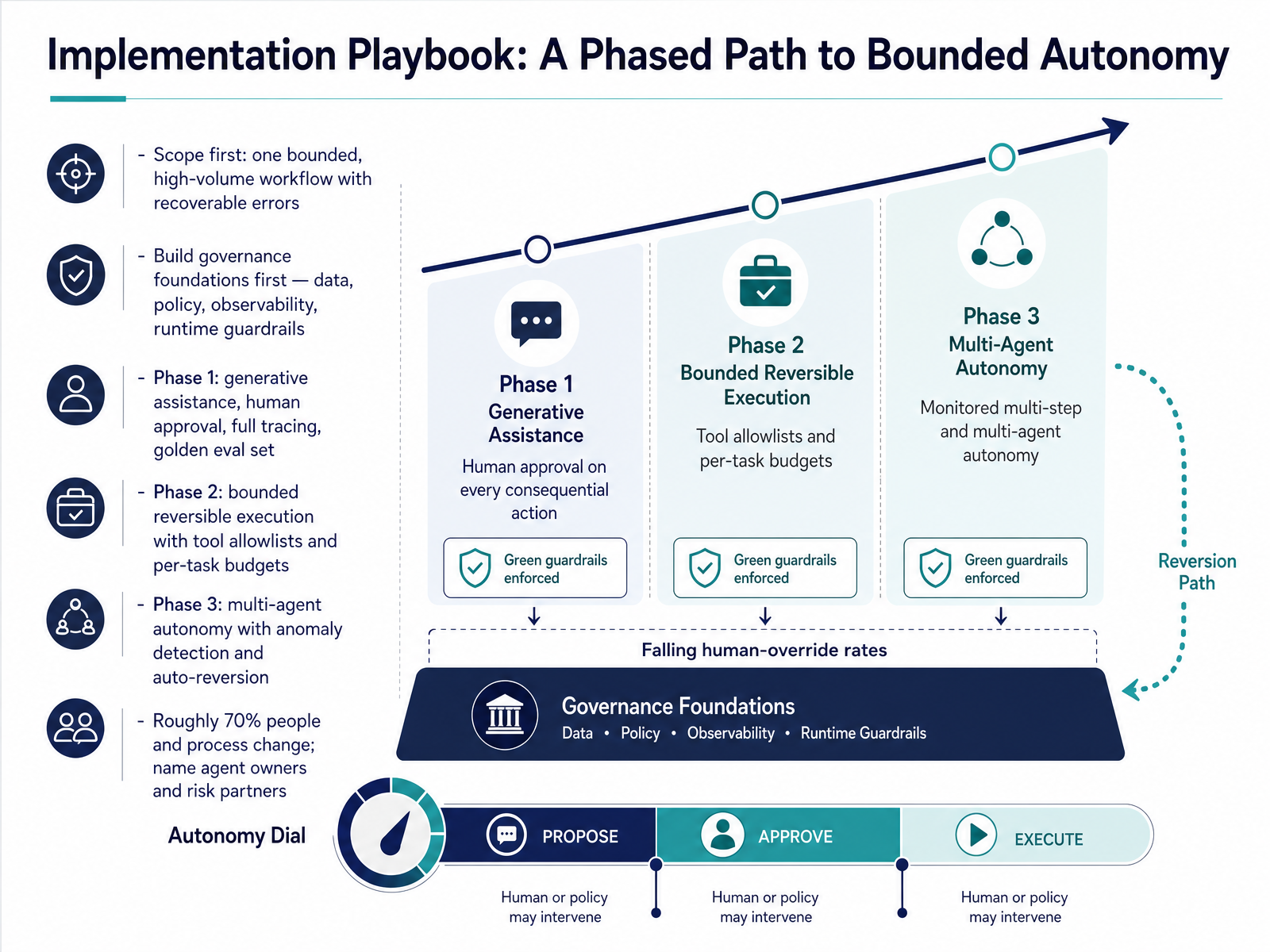
2 min - 12Implementation Playbook: A Phased Path to Bounded AutonomyNow let's turn to the implementation playbook, a phased path to bounded autonomy. The first move is scope. Pick one bounded, high volume workflow where errors are recoverable, and build your governance foundations before anything else: data quality, policy, observability, and runtime guardrails. Then move in phases. Phase one is generative assistance with human approval, full tracing, and a golden evaluation set. Phase two adds bounded, reversible execution with tool allowlists and per task budgets. Phase three opens multi agent autonomy, but only with anomaly detection and automatic reversion. One reality check: roughly seventy percent of this work is people and process, not algorithms. So name your agent owners and your risk partners up front. Governance first, autonomy last. Next, we'll work through the decision framework for choosing between generation and agency.
 link.springer.comarxiv.orglink.springer.com+21 min
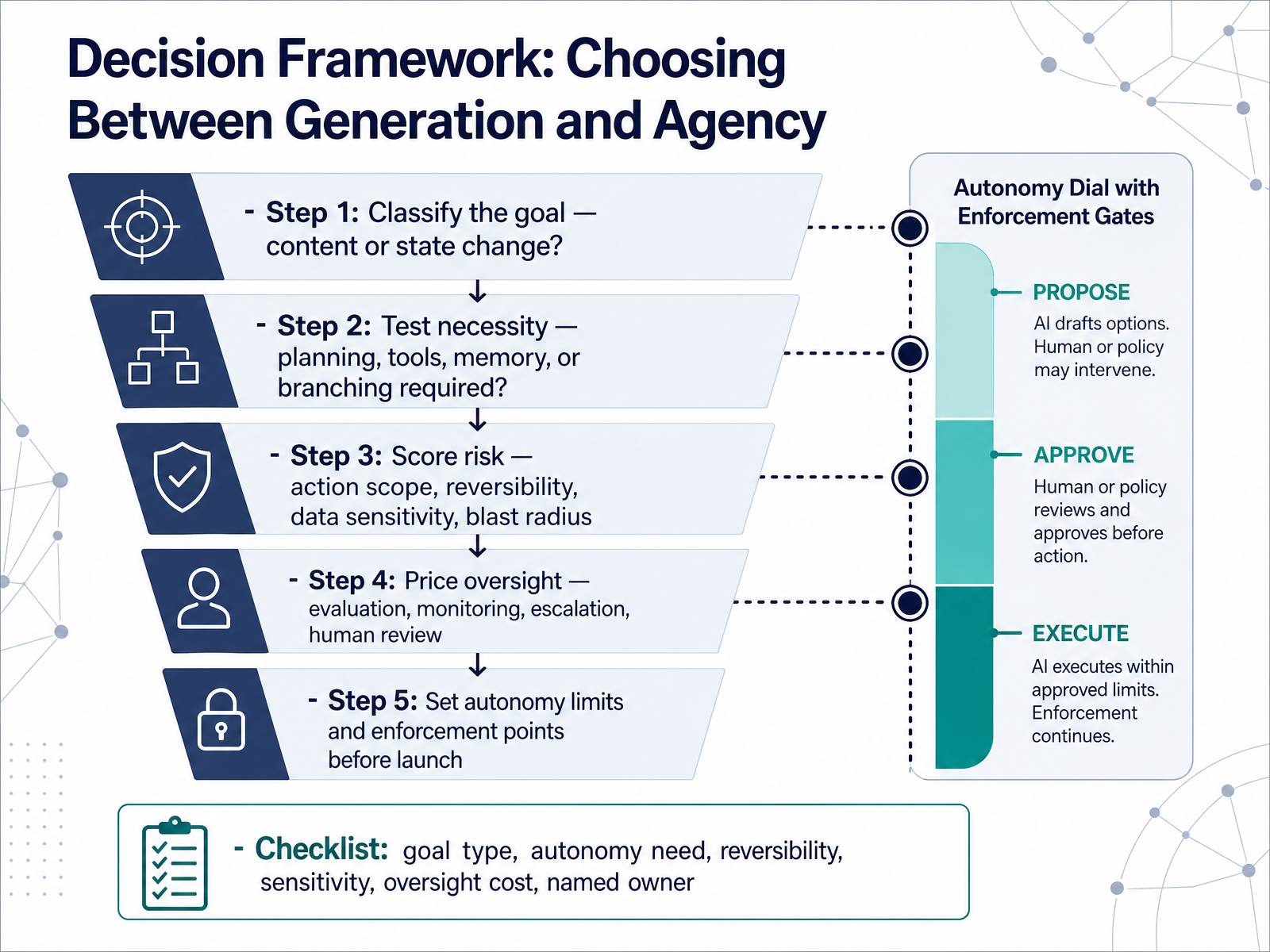
 - 13Decision Framework: Choosing Between Generation and AgencyNow let's put it together into a decision framework you can actually run. Start with Step One: classify the goal. Are you producing content, or changing state? Generation answers questions. Agency updates a database, sends a payment, changes a record. Step Two: test necessity. If the task needs planning, tools, memory, or branching, you likely need agency. If not, generation is cheaper and safer. Step Three: score the risk. Look at action scope, reversibility, data sensitivity, and blast radius. A reversible draft is low risk. An irreversible payment is not. Step Four: price the oversight. Evaluation, monitoring, escalation, and human review are real costs, often eighteen to thirty-five percent of total agent spend. Step Five: set autonomy limits and enforcement points before launch, not after. Use proposer mode for high-risk actions, and full autonomy only for low-blast-radius tasks. Run the checklist: goal type, autonomy need, reversibility, sensitivity, oversight cost, and a named owner. Own the risk, and you can scale responsibly. Next, Key Takeaways and Next Steps by Role.
 2 min
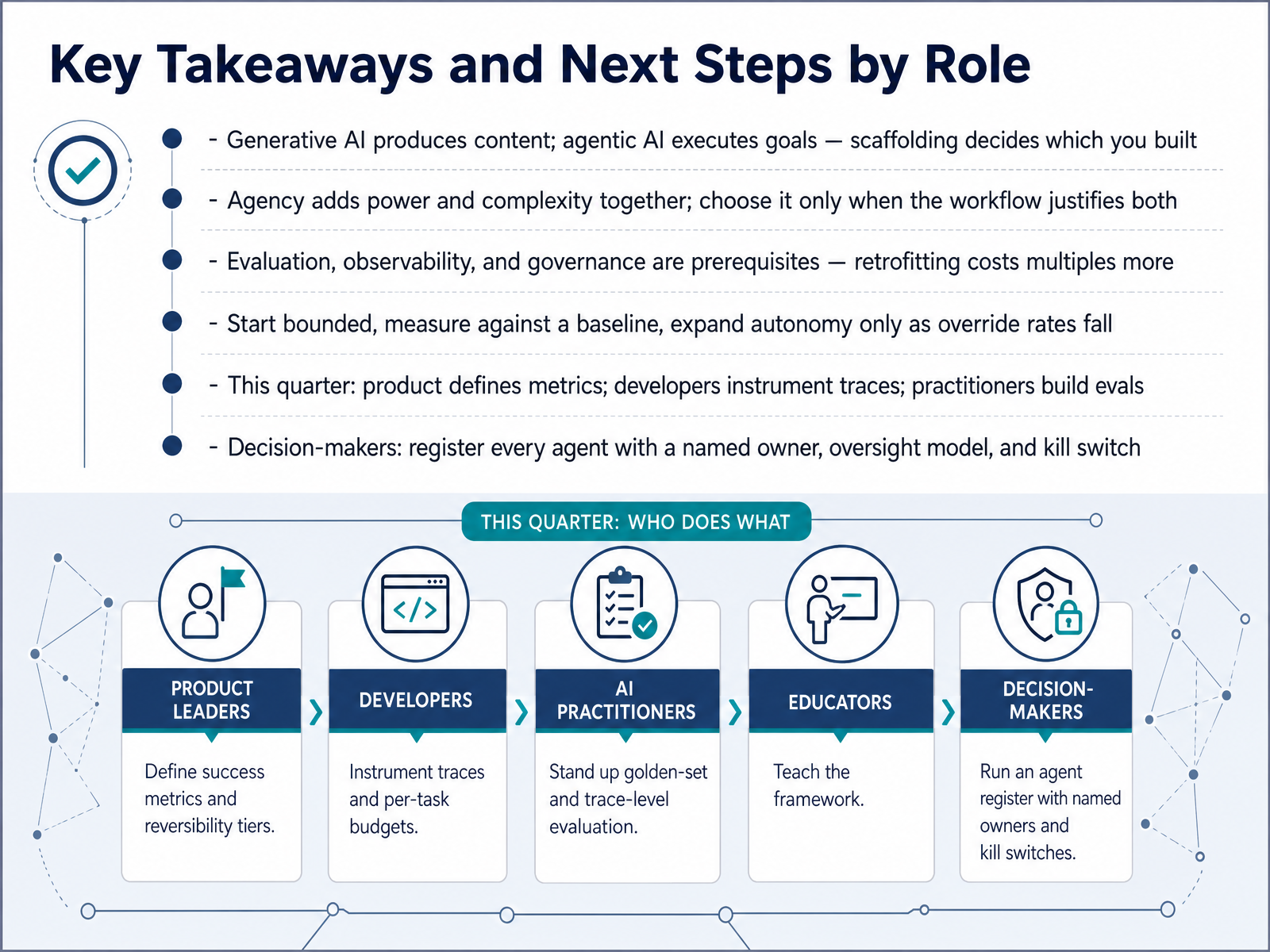
2 min - 14Key Takeaways and Next Steps by RoleLet's land this with six takeaways. First, generative AI produces content; agentic AI executes goals. The scaffolding is what decides which one you actually built. Second, agency adds power and complexity together. Choose it only when the workflow justifies both. Third, evaluation, observability, and governance are prerequisites, not add-ons. Retrofitting them costs three to four times more. Fourth, start bounded, measure against a baseline, and expand autonomy only as override rates fall. Make autonomy configurable. Use proposer mode for high-risk actions and full autonomy only for low-blast-radius work. Fifth, this quarter, divide the work. Product defines the metrics. Developers instrument the traces. Practitioners build the evals. And sixth, decision-makers: register every agent with a named owner, an oversight model, and a kill switch. That registration step is where governance becomes real. So the through-line is this. Treat agentic capability as an investment with a specific return, not a default architecture. Start small, measure honestly, and earn autonomy tier by tier. Thank you for working through this with me. You now have a clear way to separate content from action and to choose deliberately. Go build something bounded, governed, and genuinely useful.
 ibm.comredhat.comgrammarly.com+22 min
Take the deck with you
Download this course as a file — free, no sign-up needed.
- PDF handoutEvery slide page, ready to print or share.15 pages · 4.0 MBDownload
- Narrated PowerPointThe deck that presents itself — every slide carries the digital human's narration video.15 pages · 17.4 MBDownload
- PowerPoint slidesThe full deck as a .pptx — open it in PowerPoint, Keynote, or Google Slides.15 pages · 3.9 MBDownload
Free to use in your own training — please keep the PersonWise credit page at the end.
Have your own deck? Turn it into a course
Sources consulted
Web sources consulted while building this course.
- Agentic AI vs. Generative AI — ibm.com
- Agentic AI vs. generative AI — redhat.com
- Agentic AI vs. Generative AI: Key Differences Explained — grammarly.com
- Agentic AI vs. generative AI: Differences and use cases — zapier.com
- Agentic AI vs Generative AI: Comparing Autonomy, ... — databricks.com
- From Language Models to Agentic AI: A Survey of Autonomous, Action-Enabled, and Collaborative LLM Agents | Cognitive Computation | Springer Nature Link — link.springer.com
- https://arxiv.org/pdf/2504.18875 — arxiv.org
- A Holistic Review of Agentic AI Frameworks, Applications, and Research Trajectories | Archives of Computational Methods in Engineering | Springer Nature Link — link.springer.com
- https://arxiv.org/pdf/2604.00835 — arxiv.org
- How LLMs Got Hands: A History of Tool Use (2026) | Taskade Blog — taskade.com
- Agentic AI Reference Architecture 2026 — v1.1 | Generative AI Maturity Framework — genaimaturity.net
- Agentic AI architecture in the enterprise - AWS Prescriptive Guidance — docs.aws.amazon.com
- Reference architecture - Multi-agent Reference Architecture — microsoft.github.io
- The Enterprise Agent Reference Architecture, Annotated | Pondero — pondero.ai
- Agentic AI Architecture: Components, Layers & Stack — aiarch.dev
- HyperAgent: Planning and Acting over Tool-Schema Hypergraphs for Tool-Use LLM Agents — arxiv.org
- Agentic Memory: Learning Unified Long-Term and Short-Term Memory Management for Large Language Model Agents - ACL Anthology — aclanthology.org
- COMPASS: Enhancing Agent Long-Horizon Reasoning with Evolving Context — aclanthology.org
- CHIME: Credit-Aware Hierarchical Memory Evolution forLong-Horizon Agentic Planning — arxiv.org
- [2609.11561] Memory as Plans: World-Action Modeling with Memory-Grounded Planning — arxiv.org