Begin
14 pages · ~28 min
Galaxy Shapes, Motion, and Evolution
This training covers galaxy classification, motion, and evolutionary processes, designed for astronomy enthusiasts and students seeking a foundational understanding of galactic structures.
A digital instructor presents all 14 pages. Hold “Ask” at any point and ask out loud — the answer comes from this course. No sign-up needed.
What you’ll learn
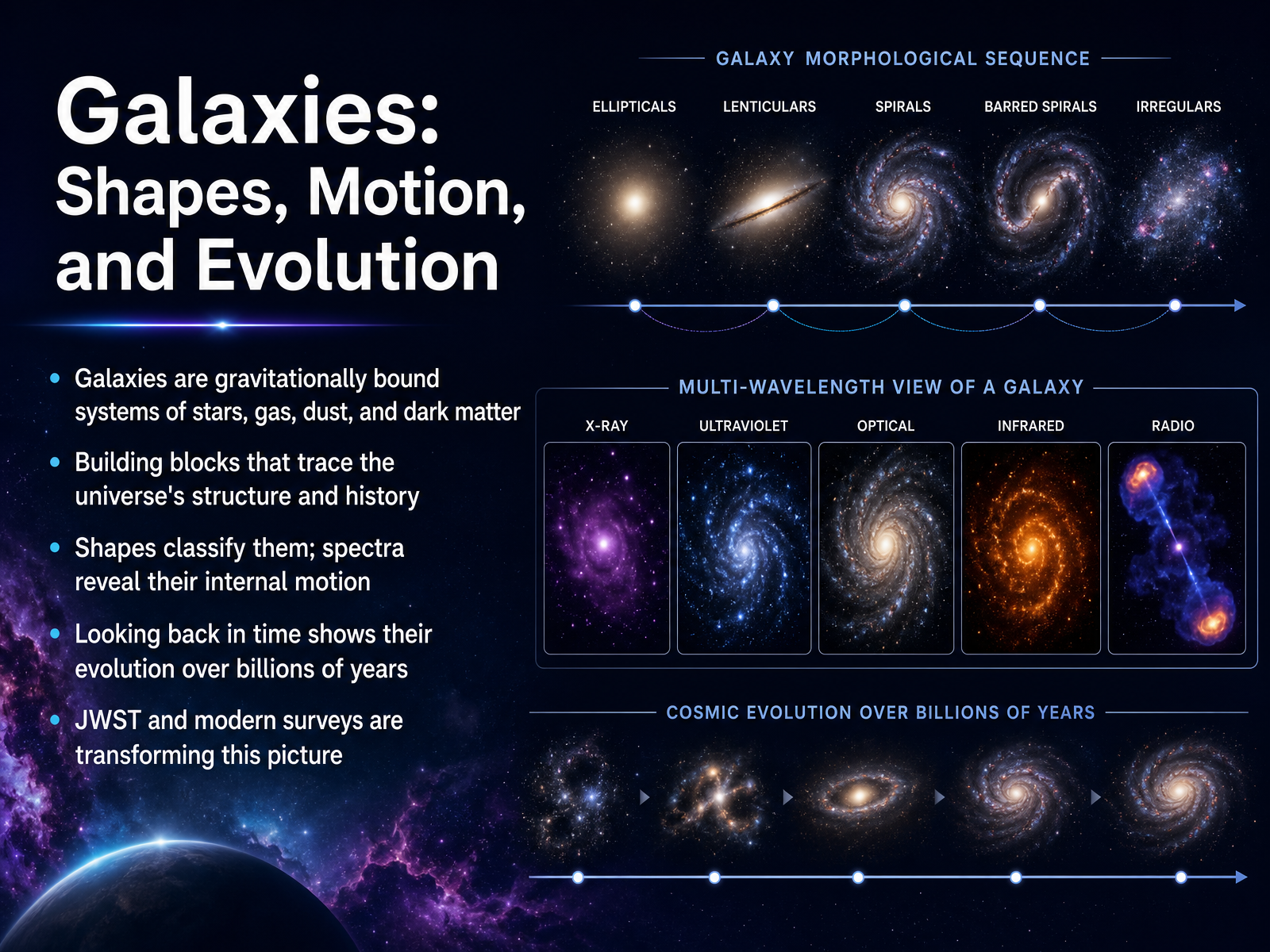
- 01Galaxies: Shapes, Motion, and EvolutionWelcome. In this course, we will explore galaxies as the fundamental building blocks of the universe. Galaxies are vast, gravitationally bound systems of stars, gas, dust, and dark matter. Their shapes help us classify them, while their spectra reveal how they move internally. Just as importantly, observing distant galaxies lets us look back in time and see how these structures evolved over billions of years. Today, the James Webb Space Telescope and large modern surveys are rapidly transforming this picture, giving us sharper and deeper views than ever before. By the end, you will have a clearer sense of how galaxies are shaped, how they move, and how they change across cosmic history. Let us begin with what galaxies are made of.google.iopscience.iop.orgaanda.orgaanda.org+21 min
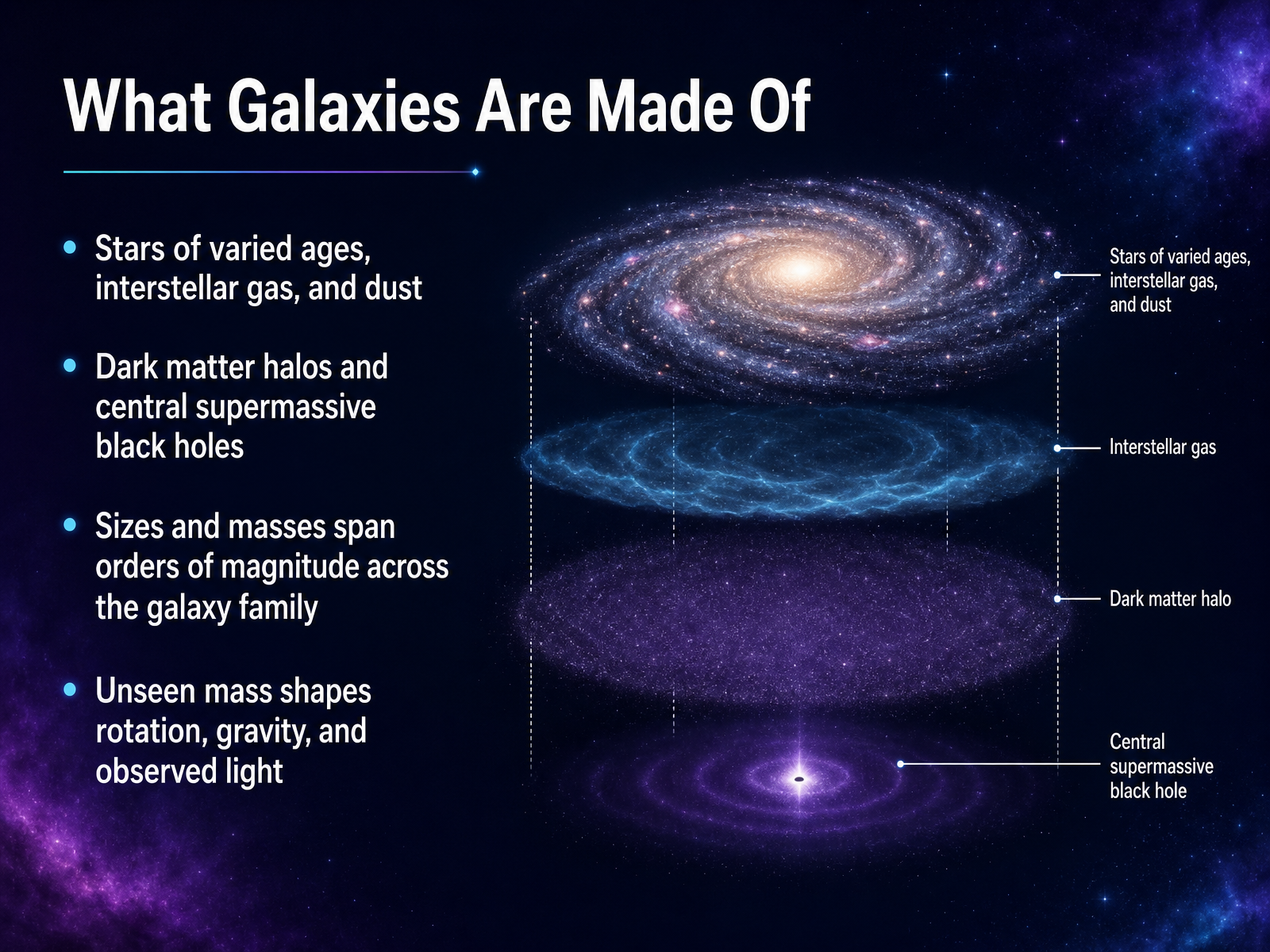
- 02What Galaxies Are Made OfNow let's look at what a galaxy actually contains. The most obvious ingredients are the stars. But not all stars are the same. A typical galaxy holds stars of many different ages, from bright young blue stars to older, cooler red ones. Between the stars, there is also a thin mixture of interstellar gas and dust. This is not empty space. The gas is the raw material for future stars, and the dust, while only a tiny fraction of the mass, absorbs and scatters starlight, shaping how we see the galaxy. Yet the visible matter tells only part of the story. Galaxies are embedded in vast halos of dark matter. We call it dark because it does not emit or absorb light. We detect it through its gravity. This unseen mass controls how fast a galaxy rotates and how its light bends. Finally, at the center of nearly every large galaxy sits a supermassive black hole. Its influence reaches far beyond its immediate surroundings. All these components together, stars, gas, dust, dark matter, and a central black hole, create the galaxies we observe. Next, we will see how these ingredients arrange themselves into distinct shapes, starting with the Hubble Tuning Fork.
 iopscience.iop.orgiopscience.iop.orgiopscience.iop.org+22 min
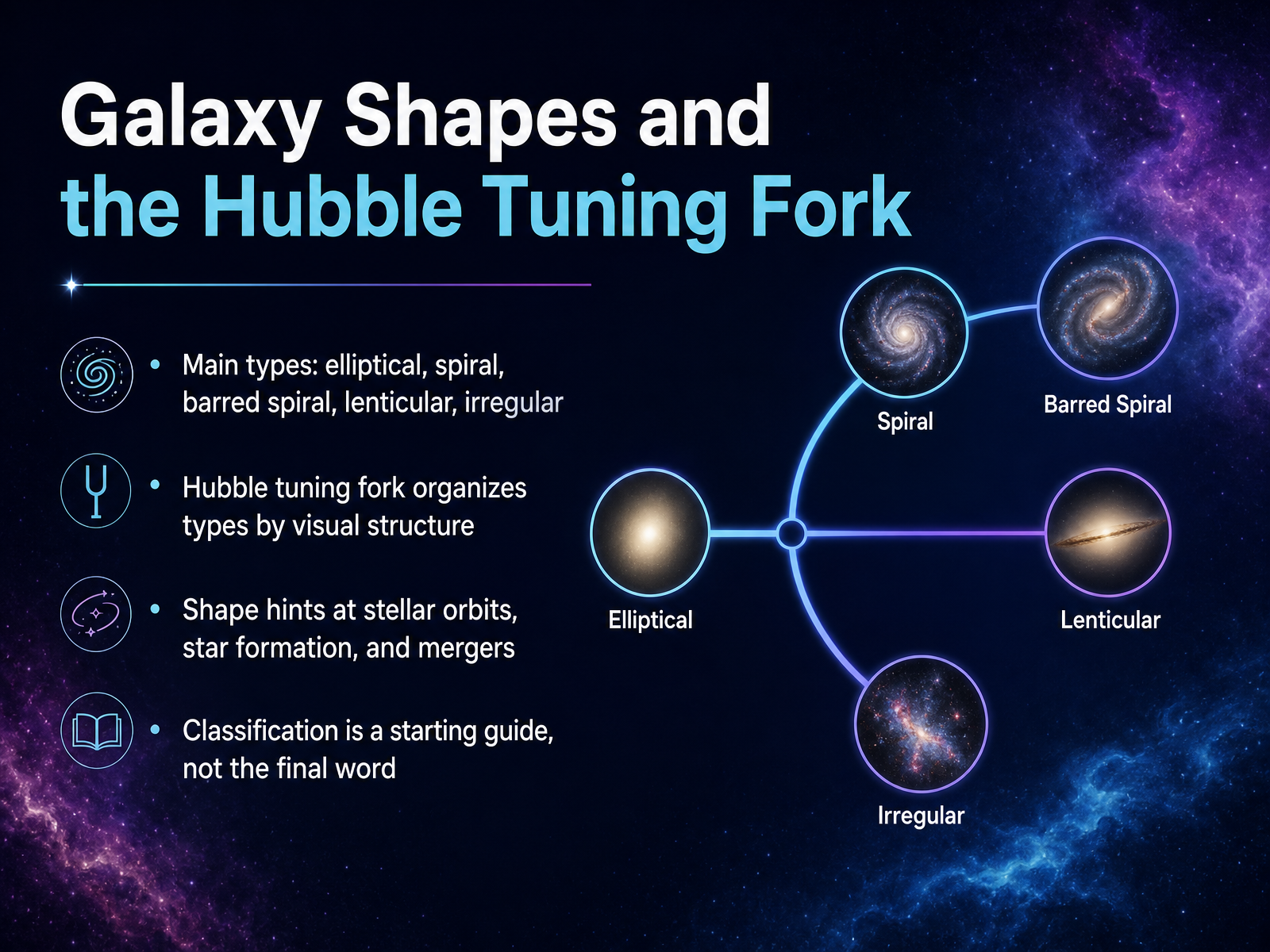
 - 03Galaxy Shapes and the Hubble Tuning ForkNow let's look at how we sort galaxies by shape. The traditional way begins with the Hubble tuning fork. This diagram organizes galaxies into a few broad families. Elliptical galaxies are smooth, round, or oval collections of older stars. Spiral galaxies have a flat disk with arms winding outward from a bright center. Barred spirals are similar, but their arms extend from a straight bar of stars crossing the middle. Lenticular galaxies sit between the two, with a disk but no clear spiral arms. Finally, irregular galaxies lack a defined shape altogether. The tuning fork is useful because shape often hints at history. A spiral pattern usually means the galaxy is still forming stars along its ordered orbits. An elliptical shape often suggests past mergers that scrambled those orbits. But shape is only a first clue. Real galaxies frequently blur these categories, and modern surveys reveal many that do not fit neatly on the fork at all. So think of classification as a helpful starting guide, not a final label. Up next, we will move beyond the classical sequence and see what newer observations reveal.
 google.iopscience.iop.orgaanda.orgaanda.org+22 min
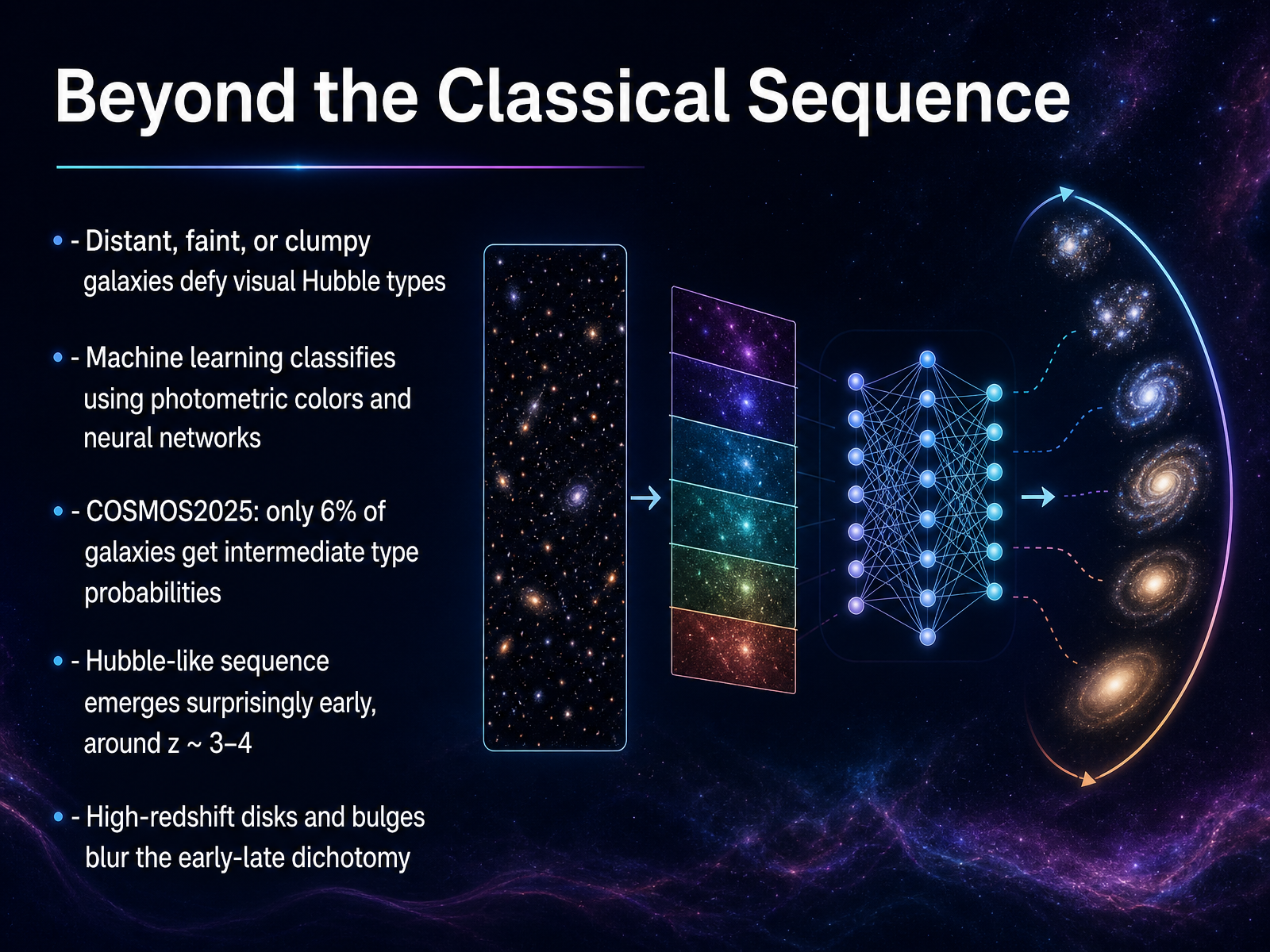
 - 04Beyond the Classical SequenceNow let's step beyond that classical sequence. When we look at distant, faint galaxies, especially in deep fields from the James Webb Space Telescope, many of them simply don't fit neatly into the visual Hubble types we just discussed. They appear clumpy, irregular, or just too dim to classify by eye. To handle millions of these objects, astronomers turned to machine learning. Instead of looking at pixel images, models like those used in the COSMOS twenty twenty-five catalog classify galaxies using photometric colors, effectively their brightness across different filters. These neural networks learn the subtle color signatures of old, quiescent populations versus young, star-forming ones. A striking result emerged: only about six percent of galaxies received intermediate type probabilities, meaning the vast majority are clearly one type or the other. Surprisingly, a Hubble-like sequence with recognizable disks and bulges appears to emerge very early in cosmic history, around redshift three to four, which is over eleven billion years ago. Even so, the story is messy. At these high redshifts, disks and bulges often blur together, and the simple early versus late dichotomy starts to break down. Next, we'll move from shapes to dynamics, and see how we can read motion through spectra.
 google.iopscience.iop.orgaanda.orgaanda.org+22 min
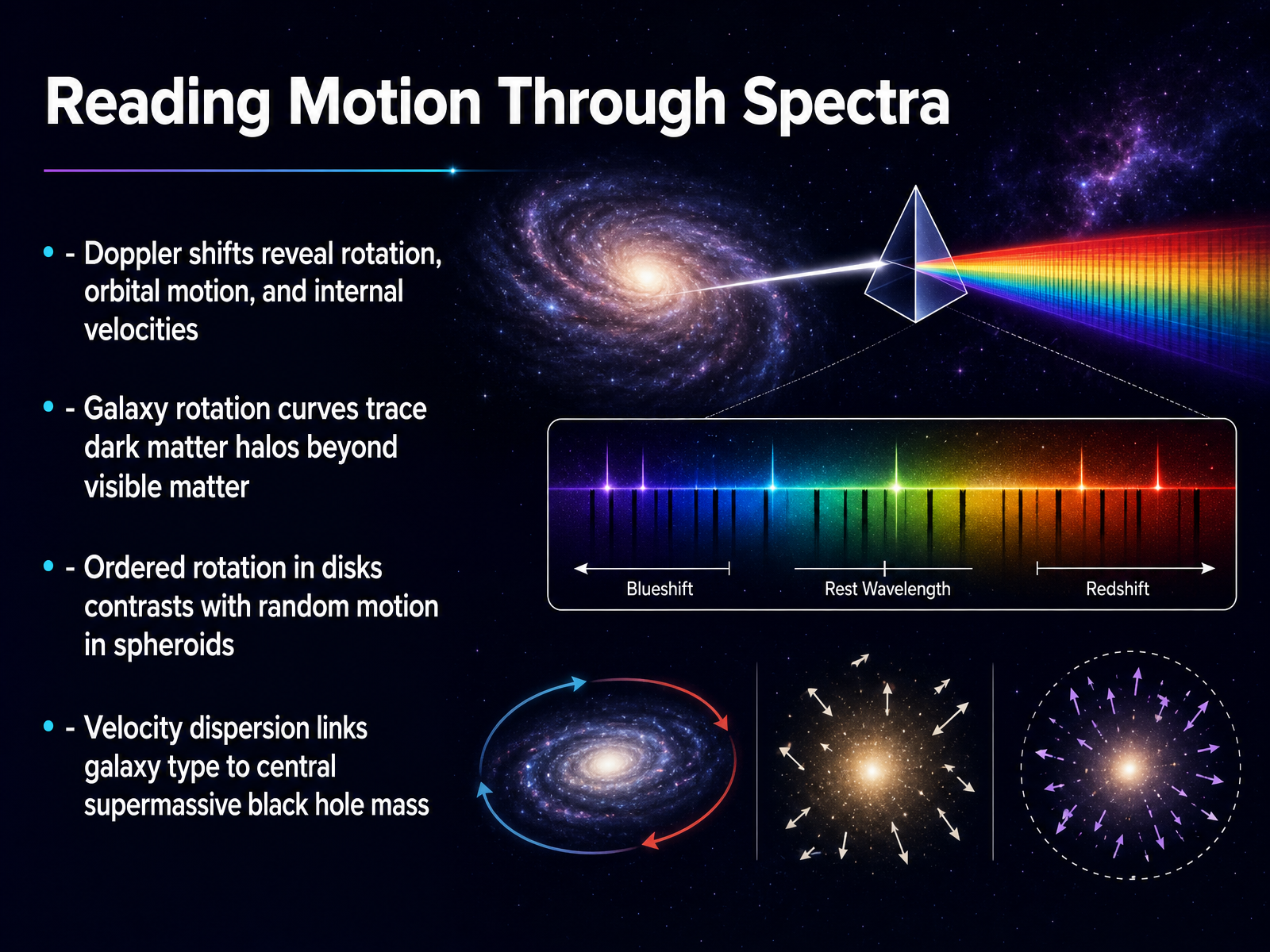
 - 05Reading Motion Through SpectraNow let's move from a galaxy's shape to its motion. When we look at a galaxy's spectrum, we're not just seeing what it's made of. Doppler shifts in that light tell us how fast different parts of the galaxy are moving toward us or away from us. This lets us measure rotation, orbital motion, and the speeds of stars deep inside. One of the great surprises from this work is the rotation curve. In the outer disk of a spiral galaxy, stars are moving much faster than the visible mass alone can explain. The simplest interpretation is that an enormous halo of dark matter surrounds the galaxy. We also see a clear contrast in how galaxies move. Disks show ordered rotation, while spheroids are dominated by more random stellar motion. That difference is not a coincidence. The velocity dispersion, essentially how scrambled the stellar motions are, is closely linked to the mass of the central supermassive black hole. In short, the way a galaxy moves is a direct record of its hidden mass and its deep history. Next, we'll turn to the clearest evidence for that hidden mass in the slide Dark Matter: Evidence and Open Questions.
 iopscience.iop.orgiopscience.iop.orgiopscience.iop.org+22 min
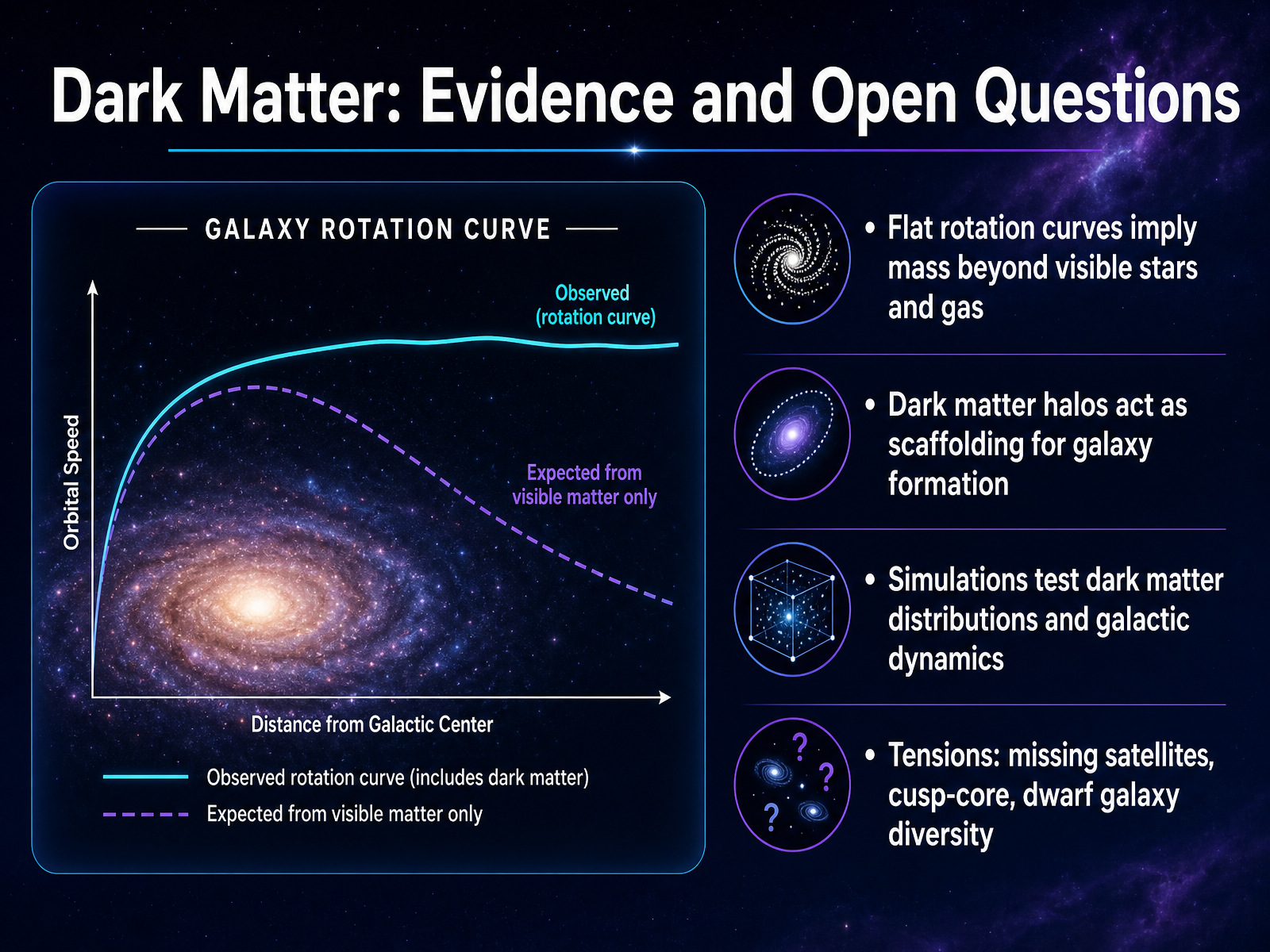
 - 06Dark Matter: Evidence and Open QuestionsNow let's turn to one of the greatest mysteries in galaxy science: dark matter. Although it emits no light, its gravity shapes everything we see. Look at how spiral galaxies rotate. If only the visible stars and gas were present, the outer regions should spin more slowly. Instead, their rotation speeds stay remarkably flat. This flat rotation curve tells us there is extra mass extending far beyond the visible galaxy. We call this hidden mass a dark matter halo. These halos act like vast, invisible scaffolding, providing the gravitational structure that allows normal gas to cool and form galaxies. Simulations build on this idea, using dark matter distributions to reproduce the large-scale web of galaxy clustering we observe. But the model is not perfect. Some simulations predict far more small satellite galaxies than we actually count around the Milky Way. Others struggle with the density shapes of dwarf galaxy centers and the wide diversity seen in their behavior. These tensions are active research areas. They push us to refine our understanding of dark matter itself and its role in galactic evolution. Up next, we will explore what happens when these massive structures meet, in galaxy collisions and mergers.
 iopscience.iop.orgiopscience.iop.orgiopscience.iop.org+21 min
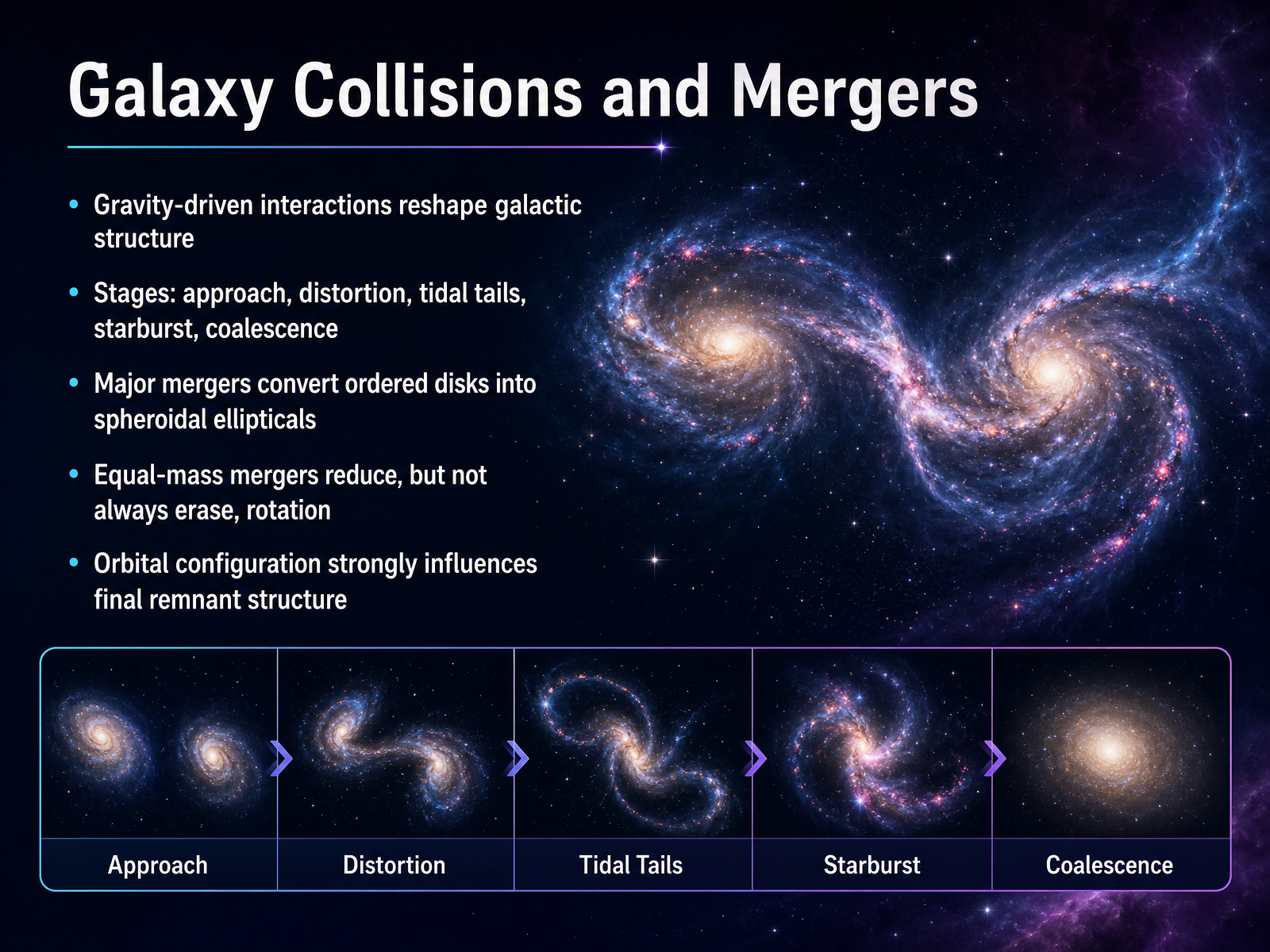
 - 07Galaxy Collisions and MergersNow we come to one of the most dramatic processes in the universe: galaxy collisions and mergers. When two galaxies pass close together, their mutual gravity begins to reshape them. We see a sequence unfold, from the first approach, to visible distortion, to long streams of stars called tidal tails. Gas clouds collide and compress, often triggering a starburst, a rapid wave of new star formation. Finally, the two systems coalesce into a single remnant. Major mergers, where the two galaxies have similar masses, tend to convert ordered disks into spheroidal ellipticals. But the outcome is not always so simple. Equal-mass mergers reduce rotation, yet they do not always erase it completely. A residual disk can survive. The final remnant depends strongly on the orbital configuration, the angle and path of the encounter. Some orbits preserve more structure, while others scatter stars into a rounder, more random shape. So mergers do not just destroy galaxies; they build new ones, piece by piece. Next, we will explore how mergers and morphology have changed across cosmic time.
 arxiv.orgaanda.orgarxiv.org+22 min
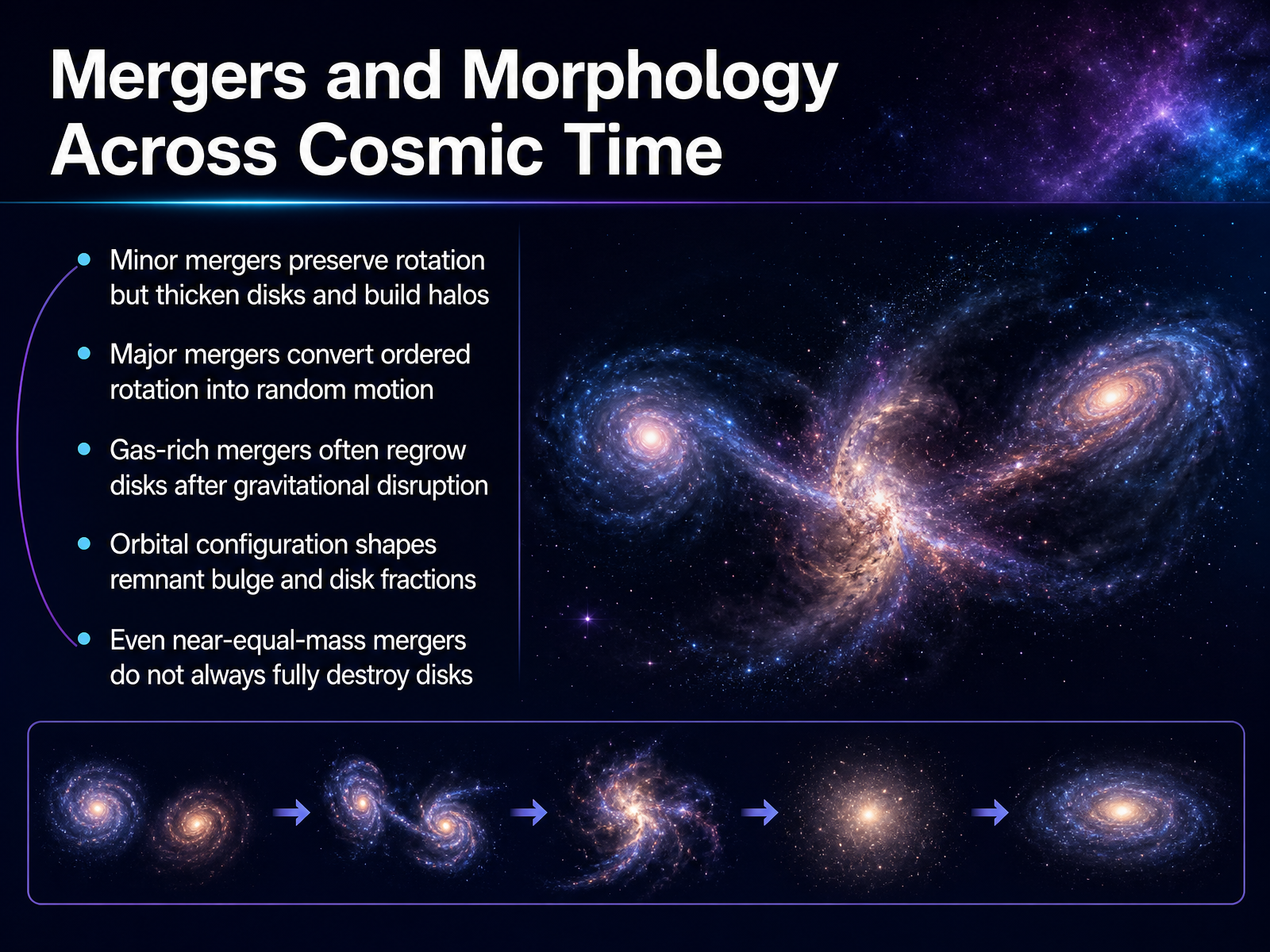
 - 08Mergers and Morphology Across Cosmic TimeNow let's look at what happens when galaxies collide. The effect depends a lot on the scale of the encounter. Minor mergers, where one galaxy is much smaller than the other, tend to preserve the larger galaxy's rotation. But they do thicken the disk and help build up the surrounding halo. Major mergers are different. When two galaxies of similar mass come together, their orderly rotation is often converted into random motion. The result is a rounder, less organized remnant. But the story doesn't end there. If the merging galaxies are rich in gas, that gas can settle back into a disk after the disruption, essentially regrowing a flat, rotating structure. Even the way the galaxies approach each other matters. Their orbital configuration shapes how much of the remnant ends up as a bulge versus a disk. And here's a finding that challenges older assumptions. Even near-equal-mass mergers don't always fully destroy the disk. Some ordered rotation can survive. So mergers sculpt galaxies, but they don't always erase their past. Next, we'll explore how star formation and the surrounding environment shape galaxies further.
 arxiv.orgaanda.orgarxiv.org+21 min
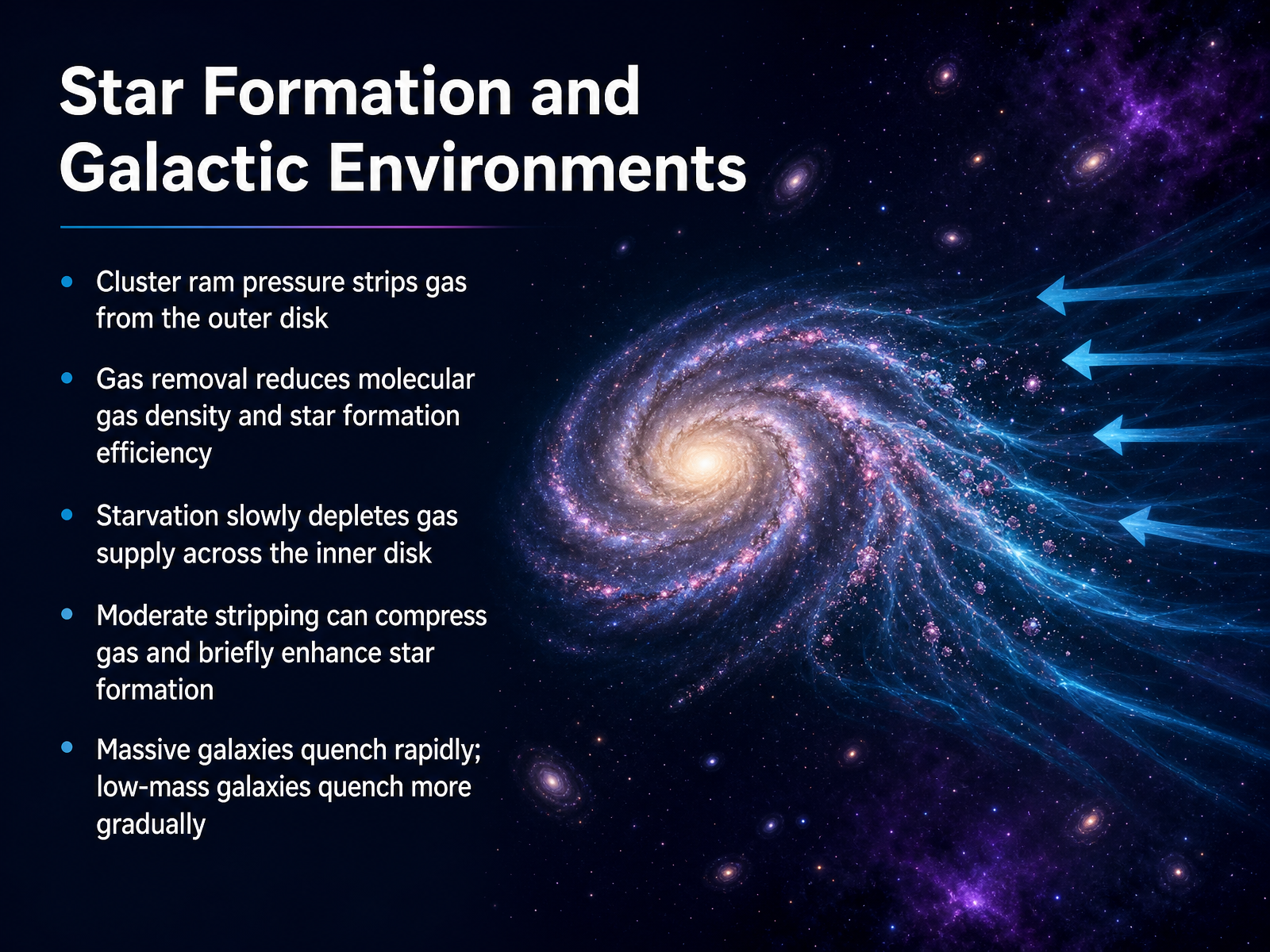
 - 09Star Formation and Galactic EnvironmentsNow let's turn to how a galaxy's environment shapes its ability to form stars. Inside a galaxy cluster, there is a hot, tenuous gas called the intracluster medium. As a galaxy moves through it, this medium pushes against the galaxy's own gas, a process called ram pressure stripping. Imagine a car speeding through rain; the water is pushed back and away. Similarly, ram pressure can sweep gas out of the galaxy's outer disk. When a galaxy loses its gas, its molecular gas density drops, and the efficiency of star formation declines along with it. But the story is not always that simple. Moderate stripping can actually compress gas, leading to a brief burst of star formation before the supply is ultimately lost. Another related effect is starvation. This happens when the galaxy's supply of fresh gas is cut off, so it slowly uses up what remains. Starvation depletes gas across the inner disk over a longer time. Interestingly, galaxy mass matters here. Massive galaxies tend to quench, or stop forming stars, rapidly, while low mass galaxies fade much more gradually. In the next slide, we will explore the powerful connection between supermassive black holes and active galaxies.
 arxiv.orgaanda.orgarxiv.org+21 min
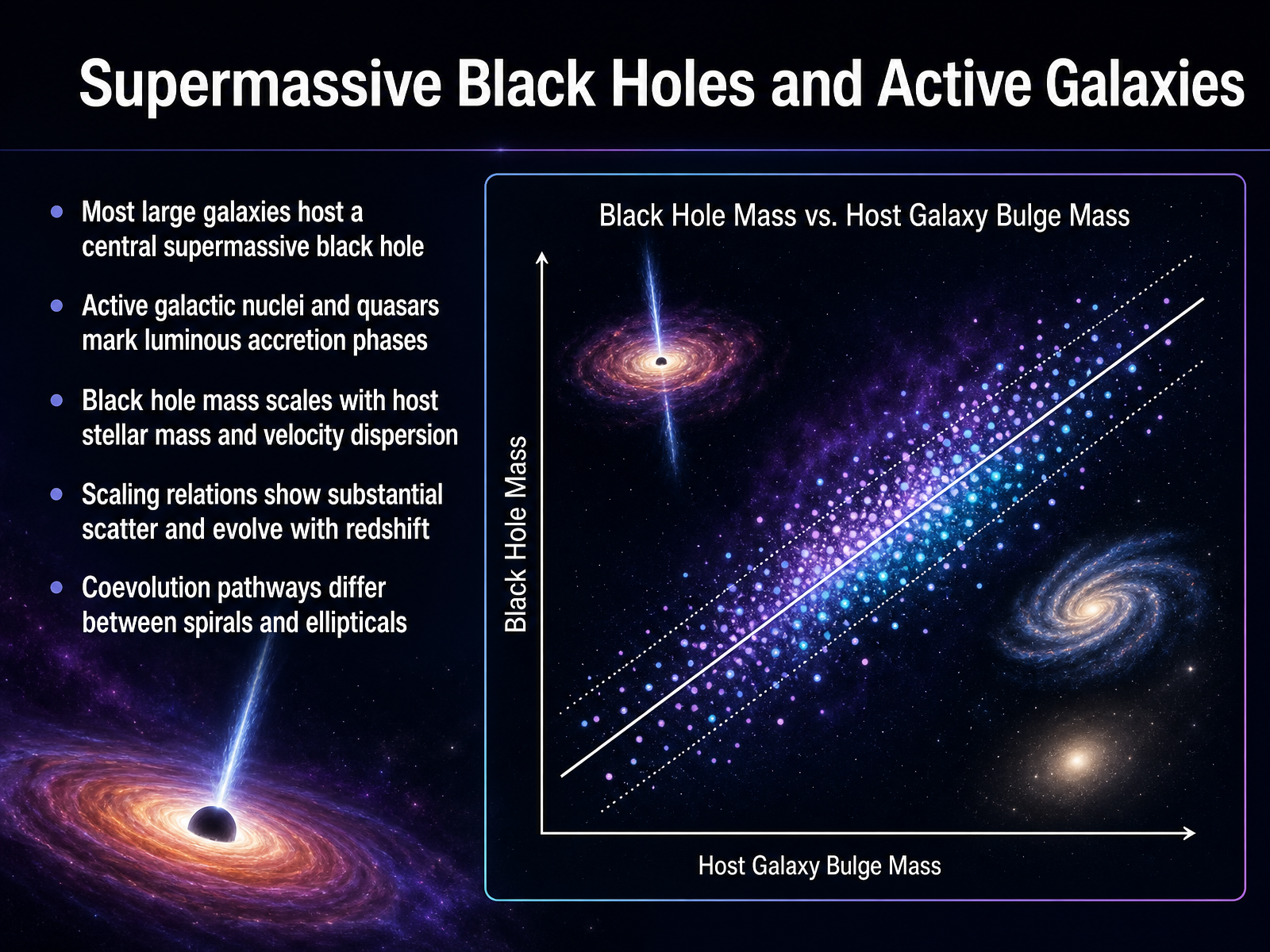
 - 10Supermassive Black Holes and Active GalaxiesNow let us turn to the gravitational centers of galaxies. Most large galaxies, including our Milky Way, host a central supermassive black hole. Some of these black holes power what we call active galactic nuclei, or quasars, which mark periods when the black hole is accreting gas and shines brilliantly. There is a remarkable pattern here. The mass of a supermassive black hole scales with its host galaxy's stellar mass and with how fast stars orbit in the galaxy's center, a quantity called velocity dispersion. This tells us black holes and galaxies grow together. But the relationship is not rigid. The scaling relations show substantial scatter, meaning individual systems can differ. This scatter changes with redshift, so the connection evolves over cosmic time. Importantly, the coevolution pathways differ between spirals and ellipticals. In spiral galaxies, black holes may drive changes in their hosts. In ellipticals, they seem to grow more passively alongside them. Next, we will explore how these black holes feed back into their galaxies and regulate star formation.
 iopscience.iop.orgiopscience.iop.orgiopscience.iop.org+22 min
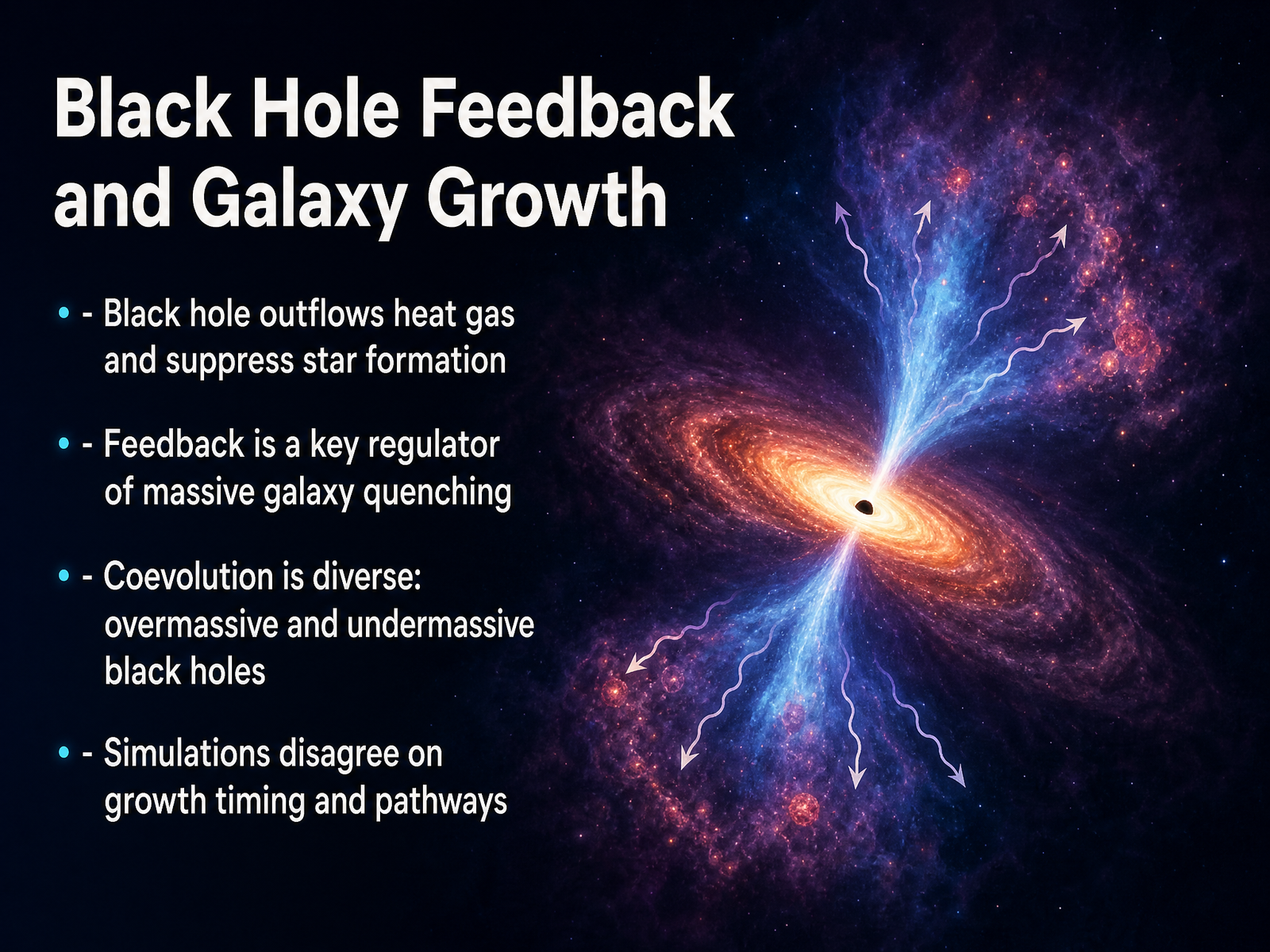
 - 11Black Hole Feedback and Galaxy GrowthNow let's consider the role of the black hole in a galaxy's life. When a supermassive black hole feeds, it can drive powerful outflows of energy and gas. These outflows heat the surrounding gas, suppressing star formation. This process, called feedback, is a key regulator of quenching, which is how a massive galaxy shuts down its star formation and becomes passive. But the story is not the same for every galaxy. Some systems have black holes that are overmassive compared to their host, while others are undermassive, revealing a diverse coevolution. Our simulations also show disagreements on the timing and pathways of this growth. Different models produce different evolutionary histories, and that's an active area of research. Next, we will explore how galaxy evolution unfolds across cosmic time.
 iopscience.iop.orgiopscience.iop.orgiopscience.iop.org+21 min
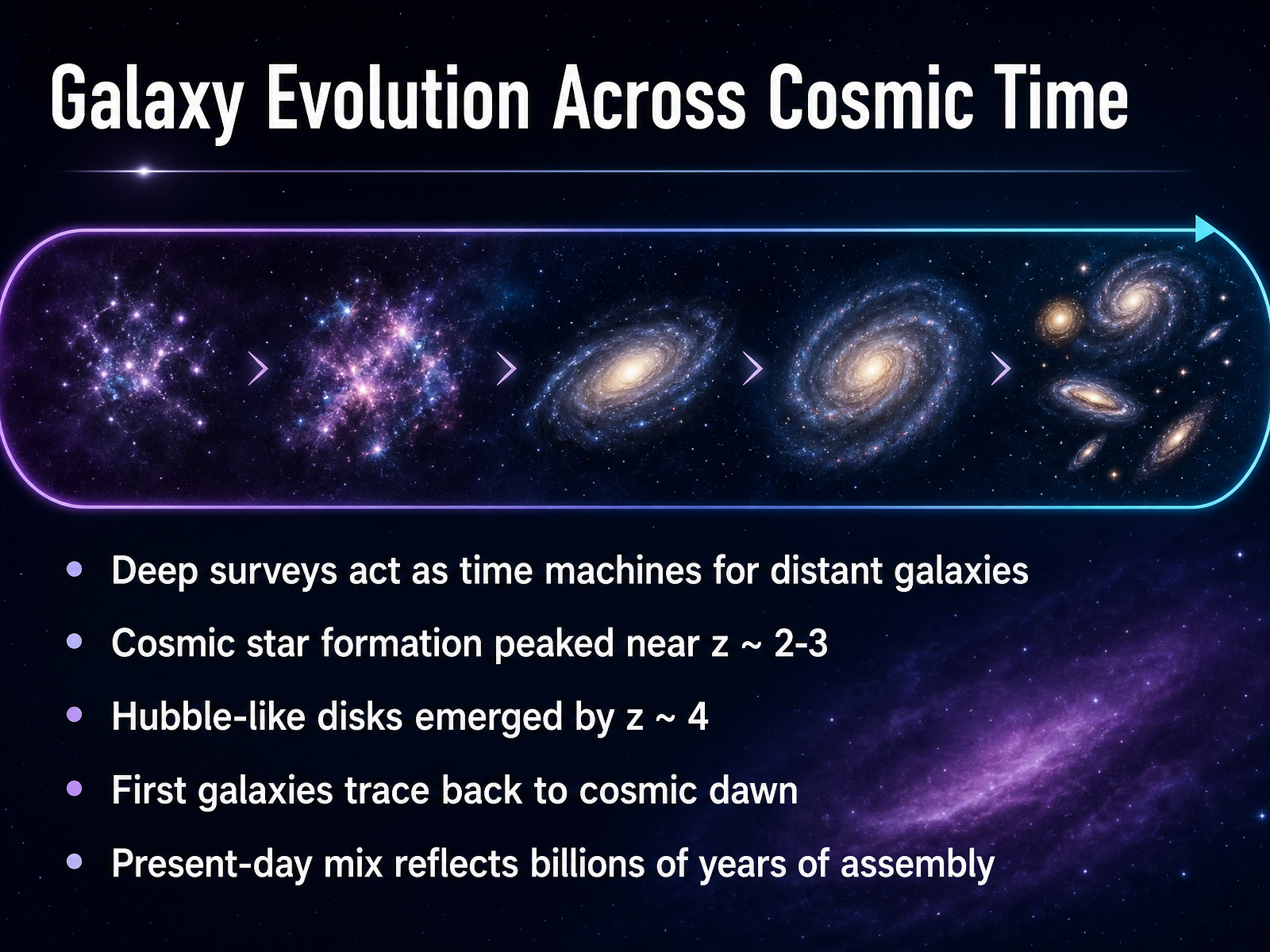
 - 12Galaxy Evolution Across Cosmic TimeNow let's step back and watch the whole grand story unfold across cosmic time. Deep surveys like those from JWST act as time machines, letting us see galaxies as they were billions of years in the past. When we chart star formation across the universe, we find a dramatic peak around redshift two to three, a period often called cosmic noon. Before that, at redshift four, we already see surprisingly mature disks taking shape. But trace things back to cosmic dawn, and the first galaxies were much smaller and more chaotic. A striking fact is that the star formation rate back then was up to ten times higher than what we see today. The universe was far more turbulent and productive. All that assembly and quenching over billions of years has produced the mix of galaxies we observe now. Understanding this evolution sets the stage for the final piece of our story, observing galaxies in the universe today.
 google.iopscience.iop.orgaanda.orgaanda.org+21 min
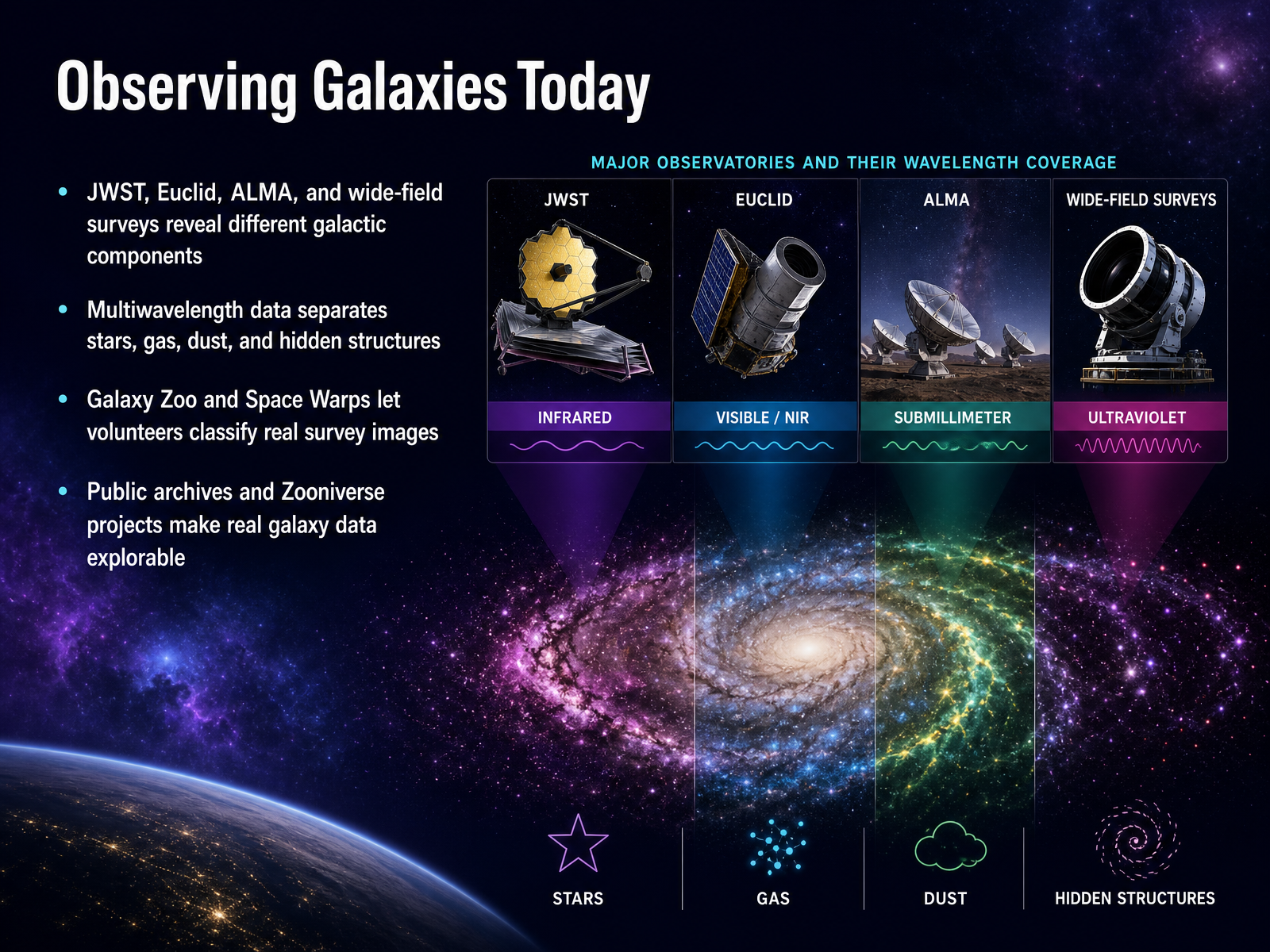
 - 13Observing Galaxies TodayToday, observing galaxies is a deeply collaborative effort between powerful instruments and curious minds. The James Webb Space Telescope reveals the faint, distant ancestors of galaxies like our Milky Way, while the Euclid telescope maps enormous regions of sky in stunning detail. Instruments like ALMA detect the cold gas and dust where new stars form, and wide field surveys capture millions of galaxies at once. By combining these multiwavelength views, astronomers can separate the light of stars from glowing gas, dark dust lanes, and hidden structures that any single image would miss. The sheer volume of data is immense, far more than researchers can examine alone. This is where you can actually participate, through citizen science. Projects like Galaxy Zoo and Space Warps let volunteers inspect real survey images, classify galaxy shapes, and even find rare gravitational lenses. When humans and artificial intelligence work together, hundreds of thousands of galaxies become explorable by anyone with an internet connection. Next, we will tie these threads together in a synthesis of what we have learned, and look ahead to the open questions that still shape our understanding of the universe.
 2 min
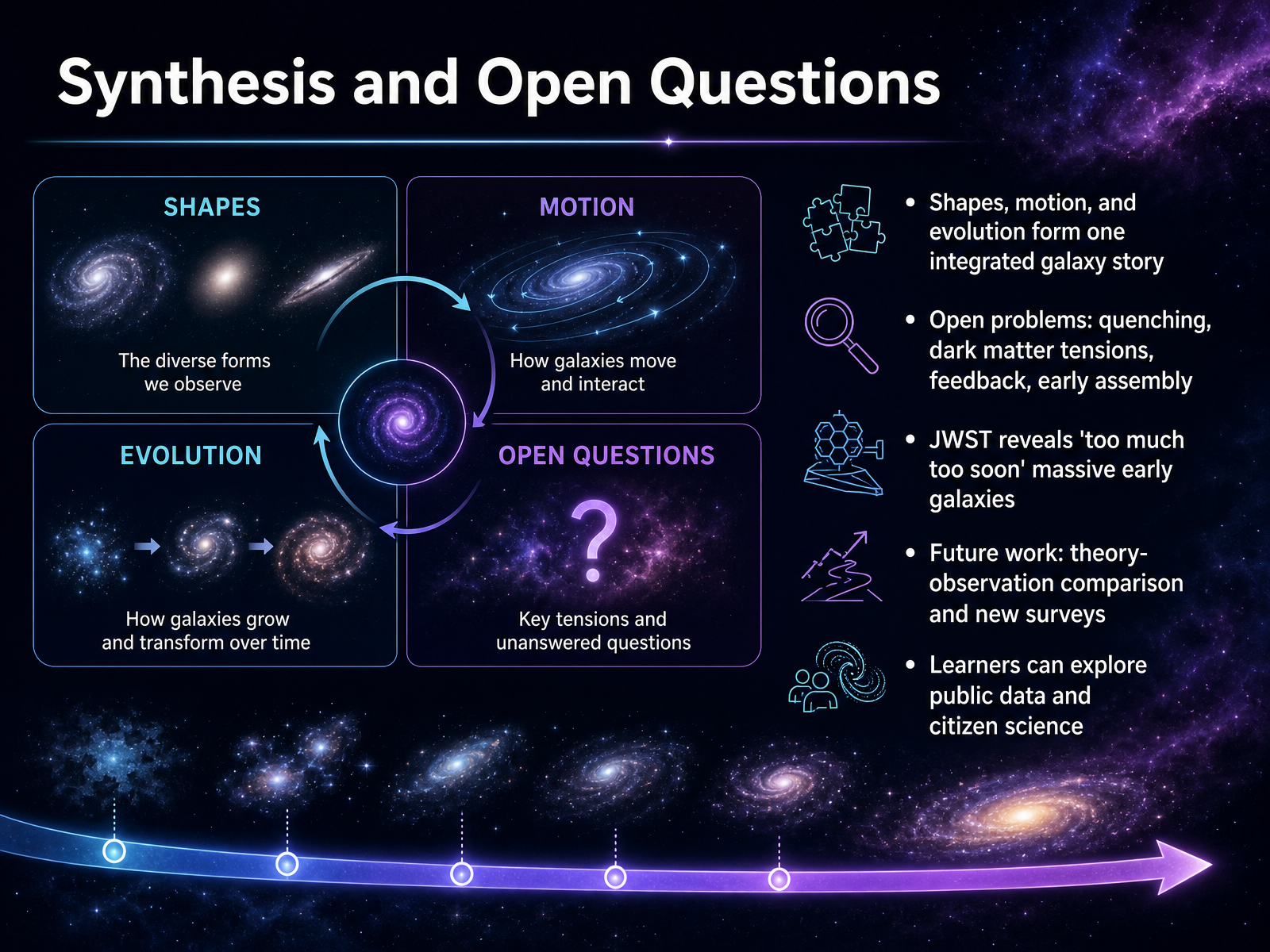
2 min - 14Synthesis and Open QuestionsWe have traced one connected story, from the elegant spiral arms of a disk galaxy to the gentle aging of an elliptical, and then out through the long, slow dance of galactic motion. Shapes are not frozen categories. They are chapters in a galaxy's life, written by gravity, gas, and time. But for all we have mapped, the story is not finished. Some of our most interesting questions remain open. Why do certain massive galaxies shut down their star formation so abruptly? How exactly does feedback from stars and central black holes push gas out of a galaxy, and how much of that gas later falls back in? We also face genuine puzzles around the nature and distribution of dark matter. And the James Webb Space Telescope has added a new and humbling twist: galaxies in the very early universe that appear to have assembled far too much stellar mass, far too soon for our standard models to comfortably explain. That tension, which astronomers often call too much too soon, is one of the most exciting problems in the field. The next chapter will be written through careful comparisons between theory and new observations, paired with large surveys that chart billions of galaxies. And you do not need a telescope in orbit to take part. Public data archives and citizen science projects let learners like you help classify real galaxies, including some that no one has carefully studied before. That is a remarkable way to end this course. You now understand why a spiral looks the way it does, how galaxies move through space and time, and why so many open questions remain. Thank you for joining this journey across the universe. Keep looking up, and maybe the next galaxy you help classify will surprise us all.
 2 min
2 min
Take the deck with you
Download this course as a file — free, no sign-up needed.
- PDF handoutEvery slide page, ready to print or share.15 pages · 4.4 MBDownload
- Narrated PowerPointThe deck that presents itself — every slide carries the digital human's narration video.15 pages · 16.2 MBDownload
- PowerPoint slidesThe full deck as a .pptx — open it in PowerPoint, Keynote, or Google Slides.15 pages · 4.4 MBDownload
Free to use in your own training — please keep the PersonWise credit page at the end.
Have your own deck? Turn it into a course
Sources consulted
Web sources consulted while building this course.
- COSMOS2025: Machine Learning Classification of Early- and Late-type Galaxies at 0 < z < 3 - IOPscience — google.iopscience.iop.org
- COSMOS-Web: The emergence of the Hubble sequence — aanda.org
- A robust morphological classification method for galaxies using dual-encoding contrastive learning and multi-clustering voting on JWST/NIRCam images | Astronomy & Astrophysics (A&A) — aanda.org
- DAWN JWST Archive: Morphology from profile fitting of over 340 000 galaxies in major JWST fields - Morphology evolution with redshift and galaxy type | Astronomy & Astrophysics (A&A) — aanda.org
- An Updated Efficient Galaxy Morphology Classification Model Based on ConvNeXt Encoding with UMAP Dimensionality Reduction - IOPscience — iopscience.iop.org
- Large-scale Structure in COSMOS-Web: Tracing Galaxy Evolution in the Cosmic Web up to z ∼ 7 with the Largest JWST Survey - IOPscience — iopscience.iop.org
- Overview of the JWST Advanced Deep Extragalactic Survey (JADES) - IOPscience — iopscience.iop.org
- The Cosmic Evolution Early Release Science Survey (CEERS) - IOPscience — iopscience.iop.org
- Galaxies Over Time — science.nasa.gov
- The UNCOVER Survey: A First-look HST+JWST Catalog of Galaxy Redshifts and Stellar Population Properties Spanning 0.2 ≲ z ≲ 15 - IOPscience — iopscience.iop.org
- Diverse Pathways for Supermassive Black Hole–Galaxy Coevolution - IOPscience — iopscience.iop.org
- Causal Reversal in the M•–σ0 Relation: Implications for High-redshift Supermassive Black Hole Mass Estimates - IOPscience — iopscience.iop.org
- The Redshift Evolution of the MBH–M* Scaling Relation: New Insights from Cosmological Simulations and Semianalytic Models - IOPscience — iopscience.iop.org
- Tracking the Assembly of Supermassive Black Holes: A Comparison of Diverse Models across Cosmic Time - IOPscience — iopscience.iop.org
- Overmassive and Undermassive Massive Black Holes: The Role of Environment and Gravitational-Wave Recoils | Astronomy & Astrophysics (A&A) — aanda.org
- Ruffled Feathers: Merger-driven galaxy size growth and structural transformation in EAGLE — arxiv.org
- The effects of the orbital configurations of mergers on reshaping galaxy structures | Astronomy & Astrophysics (A&A) — aanda.org
- [2602.19227v1] Feedback shaped the galaxy morphological sequence in presence of mergers — arxiv.org
- Revisiting Galaxy Evolution in Morphology in the Cosmic Evolution Survey Field (COSMOS-ReGEM). I. Merging Galaxies - IOPscience — iopscience.iop.org
- role of mergers in driving morphological transformation over ... — academic.oup.com