Cybersecurity vs Software Engineering: Key Differences
Begin
14 pages · ~28 min
Cybersecurity vs Software Engineering: Key Differences
This training compares cybersecurity and software engineering, helping professionals understand their key differences, tradeoffs, and use cases to make informed career and project decisions.
What you’ll learn
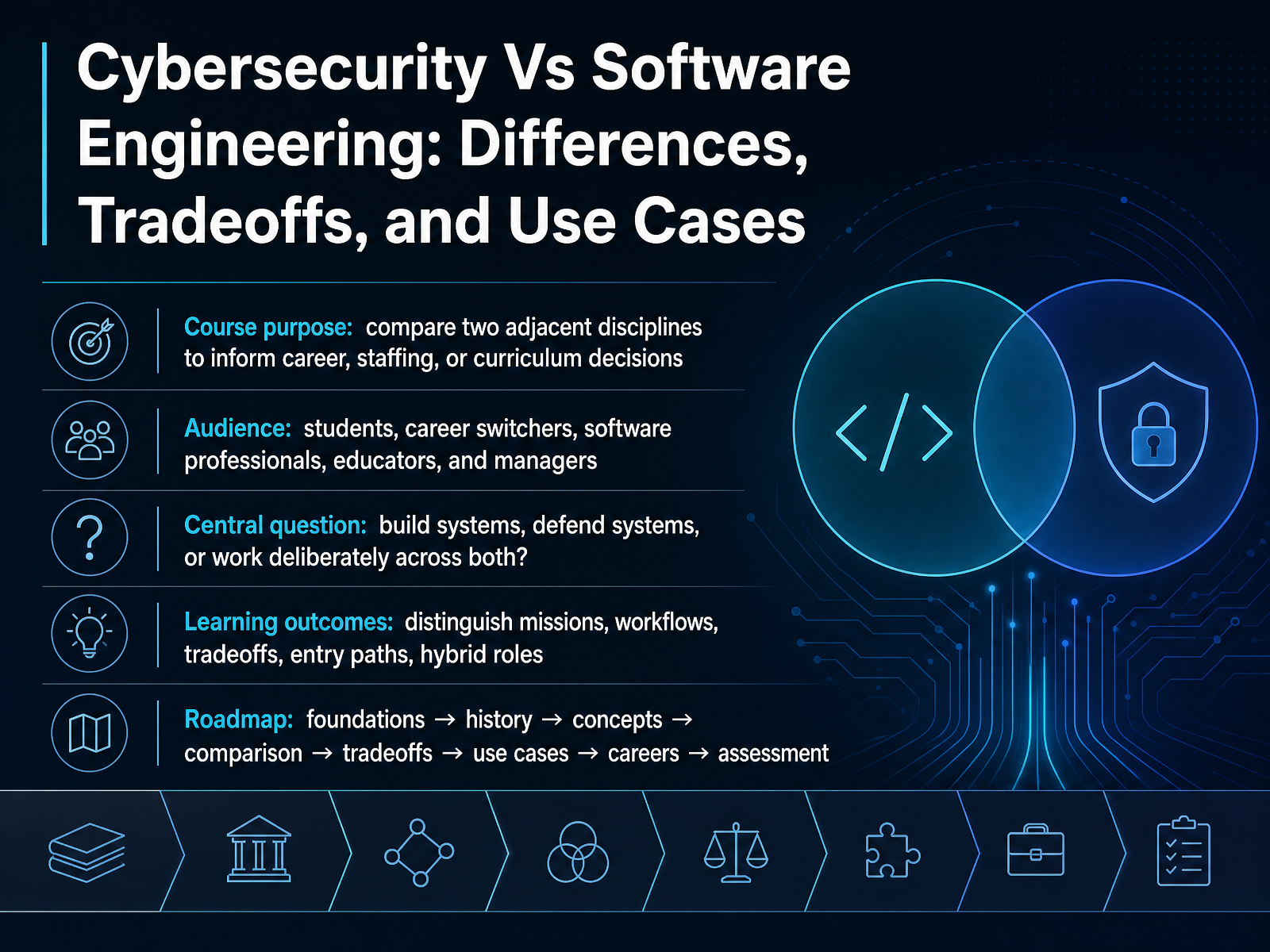
- 01Cybersecurity Vs Software Engineering: Differences, Tradeoffs, and Use CasesWelcome. This course compares two adjacent fields: cybersecurity and software engineering. The goal is practical. If you are a student, a career switcher, a working professional, an educator, or a manager, you will finish with clear language for career, staffing, and curriculum decisions. Here is the central question. Do you want to build systems, defend systems, or work deliberately across both? We will answer it step by step. Along the way, you will learn to distinguish missions, workflows, tradeoffs, entry paths, and hybrid roles. A quick example: a software engineer ships a new login feature, while a security analyst tests whether that login can be abused. You will see how each role thinks, what evidence employers look for, and where the two overlap. Our roadmap runs from foundations, to history, to core concepts, then a side by side comparison, tradeoffs, use cases, careers, and a short assessment. You do not need to choose a side today. You need a clear framework, and that is what we will build together. Next, we look at how these two disciplines emerged.techcerted.comonlinecybersecurity.orgdigitaldefynd.com+21 min
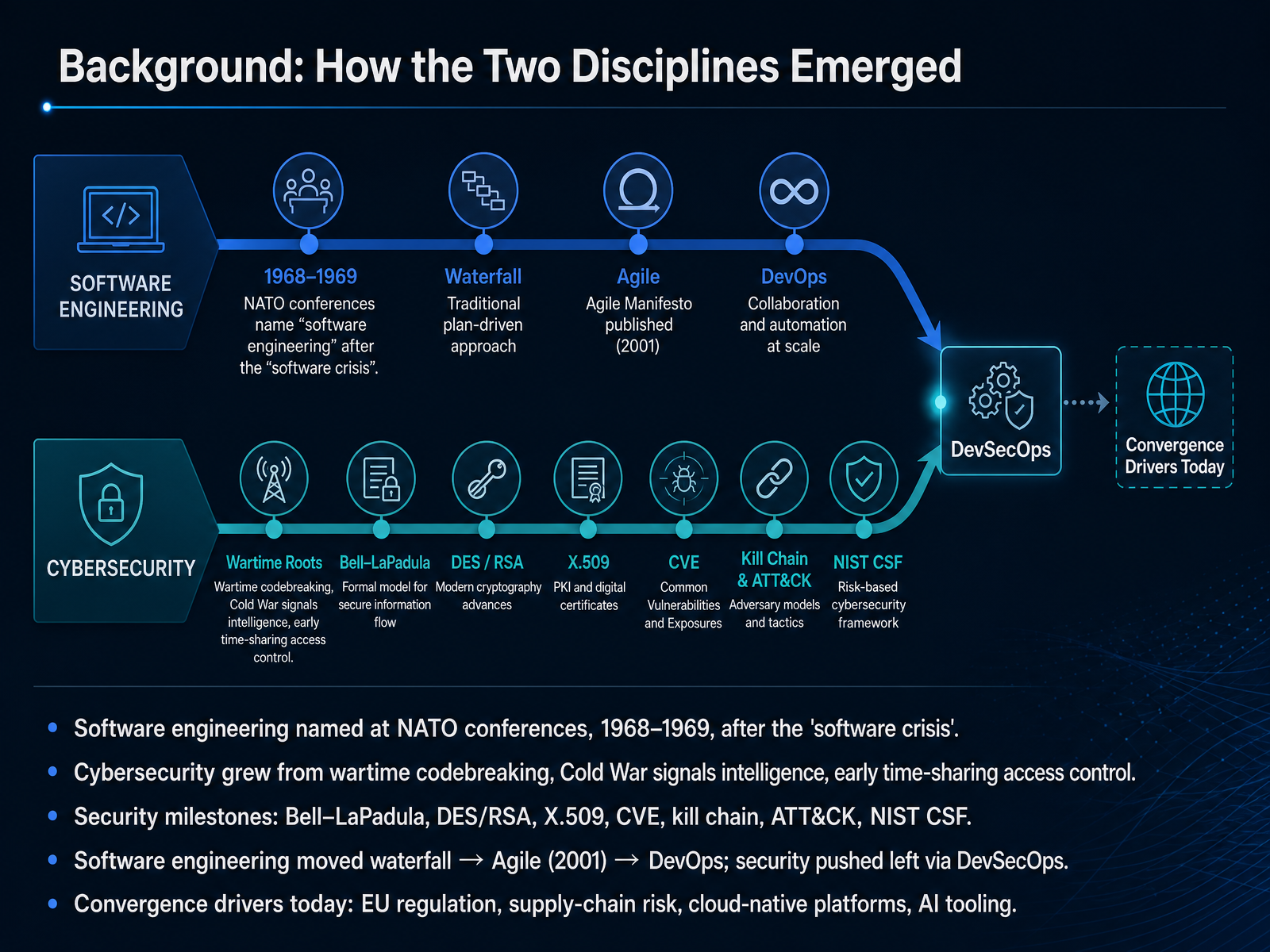
- 02Background: How the Two Disciplines EmergedLet's look at how these two disciplines emerged. Software engineering got its name at NATO conferences in nineteen sixty-eight and sixty-nine, a response to what people called the software crisis. Projects ran over budget, and some failures caused real harm. Around the same time, cybersecurity grew from different roots. Wartime codebreaking, Cold War signals intelligence, and early time-sharing access controls all shaped it. Key security milestones include the Bell–LaPadula model, DES and RSA encryption, the X.509 certificate standard, the CVE vulnerability database, the kill chain, MITRE ATT&CK, and the NIST Cybersecurity Framework. Software engineering, meanwhile, moved from waterfall to Agile in two thousand one, then to DevOps. Security followed by shifting left, which is why we now talk about DevSecOps. Today, several forces push the two fields closer. European Union regulation, supply chain risk, cloud-native platforms, and AI tooling all require both secure code and security-aware engineers. So historically, software engineering focused on building reliable systems, while cybersecurity focused on defending them. Next, let's define what each discipline actually does.
 doi.orgen.wikipedia.orgpeople.inf.ethz.ch+21 min
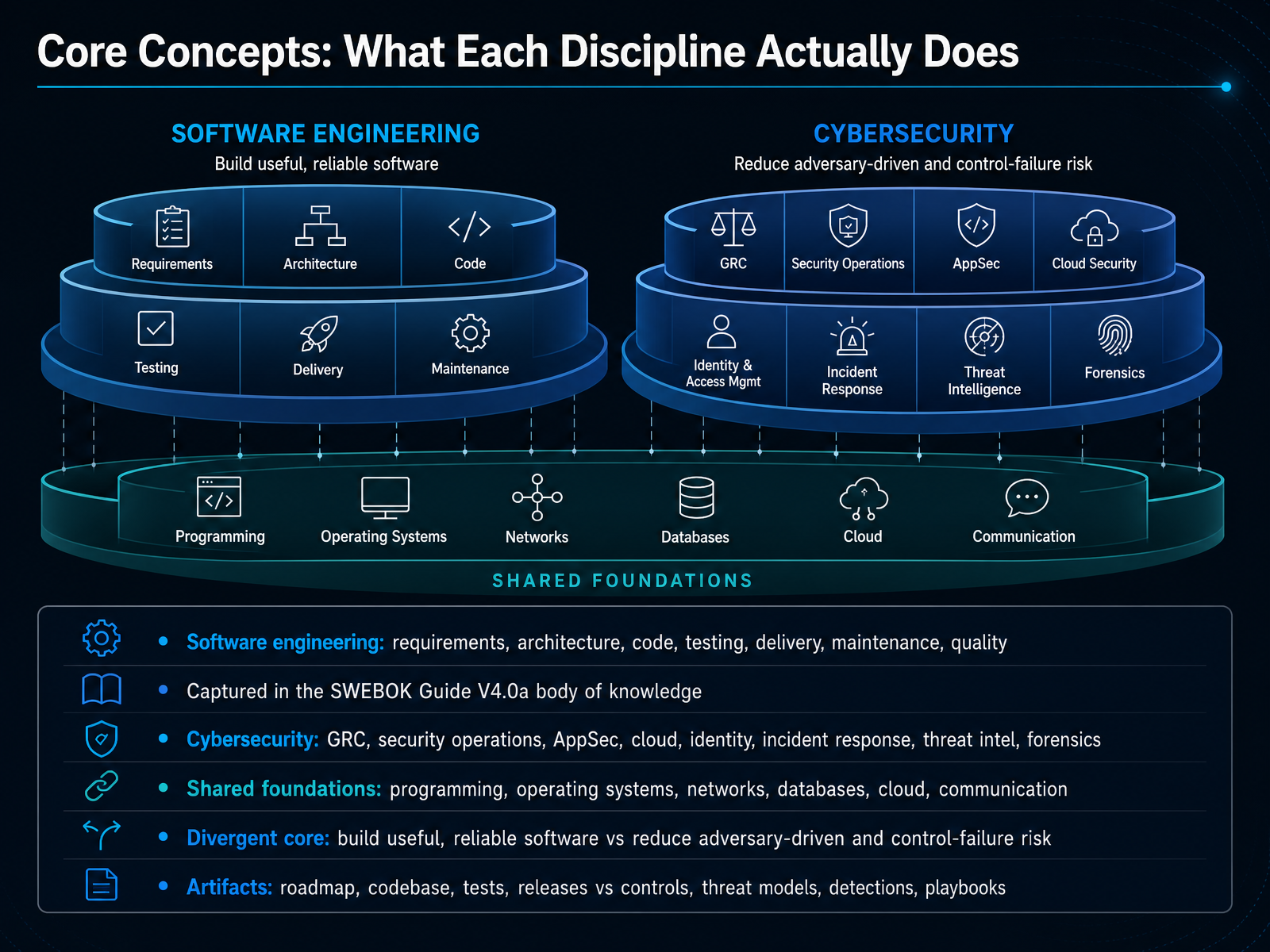
 - 03Core Concepts: What Each Discipline Actually DoesLet's define what each discipline actually does. Software engineering covers requirements, architecture, code, testing, delivery, maintenance, and quality. That scope is captured in the SWEBOK Guide, version four point zero a, the IEEE Computer Society body of knowledge. Cybersecurity covers governance, risk, and compliance, security operations, application security, cloud, identity, incident response, threat intelligence, and forensics. Now, both fields share foundations: programming, operating systems, networks, databases, cloud, and communication. What diverges is the core purpose. Software engineering builds useful, reliable software. Cybersecurity reduces adversary-driven and control-failure risk. You can also see the difference in the artifacts each produces. Software engineering delivers a roadmap, a codebase, tests, and releases. Cybersecurity delivers controls, threat models, detections, and playbooks. So think of it this way: one discipline creates and sustains the product, the other protects it and manages the risk around it. Next, we'll compare these fields across skills, metrics, and work rhythms.
 onlinecybersecurity.orgonline.uwa.edualbany.edu+22 min
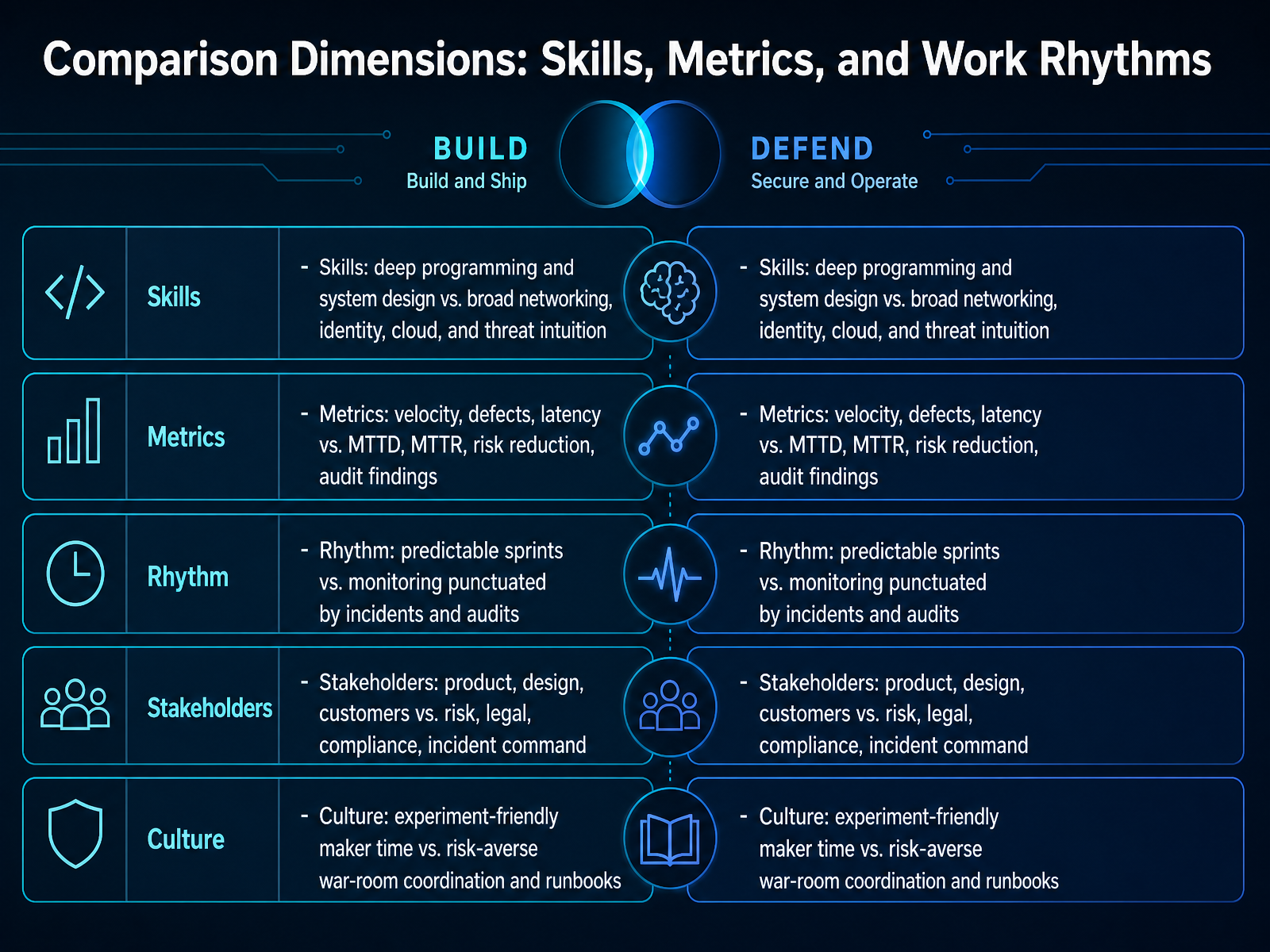
 - 04Comparison Dimensions: Skills, Metrics, and Work RhythmsLet's break the comparison into dimensions you can actually observe at work. Start with skills. Software engineering rewards depth: strong programming and system design, so you can hold a complex system in your head. Cybersecurity rewards breadth: networking, identity, cloud, and threat intuition, so you can spot what could go wrong.
Next, metrics. Engineering teams track velocity, defects, and latency. Security teams track mean time to detect, mean time to repair, risk reduction, and audit findings. Notice how one set measures output and the other measures exposure.
Then rhythm. Engineering tends to run in predictable sprints. Security runs on monitoring, punctuated by incidents and audits.
Stakeholders differ too. Engineers work with product, design, and customers. Security works with risk, legal, compliance, and incident command.
Finally, culture. Engineering is experiment friendly, with protected maker time. Security is risk averse, built on runbooks and war room coordination. Same company, different operating modes.
Tradeoffs: Speed, Rigor, Cost, and Risk
 techcerted.comindeed.compaymetriclabs.com+21 min
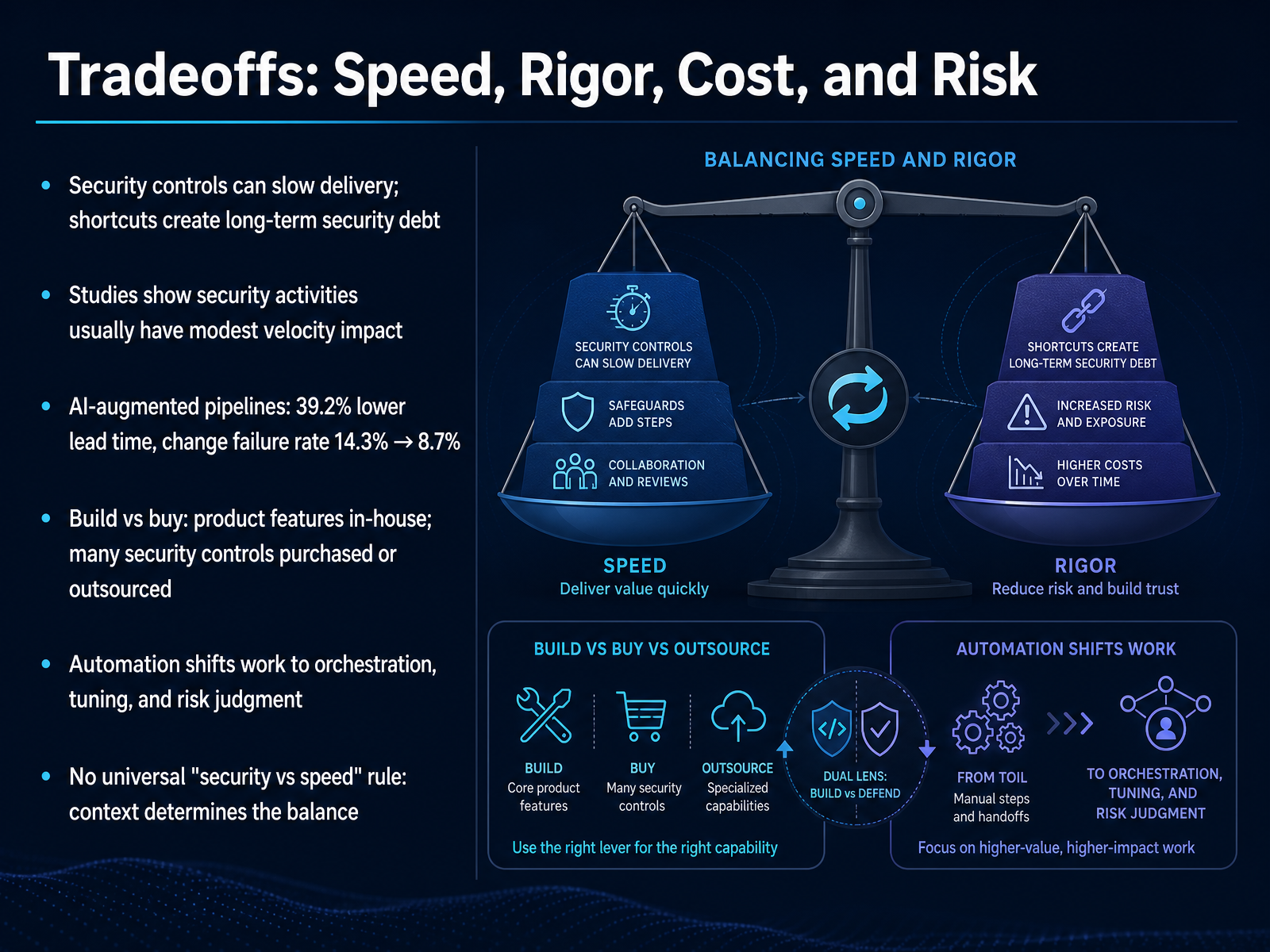
 - 05Tradeoffs: Speed, Rigor, Cost, and RiskNow let's compare the tradeoffs between these two worlds. When you add security controls, delivery can slow down. Skip those steps, and you build what practitioners call security debt, problems that compound over time. But here is the nuance. Our next slide will cover that. In practice, security activities usually have a modest velocity cost, often ten to twenty percent, and careful planning absorbs much of it. Automation changes the equation. In one study of AI-augmented pipelines, lead time dropped by thirty-nine point two percent, and change failure rate fell from fourteen point three percent to eight point seven percent. Build versus buy also matters. Teams build product features in-house, but many security controls are purchased or outsourced as tools and services. Automation shifts the work toward orchestration, tuning, and risk judgment. There is no universal security versus speed rule. Context determines the balance, based on criticality, regulation, and user expectations. Coming up next, we look at use cases, where each discipline creates the most value.
 f1000research.comdl.acm.orgsciencedirect.com2 min
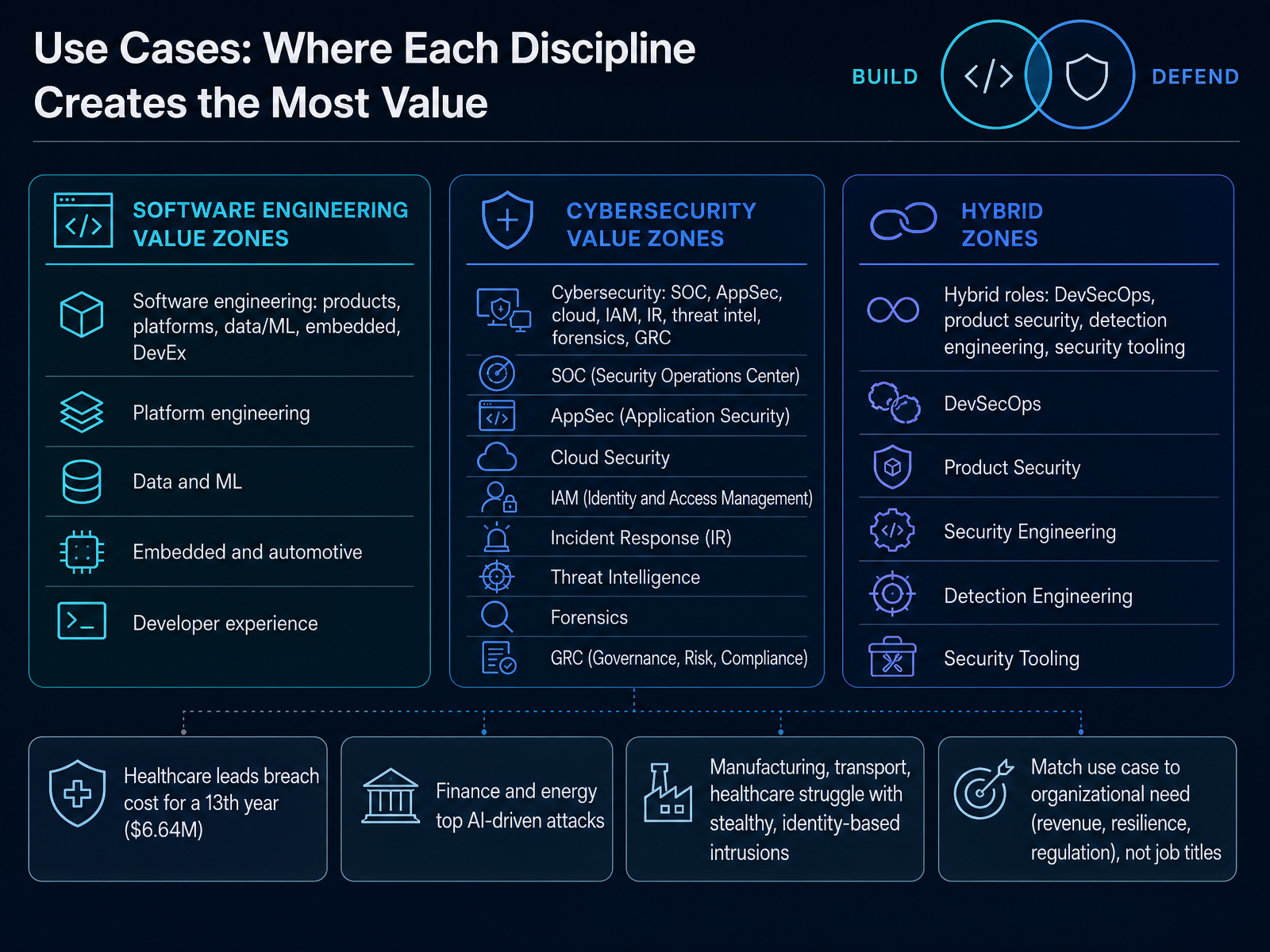
 - 06Use Cases: Where Each Discipline Creates the Most ValueLet's look at where each discipline creates the most value. Software engineering drives products, platforms, data and machine learning systems, embedded software, and developer experience. Cybersecurity protects the organization through the security operations center, application security, cloud security, identity and access management, incident response, threat intelligence, forensics, and governance, risk, and compliance. Between them sit hybrid roles: DevSecOps, product security, detection engineering, and security tooling. Now consider industry context. Healthcare has led breach cost for a thirteenth straight year, at six point six four million dollars. Finance and energy top the list for AI-driven attacks. Manufacturing, transport, and healthcare struggle most with stealthy, identity-based intrusions. So match the use case to the organizational need, whether that is revenue, resilience, or regulation, not to job titles. Next, we turn to career paths, roles, progression, and specializations.
 onlinecybersecurity.orgonline.uwa.edualbany.edu+21 min
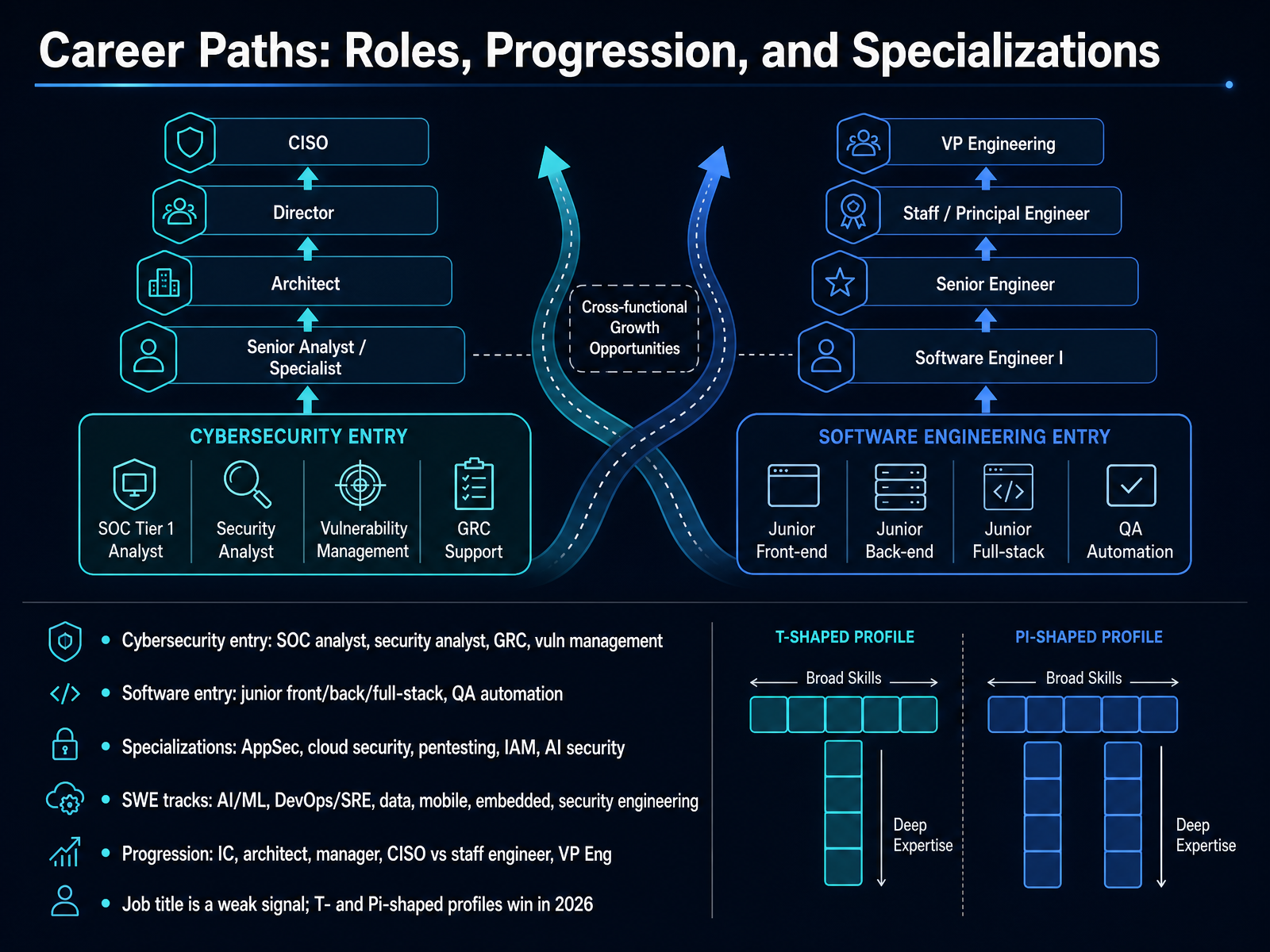
 - 07Career Paths: Roles, Progression, and SpecializationsNow let's look at career paths, because this is where the two fields separate most clearly. In cybersecurity, entry roles include SOC analyst, security analyst, governance risk and compliance, and vulnerability management. In software engineering, typical entry points are junior front end, back end, or full stack developer, plus QA automation. From there, both fields offer specializations. Cybersecurity leans toward application security, cloud security, penetration testing, identity and access management, and the newer AI security space. Software engineering spans AI and machine learning, DevOps and SRE, data, mobile, embedded, and security engineering. Progression also differs. Cybersecurity commonly moves through individual contributor to architect, manager, and ultimately CISO. Software engineering often moves from individual contributor to staff engineer, then VP of Engineering. One important point for twenty twenty-six: job titles are a weak signal. Employers increasingly look for T-shaped or Pi-shaped profiles, meaning broad capability plus one or two deep specializations. Next, we will examine hiring signals, compensation, and the twenty twenty-six entry market.
 techcerted.comonlinecybersecurity.orgdigitaldefynd.com+22 min
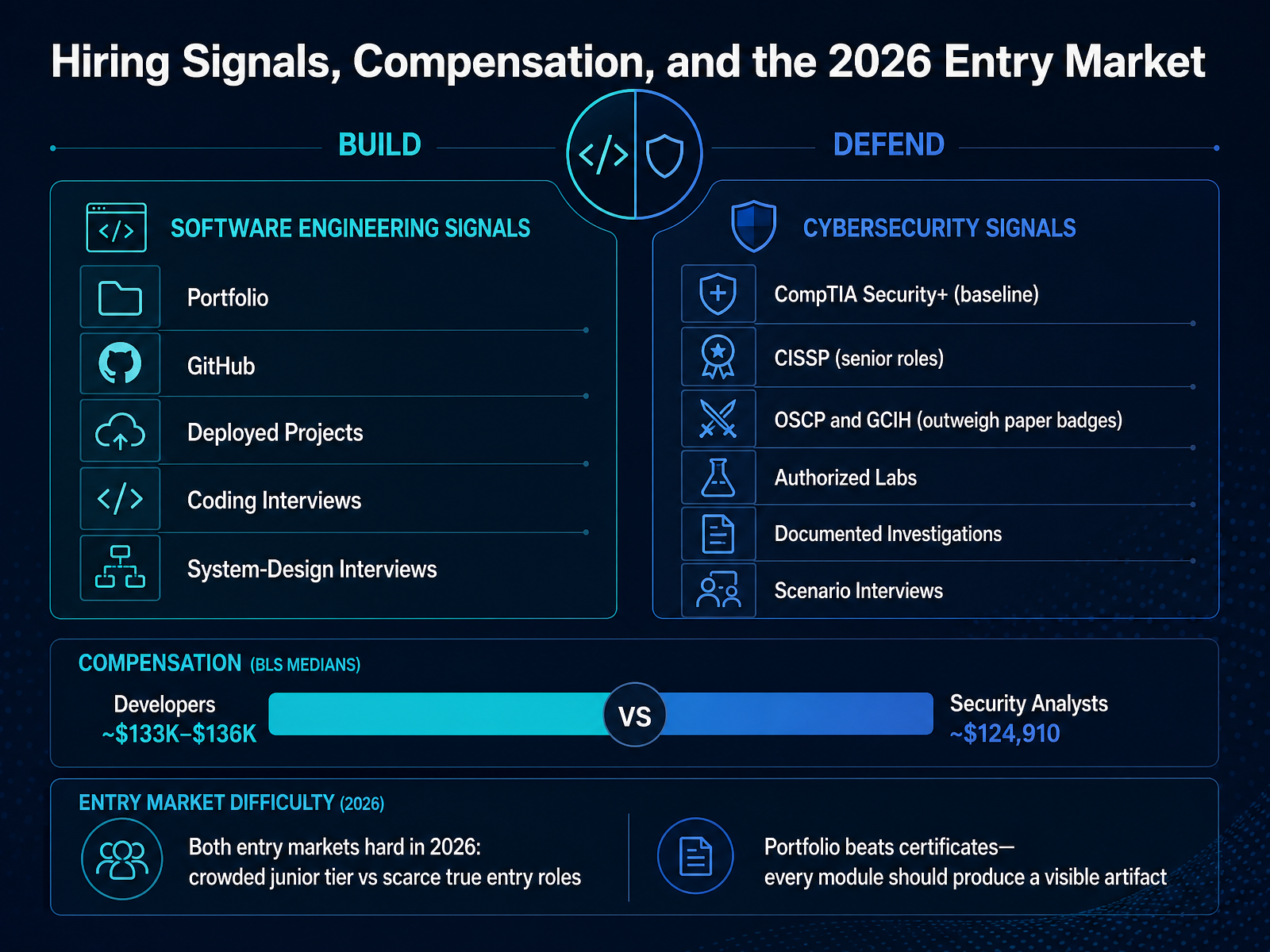
 - 08Hiring Signals, Compensation, and the 2026 Entry MarketNow let's talk about hiring signals, pay, and the entry market in 2026. Software engineering screens for portfolios, GitHub activity, deployed projects, and system design interviews. Cybersecurity screens differently: certifications, authorized labs, documented investigations, and scenario interviews. On credentials, Security Plus is the common baseline. The CISSP is for senior roles and needs years of experience. And hands-on certs like the OSCP and GCIH tend to outweigh paper badges because they require real technical performance. Pay is closer than people expect. Median base is roughly one hundred thirty-three thousand for developers, and about one hundred twenty-five thousand for security analysts. Both entry markets are hard in 2026, just for different reasons. Software has a crowded junior tier, while cybersecurity has scarce true entry roles, since most listings quietly want a year or two of experience. So here is the takeaway for either path. Your portfolio beats your certificates. Every course, certification, or module should produce a visible artifact, like code, a deployed project, or a lab write-up, because that is what hiring managers can actually evaluate. Next, we will look at learning roadmaps and skill bridges.
 onlinecybersecurity.orgtechcerted.comcollegenp.com+22 min
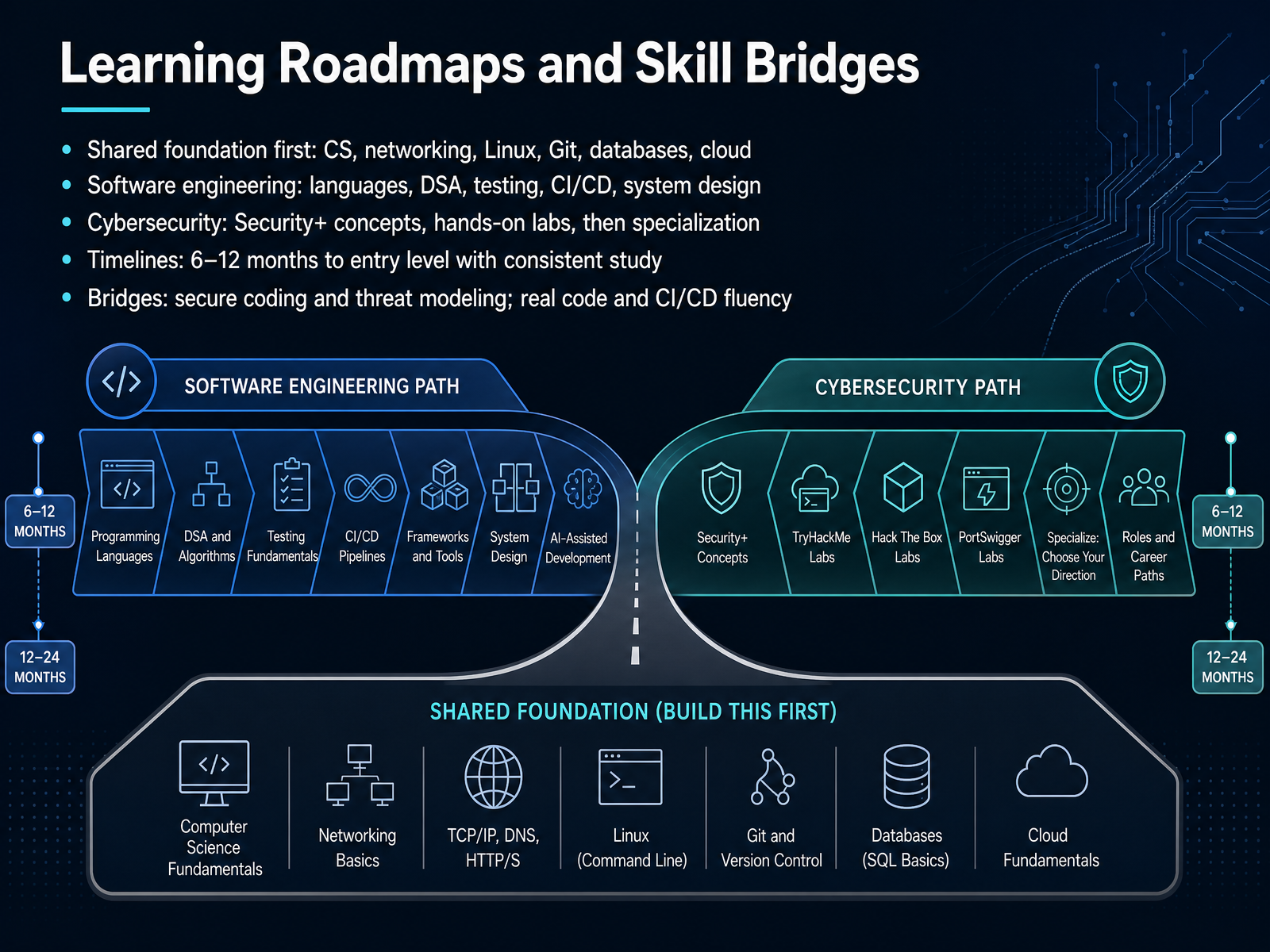
 - 09Learning Roadmaps and Skill BridgesNow let's talk about how each path actually gets built. Start with a shared foundation. Both fields begin in the same place: computer science basics, networking, Linux, Git, databases, and cloud fundamentals. That common ground is your launch pad. From there, the roadmaps split. Software engineering goes deep on programming languages, data structures and algorithms, testing, continuous integration and continuous delivery, and system design. Cybersecurity takes a different route: Security Plus concepts first, then hands-on labs, then a specialization like defensive operations, penetration testing, or application security. On timelines, entry level is realistic in six to twelve months of consistent study, faster with prior IT experience. And notice the bridges between the two. Secure coding and threat modeling let developers move into security, while real code and CI/CD fluency let security people work alongside engineering teams. Keep that shared foundation strong, and you keep options open on both sides. Next, we look at where the two fields meet: DevSecOps and the secure software development life cycle.
 onlinecybersecurity.orgtechcerted.comcollegenp.com+12 min
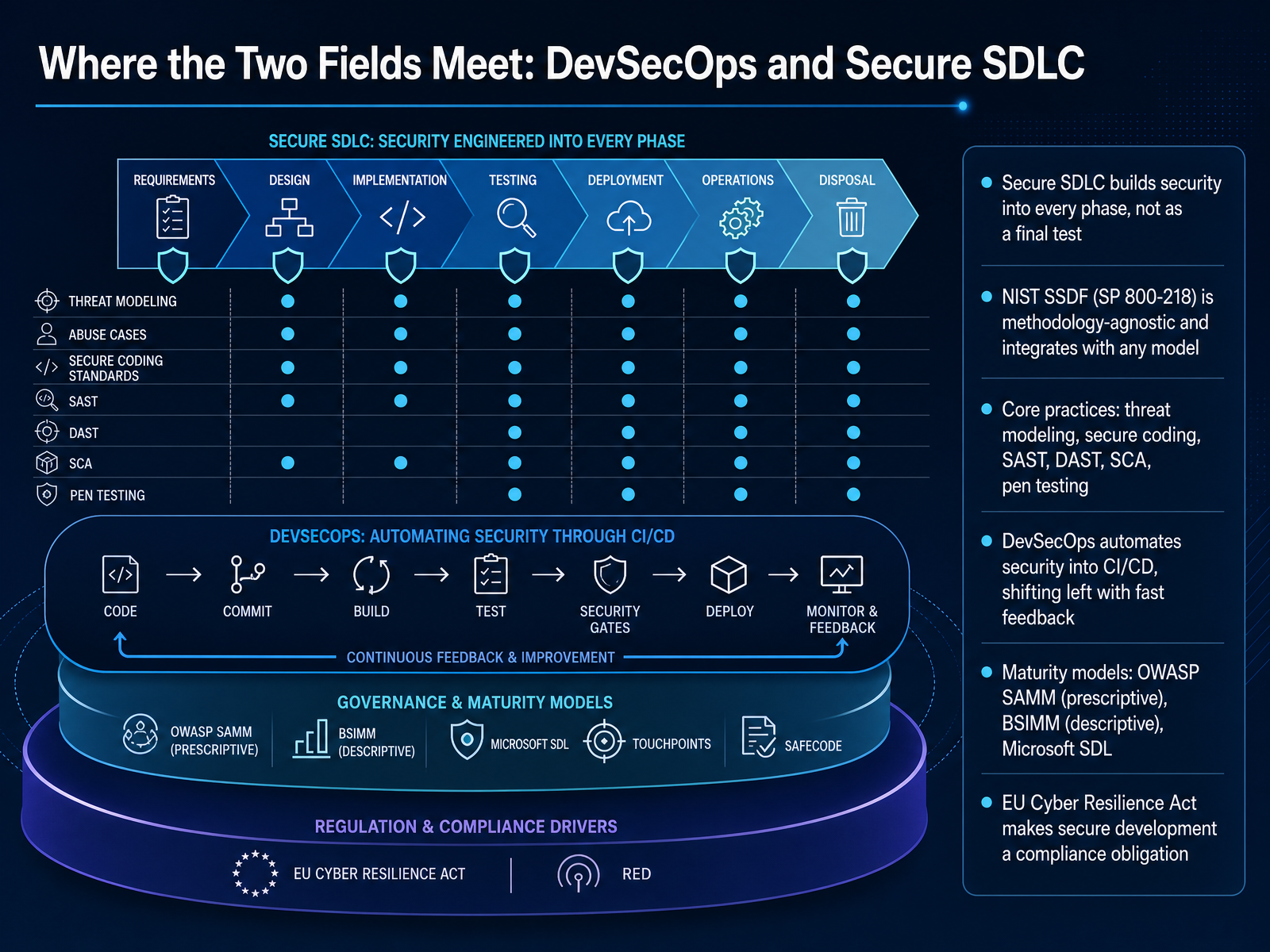
 - 10Where the Two Fields Meet: DevSecOps and Secure SDLCNow let's look at where these two fields meet. A secure Software Development Life Cycle builds security into every phase, not as a final test before release. NIST's Secure Software Development Framework, Special Publication 800-218, is deliberately methodology-agnostic, so it plugs into Waterfall, Agile, or DevOps without replacing any of them. Core practices include threat modeling, secure coding, Static Application Security Testing, Dynamic Application Security Testing, Software Composition Analysis, and penetration testing. DevSecOps is the next step. It automates those security checks inside the continuous integration and delivery pipeline. This is what people mean by shifting left, catching problems early with fast feedback. To track maturity, teams use frameworks like OWASP SAMM, which is prescriptive and tells you what to adopt next, and BSIMM, which is descriptive and benchmarks you against peers. Microsoft's Security Development Lifecycle is another reference point. Finally, regulation is catching up. The EU Cyber Resilience Act makes secure development a compliance obligation, not just a good habit. So the meeting point is clear: security becomes part of the engineering process itself. Next, let's consider AI, Automation, and the Changing Shape of Both Careers.
 doi.orgen.wikipedia.orgpeople.inf.ethz.ch+22 min
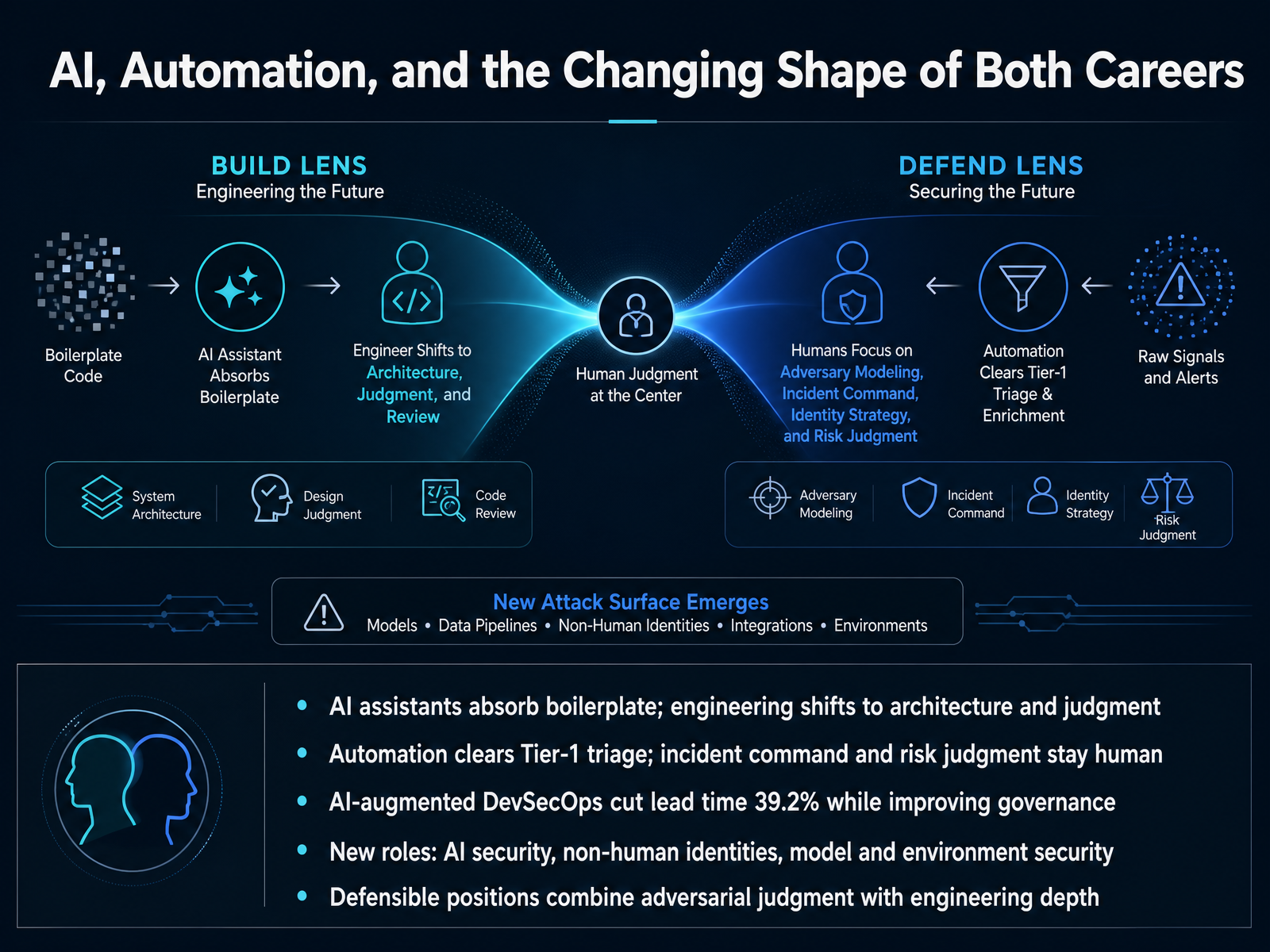
 - 11AI, Automation, and the Changing Shape of Both CareersLet's look at how AI and automation are reshaping both careers. On the engineering side, AI assistants now absorb boilerplate work, so the value shifts toward architecture and judgment. On the security side, automation clears Tier One triage, but incident command and risk judgment stay human. One study of an AI-augmented DevSecOps pipeline found lead time dropped thirty-nine point two percent while governance actually improved. That challenges the old idea that speed and security must trade off. New roles are emerging too, like AI security, non-human identities, and model and environment security. The pattern across all of them is the same. Defensible positions combine adversarial judgment with real engineering depth. Next, we'll work through a decision framework for individuals and teams.
 f1000research.comdl.acm.orgsciencedirect.com1 min
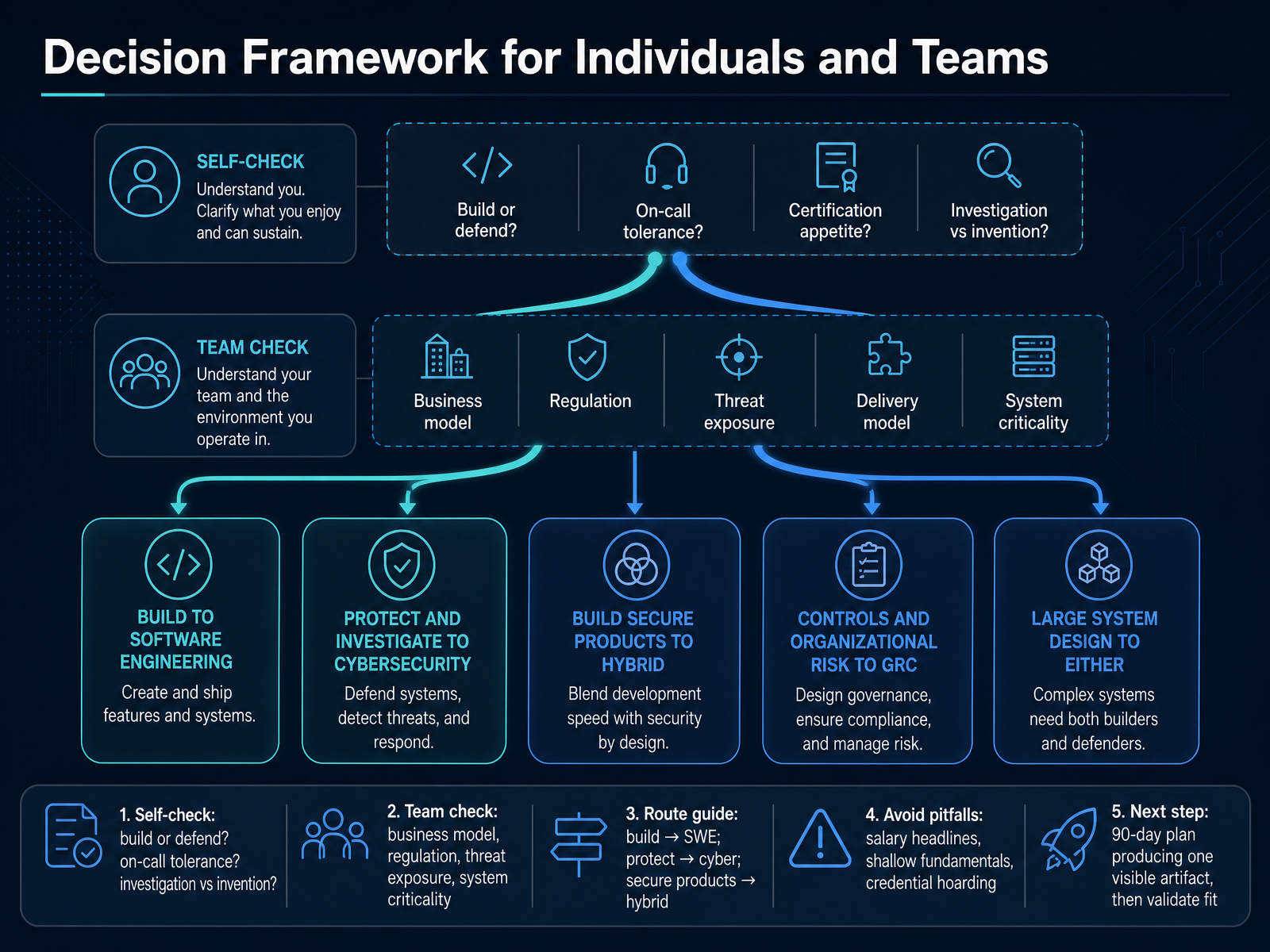
 - 12Decision Framework for Individuals and TeamsLet us turn this into a practical decision framework you can actually use. Start with a self-check. Ask yourself: do I want to build, or to defend? Can I tolerate on-call rotations and surprise incidents? And do I prefer investigation, or invention? For example, if an afternoon spent debugging a stubborn bug energizes you, software engineering likely fits. If you enjoy tracing how an attacker got in, cybersecurity may fit better. Then run a team check. Look at the business model, regulation, threat exposure, and system criticality. A hospital or bank faces different security pressure than a small internal tool. Next, a simple route guide. If your goal is to build, aim toward software engineering. If it is to protect, aim toward cyber. If it is to secure the products you build, consider the hybrid path. Avoid three common pitfalls: chasing salary headlines, skipping fundamentals, and hoarding credentials without proof of skill. Finally, set a ninety-day plan that produces one visible artifact, such as a deployed app or a documented security lab, then validate your fit with real feedback. Worked Examples: Choosing Between the Two in Real Settings.
 academi.devcollegenp.comonline.uwa.edu+22 min
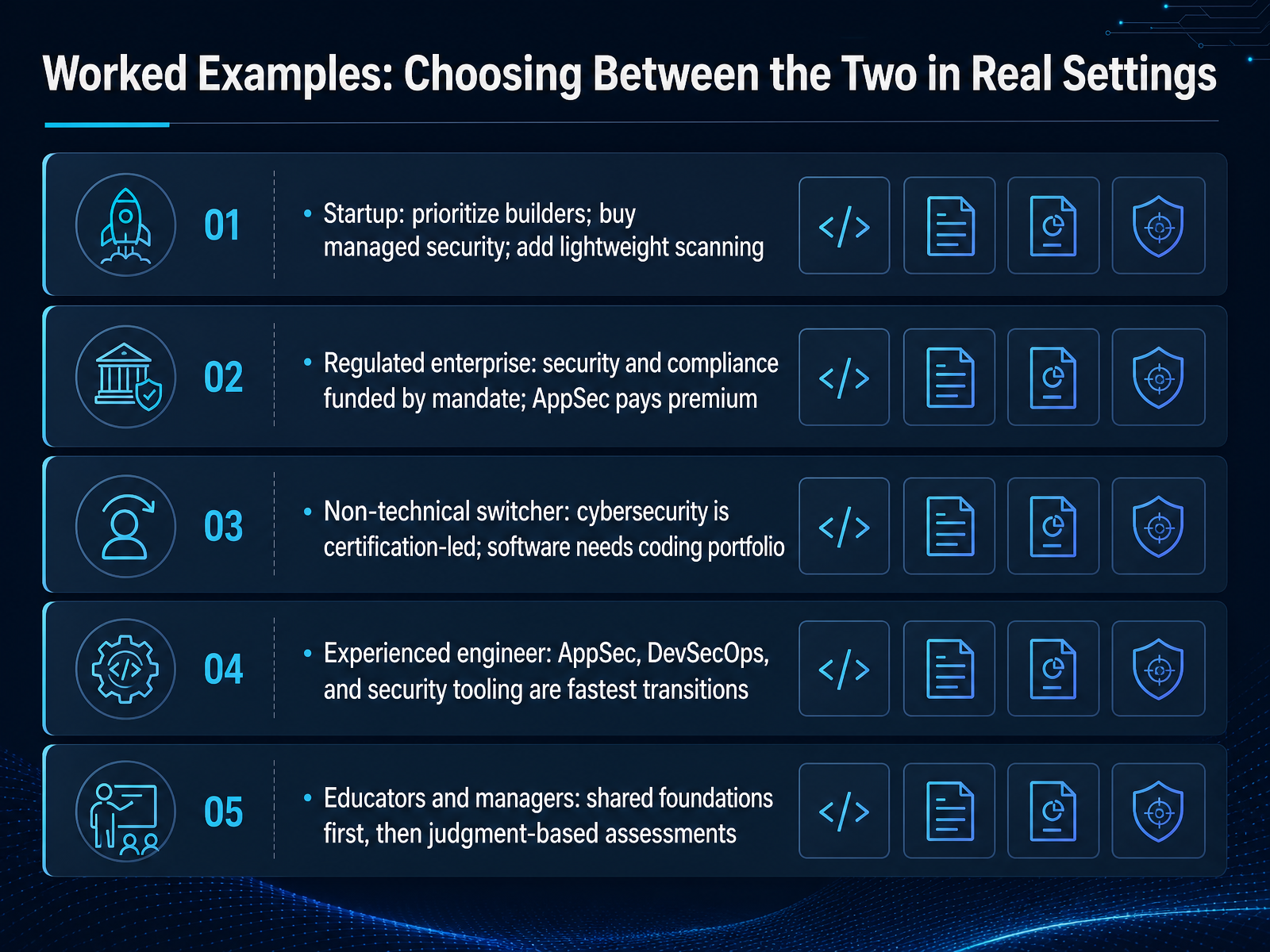
 - 13Worked Examples: Choosing Between the Two in Real SettingsLet's walk through a few worked examples that show how this decision plays out in real settings. First, a startup. Speed matters most, so prioritize builders and buy managed security. Add lightweight scanning in the pipeline, so you get basic coverage without slowing releases. Second, a regulated enterprise. Here, security and compliance are funded by mandate, so security roles are protected budget lines. Application security pays a premium, because it combines coding skill with risk judgment. Third, if you are a non-technical switcher, the paths differ. Cybersecurity is certification-led, so Security Plus or similar credentials open doors. Software engineering needs a coding portfolio, meaning deployed projects reviewers can actually run. Fourth, experienced engineers. The fastest transition into security is through application security, DevSecOps, and security tooling, because your programming background is the hardest skill to teach. Finally, for educators and managers, teach shared foundations first, then assess judgment. Ask learners to explain tradeoffs, not just recall terms. So match the choice to the setting, not just the job title. That leads us into our Summary, Assessment, and Discussion.
 academi.devcollegenp.comonline.uwa.edu+22 min
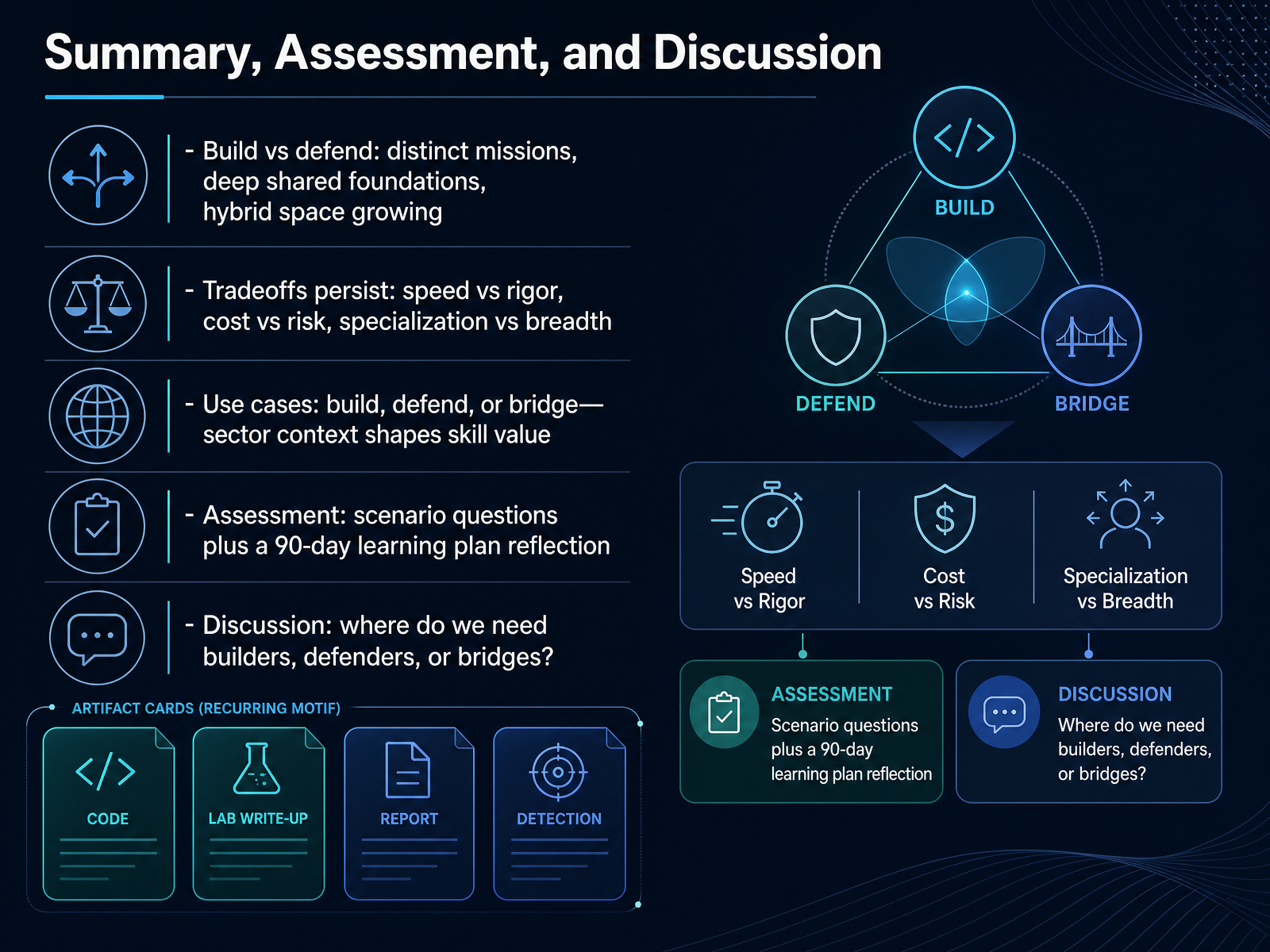
 - 14Summary, Assessment, and DiscussionLet's bring this full comparison together. Build versus defend: two distinct missions, but with deep shared foundations. Software engineers create and maintain systems; cybersecurity professionals protect them. Increasingly, hybrid roles like application security and DevSecOps sit right in between. The tradeoffs also persist. Builders weigh speed against rigor. Defenders weigh cost against risk. And both fields ask whether to specialize deeply or build broader skills. Use cases depend on context: some teams need builders, some need defenders, and many need people who can bridge both. Sector matters too. A bank may value security expertise more, while a product startup may lean toward engineering. For your assessment, you'll work through scenario questions and reflect on a ninety-day learning plan. In discussion, consider this: where do we need builders, defenders, or bridges? Thank you for going through this course with me. Keep asking good questions, stay curious, and build the path that fits how you think.
 academi.devcollegenp.comonline.uwa.edu+21 min
Take the deck with you
Download this course as a file — free, no sign-up needed.
- PDF handoutEvery slide page, ready to print or share.15 pages · 4.1 MBDownload
- Narrated PowerPointThe deck that presents itself — every slide carries the digital human's narration video.15 pages · 15.2 MBDownload
- PowerPoint slidesThe full deck as a .pptx — open it in PowerPoint, Keynote, or Google Slides.15 pages · 4.0 MBDownload
Free to use in your own training — please keep the PersonWise credit page at the end.
Have your own deck? Turn it into a course
Sources consulted
Web sources consulted while building this course.
- Cybersecurity Analyst vs Software Engineer: Which Should You Choose in 2026? | TechCerted — techcerted.com
- Cybersecurity vs Software Development: Career Comparison Guide — onlinecybersecurity.org
- Career in Cybersecurity vs. Software Engineering [2026] - DigitalDefynd Education — digitaldefynd.com
- Cybersecurity vs Software Engineering: Career Fit — collegenp.com
- Cybersecurity vs Software Engineering in 2026 — khired.com
- Toward a Discipline of Cyber Security: Some Parallels with the Development of Software Engineering Education — doi.org
- History of software engineering — en.wikipedia.org
- A Brief History of Software Engineering — people.inf.ethz.ch
- The Evolution of Cybersecurity — doi.org
- 50 years of Software: How It Began, Where It's Going — computer.org
- Which Tech Career Path Is Right for You? Security vs Dev — online.uwa.edu
- Cybersecurity vs. Software Engineering: Choosing Your Path | University at Albany — albany.edu
- Cybersecurity vs. Software Engineering — coursera.org
- Cybersecurity vs Software Engineering: What's the ... — indeed.com
- Software Engineer vs Cybersecurity Analyst Salary Comparison: 26 global markets (2026) | PayMetric Labs — paymetriclabs.com
- Software Engineering vs Cyber Security: How to Pick the Right Tech Career in 2026 | Academi — academi.dev
- Software Developer vs Information Security Analyst | Scrypath — scrypath.com
- Assessing the Impact of AI-Augmented DevSecOps on... | F1000Research — f1000research.com
- Securing Agile: Assessing the Impact of Security Activities on Agile Development — dl.acm.org
- Identifying the primary dimensions of DevSecOps: A multi-vocal ... — sciencedirect.com