Begin
14 pages · ~28 min
Sales Enablement Strategy Tradeoffs
Learn how to craft impactful sales enablement strategies that align with business goals, navigate key choices, and manage tradeoffs effectively.
A digital instructor presents all 14 pages. Hold “Ask” at any point and ask out loud — the answer comes from this course. No sign-up needed.
What you’ll learn
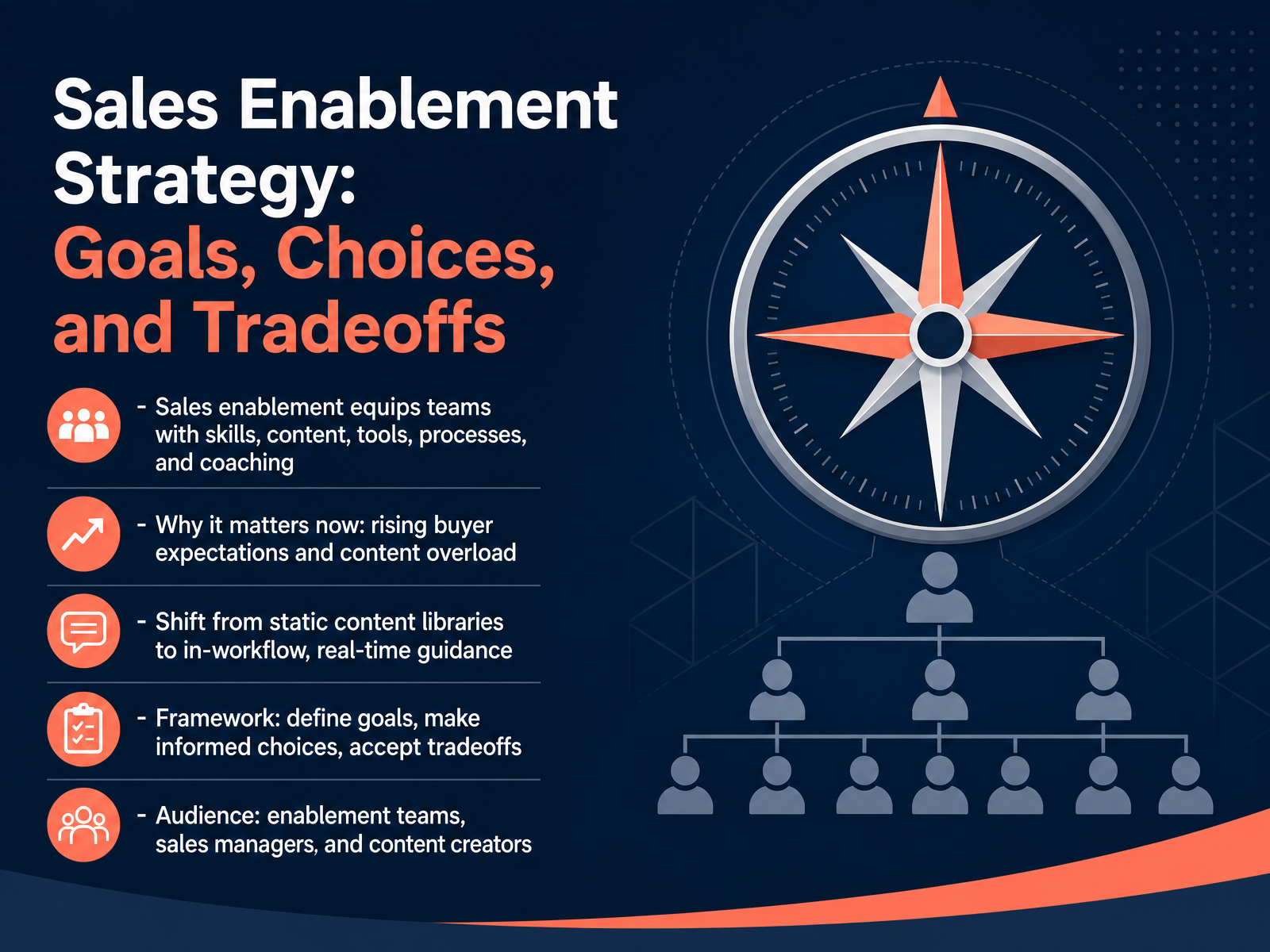
- 01Sales Enablement Strategy: Goals, Choices, and TradeoffsWelcome. I am glad you are here, because the work you do sits at the center of how your company creates revenue. This course is about making clearer, more defensible choices in sales enablement. That matters, because the ground has shifted under us. Buyers are doing more of their own research before they ever speak to a rep, and the volume of content we produce can overwhelm the very people it is meant to help. The old model, building a big static library and hoping reps find the right asset, is no longer enough. We need to think about guiding reps in the moment, inside their actual workflow. Over the next several slides, we will use a simple framework. First, we define the goals we are actually trying to achieve. Second, we look at the informed choices that get us there. Third, we accept the real tradeoffs those choices require. My goal is to give you a practical way to think about this, whether you are an enablement professional, a sales manager, or someone creating the content reps use every day. Let us start by looking at what sales enablement really means in the year ahead.salesassembly.comgetbackdrop.aiseismic.com+21 min
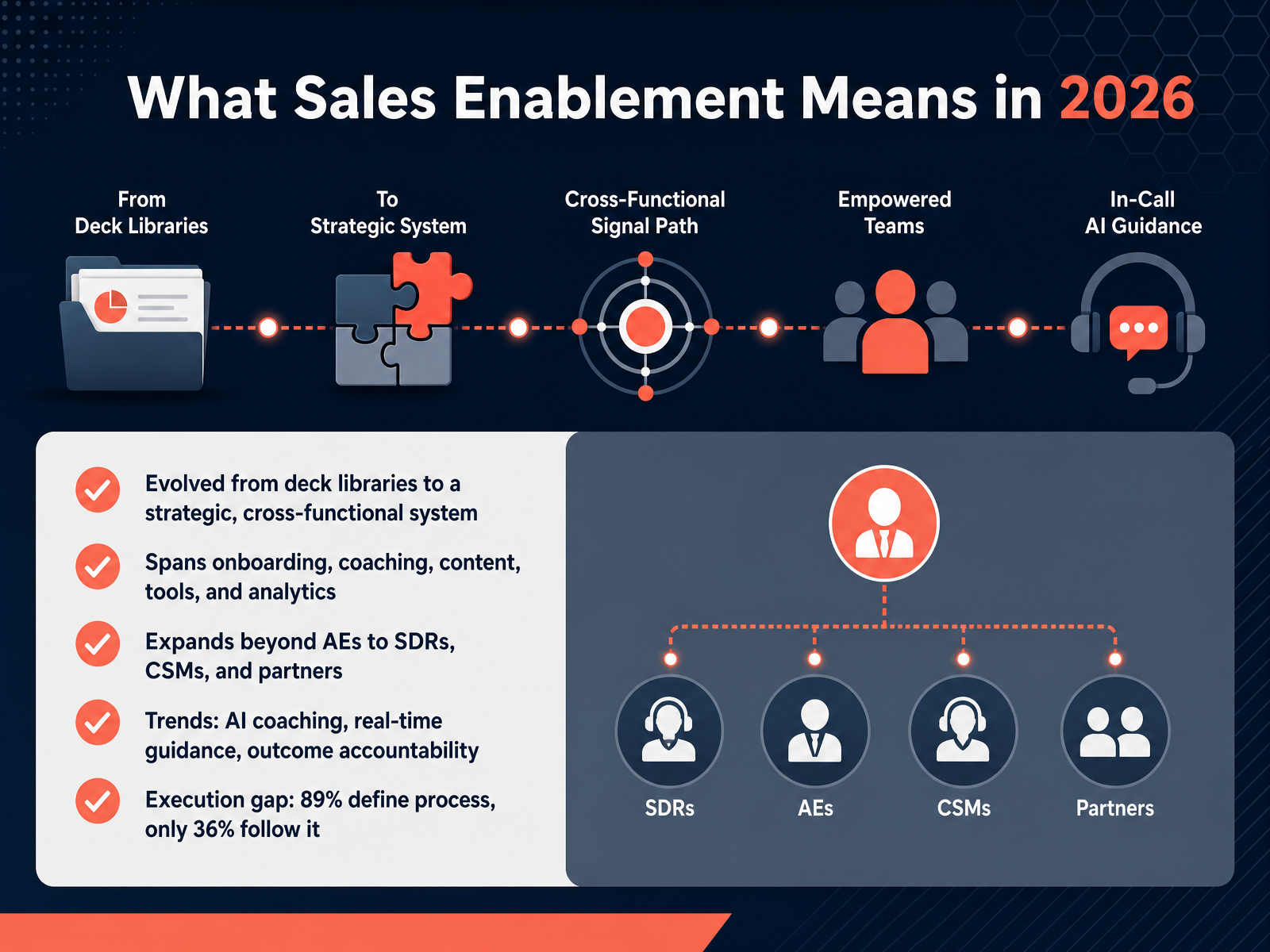
- 02What Sales Enablement Means in 2026Let's ground ourselves in what sales enablement actually means in 2026. The function has moved well beyond deck libraries and product training. It's now a strategic, cross-functional system. A real enablement program spans onboarding, coaching, content, tools, and analytics. And the scope has widened. We're no longer just supporting account executives. We're expected to serve SDRs, customer success managers, and partners. The underlying shifts are clear. AI coaching and real-time guidance are becoming table stakes. At the same time, we're being held to outcomes, not just activity. That's where the execution gap comes in. Many organizations say they have defined processes. The number often cited is eighty-nine percent. But only thirty-six percent of teams actually follow them. That gap is not a trivial data point. It's the difference between a strategy on paper and one that changes rep behavior. So as we move forward, keep that tension in mind. Our next step is to turn this definition into decisions. Let's look at defining goals that drive business outcomes.
 guideflow.comgtmonly.comsendnow.live+22 min
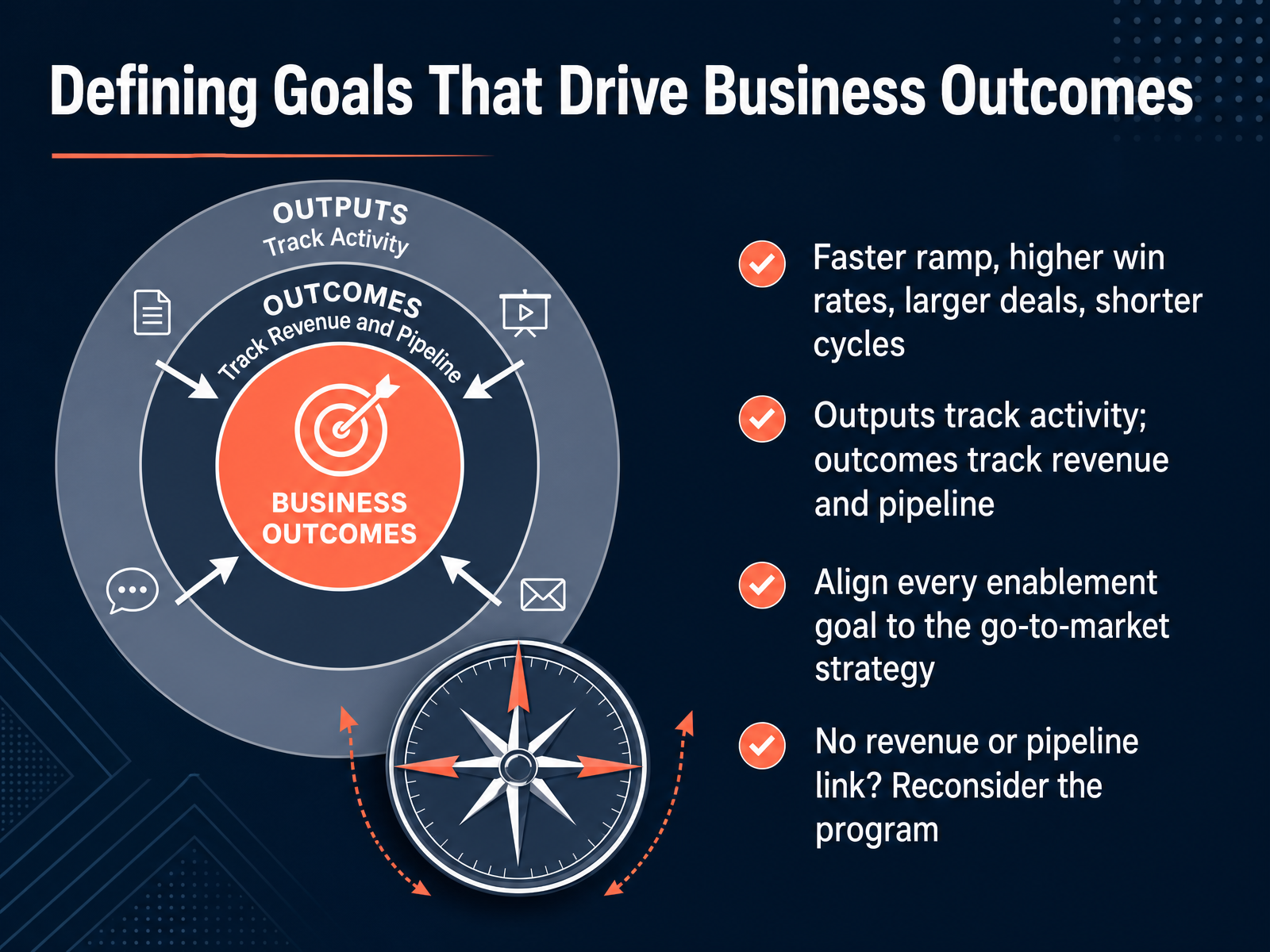
 - 03Defining Goals That Drive Business OutcomesNow let’s talk about what this actually looks like in terms of goals. When we set targets for enablement, we tend to start with the outcomes everyone can see. Faster ramp. Higher win rates. Larger deals. Shorter cycles. Those are all legitimate goals, but they are not interchangeable. They each require different investments. Compress ramp time, and you are likely spending more on onboarding assets and structured coaching. Push for larger deals, and you should be looking at executive engagement and business case support. The key is to choose deliberately, not accept all four as a wish list. The more important distinction is between outputs and outcomes. Outputs track activity. Things like training completion, content downloaded, certifications issued. Those tell you whether the program is being used. Outcomes track revenue and pipeline. Win rate movement, cycle length, deal size, quota attainment. That is whether the program is working. One is easy to count. The other makes the case for the budget. If you cannot draw a line from an enablement goal back to the go to market strategy, you have a problem. The goal should help the business execute its actual motion. And if there is no revenue or pipeline link at all, that is not just a measurement gap. That is a reason to reconsider the program itself. Next, we will look at the metrics that matter.
 guideflow.comgtmonly.comsendnow.live+22 min
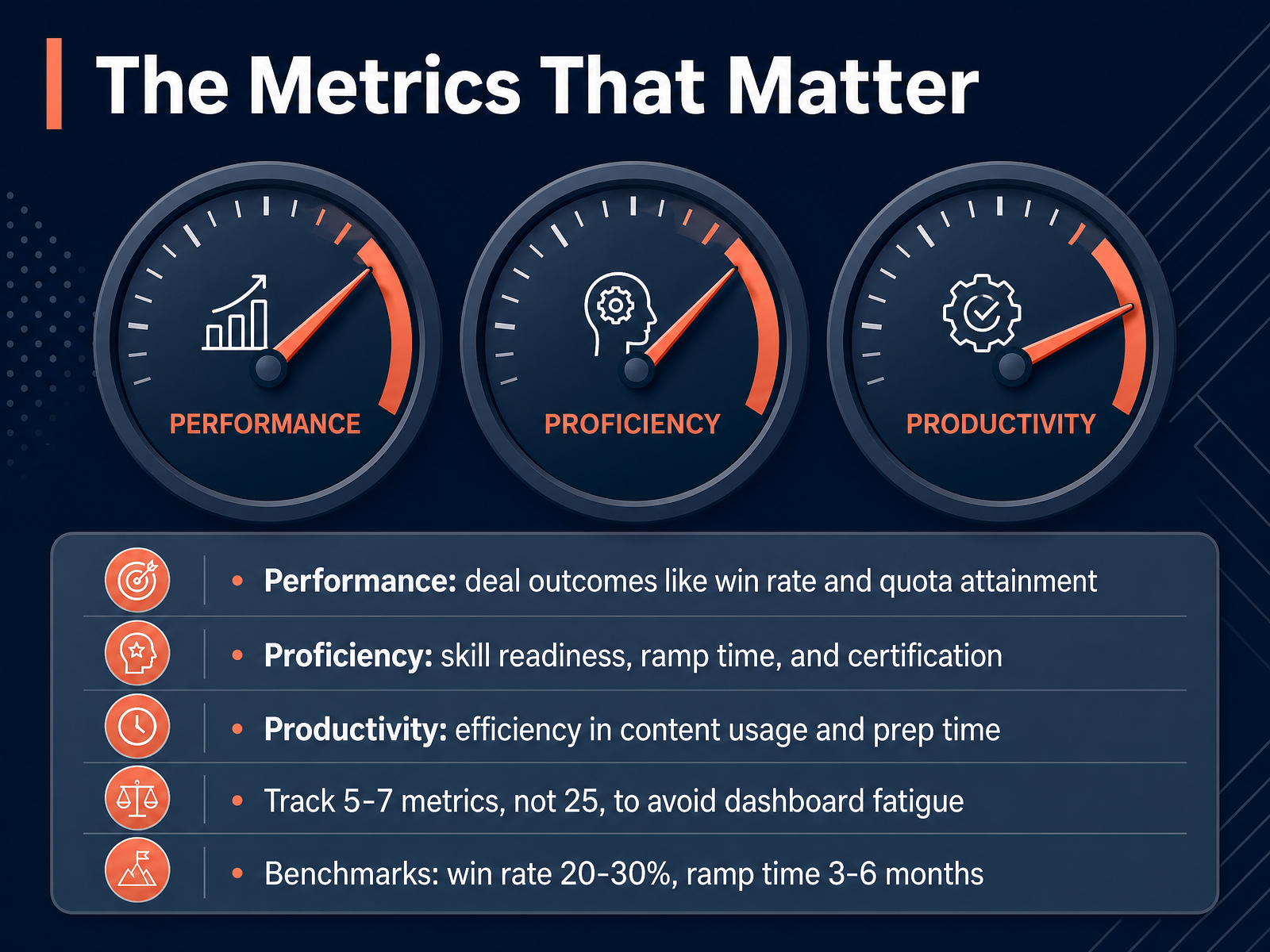
 - 04The Metrics That MatterSo with all that in mind, let's talk about the metrics that actually matter. You will often see a long list of possibilities, but you need to be selective to avoid dashboard fatigue. Think of it as three distinct buckets. Performance covers the deal outcomes, like win rate and quota attainment. Proficiency focuses on how ready your reps actually are, tracking skill readiness, ramp time, and certification pass rates. And Productivity looks at efficiency, like content usage and prep time. A practical target is to track five to seven metrics total. That keeps your focus sharp and allows you to act on the data, instead of just reporting it. To give you a sense of real-world numbers, a healthy win rate for mid-market teams is typically in the twenty to thirty percent range. For ramp time, getting a rep productive in three to six months is a solid benchmark. Focus on a small set that links directly to what you are trying to change. Next, let's talk about measuring impact without over-claiming.
 guideflow.comgtmonly.comsendnow.live+21 min
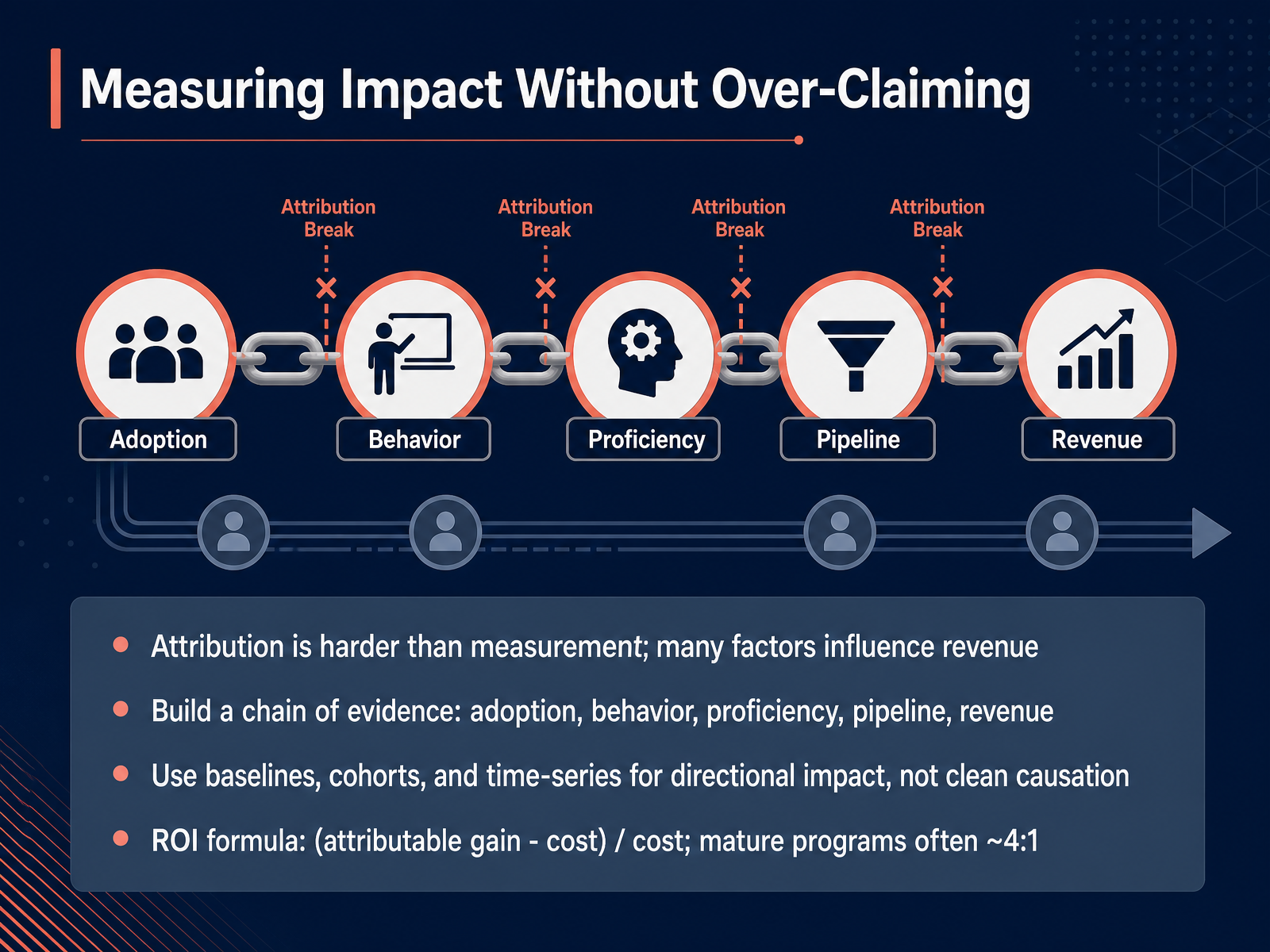
 - 05Measuring Impact Without Over-ClaimingLet's move to the measurement question, because this is where credibility gets built or gets lost. The first thing to accept is that attribution is not the same as measurement. Revenue has many causes: product, pricing, territory, market conditions. We are one input. So the goal is not clean causation. It is a defensible directional case. What does that look like in practice? You build a chain of evidence. Start with adoption, then behavior, then proficiency, then pipeline, and finally revenue. Each layer should connect to the next. If adoption is high but revenue does not move, you have learned something important early. Use baselines and cohorts. Compare a rep group that went through the program against a comparable one that did not. Or compare the same team over time. That gives you a credible share of the outcome, not an inflated claim. For the ROI calculation, use the formula: attributable gain minus cost, divided by cost. And use conservative attribution. Mature programs often land around a four to one return, but that number is only meaningful when the assumptions behind it are transparent. Next, let's look at the key strategic choices that shape this whole effort.
 kaon.comaccent-technologies.compulserevops.com+22 min
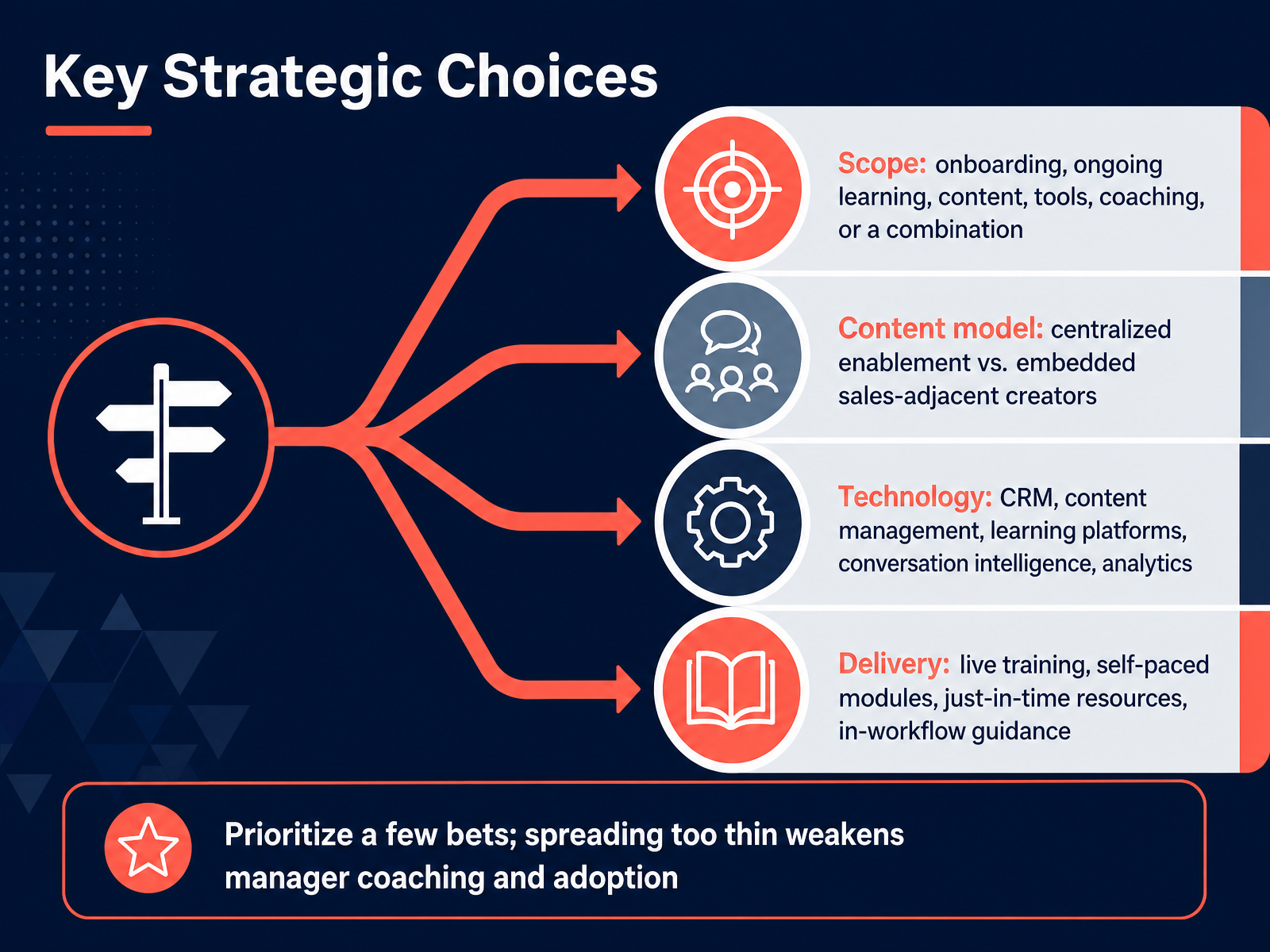
 - 06Key Strategic ChoicesNow let's talk through the key strategic choices. These are the decisions that define where your enablement budget and time actually go, so it's worth being deliberate here. First is scope. Are you focused on onboarding, ongoing learning, content, tools, coaching, or a combination? You can't do all of these well at once, so pick your emphasis. Second is the content model. Do you centralize enablement, or do you embed creators closer to the sales team? That choice shapes speed and relevance. Third is technology. CRM, content management, learning platforms, conversation intelligence, analytics. The stack only creates value if it fits how reps already work. Fourth is delivery. Live training, self-paced modules, just-in-time resources, or in-workflow guidance. Each reaches a different moment of need. The honest advice here is to prioritize a few bets. Spreading resources too thin weakens manager coaching and kills adoption, which is where most programs quietly fail. Next, let's look at accepting and managing the tradeoffs.
 salesassembly.comgetbackdrop.aiseismic.com+21 min
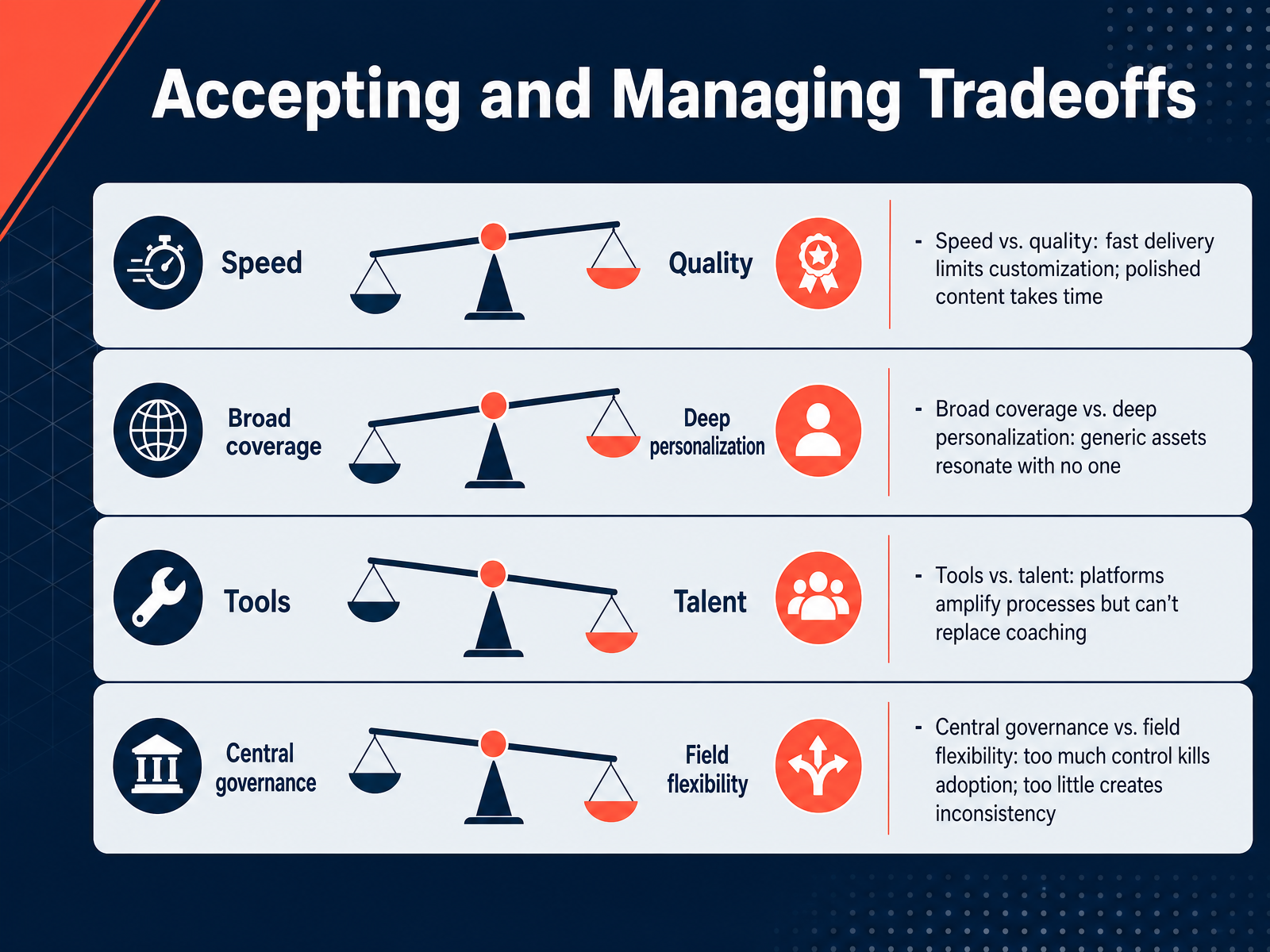
 - 07Accepting and Managing TradeoffsNow let's get specific about the tradeoffs you'll actually face when building your enablement strategy. First, there's speed versus quality. Shipping a quick one-page summary gets something into the field fast, but it will lack the depth and customization of a fully produced playbook. The tension is real. Next, consider broad coverage versus deep personalization. Trying to build one generic asset that works for every team and region usually means it resonates with no one. You have to choose where to focus your depth. Third, think about tools versus talent. A new platform can scale your process and deliver insights, but it cannot replace the manager who coaches a rep through a difficult deal. The platform amplifies what your team already does well. Finally, there's the constant pull between central governance and field flexibility. If you lock everything down, your team will work around you and adoption will collapse. If you let everyone improvise, you get inconsistency and drift. The goal is to set a standard tightly enough to protect the message, but loosely enough that a seasoned rep can still sell with judgment. Accepting these tradeoffs isn't a failure of strategy. It's what makes the strategy real. And that leads us naturally into the next conversation, which is how to build content that actually drives sales outcomes.
 federicopresicci.comfedericopresicci.compedowitzgroup.com+22 min
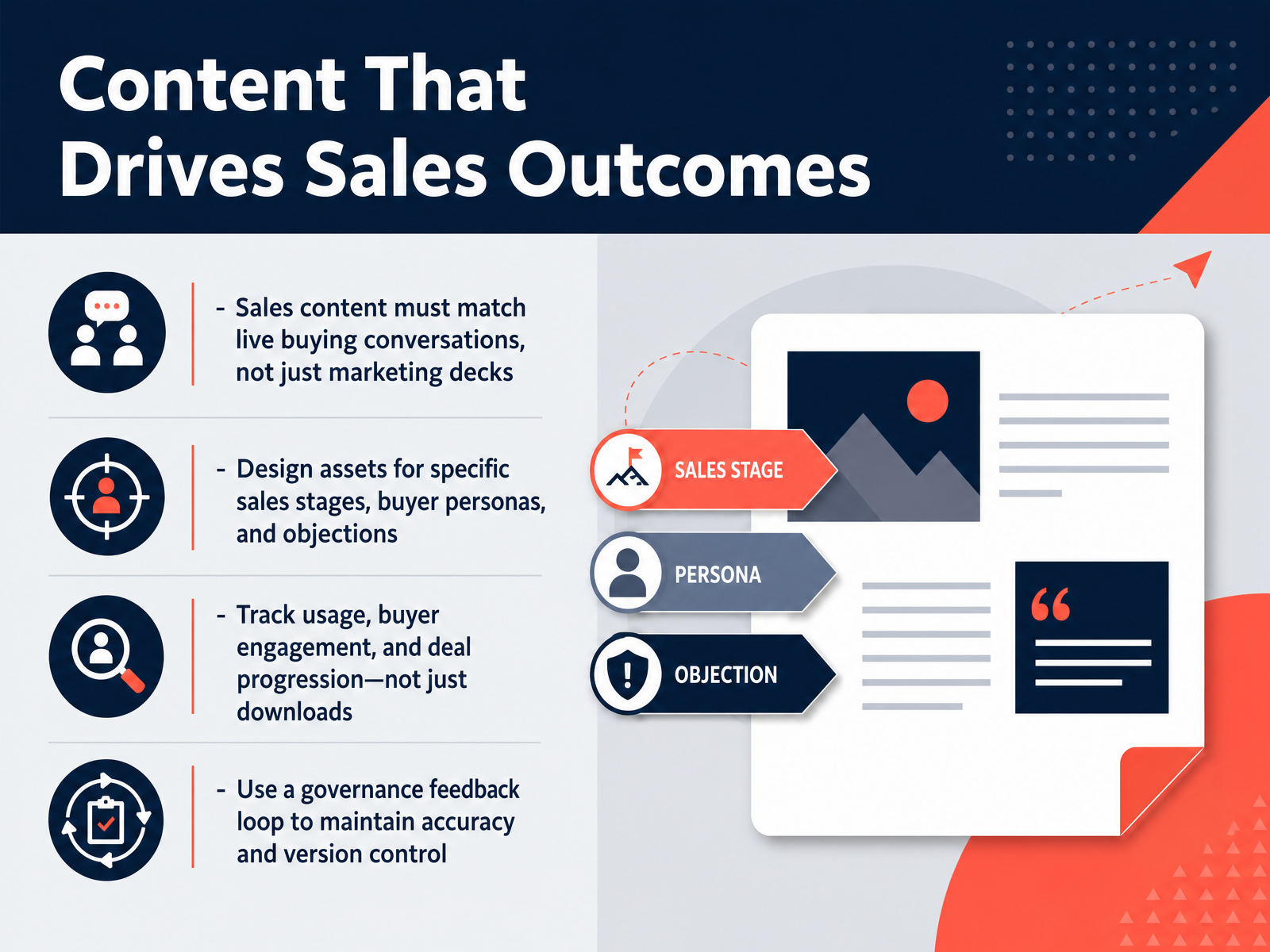
 - 08Content That Drives Sales OutcomesLet's look at what content actually needs to do. It can't just be a trimmed-down marketing deck. It has to match the conversations your reps are having live, in the moment, with the buyer in front of them. That means designing assets for specific sales stages, for specific personas, and for the objections that come up at each point. A discovery call asset and a final business case are different jobs, and they should look different. Then comes measurement. Downloads are not a signal. What you need to know is whether the content is being used in real deals, whether buyers are engaging with it, and whether that engagement connects to deal progression. That connection is what lets you defend the investment. Finally, governance matters more than most teams want to admit. Without a feedback loop, you get version chaos and reps start pulling old slides from their desktop. A simple review cadence keeps accuracy and version control from becoming a fire drill. So the decision here is whether you build a content system that supports selling, or a library that just stores files. Next, we'll talk about coaching and reinforcement, because even the best content is worthless if reps don't internalize how to use it.
 federicopresicci.comfedericopresicci.compedowitzgroup.com+22 min
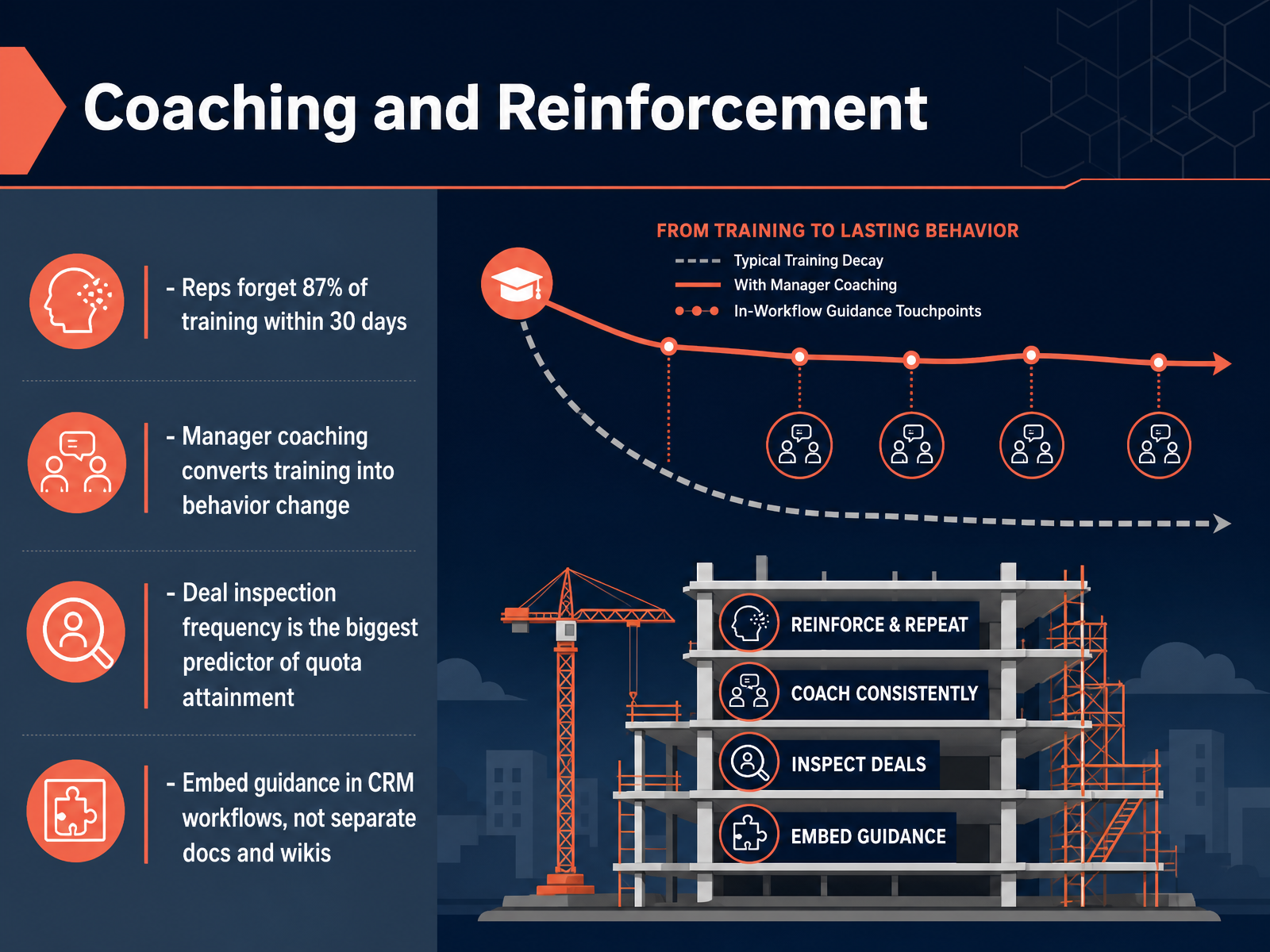
 - 09Coaching and ReinforcementLet's shift from what we deliver to what actually sticks. Training is not the finish line. Reps forget roughly eighty-seven percent of what they learn within thirty days. That is not a motivation problem. It is a reinforcement problem. The missing link is usually the front-line manager. Manager coaching converts a one-time training event into repeated behavior change in real deals. And not just any coaching. The research is clear that the single biggest predictor of quota attainment is how often deals get inspected against a defined process. That cadence matters more than the methodology you choose or the volume of training you run. So the practical choice is where guidance lives. If it sits in a separate document or wiki, reps have to leave the deal to find it. If it is embedded directly in the CRM workflow, at the step where the decision happens, the right action stays in front of them. That placement is the difference between guidance that gets used and guidance that gets ignored. Let's move now to Roles and Responsibilities, because making this stick requires clarity on who owns reinforcement.
 federicopresicci.comfedericopresicci.compedowitzgroup.com+22 min
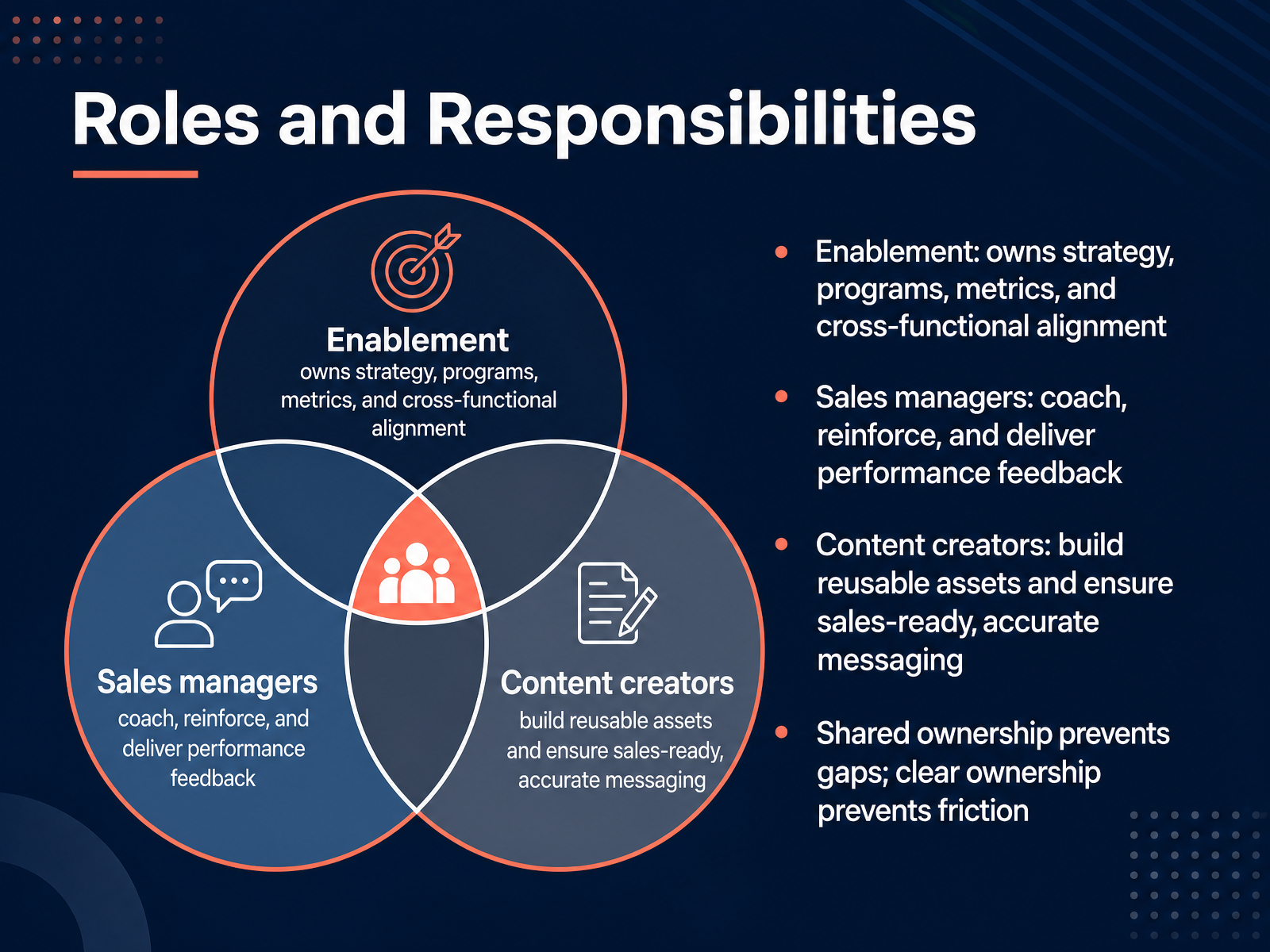
 - 10Roles and ResponsibilitiesNow let's get specific about who owns what. This is where strategy either holds together or quietly comes apart. Enablement owns the system: the strategy, the programs, the metrics, and the cross-functional alignment. That's the accountability. Sales managers own the reinforcement. They coach, they observe real deals, and they deliver performance feedback. Without that layer, even the best program stays on paper. Content creators build the reusable assets. Their job is making sure messaging is accurate, findable, and actually sales-ready. The reason this matters is the tradeoff between gaps and friction. Shared ownership prevents gaps, because no single team can carry the whole thing. But clear ownership prevents friction, because overlap without definition creates confusion about who decides. You are likely managing both tensions right now. The practical move is to name a single owner for each major workstream, and a shared owner for the outcome it supports. That is durable. Let's carry this into the next slide, where we look at common pitfalls and how to avoid them.
 guideflow.comgtmonly.comsendnow.live+22 min
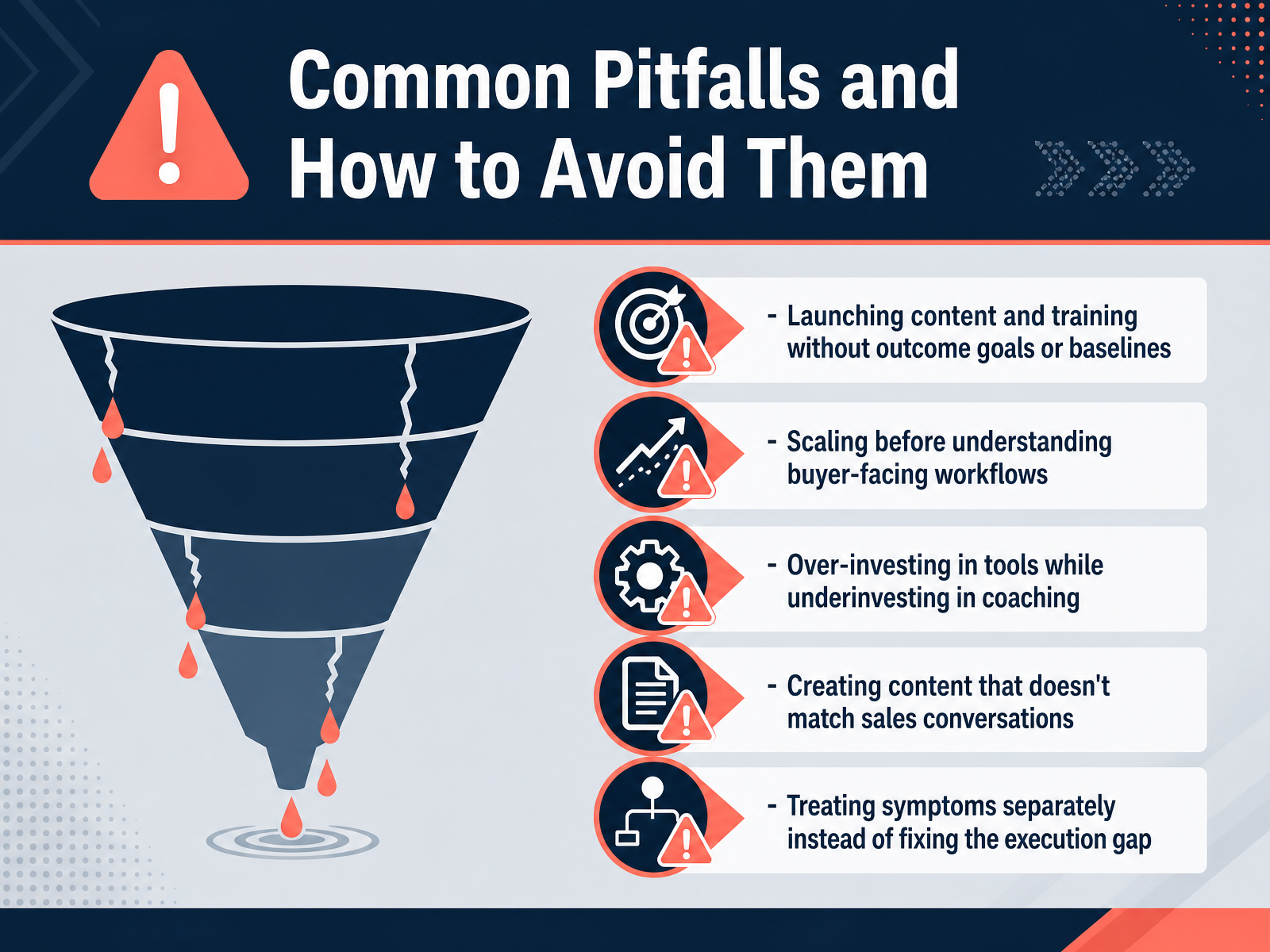
 - 11Common Pitfalls and How to Avoid ThemNow let us look at the five most common failure patterns, because each one represents a choice with real tradeoffs. First, launching content and training without outcome goals or baselines. If you do not define what success looks like before you start, you cannot defend the investment later. Second, scaling before understanding buyer-facing workflows. Adding volume to a broken process just produces more waste. Third, over-investing in tools while under-investing in coaching. Technology rarely changes behavior on its own. Reps change when managers reinforce the right actions. Fourth, creating content that does not match real sales conversations. If the messaging does not sound like what buyers actually hear and ask about, sellers will ignore it. And fifth, treating each symptom separately instead of fixing the underlying execution gap. Unused content, low adoption, and weak measurement are usually one problem showing up in different places. The avoidance strategy is simple. Define the outcome before the work begins. Anchor everything in workflow. Prioritize coaching over tool acquisition. And measure behavior change, not just activity. That brings us to the next and final piece of the framework: building an operating model for sustainable enablement.
 federicopresicci.comfedericopresicci.compedowitzgroup.com+22 min
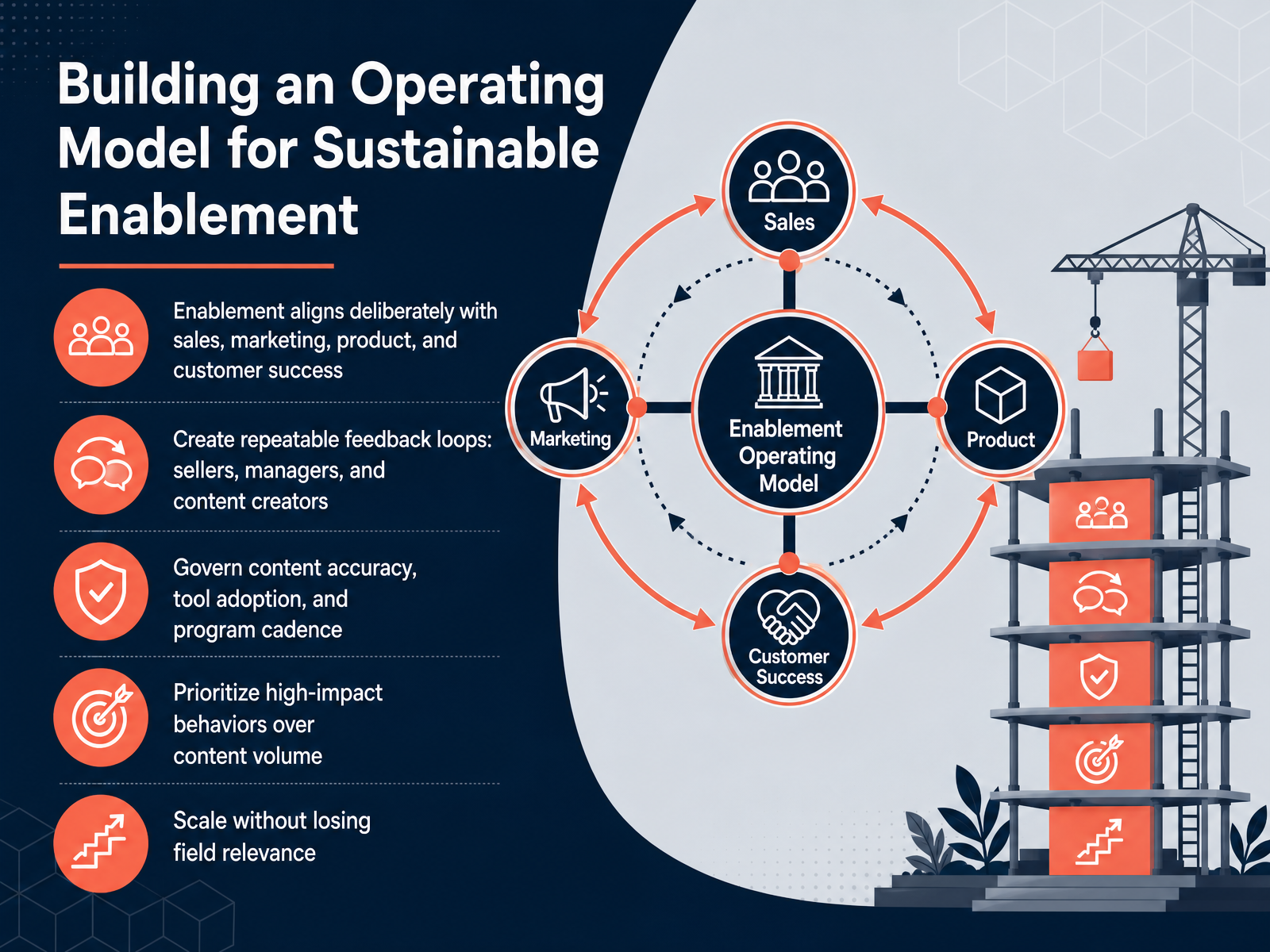
 - 12Building an Operating Model for Sustainable EnablementLet’s shift to the operating model, because this is where enablement either becomes repeatable or stays reactive. The starting point is deliberate alignment with sales, marketing, product, and customer success. That doesn’t mean attending every meeting. It means agreeing on shared outcomes and a clear handoff rhythm so your work lands in their workflow, not beside it. The next piece is feedback loops. You need structured input from sellers, managers, and content creators, not ad hoc requests. A short monthly review of what’s being used and what’s stalling in the field is usually enough to keep content and programs honest. Then you have to govern the system, meaning content accuracy, tool adoption, and program cadence. Without basic ownership and refresh rules, your library will drift and your tools will quietly become shelfware. The hardest choice here is focus. Prioritize the few behaviors that actually move deals, rather than trying to cover every topic at once. And as you scale, keep field relevance by testing changes with one team before rolling them broadly. That’s the operating model: aligned, governed, and deliberately focused. Next, let’s turn that into a 90-day action plan.
 federicopresicci.comfedericopresicci.compedowitzgroup.com+22 min
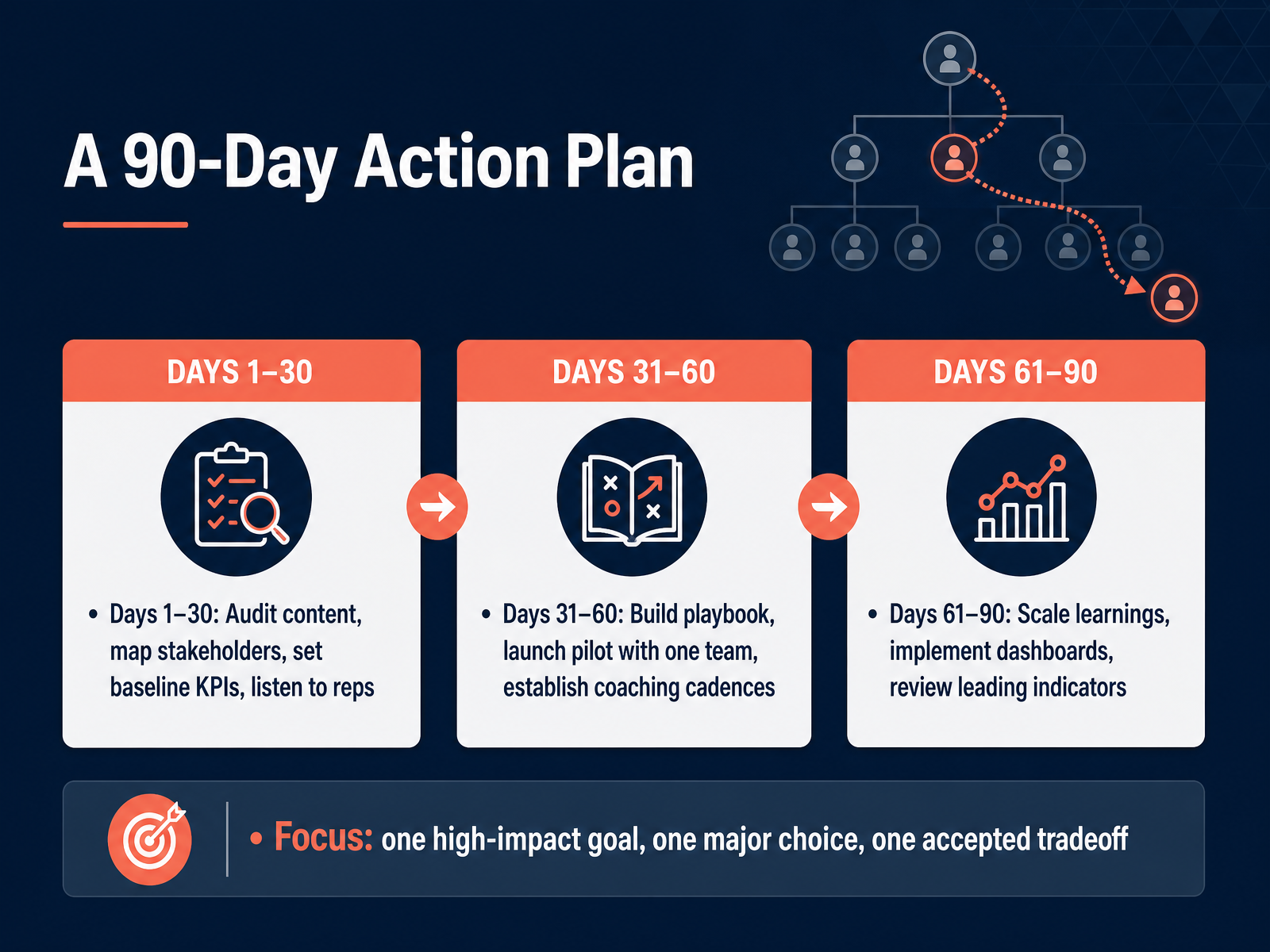
 - 13A 90-Day Action PlanLet's get concrete about the next ninety days. The plan breaks into three blocks. During the first thirty, do the unglamorous work: audit what content exists, map your key stakeholders, and set baseline metrics. Spend real time listening to reps. This is where you earn the right to make changes. In the next thirty days, build your playbook and run a pilot with one team. Establish coaching cadences with managers. Do not roll out to everyone yet. In the final thirty days, scale what worked in the pilot and implement dashboards. Review leading indicators, not just revenue. Throughout all of this, keep the focus tight: one high impact goal, one major choice, and one accepted tradeoff. That discipline is what protects you from spreading resources too thin. Next, we will close with how to secure buy-in and next steps.
 federicopresicci.comfedericopresicci.compedowitzgroup.com+21 min
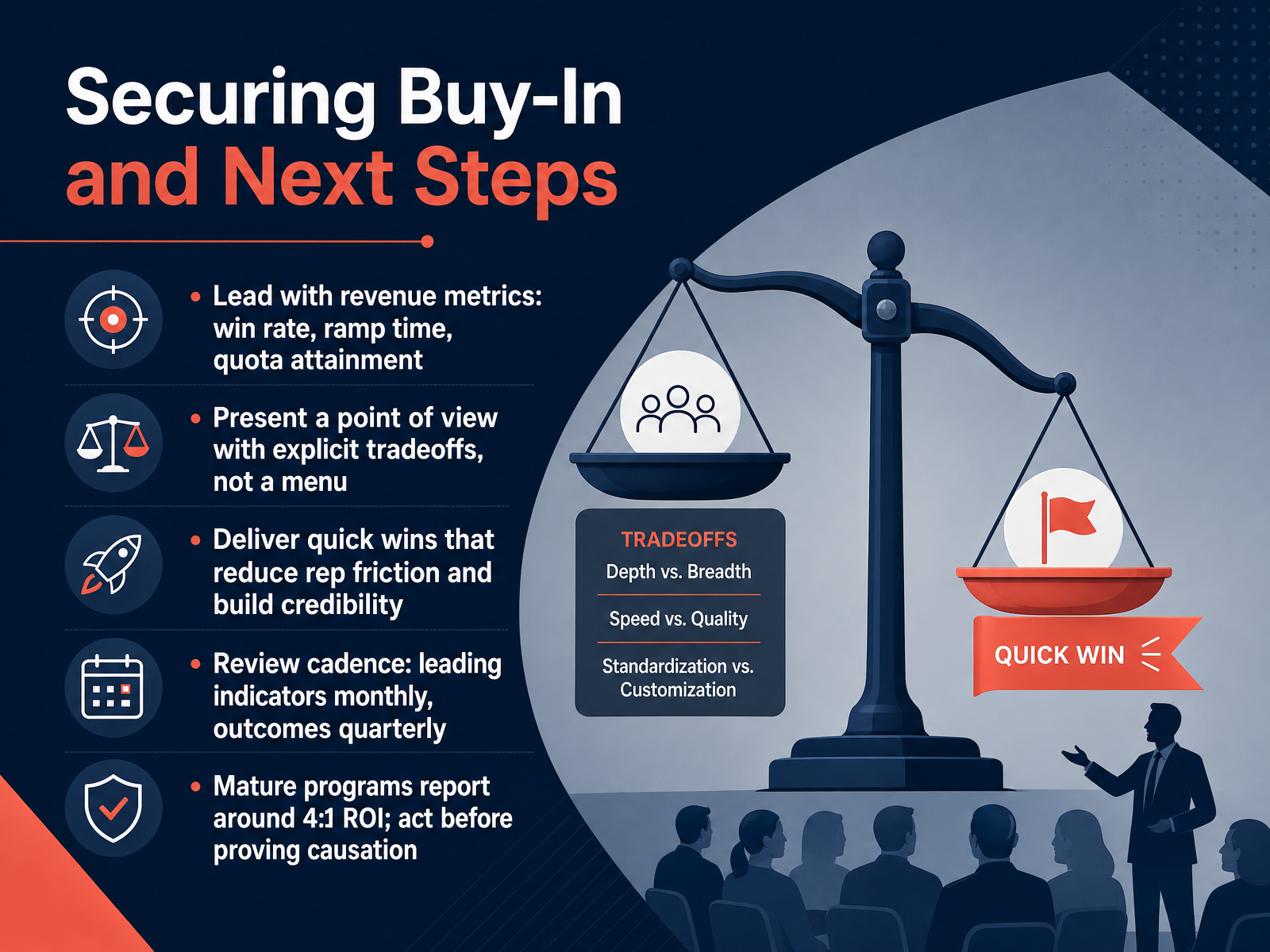
 - 14Securing Buy-In and Next StepsSo let's bring this to a close by talking about the practical work of securing buy-in and keeping the program alive. When you walk into that conversation, lead with the numbers your stakeholders already care about: win rate, ramp time, and quota attainment. Those are the revenue levers, not activity counts. Then, rather than offering a menu of options, present your point of view. State what you recommend, and be explicit about the tradeoffs. That signals you understand the business. Build credibility early with a few quick wins that reduce rep friction, like fixing a broken content path or simplifying a handoff. For your review cadence, report leading indicators monthly so you can course-correct, and reserve outcomes for a quarterly review. And finally, be honest about the timeline. Mature programs often land around a four-to-one return, but proving causation takes time. Don't wait for perfect attribution before you act. Build the evidence chain, show the trend, and keep moving. That's the full arc here: define the goals, make the choices, own the tradeoffs, and then defend the work with a credible, revenue-linked story. Thanks for your time, and good luck putting this into practice.
 kaon.comaccent-technologies.compulserevops.com+22 min
Take the deck with you
Download this course as a file — free, no sign-up needed.
- PDF handoutEvery slide page, ready to print or share.15 pages · 3.5 MBDownload
- Narrated PowerPointThe deck that presents itself — every slide carries the digital human's narration video.15 pages · 14.2 MBDownload
- PowerPoint slidesThe full deck as a .pptx — open it in PowerPoint, Keynote, or Google Slides.15 pages · 3.4 MBDownload
Free to use in your own training — please keep the PersonWise credit page at the end.
Have your own deck? Turn it into a course
Sources consulted
Web sources consulted while building this course.
- What Is Sales Enablement? A 2026 Definition & Guide — salesassembly.com
- 7 Sales Enablement Trends Reshaping B2B Sales in 2026 | Backdrop — getbackdrop.ai
- Ultimate Guide to Sales Enablement Success in 2026 - Seismic — seismic.com
- Sales Enablement Guide: Strategy, Metrics, and Software (2026) — g2.com
- Sales Enablement Strategy — gartner.com
- 25 sales enablement metrics: how to measure SE success - Guideflow Blog — guideflow.com
- Sales Enablement KPIs: 16 Metrics That Prove ROI (Not Just Activity) — gtmonly.com
- Sales Enablement KPIs Every Revenue Team Should Track — SendNow Blog — sendnow.live
- 100+ Sales Enablement Metrics: The Ultimate Breakdown — federicopresicci.com
- 90 Eye-Opening Sales Enablement Statistics for 2026 — federicopresicci.com
- Measuring Sales Enablement ROI: Why Attribution Design Is the Key to Justifying Investment in 2026 — kaon.com
- How to Measure Sales Enablement ROI: A 2026 Framework for Revenue Leaders — accent-technologies.com
- What's the right way to measure an enablement function's actual… — pulserevops.com
- How to Measure Sales Enablement ROI: A CRO's Framework — revcentricpartners.com
- Sales Enablement ROI: How to Measure Programme and Function Impact — federicopresicci.com
- Sales Enablement Challenges Report 2025-2026 — federicopresicci.com
- Leaders' Perspectives: The Top Sales Enablement Challenges — federicopresicci.com
- Why do sales enablement programs fail? — pedowitzgroup.com
- Sales Enablement Challenges: The One Root Cause — supered.io
- How do enablement leaders set sales enablement priorities at the start of a new period, when priorities keep changing? — federicopresicci.com