Begin
13 pages · ~26 min
Communicating SEO to Stakeholders
This course helps marketers and SEO specialists explain SEO strategy, results, and value to non-technical stakeholders and clients.
A digital instructor presents all 13 pages. Hold “Ask” at any point and ask out loud — the answer comes from this course. No sign-up needed.
What you’ll learn
- 01Communicating SEO to Stakeholders: From Reporting Task to Leadership SkillWelcome. This course is about communicating SEO to stakeholders, and it may be the highest-value skill you build this year.
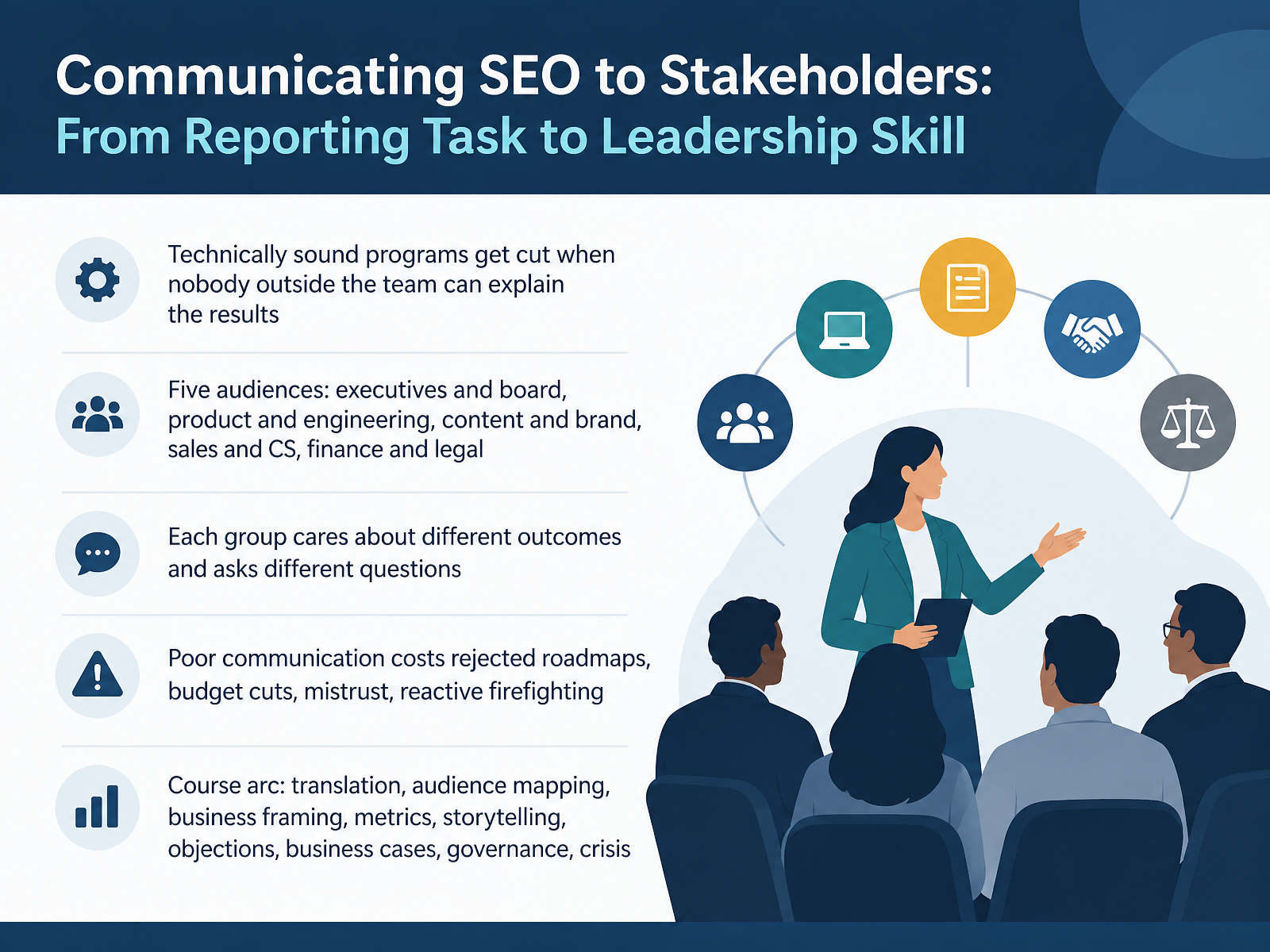
Here is the hard truth. Technically sound programs get cut when nobody outside the team can explain the results. Your rankings can improve every quarter and still lose funding, because the people holding the budget cannot see what they are paying for.
So who are you actually talking to? Five audiences. Executives and the board. Product and engineering. Content and brand. Sales and customer success. Finance and legal. Each group cares about different outcomes, and each asks different questions. Finance wants cost and return. Sales wants lead quality. Engineering wants to know why your ticket beats feature work.
When communication breaks down, the costs are concrete. Rejected roadmaps. Budget cuts. Lost trust. Reactive firefighting instead of planned work.
So here is the plan. Over the next twelve slides, we will cover translation, audience mapping, business framing, metrics, storytelling, objections, business cases, governance, and crisis communication. By the end, you will have language you can lift directly into your next meeting.
Let's start with why SEO gets lost in translation.aamax.cohashmeta.aiaamax.co+22 min
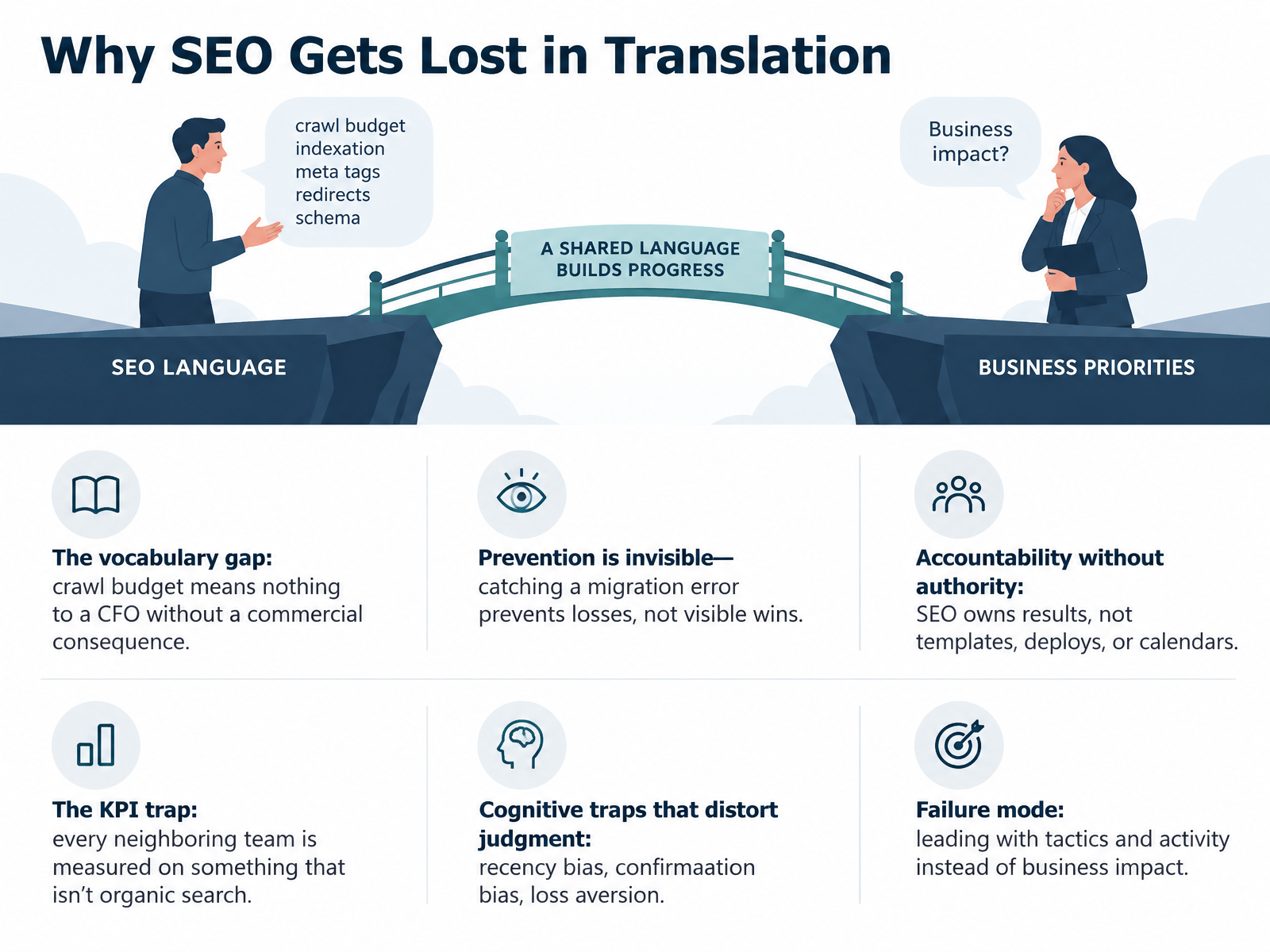
- 02Why SEO Gets Lost in TranslationLet's talk about why SEO gets lost in translation. Start with the vocabulary gap. Crawl budget means nothing to a CFO. But if you say, slow indexing is holding back revenue from pages we already paid to build, now you have their attention. Next, prevention is invisible. Catching a migration error prevents a loss, but nobody sees a win. So quantify the avoided loss and report it as an outcome. Then there's accountability without authority. SEO owns the results, but not the templates, the deploy schedule, or the content calendar. Say that plainly, because it explains why timelines slip. The KPI trap is next. Every neighboring team is measured on something that isn't organic search, so your request competes with their scorecard. And watch the cognitive traps that distort judgment: recency bias, confirmation bias, and loss aversion. Finally, the failure mode. Leading with tactics and activity instead of business impact. Here's the rule. Pair every search metric with its commercial consequence in the same sentence. Next, we'll look at Know Your Audience: Stakeholder Archetypes and Priorities.
 aamax.cohashmeta.aiaamax.co+22 min
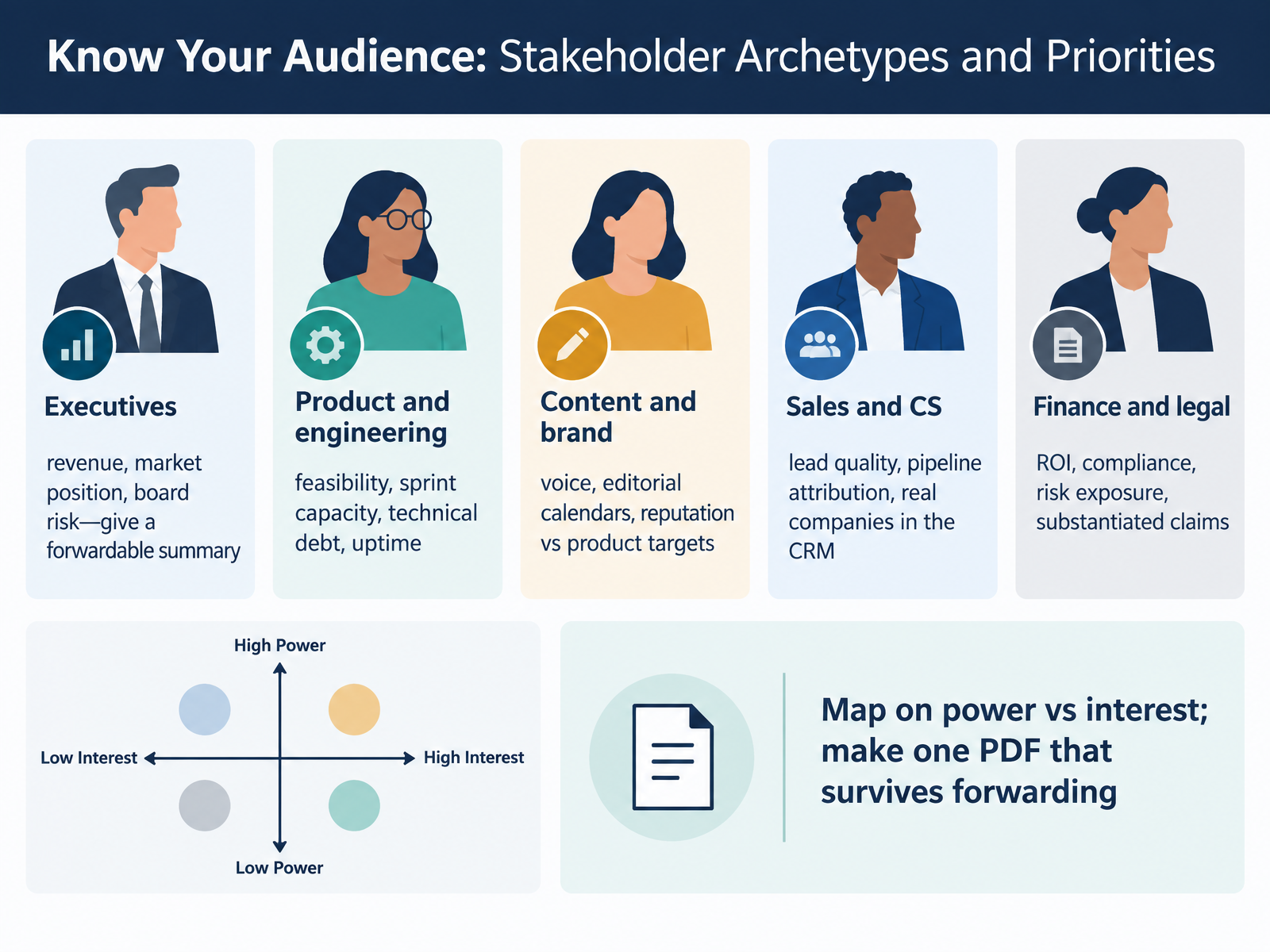
 - 03Know Your Audience: Stakeholder Archetypes and PrioritiesNow let's talk about who you're actually talking to. Different stakeholders optimize for different things, and if you use one message for all of them, you lose the room. Start with executives. They care about revenue, market position, and board risk. Give them a forwardable summary they can send upward without editing. Product and engineering care about feasibility, sprint capacity, technical debt, and uptime. Content and brand care about voice, editorial calendars, and reputation versus product targets. Sales and customer success care about lead quality, pipeline attribution, and whether they can recognize real companies in the CRM. Finance and legal care about return on investment, compliance, risk exposure, and substantiated claims. Here's your practical move. Map each stakeholder on power versus interest, then build one PDF that survives forwarding. Write it so any reader can grasp the decision, the cost, and the risk without you in the room. That single document becomes your quiet advocate. Next, we'll look at framing SEO as business value, not a marketing expense.
 searchengineland.comscalewithsearch.comgetpassionfruit.com+22 min
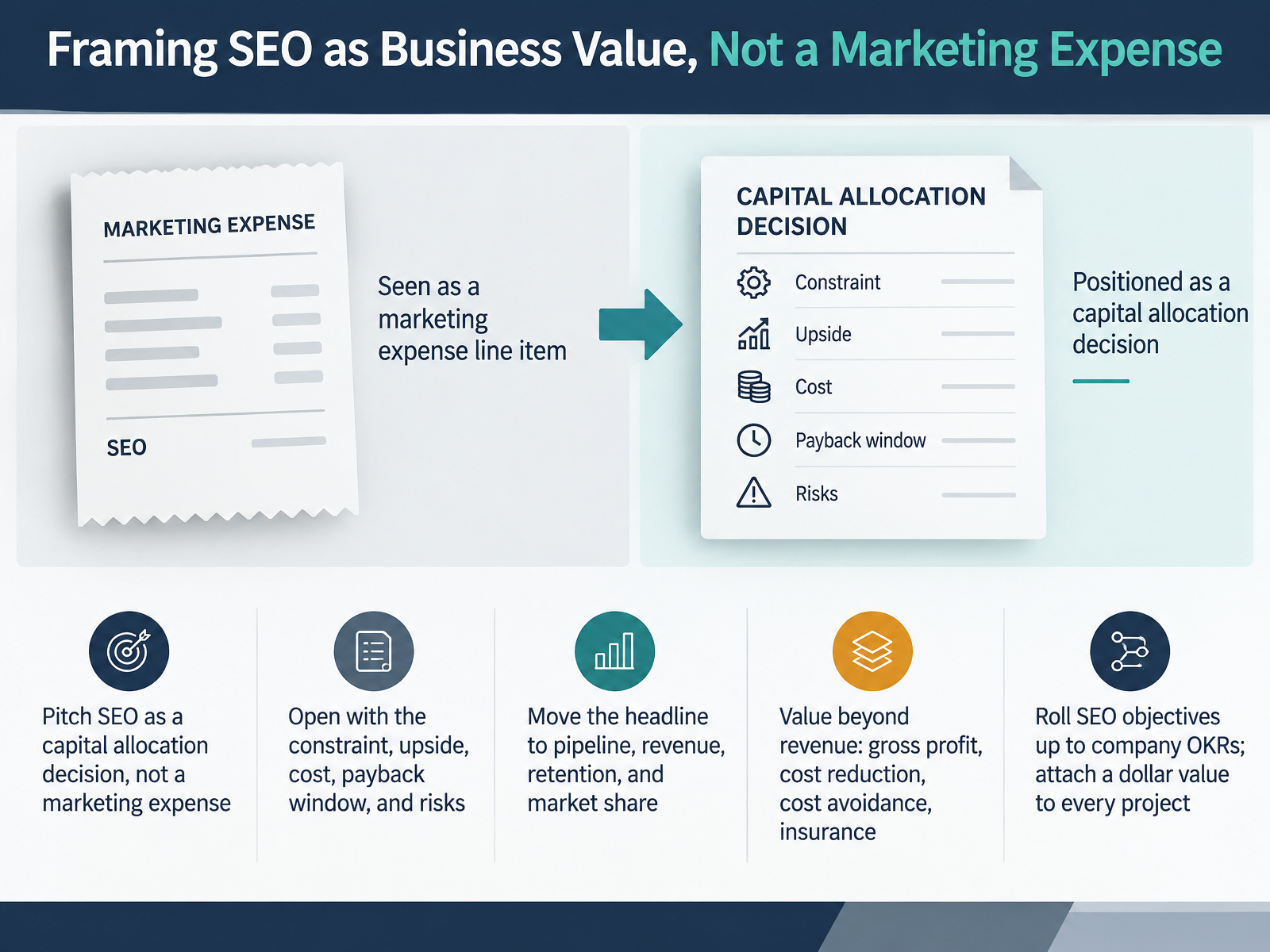
 - 04Framing SEO as Business Value, Not a Marketing ExpenseLet's talk about how you frame SEO so executives stop hearing a marketing expense and start hearing a capital allocation decision. Open with the constraint, the upside, the cost, the payback window, and the risks. That is the order a CFO expects, and it tells them you are asking for investment, not permission to spend. Then move the headline off rankings and traffic. Put pipeline, revenue, retention, and market share on the first slide. Rankings stay in the appendix. Remember, value goes beyond revenue. Gross profit, cost reduction, cost avoidance, and insurance all matter. A migration fix that prevents a revenue loss is insurance, and finance funds insurance willingly. Finally, roll your SEO objectives up to company OKRs, and attach a dollar value to every project. If a redirect effort recovers referring domains, price each one. Suddenly a technical task becomes a line item an executive cares about. Next, we look at the metrics to bring into that room: Metrics That Matter in the Boardroom.
 patrickstox.comhighervisibility.comahrefs.com+22 min
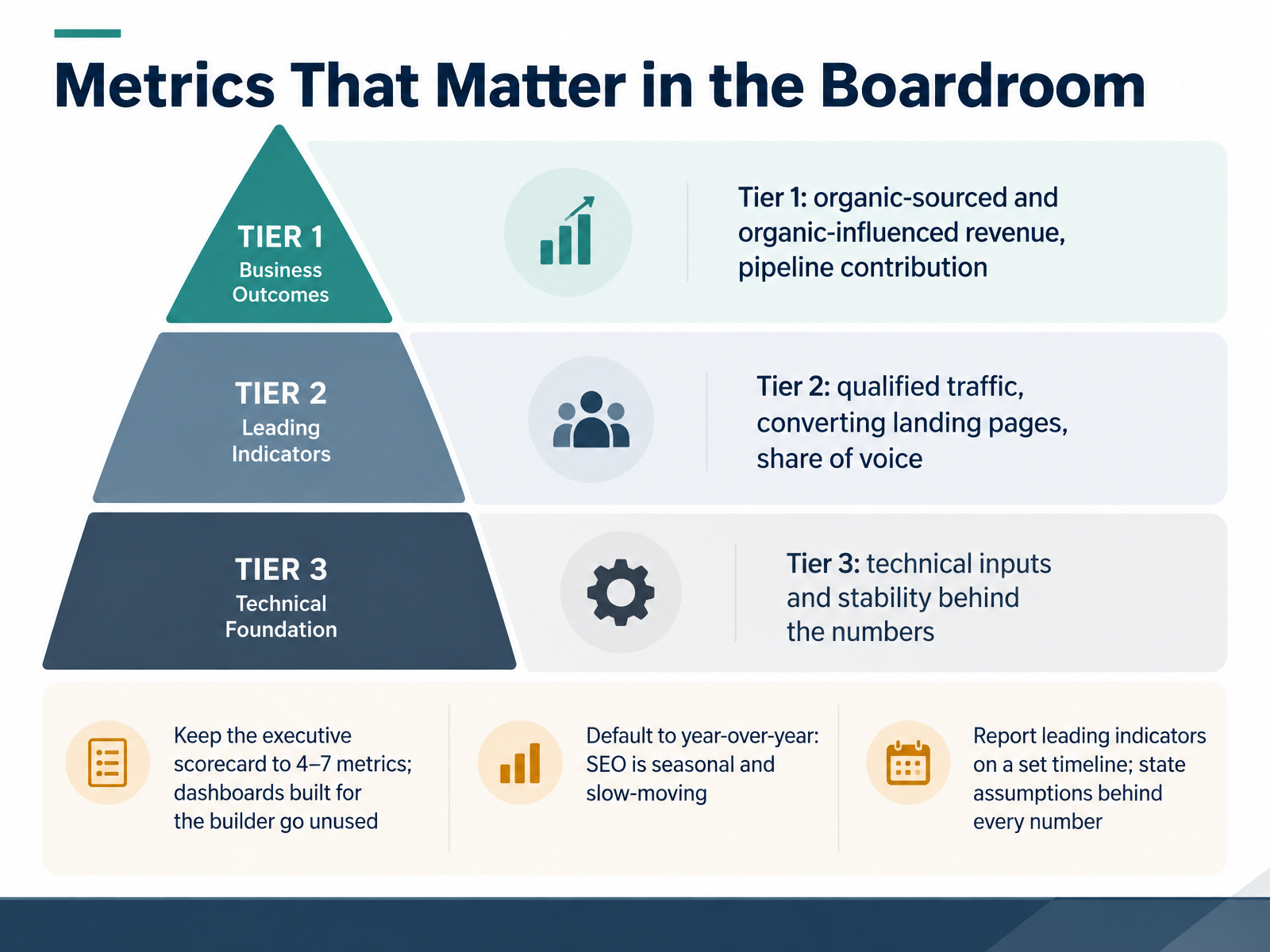
 - 05Metrics That Matter in the BoardroomLet's talk about the metrics that actually hold up in the boardroom. Executives fund outcomes, not activity, so organize your scorecard into three tiers. Tier one is revenue: organic-sourced and organic-influenced revenue, plus pipeline contribution. Tier two is compounding and reach: qualified traffic, the number of converting landing pages, and share of voice. Tier three is the technical inputs and stability behind those numbers. Resist adding more. Keep the executive scorecard to four to seven metrics, because dashboards built for the builder go unused. Default to year-over-year comparisons. SEO is seasonal and slow-moving, and a December-to-January drop looks alarming until you compare it to last January. Finally, report leading indicators on a set timeline, and state the assumptions behind every number. A number next to another number is a decision. Now let's make those numbers credible as we move into attribution and return framing.
 infinitemediaresources.comnextstepseo.coblog.theseoengine.com+21 min
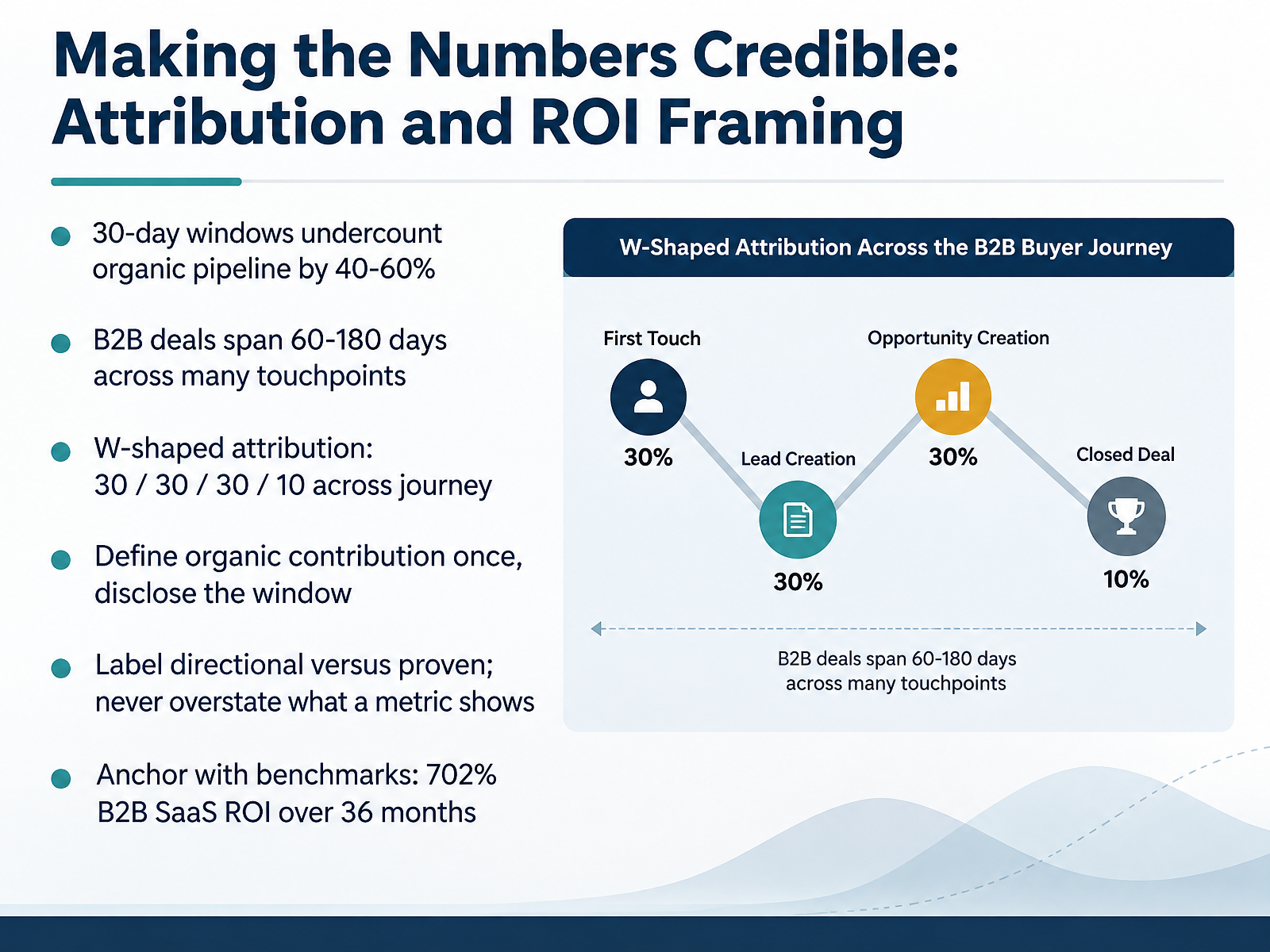
 - 06Making the Numbers Credible: Attribution and ROI FramingNow let's make those numbers credible. If you report SEO on a thirty-day window, you will undercount organic pipeline by forty to sixty percent. Here's why. B2B deals span sixty to one hundred eighty days and cross many touchpoints. A buyer who read your article in January and closed in October shows up as direct traffic in a short window. So define organic contribution once, and disclose the window you're using. Say it plainly. We credit organic across a one hundred eighty day window on a W-shaped model. That gives thirty percent to first touch, thirty percent to lead creation, thirty percent to opportunity creation, and ten percent across the middle. Then label your numbers honestly. Call them directional or proven, and never overstate what a metric shows. Finally, anchor with a benchmark executives respect. Well-executed B2B SaaS programs average seven hundred two percent return over thirty six months. Credibility comes from being precise, not from being loud. Next, the Board Pack: Structure, Visualization, and Narrative.
 thestarrconspiracy.comaamax.cohashmeta.ai+22 min
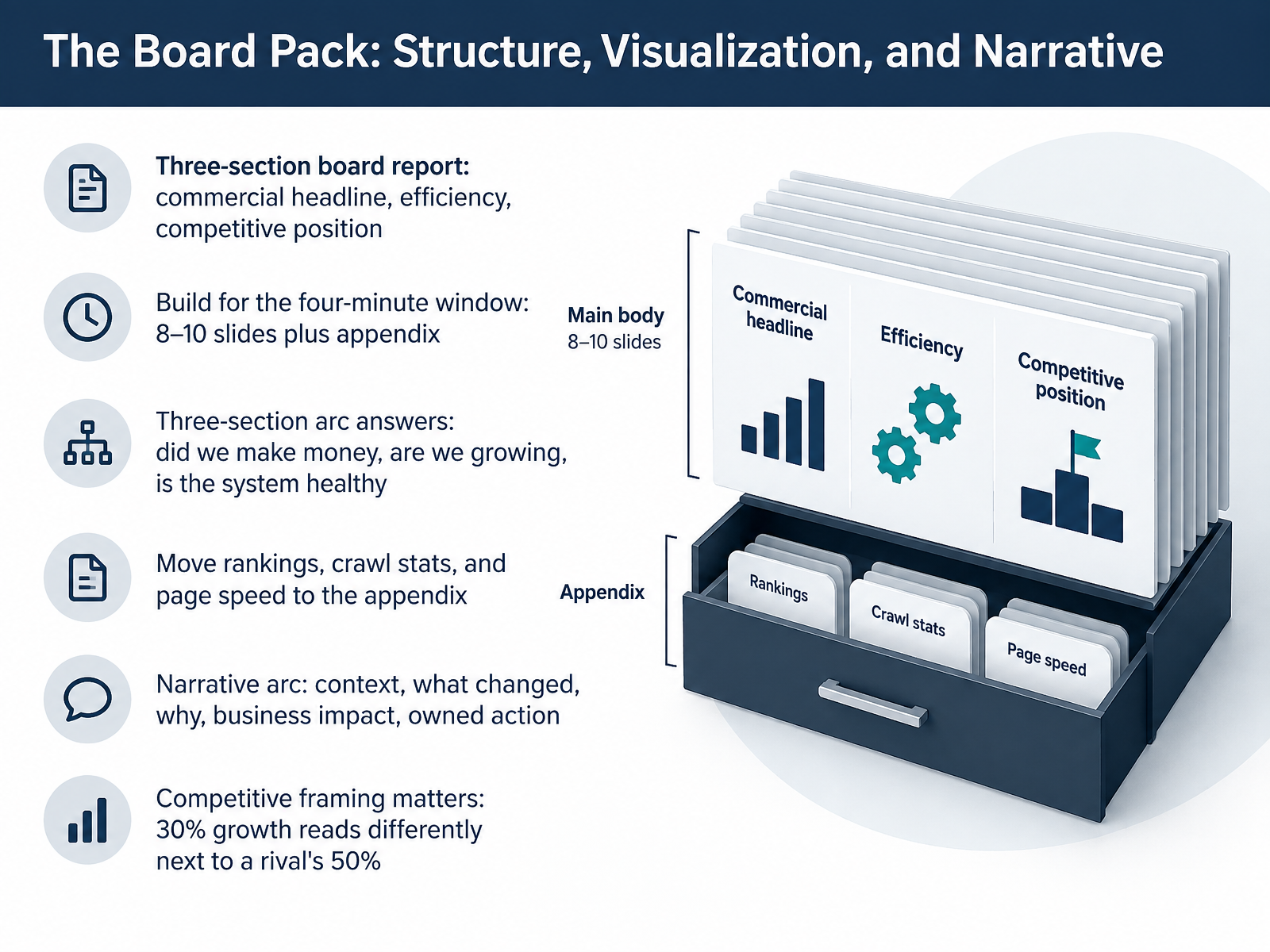
 - 07The Board Pack: Structure, Visualization, and NarrativeNow let's design the board pack itself. Build a three section board report: commercial headline, efficiency, and competitive position. That structure answers the three questions every board member is silently asking. Did we make money. Are we growing. Is the system healthy. Keep the whole pack inside a four minute window. Aim for eight to ten slides, plus an appendix. Everything else is clutter. Move rankings, crawl stats, and page speed into that appendix. None of it belongs in the room unless someone asks. Your narrative arc should run context, what changed, why, business impact, owned action. Then land one slide on competitive position. That framing matters. Thirty percent growth sounds strong on its own. It reads very differently next to a rival's fifty percent. So always show the comparison. Next, we will look at handling objections and tough questions.
 aamax.cohashmeta.aiaamax.co+21 min
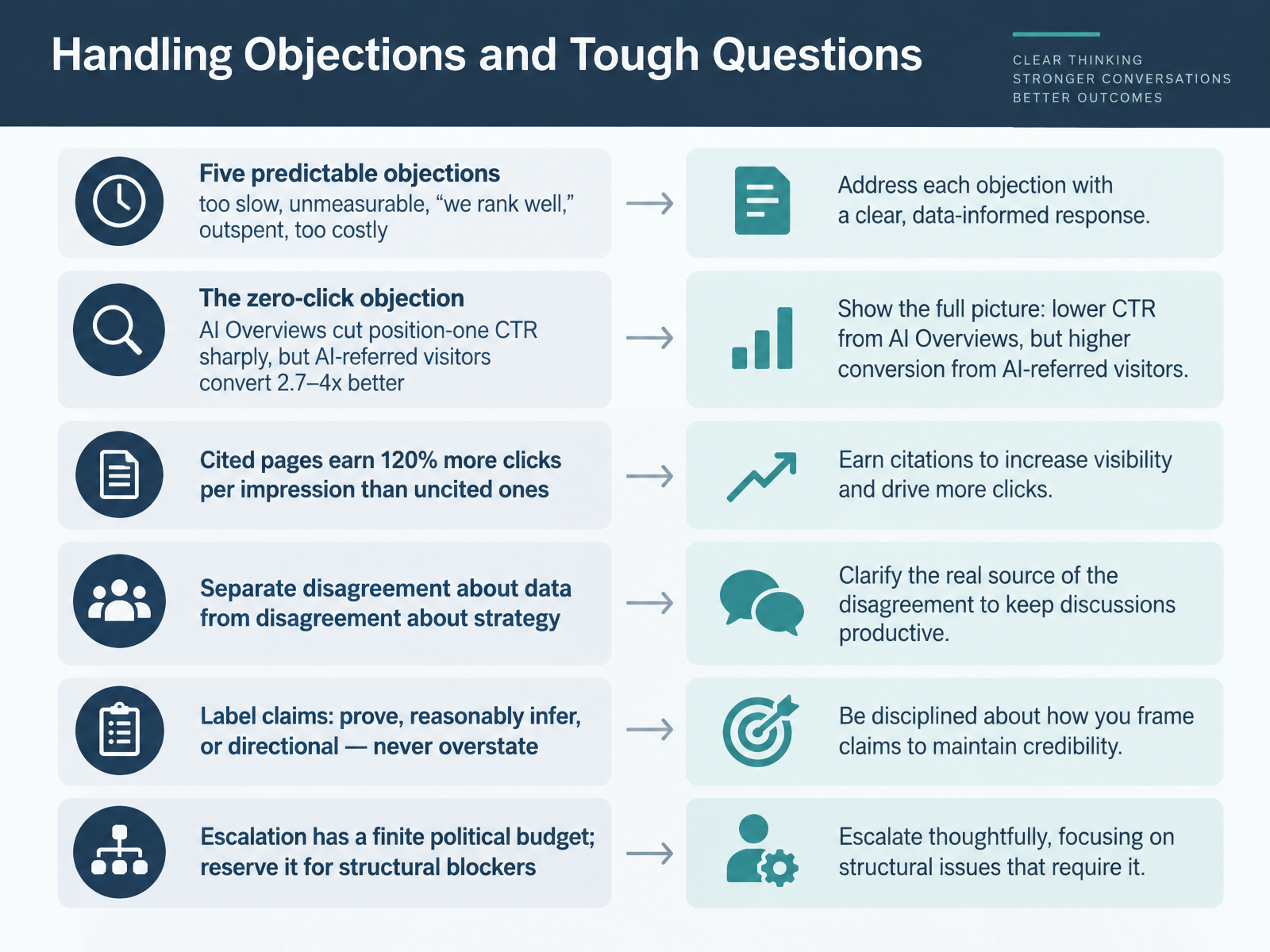
 - 08Handling Objections and Tough QuestionsLet's talk about objections, because you will hear the same five almost every time. Too slow. Unmeasurable. We already rank well. We're outspent. And it costs too much. Have a short answer ready for each before the meeting, not during it. The zero-click objection deserves the most care. Yes, AI Overviews cut position-one click-through dramatically. But AI-referred visitors convert two point seven to four times better. And pages cited inside an AI Overview earn one hundred twenty percent more clicks per impression than uncited ones. So the traffic is smaller and more valuable. Now separate the two kinds of disagreement. There is disagreement about the data, and disagreement about the strategy. Fix the first with evidence. Fix the second with a decision. And label every claim. Is it proven, reasonably inferred, or directional? Never overstate. Finally, escalation has a finite political budget. Spend it on structural blockers, not preferences. Next, we move to building the business case and securing budget.
 aamax.cohashmeta.aiaamax.co+22 min
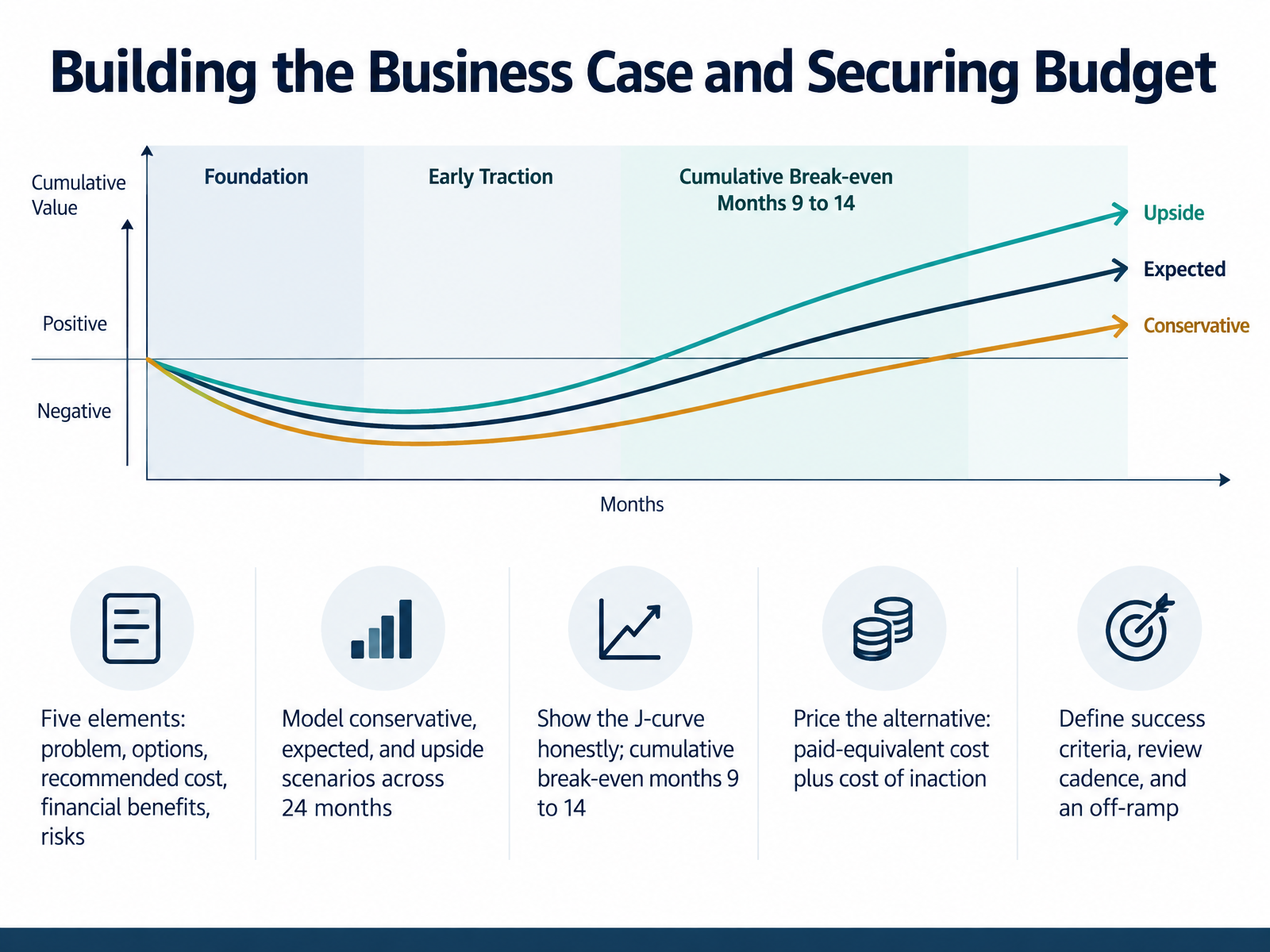
 - 09Building the Business Case and Securing BudgetNow let's turn to the budget conversation itself. A strong business case has five elements: the problem, the options you considered, the recommended cost, the financial benefits, and the risks. Model three scenarios across twenty-four months: conservative, expected, and upside. Show the J-curve honestly. Revenue lags early, and cumulative break-even usually lands between months nine and fourteen. Don't hide that dip; name it before finance does. Next, price the alternative. Show the paid-equivalent cost of the same visibility, plus the cost of doing nothing. That comparison is where approvals happen. Finally, define your success criteria, your review cadence, and an off-ramp. An off-ramp builds confidence because it proves this isn't blind faith. Bring the numbers, the timeline, and the risks. That's what turns an SEO request into an investment decision. Let's move on to cross-functional alignment and governance.
 patrickstox.comhighervisibility.comahrefs.com+22 min
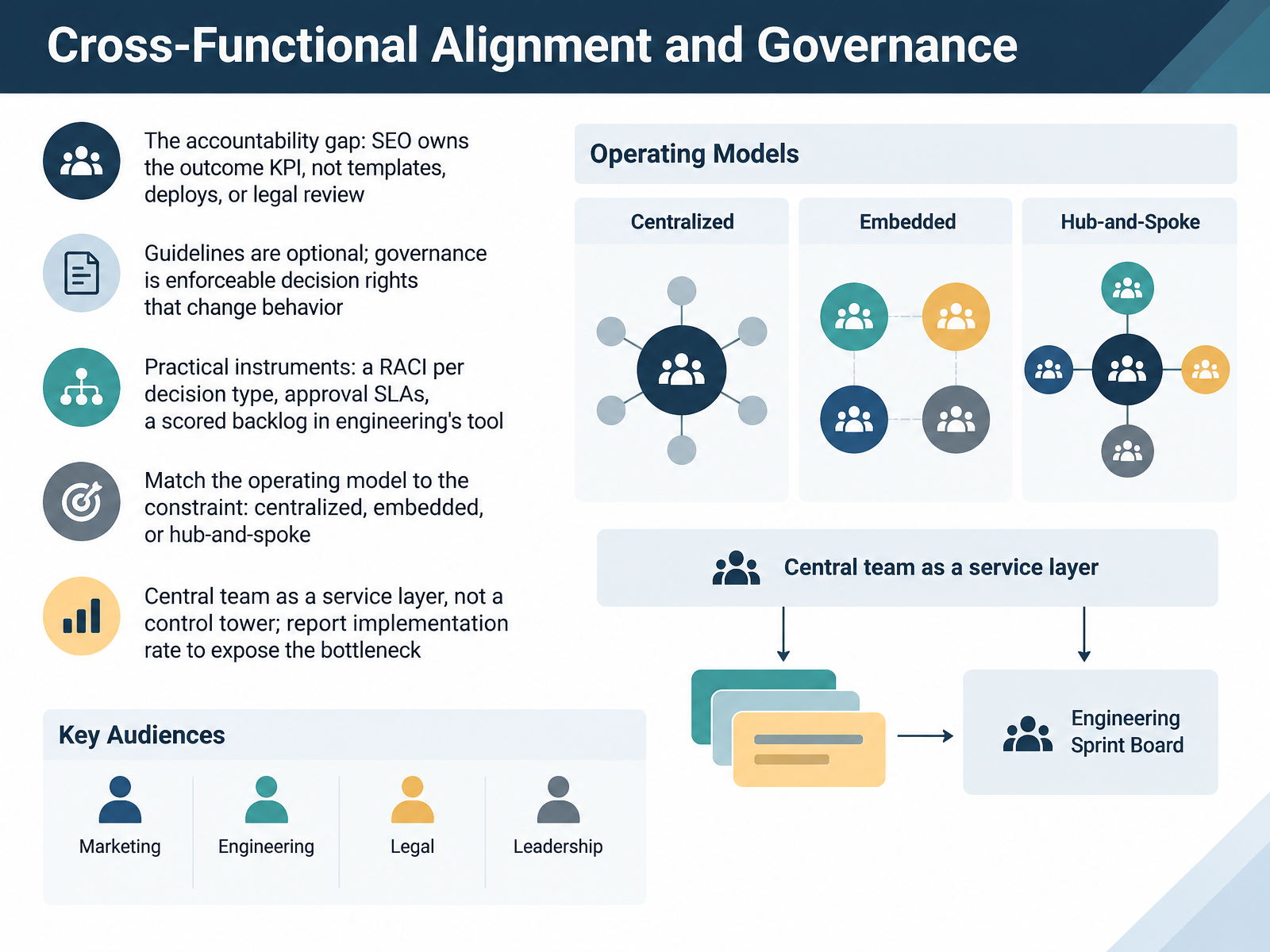
 - 10Cross-Functional Alignment and GovernanceLet's talk about cross functional alignment and governance. Here is the core problem. SEO owns the outcome K P I, but it does not own templates, deploys, or legal review. That is an accountability gap, not a performance gap. And it will not close on its own.
So remember this distinction. Guidelines are optional. Governance is enforceable decision rights that actually change behavior.
What does that look like in practice? Four instruments. First, a RACI per decision type, so every decision has one accountable owner. Second, approval service level agreements, with time limits and automatic progression. Third, a scored backlog that lives in engineering's own tool, not a spreadsheet. And fourth, an operating model matched to your real constraint, whether that is centralized, embedded, or hub and spoke.
One warning. The central team should act as a service layer, not a control tower. If business units feel policed, adoption dies. Instead, report your implementation rate, the percentage of recommendations actually shipped. That single number exposes the bottleneck faster than any dashboard.
Next, we will look at crisis communication under pressure.
 getpassionfruit.comhashmeta.aiinfinitemediaresources.com+22 min
 - 11Crisis Communication Under PressureLet's talk about what happens when a drop turns into a crisis, and you're the one facing the room.
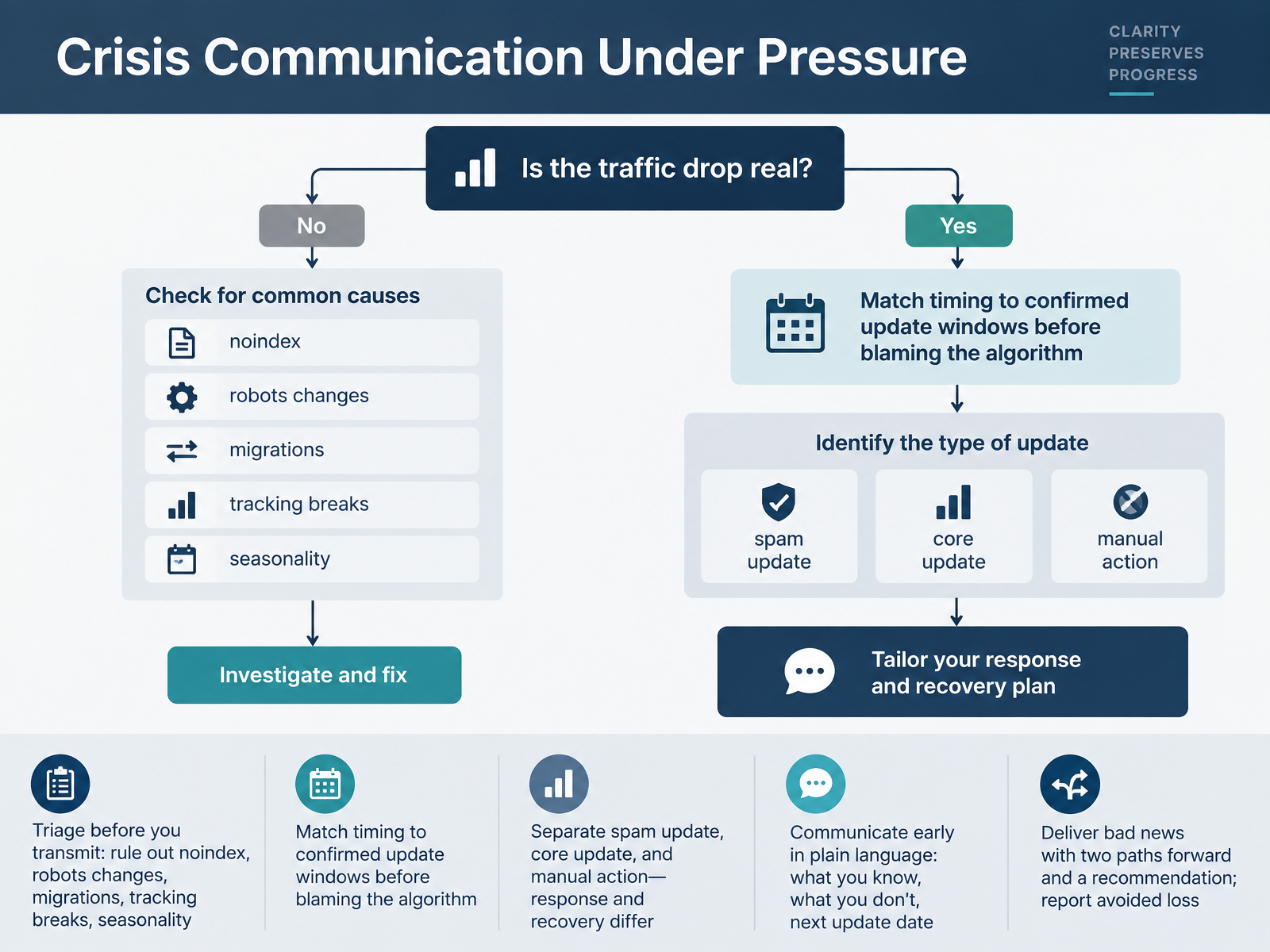
Start with triage, not transmission. Before you blame the algorithm, rule out the boring causes: a noindex tag, a robots change, a recent migration, a broken tracking setup, or plain seasonality. Twenty minutes of triage saves you an awkward correction later. Then check the timing against confirmed update windows. A drop that doesn't line up usually isn't the update. And separate a spam update, a core update, and a manual action. They are three different events, and your response and recovery differ for each.
Communicate early, in plain language: what you know, what you don't, and when they'll hear from you next. And when the news is bad, never deliver a problem alone. Bring two paths forward and a clear recommendation. That turns a tense room into a decision, not a blame session. Report the loss you avoided, too, because prevention is real value.
Next, we'll look at leading indicators and the AI search conversation.
 aamax.cohashmeta.aiaamax.co+22 min
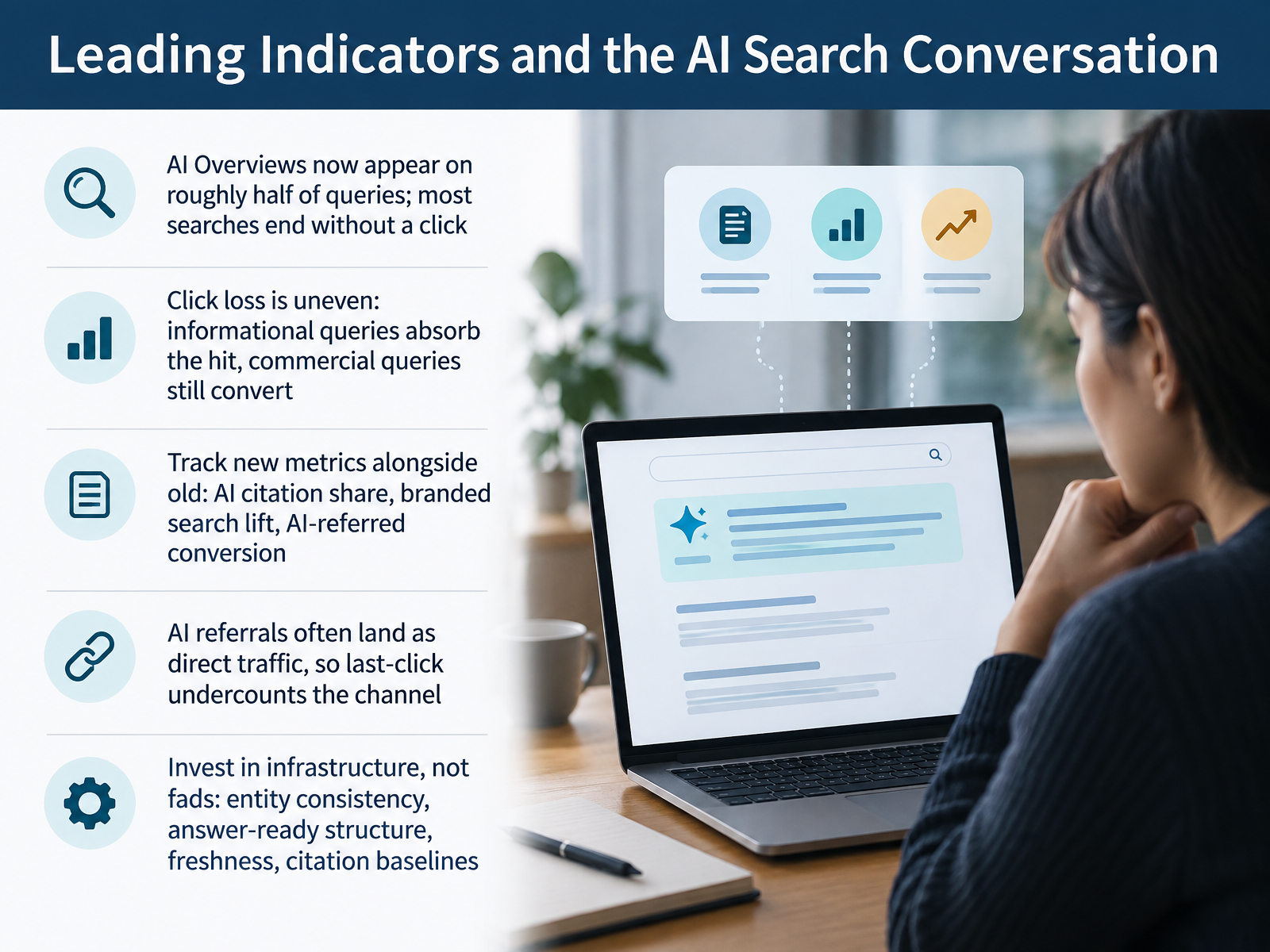
 - 12Leading Indicators and the AI Search ConversationLet's talk about leading indicators and the AI search conversation. AI Overviews now appear on roughly half of queries, and most searches end without a click. But the click loss is uneven. Informational queries absorb the hit. Commercial queries still convert. So do not panic about the whole channel. Segment it. Track new metrics alongside the old ones. AI citation share, branded search lift, and AI-referred conversion. One caution. AI referrals often land as direct traffic, so last-click attribution undercounts the channel. When you present this to executives, lead with that framing. The dashboard is incomplete, not the strategy. Finally, invest in infrastructure, not fads. Entity consistency, answer-ready structure, freshness, and citation baselines. Those are the compounding assets. Now let's put this into practice. Practical Workshop: Build Your Stakeholder Communication Kit.
 infinitemediaresources.comnextstepseo.coblog.theseoengine.com+21 min
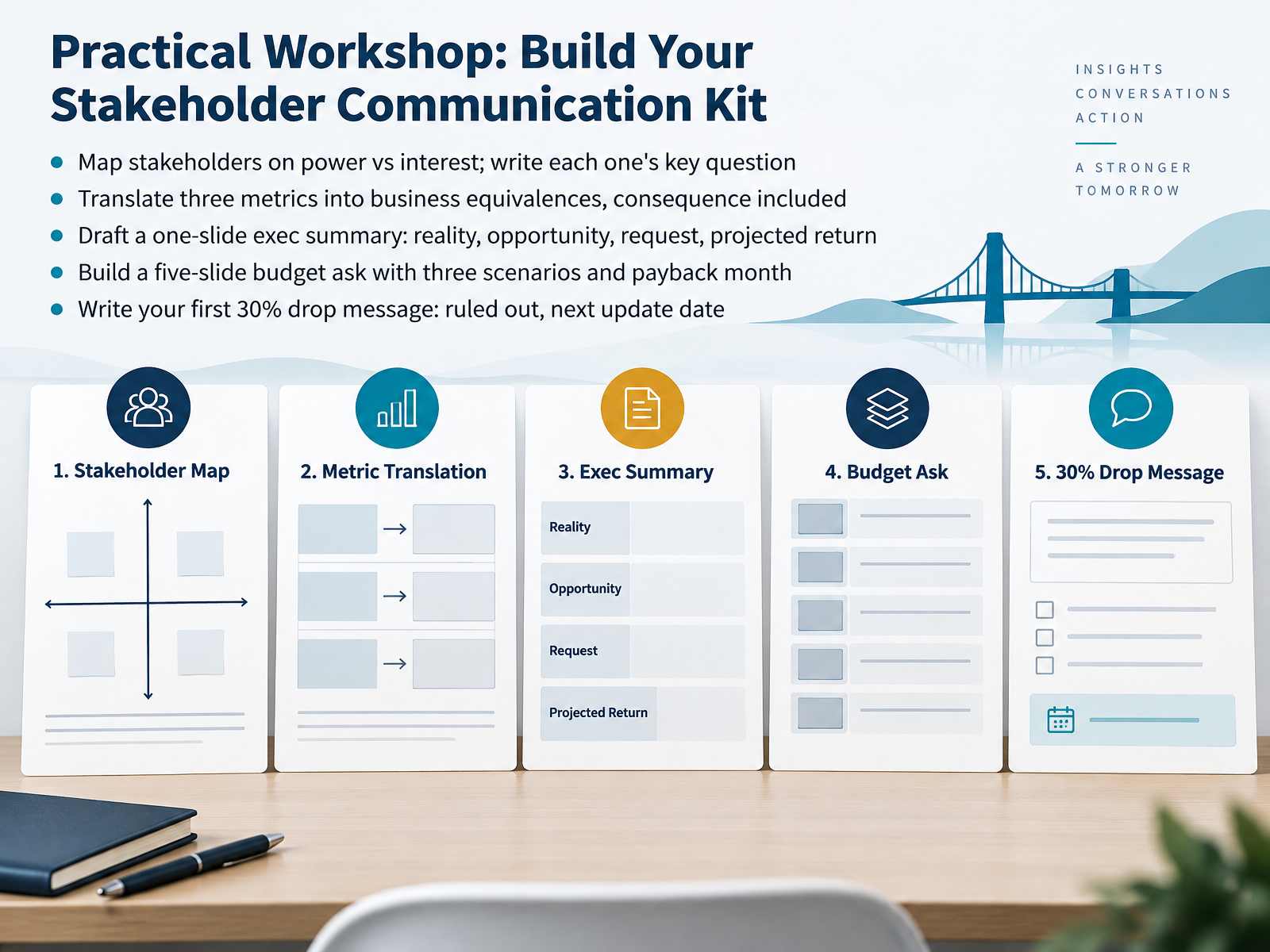
 - 13Practical Workshop: Build Your Stakeholder Communication KitLet's close by building your kit. First, map your stakeholders on power versus interest, and write down each one's single key question. That tells you what to answer before they ask it. Second, take three metrics and translate each into a business equivalent, a dollar figure, a saved cost, a shared consequence. Pair a search metric with its commercial consequence in the same sentence. Third, draft a one slide executive summary with four parts: current reality, opportunity, the request, and projected return. Keep it tight. Fourth, build a five slide budget ask with three scenarios, conservative, expected, and aggressive, each showing the payback month. Fifth, write your first thirty percent drop message now, before you need it. State what you have ruled out, what you are investigating, and the date of your next update. That last one protects your credibility more than any win. You now have the language. Build the kit, rehearse it, and walk in ready. Thanks for staying with me, and good luck in your next stakeholder meeting.
 searchengineland.comscalewithsearch.comgetpassionfruit.com+22 min
Take the deck with you
Download this course as a file — free, no sign-up needed.
- PDF handoutEvery slide page, ready to print or share.14 pages · 3.0 MBDownload
- Narrated PowerPointThe deck that presents itself — every slide carries the digital human's narration video.14 pages · 12.3 MBDownload
- PowerPoint slidesThe full deck as a .pptx — open it in PowerPoint, Keynote, or Google Slides.14 pages · 2.9 MBDownload
Free to use in your own training — please keep the PersonWise credit page at the end.
Have your own deck? Turn it into a course
Sources consulted
Web sources consulted while building this course.
- How to Communicate SEO Value to Nonseo Stakeholders | AAMAX — aamax.co
- How to Present Enterprise SEO Wins to Non-Technical Executives: A Strategic Guide | Hashmeta AI Marketing Blog — hashmeta.ai
- How to Present SEO Results to Non-Technical Stakeholders | AAMAX — aamax.co
- Pitching SEO to C-Suite in Revenue Terms | GL — growthlimit.com
- How to Prove SEO ROI to Your CEO or Board: A Framework for Non-Technical Stakeholders | Semola Digital — semoladigita.com
- SEO Stakeholders: Align Teams & Prove ROI Like a Pro — searchengineland.com
- Build an SEO responsibility matrix so every task has one owner. — scalewithsearch.com
- Enterprise SEO Governance: Process Framework for B2B Teams — getpassionfruit.com
- 15 Essential Stakeholder Management Strategies for Enterprise SEO Success | Hashmeta AI — hashmeta.ai
- How should organizations build a resourcing model for SEO? — pedowitzgroup.com
- SEO OKRs — patrickstox.com
- Building a Business Case for SEO: How to Get SEO Buy-In From Your CEO — highervisibility.com
- SEO OKRs: Driving Performance & Measuring Impact — ahrefs.com
- How to Explain the Value of SEO to Executives — Whiteboard Friday 2026 — pixelkraft.net
- Which SEO KPIs Should Executives Review Monthly? — infinitemediaresources.com
- The Executive SEO Dashboard: What Leaders Should See — nextstepseo.co
- SEO Executive Dashboard: 7 Proven Fixes for 2026 — The Seo Engine — blog.theseoengine.com
- Enterprise SEO Reporting: Dashboards | The Business Rover — thebusinessrover.com
- Ultimate SEO KPI Dashboard (2026): Track Rankings, Leads — seoraf.com
- B2B SEO ROI Benchmarks | The Starr Conspiracy — thestarrconspiracy.com