Colonialism and Decolonization
Begin
14 pages · ~28 min
Colonialism and Decolonization
This training explores the history, impact, and legacies of colonialism while examining key decolonization movements, empowering learners to critically analyze global power dynamics and contemporary post-colonial issues.
What you’ll learn
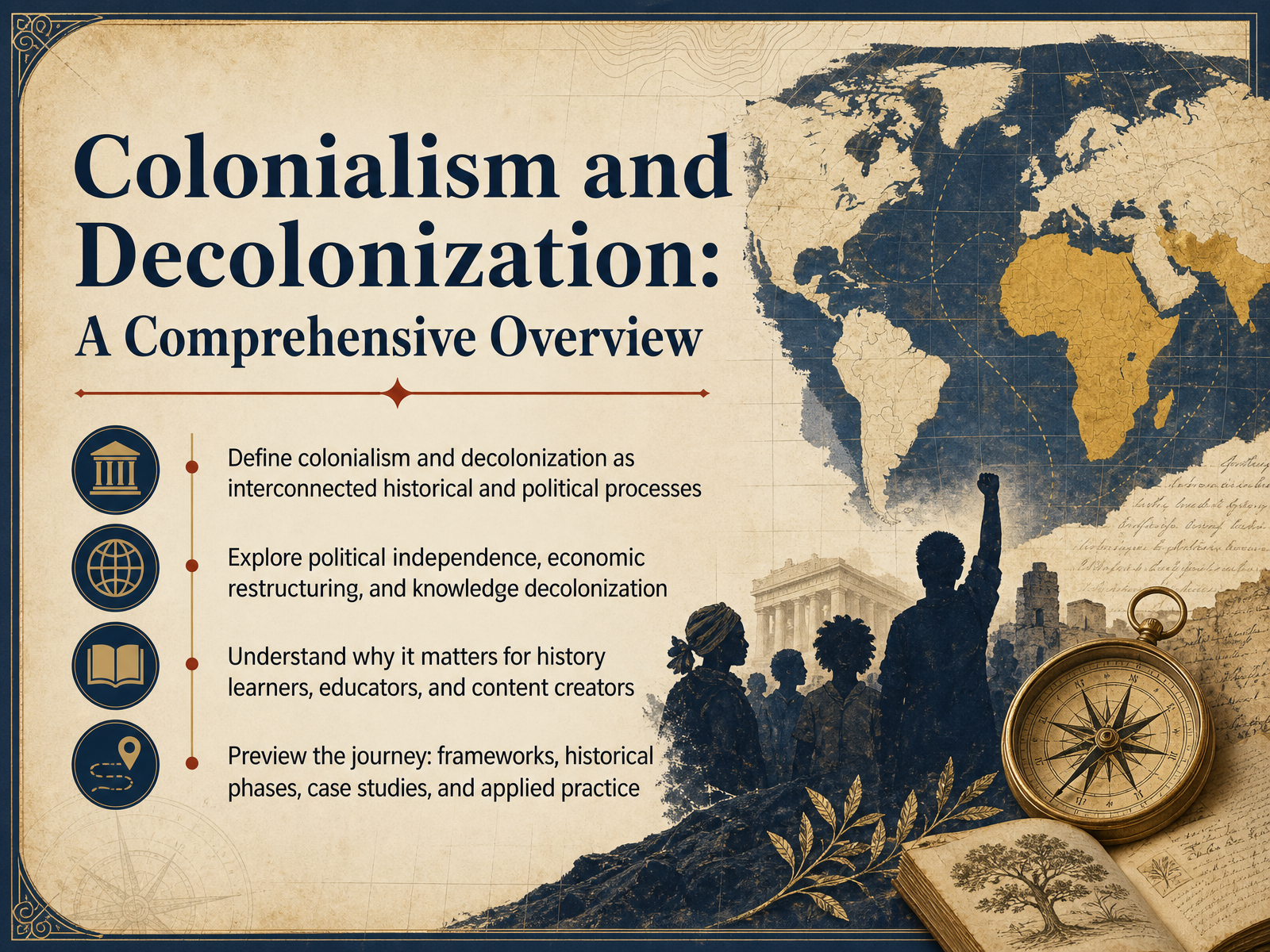
- 01Colonialism and Decolonization: A Comprehensive OverviewWelcome to this overview of colonialism and decolonization. In this course, we will explore how these two interconnected processes have shaped political borders, economies, and systems of knowledge across centuries. We will examine the fight for political independence, the ongoing work of economic restructuring, and the deeper project of knowledge decolonization, which asks whose perspectives count as authoritative. Throughout, we will move carefully through clearly dated cases, such as the 1846 Oregon Treaty or recent land restitution efforts in Aotearoa New Zealand, so that each example is grounded in its own time and place. The goal is not to deliver a single verdict, but to give history learners, educators, and content creators a more precise vocabulary and a more reflective approach. We will preview the journey ahead: core frameworks, historical phases, regional case studies, and practical questions for teaching and creating content responsibly. As we go, I invite you to think critically about how colonial legacies appear in the present. Let us begin by asking why this topic still matters today.teaonews.co.nzapiboficial.orgrnz.co.nz+22 min
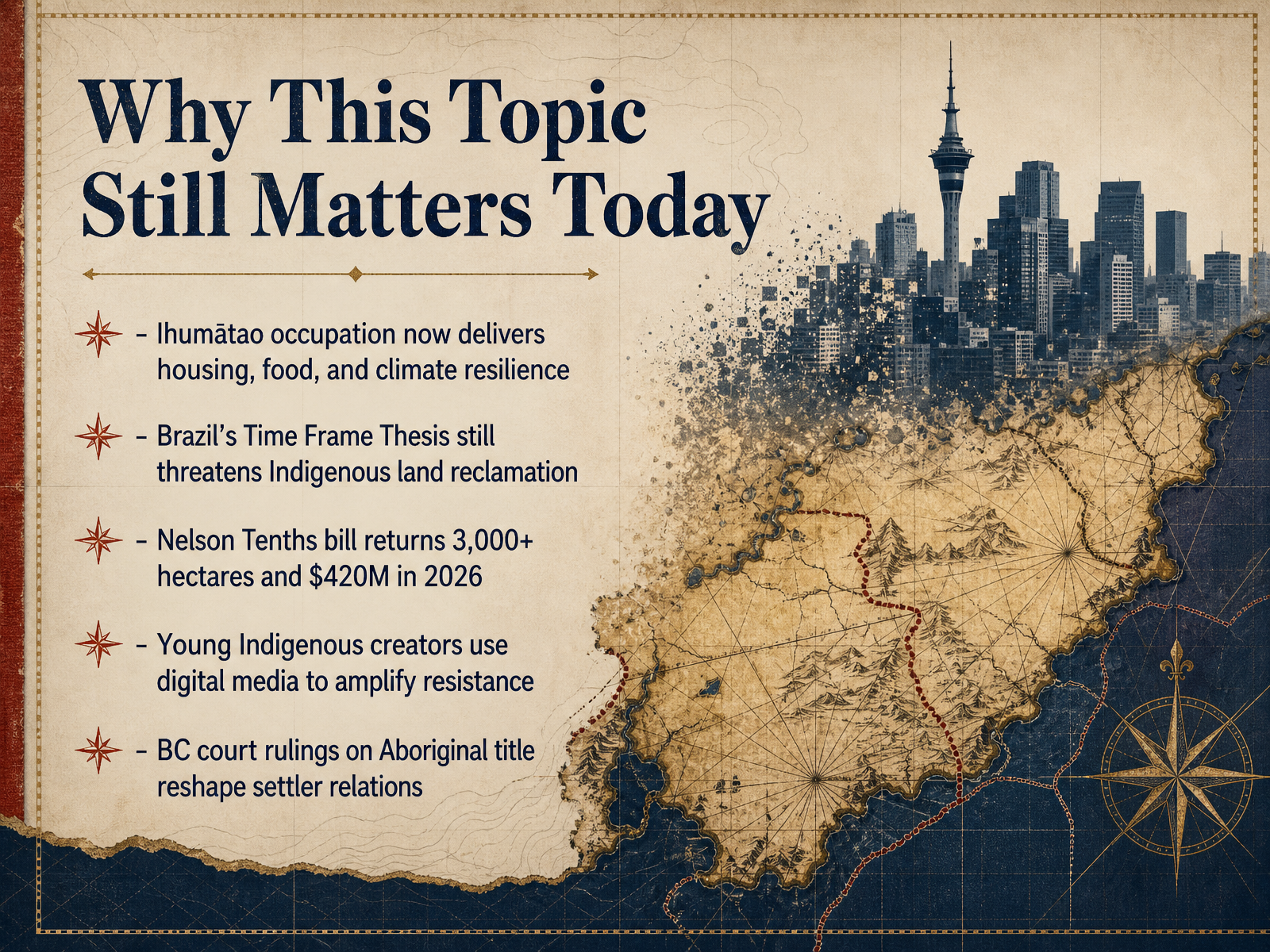
- 02Why This Topic Still Matters TodayWhy does this history still matter today? Because its consequences are unfolding right now, in courtrooms, communities, and online spaces. Consider Aotearoa New Zealand. A decade ago, the occupation at Ihumātao became a defining moment in Māori land movements. Today, the first families have moved into new homes on that land, alongside food forests and solar energy projects designed for climate resilience. In Brazil, however, the situation remains contested. The Time Frame Thesis has been rejected by the Supreme Court, yet its underlying logic still threatens Indigenous land reclamation, creating legal and political uncertainty. Meanwhile, a bill in New Zealand is set to return over three thousand hectares and four hundred twenty million dollars to Māori owners in Te Tauihu, resolving a dispute that began in the eighteen forties. Young Indigenous creators are also changing the conversation, using digital media to amplify resistance and reach global audiences. And in British Columbia, recent court rulings on Aboriginal title are reshaping the relationship between settler governments and First Nations. These examples show that decolonization is not only a historical concept. It is a living process with real stakes for land, law, and identity. With this context in mind, let us now turn to the core concepts and terminology that will anchor our discussion.
 teaonews.co.nzapiboficial.orgrnz.co.nz+22 min
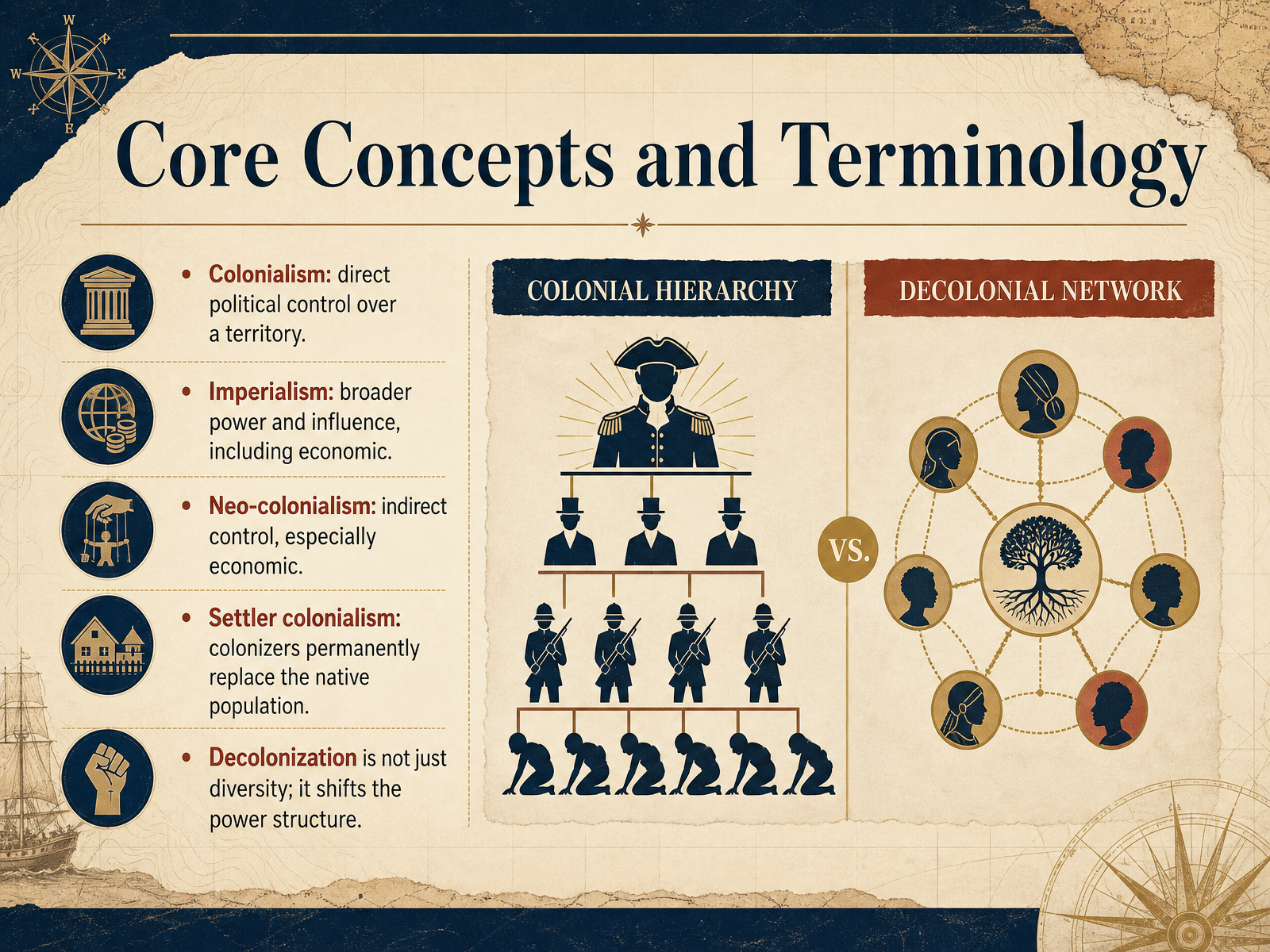
 - 03Core Concepts and TerminologyLet's establish some shared vocabulary before we move into the historical narrative. Colonialism, in its strictest sense, refers to direct political control over a territory and its people. Imperialism is broader. It describes the extension of power and influence, which often includes economic domination even without direct rule. Neo-colonialism describes how that influence continues after formal independence, frequently through economic pressure, debt, or corporate control. Settler colonialism is a distinct form where the colonizing population arrives with the intention of staying permanently, displacing and replacing the indigenous population, rather than merely administering it from afar. Finally, it is important to clarify what decolonization means in this context. It is not simply about diversifying voices or adding representation, though those are valuable steps. Decolonization involves a shift in the underlying power structure, asking who holds authority, whose knowledge is legitimized, and how systems can be fundamentally reordered. With these terms in mind, we can turn, next, to the historical phases of colonial expansion.
 bath.ac.uktlc.wwu.eduedshare.gla.ac.uk+21 min
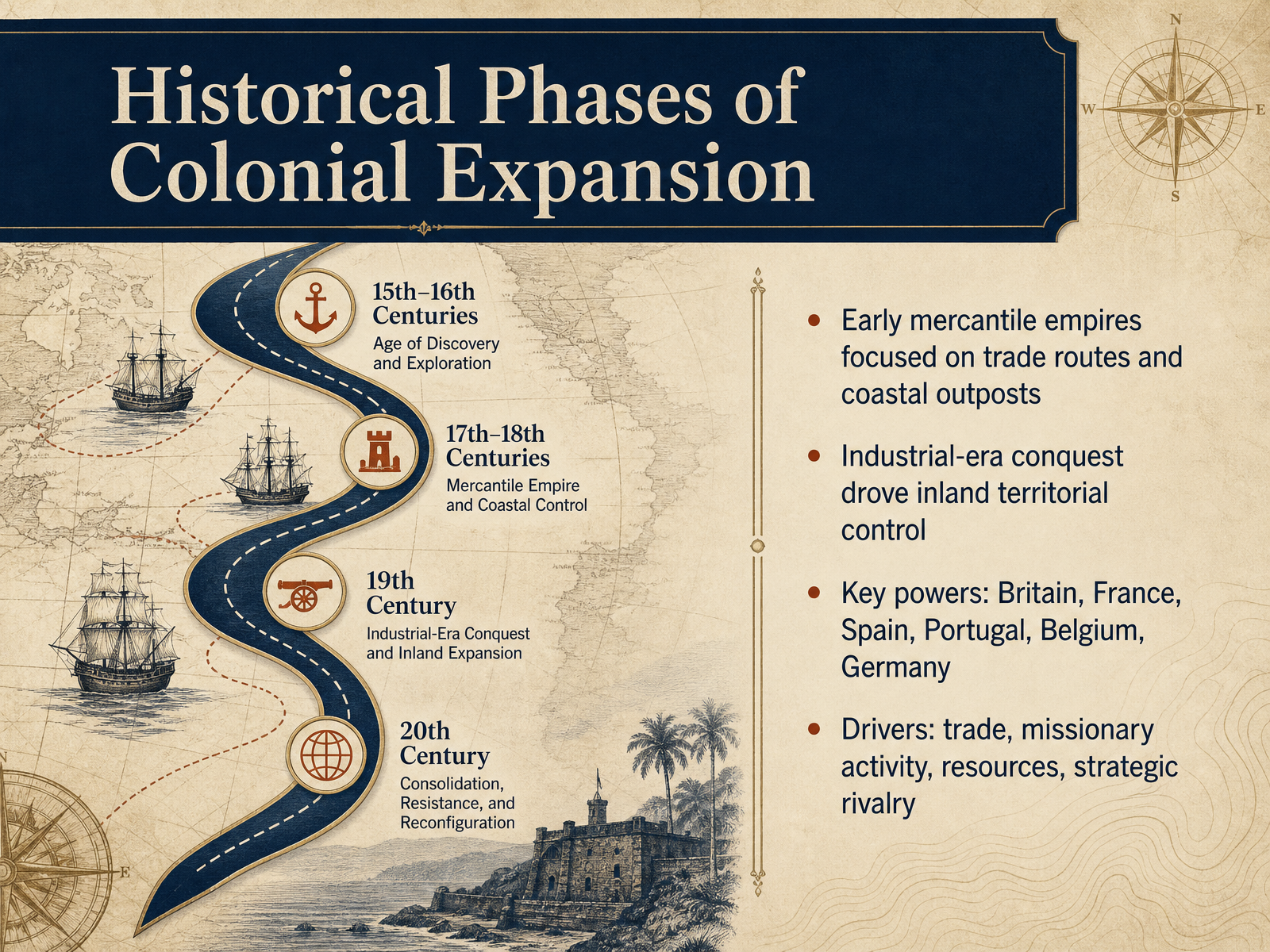
 - 04Historical Phases of Colonial ExpansionLet's turn now to the historical phases of colonial expansion. In the early period, mercantile empires focused mainly on trade routes and coastal outposts. They established ports and forts along coasts to control the movement of goods, rather than claiming vast inland territory. This pattern shifted during the industrial era. Conquest became more aggressive and moved inland, as colonial powers sought direct control over land, labor, and raw materials. The key imperial states in this process included Britain, France, Spain, Portugal, Belgium, and Germany. Their expansion was driven by several overlapping forces: trade, missionary activity, the demand for resources, and strategic rivalry among European powers. It is worth noting that these motivations did not operate in the same way everywhere. In some regions, trade interests dominated, while in others, settlement or resource extraction took priority. As we continue, we will compare colonial systems and local agency.
 1 min
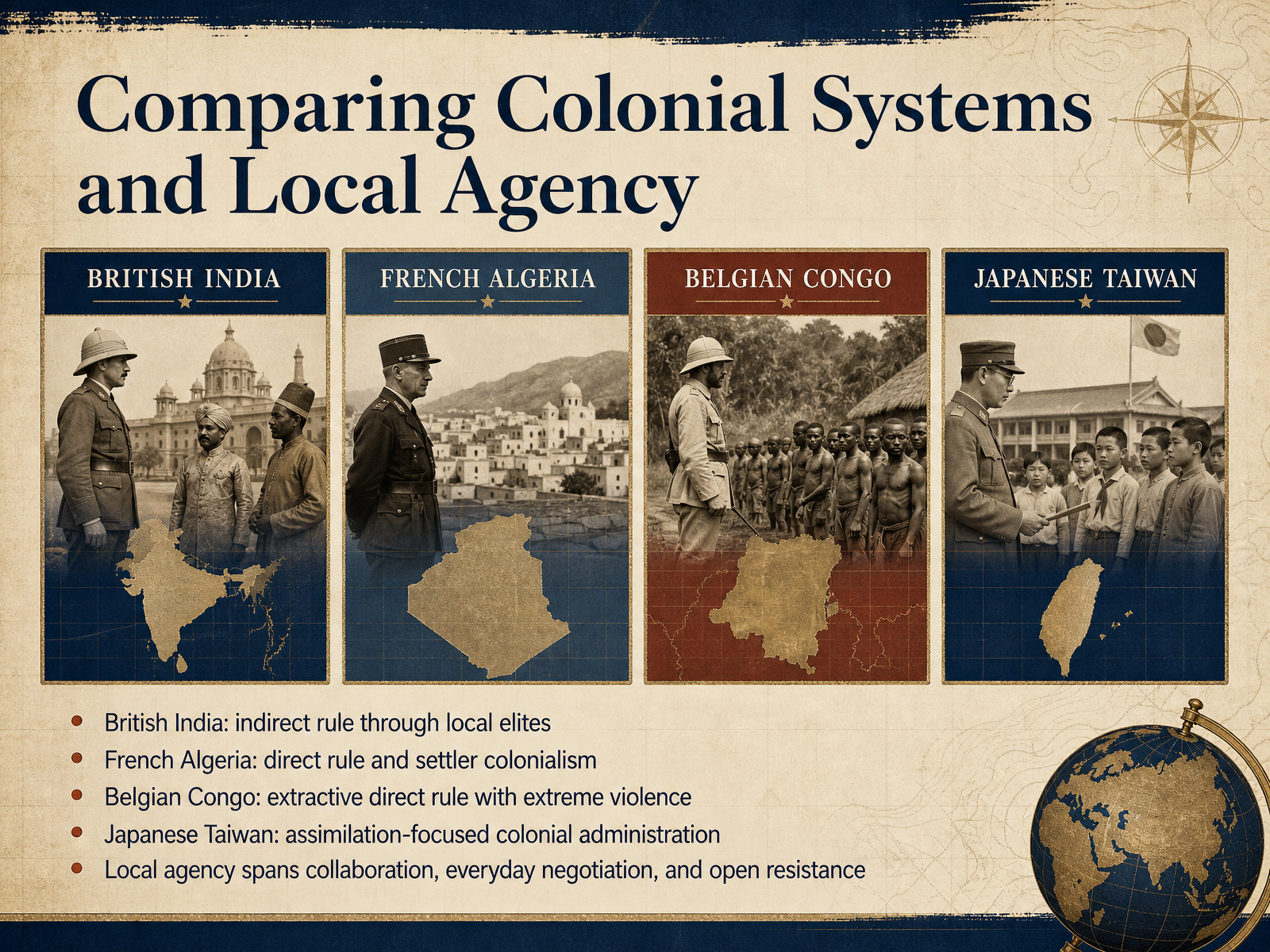
1 min - 05Comparing Colonial Systems and Local AgencyNow let's compare several colonial systems, because these were not the same everywhere. In British India, the administration often governed indirectly, working through local princes and elites. This approach depended heavily on those local figures and shaped local politics in lasting ways. French Algeria followed a very different path, one of direct rule and settler colonialism, with large numbers of French settlers and French institutions imposed on Algerian society. The Belgian Congo was even more extractive, with direct administrative control and extreme violence used to force labor and resource extraction. In contrast, Japanese Taiwan developed an assimilation focused administration, aiming to integrate the island into the Japanese empire through schools, language policies, and infrastructure. Across all these cases, local agency never disappeared. People collaborated, negotiated in everyday life, or resisted openly. A key question is why colonial strategies differed so much, and historians still debate how much this came from imperial design versus local conditions on the ground. With these comparisons in mind, we can now turn to the unraveling of these systems and the rise of independence struggles.
 2 min
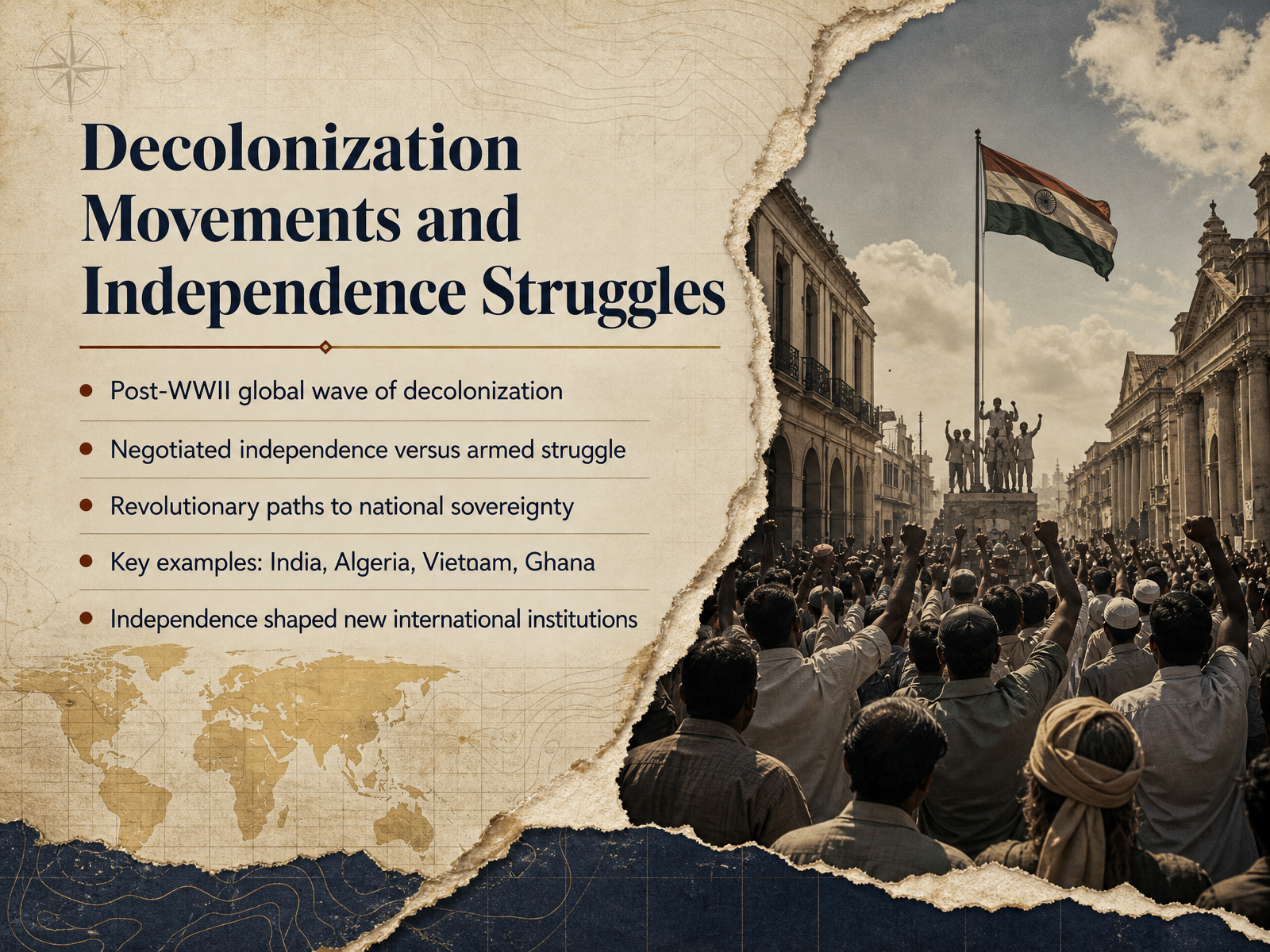
2 min - 06Decolonization Movements and Independence StrugglesMoving from the theory to the practice of liberation, we now turn to the mid-twentieth century, which witnessed a widespread global wave of decolonization after the Second World War. These independence struggles took various forms. Some transitions were achieved through negotiated settlements and constitutional transfer of power. Others were won through prolonged armed conflict and revolutionary movements. Consider India, where mass civil disobedience and political pressure led to negotiated independence from Britain in 1947. Contrast that with Algeria, where a brutal war of independence against French rule lasted from 1954 to 1962. Vietnam’s path involved decades of anti-colonial and Cold War conflict. And in Ghana, under the leadership of Kwame Nkrumah, independence in 1957 became a Pan-African symbol of sovereignty. These varied paths fundamentally reshaped the international order, bringing many newly sovereign states into institutions like the United Nations. In the next slide, we will examine the economic legacies and ongoing debates around neo-colonialism.
 1 min
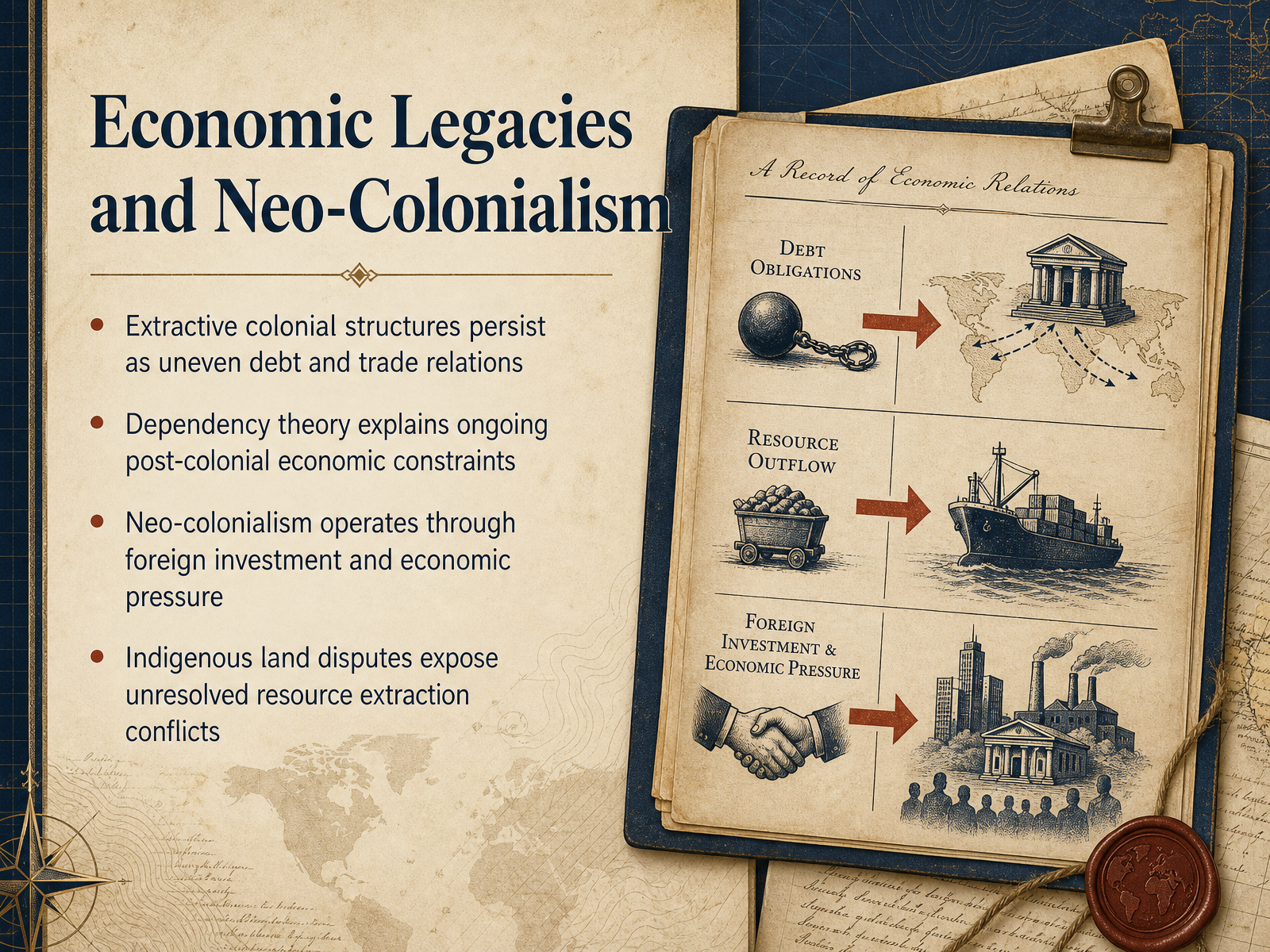
1 min - 07Economic Legacies and Neo-ColonialismLet's turn now to the economic legacies of colonialism, and the idea of neo-colonialism. Even after political independence, many former colonies found that economic structures built for extraction remained in place. Uneven trade relations and heavy debt often kept them dependent on wealthier nations. Scholars call this dependency theory: the idea that post-colonial economies can remain constrained by systems designed to benefit former colonial powers. Neo-colonialism describes how this influence can continue today, not through direct rule, but through foreign investment, loan conditions, and economic pressure. These dynamics are often visible in disputes over land and resources. For example, in Brazil, Indigenous peoples continue to fight for the demarcation of ancestral territories, while in Canada, debates over pipeline projects and mineral extraction raise unresolved questions about sovereignty and consent. These are not simply historical issues. They are present day contests over who controls land, resources, and economic futures. We'll explore the cultural dimensions of this struggle next.
 teaonews.co.nzapiboficial.orgrnz.co.nz+21 min
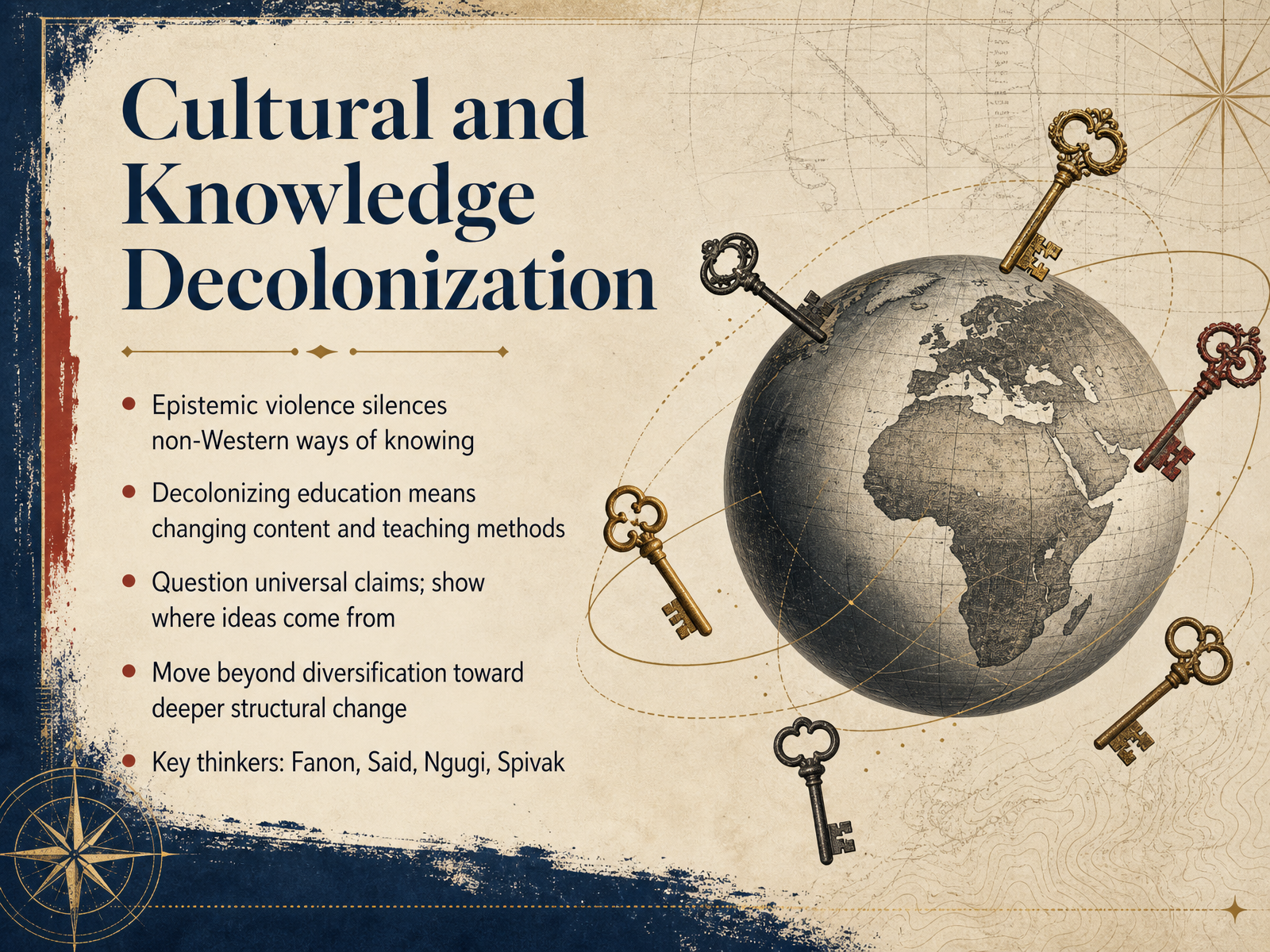
 - 08Cultural and Knowledge DecolonizationNow we turn to a different but equally important dimension of decolonization, which concerns knowledge itself. One key concept here is epistemic violence. This term describes how certain ways of knowing often those rooted in Western scientific traditions have been treated as universal, while other knowledge systems from Indigenous communities or the Global South have been dismissed or silenced. Decolonizing education, therefore, asks us to change both the content of what we teach and the methods we use to teach it. It means questioning claims that present themselves as neutral or universal by asking where ideas come from, and whose perspectives might be missing. It is important to note that this goes deeper than simply adding a few diverse authors to a reading list. Scholars in this field argue that real change requires structural transformation in how curricula are designed and how classrooms are run. Thinkers like Frantz Fanon, Edward Said, Ngugi wa Thiong'o, and Gayatri Chakravorty Spivak have been central to these debates. Each of them, in different ways, challenged the assumption that European frameworks should set the terms for all knowledge. As you consider their work, you might ask yourself what counts as valid knowledge in your own field, and who decides. This line of questioning leads us directly to the next topic, which examines the political and social challenges faced by post-colonial states.
 bath.ac.uktlc.wwu.eduedshare.gla.ac.uk+22 min
 - 09Post-Colonial States and Contemporary ChallengesMoving from the era of independence to the present, many new states faced the challenge of governing within borders drawn by colonial administrators. These boundaries often grouped rival communities together or split the same people across different countries, a pattern traced to divide and rule strategies. The result was not simply ethnic conflict but a deeper problem of legitimacy, as national identity had to be built around territories that rarely matched older social or political realities. At the same time, migration and diaspora have kept former colonies connected to their former metropoles. Labor flows, family networks, and postcolonial citizenship debates continue to link Senegal and France, India and Britain, or Indonesia and the Netherlands. These ties shape everything from remittances to voting rights and complicate simple ideas of national belonging. Debates about who counts as a citizen, whose land claims are legitimate, and how sovereignty should be understood still carry the imprint of colonial legal categories. Rather than treating these as settled questions, it helps to see them as ongoing negotiations over the meaning of independence. In the next slide, we consider how decolonization continues to unfold in the twenty first century, including calls for reparative justice and the return of cultural heritage.
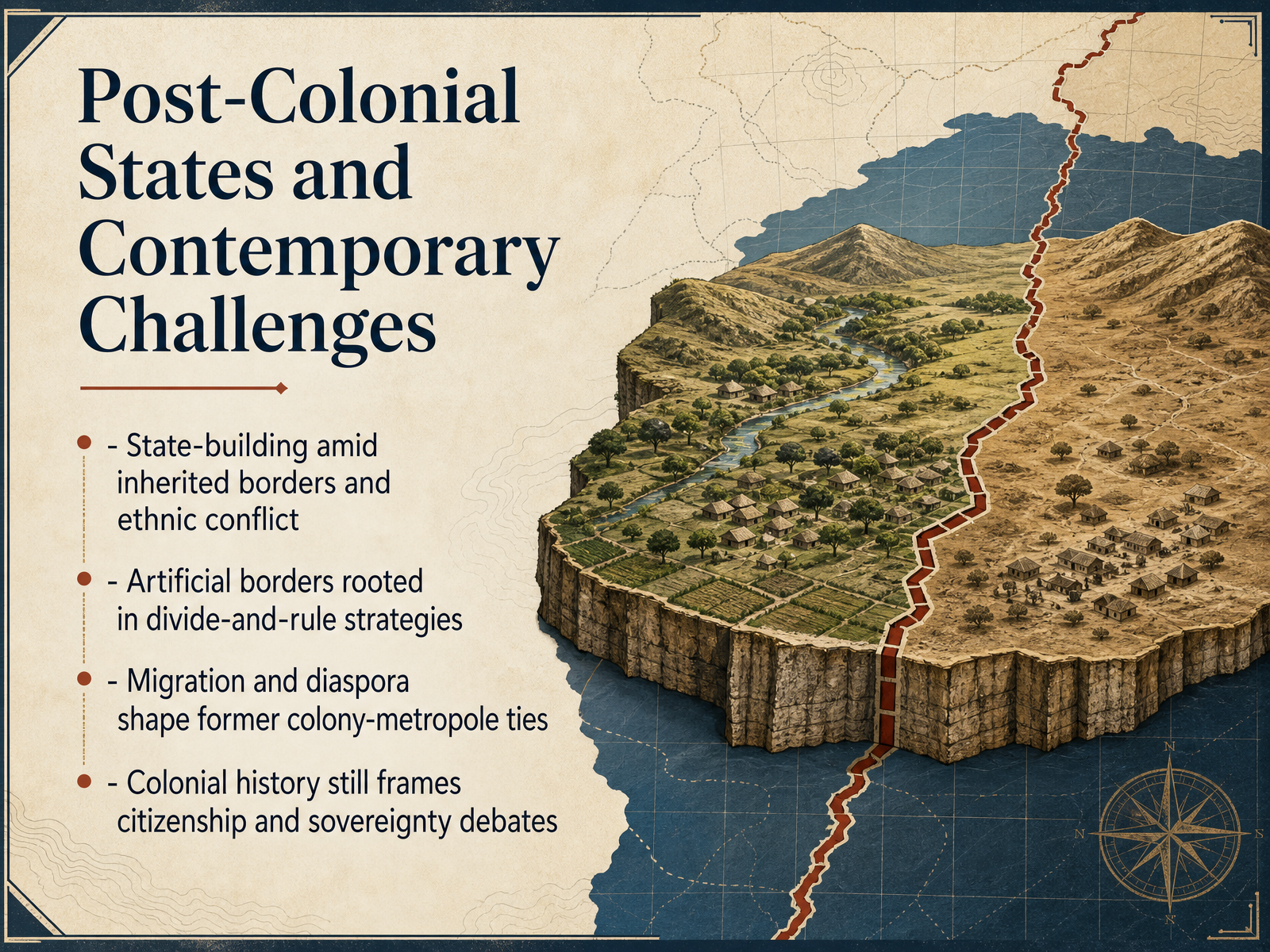 2 min
2 min - 10Decolonization in the 21st CenturyMoving into the twenty-first century, decolonization is not simply a historical process. It is unfolding now, through land returns, legal struggles, and cultural renewal. Consider Ihumātao in Aotearoa, New Zealand. What began as an occupation has grown into papakāinga housing and a food forest, showing how land return can support both homes and food sovereignty. In the same country, the Nelson Tenths Bill returned over three thousand hectares of land after an unresolved dispute spanning one hundred and eighty years. In Brazil, Indigenous organizations continue to resist legal reinterpretations that would undermine territorial rights, even after the Time Frame thesis was formally rejected. At the same time, Indigenous youth are using social media and the arts to make land struggles visible to a global public. And in another form of return, the Smithsonian Institution is repatriating a teepee cover stolen from Kawacatoose First Nation a century ago. These cases show that decolonization involves law, land, food, visibility, and the return of cultural heritage. They also invite a question: what does meaningful repair look like in different places? Next, we will focus on Indigenous sovereignty and land reclamation today.
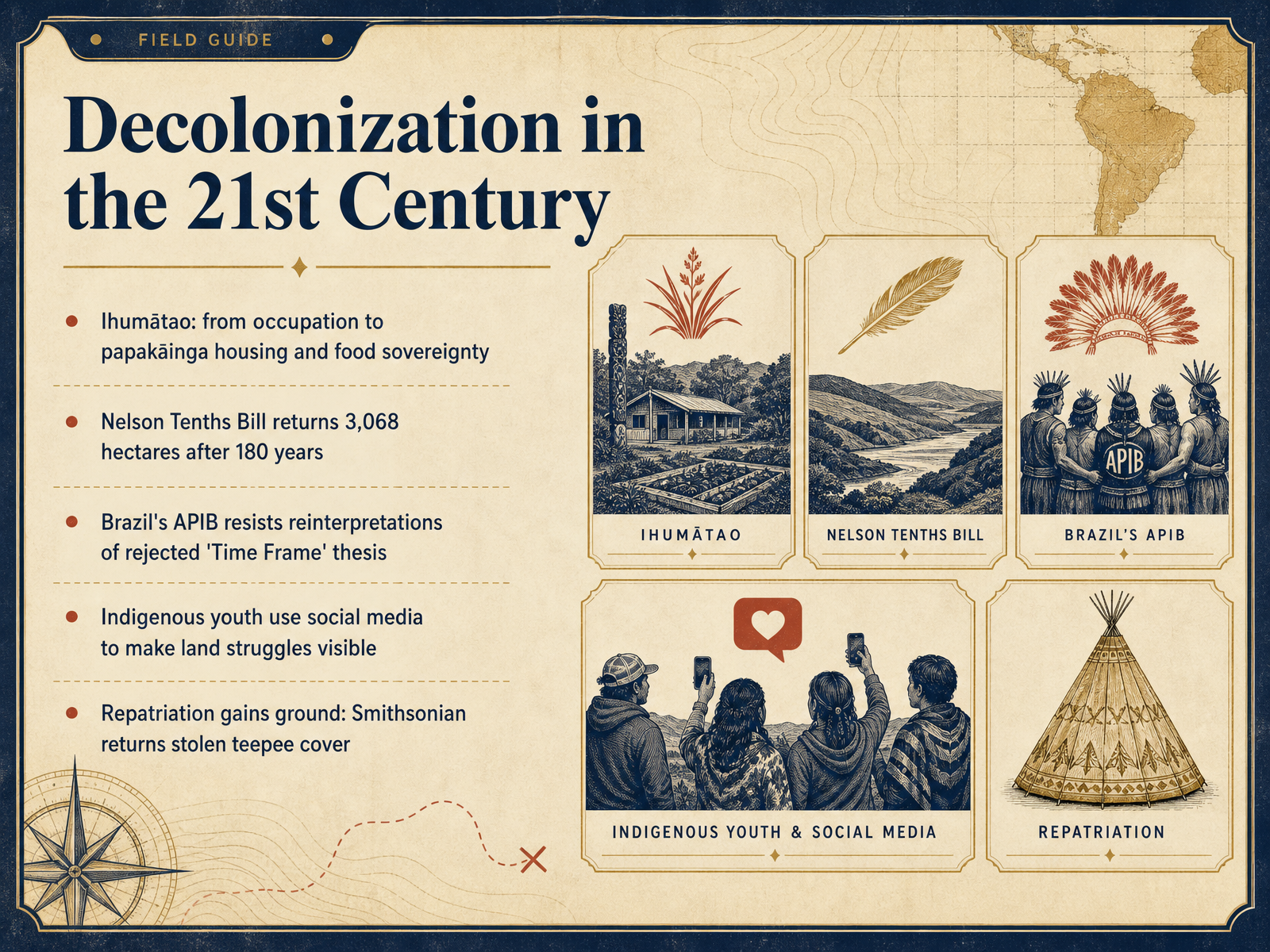 teaonews.co.nzapiboficial.orgrnz.co.nz+22 min
 - 11Indigenous Sovereignty and Land Reclamation TodayAcross Aotearoa and Brazil, Indigenous communities are showing what land reclamation looks like in practice, while defending it in the courts. At Ihumātao, the first families have moved into papakāinga homes, and food forests now support climate resilience and kai sovereignty. In Brazil, the Supreme Court has rejected the Time Frame thesis, yet legislative rollbacks continue to threaten demarcation. Aotearoa also marked a major settlement with the Nelson Tenths bill, returning over three thousand hectares and four hundred twenty million dollars after an 180-year dispute. In British Columbia, First Nations defended the Declaration Act and the UN Declaration against government appeal. Across these movements, Indigenous youth are using digital platforms, music, and art to make sovereignty visible. Next, we turn to repatriation and historical memory.
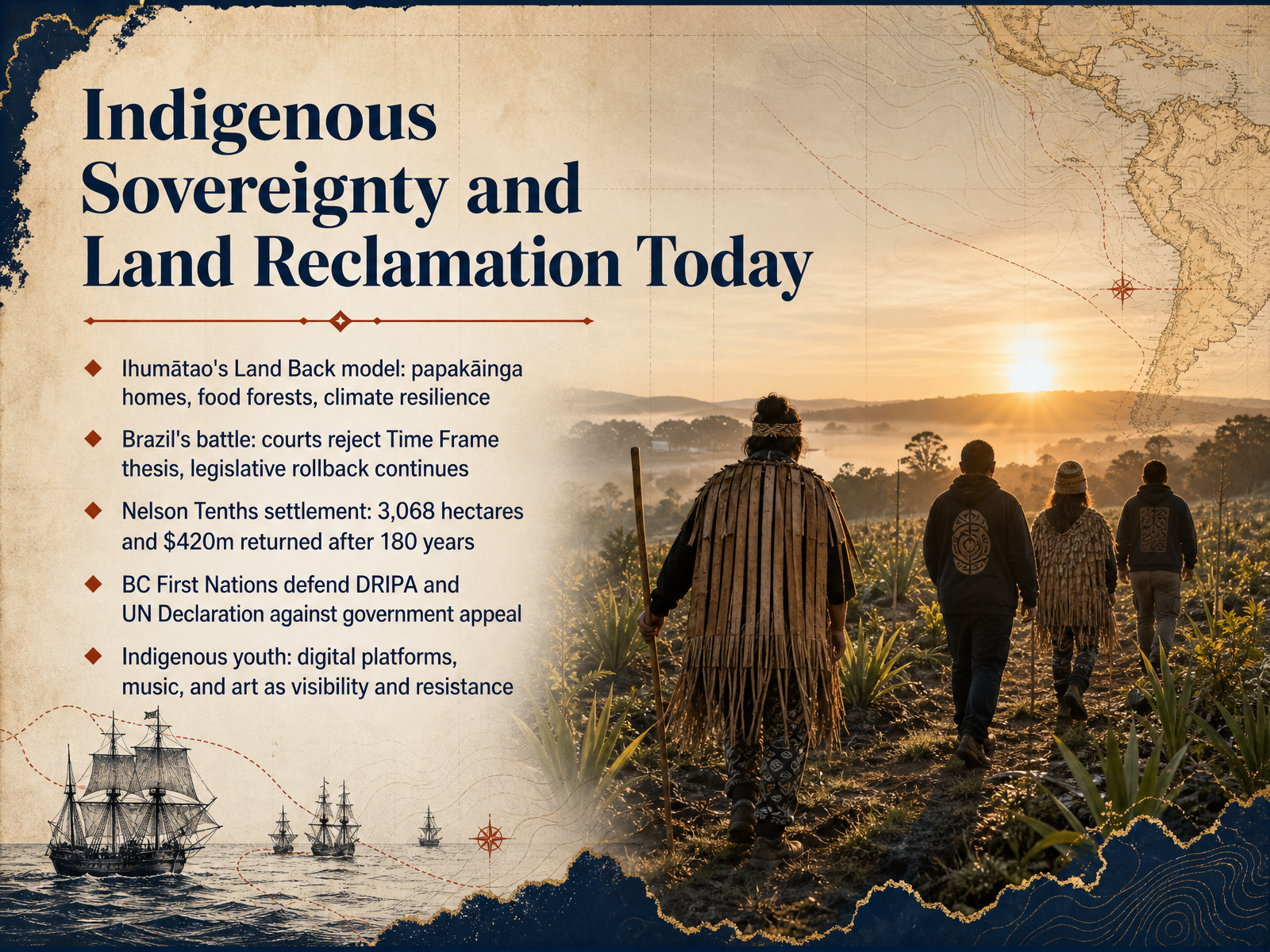 teaonews.co.nzapiboficial.orgrnz.co.nz+22 min
 - 12Repatriation and Historical MemoryRepatriation and historical memory represent a significant frontier in decolonization. In practice, repatriation involves returning cultural objects, human remains, and sometimes land itself to Indigenous communities. When the Smithsonian Institution returned a teepee cover stolen from Kawacatoose First Nation in 1926, they relied on oral history to confirm its provenance. That is a reminder that repatriation is not just about restoring objects. It restores dignity and enables cultural revival. Oral histories often confirm what museum records leave unclear, and archives shape public memory in ways that can either obscure or advance truth-telling. Land returns show this process operating at a larger scale. The Nelson Tenths settlement in Aotearoa resolved a promise broken for over 180 years across more than three thousand hectares of land. At Ihumātao, a decade of sustained occupation has led to papakāinga housing and food sovereignty projects, demonstrating what land return can mean in everyday life. These cases invite us to ask how memory itself becomes a site of repair. With that question in mind, we can now turn to teaching colonialism without oversimplification.
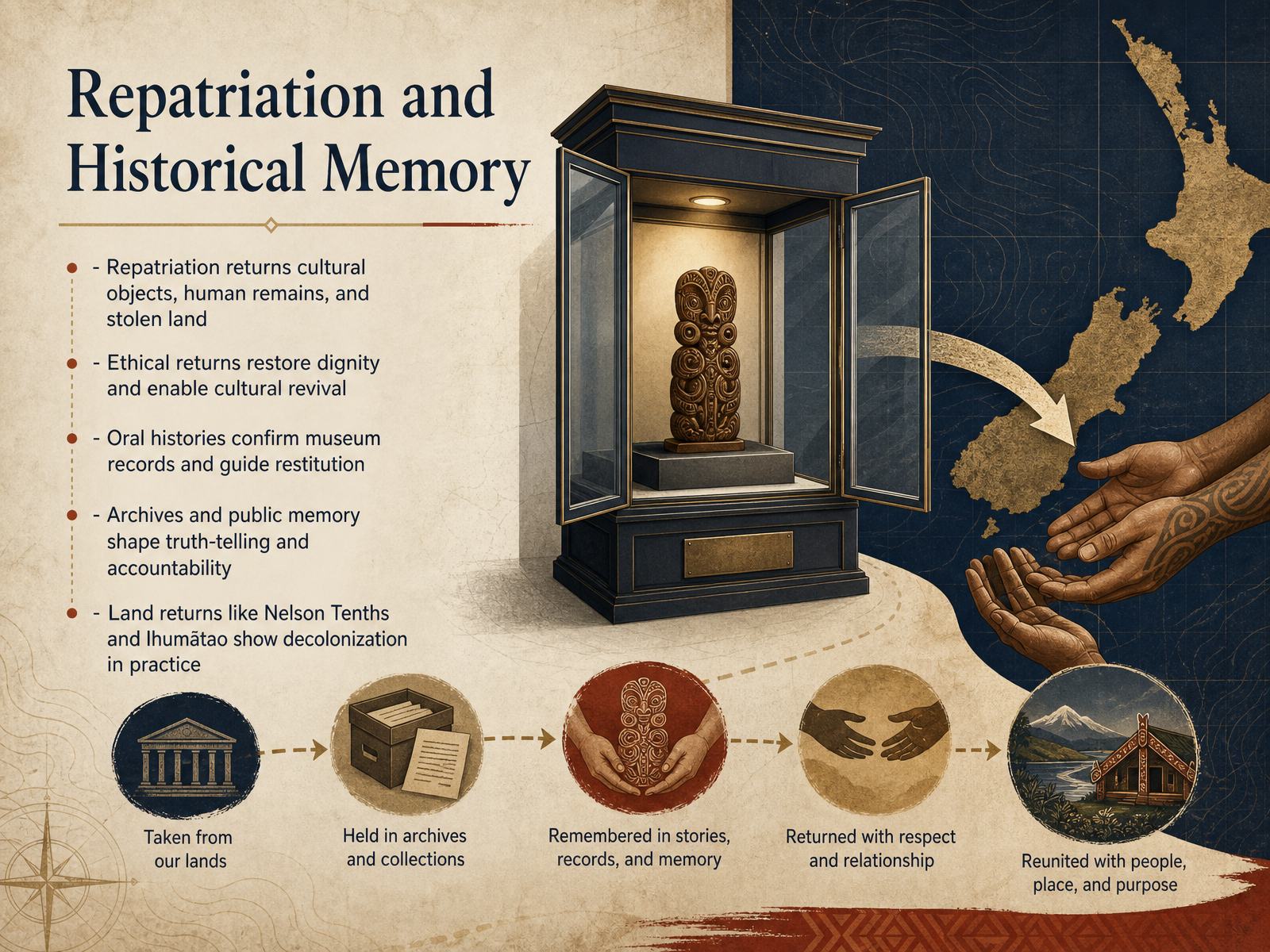 teaonews.co.nzapiboficial.orgrnz.co.nz+22 min
 - 13Teaching Colonialism Without OversimplificationLet us turn now to the practice of teaching these histories themselves. One of the greatest risks in this field is oversimplification, where complex histories become either stories of heroic triumph or simple victimhood. The first principle, then, is to use multi-perspectival sources. This does not mean a token addition of one or two non-Western voices. It means making Indigenous, Global South, and other marginalized perspectives central to how the course is framed. We also need to contextualize Western theories. Rather than rejecting them outright, we ask where these ideas came from, whose interests they served, and where their limits lie. This connects to a deeper point about pedagogy itself. Traditional lecture formats often reproduce colonial hierarchies, positioning the teacher as the sole authority. Decolonizing practice asks us to reduce that hierarchy, treating students as co-creators of knowledge, not just recipients. Finally, we must look at how students are evaluated. Relying only on the linear, thesis-driven Western essay can disadvantage those who draw on other intellectual traditions. Diversifying assessments allows different forms of reasoning and expression to be valued. Together, these practices move us beyond simple content changes toward a more reflexive and inclusive way of teaching. In our final slide, we will bring these threads together and consider ethical content creation and next steps.
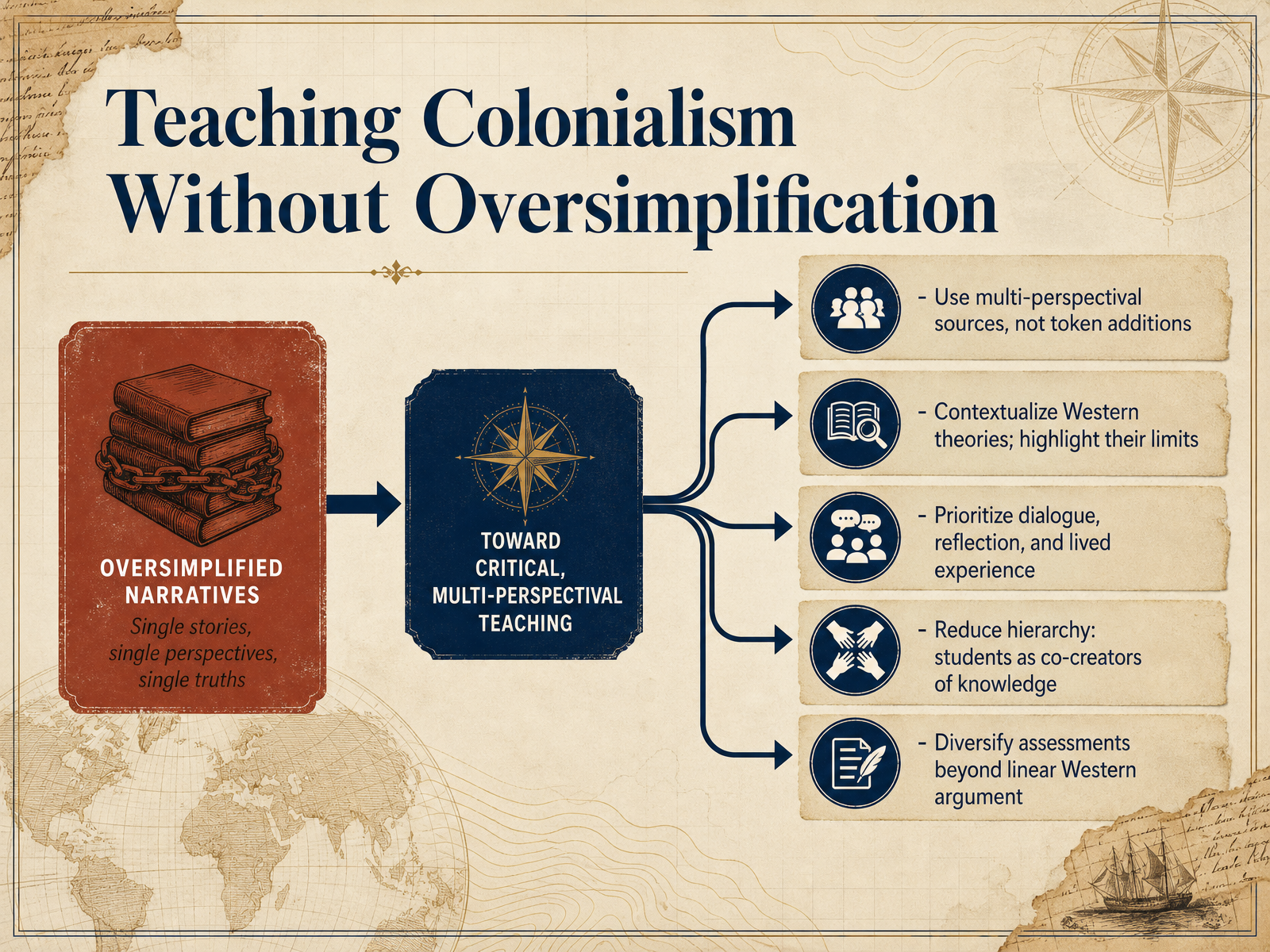 bath.ac.uktlc.wwu.eduedshare.gla.ac.uk+22 min
 - 14Ethical Content Creation and Next StepsIn this final section, let's consider what ethical content creation means for teaching and learning about colonialism. First, avoid extractive framing. This means we should not treat communities or their histories merely as raw material for our courses. Instead, center community voices and seek consent when we share knowledge, stories, or cultural materials. Second, use plain language, real examples, and transparent sourcing. Show learners where ideas come from, and explain the historical and geographical context behind every case study. This makes our work accountable and easier to critically evaluate. Third, involve students as co-creators. Invite them to review course materials, suggest readings, and help design assessments. This does not mean handing over all authority, but rather sharing responsibility and reducing unnecessary power imbalances. Finally, treat decolonization as ongoing, iterative, and collaborative practice. There is no single finished checklist. The work involves reflection, correction, and dialogue over time. A good course is not one that claims to have solved decolonization, but one that makes its process visible and open to revision. So, as you move forward, ask yourself whose voices are centered in your materials, what assumptions you might be carrying, and how you can create space for learners to bring their own knowledge and experience. Decolonizing content is not easy work, and it should not be done alone. But small, honest, and context-aware steps can make your teaching more rigorous, more inclusive, and more just. Thank you for joining this course. I hope you feel better prepared to approach these histories with care, precision, and a commitment to learning that continues well beyond the final slide.
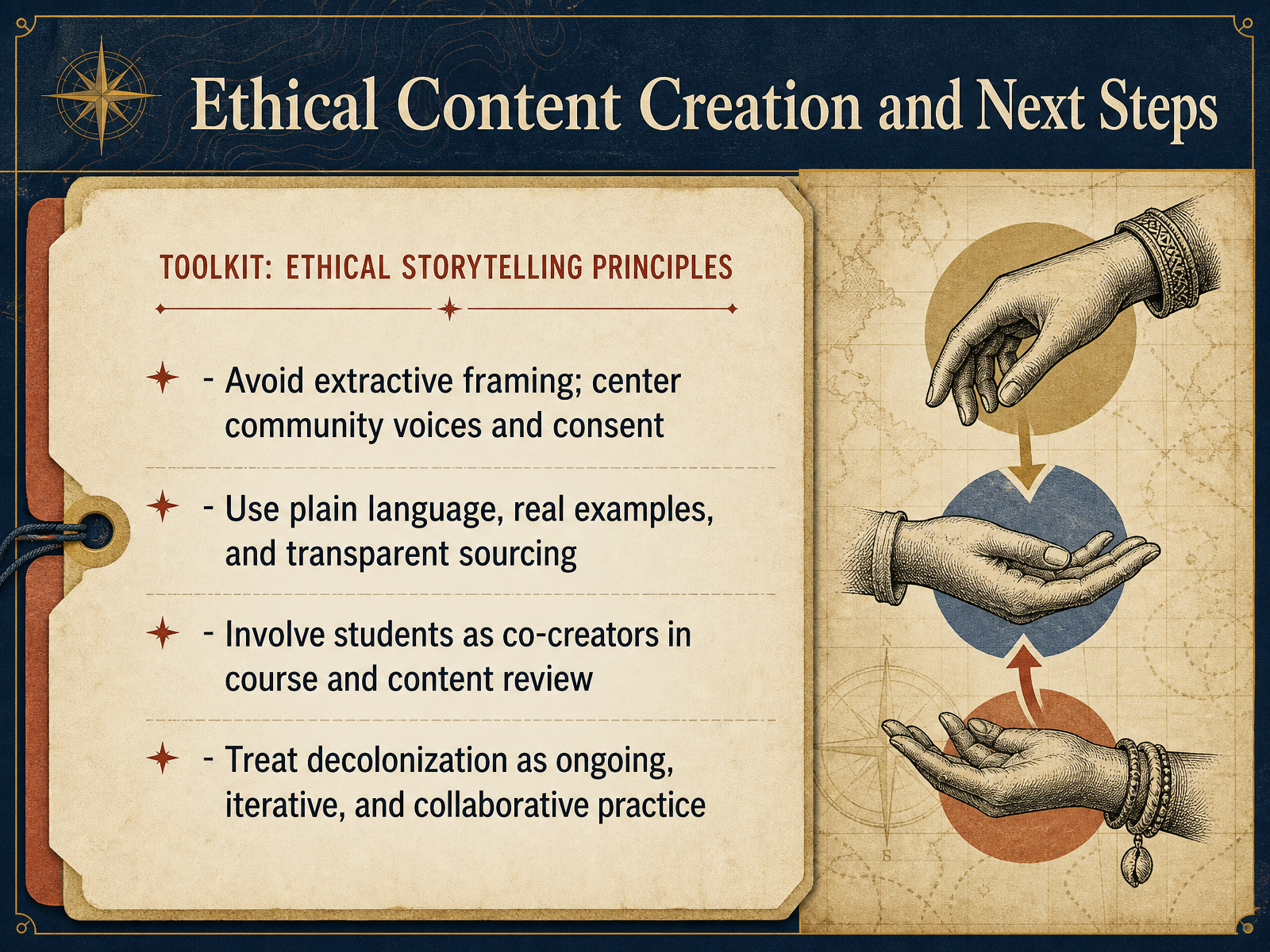 bath.ac.uktlc.wwu.eduedshare.gla.ac.uk+22 min
Take the deck with you
Download this course as a file — free, no sign-up needed.
- PDF handoutEvery slide page, ready to print or share.15 pages · 6.8 MBDownload
- Narrated PowerPointThe deck that presents itself — every slide carries the digital human's narration video.15 pages · 19.6 MBDownload
- PowerPoint slidesThe full deck as a .pptx — open it in PowerPoint, Keynote, or Google Slides.15 pages · 6.7 MBDownload
Free to use in your own training — please keep the PersonWise credit page at the end.
Have your own deck? Turn it into a course
Sources consulted
Web sources consulted while building this course.
- Ihumātao today: How a decade-long occupation turned into papakāinga and reclamation – Te Ao Māori News — teaonews.co.nz
- APIB Policy Statement on the Time Frame Thesis and the Serious Threats to the Rights of Indigenous Peoples in Brazil | APIB — apiboficial.org
- 'Nelson Tenths' bill passing finally settles 180-year land dispute | RNZ — rnz.co.nz
- DRIPA, the 1846 Oregon Treaty and the Future of Indigenous-Settler Relations — bcpolicy.ca
- California bill would expand tribal say on state land use | Sacramento Bee — sacbee.com
- Decolonisation: How-to guide for teaching in humanities and social sciences — bath.ac.uk
- First Steps: How to Begin Decolonizing Your Content | Teaching & Learning Co-op - Western Washington University — tlc.wwu.edu
- https://edshare.gla.ac.uk/3099/1/A%20Toolkit%20for%20Thinking%20About%20Decolonising%20the%20Curriculum_An%20Example-Based%20Approach.pdf — edshare.gla.ac.uk
- Indigenous Content and Decolonizing Principles in the Classroom – Better Practices in the Classroom — opentextbooks.concordia.ca
- Decolonization and SociologyJustin EC Tetrault, TRC Calls to Action CommitteeDepartment of SociologyUniversity of Alberta2023 — ualberta.ca