Begin
14 pages · ~28 min
Project Management Fundamentals
Learn the key principles of project management for successful project planning, execution, and delivery.
A digital instructor presents all 14 pages. Hold “Ask” at any point and ask out loud — the answer comes from this course. No sign-up needed.
What you’ll learn
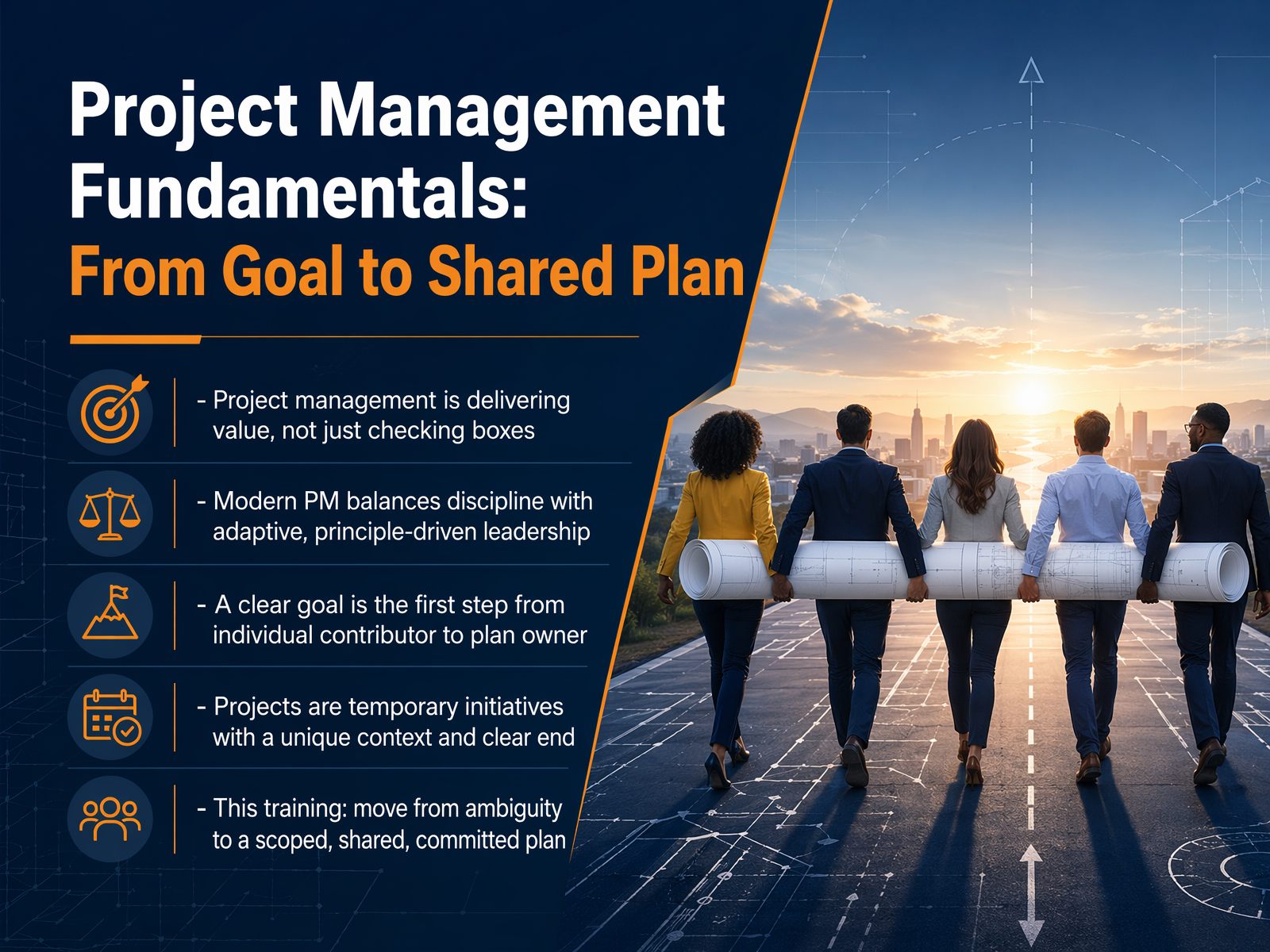
- 01Project Management Fundamentals: From Goal to Shared PlanWelcome. I'm glad you're here. If you're stepping into your first project as a contributor or a team lead, this training is built for you. Our goal is to take you from a promising goal to a scoped, shared plan you can actually commit to. Let's start with the big picture. Project management is about delivering value, not just checking boxes. Modern project management balances discipline with adaptive, principle-driven leadership. A clear goal is your first step from being an individual contributor to owning the plan. Remember, projects are temporary initiatives with a unique context and a clear end—they exist to create something new. Over the next few minutes, we'll move from ambiguity to a plan you can share with confidence. We'll start by looking at the real cost of unclear projects.pmi.orgpmi.orgprojectmanagement.com.br+21 min
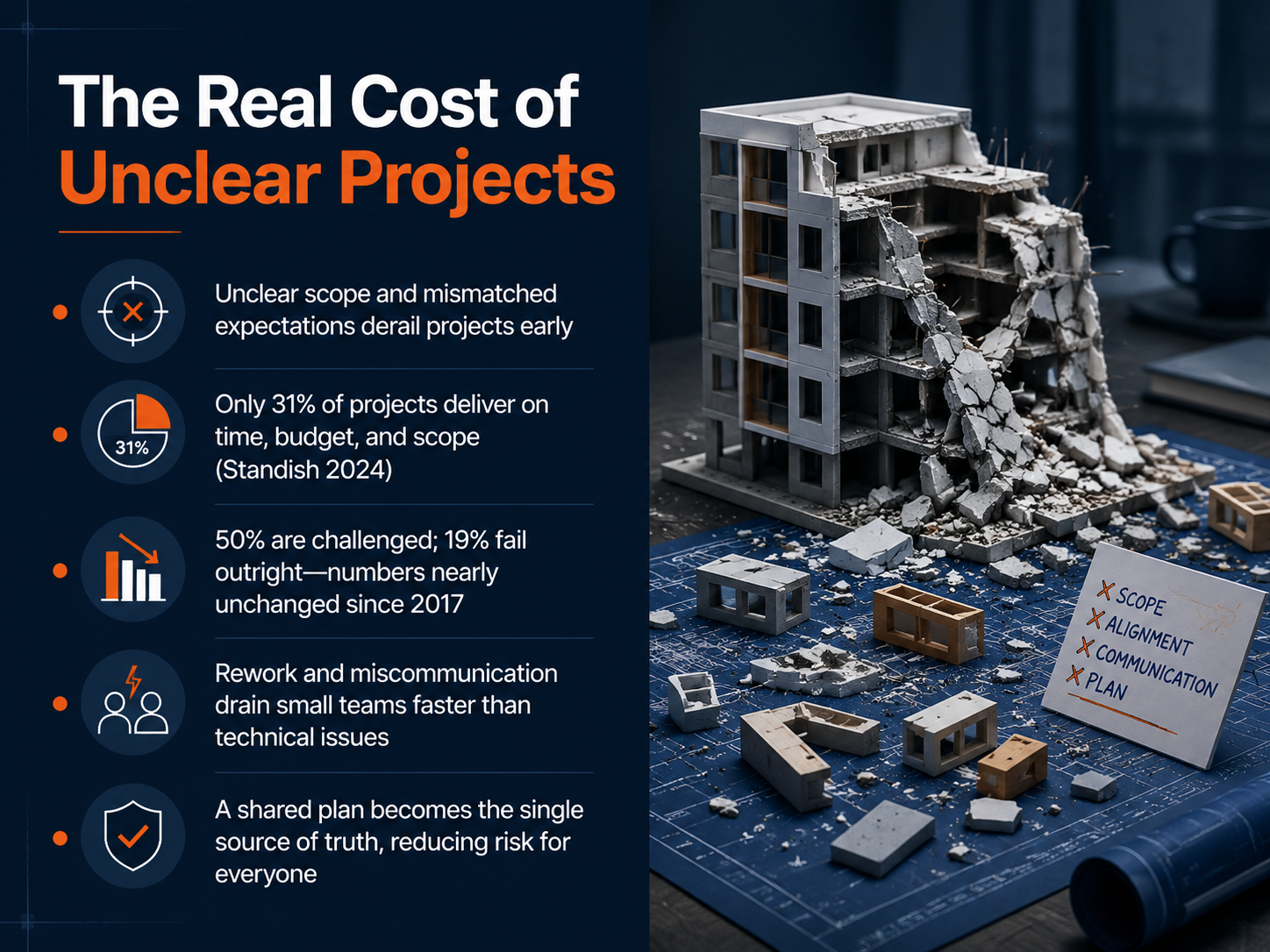
- 02The Real Cost of Unclear ProjectsNow, let's talk about the real cost of unclear projects. The numbers are pretty eye-opening. According to the latest Standish Group data, only thirty-one percent of projects deliver on time, on budget, and within scope. That means roughly fifty percent are challenged, they run late or over budget, and nineteen percent fail outright. And here's the thing: these numbers have barely moved in nearly a decade. For small teams, the biggest drain isn't usually technical problems. It's rework and miscommunication. When scope is unclear or expectations don't match, work gets done twice, and trust erodes fast. This is why a shared plan is so powerful. It becomes your single source of truth, a document that aligns everyone and reduces risk for the whole team. Let's look next at what first-time leads and contributors struggle with most.
 pmworldlibrary.netpmstudycircle.compmi.org+21 min
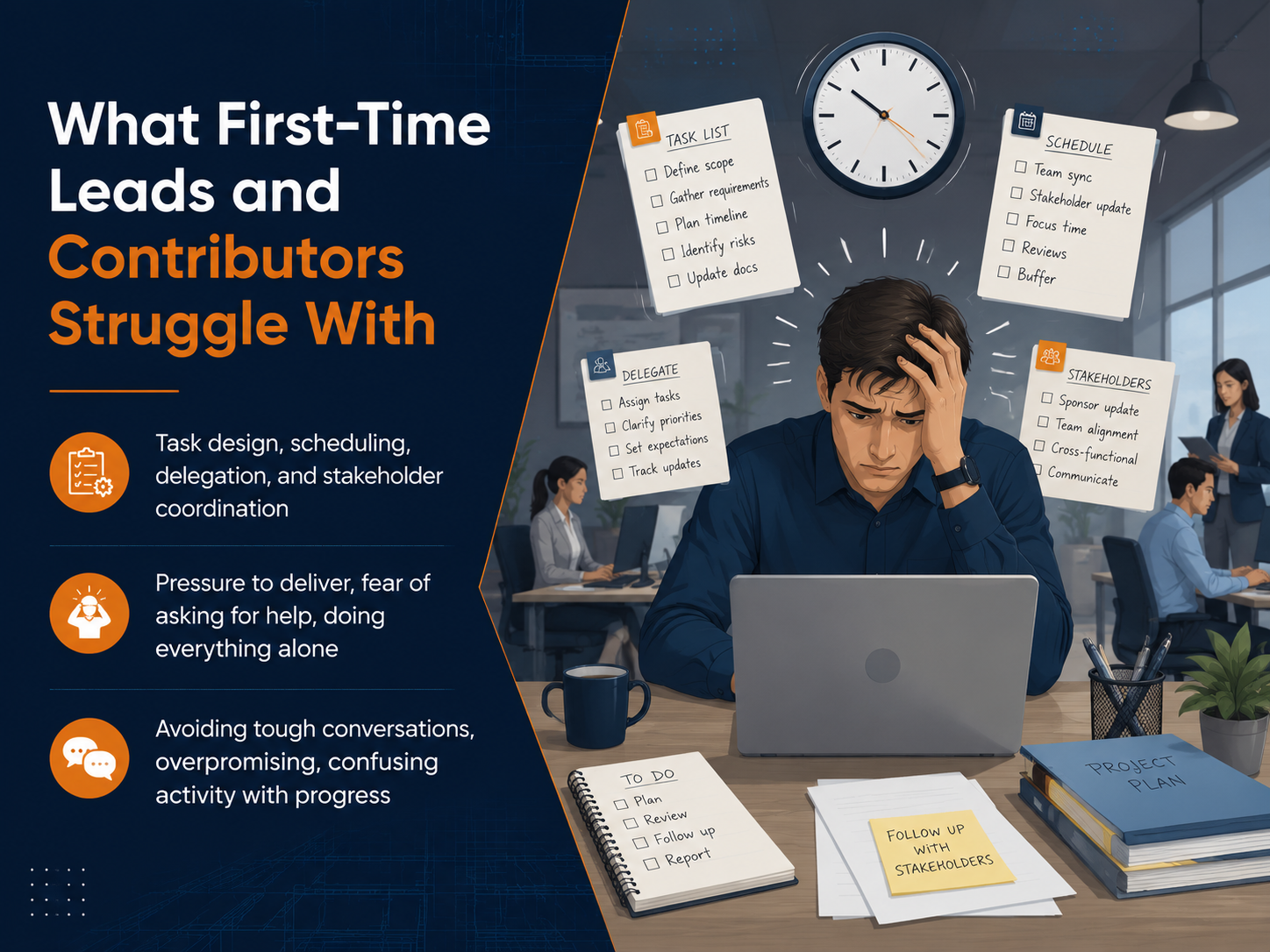
 - 03What First-Time Leads and Contributors Struggle WithNow, let's look at the real struggles first-time leads and contributors face. It's not about forgetting the theory. Reality is just more complicated. A recent survey of new project leaders found that the top practical challenges are task design, scheduling, delegation, and stakeholder coordination. Nearly 40 percent of people said they felt overwhelmed just by planning and managing timelines. Many also struggle with the pressure to deliver. There's often a fear of asking for help, which leads to trying to do everything alone. That's a fast track to burnout and becoming a bottleneck. Other common traps include avoiding tough conversations, hoping a problem will just go away. Or overpromising to keep everyone happy, which sets the team up for failure. And a big one is confusing activity with progress. Just because everyone is busy doesn't mean you're moving closer to the goal. Recognizing these patterns is the first step to building better habits. Next, we'll start with the most critical habit: clarifying the goal. What are we really trying to achieve?
 projectmanagementcompass.substack.comthird-news.comprojectmanagementcompass.substack.com+22 min
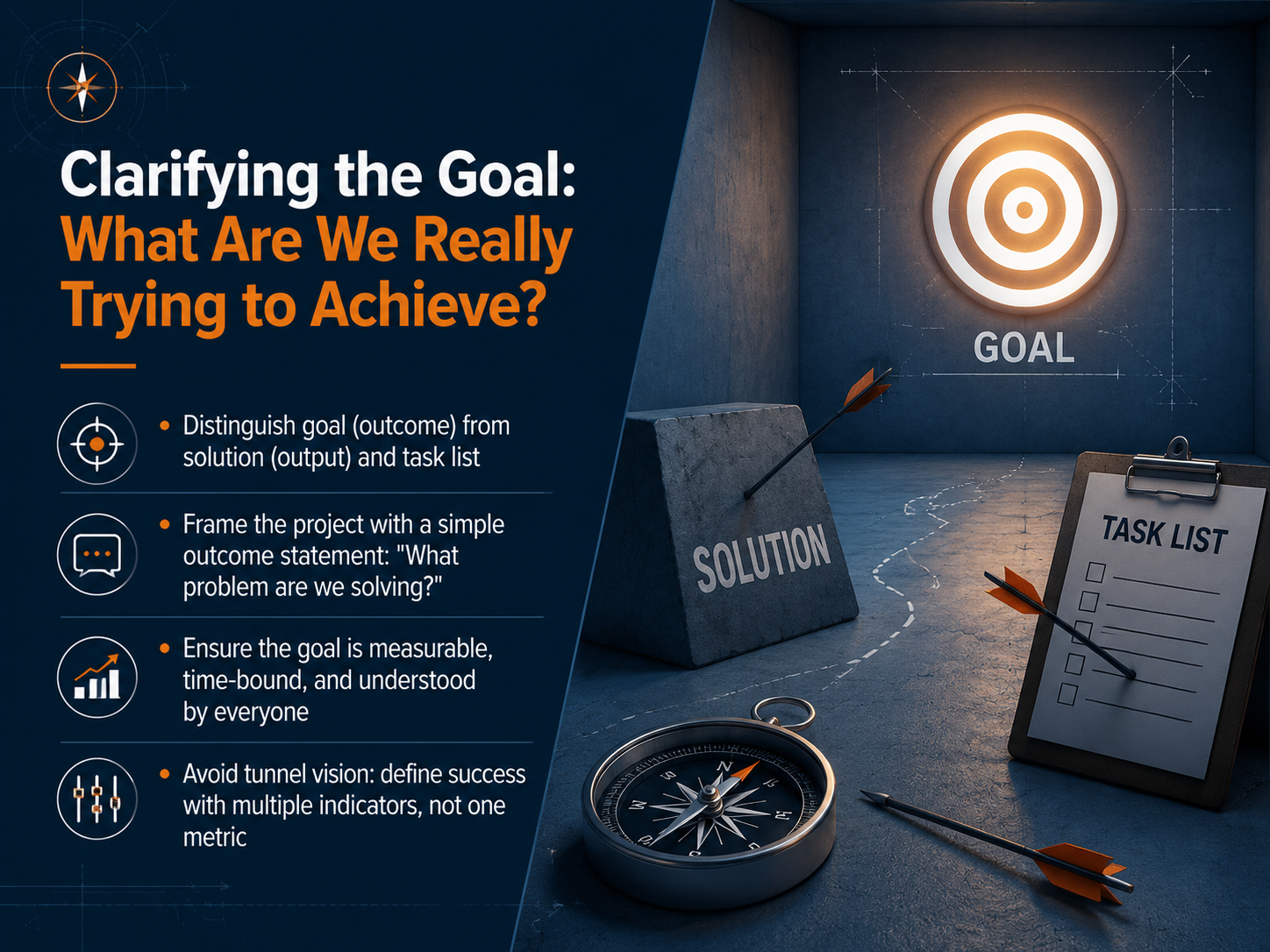
 - 04Clarifying the Goal: What Are We Really Trying to Achieve?Now that we have the big picture, let's get precise about our goal. The first thing to do is separate the outcome from the output. An outcome is the real change you want to create, like reducing customer wait times. An output is the thing you build to get there, like a new mobile app. If you start with the app, you might build a beautiful tool that never actually solves the problem. So, step back and ask the team, "What problem are we really solving?" Frame the whole project with a simple outcome statement, like "We're helping support agents resolve tickets in half the time." That's your north star. To make it stick, your goal must be measurable, time-bound, and understood by everyone. A vague goal like "improve efficiency" is just a wish. But if you say, "We'll reduce the average resolution time from 40 minutes to 20 minutes by the end of the second quarter," everyone knows exactly what they're working toward. Finally, watch out for tunnel vision. Defining success with a single metric can be dangerous. If you only track speed, quality might suffer. Pair your main metric with a balance indicator, like maintaining a customer satisfaction score of 90 percent or higher. This keeps the team focused on delivering genuine value, not just hitting a number. Coming up next, we'll use this outcome to define your project's scope. We'll talk about drawing the line between what's in and what's out.
 perdoo.comproofhub.comtechademy.com+22 min
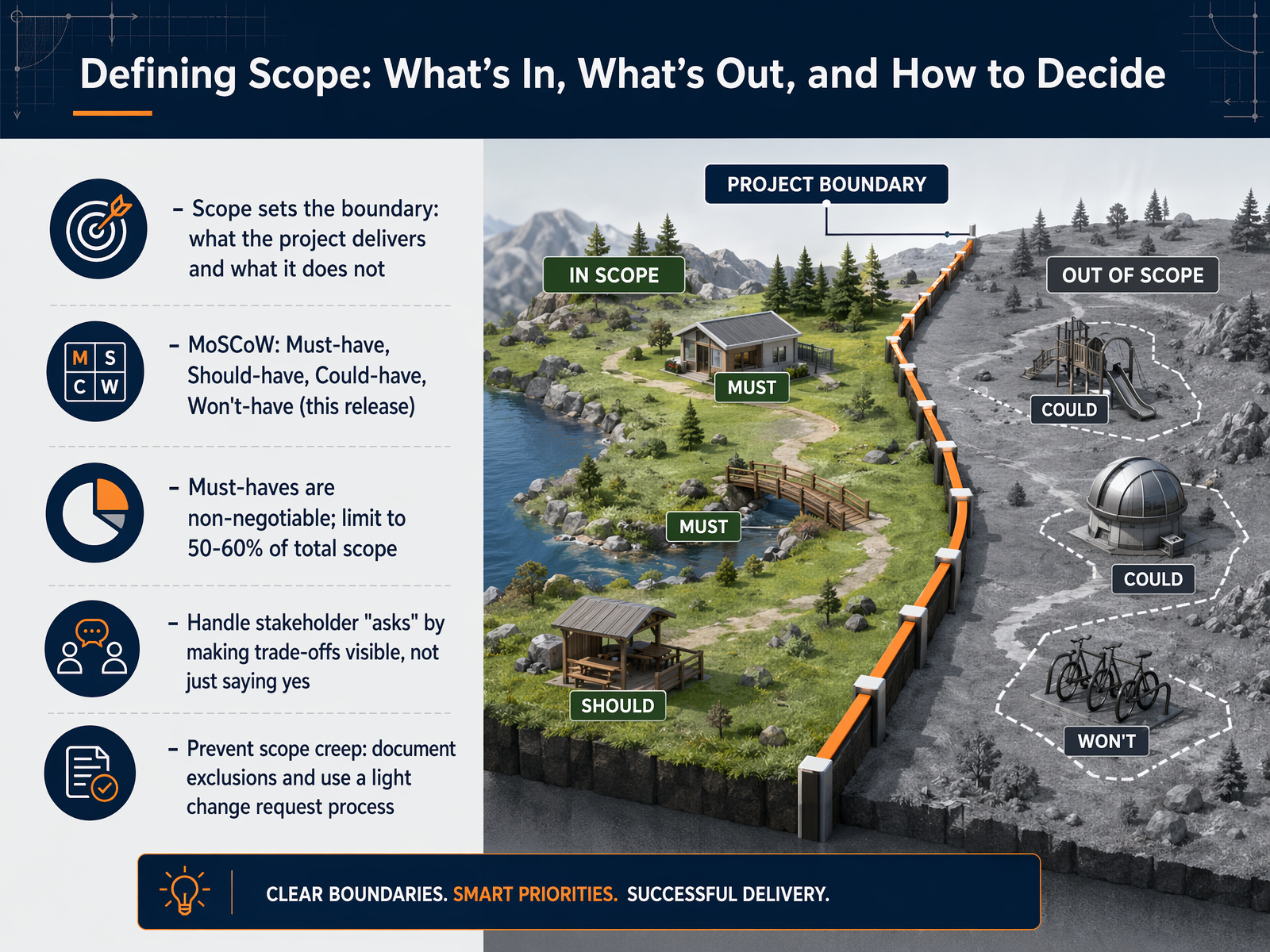
 - 05Defining Scope: What’s In, What’s Out, and How to DecideNow, let's talk about defining your project's scope. Think of scope as the fence around your project. It sets the boundary, making clear what you will deliver and, just as importantly, what you won't. To make these tough decisions, we use a simple tool called the MoSCoW method. It stands for Must-have, Should-have, Could-have, and Won't-have for this release. Your Must-haves are non-negotiable. Without them, the project fails. A good rule is to limit these to about fifty to sixty percent of your total work. If everything is a must-have, the method has failed. Next are Should-haves, which are important but not critical. You can ship without them. Could-haves are the nice-to-haves, the first things you cut when time gets tight. And the Won't-haves are your most powerful tool. This list documents what you've explicitly decided not to build, preventing scope creep. When a stakeholder asks for something new, don't just say yes. Make the trade-offs visible. Ask, 'If we add this, what should we drop or delay?' This structured conversation protects your plan. So, use MoSCoW to force clear decisions, document your exclusions, and always link new requests to a visible trade-off. Next, we'll move from defining scope to scheduling it in 'From Tasks to Timeline: Building a Realistic Schedule.'
 productplan.com2 min
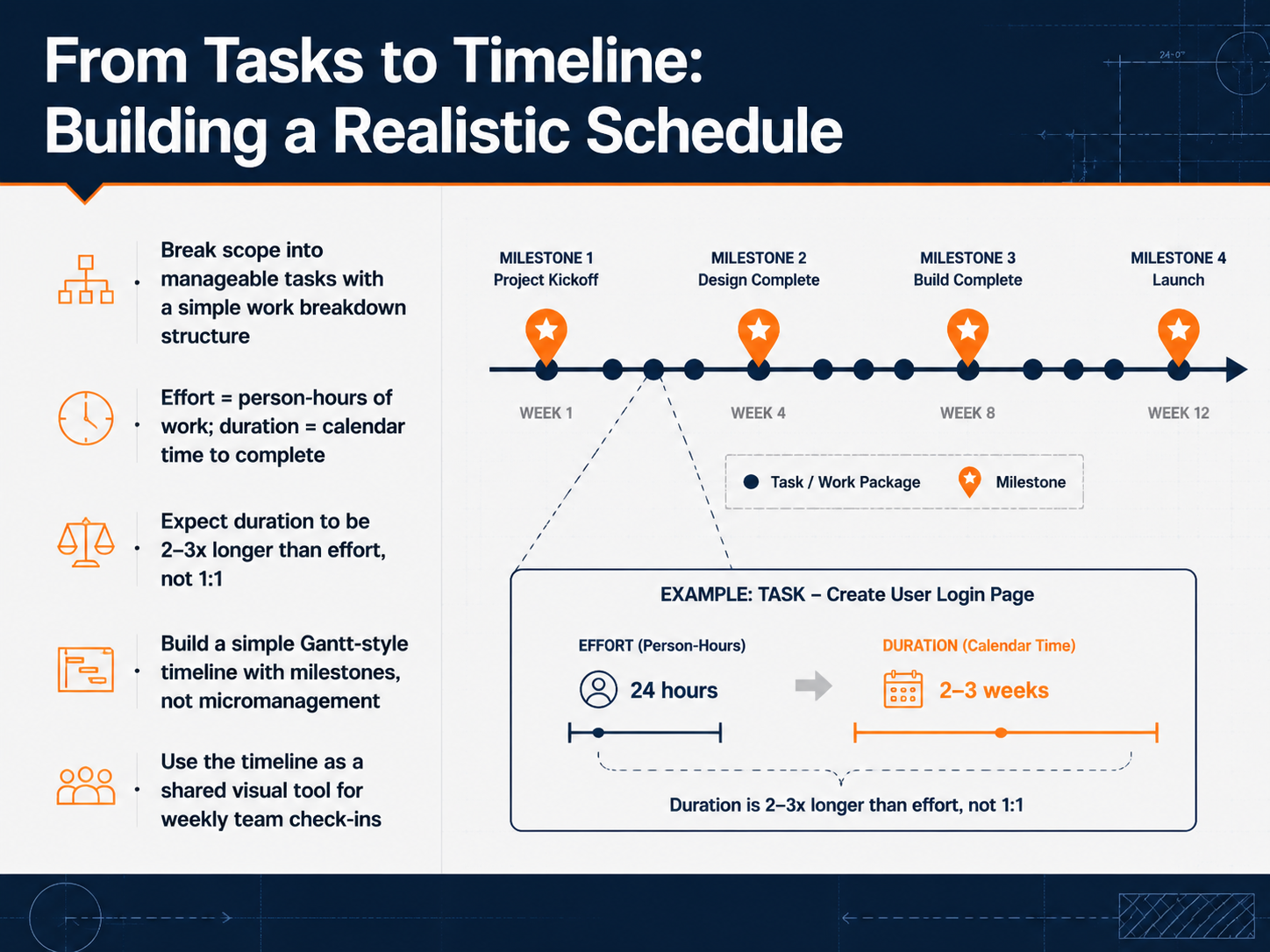
 - 06From Tasks to Timeline: Building a Realistic ScheduleNow, let's turn that task list into a real schedule. Start by breaking your scope into manageable pieces, a simple work breakdown structure. This just means listing the work as clear, bite-sized tasks. Next, let's clarify two terms that often get mixed up: effort and duration. Effort is the pure work time, the person-hours needed to finish a task. Duration, however, is the calendar time it takes. Your duration will almost always be longer than the effort, often two to three times longer, because of meetings, email, and waiting on others. So, if someone estimates five hours of effort, budget twelve to fifteen hours, or even a couple of days, on the calendar. Finally, build a simple Gantt-style timeline. Plot your tasks as bars across the weeks, and add a few milestone markers for key dates. Keep it at a high level to track major work, not every to-do. Use this timeline as a shared visual tool for your weekly check-ins, so everyone stays aligned. Next, we'll talk about how to turn this plan into shared ownership for the whole team.
 2 min
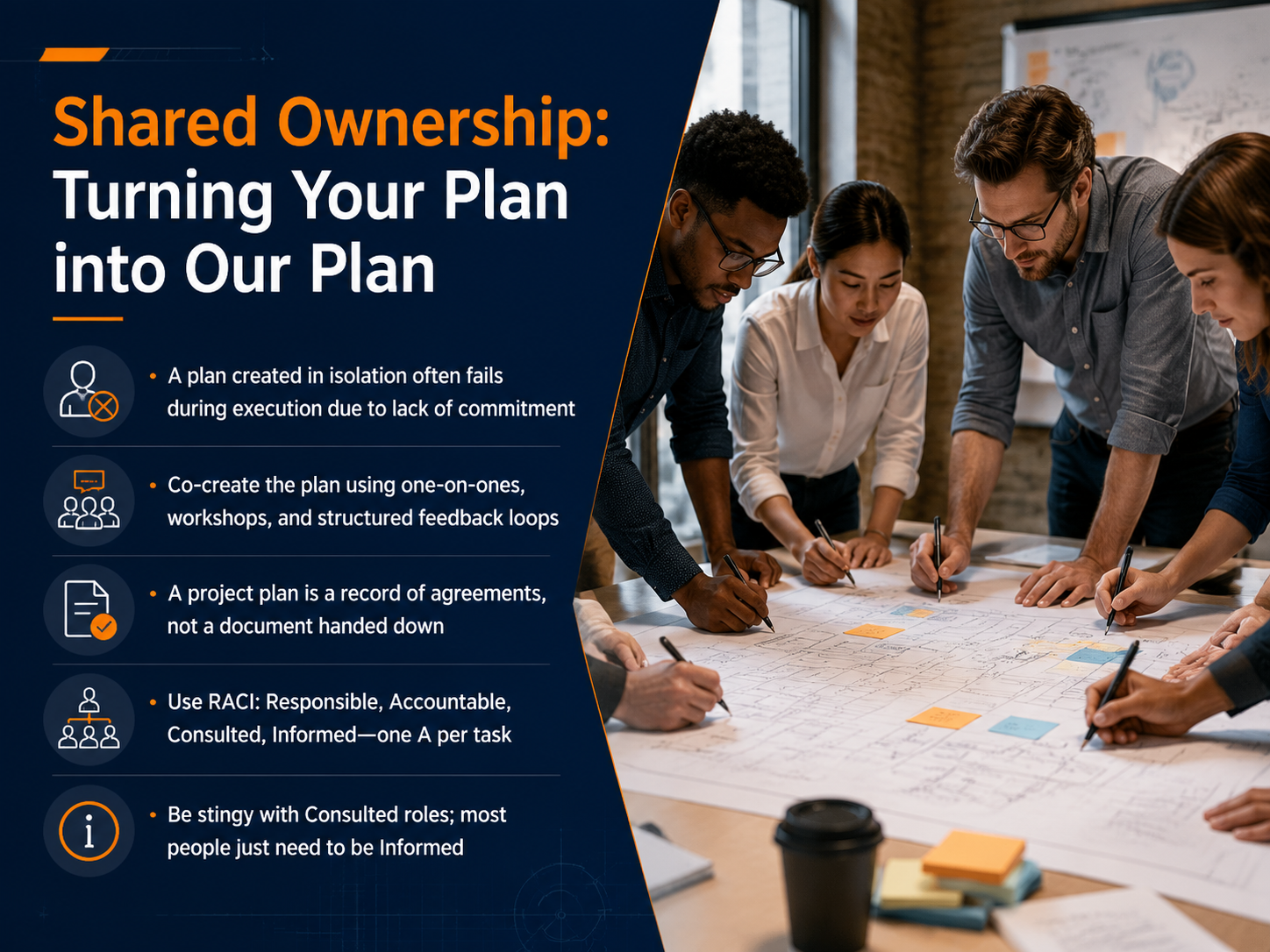
2 min - 07Shared Ownership: Turning Your Plan into Our PlanNow, let's talk about the most important shift you can make: turning your plan into our plan. A project plan created alone often fails the moment execution starts, because nobody else feels committed to it. The secret is to co-create the plan. Sit down with your contributors one-on-one, run a focused workshop, or build in structured feedback loops before you finalize anything. Think of the project plan not as a document you hand down, but as a formal record of agreements you built together. A practical tool you can use tomorrow is called RACI. It stands for Responsible, Accountable, Consulted, and Informed. Here is the rule that changes everything: every single task gets exactly one Accountable person. One A. That person owns the outcome and makes the final call. For the Consulted role, be stingy. Only include people whose input is truly required before a decision is made. Most people just need to be Informed, meaning they get a simple update after the work is done. Being stingy with consultation keeps your project moving fast. Up next, we will apply this clarity to managing risks without overhead.
 2 min
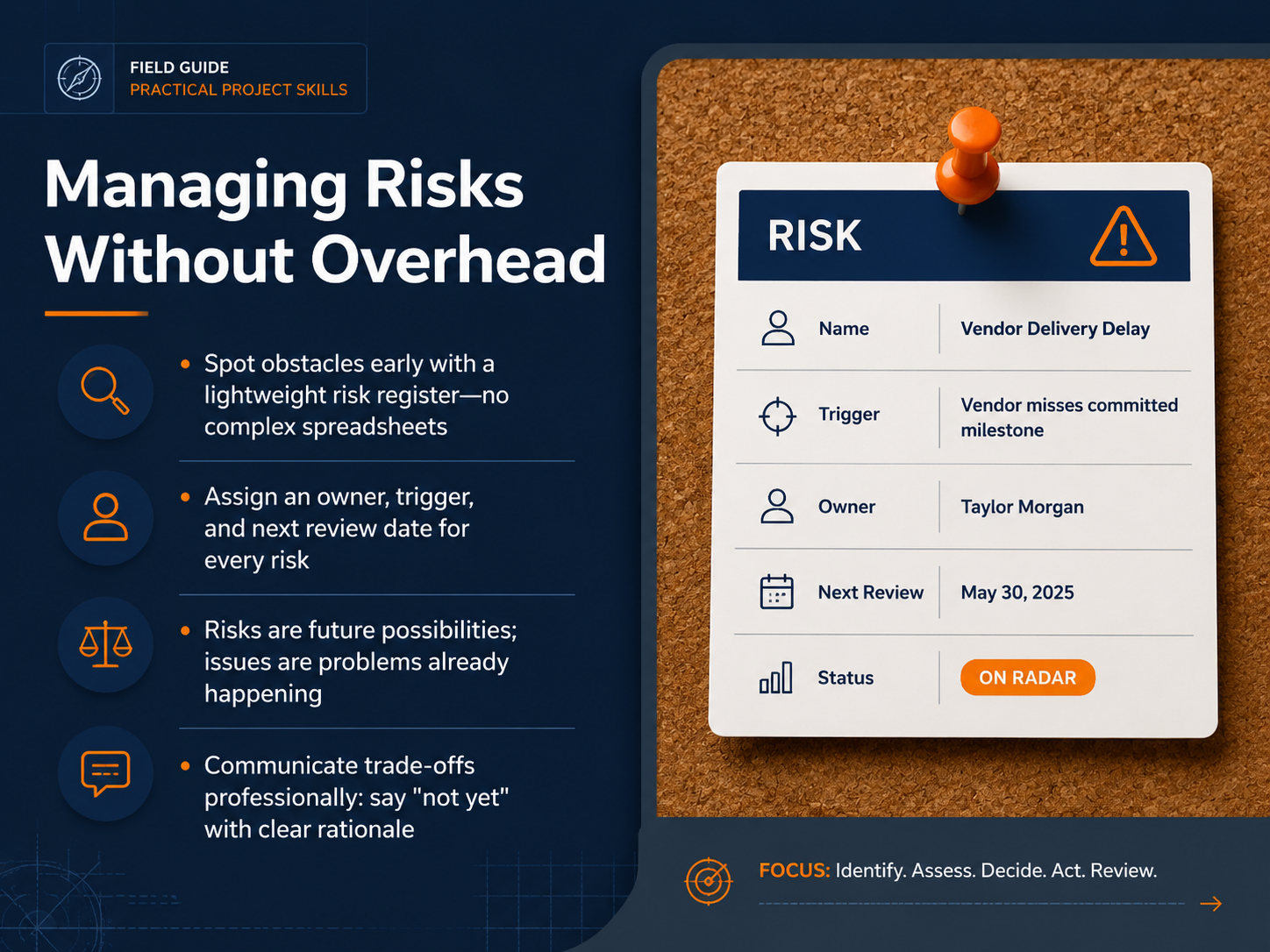
2 min - 08Managing Risks Without OverheadNow let's talk about managing risks without drowning in paperwork. A risk is simply a future possibility that could affect your project. The moment it actually happens, it's no longer a risk—it's an issue. Keep that distinction clear, and you'll avoid a lot of confusion. To spot obstacles early, use a lightweight risk register. This doesn't need to be a complex spreadsheet. A simple list with a few key fields is enough. For every risk, assign a named owner, a clear trigger that signals when to act, and a next review date. The trigger is your early warning system. It moves the item from a vague worry to a manageable thing you can watch. This structure gives you visibility without creating busywork. Finally, when you need to communicate trade-offs, you can use a professional response like 'not yet' and back it up with a clear rationale. This keeps your plan focused and builds trust. Up next, we'll explore a related skill: handling changes without chaos.
 2 min
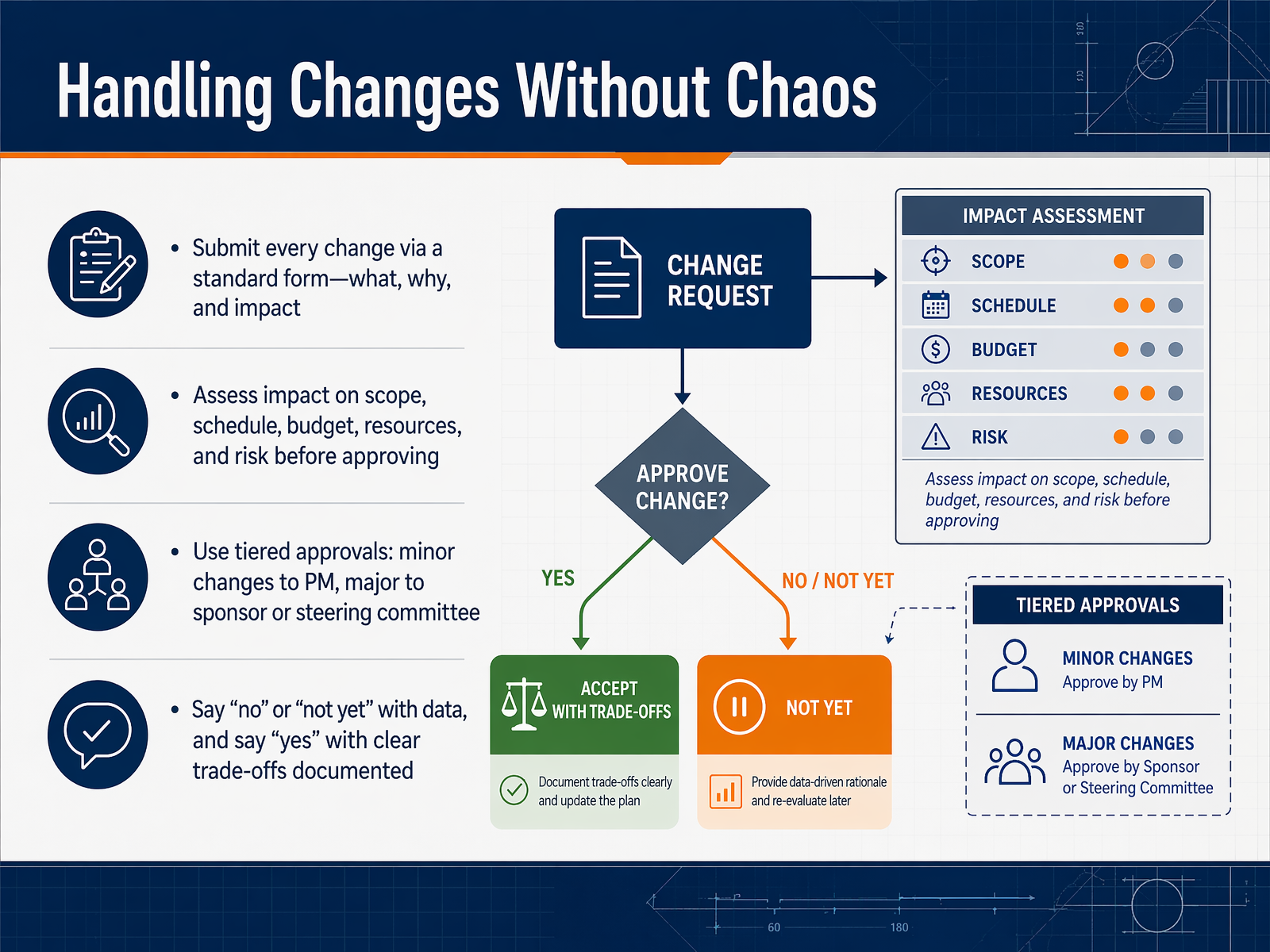
2 min - 09Handling Changes Without ChaosNow, let's talk about handling changes without chaos. Because changes are going to come. The goal isn't to avoid them, it's to manage them so your project doesn't spin out of control. The key is a simple, written process. First, every change starts with a standard form. This captures three things: what the change is, why it's needed, and the potential impact. It forces everyone to think before they ask. Next, you assess the impact before anyone approves. You look at how the change affects scope, schedule, budget, resources, and risk. This gives you the data to make a smart decision. Then, use tiered approvals. Small changes that cost under five thousand dollars or take less than a week can usually be approved by you, the project manager. Major changes that impact the budget or timeline significantly go to the sponsor or a steering committee. This keeps things moving fast without losing control. Finally, learn to say "no" or "not yet" with data. Show the person the impact and explain why it can't be done now. And when you say "yes," document the trade-offs clearly. For example, "We can add this feature, but it will push the launch date out by two weeks." A clear process turns change from a threat into a managed conversation. Next, we'll take that plan and align everyone on it by looking at communicating the plan with a kickoff that builds alignment.
 2 min
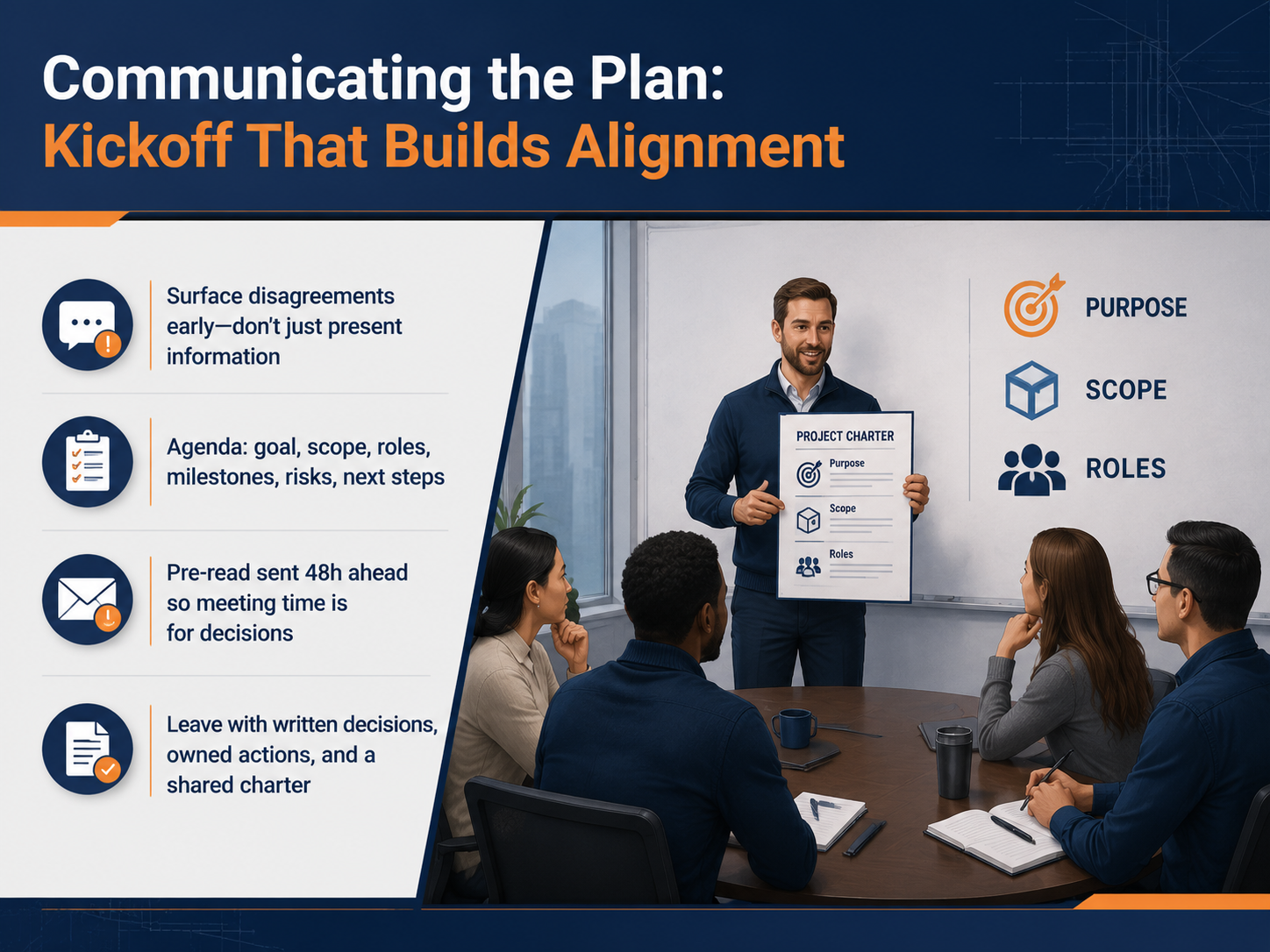
2 min - 10Communicating the Plan: Kickoff That Builds AlignmentNow, let's move from building the plan to sharing it. The kickoff meeting is your main tool for building true alignment, and the most important word here is 'alignment,' not 'presentation.' Your goal isn't to just read information to a quiet room. It's to surface disagreements early, while they're still cheap and easy to fix. To do this, send a pre-read document at least 48 hours ahead. This should include the draft goal, scope, roles, and a few key decisions to discuss. The meeting itself is then reserved for discussion and decisions. Your agenda should move through the core elements: the goal, scope, roles, milestones, and risks. But the real output is not the agenda. You must leave the room with three things: written decisions, clear actions with owners, and a shared, living charter that everyone agreed to. That's a successful kickoff. Next, let's look at how to keep the team in sync with updates and check-ins.
 2 min
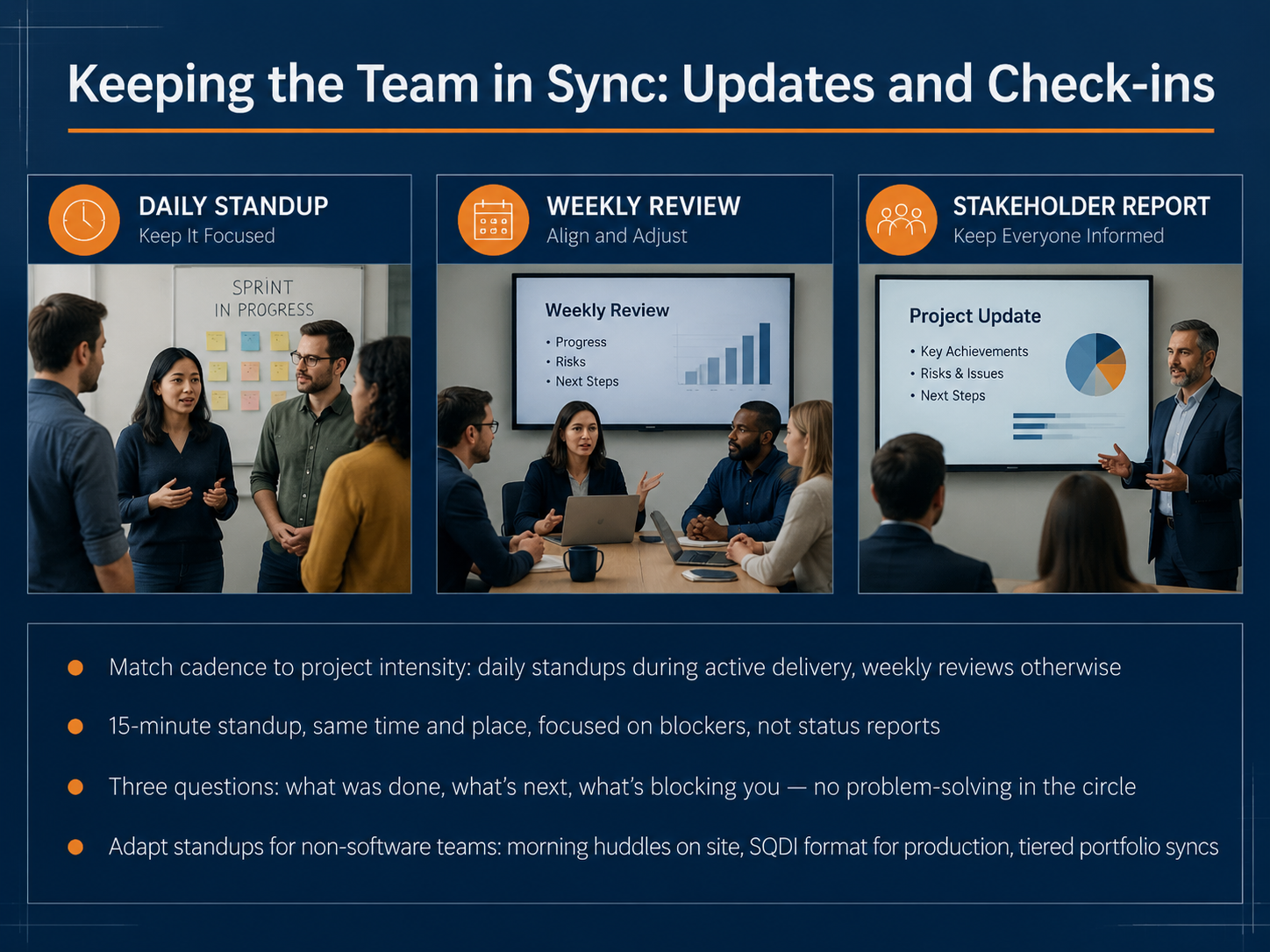
2 min - 11Keeping the Team in Sync: Updates and Check-insNow let's talk about keeping the team in sync through the right rhythm of updates and check-ins. The cadence should match the intensity of the work. During active delivery, daily standups are your best tool. In quieter periods, a weekly review might be all you need. The classic standup is 15 minutes, held at the same time and place every day. Its focus is on blockers, not full status reports. The three core questions are: what did you accomplish since we last met, what will you work on next, and what is blocking you? The golden rule is no problem-solving in the circle. If a topic needs a deep dive, flag it, assign an owner, and handle it after the meeting. This format also adapts well outside of software teams. A construction crew might hold a morning huddle on site. A production team can use the SQDI format to check Safety, Quality, Delivery, and Inventory. For managers overseeing multiple projects, a tiered sync works best. Each project runs its own daily standup, and then a brief portfolio sync surfaces only the cross-project issues and resource conflicts. The key is consistency. A 15-minute meeting that respects everyone's time and resolves blockers is a tool your team will value, not dread. Next, we'll close the loop by looking at reviews, retrospectives, and lessons learned.
 2 min
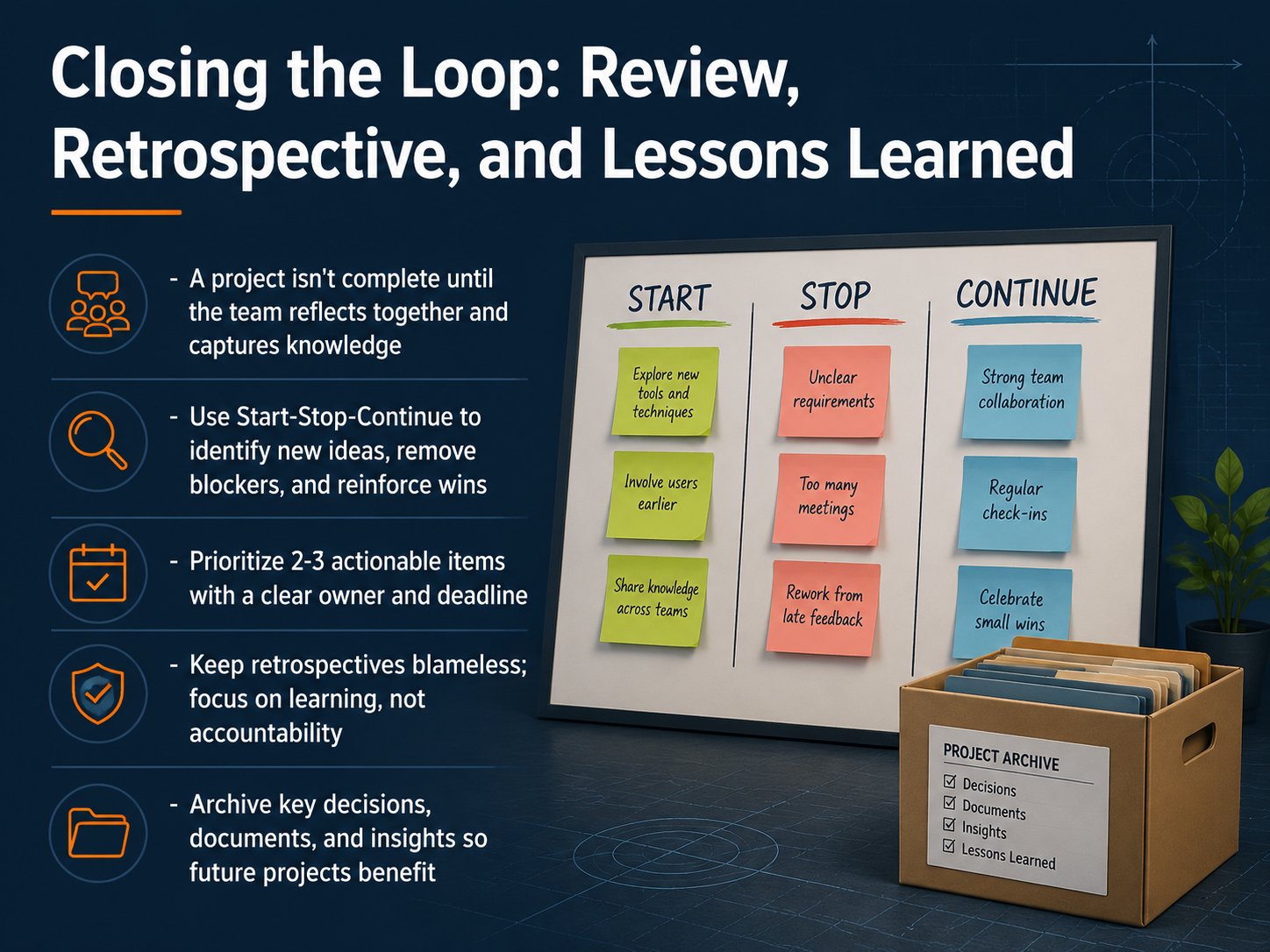
2 min - 12Closing the Loop: Review, Retrospective, and Lessons LearnedNow let's talk about the final, incredibly important phase: closing the loop. A project isn't truly complete until the team reflects together and captures what we've learned. The simplest way to do this is with a method called Start, Stop, Continue. It's a structured, blameless conversation. First, ask what we should start doing, like introducing a new communication tool. Then, what should we stop doing, maybe a meeting that's lost its purpose. And finally, what should we continue doing, because it's really working well. The goal is learning, not accountability. Once you have ideas, don't try to fix everything. Prioritize just two or three actionable items, and give each one a clear owner and a deadline. Finally, archive your key decisions and insights in a shared space so the next project team starts ahead, not from scratch. Next, let's bring all of this home and talk about your first 30 days putting these fundamentals into practice.
 2 min
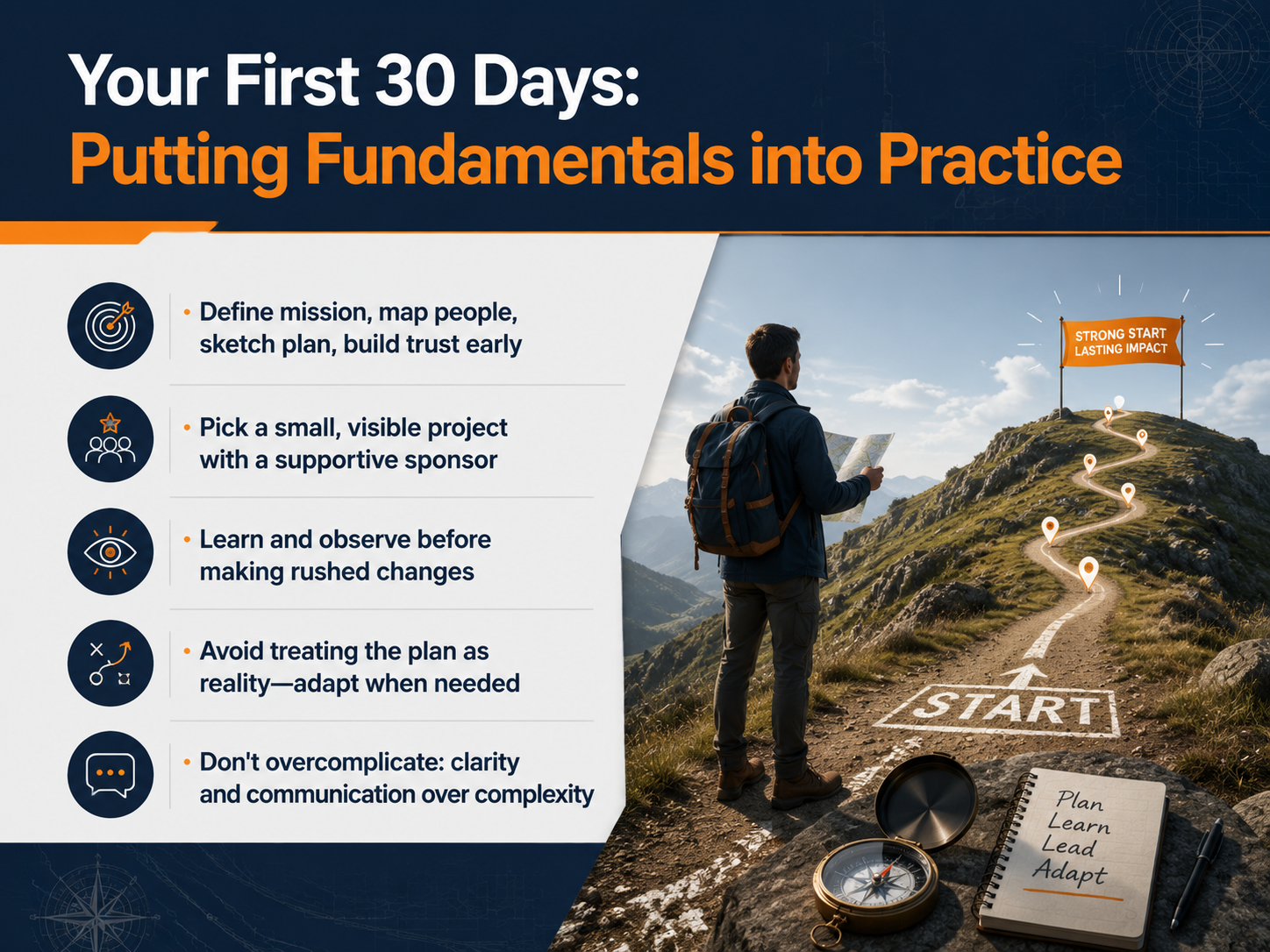
2 min - 13Your First 30 Days: Putting Fundamentals into PracticeNow, let's bring everything together and talk about your first thirty days putting these fundamentals into practice. Think of this as your quick-start guide. First, you must define the mission, map out the people involved, sketch a simple plan, and start building trust from day one. Next, pick a small, visible project with a supportive sponsor. This gives you a safe space to learn and a chance to deliver a quick win. During these early weeks, prioritize learning and observing before you make any rushed changes. Your job is to understand the system, not overhaul it overnight. One of the most important mindsets you can adopt is to avoid treating the plan as reality. A plan is a flexible guide. When things change, and they will, adapt the plan. Finally, don't overcomplicate things. Always choose clarity and communication over complexity. A simple, well-communicated path forward is far more valuable than a perfect but confusing plan. Now, let's wrap up our session with the key takeaways and your next steps.
 projectmanagementcompass.substack.comprojectmanagementcompass.substack.com2 min
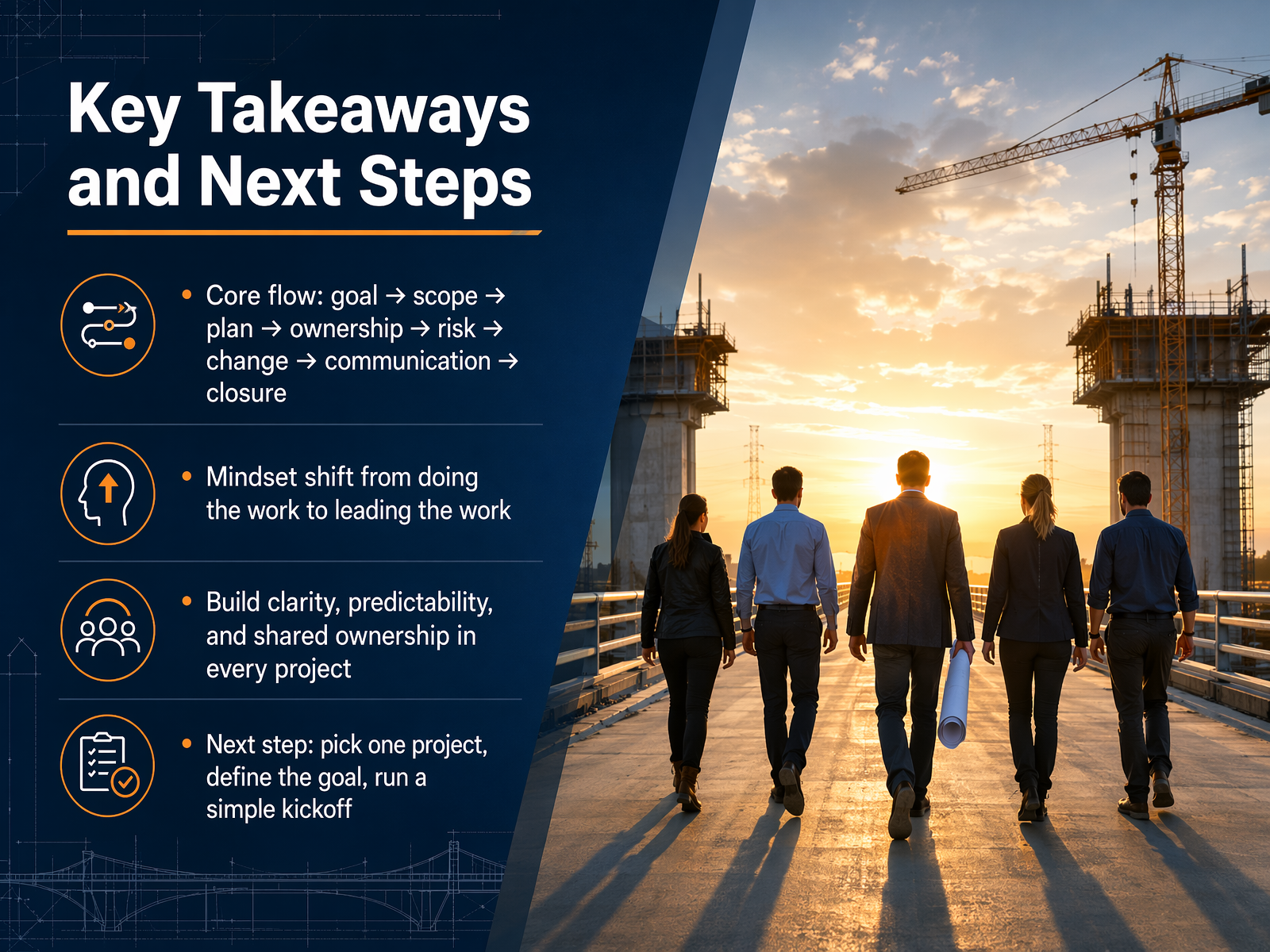
 - 14Key Takeaways and Next StepsWe have covered a lot, so let's bring it together. The core flow you can use starting tomorrow is: move from a clear goal, to a defined scope, to a realistic plan, to clear ownership. Then, stay ahead by managing risk, handling change, communicating intentionally, and closing cleanly. The biggest shift is moving from doing the work to leading the work. Your role is to build clarity, predictability, and shared ownership with your team. Your next step is simple: pick one project, define a single sentence that captures the goal, and run a quick kickoff with your team. That is the fastest way to put these fundamentals into practice. Thank you for investing this time in your growth. You now have a toolkit you can use tomorrow. Go build something great.
 2 min
2 min
Take the deck with you
Download this course as a file — free, no sign-up needed.
- PDF handoutEvery slide page, ready to print or share.15 pages · 4.2 MBDownload
- Narrated PowerPointThe deck that presents itself — every slide carries the digital human's narration video.15 pages · 14.0 MBDownload
- PowerPoint slidesThe full deck as a .pptx — open it in PowerPoint, Keynote, or Google Slides.15 pages · 4.1 MBDownload
Free to use in your own training — please keep the PersonWise credit page at the end.
Have your own deck? Turn it into a course
Sources consulted
Web sources consulted while building this course.
- PMBOK Guide | Project Management Institute — pmi.org
- What Is Project Management — pmi.org
- Project Management: Complete PMBOK 8 Guide (2025) — projectmanagement.com.br
- What Is a Project? Definition per PMBOK 8 (2025) — projectmanagement.com.br
- PMI Lexicon of Project Management Terms — pmi.org
- Comparative research on IT project failure rates: A 2025 longitudinal update — pmworldlibrary.net
- Project Management Statistics 2025-26: Success Rates, Trends & KPIs PMI & Wellingtone Data | PM Study Circle — pmstudycircle.com
- New PMI Research Reveals Strategy-Execution Gap Is Undermining Transformation And How to Close It — pmi.org
- https://143758361.fs1.hubspotusercontent-eu1.net/hubfs/143758361/The%20State%20of%20Project%20Management%20Report%202025.pdf — 143758361.fs1.hubspotusercontent-eu1.net
- Why do projects really fail? — pmi.org
- 10 Ways to Fail as a First-Time Project Manager — projectmanagementcompass.substack.com
- Essential Skills for First-Time Project Leaders Revealed by GLOBIS Survey - Third News — third-news.com
- How to Lead Your First Project Without Feeling Lost — projectmanagementcompass.substack.com
- Top 3 Project Management Challenges in 2025 (+ Solutions) — actitime.com
- SMART goals are awful, here is why. — perdoo.com
- SMART Goals For Project Managers: A Complete Guide (2026) — proofhub.com
- Goal vs Objective in Project Management: Key Differences — techademy.com
- Objective vs Outcome – What is What & Why Does It Matter? — softwarefinder.com
- SMART Goals for Project Managers: Set, Track, & Succeed! — fluentboards.com
- MoSCoW Prioritization | Glossary | ProductPlan — productplan.com