Begin
12 pages · ~24 min
Brand Strategy Patterns and Pitfalls
Analyze real brand strategy examples to identify successful patterns, key strengths, and common pitfalls. Ideal for marketers and brand strategists seeking practical insights.
A digital instructor presents all 12 pages. Hold “Ask” at any point and ask out loud — the answer comes from this course. No sign-up needed.
What you’ll learn
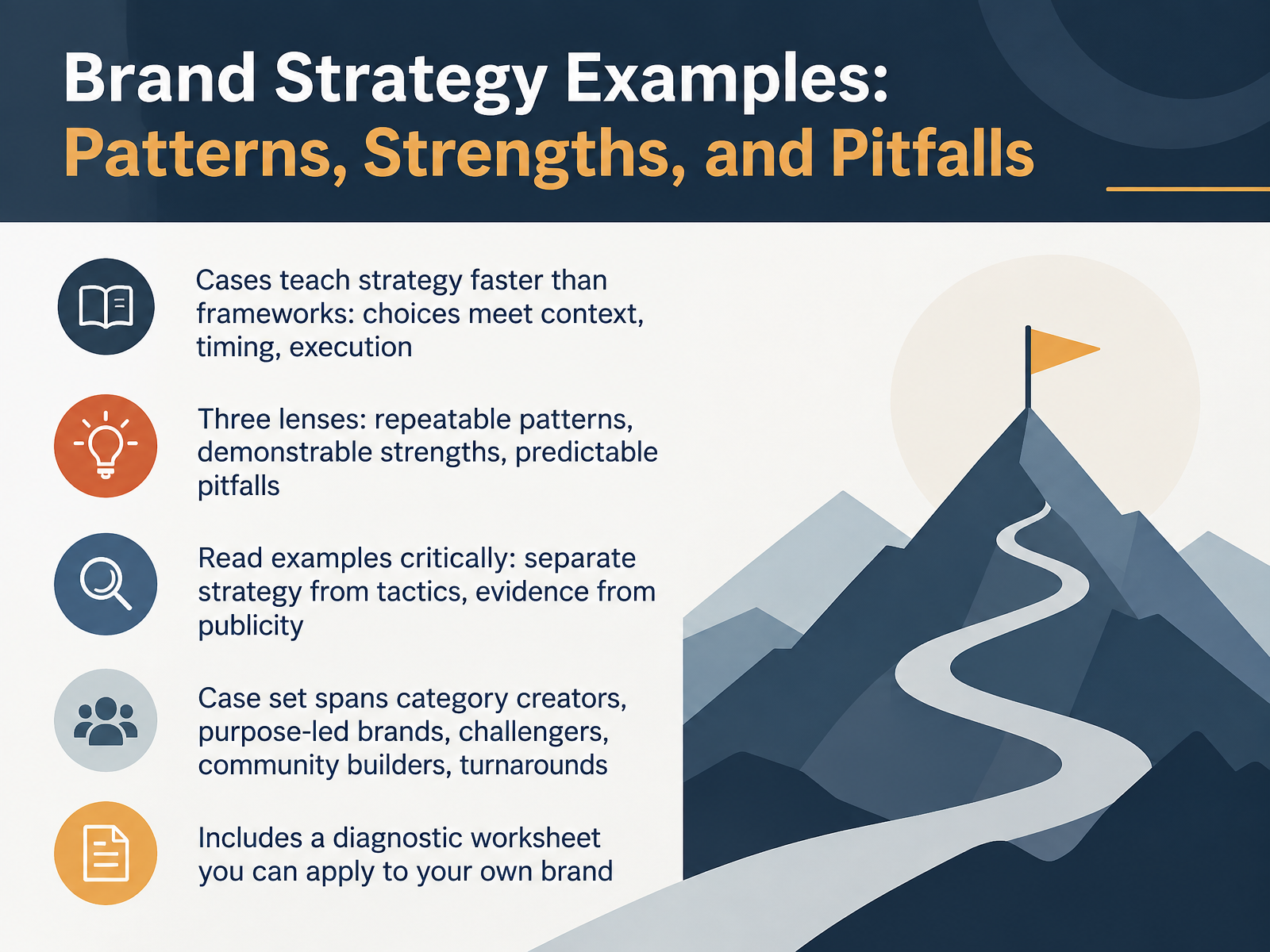
- 01Brand Strategy Examples: Patterns, Strengths, and PitfallsWelcome. Today we're talking about brand strategy examples, and what they actually teach us. Here's the core idea. Cases teach strategy faster than frameworks do, because you see choices meet context, timing, and execution. We'll use three lenses throughout. First, repeatable patterns. Second, demonstrable strengths. And third, predictable pitfalls. For example, a challenger brand might lead with one sharp point of difference instead of matching the leader on everything. That's the move. The consequence is clarity, but also risk if the proof isn't there. So we'll read every example critically, separating strategy from tactics, and evidence from publicity. Our case set spans category creators, purpose led brands, challengers, community builders, and turnarounds. You'll also get a diagnostic worksheet you can apply to your own brand. Let's start with core concepts and a shared vocabulary.burke.comngovietliem.commarksherrington.com+21 min
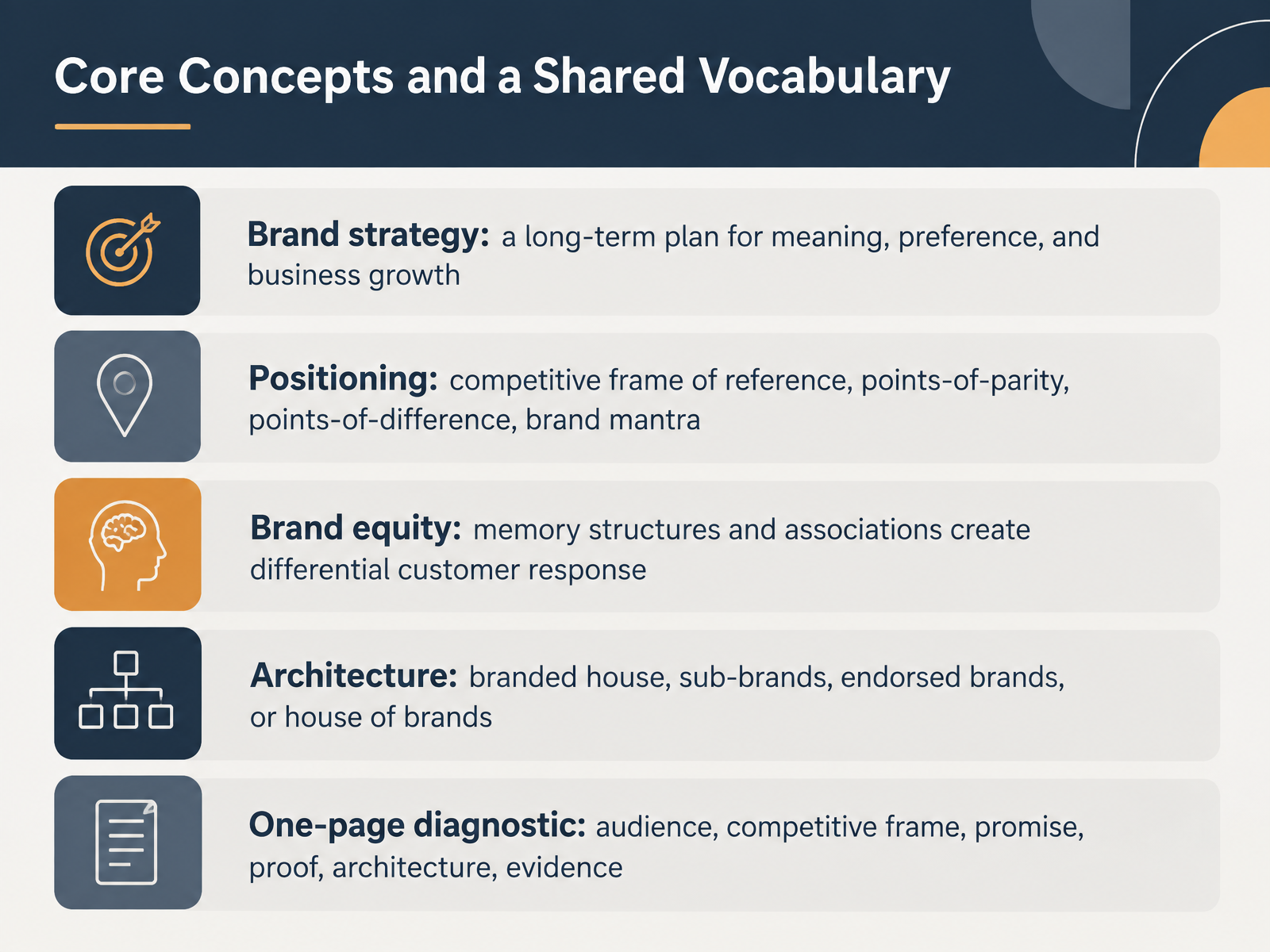
- 02Core Concepts and a Shared VocabularyLet's lock in a shared vocabulary, because these six words will carry the rest of this course. Brand strategy is the long-term plan for meaning, preference, and business growth. Positioning is your competitive frame of reference, plus the points of parity you match and the points of difference you own, all compressed into a brand mantra, a short phrase of three to five words. Brand equity is the memory structures and associations that create a different customer response. Architecture decides how your portfolio fits together, whether that's a branded house, sub-brands, endorsed brands, or a house of brands. And the one-page diagnostic keeps you honest: audience, competitive frame, promise, proof, architecture, and evidence. If you can fill that page clearly, your strategy is real. If you can't, it's still a wish. Next, we'll see how this plays out with Pattern 1: Positioning by Category Ownership or Redefinition.
 burke.comngovietliem.commarksherrington.com+21 min
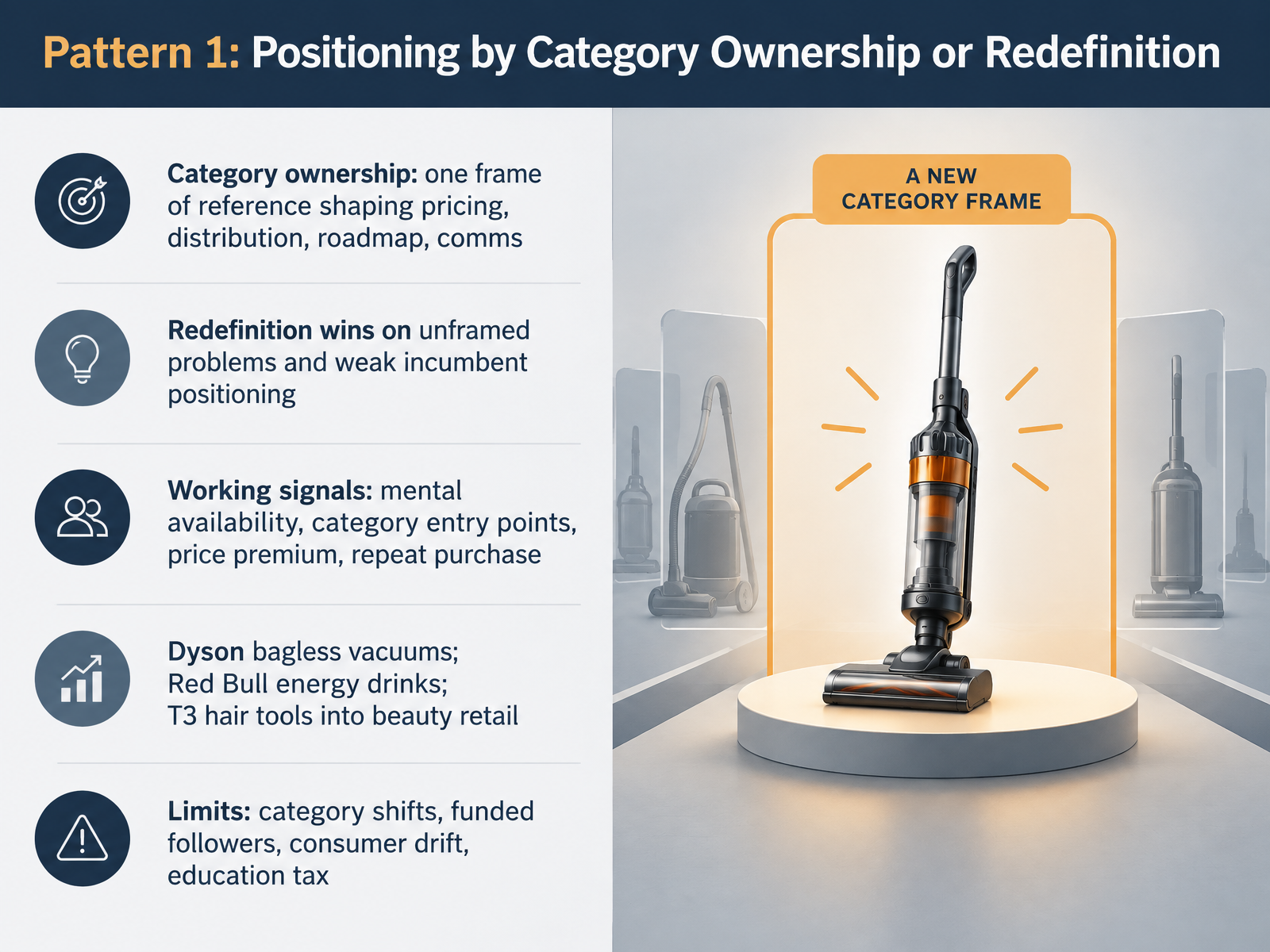
- 03Pattern 1: Positioning by Category Ownership or RedefinitionLet's talk about our first pattern. Positioning by owning a category, or redefining one. Category ownership means one clear frame of reference shapes everything. Your pricing, distribution, product roadmap, and communications all line up behind it. Redefinition tends to win when the problem is unframed and the incumbents are weak. So what signals tell you it is working? Mental availability, meaning your brand comes to mind first. Strong category entry points. A price premium. And repeat purchase. Dyson did this with bagless vacuums. Red Bull did it with energy drinks. T3 moved hair tools out of appliances and into beauty retail, right beside skincare. Now the limits. Categories shift. Funded followers copy you fast. Consumer tastes drift. And you pay an education tax, because you have to teach the market before you can sell to it. Quick takeaway. Own the category, but budget for the long haul. Next, Pattern 2: Purpose-Led and Values-Led Brands.
 fastcompany.combeautymatter.comshopify.com+22 min
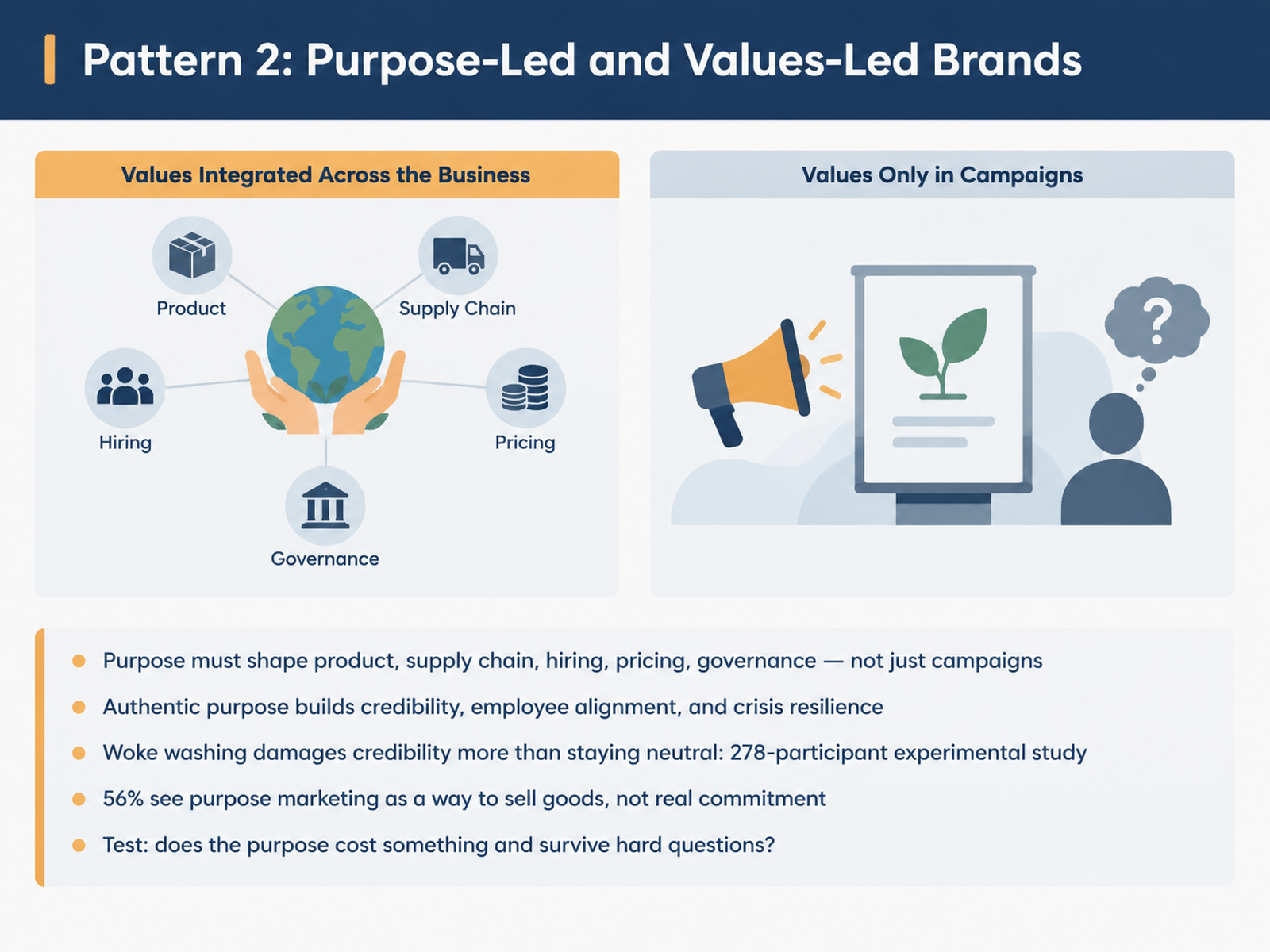
- 04Pattern 2: Purpose-Led and Values-Led BrandsNow let's look at Pattern Two: purpose-led and values-led brands. Here's the core idea. Purpose has to shape the product, the supply chain, hiring, pricing, and governance. Not just the campaign. Take Patagonia. Its environmental stance changed what it made and how it gave away ownership. That consistency built credibility and loyalty. But the flip side is woke washing, and the evidence is uncomfortable. A study of two hundred seventy eight participants found that woke washing actually damages brand credibility more than staying neutral. And fifty six percent of people see purpose marketing as a way to sell goods, not as real commitment. So before you run a purpose campaign, ask one test question. Does this purpose cost us something, and can we survive hard questions about it? If the answer is no, fix the business first. Next, Pattern Three: challenger, founder-led, and community-led brands.
 sciencedirect.commarketingweek.comkcl.ac.uk+21 min
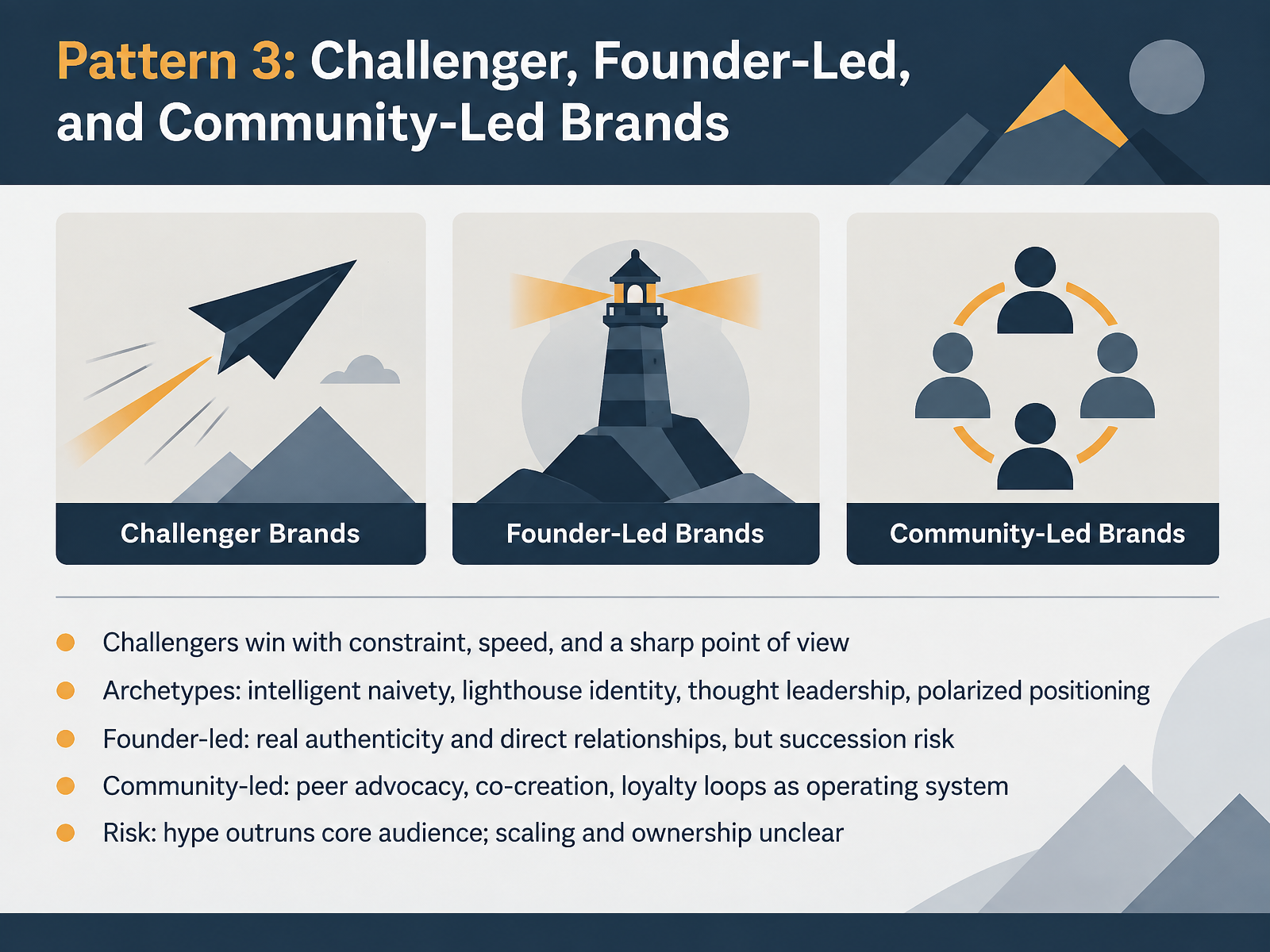
- 05Pattern 3: Challenger, Founder-Led, and Community-Led BrandsNow let's look at a third pattern: challenger, founder-led, and community-led brands. If you're not the market leader, you can't win by copying the leader. Challengers win with constraint, speed, and a sharp point of view. Think of a small coffee roaster turning local culture into a daily habit, or a running brand that launched with no paid ads and grew through run clubs instead. The archetypes here include intelligent naivety, which means asking the obvious question your category stopped asking. A lighthouse identity, which is knowing who you are and projecting it consistently. Thought leadership, which is leading the conversation when you can't lead the market. And polarized positioning, which means taking a clear side. Founder-led brands give you real authenticity and direct relationships. That's a strength. But there's a succession risk if everything depends on one person. Community-led brands turn peer advocacy, co-creation, and loyalty loops into an operating system. Customers help choose products, spread the word, and come back. Here's the pitfall. Hype can outrun the core audience, and when you scale, ownership and direction get unclear. So protect the community you started with. Up next, we'll pull these patterns together in What Strong Examples Have in Common.
 dash.appchrislema.comwearerival.com+22 min
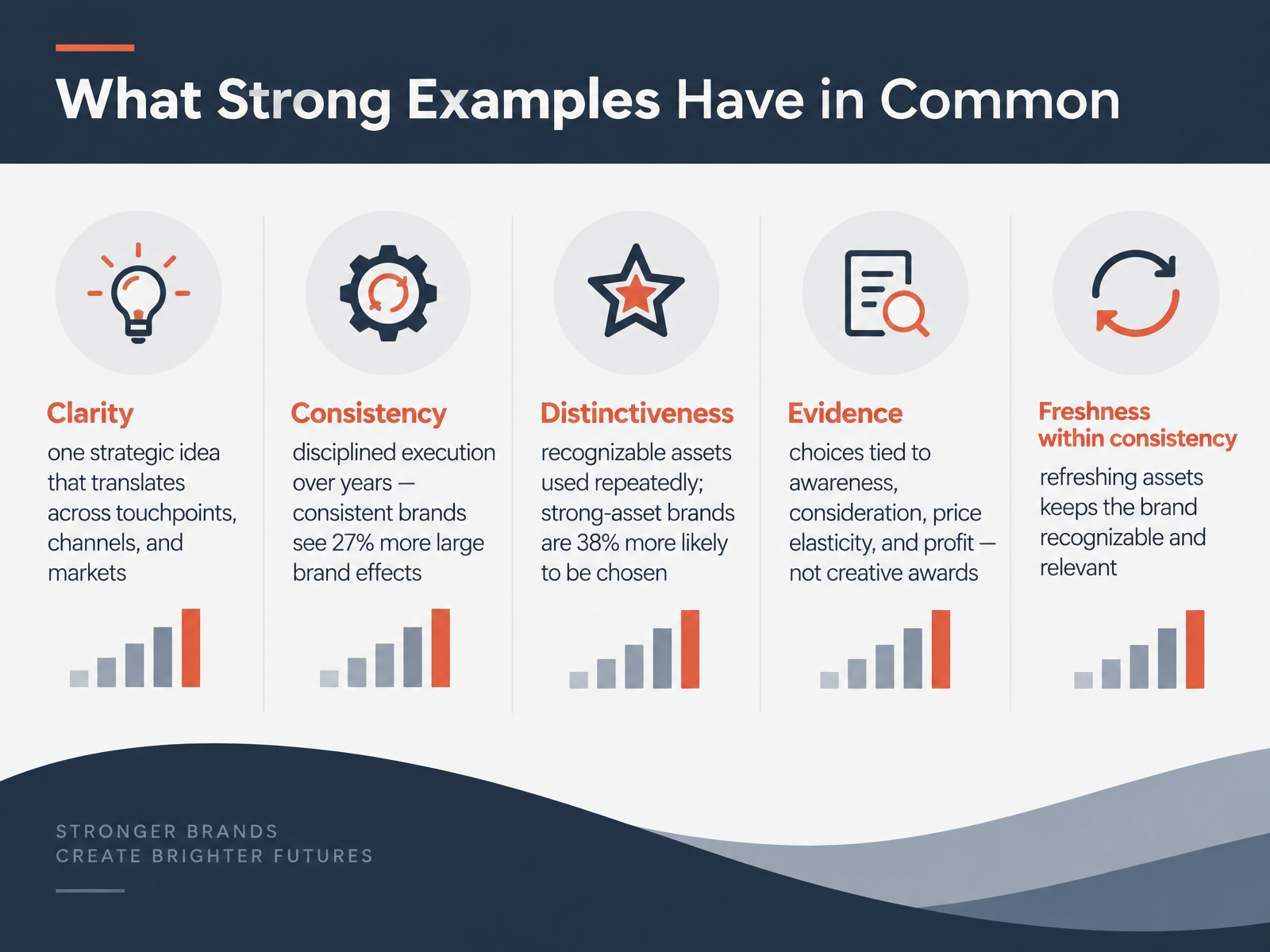
- 06What Strong Examples Have in CommonSo let's move from individual examples to the patterns behind them. What do strong examples actually have in common? First, clarity. One strategic idea, translated across touchpoints, channels, and markets. Second, consistency. Disciplined execution over years. Consistent brands see twenty-seven percent more large brand effects. Third, distinctiveness. Recognizable assets used repeatedly. Brands with strong asset portfolios are thirty-eight percent more likely to be chosen. Fourth, evidence. Choices tied to awareness, consideration, price elasticity, and profit, not creative awards. And fifth, freshness within consistency. Refreshing assets keeps the brand recognizable and relevant. That balance is where the real discipline sits. Inconsistent branding erodes potential profits, and one study estimated it could cost the brands studied nearly three and a half billion pounds over five years. So before you add anything new, ask which of these five is weakest in your brand right now. Next, we will look at the recurring pitfalls and how to avoid them.
 1 min
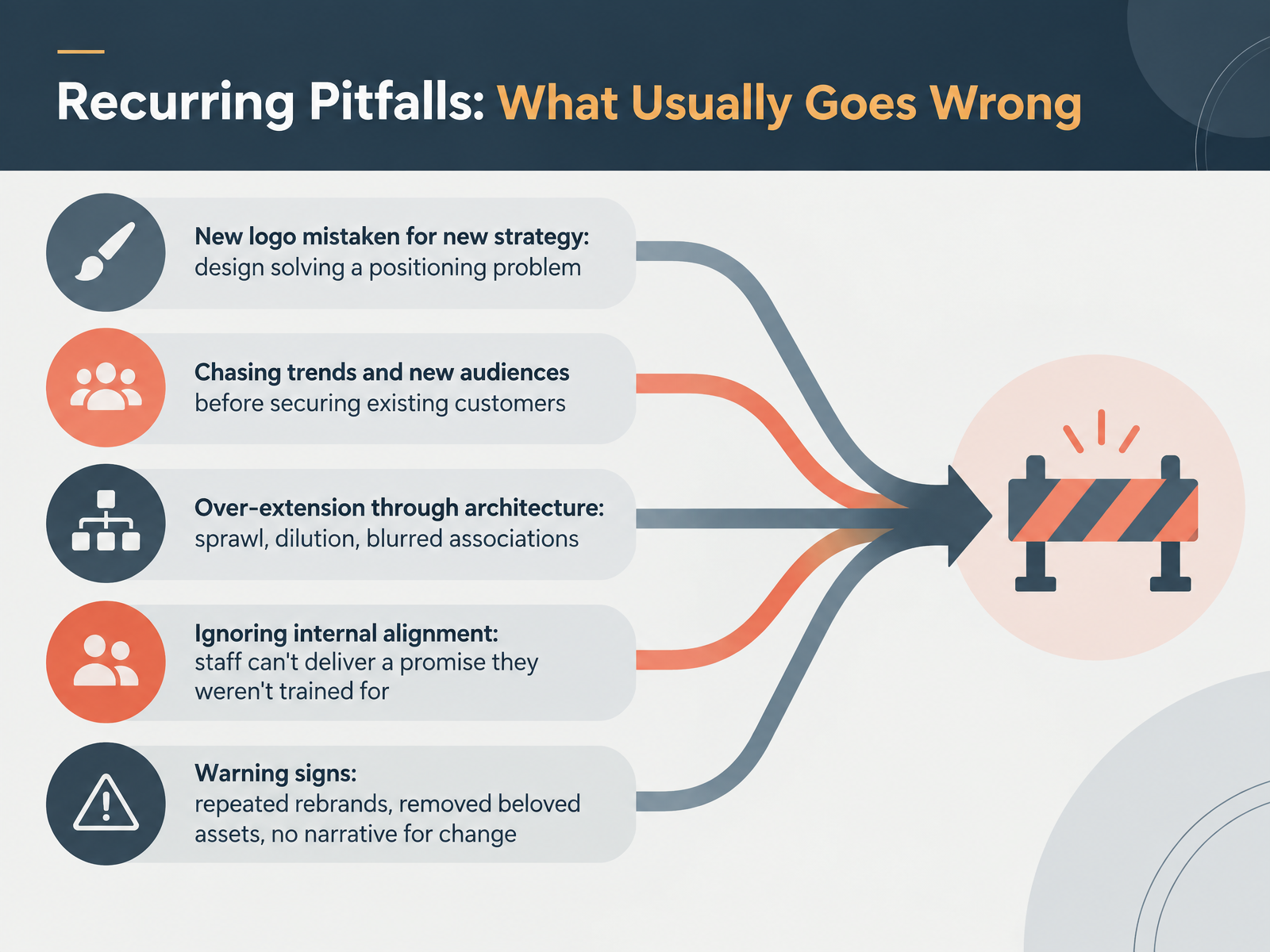
- 07Recurring Pitfalls: What Usually Goes WrongLet's turn to the recurring pitfalls, because these mistakes show up again and again. First, a new logo mistaken for new strategy. Gap spent around one hundred million dollars on a logo it abandoned in six days. The design changed; the positioning never did. Second, chasing trends and new audiences before securing existing customers. Jaguar dropped its leaping cat, showed no cars, and sales fell forty-six percent. Third, over-extension through architecture. When one brand covers too many offerings, associations blur and dilution sets in. Fourth, ignoring internal alignment. Staff cannot deliver a promise they were never trained for. JCPenney associates were asked to explain everyday low pricing with no preparation. Watch for the warning signs too. Repeated rebrands within a few years, removing beloved assets, and no narrative explaining why change is happening. Here's your takeaway. Pitfalls cluster around four gaps: strategy, audience, architecture, and internal alignment. Fix those before you touch the logo. Next, we'll look at Reading Examples Critically: Evidence, Context, and Survivorship Bias.
 burke.comngovietliem.commarksherrington.com+22 min
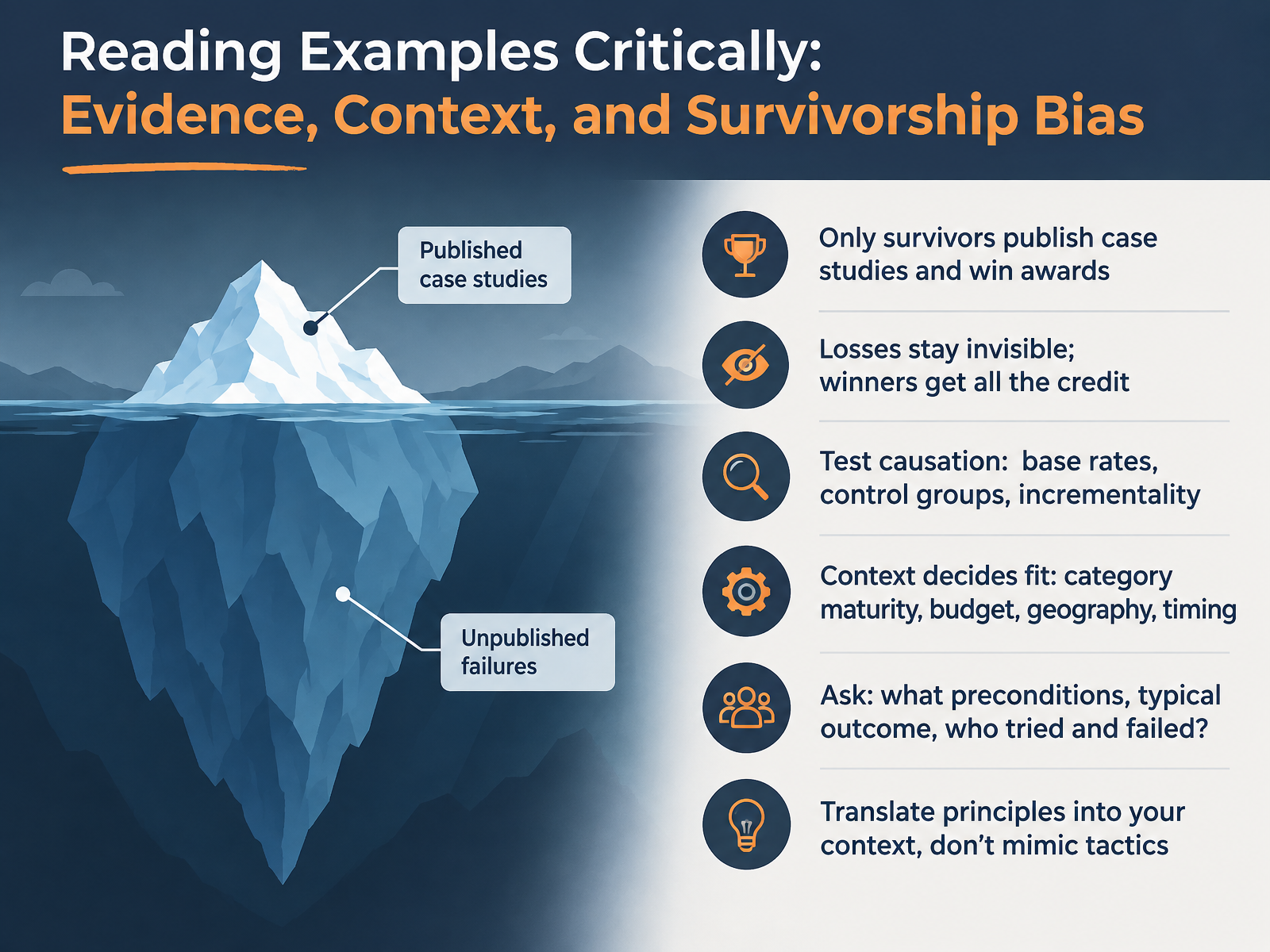
- 08Reading Examples Critically: Evidence, Context, and Survivorship BiasNow let's talk about reading examples critically. Case studies and awards are useful, but they suffer from survivorship bias. That means we only see the winners. The failed campaigns, the quiet losses, they rarely get published. So when you study a success story, always test causation. Ask about base rates, control groups, and incrementality. In plain terms: what happens when we run this tactic, compared to not running it at all? Context decides fit too. Category maturity, budget size, geography, and timing all shape whether a tactic will work for you. So before you copy anything, ask three questions. What preconditions did this brand have? What was the typical outcome, not just the best case? And who tried this and failed? The goal is to translate principles into your own context, not mimic tactics. That single distinction will save you from a lot of expensive experiments.
Next, let's look at reference examples across leaders, challengers, and turnarounds.
 1 min
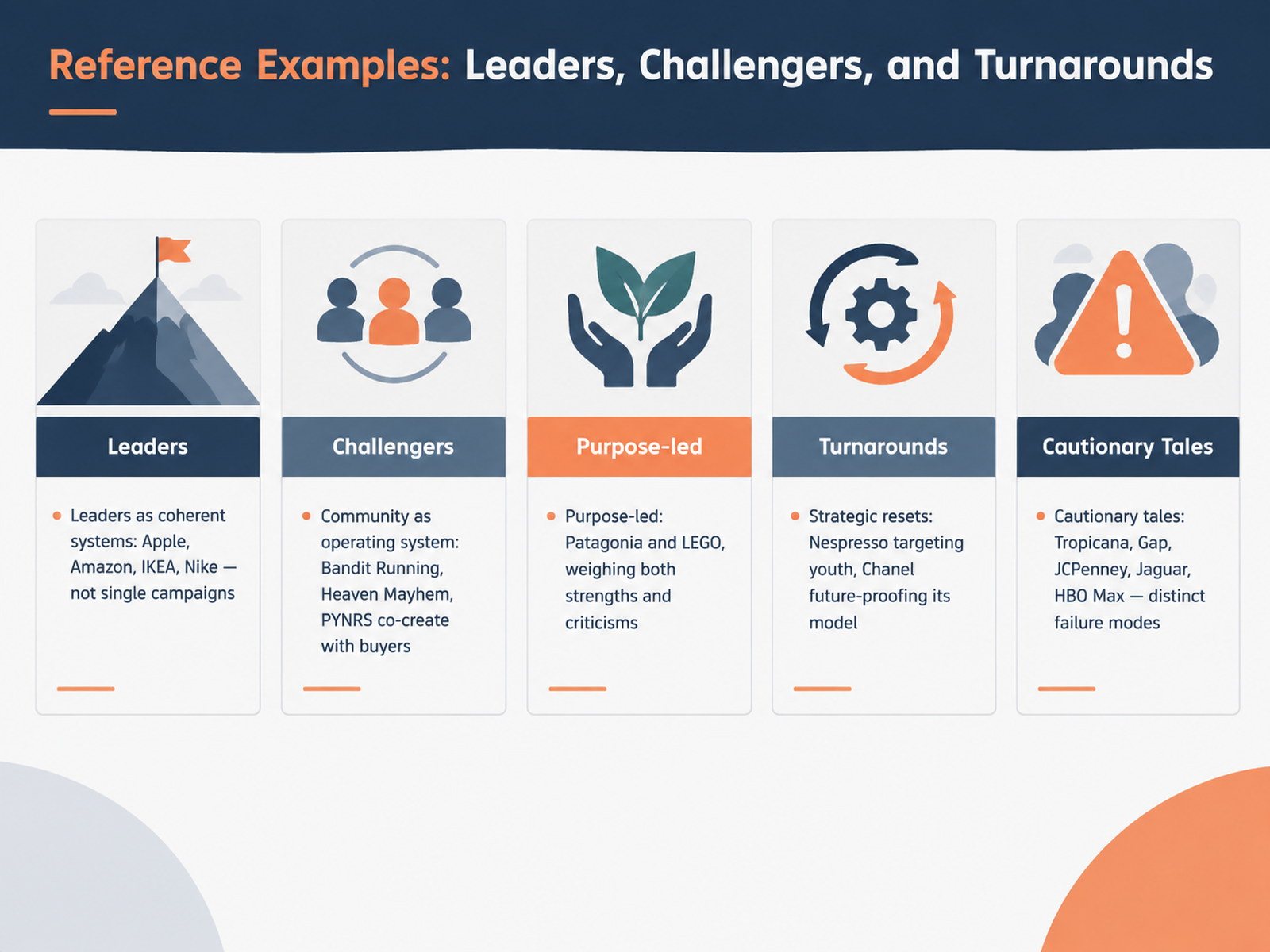
- 09Reference Examples: Leaders, Challengers, and TurnaroundsNow let's ground all of this in real reference examples. Notice the categories. First, leaders as coherent systems. Apple, Amazon, IKEA, and Nike don't win on single campaigns. They build one aligned system of product, retail, pricing, and story. Next, community as an operating system. Bandit Running, Heaven Mayhem, and PYNRS actually co-create with buyers. They ask members what to design, then sell it back to them. Then purpose-led brands like Patagonia and LEGO. Both are strong, and both face fair criticism. Weigh the strengths and the tension, don't just cheer. Strategic resets matter too. Nespresso targeted younger drinkers, and Chanel is future-proofing its luxury model. Finally, cautionary tales. Tropicana, Gap, JCPenney, Jaguar, and HBO Max. Each failed in a distinct way. So the pattern is this. Name the strategic role, then judge the brand move against it. Coming up next, we'll practice that in a case analysis workshop with a worksheet.
 dash.appchrislema.comwearerival.com+22 min
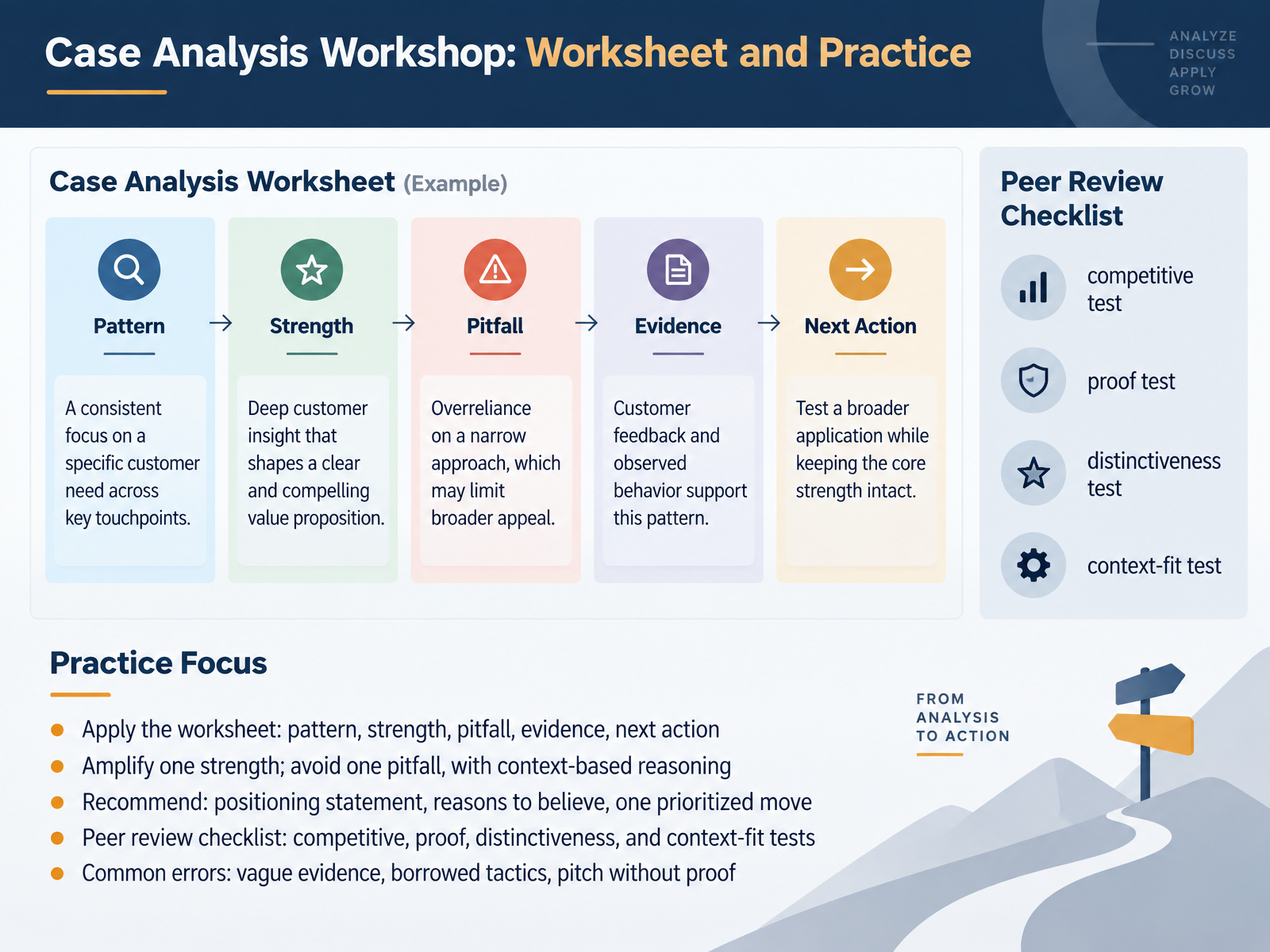
- 10Case Analysis Workshop: Worksheet and PracticeNow let's put all of this into practice with a case analysis workshop. Grab the worksheet, and work through five columns: pattern, strength, pitfall, evidence, and next action. So if a brand uses consistent assets, that's the pattern. One strength is faster recognition. One pitfall is that consistency can turn stale. Your evidence might be a recall metric, and your next action is one clear move. Then amplify one strength and avoid one pitfall, always with context-based reasoning. From there, recommend three things: a positioning statement, reasons to believe, and one prioritized move. Keep proof tied to evidence, not adjectives. Use the peer review checklist: competitive, proof, distinctiveness, and context-fit tests. And watch for the common errors: vague evidence, borrowed tactics, and pitch without proof. Test this against your own brand before we apply the three lenses next.
 burke.comngovietliem.commarksherrington.com+22 min
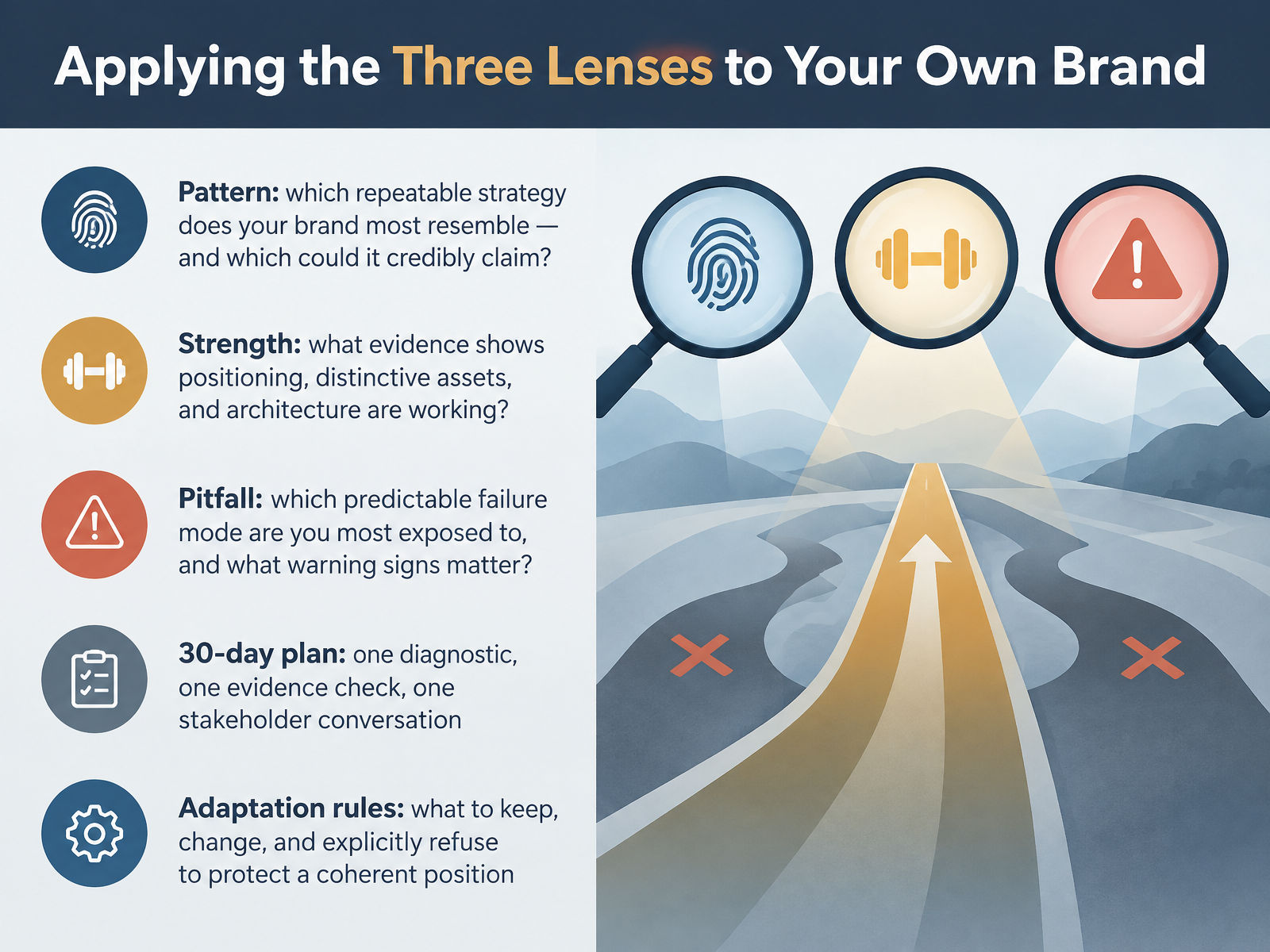
- 11Applying the Three Lenses to Your Own BrandNow let's turn the three lenses on your own brand. Start with pattern. Which repeatable strategy does your brand most resemble, and which could it credibly claim? If you're a branded house, every launch should strengthen one name. If you're a house of brands, each name carries its own cost. Next, strength. What evidence shows your positioning, distinctive assets, and architecture are actually working? Look at recognition and consideration data, not internal opinion. Your gut can misjudge asset fame by a wide margin. Then, pitfall. Which failure mode are you most exposed to? Watch for warning signs like declining sales after a repack, or a new name with no equity. Here's a simple thirty-day plan: one diagnostic, one evidence check, one stakeholder conversation. Finally, set adaptation rules. Write down what you keep, what you change, and what you explicitly refuse to protect a coherent position. That refusal is strategy. Let's move to Key Takeaways and Further Exploration.
 burke.comngovietliem.commarksherrington.com+22 min
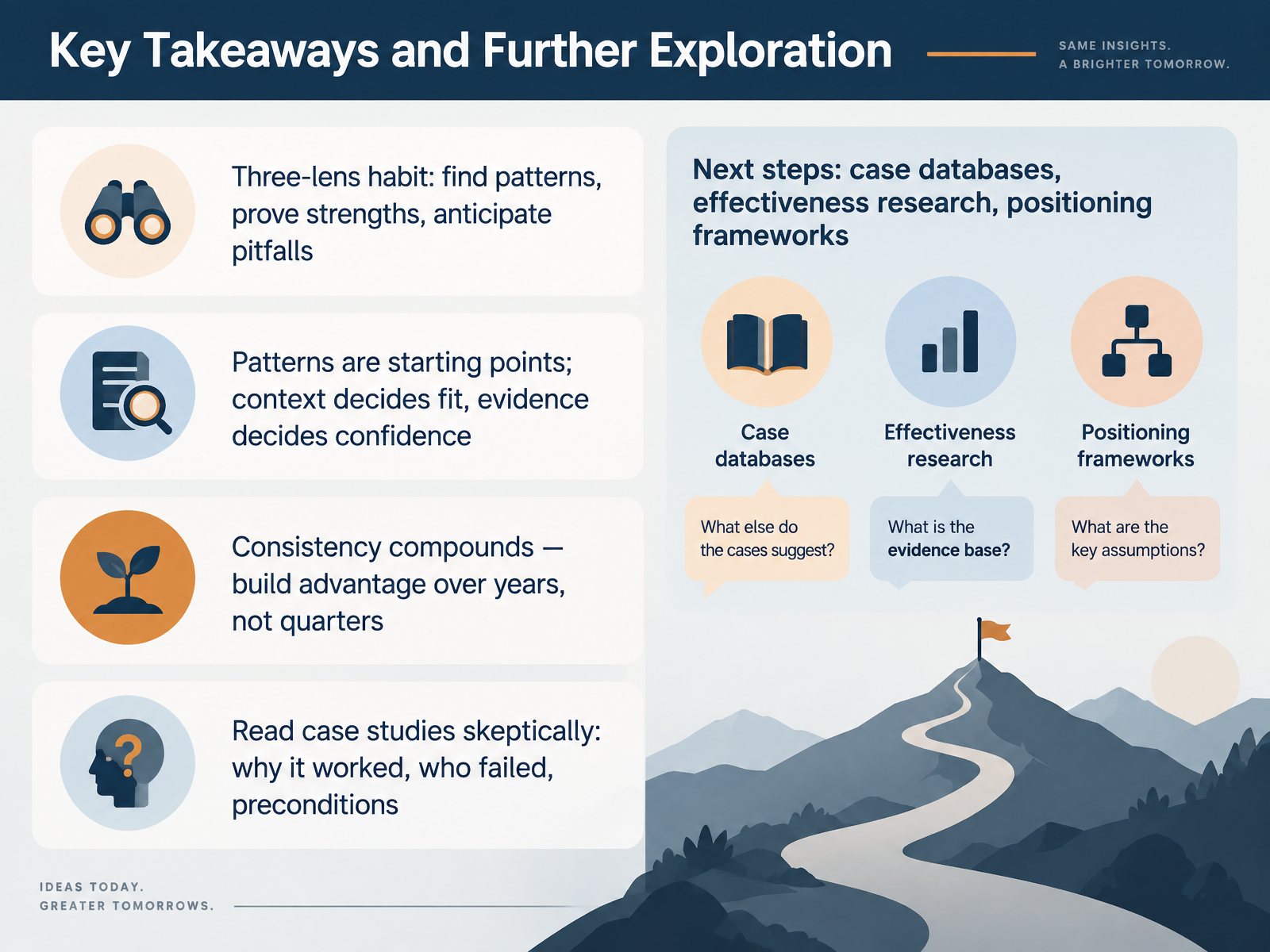
- 12Key Takeaways and Further ExplorationLet's pull this together, because these takeaways are what you'll actually carry into your next brand decision. First, build the three-lens habit. Look for patterns, prove the strengths with evidence, then anticipate the pitfalls before you commit budget or reputation. Second, treat every pattern as a starting point. Context decides fit, and evidence decides confidence, so what worked for another brand may not transfer to yours. Third, consistency compounds. Build advantage over years, not quarters. And fourth, read case studies skeptically. Ask why it really worked, who tried it and failed, and what preconditions made success possible. That single question, why did this work, saves you from survivorship bias, the trap of studying only winners and assuming their tactics caused the win. For next steps, explore case databases, effectiveness research, and positioning frameworks. Thank you for working through this with me. Keep testing, keep documenting your losses as carefully as your wins, and keep building one consistent choice at a time. You've got the lenses now, so go use them.
 1 min
Take the deck with you
Download this course as a file — free, no sign-up needed.
- PDF handoutEvery slide page, ready to print or share.13 pages · 2.6 MBDownload
- Narrated PowerPointThe deck that presents itself — every slide carries the digital human's narration video.13 pages · 12.1 MBDownload
- PowerPoint slidesThe full deck as a .pptx — open it in PowerPoint, Keynote, or Google Slides.13 pages · 2.6 MBDownload
Free to use in your own training — please keep the PersonWise credit page at the end.
Have your own deck? Turn it into a course
Sources consulted
Web sources consulted while building this course.
- Building Brand Strategy — burke.com
- Customer-Based Brand — ngovietliem.com
- by Kevin Lane KellerBRAND PLANNING — marksherrington.com
- Brand architecture — en.wikipedia.org
- Brand Strategy Format: What a Working Document Looks Like — themarketingjuice.com
- Here’s how we created a product category that didn’t exist - Fast Company — fastcompany.com
- How Grande Cosmetics Created Sephora's Lash Serum Category | BeautyMatter — beautymatter.com
- Stop Competing on Features: Reimagine Your Entire Product Category Instead (2026) - Shopify Nigeria — shopify.com
- Why Category Creation Beats Competing On Features & ... — forbes.com
- THE COMPLETE CATEGORY CREATION PLAYBOOK - by David Olusegun — creatorsblueprint.co
- Act as you preach! Authentic brand purpose versus “woke ... — sciencedirect.com
- ‘Good intentions lead to bad marketing’: Why purpose is missing the mark — marketingweek.com
- Purpose-washing — kcl.ac.uk
- Unilever praises purpose amid fresh criticism from major investor — marketingweek.com
- CSR and the problem with purpose washing — ethicalhour.com
- 12 challenger brand examples from small businesses — dash.app
- Embracing a Challenger Brand Strategy — chrislema.com
- What is a Challenger Brand? | Rival — wearerival.com
- The Challenger Brand Playbook: How to Beat Big CPG at ... — hangar-12.com
- Heaven Mayhem: How Pia Mance Built a $10M Brand (2026) - Shopify — shopify.com