Go-To-Market Strategy: Goals, Choices, Tradeoffs
Begin
14 pages · ~28 min
Go-To-Market Strategy: Goals, Choices, Tradeoffs
Product management training on go-to-market strategy, teaching how to set goals, make strategic choices, and navigate tradeoffs for successful product launches.
What you’ll learn
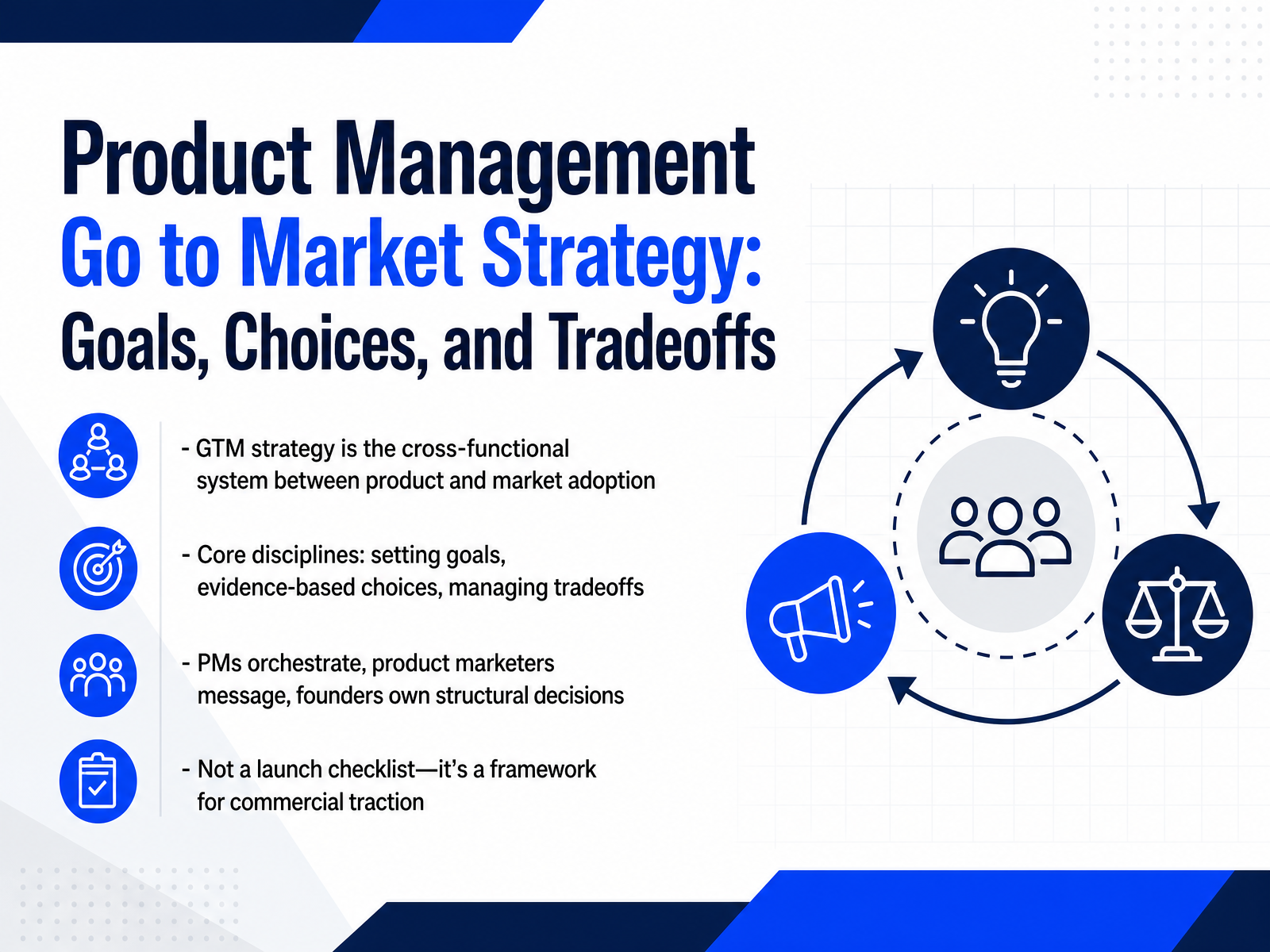
- 01Product Management Go to Market Strategy: Goals, Choices, and TradeoffsWelcome. If you're a product manager, a product marketer, or a founder, you know the feeling: a great product that stalls in the market. That gap between what you build and what customers adopt is exactly where go-to-market strategy lives. This isn't a launch checklist. It's the cross-functional system that turns a product bet into commercial traction. Today, we'll work through three core disciplines: setting clear goals, making evidence-based choices instead of gut calls, and managing the tradeoffs those choices force on you. Your role in this system matters. Product managers orchestrate the who, what, and why. Product marketers shape the message. And founders own the structural decisions, like pricing architecture and sales motion, that determine whether the whole engine runs efficiently. Each of you will weigh options with stakeholders. My job is to give you a framework that makes those conversations sharper. You're not just launching a feature. You're designing the path to revenue. Let's start by looking at why go-to-market efforts fail without clear goals.pulserevops.comdigitalapplied.comgrowthengineer.ai+22 min
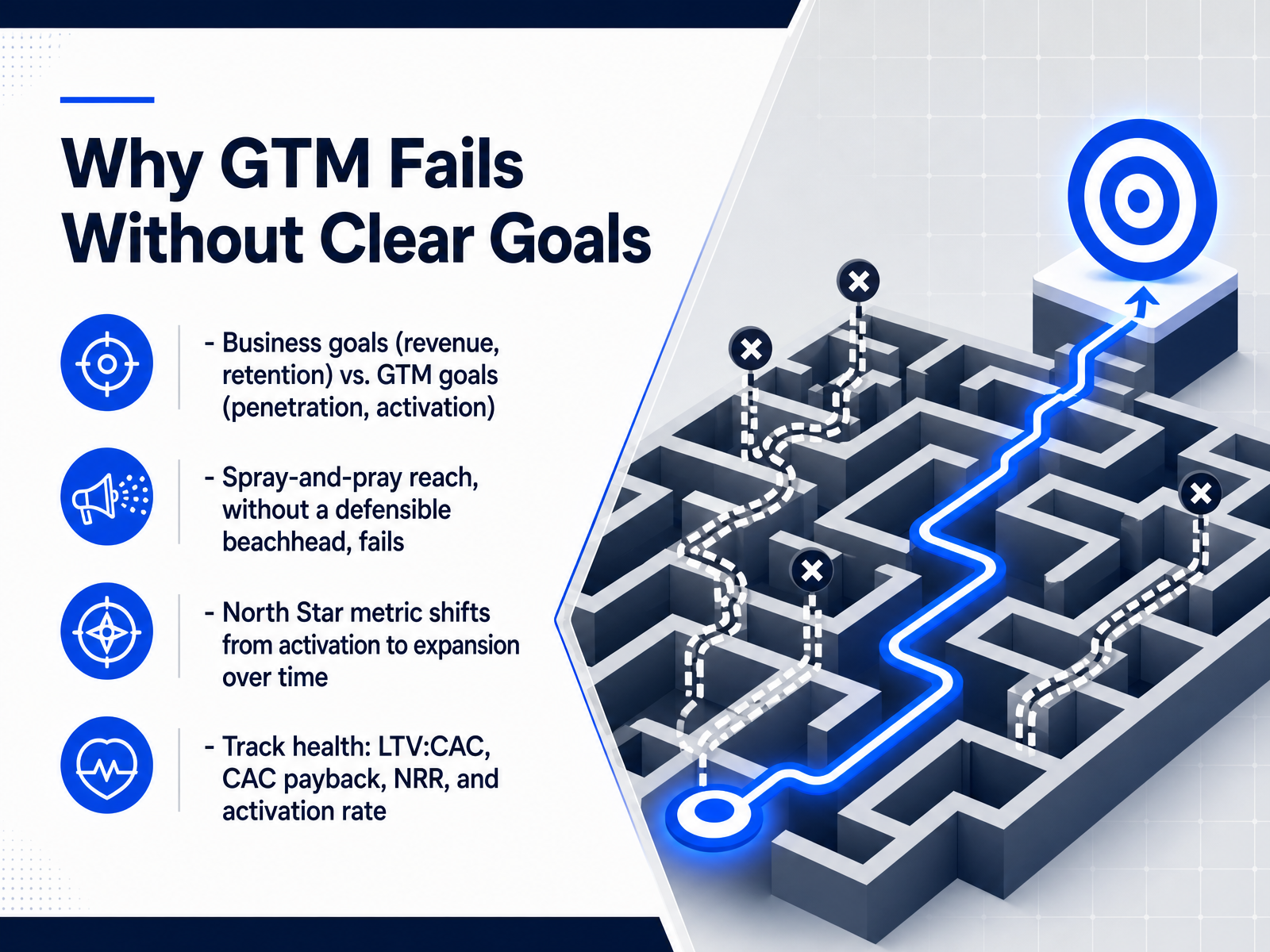
- 02Why GTM Fails Without Clear GoalsLet's be direct about why go-to-market efforts fail. It's rarely the product. It's almost always a strategy built without clear goals. You can't just spray and pray for reach. You need a defensible beachhead, a specific segment where you win first. And here's the critical distinction: your business goals, revenue and retention, are not your go-to-market goals. GTM goals are about penetration and activation. That's how you enter a market and get users to first value. But your north star metric shifts over time. Early on, you chase activation. Later, you live and die by expansion. So track the health metrics that tell you the truth. Your LTV to CAC ratio. CAC payback period. Net revenue retention above one twenty. And activation rate, the leading indicator of everything downstream. Keep an eye on those, and you'll catch a failing motion before it sinks the quarter. Now, let's move on to the core strategic choices you'll need to make.
 pulserevops.comdigitalapplied.comgrowthengineer.ai+21 min
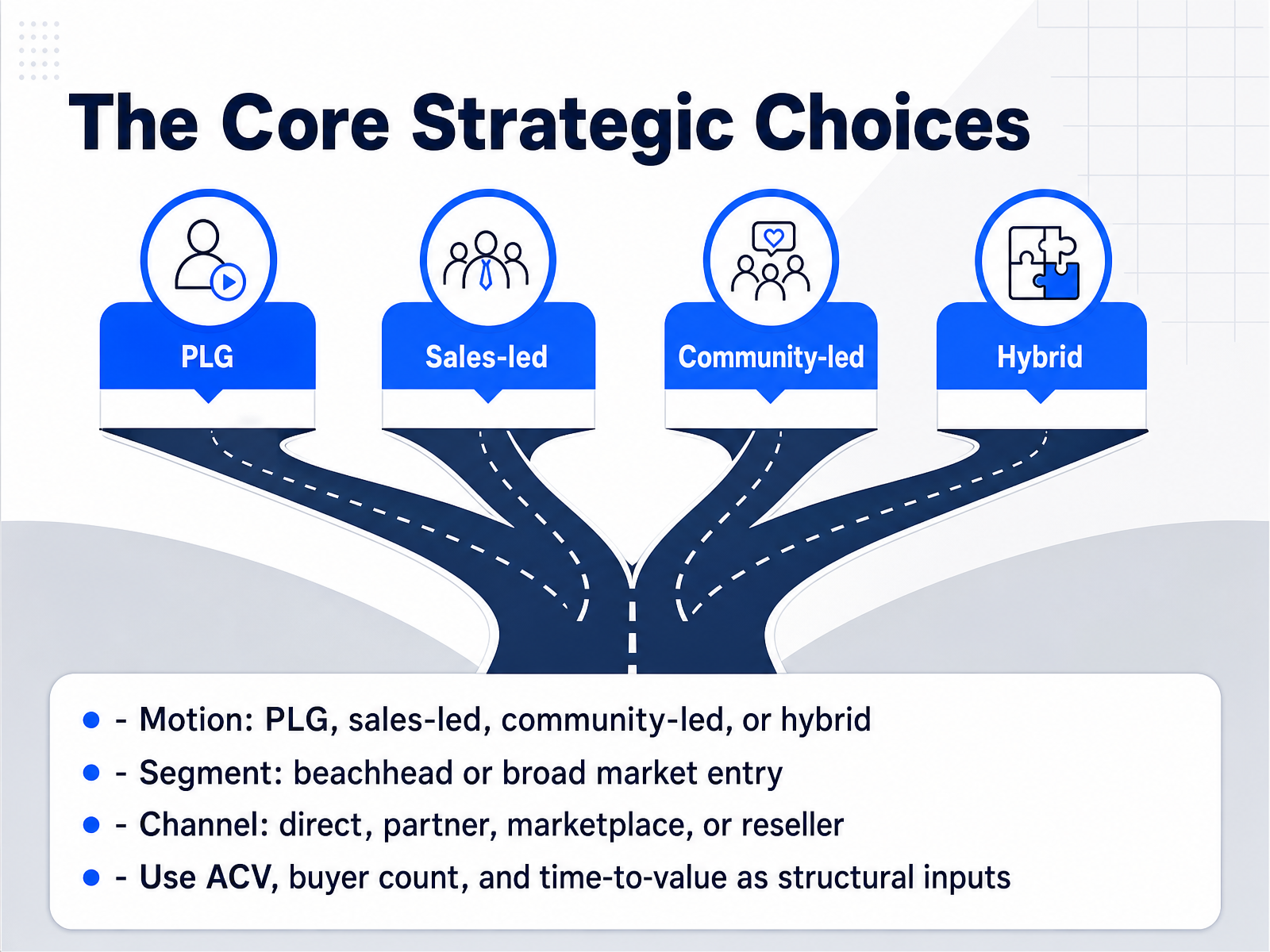
 - 03The Core Strategic ChoicesNow let's get to the heart of your go-to-market strategy: the core strategic choices that actually determine your revenue architecture. You are making four interrelated decisions. First, motion: product-led, sales-led, community-led, or a sequenced hybrid. Second, segment: do you start with a narrow beachhead or go broad from day one? Third, channel: direct, partner, marketplace, or reseller. These aren't independent choices. Your structural inputs—annual contract value, buyer count, and time to value—should dictate all of them. Here is the discipline: if your time to value is measured in minutes and your contract value is low, the product must sell itself. If you have a committee of buyers and a six-figure contract, a human-led motion is the only way to earn the right to scale. Don't let founder preference or mimicry cloud this. The framework decides; you execute. Choose a beachhead narrow enough to win in under 90 days, then let those proof points fund expansion. We will now examine how these principles play out when comparing product-led growth and sales-led approaches in practice.
 pulserevops.comdigitalapplied.comgrowthengineer.ai+21 min
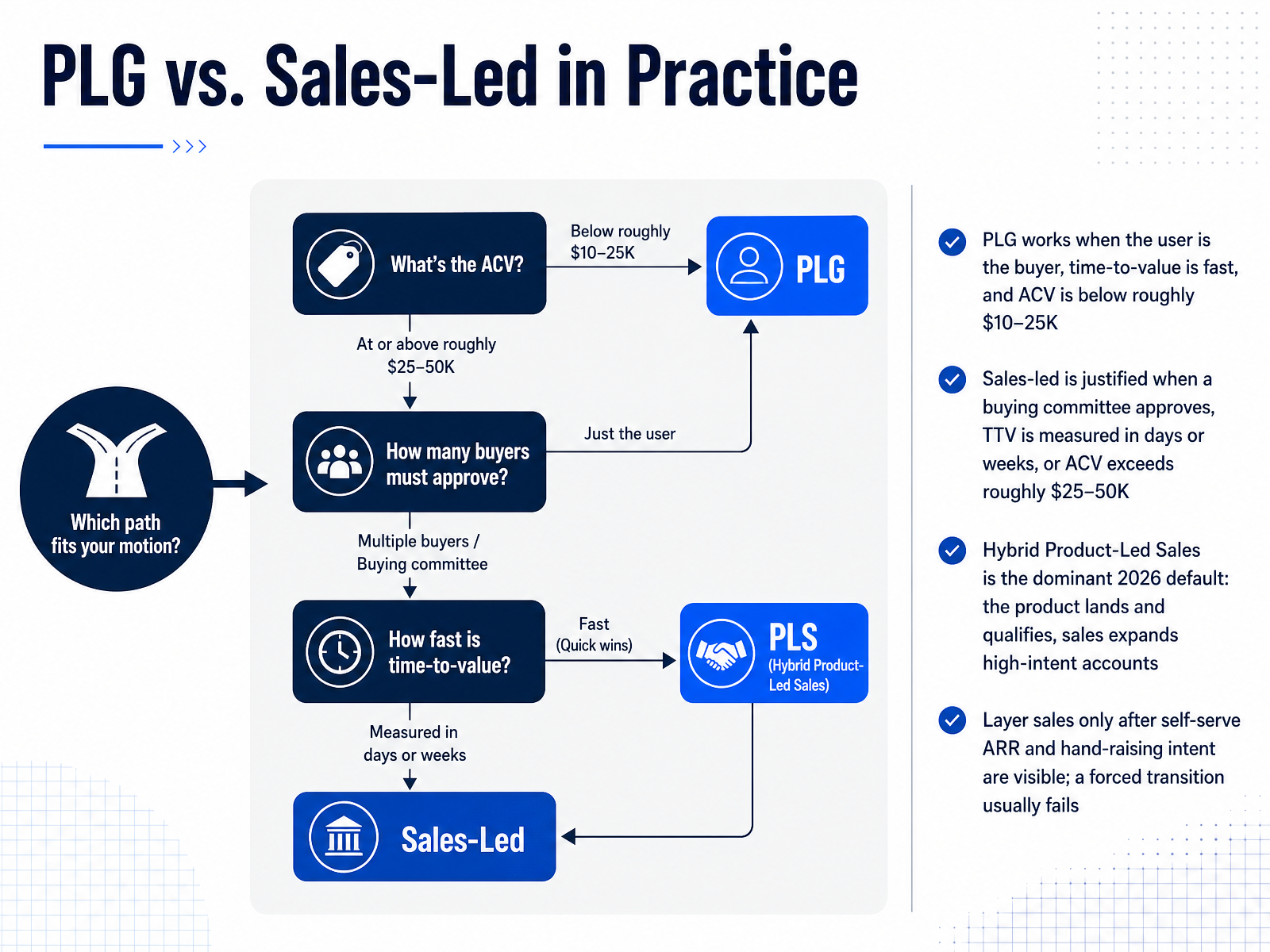
 - 04PLG vs. Sales-Led in PracticeNow let’s ground this in practice. Product-led growth works best when the user is the buyer, time-to-value is measured in minutes or hours, and the annual contract value stays below roughly ten to twenty-five thousand dollars. In that zone, the product can do the selling efficiently. Sales-led is justified when a buying committee has to approve, when time-to-value stretches into days or weeks because of implementation, or when the ACV exceeds twenty-five to fifty thousand dollars. That’s the price point where a human-led deal can actually pay for itself. But for most successful companies in 2026, this isn’t an either-or decision. The dominant pattern is hybrid product-led sales: the product lands users and qualifies accounts at near-zero cost, then a sales layer expands the high-intent ones. The key is timing. Layer in sales only after you see real self-serve ARR and, critically, hand-raisers—users reaching out to buy more. A forced transition before those signals exist usually fails because sales has nothing warm to work. Sequence it correctly, and you get the efficiency of product-led acquisition with the expansion power of sales. Next, let’s look at how you pick the beachhead to focus this motion on.
 pulserevops.comdigitalapplied.comgrowthengineer.ai+21 min
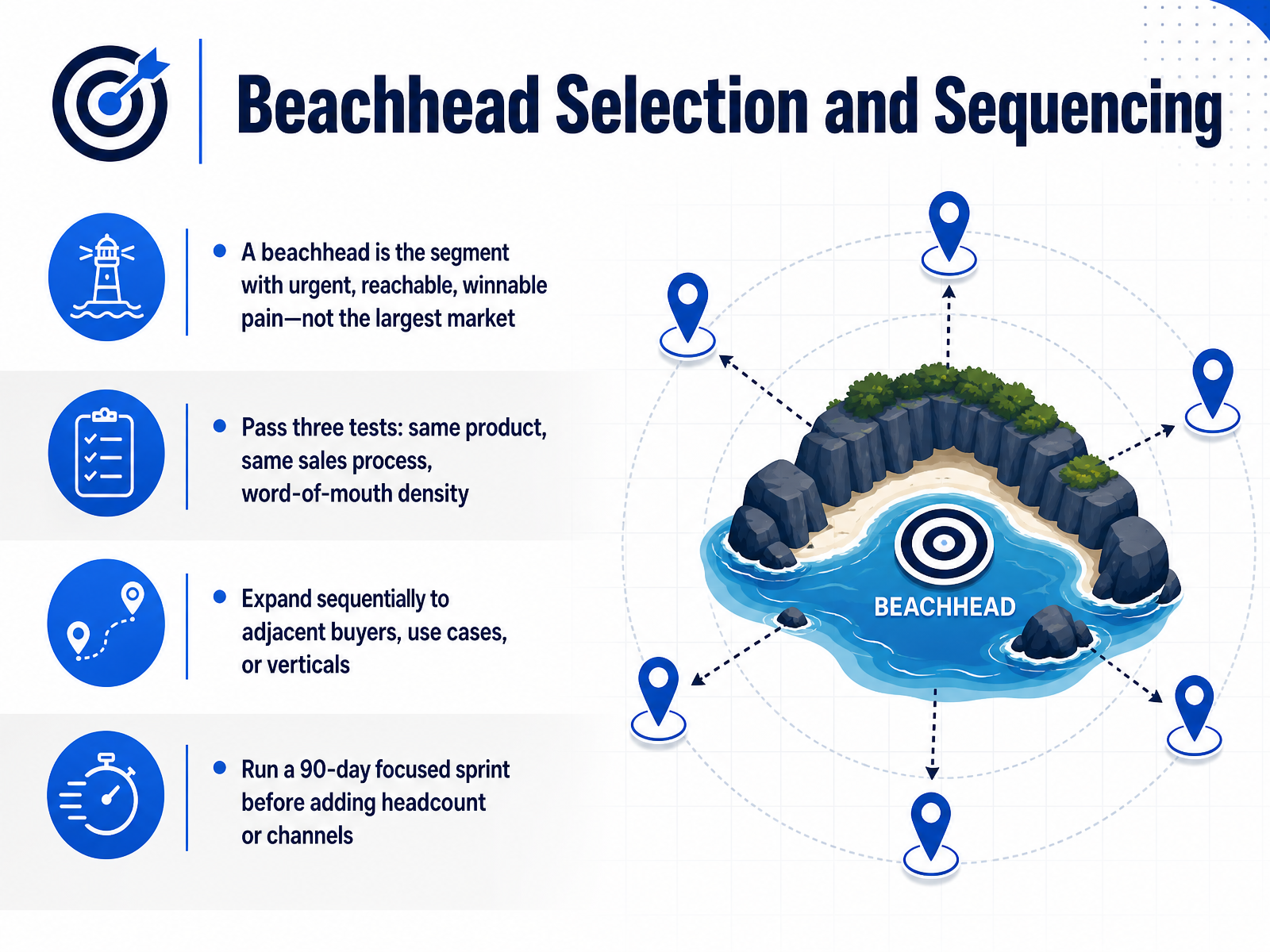
 - 05Beachhead Selection and SequencingLet’s turn to the discipline of beachhead selection and sequencing. A beachhead is not your largest market; it’s the segment with urgent, reachable, and winnable pain. Think of it as your proof-of-concept market—the place where you earn the right to expand. Run every candidate through three tests. First, can they succeed with the same product, without costly forks or custom builds? Second, do they buy through the same repeatable sales process—consistent buyer, deal size, and cycle? Third, is there word-of-mouth density, a community where your success stories will travel? If a segment fails any of these, it will drain your focus. Once you choose, commit for a ninety-day sprint. Resist the urge to add headcount or new channels until you have evidence of a repeatable motion. Only then do you sequence outward—into adjacent buyers, use cases, or verticals where your core offer carries over with minimal changes. Your goal is momentum, not market size. Depth first, scale second. This focus is what sets up the next decision: the tradeoffs you will own as you allocate resources across your go-to-market plan.
 jaglan.substack.comnmsconsulting.comthe-founders-corner.com+22 min
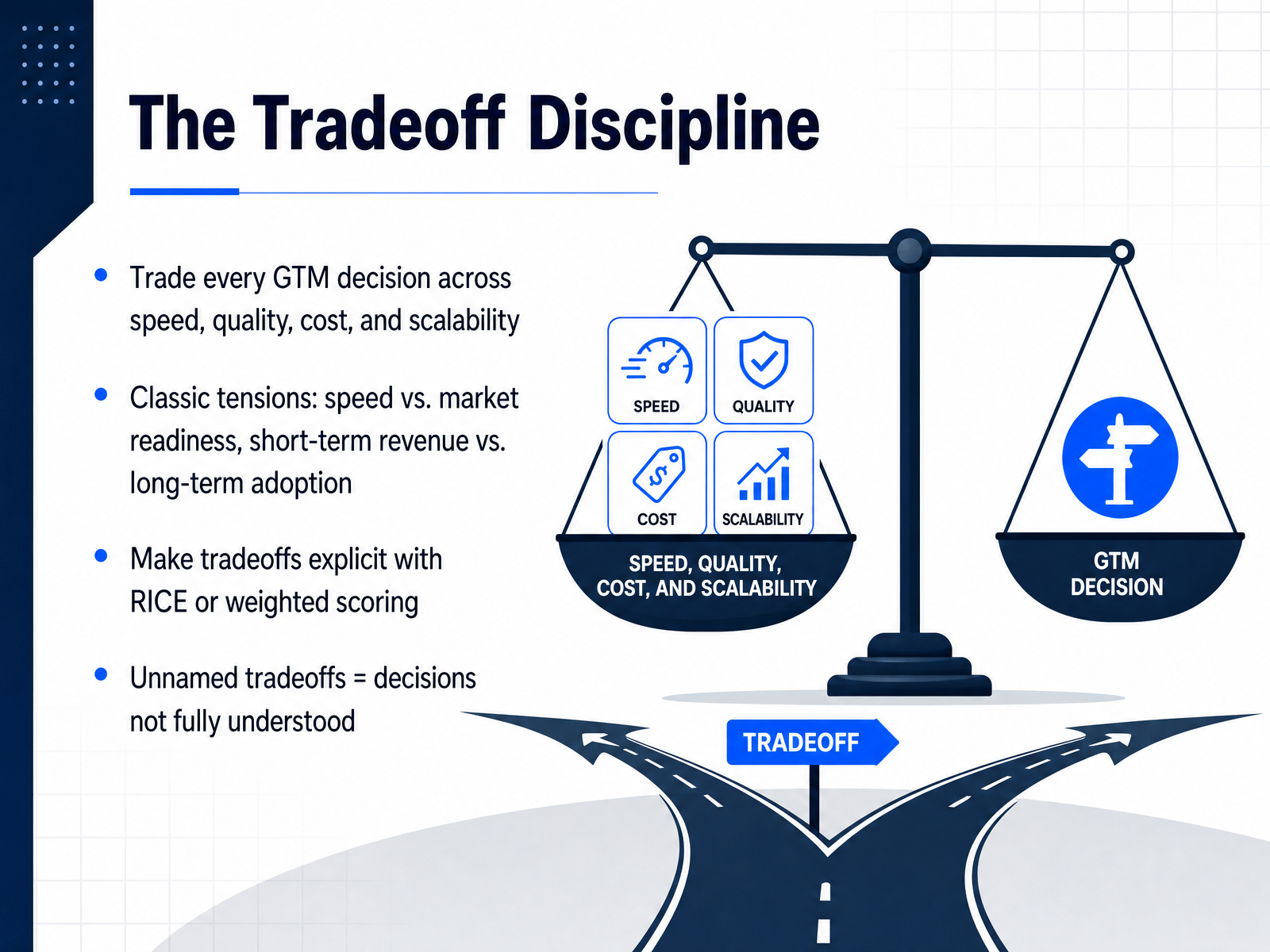
 - 06The Tradeoff DisciplineLet’s get into the discipline of tradeoffs, because this is where strategy gets real. Every go-to-market decision is a bet across four dimensions: speed, quality, cost, and scalability. You can’t win all four at once. The classic tension? Speed versus market readiness. Another one? Short-term revenue versus long-term adoption. Think about it. You can rush a launch to capture a category window, but you might ship with gaps that burn trust. Or you chase quarterly revenue with aggressive discounting, and you train buyers to never pay full price. The fix is making these tradeoffs explicit. Use a framework like RICE or a simple weighted scoring model. Score each option against your strategic priorities, and you’ll see the real cost of each choice. Here’s the hard rule: an unnamed tradeoff is a decision you don’t fully understand. If you can’t articulate what you’re giving up, you haven’t thought it through. So, in your next planning session, force the conversation. Ask what you are deprioritizing to make this work. Now, let’s look at how to track whether the tradeoffs you chose are actually paying off, with metrics that predict GTM health.
 gauravbisen.comomnius.somedium.com+22 min
 - 07Metrics That Predict GTM HealthNow let's shift from motion design to the metrics that predict go-to-market health. Revenue is a lagging indicator—by the time you see it dip, the root cause is months old. So lead with the leading indicators: activation rate, time-to-value, and product-qualified lead volume. If you're product-led, benchmark activation between twenty-five and forty percent; sales-led motions typically run higher because users arrive pre-qualified. Track time-to-activation as a distribution, not an average. Users who reach value in the first three days retain dramatically better than those who take two weeks. Early value compounds into habit. Finally, define your kill and swivel thresholds before you launch. Decide in advance which metrics, at what levels, will tell you to double down, pivot the motion, or shut it down. This removes ego from the equation and lets data make the hard call. A healthy GTM dashboard answers three questions: Are users getting value fast? Are the right accounts showing intent? And do we have the discipline to act when the numbers turn? That discipline is what separates learning from wishful thinking. Now, let's look at why most GTM plans—even with perfect metrics—still fail in execution.
 amplitude.comgrowthengineer.aigetperspective.ai+21 min
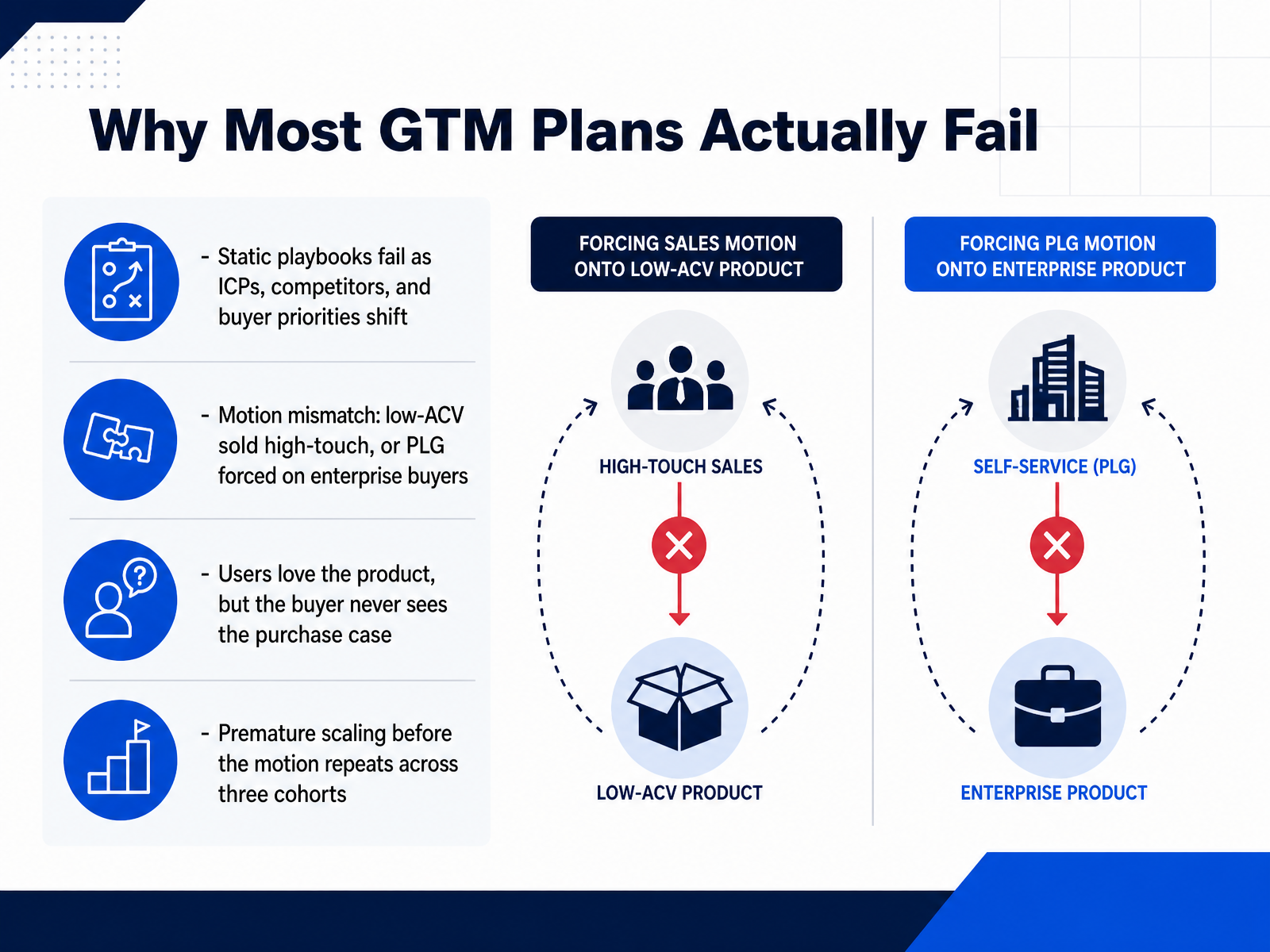
 - 08Why Most GTM Plans Actually FailLet’s be direct about why most go-to-market plans fail. It’s rarely the product. It’s the system around it. Static playbooks are a primary culprit. Your ICP shifts, competitors pivot, and buyer priorities change—usually within a quarter. A plan written once and executed by rote is a plan that’s already out of date. Then there’s motion mismatch. Running a high-touch sales motion on a low-ACV product, or forcing product-led growth on enterprise buyers, breaks the economics before you even start. The buyer experience feels wrong. Deals stall. The hardest failure to catch? Users love the product, but the buyer never sees the purchase case. Snyk spent four million dollars learning that distinction. Developers loved the tool; security teams never saw the governance features they needed to write the check. You have to build for the user and the buyer simultaneously. Finally, premature scaling. Adding headcount before the motion repeats across three consecutive cohorts multiplies the burn rate, not the revenue. The common thread here is execution on assumptions instead of intelligence. Let’s talk about avoiding those data and feedback traps next.
 gauravbisen.comomnius.somedium.com+22 min
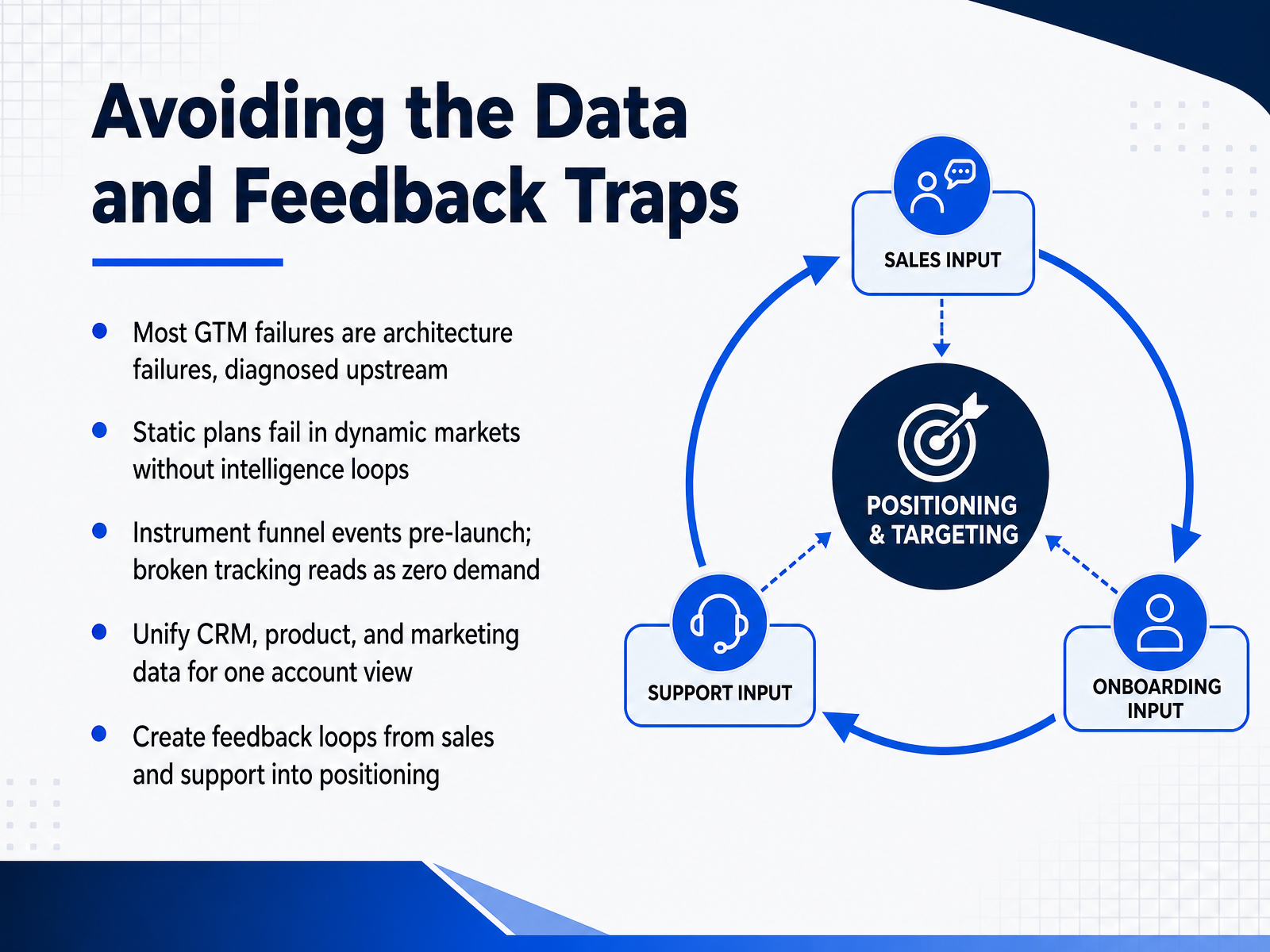
 - 09Avoiding the Data and Feedback TrapsLet’s move past optimistic plans and into the traps that derail execution. Most GTM failures aren’t execution failures—they’re architecture failures diagnosed upstream. The unvalidated ICP, the mismatched channel, the pricing signal sent too early. When the architecture is wrong, more sales effort only amplifies the burn.
Static plans fail in dynamic markets. So build intelligence loops before launch. Instrument funnel events pre-launch. Broken tracking reads as zero demand, and teams kill losing initiatives based on bad data. If your goals don’t fire, you’ll spend a quarter chasing ghosts.
Unify your CRM, product, and marketing data into one account view. When sales sees intent signals and marketing sees engagement in the same place, you stop fighting over lead definitions.
And close the loop. Create structured feedback from sales and support into positioning. New objections and lost deals are intelligence—they should update your battlecards monthly, not vanish in Slack threads.
Remember: static plans and broken instruments turn real demand into dead pipeline. Next, let’s look at the pitfalls in launch economics.
 amplitude.comgrowthengineer.aigetperspective.ai+22 min
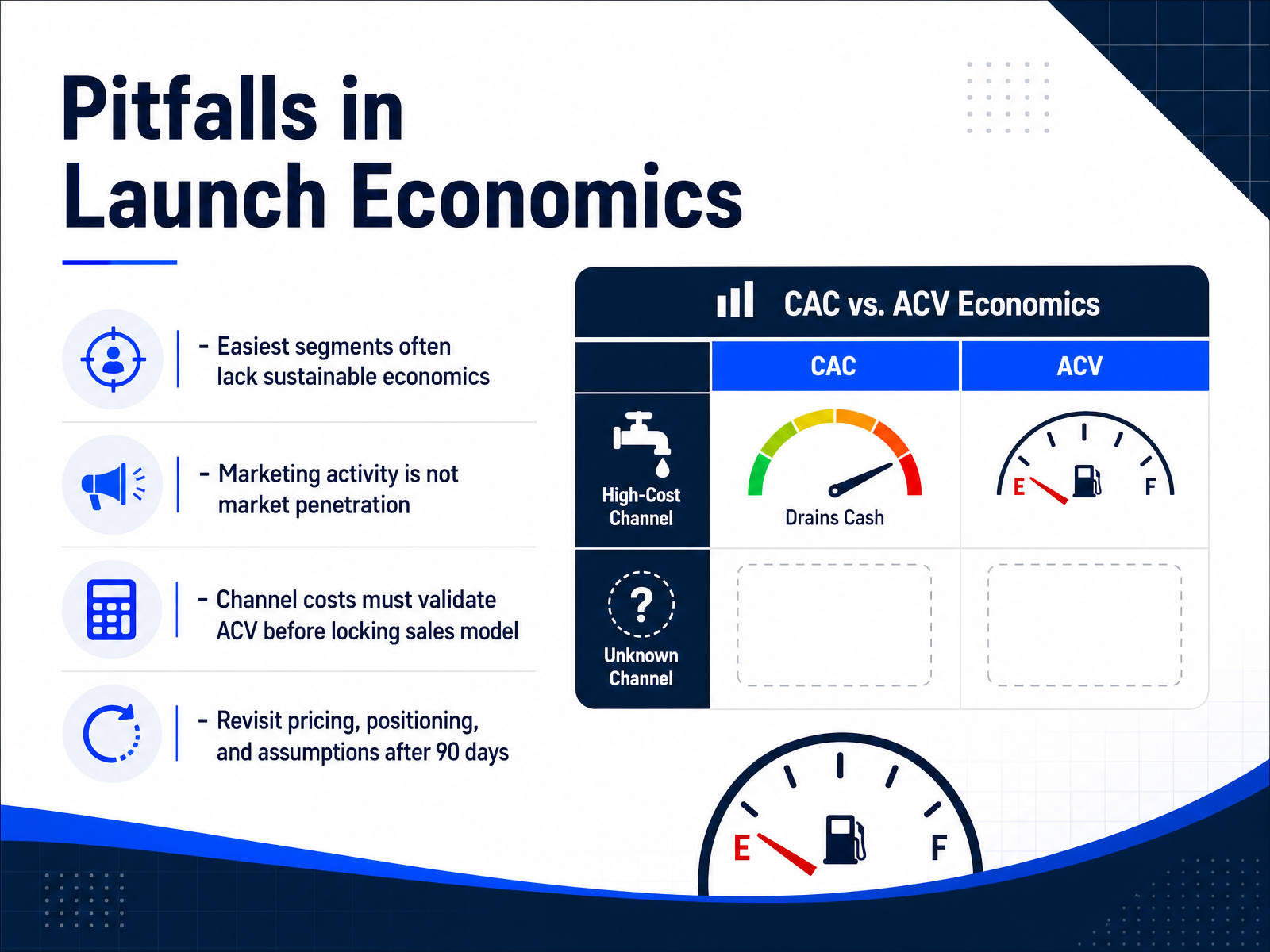
 - 10Pitfalls in Launch EconomicsLet's talk about the pitfalls in launch economics, because this is where great strategies go to die. First, the easiest segments to reach are often the ones with the weakest sustainable economics. They might convert quickly, but if their churn is high or their lifetime value is low, you've built a treadmill, not a business. Second, remember that marketing activity is not market penetration. Running ads and generating clicks creates noise. Penetration means your product is embedded in the buyer's workflow. If you stop spending, does the growth stop? That's the test. Third, validate channel costs against your annual contract value before you lock in a sales model. If your ACV is eight thousand dollars, you cannot afford a two-stage sales motion with a high-touch demo. The cost of acquisition will quietly destroy your margins. And finally, treat your launch as a hypothesis. Revisit your pricing, your positioning, and the assumptions in your business case within ninety days. Not a year. Not when quarterly results miss. Ninety days gives you time to correct course while you still have capital and credibility. Keep these guardrails in mind as we look at some real-world examples of good and bad tradeoffs in the case studies ahead.
 gauravbisen.comomnius.somedium.com+22 min
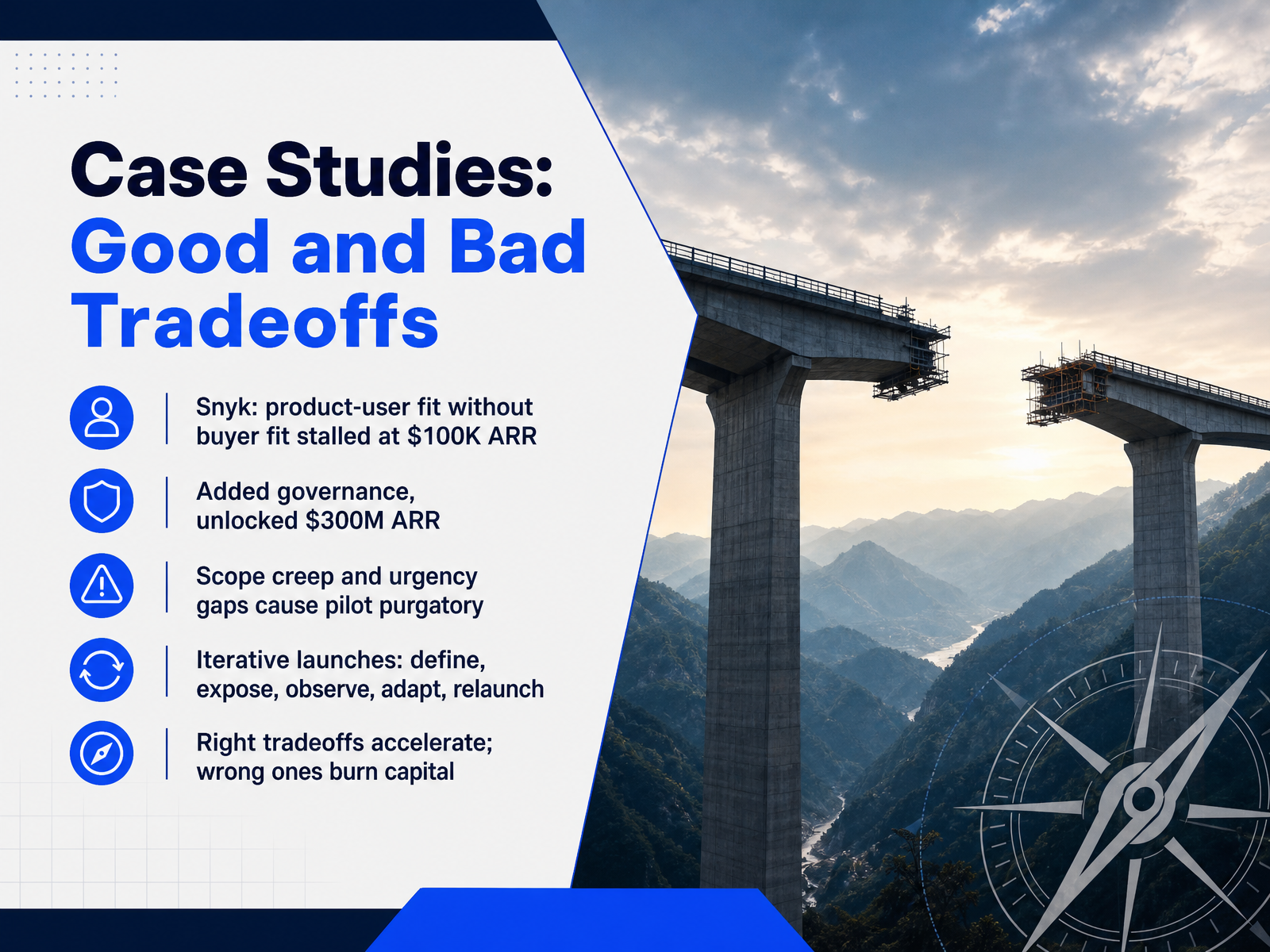
 - 11Case Studies: Good and Bad TradeoffsLet’s ground this in real tradeoffs. Snyk is the cautionary tale. Two years in, they had thousands of developers who loved the product, but only one hundred thousand in annual recurring revenue. They had product-user fit, but not product-buyer fit. Developers don’t write checks for security governance. So they added the reporting, compliance, and multi-stack support that security leaders needed. That single tradeoff unlocked three hundred million in ARR. Now, the other failure mode: scope creep and urgency gaps. That’s how you land in pilot purgatory, like that database gateway startup. Big logos, high hopes, but nobody ranked them in their top five priorities. The antidote is iterative launching. Define your beachhead, expose it, observe behavior, adapt, and relaunch. Snyk had to relaunch with a new buyer in mind. The right tradeoffs accelerate. The wrong ones burn capital and stakeholder trust.
 gauravbisen.comomnius.somedium.com+22 min
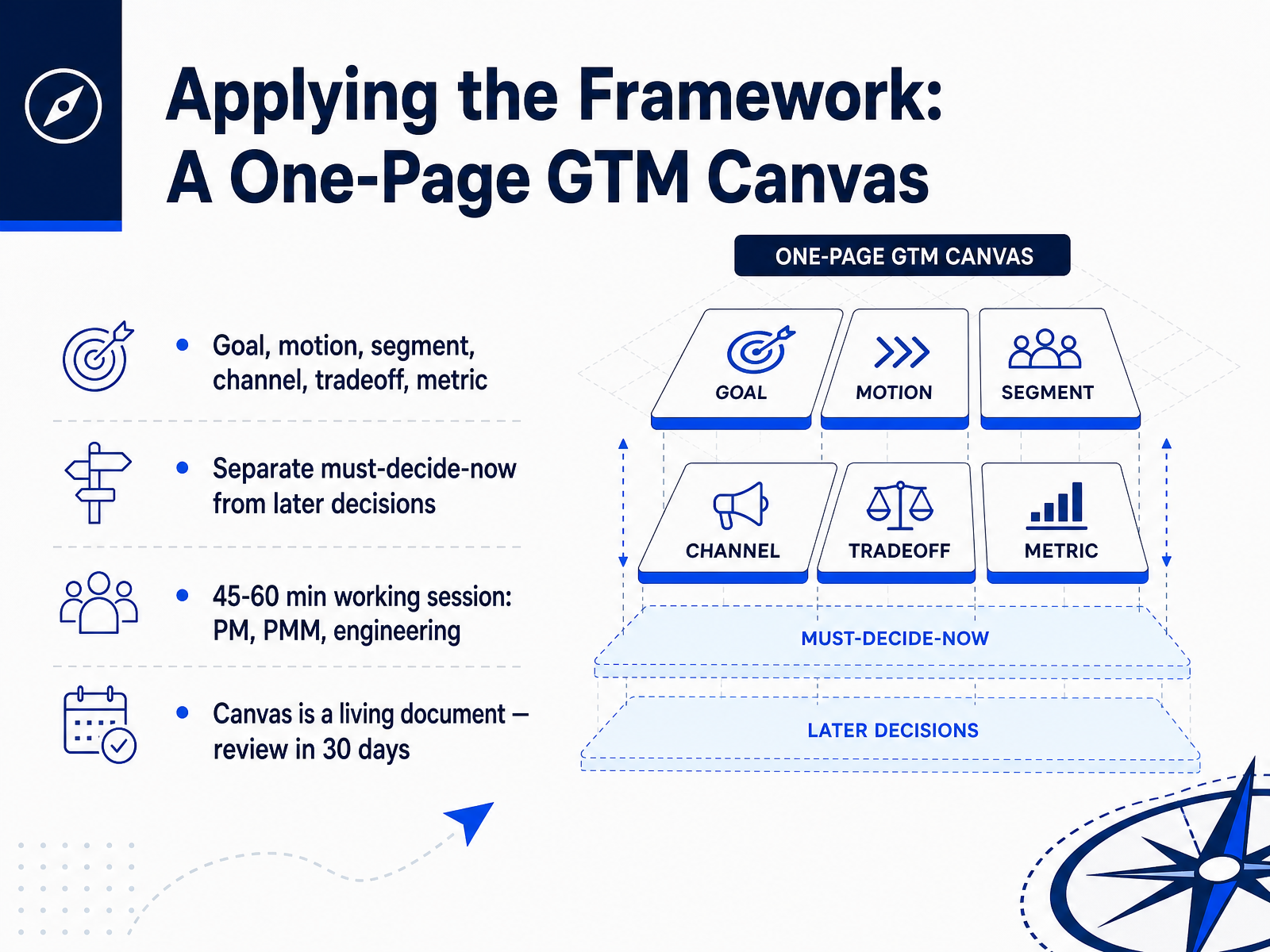
 - 12Applying the Framework: A One-Page GTM CanvasNow let’s turn all of this into something you can actually use. Here is a one-page GTM canvas built around six slots: goal, motion, segment, channel, tradeoff, and metric. The discipline is to separate what must be decided now from what can wait until you have real customer data. Don’t let perfect be the enemy of actionable. Block forty-five to sixty minutes for a working session with product management, product marketing, and engineering. That cross-functional trio is what makes the canvas stick. Each of you brings a different lens on the same set of tradeoffs. The output is not a static artifact. Treat it as a living document. Schedule a thirty-day review where you revisit each slot against what you have learned. That cadence is what turns strategy from a deck into a decision loop. From canvas to operating cadence, next.
 pulserevops.comdigitalapplied.comgrowthengineer.ai+21 min
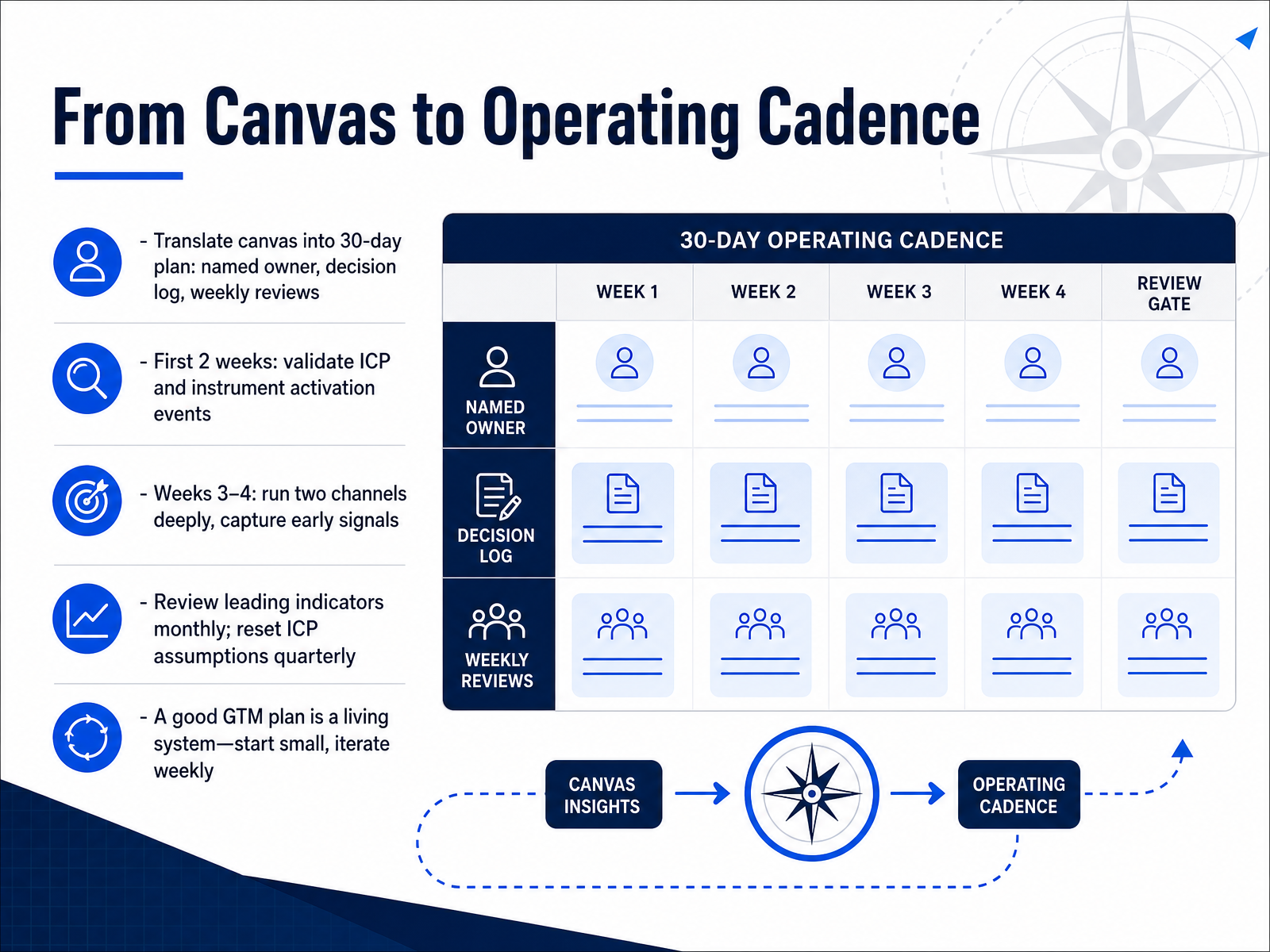
 - 13From Canvas to Operating CadenceNow let's turn your canvas into an operating cadence. A great GTM plan is a living system—start small and iterate weekly. Translate your canvas into a thirty-day plan with a named owner, a decision log, and weekly reviews. In the first two weeks, validate your ICP and instrument your activation events. Weeks three and four—run just two channels deeply and capture early signals. Review your leading indicators monthly, and reset your ICP assumptions quarterly. Remember, firms operating on a slower cadence lose share to faster ones. So make the feedback loop tight. Next, we'll walk through the concrete next steps for your plan.
 jaglan.substack.comnmsconsulting.comthe-founders-corner.com+21 min
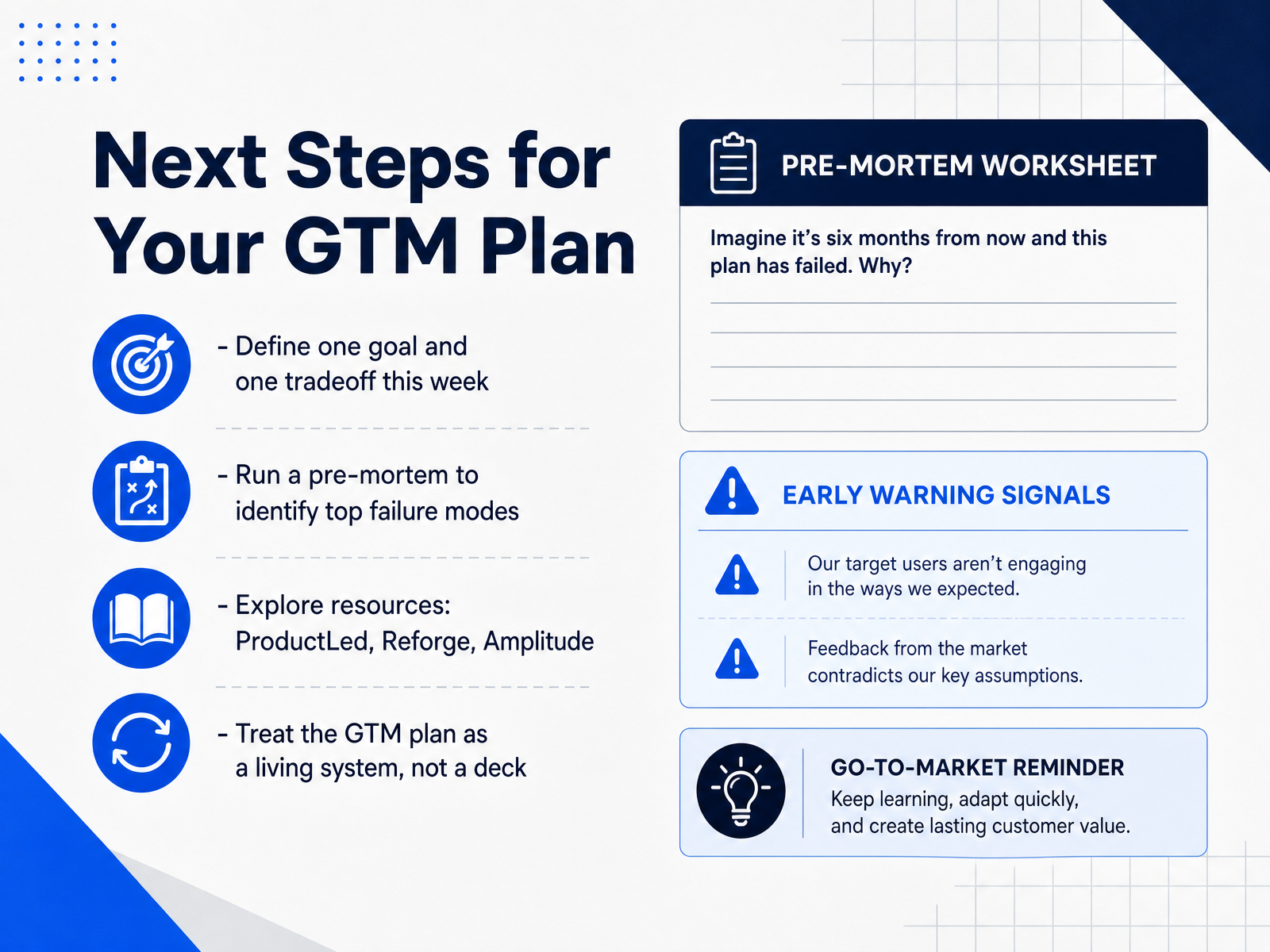
 - 14Next Steps for Your GTM PlanAs we wrap up, I want you to leave with action, not just frameworks. This week, define the one goal your plan has to hit, and the one tradeoff you're willing to make to get there. Then, gather the team and run a pre-mortem. Assume the launch failed in six months, and work backward to identify the top failure modes. That exercise alone will surface gaps you can fix before they become problems. To keep growing, explore the resources practitioners swear by: ProductLed for product-led motion benchmarks, Reforge for deep dives on segmentation and pricing, and Amplitude for activation data that will anchor your decisions. Most importantly, treat this plan as a living system. The teams that win are not the ones with the most elegant decks; they are the ones with the fastest, most honest iteration loops. Review your metrics weekly, challenge your ICP quarterly, and never let the document become a monument. This is your blueprint for winning. Now go make the deliberate choices that turn your product bet into market results.
 amplitude.comgrowthengineer.aigetperspective.ai+22 min
Take the deck with you
Download this course as a file — free, no sign-up needed.
- PDF handoutEvery slide page, ready to print or share.15 pages · 3.4 MBDownload
- Narrated PowerPointThe deck that presents itself — every slide carries the digital human's narration video.15 pages · 16.1 MBDownload
- PowerPoint slidesThe full deck as a .pptx — open it in PowerPoint, Keynote, or Google Slides.15 pages · 3.3 MBDownload
Free to use in your own training — please keep the PersonWise credit page at the end.
Have your own deck? Turn it into a course
Sources consulted
Web sources consulted while building this course.
- PLG vs. SLG: Choosing a GTM Motion | Pulse RevOps — pulserevops.com
- PLG vs Sales-Led GTM: 2026 Motion Decision Framework — digitalapplied.com
- PLG vs Sales-Led vs Hybrid Growth: A Decision Framework, Not a Religion — Growth Engineer — growthengineer.ai
- The Sales-Led vs Product-Led GTM Debate—Which One Wins in 2025? - REM Digital — remdigital.org
- David Sacks on PLG vs Sales-Led: A Hybrid GTM Framework for B2B SaaS in 2025 | Capitaly — capitaly.vc
- 2025 Beachhead GTM Playbook (4 Steps + AI Prompt) — jaglan.substack.com
- Market Entry Strategy for Startups: Wedge, Beachhead and Scale — nmsconsulting.com
- The Go To Market Sequencing Playbook Every Founder Needs — the-founders-corner.com
- The Beachhead Strategy Playbook - by Rick Koleta — gtmvault.co
- Product Launch Strategy (2026): Framework, Timeline, Checklist & Examples — firsto.co
- Emergent: $0 to $20M ARR via Influencer-First GTM | Gaurav Singh Bisen — gauravbisen.com
- How Manus AI Hit $100M ARR in 9 Months [AI SaaS Case Study] — omnius.so
- How I Launched New Feature with 1/5 the Budget: An Influencer-Led GTM Case Study | by Lee Chang-Te | Medium — medium.com
- Enterprise Version Launched to Counter Corporate Bans - Nick Turley — lennysvault.com
- How Wistia Turned Strategy Into a Scalable Machine — databox.com
- Time to Value: The Key to Driving User Retention - Amplitude — amplitude.com
- SaaS Activation Rate Benchmarks 2026: Median, Top 10%, By Stage and ACV — Growth Engineer — growthengineer.ai
- The 2026 Customer Onboarding Benchmark Report: Activation Rates by Industry | Blog | Perspective AI — getperspective.ai
- Average Time to Value by SaaS Category: 2026 Benchmark Report | Artisan Strategies — artisangrowthstrategies.com
- The SaaS Go-To-Market Report - ChartMogul — chartmogul.com