Begin
15 pages · ~30 min
Customer Education Checklist Review
This checklist guides customer-facing teams through a step-by-step review of customer education best practices to ensure consistent, effective onboarding and training delivery.
A digital instructor presents all 15 pages. Hold “Ask” at any point and ask out loud — the answer comes from this course. No sign-up needed.
What you’ll learn
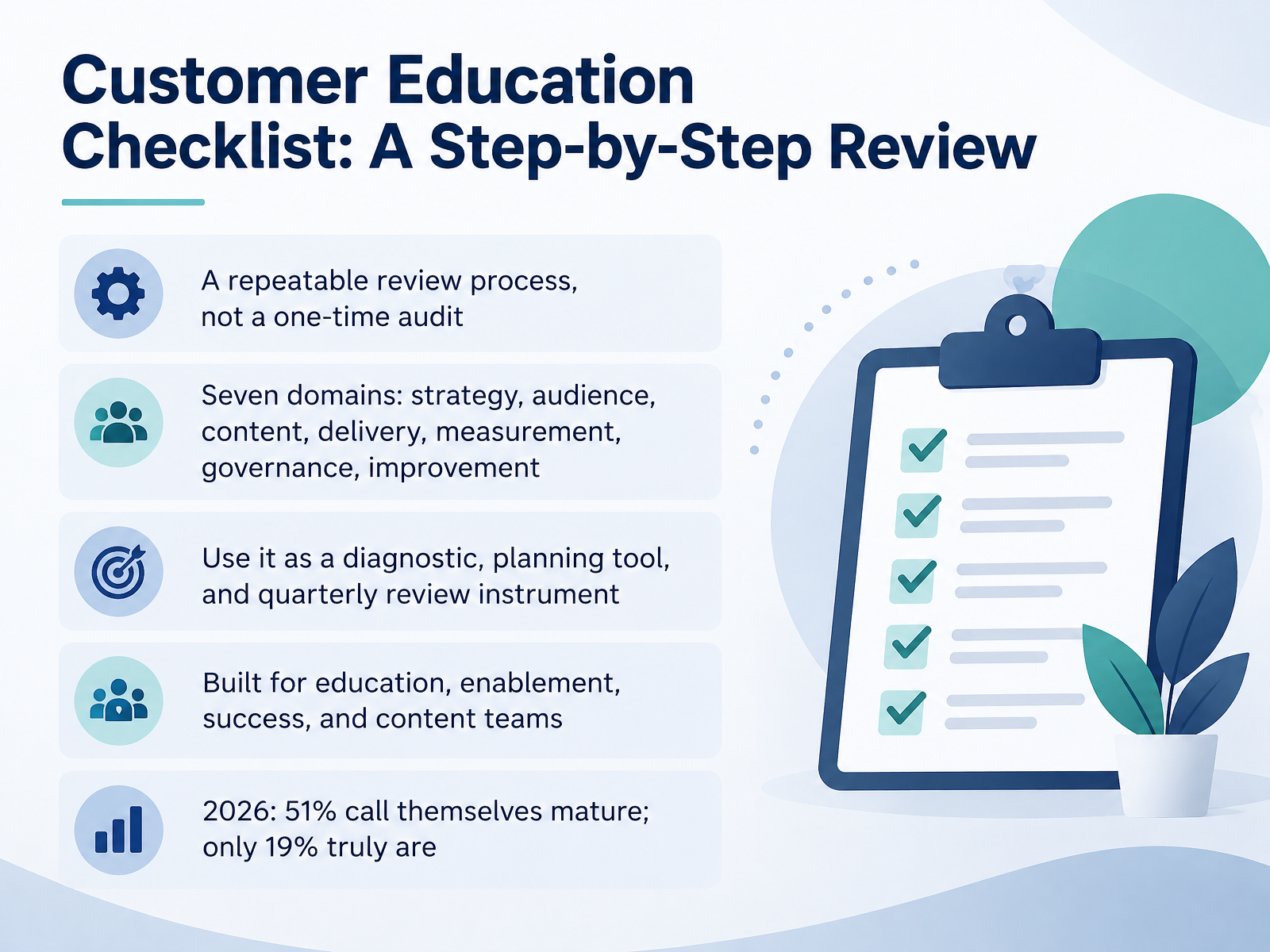
- 01Customer Education Checklist: A Step-by-Step ReviewWelcome. Over the next fifteen slides, we're going to walk through a customer education checklist you can actually use. This is a repeatable review process, not a one-time audit. It covers seven domains: strategy, audience, content, delivery, measurement, governance, and improvement. Use it as a diagnostic when something feels off. Use it as a planning tool at the start of a cycle. And use it as a quarterly review instrument to confirm you're still on track. It's built for education, enablement, success, and content teams, so each domain has an owner and a decision attached. One number to hold in mind as we go. In 2026, fifty-one percent of programs call themselves mature. Only nineteen percent truly are. That gap is exactly what a structured review closes. Next, we'll look at why a structured review matters.echtus.comtrytami.comtechsmith.com+21 min
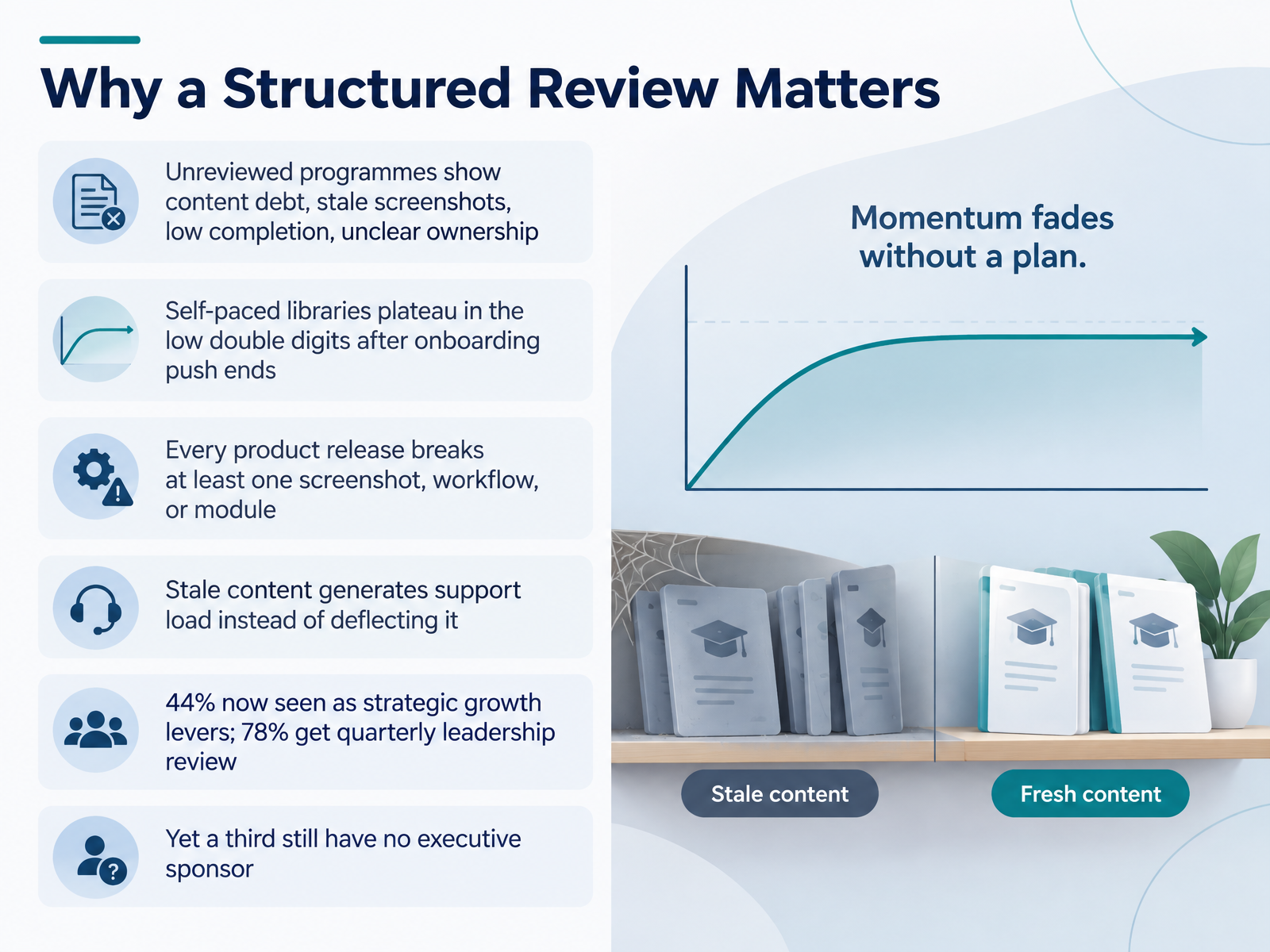
- 02Why a Structured Review MattersSo why does a structured review matter? Because unreviewed programs tend to show the same symptoms. Content debt. Stale screenshots. Low completion. Unclear ownership. And self-paced libraries often plateau in the low double digits once the initial onboarding push ends. There is also a maintenance reality to plan for. Every product release breaks at least one screenshot, one workflow, or one module. Stale content then generates support load instead of deflecting it. The strategic picture is mixed. Forty-four percent of programs are now seen as strategic growth levers, and seventy-eight percent get leadership review at least quarterly. Yet a third still have no executive sponsor. So treat this review as your checkpoint. Let us start by aligning on definitions. Next, definitions of education, enablement, training, and support.
 mailer.learningnews.comdisco.codisco.co+21 min
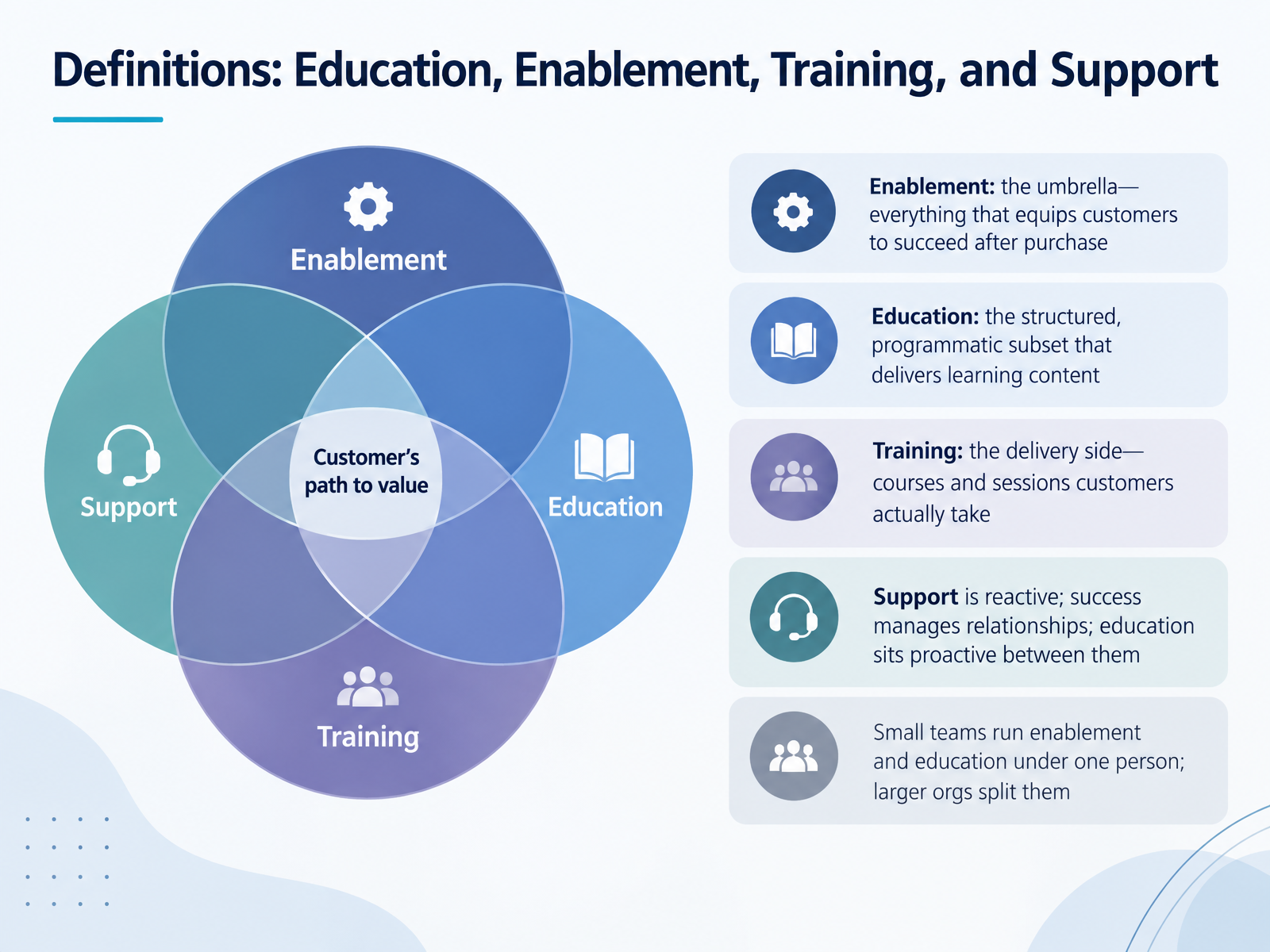
 - 03Definitions: Education, Enablement, Training, and SupportLet us align on four terms before we review anything else, because they shape who owns what. Enablement is the umbrella. It covers everything that equips customers to succeed after purchase. Education is the structured, programmatic subset that delivers learning content. Training is the delivery side, the courses and sessions customers actually take. Support is reactive, and success manages relationships, while education sits proactive between them. On ownership: small teams often run enablement and education under one person. Larger organizations split them. So as you review your own programme, ask one checkbox question: for each of these four terms, who is the named owner? If the answer is everyone, it is really no one. Next, we will start with scope, audience, and programme goals.
 docsio.cotrainn.colitmos.com+21 min
 - 04Start With Scope, Audience, and Programme GoalsLet's begin with scope, audience, and programme goals.
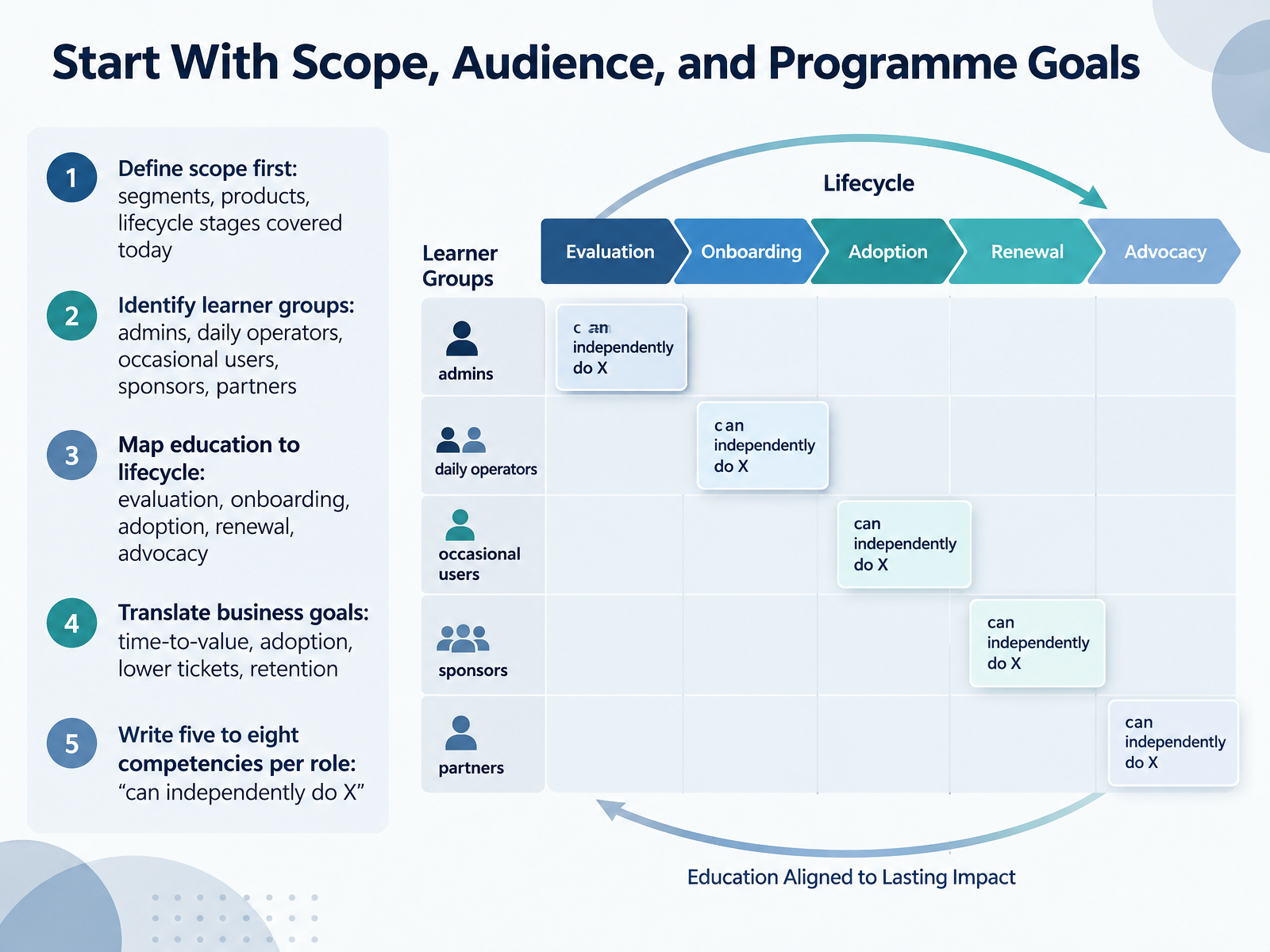
First, define scope. Which segments, products, and lifecycle stages are covered today? Write them down before anything else.
Next, name your learner groups. Admins, daily operators, occasional users, sponsors, and partners. They need different things.
Then map education to the lifecycle: evaluation, onboarding, adoption, renewal, and advocacy. Each stage has a different competence goal.
Translate business goals into numbers: time-to-value, adoption, lower tickets, retention. Pick one or two.
Finally, write five to eight competencies per role, phrased as "can independently do X." For example, "can build and schedule a filtered report." These become your curriculum and your test for whether content is needed at all.
Review the Goal-to-Metric Link Before Content.
 trainn.cotechsmith.comaicoursify.com+21 min
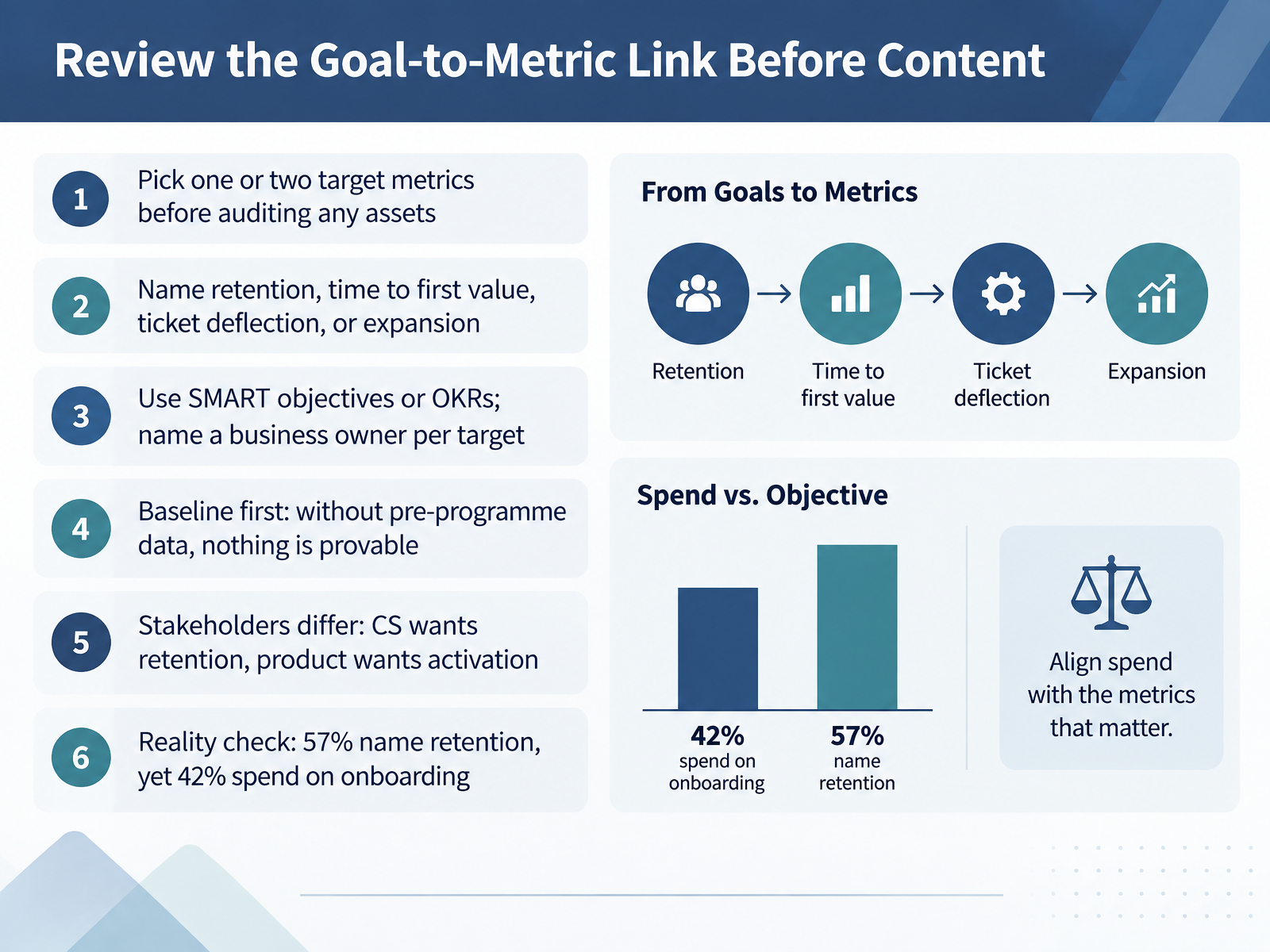
 - 05Review the Goal-to-Metric Link Before ContentBefore we look at content, we lock down the goal-to-metric link. Pick one or two target metrics before you audit a single asset. Name them plainly: retention, time to first value, ticket deflection, or expansion. Then write them as SMART objectives or OKRs, and assign a business owner to each target. Baseline first. Without pre-programme data, nothing is provable. Expect stakeholder differences too. Customer Success usually wants retention. Product usually wants activation. Both are right, and both need their own number. Here is the reality check. Fifty-seven percent of programmes name retention as their top objective, yet forty-two percent concentrate their spend on onboarding. That gap is the audit finding. So before content, confirm the metric, the owner, and the baseline. Next, we inventory what you already have in Content Inventory: Build the Single Source of Truth.
 trainn.cotechsmith.comaicoursify.com+21 min
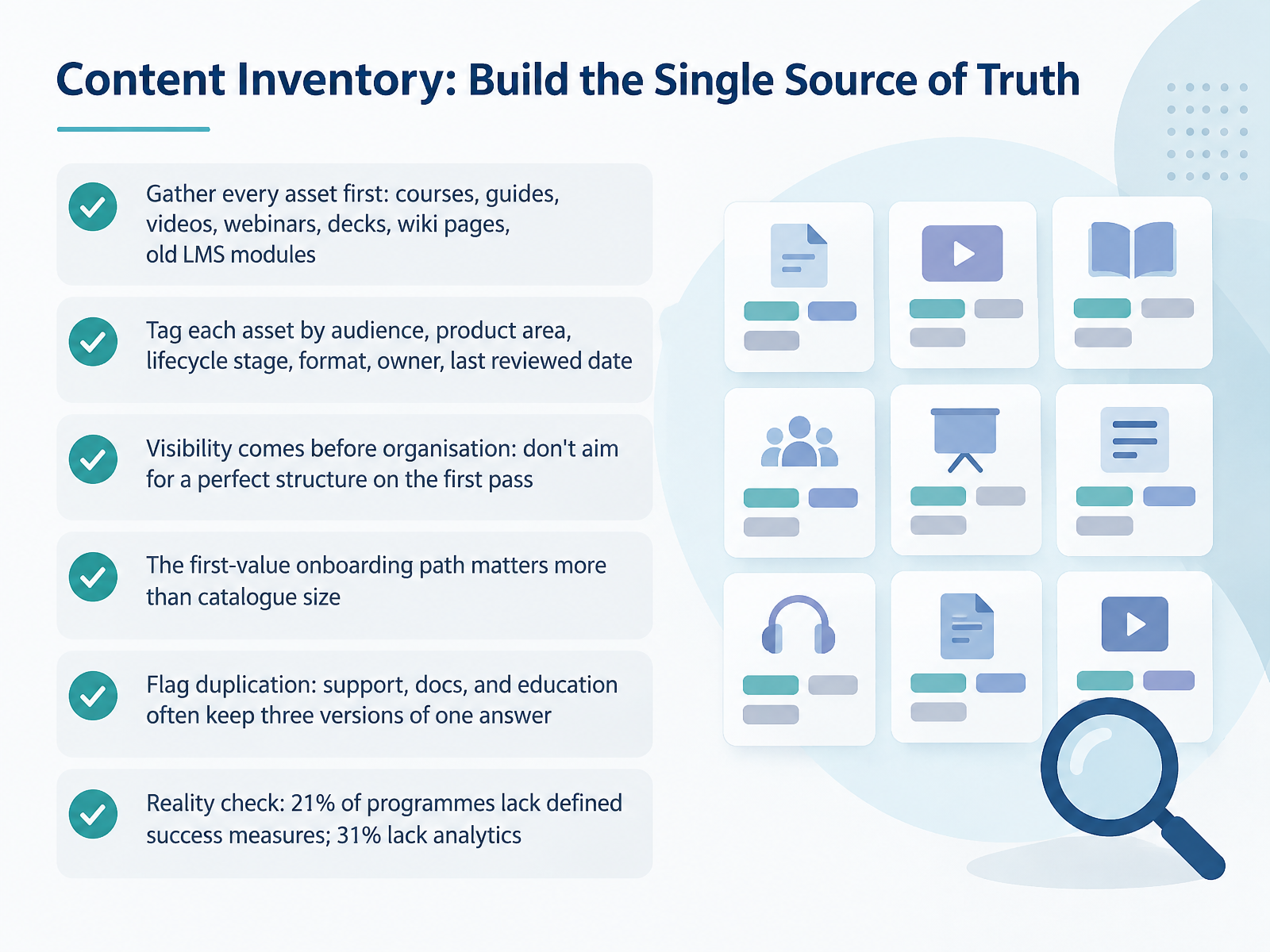
 - 06Content Inventory: Build the Single Source of TruthLet's move on to the content inventory. The goal here is a single source of truth, not a perfect catalogue. Start by gathering every asset you own. Courses, guides, videos, webinars, slide decks, wiki pages, and those old LMS modules nobody has opened in two years. Get them all into one place first. Visibility comes before organisation, so resist the urge to build a clean structure on your first pass. Next, tag each asset with six fields. Audience, product area, lifecycle stage, format, owner, and last reviewed date. That owner field and review date are what make this maintainable later. As you tag, flag duplication. Support, docs, and education often keep three versions of the same answer. And keep perspective: your first-value onboarding path matters far more than catalogue size. One reality check before you close this out. Twenty-one percent of programmes have no defined success measures, and thirty-one percent lack analytics capability. If your inventory uncovers the same gaps, log them now. That brings us to content quality, where we score accuracy, clarity, and instructional soundness.
 learning.iorad.comlearningowl.inaurionlearning.com+22 min
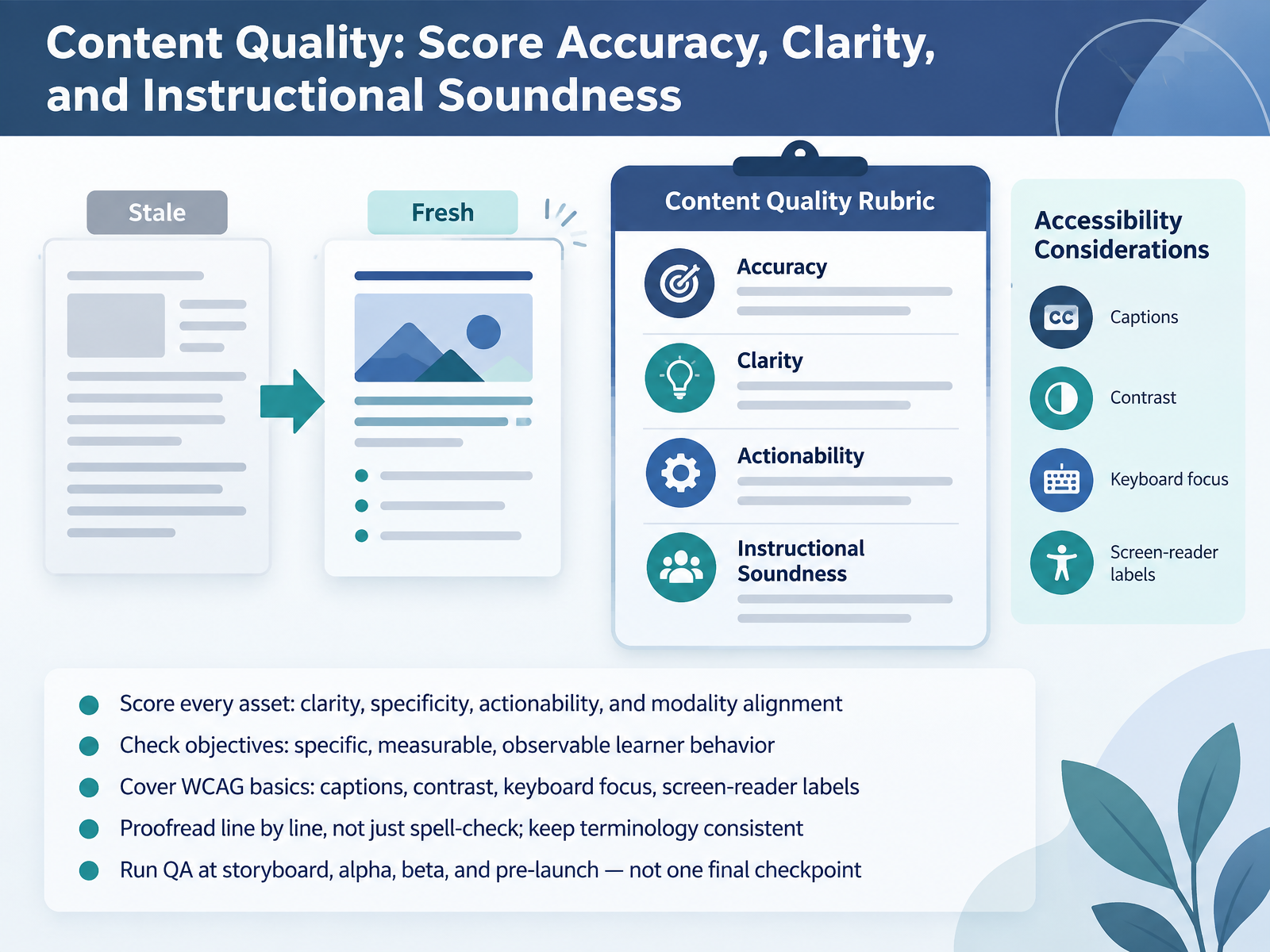
 - 07Content Quality: Score Accuracy, Clarity, and Instructional SoundnessLet us turn to content quality, and how to score it accurately. Start every asset with four scores: clarity, specificity, actionability, and modality alignment. For clarity, check whether your asset explains why a workflow matters, who it is for, and what the learner should take away. Next, review your objectives. Each one should describe specific, measurable, observable learner behavior. If you cannot observe it, you cannot assess it. Then confirm accessibility basics: captions, color contrast, visible keyboard focus, and screen reader labels. Do not leave these for launch week. For text quality, proofread line by line. Spell check will miss correctly spelled words used in the wrong context, so a human review is still required. Keep terminology consistent, and work from a glossary or style guide. Finally, run quality assurance at four stages: storyboard, alpha, beta, and pre launch. A single final checkpoint will not catch what earlier reviews are designed to find. Score each asset, fix the weakest dimension first, and document who signs off. Next, we will sort assets into four buckets: keep, patch, convert, or retire.
 learning.iorad.comlearningowl.inaurionlearning.com+12 min
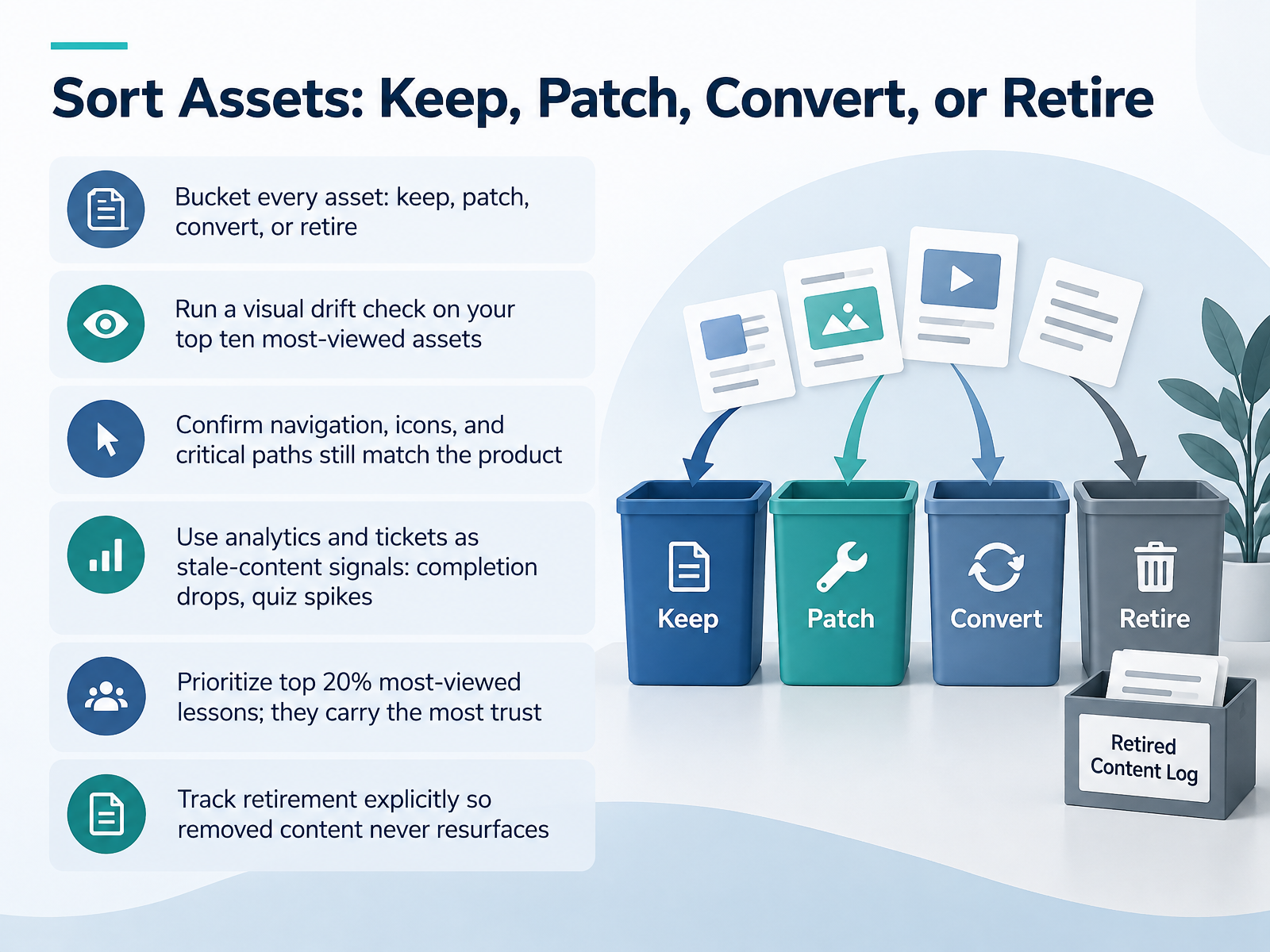
 - 08Sort Assets: Keep, Patch, Convert, or RetireLet's move on to sorting your assets. Start by placing every asset into one of four buckets: keep, patch, convert, or retire. Then run a visual drift check on your top ten most-viewed assets. Open the live product beside the tutorial, and confirm that navigation, icons, and critical paths still match. Next, use analytics and support tickets as stale-content signals. Watch for completion drops and quiz spikes. Prioritize your top twenty percent most-viewed lessons, because they carry the most learner trust. And track retirement explicitly, so removed content never resurfaces later. This gives you a clear, defensible decision for every asset. From there, we look at delivery channels and the learner experience.
 learning.iorad.comlearningowl.inaurionlearning.com+21 min
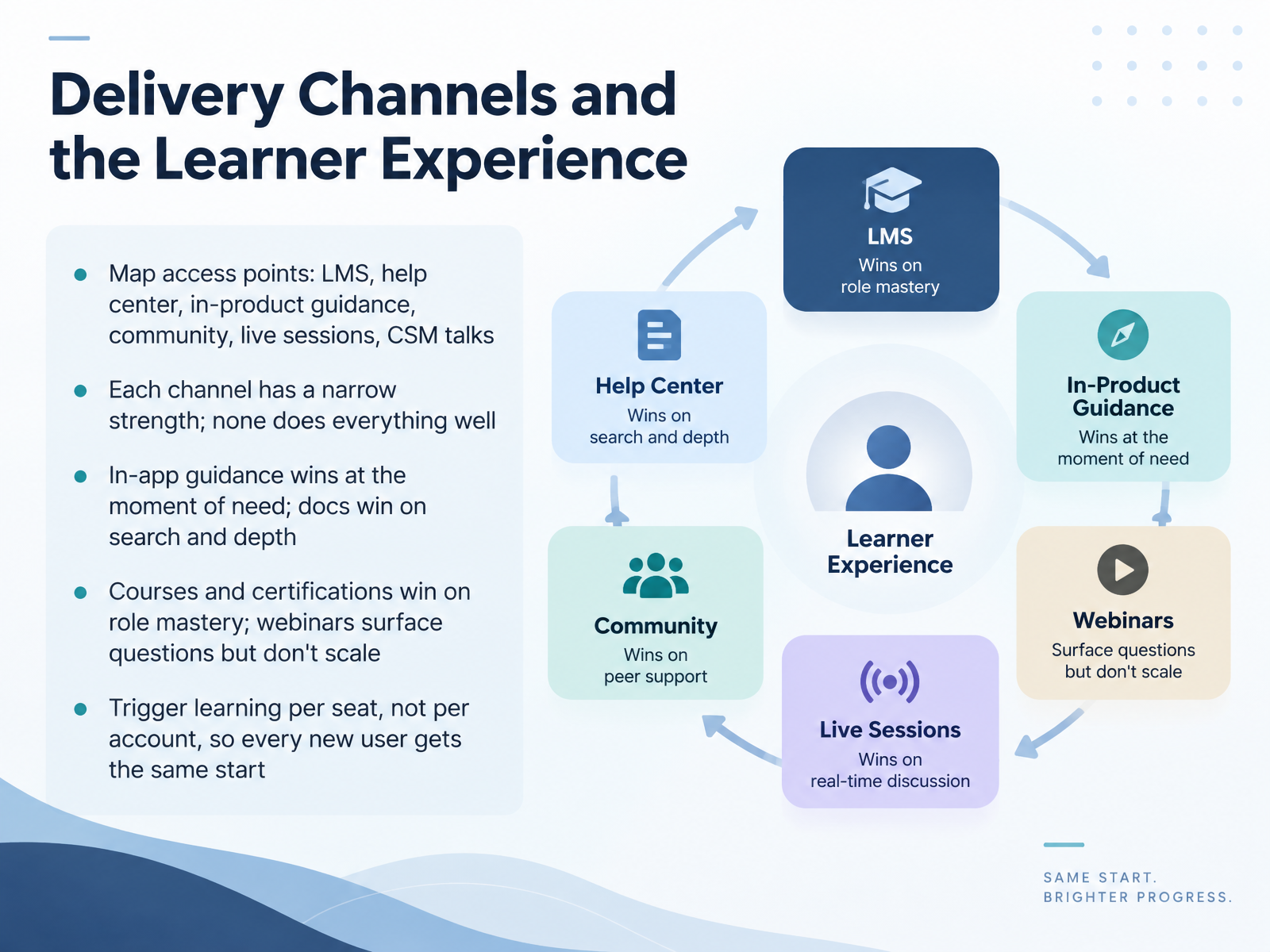
 - 09Delivery Channels and the Learner ExperienceLet's move to delivery channels and the learner experience. Start by mapping every access point your customers actually touch: the learning management system, the help center, in-product guidance, community, live sessions, and conversations with customer success managers.
Here is the review criterion. Each channel has a narrow strength. None of them does everything well. In-app guidance wins at the moment of need, because it reaches users who would never stop working to go and study. Documentation wins on search and depth, which makes it right for reference, edge cases, and troubleshooting. Courses and certifications win on role mastery. Webinars surface questions you did not anticipate, but they do not scale.
So when you audit, ask one question per competency: is this being taught in the channel that is actually good at it? A first-time setup task taught through a written page fails quietly. You get traffic on the page and low completion on the task.
One more checkpoint, and it is the highest-leverage one. Trigger learning per seat, not per account. When someone leaves and a replacement joins six months later, that new user should get the same first-time experience as the original cohort, instead of inheriting whatever workarounds their predecessor left behind.
Next, we look at accessibility, localization, and the busy-professional learner.
 trainn.codocsio.coaicoursify.com+22 min
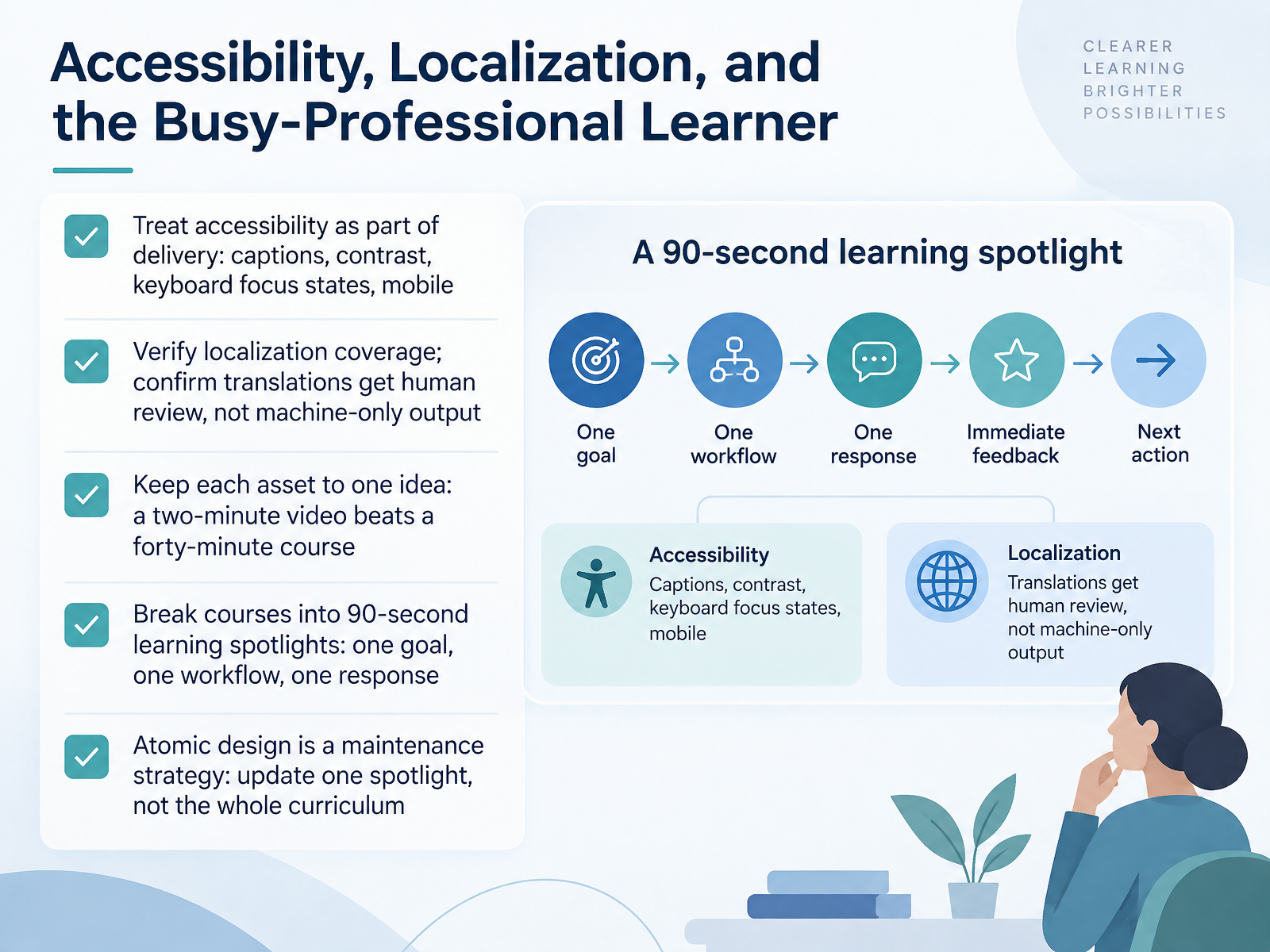
 - 10Accessibility, Localization, and the Busy-Professional LearnerLet's review three delivery checks: accessibility, localization, and the busy professional learner. First, treat accessibility as part of delivery, not a separate project. Confirm captions are accurate, color contrast meets standards, keyboard focus states are clearly visible, and everything works on mobile. Second, verify localization coverage. Check that translations receive human review, not machine-only output, and that terminology stays consistent across languages. Third, design for time. Keep each asset to one idea. A focused two-minute video beats a forty-minute course people abandon by minute six. Break courses into ninety-second learning spotlights: one goal, one workflow, one response. This is atomic design, and it's a maintenance strategy. When the product changes, you update one spotlight, not the whole curriculum. So when you review your library, confirm accessible delivery, confirmed human-reviewed localization, and short, single-idea assets you can update independently. That keeps education usable and maintainable. Measurement: Climb the Ladder From Activity to Business Outcome.
 learning.iorad.comlearningowl.inaurionlearning.com+22 min
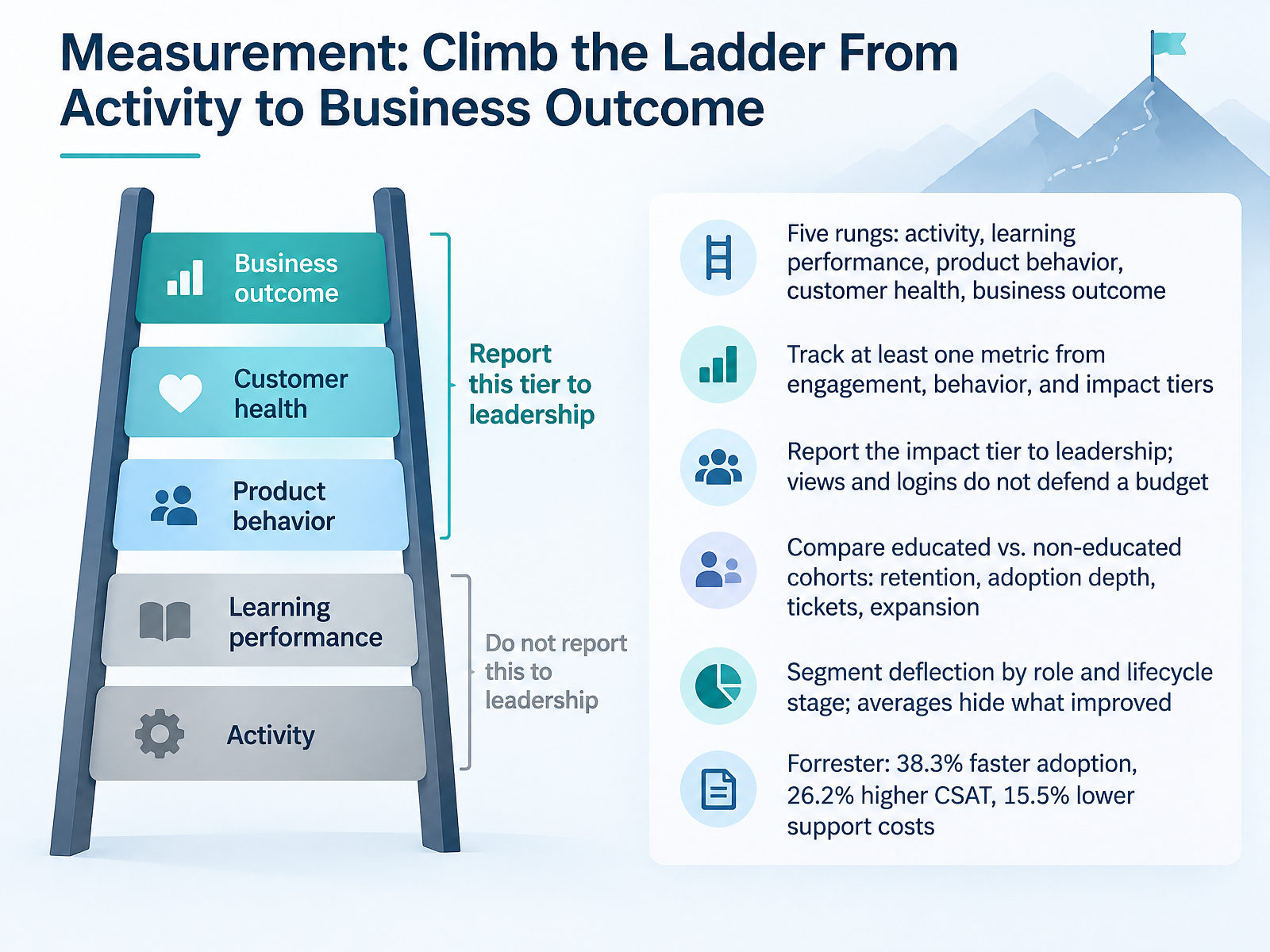
 - 11Measurement: Climb the Ladder From Activity to Business OutcomeNext, let us talk about measurement. Think of it as a ladder with five rungs. Activity. Learning performance. Product behavior. Customer health. And business outcome. Track at least one metric from the engagement, behavior, and impact tiers. That gives you a connected story, not a single number. When you report to leadership, lead with the impact tier. Views and logins do not defend a budget. Compare educated and non-educated cohorts on retention, adoption depth, tickets, and expansion. And segment deflection by role and lifecycle stage, because averages hide what actually improved. For benchmark context, Forrester found thirty eight point three percent faster adoption, twenty six point two percent higher customer satisfaction, and fifteen point five percent lower support costs. So pick your rungs, connect them, and report the outcome. That sets up our next topic. Instrument before you distribute.
 absorbai.comdocsio.coclueso.io+21 min
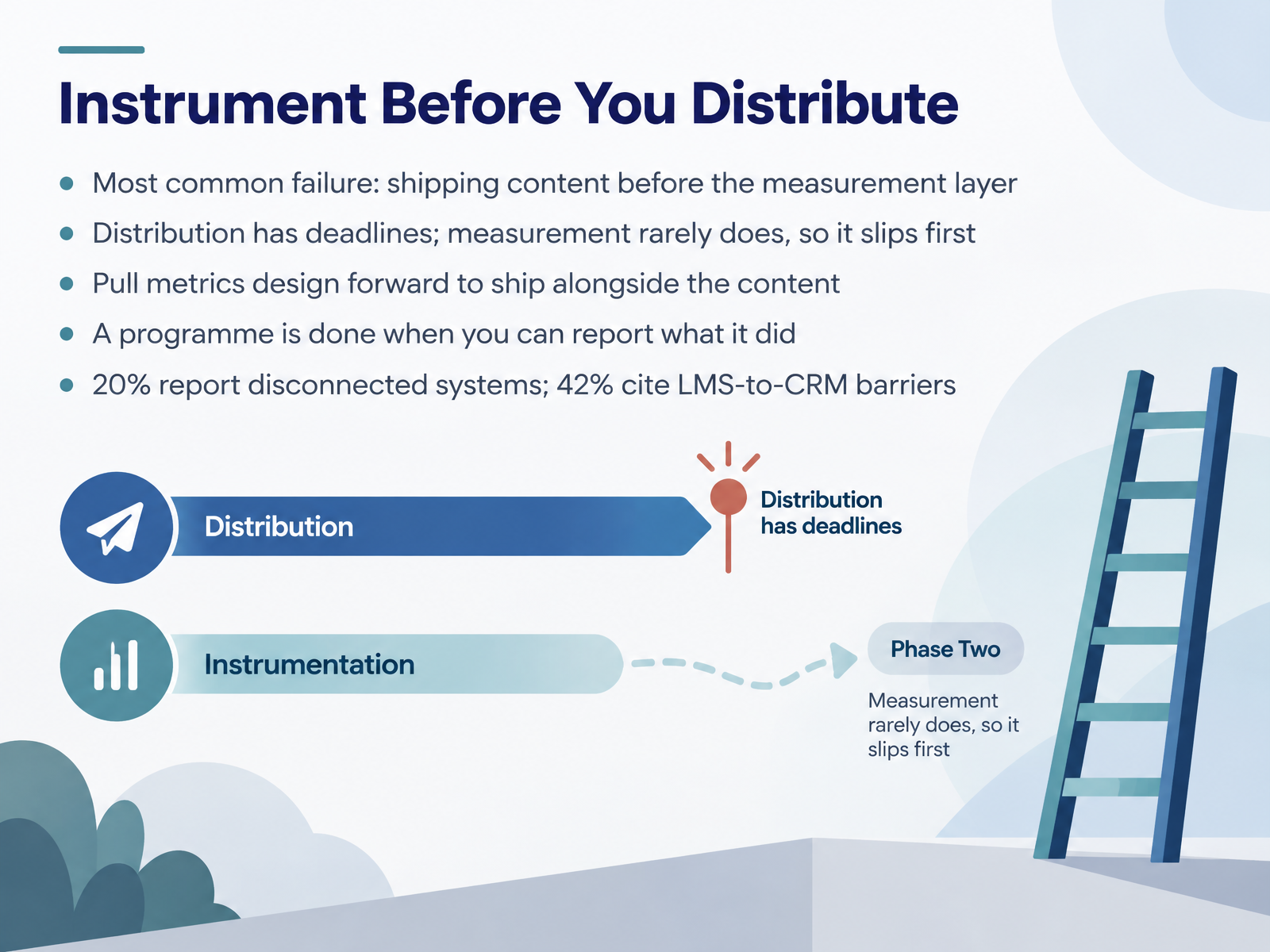
 - 12Instrument Before You DistributeNow, let's look at the most common failure in customer education: shipping content before the measurement layer is in place. Here's why it happens. Distribution has deadlines. Measurement rarely does, so it slips first. When timelines compress, the visible work wins the queue every time, and instrumentation becomes permanent technical debt. A program is done when you can report what it did, not when it goes live. So pull metrics design forward to ship alongside the content it is meant to measure. Bear in mind the scale of this problem. Twenty percent of organizations report disconnected systems, and forty-two percent cite LMS-to-CRM integration as a major barrier. Instrumentation is part of the launch definition, not a post-launch enhancement. Next, we will cover operations, ownership, and governance.
 absorbai.comtrainn.codocsio.co+21 min
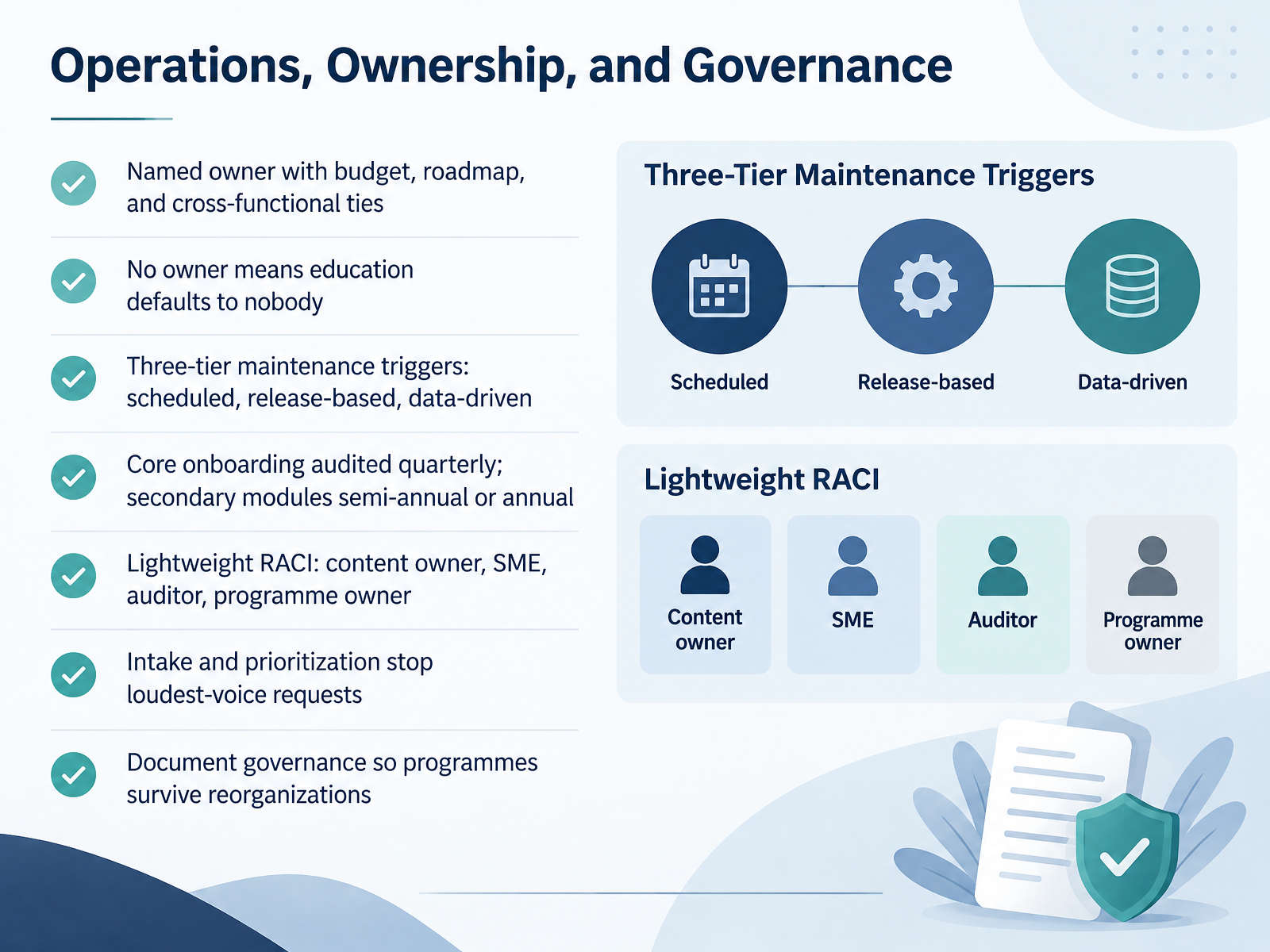
 - 13Operations, Ownership, and GovernanceNow let's look at operations, ownership, and governance.
This is a decision point, so start here. Every education programme needs a named owner with a budget, a roadmap, and cross-functional ties to product, support, and customer success. If no one owns it, education defaults to nobody. That is the most common failure mode, and it makes every other control on this checklist harder.
Next, agree on three maintenance triggers: scheduled reviews, release-based reviews, and data-driven reviews. Then set the audit cadence. Core onboarding content is audited quarterly. Secondary modules run semi-annual or annual.
Keep the roles light. A RACI that covers four parts is usually enough: content owner, subject matter expert, auditor, and programme owner.
Then put an intake and prioritization process in place, so the loudest voice in the room does not set your roadmap. Document all of this, so the programme survives reorganizations.
Quick takeaway. One named owner. Three triggers. One lightweight RACI. That is the governance backbone.
Next, we will run the review, step by step, in the workshop.
 trainn.cotrytami.comdocsio.co+22 min
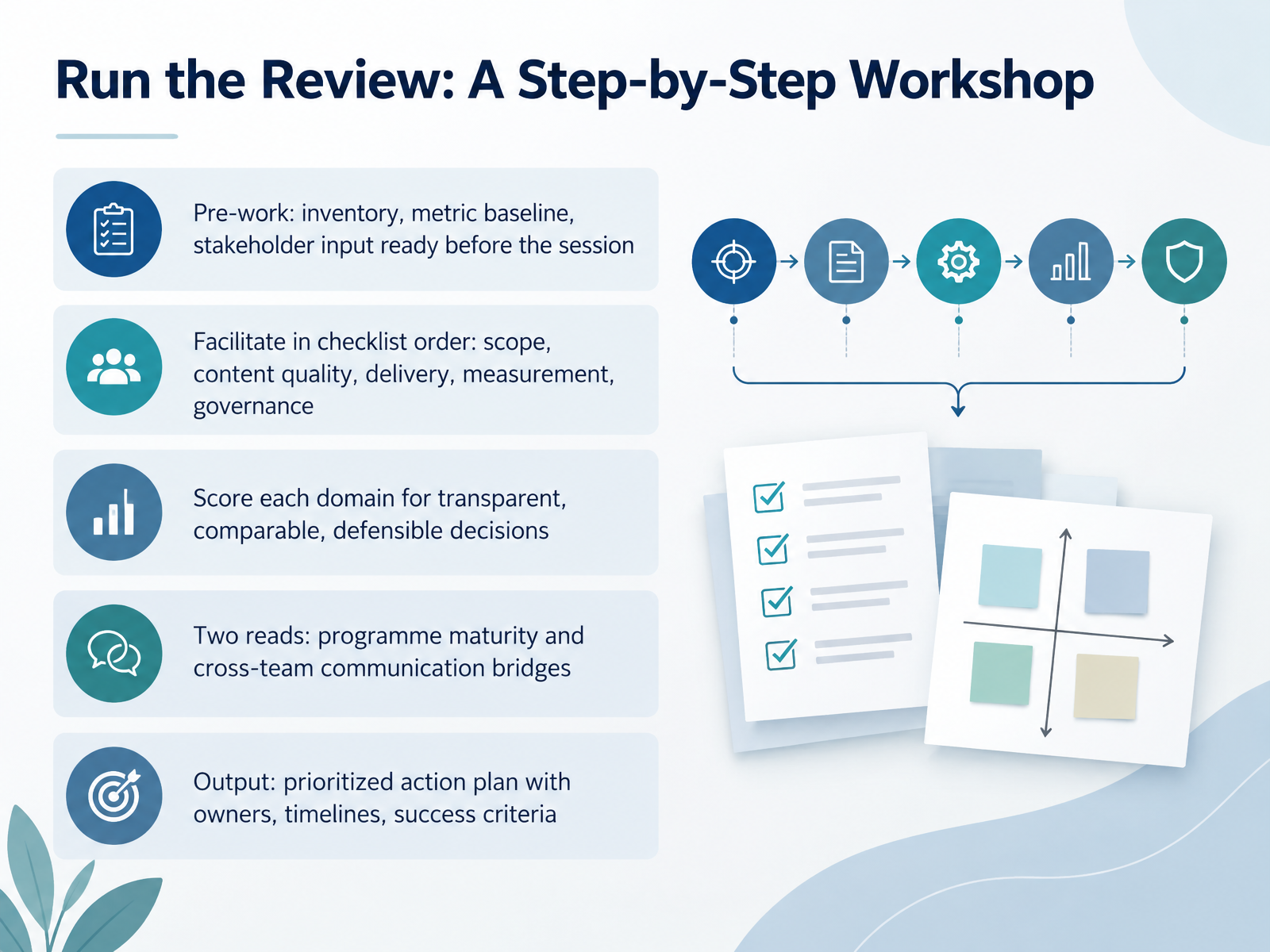
 - 14Run the Review: A Step-by-Step WorkshopNow let's walk through running the review itself as a structured workshop. Before anyone meets, confirm the pre-work is done. You need a full content inventory, a metric baseline, and stakeholder input already gathered. If that isn't ready, reschedule. You'll spend the session reconstructing data instead of making decisions. Facilitate in checklist order: scope first, then content quality, delivery, measurement, and governance. Keep that sequence. Each domain builds on the one before it. Score every domain. A simple numeric score makes decisions transparent, comparable, and defensible when you report upward. If you only discuss in prose, two reviewers can leave with completely different impressions of the same program. Run two reads. First, score programme maturity. Second, assess the communication bridges across teams. Support, customer success, and product often see the same friction from different angles, and the review should surface that. Close by producing one prioritized action plan. Every action needs a named owner, a timeline, and a success criterion. An action without an owner is a wish. That's the workshop. Next, we'll cover common pitfalls, small-team adaptations, and next steps.
 absorbai.comtrytami.comteachable.com+22 min
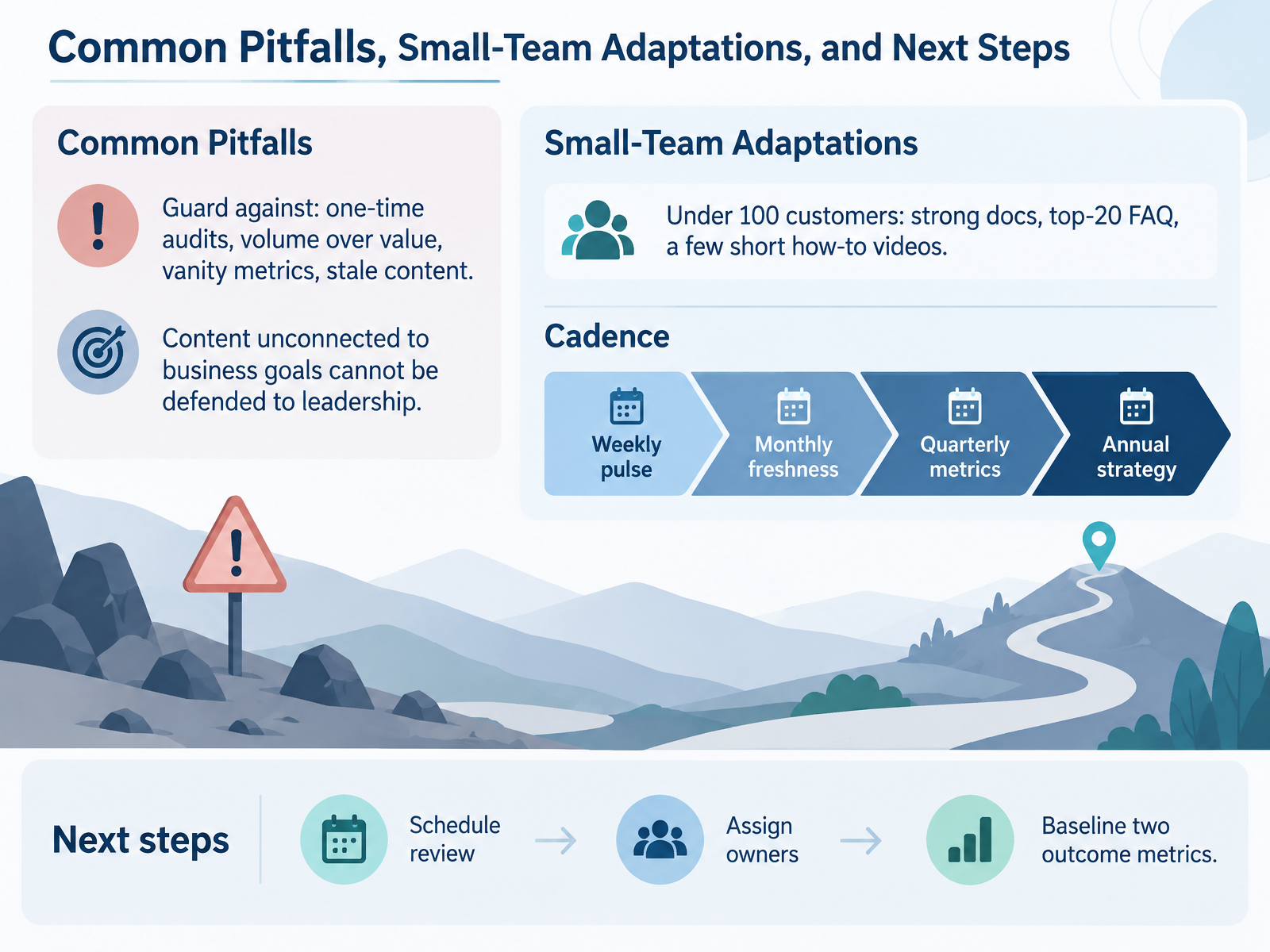
 - 15Common Pitfalls, Small-Team Adaptations, and Next StepsLet's close on the pitfalls to watch and the next steps to take. First, four things to guard against. One-time audits, where you review once and never return. Volume over value, building a large catalog before the first-value path works. Vanity metrics, reporting views when leadership wants adoption and retention. And stale content, which erodes trust faster than having nothing at all. If your content has no connection to a business goal, you cannot defend it to leadership. So keep every asset tied to a named outcome. For teams under one hundred customers, keep it lean. Strong documentation, the top twenty frequently asked questions, and a few short how-to videos. That is enough. For cadence, think weekly pulse, monthly freshness, quarterly metrics, and an annual strategy review. Before you finish, three next steps. Schedule the review. Assign owners. And baseline two outcome metrics, such as time to first value and support tickets per account. Thank you for working through this checklist. You now have a repeatable review you can run with your team. Keep it practical, keep it current, and good luck with your next programme review.
 docsio.cotrainn.cotrytami.com+22 min
Take the deck with you
Download this course as a file — free, no sign-up needed.
- PDF handoutEvery slide page, ready to print or share.16 pages · 3.3 MBDownload
- Narrated PowerPointThe deck that presents itself — every slide carries the digital human's narration video.16 pages · 16.3 MBDownload
- PowerPoint slidesThe full deck as a .pptx — open it in PowerPoint, Keynote, or Google Slides.16 pages · 3.3 MBDownload
Free to use in your own training — please keep the PersonWise credit page at the end.
Have your own deck? Turn it into a course
Sources consulted
Web sources consulted while building this course.
- End-of-Year Customer Education Strategy Checklist - Echtus — echtus.com
- How to Build a Customer Education Strategy — trytami.com
- How to Build an Effective Customer Education Program | TechSmith — techsmith.com
- Customer Education Platform: Build & Measure for 2026 — aicoursify.com
- Customer Education Best Practices: 12 Proven (2026) | Trainn — trainn.co
- Only 19% of customer education programmes meet maturity benchmark - Learning News — mailer.learningnews.com
- Why Do Customer Education Libraries Get Low Completion Rates Even With Great Content? — disco.co
- Why Do Most Customer Education Strategies Underinvest in Retention? — disco.co
- Tackling the Relevance Roadblock in Customer Education — thoughtindustries.com
- The state of customer education in 2026 | Absorb LMS Software — absorbai.com
- Customer Education: The Complete SaaS Guide for 2026 | Docsio — docsio.co
- What Is Customer Education? Benefits, Types + How to Drive Adoption — trainn.co
- What Is Customer Education? Definition and Benefits — litmos.com
- Customer enablement: What it is + why you need it — zendesk.com
- Customer Enablement: Definition and Benefits (2026) - Shopify — shopify.com
- How to build a customer education program → Teachable — teachable.com
- Rethinking Customer Education for B2Bs in 2026 — clueso.io
- How to Audit Software Training with iorad — learning.iorad.com
- The Complete eLearning Quality Assurance Checklist Every L&D Team Must Use Before Going Live - Learning Owl — learningowl.in
- eLearning Content Audit Checklist | Aurion Learning — aurionlearning.com