Begin
14 pages · ~28 min
Cloud Platform Selection and Architecture Tradeoffs
This training teaches IT professionals and architects how to evaluate cloud platforms, design scalable architectures, and balance cost, performance, and security tradeoffs.
A digital instructor presents all 14 pages. Hold “Ask” at any point and ask out loud — the answer comes from this course. No sign-up needed.
What you’ll learn
- 01Cloud Computing Platforms: Selection, Architecture, and TradeoffsWelcome. If you are responsible for picking a cloud platform, you know the stakes. This is a three-to-five-year commitment that touches your cost structure, your hiring pipeline, and your operational reality. In this training, we will move past the marketing slides and build a structured way to evaluate AWS, Azure, and Google Cloud. We will cover selection frameworks, architecture patterns, and the real tradeoffs between performance, cost, and operational overhead. The outcome we are aiming for is simple: you will be able to run a defensible platform selection and justify your architecture decisions to your team and your leadership. We will work through this at the level of engineering decisions, not vendor hype. Let us start with the 2026 landscape and the core drivers that should shape your shortlist.saascompared.cominfoworld.comardura.consulting+22 min
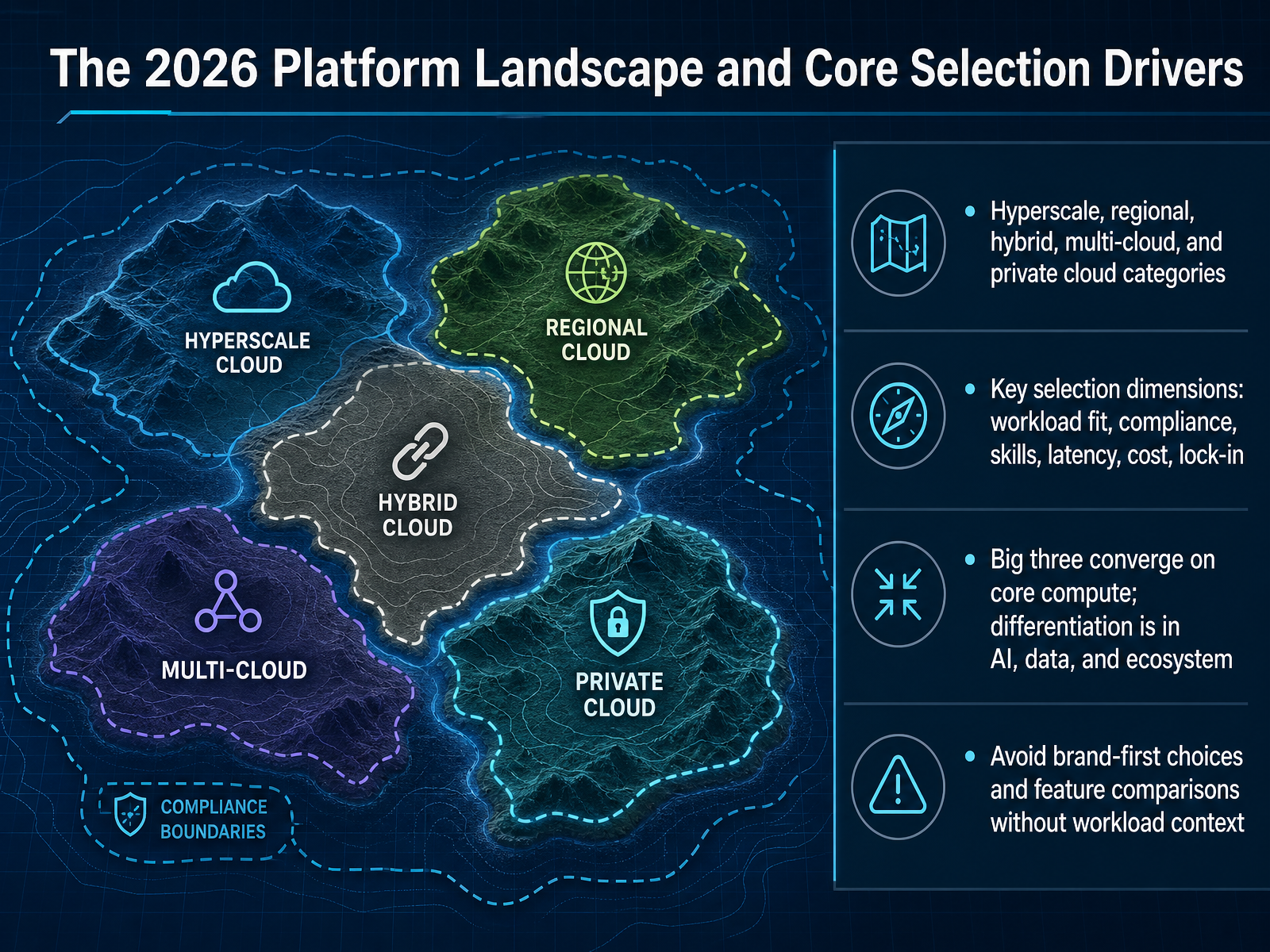
- 02The 2026 Platform Landscape and Core Selection DriversLet’s talk about the 2026 platform landscape. The market has sorted into hyperscale, regional, hybrid, multi-cloud, and private cloud categories. But the real question isn’t which category you belong to — it’s which platform fits your workload, compliance needs, team skills, latency targets, cost model, and tolerance for lock-in. Here’s the key insight: the big three have largely converged on core compute and storage. The differentiation now lives in AI services, data platforms, and ecosystem depth. So avoid brand-first decisions and feature-list comparisons without workload context. A great fit for one team can be a bad fit for yours. What matters is the match between your actual workloads and the platform’s strengths. Next, we’ll walk through how to map your workloads to the right platform.
 saascompared.cominfoworld.comardura.consulting+21 min
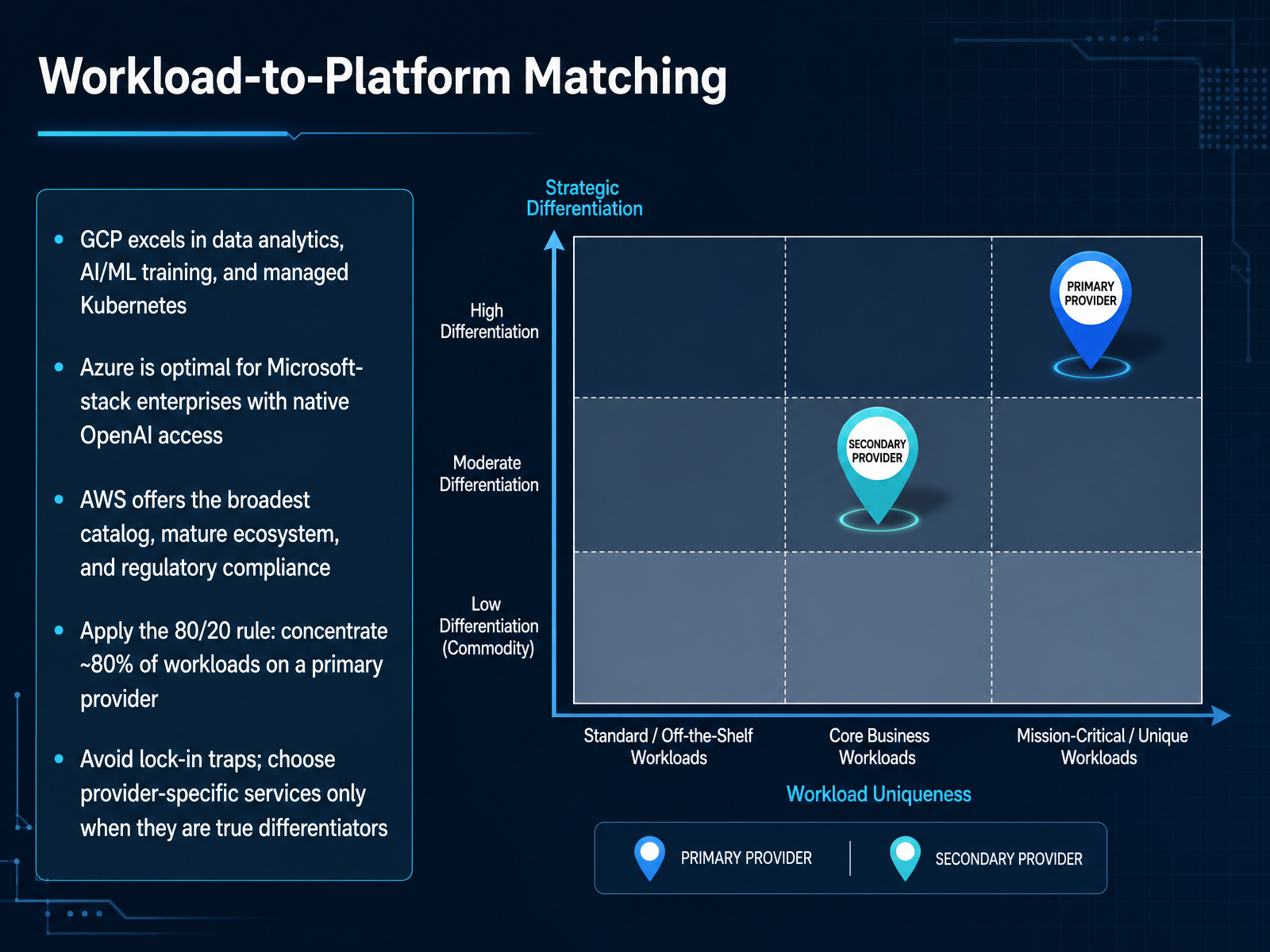
 - 03Workload-to-Platform MatchingLet's talk about matching workloads to platforms. GCP leads in data analytics and AI training, especially with BigQuery and TPU access. Azure is the natural fit for Microsoft-centric enterprises, with native OpenAI integration that's hard to beat. And AWS offers the broadest catalog and the most mature compliance story. But here's the key move: apply the eighty-twenty rule. Concentrate about eighty percent of your workloads on one primary provider. This lets your team build deep expertise and gives you stronger negotiating leverage. Use a second provider only when a specific service is a true differentiator. Watch out for lock-in traps. DynamoDB, BigQuery, Cosmos DB — these are anchors. Choose them deliberately, not by default. Ask yourself: does this service give us a strategic advantage that justifies the switching cost? If it's just convenience, you're building a cage, not a platform. Keep the core portable, and lock in only where the value is undeniable. Next, we'll explore architecture patterns for cloud-native systems.
 saascompared.cominfoworld.comardura.consulting+22 min
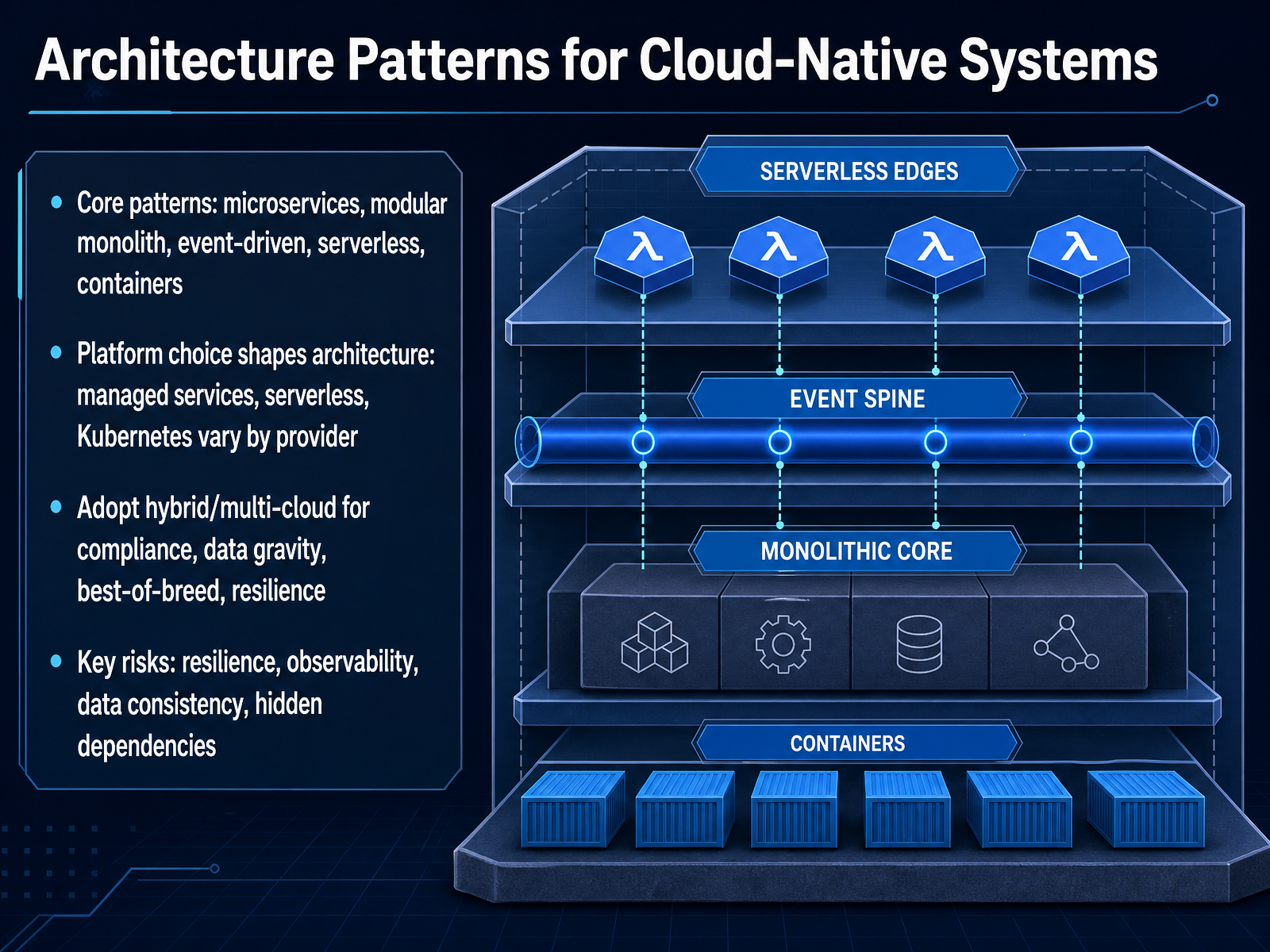
 - 04Architecture Patterns for Cloud-Native SystemsLet’s talk architecture patterns. The core options haven’t changed much: microservices, modular monoliths, event-driven, serverless, and containers. But your platform choice shapes which of these are actually viable. Managed services, serverless functions, and Kubernetes all vary significantly across providers. For example, a serverless function that’s trivial on AWS Lambda might require a cold-start tradeoff on another platform. So don’t pick a pattern in a vacuum—pick it in the context of your platform. Now, hybrid and multi-cloud. The common drivers are compliance, data gravity, best-of-breed services, and resilience. But here’s the catch: multi-cloud adds 30 to 60 percent operational overhead in tooling, skills, and debugging. It only pays off when the business case is unambiguous. And even then, keep the 80/20 principle in mind: one primary provider for most workloads, secondary providers only for specific strengths. The key risks to watch: resilience when a provider fails, observability across disjoint monitoring stacks, data consistency with cross-cloud replication lag, and hidden dependencies on proprietary services. Design your abstraction boundary deliberately. Use portable interfaces like PostgreSQL, Redis, Kafka, and Kubernetes where you need flexibility, and accept lock-in where the productivity gain is worth it. The real takeaway is that architecture patterns are only as good as their fit with your platform and your team’s operational capacity. Next, we’ll dig into multi-cloud and hybrid tradeoffs.
 stripesys.comdefensive.cloudstudio3t.com+22 min
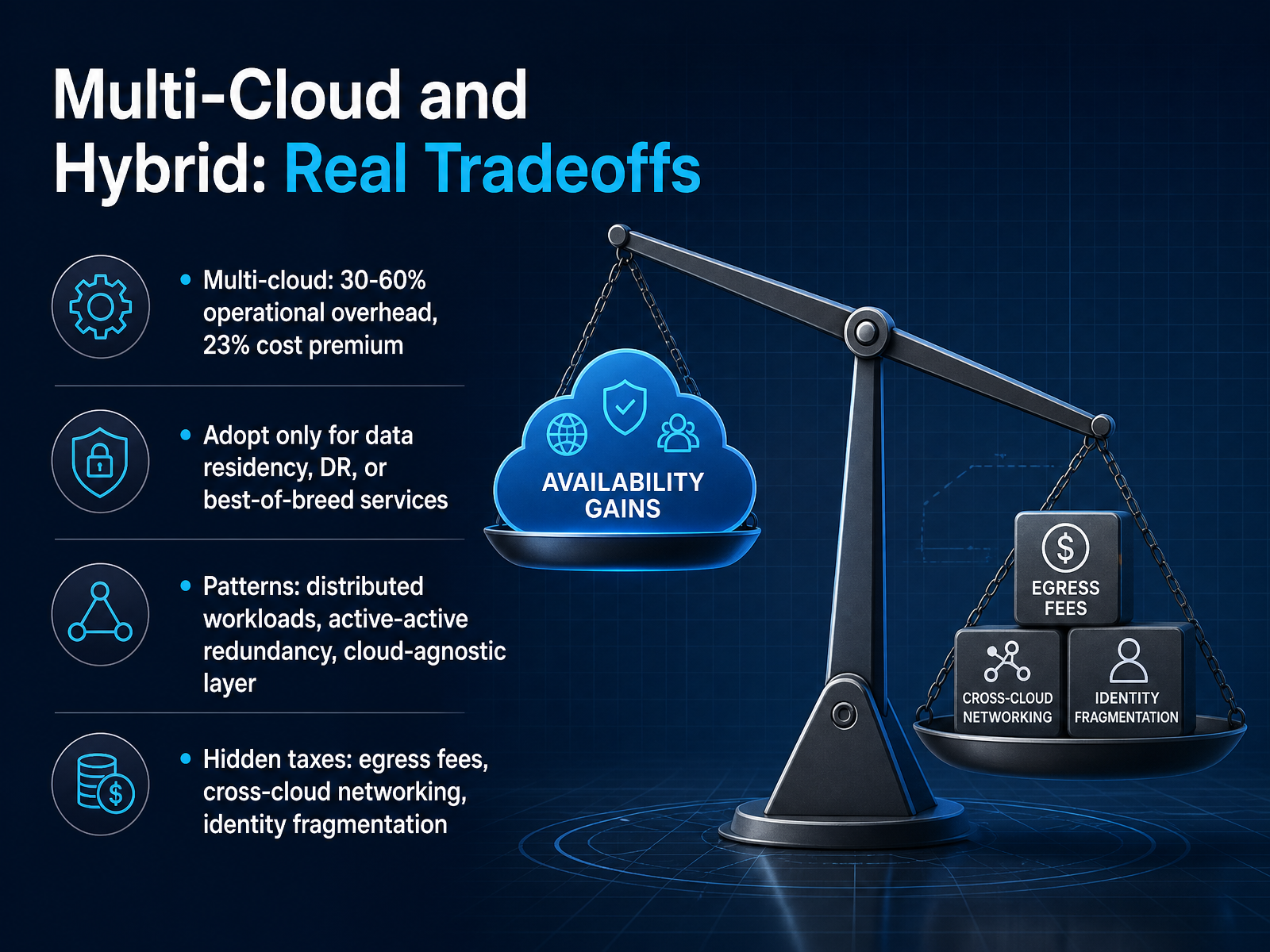
 - 05Multi-Cloud and Hybrid: Real TradeoffsNow let's cut through the marketing and talk about multi-cloud and hybrid as real engineering tradeoffs. The numbers are sobering: multi-cloud can add thirty to sixty percent operational overhead, and you may see a twenty-three percent cost premium. That's not a typo. So when does it actually make sense? Only for three specific cases: data residency requirements, disaster recovery with clear recovery objectives, or when you genuinely need best-of-breed services from different providers. The common patterns are distributed workloads, active-active redundancy, or a cloud-agnostic layer built with Terraform and Kubernetes. But here's the hidden tax: egress fees. Every byte crossing between clouds gets billed by both sides. A moderately active deployment can easily run two to five thousand dollars a month just in cross-cloud data transfer. Add cross-cloud networking and identity fragmentation, and you have a significant operational burden. So before you commit, ask yourself: which tradeoff fits your team's SLO? Next, let's look at how cost, performance, and operational tradeoffs shape your choice.
 stripesys.comdefensive.cloudstudio3t.com+21 min
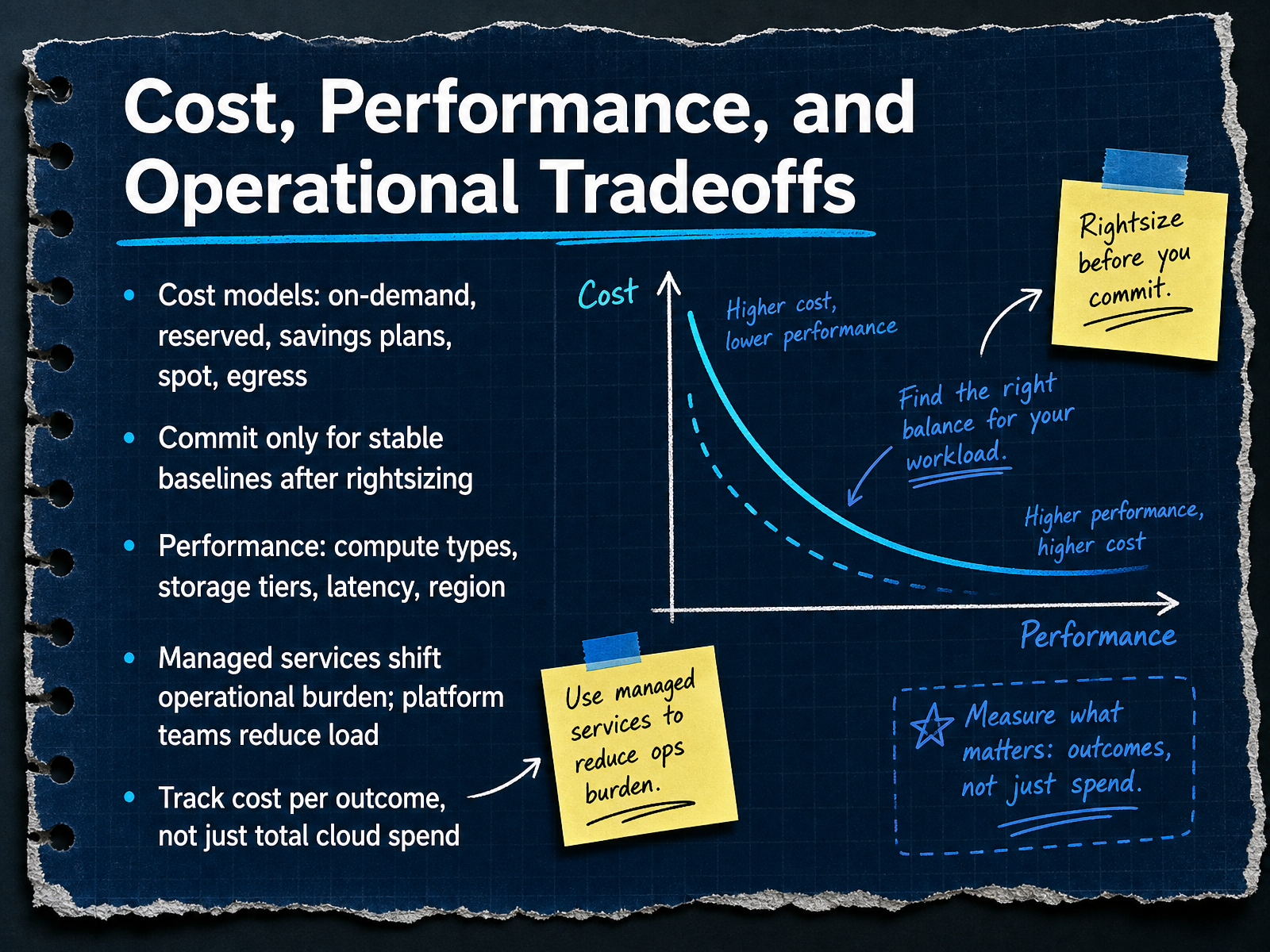
 - 06Cost, Performance, and Operational TradeoffsLet’s talk about the real cost levers, because this is where most selection models fall apart. You have four core pricing instruments: on-demand, reserved, savings plans, and spot. On-demand is your escape hatch—maximum flexibility, maximum price. Reserved and savings plans buy you thirty to seventy percent off in exchange for commitment. Spot gives you sixty to ninety percent off, but only if your workload tolerates interruption. The sequence matters more than the instrument: right-size first, then commit only for the stable baseline—roughly eighty to ninety percent of your steady-state usage, backed by at least six months of consistent data. Never commit before you right-size; that’s the classic way to lock in waste. Now for performance, that’s compute type, storage tier, latency, and region placement. Colocate data and compute to avoid egress fees—they’re the invisible killer on most bills. And ask yourself where the operational burden sits. Managed services shift the load to the provider, freeing your platform team to focus on core delivery. Finally, track unit costs, the spend per outcome, per transaction, not just the total. That’s the signal that tells you if scaling is actually healthy. Coming up next, we’ll turn this into an operating model with FinOps and cost governance.
 spot.rackspace.comcloudcostroom.comlegiosoft.net+22 min
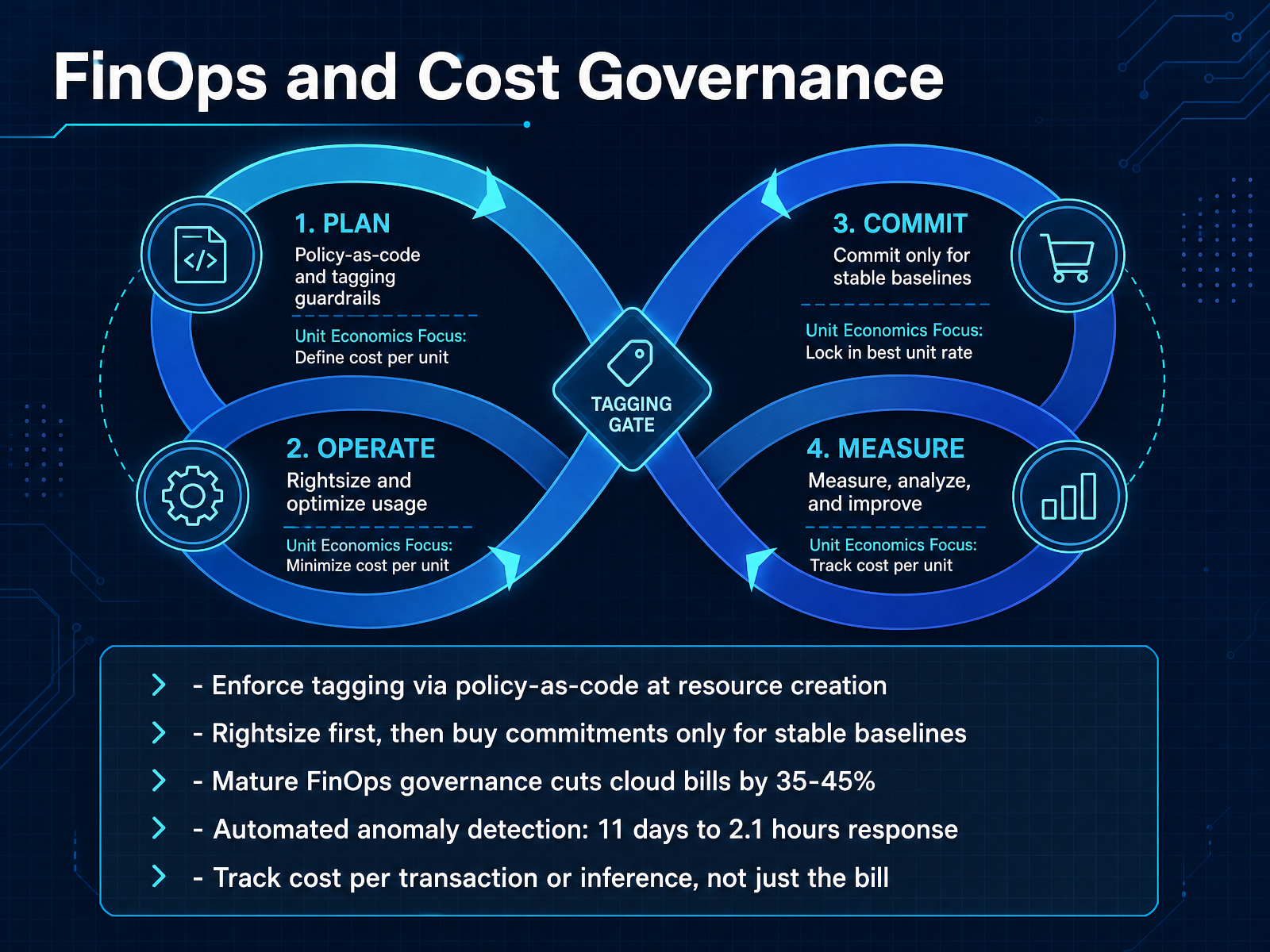
 - 07FinOps and Cost GovernanceLet's talk about FinOps and cost governance. This is where we turn spend from a surprise into a discipline. First, enforce tagging through policy-as-code at resource creation. Do not audit after the fact. That's too late, and it's the strongest predictor of budget overruns. Second, rightsize before you commit. Buy Savings Plans or Reserved Instances only for stable baselines, workloads with at least six months of predictable usage. Committing before right-sizing locks in waste. The data is clear here. Mature FinOps governance cuts cloud bills by 35 to 45 percent, and automated anomaly detection collapses response time from eleven days down to about two hours. That is the difference between a minor incident and a financial disaster. Finally, track cost per transaction or per inference, not just the total bill. A rising bill is ambiguous. Rising cost per transaction is a specific engineering problem. Total spend will grow as you scale. Unit costs are what tell you if you are scaling efficiently. The takeaway is this: govern at creation, right-size first, and manage to unit economics. Now, let's consider the next layer of constraints, security, compliance, and governance.
 spot.rackspace.comcloudcostroom.comlegiosoft.net+22 min
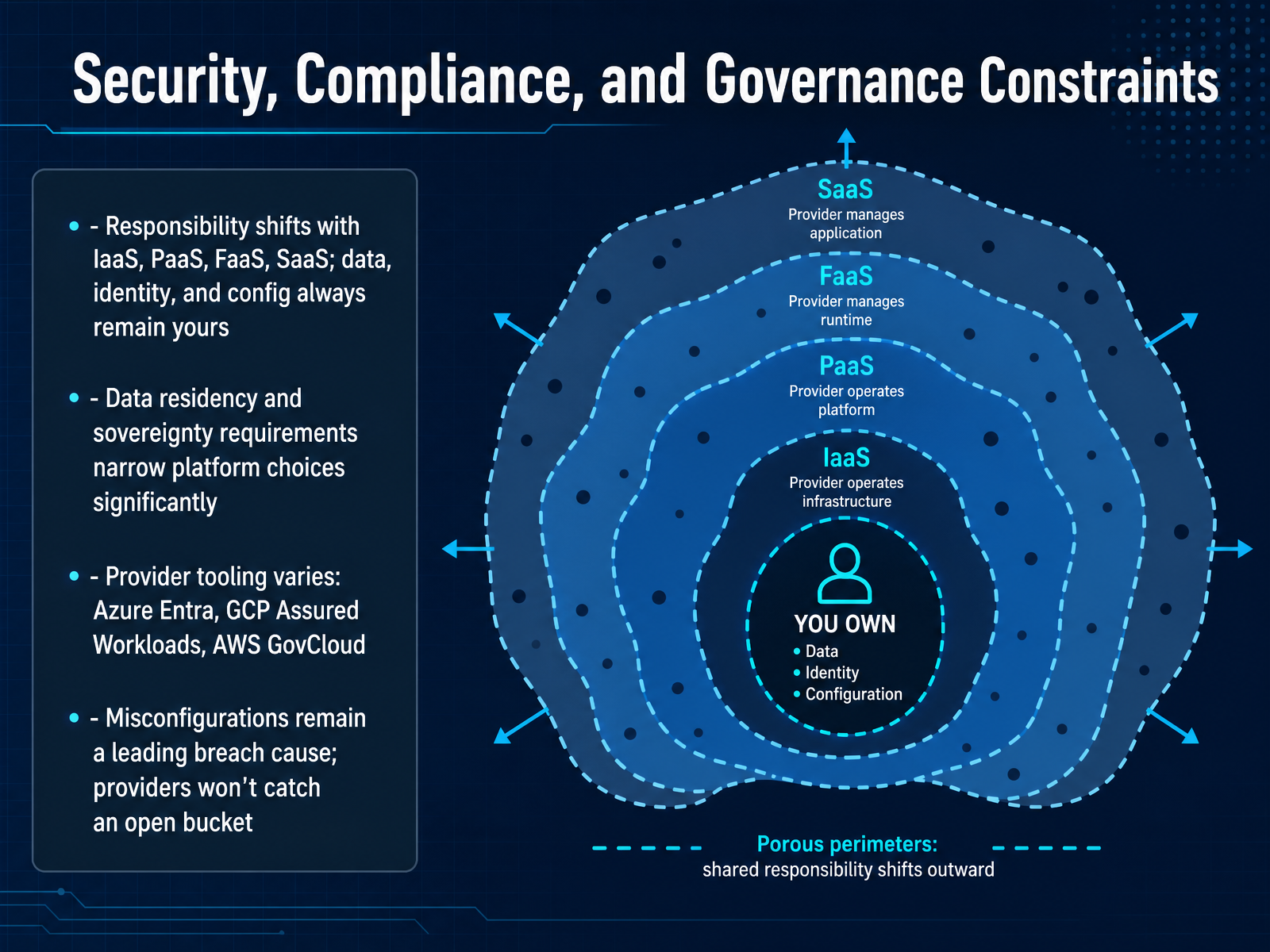
 - 08Security, Compliance, and Governance ConstraintsNow let’s talk about security, compliance, and governance constraints—because these often narrow your platform choices more than any technical benchmark. The shared responsibility model shifts as you move from IaaS up to SaaS, but three things always remain on your side: your data, your identity, and your configuration. On IaaS, you own the OS, the runtime, and the network controls. On PaaS, the provider takes the OS, but your application code and access policies are still yours. And on SaaS, you’re mostly configuring user access and data handling. The provider will not catch an open storage bucket or an overly permissive IAM role. Misconfigurations remain a leading cause of breaches, so your compliance evidence—SOC 2 Type II, ISO 27001, FedRAMP—only covers the provider’s controls, not your own. Data residency and sovereignty requirements can also be decisive. If your users are in the EU, GDPR means your data stays in EU regions, and you need to account for backup and disaster recovery locations. So you must verify that your provider’s regional footprint actually aligns with your regulatory map. Provider tooling differs here: Azure Entra ID gives you granular conditional access, GCP Assured Workloads enforces region and key constraints, and AWS GovCloud for US federal work. That’s where governance meets reality. This brings us directly to vendor lock-in, portability, and exit strategy.
 cloudcomplianceauthority.comdocs.cloud.google.comcsoh.org+22 min
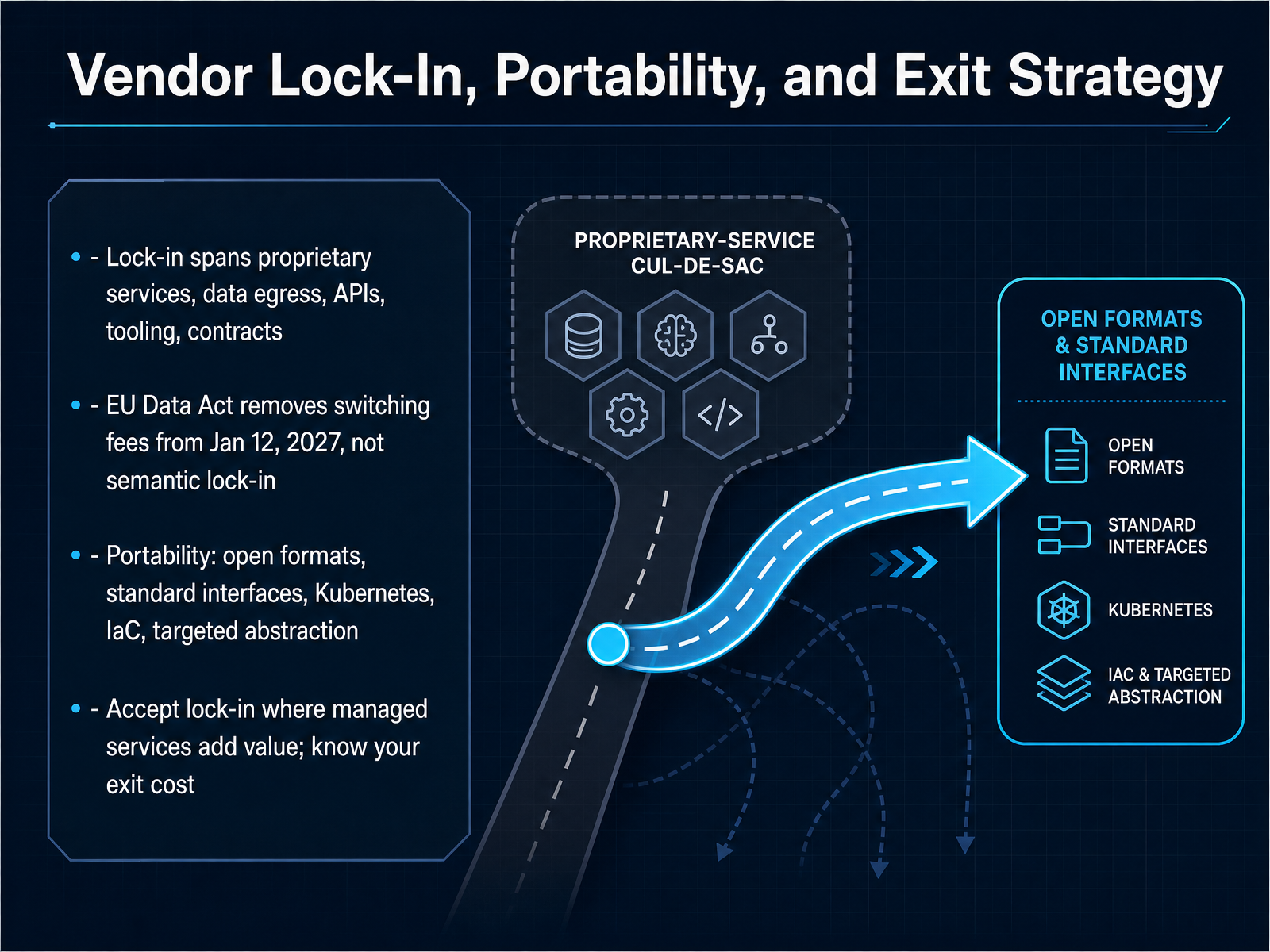
 - 09Vendor Lock-In, Portability, and Exit StrategyNow let's talk about vendor lock-in with clear eyes. Lock-in doesn't come from one thing. It spans proprietary services, data egress fees, API contracts, tooling, and the fine print in your agreements. The EU Data Act will remove switching fees starting January twelfth, twenty twenty-seven. That's real, but it only removes the financial barrier. It does not remove semantic lock-in. Free egress won't help you if your business logic, IAM policies, and schedulers have to be rebuilt by hand. Portability means open data formats, standard interfaces, Kubernetes, and infrastructure as code. But do not abstract everything. Accept lock-in where a managed service genuinely buys back engineering time. Just know your exit cost before you sign. The question is not whether you can export. It is whether you can reconstitute the full system on a different runtime. That means testing restore, not just documenting it. Which tradeoff fits your team's SLO? That is the decision. Next, let's look at exit planning and contract leverage.
 2 min
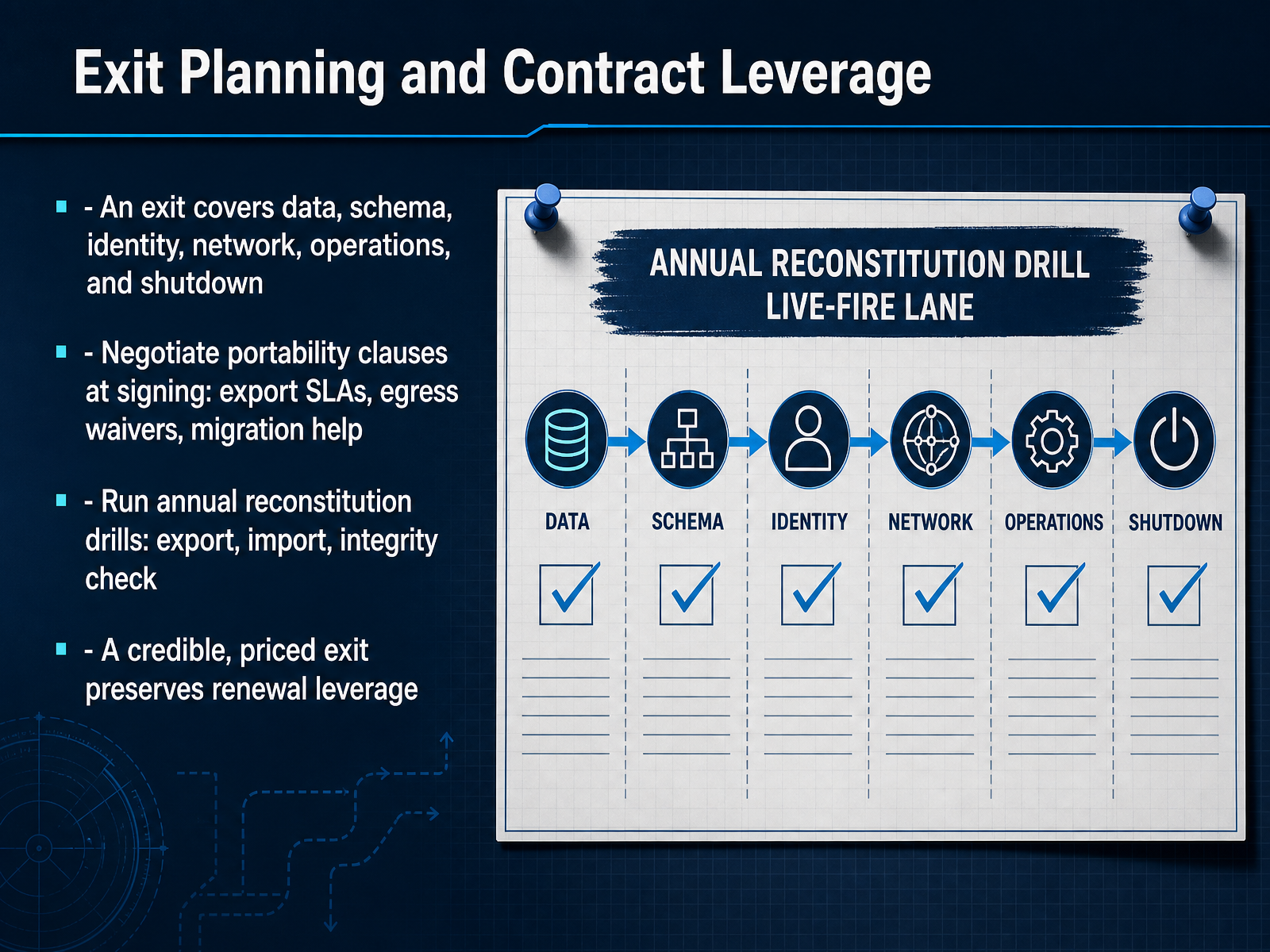
2 min - 10Exit Planning and Contract LeverageNow let's talk about the part most teams avoid until it's too late: exit planning. An exit isn't just pulling your data out. It's data, schema, identity, permissions, business logic, integrations, runtime, and even operational knowledge like runbooks and monitoring. Static exports aren't enough if you can't reconstitute the whole system on a new runtime. The research is clear: core data is often exportable, but permissions, automations, and runnable configuration rarely are. So negotiate portability clauses at signing, not at renewal. Demand export SLAs, egress waivers for migration, and dedicated migration assistance for up to 180 days. And don't just document the exit — test it. Run an annual reconstitution drill: export, import, integrity check, and document residual deviation. This isn't just insurance. A credible, priced exit preserves your leverage at renewal. Providers know whether you can realistically walk away. If you can't, you're accepting whatever terms they offer. So make leaving a priced option, even if you never use it. That discipline will frame how we approach the structured selection framework next.
 1 min
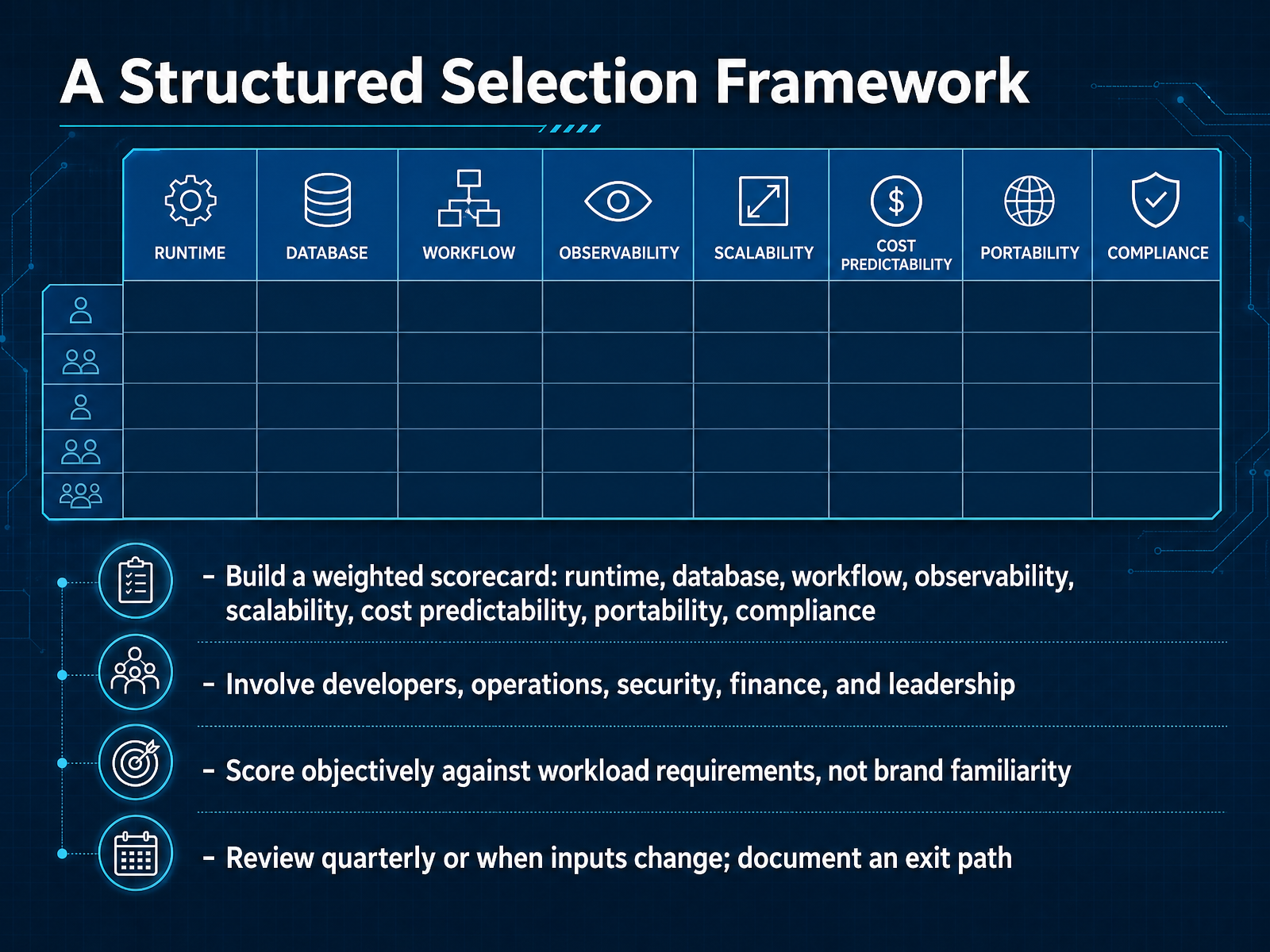
1 min - 11A Structured Selection FrameworkLet’s turn that analysis into a decision. A structured framework starts with a weighted scorecard. Don’t just list pros and cons—assign weights to runtime fit, database compatibility, workflow, observability, scalability, cost predictability, portability, and compliance. Weight them based on your actual workload, not on what’s popular. And involve the right people: developers, operations, security, finance, and leadership. Each brings a different perspective, and that’s exactly what you need. Now, score each candidate objectively against your requirements—not against brand familiarity. If you’re tempted to favor a provider because your team already knows it, that’s a bias, not a criterion. Document assumptions, revisit the scorecard quarterly, or whenever inputs change—like a new workload type or a shift in traffic patterns. And most importantly, document your exit path before you commit. You need to know how you’d migrate data, code, and workflows if the provider doesn’t meet expectations. The scorecard gives you repeatable, defensible selection—not a one-time opinion. Next, we’ll look at real case studies and the antipatterns that trip teams up.
 2 min
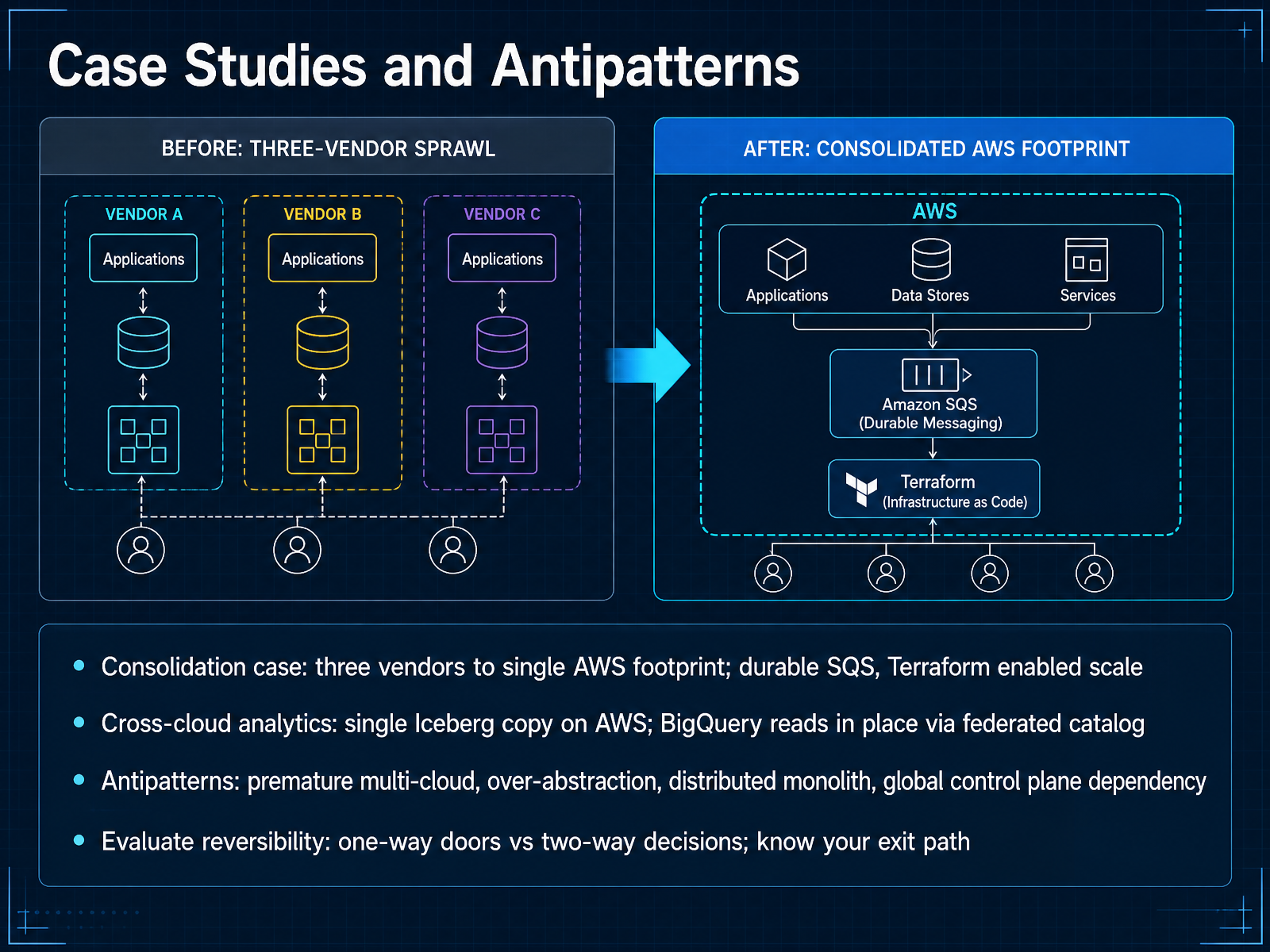
2 min - 12Case Studies and AntipatternsLet’s ground this in real cases and, just as importantly, in the antipatterns that still trip teams up. First, the consolidation case. Profound ran the same platform across three vendors. It worked early on, but reliability suffered and costs climbed. They moved everything to a single AWS footprint, using SQS with dead-letter queues for durable, replayable messaging, and Terraform for infrastructure as code. That eliminated their main failure mode and gave them 99.9 percent availability targets. Then consider a cross-cloud analytics approach that avoids copying data. Talabat keeps a single Iceberg copy on AWS and lets BigQuery read it in place through a federated catalog. The write path stays local; the cross-cloud concern lives on the read path. Now the antipatterns. Premature multi-cloud is one: you spread workloads across providers before you have a real driver, and you end up with a single control plane dependency. Over-abstraction is another: wrapping every vendor API in a custom layer adds complexity without adding portability. And the distributed monolith—splitting services but keeping them tightly coupled—creates more coordination overhead than resilience. Finally, evaluate reversibility. Know which decisions are one-way doors and which are two-way. If you don’t know your exit path, you haven’t finished the design. Next, we’ll cover tooling, observability, and day-two operations.
 2 min
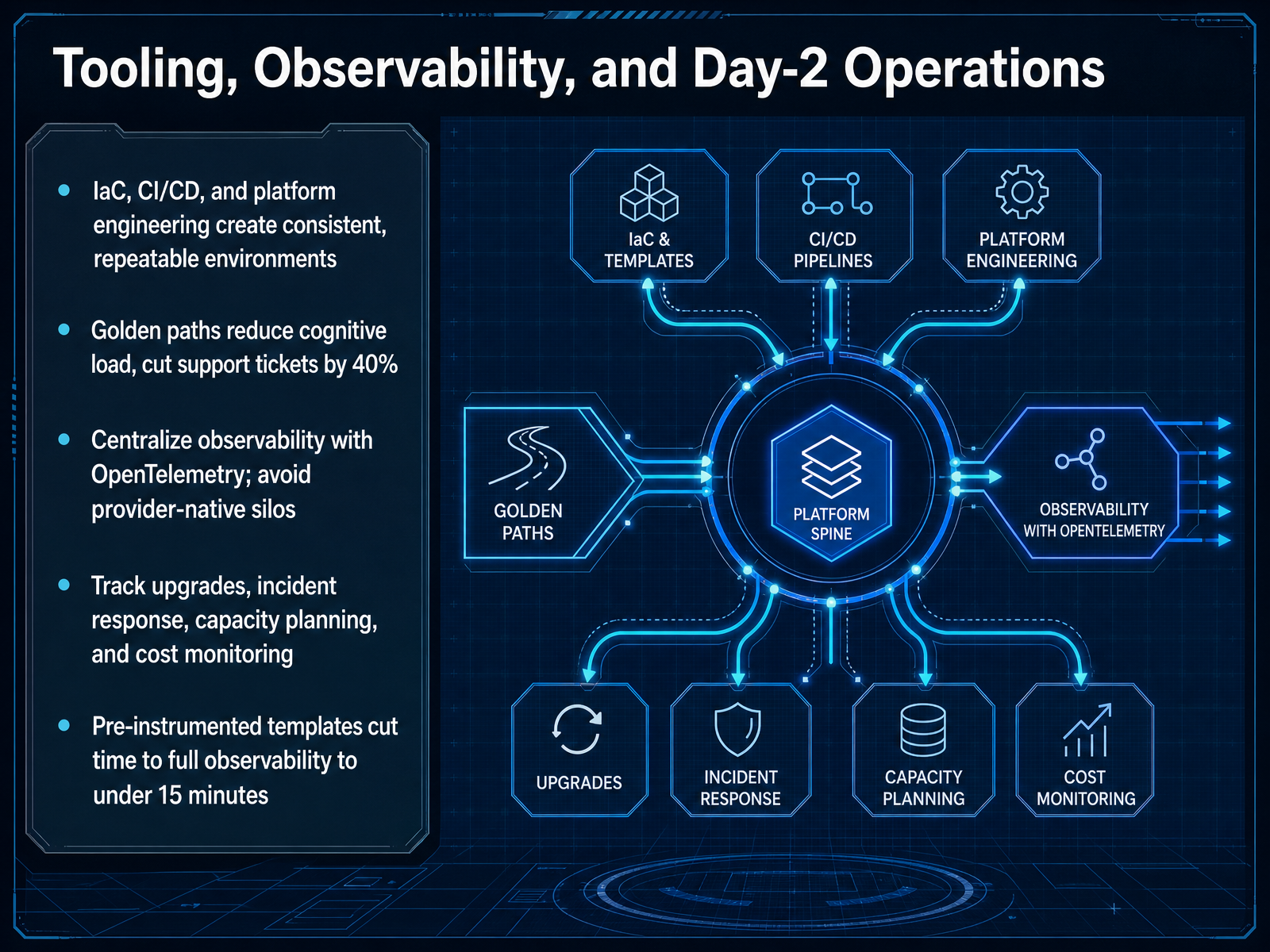
2 min - 13Tooling, Observability, and Day-2 OperationsLet’s talk about day two operations, because that’s where platform choices really pay off or punish you. The goal is consistent, repeatable environments, and that means investing in infrastructure as code, CI/CD, and platform engineering from day one. The most mature teams build golden paths—opinionated, pre-configured routes for provisioning, deployment, and instrumentation. Those paths reduce cognitive load significantly, and mature organizations report about forty percent fewer support tickets to the platform team. That’s a number you can take to your stakeholders. On observability, consolidate. Standardize on OpenTelemetry and run a unified pipeline, rather than adopting provider-native silos. If you let each team pick their own monitoring stack, you’re building the next migration project. Pre-instrumented templates are the answer. The best platforms get a new service from scaffold to full observability coverage in under fifteen minutes. That is the operating bar you should set. And remember, day two is not just monitoring. It’s upgrades, incident response, capacity planning, and cost monitoring, all managed as code through the same GitOps pipelines as your applications. Get that right, and your platform becomes a strategic asset instead of a maintenance burden. Next, we’ll turn this into a decision playbook and outline your concrete next steps.
 2 min
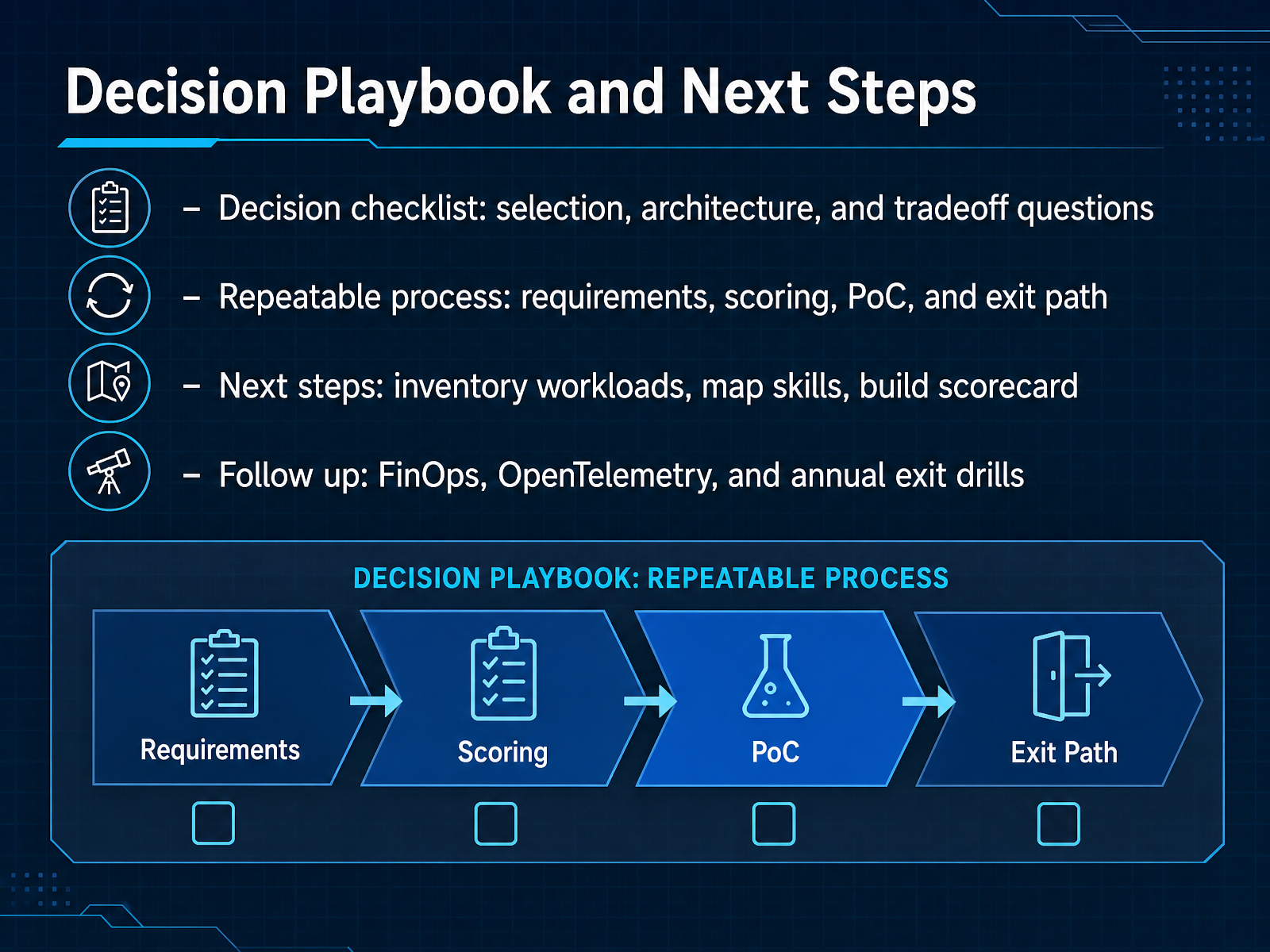
2 min - 14Decision Playbook and Next StepsWe've covered a lot of ground, from selection frameworks to architectural tradeoffs to the hidden costs of lock-in. Let's wrap this up with a practical playbook. First, build a decision checklist. Ask: does this platform run our workloads today, will it scale with us, can we predict the bill, and how hard is it to leave? Use a weighted scorecard, not a gut feeling. Assign weights to what matters most for your team—whether that's cost predictability, operational overhead, or portability. Then run a repeatable process: inventory your workloads, map the skills your team actually has, and score each provider against those requirements. Don't skip the proof of concept. And define your exit path before you sign, not after. After selection, your work continues. Stand up a FinOps practice to monitor unit costs, adopt OpenTelemetry for portable observability, and run annual exit drills. Test that you can actually export data and reconstitute a critical workflow elsewhere. That discipline keeps your options open and your leverage real. The goal isn't to find the perfect cloud. It's to make a defensible choice you can adapt as your workloads and business evolve. Thanks for your attention, and good luck with your next build. You've got the tools to decide with confidence.
 spot.rackspace.comcloudcostroom.comlegiosoft.net+21 min
Take the deck with you
Download this course as a file — free, no sign-up needed.
- PDF handoutEvery slide page, ready to print or share.15 pages · 4.3 MBDownload
- Narrated PowerPointThe deck that presents itself — every slide carries the digital human's narration video.15 pages · 17.6 MBDownload
- PowerPoint slidesThe full deck as a .pptx — open it in PowerPoint, Keynote, or Google Slides.15 pages · 4.2 MBDownload
Free to use in your own training — please keep the PersonWise credit page at the end.
Have your own deck? Turn it into a course
Sources consulted
Web sources consulted while building this course.
- AWS vs Google Cloud vs Azure 2026: Cloud Platform Comparison | SaaSCompared — saascompared.com
- The Big Three cloud providers are more alike than not | InfoWorld — infoworld.com
- AWS vs Azure vs GCP: Cloud Provider Selection Guide 2026 — ardura.consulting
- AWS vs GCP vs Azure: GCP Cuts SQL Costs 30% [2026] — shattered.io
- AWS vs Azure vs GCP in 2026 | Privum Cloud — privum.cloud
- Multi-Cloud Architecture (Real Trade-offs) | Stripe Systems — stripesys.com
- Multi-Cloud Resilience Patterns for Provider Outages — defensive.cloud
- Multi-cloud strategy explained: Architecture tradeoffs and why data matters - Studio 3T — studio3t.com
- Should you migrate, modernize to hybrid cloud or multi-cloud? | TechTarget — techtarget.com
- Multi-Cloud Strategy: When and How to Use Multiple Providers — Citadel Cloud Management — citadelcloudmanagement.com
- Cloud Cost Optimization Strategies: The Complete 2026 Guide — spot.rackspace.com
- The Complete Cloud Cost Optimization Playbook 2026 — cloudcostroom.com
- How to Reduce Cloud Costs Without Breaking Performance | LegioSoft — legiosoft.net
- The Complete Guide To Cloud Cost Management [2026] — cloudzero.com
- Cloud Capacity Planning and Cost Optimization: A Practical FinOps Guide | Attract Group — attractgroup.com
- Cloud Data Residency and Data Sovereignty: Compliance Implications for US Organizations | Cloud Compliance Authority — cloudcomplianceauthority.com
- Shared responsibilities and shared fate on Google Cloud | Cloud Architecture Center | Google Cloud Documentation — docs.cloud.google.com
- Shared Responsibility Model - Cloud Security Office Hours — csoh.org
- Shared responsibility in the cloud - Azure — learn.microsoft.com
- Shared Responsibility Model - Amazon Web Services (AWS) — aws.amazon.com