Begin
14 pages · ~28 min
Motto Brand Strategy Development Approach
This training guides brand and marketing professionals through the Motto brand strategy development approach, helping them build and apply a clear, effective brand strategy.
A digital instructor presents all 14 pages. Hold “Ask” at any point and ask out loud — the answer comes from this course. No sign-up needed.
What you’ll learn
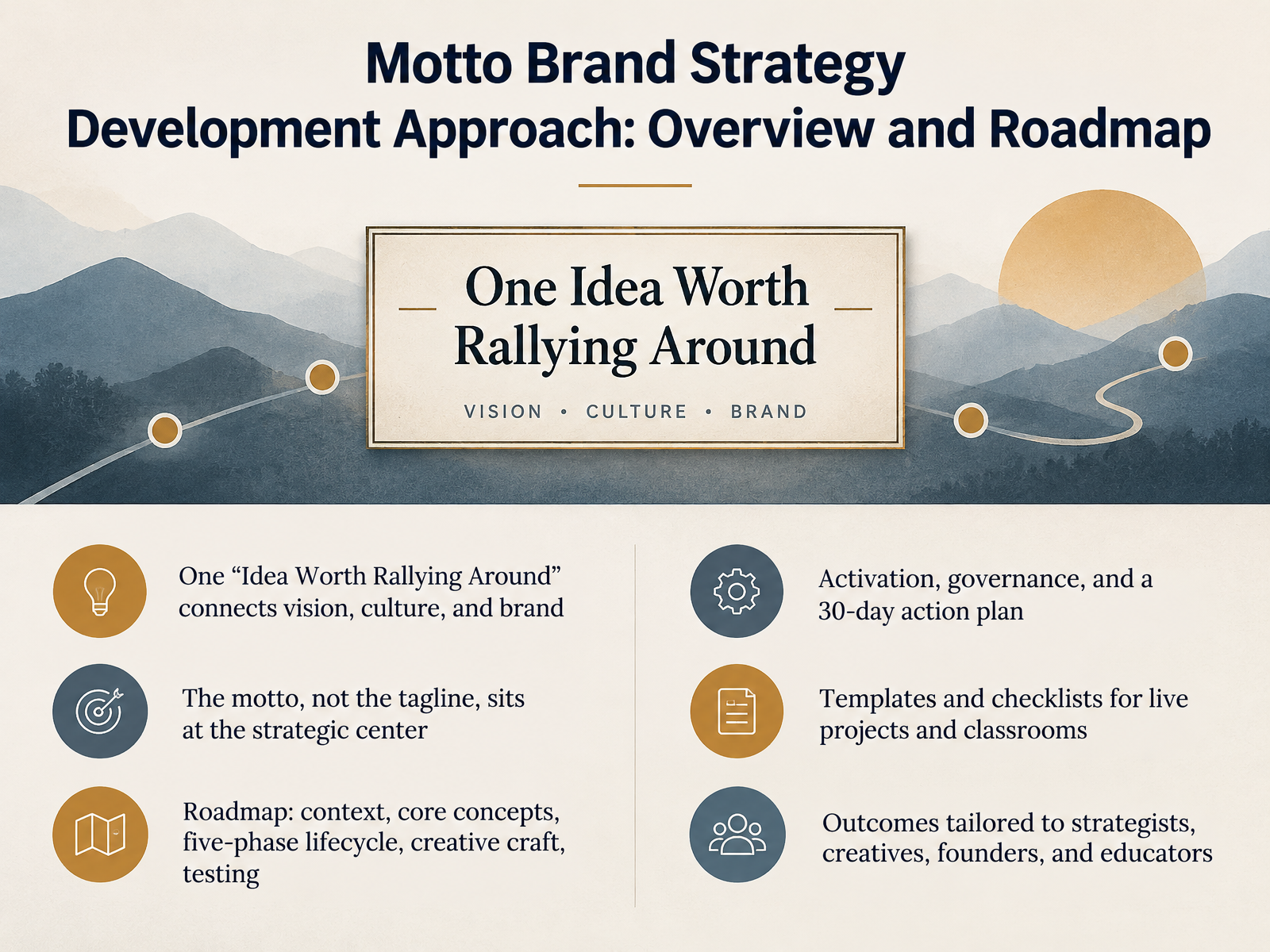
- 01Motto Brand Strategy Development Approach: Overview and RoadmapWelcome. Over the next fourteen slides, we'll walk through a repeatable approach to motto brand strategy, built for strategists, creative teams, founders, and educators. Our goal is simple. You leave with a structure you can test on a live client or in a classroom. Here's the roadmap. Everything starts with one Idea Worth Rallying Around, a single defining idea that connects vision, culture, and brand as complexity grows. We keep the motto, not the tagline, at the strategic center. A motto guides internal decisions. A tagline carries the external promise. Next, we map the logic. We cover context and core concepts, then a five-phase lifecycle, creative craft, and testing. From there, we move into activation and governance, plus a thirty-day action plan. You'll also get templates and checklists you can apply right away. I'll explain each framework step the first time it appears, so you can run it in real projects. Expect a steady, practical pace, and bring your questions for iteration. Your first action: write down the one idea your current brand could rally around. If you can't state it in a sentence, that's our starting point. Next, we look at why a motto-centered strategy matters now.wearemotto.comwearemotto.comwearemotto.com+22 min
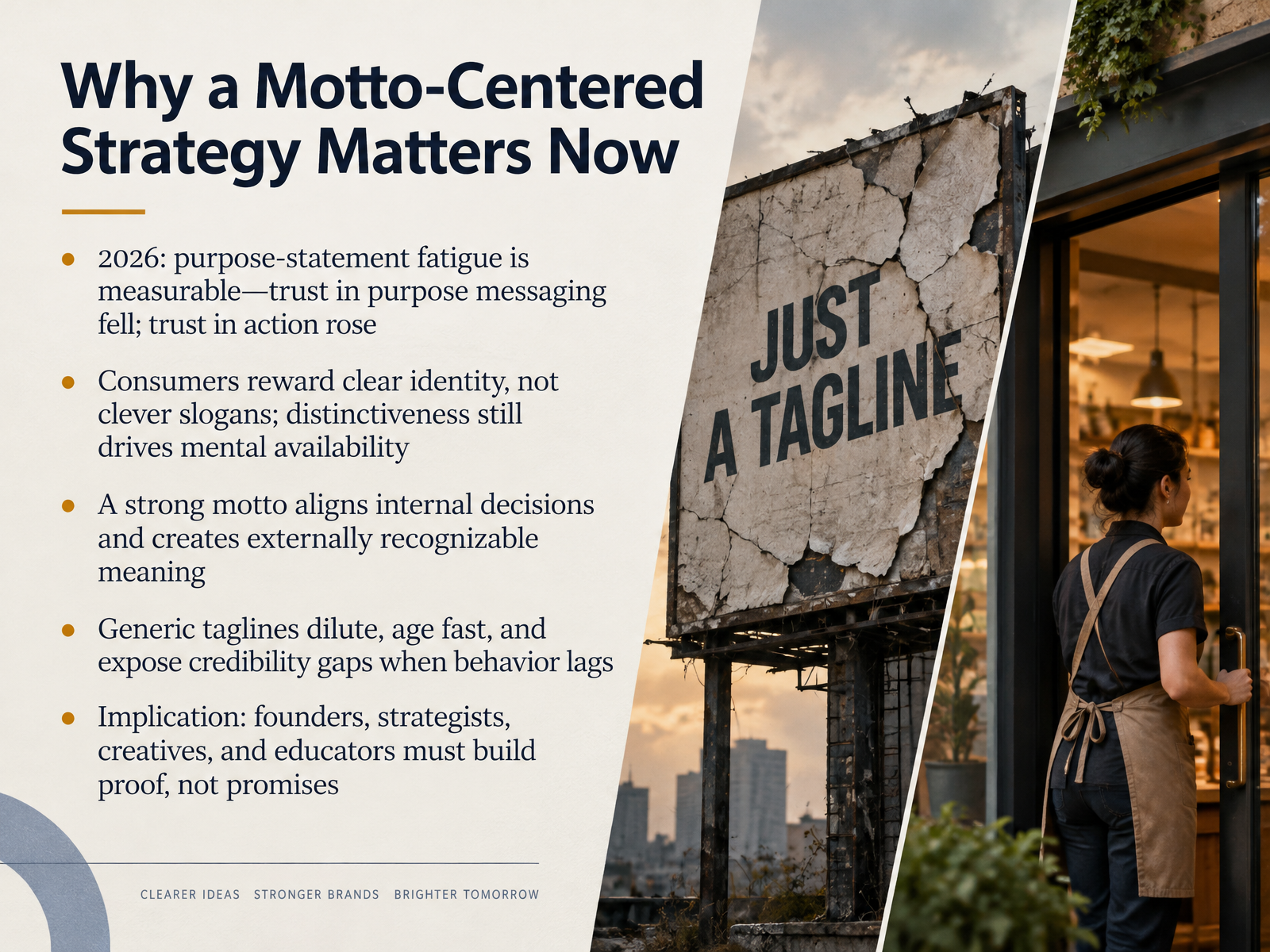
- 02Why a Motto-Centered Strategy Matters NowLet's look at why a motto-centered strategy matters right now. In 2026, purpose-statement fatigue is measurable. Trust in purpose messaging fell by six points, while trust in brand action rose by four. Consumers reward clear identity, not clever slogans. Distinctiveness still drives mental availability, which is the ease with which buyers recall your brand at the moment of choice. A strong motto does two jobs at once. It aligns internal decisions, and it creates externally recognizable meaning. Generic taglines do the opposite. They dilute, they age fast, and they expose credibility gaps when behavior lags. So here is the implication for all of us. Founders, strategists, creatives, and educators must build proof, not promises. Pick one motto you are working on this week, and write down one concrete behavior that proves it. Next, we will clear up the terms: motto, tagline, slogan, and brand promise.
 wfanet.orgtotembranding.combrandstruck.co+22 min
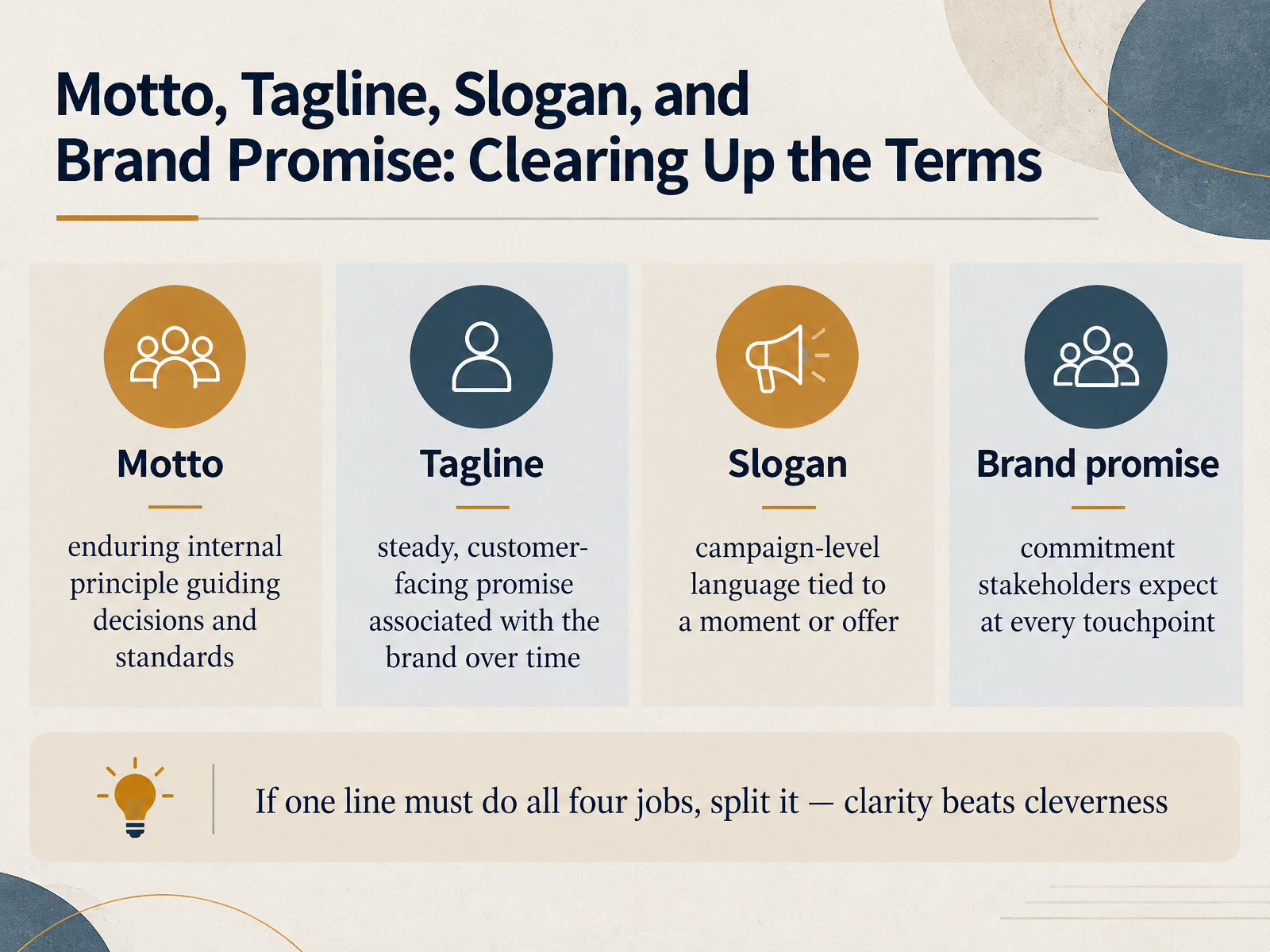
- 03Motto, Tagline, Slogan, and Brand Promise: Clearing Up the TermsLet's clear up four terms that teams often blur together. A motto is an enduring internal principle. It guides decisions and standards, not customer acquisition. Think of it as the line that settles an argument inside the building. A tagline is the steady, customer-facing promise associated with your brand over time. It should survive product cycles and work across channels. A slogan is campaign-level language tied to a moment, an offer, or a behavior. The quick test is time. If the line lives and dies with one campaign, it's a slogan. A brand promise is the commitment stakeholders expect at every touchpoint. It's broader than any single line, and it's grounded in how you actually behave. Here's the practical rule. If one line must do all four jobs, split it. Clarity beats cleverness. So document each line's role, and where it gets used. Your next action is simple. Audit one live brand and label every existing line as motto, tagline, slogan, or promise. That prepares us for the next section on core concepts and guiding principles.
 brandvm.comchevronediting.com.autheidbureau.com+22 min
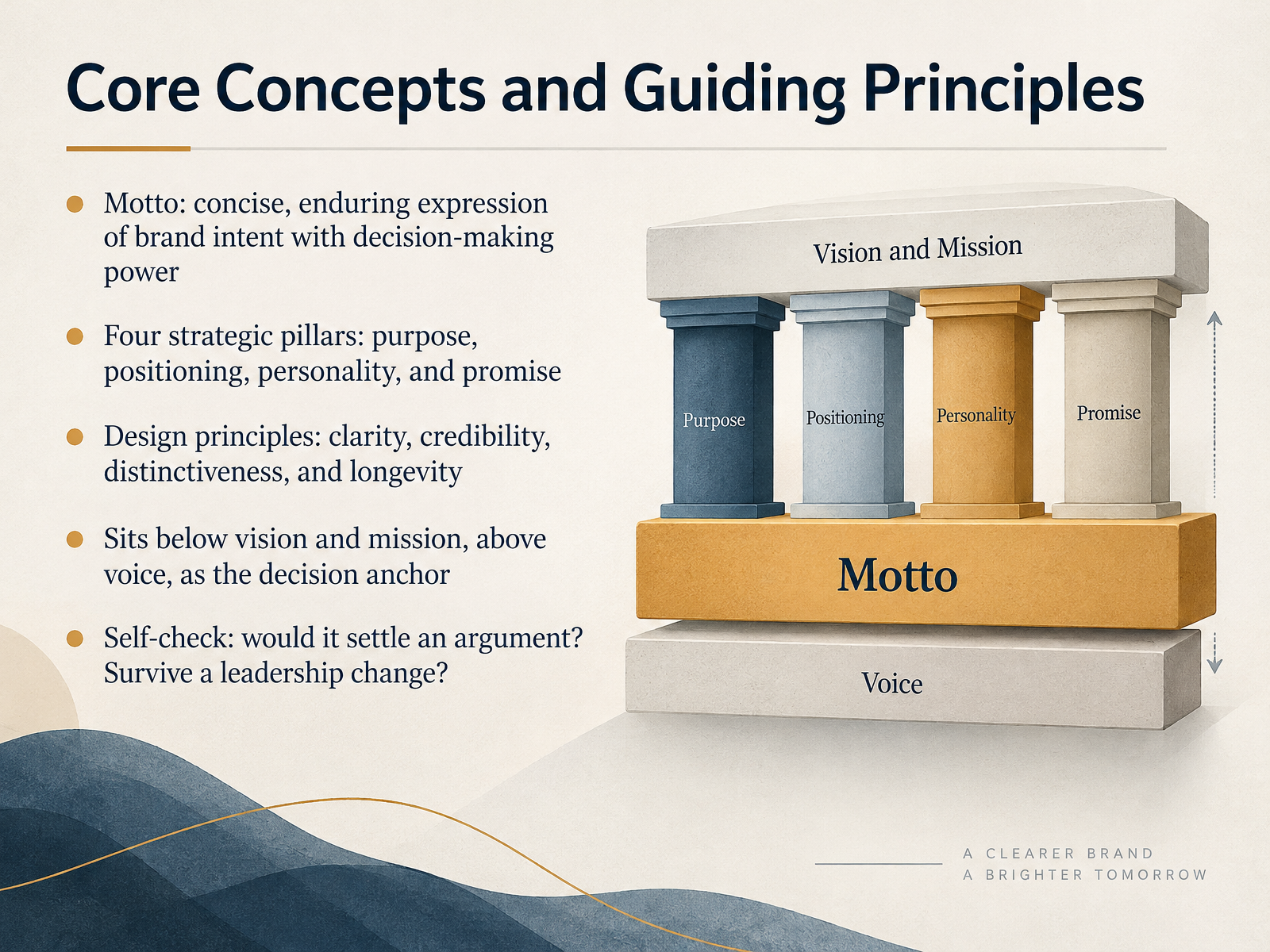
- 04Core Concepts and Guiding PrinciplesLet's ground the work in core concepts and guiding principles. A motto is a concise, enduring expression of brand intent. Its job is to carry decision-making power, not to sell. When tradeoffs appear, the motto should settle the argument and give the team one standard. Think of it as the decision layer, not campaign language.
It rests on four strategic pillars. Purpose is why you exist beyond revenue. Positioning is the space you own in the market. Personality is how you sound and behave. Promise is what people can expect from every interaction. These four give the motto its substance.
Then design the line against four principles. Clarity, so anyone can repeat it. Credibility, so the business can deliver it. Distinctiveness, so it is recognizably yours. And longevity, so it survives product cycles. Here is a practical self-check. Would it settle an argument in a leadership meeting? Would it survive a leadership change? If both answers are yes, you likely have a motto. If not, keep refining, and test it against a live decision this week. Next, let's look at "The Motto Development Lifecycle at a Glance."
 wearemotto.comwearemotto.comwearemotto.com+22 min
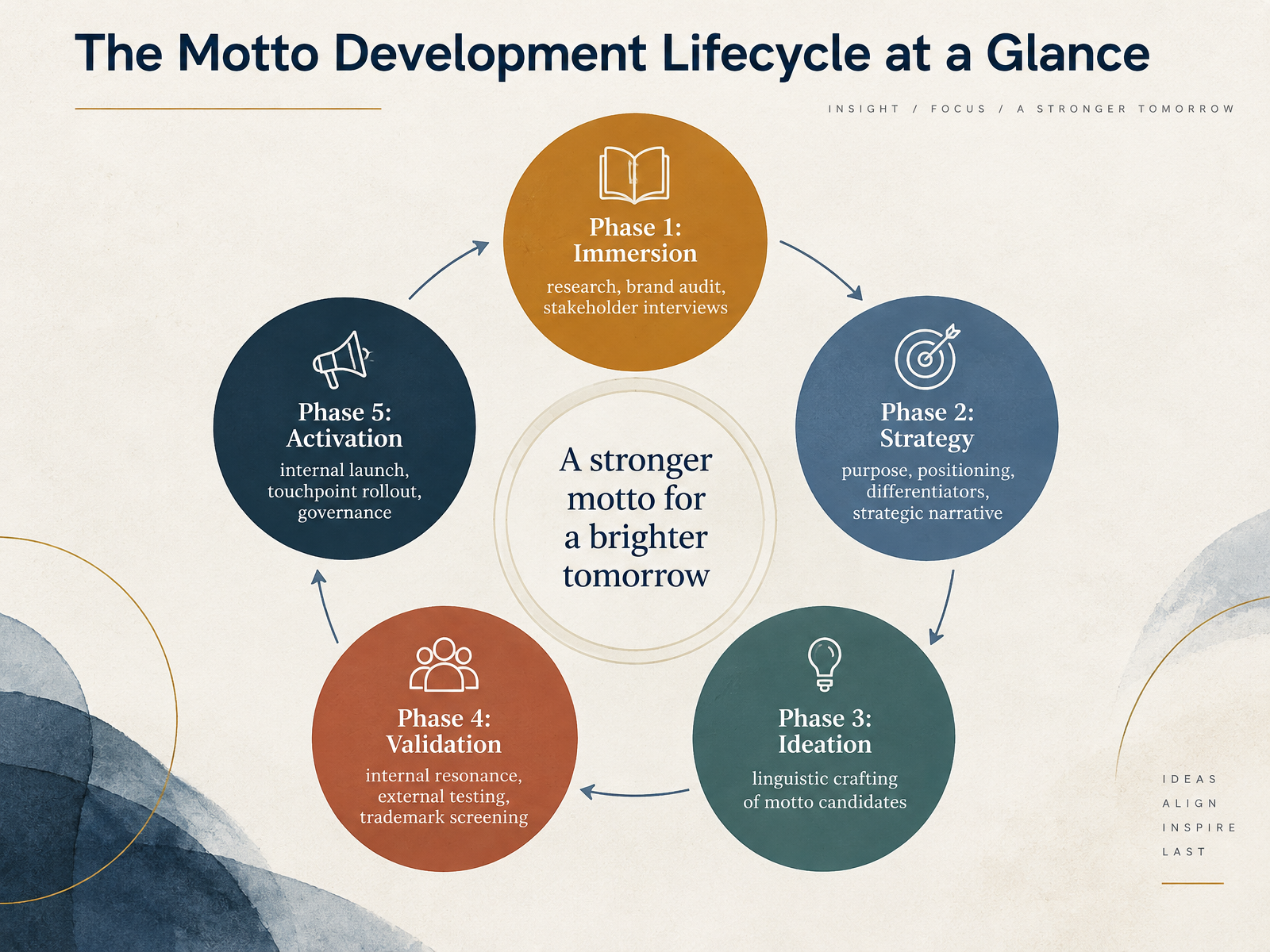
- 05The Motto Development Lifecycle at a GlanceLet's step back and look at the full lifecycle. Five phases. Think of them as gates, not suggestions. Phase one, Immersion. That means research, a brand audit, and stakeholder interviews, so you understand the truth of the company before you write a word. Phase two, Strategy. Purpose, positioning, differentiators, and a strategic narrative. This is the anchor everything else hangs on. Phase three, Ideation. The linguistic crafting of motto candidates, where you test rhythm, meaning, and how each line lands out loud. Phase four, Validation. Internal resonance, external testing, and trademark screening, before you fall in love with anything. Phase five, Activation. Internal launch first, then touchpoint rollout, then governance, so the motto stays alive after launch day and gets used, not framed. Your next action, map a live client project against these five phases and mark which gate you're standing in today. Next, we go deeper into Discovery: Brand Audit and Perception Mapping.
 wearemotto.comwearemotto.comwearemotto.com+22 min
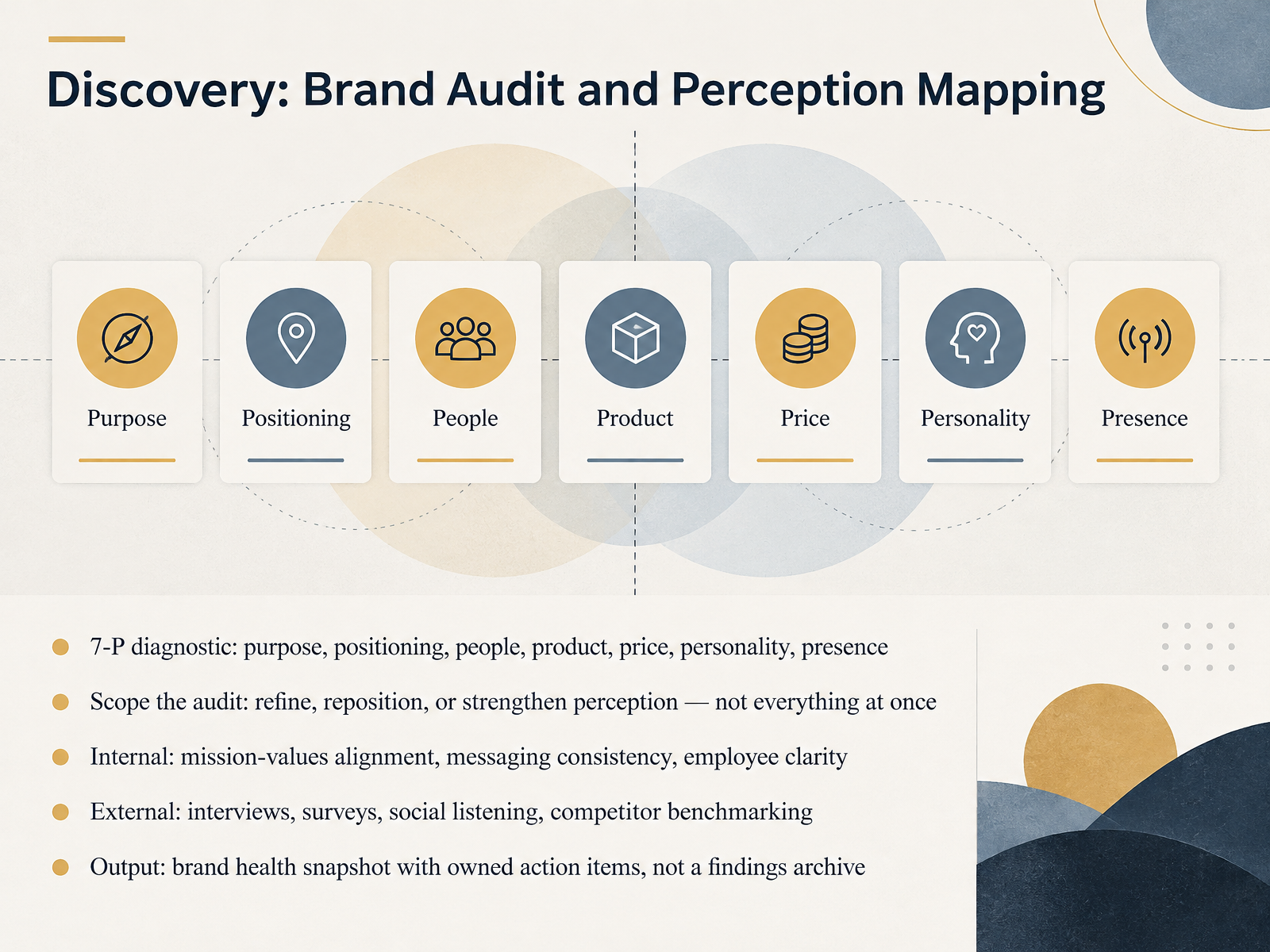
- 06Discovery: Brand Audit and Perception MappingNow let's move into Discovery. This is where a brand audit and perception mapping tell you what's actually true. Start with the seven-P diagnostic: purpose, positioning, people, product, price, personality, and presence. Read each one as a question about alignment, not a box to tick. Next, scope the audit. Decide whether you're refining, repositioning, or strengthening perception. Not everything at once. Then split the work. Internally, check mission and values alignment, messaging consistency, and whether employees can clearly describe the brand. Externally, run one-on-one interviews, surveys, social listening, and competitor benchmarking. One practical note: a handful of well-prepared interviews beats a long list of shallow ones. The output matters most. Deliver a brand health snapshot with owned action items, not a findings archive. So here's your next action: pick your scope, then draft the interview guide before you book a single session. Coming up next, Stakeholder Interviews That Produce Real Insight.
 chrisdowdall.comfountainheadstrategy.comumbrex.com+22 min
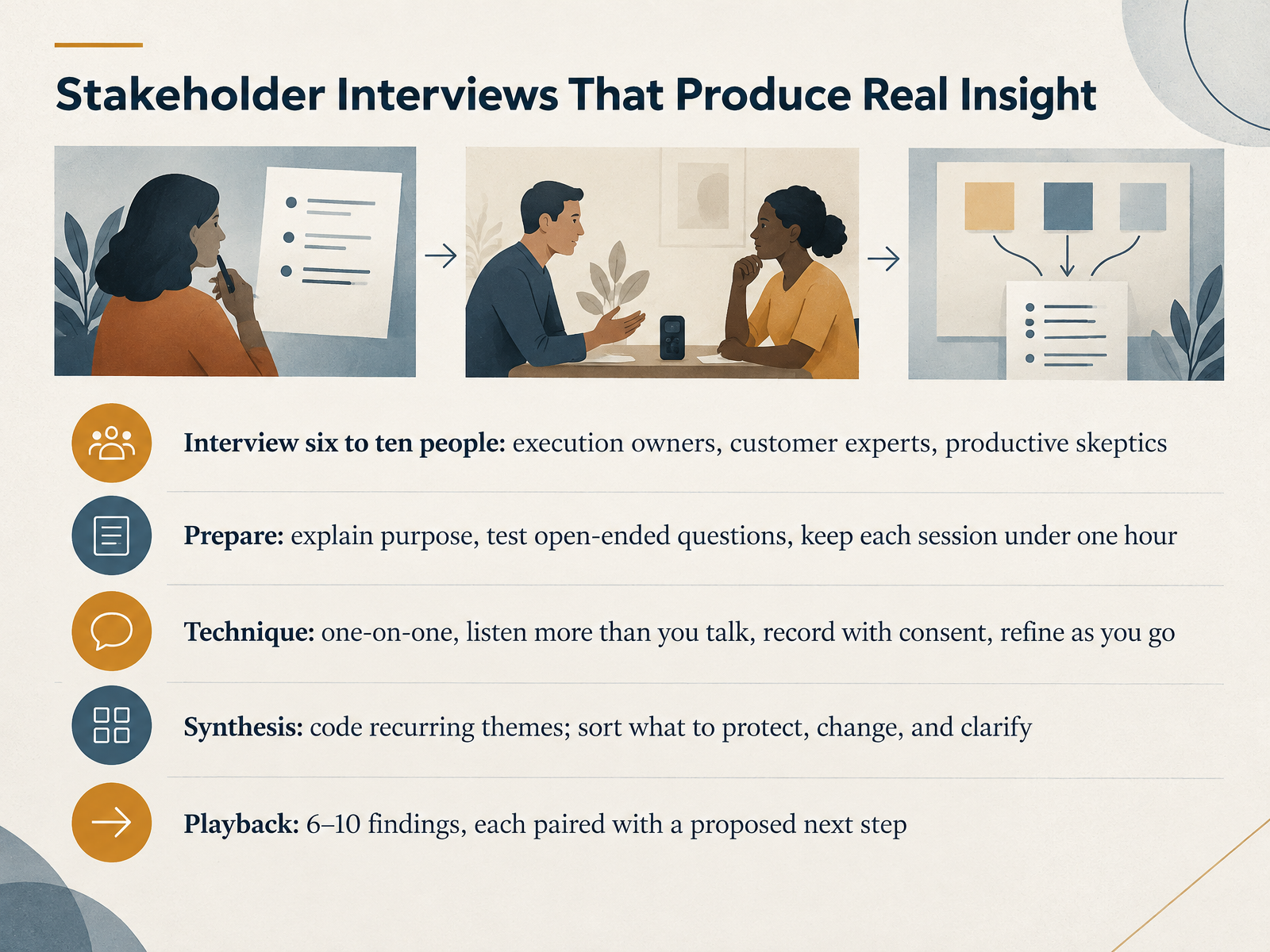
- 07Stakeholder Interviews That Produce Real InsightNext, let's look at how to run stakeholder interviews that actually produce insight. Aim for six to ten people. Include the execution owners, the customer experts, and at least one productive skeptic. Before each session, explain the purpose, test your open-ended questions, and keep the conversation under one hour. Run it one-on-one. Listen more than you talk. Record with consent, and refine your questions as you learn. Then synthesize. Code the recurring themes and sort them into three buckets: what to protect, what to change, and what to clarify. In playback, present six to ten findings, and pair each one with a proposed next step. That keeps the work decision-ready. Your next action is to draft your interviewee list and one open-ended question guide today. Building the Strategic Foundation.
 chrisdowdall.comfountainheadstrategy.comumbrex.com+22 min
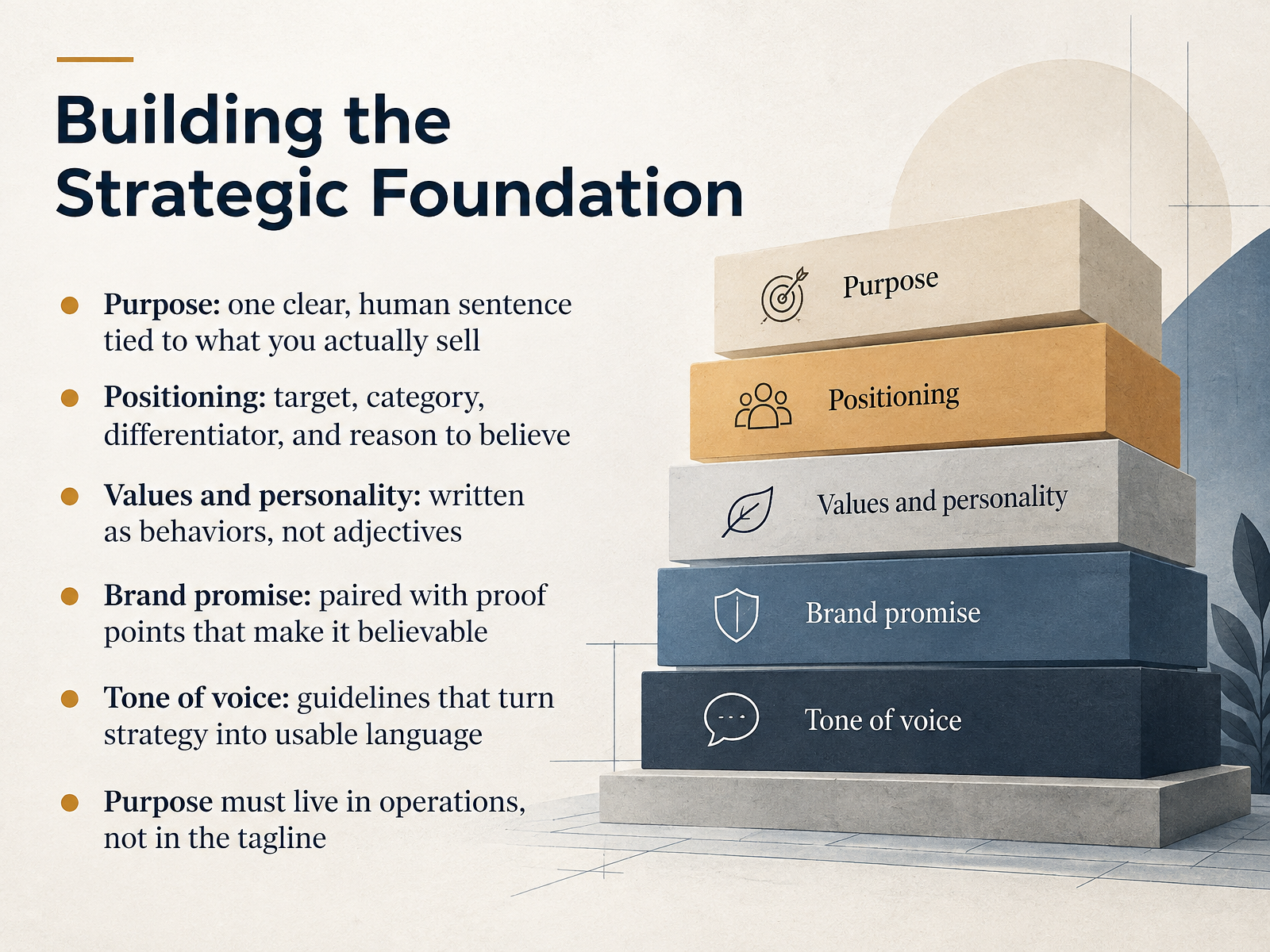
- 08Building the Strategic FoundationLet's build the strategic foundation. Start with purpose. Write it as one clear, human sentence tied to what you actually sell, not a vague aspiration. Then positioning: name the target, the category, the differentiator, and the reason to believe. Keep it testable.
Write values and personality as behaviors, not adjectives. So instead of saying we are bold, show how the team makes a bold call. Pair the brand promise with proof points that make it believable, and turn tone of voice into guidelines that convert strategy into usable language for writers and designers.
One discipline matters most: purpose must live in operations, not in the tagline. If hiring, pricing, and product decisions don't reflect it, it isn't real. Your next action: draft the purpose sentence and pressure-test it against three live operational decisions this week. That sets up the craft work ahead, Motto Ideation and Linguistic Craft.
 wfanet.orgtotembranding.combrandstruck.co+22 min
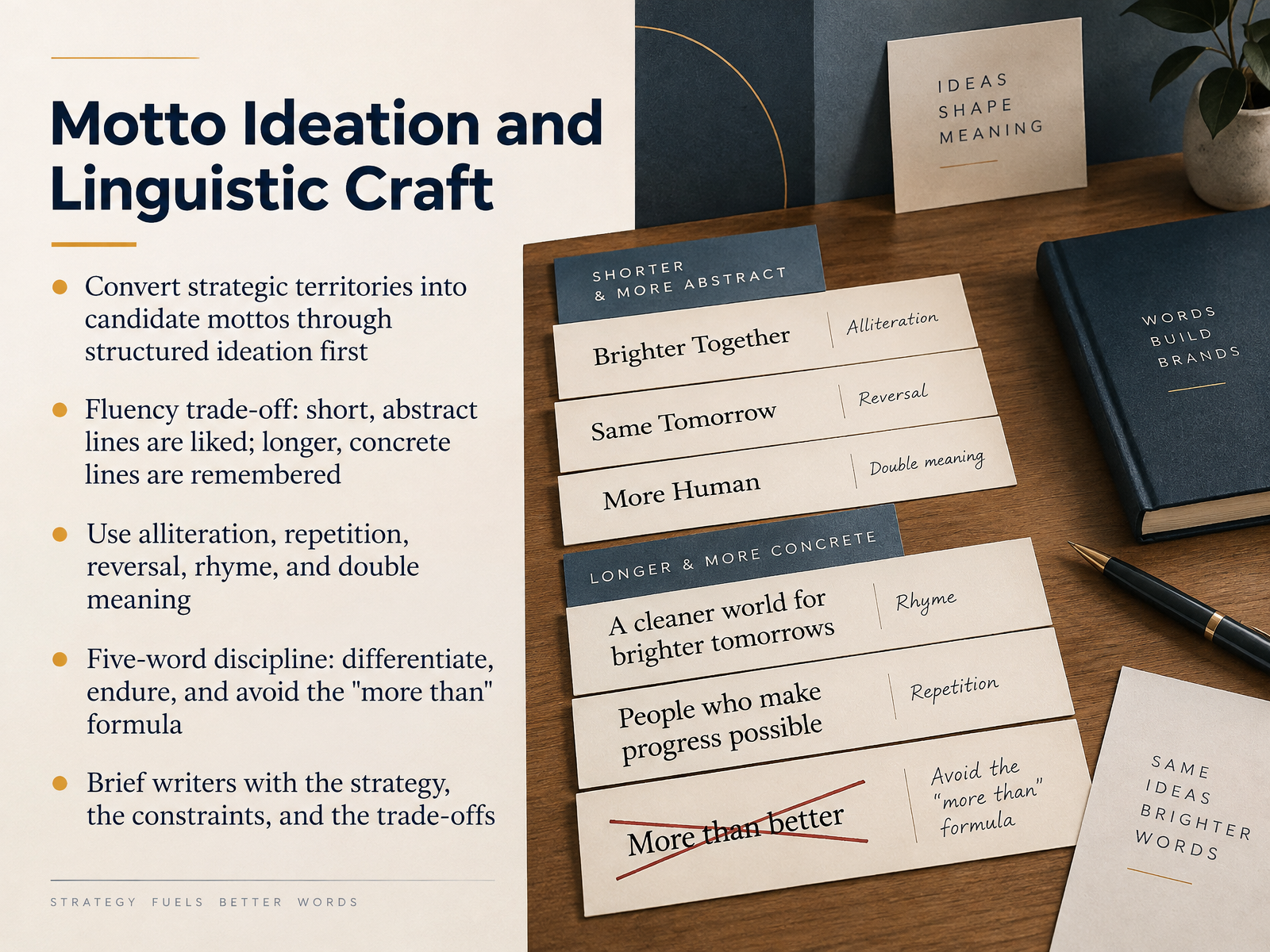
- 09Motto Ideation and Linguistic CraftNow let's turn strategy into language. Start by converting your strategic territories into candidate mottos through structured ideation, working from the territory outward rather than free-associating from nothing. Expect a trade-off. Research on over eight hundred slogans found that short, abstract lines are liked, while longer, concrete lines are remembered. Decide which job your motto needs to do. Then craft with devices: alliteration, repetition, reversal, rhyme, and double meaning. Keep the five-word discipline: differentiate, endure, and avoid the more than formula. And brief your writers properly, with the strategy, the constraints, and the trade-offs stated up front. Your next action: take one territory and generate ten candidates against these devices before judging any of them. That sets up testing, selection, and trademark screening.
 2 min
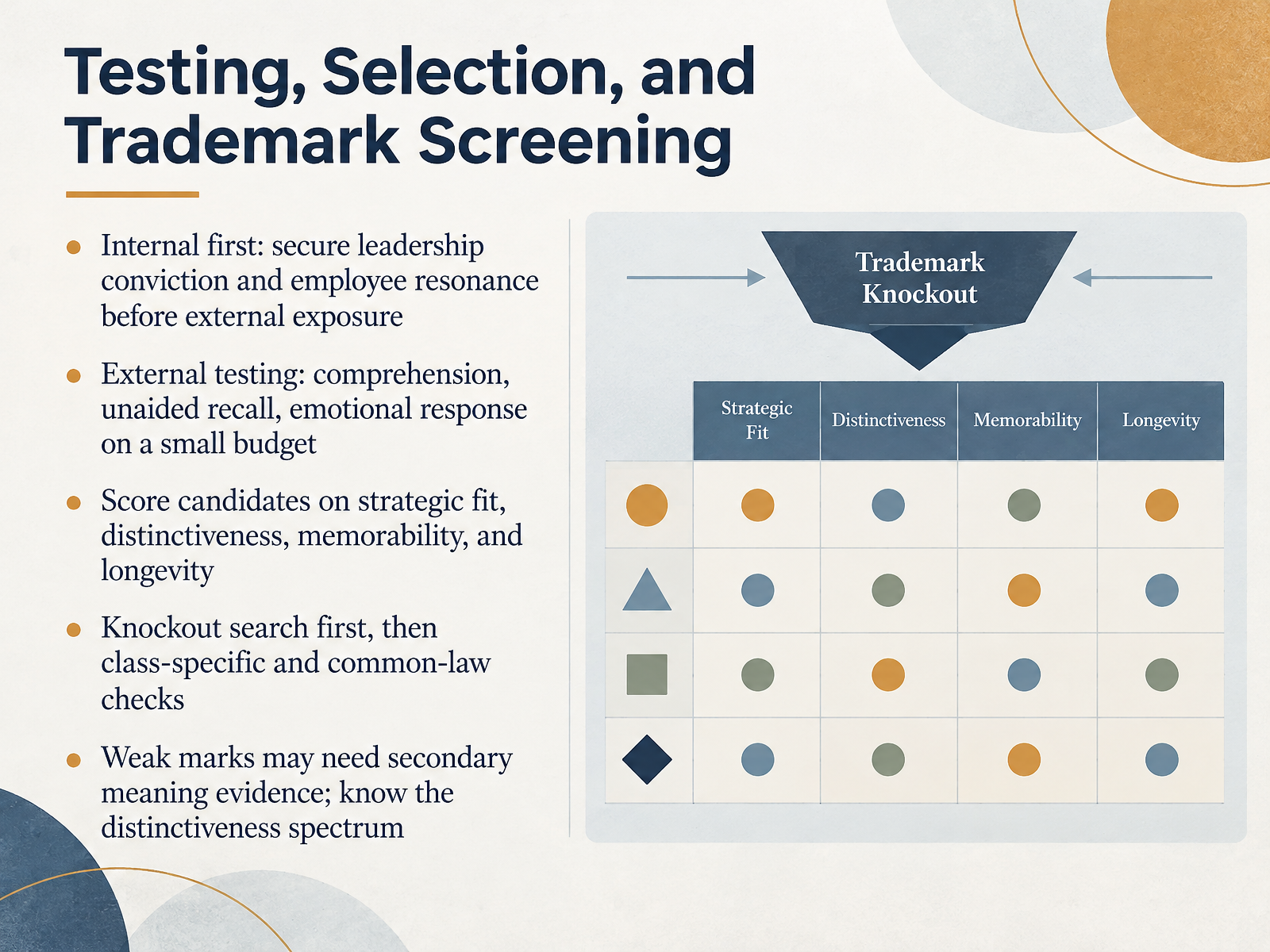
- 10Testing, Selection, and Trademark ScreeningNow let's move from drafting to testing and selection. Start internally. Secure leadership conviction and employee resonance before any external exposure. A motto your own team does not feel will not survive contact with the market.
Then test externally on a small budget. Measure three things: comprehension, unaided recall, and emotional response. Ask people what the motto means to them, and later, whether they remember it without prompting.
Score your candidates on four criteria: strategic fit, distinctiveness, memorability, and longevity.
On legal screening, run a knockout search first to eliminate obvious conflicts. Then do class-specific checks in your relevant goods and services classes, followed by common-law checks, including web and social use.
Remember the distinctiveness spectrum. Descriptive or weak marks may need secondary meaning evidence before they can be protected. Know where each candidate sits before you invest.
Your next action: build a simple screening sheet per candidate and run the knockout search this week.
Activation: Turning the Motto into Everyday Behavior.
 2 min
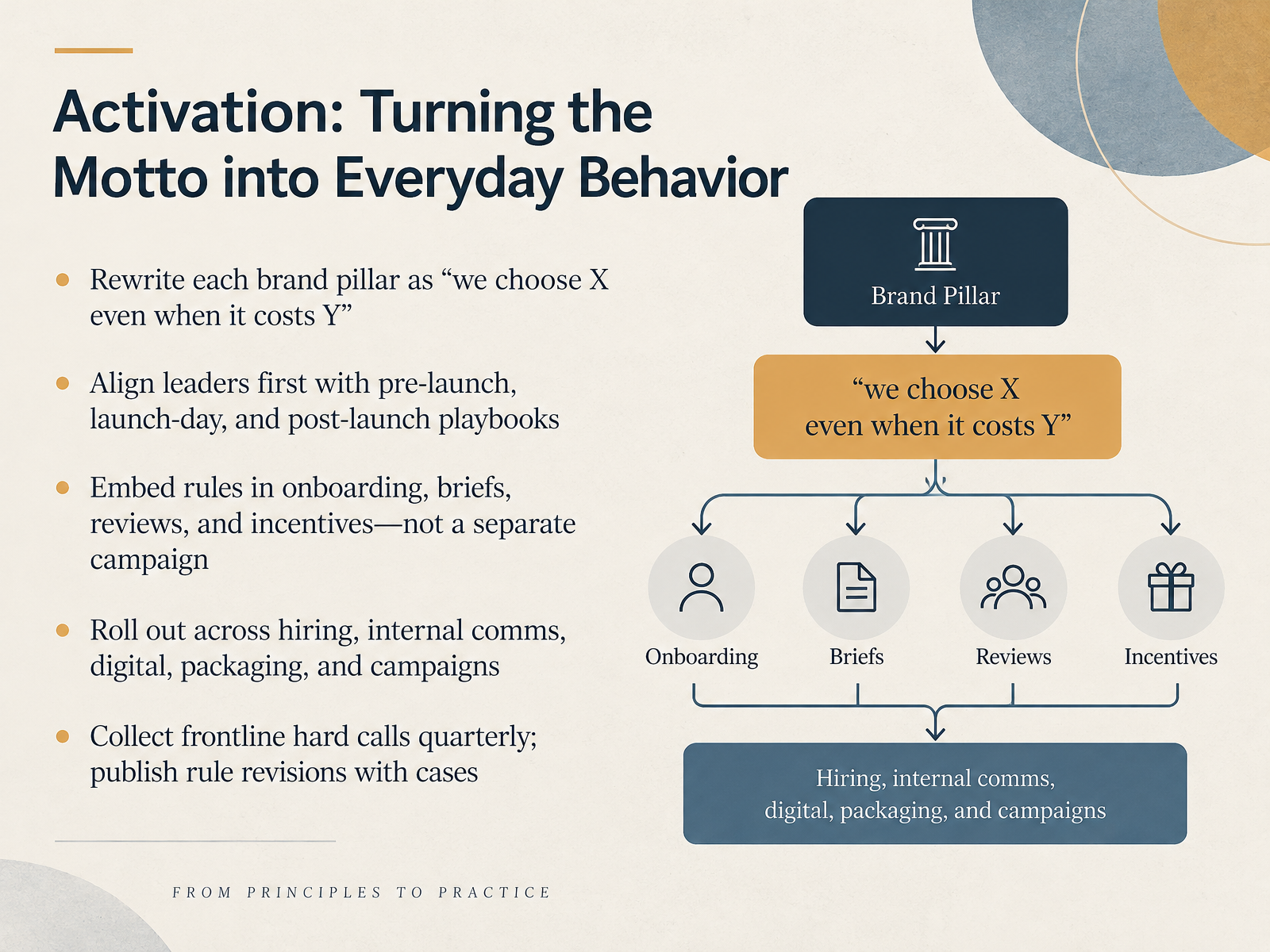
- 11Activation: Turning the Motto into Everyday BehaviorNow let's make the motto real, because a principle people can't apply under pressure is just a poster. Start by rewriting each brand pillar as a decision rule: we choose X even when it costs Y. A principle with no named cost guides nothing. Test each rule against a real decision from last month. If it wouldn't have changed the outcome, rewrite it. Next, align leaders first. Give each level a playbook for pre-launch, launch day, and post-launch. Then embed the rules where decisions already happen: onboarding, creative briefs, review templates, and incentive design. Check whether any target quietly rewards breaking a rule, and fix the target before you retrain anyone. Roll the same rules across hiring, internal comms, digital, packaging, and campaigns, so this becomes an operating system, not a separate campaign. Every quarter, collect frontline hard calls and publish rule revisions alongside the case that prompted them. Your next action: draft three decision rules and pressure-test them against recent decisions. That brings us to measuring adoption and brand alignment.
 2 min
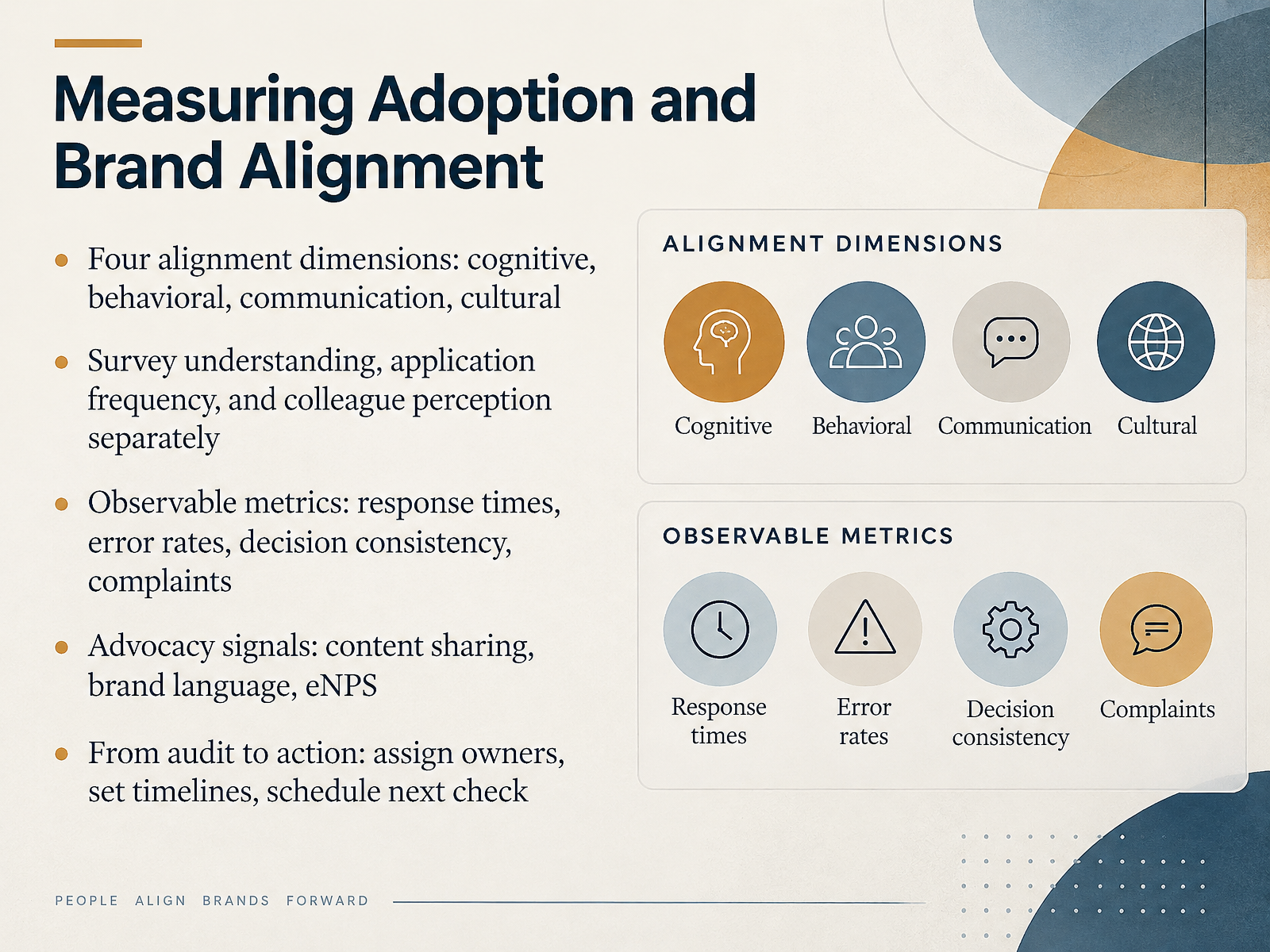
- 12Measuring Adoption and Brand AlignmentNow let's talk about measuring adoption and brand alignment. An audit is only useful if it produces action, so measure four dimensions. Cognitive alignment asks whether employees understand the brand. Behavioral alignment asks whether daily decisions reflect it. Communication alignment checks whether messaging stays consistent. And cultural alignment asks whether rituals and norms reinforce the brand. Keep your surveys separate. Ask about understanding, application frequency, and colleague perception as distinct questions. Then add observable metrics. If speed is a value, track response times. If quality is a value, track error rates and rework. Also watch decision consistency and customer complaints. Advocacy signals matter too, such as content sharing, use of brand language, and employee net promoter score. Here's your next action. Turn the findings into an action plan. Assign owners, set timelines, and schedule the next check. That rhythm is what keeps alignment alive. Let's move on to governance and common pitfalls.
 1 min
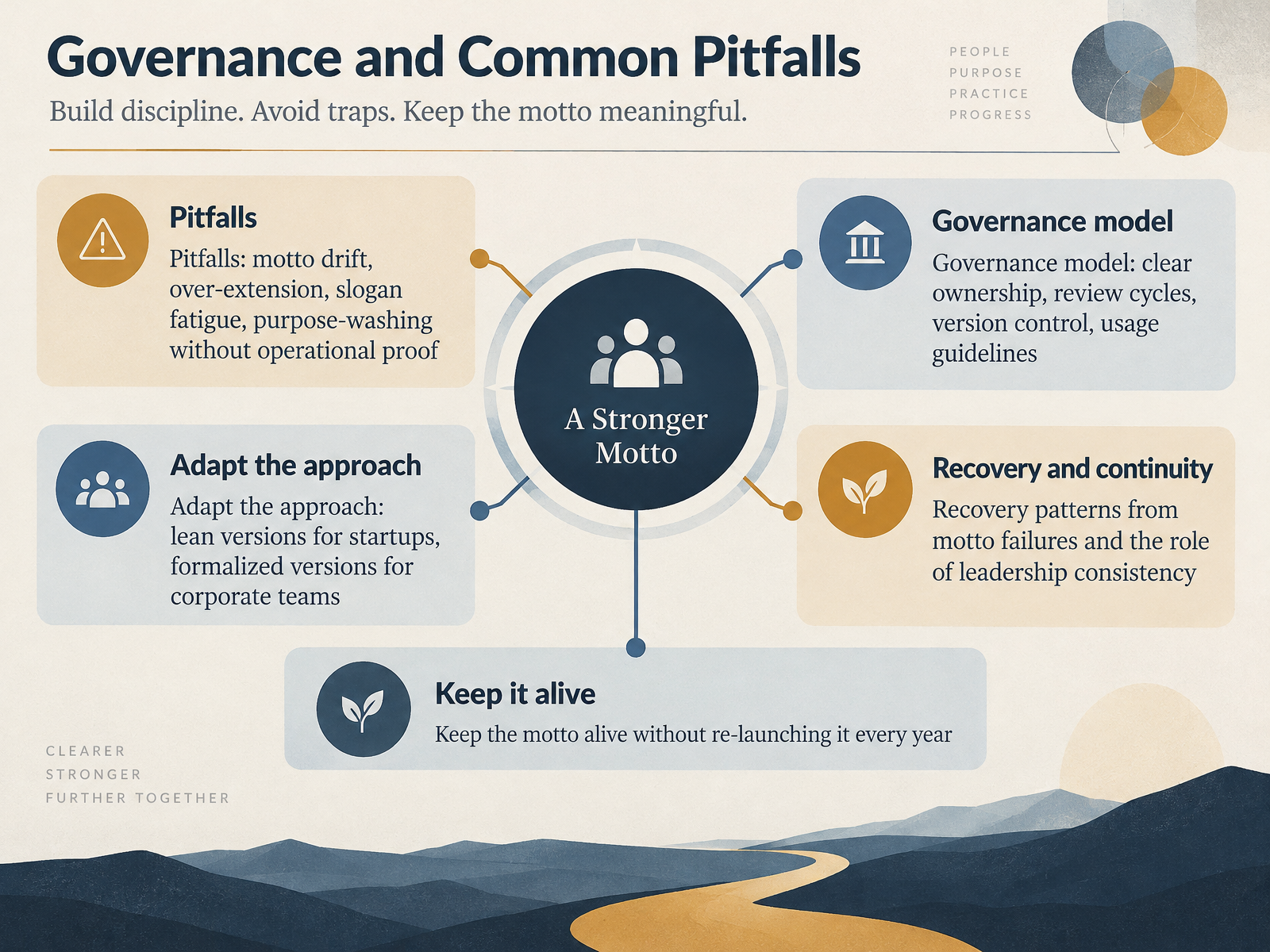
- 13Governance and Common PitfallsNow let's talk about governance, and the four pitfalls that quietly kill a motto. Watch for motto drift, where usage slowly drifts from the original meaning. Over-extension, where the line gets stretched to cover everything. Slogan fatigue, where repetition dulls impact. And purpose-washing, where claims run ahead of operational proof. Governance prevents all four. Assign clear ownership. Set review cycles. Use version control. Publish usage guidelines. Then adapt the model: lean and light for startups, more formalized for corporate teams. If a motto fails, treat it as a recovery exercise. Restate the intent, publish the proof, and let leadership consistency do the repair. Keep the motto alive through behavior, not an annual relaunch. Your next action: name one owner and one review date this week. Next, we move into teaching the approach and your thirty day action plan.
 wfanet.orgtotembranding.combrandstruck.co+22 min
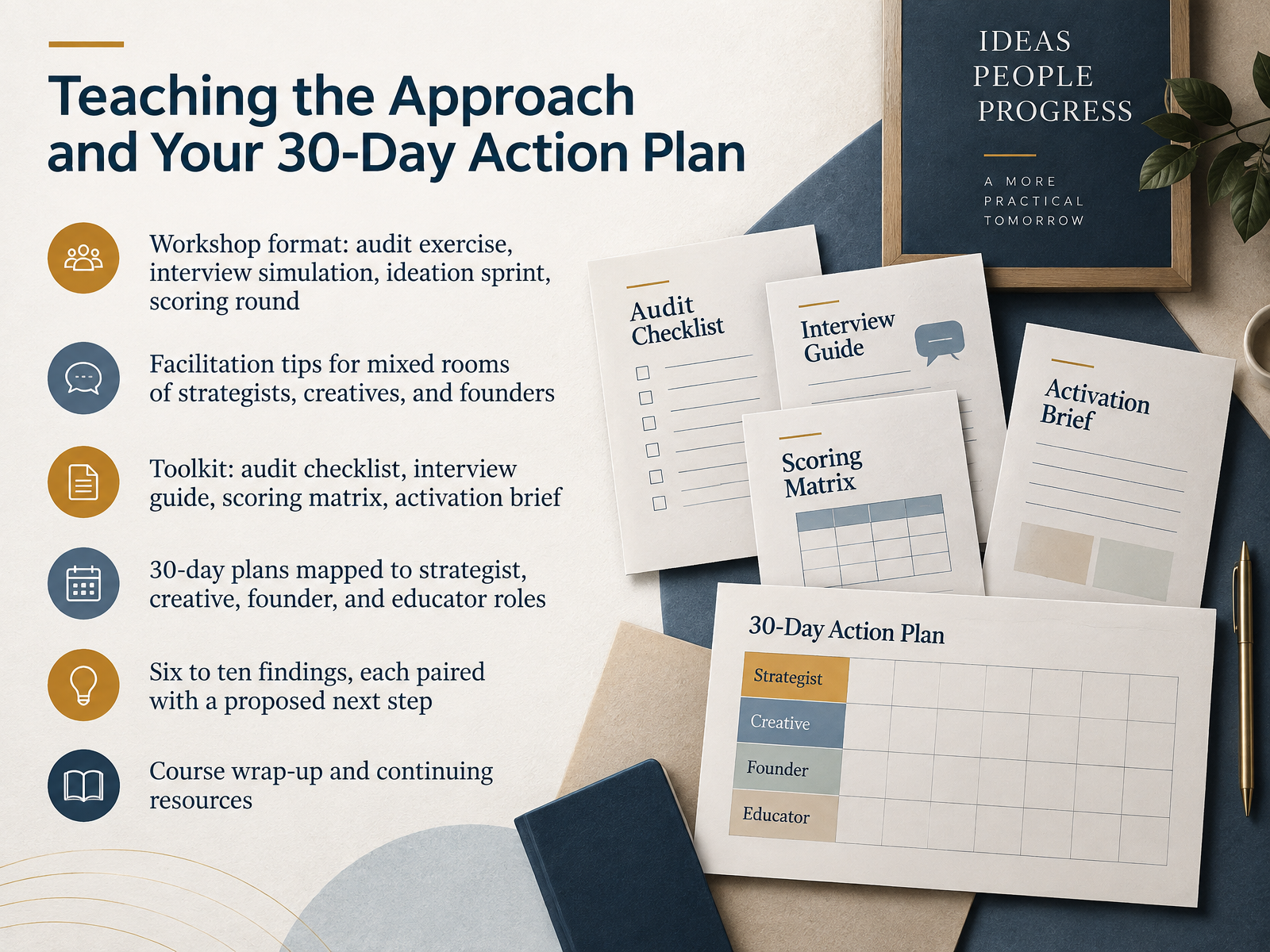
- 14Teaching the Approach and Your 30-Day Action PlanLet's land this by making it teachable. Run your workshop in four moves: a brand audit exercise, an interview simulation, an ideation sprint, and a scoring round. In a mixed room, give strategists, creatives, and founders the same brief, then assign different lenses. Facilitation tip for mixed rooms: let each group speak first in their own language, then translate. Creatives say feelings, founders say trade-offs. For your toolkit, keep four assets: an audit checklist, an interview guide, a scoring matrix, and an activation brief. In stakeholder playback, distil findings into six to ten points, and pair every single one with a proposed next step. Never share a problem without a possible way out. Now the thirty day plans. Strategists, run one audit and five interviews. Creatives, turn insights into one activation concept. Founders, write your positioning as decision rules with stated trade-offs. Educators, pilot one workshop module and collect feedback. Your next action: choose your role, pick one item from that plan, and book the calendar time today. Thank you for learning with me. You now have a method worth testing. Go run it on a real client, and welcome questions and iteration as you refine it.
 chrisdowdall.comfountainheadstrategy.comumbrex.com+22 min
Take the deck with you
Download this course as a file — free, no sign-up needed.
- PDF handoutEvery slide page, ready to print or share.15 pages · 4.2 MBDownload
- Narrated PowerPointThe deck that presents itself — every slide carries the digital human's narration video.15 pages · 14.3 MBDownload
- PowerPoint slidesThe full deck as a .pptx — open it in PowerPoint, Keynote, or Google Slides.15 pages · 4.2 MBDownload
Free to use in your own training — please keep the PersonWise credit page at the end.
Have your own deck? Turn it into a course
Sources consulted
Web sources consulted while building this course.
- Motto® | Branding Company | Ideas Worth Rallying Around® — wearemotto.com
- The complete guide to creating a brand strategy | Motto® — wearemotto.com
- Foundation® | Brand Strategy | Brand Positioning — wearemotto.com
- Explore our 7-point brand audit | Motto® — wearemotto.com
- What is brand strategy and why it matters — wearemotto.com
- What brand purpose really does - World Federation of Advertisers — wfanet.org
- Brand Strategy Trends 2026: 6 Shifts You Cannot Ignore | TOTEM — totembranding.com
- Is brand purpose dead? | BrandStruck: Brand Strategy / Positioning Case Studies — brandstruck.co
- The emotional shift reshaping brand strategy in 2026 - The Media Online — themediaonline.co.za
- Purpose Driven Brand Strategy 2026: What Works & Why | Grounded World | Grounded World — grounded.world
- Brand Tagline vs Slogan vs Motto: What’s the Difference and When to Use Each? | Brand Vision — brandvm.com
- What’s the Difference Between a Motto, a Tagline and a Slogan? — chevronediting.com.au
- Straplines, statements, propositions and promises: Brand statements explained | The Identity Bureau — theidbureau.com
- Positioning Statement? Tagline? Mantra? - GT&A Strategic Marketing Inc. — gtamarketing.com
- Why & how to write a Brand Promise (with 12 examples) - BMB — brandmarketingblog.com
- Mastering brand interviews - Chris Dowdall — chrisdowdall.com
- Stakeholder Interviews Set the Stage When Embarking on Brand Positioning - Fountainhead | Brand Strategy — fountainheadstrategy.com
- Branding Diagnostic Guide | Umbrex — umbrex.com
- The guide to stakeholder interviews: What works and what doesn’t - Studio Noel — studionoel.co.uk
- A Step-By-Step Guide to Conducting a Brand Audit | Substance151 — substance151.com