English Pronunciation Fundamentals
Begin
15 pages · ~30 min
English Pronunciation Fundamentals
This training introduces English pronunciation fundamentals, helping learners improve clarity, accuracy, and confidence in spoken English through core sound and intonation practice.
What you’ll learn
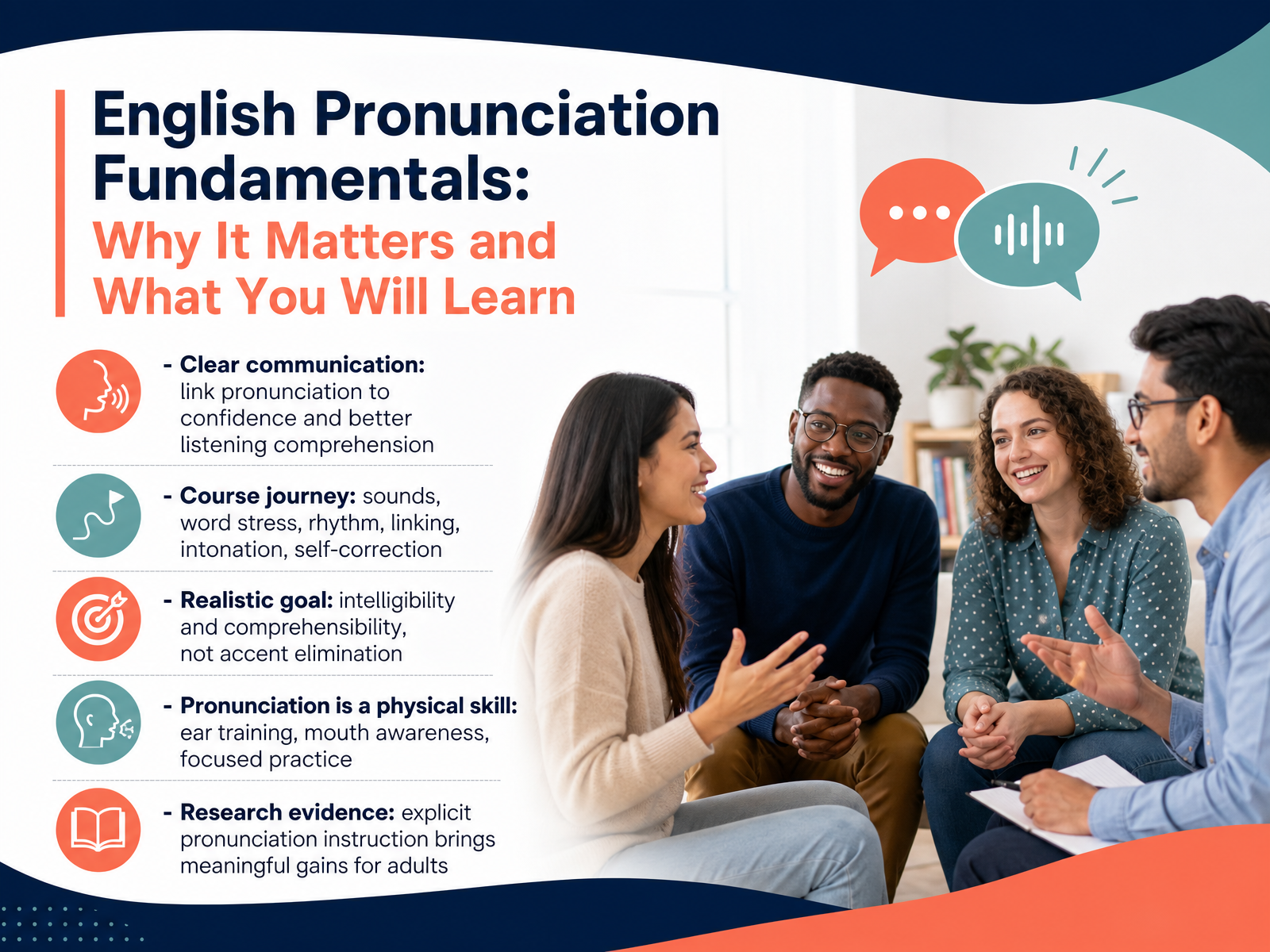
- 01English Pronunciation Fundamentals: Why It Matters and What You Will LearnHello, and welcome. If you have ever felt nervous about how you sound when speaking English, you are in exactly the right place. Let me start with a simple truth: clear pronunciation is not about sounding like a native speaker. It is about being understood, and about feeling confident when you speak. Over this course, we will walk through the building blocks of English pronunciation together. We will explore individual sounds, word stress, rhythm, and intonation. We will learn how to hear the music of the language and how to correct ourselves naturally. Our goal is realistic and very achievable: to make your speech clear, intelligible, and easy to follow. Pronunciation is a physical skill, like learning to dance or to play an instrument. It requires training your ear, becoming aware of how your mouth moves, and practicing with focus. And here is the encouraging part: research shows that when adults receive clear, explicit pronunciation instruction, they make meaningful, measurable progress. So please do not worry about perfection. Bring your curiosity, be patient with yourself, and get ready to practice. Next, we will look at what pronunciation really involves: the sounds, the stress, and the music of speech.doi.orgdoi.orgdoi.org+22 min
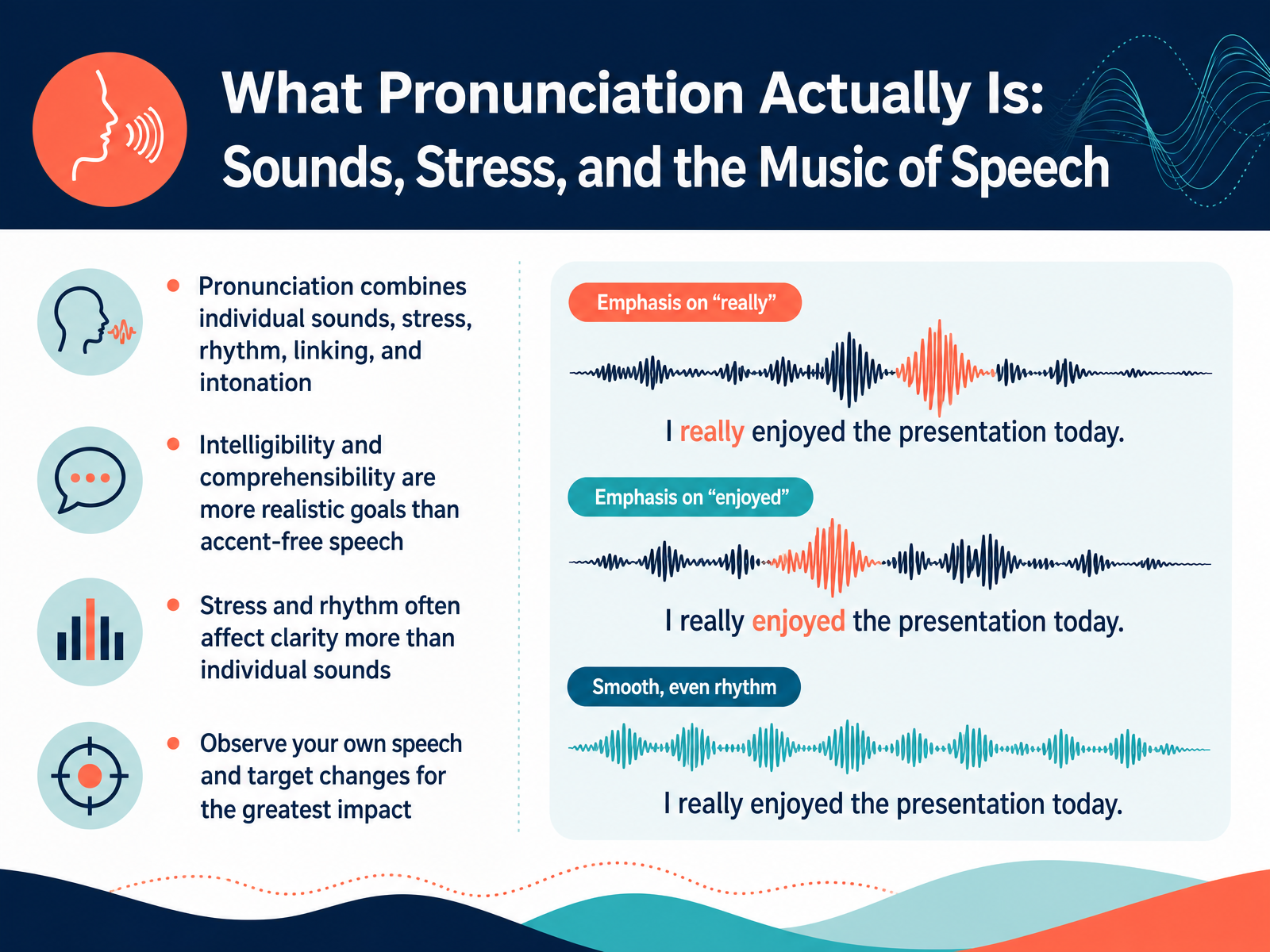
- 02What Pronunciation Actually Is: Sounds, Stress, and the Music of SpeechLet's take a closer look at what pronunciation really means. It's not just about individual sounds, though those matter. Pronunciation also includes stress, rhythm, linking, and intonation—the music of speech. Think of stress as the emphasis we put on certain syllables, like in the word 'photograph' versus 'photography.' The rhythm is the beat of the sentence, and intonation is the rising and falling pitch that shows emotion or asks a question. Now, here's an encouraging thought: you don't need to sound like a native speaker. The real goal is intelligibility and comprehensibility—making sure people understand you easily. In fact, stress and rhythm often affect clarity more than the individual sounds do. So, if you're not sure where to start, listen to your own speech, pick one pattern to work on, and practice that. Small, focused changes make a big impact. Coming up next, we'll take a quick tour of the vocal tract to see how we actually produce speech.
 2 min
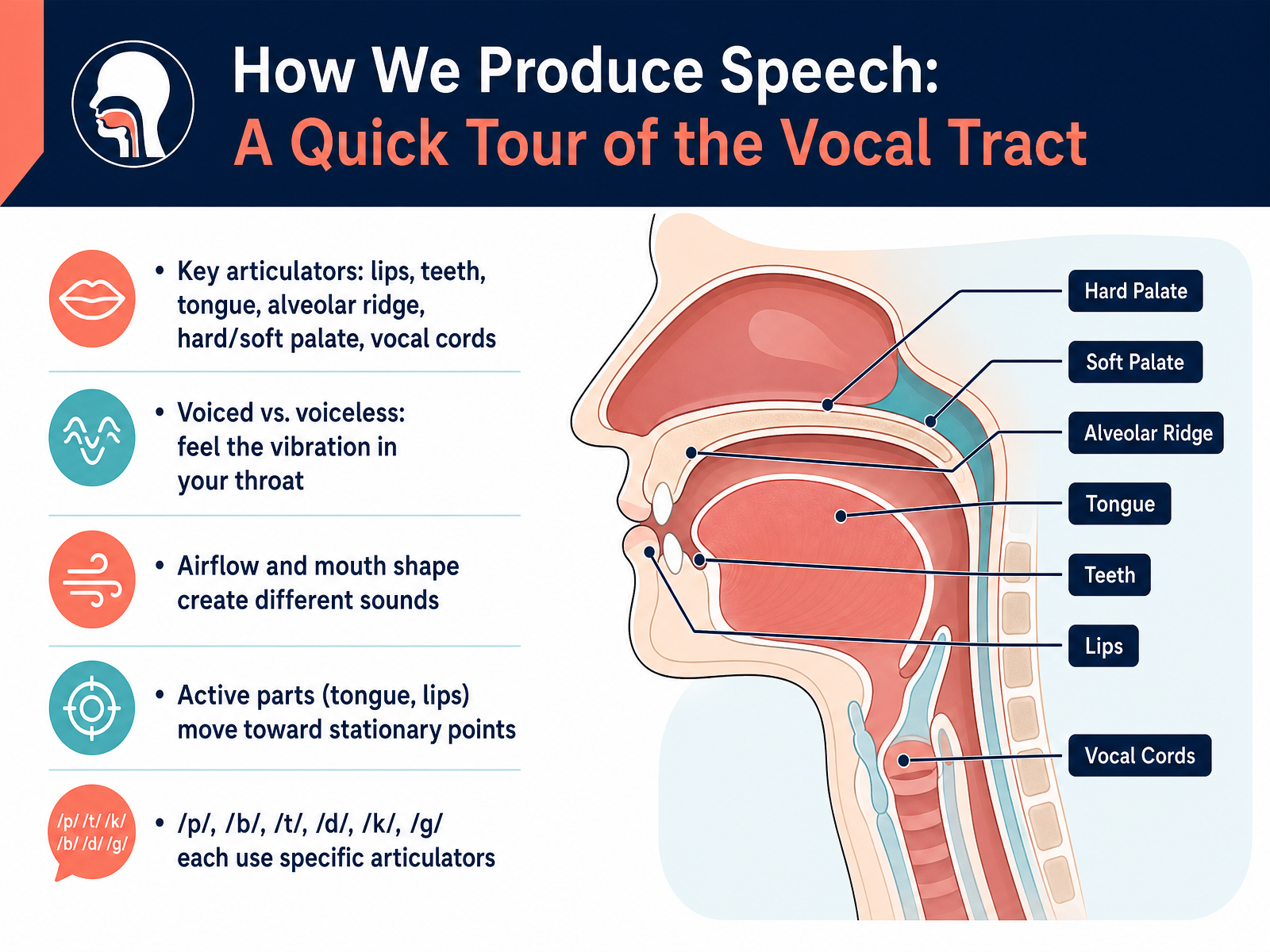
2 min - 03How We Produce Speech: A Quick Tour of the Vocal TractLet’s take a quick tour inside your mouth. Every sound you make is shaped by parts of your vocal tract. The main players are your lips, your teeth, your tongue, the hard and soft parts of your palate, and the ridge just behind your upper teeth, called the alveolar ridge. Here is a key idea. Say the sound /s/, and hold it. Now say /z/. Did you feel a vibration in your throat for /z/? That is voicing. Your vocal cords vibrate for voiced sounds like /b/ and /d/. They stay still for voiceless sounds like /p/ and /t/. Put your hand on your throat and compare /p/, /b/, /p/, /b/. That feeling is your guide. For most consonant sounds, a moving part, usually your tongue or lips, touches or comes close to a stationary point. For example, /p/ and /b/ use both lips together. /t/ and /d/ touch the tongue tip to the alveolar ridge. And /k/ and /g/ are made further back where the tongue meets the soft palate. These little movements create very different sounds in English. Practice each pair slowly. Feel where your tongue goes, and notice the vibration. Next, we will explore the vowel sounds, where mouth shape and tongue position matter most.
 ocw.mit.edupressbooks.nvcc.eduwordwall.net+21 min
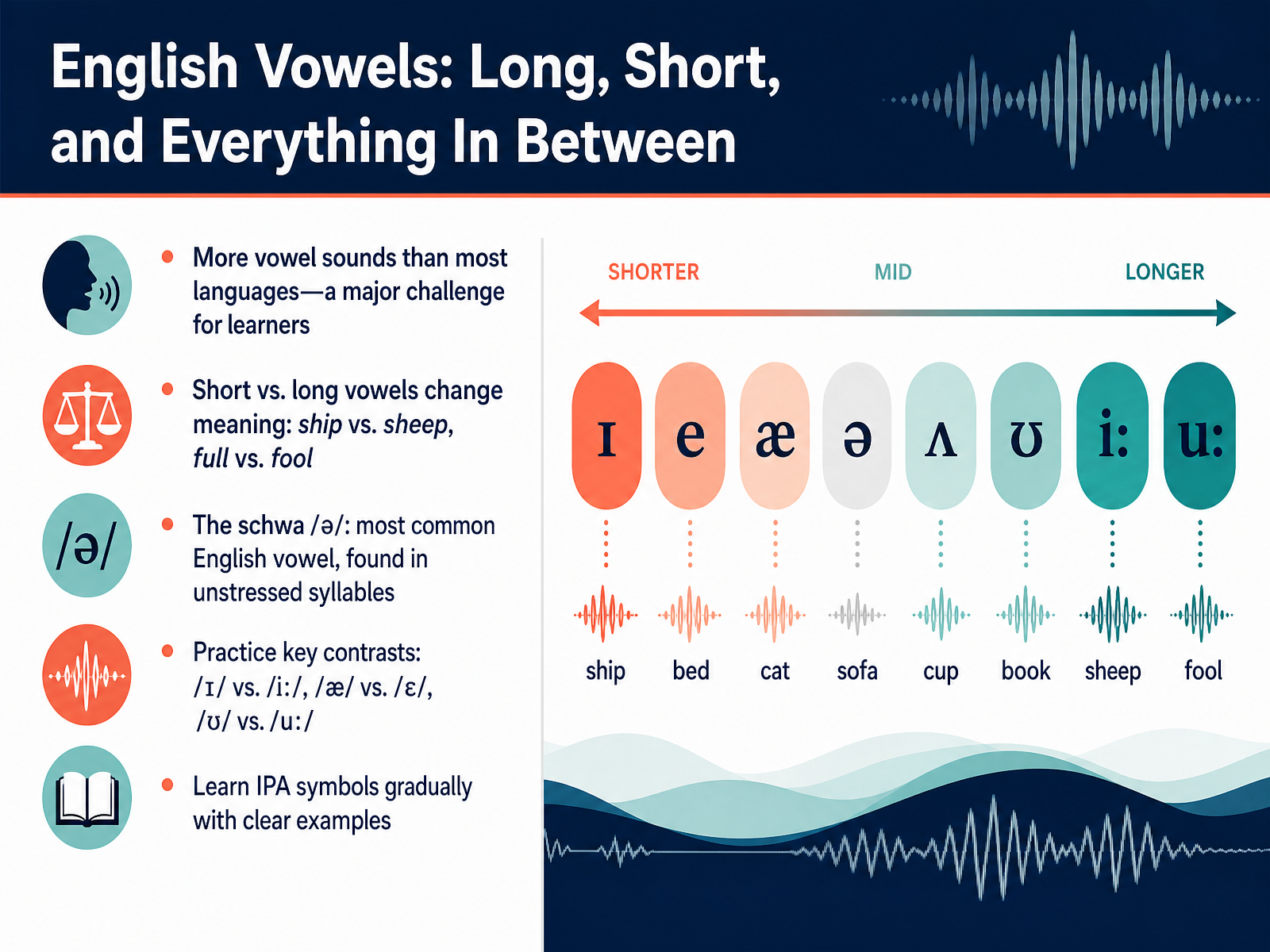
 - 04English Vowels: Long, Short, and Everything In BetweenLet’s look closely at English vowel sounds. English has many more vowel sounds than most other languages, which is why this can feel like a big challenge. But don’t worry, you can master it step by step. The key idea here is that the length of a vowel can completely change the meaning of a word. For example, ship and sheep. In ship, the vowel is short. In sheep, the vowel is long. Try it with me. Ship. Sheep. Now another pair. Full and fool. Full, short vowel. Fool, long vowel. Hearing that difference matters. There is also a very special sound called the schwa. It’s the most common vowel sound in English. You hear it in unstressed syllables, like the first sound in the word about. It’s very relaxed and quick. Uh, about. For practice today, focus on three important sound contrasts. The short i in ship versus the long e in sheep. The a sound in cat versus the e sound in bed. And the short u in full versus the long u in fool. You don’t need to memorize all the symbols at once. Just learn them gradually with clear examples, one pair at a time. This will train your ear and your mouth together. Next, we’ll move on to English consonants and how we shape them.
 englishclub.comitalki.comesl-lounge.com+22 min
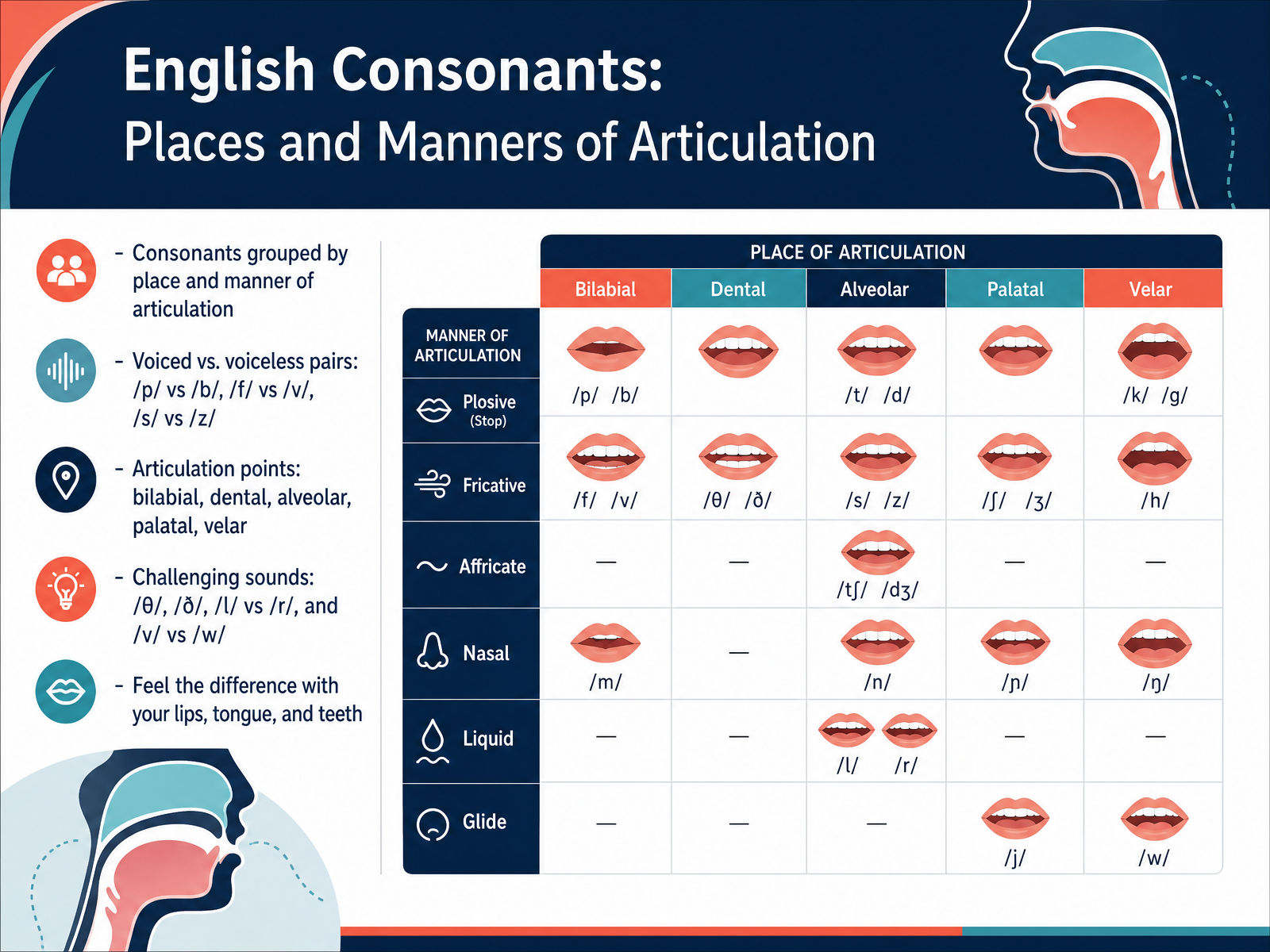
 - 05English Consonants: Places and Manners of ArticulationLet’s take a closer look at how consonants are formed. Every consonant sound is made by blocking or shaping the air in a specific way, and in a specific place in your mouth. Think of it as a small movement map for your lips, tongue, and teeth. First, let’s talk about paired sounds. Many consonants come in voiced and voiceless pairs. For example, the sound p is voiceless, meaning you don’t use your vocal cords, while its partner b is voiced. Try it. Put your hand on your throat. Say p, p, p. Then say b, b, b. Feel the vibration with b? Good. The same idea applies to f and v, and s and z. Now, where do we make these sounds? Some are bilabial, which means you use both lips, like p and b. Others are dental, where your tongue touches your teeth, like th in think. We also have alveolar sounds, made near the ridge behind your teeth, like t and d. And we have palatal and velar sounds, made further back in the mouth. Now, a few sounds are especially tricky for learners. The th sound, both voiceless and voiced, can feel strange at first. Also, many learners mix up l and r, or v and w. That is completely normal. The key is to notice where your tongue is and what your lips are doing. Take a moment to feel the difference with your own mouth. Press your lips for w, and touch your teeth to your bottom lip for v. Feeling the placement is the first step to making the sound clearly. Keep practicing these positions slowly, and soon, they will feel natural. Now, let’s look at some confusing sound pairs and the practical contrasts that really matter in everyday conversation.
 2 min
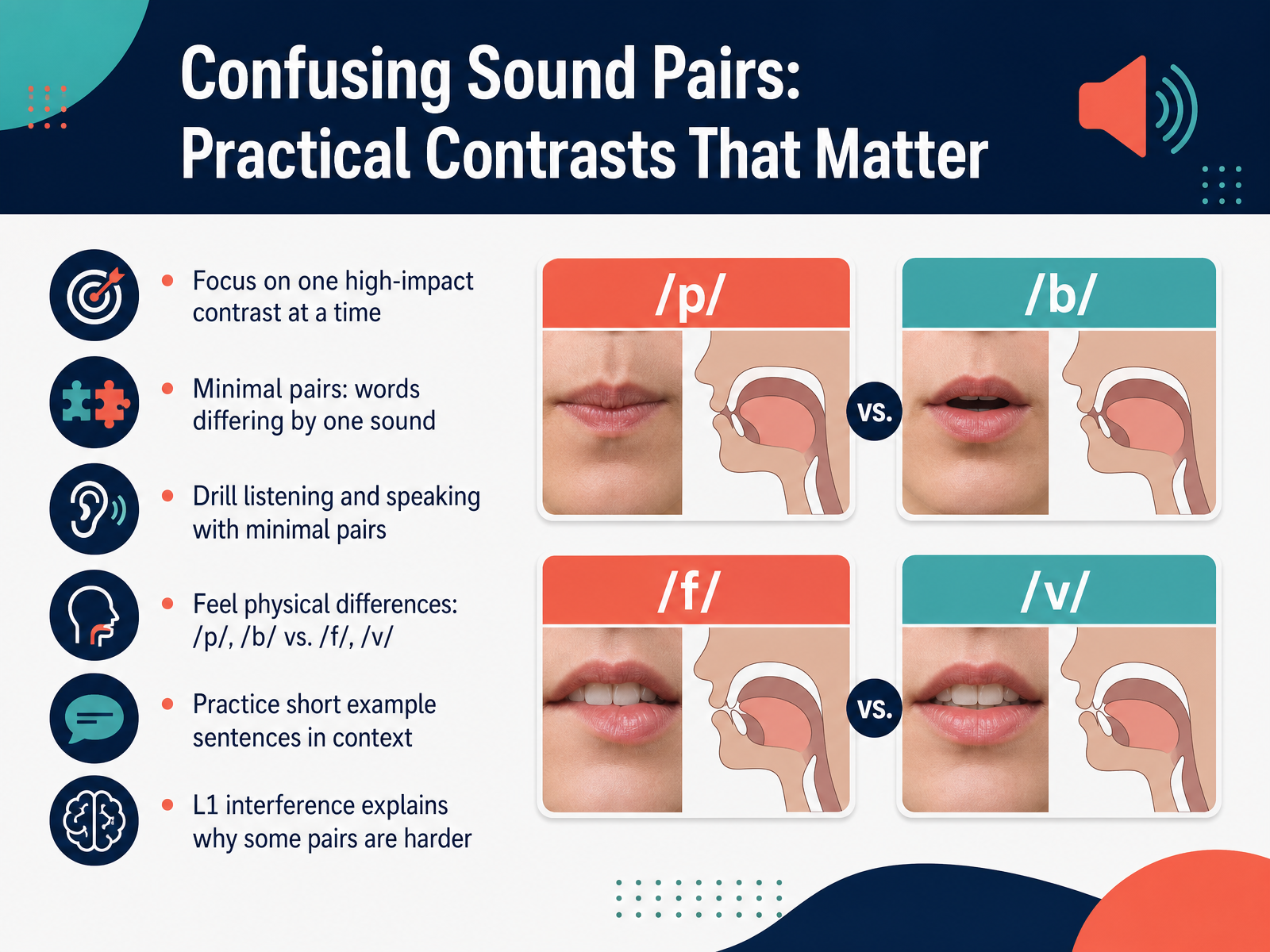
2 min - 06Confusing Sound Pairs: Practical Contrasts That MatterLet’s take a closer look at confusing sound pairs and why focusing on just one contrast at a time can change how clearly you speak. Think of two words that sound almost the same, like ship and sheep, or fan and van. These are called minimal pairs because they differ by only one sound. When you practice a pair slowly, your ears learn to hear the difference, and your mouth learns to make it. Here is a helpful trick: feel where the sound is made. For p and b, your lips close completely and air pops out. For f and v, your top teeth gently touch your bottom lip, and you feel a soft vibration for v. Try that: pat, bat, fan, van. Notice how your mouth moves differently. Short sentences help too. Say, Please pass the pat, not please pass the bat, or The fan is loud, not the van is loud. If one pair is harder for you, that is completely normal. It often comes from your first language, and there is no need to be hard on yourself about it. The goal is progress, not perfection. Keep choosing one pair each day, and soon these sounds will feel natural. Next, we will look at word stress and where to place emphasis so your words carry the right meaning.
 2 min
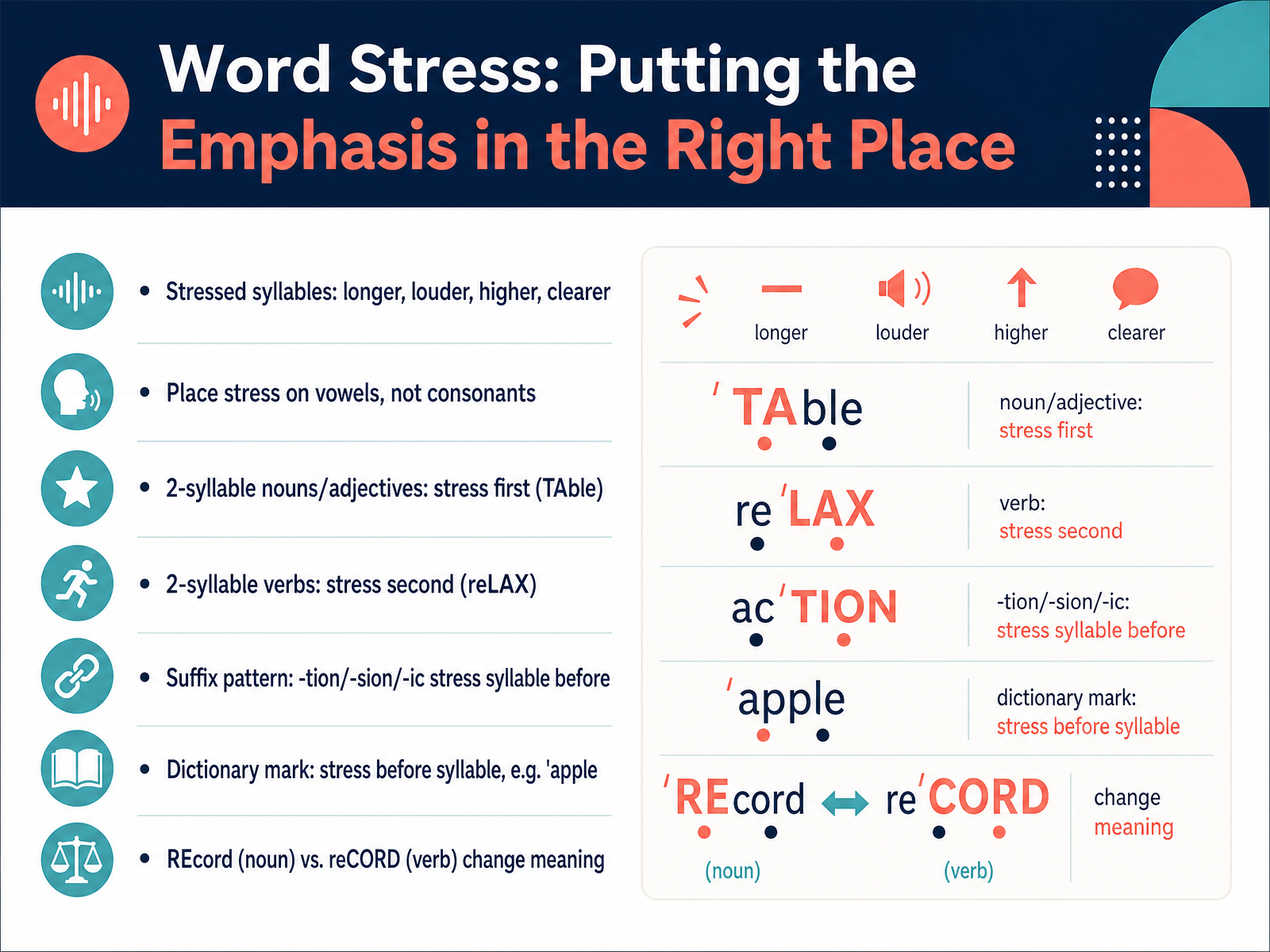
2 min - 07Word Stress: Putting the Emphasis in the Right PlaceNow let's talk about word stress, which means making one syllable in a word stronger than the others. A stressed syllable is longer, louder, higher in pitch, and clearer. And we always stress a vowel, not a consonant. For two-syllable nouns and adjectives, like table, stress the first syllable: TA-ble. But for two-syllable verbs, like relax, stress the second: re-LAX. Here's a helpful pattern: words ending in tion, sion, or ic, stress the syllable right before that ending, like in in-for-MA-tion or e-LEK-trik. When you check a dictionary, you'll see a small mark before the stressed syllable, like this: apostrophe apple. And sometimes stress changes meaning. RE-cord is a noun. But re-CORD is a verb. Listen to the difference and practice saying it both ways. Getting the stress right makes a huge difference in being understood. Next, we'll explore rhythm and linking, and why English often sounds so connected when we speak naturally.
 teachingenglish.org.ukenglishclub.comgrammar-monster.com+21 min
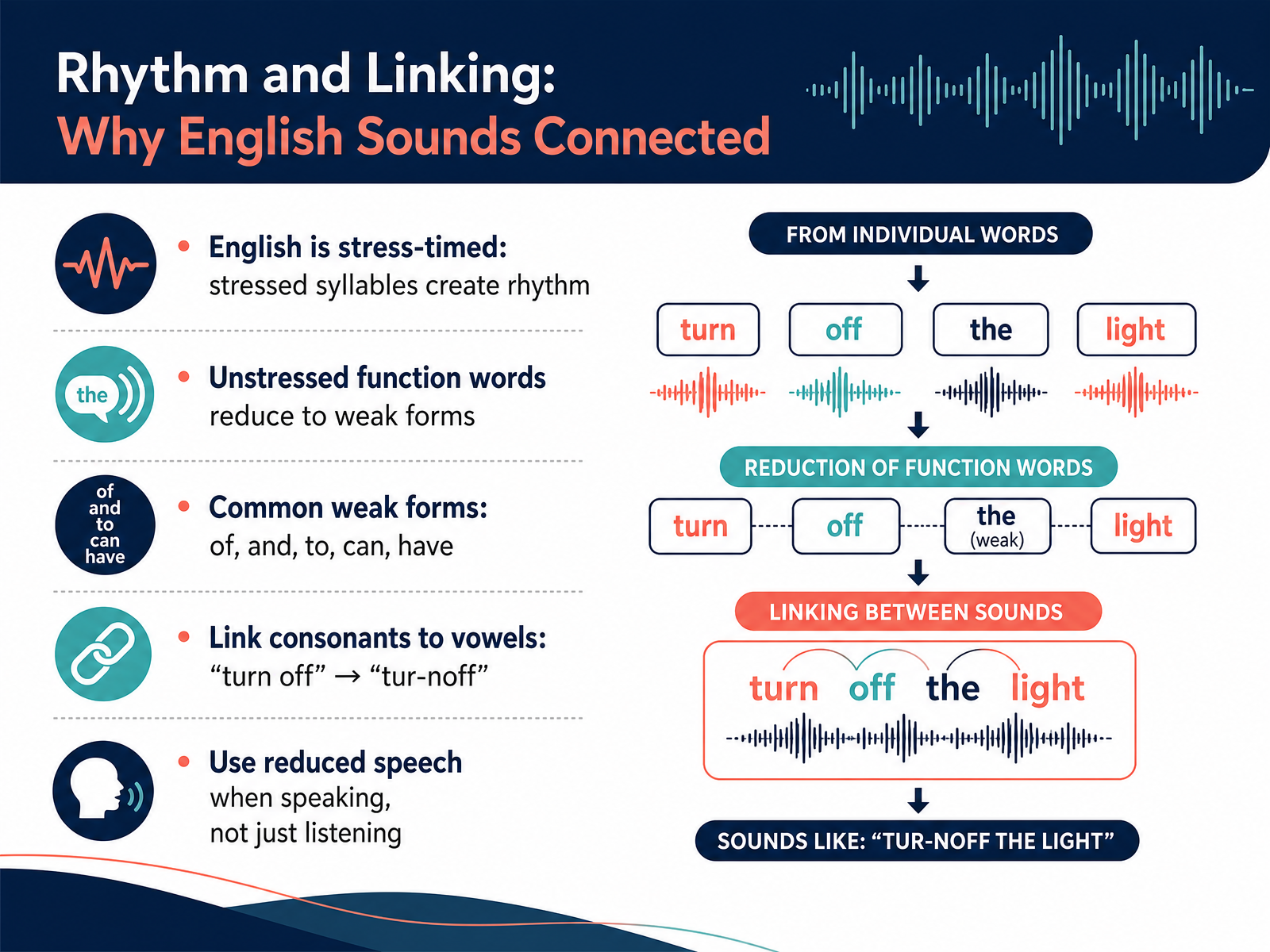
 - 08Rhythm and Linking: Why English Sounds ConnectedLet’s talk about why English often sounds so connected. English is a stress-timed language, which means we don’t give every word equal weight. Instead, we stress the important words and glide over the smaller function words like of, and, to, can, and have. These smaller words often become weak forms. For example, fish and chips sounds like fish-n-chips. And a cup of tea sounds like a cup-uh-tea. By using these weak forms, your speech gets a natural, steady rhythm that’s easier for listeners to follow. Another key part of connected speech is linking. When one word ends in a consonant and the next begins with a vowel, we join them. Try this: turn off becomes tur-noff. Pick it up becomes pi-ki-tup. This isn’t sloppy speech. It’s the natural way English flows. So as you practice, don’t only listen for reduced speech. Use it when you speak too. It will make you sound more natural and help you understand native speakers more easily. Next, let’s look at how intonation, the rise and fall of your voice, adds meaning and emotion to what you say.
 2 min
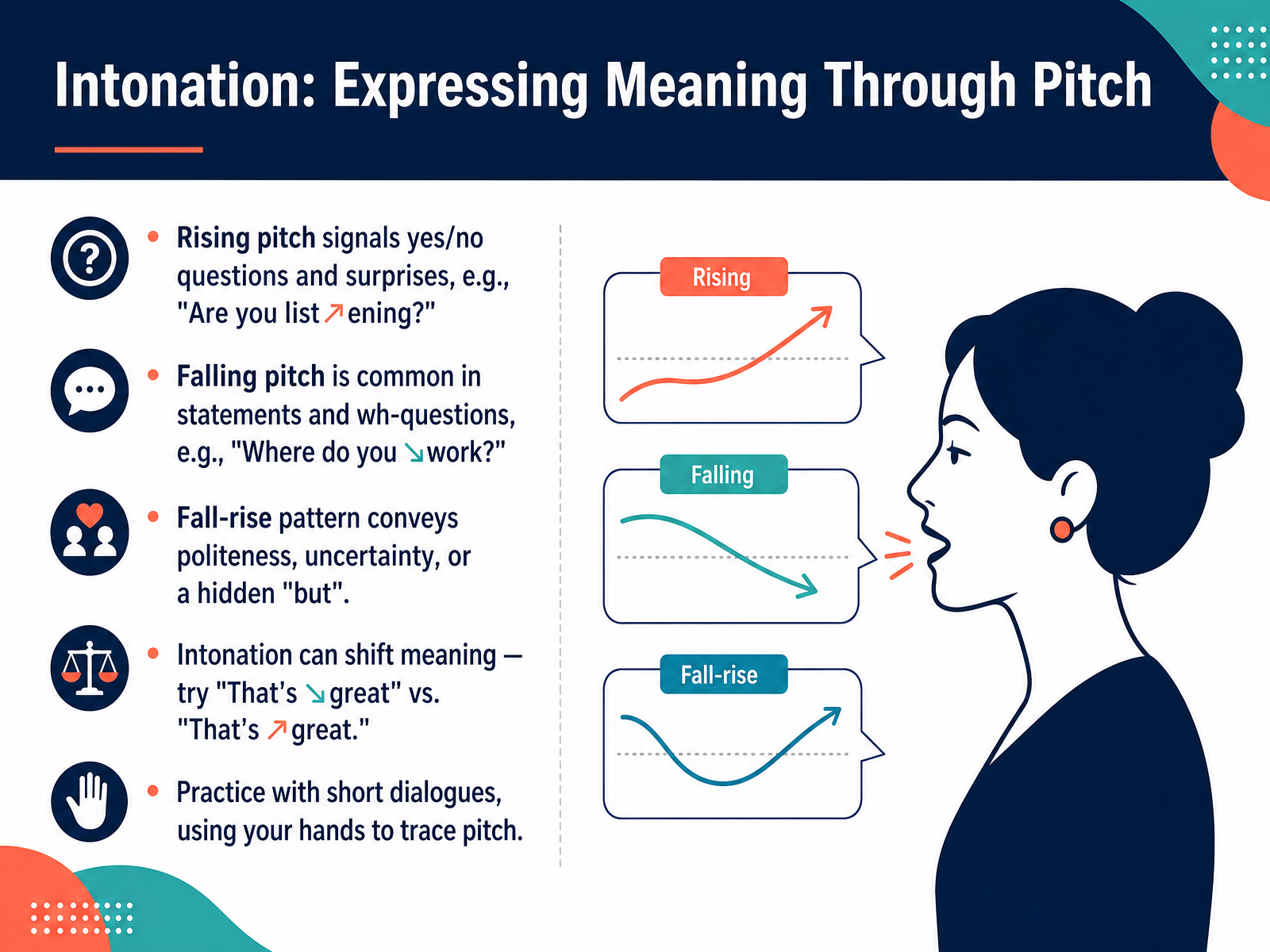
2 min - 09Intonation: Expressing Meaning Through PitchLet's look at how your voice can carry meaning. Intonation is the way your pitch rises and falls as you speak. A rising pitch, where your voice goes up at the end, is common for yes-no questions, like "Are you lis-tening?" Hear how it lifts. A falling pitch, where your voice goes down, is used for statements and wh-questions, like "Where do you work?" Your voice drops at the end. There's also a pattern called fall-rise. Your voice goes down, then back up. This can show politeness or uncertainty. It often hints at an unspoken "but." Intonation can even change the meaning of the same words. Compare a flat "That's great" with an enthusiastic "That's great." Different meaning, right? As a practical exercise, try speaking short dialogues. You can even use your hand to trace the pitch movement in the air. That physical motion helps your ear and your voice connect. Up for a question, down for a statement, and down-and-up for that polite hesitation. In our next section, we will look at some common pronunciation challenges that adult learners often face.
 2 min
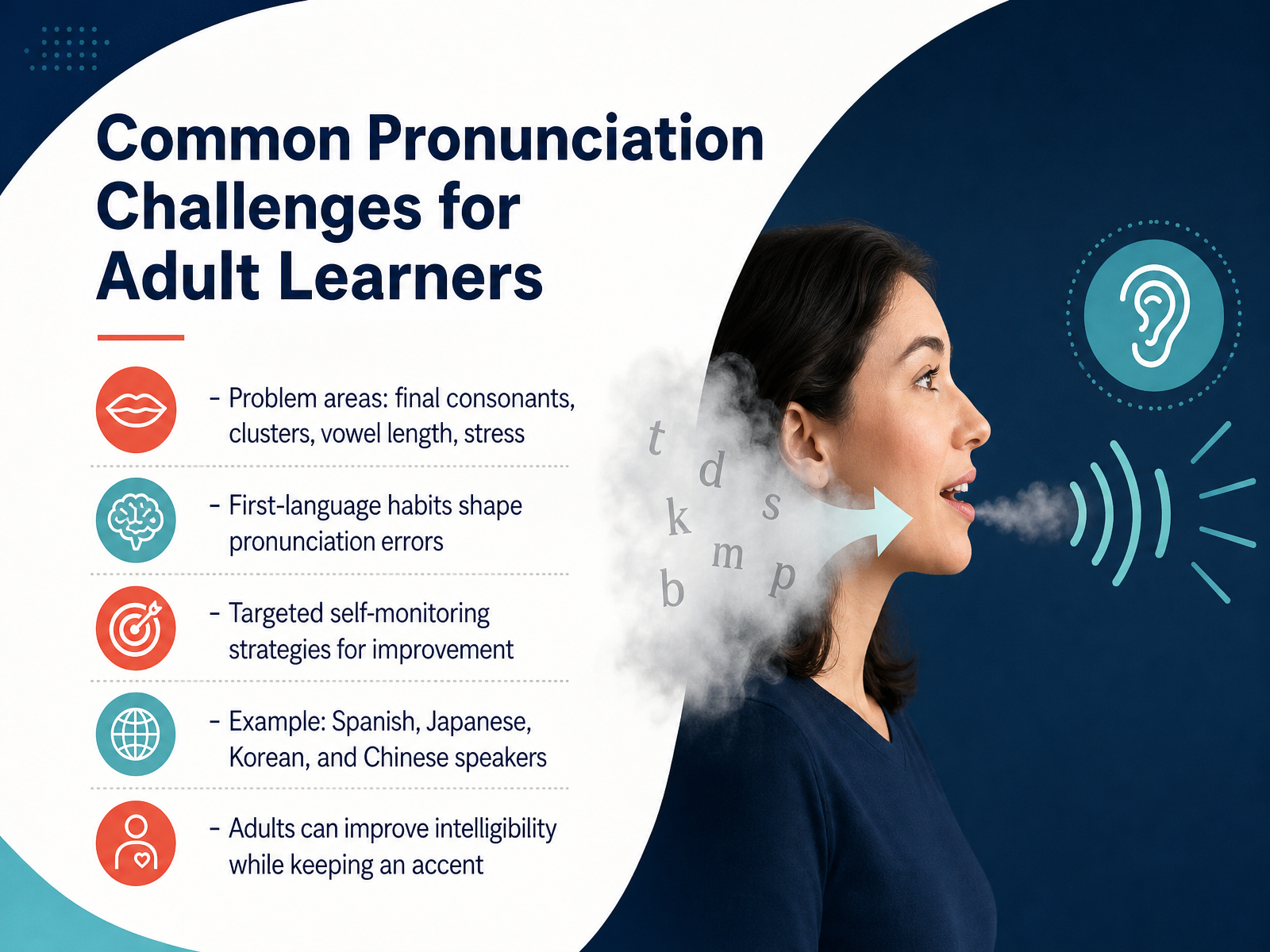
2 min - 10Common Pronunciation Challenges for Adult LearnersNow let's talk about the challenges that adults commonly face. You might already recognize some of these in your own speaking. Four areas cause most of the difficulty: pronouncing final consonants clearly, managing consonant clusters like in the word 'texts', distinguishing between long and short vowels as in 'ship' and 'sheep', and placing stress on the correct syllable. Your first language habits shape these errors. For example, Spanish speakers may add an extra vowel to words ending in consonants, so 'stop' becomes 'stop-uh'. Japanese and Korean speakers might struggle with the difference between 'r' and 'l', while Chinese speakers often need extra practice with final consonants. But here is the encouraging news. Adults can absolutely improve their intelligibility. The key is targeted self-monitoring. Record yourself, compare your speech to a model speaker, and focus on just one problem area at a time. Remember, the goal is not to erase your accent completely. The goal is to be clearly understood. Your accent is part of your identity, and that is perfectly fine. This brings us to the next part of our journey: your self-practice toolkit with techniques and resources for continued improvement.
 1 min
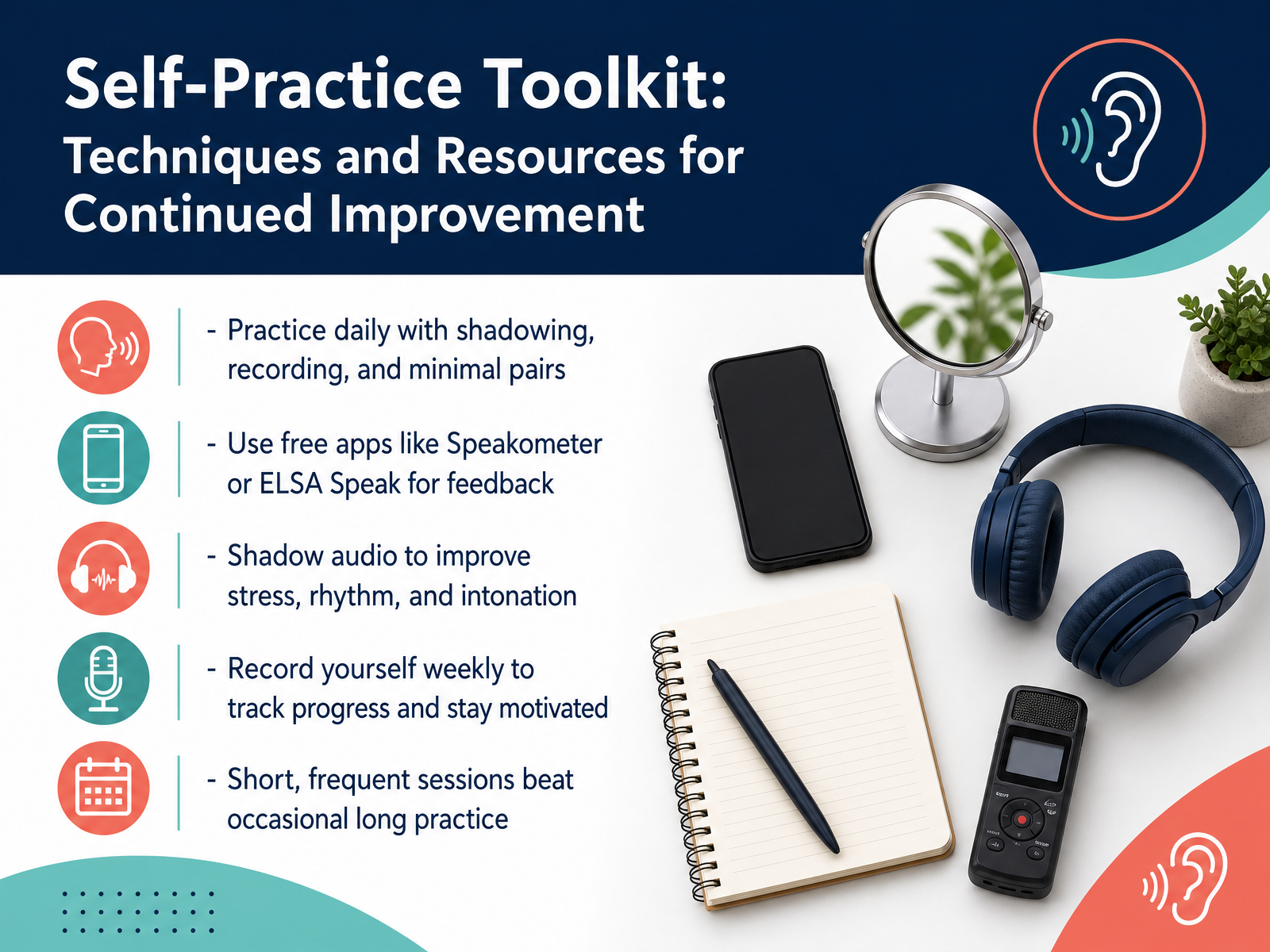
1 min - 11Self-Practice Toolkit: Techniques and Resources for Continued ImprovementNow let's build your personal practice toolkit. These simple techniques and free resources will keep your pronunciation improving every day. First, practice daily with three core techniques: shadowing, recording, and minimal pairs. Shadowing means listening to a short audio clip and repeating it immediately, imitating the speaker's stress and rhythm. Recording yourself weekly lets you hear your progress and stay motivated. Minimal pairs are word pairs that differ by just one sound, like ship and sheep, or bit and beat. Use free apps like Speakometer or ELSA Speak for instant feedback on your speaking. These apps listen to you, score your accuracy, and point out exactly which sounds need work. For instructors, these tools are excellent for assigning short, focused practice between classes. Remember, short daily sessions beat occasional long ones. Even five minutes of focused practice each day will build your confidence faster than one hour once a week. So pick one technique, try one app, and make it a small daily habit. And for learners and instructors together, that daily rhythm will carry you into the next part of our journey, where we bring together stress, rhythm, and sound in real speech.
 2 min
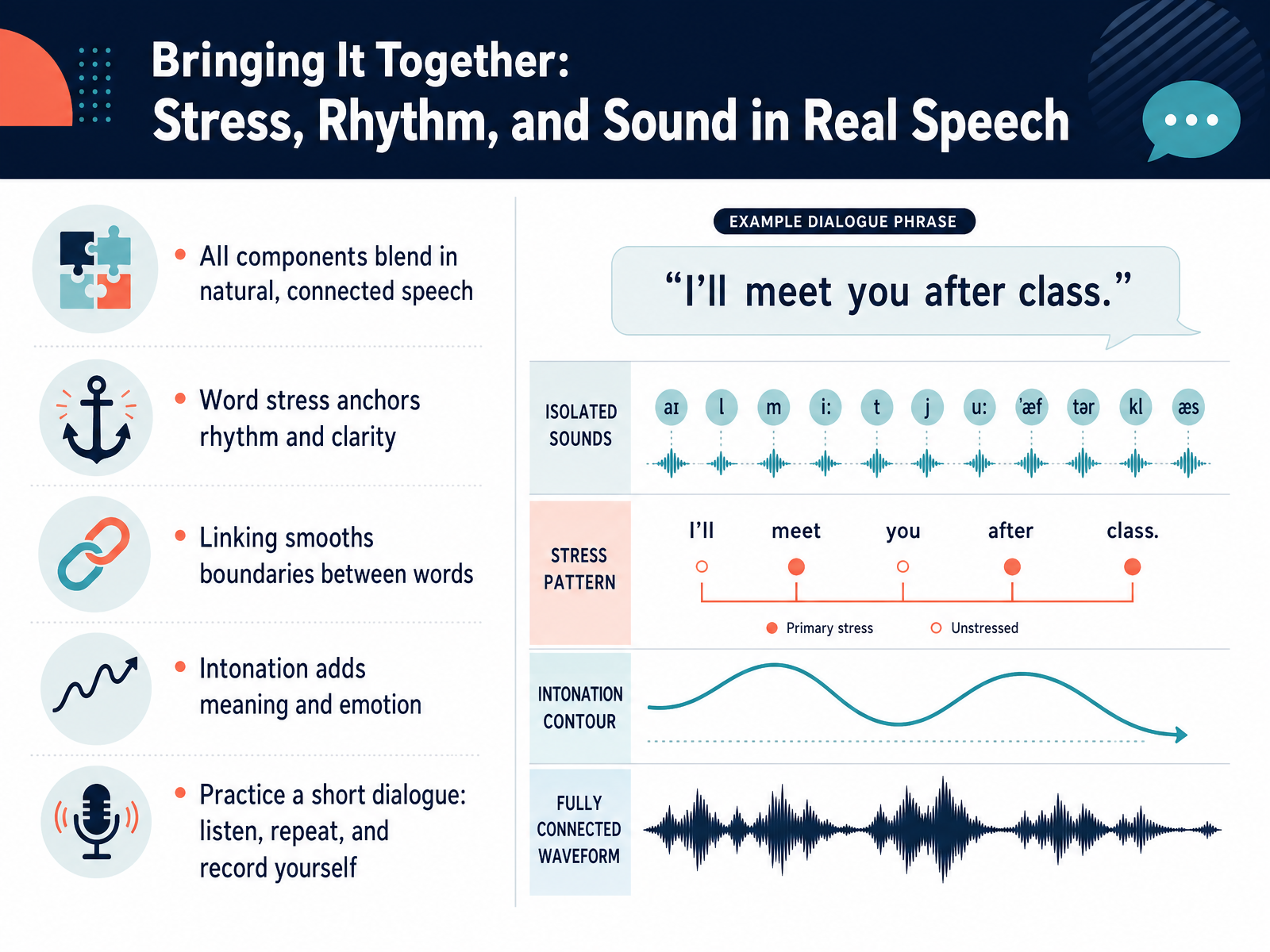
2 min - 12Bringing It Together: Stress, Rhythm, and Sound in Real SpeechNow let’s see how stress, rhythm, and sound work together when we actually speak. In real conversation, we don’t say each word separately. We blend them. Word stress gives your speech a steady rhythm, like a heartbeat. It helps listeners know which words matter most. Linking smooths the edges between words, so phrases flow together naturally. And intonation, the rise and fall of your voice, adds feeling. It can turn a statement into a question, or show surprise. Let’s try a short dialogue. Listen first, then repeat each line, and finally, record yourself. For example: “Are you coming to the meeting?” Your voice goes up at the end. “Yes, I’ll be there soon.” Your voice goes down. Try it. Don’t worry about being perfect. The goal is to feel how the pieces fit. You’re building strong habits every time you practice. Next, we’ll move into a guided practice where you can apply everything you’ve learned.
 1 min
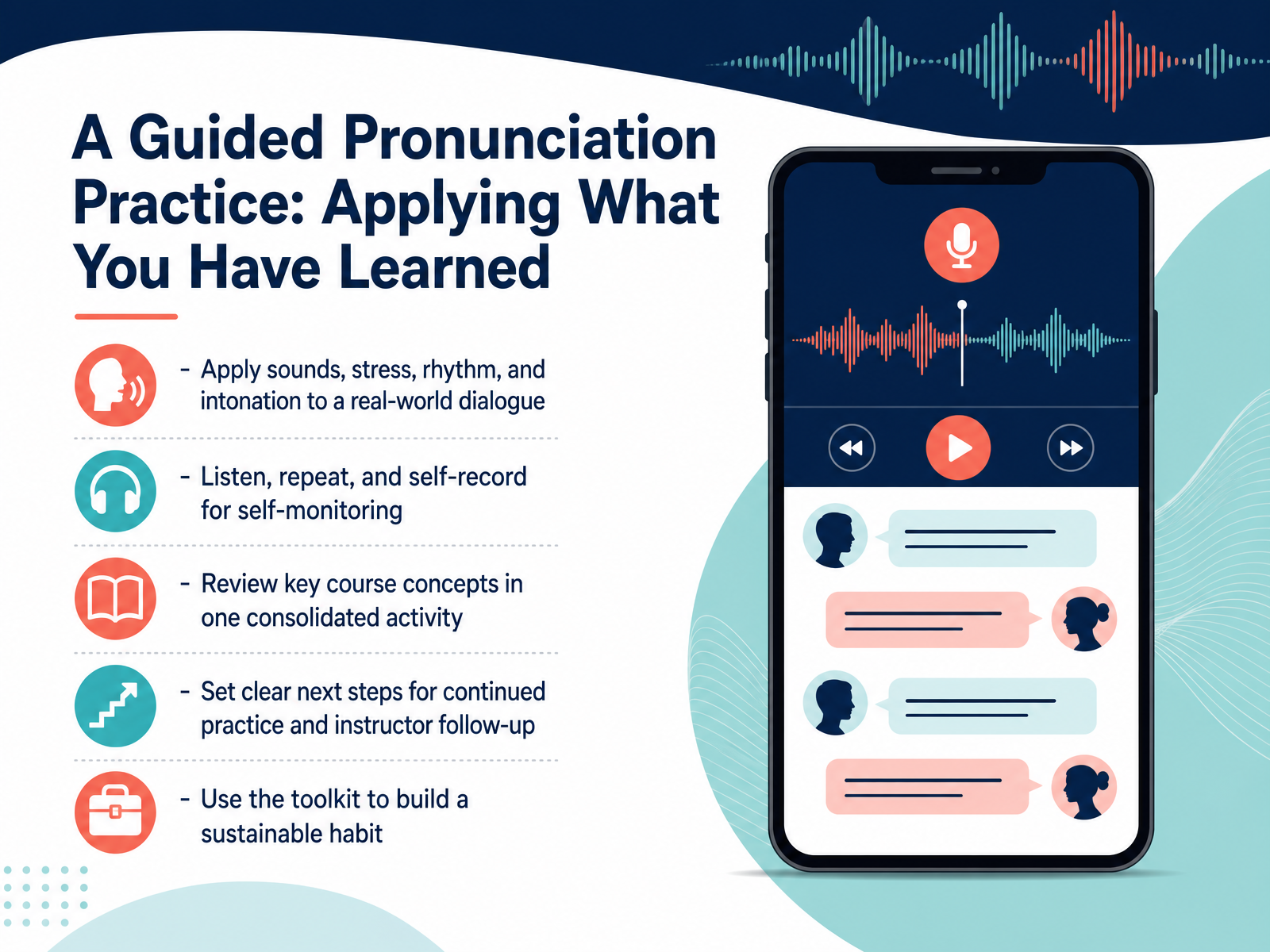
1 min - 13A Guided Pronunciation Practice: Applying What You Have LearnedNow let's put everything together with a guided practice. We'll take a real-world dialogue and apply the sounds, stress, rhythm, and intonation you've learned. First, listen to the dialogue as I read it. Then, repeat each line out loud, matching my pace and melody. After that, record yourself with your phone or computer. Play it back and compare. Are you stressing the important words? Is your intonation going up for questions and down for statements? This self-check is a powerful way to notice small areas to improve. Remember, this practice pulls together all the key concepts we've covered in one activity. It's your chance to use them in a natural conversation, not just in isolated words. When you finish, take a moment to set clear next steps. Maybe you'll focus on one challenging sound each day, or practice the dialogue again tomorrow. Tell your instructor what you found difficult, so they can guide you. Use the toolkit—recordings, notes, and repetition logs—to build a sustainable habit that fits your daily life. This is your journey, and every step counts. Up next, we'll look at practical next steps and how to keep improving your pronunciation habit.
 1 min
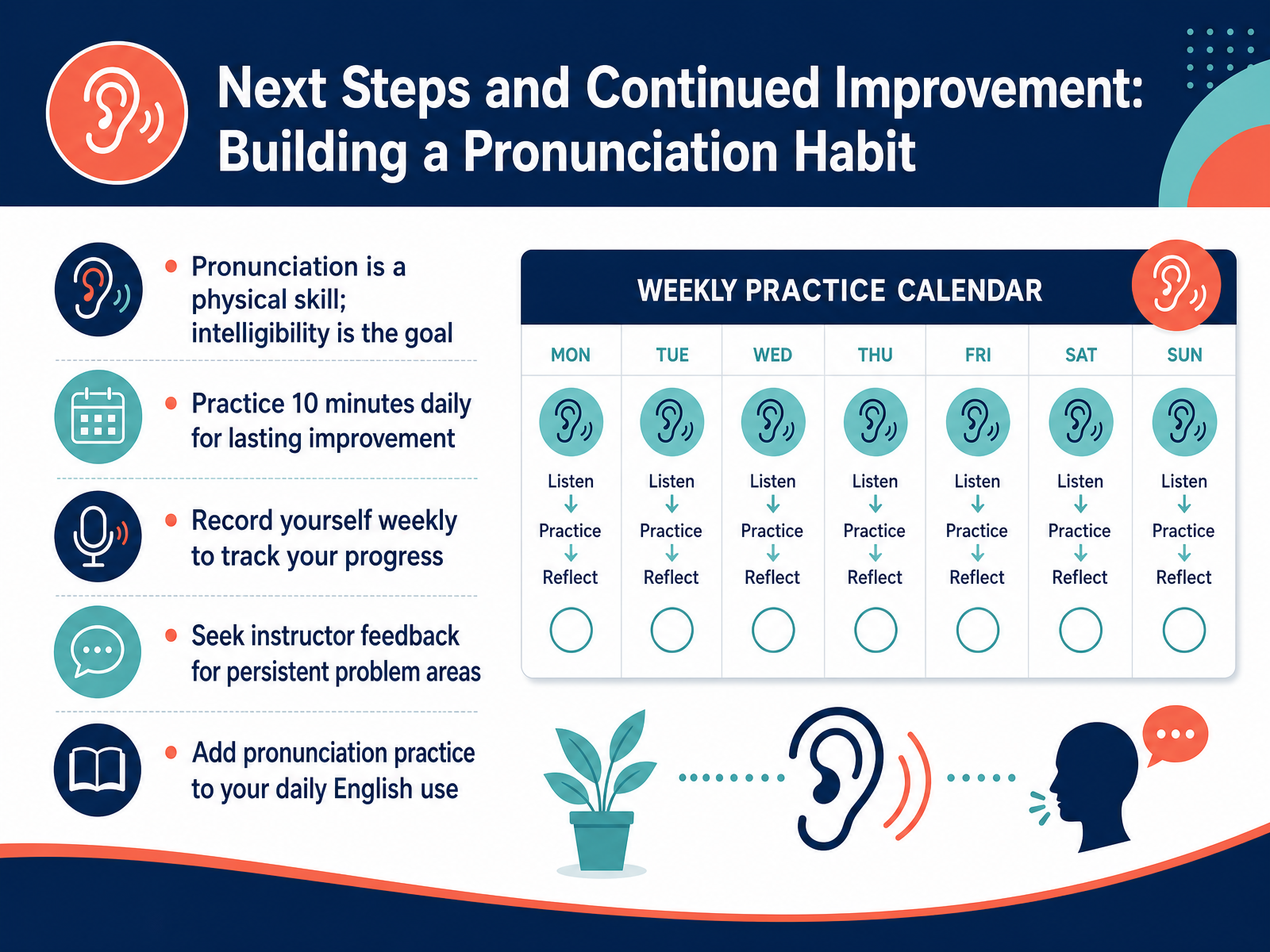
1 min - 14Next Steps and Continued Improvement: Building a Pronunciation HabitSo, where do you go from here? Building a pronunciation habit is like building any other habit. It takes a little time, but the results are worth it. Remember, pronunciation is a physical skill. It uses your mouth, your tongue, and your breath, just like playing a sport. So the goal is clear speech, not perfect speech. Focus on being understood. Try practicing for just ten minutes each day. Short daily practice is far better than one long session once a week. Make it part of your routine, maybe with your morning coffee or before bed. Also, try recording yourself weekly. Use your phone to record a short paragraph. Listen back and compare it to earlier recordings. You will hear your progress, and that is very motivating. And please, do not be shy about asking for feedback. Your instructor is there to help with sounds that are tricky for you. Ask about your specific problem areas. Practice a little, record a little, and use English every day. Keep it simple. Now, let us review the key points together in our final slide.
 1 min
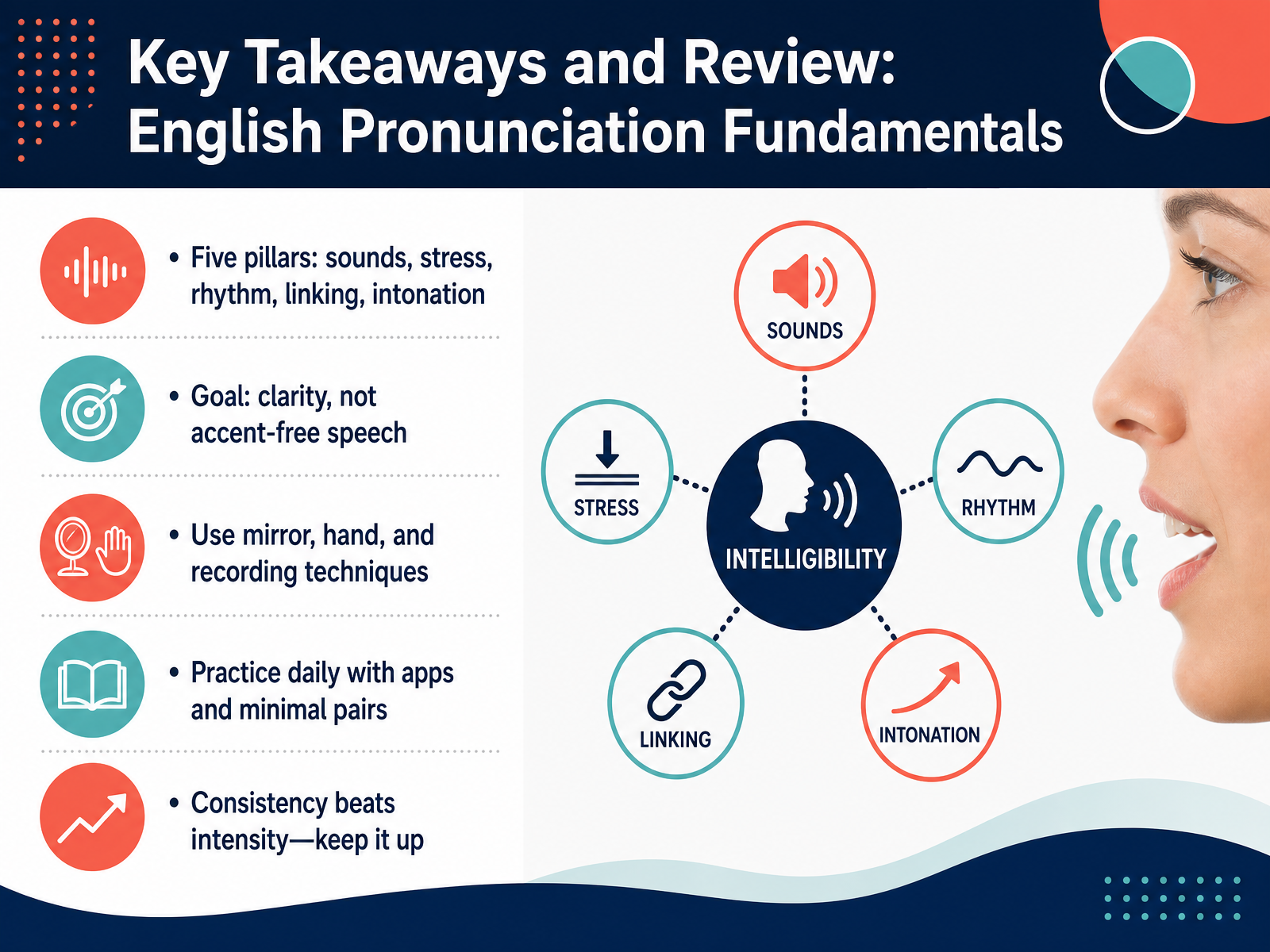
1 min - 15Key Takeaways and Review: English Pronunciation FundamentalsAnd here we are at the finish line. Let's bring it all together. We've covered the five pillars: sounds, stress, rhythm, linking, and intonation. Remember, the goal is clear communication, not sounding exactly like a native speaker. Your accent is part of your identity, and that is something to be proud of. In your daily practice, use the mirror to watch your mouth shape, use your hand to feel the rhythm of stress, and use your phone to record and compare your speech. Even five minutes a day with a pronunciation app or minimal pairs makes a real difference. Small, consistent steps will always beat a big burst of effort once a month. So keep it up, be kind to yourself, and celebrate every clear sentence you speak. Thank you for learning with me today. You've got this.
 1 min
1 min
Take the deck with you
Download this course as a file — free, no sign-up needed.
- PDF handoutEvery slide page, ready to print or share.16 pages · 3.9 MBDownload
- Narrated PowerPointThe deck that presents itself — every slide carries the digital human's narration video.16 pages · 15.9 MBDownload
- PowerPoint slidesThe full deck as a .pptx — open it in PowerPoint, Keynote, or Google Slides.16 pages · 3.8 MBDownload
Free to use in your own training — please keep the PersonWise credit page at the end.
Have your own deck? Turn it into a course
Sources consulted
Web sources consulted while building this course.
- The effectiveness of L2 pronunciation instruction: A critical systematic review of the intervention studies — doi.org
- Effectiveness of interventions on improving English language learners’ intelligibility and comprehensibility: A meta-analytic review — doi.org
- The Effectiveness of Second Language Pronunciation Instruction: A Meta-Analysis — doi.org
- Teaching Pronunciation to Adult English Language Learners — cal.org
- Opening the Window on Comprehensible Pronunciation After 19 Years: A Workplace Training Study — doi.org
- Labeled profile diagram of vocal tract | Topics in Linguistic Theory: Laboratory Phonology | Linguistics and Philosophy | MIT OpenCourseWare — ocw.mit.edu
- 3.2 Speech articulators – ENG 200: Introduction to Linguistics — pressbooks.nvcc.edu
- Phase 1: The Vocal Tract and Articulators - Labelled diagram — wordwall.net
- Phonetic map of the vocal tract | Teaching Resources — tes.com
- The Articulators & Vocal Tract – Billie English — billie-english.com
- Minimal Pairs | Learn English — englishclub.com
- 50+ English Minimal Pairs for Better Pronunciation (With Examples) - Learn languages with italki — italki.com
- Minimal Pairs Filter | US English Pronunciation — esl-lounge.com
- Minimal Pairs (with Audio) – English Pronunciation Practice (free PDF) — englishclub.com
- 25 English Minimal Pairs with Examples — fluentu.com
- Word stress | TeachingEnglish | British Council — teachingenglish.org.uk
- Word Stress Rules | Learn English — englishclub.com
- Stress Placement in English — grammar-monster.com
- Word Stress and Sentence Stress Rules in English - Busuu — busuu.com
- How to sound like a native speaker – Word Stress · engVid — engvid.com